EP1530351A2 - Système et méthode pour procurer une musique de fond - Google Patents
Système et méthode pour procurer une musique de fond Download PDFInfo
- Publication number
- EP1530351A2 EP1530351A2 EP04012788A EP04012788A EP1530351A2 EP 1530351 A2 EP1530351 A2 EP 1530351A2 EP 04012788 A EP04012788 A EP 04012788A EP 04012788 A EP04012788 A EP 04012788A EP 1530351 A2 EP1530351 A2 EP 1530351A2
- Authority
- EP
- European Patent Office
- Prior art keywords
- background music
- mobile terminal
- bgm
- mode
- information
- Prior art date
- Legal status (The legal status is an assumption and is not a legal conclusion. Google has not performed a legal analysis and makes no representation as to the accuracy of the status listed.)
- Withdrawn
Links
Images




Classifications
-
- H—ELECTRICITY
- H04—ELECTRIC COMMUNICATION TECHNIQUE
- H04M—TELEPHONIC COMMUNICATION
- H04M3/00—Automatic or semi-automatic exchanges
- H04M3/42—Systems providing special services or facilities to subscribers
- H04M3/42348—Location-based services which utilize the location information of a target
-
- H—ELECTRICITY
- H04—ELECTRIC COMMUNICATION TECHNIQUE
- H04W—WIRELESS COMMUNICATION NETWORKS
- H04W4/00—Services specially adapted for wireless communication networks; Facilities therefor
- H04W4/16—Communication-related supplementary services, e.g. call-transfer or call-hold
-
- H—ELECTRICITY
- H04—ELECTRIC COMMUNICATION TECHNIQUE
- H04B—TRANSMISSION
- H04B1/00—Details of transmission systems, not covered by a single one of groups H04B3/00 - H04B13/00; Details of transmission systems not characterised by the medium used for transmission
- H04B1/38—Transceivers, i.e. devices in which transmitter and receiver form a structural unit and in which at least one part is used for functions of transmitting and receiving
- H04B1/40—Circuits
-
- H—ELECTRICITY
- H04—ELECTRIC COMMUNICATION TECHNIQUE
- H04M—TELEPHONIC COMMUNICATION
- H04M3/00—Automatic or semi-automatic exchanges
- H04M3/42—Systems providing special services or facilities to subscribers
- H04M3/487—Arrangements for providing information services, e.g. recorded voice services or time announcements
-
- H—ELECTRICITY
- H04—ELECTRIC COMMUNICATION TECHNIQUE
- H04M—TELEPHONIC COMMUNICATION
- H04M1/00—Substation equipment, e.g. for use by subscribers
- H04M1/72—Mobile telephones; Cordless telephones, i.e. devices for establishing wireless links to base stations without route selection
- H04M1/724—User interfaces specially adapted for cordless or mobile telephones
- H04M1/72403—User interfaces specially adapted for cordless or mobile telephones with means for local support of applications that increase the functionality
- H04M1/72442—User interfaces specially adapted for cordless or mobile telephones with means for local support of applications that increase the functionality for playing music files
-
- H—ELECTRICITY
- H04—ELECTRIC COMMUNICATION TECHNIQUE
- H04M—TELEPHONIC COMMUNICATION
- H04M2203/00—Aspects of automatic or semi-automatic exchanges
- H04M2203/20—Aspects of automatic or semi-automatic exchanges related to features of supplementary services
- H04M2203/2072—Schedules, e.g. personal calendars
-
- H—ELECTRICITY
- H04—ELECTRIC COMMUNICATION TECHNIQUE
- H04M—TELEPHONIC COMMUNICATION
- H04M2203/00—Aspects of automatic or semi-automatic exchanges
- H04M2203/35—Aspects of automatic or semi-automatic exchanges related to information services provided via a voice call
- H04M2203/352—In-call/conference information service
-
- H—ELECTRICITY
- H04—ELECTRIC COMMUNICATION TECHNIQUE
- H04M—TELEPHONIC COMMUNICATION
- H04M2207/00—Type of exchange or network, i.e. telephonic medium, in which the telephonic communication takes place
- H04M2207/18—Type of exchange or network, i.e. telephonic medium, in which the telephonic communication takes place wireless networks
-
- H—ELECTRICITY
- H04—ELECTRIC COMMUNICATION TECHNIQUE
- H04M—TELEPHONIC COMMUNICATION
- H04M3/00—Automatic or semi-automatic exchanges
- H04M3/42—Systems providing special services or facilities to subscribers
- H04M3/42025—Calling or Called party identification service
- H04M3/42085—Called party identification service
- H04M3/42102—Making use of the called party identifier
Definitions
- the present invention relates generally to a background music (BGM) service of a mobile terminal, and more particularly to a system for providing a background music (BGM) service in a mobile terminal according to a user's wishes.
- BGM background music
- a background music (BGM) service provides a user receiving a mobile communication service a sound service using wired/wireless Internet and a telephone set.
- BGM background music
- a user selects and stores music or sound appropriate for the user's conversation content.
- stored BGM is provided to both parties (i.e., calling and called parties) while the parties communicate with each other.
- Such a BGM service is currently provided through a mobile communication carrier.
- the current BGM service provides a subscriber management function, a music call setup function, a resource management function, a subscriber command processing function, a call processing function, and an operation and maintenance (O&M) function.
- the subscriber management function includes a music call service subscriber management function and a subscriber set information (or profile information) management function.
- the music call setup function includes a BGM selection function, a conditional search function, a pre-listening function, a transmission condition setting function, and a volume control function.
- the resource management function includes a BGM resource management function, a sound storing function, an automatic sound update function, and an interface function for providing content.
- the subscriber command processing function includes a user information management function, a user command collection function (or digit collection function), and a command processing function.
- the call processing function includes a call processing function for signal conversion, an incoming call processing function, an outgoing call processing function, an incoming call distribution function, and a line management function.
- the O&M function includes a statistical management function, a status management function, a failure management function, and an operation management function.
- FIG. 1 is a block diagram illustrating a configuration of a system for providing background music (BGM).
- a calling party accesses a sound provider 24 using a mobile terminal 10 (or any other wired/wireless communication device) and selects and stores BGM to be utilized.
- the mobile terminal 10 transmits, to a mobile exchange 22, the input telephone number and a telephone number assigned to the mobile terminal 10.
- the mobile exchange 22 sends, to a mobile terminal 30 having the destination telephone number, a communication request signal through a communication network 28. Further, the mobile exchange 22 determines whether the telephone number of the mobile terminal 10 is subscribed to the BGM service.
- the mobile exchange 22 sends the telephone number of the mobile terminal 10 to the sound provider 24.
- the sound provider 24 retrieves stored BGM mapped to the telephone number of the mobile terminal 10 from a sound database (DB) server 26.
- DB sound database
- the sound provider 24 then sends the retrieved BGM to the mobile exchange 22.
- the mobile exchange 22 provides the BGM from the sound provider 24 to the mobile terminals 10 and 30 of the calling and called parties while they are connected to each other.
- each of the mobile terminals 10 and 30 of the calling and called parties outputs a sound signal as well as a voice signal sent from an opposite party through a speaker (not shown) and simultaneously outputs the BGM sent from the mobile exchange 22 through the speaker.
- the conventional system for providing a BGM service has several limits when changing BGM.
- the number of BGM pieces is limited. More specifically, there is a problem in that the total number of BGM pieces that can be provided through the conventional sound change channel is limited to three, and more than the three BGM pieces cannot be changed.
- the calling party cannot easily change a preset BGM. That is, the calling party can only change the BGM through a telephone call with an operator or can recognize a list of BGM pieces through a connection based on the Internet network coupled to a communication carrier providing the BGM. Therefore, there is a problem in that the list of BGM pieces must be changed through the telephone call with the operator or the connection to the Internet network when the setting of the BGM is changed.
- a user When the calling party receives the BGM service through the conventional BGM service providing system, a user must sequentially depress keys or buttons indicating, for example, "*79 + destination number + SEND", whenever the calling party makes a telephone call, and must know if any BGM is previously stored. If a BGM is stored, one of the existing possible three BGM pieces stored by the calling party is provided to the mobile terminals of the calling and called parties together with voice communication content.
- BGM background music
- BGM background music
- a system for providing a background music (BGM) service in a communication state comprising: a sound provider storing at least one BGM piece and BGM list information corresponding to the at least one BGM piece, and outputting the at least one BGM piece when the corresponding BGM list information is received; a calling mobile terminal for receiving the BGM list information corresponding to the at least one BGM piece from the sound provider, enabling a plurality of BGM service modes to be set, detecting a set BGM service mode when a communication request signal is input, and transmitting the BGM list information for to the set mode to the sound provider; a called mobile terminal for transmitting a response signal to the communication request signal; and a mobile exchange for connecting the calling mobile terminal and the sound provider, connecting the calling mobile terminal and the called mobile terminal of the called party, and transmitting the at least one BGM piece from the sound provider to the calling and called mobile terminals, when the response signal is received from the called mobile terminal.
- BGM background music
- the calling and called mobile terminals output the at least one BGM piece sent from the sound provider while the calling and called mobile terminals are communicating with each other.
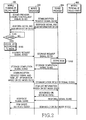
- FIG. 2 is a flow chart illustrating a process for receiving a background music (BGM) service in accordance with the present invention.
- a calling mobile terminal 100 sends a connection request signal to a mobile exchange 200 so that it can be connected to a sound provider 300 and receive the BGM service from the sound provider 300 in step S100.
- the mobile exchange 200 receives the connection request signal from the calling mobile terminal 100 and sends a communication request signal to the sound provider 300 in step S110.
- the sound provider 300 receives the communication request signal from the mobile exchange 200, and sends a response signal and BGM information to the mobile exchange 200 in step S120.
- the mobile exchange 200 receives the response signal and the BGM information, and transmits the received signal and information to the calling mobile terminal 100 in step S 130.
- the calling mobile terminal 100 receives the response signal and BGM information from the mobile exchange 200, outputs the BGM information, and determines whether a mode setting command and a storing command are input in step S 140. If the mode setting command and the storing command are input, the calling mobile terminal 100 stores a list of BGM information and mode setting information in response to the mode setting command in step S150.
- BGM service modes capable of being set to receive the BGM service may include a time mode, a place mode, a telephone number mode, a common mode, etc.
- the time mode is a BGM service mode for providing BGM of a stored BGM list to the calling mobile terminal 100 and the called mobile terminal 400 in a communication state according to a set time.
- the place mode is a BGM service mode for providing BGM of a stored BGM list to the calling mobile terminal 100 and the called mobile terminal 400 in the communication state according to a set place.
- the telephone number mode is a BGM service mode for providing BGM of a stored BGM list to the calling mobile terminal 100 and the called mobile terminal 400 in the communication state according to a set telephone number of the called party.
- the common mode is a BGM service mode for providing common BGM to the calling mobile terminal 100 and the called mobile terminal 400 in a communication state when a specific mode for receiving the BGM is not set.
- the sound provider 300 which is equipped with a large-capacity database, stores BGM set in calling mobile terminals in the database, the number of BGM pieces possibly stored on a mode-by-mode basis is not limited.
- the calling mobile terminal 100 sends a storage request signal to the mobile exchange 200 to request that the sound provider 300 store BGM of a BGM list corresponding to each set mode in step S160.
- the mobile exchange 200 sends the storage request signal from the calling mobile terminal 100 to the sound provider 300 in step S170.
- the sound provider 300 maps BGM corresponding to the storage request signal from the mobile exchange 200 to a telephone number of the calling mobile terminal 100 and stores a result of the mapping in step S180. Then, the sound provider 300 sends a storage completion signal to the mobile exchange 200, indicating that the BGM has been completely stored in step S 190.
- the mobile exchange 200 receives the storage completion signal and sends the received storage completion signal to the calling mobile terminal 100 in step S200.
- the calling mobile terminal 100 receives the storage completion signal from the mobile exchange 200 and outputs a signal, for example, text or voice, notifying a user that the storage is complete.
- the calling mobile terminal 100 determines if a BGM service mode is set for receiving the BGM service, and sends the communication request signal and information of a BGM list associated with the set mode to the mobile exchange 200 in step S210.
- the mobile exchange 200 receives the communication request signal and the BGM list information from the calling mobile terminal 100, sends the received communication request signal to the called mobile terminal 400 in step S220, and sends the received BGM list information to the sound provider 300 in step S225.
- the sound provider 300 receives the BGM list information from the mobile exchange 200 and sends BGM corresponding to the received BGM list information to the mobile exchange 200 in step S230.
- the mobile exchange 200 receives a response signal to the communication request signal from the called mobile terminal 400 in step S240, the received response signal is sent to the calling mobile terminal 100 in step S245.
- the mobile exchange 200 transmits the BGM from the sound provider 300 to the calling mobile terminal 100 and the called mobile terminal 400 in steps S250 and S255.
- the mobile exchange 200 combines the BGM with voice signals sent from the calling mobile terminal 100 and the called mobile terminal 400, and can transmit a combined signal to destination mobile terminals.
- the calling mobile terminal 100 sets and stores the BGM list for each service mode.
- the sound provider 300 maps the BGM of the BGM list to a telephone number of the calling mobile terminal 100 and stores a result of the mapping.
- the calling mobile terminal 100 sends a communication request signal
- the set mode is determined, BGM list information stored for the set mode is detected, and the detected BGM list information is sent to the sound provider 300. Therefore, the user can receive many different BGM pieces.
- a BGM list is stored according to a service mode in the calling mobile terminal 100 and BGM of the stored BGM list stored according to the set mode is received from the sound provider 300.
- set mode information and stored BGM list information corresponding to the set mode are stored in the mobile terminal, and a telephone number of the mobile terminal and requested BGM mapped to the telephone number are stored in the sound provider so that a BGM service operation can be performed.
- the mobile terminal stores only set mode information.
- the sound provider stores the telephone number of the mobile terminal, mode information set in the mobile terminal, and requested BGM corresponding to the mode information.
- the sound provider 200 provides the stored BGM corresponding to the set mode information. In this embodiment, there is a benefit in that the amount of data stored in the mobile terminal is reduced.
- BGM is stored in the mobile terminal, and a voice signal and BGM can be output according to a mode in a communication state. That is, the mobile terminal stores set mode information and BGM mapped thereto so that the BGM can be provided according to the mode.
- the mobile terminal corresponding to this embodiment includes a BGM playback part for reproducing BGM therein and outputting the BGM to a speaker. Further, in this embodiment, a function of the BGM playback part is performed by an audio processing part 150.
- the mobile terminal 100 of the calling party detects set BGM according to the mode to output the detected BGM and the output BGM is sent to the mobile terminal 400 of the called party in a communication connection state.
- the mobile terminal 100 of the calling party outputs BGM set according to a mode so that a speaker (not shown) can output the BGM through the audio processing part.
- the calling mobile terminal 100 mixes and encodes the BGM set according to the mode and the input voice signal of the calling party, and then transmits a result of the mixing and encoding to the called mobile terminal 400 through an antenna (not shown). Thereafter, the called mobile terminal 400 decodes the mixed and encoded data, separates the decoded data into a voice signal and BGM, and outputs the voice signal and BGM through a speaker (not shown).
- the calling mobile terminal 100 decodes the received voice signal and outputs the BGM together with the decoded received voice signal while outputting stored BGM according to a mode.
- a sufficient storing space capable of storing BGM is required.
- mode information for the BGM service and BGM can be stored in the mobile terminal.
- the calling mobile terminal 100 does not need to access the sound provider 300 whenever communication is attempted in a state in which the BGM service is set. Further, as mode information for the BGM service and BGM are stored, the calling mobile terminal 100 can easily change the mode without accessing the sound provider 300.
- FIG. 3 is a block diagram illustrating a mobile terminal for providing a BGM service in accordance with the present invention.
- a communication part 130 performs a wireless communication function of the mobile terminal.
- the communication part 130 includes among other things, a radio frequency (RF) transmitter for up-converting and amplifying a transmission signal, and an RF receiver for carrying out a low noise amplification operation for a received signal and down-converting a frequency signal.
- RF radio frequency
- a data processing part 140 includes a MODEM for encoding and modulating a signal to be transmitted by the communication part 130 and a CODEC for demodulating and decoding a signal received by the communication part 130.
- the CODEC includes a data CODEC for processing packet data and an audio CODEC for processing an audio signal such as voice.
- An audio processing part 150 reproduces an audio signal output from the audio CODEC of the data processing part 140 to output the reproduced audio signal through a speaker (not shown), or transmits an audio signal input from a microphone (not shown) to the audio CODEC.
- the audio processing part 150 reproduces BGM stored in a storing part 160 or externally received BGM to output the reproduced BGM through the speaker, and outputs a user's voice signal input from the microphone to the data processing part 140.
- the audio processing part 150 When the communication part 130 receives data in which a voice signal and BGM are mixed, and the data processing part 140 decodes the received data, the audio processing part 150 separates the decoded data into a voice signal and BGM and outputs the voice signal and BGM through the speaker. Further, when the BGM is stored in the storing part 160 in accordance with the third embodiment of the present invention, the audio processing part 150 mixes a voice signal input into the microphone and BGM detected from the storing part 160 by a control part 110 according to a mode, and outputs a result of the mixing to the data processing part 140. The data processing part 140 encodes the mixed data, and the communication part 130 transmits the encoded mixed data to an opposite mobile terminal in a communication state.
- the control part 110 controls an overall operation of the mobile terminal. Further, the control part 110 can include the data processing part 140. The control part 110 can start a program stored in the storing part 160 in response to a command input from manipulation keys 170, and can change the setting of a corresponding operation.
- the manipulation keys 170 may include a SEND key 172, setting keys 174 for setting an operation, and number/character keys 176 for inputting numbers and characters.
- the storing part 160 stores at least one BGM list 162, mode information 164, and at least one set mode-based BGM list 166.
- the BGM list 162 is received from the sound provider 300 and stored as list information of stored BGM pieces.
- the mode information 164 is settable mode information for BGM received from the sound provider 300.
- the set mode-based BGM list 166 is information of a stored BGM list corresponding to a set mode for the BGM received from the sound provider 300.
- the BGM received from the sound provider 300 is further stored in the storing part 160.
- the control part 110 can set arbitrary BGM of the stored BGM list 162 in any one mode of the mode information 164 in response to a signal input from the manipulation keys 170. - Further, the control part 110 can delete or update the set mode-based BGM list 166 in response to a signal input from the manipulation keys 170.
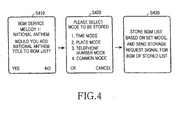
- FIG. 4 illustrates a process for receiving BGM information for the BGM service from the sound provider 300.
- the user When a BGM list is selected and stored, the user must determine a mode in which BGM of the BGM list provided from the sound provider 300 will be used. Further, FIG. 4 illustrates a process for downloading a national anthem title of the BGM list.
- the mobile terminal When the national anthem title is received from the sound provider 300, the mobile terminal displays a message indicating whether the national anthem title must be added to the BGM list 162 in step S410. If the national anthem title is to be added to the BGM list 162, a user determines a mode in which a national anthem will be provided in step S420.
- the mobile terminal stores the national anthem title in the set mode-based BGM list 166, and requests that the sound provider 300 store the national anthem as BGM by transmitting a storage request signal to the sound provider 300.
- the national anthem is set to be provided in a time mode, it is provided as the BGM according to a time. Further, if the national anthem is set to be provided in a place mode, it is provided as the BGM according to a place at which the user is located. Furthermore, if the national anthem is set to be provided in a telephone mode, it is provided as the BGM according to a telephone number of an opposite party.
- FIG. 5 illustrates a process for setting a mode for a BGM list provided from the sound provider. More specifically, FIG. 5 illustrates a process for setting detailed mode information associated with BGM added to the set mode-based BGM list 166.
- the mobile terminal displays information on the screen so that a time zone for the BGM can be selected in the time mode as indicated by reference numeral 520.
- time zones in the time mode are classified into morning, lunchtime, evening and night. Each time zone is set on the basis of start and end hours.
- the user selects a morning time zone in a displayed time zone list containing various time zones. If the morning time zone in the time mode is selected, the mobile terminal sets the time mode and a stored BGM list withdrawn from the set mode-based BGM list 166 is displayed as indicated by reference numeral 530. Then, when a stored national anthem associated with FIG. 4 is selected, the mobile terminal in which a mode for the BGM service is set to the time mode receives the national anthem as the BGM from the sound provider 300 in the communication state at the morning time zone and outputs the national anthem.
- the BGM service can be set according to a place. If the place mode has been selected, the mobile terminal displays a place list such as home, school, subway, etc., provided in the place mode as indicated by reference numeral 540.
- the mobile terminal withdraws a BGM list stored in the place mode from the set mode-based BGM list 166 and displays the BGM list as indicated by reference numeral 550.
- the mobile terminal receives BGM corresponding to a specific place from the sound provider 300 at the specific place in the set mode, and outputs the BGM.
- the telephone number mode is selected in the BGM setting screen 510 and the BGM service can be set according to a destination telephone number. If the telephone number mode has been selected, the mobile terminal displays a name list registered as destination telephone numbers of a mother, father, Ms. Cheon, Ms. Lee, etc., provided in the telephone number mode as indicated by reference numeral 560.
- the mobile terminal withdraws a BGM list stored in the telephone number mode from the set mode-based BGM list 166 and displays the withdrawn BGM list as indicated by reference numeral 570.
- the mobile terminal receives, from the sound provider 300, BGM correspondingly set to a destination telephone number in the communication state and outputs the received BGM.
- the common mode in the BGM setting screen 510 is the BGM service mode for outputting common BGM when the user does not set the BGM service in any specific mode or BGM corresponding to a set mode is not present.
- FIG. 6 illustrates a process for setting a BGM service mode to receive the BGM service according to each mode. More specifically, FIG. 6 illustrates a state for determining a mode in which BGM must be received in the communication state after the BGM list is set according to the BGM service mode through the processes illustrated in FIGS. 4 and 5.
- the mobile terminal when the user sets the BGM service mode to the time mode, place mode, telephone number mode, or common mode, the mobile terminal requests that the sound provider 300 provide BGM set in each mode, and outputs corresponding BGM. For example, when the user sets the BGM service mode to the time mode, the mobile terminal retrieves a set BGM list corresponding to a current time in the time mode and requests that the sound provider 300 provide BGM. Then, the mobile terminal receives corresponding BGM from the sound provider 300 and outputs the received BGM. That is, when the current time corresponds to the morning time zone, BGM set in the morning time zone is output in the time mode. Further, when the current time corresponds to the night time zone, BGM set in the night time zone is output in the time mode.
- the mobile terminal When the user sets the BGM service mode to the place mode, the mobile terminal confirms a current place, receives, from the sound provider 300, BGM correspondingly set to the current place in the communication state, and outputs the received BGM. That is, if the current place is school, BGM set in the school place is output.
- the mobile terminal receives, from the sound provider 300, BGM correspondingly set to a destination telephone number, and outputs the received BGM.
- the user sets the BGM service mode to the telephone number mode and makes a telephone call to the mother's telephone number stored in a telephone directory, it receives, from the sound provider 300, BGM set in the mother's telephone number in the telephone number mode and outputs the received BGM.
- the mobile terminal When the user sets the BGM service mode to the common mode indicating that the user does not set the BGM service in any specific mode or specific BGM corresponding to a set mode is not present, the mobile terminal receives common BGM from the sound provider 300 and outputs the received common BGM.
- a plurality of BGM service modes can be simultaneously set. For example, the place mode and the common mode can be simultaneously set.
- the mobile terminal outputs the BGM pieces provided from the sound provider 300 arbitrarily or in predetermined order. For example, when the user sets the time mode and the telephone number mode for the BGM service, a current time is within the morning time zone, and the telephone call is made with a telephone number correspondingly set to the "mother" item, the mobile terminal outputs BGM corresponding to the morning time zone and BGM corresponding to the "mother” item in predetermined order.
- FIG. 7 is a flow chart illustrating a process for receiving the BGM service in the communication state using a mobile terminal in which the BGM service is set.
- the mobile terminal can add a BGM list to the storing part 160 as illustrated in FIG. 4.
- the mobile terminal selects the added BGM list in any one of the time mode, the place mode, the telephone number mode, and the common mode, and stores the added BGM list in the storing part 160.
- detailed mode information associated with the BGM list stored in the storing part 160 is set. That is, if the BGM service mode is set as the time mode when the BGM list is stored in the storing part 160, the mobile terminal sets one time zone of morning, lunchtime, evening, night, etc., as detailed time mode information according to the user's selection.
- the mobile terminal sets one place of home, school, subway, etc., as detailed place mode information according to the user's selection.
- the BGM service mode is set as the telephone number mode when the BGM list is stored in the storing part 160
- the mobile terminal sets one name of "mother", “father” and “friend” items, etc., as detailed place mode information according to the user's selection.
- the mobile terminal Before the user receives the BGM service, the user determines a mode in which the BGM service must be received. Thus, the mobile terminal selects a BGM service mode in response to the user's selection in step S700. At this point, the mobile terminal determines, in response to the user's selection, whether the BGM service must be in an ON/OFF state in step S710.
- a telephone number is input, and a communication command is input in step S720, a set BGM service mode is determined for the BGM service in step S730.
- a plurality of modes can be set. An example of simultaneously setting the time mode, the place mode, and the telephone number mode is illustrated in FIG. 7.
- the mobile terminal When a set mode is the time mode, the mobile terminal confirms a current time in step S740, and selects a BGM list of the mode set in a current time zone in step S750. However, when the current mode is the place mode as well as the time mode, the mobile terminal confirms a current place in step S760 and selects a BGM list of the mode set in the current place in step S770. Alternatively, when the current mode is the telephone number mode as well as the time mode and the place mode, the mobile terminal confirms a destination telephone number in step S780 and selects a BGM list of the mode set in the destination telephone number in step 5790.
- the mobile terminal When the plurality of modes are simultaneously set, the mobile terminal requests that the sound provider 300 provide a BGM list corresponding to each mode, and arbitrarily outputs BGM pieces. However, the mobile terminal lastly selects one of BGM lists and can request that the sound provider 300 provide the BGM service corresponding to the selected BGM list, as illustrated in FIG. 7.
- the mobile terminal lastly selects one of the BGM lists set in the time mode, the place mode, and the telephone number mode according to the user's selection, and requests that the sound provider 300 provide BGM of the selected BGM list in step S800.
- the mobile terminal receives and outputs requested BGM of the BGM list combined with voice data sent from the destination mobile terminal in step S810.
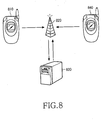
- FIG. 8 is a schematic diagram illustrating a BGM service providing system in accordance with another embodiment of the present invention.
- a sound provider 830 stores mode information for the BGM service requested by mobile terminals 810 and 840, a stored BGM list corresponding to a set mode, and BGM of the BGM list.
- the mobile terminals 810 and 840 store only the mode information for the BGM service.
- the calling mobile terminal 810 determines a mode in which the BGM service is set, and sends the set mode information and a communication request signal to a mobile exchange 820.
- the mobile exchange 820 sends the communication request signal to the called mobile terminal 840 and sends the mode information to the sound provider 830.
- the sound provider 830 detects a BGM list correspondingly set to the mode information from the mobile exchange 820, and sends BGM of the detected BGM list to the mobile exchange 820.
- the mobile exchange 820 combines voice data sent from the mobile terminals 810 and 840 and the BGM sent from the sound provider 300, and transmits the combined BGM to destination mobile terminals.
- the mobile terminal sets BGM in each service mode and stores a BGM list mapped to the set mode.
- the sound provider maps BGM of the BGM list to a telephone number of a destination mobile terminal and stores a result of the mapping.
- the mobile terminal determines a set mode, detects BGM list information stored in the set mode, and sends the detected BGM list information, such that the user can receive BGM pieces.
- the mobile terminal stores a BGM list according to a service mode and receives BGM from the BGM list stored for the set mode.
- the mobile terminal When BGM of the BGM service is set according to a place, time zone, and telephone number (opposite party) and the communication request signal is input, the mobile terminal automatically confirms a place at which the user is located, a current time, and an identity of the opposite party, receives the BGM and outputs the received BGM, such that various BGM pieces can be variously provided according to the user's wishes without a special setting operation when a place, time zone and opposite party are selected.
Landscapes
- Engineering & Computer Science (AREA)
- Signal Processing (AREA)
- Computer Networks & Wireless Communication (AREA)
- Telephonic Communication Services (AREA)
- Mobile Radio Communication Systems (AREA)
- Telephone Function (AREA)
Applications Claiming Priority (2)
| Application Number | Priority Date | Filing Date | Title |
|---|---|---|---|
| KR1020030079102A KR100689485B1 (ko) | 2003-11-10 | 2003-11-10 | 배경음악 제공 시스템 및 방법, 및 휴대용단말기 |
| KR2003079102 | 2003-11-10 |
Publications (2)
| Publication Number | Publication Date |
|---|---|
| EP1530351A2 true EP1530351A2 (fr) | 2005-05-11 |
| EP1530351A3 EP1530351A3 (fr) | 2006-08-02 |
Family
ID=34431745
Family Applications (1)
| Application Number | Title | Priority Date | Filing Date |
|---|---|---|---|
| EP04012788A Withdrawn EP1530351A3 (fr) | 2003-11-10 | 2004-05-28 | Système et méthode pour procurer une musique de fond |
Country Status (4)
| Country | Link |
|---|---|
| US (1) | US20050101262A1 (fr) |
| EP (1) | EP1530351A3 (fr) |
| KR (1) | KR100689485B1 (fr) |
| CN (1) | CN1326421C (fr) |
Cited By (1)
| Publication number | Priority date | Publication date | Assignee | Title |
|---|---|---|---|---|
| EP2061201A1 (fr) | 2007-11-16 | 2009-05-20 | Lucent Technologies Inc. | Procédé et système pour augmenter une session de communication avec ambiance personalisée |
Families Citing this family (19)
| Publication number | Priority date | Publication date | Assignee | Title |
|---|---|---|---|---|
| KR100599183B1 (ko) * | 2004-04-21 | 2006-07-20 | 주식회사 퓨전소프트 | Mp3기능이 탑재된 개인 휴대용 단말기에서 mp3의 재생 음악을 통화중의 배경음악으로 활용하는 방법 및 이를 채용한 단말기 |
| US20050282552A1 (en) * | 2004-06-18 | 2005-12-22 | Hatalkar Atul N | Media mixing using wireless devices |
| KR100619993B1 (ko) * | 2005-03-16 | 2006-09-06 | 엘지전자 주식회사 | 이동 통신 단말기의 통화 상태에서 배경 음악 설정 방법 |
| KR100723713B1 (ko) * | 2005-06-09 | 2007-05-30 | 에스케이 텔레콤주식회사 | 에스브이디를 이용한 통화중 배경음악 서비스 방법 및기록매체 |
| CN100499707C (zh) * | 2005-08-19 | 2009-06-10 | 华为技术有限公司 | 一种提供个性化信息的装置和方法 |
| CN1953579B (zh) * | 2005-10-22 | 2011-05-25 | 康佳集团股份有限公司 | 一种实现通话背景音乐的方法及其装置 |
| JP2007274480A (ja) * | 2006-03-31 | 2007-10-18 | Toshiba Corp | 電話システム及び電話端末装置 |
| KR101251627B1 (ko) * | 2006-11-15 | 2013-04-12 | 에스케이텔레콤 주식회사 | 음원 전송 시스템, 방법 및 음원 푸시 장치 |
| KR100834155B1 (ko) * | 2007-08-22 | 2008-06-02 | (주)케이티에프테크놀로지스 | 음성 채널을 이용한 음원 데이터 전송 방법 및 장치 |
| KR20090027817A (ko) | 2007-09-13 | 2009-03-18 | 삼성전자주식회사 | 배경음 출력 방법 및 이를 이용하는 이동통신 단말기 |
| CN101321316B (zh) * | 2008-06-30 | 2012-01-11 | 中兴通讯股份有限公司 | 一种为通话双方提供多媒体背景音的系统及方法 |
| US20120213346A1 (en) * | 2009-02-04 | 2012-08-23 | Huawei Device Co.,Ltd. | Method, server and terminal device for playing multimedia ring tone during call |
| WO2014085868A1 (fr) * | 2012-12-07 | 2014-06-12 | King Robert Mark | Système et procédé pour l'insertion d'élément multimédia dans un canal vocal |
| KR102101410B1 (ko) * | 2013-10-07 | 2020-04-16 | 에스케이텔레콤 주식회사 | 배경음악 정보 제공을 위한 장치, 이를 위한 방법 및 이 방법이 기록된 컴퓨터 판독 가능한 기록매체 |
| US9578070B2 (en) * | 2014-07-17 | 2017-02-21 | Cellco Partnersip | Method for inserting background audio into voice/video call |
| KR102369985B1 (ko) | 2015-09-04 | 2022-03-04 | 삼성전자주식회사 | 디스플레이 장치, 디스플레이 장치의 배경음악 제공방법 및 배경음악 제공 시스템 |
| US10382609B1 (en) | 2016-06-28 | 2019-08-13 | Steve Antoine | System for sharing sounds from a smartphone during a voice call |
| CN106506834B (zh) * | 2016-11-07 | 2019-12-13 | 北京安云世纪科技有限公司 | 通话中添加背景音的方法、终端及系统 |
| CN112866476A (zh) * | 2019-11-28 | 2021-05-28 | 深圳市万普拉斯科技有限公司 | 通话氛围生成方法、装置、电子设备和存储介质 |
Family Cites Families (19)
| Publication number | Priority date | Publication date | Assignee | Title |
|---|---|---|---|---|
| JP2949080B2 (ja) * | 1996-10-30 | 1999-09-13 | パイオニア株式会社 | 演奏システム |
| CN1337129A (zh) * | 1998-12-10 | 2002-02-20 | 利普无线国际公司 | 基于无线移动位置提供定向消息的系统和方法 |
| TW495735B (en) * | 1999-07-28 | 2002-07-21 | Yamaha Corp | Audio controller and the portable terminal and system using the same |
| JP3719057B2 (ja) * | 1999-08-24 | 2005-11-24 | ヤマハ株式会社 | 電話端末装置および通信方法 |
| KR100362150B1 (ko) * | 1999-12-28 | 2002-11-23 | 엘지전자 주식회사 | 배경음악 기능을 갖는 이동 단말기 |
| JP2001197159A (ja) * | 2000-01-14 | 2001-07-19 | Yamaha Corp | 携帯電話機 |
| JP3975639B2 (ja) * | 2000-03-02 | 2007-09-12 | ヤマハ株式会社 | 電話端末装置 |
| KR100341384B1 (ko) * | 2000-05-23 | 2002-06-22 | 홍경 | 이동통신 단말기에서의 배경음악 재생 방법 |
| KR20020016983A (ko) * | 2000-08-28 | 2002-03-07 | 홍경 | 이동통신 단말기의 통화중에 배경음악 전송방법 |
| FI20002828A7 (fi) * | 2000-12-22 | 2002-06-23 | Nokia Corp | Menetelmä ja järjestelmä tunnetilan ilmaisemiseksi puhelimella tapahtuvassa viestinnässä |
| KR100735250B1 (ko) * | 2001-02-08 | 2007-07-03 | 삼성전자주식회사 | 환경 설정을 변경하는 휴대폰 및 방법 |
| US7003083B2 (en) * | 2001-02-13 | 2006-02-21 | International Business Machines Corporation | Selectable audio and mixed background sound for voice messaging system |
| KR100475453B1 (ko) * | 2001-03-15 | 2005-03-10 | 이장현 | 전화기 벨소리 제어 시스템 |
| JP2003046606A (ja) * | 2001-08-01 | 2003-02-14 | Nec Corp | 携帯通信端末装置及び携帯通信端末装置の音鳴動方法 |
| KR20030071900A (ko) * | 2002-03-02 | 2003-09-13 | 장수범 | 이동통신 단말기의 착신음 제공시스템 및 그 운영방법 |
| US6731323B2 (en) * | 2002-04-10 | 2004-05-04 | International Business Machines Corporation | Media-enhanced greetings and/or responses in communication systems |
| JP3863053B2 (ja) * | 2002-04-12 | 2006-12-27 | シャープ株式会社 | 情報配信方法、情報配信装置、情報配信プログラムならびにそれを記録したコンピュータ読み取り可能な記録媒体 |
| US6990333B2 (en) * | 2002-11-27 | 2006-01-24 | Microsoft Corporation | System and method for timed profile changes on a mobile device |
| CN1242641C (zh) * | 2003-04-16 | 2006-02-15 | 海信集团有限公司 | 多方式互动及数据共享手机 |
-
2003
- 2003-11-10 KR KR1020030079102A patent/KR100689485B1/ko not_active Expired - Fee Related
-
2004
- 2004-04-22 US US10/830,470 patent/US20050101262A1/en not_active Abandoned
- 2004-05-28 EP EP04012788A patent/EP1530351A3/fr not_active Withdrawn
- 2004-06-10 CN CNB2004100492835A patent/CN1326421C/zh not_active Expired - Fee Related
Cited By (1)
| Publication number | Priority date | Publication date | Assignee | Title |
|---|---|---|---|---|
| EP2061201A1 (fr) | 2007-11-16 | 2009-05-20 | Lucent Technologies Inc. | Procédé et système pour augmenter une session de communication avec ambiance personalisée |
Also Published As
| Publication number | Publication date |
|---|---|
| CN1326421C (zh) | 2007-07-11 |
| US20050101262A1 (en) | 2005-05-12 |
| EP1530351A3 (fr) | 2006-08-02 |
| CN1617618A (zh) | 2005-05-18 |
| KR20050045142A (ko) | 2005-05-17 |
| KR100689485B1 (ko) | 2007-03-02 |
Similar Documents
| Publication | Publication Date | Title |
|---|---|---|
| US20050101262A1 (en) | System and method for providing background music | |
| US7421270B2 (en) | Method of remotely changing operating characteristics of a communications device | |
| US7035658B2 (en) | Wireless communication device and network controller for affiliation with associated groups and method thereof | |
| US8285255B2 (en) | Voicemail user interface methods and apparatus for mobile communication devices | |
| US7333804B2 (en) | Message transmitting scheme of mobile terminal | |
| KR100758588B1 (ko) | 라디오 채널 설정값들을 갱신하는 방법 및 이동 전화 | |
| US20080146291A1 (en) | Personal Communications Systems | |
| KR100312233B1 (ko) | 이동통신 시스템에서 단말기의 복합 정보수신 및 전송방법 | |
| KR20030009000A (ko) | 이동통신기기를 이용하여 문자 채팅 서비스를 제공하는 방법 | |
| US20060023722A1 (en) | Apparatus and method for managing scheduling information in mobile communication terminal | |
| US7069029B2 (en) | Method for transmitting multi-SMS in mobile telephone | |
| KR100825406B1 (ko) | 휴대 단말기의 음성 알림 서비스 시스템 및 서비스 제공방법 | |
| KR20060016426A (ko) | 이동 통신 단말기의 메시지 관리 방법 | |
| US20020016184A1 (en) | Automatic method of managing network services | |
| KR100619810B1 (ko) | 이동 통신 단말기의 전화번호 저장 방법 | |
| JP3815253B2 (ja) | リモコン送受信機を用いたデータ通信システム | |
| KR100364477B1 (ko) | 이동통신 시스템에서 단말기의 메모 메시지 수신 및 전송방법 | |
| KR100539933B1 (ko) | 그룹 sms전송에서의 수신자 정보 제공 방법 | |
| KR100591683B1 (ko) | 휴대용 단말기를 이용한 방송 신청 서비스 방법 및 서비스시스템 | |
| KR100834659B1 (ko) | 이동통신 단말기에서 복수의 전화번호를 이용한전화통신과 단문 메시지 전송 및 전화번호 저장방법 | |
| KR20040089237A (ko) | 동보전송 주소록을 이용한 단문 메시지 발송방법 | |
| US20130223601A1 (en) | Terminal, service system and control method for providing message communication function while calling | |
| KR100775561B1 (ko) | 이동 통신 단말기에서의 통화중 감성 및 상태 전달 방법 | |
| KR100590690B1 (ko) | 대기모드 기반 정보채널 방송의 실시간 수신을 위한이동통신 시스템 및 방법 | |
| KR100986511B1 (ko) | 단문메시지가 가능한 일반전화에 푸쉬형 서비스를 제공하기위한 시스템 및 그 방법 |
Legal Events
| Date | Code | Title | Description |
|---|---|---|---|
| PUAI | Public reference made under article 153(3) epc to a published international application that has entered the european phase |
Free format text: ORIGINAL CODE: 0009012 |
|
| 17P | Request for examination filed |
Effective date: 20040528 |
|
| AK | Designated contracting states |
Kind code of ref document: A2 Designated state(s): AT BE BG CH CY CZ DE DK EE ES FI FR GB GR HU IE IT LI LU MC NL PL PT RO SE SI SK TR |
|
| AX | Request for extension of the european patent |
Extension state: AL HR LT LV MK |
|
| PUAL | Search report despatched |
Free format text: ORIGINAL CODE: 0009013 |
|
| AK | Designated contracting states |
Kind code of ref document: A3 Designated state(s): AT BE BG CH CY CZ DE DK EE ES FI FR GB GR HU IE IT LI LU MC NL PL PT RO SE SI SK TR |
|
| AX | Request for extension of the european patent |
Extension state: AL HR LT LV MK |
|
| RIC1 | Information provided on ipc code assigned before grant |
Ipc: H04M 3/487 20060101ALI20060629BHEP Ipc: H04M 1/725 20060101AFI20050216BHEP |
|
| 17Q | First examination report despatched |
Effective date: 20070103 |
|
| AKX | Designation fees paid |
Designated state(s): DE FR GB |
|
| STAA | Information on the status of an ep patent application or granted ep patent |
Free format text: STATUS: THE APPLICATION IS DEEMED TO BE WITHDRAWN |
|
| 18D | Application deemed to be withdrawn |
Effective date: 20080927 |