EP1531375A2 - Mit der Stimme gesteuertes Gerät zum Editieren eines Roboterlehrprogrammes - Google Patents
Mit der Stimme gesteuertes Gerät zum Editieren eines Roboterlehrprogrammes Download PDFInfo
- Publication number
- EP1531375A2 EP1531375A2 EP04256831A EP04256831A EP1531375A2 EP 1531375 A2 EP1531375 A2 EP 1531375A2 EP 04256831 A EP04256831 A EP 04256831A EP 04256831 A EP04256831 A EP 04256831A EP 1531375 A2 EP1531375 A2 EP 1531375A2
- Authority
- EP
- European Patent Office
- Prior art keywords
- robot
- program
- editing apparatus
- command
- program editing
- Prior art date
- Legal status (The legal status is an assumption and is not a legal conclusion. Google has not performed a legal analysis and makes no representation as to the accuracy of the status listed.)
- Granted
Links
Images


Classifications
-
- B—PERFORMING OPERATIONS; TRANSPORTING
- B25—HAND TOOLS; PORTABLE POWER-DRIVEN TOOLS; MANIPULATORS
- B25J—MANIPULATORS; CHAMBERS PROVIDED WITH MANIPULATION DEVICES
- B25J13/00—Controls for manipulators
- B25J13/003—Controls for manipulators by means of an audio-responsive input
-
- B—PERFORMING OPERATIONS; TRANSPORTING
- B25—HAND TOOLS; PORTABLE POWER-DRIVEN TOOLS; MANIPULATORS
- B25J—MANIPULATORS; CHAMBERS PROVIDED WITH MANIPULATION DEVICES
- B25J9/00—Program-controlled manipulators
- B25J9/16—Program controls
- B25J9/1656—Program controls characterised by programming, planning systems for manipulators
-
- G—PHYSICS
- G10—MUSICAL INSTRUMENTS; ACOUSTICS
- G10L—SPEECH ANALYSIS TECHNIQUES OR SPEECH SYNTHESIS; SPEECH RECOGNITION; SPEECH OR VOICE PROCESSING TECHNIQUES; SPEECH OR AUDIO CODING OR DECODING
- G10L15/00—Speech recognition
- G10L15/26—Speech to text systems
-
- G—PHYSICS
- G05—CONTROLLING; REGULATING
- G05B—CONTROL OR REGULATING SYSTEMS IN GENERAL; FUNCTIONAL ELEMENTS OF SUCH SYSTEMS; MONITORING OR TESTING ARRANGEMENTS FOR SUCH SYSTEMS OR ELEMENTS
- G05B2219/00—Program-control systems
- G05B2219/30—Nc systems
- G05B2219/39—Robotics, robotics to robotics hand
- G05B2219/39441—Voice command, camera detects object, grasp, move
Definitions
- the present invention relates to a program editing apparatus that can be used for editing a teaching program for a robot system.
- Teach pendants and offline programming systems have been used to edit (create, modify, add code to, etc.) teaching programs for robot systems.
- a teach pendant is used for programming, for example, the programming is performed in the programming language of the robot, and the robot may also be moved, for example, to teach positions and the like.
- Programming and teaching are also frequently carried out by offline programming methods using a keyboard or mouse.
- the creation and editing of teaching programs for a robot system thus involves tasks such as programming at a teach pendant or in an offline programming system, as well as teaching and modification of the program. These tasks generally require the mastering of a programming language specific to the robot, and demand complicated input procedures with a keyboard or another input device, making specialized knowledge and skills indispensable. These tasks have accordingly been difficult for non-specialists lacking such knowledge and skills. No examples of the use of voice input to solve this problem have been disclosed in the literature.
- the present invention relates to a program editing apparatus that arranges and displays three-dimensional models of at least one robot and at least one peripheral object on a screen, and edits a teaching program instructing the robot how to operate.
- the program editing apparatus comprises: voice input means; means for storing a plurality of models each of which allows one or more character strings to be assigned in certain places therein to complete a statement; candidate character string storing means for storing a plurality of candidate character strings to be assigned to each of the plurality of models; correspondence storing means for storing correspondence between a statement completed by assigning the candidate character strings to the model and a command to be used in instruction of the robot; search means for finding a statement, if any, that matches a statement input from the voice input means, in the statements completed by assigning any of the candidate character strings to any of the stored models; and means for converting the matching statement found by the search means to a robot command according to the correspondence stored in the correspondence storing means and for inserting the robot command into the teaching program.
- the program editing apparatus may take the following form.
- the program editing apparatus may have means for displaying character strings of the models on the screen during editing of the teaching program.
- the program editing apparatus may have means for displaying contents of the teaching program on the screen during editing of the teaching program, enabling confirmation of the result of insertion of the robot command in the teaching program.
- the candidate character strings may be identification character strings that can identify objects represented by the above three-dimensional models.
- the program editing apparatus may have object associated command storing means for storing an operation command for a robot related to an object represented by one of the three-dimensional models, in association with the object, and means for converting a candidate character string assigned in a statement found by the search means into a robot command according to the contents stored in the object associated command storing means, in case where the candidate character string is an identification character string.
- the program editing apparatus may have means for operating the three-dimensional model of the robot on the screen, according to the robot command.
- the program editing apparatus may have further means for causing the display state to change so as to indicate that the robot or the workpiece on the screen has been recognized, when the robot or the workpiece is specified by voice.
- the robot command may be a macro command that includes at least one of a robot operation command, an input/output command to and from a peripheral unit, and a conditional statement.
- a program editing apparatus that accepts voice input and thereby inputs related operations and sequences, enabling programming to be performed easily without the need to master specialized knowledge and skills. As a result, person-hours and the human burden required for system construction can be reduced.
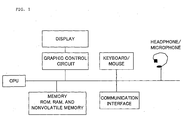
- FIG. 1 is a block diagram schematically showing the structure of a program editing apparatus according to this embodiment.
- the program editing apparatus comprises a CPU, memory (ROM, RAM, and nonvolatile memory) connected to the bus line of the CPU, a graphic control circuit, a keyboard or mouse (manual input devices), a communication interface, a headphone or microphone, and a display (liquid crystal display, CRT, or the like) connected to the graphic control circuit.
- a keyboard or mouse manual input devices
- a communication interface a headphone or microphone
- a display liquid crystal display, CRT, or the like
- An input/output device and the like are also included, as necessary, so that data can be transmitted to and received from a printer, personal computer, or another external device.
- the memory is stored with three-dimensional shape data including dimensional data (simply called three-dimensional shape data hereinafter) describing a robot to be displayed and programmed as described below, three-dimensional shape data describing workpieces and, if necessary, three-dimensional shape data describing a vision sensor (imaging device), tools (such as a hand, arc welding torch, and spot welding gun) mounted on the robot, and peripheral objects (suchas, for example, workpiece fixtures and a machine tool).
- dimensional data (simply called three-dimensional shape data hereinafter) describing a robot to be displayed and programmed as described below
- three-dimensional shape data describing workpieces and, if necessary, three-dimensional shape data describing a vision sensor (imaging device), tools (such as a hand, arc welding torch, and spot welding gun) mounted on the robot, and peripheral objects (suchas, for example, workpiece fixtures and a machine tool).
- vision sensor imaging device
- tools such as a hand, arc welding torch, and spot welding gun
- the memory is also stored with programs, settings, and various other data for operating the graphic control circuit to display the objects defined by these three-dimensional models in a display space (three-dimensional space used for programming) and to display motion corresponding to robot commands in animation form.
- the positions and orientations of the objects (three-dimensional models) in the display space are defined by work cell data.
- Awork cell is a unit of location for the robot system to be programmed; the work cell includes data specifying objects (three-dimensional models of a robot, workpieces, peripheral devices, and the like) in the robot system being programmed and data specifying initial positions and orientations of the specified objects.
- the data defining the work cell can be changed at any time by, for example, operating the keyboard or mouse.
- the program editing apparatus is provided with software (a voice recognition program and other software) for program editing (described below in detail) based on voice input through the microphone and for related display and voice output by procedures and processing that will be described below.
- software a voice recognition program and other software
- Step S1 Candidate character strings corresponding to a plurality of objects that may be disposed in the work cell corresponding to the program to be edited are input by, for example, using the keyboard.
- the candidate character strings include robot names, workpiece names, peripheral object names, and so on.
- a character string is input, it is stored in memory (nonvolatile memory) in the program editing apparatus.
- the candidate character strings are in one-to-one correspondence with the object label data in the data describing the work cell.
- the CPU can determine which object the character string identifies.
- an obj ect disposed in the work cell can be specified by voice input (in query form), as described below.
- the plurality of candidate character strings that are input are structured so that whether the character strings indicate robot names or the names of objects other than robots can be identified.
- the candidate character strings for robot names may be distinguished by black circles ( ⁇ ), and the candidate character strings for the names of non-robot objects, such as workpieces, peripheral objects and tools, by white circles ( ⁇ ).
- step S2 Upon the completion of candidate character string input, the sequence proceeds to step S2.
- Step S2 A plurality of models for robot operation instructions are input by, for example, using the keyboard; the coding of a model for a robot operation instruction comprises variable and non-variable parts.
- Each variable part of the model is stored as a variable term signifying that the name of a robot is to be assigned, or a variable term signifying that the name of an object other than a robot is to be assigned.
- variable terms to which a robot name is to be assigned will be represented as 'robot X', 'robot Y', and so on, while variable terms to which the names of objects other than robots are to be assigned will be represented as 'object A' , 'object B' , and so on.
- This notation will also be applied to the display screen. It should be noted here that 'robot X' and 'robot Y' do not refer to the names of particular robots, nor do 'object A' and 'object B' refer to the names of particular objects other than robots.
- Each non-variable part of the model includes a character or character string representing a predicate, a particle, a noun, or another word.
- a character string representing a noun may include a character stringmatching one of the specific terms used in the robot operation commands input in step S3 below.
- character strings of this type will be represented as specific names enclosed by double quotation marks, e.g., "arc welding position” and "spot welding position”.
- a portion that will be replaced during voice input carried out later is enclosed by single quotation marks, while a specific term in a robot command input in relation to an object in the next step, step S3, is enclosed by double quotation marks.
- a model for a robot operation instruction is stored by the program editing apparatus, in case of '****', **** within the single quotation marks (' ') is stored with a header corresponding to the single quotation marks attached, and in case of "####", #### within the double quotation marks (" ”) is stored with a header corresponding to the double quotation marks attached.
- a model prepared in this way can be displayed on the display screen anytime.
- FIG. 3 shows an exemplary display screen on which a model for robot operation instructions is displayed.
- Step S3 Robot commands related to non-robot objects indicated by candidate character strings supplied in step S1 are now defined.
- the objects that could conceivably be specified as object A are the workpieces 1 to 5 mentioned above, so that robot position and orientation data and other data related to approach points and grip points for gripping by the robot hand are stored for each of the workpieces 1 to 5.
- the data is stored as data belonging to the model which states 'robot X' picks up 'object A'.
- specific data for operation commands belonging to each model is stored, in association with the objects that might be included when the model is completed.
- Step T1 The work cell associated with the program to be edited is displayed. It will be assumed that the work cell has already been defined by well-known methods. For example, a model for a work cell in which a robot, workpieces, peripheral objects, and other objects are provisionally disposed is prepared by external CAD apparatus (not shown) in advance, and the model is taken in the program editing apparatus via the communication interface, thereby subjecting to necessary modification, additions, deletions and other processing to define the work cell. Of course, other methods can be used; for example, existing data for a similar work cell may be taken in from other electronic data storage media (such as a hard disk or flexible magnetic disk in a personal computer), or a new work cell may be defined by means of the program editing apparatus.
- FIG. 5 illustrates an exemplary work cell that may be displayed.
- Objects with the following names are disposed in the work cell in this example (the parenthesized items are reference characters used in FIG. 5).
- Reference character H1 in FIG. 5 denotes a hand suitable for gripping workpieces 1 to 5 positioned on table 1 (a workpiece table equipped with fixtures for workpieces), the hand being attached at the end of the arm of robot 1 (RB).
- Reference character MH1 denotes a port for accepting workpieces; in the example described below, it will accept a workpiece held by the hand H1.
- Step T2 Voice recognition mode 1 is initiated.
- voice recognition mode 1 a sentence, clause, or word input by voice in step T3 below is recognized and interpreted to be a query.
- Step T3 A query is input by voice in short form, such as 'Robot 1?' or 'Workpiece 3?'
- Step T4 The voice input is recognized. Then it is determined which object (three-dimensional model) in the displayed work cell the query pertains to, and the result is displayed.
- object three-dimensional model
- the result is displayed.
- 'Workpiece 2?' is input by voice for the work cell shown in FIG. 5, for example, workpiece 2 (W2) on the screen is highlighted by, for example, changing the display color. If the object is not found in the work cell, a message to the effect is displayed on the screen. Instead of the display indicating the decision result, artificial voice can be output to the headphone to indicate the presence or absence of the object.
- Step T5 If there are more queries to be input by voice, the sequence returns to step T3 to accept the next voice-based query. Steps T3 to T5 are repeated until there are no more queries. When all queries have been input, the process is terminated.
- the range of input queries and responses can be expanded through the use of terms (character strings) employed in the work cell definitions. If, for example, the character string 'hand position' has been prepared in correspondence to the hand H1 in FIG. 5 as a candidate character string effective in voice recognition mode 1, the hand H1 in FIG. 5 can be highlighted when 'Hand position?' is input by voice.
- terms character strings
- Step U1 As in step T1, a work cell corresponding to the program to be edited is displayed. In this step, the work cell shown in FIG. 5 is displayed.
- Step U2 Voice recognition mode 2 is initiated.
- Voice recognition mode 2 is an interpretation mode described below in which a sentence, clause, or word input by voice in step U6 below is recognized and an operation instruction is given (details will be given below).
- Step U3 Models for operation instructions are displayed as shown in FIG. 3, for example.
- Step U4 The program to be edited is displayed.
- the program to be edited is named S5A_01A2.
- the third line in the command block is highlighted (shaded) to indicate the portion that will be edited in step U5.
- Step U5 The portion of the program to be edited is selected, and the selection is indicated on the display.
- the operator uses the keyboard or another device to select a line and specify insertion of a new line above the selected line (pre-insertion), insertion of a new line below the selected line (post-insertion), or replacement of the selected line (overwriting).
- the selected line is highlighted.
- pre-insertion, post-insertion, and overwriting can be indicated by, for example, the way in which the selected line is highlighted, e.g., by color coding, shading, underlining, or reverse video.
- the command specified on the third line is shaded to indicate that an operation instruction will be inserted below that line, i.e., between the third and fourth lines.
- Step U6 An operation instruction is input by voice. Specifically, the operator calls up the model display screen, if necessary, and while viewing the screen, inputs by voice the operation instruction the operator wants to insert at the location specified in step U5, following the pattern given by the model. As an example, 'Robot 1 picks up workpiece 1' is input by voice here, following the pattern of the first model in the model list in FIG. 3.
- Steps U7, U8, and U9 The program editing apparatus executes a process for parsing the operation instruction by using the voice recognition function. Specifically, the program editing apparatus generates a series of statements completed by assigning candidate character strings to the variable parts of the models (these statements are referred to as completed statements), and compares the completed statements with the voice-recognized statement to see if they match. When a matching statement is found, the program editing apparatus displays a message on the screen and proceeds to step U10.
- step U8 If a statement matching the voice-recognized statement is not found even after all the candidate character strings have been assigned to all variable parts of all models (in this case, step U8 produces a NO result), the program editing apparatus displays a prompt for reinput (or informs the operator by an artificial voice alert through the headphone) in step U9, and the sequence returns to step U6.
- step U10 If the program cannot proceed to step U10 even after executing steps U6 to U9 repeatedly, there may be an error (such as a missing candidate character string). When this happens, the process is terminated forcibly to find the cause of the error.
- an error such as a missing candidate character string
- Step U10 The robot operation command (see preparatory step S3 described above) belonging to the model in the complete statement found in step U9 and stored in correspondence to the object is read and displayed.
- the first model in the model list in FIG. 3 is completed in response to the voice input 'Robot 1 picks up workpiece 1', so the robot operation command (see the description of step S3 above) stored in correspondence to workpiece 1 is read and displayed.
- the robot operation command includes robot position data and robot orientation data for the approach points for pickup by the robot hand and for the point at which the pickup is performed.
- Step U11 The operation is displayed on the screen in animation form, according to the data in the displayed robot operation command.
- the robot 1 (RB1) displayed on the screen in FIG. 5 may be shown moving through an approach point to the pickup point.
- Step U12 Whether it is safe to adopt the operation command and incorporate it into the program at the location selected in step U5 is determined from, for example, the viewpoint of the risk of interference with peripheral devices. If there is no problem, the sequence proceeds to step U13. If the operation command is not adopted, the sequence is repeated from step U4.
- Step U13 The operation command is incorporated into the program at the location selected in step U5.
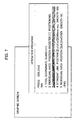
- the statement corresponding to the robot operation command adopted above may be inserted between the third line and fourth line in the program shown in FIG. 7.
- the statements on the fourth line and the lines that follow are renumbered upward according to the number of operation statements inserted.
- Step U14 If further editing is required, the sequence returns to step U4 and the desired editing is carried out by executing step U4 and the steps that follow. If there is no need to continue the editing, the process is terminated.
- step S3 in the above embodiment the following subroutine is predefined in correspondence to workpiece 1 and machine tool 1.
- the meaning of each statement is parenthesized.
- step S3 This completes the subroutines that have to be predefined in step S3 in the above embodiment, in correspondence to workpiece 1 and machine tool 1.
- step U1 and the following steps are executed sequentially. It will be assumed here, purely as an example, that the program displayed in step U4 is the same as before (that is, the program name is S5A_01A2) and that the editing location selected in step U5 is now pre-insertion at the third line.
- the operation instruction 'Robot 1 picks up workpiece 1 and places it on machine tool 1' is input by voice.
- step U7 the program editing apparatus uses the voice recognition function to execute the parsing process on the operation instruction, generates complete statements in succession by assigning candidate character strings to the variable parts of models, and searches for a matching statement.
- the matching statement is found from the fourthmodel in the model list in FIG. 3. Specifically, when robot 1 is assigned to robot X, workpiece 1 to object A, and machine tool 1 to object B, the completed statement matches the voice recognized statement.
- step U10 the subroutine (PROG WorkPick) stored for workpiece 1 and the subroutine (PROG MachineToolInsert) stored for machine tool 1 are read in succession and displayed. Then the operation corresponding to the displayed data is animated on the screen in step U11.
- step U12 If the operation command is adopted in step U12, the above subroutines are inserted in the selected location.
- the relevant part of the program is shown below.
Landscapes
- Engineering & Computer Science (AREA)
- Multimedia (AREA)
- Robotics (AREA)
- Mechanical Engineering (AREA)
- Computational Linguistics (AREA)
- Health & Medical Sciences (AREA)
- Audiology, Speech & Language Pathology (AREA)
- Human Computer Interaction (AREA)
- Physics & Mathematics (AREA)
- Acoustics & Sound (AREA)
- Numerical Control (AREA)
- Manipulator (AREA)
Applications Claiming Priority (2)
| Application Number | Priority Date | Filing Date | Title |
|---|---|---|---|
| JP2003380698A JP2005148789A (ja) | 2003-11-11 | 2003-11-11 | 音声入力によるロボット教示プログラム編集装置 |
| JP2003380698 | 2003-11-11 |
Publications (3)
| Publication Number | Publication Date |
|---|---|
| EP1531375A2 true EP1531375A2 (de) | 2005-05-18 |
| EP1531375A3 EP1531375A3 (de) | 2005-11-09 |
| EP1531375B1 EP1531375B1 (de) | 2007-10-03 |
Family
ID=34431408
Family Applications (1)
| Application Number | Title | Priority Date | Filing Date |
|---|---|---|---|
| EP04256831A Expired - Lifetime EP1531375B1 (de) | 2003-11-11 | 2004-11-04 | Sprachgesteuertes Gerät zum Editieren eines Roboterlehrprogrammes |
Country Status (4)
| Country | Link |
|---|---|
| US (1) | US7430457B2 (de) |
| EP (1) | EP1531375B1 (de) |
| JP (1) | JP2005148789A (de) |
| DE (1) | DE602004009264T2 (de) |
Families Citing this family (37)
| Publication number | Priority date | Publication date | Assignee | Title |
|---|---|---|---|---|
| JP4181590B2 (ja) * | 2006-08-30 | 2008-11-19 | 株式会社東芝 | インタフェース装置及びインタフェース処理方法 |
| US20080255433A1 (en) * | 2007-04-11 | 2008-10-16 | The Board Of Regents Of The University Of Texas Syatem | Optoacoustic monitoring of multiple parameters |
| EP2258521B1 (de) | 2008-02-28 | 2015-08-19 | Panasonic Intellectual Property Management Co., Ltd. | Steuervorrichtung und steuerverfahren für einen roboterarm, roboter, steuerprogramm für einen roboterarm und integrierter elektronischer schaltkreis zur steuerung eines roboterarms |
| KR101631496B1 (ko) * | 2008-06-03 | 2016-06-17 | 삼성전자주식회사 | 로봇 장치 및 그 단축 명령 등록 방법 |
| JP2010092330A (ja) * | 2008-10-09 | 2010-04-22 | Seiko Epson Corp | 動作シーケンス作成装置、動作シーケンス作成装置の制御方法およびプログラム |
| WO2011036865A1 (ja) * | 2009-09-28 | 2011-03-31 | パナソニック株式会社 | ロボットアームの制御装置及び制御方法、ロボット、ロボットアームの制御プログラム、及び、ロボットアーム制御用集積電子回路 |
| US8483873B2 (en) | 2010-07-20 | 2013-07-09 | Innvo Labs Limited | Autonomous robotic life form |
| EP2453325A1 (de) | 2010-11-16 | 2012-05-16 | Universal Robots ApS | Verfahren und Mittel zur Steuerung eines Roboters |
| SG182033A1 (en) * | 2011-01-03 | 2012-07-30 | Katotec Pte Ltd Singapore | Robot controllers and content files therefor |
| JP5565392B2 (ja) * | 2011-08-11 | 2014-08-06 | 株式会社安川電機 | 携帯遠隔操作装置およびロボットシステム |
| JP6182143B2 (ja) | 2011-09-28 | 2017-08-16 | ユニバーサル ロボッツ アクツイエセルスカプ | ロボットの較正およびプログラミング |
| US9443515B1 (en) * | 2012-09-05 | 2016-09-13 | Paul G. Boyce | Personality designer system for a detachably attachable remote audio object |
| US20150129581A1 (en) * | 2013-11-12 | 2015-05-14 | Lincoln Global, Inc. | System and method for pendant component for a welding system |
| US20170072513A1 (en) * | 2014-02-24 | 2017-03-16 | Howon Co., Ltd. | Hybrid welder |
| JP7042554B2 (ja) | 2014-03-04 | 2022-03-28 | ユニバーサル ロボッツ アクツイエセルスカプ | 安全機能を有する工業用ロボットとその安全制御のための方法 |
| JP6361213B2 (ja) * | 2014-03-26 | 2018-07-25 | セイコーエプソン株式会社 | ロボット制御装置、ロボット、ロボットシステム、教示方法、及びプログラム |
| JP6678648B2 (ja) | 2014-09-26 | 2020-04-08 | テラダイン、 インコーポレイテッド | グリッパと自動試験装置 |
| US20160221190A1 (en) * | 2015-01-29 | 2016-08-04 | Yiannis Aloimonos | Learning manipulation actions from unconstrained videos |
| KR102603939B1 (ko) | 2015-07-08 | 2023-11-20 | 유니버셜 로보츠 에이/에스 | 제3자 기여를 가진 산업용 로봇의 최종 사용자 프로그래밍 확장 방법 |
| TWI805545B (zh) | 2016-04-12 | 2023-06-21 | 丹麥商環球機器人公司 | 用於藉由示範來程式化機器人之方法和電腦程式產品 |
| JP6653064B2 (ja) * | 2016-12-28 | 2020-02-26 | オムロン株式会社 | シミュレーション装置、ロボット、シミュレーション方法、及びそのプログラム |
| JP6568169B2 (ja) * | 2017-09-12 | 2019-08-28 | ファナック株式会社 | 溶接ロボットプログラミング装置および溶接ロボットのプログラミング方法 |
| JP6816068B2 (ja) | 2018-07-06 | 2021-01-20 | ファナック株式会社 | ロボットプログラム生成装置 |
| JP7251224B2 (ja) * | 2019-03-11 | 2023-04-04 | セイコーエプソン株式会社 | 制御装置およびロボットシステム |
| JP7063844B2 (ja) * | 2019-04-26 | 2022-05-09 | ファナック株式会社 | ロボット教示装置 |
| JP6993382B2 (ja) * | 2019-04-26 | 2022-02-04 | ファナック株式会社 | ロボット教示装置 |
| DK180508B1 (en) | 2019-10-22 | 2021-06-03 | Universal Robots As | Maintaining free-drive mode of robot arm for period of time |
| WO2021078344A1 (en) | 2019-10-22 | 2021-04-29 | Universal Robots A/S | Safe activation of free-drive mode of robot arm |
| EP4049104B1 (de) | 2019-10-22 | 2026-02-18 | Universal Robots A/S | Roboterarm mit adaptiver dreidimensionaler begrenzung im freilauf |
| JPWO2021245746A1 (de) * | 2020-06-01 | 2021-12-09 | ||
| CN116056841A (zh) * | 2020-08-20 | 2023-05-02 | 发那科株式会社 | 机器人控制系统 |
| JP2023080596A (ja) * | 2021-11-30 | 2023-06-09 | セイコーエプソン株式会社 | プログラム作成装置およびプログラム |
| USD1099187S1 (en) | 2022-01-14 | 2025-10-21 | Universal Robots A/S | Robot joint |
| USD1082878S1 (en) | 2022-01-14 | 2025-07-08 | Universal Robots A/S | Robot joint |
| CA3264009A1 (en) * | 2022-12-05 | 2024-06-13 | Seegrid Corporation | GENERATION OF A "Plain Language" Summary of Descriptions for an Automation Logic |
| JPWO2025009384A1 (de) * | 2023-07-05 | 2025-01-09 | ||
| US20260070172A1 (en) * | 2024-09-09 | 2026-03-12 | Alm Positioners, Inc. | Voice control positioning system |
Family Cites Families (12)
| Publication number | Priority date | Publication date | Assignee | Title |
|---|---|---|---|---|
| SE8305378L (sv) | 1983-09-30 | 1985-03-31 | Asea Ab | Industrirobot |
| JP3884160B2 (ja) * | 1997-11-17 | 2007-02-21 | 富士通株式会社 | 用語付きデータを扱うデータ処理方法,データ処理装置およびプログラム記憶媒体 |
| IT1313346B1 (it) * | 1999-09-06 | 2002-07-23 | Abb Ricerca Spa | Metodo per eseguire la programmazione fuori linea di un robotindustriale. |
| JP2001222309A (ja) * | 2000-02-10 | 2001-08-17 | Yaskawa Electric Corp | ロボット制御装置 |
| WO2001058649A1 (en) * | 2000-02-14 | 2001-08-16 | Sony Corporation | Robot system, robot device and method for controlling the same, and information processing device and method |
| US6754560B2 (en) * | 2000-03-31 | 2004-06-22 | Sony Corporation | Robot device, robot device action control method, external force detecting device and external force detecting method |
| JP4765155B2 (ja) * | 2000-09-28 | 2011-09-07 | ソニー株式会社 | オーサリング・システム及びオーサリング方法、並びに記憶媒体 |
| JP2002283259A (ja) * | 2001-03-27 | 2002-10-03 | Sony Corp | ロボット装置のための動作教示装置及び動作教示方法、並びに記憶媒体 |
| JP2002337079A (ja) * | 2001-05-11 | 2002-11-26 | Sony Corp | 情報処理装置および方法、記録媒体、並びにプログラム |
| JP2003080482A (ja) * | 2001-09-07 | 2003-03-18 | Yaskawa Electric Corp | ロボット教示装置 |
| JP3708097B2 (ja) * | 2003-10-08 | 2005-10-19 | ファナック株式会社 | ロボットの手動送り装置 |
| US7236854B2 (en) * | 2004-01-05 | 2007-06-26 | Abb Research Ltd. | Method and a system for programming an industrial robot |
-
2003
- 2003-11-11 JP JP2003380698A patent/JP2005148789A/ja active Pending
-
2004
- 2004-11-04 EP EP04256831A patent/EP1531375B1/de not_active Expired - Lifetime
- 2004-11-04 DE DE602004009264T patent/DE602004009264T2/de not_active Expired - Fee Related
- 2004-11-09 US US10/983,717 patent/US7430457B2/en active Active
Also Published As
| Publication number | Publication date |
|---|---|
| DE602004009264T2 (de) | 2008-07-24 |
| DE602004009264D1 (de) | 2007-11-15 |
| EP1531375A3 (de) | 2005-11-09 |
| US20050102066A1 (en) | 2005-05-12 |
| JP2005148789A (ja) | 2005-06-09 |
| EP1531375B1 (de) | 2007-10-03 |
| US7430457B2 (en) | 2008-09-30 |
Similar Documents
| Publication | Publication Date | Title |
|---|---|---|
| EP1531375B1 (de) | Sprachgesteuertes Gerät zum Editieren eines Roboterlehrprogrammes | |
| US5511147A (en) | Graphical interface for robot | |
| CN100460159C (zh) | 工业机器人离线编程系统 | |
| EP1310844B1 (de) | Simulationsvorrichtung | |
| EP1527850B1 (de) | Simulationsvorrichtung | |
| US20030074170A1 (en) | Robot simulation apparatus | |
| CA2526459C (en) | Teaching data preparing method for articulated robot | |
| US4843566A (en) | Robot motion control system | |
| JP5071361B2 (ja) | 複腕ロボットの作業プログラム作成方法および複腕ロボット | |
| JP4329248B2 (ja) | Nc加工シミュレーション装置 | |
| JP2002091523A (ja) | 自動プログラミング・シミュレーション装置 | |
| JP2019171498A (ja) | ロボットプログラム実行装置、ロボットプログラム実行方法、プログラム | |
| US20060058906A1 (en) | Simulation apparatus and method for NC machining | |
| JPH10124130A (ja) | 組立装置 | |
| JP7121221B1 (ja) | 数値制御装置及び数値制御システム | |
| JP2013226602A (ja) | 産業用機械システム | |
| US11975454B2 (en) | Program generation device and non-transitory computer-readable storage medium storing program | |
| JP2003165079A (ja) | 産業用ロボット | |
| JPH10291183A (ja) | ロボット言語処理装置 | |
| JPH08286722A (ja) | Cadデータ利用オフラインティーチング方法及びそのシステム | |
| EP0240733B1 (de) | Roboter-Antrieb-Steuersystem und -Steuerverfahren | |
| JP2011059801A (ja) | プログラム作成・教示装置及び方法 | |
| JPH06270082A (ja) | 補軸を有するロボットの制御方法 | |
| JPH07168616A (ja) | ロボットプログラム作成装置 | |
| JPS60101606A (ja) | ロボツト自動運転方式 |
Legal Events
| Date | Code | Title | Description |
|---|---|---|---|
| PUAI | Public reference made under article 153(3) epc to a published international application that has entered the european phase |
Free format text: ORIGINAL CODE: 0009012 |
|
| AK | Designated contracting states |
Kind code of ref document: A2 Designated state(s): AT BE BG CH CY CZ DE DK EE ES FI FR GB GR HU IE IS IT LI LU MC NL PL PT RO SE SI SK TR |
|
| AX | Request for extension of the european patent |
Extension state: AL HR LT LV MK YU |
|
| PUAL | Search report despatched |
Free format text: ORIGINAL CODE: 0009013 |
|
| AK | Designated contracting states |
Kind code of ref document: A3 Designated state(s): AT BE BG CH CY CZ DE DK EE ES FI FR GB GR HU IE IS IT LI LU MC NL PL PT RO SE SI SK TR |
|
| AX | Request for extension of the european patent |
Extension state: AL HR LT LV MK YU |
|
| 17P | Request for examination filed |
Effective date: 20060322 |
|
| AKX | Designation fees paid |
Designated state(s): DE |
|
| GRAP | Despatch of communication of intention to grant a patent |
Free format text: ORIGINAL CODE: EPIDOSNIGR1 |
|
| GRAS | Grant fee paid |
Free format text: ORIGINAL CODE: EPIDOSNIGR3 |
|
| GRAA | (expected) grant |
Free format text: ORIGINAL CODE: 0009210 |
|
| AK | Designated contracting states |
Kind code of ref document: B1 Designated state(s): DE |
|
| REF | Corresponds to: |
Ref document number: 602004009264 Country of ref document: DE Date of ref document: 20071115 Kind code of ref document: P |
|
| PLBE | No opposition filed within time limit |
Free format text: ORIGINAL CODE: 0009261 |
|
| STAA | Information on the status of an ep patent application or granted ep patent |
Free format text: STATUS: NO OPPOSITION FILED WITHIN TIME LIMIT |
|
| 26N | No opposition filed |
Effective date: 20080704 |
|
| PGFP | Annual fee paid to national office [announced via postgrant information from national office to epo] |
Ref country code: DE Payment date: 20081126 Year of fee payment: 5 |
|
| PG25 | Lapsed in a contracting state [announced via postgrant information from national office to epo] |
Ref country code: DE Free format text: LAPSE BECAUSE OF NON-PAYMENT OF DUE FEES Effective date: 20100601 |