EP1531439A1 - Procédé de localisation - Google Patents
Procédé de localisation Download PDFInfo
- Publication number
- EP1531439A1 EP1531439A1 EP04026514A EP04026514A EP1531439A1 EP 1531439 A1 EP1531439 A1 EP 1531439A1 EP 04026514 A EP04026514 A EP 04026514A EP 04026514 A EP04026514 A EP 04026514A EP 1531439 A1 EP1531439 A1 EP 1531439A1
- Authority
- EP
- European Patent Office
- Prior art keywords
- circuitry
- user
- base stations
- program
- information
- Prior art date
- Legal status (The legal status is an assumption and is not a legal conclusion. Google has not performed a legal analysis and makes no representation as to the accuracy of the status listed.)
- Withdrawn
Links
Images



Classifications
-
- G—PHYSICS
- G08—SIGNALLING
- G08B—SIGNALLING SYSTEMS, e.g. PERSONAL CALLING SYSTEMS; ORDER TELEGRAPHS; ALARM SYSTEMS
- G08B21/00—Alarms responsive to a single specified undesired or abnormal condition and not otherwise provided for
- G08B21/02—Alarms for ensuring the safety of persons
- G08B21/0202—Child monitoring systems using a transmitter-receiver system carried by the parent and the child
-
- G—PHYSICS
- G01—MEASURING; TESTING
- G01S—RADIO DIRECTION-FINDING; RADIO NAVIGATION; DETERMINING DISTANCE OR VELOCITY BY USE OF RADIO WAVES; LOCATING OR PRESENCE-DETECTING BY USE OF THE REFLECTION OR RERADIATION OF RADIO WAVES; ANALOGOUS ARRANGEMENTS USING OTHER WAVES
- G01S5/00—Position-fixing by co-ordinating two or more direction or position line determinations; Position-fixing by co-ordinating two or more distance determinations
- G01S5/02—Position-fixing by co-ordinating two or more direction or position line determinations; Position-fixing by co-ordinating two or more distance determinations using radio waves
-
- G—PHYSICS
- G08—SIGNALLING
- G08B—SIGNALLING SYSTEMS, e.g. PERSONAL CALLING SYSTEMS; ORDER TELEGRAPHS; ALARM SYSTEMS
- G08B13/00—Burglar, theft or intruder alarms
- G08B13/02—Mechanical actuation
- G08B13/14—Mechanical actuation by lifting or attempted removal of hand-portable articles
- G08B13/1427—Mechanical actuation by lifting or attempted removal of hand-portable articles with transmitter-receiver for distance detection
-
- G—PHYSICS
- G08—SIGNALLING
- G08B—SIGNALLING SYSTEMS, e.g. PERSONAL CALLING SYSTEMS; ORDER TELEGRAPHS; ALARM SYSTEMS
- G08B21/00—Alarms responsive to a single specified undesired or abnormal condition and not otherwise provided for
- G08B21/18—Status alarms
- G08B21/24—Reminder alarms, e.g. anti-loss alarms
-
- G—PHYSICS
- G08—SIGNALLING
- G08B—SIGNALLING SYSTEMS, e.g. PERSONAL CALLING SYSTEMS; ORDER TELEGRAPHS; ALARM SYSTEMS
- G08B25/00—Alarm systems in which the location of the alarm condition is signalled to a central station, e.g. fire or police telegraphic systems
- G08B25/01—Alarm systems in which the location of the alarm condition is signalled to a central station, e.g. fire or police telegraphic systems characterised by the transmission medium
- G08B25/016—Personal emergency signalling and security systems
-
- G—PHYSICS
- G01—MEASURING; TESTING
- G01S—RADIO DIRECTION-FINDING; RADIO NAVIGATION; DETERMINING DISTANCE OR VELOCITY BY USE OF RADIO WAVES; LOCATING OR PRESENCE-DETECTING BY USE OF THE REFLECTION OR RERADIATION OF RADIO WAVES; ANALOGOUS ARRANGEMENTS USING OTHER WAVES
- G01S2205/00—Position-fixing by co-ordinating two or more direction or position line determinations; Position-fixing by co-ordinating two or more distance determinations
- G01S2205/01—Position-fixing by co-ordinating two or more direction or position line determinations; Position-fixing by co-ordinating two or more distance determinations specially adapted for specific applications
- G01S2205/06—Emergency
Definitions
- This invention relates to a method of locating people in general or children specifically, animals and or possessions.
- the cellular network communications systems used by cellular telephone and personal messaging services are characterised by overlapping cells, with each cell having an antenna/transmitter or base station.
- a typical mobile phone user passes through different cells with constant, or semi constant, contact with the base stations being passed from station to station. This way the network knows which cell and base station to use to make contact and keeps loose track of the user.
- SIM Subscriber Identification Module
- TSP telecommunications service provider
- the triggering of an airbag in a car for example.
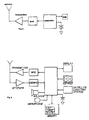
- the circuitry shown in figure 4 is the circuitry to be incorporated into different items which can be worn or carried by children, adults, animals or placed on/in mobile objects.
- the aforementioned carriers shall hereafter be known as porters.
- the person operating the device i.e. the person looking, shall hereafter be known as the user.
- a method for tracking and locating people, animals or things furnished with the specified circuitry comprising the steps of, a) the device emits a constant or intermittent signal with identification information for cell network tracking, b) the user calls the device tracking/phone number which activates a program installed on the base stations, c) the program contacts other surrounding antennae and triangulates the position of the user, d) then with the user as one point of reference triangulates the position of the device and e) calculates its position relative to the user, f) the program then sends a text message to the phone/user, giving direction and distance of device from user. The process is repeated from c until the call is terminated.
- the information sent to the user contains at least one direction, N, S, E, W, and the distance in metres or kilometres.
- the device In the case that the device is in constant independent operation and not activated by the porter, it is in constant or semi constant contact with the cellular network.
- the device does not need to receive or process any information and only acts as a beacon for the cellular network. This would be the case when the porter is a child or animal for example.
- the TSP using this method and devices must determine the frequencies to be used and the range of call or identification numbers that are to be assigned to the SIM chip in each device and for each application the different devices are used for.
- the existing cellular network is made up of many base stations at the centre of many overlapping cells, (FIG 1).
- the circuitry that is responsible for keeping in touch with the cellular network from a standard mobile telephone, (FIG 2), the antenna, modulator, controller and transmitter, and combining it with SIM technology, flexible circuitry, giving it its own power supply and introducing it into various items a new, easy and effective tracking device is created, (FIG 4), and with the introduction of a specialised program in the base stations of the cellular network, designed to use the signal and other base stations to position the device, the method of tracking the devices is in place.
- circuitry and necessary components are on flexible circuitry, which is to be sandwiched between layers of leather or whatever material is used to make animal collars, FIG5, or sewn onto the animal bandanas.
- Each collar will have a unique calling number to be used with the method explained in claim 1, and shown in FIG 3, by the user in the event of loss.
- the circuitry When being used by the elderly or infirm, the circuitry could be either rigid or flexible. It would be housed in a slim, preferably water resistant, case with a button. This could be worn or carried by the porter and when in distress they push the button.
- the SIM could be programmed with information such as allergies, blood type, medication, known problems etc, and this information is sent to the emergency services with the location of the porter when activated. This would be similar to the personal alarm device in case of aggression but with a direct contact to different emergency services.
- the device would be connected to the airbag controller.
- the airbag controller When the airbag controller generates an activation signal for the airbag it simultaneously activates the circuitry.
- the SIM could be programmed with information such as registration, name, blood type etc.
- the activation of the circuitry emits a signal with the information to the base stations and the base stations find the location of the accident and instantly sent porter information and location to the emergency services such as police and ambulance.
- circuitry When used for the location of people the circuitry would be incorporated into badges, pins, broaches, hats, or sewn into clothes or bags etc. Each device has a unique calling number to be used with the method described in claim 1.
- the existing network does not provide sufficient coverage or the signal may be weakened due to obstructions or the signal my be reflected off of objects. In these cases it may be necessary to install some supplementary antennae or in some cases, (if the device is primarily used indoors) a small signal booster. This is also an important reason to use as many base stations as have contact with both user and porter to ensure an accurate location.
- a small private network of antennae could be set up. Small antennae used specifically for this purpose and not carrying regular communication traffic.
Landscapes
- Physics & Mathematics (AREA)
- General Physics & Mathematics (AREA)
- Engineering & Computer Science (AREA)
- Business, Economics & Management (AREA)
- Emergency Management (AREA)
- Radar, Positioning & Navigation (AREA)
- Remote Sensing (AREA)
- Health & Medical Sciences (AREA)
- Child & Adolescent Psychology (AREA)
- General Health & Medical Sciences (AREA)
- Computer Security & Cryptography (AREA)
- Mobile Radio Communication Systems (AREA)
Applications Claiming Priority (2)
| Application Number | Priority Date | Filing Date | Title |
|---|---|---|---|
| CH0300736 | 2003-11-14 | ||
| CH7362003 | 2003-11-14 |
Publications (1)
| Publication Number | Publication Date |
|---|---|
| EP1531439A1 true EP1531439A1 (fr) | 2005-05-18 |
Family
ID=34427740
Family Applications (1)
| Application Number | Title | Priority Date | Filing Date |
|---|---|---|---|
| EP04026514A Withdrawn EP1531439A1 (fr) | 2003-11-14 | 2004-11-09 | Procédé de localisation |
Country Status (1)
| Country | Link |
|---|---|
| EP (1) | EP1531439A1 (fr) |
Cited By (5)
| Publication number | Priority date | Publication date | Assignee | Title |
|---|---|---|---|---|
| GB2454694A (en) * | 2007-11-15 | 2009-05-20 | Buddie Worldwide Ltd | Tracking device having discrete circuit elements connected by flexible connectors |
| GB2464688A (en) * | 2008-10-22 | 2010-04-28 | Duncan Gregory Anderson | Location of a device attached to an item within a cellular network is provided to a mobile telephone |
| EP2362367A1 (fr) * | 2010-02-18 | 2011-08-31 | HergFinanz AG | Système de localisation comportant au moins un dispositif de localisation et dispositif à un seul écran |
| RU169423U1 (ru) * | 2016-07-21 | 2017-03-16 | Элдар Али Оглы Разроев | Идентификационная метка |
| CN109212947A (zh) * | 2017-06-29 | 2019-01-15 | 上海共联通信信息发展有限公司 | 用于孩童定位的便携式定位装置及定位系统、方法 |
Citations (10)
| Publication number | Priority date | Publication date | Assignee | Title |
|---|---|---|---|---|
| US3714573A (en) * | 1970-05-06 | 1973-01-30 | Hazeltine Corp | Spread-spectrum position monitoring system |
| US3828306A (en) * | 1973-01-08 | 1974-08-06 | P Angeloni | Highway distress system |
| US4369426A (en) * | 1979-03-29 | 1983-01-18 | Repa Feinstanzwerk Gmbh | Emergency distress signal system for motor vehicles |
| US5021794A (en) * | 1989-08-15 | 1991-06-04 | Lawrence Robert A | Personal emergency locator system |
| US5208756A (en) * | 1991-01-28 | 1993-05-04 | Song Han L | Vehicle locating and navigating system |
| US5485163A (en) * | 1994-03-30 | 1996-01-16 | Motorola, Inc. | Personal locator system |
| GB2348080A (en) * | 1999-01-19 | 2000-09-20 | Dominic Conrad Lakin | Child position monitoring |
| US6169497B1 (en) * | 1993-04-01 | 2001-01-02 | Bruno G. Robert | Mobile tracking and positioning system |
| US6472976B1 (en) * | 1999-05-21 | 2002-10-29 | Charles M. Wohl | Monitoring location and tracking system |
| US20020196161A1 (en) * | 2001-03-16 | 2002-12-26 | Gould Lawrence A. | Methods for employing location information associated with emergency 911 wireless transmissions for supplementary and complementary purposes |
-
2004
- 2004-11-09 EP EP04026514A patent/EP1531439A1/fr not_active Withdrawn
Patent Citations (10)
| Publication number | Priority date | Publication date | Assignee | Title |
|---|---|---|---|---|
| US3714573A (en) * | 1970-05-06 | 1973-01-30 | Hazeltine Corp | Spread-spectrum position monitoring system |
| US3828306A (en) * | 1973-01-08 | 1974-08-06 | P Angeloni | Highway distress system |
| US4369426A (en) * | 1979-03-29 | 1983-01-18 | Repa Feinstanzwerk Gmbh | Emergency distress signal system for motor vehicles |
| US5021794A (en) * | 1989-08-15 | 1991-06-04 | Lawrence Robert A | Personal emergency locator system |
| US5208756A (en) * | 1991-01-28 | 1993-05-04 | Song Han L | Vehicle locating and navigating system |
| US6169497B1 (en) * | 1993-04-01 | 2001-01-02 | Bruno G. Robert | Mobile tracking and positioning system |
| US5485163A (en) * | 1994-03-30 | 1996-01-16 | Motorola, Inc. | Personal locator system |
| GB2348080A (en) * | 1999-01-19 | 2000-09-20 | Dominic Conrad Lakin | Child position monitoring |
| US6472976B1 (en) * | 1999-05-21 | 2002-10-29 | Charles M. Wohl | Monitoring location and tracking system |
| US20020196161A1 (en) * | 2001-03-16 | 2002-12-26 | Gould Lawrence A. | Methods for employing location information associated with emergency 911 wireless transmissions for supplementary and complementary purposes |
Cited By (5)
| Publication number | Priority date | Publication date | Assignee | Title |
|---|---|---|---|---|
| GB2454694A (en) * | 2007-11-15 | 2009-05-20 | Buddie Worldwide Ltd | Tracking device having discrete circuit elements connected by flexible connectors |
| GB2464688A (en) * | 2008-10-22 | 2010-04-28 | Duncan Gregory Anderson | Location of a device attached to an item within a cellular network is provided to a mobile telephone |
| EP2362367A1 (fr) * | 2010-02-18 | 2011-08-31 | HergFinanz AG | Système de localisation comportant au moins un dispositif de localisation et dispositif à un seul écran |
| RU169423U1 (ru) * | 2016-07-21 | 2017-03-16 | Элдар Али Оглы Разроев | Идентификационная метка |
| CN109212947A (zh) * | 2017-06-29 | 2019-01-15 | 上海共联通信信息发展有限公司 | 用于孩童定位的便携式定位装置及定位系统、方法 |
Similar Documents
| Publication | Publication Date | Title |
|---|---|---|
| JP5186692B2 (ja) | トラッキング装置を使用し、個人および個体をロケーティングする装置および方法 | |
| US6510380B1 (en) | Security and tracking system | |
| Koshima et al. | Personal locator services emerge | |
| US6606556B2 (en) | Security and tracking system | |
| US6961001B1 (en) | Perimeter monitoring alarm method and system | |
| US6889135B2 (en) | Security and tracking system | |
| US7164921B2 (en) | Auxiliary switch activated GPS-equipped wireless phone | |
| US8862378B2 (en) | Security and tracking system | |
| Zagami et al. | Providing universal location services using a wireless E911 location network | |
| US8102316B1 (en) | System and method for tracking lost subjects | |
| US20120086574A1 (en) | Tracking and alert apparatus, system and method | |
| US8149124B2 (en) | Personal security and tracking system | |
| US8988284B2 (en) | System and method for tracking lost subjects | |
| US20050086261A1 (en) | Child locator apparatus and method | |
| US20110037592A1 (en) | System and method for locating an individual | |
| GB2539952A (en) | Location systems | |
| US20190156643A1 (en) | Child/Individual Tracking System | |
| WO1996026614A1 (fr) | Dispositif de localisation et systeme utilisant des technologies cellulaires | |
| EP1531439A1 (fr) | Procédé de localisation | |
| JP3026170B2 (ja) | 捜索装置 | |
| WO1999049331A1 (fr) | Systeme de localisation mobile | |
| CN103869349A (zh) | 定位装置 | |
| US20040164867A1 (en) | System and device for monitoring of occupancy area | |
| CA2513733C (fr) | Systeme de securite et de suivi | |
| CA2475823C (fr) | Systeme de communication pour animal de compagnie |
Legal Events
| Date | Code | Title | Description |
|---|---|---|---|
| PUAI | Public reference made under article 153(3) epc to a published international application that has entered the european phase |
Free format text: ORIGINAL CODE: 0009012 |
|
| AK | Designated contracting states |
Kind code of ref document: A1 Designated state(s): AT BE BG CH CY CZ DE DK EE ES FI FR GB GR HU IE IS IT LI LU MC NL PL PT RO SE SI SK TR |
|
| AX | Request for extension of the european patent |
Extension state: AL HR LT LV MK YU |
|
| AKX | Designation fees paid | ||
| REG | Reference to a national code |
Ref country code: DE Ref legal event code: 8566 |
|
| STAA | Information on the status of an ep patent application or granted ep patent |
Free format text: STATUS: THE APPLICATION IS DEEMED TO BE WITHDRAWN |
|
| 18D | Application deemed to be withdrawn |
Effective date: 20051119 |