EP1532902A1 - Appareil de cuisson automatique d'aliments - Google Patents
Appareil de cuisson automatique d'aliments Download PDFInfo
- Publication number
- EP1532902A1 EP1532902A1 EP03732191A EP03732191A EP1532902A1 EP 1532902 A1 EP1532902 A1 EP 1532902A1 EP 03732191 A EP03732191 A EP 03732191A EP 03732191 A EP03732191 A EP 03732191A EP 1532902 A1 EP1532902 A1 EP 1532902A1
- Authority
- EP
- European Patent Office
- Prior art keywords
- cooking
- auto
- cooking machine
- automatic cooking
- machine according
- Prior art date
- Legal status (The legal status is an assumption and is not a legal conclusion. Google has not performed a legal analysis and makes no representation as to the accuracy of the status listed.)
- Granted
Links
Images



Classifications
-
- F—MECHANICAL ENGINEERING; LIGHTING; HEATING; WEAPONS; BLASTING
- F24—HEATING; RANGES; VENTILATING
- F24C—DOMESTIC STOVES OR RANGES ; DETAILS OF DOMESTIC STOVES OR RANGES, OF GENERAL APPLICATION
- F24C3/00—Stoves or ranges for gaseous fuels
- F24C3/12—Arrangement or mounting of control or safety devices
- F24C3/126—Arrangement or mounting of control or safety devices on ranges
-
- A—HUMAN NECESSITIES
- A47—FURNITURE; DOMESTIC ARTICLES OR APPLIANCES; COFFEE MILLS; SPICE MILLS; SUCTION CLEANERS IN GENERAL
- A47J—KITCHEN EQUIPMENT; COFFEE MILLS; SPICE MILLS; APPARATUS FOR MAKING BEVERAGES
- A47J36/00—Parts, details or accessories of cooking-vessels
- A47J36/32—Time-controlled igniting mechanisms or alarm devices
- A47J36/321—Time-controlled igniting mechanisms or alarm devices the electronic control being performed over a network, e.g. by means of a handheld device
Definitions
- the present invention relates to an automatic cooking machine, and more specifically, to an automatic cooking machine which is able to accurately control the duration and degree of cooking and to carry out various major cooking techniques, especially the cooking techniques required by preparing Chinese dishes.
- Cooking is to heat up the cooked materials to the expected duration and degree so as to realize desired tastes and flavors such as fragrant, crispy and tender by performing some major cooking techniques such as stirring frying, quick frying, frying, deep frying, braising, steaming, wet quick frying and boiling, etc.
- An automatic cooking machine is expected to completely and automatically carry out various major cooking techniques, typically, Chinese cooking techniques, to prepare desired food with stable quality.
- Such an automatic cooking machine should solve two key problems. That is how to control the duration and degree of cooking automatically and how to perform basic cooking operation to get the same or similar effect by the manual operation of a chef.
- the duration and degree of cooking is one of the key factors of cooking.
- appropriate duration and degree of cooking plays a decisive role for cooking dishes and other foodstuffs. Inappropriate duration and degree of cooking will result in overcooking or undercooking.
- the duration and degree of cooking is also a key condition to realize different cooking techniques and to prepare dishes in different flavors. If the duration and degree of cooking is inappropriate, characteristics of those different techniques and styles may be lose. Controlling the duration and degree of cooking is the most important skill and also the most difficult skill for a chef to master. It also remains the most important standard to evaluate a chef as well as an automatic cooking machine. Therefore, to realize full-automatic cooking, the first problem to be solved is how to control the duration and degree of cooking automatically.
- Another key issue in performing automatic cooking techniques in a machine is how to perform or imitate basic cooking operations required by different cooking techniques and different types of materials employed. For example, how to automatically feed different materials in a proper order, how to turn over the cooked materials with basic turning methods similar to the actions of a chef such as turning and stirring, small turnover, large turnover and scattering, and how to automatically take out and put into again the cooked materials, etc.
- a thermal sensor disposed at the bottom or on the external wall of the cooking pan has been proposed to detect the duration and degree of cooking in Chinese Patent ZL99224470.6.
- the temperature of the cooked materials and the heat transfer media in the pan is different from that of the external wall of the pan due to thermal resistance, differences of thermal conductivity of different substances and lag of heat transfer process.
- Thermal sensors on the external wall of the pan can only be used to detect the temperature of the external wall of the pan. They could not precisely and timely detect the temperature of the cooked materials in the pan because the relationship between the temperature of the external wall and the temperature of the cooked material is rather complicate and may not be linear. That means the duration and degree of cooking can not be detected precisely and timely by such kind of thermal sensors.
- a typical instance is the situation of a steaming process.
- the temperature of foodstuff in a pan is far different from that of the external wall of the pan.
- the object of heating control is to control the temperature of foodstuff in a pan rather than that of the external wall of the pan.
- the only way to precisely and timely control the duration and degree of cooking is to detect the temperature of cooked materials in a pan directly and precisely.
- Cida Patent Application 98109182.2 also disclosed a thermal sensor for automatic control of heating. However, it does not disclose the installation position and method of the sensor.
- the control mode disclosed in this patent application is to drive a gas stove (gas range) to move towards or away from a pan.
- a control mode has at least two disadvantages.
- One is that the temperature of the body of a pan is not equal to that of cooked materials in the pan and thus the duration and degree of cooking of cooked materials can't be controlled only through controlling temperature of the body of the pan.
- Another disadvantage is that the installation position is not clear. Only by laying out thermal sensors at the proper positions can the duration and degree of cooking be precisely and effectively controlled.
- a chef can control heating intensity by manually adjusting the button on a gas stove to control gas flux. Automatic adjustment must be performed in an automatic cooking process.
- Chinese Patent ZL98232677.7 disclosed such a manner that two gas channels, which are parallel with each other, could be disposed between the gas firing port and the gas inlet at a hearth. In one of the channels a plug controlled by electromagnet attracting circuit is installed. The plug will block this channel when the electromagnet is powered to reduce the gas flux.
- This method can only get a two-stage adjustment of heating intensity, and no continuous or multi-stage adjustment can be accomplished. Obviously, it can't meet various heating requirements needed by different main cooking techniques.
- a photoelectric control card is adopted to control the working motor of a feeder and the working motor of a frying pan, in which the feeder is driven to open a material package and put the materials into the pan according to the time sequence of a cooking process, and in which the pan is driven to rotate around the axis of the pan surface with uniform velocity so as to ensure thorough stirring and uniform heating of the cooked materials.
- switches of the electromagnetic clutches, electromagnetic valves, electric cookers, motors and main power are connected to a programmable controller, using keys in this controller to control the entire cooking process.
- the radical defect of all these control modes is the lack of effective measures to detect the duration and degree of cooking of cooked materials and to control heating intensity.
- the operating mode and timing of the feeding and stirring mechanisms are performed according to given time sequence without considering the duration and degree of cooking. Obviously, this kind of control system can't meet the requirements of correctly controlling the duration and degree of cooking of cooked materials in different cooking techniques.
- Chinese Patent 98232677.7 above disclosed an automatic feeder and a pouch used thereof containing materials.
- two sealing strips of the pouch are clamped into two slots on two gear slide rods and rolled.
- the two gear slide rods make synchronous contra-rotation, pulling the two strips outwards to open series bags of the pouch.
- the materials in the bags are thus released into the leaning pan.
- Such kind of feeder is designed to match this patented leaning pan.
- the materials are released slantways. Since the leaning angle is limited, the feeder cannot be placed horizontally, and thus the materials cannot be released vertically. If used in conjunction with a conventional horizontally placed pan, the feeding effect will be impaired.
- this feeder Because the feeding position of this feeder is fixed, materials cannot be released at the most proper position and distance required by the cooking techniques. Preferably, since the feeder is inclined forward, the release of materials will generate an impact force, which may cause the hot oil or soup in a pan to splash. Because various materials in different sections of the series bags have different volume, the required torn length of different sections should be different in order to thraw different materials. But how to control the torn length has not been indicated in this patent. Additionally, this kind of feeder has other disadvantages, for example, the opening device is too complicated: there are two pulling devices to tear the two sealing strips.
- the above patent 98232677.7 also disclosed a method for turning over the cooked materials.
- a plurality of radial ribs are set up in the inner wall of a leaning pan and the leaning pan is driven to rotate by a motor.
- the pan In this turnover method, the pan must be rotated; the mode is too simple to turn over well the cooked materials, especially the large flat pieces, such as fish. Therefore, this turnover method is far different from the ideal turnover modes required by main cooking techniques. Additionally, the ribs in the pan may bring about some disadvantages for cooking large flat pieces and cleansing the pan.
- the above patent application 98109123.7 disclosed a solution to turn over cooked materials, in which a pan turner keeping close to the inner wall of a pan can rotate around an axis of the pan.
- This turnover method is also too simple to turn over cooked materials well and far different from the ideal turnover modes required by main cooking techniques. These two modes obviously can't perform material turnover required by various cooking techniques, say nothing of taking-out one or more kinds of cooked materials and then put them in a pan again.
- the essential object of cooking is to heat cooked materials to expected duration and degree through different main cooking techniques to get desired taste and flavor.
- the above devices in the prior art can't control or control well the duration and degree of cooking, and can't perform or perform well the basic cooking operations such as auto feeding, turnover, and taking-out according to requirements of different cooking techniques. They are still far from the most essential requirements for an automatic cooking machine, say nothing of the requirements to automatically perform the cooking techniques and get the desired taste and flavor. They could not put into practical use and there is actually no automatic cooking machine for Chinese dishes at present.
- One of the objects of the present invention is to provide a kind of automatic cooking machine which can automatically and correctly control the duration and degree of cooking in cooking and perform basic cooking operations such as feeding, turning over and taking out the cooked materials with the proper modes at the proper duration and degree of cooking required by cooking techniques, and which can automatically carry out the whole process of cooking and realize various basic cooking techniques, especially basic Chinese cooking techniques.
- This kind of automatic cooking machine can cook dishes and other food with stable quality and desired taste and flavor.
- an automatic cooking machine which comprises a pan, an auto feeding system, an auto turnover system for cooked materials, a heating system, an control system, a sensor system and an auto adjusting system for heating intensity.
- the sensor system comprises one or more sensors which are used to detect the duration and degree of cooking.
- the control system (also referred to the computer system) is used to control the auto feeding system, the auto turnover system for cooked materials, the heating system and other systems to perform the basic cooking operations such as automatically feeding materials, turning over cooked materials, and adjusting fire power.
- the automatic cooking machine can control the duration and degree of cooking of cooked materials according to the values and the variations of the physical variables and/or the chemical variables detected by the sensors in the sensor system and perform the above basic cooking operations at the proper moment with regard to the duration and degree of cooking required by cooking techniques.
- the above automatic cooking machine may also include an auto taking-out system for cooked materials, which may be an independent system of the auto turnover system or may be integrated with the auto turnover system.
- the sensor system of the above automatic cooking machine can also include a movement detecting device.
- the control system can automatically control a driving unit and/or a transmission mechanism and/or other moving unit according to the values and the variations of the physical variables detected by the movement detecting device.
- the movement detecting device may comprise one or more sensors used to detect motion parameters, or other types of detecting devices, such as detecting and control devices attached with some motors.
- the sensor(s) in the sensor system for determining the duration and degree of cooking are used to detect the values or the changes of the physical variables and/or the chemical variables of heat source, heat transfer media and/or cooked materials.
- the detected data is transmitted to the control system to enable it to precisely judge and control the duration and degree of cooking.
- the heat transfer media may be the pan itself, steam, water, oil and/or other substances.
- the sensor(s) for determining the duration and degree of cooking can be installed on detecting positions of the subjects to be detected and/ or on a mechanical device which can be moved to the detecting positions, and can directly detect the values and/or the changes of the physical variables and/or the chemical variables which are related to the duration and degree of cooking, coming into contact the detected subjects or not.
- the sensor system also can include one or more sensors used to detect the working conditions and/or working environment of the automatic cooking machine and/or the initial conditions of cooked materials and the machine, and the detected data are transferred to the control system.
- the heating system of the above automatic cooking machine can be gas heating system and/or electrical heating system and/or electromagnetic heating system and/or micrawave heating system and/or infra-red heating system and/or other heating systems.
- One or more heating devices can be set in the heating system according to the number of the pans.
- the heating device(s) can use the same or different kind of heating sources, for example, jointly adopting gas, electrical and micrawave heating.
- An auto adjusting system for heating intensity includes an auto adjusting device for gas flux, electrical power, electromagnetic power and/or other heating intensity.
- a driving unit which can make continuous movement or multistage movement, can be used in this auto adjusting device to automatically control gas flux, electrical power, electromagnetic power and/or other heating intensity in a continuous manner or a multistage manner.
- this auto adjusting device directly performs continuous or multistage regulation through a digital/analog device instead of a driving unit, for example, a controllable valve, which can automatically adjust its opening degree according to the data from the control system.
- the control system of the automatic cooking machine can determine the moment and procedure of basic cooking operations such as material feeding, turnover of cooked materials, etc according to the data of the duration and degree of cooking measured by the sensor system under the requirements of cooking techniques.
- the control system has various control applications (software) in its memory for various cooking-materials, which can control the duration and degree of cooking of cooked materials and other operation of the automatic cooking machine when executed.
- the control system also includes manual input port, floppy disk input port, CD input port, network input port and/or other kind of input ports to accept order or order sequence.
- the above automatic cooking machine further includes a network remote control device, a local remote control device and/or a communication remote control device.
- the above automatic cooking machine further includes a cover for its pan.
- the cover is installed on an auto open/close device controlled by the control system.
- the time for opening/closing is determined by the requirements of cooking techniques and the signal from the sensor system.
- the above automatic cooking machine further includes a oil smoke exhausting or treatment device, which can reduce the pollution caused by the smoke from cooking and improve the cleanliness of a kitchen.
- a oil smoke exhausting or treatment device which can reduce the pollution caused by the smoke from cooking and improve the cleanliness of a kitchen.
- the whole body of the cooking machine or its upper part from the edge of the pan can be placed in a closing or semi-closing transparent or nontransparent cabinet which is connected to the smoke exhausting or treatment device.
- the smoke exhausting or treatment device is installed on such a cabinet.
- the above automatic cooking machine further includes a bar code scanner and/or other identification device, which can automatically acquire the information on a cooking-material package and transmit it to the control system.
- a bar code scanner and/or other identification device which can automatically acquire the information on a cooking-material package and transmit it to the control system.
- the above automatic cooking machine further includes a cooling system, which can rapidly cool the pan or cooked materials in order to precisely control the temperature and the duration and degree of cooking.
- a cooling system could be an air cooling (blower) and/or water cooling (coil pipe) and/or water-injection system.
- the pan could also be cooled by opening the pan cover.
- the auto feeding system of the automatic cooking machine includes one or more opening devices to open one or more cooking-material packages. It also has a linking unit to link with the connectable or fixable part on the cooking-material package(s).
- the auto feeding system also includes a driving mechanism controlled by the control system, which drives the opening device(s) and/or the cooking-material package(s), tearing the sealing part and the packaging part of the cooking-material package(s) to open or to separate with each other in one time or step by step, and thus feeding the cooking material contained in the packages(s) to the pan in one time or step by step through a gap torn on the package(s).
- the driving mechanism can drive only the opening device or only the cooking-material package to move or it can drive both the opening device and the cooking-material package to move, feeding the cooking material.
- the auto feeding system can be installed on a mechanical device or a mechanical arm controlled by the control system, which can move to a proper position to start to feed the cooking material.
- the opening device can be a rolling-pulling device or a pushing-pulling device or other opening devices matching with the form of the cooking-material packages.
- the auto turnover/taking-out system in the automatic cooking machine includes a support or a hanger, a The turnover/taking-out actuator, and a linker between The turnover/taking-out actuator and the support or the hanger.
- a guide rail or a drawing device or a hoisting device or other moving device is installed on the support or the hanger.
- the control system drives the linker and The turnover/taking-out actuator via the transmission mechanism to move linearly or curvedly in relation to the support or the hanger.
- the support or the hanger is installed on the guide rail or other moving device.
- the control system drives the support or the hanger together with the linker and The turnover/taking-out actuator to move linearly or curvedly.
- the auto turnover/taking-out system is a flexible structure including a pulley mechanism which controls the vertical movement of the linker and The turnover/taking-out actuator through pulling the steel ropes.
- the automatic cooking machine further includes an auto, a semi-auto or a manual washing system, which comprises a flushing device and/or a brushing device.
- the flushing device can be connected to a water tap or a controllable valve.
- the brushing device can be installed on the auto turnover/taking-out system to replace The turnover/taking-out actuator.
- the control system controls the above washing system to wash the cooking machine automatically, semi-automatically or manually.
- the pan can comprise one or more cooking utensils and the heating system can comprise one or more sets of heating device.
- One or more containers for liquid or solid cooking-material can be placed in the automatic cooking machine, such as water container, oil container, soup container as well as waste container which is connected to a waste discharge system. Additionally, devices can be equipped with the cooking machine to take out liquid or solid material from these containers, such as a pump.
- Another object of the present invention is to provide a cooking-material package which can be used in a cooking device as well as in the automatic cooking machine of the present invention.
- This cooking-material package comprises a packing part that is used to contain the cooking-material and a sealing part that is used to seal the packing part.
- the packing part can be a container with single cell or multi cells, in which the cooking-material is packed.
- the sealing part can be a film, a plate or a sealing cover.
- a connectable or fixable part is designed to connect with the opening device of the auto feeding system in form of a slot, a notch, dentations, a protrusion, a hole or holes, a groove, a thickened section, a hardened section, a sticky section, a rough section and/or a hook.
- the cooking-material to be cooked is sealed between the parking part and the sealing part.
- an identification signal such as two dimensional bar codes. After reading this signal the control system gives out a corresponding order, such as loading and executing a corresponding cooking software.
- the sensor system dynamically detects physical and chemical variables and their variations of cooked materials, heat transfer media, environment and other related subjects which are important to control the duration and degree of cooking before and during a cooking process.
- the control system loads and executes different cooking software according to different kinds of material to be cooked under the requirements of cooking techniques and controls the whole cooking process on the bases of the values detected by sensors.
- the auto regulating system for gas or electrical heating automatically regulates the heating intensity by determining the heat mode, the selection of heat source, the moment of startup and shutdown, the length of heating time, the speed of raising up or falling down temperature, etc.
- the cooling system helps the control system to regulate the temperature so as to control the duration and degree of cooking of cooked materials dynamically.
- the auto feeding system can automatically feed various raw materials, auxiliary materials and semi-finished products in proper sequence at proper duration and degree of cooking according to different kinds of material to be cooked under the requirements of cooking techniques.
- the turnover system for cooked materials automatically turns over cooked materials in a manner similar to manual operations at proper duration and degree of cooking according to different kinds of material to be cooked under the requirements of cooking techniques.
- the taking-out system for cooked materials can automatically take out or put into again the cooked materials at proper duration and degree of cooking according to different kinds of material to be cooked under the requirements of cooking techniques.
- Temperature is the most important physical variable of cooked materials. Detecting the temperature of cooked materials and its variation has decisive significance for controlling the duration and degree of cooking. Both non-contacting thermal sensor, such as infrared thermal sensor, and contacting thermal sensor, such as thermocouple and thermal resistance are adopted in practice. Additionally, because a chef always judges the duration and degree of cooking in the process of cooking according to color, smell, smoke, etc of cooked materials. Therefore, beside the above thermal sensors, sensors to detect color, smell, smoke and other physical variables can be installed for judging and controlling the duration and degree of cooking, such as color sensor, electronic nose, smoke sensor, etc. Sensors for chemical variables can also be installed to detect the concentrations or their variations of certain chemical components to help the system to judge and control the duration and degree of cooking. In practice, the above sensors can be installed or placed in the pan, on the turnover/taking-out system, on other mechanical devices, or on other place(s) at which cooked materials can be directly detected.
- the temperature of heat transfer media such as air, steam and pan walls has relation to the duration and degree of cooking. Therefore, some sensors can be installed to detect physical or chemical variables, such as temperature, of heat transfer media to help the control system to precisely judge and control the duration and degree of cooking.
- the data detected by above sensors are provided to the control system to judge the duration and degree of cooking and to decide whether to issue orders to corresponding devices to make necessary actions such as starting heating, shutting heating, feeding, turning over cooked materials, taking out cooked materials and so on.
- the above data serves as feedback data for the control system to dynamically regulate and control the duration and degree of cooking of cooked materials.
- Feed-forward sensors to detect environmental temperature, the initial temperature of the cooking-material to be cooked, gas flux, gas pressure and others, and feedback sensors to detect gas flux, pressure, flame temperature, voltage, current, temperature of electrical/ electromagnetic heating, switching state of gas source or electrical heating, etc can be installed to help the control system to control the duration and degree of cooking more rapidly and more precisely and more timely.
- sensors used to detect motion state of various action units such as linear displacement, angular displacement, velocity, acceleration, and sensors used to detect working effects such as temperature and smoke, can be installed to help the computer system to more effectively control the motion and working effect of various systems.
- an auto adjusting system for gas heating, electrical heating source, electromagnetic heating and/ or other heating modes in a continuous manner or a multistage manner replaces manual adjusting system.
- the gas adjusting refers to regulating and controlling heating intensity through regulating and controlling gas pressure and/or gas flow and/or other quantities. This can be achieved by installing valves for adjusting gas flux or gas pressure between gas source and a burner.
- the auto adjusting system controlled by the control system may be driven by electric, hydraulic, pneumatic or other types of equipments.
- AC motor or DC motor can be used for continuous adjusting, and step-motor can be used for multistage adjusting.
- Sensors for gas pressure, gas flux, linear displacement, angular displacement, flame temperature and so on will provide the control system with feedback data to precisely control gas flux and/ or gas pressure and/or other state parameters.
- adjusting devices can be adopted to regulate heating intensity, such as device for mixing combustion promoter or combustion inhibitor with gas, device for regulating the proportion of gas to air, device for pressurizing or depressurizing, etc.
- Electromagnetic valve, other controllable valves or auto lighter can be installed to automatically open and close gas source or to ignite gas.
- Flame sensor can be installed to detect the burning state or extinguishing state. In case of igniting failure, the auto lighter controlled by the control system will keep igniting till firing. When the flame is extinguished the control system will automatically close electromagnetic valve or other controllable valves or switches to cut down gas source to guarantee safety.
- Voltage regulating, current regulating and other forms of adjusting devices controlled by the control systems such as controllable silicon and adjustable resistance are adopted to automatically regulate heating strength of electrical/ electromagnetic, microwave, light-wave and other heating system.
- Adjusting devices such as analog adjusting devices and digital adjusting devices can be used to adjust heating intensity in a continuous manner or a multistage manner.
- Sensors for voltage, current, temperature and so on can be installed to provide the computer system with feedback data to precisely regulate and control heating intensity.
- Feeding devices driven by electric, hydraulic, pneumatic or other types of driving units are adopted to perform auto feeding under the control of the control system.
- the structure of feeding device matches with the packaging form of raw materials, auxiliary (supplementary) materials and semi-finished products.
- the container of the cooking-material package can be a case or a bag with single or multiple cells. Different materials are packed in different cells according to feeding sequence and sealed by a film, a cover plate or other sealing materials. There are connectable or fixable parts or components used to connect or fix to an opening device such as a rolling-pulling device or a pushing-pulling device on the film, the cover plate or other sealing materials for opening the package.
- An available form to connect or fix a sealing part to an opening device is as follows: there is an extending part or a protruding part on a sealing part to insert into a slot of an opening device, or stick to an opening device.
- the extending part there is provided a protuberance, a hole or holes, a groove, a thickened section, a hardened section, a sticky section, a rough section and/or a hook.
- Another available form to connect or fix a sealing part to an opening device is as follows: there are holes on an extending part or a protruding part on a sealing part, with which the sealing part can be hung to the dentations or other protuberant component of an opening device.
- the auto feeding device there are one or more rolling-pulling device(s) or pushing-pulling device(s) or mechanical opening devices matching with other sealing forms, equipped with connecting or fixing parts used to connect or fix to connectable or fixable parts on a sealing part of the cooking-material package.
- the rolling-pulling devices or pushing-pulling device controlled by the control system moves to separate or open the sealing part and the packing part in one time or step by step, letting materials in the package drop into the pan through torn gap in one time or step by step.
- the opening device in the auto feeding system can be a rolling-pulling device with a rotating-shaft or a pushing-pulling device with a pushing-pulling rod.
- the above opening device controlled by the control systems rolls and pulls, or pushes and pulls the film to separate it from the case or the bag in one time or step by step, dropping the cooking-material contained in the case or the bag into the pan in one time or step by step through torn gap.
- the opening devices can be one or more drawing device or a pushing-pulling device with a pushing-pulling rod or other types of device.
- the above opening device controlled by the control system pushes drawls the cover plate along the sliding groove of the case or the bag, dropping material contained in the case or the bag into the pan in one time or step by step through torn gap.
- some liquid materials such as oil, water and soup may be injected into the pan.
- the raw material is always fried first and then stewed after adding some soup or water.
- the independent or multi-celled oil tank, water tank, soup tank or other tanks are equipped with electromagnetic valves or other controllable valves or switches, and can be installed with a heating device or an attemperator.
- the computer system controls these tanks to inject oil, water, soup or other liquid materials in certain amount and certain temperature.
- the pumps controlled by the control system can be installed to quantificationally pump liquid materials to above tanks from the pan or to the pan from the tanks.
- Cooling system can be installed to cool hot liquid materials before pumping back to tanks or to the discharging system.
- the feeding system can be fixed on the proper position above the pan which is suitable for feeding, or on a mechanical device or a mechanical arm, which enables it to move vertically, aslant or agley to a proper position to feed the cooking-material under the control of computer system to meet the requirements of cooking techniques.
- the computer system judges the duration and degree of cooking according to the physical and chemical data of the cooked materials detected by the above sensors during a cooking process by executing a software programmed according to cooking techniques.
- the feeding system moves to proper positions and feeds a kind of or several kinds of materials to be cooked in the pan when it judges that they should be fed, performing this process again and again till the cooking process is completed.
- sensors used to detect linear displacement and angular displacement can be installed to help the computer system for exact control.
- the turnover device in the present invention comprises a support or a hanger, a The turnover/taking-out actuator and a linker between a turnover/ taking-out actuator and a support or a hanger.
- the turnover/taking-out actuator is a curved surface body which can turn over and hold cooked materials, and can be made into a net-form similar to strainer.
- the turnover/taking-out actuator can be integrated with a linker, or installed on a linker with a fixed or adjustable angle, or rotatable to the shaft on the linker.
- a guide rail or a rolling-pulling device or a pushing-pulling device set to a support or a hanger, or other moving devices which enable linker, together with the turnover/taking-out actuator to make rectilinear motion or curvedly motion relative to a support or a hanger.
- the a support or a hanger is installed on guide rail or other moving device, which enable it to make rectilinear motion, curvedly motion and rotation, the linker and turnover actuator, together with a support or a hanger can make rotation, rectilinear motion or curvedly motion.
- Sensors for displacement, angular displacement and other types of motion quantities can be installed to help computer system to control motions.
- the machine can perform not only the above general basic cooking actions such as t turnover, small or large tossing and scattering but also perform many special actions to meet the requirement by different cooking techniques.
- the above turnover/taking-out system can be a kind of flexible structure, which enable this device to move vertically and freely to a regulating position, if the turnover/taking-out interferes with a pan, and enable the turnover/taking-out actuator to adequate itself to pans with different curvature.
- An adoptable flexible device is pulley mechanism, which control the vertical motion of the turnover/taking-out actuator through pulling the steel ropes.
- Another available flexible structure is to install a support or a hanger on the base with spring or other flexible devices, and/or divide a support or a hanger into several sections, the linker between sections is flexible.
- the link between The turnover/taking-out actuator and linker can be designed to be knock-down, which can give facility to change of different The turnover/taking-out actuators to meet the different cooking requirements.
- a support or a hanger can be installed on rotatable device, or install rotatable device on linker, a support or a hanger, enable The turnover/taking-out actuator to rotate around linker, or rotate together with linker, or place the pan on the supporting device, enable the pan to rotate on the supporting device, and install moving device to drive the pan to rotate.
- the turnover/taking-out actuator or the pan or both rotate by a certain angle for next scooping.
- the above moving device is driven by electrical, hydraulic or pneumatic drive system controlled by the control system.
- a scoop is installed on the linker or a pair of linkers.
- the scoop is installed on the shaft of linker and can rotate around the shaft; or it can be installed on the body of linker by a fixed or adjustable angle.
- the linker is installed on the shaft of a support or a hanger, the linker can rote round the shaft.
- the guide rail or rolling-pulling device, or push-or-pull device or other moving device is installed on the a support or a hanger, which enable linker together with The turnover/taking-out actuator to make rectilinear motion or curvedly motion relative to a support or a hanger.
- a support or a hanger is installed on guide rail or other moving device, which enable it to translate.
- the linker and the turnover/taking-out actuator can translate together with a support or a hanger.
- This device can be used to simulate the actions of cook, realize actions similar to the above turnover actions.
- linker drives scoop to rotate around the shaft, and move vertically along the a support or a hanger according to the change of curve of the pan, if the pan is flat or small in curvature, the a support or a hanger will translate, scoop up the cooked materials in scoop with a certain angle or along the bottom of the pan, the linker go on rotation and rise up; when the linker exceed proper position after the central vertical line of the pan bottom, the scoop will turn over along the oppose direction of linker movement till the surface of scoop face to the bottom of the pan, the cooked materials falls into the pan, linker and scoop go on moving, or make the opposite motion till they return the initial status before the cooked materials is scooped. So far, one scooping is over. Repeat these motions to perform continuous turnovers.
- Small tossing the action of scooping up is similar to that in turnover except that the linker moves with higher speed, the scoop rotate with higher speed on the opposite direction when the linker near to the upper edge of the pan; the cooked materials in the scoop is thrown out, and turn over in the air, and then fall into the pan, the linker and scoop go on moving or makes opposite motion till they return to the initial status before the cooked materials is scooped up. So far, one small tossing is over. Repeat these motions to perform continuous small tossing;
- the scooping up, throwing out and subsequent recovery motions are similar to small tossing.
- the scoop turns over with higher speed to throw out the cooked materials when the linker nears to or exceeds the upper edge of the pan.
- the scoop doesn't make throwing out motion.
- the scoop turns over when the linker nears or exceeds the upper edge of the pan.
- the cooked materials turn over and fall into the pan.
- Another available turnover is as follows: Install a pair of curved surface bodies with the similar shape to the pan on a linker or a pair of linkers, the upper curved surface body can switch.
- the upper and lower curved surface bodies can combine to form a ellipsoid container, which can rotates round the shaft on the linker.
- the liner is installed on the shaft of a support or a hanger; the linker can rotate around the shaft on a support or a hanger, the guide rail or roll-and pull or hang-and pull devoice or other devices on a support or a hanger which enable the linker, together with
- the turnover/taking-out actuator to make rectilinear motion or curvedly motion relative to a support or a hanger.
- a support or a hanger is installed on guide rail or other moving device, which enable it to translate. Linker and The turnover/taking-out actuator can translate with a support or a hanger.
- the upper curved surface body opens, the lower curved surface body undertakes the fed material, it also can scoop the cooked materials in the pan through the rotation of linker or itself; the upper body closes, the linker fall down till the lower curved surface near to or touch pan bottom, the material is heated in the pan.
- the similar turnover to the above forms can be realized through linker lifting, ellipsoid and linker rotation round the shaft and upper curved surface body switching. This kind of device gives facility to turnover of large pieces (such as fish), and is especially suitable for frying and dry frying cooking techniques.
- a third turnover device is available in the present invention: Install pan or the turnover/taking-out actuator on mechanical arm.
- Computer system controls the arm to make basic turnover actions such as large tossing, small tossing, turnover, scattering, similar to manual actions.
- the mechanical arm can be installed on the above mobile a support or a hanger, or a fix base. This kind of turnover/taking-out system can be used independently or jointly with above turnover/taking-out system to perform more complicated turnover operations.
- the cooking process is divided into two or more steps, among which, one or more kinds of cooked materials are needed to taken out of pan and then put in at proper the duration and degree of cooking.
- the deep frying technique the first step: primary frying, use lower temperature oil to fry material until it matures, and then take out it with strainer, heat the oil to higher temperature, and then perform the second step: re-frying to make the surface of the material dehydrated and crisp.
- thickening soup with cooking starch is an important content in cooking, and be used in many cooking techniques.
- Thickening soup with cooking starch has distinguishing of thickening soup-put in material, and put in material-thicken soup, among which, the so called thicken soup-put in material is that: take out cooked materials, and then thicken soup in the pan, finally put in the former cooked materials.
- the cooked materials may be taken out two or more times.
- taking-out cooked materials are as follows: taking-out the cooked materials for a while and then put it in the pan later, and taking-out the finished cooked products.
- the taking-out action is the operation of scooping or placing the cooked materials into the container, and lifting out the pan.
- the above materials can be put in the pan again or place in other container in light of requirements.
- the above turnover/taking-out system can perform these actions, so that they all can serve as taking-out device to separately or jointly perform taking-out/putting in again function.
- two or more similar or different turnover/taking-out systems are needed to equip to one automatic cooking machine, they should be installed on the above guide rail or one or more moving devices which can make rectilinear motion or curvedly motion.
- the turnover/taking-out systems moves along guide rail or make rectilinear motion or curvedly motion, rotation or aggregate motion with above moving devices, the two turnover/taking-out systems can operate independently or jointly to perform the complicate operations, such as two times taking-out, one devices taking-out and the other turns over the cooked materials.
- one or more containers can be set outside pan, placed near by or above the pan, or installed on moving devices, enable them to move to proper position and undertake the cooked materials dropped by taking-out device.
- the auto overturning device can be installed to enable container to empty their content into the pan or other containers, its actions are controlled by driving unit controlled by the control system.
- These containers can store the taken out materials, which will be put in the pan again when necessary; or contain finished dishes or other cooked materials to meet the requirements of continuously cooking or others.
- the control system in the present invention is a closed loop control system including feedback control and feed-forward control.
- the control object of the system is the duration and degree of cooking of the cooked materials
- the main control quantities are the quantities of the duration and degree of cooking of the cooked materials, i.e., the related physical and chemical status quantities of the cooked materials, as well as supplementary control quantities-the duration and degree of cooking of heat transfer media status quantities, i.e., related physical and chemical status quantities of heat transfer media.
- the feedback system transfers the detected main and supplementary data of the duration and degree of cooking status quantities and other related quantities which have influence to the duration and degree of cooking, such as data of gas flux, pressure, flame temperature and temperature of electrical or electromagnetic heating source and other feedback data, feed-forward system transfers data of detected environment status quantities and external disturbance quantities and other feed-forward data to computer and other control devices as programmable controller.
- Computer systems independently or jointly control(s) the duration and degree of cooking of the cooked materials according to the requirements of cooking techniques on the base of feedback and feed-forward signal, using the pre-formulated cooking control software, by the optimal control, fuzzy control, artificial intelligence control or other control modes, through controlling the start an stop of gas and/or electrical heating source/electromagnetic and/or other heating source, and automatically regulating heating strength, modes and the working condition of cooling system in a continuous manner or a multistage manner.
- the computer or other control auto feeding system feed materials in correct order, control auto turnover and taking-out system to turn over, take out and put in again the cooked materials with the proper mode required by cooking techniques, control switching of pan cover and working condition of other devices, and get the final aim: heating the cooked materials to the expected the duration and degree of cooking required by coking techniques and realizing special flavors.
- the control system is equipped with hard disc or other storing devices to store cooking software of different dishes, equipped with keyboard, CD driver or other input devices to input the starting time command and other cooking commands, input and select cooking control software for dishes and foods.
- the control system can be connected to Internet or other networks to load cooking control software of dishes and other foods and remotely control automatic cooking machine through network.
- Bar code scanner and other identification devices can be installed in the present invention to automatically recognize the sort mark on the packages of materials to be cooked and transfer this information to the control system, the control system loads and executes the corresponding cooking software from storing devices or network according to the reorganization information.
- Pan cover is installed on the auto open/close device, which is driven by electrical, hydraulic or pneumatic driving unit such as controlled by the control systems electromagnetic absorbing system or other driving unit.
- Computer system determines the switching moment and opening of the pan cover according to the requirements by cooking techniques and data of status of the duration and degree of cooking provided by sensor system, controls pan cover switching system to perform complete switching or part switching at proper duration and degree of cooking required by cooking techniques.
- Multi-pan deign can be considered to meet requirements by special cooking techniques, for example, independent frying pan, oil pan, soup pan or other pan and more than one set of gas heating devices, electrical or electromagnetic heating devices, and more than one set of adjusting devices for gas heating devices, electrical or electromagnetic heating at the same time.
- stir-fry with oil cooking technique is divided into three steps: scalding, deep-frying and stir-frying. The material is scaled in boiled water, and then put in oil pan to deep fry, finally put in stir frying pan.
- the assistant Oil pan and water pan can be set nearby the main stir-frying pan. Layout the three pans along the guide rail of The turnover/taking-out actuator to make The turnover/taking-out actuator move and work among pans.
- the triangular and other layout forms are available .Install The turnover/taking-out actuator on the above moving device to make it move and work among pans.
- the cooked materials should be turned over by shaking or tossing pan, or by above small and large tossing, instead of direct turnover.
- the pan makes accelerated or decelerated curvedly motion vertically or horizontally.
- the pan can be installed on orbit similar to the curve along which shaken or tossed pan runs, controlled by the control system to make accelerated or decelerated motion on the orbit; the pan also can be fixed on mechanical moving device or be placed or installed on the supporting device, which enable it to move on this supporting device, the cam gear or rod driving unit or combined driving unit or other driving unit drives the pan to make curved motions similar to that of shaking and tossing pan in plane or vertical plane, the computer system controls the driving, the speed and acceleration of motion of the mechanical motion driving unit to get the similar effect to that of shaking or tossing pan; or the pan is installed on the mechanical arm, whose action is controlled by the control system to make motions similar to manual shaking or tossing pan.
- Continuous cooking refers to continuously cooking two or more dishes or other foods.
- the following three problems should be settled:
- the auto feeding system can be designed to place multiple cooking cooking-material packages, with multiple opening actuators matching various packaging.
- the mechanical or electromagnetic or other types of clutches controlled by the control system connects to feeding driving units to opening devices for various packaging in the cooking order to open packages separately in turn to feed materials separately and continuously, or design the opening operation device and packaging sealing part can automatically connect to each other, the driving unit controlled by the control system drives opening device to move to various cooking-material packages, or drives various cooking-material packages to the opening devices, then connect and open packaging in turn to feed materials continuously and separately.
- Electromagnetic valve or other controllable valves or switches are installed on water tap.
- the computer or other system controls the switching of them to automatically inject water to the pan or wash the pan.
- the pan can be installed on the device that can make it translate, rotate or lean, or installed on the mechanical arm. If it is necessary to discharge the oil, water, and soup in the pan, the computer system controls this device or mechanical arm to perform the motion of translating, rotating and leaning, drop the content in the pan into the waste store or treatment devices, below the pan, or pump out the remained liquid from the pan, the above turnover/taking-out system near to the inner wall of the pan to help discharging. In the process of washing the pan, the computer system controls the above water tank or water tap to inject water to the pan, stick The turnover/taking-out actuator to inner wall, making reciprocating motion to clean up the wall, the waste water can be discharge with the above method. Other discharge device can be designed to perform the same task.
- this automatic cooking machine can realize complete automatic and high quality cooking.
- the only thing users have to do is to insert the package of raw materials and/or supplementary materials to be cooked and/or semi-finished products into the auto feeding system and start up this automatic cooking machine.
- the scanner of the auto feeding system automatically recognizes the identification signal and transfers this identification information to the control system, and the control system loads the corresponding cooking software to control the sensor system to detect and transfer signal back to the control system.
- the control system controls the working condition of the auto adjusting system for gas and/or electrical/electromagnetic and/or other heating system, the auto feeding system, the auto turnover system for cooked materials, the auto taking-out system for cooked materials and other systems.
- the whole cooking process from inflaming and feeding materials to finishing cooking and taking-out finished product, is performed automatically. Because this automatic cooking machine can automatically and correctly control the duration and degree of cooking, and can perform many cooking techniques, especially those Chinese cooking techniques, this automatic cooking machine can not only automatically cook but also make high and stable quality dishes and other foods with various special flavors.
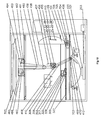
- the automatic cooking machine shown in Fig 1 comprises a pan, a sensor system, an auto adjusting system for gas heating or electrical/electromagnetic heating, an auto feeding system, an auto turnover/taking-out system for cooked materials, and a computer system or other control system.
- Sensor 101,102 are non-contacting sensors. Sensor 102 is installed on the support of the auto feeding system and sensor 101 is installed on the pan cover. They separately detect the temperature and other parameters of cooked materials in the pan when the pan cover is close or open and provide the computer system with feedback data.
- Sensor 105 is a contacting sensor which is installed on the edge of the scoop of the turnover/taking-out system to detect the temperature and other parameters of the cooked materials in the pan and also provides the computer system with feedback data.
- Sensor 107 provides the computer system with feedback data on gas flux and pressure.
- Sensor 106 provides the computer system with feedback data on flame temperature and monitors the burning or extinguishing state of flame.
- Sensor 103 is installed on the outlet of the auto feeding system to provide the computer system with feed-forward data such as the initial temperature of the cooking-material to be cooked.
- Sensor 104 provides the computer system with feed-forward data such as the environmental temperature.
- Sensor 108 provides the computer system with feed-forward data such as the flux and pressure of gas source.
- feed-forward data such as the flux and pressure of gas source.
- the auto adjusting system for gas heating or electrical/electromagnetic heating can be an auto adjusting devices for controlling gas flux, as shown in Fig 2.
- the gas flows into the system via inlet 206, passing through channel 207, a throttling gap on valve core 210 and channel 209, and flows out of the system via outlet 216.
- the motor 205 drives shaft 212 to spin in or out by gears 213 and 214, pushing valve core 210 in axial direction via pushing-rod 211 to change the flux area section and thus to adjust the gas flux.
- Sensor 215 detects linear displacement and angular displacement of shaft 212, and sensor 208 detects the gas flux of the outlet to provide the computer system with feedback data to precisely control the gas flux.
- the auto adjusting system for gas heating or electrical/electromagnetic heating can also be an auto adjusting device for control gas pressure, as shown in Fig 3.
- the gas flows into the system via inlet 223, passing through radial hole 224 on valve core 229 and axial hole 226, enters sensitive cave 225 under the valve core, and generates thrust force upward upon the valve core. If no gas enters sensitive cave 225 or the gas pressure is lower when at the beginning, the thrust force is not large enough to overcome the acting force of spring 230, so that the valve core is at the lowest position, cutting off the inlet 223 and outlet 227 and shutting down the valve.
- the pressure at inlet gets higher and higher with the gas fluxing in, the pressure in cave 225 becomes higher and higher too.
- valve core 229 When the gas pressure of 225 become higher than the acting force of spring 223, the valve core 229 is lifted up and stops at a balance position. In this case, the inlet 223 and outlet 227 are open and the gas flows out from outlet 227. The pressure in cave 225 no longer becomes high and keeps balance with acting fore of spring 230.
- Motor 218 drives shaft 222 to spin in and out along axial direction through gear 220 and 221 to change the pre-tightening force of spring 230, and thus adjusts the pressure used to lift up the valve core.
- Sensor 219 detects linear displacement and angular displacement of shaft 222, and sensor 228 detects the gas pressure of the outlet to provide the computer system with feedback data to precisely control the gas pressure.
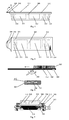
- Fig 4 and 5 show a form of the cooking-material package.
- Raw materials, supplementary or auxiliary materials and semi-finished products are packed in different cells 313 of plastic case 303 according to the feeding sequence when they are put into the pan.
- the upper part of plastic case 303 is sealed by plastic film 311 through hot pressing.
- Fig 6 and 7 show the auto feeding system matched with this kind of package.
- Code bar scanner 304 automatically scans the identification bar 314 and provides the recognition information with the computer system.
- the computer system loads and executes the corresponding cooking software from its memory or from Network.
- motor 317 controlled by the computer system drives rotating-shaft 305 to rotate and thus to separate hot pressed film 311 from the body of plastic case 303.
- the body of the case slides forward and the cooking-material contained in the case drops into the pan under the case.
- the computer system controls rotating-shaft 305 to stop at proper position and the separation between hot pressed plastic film 311 and case 303 stops at the edge of cells 313, which enables only the needed material to drop into the pan at proper moment.
- sensors used to detect linear displacement and angular displacement can be installed to help the computer system for exact control.
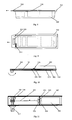
- Fig 8 and 9 show another form of the cooking-material package.
- the raw materials, supplementary materials and semi-finished products are packed in different cells of plastic case 303 according to the feeding sequence when they are put into the pan.
- the upper part of plastic case is sealed with a pushing-pulling plate cover 318.
- Fig 10 and 11 show the auto feeding system matched with this kind of package.
- Bar code scanner 304 automatically scans the identification bar 314 on the packaging case and provides the recognition information with the computer system.
- the computer system loads and executes the corresponding cooking software from its memory or from Network.
- motor 317 controlled by the computer system drives rotating-shaft 305 to rotate and thus to make the winding device 324 roll the soft steel rope 321.
- Stopper 323 stops the movement of plastic case 303 with the pushing-pulling plate cover 318 sliding forward and thus separate 318 from the plastic case 303.
- the materials contained in the case drops into the pan.
- the computer system controls rotating-shaft 305 to stop at proper position and the separation between 318 and 303 stops at the edge of cells 313, which enables only the needed material to drop into the pan at proper moment.
- sensors used to detect linear displacement and angular displacement can be installed to help the computer system for exact control.
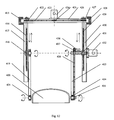
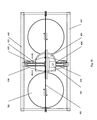
- Fig 12 and 13 show a form of turnover/taking-out system.
- the turnover/taking-out actuator 420 is a scoop-shaped device with one side as its inlet and the other three sides as walls in the shape of bevel surface or curved surface.
- the bottom surface of 420 is a curved surface similar to the shape of the pan bottom.
- This device is fixed on rotating-shaft 421 and 434.
- Motor 436 drives rotating-shafts 421 and 434, together with scoop 420, to rotate through gear 437, chain 438 and gear 435.
- Motor 432 drives rotating-shafts 431 and 418, together with linkers 419, 433 and scoop 420, to rotate.
- Motor 424 drives rotating-shafts 431 and 418, together with linkers 419, 433 and scoop 420, to move vertically along supports 417 and 430 through gears 425, 422, 427, chain 423, and guide screws 416 and 429.
- Crossbeam 426 of the supports moves along sliding grooves (not shown) of a pair of sliding rails 415 and 428, which can move the whole turnover/taking system out of or into the pan.
- the computer system controls this system to complete actions such as turnover, small tossing, large tossing, stirring, taking-out, taking-in, re-feeding, etc according to the requirements of cooking techniques.
- sensors used to detect linear displacement and angular displacement can be installed to help the computer system for exact control.
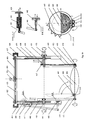
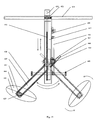
- Fig14 and 15 show another form of turnover/taking-out system.
- the upper curved surface body 444 and the lower curved surface body 443 combine to form an ellipsoid container fixed on rotating-shafts 421 and 434 with its top surface and bottom surface similar to the pan bottom.
- Motor 436 drives rotating-shafts 421 and 434, together with the ellipsoid container, to rotate through gear 437, chain 438 and gear 435.
- Motor 432 drives rotating-shafts 431 and 418, together with linkers 419, 433 and the ellipsoid container, to rotate.
- Motor 424 drives rotating-shafts 431 and 418, together with linkers 419, 433 and the ellipsoid container, to move along supports 417 and 430 vertically through gears 425, 422, 427, chain 423 and guide screws 416 and 429.
- Crossbeam 426 of the supports moves along sliding grooves (not shown) of a pair of sliding rails 415 and 428, which can move the whole turnover/taking system out of or into the pan.
- Rack 442 extends forward through linkage mechanism 441, joggling with gear 447 of the linking shaft of the upper and lower curved surface body. Shaft 445 rotates by 90°, and the curved surface body 444 is opened. When linkers 419 and 433 continues to rise until the protrusion 440 leaves from half-moon 439, spring 446 makes half-moon 439 back to its original position. Rack 442 retracts, departing from gear 447. At this time the protuberance 448 on shaft 445 has rotated 90° to a position shown by 449. Ratchet wheel 450 rotates to a position shown by 451 to block the edge of the protuberance 448 from returning. The upper curved surface body remains open.
- linkers 419 and 433 fall down, the same actions are repeated but in a reverse procedure.
- the upper curved surface closes; ratchet wheel 453 rotates to a position shown by 452 to keep the upper curved surface body closed.
- linkers 419 and 433 can be departed a certain angle from the vertical direction to avoid the contacting of protuberance 440 and half-moon 439 and thus to keep the initial state of the upper curved surface body.
- the computer system controls this system to complete actions such as turnover, small tossing, large tossing, stirring, taking-out, taking-in, re-feeding, etc according to the requirements of cooking techniques.
- sensors used to detect linear displacement and angular displacement can be installed to help the computer system for exact control.
- the turnover/taking-out system is installed on the sliding guide rails 403.
- Motor 401 draws soft steel rope 402 to pull the tripod 454 fixed on the crossbeam 426 of the supports of the turnover/taking-out system and thus drives the turnover/taking-out system to make horizontal movement along the above guide rails to complete the actions of moving out of and into the pain or moving from one pan to another.
- the multiple-pan design can adopt the same mode.
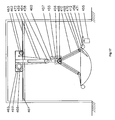
- Fig 17 shows a turnover/tasking-out system with a flexible structure.
- Motor 468 drives scoop 412 to rotate around a rotating-shaft of linker 410 through tapering gears 469 and 470.
- Motor 457 drives linker 410, together with scoop 412, to rotate around a shaft on inner sleeve 460.
- Motor 466 drives reel wheel 467 to reel or release sling rope 459 and thus drives pulley 458 on inner sleeve 460 to move vertically; linker 410 and scoop 412, together with inner sleeve 460, move vertically along outer sleeve 464.
- Motor 463 drives gear 462 on hanger 465 to rotate and thus drives hanger 465, together with the inner and outer sleeves, the linker and the scoop, to move along the guide rail 461.
- the combination of the above movements can realize the turnover action and the taking-out action for the cooked materials. If the scoop interferes with the pan, this turnover/taking-out system with a flexible structure will rise wholly and freely to avoid the damage caused by collision between the pan and the scoop and can adapt the scoop to pans with different curved surfaces.
- Motor 455 drives pan 702 to rotate through gears 471 and 456 and thus change the scooping position with a better effect.
- the control system controls the gas flux and the working state of various other systems according to the feed-forward data provided by sensors 103,104 and 108, and the feedback data provided by sensors 101, 102, 105, 106 and 107.
- a motor drives rotating-shaft 305 to rotate and rolls hot pressed film 311 to separate from packing case 303, the cooking-material drops into the pan 702 from the torn gap.
- the insulated container 308, which can be heated, has three cells storing oil, soup and water respectively.
- a tri-path electromagnetic valve 307 controls individually the switches of the oil cell, the soup cell and the water cell. Oil, water and soup can be separately injected into the pan through a tee pipeline 306.
- Groove 302 and pan cover 701 is installed on rotating-shaft 301.
- the auto feeding system in process of feeding, the auto feeding system is at the lower position below the pan cover.
- motor 414 drives rotating-shaft 301 to rotate and thus drives the pan cover to turn down.
- Motor 404 drives rotating-shaft 301 to move down along support 408 through chain 413, gear 406 and guide screw 407, sending the auto feeding system to the most proper feeding position or covering the pan cover.
- rotating-shaft 301 moves upward to make working space for the turnover/taking-out system.
- Scoop 412 controlled by the control system as above, performs the turnover action and the taking-out action under the requirements of cooking techniques through combined movements of rotating around rotating-shaft 411, rotating around rotating-shaft 409 together with linker 410 and moving along support 405 vertically. If the turnover/taking-out system is needed to move into or out of the pan, motor 401 will drive support 405 to move along sliding guide rail 403.
- 603 is the panel of the control system.
- 602 is a CD diver
- 604 is a keyboard
- 601 is a display
- 703 is a smoke exhauster.
- Fig 18 shows another embodiment of the present invention.
- 203 is an auto adjusting system for gas heating
- 501 is gas burning base
- 703 is a smoke exhauster.
- the dentations on feeding reel 305 are inserted into the holes on sealing film 311 on packing case 303.
- Motor 317 drives rotating-shaft 305 to rotate, rolling and pulling hot pressed film and thus separating it from packing case 303, with the cooking-material dropping into the pan 702 from the torn gap.
- Motor 325 drives gear 326 to rotate, driving the auto feeding system together with packing case 303 to move along guide rail 327, and thus sending the auto feeding system to the most proper position for feeding.
- the insulated container 308 has three cells storing oil, soup and water respectively.
- Motor 468 drives scoop 412 to rotate around the rotating-shaft on linker 410 through tapering gears 469 and 470.
- Motor 457 drives a shaft to rotate around inner sleeve 460 through worm wheel 456 and worm 470.
- Motor 466 drives reel wheel 467 to roll and release steel rope 459 and thus to drive pulley 458 on inner sleeve 460 to move vertically.
- Motor 463 drives gear 462 on hanger 465 to rotate, having hanger 465, together with the inner and outer sleeves, the linker and the scoop ,to move along guide rail 461.
- the turnover action and the taking-out action can be performed under the requirements of cooking techniques through combined movements.
- Motor 455 drives pan 702 to rotate through gear 456, changing the scooping position.
- Motor 706 drives pan cover 701 to rotate to be opened or closed through gears 705 and 704.
- the pan cover can be moved besides the pan along the guide rail.
- Sensor 109 is installed on flexible joint 110 and moves to the detecting position automatically when the pan cover is closed.
Landscapes
- Engineering & Computer Science (AREA)
- Chemical & Material Sciences (AREA)
- Combustion & Propulsion (AREA)
- Mechanical Engineering (AREA)
- General Engineering & Computer Science (AREA)
- Food Science & Technology (AREA)
- Cookers (AREA)
- General Preparation And Processing Of Foods (AREA)
- Baking, Grill, Roasting (AREA)
- Vending Machines For Individual Products (AREA)
- Commercial Cooking Devices (AREA)
Applications Claiming Priority (3)
| Application Number | Priority Date | Filing Date | Title |
|---|---|---|---|
| CN02115320 | 2002-05-31 | ||
| CN02115320 | 2002-05-31 | ||
| PCT/CN2003/000400 WO2003101262A1 (fr) | 2002-05-31 | 2003-05-27 | Appareil de cuisson automatique d'aliments |
Publications (3)
| Publication Number | Publication Date |
|---|---|
| EP1532902A1 true EP1532902A1 (fr) | 2005-05-25 |
| EP1532902A4 EP1532902A4 (fr) | 2008-08-06 |
| EP1532902B1 EP1532902B1 (fr) | 2010-03-24 |
Family
ID=29589496
Family Applications (1)
| Application Number | Title | Priority Date | Filing Date |
|---|---|---|---|
| EP03732191A Expired - Lifetime EP1532902B1 (fr) | 2002-05-31 | 2003-05-27 | Appareil de cuisson automatique d'aliments |
Country Status (5)
| Country | Link |
|---|---|
| EP (1) | EP1532902B1 (fr) |
| AT (1) | ATE461642T1 (fr) |
| AU (1) | AU2003242176A1 (fr) |
| DE (1) | DE60331839D1 (fr) |
| WO (1) | WO2003101262A1 (fr) |
Cited By (16)
| Publication number | Priority date | Publication date | Assignee | Title |
|---|---|---|---|---|
| FR2867841A1 (fr) * | 2004-03-19 | 2005-09-23 | Rational Ag | Dispositif bruleur avec dispositif de commande pour un appareil de cuisson et appareil de cuisson avec un tel dispositif bruleur |
| EP1685781A4 (fr) * | 2003-10-17 | 2007-10-17 | Xiaoyong Liu | Procede de cuisson intelligent |
| FR2920861A1 (fr) * | 2007-09-06 | 2009-03-13 | Fagorbrandt Sas Soc Par Action | Procede de detection d'un dysfonctionnement de l'alimentation en gaz d'un four de cuisson domestique a gaz et four de cuisson domestique associe |
| US9167633B2 (en) | 2006-02-21 | 2015-10-20 | Goji Limited | Food preparation |
| CN105640171A (zh) * | 2016-02-04 | 2016-06-08 | 德奥通用航空股份有限公司 | 自动分菜机 |
| CN106235871A (zh) * | 2016-10-09 | 2016-12-21 | 顾维东 | 一种数控全自动炒菜装置 |
| CN106235870A (zh) * | 2016-10-09 | 2016-12-21 | 顾维东 | 一种全自动炒菜装置 |
| EP3172996A1 (fr) * | 2015-11-30 | 2017-05-31 | Whirlpool Corporation | Systeme de cuisson |
| EP3351857A1 (fr) * | 2017-01-18 | 2018-07-25 | Electrolux Appliances Aktiebolag | Système pour préparer et/ou effectuer un procédé de cuisson automatique |
| JP2019509772A (ja) * | 2015-12-31 | 2019-04-11 | 葛武 | 調理用ロボット |
| JP2019524248A (ja) * | 2017-05-19 | 2019-09-05 | 深▲セン▼飯来科技有限公司Shenzhen Fanlai Technology Co., Ltd. | 自動調理機 |
| JP2019532784A (ja) * | 2017-03-23 | 2019-11-14 | 深▲セン▼飯来科技有限公司Shenzhen Fanlai Technology Co., Ltd. | 膜剥離食材投入機構 |
| CN110772112A (zh) * | 2019-10-31 | 2020-02-11 | 北京鲲鹏神通科技有限公司 | 一种厨房协助机器人 |
| US20200138233A1 (en) * | 2017-05-19 | 2020-05-07 | Coffee Innovations Pty Ltd | Apparatus and method of frothing a quantity of milk |
| EP3570710A4 (fr) * | 2017-01-23 | 2020-12-16 | Shanghai Changshan Intelligent Technology Corporation Limited | Appareil de cuisson automatique et son procédé d'utilisation pour la cuisson |
| EP4636680A4 (fr) * | 2022-12-14 | 2026-03-18 | Mandarin Robotics Inc | Appareil de cuisson automatique |
Families Citing this family (19)
| Publication number | Priority date | Publication date | Assignee | Title |
|---|---|---|---|---|
| US6315224B1 (en) * | 1999-03-26 | 2001-11-13 | Chef'n Corporation | Grater and method of making a grating device |
| CN101233905B (zh) * | 2007-02-01 | 2011-11-02 | 蒋克亮 | 自动烹饪机 |
| CN101836816B (zh) * | 2010-04-12 | 2012-08-08 | 张金凤 | 自动烹饪机 |
| CN102241295A (zh) * | 2011-06-29 | 2011-11-16 | 东莞市天信金属制品有限公司 | 一种自动打开包装盒 |
| US9622617B2 (en) | 2013-03-15 | 2017-04-18 | Aurelio F Barreto | Barbeque grill |
| WO2016202226A1 (fr) * | 2015-06-17 | 2016-12-22 | 深圳市爱可机器人技术有限公司 | Système de cuisson de type au gaz à fonction d'étalonnage de puissance de chauffage automatique |
| CN105147047B (zh) * | 2015-09-17 | 2017-06-06 | 杭州集思帮科技有限公司 | 可视汽烧烹饪装置 |
| CN105366375B (zh) * | 2015-11-25 | 2018-08-07 | 深圳饭来科技有限公司 | 自动投料机构 |
| CN111886448B (zh) * | 2017-11-06 | 2023-06-20 | 帕埃拉斯阿尔塔精密有限公司 | 食物烹饪单元 |
| CN113842025A (zh) * | 2017-12-22 | 2021-12-28 | 李亚锐 | 一种锅体及智能烹调机 |
| CN111103820A (zh) * | 2018-10-26 | 2020-05-05 | 佛山市顺德区美的电热电器制造有限公司 | 烹饪控制方法、装置、烹饪器具和计算机可读存储介质 |
| CN109767558A (zh) * | 2019-01-18 | 2019-05-17 | 合肥道卓科技有限公司 | 智能烹饪中心 |
| CN110279305A (zh) * | 2019-06-24 | 2019-09-27 | 北京鲲鹏神通科技有限公司 | 一种智能厨房烹饪食材自动投放装置 |
| CN110584492A (zh) * | 2019-09-12 | 2019-12-20 | 北京故亭科技有限公司 | 自动烹饪方法 |
| CN111820720B (zh) * | 2020-07-16 | 2024-08-20 | 深圳市饭立得科技有限公司 | 用于容器锅的集成型加热平台及方法 |
| CN112401631B (zh) * | 2020-10-30 | 2022-05-31 | 添可智能科技有限公司 | 一种厨房机器人、调料盒及其控制方法 |
| CN112586991A (zh) * | 2020-12-18 | 2021-04-02 | 苏州神运机器人有限公司 | 复合驱动系统 |
| CN114609932B (zh) * | 2022-05-10 | 2022-07-29 | 北京橡鹭科技有限公司 | 物料投放控制方法、装置及存储介质 |
| CN117369558B (zh) * | 2023-12-06 | 2024-02-06 | 广州蚁窝智能科技有限公司 | 一种基于人工智能的温控保温餐炉控制系统 |
Family Cites Families (9)
| Publication number | Priority date | Publication date | Assignee | Title |
|---|---|---|---|---|
| US4503502A (en) | 1983-06-03 | 1985-03-05 | Chapin Roger A | Method and apparatus for automated chinese stir-fry cooking |
| IE63840B1 (en) * | 1988-04-29 | 1995-06-14 | Lancet Sa | Domestic food cooking apparatus |
| IE903986A1 (en) * | 1990-04-24 | 1991-11-06 | Lancet Sa | Cooking device |
| CN1081866A (zh) * | 1993-06-15 | 1994-02-16 | 李祥 | 食品烹饪装置 |
| US5881632A (en) | 1997-09-02 | 1999-03-16 | Fadoul; Fadoul George | Automatic cooking apparatus |
| CN1314124A (zh) * | 2000-03-20 | 2001-09-26 | 全球电视销售有限公司 | 自动电热烹饪方法和设备 |
| CN2448232Y (zh) * | 2000-11-21 | 2001-09-19 | 李亚锐 | 自动烹调装置 |
| CN1364436A (zh) * | 2001-01-12 | 2002-08-21 | 李亚锐 | 全自动智能烹调方法及系统 |
| CN2493122Y (zh) * | 2001-07-13 | 2002-05-29 | 李玮 | 全自动烹饪机 |
-
2003
- 2003-05-27 AT AT03732191T patent/ATE461642T1/de not_active IP Right Cessation
- 2003-05-27 AU AU2003242176A patent/AU2003242176A1/en not_active Abandoned
- 2003-05-27 WO PCT/CN2003/000400 patent/WO2003101262A1/fr not_active Ceased
- 2003-05-27 EP EP03732191A patent/EP1532902B1/fr not_active Expired - Lifetime
- 2003-05-27 DE DE60331839T patent/DE60331839D1/de not_active Expired - Lifetime
Cited By (24)
| Publication number | Priority date | Publication date | Assignee | Title |
|---|---|---|---|---|
| EP1685781A4 (fr) * | 2003-10-17 | 2007-10-17 | Xiaoyong Liu | Procede de cuisson intelligent |
| FR2867841A1 (fr) * | 2004-03-19 | 2005-09-23 | Rational Ag | Dispositif bruleur avec dispositif de commande pour un appareil de cuisson et appareil de cuisson avec un tel dispositif bruleur |
| US9167633B2 (en) | 2006-02-21 | 2015-10-20 | Goji Limited | Food preparation |
| US10492247B2 (en) | 2006-02-21 | 2019-11-26 | Goji Limited | Food preparation |
| FR2920861A1 (fr) * | 2007-09-06 | 2009-03-13 | Fagorbrandt Sas Soc Par Action | Procede de detection d'un dysfonctionnement de l'alimentation en gaz d'un four de cuisson domestique a gaz et four de cuisson domestique associe |
| US11166598B2 (en) | 2015-11-30 | 2021-11-09 | Whirlpool Corporation | Cooking system |
| US10448776B2 (en) | 2015-11-30 | 2019-10-22 | Whirlpool Corporation | Cooking system |
| EP3172996A1 (fr) * | 2015-11-30 | 2017-05-31 | Whirlpool Corporation | Systeme de cuisson |
| JP2019509772A (ja) * | 2015-12-31 | 2019-04-11 | 葛武 | 調理用ロボット |
| CN105640171A (zh) * | 2016-02-04 | 2016-06-08 | 德奥通用航空股份有限公司 | 自动分菜机 |
| CN106235871B (zh) * | 2016-10-09 | 2019-03-15 | 顾维东 | 一种数控全自动炒菜装置 |
| CN106235870A (zh) * | 2016-10-09 | 2016-12-21 | 顾维东 | 一种全自动炒菜装置 |
| CN106235871A (zh) * | 2016-10-09 | 2016-12-21 | 顾维东 | 一种数控全自动炒菜装置 |
| WO2018134072A1 (fr) * | 2017-01-18 | 2018-07-26 | Electrolux Appliances Aktiebolag | Système de préparation et/ou d'exécution d'un processus de cuisson automatique |
| EP3351857A1 (fr) * | 2017-01-18 | 2018-07-25 | Electrolux Appliances Aktiebolag | Système pour préparer et/ou effectuer un procédé de cuisson automatique |
| EP3570710A4 (fr) * | 2017-01-23 | 2020-12-16 | Shanghai Changshan Intelligent Technology Corporation Limited | Appareil de cuisson automatique et son procédé d'utilisation pour la cuisson |
| JP2019532784A (ja) * | 2017-03-23 | 2019-11-14 | 深▲セン▼飯来科技有限公司Shenzhen Fanlai Technology Co., Ltd. | 膜剥離食材投入機構 |
| JP2019524248A (ja) * | 2017-05-19 | 2019-09-05 | 深▲セン▼飯来科技有限公司Shenzhen Fanlai Technology Co., Ltd. | 自動調理機 |
| US20200138233A1 (en) * | 2017-05-19 | 2020-05-07 | Coffee Innovations Pty Ltd | Apparatus and method of frothing a quantity of milk |
| EP3485768A4 (fr) * | 2017-05-19 | 2020-03-18 | Shenzhen Fanlai Technology Co., Ltd. | Machine de type sauteuse automatique |
| US12256862B2 (en) * | 2017-05-19 | 2025-03-25 | Coffee Innovations Pty Ltd | Apparatus for frothing a quantity of milk |
| CN110772112B (zh) * | 2019-10-31 | 2021-11-02 | 北京鲲鹏神通科技有限公司 | 一种厨房协助机器人 |
| CN110772112A (zh) * | 2019-10-31 | 2020-02-11 | 北京鲲鹏神通科技有限公司 | 一种厨房协助机器人 |
| EP4636680A4 (fr) * | 2022-12-14 | 2026-03-18 | Mandarin Robotics Inc | Appareil de cuisson automatique |
Also Published As
| Publication number | Publication date |
|---|---|
| EP1532902A4 (fr) | 2008-08-06 |
| EP1532902B1 (fr) | 2010-03-24 |
| ATE461642T1 (de) | 2010-04-15 |
| DE60331839D1 (de) | 2010-05-06 |
| WO2003101262A1 (fr) | 2003-12-11 |
| AU2003242176A1 (en) | 2003-12-19 |
Similar Documents
| Publication | Publication Date | Title |
|---|---|---|
| EP1532902B1 (fr) | Appareil de cuisson automatique d'aliments | |
| EP2203098B1 (fr) | Rôtissoire automatique pour cuisson par lots variable | |
| US9775466B2 (en) | Automatic stir-fryer | |
| US10638876B2 (en) | Automatic stir-fryer | |
| EP1685781B9 (fr) | Procede de cuisson intelligent | |
| CN1250141C (zh) | 自动烹调机及其所使用的物料包装 | |
| WO2007147331A1 (fr) | Procédé de mijotage ou de cuisson automatique ou semi-automatique | |
| US5881632A (en) | Automatic cooking apparatus | |
| US10713879B2 (en) | Cooking device for a food vending machine | |
| CN100413443C (zh) | 烹调器具的自动翻动系统及烹调器具 | |
| CN101406265A (zh) | 一种自动/半自动的爆炒烹调方法 | |
| CN210018902U (zh) | 炒菜锅组件及自动炒菜机 | |
| WO2006124799A2 (fr) | Grilloir automatique permettant d'effectuer la cuisson variable par lots | |
| CN100506129C (zh) | 一种智能化的烹调方法 | |
| CN100413438C (zh) | 物料自动投放系统、其所用物料包装以及相应的烹调器具 | |
| CN100518593C (zh) | 一种智能厨师式的烹调方法 | |
| CN100488418C (zh) | 烹调器具的自动盛出装置及烹调器具 | |
| CN220898565U (zh) | 一种具有自动上料功能的新型自动旋转炒锅 | |
| TWI308864B (fr) | ||
| KR200386546Y1 (ko) | 전기히터를 이용한 자동연속 튀김장치 | |
| KR200430609Y1 (ko) | 수직 양면 숯불구이용 숯통 구조 | |
| KR20170109212A (ko) | 스팀과 인덕션 가열을 열원으로 하는 즉석식품 가열조리기 제어장치 | |
| HK1131006A (en) | An automatic or semi-automatic cooking method | |
| HK1094663B (en) | An intelligent cooking method | |
| HK1094663A1 (en) | An intelligent cooking method |
Legal Events
| Date | Code | Title | Description |
|---|---|---|---|
| PUAI | Public reference made under article 153(3) epc to a published international application that has entered the european phase |
Free format text: ORIGINAL CODE: 0009012 |
|
| 17P | Request for examination filed |
Effective date: 20050103 |
|
| AK | Designated contracting states |
Kind code of ref document: A1 Designated state(s): AT BE BG CH CY CZ DE DK EE ES FI FR GB GR HU IE IT LI LU MC NL PT RO SE SI SK TR |
|
| AX | Request for extension of the european patent |
Extension state: AL LT LV MK |
|
| DAX | Request for extension of the european patent (deleted) | ||
| A4 | Supplementary search report drawn up and despatched |
Effective date: 20080708 |
|
| 17Q | First examination report despatched |
Effective date: 20080918 |
|
| GRAP | Despatch of communication of intention to grant a patent |
Free format text: ORIGINAL CODE: EPIDOSNIGR1 |
|
| GRAS | Grant fee paid |
Free format text: ORIGINAL CODE: EPIDOSNIGR3 |
|
| GRAA | (expected) grant |
Free format text: ORIGINAL CODE: 0009210 |
|
| AK | Designated contracting states |
Kind code of ref document: B1 Designated state(s): AT BE BG CH CY CZ DE DK EE ES FI FR GB GR HU IE IT LI LU MC NL PT RO SE SI SK TR |
|
| REG | Reference to a national code |
Ref country code: GB Ref legal event code: FG4D |
|
| REG | Reference to a national code |
Ref country code: CH Ref legal event code: EP |
|
| REG | Reference to a national code |
Ref country code: IE Ref legal event code: FG4D |
|
| REF | Corresponds to: |
Ref document number: 60331839 Country of ref document: DE Date of ref document: 20100506 Kind code of ref document: P |
|
| REG | Reference to a national code |
Ref country code: NL Ref legal event code: VDEP Effective date: 20100324 |
|
| PG25 | Lapsed in a contracting state [announced via postgrant information from national office to epo] |
Ref country code: SI Free format text: LAPSE BECAUSE OF FAILURE TO SUBMIT A TRANSLATION OF THE DESCRIPTION OR TO PAY THE FEE WITHIN THE PRESCRIBED TIME-LIMIT Effective date: 20100324 Ref country code: FI Free format text: LAPSE BECAUSE OF FAILURE TO SUBMIT A TRANSLATION OF THE DESCRIPTION OR TO PAY THE FEE WITHIN THE PRESCRIBED TIME-LIMIT Effective date: 20100324 Ref country code: AT Free format text: LAPSE BECAUSE OF FAILURE TO SUBMIT A TRANSLATION OF THE DESCRIPTION OR TO PAY THE FEE WITHIN THE PRESCRIBED TIME-LIMIT Effective date: 20100324 |
|
| PG25 | Lapsed in a contracting state [announced via postgrant information from national office to epo] |
Ref country code: GR Free format text: LAPSE BECAUSE OF FAILURE TO SUBMIT A TRANSLATION OF THE DESCRIPTION OR TO PAY THE FEE WITHIN THE PRESCRIBED TIME-LIMIT Effective date: 20100625 Ref country code: EE Free format text: LAPSE BECAUSE OF FAILURE TO SUBMIT A TRANSLATION OF THE DESCRIPTION OR TO PAY THE FEE WITHIN THE PRESCRIBED TIME-LIMIT Effective date: 20100324 Ref country code: ES Free format text: LAPSE BECAUSE OF FAILURE TO SUBMIT A TRANSLATION OF THE DESCRIPTION OR TO PAY THE FEE WITHIN THE PRESCRIBED TIME-LIMIT Effective date: 20100705 Ref country code: BE Free format text: LAPSE BECAUSE OF FAILURE TO SUBMIT A TRANSLATION OF THE DESCRIPTION OR TO PAY THE FEE WITHIN THE PRESCRIBED TIME-LIMIT Effective date: 20100324 Ref country code: SE Free format text: LAPSE BECAUSE OF FAILURE TO SUBMIT A TRANSLATION OF THE DESCRIPTION OR TO PAY THE FEE WITHIN THE PRESCRIBED TIME-LIMIT Effective date: 20100324 Ref country code: RO Free format text: LAPSE BECAUSE OF FAILURE TO SUBMIT A TRANSLATION OF THE DESCRIPTION OR TO PAY THE FEE WITHIN THE PRESCRIBED TIME-LIMIT Effective date: 20100324 Ref country code: NL Free format text: LAPSE BECAUSE OF FAILURE TO SUBMIT A TRANSLATION OF THE DESCRIPTION OR TO PAY THE FEE WITHIN THE PRESCRIBED TIME-LIMIT Effective date: 20100324 |
|
| PG25 | Lapsed in a contracting state [announced via postgrant information from national office to epo] |
Ref country code: SK Free format text: LAPSE BECAUSE OF FAILURE TO SUBMIT A TRANSLATION OF THE DESCRIPTION OR TO PAY THE FEE WITHIN THE PRESCRIBED TIME-LIMIT Effective date: 20100324 Ref country code: CZ Free format text: LAPSE BECAUSE OF FAILURE TO SUBMIT A TRANSLATION OF THE DESCRIPTION OR TO PAY THE FEE WITHIN THE PRESCRIBED TIME-LIMIT Effective date: 20100324 Ref country code: BG Free format text: LAPSE BECAUSE OF FAILURE TO SUBMIT A TRANSLATION OF THE DESCRIPTION OR TO PAY THE FEE WITHIN THE PRESCRIBED TIME-LIMIT Effective date: 20100624 |
|
| PG25 | Lapsed in a contracting state [announced via postgrant information from national office to epo] |
Ref country code: MC Free format text: LAPSE BECAUSE OF NON-PAYMENT OF DUE FEES Effective date: 20100531 |
|
| PLBE | No opposition filed within time limit |
Free format text: ORIGINAL CODE: 0009261 |
|
| STAA | Information on the status of an ep patent application or granted ep patent |
Free format text: STATUS: NO OPPOSITION FILED WITHIN TIME LIMIT |
|
| PG25 | Lapsed in a contracting state [announced via postgrant information from national office to epo] |
Ref country code: PT Free format text: LAPSE BECAUSE OF FAILURE TO SUBMIT A TRANSLATION OF THE DESCRIPTION OR TO PAY THE FEE WITHIN THE PRESCRIBED TIME-LIMIT Effective date: 20100726 Ref country code: DK Free format text: LAPSE BECAUSE OF FAILURE TO SUBMIT A TRANSLATION OF THE DESCRIPTION OR TO PAY THE FEE WITHIN THE PRESCRIBED TIME-LIMIT Effective date: 20100324 |
|
| 26N | No opposition filed |
Effective date: 20101228 |
|
| PG25 | Lapsed in a contracting state [announced via postgrant information from national office to epo] |
Ref country code: IT Free format text: LAPSE BECAUSE OF FAILURE TO SUBMIT A TRANSLATION OF THE DESCRIPTION OR TO PAY THE FEE WITHIN THE PRESCRIBED TIME-LIMIT Effective date: 20100324 |
|
| PG25 | Lapsed in a contracting state [announced via postgrant information from national office to epo] |
Ref country code: IE Free format text: LAPSE BECAUSE OF NON-PAYMENT OF DUE FEES Effective date: 20100527 |
|
| PGFP | Annual fee paid to national office [announced via postgrant information from national office to epo] |
Ref country code: CH Payment date: 20120523 Year of fee payment: 10 |
|
| PG25 | Lapsed in a contracting state [announced via postgrant information from national office to epo] |
Ref country code: CY Free format text: LAPSE BECAUSE OF FAILURE TO SUBMIT A TRANSLATION OF THE DESCRIPTION OR TO PAY THE FEE WITHIN THE PRESCRIBED TIME-LIMIT Effective date: 20100324 |
|
| PG25 | Lapsed in a contracting state [announced via postgrant information from national office to epo] |
Ref country code: LU Free format text: LAPSE BECAUSE OF NON-PAYMENT OF DUE FEES Effective date: 20100527 Ref country code: HU Free format text: LAPSE BECAUSE OF FAILURE TO SUBMIT A TRANSLATION OF THE DESCRIPTION OR TO PAY THE FEE WITHIN THE PRESCRIBED TIME-LIMIT Effective date: 20100925 |
|
| PG25 | Lapsed in a contracting state [announced via postgrant information from national office to epo] |
Ref country code: TR Free format text: LAPSE BECAUSE OF FAILURE TO SUBMIT A TRANSLATION OF THE DESCRIPTION OR TO PAY THE FEE WITHIN THE PRESCRIBED TIME-LIMIT Effective date: 20100324 |
|
| REG | Reference to a national code |
Ref country code: CH Ref legal event code: PL |
|
| PG25 | Lapsed in a contracting state [announced via postgrant information from national office to epo] |
Ref country code: LI Free format text: LAPSE BECAUSE OF NON-PAYMENT OF DUE FEES Effective date: 20130531 Ref country code: CH Free format text: LAPSE BECAUSE OF NON-PAYMENT OF DUE FEES Effective date: 20130531 |
|
| REG | Reference to a national code |
Ref country code: FR Ref legal event code: PLFP Year of fee payment: 14 |
|
| PGFP | Annual fee paid to national office [announced via postgrant information from national office to epo] |
Ref country code: GB Payment date: 20160520 Year of fee payment: 14 Ref country code: DE Payment date: 20160520 Year of fee payment: 14 |
|
| PGFP | Annual fee paid to national office [announced via postgrant information from national office to epo] |
Ref country code: FR Payment date: 20160520 Year of fee payment: 14 |
|
| REG | Reference to a national code |
Ref country code: DE Ref legal event code: R119 Ref document number: 60331839 Country of ref document: DE |
|
| GBPC | Gb: european patent ceased through non-payment of renewal fee |
Effective date: 20170527 |
|
| REG | Reference to a national code |
Ref country code: FR Ref legal event code: ST Effective date: 20180131 |
|
| PG25 | Lapsed in a contracting state [announced via postgrant information from national office to epo] |
Ref country code: DE Free format text: LAPSE BECAUSE OF NON-PAYMENT OF DUE FEES Effective date: 20171201 Ref country code: GB Free format text: LAPSE BECAUSE OF NON-PAYMENT OF DUE FEES Effective date: 20170527 |
|
| PG25 | Lapsed in a contracting state [announced via postgrant information from national office to epo] |
Ref country code: FR Free format text: LAPSE BECAUSE OF NON-PAYMENT OF DUE FEES Effective date: 20170531 |