EP1533722A2 - Vérification pour la conception à l'aide de techniques formelles - Google Patents
Vérification pour la conception à l'aide de techniques formelles Download PDFInfo
- Publication number
- EP1533722A2 EP1533722A2 EP04026607A EP04026607A EP1533722A2 EP 1533722 A2 EP1533722 A2 EP 1533722A2 EP 04026607 A EP04026607 A EP 04026607A EP 04026607 A EP04026607 A EP 04026607A EP 1533722 A2 EP1533722 A2 EP 1533722A2
- Authority
- EP
- European Patent Office
- Prior art keywords
- model
- design
- circuit design
- verification
- verify
- Prior art date
- Legal status (The legal status is an assumption and is not a legal conclusion. Google has not performed a legal analysis and makes no representation as to the accuracy of the status listed.)
- Withdrawn
Links
Images



Classifications
-
- G—PHYSICS
- G06—COMPUTING OR CALCULATING; COUNTING
- G06F—ELECTRIC DIGITAL DATA PROCESSING
- G06F30/00—Computer-aided design [CAD]
- G06F30/30—Circuit design
- G06F30/32—Circuit design at the digital level
- G06F30/33—Design verification, e.g. functional simulation or model checking
- G06F30/3323—Design verification, e.g. functional simulation or model checking using formal methods, e.g. equivalence checking or property checking
Definitions
- This application relates to design verification and, more specifically, to formal analysis verification techniques.
- Verification of a circuit design typically involves testing the circuit design before the design is physically implemented as a circuit (e.g., fabricated as an integrated circuit). In this way, errors (i.e., "bugs") in the design may be identified before the designer incurs the expense of fabrication.
- Simulation-based tools have traditionally been used to verify designs. These tools typically verify a design by randomly applying tests to portions of the design. However, simulation-based validation methodologies often fail to discover corner-case design errors.
- An example of a corner-case error may include an error that does not occur until a specific set of conditions occur at the same time wherein that set of conditions occurs relatively infrequently.
- formal techniques have been proposed for use in verification of circuit designs.
- the concept behind formal techniques is to thoroughly search the design for errors. Examples of formal techniques include model checking, theorem proving and symbolic simulation.
- Formal techniques are applied to industrial design problems such as verification of a circuit design. These techniques may include, for example, making verification decisions, defining properties to verify a design, creating an abstraction of the design and model checking. In some embodiments, verification may be further extended by performance analysis and/or verification of sequential operations.
- an abstraction e.g., a reduced model
- this abstraction is used in the model checking process. For example, building on classic model checking, an induction technique may be employed to avoid state explosion as the environment model becomes more sophisticated. As a result, the model checking operation may be performed more efficiently.
- a definition of "high-quality" bugs may be presented and results analyzed with respect to that definition. In this way, the results of the formal techniques may be compared with results from other verification techniques.
- the verification is extended to identify performance margin.
- Identifying performance margin may include, for example, modifying properties and applying the modified properties to the abstraction to identify timing margins. Such performance analysis may not be achieved by conventional formal or simulation approaches independently.
- the verification is extended to analyze design performance of sequential operations. This analysis may involve, for example, identifying initial and residual states of internal registers to be applied during model checking.
- a symbolic model checker validates circuits such as those found in an integrated circuit (i.e., a "chip").
- a symbolic model checker such as Cadence SMV may be used to validate a circuit design with a dynamic nature and great concurrency such as an Ethernet switching logic block in a Gigabit Ethernet networking chip.
- abstraction may be applied to portions of the switching block to reduce the complexity of the model to be checked.
- performance such as switch latency may be verified using the described techniques.
- the techniques described herein may be applied to verify designs such as a networking chip that may have fundamentally different verification problems due to, for example, the absence of exact specifications.
- a method of verifying a circuit design comprises:
- FIG. 1 is a flowchart that represents one embodiment of design verification operations that may be performed in accordance with the invention.
- these operations are applied to a circuit design.
- a circuit design may be defined using a register-transfer-level (“RTL”) tool. It should be appreciated, however, that these operations may be applied to other types of designs.
- RTL register-transfer-level
- a model of the circuit design is defined. This may involve, for example, identifying features of the design and identifying issues that affect verification decisions.
- a given design may consist of various registers, tables and logic operations that need to be characterized to verify the design.
- decisions regarding the environment model may be made to increase the efficiency of the verification process. For example, a decision may be made to verify concurrent operations but not verify sequential operations.
- various properties are defined to verify the design. This process may involve, for example, defining, based on an extensive knowledge of the design, the state of internal registers under various conditions. For example, if the circuit is operating as intended the circuit may be designed such that after a given operation has been performed the values in a register may be limited to a certain values. If the register does not contain the expected values an error condition (and a corresponding "trace") may be generated during model checking.
- the properties may be defined by writing a specification of the design using, for example, computational tree logic ("CTL") specification language.
- CTL computational tree logic
- each property may be used to verify a different property of the design. For example, in embodiments where the design is defined in RTL, each property may verify a different RTL function.
- the properties may not be completely based on the design definition. As a result, the properties may not include the same errors as the design.
- Abstraction techniques may be applied to the model to reduce the size of the model (block 106). For example, induction may be applied to a table to establish that if a property is verified against a subset of the table then that property necessarily is verified against the entire table. In this way, the number of operations required during the model checking stage maybe substantially reduced because model checking may be performed on the subset of the table rather than the entire table.
- Examples of design aspects that may be reduced through the use of abstraction may include, for example, the size of tables, the number of entries in a table, the length of an address, the number of ports. It should be appreciated that abstraction is not limited to these examples and may be applied to many different aspects of a design.
- the reduced model may be generated, for example, by recoding the RTL design using a tool such as ePERL or VPP.
- Model checking is performed on the reduced model (block 108). Model checking may involve, for example, performing a state transversal to verify the design. Typically, the various properties are run at different times with different iterations in sequence to test various aspects of the design.
- the model checker may generate a trace.
- the trace may be analyzed to determine why the design does not satisfy the property.
- model checker Cadence symbolic model verifier
- Conventional model checkers may utilize binary decision diagrams (“BDD”) and/or satisfiability solvers ("SAT").
- BDD binary decision diagrams
- SAT satisfiability solvers
- the results of the model checking may then be applied to the design. For example, once a bug is found, the corresponding error in the design may be modified. The verification process may then be performed again.
- Additional processes may be performed to improve the verification of the design.
- performance analysis may be performed to determine, for example, performance margins in the design.
- block 114 sequential operations may be verified. Blocks 112 and 114 will be discussed in more detail in conjunction with Figures 2 and 3, respectively.
- FIG. 2 is a flowchart that represents one embodiment of performance analysis operations that may be performed in accordance with the invention.
- Performance analysis may involve, for example, determining a worst case condition for an operation.
- performance analysis may be used to determine the maximum number of clock cycles within which a given operation must be completed.
- Such an analysis may be critical in a design where proper operation of a subsequent operation depends on a preceding operation being completed before the subsequent operation begins.
- one or more properties are defined for the performance analysis.
- a property may be designed so that a specified number of cycles occurs before a given operation completes.
- the properties are applied to the reduced model (block 204). This may be accomplished, for example, using a model checker.
- the model checker will generate a result that indicates whether the design satisfies the property. For example, this result may indicate whether the design is operating within a design limit.
- the properties may be modified to further test the limits of the design (block 208). For example, in the example referred to in conjunction with block 202, the number of clock cycles within which the operation completes may be increased. After the property has been modified, the properties are again applied to the reduced model (block 204) to determine whether a design limit has been reached.
- the design limit e.g., a worst case condition
- the model checker will generate a trace that may be analyzed to determine where the design limit was reached. This information may be used, for example, to define a performance margin of one or more aspects of the design.
- the trace may be used to determine the exact conditions (e.g., states of registers and variables, specific operations that were performed, etc.) under which the design limit is met. This information may be useful in redesigning the circuit to improve its performance.
- these results may then be applied to the design.
- the design may be modified if the performance margin needs to be increased.
- Figure 3 is a flowchart that represents one embodiment of sequential operation verification that may be performed in accordance with the invention.
- a model may be designed such that it does not take sequential operations into account.
- the operations described in Figure 3 may be used, for example, to improve the verification provided by such a model.
- One problem that may arise when verifying sequential operations is that the initial state of the operation may not be readily determinable for a subsequent operation. This problem may arise when the prior operation is not designed to set all the states used in the process to one or more predefined states. Accordingly, to effectively test such sequential operations, it is desirable to model the potential residual states that may result after a prior operation. In this way the operation of the subsequent operation may be verified more effectively.
- a set of initial states (e.g., internal states of the design such as the values of registers and variables) is defined for a sequential operation. This includes defining the known initial states (e.g., a reset state) and the residual states (e.g., states that exist after logic operations tend to "settle down") that may result from a prior operation.
- the superset of initial conditions is defined by a series of subsets of the superset.
- a prediction may be made as to the projection of the subsets on sets of internal states (e.g., residual states). These internal states may, for example, relate to the states of registers.
- properties designed to check the subsequent operations may then be applied to the design (e.g., using a model checker). These properties may be verified using the subsets of initial states that were determined as discussed above.
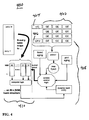
- FIG. 4 an example is presented of the application of the above techniques to verify a Gigabit Ethernet switch.
- This example first involves, in conjunction with Figure 4, describing the functionality and micro-architecture of the design. Then, specific features and intuitive observations that affect verification decisions are identified. Next, basic abstraction techniques are defined. Experimental results are then outlined by introducing two metrics to analyze bug quality in conjunction with Figures 5 and 6. Examples of how the model checking capability may be extended including performance analysis ( Figure 7) are presented. Finally, conclusions that may be made based on the above are discussed.
- FIG 4 depicts one embodiment of a Gigabit Ethernet switch 400 that includes a single chip with 12 Gigabit Ethernet (“GE”) ports 402, one 10-Gigabit high-speed interconnect (“10G”) 404 and a CPU interface 406.
- the switch 400 accomplishes switching functions such as Ethernet switching (Layer 2, or L2), IP switching (Layer 3, or L3) and higher level switching in an Address Resolution Logic (“ARL”) block, a portion of which is designated as block 408 in Figure 4.
- Ethernet switching Layer 2, or L2
- IP switching Layer 3, or L3
- ARL Address Resolution Logic
- each port (e.g., a port associated with a GE 402 or 10G 404) sends a request to the ARL when that port receives a packet.
- the ARL logic returns an egress port based on the L2 or L3 destination address.
- L2 and L3 functions use hash tables, referred to as the L2 table and the L3 table, respectively. An example of verification of the L2 table follows.
- the L2 table maps MAC addresses to ports. Packets from Gigabit ports are forwarded to the appropriate egress port based on their destination MAC addresses. Switching information, in the form of a MAC address mapped to a port, is both learned and updated dynamically in hardware.
- the 10G port is an interconnect.
- the CPU modifies the table by inserting or deleting entries, which may be exempt from dynamic updates. Entries are dynamically "aged" out of the table based either on usage over time, or upon request by the CPU.
- the ARL For each packet, there are at most three possible actions that the ARL performs: source MAC address lookup, destination MAC address lookup, and dynamic learning. If the chip is running at 125MHz, the L2 table logic should finish these actions within 84 cycles for each Gigabit port and within 8 cycles for the 10-Gigabit port.
- the L2 table is structured as a hash table 410 as depicted in Figure 1.
- the 16K logical entries are mapped to 2K buckets, with 8 entries per bucket, using a hash function. There is no ordering between the buckets. Similarly, within each bucket, there is no ordering among the entries. Duplicate entries within a bucket are strictly forbidden. Dynamic modifications are read-modify-write operations which require coherency. The reads and writes are decoupled. Aging has lower priority than lookups, so the design accounts for starvation cases.
- the L2 table logic has traditionally been difficult to verify due to its dynamic nature. First, there may be no high level learning specification. Learns may be cancelled for many reasons. Without knowing the exact state of the logic on a cycle-accurate basis, it may be almost impossible to predict when learns happen. Aging and CPU operations also contribute dynamic activity, resulting in corner cases that are difficult to stimulate using traditional simulation techniques.
- performance issues may be difficult to identify in simulation.
- the design must handle multiple processes concurrently, fairly, and efficiently to meet throughput and latency considerations. Multiple operations associated with a single packet may be decoupled over many cycles. Erroneous behavior may thus result in an observable effect thousands of cycles after the fact, or not at all, depending on the test or application. This makes verifying performance in simulation difficult.
- teachings provided herein may provide more effective verification as compared to traditional simulation techniques.
- abstraction may be applied to reduce the design size.
- the L2 table logic includes approximately 3000 registers and a 16K-entry (1Mbit) lookup table. It may be impracticable to verify a large design with complicated properties such as this with state-of-the-art model checkers. Thus, there may be advantages in applying aggressive abstraction even though this may result in some important features not being completely verified.
- h is a hash function that maps MAC addresses to indices of the L2 table.
- L does not include the labels related to the hash function.
- M ⁇ t be a short-hand notation for the model M where a function t is disabled.
- M ⁇ aging represents the reduced L2 table model where aging is disabled.
- Lemma 1 implies that the buckets in the L2 table are fully symmetric when aging is disabled. Thus, instead of modeling all 2048 buckets, it may only be necessary to model two buckets. Here, the buckets are independent, yet effectively identical. Thus, the operation of one bucket is the same as the operation of another bucket.
- the reduced L2 table is used because the original table may be too large for practical verification.
- the aging behavior may be modified to match the reduced table. This may, however, introduce both false positive and false negative behaviors into the abstracted model. Such unwanted behaviors may be avoided by proper analysis of the design and debugging.
- Similar symmetry may also exist within buckets. For example, any two entries within a bucket may be symmetric. Thus, it may be possible to only model two entries per bucket, rather than eight entries per bucket.
- the MAC addresses may be represented by two bits instead of 48 bits because there are only four entries in the reduced L2 table. This is a known technique in formal verification.
- the behaviors of the 12 Gigabit ports may be independent even though they may not be symmetric. This lack of symmetry may, for example, be a result of arbitration whereby one port is assigned a higher priority than another port.
- the reduced model may incorporate at most two Gigabit ports instead of twelve.
- the 10-Gigabit port and the CPU interface are modeled accurately.
- the size of the L2 table model may be reduced to fewer than 150 registers. See Table 1.
- the environment model also may be simplified.
- a request from a Gigabit port to the L2 table arrives every 84 cycles. It may be difficult for SMV to complete a fix-point computation if every port request is modeled precisely.
- a single request from multiple ports may be more interesting from a design verification point of view than multiple requests from a single port. Therefore, only one request per port may be modeled, significantly reducing the verification computation time.
- ePerl may be used to generate the model and its related properties automatically. If a property is falsified by SMV, the tool may generate a counterexample that explains why that property is false.
- the number of properties defined to verify a design depends, in general, on the complexity of the design. In some applications, the number of properties may be between 150 and 300 properties. A typical runtime for every property may range, for example, from 15 seconds to 2 hours. To verify 35 different configurations and where all design changes are regressed against these 35 configurations it may take, for example, eight person months to complete the formal verification process.
- Verification as discussed herein may be more efficient than conventional simulation techniques. For example, a simulator may observe signals at the interface of the ARL block. Hence, it not only should stimulate the error behavior in the L2 table logic, it also should make them visible at the ARL interface. This reduces the effectiveness of the simulator.
- error stimulus To quantify the quality of bugs discovered, two metrics may be defined: error stimulus and error visibility.
- the error visibility (“EV”) of a bug is a function of time and input stimuli.
- EV time is the number of cycles required for erroneous behavior to propagate to the test bench.
- EV is evaluated conservatively because EV time is approximated using the shortest trace and EV stim is the upper-bound probability for stimuli required to propagate the bug.
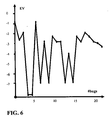
- Figures 5 and 6 Two examples of the error stimulus ES and error visibility EV are depicted in Figures 5 and 6.
- the X axis corresponds to the cumulative number of bugs and the Y axis corresponds to ES and EV separately.
- the Y axis is in logarithm scale.
- Figure 5 depicts that it is much more difficult to stimulate bug No. 16 than bug No. 15. It may be relatively easy for a simulator to detect bug No. 15. In contrast, without formal approaches, it may be extremely difficult for random simulation to detect bug No. 16.
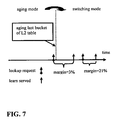
- SMV may be used to determine that a learn is served far later than expected when the logic transitions from the aging mode to the normal switching mode. If a lookup request comes just before that transition, it is possible that its learn happens much later.
- performance analysis may be used to determine, for example, that the performance requirement for learns is only marginally satisfied. For example, the margin for learns may actually be 3% rather than 21% (see, for example, Figure 7).
- the performance analysis process may involve constructing properties to test the design limits, performing model checking and modifying the properties to determine the actual design limits.
- properties may be defined to test the lookup and learn operations. Starting with an SMV trace, an initial informal analysis of the margin may be made. The lookup and learns may then be repeatedly pushed back later in the request cycle (e.g., by modifying the properties) until SMV generates a trace.
- this problem may be addressed by modeling consecutive requests using a set Q of initial states larger than I, i.e., I ⁇ Q , and Q - I models the set of residual states.
- the L2 table may already be modeled non-deterministically. Thus, only the initial values for the registers outside the L2 table may need to be considered. This results in the following theorem.
- M ⁇ req (S, I, R ⁇ req, L) be the L2 table model with only one request for each port and p be an ACTL property on M ⁇ req.
- I ⁇ Q , Q ⁇ S and M' ⁇ req ( S , Q, R ⁇ req, L) be a modified Kripke structure using Q as an initial set of states. Then where
- Q i Q i1 x ... x Q ij x I k1 x ... x I kp may be used as the set of initial states for model checking. It may not always be possible to fully verify the intended property on M with this approximation. However, this extension does increase verification confidence.
- Different embodiments of the invention may be implemented using a variety of hardware and software processing components.
- hardware components such as controllers, state machines and/or logic are used in a system constructed in accordance with the invention.
- code such as software or firmware executing on one or more processing devices may be used to implement one or more of the described operations.
Landscapes
- Engineering & Computer Science (AREA)
- Computer Hardware Design (AREA)
- Physics & Mathematics (AREA)
- Theoretical Computer Science (AREA)
- Evolutionary Computation (AREA)
- Geometry (AREA)
- General Engineering & Computer Science (AREA)
- General Physics & Mathematics (AREA)
- Design And Manufacture Of Integrated Circuits (AREA)
- Tests Of Electronic Circuits (AREA)
Applications Claiming Priority (6)
| Application Number | Priority Date | Filing Date | Title |
|---|---|---|---|
| US835561 | 1992-02-14 | ||
| US52436503P | 2003-11-21 | 2003-11-21 | |
| US524365P | 2003-11-21 | ||
| US56320504P | 2004-04-17 | 2004-04-17 | |
| US563205P | 2004-04-17 | ||
| US10/835,561 US20050114809A1 (en) | 2003-11-21 | 2004-04-29 | Design verification using formal techniques |
Publications (2)
| Publication Number | Publication Date |
|---|---|
| EP1533722A2 true EP1533722A2 (fr) | 2005-05-25 |
| EP1533722A3 EP1533722A3 (fr) | 2005-06-01 |
Family
ID=34437681
Family Applications (1)
| Application Number | Title | Priority Date | Filing Date |
|---|---|---|---|
| EP04026607A Withdrawn EP1533722A3 (fr) | 2003-11-21 | 2004-11-09 | Vérification pour la conception à l'aide de techniques formelles |
Country Status (4)
| Country | Link |
|---|---|
| US (2) | US20050114809A1 (fr) |
| EP (1) | EP1533722A3 (fr) |
| CN (1) | CN1667622B (fr) |
| TW (1) | TWI266216B (fr) |
Families Citing this family (21)
| Publication number | Priority date | Publication date | Assignee | Title |
|---|---|---|---|---|
| US7076753B2 (en) * | 2003-12-18 | 2006-07-11 | Synopsys, Inc. | Method and apparatus for solving sequential constraints |
| US7237208B1 (en) * | 2004-04-05 | 2007-06-26 | Jasper Design Automation, Inc. | Managing formal verification complexity of designs with datapaths |
| US7290230B2 (en) * | 2005-03-17 | 2007-10-30 | Fujitsu Limited | System and method for verifying a digital design using dynamic abstraction |
| US7367002B2 (en) * | 2005-04-14 | 2008-04-29 | International Business Machines Corporation | Method and system for parametric reduction of sequential designs |
| US7370298B2 (en) * | 2005-04-14 | 2008-05-06 | International Business Machines Corporation | Method for heuristic preservation of critical inputs during sequential reparameterization |
| ATE488808T1 (de) * | 2005-09-15 | 2010-12-15 | Onespin Solutions Gmbh | Verfahren zur bestimmung der güte einer menge von eigenschaften, verwendbar zur verifikation and zur spezifikation von schaltungen |
| US7437690B2 (en) * | 2005-10-13 | 2008-10-14 | International Business Machines Corporation | Method for predicate-based compositional minimization in a verification environment |
| US20070168372A1 (en) * | 2006-01-17 | 2007-07-19 | Baumgartner Jason R | Method and system for predicate selection in bit-level compositional transformations |
| US8073798B2 (en) * | 2007-05-24 | 2011-12-06 | Palo Alto Research Center Incorporated | Dynamic domain abstraction through meta-analysis |
| US7908576B2 (en) * | 2007-12-10 | 2011-03-15 | Inpa Systems, Inc. | Method of progressively prototyping and validating a customer's electronic system design |
| US8136065B2 (en) * | 2007-12-10 | 2012-03-13 | Inpa Systems, Inc. | Integrated prototyping system for validating an electronic system design |
| US8032848B2 (en) * | 2009-01-29 | 2011-10-04 | Synopsys, Inc. | Performing abstraction-refinement using a lower-bound-distance to verify the functionality of a circuit design |
| US20100313175A1 (en) * | 2009-06-05 | 2010-12-09 | Advanced Micro Devices, Inc. | Verification systems and methods |
| US8862439B1 (en) * | 2009-06-25 | 2014-10-14 | Cadence Design Systems, Inc. | General numeric backtracking algorithm for solving satifiability problems to verify functionality of circuits and software |
| US9471327B2 (en) | 2013-08-20 | 2016-10-18 | International Business Machines Corporation | Verifying forwarding paths in pipelines |
| US9058463B1 (en) * | 2013-12-03 | 2015-06-16 | Cavium, Inc. | Systems and methods for specifying. modeling, implementing and verifying IC design protocols |
| US9606773B2 (en) * | 2014-06-10 | 2017-03-28 | Toyota Motor Engineering & Manufacturing North America, Inc. | Simulation-guided incremental stability analysis |
| US10002218B2 (en) | 2015-03-12 | 2018-06-19 | Cavium, Inc. | Verification of a multichip coherence protocol |
| US10331829B2 (en) | 2015-12-15 | 2019-06-25 | International Business Machines Corporation | System design using accurate performance models |
| GB2550614B (en) * | 2016-05-25 | 2019-08-07 | Imagination Tech Ltd | Assessing performance of a hardware design using formal verification and symbolic tasks |
| US11314620B1 (en) * | 2020-12-09 | 2022-04-26 | Capital One Services, Llc | Methods and systems for integrating model development control systems and model validation platforms |
Family Cites Families (15)
| Publication number | Priority date | Publication date | Assignee | Title |
|---|---|---|---|---|
| US6141633A (en) * | 1997-02-28 | 2000-10-31 | Fujitsu Limited | Logical device verification method and apparatus |
| US6080203A (en) * | 1997-12-18 | 2000-06-27 | Advanced Micro Devices, Inc. | Apparatus and method for designing a test and modeling system for a network switch device |
| US5999717A (en) * | 1997-12-31 | 1999-12-07 | Motorola, Inc. | Method for performing model checking in integrated circuit design |
| US6324496B1 (en) * | 1998-06-18 | 2001-11-27 | Lucent Technologies Inc. | Model checking of hierarchical state machines |
| US6311293B1 (en) | 1998-12-14 | 2001-10-30 | Lucent Technologies Inc. | Detecting of model errors through simplification of model via state reachability analysis |
| US7103053B2 (en) * | 2000-05-03 | 2006-09-05 | Broadcom Corporation | Gigabit switch on chip architecture |
| US6708143B1 (en) | 2000-05-22 | 2004-03-16 | Lucent Technologies Inc. | Verification coverage method |
| US6728939B2 (en) * | 2001-01-08 | 2004-04-27 | Siemens Aktiengesellschaft | Method of circuit verification in digital design |
| US6929630B2 (en) * | 2002-05-07 | 2005-08-16 | Baylor College Of Medicine | Infusion clamp |
| US7711525B2 (en) * | 2002-05-30 | 2010-05-04 | Nec Corporation | Efficient approaches for bounded model checking |
| US7058910B2 (en) * | 2002-06-27 | 2006-06-06 | The United States Of America As Represented By The Secretary Of The Navy | Invariant checking method and apparatus using binary decision diagrams in combination with constraint solvers |
| US7788556B2 (en) * | 2002-11-13 | 2010-08-31 | Fujitsu Limited | System and method for evaluating an erroneous state associated with a target circuit |
| US6957404B2 (en) * | 2002-12-20 | 2005-10-18 | International Business Machines Corporation | Model checking with layered localization reduction |
| US7203917B2 (en) * | 2003-04-07 | 2007-04-10 | Nec Laboratories America, Inc. | Efficient distributed SAT and SAT-based distributed bounded model checking |
| US7742907B2 (en) * | 2003-04-15 | 2010-06-22 | Nec Laboratories America, Inc. | Iterative abstraction using SAT-based BMC with proof analysis |
-
2004
- 2004-04-29 US US10/835,561 patent/US20050114809A1/en not_active Abandoned
- 2004-11-09 EP EP04026607A patent/EP1533722A3/fr not_active Withdrawn
- 2004-11-17 TW TW093135264A patent/TWI266216B/zh not_active IP Right Cessation
- 2004-11-22 CN CN2004100976180A patent/CN1667622B/zh not_active Expired - Fee Related
-
2007
- 2007-04-16 US US11/735,808 patent/US7562322B2/en not_active Expired - Fee Related
Also Published As
| Publication number | Publication date |
|---|---|
| US20050114809A1 (en) | 2005-05-26 |
| TW200534131A (en) | 2005-10-16 |
| EP1533722A3 (fr) | 2005-06-01 |
| US20070186197A1 (en) | 2007-08-09 |
| TWI266216B (en) | 2006-11-11 |
| US7562322B2 (en) | 2009-07-14 |
| CN1667622B (zh) | 2010-10-06 |
| CN1667622A (zh) | 2005-09-14 |
Similar Documents
| Publication | Publication Date | Title |
|---|---|---|
| US7562322B2 (en) | Design verification for a switching network logic using formal techniques | |
| Lahiri et al. | A symbolic approach to predicate abstraction | |
| US20050138474A1 (en) | Circuit verification using multiple engines | |
| US6698003B2 (en) | Framework for multiple-engine based verification tools for integrated circuits | |
| US8359561B2 (en) | Equivalence verification between transaction level models and RTL at the example to processors | |
| US7996800B2 (en) | Computer program product for design verification using sequential and combinational transformations | |
| US20090049416A1 (en) | Computer Program Product for Extending Incremental Verification of Circuit Design to Encompass Verification Restraints | |
| US20060190873A1 (en) | Exploiting suspected redundancy for enhanced design verification | |
| El-Ashry et al. | On error injection for NoC platforms: a UVM-based generic verification environment | |
| Ahmed et al. | QUEBS: Qualifying event based search in concolic testing for validation of RTL models | |
| Lamport et al. | Specifying and verifying systems with TLA+ | |
| US9633153B1 (en) | Method, system, and computer program product for verifying an electronic design using stall prevention requirements of electronic circuit design models of the electronic design | |
| Kim et al. | Sign-off with Bounded Formal Verification Proofs | |
| US7308657B2 (en) | Method for generating hints for program analysis | |
| Foster et al. | Guidelines for creating a formal verification testplan | |
| Habibi et al. | An approach for the verification of systemc designs using asml | |
| CN113496106A (zh) | 用于验证排序器的方法和系统 | |
| Lu et al. | Verifying a gigabit ethernet switch using SMV | |
| Bingham | Automatic Non-Interference Lemmas for Parameterized Model Checking. | |
| US11526643B1 (en) | Enumerating coverage based on an architectural specification | |
| Durand et al. | Model checking AUTOSAR components with CBMC | |
| Darbari et al. | Industrial strength formal using abstractions | |
| Ben-David et al. | Scalable distributed on-the-fly symbolic model checking | |
| Zheng et al. | Local state space analysis leads to better partial order reduction | |
| Yeung et al. | Raising the level of Formal Signoff with End-to-End Checking Methodology |
Legal Events
| Date | Code | Title | Description |
|---|---|---|---|
| PUAI | Public reference made under article 153(3) epc to a published international application that has entered the european phase |
Free format text: ORIGINAL CODE: 0009012 |
|
| PUAL | Search report despatched |
Free format text: ORIGINAL CODE: 0009013 |
|
| AK | Designated contracting states |
Kind code of ref document: A2 Designated state(s): AT BE BG CH CY CZ DE DK EE ES FI FR GB GR HU IE IS IT LI LU MC NL PL PT RO SE SI SK TR |
|
| AX | Request for extension of the european patent |
Extension state: AL HR LT LV MK YU |
|
| AK | Designated contracting states |
Kind code of ref document: A3 Designated state(s): AT BE BG CH CY CZ DE DK EE ES FI FR GB GR HU IE IS IT LI LU MC NL PL PT RO SE SI SK TR |
|
| AX | Request for extension of the european patent |
Extension state: AL HR LT LV MK YU |
|
| 17P | Request for examination filed |
Effective date: 20051201 |
|
| AKX | Designation fees paid |
Designated state(s): DE FR GB |
|
| RAP1 | Party data changed (applicant data changed or rights of an application transferred) |
Owner name: BROADCOM CORPORATION |
|
| 17Q | First examination report despatched |
Effective date: 20080204 |
|
| STAA | Information on the status of an ep patent application or granted ep patent |
Free format text: STATUS: THE APPLICATION IS DEEMED TO BE WITHDRAWN |
|
| 18D | Application deemed to be withdrawn |
Effective date: 20140219 |