EP1533833A1 - Dampfphasenepitaxiebauelement - Google Patents
Dampfphasenepitaxiebauelement Download PDFInfo
- Publication number
- EP1533833A1 EP1533833A1 EP02807524A EP02807524A EP1533833A1 EP 1533833 A1 EP1533833 A1 EP 1533833A1 EP 02807524 A EP02807524 A EP 02807524A EP 02807524 A EP02807524 A EP 02807524A EP 1533833 A1 EP1533833 A1 EP 1533833A1
- Authority
- EP
- European Patent Office
- Prior art keywords
- wafer
- vapor
- wafer holder
- container
- heat transfer
- Prior art date
- Legal status (The legal status is an assumption and is not a legal conclusion. Google has not performed a legal analysis and makes no representation as to the accuracy of the status listed.)
- Granted
Links
Images



Classifications
-
- C—CHEMISTRY; METALLURGY
- C30—CRYSTAL GROWTH
- C30B—SINGLE-CRYSTAL GROWTH; UNIDIRECTIONAL SOLIDIFICATION OF EUTECTIC MATERIAL OR UNIDIRECTIONAL DEMIXING OF EUTECTOID MATERIAL; REFINING BY ZONE-MELTING OF MATERIAL; PRODUCTION OF A HOMOGENEOUS POLYCRYSTALLINE MATERIAL WITH DEFINED STRUCTURE; SINGLE CRYSTALS OR HOMOGENEOUS POLYCRYSTALLINE MATERIAL WITH DEFINED STRUCTURE; AFTER-TREATMENT OF SINGLE CRYSTALS OR A HOMOGENEOUS POLYCRYSTALLINE MATERIAL WITH DEFINED STRUCTURE; APPARATUS THEREFOR
- C30B25/00—Single-crystal growth by chemical reaction of reactive gases, e.g. chemical vapour-deposition growth
- C30B25/02—Epitaxial-layer growth
- C30B25/12—Substrate holders or susceptors
-
- C—CHEMISTRY; METALLURGY
- C23—COATING METALLIC MATERIAL; COATING MATERIAL WITH METALLIC MATERIAL; CHEMICAL SURFACE TREATMENT; DIFFUSION TREATMENT OF METALLIC MATERIAL; COATING BY VACUUM EVAPORATION, BY SPUTTERING, BY ION IMPLANTATION OR BY CHEMICAL VAPOUR DEPOSITION, IN GENERAL; INHIBITING CORROSION OF METALLIC MATERIAL OR INCRUSTATION IN GENERAL
- C23C—COATING METALLIC MATERIAL; COATING MATERIAL WITH METALLIC MATERIAL; SURFACE TREATMENT OF METALLIC MATERIAL BY DIFFUSION INTO THE SURFACE, BY CHEMICAL CONVERSION OR SUBSTITUTION; COATING BY VACUUM EVAPORATION, BY SPUTTERING, BY ION IMPLANTATION OR BY CHEMICAL VAPOUR DEPOSITION, IN GENERAL
- C23C16/00—Chemical coating by decomposition of gaseous compounds, without leaving reaction products of surface material in the coating, i.e. chemical vapour deposition [CVD] processes
- C23C16/44—Chemical coating by decomposition of gaseous compounds, without leaving reaction products of surface material in the coating, i.e. chemical vapour deposition [CVD] processes characterised by the method of coating
- C23C16/458—Chemical coating by decomposition of gaseous compounds, without leaving reaction products of surface material in the coating, i.e. chemical vapour deposition [CVD] processes characterised by the method of coating characterised by the method used for supporting substrates in the reaction chamber
- C23C16/4581—Chemical coating by decomposition of gaseous compounds, without leaving reaction products of surface material in the coating, i.e. chemical vapour deposition [CVD] processes characterised by the method of coating characterised by the method used for supporting substrates in the reaction chamber characterised by material of construction or surface finish of the means for supporting the substrate
-
- C—CHEMISTRY; METALLURGY
- C30—CRYSTAL GROWTH
- C30B—SINGLE-CRYSTAL GROWTH; UNIDIRECTIONAL SOLIDIFICATION OF EUTECTIC MATERIAL OR UNIDIRECTIONAL DEMIXING OF EUTECTOID MATERIAL; REFINING BY ZONE-MELTING OF MATERIAL; PRODUCTION OF A HOMOGENEOUS POLYCRYSTALLINE MATERIAL WITH DEFINED STRUCTURE; SINGLE CRYSTALS OR HOMOGENEOUS POLYCRYSTALLINE MATERIAL WITH DEFINED STRUCTURE; AFTER-TREATMENT OF SINGLE CRYSTALS OR A HOMOGENEOUS POLYCRYSTALLINE MATERIAL WITH DEFINED STRUCTURE; APPARATUS THEREFOR
- C30B25/00—Single-crystal growth by chemical reaction of reactive gases, e.g. chemical vapour-deposition growth
- C30B25/02—Epitaxial-layer growth
- C30B25/10—Heating of the reaction chamber or the substrate
-
- Y—GENERAL TAGGING OF NEW TECHNOLOGICAL DEVELOPMENTS; GENERAL TAGGING OF CROSS-SECTIONAL TECHNOLOGIES SPANNING OVER SEVERAL SECTIONS OF THE IPC; TECHNICAL SUBJECTS COVERED BY FORMER USPC CROSS-REFERENCE ART COLLECTIONS [XRACs] AND DIGESTS
- Y10—TECHNICAL SUBJECTS COVERED BY FORMER USPC
- Y10S—TECHNICAL SUBJECTS COVERED BY FORMER USPC CROSS-REFERENCE ART COLLECTIONS [XRACs] AND DIGESTS
- Y10S117/00—Single-crystal, oriented-crystal, and epitaxy growth processes; non-coating apparatus therefor
- Y10S117/90—Apparatus characterized by composition or treatment thereof, e.g. surface finish, surface coating
-
- Y—GENERAL TAGGING OF NEW TECHNOLOGICAL DEVELOPMENTS; GENERAL TAGGING OF CROSS-SECTIONAL TECHNOLOGIES SPANNING OVER SEVERAL SECTIONS OF THE IPC; TECHNICAL SUBJECTS COVERED BY FORMER USPC CROSS-REFERENCE ART COLLECTIONS [XRACs] AND DIGESTS
- Y10—TECHNICAL SUBJECTS COVERED BY FORMER USPC
- Y10T—TECHNICAL SUBJECTS COVERED BY FORMER US CLASSIFICATION
- Y10T117/00—Single-crystal, oriented-crystal, and epitaxy growth processes; non-coating apparatus therefor
- Y10T117/10—Apparatus
-
- Y—GENERAL TAGGING OF NEW TECHNOLOGICAL DEVELOPMENTS; GENERAL TAGGING OF CROSS-SECTIONAL TECHNOLOGIES SPANNING OVER SEVERAL SECTIONS OF THE IPC; TECHNICAL SUBJECTS COVERED BY FORMER USPC CROSS-REFERENCE ART COLLECTIONS [XRACs] AND DIGESTS
- Y10—TECHNICAL SUBJECTS COVERED BY FORMER USPC
- Y10T—TECHNICAL SUBJECTS COVERED BY FORMER US CLASSIFICATION
- Y10T117/00—Single-crystal, oriented-crystal, and epitaxy growth processes; non-coating apparatus therefor
- Y10T117/10—Apparatus
- Y10T117/1024—Apparatus for crystallization from liquid or supercritical state
- Y10T117/1032—Seed pulling
- Y10T117/1064—Seed pulling including a fully-sealed or vacuum-maintained crystallization chamber [e.g., ampoule]
-
- Y—GENERAL TAGGING OF NEW TECHNOLOGICAL DEVELOPMENTS; GENERAL TAGGING OF CROSS-SECTIONAL TECHNOLOGIES SPANNING OVER SEVERAL SECTIONS OF THE IPC; TECHNICAL SUBJECTS COVERED BY FORMER USPC CROSS-REFERENCE ART COLLECTIONS [XRACs] AND DIGESTS
- Y10—TECHNICAL SUBJECTS COVERED BY FORMER USPC
- Y10T—TECHNICAL SUBJECTS COVERED BY FORMER US CLASSIFICATION
- Y10T117/00—Single-crystal, oriented-crystal, and epitaxy growth processes; non-coating apparatus therefor
- Y10T117/10—Apparatus
- Y10T117/1024—Apparatus for crystallization from liquid or supercritical state
- Y10T117/1032—Seed pulling
- Y10T117/1068—Seed pulling including heating or cooling details [e.g., shield configuration]
Definitions
- the present invention relates to a vapor-phase growth apparatus for growing a thin film of compound semiconductor or the like on a surface of a wafer in a vapor phase, while heating the wafer under a supply of a source gas in a high temperature state, and in particular to material characteristics of a wafer container for disposing wafers thereon.
- Vapor-phase growth process is currently utilized in various industrial fields. Needless to say in the vapor-phase growth, advanced uniformities in thickness, composition and doping concentration of a film grown on the wafer over the entire surface thereof are an essential matter. Achievement of thermal uniformity in wafer heating is therefore recognized as the most important elementary technology as one means for realizing the aforementioned uniformities over the entire surface.
- FIG. 1 is a sectional view showing an exemplary constitution of a general vapor-phase growth apparatus.
- a vapor-phase growth apparatus 100 comprises a reaction furnace 1, a wafer holder 3 for disposing the wafer 2 thereon, a susceptor 4 for placing the wafer holder 3 thereon, a heater 5 disposed below the susceptor 4, a rotary mechanism 6 for supporting the wafer holder 3 and the susceptor 4 to allow them to rotate freely, a gas introducing duct 7 for supplying a source gas and a carrier gas therethrough, and a gas exhaust duct 8 for discharging the non-reacted gas, and the like.
- FIG. 2 is an enlarged view for showing a detailed construction of the wafer holder 3, where (a) is a plan view, and (b) is a sectional view taken along the line A-A.
- a plurality of (six in FIG. 2) circular pocket holes 3a are formed for disposing the wafers 2 therein, to be arranged along a single circumference on the surface.
- the other surface of the wafer holder 3 is in contact with the susceptor 4.
- the susceptor 4 herein is made of a material having a large coefficient of thermal conductivity (e.g., molybdenum) in order to uniformly transfer heat from the heater 5. It is also general to use graphite, molybdenum or the like, having a large coefficient of thermal conductivity for the wafer holder 3.
- a material having a large coefficient of thermal conductivity e.g., molybdenum
- graphite, molybdenum or the like having a large coefficient of thermal conductivity for the wafer holder 3.
- vapor-phase growth apparatus having such a structure described above, heat is transferred to the wafer 2 through the susceptor 4 and wafer holder 3 by heating the susceptor 4 from the lower side thereof by using the heater 5, to thereby heat the wafer 2 up to a predetermined temperature.
- Vapor-phase growth of a thin film is carried out by rotating the susceptor 4 at a predetermined number of rotation with the aid of a rotating mechanism 6 while uniformly supplying source gas and carrier gas, introduced through a gas introducing duct 7 toward the front surface of the wafer 2.
- An object of the invention is therefore to provide a vapor-phase growth apparatus which is capable of allowing a thin film to grow in a vapor phase so as to achieve a desirable uniformity over the entire surface of a wafer.
- the vapor-phase growth apparatus comprises: at least a reaction furnace which can be hermetically closed, a wafer container which is disposed in the reaction furnace, for disposing a wafer at a predetermined position thereon, a gas supply member for supplying a source gas toward the wafer, and a heating member for heating the wafer; the apparatus being designed to form a grown film on a front surface of the wafer by heating the wafer in the reaction furnace through the wafer container while supplying the source gas in a high temperature state, wherein the wafer container comprises a single material or a single member, and has a ratio R 2 /R 1 which is not less than 0.4 and not more than 1.0, where R 1 is a heat resistance for a heat transfer route from a rear surface of the wafer container toward the front surface of the wafer, and R 2 is a heat resistance for a heat transfer route from the rear surface of the wafer container toward a front surface of the wafer container.
- the heat resistance R 1 for the heat transfer route from the rear surface of the wafer holder 3 toward the front surface of the wafer 2 is the sum of the heat resistance R 1c for the portion of wafer holder 3, the contact heat resistance R 1g between the wafer holder 3 and wafer 2, and the heat resistance R 1w for the portion of wafer 2; and the heat resistance R 2 for the heat transfer route from the rear surface of the wafer holder 3 toward the front surface thereof is the heat resistance R 2c for the portion of wafer holder 3.
- the wafer container preferably is made of a material having a coefficient of thermal conductivity close to that of the wafer to be disposed on the wafer container.
- any materials may be available for fabrication of the wafer container so far as they have a characteristic of not being a pollutant in thin film growth or in the atmosphere of the reactor.
- amorphous carbon coefficient of thermal conductivity: 10 W/m ⁇ K
- aluminum nitride coefficient of thermal conductivity: 40 to 50 W/m ⁇ K
- the wafer container is made of a material having a coefficient of thermal conductivity which is not less than 0.5 times that of the wafer to be located thereon and not more than 2 times that of the wafer.
- the wafer container only have to be composed of a material having a coefficient of thermal conductivity of 7.15 to 28.6 W/m ⁇ K (e.g., amorphous carbon).
- the present inventors placed a focus on the difference between heat transfer routes inside the wafer 2 and wafer holder 3. That is, the present inventors considered that because the wafer 2 and wafer holder 3 generally differs from each other in materials, so that the same heat transfer cannot be performed in the routes, it causes a difference between achievable surface temperatures of the wafer and the wafer holder.
- FIG. 3 is a schematic view showing heat resistances in the wafer 2 and wafer holder 3.
- T up denotes rear surface temperature of the wafer holder 3
- T surf denotes surface temperature of the wafer 2 or wafer holder 3
- T down denotes a temperature at an imaginary plane (referred to as “virtual boundary plane”, hereinafter) set at a position away from the surfaces of the wafer 2 and wafer holder 3 by a predetermined distance.
- V imaginary plane
- heat transfer toward the front surface of the wafer 2 is established along a heat transfer route 1 which originates from the rear surface of the wafer holder 3 and is directed through the wafer holder 3 itself and the wafer 2 to reach the virtual boundary plane
- heat transfer toward the front surface of the wafer holder 3 is established along a heat transfer route 2 which originates from the rear surface of the wafer holder 3 and is directed through the wafer holder 3 itself to reach the virtual boundary plane.
- the wafer 2 and wafer holder 3 differ from each other in the heat transfer route toward the respective surfaces thereof.
- the heat resistance R 1 for the heat transfer route 1 is equal to the sum of heat resistance R 1c for the portion of wafer holder 3, the contact heat resistance R 1g between the wafer holder 3 and wafer 2, and the heat resistance R 1w for the portion of wafer 2; and the heat resistance R 2 for the heat transfer route 2 is equal to the heat resistance R 2c for the portion of wafer holder 3.
- heat transfer is subject to heat flux in the heat transfer route.
- the present inventors therefore studied a method of reducing the difference between the surface temperature T 1surf of the wafer 2 and the surface temperature T 2surf of the wafer holder 3, and based on the above equations (5) through (10), we reached an idea that close equalization of the heat resistances R 1 and R 2 in the individual heat transfer routes would be successful (that is, to set heat resistance ratio R 2 /R 1 close to 1).
- the present invention is completed based on the aforementioned findings, and is to provide a vapor-phase growth apparatus 100 in which, for the case where the wafer holder 3 is composed of a single material or a single member, a ratio R 2 /R 1 , where R 1 is heat resistance for a heat transfer route from the rear surface of the wafer container towards the surface of the wafer, and R 2 is heat resistance for a heat transfer route from the rear surface of the wafer container towards the surface of the wafer container, is adjusted within a range from 0.4 to 1.0.
- the heat resistance ratio R 2 /R 1 can be approximated to 1 also by raising a value of L c in the equations (2) and (3), this is less feasible due to problems in temperature control, in space efficiency of the apparatus and in costs, so that a material of the wafer holder 3 was selected such as one having a coefficient of thermal conductivity close to that of the wafer 2, as a more practical strategy.
- FIG. 1 is a sectional view showing a schematic construction of the vapor-phase apparatus according to the present embodiment.
- FIG. 2 is an enlarged view showing a detailed construction of the wafer holder 3 which is composed of a single material or a single member, where (a) is a plan view, and (b) is a sectional view taken along the line A-A.
- the schematic construction of the vapor-phase apparatus of the first embodiment is similar to that described in the Background Art.
- the vapor-phase apparatus of the first embodiment is different from the earlier technology described in the Background Art in that amorphous carbon (abbreviated as a-carbon, hereinafter) was used as a material for the wafer holder 3 in the first embodiment of the present invention although a material having a large coefficient of thermal conductivity, such as graphite, is used in the earlier technology.
- amorphous carbon abbreviated as a-carbon, hereinafter
- the vapor-phase growth apparatus 100 comprises a reaction furnace 1, a wafer holder 3 for disposing wafers 2 thereon, a susceptor 4 for placing the wafer holder 3 thereon, a heater 5 disposed below the susceptor 4, a rotary mechanism 6 for supporting the wafer holder 3 and the susceptor 4 to allow them to rotate freely, a gas introducing duct 7 for supplying a source gas and a carrier gas therethrough, and a gas exhaust duct 8 for discharging the non-reacted gas, and the like.
- Each of wall members of the vapor-phase growth apparatus 100 is typically made of a stainless steel.
- the gas introducing duct 7 is disposed at the vicinity of the center portion of the upper wall member, and introduces a Group XIII (IIIB) source gas such as trimethyl indium (TMI), trimethyl aluminum (TMA1) or trimethyl gallium (TMG); a Group XV (VB) source gas such as arsine (AsH 3 ) or phosphine (PH 3 ); and an inert gas such as hydrogen (H 2 ) as a carrier gas, into the reaction furnace.
- a Group XIII (IIIB) source gas such as trimethyl indium (TMI), trimethyl aluminum (TMA1) or trimethyl gallium (TMG)
- a Group XV (VB) source gas such as arsine (AsH 3 ) or phosphine (PH 3 )
- an inert gas such as hydrogen (H 2 ) as a carrier gas
- the wafer holder 3 which is made of a-carbon and formed in a disk shape, is placed on the upper surface of susceptor 4.
- a plurality of (six in FIG. 2) circular pocket holes (recesses) 3a for disposing the wafers 2 therein, are formed along a single circumference.
- the susceptor 4 is composed of a material having a large coefficient of thermal conductivity (e.g. molybdenum) in order to uniformly transfer heat from the heater 5, and is supported by the rotary mechanism 6 in a freely rotatable manner.
- the heater 5 for heating the wafer 2 is concentrically arranged.
- a-carbon is used for the wafer holder 3 in the present embodiment. That is, by using a-carbon having a coefficient of thermal conductivity of 10 W/m ⁇ K in place of graphite having a coefficient of thermal conductivity of 100 W/m ⁇ K, the coefficient of thermal conductivity of the wafer 2 placed on the wafer holder 3 and the coefficient of thermal conductivity of the wafer holder 3 come to be approximately equal to each other. Because the coefficient of thermal conductivity of an InP wafer is 14.3 W/m ⁇ K, the coefficient of thermal conductivity of a-carbon can be estimated as approximately 0.7 times thereof.
- the heat resistances become equivalent in both heat transfer routes from the heater 5 through the susceptor 4 and wafer holder 3, toward the front surface of the wafer 2 and toward the front surface of the wafer holder 3, and this makes the front surfaces of the wafer 2 and wafer holder 3 reach almost the same temperature.
- the gas exhaust duct 8 is disposed at the bottom surface of the reaction furnace 1.
- a source gas introduced into the reaction furnace 1 from an introduction port through the gas introducing duct 7 is decomposed in the upstream side of the reaction furnace, and is then flown to the downstream side to form a thin film on the wafers 2.
- the non-reacted source gas is discharged out through an exhaust port and the gas exhaust duct 8, together with the carrier gas.
- water-cooled jackets are provided typically on the outer periphery of the rotary mechanism 6 and on the lower outside wall of the reaction furnace. These water-cooled jackets and heater 5 control the temperature inside the reaction furnace 1.
- vapor-phase growth apparatus 100 heat is transferred to the wafer 2 through the susceptor 4 and the wafer holder 3 under heating of the susceptor 4 from the lower side thereof by using heater 5, to thereby heat the wafer 2 to a predetermined temperature.
- Vapor-phase growth of a thin film is carried out by rotating the susceptor 4 at a predetermined number of rotation with the aid of a rotating mechanism 6 while uniformly supplying a source gas and carrier gas introduced through a gas introducing duct 7 toward the upper surface of the wafers 2. Since temperatures of the upper surface of the wafer 2 and the upper surface of the wafer holder 3 herein become almost equivalent, the in-plane temperature distribution of the wafer 2 becomes uniform, and this allows vapor-phase growth of a thin film having an excellent uniformity.
- the wafer 2 and the vicinity thereof in the vapor-phase growth apparatus 100 were modeled, and three-dimensional heat transfer analysis based on the finite volume method was carried out.
- An a-carbon-made wafer holder 3 was used in the embodiment, and a graphite-made wafer holder 3 was used in a comparative embodiment.
- FIG. 4 is a schematic analytical model view showing a region around the wafer 2 and wafer holder 3 (showing an outward width of 10 mm from the periphery of wafer) of the vapor-phase growth apparatus 100 according to the embodiment.
- a distance from the bottom surface of the wafer holder 3 to the wafer 2 was defined as 2.3 mm.
- the wafer 2 was an InP wafer having a thickness of 0.5 mm and an inner diameter of 50 mm (2 inches), and the reaction furnace 1 was conditioned to have a hydrogen atmosphere.
- the number of meshes for the analysis was set to about 6,000,000 meshes.
- the contact heat resistance (R 1g ) between the wafer 2 and wafer holder 3 was defined as 2.0 ⁇ 10 -4 m 2 K/W. It is to be noted that the contact heat resistance R 1g is affected by the flatness, surface roughness and coefficient of thermal diffusion of the material, of the members to be brought into contact with each other, and it can further be reduced by reducing the distance between the contact planes.
- the analytical conditions further included boundary conditions of 45°C for the virtual boundary plane located 35 mm above the wafer 2, and of 650 °C for the boundary (rear surface) of the wafer holder 3.
- hydrogen was approximately assumed as a solid, since hydrogen having a small Prandtl number shows thermal diffusion which prevails over viscous diffusion, and since effects of advection is negligible in a region having a relatively small Reynolds number in the laminar flow region.
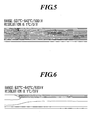
- FIG. 5 shows an analytical result of temperature distribution within the wafer 2 and wafer holder 3 in an Example where an a-carbon-made wafer holder 3 is used
- FIG. 6 shows an analytical result in a Comparative Example. It is to be noted that FIGS. 5 and 6 show enlarged views of the boundary portion between the wafer 2 and wafer holder 3 in order to clarify the analytical results.
- FIG. 7 shows analytical results of surface temperature distribution of the wafer 2 and wafer holder 3 in the Example
- FIG. 8 shows analytical results of surface temperature distribution of the wafer 2 and wafer holder 3 in the Comparative Example. It is to be noted that FIGS. 7 and 8 show the surface temperature measured at positions along the direction of diameter difining the center of the wafer as zero.
- Example As shown in FIG. 5, a large temperature gradient is found in the propagation direction of heat flow (rear surface ⁇ front surface, of the wafer holder 3), but the temperature gradients in the wafer 2 and wafer holder 3 are almost equivalent.
- Comparative Example As shown in FIG. 6, a large temperature gradient is found in the wafer 2 but a relatively moderate temperature gradient is found in the wafer holder 3. This indicates that, in Example, similar heat transfer is established even if the heat transfer route differs.
- Heat resistance ratio R 2 /R 1 was found to be 0.554 in Example, but 0.091 in Comparative Example.
- Example shown in FIG. 7 It was also found for Example shown in FIG. 7 that the surface temperature of the wafer was 637.4°C, the surface temperature of the wafer holder was 639.0°C, showing a difference between the two of about 1.6°C, whereas it was found for Comparative Example shown in FIG. 8 that the surface temperature of the wafer was 638.7°C, the surface temperature of the wafer holder was 641.0°C, that is, the difference between them is about 2.3°C. It was thus made clear that Example showed a smaller difference in the surface temperatures between the circumferential portion (22 to 25 mm) and the central portion (around 0) of the wafer 2, and that the in-plane temperature distribution of the wafer 2 was improved to attain uniformity.
- Example was successful in keeping uniformity of the in-plane temperature distribution of the wafer 2 because the surface temperature in the circumferential portion of the wafer 2 became less likely to be affected by the surface temperature of the wafer holder 3.
- the present invention is suitable for proceeding vapor-phase growth of a thin film which has a desirable uniformity over the entire surface of the wafer.
- the vapor-phase growth apparatus 100 was designed so that the wafer container has a ratio R 2 /R 1 which is not less than 0.4 and not more than 1.0, where R 1 is a heat resistance for a heat transfer route from a rear surface of the wafer container toward the front surface of the wafer, and R 2 is a heat resistance for a heat transfer route from the rear surface of the wafer container toward a front surface of the wafer container, it is possible to make the heat resistances through the heat transfer routes approximately equal to each other. That is, approximately the same achievable surface temperatures for the wafer and the wafer container can be obtained because of performing heat transfers for the above routes by approximately similar heat flux.
- the present invention conceived by the present inventors mainly referring to a vertical high-speed-rotating-type of vapor-phase growth apparatus on which the background of the invention stands, the present invention is not limited to the above type, and is also applicable to any general vapor-phase growth apparatuses such as those based on face-down system, lateral type, autorotation/revolution system, and the like.
- the present invention is applicable not only to the case where InP wafer is used, but also to cases where a thin film is grown on wafers made of such as Si, GaAs, GaN, sapphire, glass, ceramic, and the like. In these cases, it is also allowable to alter a material composing the wafer holder 3 depending on the wafer to be used.
Landscapes
- Chemical & Material Sciences (AREA)
- Chemical Kinetics & Catalysis (AREA)
- General Chemical & Material Sciences (AREA)
- Engineering & Computer Science (AREA)
- Materials Engineering (AREA)
- Metallurgy (AREA)
- Organic Chemistry (AREA)
- Crystallography & Structural Chemistry (AREA)
- Mechanical Engineering (AREA)
- Chemical Vapour Deposition (AREA)
- Crystals, And After-Treatments Of Crystals (AREA)
Applications Claiming Priority (5)
| Application Number | Priority Date | Filing Date | Title |
|---|---|---|---|
| JP2002172391 | 2002-06-13 | ||
| JP2002172391 | 2002-06-13 | ||
| JP2002238035 | 2002-08-19 | ||
| JP2002238035A JP4216541B2 (ja) | 2002-06-13 | 2002-08-19 | 気相成長装置 |
| PCT/JP2002/010713 WO2003107403A1 (ja) | 2002-06-13 | 2002-10-16 | 気相成長装置 |
Publications (3)
| Publication Number | Publication Date |
|---|---|
| EP1533833A1 true EP1533833A1 (de) | 2005-05-25 |
| EP1533833A4 EP1533833A4 (de) | 2007-01-17 |
| EP1533833B1 EP1533833B1 (de) | 2009-09-09 |
Family
ID=29738382
Family Applications (1)
| Application Number | Title | Priority Date | Filing Date |
|---|---|---|---|
| EP02807524A Expired - Lifetime EP1533833B1 (de) | 2002-06-13 | 2002-10-16 | Dampfphasenepitaxiebauelement |
Country Status (9)
| Country | Link |
|---|---|
| US (1) | US7344597B2 (de) |
| EP (1) | EP1533833B1 (de) |
| JP (1) | JP4216541B2 (de) |
| KR (1) | KR100625823B1 (de) |
| CN (1) | CN100355028C (de) |
| CA (1) | CA2486662C (de) |
| DE (1) | DE60233684D1 (de) |
| TW (1) | TWI262548B (de) |
| WO (1) | WO2003107403A1 (de) |
Cited By (1)
| Publication number | Priority date | Publication date | Assignee | Title |
|---|---|---|---|---|
| WO2018138197A1 (de) * | 2017-01-27 | 2018-08-02 | Aixtron Se | Transportring |
Families Citing this family (4)
| Publication number | Priority date | Publication date | Assignee | Title |
|---|---|---|---|---|
| JP4514466B2 (ja) * | 2003-02-14 | 2010-07-28 | 株式会社テクノネットワーク四国 | 複素多環系化合物 |
| JP4759737B2 (ja) | 2004-02-13 | 2011-08-31 | 国立大学法人高知大学 | 複素多環化合物及び色素 |
| JP4647595B2 (ja) * | 2004-02-25 | 2011-03-09 | Jx日鉱日石金属株式会社 | 気相成長装置 |
| WO2012092064A1 (en) * | 2010-12-30 | 2012-07-05 | Veeco Instruments Inc. | Wafer processing with carrier extension |
Family Cites Families (15)
| Publication number | Priority date | Publication date | Assignee | Title |
|---|---|---|---|---|
| JPS5510436A (en) * | 1978-07-05 | 1980-01-24 | Nec Corp | Susceptor for vapor phase crystal growth |
| JPH0688872B2 (ja) * | 1984-11-14 | 1994-11-09 | 富士通株式会社 | 気相成長装置 |
| JPH01291421A (ja) * | 1988-05-19 | 1989-11-24 | Toshiba Corp | 気相成長装置 |
| JPH0282528A (ja) * | 1988-09-19 | 1990-03-23 | Fujitsu Ltd | プラズマcvd装置 |
| JPH0686662B2 (ja) | 1989-11-02 | 1994-11-02 | イビデン株式会社 | Cvd用サセプター |
| US5304247A (en) * | 1990-09-21 | 1994-04-19 | Fujitsu Limited | Apparatus for depositing compound semiconductor crystal |
| JPH07176482A (ja) | 1991-05-31 | 1995-07-14 | At & T Corp | エピタキシャル成長方法および装置 |
| JP3257741B2 (ja) * | 1994-03-03 | 2002-02-18 | 東京エレクトロン株式会社 | プラズマエッチング装置及び方法 |
| CN1177830A (zh) * | 1996-09-23 | 1998-04-01 | 三星电子株式会社 | 半导体晶片热处理设备 |
| KR100203780B1 (ko) * | 1996-09-23 | 1999-06-15 | 윤종용 | 반도체 웨이퍼 열처리 장치 |
| JPH1116991A (ja) | 1997-06-19 | 1999-01-22 | Tokai Carbon Co Ltd | 半導体製造装置用カーボン支持体 |
| JPH11180796A (ja) * | 1997-12-22 | 1999-07-06 | Japan Energy Corp | 気相成長方法およびその方法を適用した気相成長装置 |
| DE19934336A1 (de) * | 1998-09-03 | 2000-03-09 | Siemens Ag | Vorrichtung zum Herstellen und Bearbeiten von Halbleitersubstraten |
| JP2000355766A (ja) * | 1999-06-15 | 2000-12-26 | Hitachi Kokusai Electric Inc | 基板処理装置及び基板処理方法 |
| JP2001230234A (ja) | 2000-02-16 | 2001-08-24 | Hitachi Ltd | プラズマ処理装置及び方法 |
-
2002
- 2002-08-19 JP JP2002238035A patent/JP4216541B2/ja not_active Expired - Lifetime
- 2002-10-16 KR KR1020047020270A patent/KR100625823B1/ko not_active Expired - Fee Related
- 2002-10-16 DE DE60233684T patent/DE60233684D1/de not_active Expired - Lifetime
- 2002-10-16 WO PCT/JP2002/010713 patent/WO2003107403A1/ja not_active Ceased
- 2002-10-16 CA CA2486662A patent/CA2486662C/en not_active Expired - Lifetime
- 2002-10-16 CN CNB028291344A patent/CN100355028C/zh not_active Expired - Lifetime
- 2002-10-16 US US10/515,970 patent/US7344597B2/en not_active Expired - Lifetime
- 2002-10-16 EP EP02807524A patent/EP1533833B1/de not_active Expired - Lifetime
-
2003
- 2003-05-28 TW TW092114411A patent/TWI262548B/zh not_active IP Right Cessation
Cited By (1)
| Publication number | Priority date | Publication date | Assignee | Title |
|---|---|---|---|---|
| WO2018138197A1 (de) * | 2017-01-27 | 2018-08-02 | Aixtron Se | Transportring |
Also Published As
| Publication number | Publication date |
|---|---|
| JP4216541B2 (ja) | 2009-01-28 |
| US20050217564A1 (en) | 2005-10-06 |
| CA2486662A1 (en) | 2003-12-24 |
| EP1533833B1 (de) | 2009-09-09 |
| KR20050012790A (ko) | 2005-02-02 |
| DE60233684D1 (de) | 2009-10-22 |
| CN1630935A (zh) | 2005-06-22 |
| CA2486662C (en) | 2010-06-01 |
| TWI262548B (en) | 2006-09-21 |
| TW200406826A (en) | 2004-05-01 |
| WO2003107403A1 (ja) | 2003-12-24 |
| CN100355028C (zh) | 2007-12-12 |
| JP2004072053A (ja) | 2004-03-04 |
| US7344597B2 (en) | 2008-03-18 |
| EP1533833A4 (de) | 2007-01-17 |
| KR100625823B1 (ko) | 2006-09-20 |
Similar Documents
| Publication | Publication Date | Title |
|---|---|---|
| TWI361847B (en) | Method and equipment for aln-monocrystal production with gas-pervious crucible-wall | |
| JPS62500624A (ja) | 半導体ウェ−ハ処理のためのリアクタ−装置 | |
| US7314519B2 (en) | Vapor-phase epitaxial apparatus and vapor phase epitaxial method | |
| EP1720200B1 (de) | Epitaxial wachsende einrichtungen | |
| EP0164928A2 (de) | Senkrechter Heisswandreaktor zur chemischen Abscheidung aus der Gasphase | |
| US7344597B2 (en) | Vapor-phase growth apparatus | |
| JP3440769B2 (ja) | ウェーハアダプタ | |
| JP2000053493A (ja) | 単結晶の製造方法および単結晶製造装置 | |
| JPS60109222A (ja) | 3−v族化合物半導体の気相成長装置 | |
| JP2007280974A (ja) | 気相成長装置 | |
| JPH01138715A (ja) | 気相成長装置 | |
| JPH0388325A (ja) | 気相成長装置 | |
| JPH01119017A (ja) | シリコン単結晶の製造方法 |
Legal Events
| Date | Code | Title | Description |
|---|---|---|---|
| PUAI | Public reference made under article 153(3) epc to a published international application that has entered the european phase |
Free format text: ORIGINAL CODE: 0009012 |
|
| 17P | Request for examination filed |
Effective date: 20041227 |
|
| AK | Designated contracting states |
Kind code of ref document: A1 Designated state(s): AT BE BG CH CY CZ DE DK EE ES FI FR GB GR IE IT LI LU MC NL PT SE SK TR |
|
| AX | Request for extension of the european patent |
Extension state: AL LT LV MK RO SI |
|
| DAX | Request for extension of the european patent (deleted) | ||
| RBV | Designated contracting states (corrected) |
Designated state(s): DE FR GB |
|
| RAP1 | Party data changed (applicant data changed or rights of an application transferred) |
Owner name: NIPPON MINING & METALS CO., LTD. |
|
| A4 | Supplementary search report drawn up and despatched |
Effective date: 20061220 |
|
| RIC1 | Information provided on ipc code assigned before grant |
Ipc: C30B 25/12 20060101ALI20061213BHEP Ipc: H01L 21/205 20060101AFI20040106BHEP |
|
| 17Q | First examination report despatched |
Effective date: 20070711 |
|
| GRAP | Despatch of communication of intention to grant a patent |
Free format text: ORIGINAL CODE: EPIDOSNIGR1 |
|
| GRAS | Grant fee paid |
Free format text: ORIGINAL CODE: EPIDOSNIGR3 |
|
| GRAA | (expected) grant |
Free format text: ORIGINAL CODE: 0009210 |
|
| AK | Designated contracting states |
Kind code of ref document: B1 Designated state(s): DE FR GB |
|
| REG | Reference to a national code |
Ref country code: GB Ref legal event code: FG4D |
|
| REF | Corresponds to: |
Ref document number: 60233684 Country of ref document: DE Date of ref document: 20091022 Kind code of ref document: P |
|
| PLBE | No opposition filed within time limit |
Free format text: ORIGINAL CODE: 0009261 |
|
| STAA | Information on the status of an ep patent application or granted ep patent |
Free format text: STATUS: NO OPPOSITION FILED WITHIN TIME LIMIT |
|
| 26N | No opposition filed |
Effective date: 20100610 |
|
| REG | Reference to a national code |
Ref country code: FR Ref legal event code: TP |
|
| REG | Reference to a national code |
Ref country code: DE Ref legal event code: R081 Ref document number: 60233684 Country of ref document: DE Owner name: JX NIPPON MINING & METALS CORP., JP Free format text: FORMER OWNER: NIPPON MINING & METALS CO., LTD., TOKIO/TOKYO, JP Effective date: 20111222 |
|
| REG | Reference to a national code |
Ref country code: FR Ref legal event code: PLFP Year of fee payment: 14 |
|
| REG | Reference to a national code |
Ref country code: FR Ref legal event code: PLFP Year of fee payment: 15 |
|
| REG | Reference to a national code |
Ref country code: FR Ref legal event code: PLFP Year of fee payment: 16 |
|
| REG | Reference to a national code |
Ref country code: FR Ref legal event code: CA Effective date: 20171006 |
|
| REG | Reference to a national code |
Ref country code: FR Ref legal event code: PLFP Year of fee payment: 17 |
|
| PGFP | Annual fee paid to national office [announced via postgrant information from national office to epo] |
Ref country code: GB Payment date: 20211022 Year of fee payment: 20 Ref country code: DE Payment date: 20211020 Year of fee payment: 20 |
|
| PGFP | Annual fee paid to national office [announced via postgrant information from national office to epo] |
Ref country code: FR Payment date: 20211021 Year of fee payment: 20 |
|
| REG | Reference to a national code |
Ref country code: DE Ref legal event code: R071 Ref document number: 60233684 Country of ref document: DE |
|
| REG | Reference to a national code |
Ref country code: GB Ref legal event code: PE20 Expiry date: 20221015 |
|
| PG25 | Lapsed in a contracting state [announced via postgrant information from national office to epo] |
Ref country code: GB Free format text: LAPSE BECAUSE OF EXPIRATION OF PROTECTION Effective date: 20221015 |