EP1537270B1 - Fer a repasser - Google Patents
Fer a repasser Download PDFInfo
- Publication number
- EP1537270B1 EP1537270B1 EP03750454A EP03750454A EP1537270B1 EP 1537270 B1 EP1537270 B1 EP 1537270B1 EP 03750454 A EP03750454 A EP 03750454A EP 03750454 A EP03750454 A EP 03750454A EP 1537270 B1 EP1537270 B1 EP 1537270B1
- Authority
- EP
- European Patent Office
- Prior art keywords
- iron
- sole
- electrical contacts
- housing
- plug
- Prior art date
- Legal status (The legal status is an assumption and is not a legal conclusion. Google has not performed a legal analysis and makes no representation as to the accuracy of the status listed.)
- Expired - Lifetime
Links
- XEEYBQQBJWHFJM-UHFFFAOYSA-N Iron Chemical compound [Fe] XEEYBQQBJWHFJM-UHFFFAOYSA-N 0.000 title claims abstract description 180
- 229910052742 iron Inorganic materials 0.000 title claims abstract description 90
- 238000000034 method Methods 0.000 claims abstract description 19
- 239000004033 plastic Substances 0.000 claims description 32
- 229920003023 plastic Polymers 0.000 claims description 32
- 239000002184 metal Substances 0.000 claims description 22
- 229910052751 metal Inorganic materials 0.000 claims description 22
- 239000000463 material Substances 0.000 claims description 11
- 125000006850 spacer group Chemical group 0.000 claims description 9
- 230000000295 complement effect Effects 0.000 claims description 6
- 239000004743 Polypropylene Substances 0.000 claims description 4
- -1 polypropylene Polymers 0.000 claims description 4
- 230000017525 heat dissipation Effects 0.000 claims description 3
- 229920001155 polypropylene Polymers 0.000 claims description 3
- 241000826860 Trapezium Species 0.000 claims 1
- 238000004519 manufacturing process Methods 0.000 abstract description 2
- 210000002105 tongue Anatomy 0.000 description 4
- 238000009434 installation Methods 0.000 description 3
- 238000010409 ironing Methods 0.000 description 3
- 238000011161 development Methods 0.000 description 2
- 230000018109 developmental process Effects 0.000 description 2
- 238000010438 heat treatment Methods 0.000 description 2
- 229920001707 polybutylene terephthalate Polymers 0.000 description 2
- 239000004698 Polyethylene Substances 0.000 description 1
- 229910000831 Steel Inorganic materials 0.000 description 1
- 230000001419 dependent effect Effects 0.000 description 1
- 239000012777 electrically insulating material Substances 0.000 description 1
- 230000002349 favourable effect Effects 0.000 description 1
- 238000001746 injection moulding Methods 0.000 description 1
- 235000000396 iron Nutrition 0.000 description 1
- 239000012811 non-conductive material Substances 0.000 description 1
- 229920000139 polyethylene terephthalate Polymers 0.000 description 1
- 230000005855 radiation Effects 0.000 description 1
- 238000010079 rubber tapping Methods 0.000 description 1
- 238000000926 separation method Methods 0.000 description 1
- 239000000243 solution Substances 0.000 description 1
- 239000010959 steel Substances 0.000 description 1
Images


Classifications
-
- D—TEXTILES; PAPER
- D06—TREATMENT OF TEXTILES OR THE LIKE; LAUNDERING; FLEXIBLE MATERIALS NOT OTHERWISE PROVIDED FOR
- D06F—LAUNDERING, DRYING, IRONING, PRESSING OR FOLDING TEXTILE ARTICLES
- D06F75/00—Hand irons
- D06F75/08—Hand irons internally heated by electricity
- D06F75/28—Arrangements for attaching, protecting or supporting the electric supply cable
-
- H—ELECTRICITY
- H01—ELECTRIC ELEMENTS
- H01R—ELECTRICALLY-CONDUCTIVE CONNECTIONS; STRUCTURAL ASSOCIATIONS OF A PLURALITY OF MUTUALLY-INSULATED ELECTRICAL CONNECTING ELEMENTS; COUPLING DEVICES; CURRENT COLLECTORS
- H01R13/00—Details of coupling devices of the kinds covered by groups H01R12/70 or H01R24/00 - H01R33/00
- H01R13/58—Means for relieving strain on wire connection, e.g. cord grip, for avoiding loosening of connections between wires and terminals within a coupling device terminating a cable
- H01R13/5804—Means for relieving strain on wire connection, e.g. cord grip, for avoiding loosening of connections between wires and terminals within a coupling device terminating a cable comprising a separate cable clamping part
Definitions
- the invention relates to an electric iron according to the preamble of claim 1.
- the invention also relates to a method for mounting an iron.
- an iron that has a housing on which a power cord is mounted strain-relieved.
- a cuboid-shaped holding element is clamped to the power cord.
- the cuboid holding element abuts against two cantilevered webs on the housing.
- the electrical connections of the power cord are formed as annular tabs, which are electrically contacted by means of screws on the contact tongues of the soleplate.
- the power cord and conductively connect the electrical connections the two half-shells of the cuboid fastening element must first be clamped to the power cord.
- the first and then the second annular contact tab can be screwed by means of one screw to the respective contact tongue on the soleplate.
- the cuboid fastening element can be inserted behind the projecting retaining webs on the housing.
- the object of the invention is to provide an iron or a method for mounting the iron, in which the power cord in a simple manner zugentlastet and electrically connected to the iron can be connected.
- the first electrical contacts of the power cord are rigidly held on the fastening means for strain relief of the power cord.
- the first electrical contacts are positioned at a fixed distance from each other and at a fixed distance from the fastening means.
- the first electrical contacts of the power cord can be electrically connected in particular simultaneously with second electrical contacts on the iron.
- the assembly is simplified in that the electrical contacts are contacted in an assembly step simultaneously electrically conductive and the fastener is attached to the iron. The assembly takes place in a few steps in a short time.
- the first electrical contacts are held rigidly by a first plug-in element, which is formed on the fastening means, at a distance from each other.
- a plug-in element of electrically non-conductive material preferably made of plastic
- the first electrical contacts are not only electrically isolated from each other, but also held rigidly to each other at a defined distance.
- the plug-in element is formed directly on the fastening means, the electrical contacts are also positioned rigidly relative to the fastening means. This has the advantage that the electrical contacts can be mounted by the fastener is gripped and the plug element is inserted or plugged onto the electrical contacts on the iron.
- the second electrical contacts are held on a second plug-in element which is complementary to the first plug-in element, in particular in the rear region of the sole.
- the second electrical contacts can be positioned by a separate plug-in element at a defined distance from each other.
- a complementary to the first plug element second plug element may be provided, which carries the second electrical contacts.
- the second plug-in element is held in the rear region of the sole. By the second plug-in element in the rear region, the first plug-in element, which is connected to the power cord, can be plugged in a simple manner to the second plug-in element.
- the second plug-in element is pivotable from a first position, in which it is accessible for establishing the electrical connection with the first plug-in element, in a second position, in which the fastening element is fastened to the iron with strain relief.
- the power cord of an electric iron protrudes in the rear region of the iron substantially vertically upwards out of the housing.
- the fastener which serves as a strain relief for the power cord must be fixed to the iron, preferably on the housing of the iron to allow the strain relief. In this installation position, the electrical contacts are often difficult to access.
- the second plug element which carries the second electrical contacts, in a first position in which it is accessible for establishing the electrical connection with the first plug element, be pivotable.
- the second plug-in element can be pivotable upwards about a pivot axis extending parallel to the sole surface from the first position into the second position.
- the second plug-in element In the first position, the second plug-in element is accessible for establishing the electrical connection with the first plug-in element. If the second plug-in element is arranged in the rear region of the sole, then it is in particular easily accessible if the second electrical contacts of the second plug element from the rear, or from above are accessible.
- the second electrical contacts of the second plug element preferably have vertically upwards. In this second position of the second plug-in element, the first plug-in element sits in the vertical direction over the second plug-in element.
- the fastener connects to the strain relief of the power cord.
- the power cord comes out of the chassis at the top of the iron.
- a ball or swivel joint may be provided at the outlet of the power cord from the housing.
- the second male member is pivotable from the first position to the second position by an angle of between thirty and sixty degrees.
- the second male member in the first position is oriented so that it is at an angle between a vertical and a horizontal position.
- the second plug-in element for mounting is particularly accessible.
- the first plug-in element can be quickly and easily plugged onto the second plug-in element due to the guided movement.
- the second plug-in element is mounted on a holder which is fastened to the sole. If the second plug-in element is mounted on a holder, then the desired pivoting movement of the second plug-in element can be maintained particularly reliably and safely.
- the holder has two bearing journals which engage in opposite grooves of the second plug-in element.
- the second plug-in element is pivotable about the axis of the bearing pin.
- the second plug-in element does not necessarily have to be provided with grooves which engage in the bearing journals of the holder. It would be sufficient if the second plug-in element has bores on opposite sides into which the second bearing journals of the holder can engage.
- the second plug-in element may have at least one retaining lug which, in a first position in which the second plug-in element is accessible for establishing the electrical connection with the first plug-in element, acts on the holder and holds the second plug-in element in the first position.
- the retaining lug serves the second To fix the plug element to the holder. Due to the retaining lug, the second plug-in element is reliably held in the position in which the electrical connection to the first plug-in element is produced.
- the retaining lug is designed such that in cooperation with the holder, a holding force is present, which prevents falling of the second plug element due to its own weight. On the other hand, the holding force should only have an amount such that the second plug element can be pivoted with only moderate force from the first position to the second position in which the fastening means is tension relieving the iron, pivoted.
- an operation indicator and / or an electrical connection for the operation indicator be formed on the fastening means.
- a socket for an electric lamp can be formed on the fastening means.
- the operating display can be held on the fastening means.
- the operating display can be held on the housing of the iron, wherein electrical connections of the operating display can be contacted with electrical contacts on the fastening means.
- the fastening means may be attached either to the housing or to the sole.
- the fastening means is attached to a part of the housing.
- the sole of the iron is provided with a special holder to which the fastening means can be attached.
- the housing or sole has a mounting portion and the fastening means has a guide element corresponding to the mounting portion.
- the guide element of the fastening means is on the support portion, for example on the housing placed.
- the mounting portion may include a receptacle for a screw, for releasable attachment a cover on the housing or the sole.
- the receptacle may be formed as an internal thread, or at least have a bore into which a self-tapping screw can be turned into.
- the cover preferably has a stop means for fixing the fastening means. By the stop means, the fastening means is fixed in a prestressed position on the housing. The fastener is therefore not separately attached to the housing but the attachment is done together with the attachment of the cover to the housing.
- the stop means it is not only possible to dispense with a separate screw for fastening the fastening means to the housing, but it also eliminates the need for an additional assembly step.
- first electrical contacts of a power cable are electrically contacted with second electrical contacts on the iron, and in a second step, the second electrical contacts are pivotally secured to a sole, and in a third step, the first electrical contacts are pivoted against the sole or against a housing.
- both the first electrical contacts on a first plug-in element and the second electrical contacts are fastened on a second plug-in element.
- the first plug-in element, which is connected to the power cord in the second plug-in element, which is connected to the sole is electrically contacted, that is, a plug-in element is inserted into the other complementary plug-in element for mounting the iron.
- the second plug-in element is then pivotally mounted on a holder which is attached to the sole.
- the first plug-in element is pivoted together with the second plug-in element against the housing of the iron and fixed there.
- a fastening means for strain relief of the power cable is connected to the second plug-in element.
- the fastening means for strain relief of the power cord against the housing By pivoting the first and second plug element against the Housing is pivoted in the third process step, the fastening means for strain relief of the power cord against the housing.
- the fastener can then be attached to the housing.
- This is preferably done in a fourth method step, in which a cover for fixing the first electrical contacts in a defined position on the housing or the sole is attached.
- first electrical contacts on the iron are pivotally attached to a sole, and that in a second step, first electrical contacts of a power cable are electrically contacted with the second electrical contacts, and in a third step the first electrical contacts are pivoted against the sole or against a housing.
- first electrical contacts are held in position by a first plug-in element and the second electrical contacts are held in position relative to one another in a complementary second plug-in element.
- the second plug-in element is preferably pivotally mounted on a holder which is attached to the iron or to the sole.
- the first plug-in element which is preferably connected to the fastening means for strain relief, inserted into the first plug-in element, thereby creating the electrical conductive connection between the first and the second electrical contacts.
- the second plug element is pivoted together with the first plug element against the sole, or against the housing. If the first plug-in element is connected to the fastening means, both the second and the first plug-in element can be pivoted by pivoting the fastening means. At the end of the pivoting can be provided that the fastening means, which has a guide member comes to rest on a support portion on the housing. Thus, at the end of the third process step, the fastening means is in a fixed position on the housing.
- a cover for fixing the first electrical contacts or the first plug-in element in a defined position on the housing or the sole can be attached.
- the inventive method for mounting an iron allow electrical contacting and strain relief of the power cord to the iron by a few simple assembly steps. This not only shortens the installation time, but also reduces the number of parts. This has the advantage that the iron according to the invention can be produced more cheaply.
- the invention includes the further essential idea, in the rear of the iron, where usually the heating resistors are arranged and the heating energy is entered to heat the metal sole to provide a special spacer between metal sole and heat-sensitive plastic housing.
- This spacer can also be used as a supporting connection means between the two main parts of the iron. He is this particular screwed to the metal sole on the one hand and the plastic housing on the other.
- the spacer acts by the ability to cause significant heat radiation over its relatively large extent, and / or due to its limited thermal conductivity as a thermal separator between metal sole and plastic housing.
- the retainer is either a metal having relatively low (i.e., a metal) low thermal conductivity or a highly heat-resistant plastic.
- the plastic version is preferably an injection-molded part.
- the headband has a substantially trapezoidal shape in plan view, for example, with an approximately rectangular plate for connection to the metal sole at one end and a wide metal strip for connection to the plastic housing at the other end.
- Central is preferably a recess for cable management provided.
- both the sole-side mounting plate and the housing-side mounting strip horizontally aligned, and they are interconnected by from the sole obliquely rearwardly increasing connecting webs, so that in total results in about the basic shape of an elongated "S". From a thermal point of view, it is important that the attachment points for connection to the plastic housing are located horizontally (laterally) and vertically far away from the heated metal sole.
- thermal isolator - is provided in a development of the inventive idea a near the front end of the iron to the metal sole attached and connected to the plastic housing second bracket. Due to the conventional design of irons, this can not be as elongated and effectively carried out in its heat dissipation as the first headband, so that its combination with a spacer made of highly heat-resistant plastic at the screwing point with the plastic housing is preferred.
- the plastic housing can be made of a only moderately heat-resistant and therefore inexpensive plastic, such as polypropylene.
- the provision of the relatively long metal strap as a fastening means for the plastic housing also results in an increase in ironing comfort due to the elasticity of the retaining clip, and also improves the impact resistance of the entire iron, which is positive, for example, in the case tests required for approval in the US and Canada makes noticeable.
- first and / or second retaining bracket has centering openings in the vicinity of the screw holes, and the plastic housing or also the intermediate spacer have centering lugs for engagement in these centering openings. This ensures an exact positioning of the plastic housing relative to the metal sole over the respective headband.
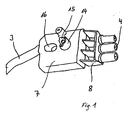
- FIG. 1 an inventive fastening means 7 is shown.
- a power cable 3 is mechanically attached to the back of the fastener 7.
- the electrical leads of the power cable 3 lead to first electrical contacts 4.
- the first electrical contacts 4 are positioned at a distance from each other and kept electrically isolated from each other.
- the three first electrical contacts 4 are positioned in a defined position relative to one another in a first plug-in element 8.
- the first plug-in element 8 is made of electrically insulating material.
- Each of the first electrical contacts 4 is surrounded by a sleeve-like portion of the first plug-in element.
- the plug pins thus formed are supported by a base plate of the first plug-in element.
- the base plate of the first plug-in element 8 is connected to the fastening means 7 via a multiplicity of ribs.
- Both the fastening means 7 and the first plug-in element 8 are preferably made of plastic.
- the first plug-in element 8 is formed directly on the fastening means 7, in particular in the plastic injection molding process.
- the fastening means 7 know a cuboid base body.
- a guide element 16 is integrated in the cuboid base body of the fastening means 7.
- the guide element 16 is formed as a tunnel-like breakthrough in the fastener 7.
- On one side surface of the fastening means 7, a connection for an operation display is provided.
- the terminal 14 consists essentially of two electrical contacts, which are arranged in a cup-shaped enclosure.
- the pot-shaped enclosure of the terminal 14 serves as a holding means, in particular as a socket for the operating display 15, which is preferably designed as an electric lamp.
- FIG. 2 a sole 2 is shown, which has a sole surface 6, which is guided for ironing over the material to be ironed. From the sole 2 of the iron all necessary second electrical contacts 5 go out.
- the second electrical contacts 5 open into a second plug-in element 9.
- the second plug-in element 9 carries the second electrical contacts 5 at a defined distance from each other and electrically isolated from each other.
- the second plug-in element 9 is pivotally attached to a holder 10.
- the holder 10 is made of a stamped sheet steel and forms a boom which protrudes in the rear area of the iron to the rear top.
- the holder 10 is firmly connected in particular by screws or rivets to the sole 2.
- the holder 10 is formed as a frame part, which surrounds the second plug-in element 9 at least partially.
- the holder 10 On opposite sides of the second plug-in element 9, the holder 10 has two opposite bearing journals 11. The bearing pins 11 engage in a respective groove 12 on the second plug element 9. By engaging in the grooves 12 bearing pin 11, the second plug-in element 9 is pivotally mounted on the holder 10. In the FIG. 2 the second plug-in element 9 is shown in a position in which it is accessible for establishing the electrical connection with the plug-in element 8 (not shown). To the second plug-in element 9 in his in FIG. 2 to hold the position shown are on 9 opposite retaining tabs 13 provided opposite sides of the second plug-in element. The retaining lugs 13 are preferably formed on the second plug-in element 9. The retaining lugs 13 engage the holder 10, such that the second plug-in element 9 is held fixed in its position.
- FIG. 3 is the second plug-in element 9 in its second position, in which the fastening means 7 is mounted strain-relieved on the iron is shown.
- the second electrical contacts 5 are held by the second plug-in element 9 at a defined distance from each other and isolated from each other.
- the second electrical contacts 5 protrude upward.
- the second plug-in element 9 is vertically displaceable by means of its grooves 12 along the bearing pin 11 of the holder 10. Due to the displaceability of the second plug element 9 by means of the grooves 12 along the grooves 12 on the bearing pin 11 of the holder 10 position and shape tolerances can be compensated.
- FIG. 4 shows an inventive iron with the second plug-in element 9 in the first position analog FIG. 2 , In the rear region of the iron, the second plug-in element 9 protrudes out of a housing 1 to the rear top.
- the first plug-in element 8, which carries the first electrical contacts 4 inserted.
- the fastening means 7, to which the first plug-in element 8 is integrally formed, is mounted pivotably on the holder 10 together with the second plug-in element 9.
- On the housing 1, a support portion 17 made of plastic is formed.
- the fastening means 7 by means of the guide member 16 can be pushed.
- the support portion 17 has a receptacle 18 into which a screw 19 can be screwed.
- a cover 20 carries a kink protection sleeve 22 for the power cord 3.
- On the inner surface of the cover 20, a stop means 21 is formed.
- the assembly method according to the invention is preferably carried out in the following steps.
- the first plug-in element 8 is inserted into the complementary second plug-in element 9.
- the power cord 3 has been mechanically fastened to the fastening means 7 and are the first electrical contacts 4 of the Power cord 3 on the first plug-in element 8 electrically contacted.
- An envisaged operating display 15 is inserted into the connection 14 on the fastening means 7.
- the mounted fastening means 7, on which the first plug-in element 8 is formed, is in the in FIG. 4 shown inserted position in the second plug-in element 9.
- the fastening means 7 is detected and pivoted against the support portion 17 on the housing 1 upwards.
- FIG. 5 the fastening means 7 is shown in the pivoted end position on the support portion 17.
- the guide member 16 of the fastener 7 is completely plugged onto the support portion 17, or postponed.
- the second electrical contacts 5 of the second plug-in element 9 are perpendicular to the top.
- the first electrical contacts 4 of the first plug-in element 8 are vertically aligned analogously to the second plug-in element 9 and the second electrical contacts 5.
- the fastening means 7 is in the fully assembled position.
- a mechanical clamping device 23 fixes the power cord 3 to the fastening means 7.
- the fastening means 7 is placed by means of its guide member 16 on the support portion 17. By this arrangement, a reliable strain relief for the first electrical contacts 4 of the power cord 3 is created. On the first plug-in element 8 and electrical contacts for the terminal 14, and the power indicator 15 are held.
- the described fastening of the fastening means 7 to the housing 1 not only provides a reliable strain relief of the power cable 3, but it is also prevented that the first plug-in element 8 can slip out of the second plug-in element 9. Thus, a reliable plug connection between the first plug-in element 8 and second plug-in element 9 is created.
- the cover 20 is pushed along the power cable 3 in the direction of the housing 1.
- the stop means 21 comes to lie on the surface of the fastening means 7.
- the screw 19 is inserted into the cover 20 and screwed into the receptacle 18 of the support portion 17.
- the fixing means 7 is reliably held on the support portion 17 by the abutment means 21.
- the cover 20 closes the housing 1 of the iron, so that the electrical connection is covered.
- FIG. 6 On a likewise molded to the metal sole mounting plate 21 is near the trailing edge with two mounting screws of the well over the trailing edge of the metal sole as well as upwardly projecting holder 10 screwed.
- the holder 10 is formed as a headband.
- the bracket 10 includes a rectangular sole mounting portion 33, two symmetrically outwardly spread and obliquely upwardly extending side bars 35 and connecting them at the free end housing mounting strip 37.
- the headband with (not separately designated) screws with a housing portion 39 bolted.
- Centering lugs 41 are provided on the housing section 39 for engagement in correspondingly arranged centering openings 43 of the retaining clip 10, which ensure a positionally accurate alignment between the two parts and thus also between the plastic housing and the metal sole.
- the headband is due to its shape suitable to hold the housing spring-loaded on the metal sole; This increases, among other things, the ironing comfort.
- FIG. 7 shows in a simplified cross-sectional view of the front end of the iron with the metal sole 2 and another housing portion 45, which are connected to each other via a second bracket 47 in double L-shape and a spacer sleeve 49 made of polyethylene or PBT (polybutylene terephthalate) and a screw 51 ,
- the headband 47 initially advantageously creates a certain distance between the hot metal sole and the actual attachment means (the screw 51), but a spacer sleeve 49 serves as an additional thermal separator for heat dissipation of the heat-sensitive plastic housing made of PP (polypropylene).
Landscapes
- Engineering & Computer Science (AREA)
- Textile Engineering (AREA)
- Details Of Connecting Devices For Male And Female Coupling (AREA)
- Soft Magnetic Materials (AREA)
- Valve Device For Special Equipments (AREA)
- Control Of Throttle Valves Provided In The Intake System Or In The Exhaust System (AREA)
- Magnetically Actuated Valves (AREA)
Claims (24)
- Fer à repasser électrique comprenant un boîtier (1), une semelle (2), un cordon d'alimentation (3) qui présente des premiers contacts électriques (4) qui sont raccordés de manière électroconductrice à des seconds contacts (5) électriques sur le fer à repasser, et comprenant un moyen de fixation (7) pour la décharge de traction du cordon d'alimentation (3), les premiers contacts électriques (4) étant maintenus de manière rigide à écart les uns des autres sur un premier élément enfichable (8), qui est réalisé sur le moyen de fixation (7), et les seconds contacts électriques (5) étant maintenus sur un second élément enfichable (9) complémentaire au premier élément enfichable (8), notamment dans la partie arrière de la semelle (2), caractérisé en ce que le second élément enfichable (9), à partir d'une première position, dans laquelle il est accessible pour établir la liaison électrique avec le premier élément enfichable (8), est orientable dans une seconde position, dans laquelle le moyen de fixation (7) est fixé sur le fer à repasser en étant déchargé de traction.
- Fer à repasser selon la revendication 1, caractérisé en ce que le second élément enfichable (9) est orientable vers le haut de la première position dans la seconde position autour d'un axe de pivotement s'étendant parallèlement à la surface de la semelle (6).
- Fer à repasser selon la revendication 1 ou 2, caractérisé en ce que le second élément enfichable (9) est orienté sensiblement verticalement dans la seconde position et en ce que les seconds contacts électriques (5) sont dirigés vers le haut.
- Fer à repasser selon l'une quelconque des revendications 1 à 3, caractérisé en ce que le second élément enfichable (9) est orientable dans la seconde position autour d'un angle compris entre 30° et 60° à partir de la première position.
- Fer à repasser selon l'une quelconque des revendications précédentes, caractérisé en ce que le second élément enfichable (9) est logé sur un support (10) qui est fixé sur la semelle (2).
- Fer à repasser selon la revendication 5, caractérisé en ce que le support (10) présente deux tourillons (11) qui ont prise dans des rainures opposées (12) du second élément enfichable (9).
- Fer à repasser selon la revendication 5 ou 6, caractérisé en ce que le second élément enfichable (9) présente au moins un ergot de retenue (13) qui, dans une première position, dans laquelle le second élément enfichable (9) est accessible pour établir la liaison électrique avec le premier élément enfichable (8), a prise sur le support (10) et maintient le second élément enfichable (9) dans la première position.
- Fer à repasser selon l'une quelconque des revendications précédentes, caractérisé en ce qu'une indication de fonctionnement (15) est maintenue sur le moyen de fixation (7) et/ou en ce qu'un raccord électrique (14) est réalisé pour l'indication de fonctionnement (15).
- Fer à repasser selon l'une quelconque des revendications précédentes, caractérisé en ce que le moyen de fixation (7) est fixé sur le boîtier (1) ou sur la semelle (2).
- Fer à repasser selon l'une quelconque des revendications précédentes, caractérisé en ce que le boîtier (1) ou la semelle (2) présente une partie de support (17) et en ce que le moyen de fixation (7) présente un élément de guidage (16) correspondant à la partie de support (17).
- Fer à repasser selon la revendication 13, caractérisé en ce que la partie de support (17) présente un logement (18) pour une vis (19), pour la fixation amovible d'un couvercle (20) sur le boîtier (1) ou la semelle (2).
- Fer à repasser selon la revendication 11, caractérisé en ce que le couvercle (20) présente un noyau de butée (21) pour fixer le moyen de fixation (7) sur le boîtier (1) dans une position précontrainte.
- Procédé d'assemblage d'un fer à repasser, caractérisé en ce que dans une première étape, des premiers contacts électriques (4) d'un cordon d'alimentation (3) sont mis en contact électriquement avec des seconds contacts électriques (5) sur le fer à repasser, et en ce que dans une deuxième étape, les seconds contacts électriques (5) sont fixés de manière orientable sur une semelle (2), et en ce que dans une troisième étape, les premiers contacts électriques (4) sont orientés contre la semelle (2) ou contre un boîtier (1).
- Procédé d'assemblage d'un fer à repasser, caractérisé en ce que dans une première étape, des seconds contacts électriques (5) sur le fer à repasser sont fixés de manière orientable sur une semelle (2), et en ce que dans une deuxième étape, des premiers contacts électriques (4) d'un cordon d'alimentation (3) sont mis en contact électriquement avec les seconds contacts électriques (5), et en ce que dans une troisième étape, les premiers contacts électriques (4) sont pivotés contre la semelle (2) ou contre un boîtier (1).
- Procédé selon la revendication 13 ou 14, caractérisé en ce que dans une quatrième étape, un couvercle (20) destiné à fixer les premiers contacts électriques (4) dans une position définie est fixé sur le boîtier (1) ou la semelle (2).
- Fer à repasser selon l'une quelconque des revendications 5 à 12, caractérisé en ce que le support (10) est réalisé en tant qu'un premier étrier de retenue allongé, qui, en tant que moyen de fixation et en même temps organe d'isolation thermique dans la partie arrière du fer à repasser, est raccordé d'une part à la semelle (2) et d'autre part au boîtier (1).
- Fer à repasser selon l'une quelconque des revendications 5 à 12 ou 16, caractérisé en ce que le support (10) est réalisé en tant que pièce moulée plane ayant une grande surface de rayonnement thermique.
- Fer à repasser selon l'une quelconque des revendications 5 à 12 ou 16 à 17, caractérisé en ce que l'étrier de retenue (10) est fabriqué dans un métal ayant une conductibilité thermique relativement faible, notamment en tant que pièce moulée en tôle, ou dans une matière plastique résistante à la chaleur à haut degré, notamment en tant que pièce moulée par injection.
- Fer à repasser selon l'une quelconque des revendications 5 à 12 ou 16 à 18, caractérisé en ce que l'étrier de retenue (10), en vue de dessus, a essentiellement une forme trapézoïdale et un évidement central pour le guidage du cordon.
- Fer à repasser selon l'une quelconque des revendications 5 à 12 ou 16 à 19, caractérisé en ce que l'étrier de retenue (10), en coupe longitudinale, a essentiellement une forme en S étirée et en ce que son extrémité destinée au raccordement au boîtier plastique (19) est éloignée latéralement et verticalement de la semelle (2).
- Fer à repasser selon l'une quelconque des revendications 16 à 20, caractérisé en ce qu'un second étrier de retenue (27), raccordé au boîtier plastique (25) près de l'extrémité avant du fer à repasser, est ménagé en tant que moyen de fixation supplémentaire et en même temps en tant qu'organe d'isolation thermique.
- Fer à repasser selon la revendication 21, caractérisé en ce que le second étrier de retenue (27) est raccordé au boîtier plastique (25) par l'intermédiaire d'une pièce d'écartement (29) en matière plastique résistante à la chaleur à haut degré, notamment en PE ou PBT.
- Fer à repasser selon l'une quelconque des revendications 21 ou 22, caractérisé en ce que le premier (11) et/ou le second étrier de retenue présentent des orifices de centrage (23) et en ce que le boîtier plastique (19) resp. la pièce d'écartement présente des ergots de centrage (21) destinés à la prise avec les orifices de centrage pour le positionnement exact du boîtier plastique par rapport à la semelle métallique (1) par l'intermédiaire de l'étrier de retenue ou de chaque étrier de retenue.
- Fer à repasser selon l'une quelconque des revendications précédentes 21 à 23, caractérisé en ce que le boîtier plastique est fabriqué dans une matière plastique peu onéreuse, modérément résistante à la chaleur, notamment en polypropylène ou dans une matière plastique similaire.
Applications Claiming Priority (5)
| Application Number | Priority Date | Filing Date | Title |
|---|---|---|---|
| ES200202053A ES2229855B1 (es) | 2002-08-28 | 2002-08-28 | Plancha. |
| ES200202053 | 2002-08-28 | ||
| ES200202179 | 2002-09-24 | ||
| ES200202179A ES2223239B1 (es) | 2002-09-24 | 2002-09-24 | Plancha. |
| PCT/EP2003/009498 WO2004025014A1 (fr) | 2002-08-28 | 2003-08-27 | Fer a repasser |
Publications (2)
| Publication Number | Publication Date |
|---|---|
| EP1537270A1 EP1537270A1 (fr) | 2005-06-08 |
| EP1537270B1 true EP1537270B1 (fr) | 2009-05-13 |
Family
ID=31995595
Family Applications (1)
| Application Number | Title | Priority Date | Filing Date |
|---|---|---|---|
| EP03750454A Expired - Lifetime EP1537270B1 (fr) | 2002-08-28 | 2003-08-27 | Fer a repasser |
Country Status (7)
| Country | Link |
|---|---|
| EP (1) | EP1537270B1 (fr) |
| CN (1) | CN1678787B (fr) |
| AT (1) | ATE431456T1 (fr) |
| AU (1) | AU2003270116A1 (fr) |
| DE (1) | DE50311525D1 (fr) |
| ES (1) | ES2325494T3 (fr) |
| WO (1) | WO2004025014A1 (fr) |
Families Citing this family (4)
| Publication number | Priority date | Publication date | Assignee | Title |
|---|---|---|---|---|
| ES2342750B1 (es) * | 2008-04-30 | 2011-06-14 | Bsh Electrodomesticos España, S.A | Plancha a vapor electrica. |
| DE102008021599B4 (de) | 2008-04-30 | 2013-03-21 | BSH Bosch und Siemens Hausgeräte GmbH | Elektrisches Dampfbügeleisen |
| DE102008021600A1 (de) | 2008-04-30 | 2009-11-05 | BSH Bosch und Siemens Hausgeräte GmbH | Dampfbügeleisen mit einer Reguliereinrichtung zur Dampfregulierung |
| CN202766880U (zh) * | 2012-07-27 | 2013-03-06 | 博西华电器(江苏)有限公司 | 家用电器 |
Family Cites Families (6)
| Publication number | Priority date | Publication date | Assignee | Title |
|---|---|---|---|---|
| US2745938A (en) * | 1954-04-05 | 1956-05-15 | Morris D Brandler | Reversible connection for electric irons |
| US4115935A (en) * | 1977-05-16 | 1978-09-26 | General Electric Company | Plastic steam iron |
| GB2157506A (en) * | 1984-02-04 | 1985-10-23 | Soernewitz Elektrowaerme Veb | Electrical connection assembly for domestic irons |
| JPH0824800B2 (ja) | 1987-10-16 | 1996-03-13 | 松下電器産業株式会社 | アイロン |
| JPH03193098A (ja) | 1989-12-25 | 1991-08-22 | Matsushita Electric Ind Co Ltd | アイロン |
| JP2002095897A (ja) * | 2000-09-25 | 2002-04-02 | Kako Maeda | アイロン及びアイロン用電気コード |
-
2003
- 2003-08-27 AT AT03750454T patent/ATE431456T1/de not_active IP Right Cessation
- 2003-08-27 ES ES03750454T patent/ES2325494T3/es not_active Expired - Lifetime
- 2003-08-27 WO PCT/EP2003/009498 patent/WO2004025014A1/fr not_active Ceased
- 2003-08-27 AU AU2003270116A patent/AU2003270116A1/en not_active Abandoned
- 2003-08-27 CN CN03820484.3A patent/CN1678787B/zh not_active Expired - Fee Related
- 2003-08-27 EP EP03750454A patent/EP1537270B1/fr not_active Expired - Lifetime
- 2003-08-27 DE DE50311525T patent/DE50311525D1/de not_active Expired - Lifetime
Also Published As
| Publication number | Publication date |
|---|---|
| ATE431456T1 (de) | 2009-05-15 |
| EP1537270A1 (fr) | 2005-06-08 |
| CN1678787A (zh) | 2005-10-05 |
| ES2325494T3 (es) | 2009-09-07 |
| AU2003270116A1 (en) | 2004-04-30 |
| WO2004025014A1 (fr) | 2004-03-25 |
| DE50311525D1 (de) | 2009-06-25 |
| CN1678787B (zh) | 2010-09-29 |
Similar Documents
| Publication | Publication Date | Title |
|---|---|---|
| DE102008052348B4 (de) | Verbindungsvorrichtung zur Verbindung eines elektrischen Leiters mit einem Solarmodul, sowie Solarmodul mit einer solchen Verbindungsvorrichtung | |
| DE69607325T2 (de) | Schnappbefestigung für sonnenblende und elektrische verbinder für sonnenblendbefestigungen | |
| DE10345994B4 (de) | Schmelzverbindungseinheit | |
| DE2709604A1 (de) | Mehrfach-kupplungsbuchse zum anschluss an insbesondere drei steckerstifte | |
| DE60121065T2 (de) | Steckdose für Fahrzeuge | |
| DE102004019644A1 (de) | Elektrischer Anschlusskasten | |
| DE102009050473A1 (de) | Elektrischer Verbindungskasten | |
| WO2012028612A2 (fr) | Composant électrique | |
| DE102010004306B4 (de) | Kontaktanordnung zum Anbringen an einem Elektronikmodul | |
| DE29506699U1 (de) | Batterieklemme | |
| DE10232650A1 (de) | Elektrischer Verbindungskasten und Verfahren zur Herstellung desselben | |
| DE112011100434T5 (de) | Sicherungseinheit | |
| EP2738884B1 (fr) | Montage d'un dispositif de raccordement | |
| DE19832011B4 (de) | Flachbandleitung mit einem zum lösbaren Verbinden vorgesehenen Anschlußbereich | |
| DE102010042161B4 (de) | Elektrisches Verteilergehäuse | |
| DE60032836T2 (de) | Schutzabdeckung für Batteriepol | |
| DE202007001079U1 (de) | Kraftfahrzeugheizung | |
| DE102006054074B4 (de) | Elektroanschlusskasten und Halterung | |
| EP1537270B1 (fr) | Fer a repasser | |
| BE1028678A1 (de) | Temperaturerfassungseinrichtung für ein Steckverbinderteil | |
| DE69902813T2 (de) | Bauweise für den automatisierten anschluss von zwei elektronischen stromkreisen eines kraftfahrzeugs | |
| EP3577733B1 (fr) | Élément de boîtier, ensemble de lignes électriques et procédé de fabrication correspondant | |
| EP0349473B1 (fr) | Batterie, en particulier pour véhicules automobiles | |
| DE102015113512B3 (de) | Klemmanordnung und Federkraftklemme | |
| DE10035475A1 (de) | Wischanlage für eine Scheibe eines Kraftfahrzeugs |
Legal Events
| Date | Code | Title | Description |
|---|---|---|---|
| PUAI | Public reference made under article 153(3) epc to a published international application that has entered the european phase |
Free format text: ORIGINAL CODE: 0009012 |
|
| 17P | Request for examination filed |
Effective date: 20050329 |
|
| AK | Designated contracting states |
Kind code of ref document: A1 Designated state(s): AT BE BG CH CY CZ DE DK EE ES FI FR GB GR HU IE IT LI LU MC NL PT RO SE SI SK TR |
|
| AX | Request for extension of the european patent |
Extension state: AL LT LV MK |
|
| DAX | Request for extension of the european patent (deleted) | ||
| GRAP | Despatch of communication of intention to grant a patent |
Free format text: ORIGINAL CODE: EPIDOSNIGR1 |
|
| GRAS | Grant fee paid |
Free format text: ORIGINAL CODE: EPIDOSNIGR3 |
|
| GRAA | (expected) grant |
Free format text: ORIGINAL CODE: 0009210 |
|
| AK | Designated contracting states |
Kind code of ref document: B1 Designated state(s): AT BE BG CH CY CZ DE DK EE ES FI FR GB GR HU IE IT LI LU MC NL PT RO SE SI SK TR |
|
| REG | Reference to a national code |
Ref country code: GB Ref legal event code: FG4D Free format text: NOT ENGLISH |
|
| REG | Reference to a national code |
Ref country code: CH Ref legal event code: EP |
|
| RAP2 | Party data changed (patent owner data changed or rights of a patent transferred) |
Owner name: BSH BOSCH UND SIEMENS HAUSGERAETE GMBH |
|
| REG | Reference to a national code |
Ref country code: IE Ref legal event code: FG4D |
|
| REF | Corresponds to: |
Ref document number: 50311525 Country of ref document: DE Date of ref document: 20090625 Kind code of ref document: P |
|
| NLT2 | Nl: modifications (of names), taken from the european patent patent bulletin |
Owner name: BSH BOSCH UND SIEMENS HAUSGERAETE GMBH Effective date: 20090603 |
|
| REG | Reference to a national code |
Ref country code: ES Ref legal event code: FG2A Ref document number: 2325494 Country of ref document: ES Kind code of ref document: T3 |
|
| PG25 | Lapsed in a contracting state [announced via postgrant information from national office to epo] |
Ref country code: PT Free format text: LAPSE BECAUSE OF FAILURE TO SUBMIT A TRANSLATION OF THE DESCRIPTION OR TO PAY THE FEE WITHIN THE PRESCRIBED TIME-LIMIT Effective date: 20090913 Ref country code: FI Free format text: LAPSE BECAUSE OF FAILURE TO SUBMIT A TRANSLATION OF THE DESCRIPTION OR TO PAY THE FEE WITHIN THE PRESCRIBED TIME-LIMIT Effective date: 20090513 |
|
| NLV1 | Nl: lapsed or annulled due to failure to fulfill the requirements of art. 29p and 29m of the patents act | ||
| PG25 | Lapsed in a contracting state [announced via postgrant information from national office to epo] |
Ref country code: SE Free format text: LAPSE BECAUSE OF FAILURE TO SUBMIT A TRANSLATION OF THE DESCRIPTION OR TO PAY THE FEE WITHIN THE PRESCRIBED TIME-LIMIT Effective date: 20090813 Ref country code: NL Free format text: LAPSE BECAUSE OF FAILURE TO SUBMIT A TRANSLATION OF THE DESCRIPTION OR TO PAY THE FEE WITHIN THE PRESCRIBED TIME-LIMIT Effective date: 20090513 Ref country code: SI Free format text: LAPSE BECAUSE OF FAILURE TO SUBMIT A TRANSLATION OF THE DESCRIPTION OR TO PAY THE FEE WITHIN THE PRESCRIBED TIME-LIMIT Effective date: 20090513 |
|
| REG | Reference to a national code |
Ref country code: IE Ref legal event code: FD4D |
|
| PG25 | Lapsed in a contracting state [announced via postgrant information from national office to epo] |
Ref country code: CZ Free format text: LAPSE BECAUSE OF FAILURE TO SUBMIT A TRANSLATION OF THE DESCRIPTION OR TO PAY THE FEE WITHIN THE PRESCRIBED TIME-LIMIT Effective date: 20090513 Ref country code: DK Free format text: LAPSE BECAUSE OF FAILURE TO SUBMIT A TRANSLATION OF THE DESCRIPTION OR TO PAY THE FEE WITHIN THE PRESCRIBED TIME-LIMIT Effective date: 20090513 Ref country code: RO Free format text: LAPSE BECAUSE OF FAILURE TO SUBMIT A TRANSLATION OF THE DESCRIPTION OR TO PAY THE FEE WITHIN THE PRESCRIBED TIME-LIMIT Effective date: 20090513 Ref country code: EE Free format text: LAPSE BECAUSE OF FAILURE TO SUBMIT A TRANSLATION OF THE DESCRIPTION OR TO PAY THE FEE WITHIN THE PRESCRIBED TIME-LIMIT Effective date: 20090513 Ref country code: IE Free format text: LAPSE BECAUSE OF FAILURE TO SUBMIT A TRANSLATION OF THE DESCRIPTION OR TO PAY THE FEE WITHIN THE PRESCRIBED TIME-LIMIT Effective date: 20090513 |
|
| PG25 | Lapsed in a contracting state [announced via postgrant information from national office to epo] |
Ref country code: SK Free format text: LAPSE BECAUSE OF FAILURE TO SUBMIT A TRANSLATION OF THE DESCRIPTION OR TO PAY THE FEE WITHIN THE PRESCRIBED TIME-LIMIT Effective date: 20090513 |
|
| BERE | Be: lapsed |
Owner name: BSH BOSCH UND SIEMENS HAUSGERATE G.M.B.H. Effective date: 20090831 |
|
| PLBE | No opposition filed within time limit |
Free format text: ORIGINAL CODE: 0009261 |
|
| STAA | Information on the status of an ep patent application or granted ep patent |
Free format text: STATUS: NO OPPOSITION FILED WITHIN TIME LIMIT |
|
| PG25 | Lapsed in a contracting state [announced via postgrant information from national office to epo] |
Ref country code: MC Free format text: LAPSE BECAUSE OF NON-PAYMENT OF DUE FEES Effective date: 20090831 Ref country code: BG Free format text: LAPSE BECAUSE OF FAILURE TO SUBMIT A TRANSLATION OF THE DESCRIPTION OR TO PAY THE FEE WITHIN THE PRESCRIBED TIME-LIMIT Effective date: 20090813 |
|
| REG | Reference to a national code |
Ref country code: CH Ref legal event code: PL |
|
| 26N | No opposition filed |
Effective date: 20100216 |
|
| PG25 | Lapsed in a contracting state [announced via postgrant information from national office to epo] |
Ref country code: CH Free format text: LAPSE BECAUSE OF NON-PAYMENT OF DUE FEES Effective date: 20090831 Ref country code: LI Free format text: LAPSE BECAUSE OF NON-PAYMENT OF DUE FEES Effective date: 20090831 |
|
| PG25 | Lapsed in a contracting state [announced via postgrant information from national office to epo] |
Ref country code: BE Free format text: LAPSE BECAUSE OF NON-PAYMENT OF DUE FEES Effective date: 20090831 |
|
| PG25 | Lapsed in a contracting state [announced via postgrant information from national office to epo] |
Ref country code: GR Free format text: LAPSE BECAUSE OF FAILURE TO SUBMIT A TRANSLATION OF THE DESCRIPTION OR TO PAY THE FEE WITHIN THE PRESCRIBED TIME-LIMIT Effective date: 20090814 |
|
| PG25 | Lapsed in a contracting state [announced via postgrant information from national office to epo] |
Ref country code: AT Free format text: LAPSE BECAUSE OF NON-PAYMENT OF DUE FEES Effective date: 20090827 |
|
| PG25 | Lapsed in a contracting state [announced via postgrant information from national office to epo] |
Ref country code: LU Free format text: LAPSE BECAUSE OF NON-PAYMENT OF DUE FEES Effective date: 20090827 |
|
| PG25 | Lapsed in a contracting state [announced via postgrant information from national office to epo] |
Ref country code: HU Free format text: LAPSE BECAUSE OF FAILURE TO SUBMIT A TRANSLATION OF THE DESCRIPTION OR TO PAY THE FEE WITHIN THE PRESCRIBED TIME-LIMIT Effective date: 20091114 |
|
| PG25 | Lapsed in a contracting state [announced via postgrant information from national office to epo] |
Ref country code: TR Free format text: LAPSE BECAUSE OF FAILURE TO SUBMIT A TRANSLATION OF THE DESCRIPTION OR TO PAY THE FEE WITHIN THE PRESCRIBED TIME-LIMIT Effective date: 20090513 |
|
| PG25 | Lapsed in a contracting state [announced via postgrant information from national office to epo] |
Ref country code: CY Free format text: LAPSE BECAUSE OF FAILURE TO SUBMIT A TRANSLATION OF THE DESCRIPTION OR TO PAY THE FEE WITHIN THE PRESCRIBED TIME-LIMIT Effective date: 20090513 |
|
| REG | Reference to a national code |
Ref country code: DE Ref legal event code: R081 Ref document number: 50311525 Country of ref document: DE Owner name: BSH HAUSGERAETE GMBH, DE Free format text: FORMER OWNER: BSH BOSCH UND SIEMENS HAUSGERAETE GMBH, 81739 MUENCHEN, DE Effective date: 20150407 |
|
| REG | Reference to a national code |
Ref country code: ES Ref legal event code: PC2A Owner name: BSH HAUSGERATE GMBH Effective date: 20150527 |
|
| REG | Reference to a national code |
Ref country code: FR Ref legal event code: PLFP Year of fee payment: 13 |
|
| REG | Reference to a national code |
Ref country code: FR Ref legal event code: CD Owner name: BSH HAUSGERATE GMBH Effective date: 20151022 |
|
| REG | Reference to a national code |
Ref country code: FR Ref legal event code: PLFP Year of fee payment: 14 |
|
| REG | Reference to a national code |
Ref country code: FR Ref legal event code: PLFP Year of fee payment: 15 |
|
| REG | Reference to a national code |
Ref country code: FR Ref legal event code: PLFP Year of fee payment: 16 |
|
| PGFP | Annual fee paid to national office [announced via postgrant information from national office to epo] |
Ref country code: DE Payment date: 20200831 Year of fee payment: 18 Ref country code: FR Payment date: 20200820 Year of fee payment: 18 Ref country code: ES Payment date: 20200917 Year of fee payment: 18 Ref country code: GB Payment date: 20200825 Year of fee payment: 18 |
|
| PGFP | Annual fee paid to national office [announced via postgrant information from national office to epo] |
Ref country code: IT Payment date: 20200831 Year of fee payment: 18 |
|
| REG | Reference to a national code |
Ref country code: DE Ref legal event code: R119 Ref document number: 50311525 Country of ref document: DE |
|
| GBPC | Gb: european patent ceased through non-payment of renewal fee |
Effective date: 20210827 |
|
| PG25 | Lapsed in a contracting state [announced via postgrant information from national office to epo] |
Ref country code: IT Free format text: LAPSE BECAUSE OF NON-PAYMENT OF DUE FEES Effective date: 20210827 Ref country code: GB Free format text: LAPSE BECAUSE OF NON-PAYMENT OF DUE FEES Effective date: 20210827 Ref country code: FR Free format text: LAPSE BECAUSE OF NON-PAYMENT OF DUE FEES Effective date: 20210831 Ref country code: DE Free format text: LAPSE BECAUSE OF NON-PAYMENT OF DUE FEES Effective date: 20220301 |
|
| REG | Reference to a national code |
Ref country code: ES Ref legal event code: FD2A Effective date: 20220930 |
|
| PG25 | Lapsed in a contracting state [announced via postgrant information from national office to epo] |
Ref country code: ES Free format text: LAPSE BECAUSE OF NON-PAYMENT OF DUE FEES Effective date: 20210828 |