EP1538153A1 - Zweikernige organometallische Iridium-Komplexe zur Verwendung in einer organischen elektrolumineszierenden Vorrichtung - Google Patents
Zweikernige organometallische Iridium-Komplexe zur Verwendung in einer organischen elektrolumineszierenden Vorrichtung Download PDFInfo
- Publication number
- EP1538153A1 EP1538153A1 EP04255158A EP04255158A EP1538153A1 EP 1538153 A1 EP1538153 A1 EP 1538153A1 EP 04255158 A EP04255158 A EP 04255158A EP 04255158 A EP04255158 A EP 04255158A EP 1538153 A1 EP1538153 A1 EP 1538153A1
- Authority
- EP
- European Patent Office
- Prior art keywords
- unsubstituted
- substituted
- formula
- organometallic complex
- compound represented
- Prior art date
- Legal status (The legal status is an assumption and is not a legal conclusion. Google has not performed a legal analysis and makes no representation as to the accuracy of the status listed.)
- Withdrawn
Links
- 0 ***(*)(*)*P(*)(*)*(*)N Chemical compound ***(*)(*)*P(*)(*)*(*)N 0.000 description 7
- YXFVVABEGXRONW-UHFFFAOYSA-N Cc1ccccc1 Chemical compound Cc1ccccc1 YXFVVABEGXRONW-UHFFFAOYSA-N 0.000 description 1
Images


Classifications
-
- C—CHEMISTRY; METALLURGY
- C09—DYES; PAINTS; POLISHES; NATURAL RESINS; ADHESIVES; COMPOSITIONS NOT OTHERWISE PROVIDED FOR; APPLICATIONS OF MATERIALS NOT OTHERWISE PROVIDED FOR
- C09K—MATERIALS FOR MISCELLANEOUS APPLICATIONS, NOT PROVIDED FOR ELSEWHERE
- C09K11/00—Luminescent materials, e.g. electroluminescent or chemiluminescent
- C09K11/06—Luminescent materials, e.g. electroluminescent or chemiluminescent containing organic luminescent materials
-
- C—CHEMISTRY; METALLURGY
- C07—ORGANIC CHEMISTRY
- C07F—ACYCLIC, CARBOCYCLIC OR HETEROCYCLIC COMPOUNDS CONTAINING ELEMENTS OTHER THAN CARBON, HYDROGEN, HALOGEN, OXYGEN, NITROGEN, SULFUR, SELENIUM OR TELLURIUM
- C07F15/00—Compounds containing elements of Groups 8, 9, 10 or 18 of the Periodic Table
- C07F15/0006—Compounds containing elements of Groups 8, 9, 10 or 18 of the Periodic Table compounds of the platinum group
- C07F15/0033—Iridium compounds
-
- H—ELECTRICITY
- H05—ELECTRIC TECHNIQUES NOT OTHERWISE PROVIDED FOR
- H05B—ELECTRIC HEATING; ELECTRIC LIGHT SOURCES NOT OTHERWISE PROVIDED FOR; CIRCUIT ARRANGEMENTS FOR ELECTRIC LIGHT SOURCES, IN GENERAL
- H05B33/00—Electroluminescent light sources
- H05B33/12—Light sources with substantially two-dimensional [2D] radiating surfaces
- H05B33/14—Light sources with substantially two-dimensional [2D] radiating surfaces characterised by the chemical or physical composition or the arrangement of the electroluminescent material, or by the simultaneous addition of the electroluminescent material in or onto the light source
-
- H—ELECTRICITY
- H10—SEMICONDUCTOR DEVICES; ELECTRIC SOLID-STATE DEVICES NOT OTHERWISE PROVIDED FOR
- H10K—ORGANIC ELECTRIC SOLID-STATE DEVICES
- H10K85/00—Organic materials used in the body or electrodes of devices covered by this subclass
- H10K85/30—Coordination compounds
- H10K85/341—Transition metal complexes, e.g. Ru(II)polypyridine complexes
- H10K85/342—Transition metal complexes, e.g. Ru(II)polypyridine complexes comprising iridium
-
- C—CHEMISTRY; METALLURGY
- C09—DYES; PAINTS; POLISHES; NATURAL RESINS; ADHESIVES; COMPOSITIONS NOT OTHERWISE PROVIDED FOR; APPLICATIONS OF MATERIALS NOT OTHERWISE PROVIDED FOR
- C09K—MATERIALS FOR MISCELLANEOUS APPLICATIONS, NOT PROVIDED FOR ELSEWHERE
- C09K2211/00—Chemical nature of organic luminescent or tenebrescent compounds
- C09K2211/10—Non-macromolecular compounds
- C09K2211/1018—Heterocyclic compounds
- C09K2211/1025—Heterocyclic compounds characterised by ligands
- C09K2211/1029—Heterocyclic compounds characterised by ligands containing one nitrogen atom as the heteroatom
-
- C—CHEMISTRY; METALLURGY
- C09—DYES; PAINTS; POLISHES; NATURAL RESINS; ADHESIVES; COMPOSITIONS NOT OTHERWISE PROVIDED FOR; APPLICATIONS OF MATERIALS NOT OTHERWISE PROVIDED FOR
- C09K—MATERIALS FOR MISCELLANEOUS APPLICATIONS, NOT PROVIDED FOR ELSEWHERE
- C09K2211/00—Chemical nature of organic luminescent or tenebrescent compounds
- C09K2211/18—Metal complexes
- C09K2211/185—Metal complexes of the platinum group, i.e. Os, Ir, Pt, Ru, Rh or Pd
-
- H—ELECTRICITY
- H10—SEMICONDUCTOR DEVICES; ELECTRIC SOLID-STATE DEVICES NOT OTHERWISE PROVIDED FOR
- H10K—ORGANIC ELECTRIC SOLID-STATE DEVICES
- H10K2101/00—Properties of the organic materials covered by group H10K85/00
- H10K2101/10—Triplet emission
-
- H—ELECTRICITY
- H10—SEMICONDUCTOR DEVICES; ELECTRIC SOLID-STATE DEVICES NOT OTHERWISE PROVIDED FOR
- H10K—ORGANIC ELECTRIC SOLID-STATE DEVICES
- H10K50/00—Organic light-emitting devices
- H10K50/10—OLEDs or polymer light-emitting diodes [PLED]
- H10K50/11—OLEDs or polymer light-emitting diodes [PLED] characterised by the electroluminescent [EL] layers
-
- Y—GENERAL TAGGING OF NEW TECHNOLOGICAL DEVELOPMENTS; GENERAL TAGGING OF CROSS-SECTIONAL TECHNOLOGIES SPANNING OVER SEVERAL SECTIONS OF THE IPC; TECHNICAL SUBJECTS COVERED BY FORMER USPC CROSS-REFERENCE ART COLLECTIONS [XRACs] AND DIGESTS
- Y02—TECHNOLOGIES OR APPLICATIONS FOR MITIGATION OR ADAPTATION AGAINST CLIMATE CHANGE
- Y02B—CLIMATE CHANGE MITIGATION TECHNOLOGIES RELATED TO BUILDINGS, e.g. HOUSING, HOUSE APPLIANCES OR RELATED END-USER APPLICATIONS
- Y02B20/00—Energy efficient lighting technologies, e.g. halogen lamps or gas discharge lamps
-
- Y—GENERAL TAGGING OF NEW TECHNOLOGICAL DEVELOPMENTS; GENERAL TAGGING OF CROSS-SECTIONAL TECHNOLOGIES SPANNING OVER SEVERAL SECTIONS OF THE IPC; TECHNICAL SUBJECTS COVERED BY FORMER USPC CROSS-REFERENCE ART COLLECTIONS [XRACs] AND DIGESTS
- Y10—TECHNICAL SUBJECTS COVERED BY FORMER USPC
- Y10S—TECHNICAL SUBJECTS COVERED BY FORMER USPC CROSS-REFERENCE ART COLLECTIONS [XRACs] AND DIGESTS
- Y10S428/00—Stock material or miscellaneous articles
- Y10S428/917—Electroluminescent
Definitions
- the present invention relates to the binuclear organometallic complexes and organic electroluminescence devices using the same, and more particularly, to a binuclear organometallic complexes capable of emitting light of wavelengths from the blue range to the red range from the triplet metal-to-ligand charge transfer (MLCT) state and an organic electroluminescence device using the same as the emitting layer forming material.
- MLCT triplet metal-to-ligand charge transfer
- an organic electroluminescent device (hereinafter referred to as EL) includes an anode, a hole injection layer, a hole transport layer, a light-emitting layer, an electron transport layer, an electron injection layer, and a cathode, sequentially formed on a substrate.
- the hole transport layer, the light-emitting layer, and the electron transport layer are organic layers made of organic compounds.
- the organic electroluminescence device having the above-described configuration is driven as follows.
- Materials for forming the light-emitting layer of the organic EL device are classified into fluorescent material which uses a singlet and phosphorescent material which uses a triplet, according to a light-emitting mechanism.
- the fluorescent material or the phosphorescent material or the material in combination with an appropriate host material forms a light-emitting layer.
- singlet excitons and triplet excitons are produced in the host.
- the singlet excitons and the triplet excitons in an OLED are created in a ratio of about 1:3.
- organic EL devices using a fluorescent material as a material for forming a light-emitting layer are disadvantageous in that triplets from the host are wasted.
- organic EL devices using a phosphorescent material as a material for forming a light-emitting layer are advantageous in that singlet excitons and triplet excitons are both utilized.
- Such phosphorescent materials can use all of the 75% triplet excitons for emission and offers higher luminescent efficiency compared to fluorescent materials using only 25% singlet excitons for emission.
- organometallic complexes having a bulky functional group, e.g., a phosphine group, or a functional group having a high ligand field intensity, e. g., a cyano group, introduced thereto to increase a difference between HOMO-LUMO energy levels by transforming the molecular geometry.
- organometallic complexes include iridium (III) complexes having cyclometalating phenyl pyridine and a phosphine group.
- the present invention provides binuclear organometallic complexes capable of efficiently emitting light over a wide wavelength range from the blue region to the red region from the triplet metal-to-ligand charge transfer (MLCT) state.
- the present invention also provides an organic electroluminescence device using the same.
- a binuclear organometallic complex represented by Formula 1: wherein (C ⁇ N) represents a cyclometalating ligand bonded to M through nitrogen (N) and carbon (C); M 1 and M 2 are independently Ru, Rh, Pt, Os or Ir; X 1 , X 2 , X 3 , and X 4 are independently a substituted or unsubstituted C 1 -C 20 alkyl, substituted or unsubstituted C 1 -C 20 alkoxy, substituted or unsubstituted C 2 -C 20 alkenyl, substituted or unsubstituted C 2 -C 20 alkynyl, a substituted or unsubstituted C 4 -C 20 cycloalkyl, substituted or unsubstituted C 6 -C 20 aryl, substituted or unsubstituted C 2 -C 20 heteroaryl, substituted or unsubstituted C 6
- an organic electroluminescence device comprising an organic layer between a pair of electrodes, wherein the organic layer includes the binuclear organometallic complex.
- a binuclear organometallic complex represented by formula 1 according to the present invention increases an energy band gap between HOMO and triplet MLCT states, enabling blue electroluminescence.
- the increased energy band gap between HOMO level and triplet MLCT level allows coordination to a bulky ligand, leading to a twisted geometry.
- An increase in the energy gap is allowed by the introduction of a ligand capable of providing a strong ligand field exhibiting excellent ⁇ -donor and ⁇ -donor capability.
- the ligand capable of performing such functions include organic phosphine, and a cyanide ion is one of the ligands capable of providing a strong ligand field and reducing the HOMO energy level, leading to a blue shift in the emission wavelength range.
- the cyclometalating ligand (C ⁇ N) is one selected from the group consisting of ligands represented by the following formulas: wherein R 1 , R 2 , R 3 , R 4 , R 5 and R 6 are independently a monosubstituted or multisubstituted substituent, and selected from the group consisting of hydrogen, halogen atom, C 1 -C 20 alkyl, or C 6 -C 20 aryl, silyl, phosphino, amino group; Y is S, O, P, or NR where R is hydrogen or a C 1 -C 20 alkyl group.
- binuclear organometallic complex of formula 1 include, but not limited thereto, compounds represented by formulas 2 through 11:
- the organometallic complexes represented by formula 1 can be prepared by the method in which [Ir(C ⁇ N) 2 CI] 2 is used as a starting material for providing the cyclometalating moeity, as reported by Watts group. (See F.O. Garces, R.J. Watts, Inorg. Chem. 1988, (35), 2450).
- the organometallic complex according to the present invention can emit light not only in the blue range but also in various wavelength ranges by the structural alteration of the ligands.
- the organic electroluminescent device according to the present invention is manufactured by forming an organic layer, particularly a light-emitting layer, using the organometallic complex represented by formula 1.
- the organometallic complex represented by formula 1 is very advantageously used as a phospholuminescent dopant material, which is a material for forming the light-emitting layer, and exhibits an excellent emission efficiency in the blue range.
- the organic layer may further comprises at least one selected from the group consisting of at least one high molecular host, a mixture of a high molecular host and a low molecular host, a low molecular host, and non-luminous high molecular matrix.
- the high molecular host, the low molecular host and the non-luminous high molecular matrix any useful materials known in the art as materials for forming a light-emitting layer of an organic electroluminescent device can be used.
- Typical examples of the high molecular host include, but not limited to, poly(vinylcarbazole) (PVK), polyfluorene and the like
- typical examples of the low molecular host include, but not limited to, CBP(4,4'-N,N'-dicarbazole-biphenyl), 4,4'-bis[9-(3,6-biphenylcarbazolyl)]-1-1,1'-biphenyl ⁇ 4,4'-bis[9-(3,6-biphenylcarbazolyl)]-1-1,1'-biphenyl ⁇ , 9,10-bis[(2',7'-t-butyl)-9',9"-spirobifluorenylanthracene, tetrafluorene and the like.
- Typical examples of the non-luminous high molecular matrix include, but not limited to, polymethylmethacrylate, polycarbonate, polystyrene and the like.
- the organometallic complex represented by formula 1 is used in an amount of about 1 to 30 parts by weight based on the total weight, i.e., 100 parts by weight of the light-emitting layer forming material.
- methods useful to introduce the organometallic complex to the light-emitting layer include vacuum deposition, sputtering, printing, coating, ink-jet printing, electron-beam application, and so on.
- the organometallic complex represented by formula 1 can induce white electroluminescence when combined with green or red luminescent materials.
- the thickness of the individual organic layer is preferably in a range of about 10 to 100 nm.
- organic layer used herein means a layer made of an organic compound formed between a pair of electrodes in an organic electroluminescent device, for example, a light-emitting layer, an electron transport layer, a hole transport layer, and the like.
- the organic electroluminescent device has a known structure selected from the group consisting of anode/light-emitting layer/cathode, anode/buffer layer/light-emitting layer/cathode, anode/hole transport layer/light-emitting layer/cathode, anode/buffer layer/hole transport layer/light-emitting layer/cathode, anode/buffer layer/hole transport layer/light-emitting layer/electron transport layer/cathode, and anode/buffer layer/hole transport layer/light-emitting layer/hole blocking layer/cathode, but is not particularly limited to these structures.
- buffer layer there may be used materials commonly used in the art, but not limited thereto. It is preferred to use copper phthalocyanine, polythiophene, polyaniline, polyacetylene, polypyrrole, polyphenylene vinylene, or derivatives thereof in the buffer layer.
- the hole transport layer there may be used materials commonly used in the art, and preferably polytriphenylamine is used.
- the electron transport layer there may be used materials commonly used in the art, and preferably polyoxadiazole is used.
- the hole blocking layer there may be used materials commonly used in the art, and preferably BCP, TAZ, TPBI, or Balq are used.
- the organic electroluminescence device according to the present invention can be manufactured in accordance with the conventional apparatus and methods in the art without any limitations.
- the binuclear iridium complex can emit light of wavelengths in a range from 400 to 650 nm. LEDs using such organometallic complexes can be used in the applications such as light sources for a full color display, backlighting, signboards, optical communication, indoor decoration, and the like.
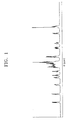
- FIG. 1 is a view showing the 1 H-NMR spectrum of the compound represented by formula 2 prepared in Example 1
- FIG. 2 is a view showing the mass spectrum thereof.
- the obtained compound represented by formula 2 was tested for emission characteristics in the following manners.
- the compound represented by formula 2 was dissolved in methylene chloride to prepare a 10 -5 M solution, and then emission characteristics of the compound being in a solution state were examined.
- the CIE color coordinate (x, y) of the compound was (0.15, 0.26).
- Example 2 Synthesis of [Ir(F 2 ppy) 2 CN] 2 P(Ph) 2 (CH 2 ) 4 P(Ph) 2 represented by Formula 3 and [Ir(F 2 ppy) 2 Cl]-P(Ph) 2 (CH 2 ) 4 P(Ph) 2 -[Ir(F 2 ppy) 2 CN] represented by Formula 4
- the first eluate was unreacted [Ir(F 2 ppy) 2 CI] 2 BDP
- the second eluate was [Ir(F 2 ppy) 2 CI]-BDP-[Ir(F 2 ppy) 2 CN] represented by formula 4
- the third eluate was [Ir(F 2 ppy) 2 CN] 2 BDP represented by formula 3.
- the compositions and structures of the final products were identified through mass spectrometry and 1 H-NMR spectroscopy.
- [Ir(F 2 ppy) 2 CN] 2 BDP represented by formula 3 had emission wavelength peaks at 450 nm and 477 nm.
- the CIE color coordinate (x, y) of the compound was (0.14, 0.18).
- the compound represented by formula 4 had an emission wavelength peak at 461 nm with a shoulder at 488 nm in a solution state and showed substantially the same emission profile with that in a film state.
- the CIE color coordinate (x, y) of the compound was (0.14, 0.22).
- the reaction mixture was stirred at room temperature for 24 hours and then the solvents were removed under reduced pressure, when a yellow colored solid was obtained.
- the acquired solid was passed through a silica gel column using ether as the eluent, followed by the removal the solvent. Thereafter, the resultant product was passed through a silica gel column using a mixed solvent consisting of methylene chloride, acetone and hexane in a volumetric ratio of 12:1:3, acquiring a yellow solid after the solvent evaporation.
- the solid was precipitated upon the addition of hexane to a methylene chloride solution.
- the structure of the compound represented by formula 5, is identified through 1 H NMR spectroscopy.
- the molecular weight of the compound represented by formula 5 was confirmed through ESI mass spectrometry.
- the compound represented by formula 5 had an emission wavelength peak at 460 nm in a 10 -5 M methylene chloride solution state and showed substantially the same emission profile with that in a film state.
- the CIE color coordinate (x, y) of the compound was (0.14, 0.22).
- the molecular weight of the compound represented by formula 6 was confirmed through ESI mass spectrometry.
- the molecular weight of the compound represented by formula 7 was confirmed through ESI mass spectrometry.
- FIG. 3 is a view showing a 1 H-NMR spectrum of the compound represented by formula 8 prepared in Example 6, and FIG. 4 is a view showing a mass spectrum thereof.
- the molecular weight of the compound represented by formula 8 was confirmed through ESI mass spectrometry.
- the molecular weight of the compound represented by formula 9 was confirmed through ESI mass spectrometry.
- the molecular weight of the compound represented by formula 10 was confirmed through ESI mass spectrometry.
- HOMO and LUMO energy levels and emission characteristics of the compounds represented by formulas 2 through 11 are summarized in Table 1.
- Formula HOMO (eV) (max(nm) in solution (max(nm) in film LUMO (eV) CIE (x,y) Decomposition temperature) 2 6.20 462 463 2.85 (0.15, 0.26) 300 3 6.32 450,477 450,477 3.57 (0.14, 0.18) 266 4 6.26.
- the solution was filtered and spin coated on the PEDOT-PS film to make a 40 nm film of the emissive layer (EL) followed by baking at 60 °C for 2h in glove box. Then 20 nm hole blocking layer (HBL) of BCP followed by 40 nm of the electron injecting layer (EIL) AIq 3 were vapor deposited on the emissive layer. Subsequently 0.8 nm of LiF and 100 nm of AI were deposited on AIq 3 , thereby finally completing an organic electroluminescence device.
- HBL hole blocking layer
- EIL electron injecting layer
- the device was tested for the EL performance and was found to furnish an efficiency of 2 cd/A with the emission of blue light.
- the CIE colr coordinates (CIE) are (0.21, 0.34).
- Similar device was fabricated for the dopants, [(F 2 ppy)lr CN] 2 CHDP.
- the efficiencies and CIE color coordinates of the devices are 1.34 cd/A and (0.24, 0.38), respectively.
- the binuclear organometallic complex represented by formula 1 can efficiently emit light of wavelengths from a blue range to a red range from the triplet MLCT state.
- the organometallic complex is suitably used for forming an organic layer of the organic electroluminescent device, and provides a luminescence maximum emission in the wavelength range of 400-650 nm.
Landscapes
- Chemical & Material Sciences (AREA)
- Organic Chemistry (AREA)
- Engineering & Computer Science (AREA)
- Materials Engineering (AREA)
- Crystallography & Structural Chemistry (AREA)
- Inorganic Chemistry (AREA)
- Electroluminescent Light Sources (AREA)
Applications Claiming Priority (2)
| Application Number | Priority Date | Filing Date | Title |
|---|---|---|---|
| KR1020030062371A KR100718100B1 (ko) | 2003-09-06 | 2003-09-06 | 이핵 유기금속 착물 및 이를 이용한 유기 전계 발광 소자 |
| KR2003062371 | 2003-09-06 |
Publications (1)
| Publication Number | Publication Date |
|---|---|
| EP1538153A1 true EP1538153A1 (de) | 2005-06-08 |
Family
ID=34374126
Family Applications (1)
| Application Number | Title | Priority Date | Filing Date |
|---|---|---|---|
| EP04255158A Withdrawn EP1538153A1 (de) | 2003-09-06 | 2004-08-26 | Zweikernige organometallische Iridium-Komplexe zur Verwendung in einer organischen elektrolumineszierenden Vorrichtung |
Country Status (5)
| Country | Link |
|---|---|
| US (1) | US7306857B2 (de) |
| EP (1) | EP1538153A1 (de) |
| JP (1) | JP4713864B2 (de) |
| KR (1) | KR100718100B1 (de) |
| CN (1) | CN100456525C (de) |
Cited By (3)
| Publication number | Priority date | Publication date | Assignee | Title |
|---|---|---|---|---|
| WO2010007098A1 (en) * | 2008-07-16 | 2010-01-21 | Solvay Sa | Light-emitting material comprising multinuclear complexes |
| CN102344465A (zh) * | 2006-02-11 | 2012-02-08 | 三星移动显示器株式会社 | 环金属化过渡金属络合物及使用其的有机电致发光器件 |
| US8618317B2 (en) | 2008-07-17 | 2013-12-31 | Merck Patent Gmbh | Organic electroluminescence device |
Families Citing this family (13)
| Publication number | Priority date | Publication date | Assignee | Title |
|---|---|---|---|---|
| WO2007004113A2 (en) * | 2005-06-30 | 2007-01-11 | Koninklijke Philips Electronics N.V. | Electro luminescent metal complexes |
| WO2008117633A1 (en) * | 2007-03-23 | 2008-10-02 | Semiconductor Energy Laboratory Co., Ltd. | Composition, method for fabricating light-emitting element, light-emitting element, light-emitting device, and electronic device |
| WO2009060742A1 (ja) * | 2007-11-08 | 2009-05-14 | Konica Minolta Holdings, Inc. | 有機エレクトロルミネッセンス素子、表示装置及び照明装置 |
| JP5733663B2 (ja) * | 2011-04-27 | 2015-06-10 | 公立大学法人大阪市立大学 | 錯体 |
| US9142785B2 (en) | 2011-09-12 | 2015-09-22 | Nippon Steel & Sumikin Chemical Co., Ltd. | Organic electroluminescent element |
| KR20140076572A (ko) | 2011-09-12 | 2014-06-20 | 신닛테츠 수미킨 가가쿠 가부시키가이샤 | 함규소 4원환구조를 가지는 유기전계발광 소자용 재료 및 유기전계발광 소자 |
| CN103988329B (zh) | 2011-12-12 | 2016-07-13 | 新日铁住金化学株式会社 | 有机场致发光元件用材料和使用其的有机场致发光元件 |
| WO2013137001A1 (ja) | 2012-03-12 | 2013-09-19 | 新日鉄住金化学株式会社 | 有機電界発光素子 |
| WO2014002629A1 (ja) | 2012-06-28 | 2014-01-03 | 新日鉄住金化学株式会社 | 有機電界発光素子用材料及び有機電界発光素子 |
| WO2014013936A1 (ja) | 2012-07-19 | 2014-01-23 | 新日鉄住金化学株式会社 | 有機電界発光素子 |
| TWI599570B (zh) | 2012-09-28 | 2017-09-21 | 新日鐵住金化學股份有限公司 | Compounds for organic electroluminescent devices and organic electroluminescent devices |
| GB2522457B (en) * | 2014-01-24 | 2016-05-25 | Cambridge Display Tech Ltd | Compound, composition and organic light-emitting device |
| JP7030780B2 (ja) * | 2016-07-25 | 2022-03-07 | メルク パテント ゲゼルシャフト ミット ベシュレンクテル ハフツング | 三脚型二座副配位子を含む、二核およびオリゴ核の金属錯体、並びにその電子デバイスにおける使用 |
Citations (3)
| Publication number | Priority date | Publication date | Assignee | Title |
|---|---|---|---|---|
| EP1191613A2 (de) * | 2000-09-26 | 2002-03-27 | Canon Kabushiki Kaisha | Lumineszente Vorrichtung, Bildanzeigevorrichtung und Metallkoordinationsverbindung |
| US20020048689A1 (en) * | 2000-09-21 | 2002-04-25 | Fuji Photo Film Co., Ltd. | Light-emitting device and iridium complex |
| WO2003063555A1 (en) * | 2001-12-26 | 2003-07-31 | E. I. Du Pont De Nemours And Company | Electroluminescent iridium compounds wiht fluorinated phenylpyridines, phenylpyrimidines, and phenylquinolines and devices made with such compounds |
Family Cites Families (4)
| Publication number | Priority date | Publication date | Assignee | Title |
|---|---|---|---|---|
| KR200276545Y1 (ko) * | 1999-05-07 | 2002-05-24 | 김학교 | 고압살수기 |
| CN101924190B (zh) | 2000-08-11 | 2012-07-04 | 普林斯顿大学理事会 | 有机金属化合物和发射转换有机电致磷光 |
| KR200286950Y1 (ko) * | 2002-05-31 | 2002-08-24 | 원 회 양 | 경량 방파제 구조 |
| EP1394171A1 (de) * | 2002-08-09 | 2004-03-03 | Bayer Aktiengesellschaft | Mehrkernige Metallkomplexe als Phosphoreszenzemitter in elektrolumineszierenden Schichtanordnungen |
-
2003
- 2003-09-06 KR KR1020030062371A patent/KR100718100B1/ko not_active Expired - Fee Related
-
2004
- 2004-08-26 EP EP04255158A patent/EP1538153A1/de not_active Withdrawn
- 2004-09-02 US US10/932,228 patent/US7306857B2/en not_active Expired - Lifetime
- 2004-09-06 CN CNB200410068766XA patent/CN100456525C/zh not_active Expired - Lifetime
- 2004-09-06 JP JP2004258987A patent/JP4713864B2/ja not_active Expired - Lifetime
Patent Citations (3)
| Publication number | Priority date | Publication date | Assignee | Title |
|---|---|---|---|---|
| US20020048689A1 (en) * | 2000-09-21 | 2002-04-25 | Fuji Photo Film Co., Ltd. | Light-emitting device and iridium complex |
| EP1191613A2 (de) * | 2000-09-26 | 2002-03-27 | Canon Kabushiki Kaisha | Lumineszente Vorrichtung, Bildanzeigevorrichtung und Metallkoordinationsverbindung |
| WO2003063555A1 (en) * | 2001-12-26 | 2003-07-31 | E. I. Du Pont De Nemours And Company | Electroluminescent iridium compounds wiht fluorinated phenylpyridines, phenylpyrimidines, and phenylquinolines and devices made with such compounds |
Non-Patent Citations (2)
| Title |
|---|
| BALASHEV ET AL.: "Synthesis and Properties of Platinum(II) 2-(2-Pyridyl)thiophenide Complexes and Ruthenium(II) Bispyridyl Complexes with 1,2-Bis(diphenylphosphino)ethene", RUSSIAN JOURNAL OF GENERAL CHEMISTRY, vol. 71, no. 7, 2001, pages 1151 - 1152, XP009040374 * |
| VILA J M ET AL: "Synthesis of complexes of platinum (II) with C,N,N'-terdentate Schiff base donor ligands. Crystal and molecular structure of [Pt{3-Me-4-MeOC6H2C(H)=NCH2CH2NMe2}(Me)]", JOURNAL OF ORGANOMETALLIC CHEMISTRY, ELSEVIER-SEQUOIA S.A. LAUSANNE, CH, vol. 566, no. 1-2, 15 September 1998 (1998-09-15), pages 93 - 101, XP004139797, ISSN: 0022-328X * |
Cited By (5)
| Publication number | Priority date | Publication date | Assignee | Title |
|---|---|---|---|---|
| CN102344465A (zh) * | 2006-02-11 | 2012-02-08 | 三星移动显示器株式会社 | 环金属化过渡金属络合物及使用其的有机电致发光器件 |
| CN102344465B (zh) * | 2006-02-11 | 2014-07-30 | 三星显示有限公司 | 环金属化过渡金属络合物及使用其的有机电致发光器件 |
| WO2010007098A1 (en) * | 2008-07-16 | 2010-01-21 | Solvay Sa | Light-emitting material comprising multinuclear complexes |
| US8663821B2 (en) | 2008-07-16 | 2014-03-04 | Solvay Sa | Light-emitting material comprising multinuclear complexes |
| US8618317B2 (en) | 2008-07-17 | 2013-12-31 | Merck Patent Gmbh | Organic electroluminescence device |
Also Published As
| Publication number | Publication date |
|---|---|
| KR20050026750A (ko) | 2005-03-16 |
| CN1610467A (zh) | 2005-04-27 |
| CN100456525C (zh) | 2009-01-28 |
| JP2005082598A (ja) | 2005-03-31 |
| JP4713864B2 (ja) | 2011-06-29 |
| US20050069728A1 (en) | 2005-03-31 |
| KR100718100B1 (ko) | 2007-05-14 |
| US7306857B2 (en) | 2007-12-11 |
Similar Documents
| Publication | Publication Date | Title |
|---|---|---|
| CN1847248B (zh) | 甲硅烷基取代的环金属化过渡金属络合物及利用它的有机电致发光器件 | |
| EP1561240B1 (de) | Organische lichtemittierende materialien und eine vorrichtung | |
| US7306857B2 (en) | Binuclear organometallic complexes and organic electroluminescence device using the same | |
| EP2743274B1 (de) | Organometallkomplexe, organische Elektrolumineszenzgeräte und Bildanzeigevorrichtung damit | |
| KR100668305B1 (ko) | 시클로메탈화 전이금속 착물 및 이를 이용한 유기 전계발광 소자 | |
| KR101015882B1 (ko) | 시클로메탈화 전이금속 착물 및 이를 이용한 유기 전계발광 소자 | |
| CN1840535B (zh) | 环金属化过渡金属络合物及使用该络合物的有机电致发光器件 | |
| JP5186085B2 (ja) | 有機金属錯体及びこれを用いた有機電界発光素子 | |
| US20070196689A1 (en) | Organometallic complex and organic electroluminescence device using the same | |
| US20070176542A1 (en) | Organometallic complex and organic electroluminescence device using the same | |
| KR101299233B1 (ko) | 유기 금속 착물 및 이를 이용한 유기 전계 발광 소자 | |
| KR101414997B1 (ko) | 발광 다핵 구리 착체 및 이를 이용한 유기 전계 발광 소자 | |
| US7670692B2 (en) | Cyclometalated transition metal complex and organic electroluminescent device using the same | |
| US8642762B2 (en) | Methods for producing materials with photo- and electroluminescence properties and systems using such materials | |
| KR101030009B1 (ko) | 시클로메탈화 전이금속 착물 및 이를 이용한 유기 전계발광 소자 |
Legal Events
| Date | Code | Title | Description |
|---|---|---|---|
| PUAI | Public reference made under article 153(3) epc to a published international application that has entered the european phase |
Free format text: ORIGINAL CODE: 0009012 |
|
| AK | Designated contracting states |
Kind code of ref document: A1 Designated state(s): AT BE BG CH CY CZ DE DK EE ES FI FR GB GR HU IE IT LI LU MC NL PL PT RO SE SI SK TR |
|
| AX | Request for extension of the european patent |
Extension state: AL HR LT LV MK |
|
| AKX | Designation fees paid | ||
| REG | Reference to a national code |
Ref country code: DE Ref legal event code: 8566 |
|
| STAA | Information on the status of an ep patent application or granted ep patent |
Free format text: STATUS: THE APPLICATION IS DEEMED TO BE WITHDRAWN |
|
| 18D | Application deemed to be withdrawn |
Effective date: 20051209 |