EP1540029B1 - Verfahren zum einsatzhärten von titan- und zirkonium-legierungen - Google Patents
Verfahren zum einsatzhärten von titan- und zirkonium-legierungen Download PDFInfo
- Publication number
- EP1540029B1 EP1540029B1 EP03764017A EP03764017A EP1540029B1 EP 1540029 B1 EP1540029 B1 EP 1540029B1 EP 03764017 A EP03764017 A EP 03764017A EP 03764017 A EP03764017 A EP 03764017A EP 1540029 B1 EP1540029 B1 EP 1540029B1
- Authority
- EP
- European Patent Office
- Prior art keywords
- oxygen
- ppm
- article
- range
- titanium
- Prior art date
- Legal status (The legal status is an assumption and is not a legal conclusion. Google has not performed a legal analysis and makes no representation as to the accuracy of the status listed.)
- Expired - Lifetime
Links
- 239000010936 titanium Substances 0.000 title claims abstract description 21
- RTAQQCXQSZGOHL-UHFFFAOYSA-N Titanium Chemical compound [Ti] RTAQQCXQSZGOHL-UHFFFAOYSA-N 0.000 title claims abstract description 19
- 238000000034 method Methods 0.000 title claims description 20
- 229910001069 Ti alloy Inorganic materials 0.000 title description 4
- 229910001093 Zr alloy Inorganic materials 0.000 title description 3
- QVGXLLKOCUKJST-UHFFFAOYSA-N atomic oxygen Chemical compound [O] QVGXLLKOCUKJST-UHFFFAOYSA-N 0.000 claims abstract description 72
- 239000001301 oxygen Substances 0.000 claims abstract description 72
- 229910052760 oxygen Inorganic materials 0.000 claims abstract description 72
- XKRFYHLGVUSROY-UHFFFAOYSA-N Argon Chemical compound [Ar] XKRFYHLGVUSROY-UHFFFAOYSA-N 0.000 claims abstract description 26
- 238000009792 diffusion process Methods 0.000 claims abstract description 18
- 229910052719 titanium Inorganic materials 0.000 claims abstract description 18
- 238000010438 heat treatment Methods 0.000 claims abstract description 16
- QCWXUUIWCKQGHC-UHFFFAOYSA-N Zirconium Chemical compound [Zr] QCWXUUIWCKQGHC-UHFFFAOYSA-N 0.000 claims abstract description 15
- 229910045601 alloy Inorganic materials 0.000 claims abstract description 14
- 239000000956 alloy Substances 0.000 claims abstract description 14
- 229910052786 argon Inorganic materials 0.000 claims abstract description 13
- 229910052726 zirconium Inorganic materials 0.000 claims abstract description 13
- 239000012159 carrier gas Substances 0.000 claims abstract description 6
- MYMOFIZGZYHOMD-UHFFFAOYSA-N Dioxygen Chemical compound O=O MYMOFIZGZYHOMD-UHFFFAOYSA-N 0.000 claims abstract description 3
- 229910001882 dioxygen Inorganic materials 0.000 claims abstract description 3
- 238000011282 treatment Methods 0.000 description 33
- 230000035515 penetration Effects 0.000 description 14
- GWEVSGVZZGPLCZ-UHFFFAOYSA-N titanium dioxide Inorganic materials O=[Ti]=O GWEVSGVZZGPLCZ-UHFFFAOYSA-N 0.000 description 14
- 239000000203 mixture Substances 0.000 description 13
- 239000010410 layer Substances 0.000 description 8
- 230000003647 oxidation Effects 0.000 description 5
- 238000007254 oxidation reaction Methods 0.000 description 5
- IJGRMHOSHXDMSA-UHFFFAOYSA-N Atomic nitrogen Chemical compound N#N IJGRMHOSHXDMSA-UHFFFAOYSA-N 0.000 description 4
- 208000021017 Weight Gain Diseases 0.000 description 4
- 238000012360 testing method Methods 0.000 description 4
- 235000019786 weight gain Nutrition 0.000 description 4
- 230000004584 weight gain Effects 0.000 description 4
- 230000001464 adherent effect Effects 0.000 description 3
- 239000007789 gas Substances 0.000 description 3
- LFQSCWFLJHTTHZ-UHFFFAOYSA-N Ethanol Chemical compound CCO LFQSCWFLJHTTHZ-UHFFFAOYSA-N 0.000 description 2
- KRHYYFGTRYWZRS-UHFFFAOYSA-N Fluorane Chemical compound F KRHYYFGTRYWZRS-UHFFFAOYSA-N 0.000 description 2
- 238000002441 X-ray diffraction Methods 0.000 description 2
- 230000015572 biosynthetic process Effects 0.000 description 2
- 238000001816 cooling Methods 0.000 description 2
- 230000000694 effects Effects 0.000 description 2
- 239000000463 material Substances 0.000 description 2
- 238000005259 measurement Methods 0.000 description 2
- 230000007935 neutral effect Effects 0.000 description 2
- 229910052757 nitrogen Inorganic materials 0.000 description 2
- 229910052756 noble gas Inorganic materials 0.000 description 2
- 239000007800 oxidant agent Substances 0.000 description 2
- 230000001590 oxidative effect Effects 0.000 description 2
- 238000002791 soaking Methods 0.000 description 2
- 239000000126 substance Substances 0.000 description 2
- 238000004381 surface treatment Methods 0.000 description 2
- 238000010301 surface-oxidation reaction Methods 0.000 description 2
- 238000007669 thermal treatment Methods 0.000 description 2
- CWYNVVGOOAEACU-UHFFFAOYSA-N Fe2+ Chemical compound [Fe+2] CWYNVVGOOAEACU-UHFFFAOYSA-N 0.000 description 1
- 229910009973 Ti2O3 Inorganic materials 0.000 description 1
- 229910000883 Ti6Al4V Inorganic materials 0.000 description 1
- VVTSZOCINPYFDP-UHFFFAOYSA-N [O].[Ar] Chemical compound [O].[Ar] VVTSZOCINPYFDP-UHFFFAOYSA-N 0.000 description 1
- 239000004411 aluminium Substances 0.000 description 1
- 229910052782 aluminium Inorganic materials 0.000 description 1
- XAGFODPZIPBFFR-UHFFFAOYSA-N aluminium Chemical compound [Al] XAGFODPZIPBFFR-UHFFFAOYSA-N 0.000 description 1
- PNEYBMLMFCGWSK-UHFFFAOYSA-N aluminium oxide Inorganic materials [O-2].[O-2].[O-2].[Al+3].[Al+3] PNEYBMLMFCGWSK-UHFFFAOYSA-N 0.000 description 1
- 238000004458 analytical method Methods 0.000 description 1
- 235000021053 average weight gain Nutrition 0.000 description 1
- 230000004888 barrier function Effects 0.000 description 1
- 230000008859 change Effects 0.000 description 1
- 238000004140 cleaning Methods 0.000 description 1
- 239000011248 coating agent Substances 0.000 description 1
- 238000000576 coating method Methods 0.000 description 1
- 239000011162 core material Substances 0.000 description 1
- 238000005336 cracking Methods 0.000 description 1
- 239000003599 detergent Substances 0.000 description 1
- 230000009977 dual effect Effects 0.000 description 1
- 238000005530 etching Methods 0.000 description 1
- 238000011156 evaluation Methods 0.000 description 1
- 239000001307 helium Substances 0.000 description 1
- 229910052734 helium Inorganic materials 0.000 description 1
- SWQJXJOGLNCZEY-UHFFFAOYSA-N helium atom Chemical compound [He] SWQJXJOGLNCZEY-UHFFFAOYSA-N 0.000 description 1
- 230000006872 improvement Effects 0.000 description 1
- 229910000765 intermetallic Inorganic materials 0.000 description 1
- 238000004519 manufacturing process Methods 0.000 description 1
- 229910052751 metal Inorganic materials 0.000 description 1
- 239000002184 metal Substances 0.000 description 1
- 238000000386 microscopy Methods 0.000 description 1
- 229910052754 neon Inorganic materials 0.000 description 1
- GKAOGPIIYCISHV-UHFFFAOYSA-N neon atom Chemical compound [Ne] GKAOGPIIYCISHV-UHFFFAOYSA-N 0.000 description 1
- 150000002835 noble gases Chemical class 0.000 description 1
- 125000004430 oxygen atom Chemical group O* 0.000 description 1
- SOQBVABWOPYFQZ-UHFFFAOYSA-N oxygen(2-);titanium(4+) Chemical class [O-2].[O-2].[Ti+4] SOQBVABWOPYFQZ-UHFFFAOYSA-N 0.000 description 1
- 230000008569 process Effects 0.000 description 1
- 238000012545 processing Methods 0.000 description 1
- 230000001681 protective effect Effects 0.000 description 1
- 230000004044 response Effects 0.000 description 1
- 238000005480 shot peening Methods 0.000 description 1
- 239000007787 solid Substances 0.000 description 1
- 238000004901 spalling Methods 0.000 description 1
- 239000002344 surface layer Substances 0.000 description 1
- OGIDPMRJRNCKJF-UHFFFAOYSA-N titanium oxide Inorganic materials [Ti]=O OGIDPMRJRNCKJF-UHFFFAOYSA-N 0.000 description 1
- GQUJEMVIKWQAEH-UHFFFAOYSA-N titanium(III) oxide Chemical compound O=[Ti]O[Ti]=O GQUJEMVIKWQAEH-UHFFFAOYSA-N 0.000 description 1
- XLYOFNOQVPJJNP-UHFFFAOYSA-N water Substances O XLYOFNOQVPJJNP-UHFFFAOYSA-N 0.000 description 1
- 238000005303 weighing Methods 0.000 description 1
- 229910052724 xenon Inorganic materials 0.000 description 1
- FHNFHKCVQCLJFQ-UHFFFAOYSA-N xenon atom Chemical compound [Xe] FHNFHKCVQCLJFQ-UHFFFAOYSA-N 0.000 description 1
Images

Classifications
-
- C—CHEMISTRY; METALLURGY
- C23—COATING METALLIC MATERIAL; COATING MATERIAL WITH METALLIC MATERIAL; CHEMICAL SURFACE TREATMENT; DIFFUSION TREATMENT OF METALLIC MATERIAL; COATING BY VACUUM EVAPORATION, BY SPUTTERING, BY ION IMPLANTATION OR BY CHEMICAL VAPOUR DEPOSITION, IN GENERAL; INHIBITING CORROSION OF METALLIC MATERIAL OR INCRUSTATION IN GENERAL
- C23C—COATING METALLIC MATERIAL; COATING MATERIAL WITH METALLIC MATERIAL; SURFACE TREATMENT OF METALLIC MATERIAL BY DIFFUSION INTO THE SURFACE, BY CHEMICAL CONVERSION OR SUBSTITUTION; COATING BY VACUUM EVAPORATION, BY SPUTTERING, BY ION IMPLANTATION OR BY CHEMICAL VAPOUR DEPOSITION, IN GENERAL
- C23C8/00—Solid state diffusion of only non-metal elements into metallic material surfaces; Chemical surface treatment of metallic material by reaction of the surface with a reactive gas, leaving reaction products of surface material in the coating, e.g. conversion coatings, passivation of metals
- C23C8/06—Solid state diffusion of only non-metal elements into metallic material surfaces; Chemical surface treatment of metallic material by reaction of the surface with a reactive gas, leaving reaction products of surface material in the coating, e.g. conversion coatings, passivation of metals using gases
- C23C8/08—Solid state diffusion of only non-metal elements into metallic material surfaces; Chemical surface treatment of metallic material by reaction of the surface with a reactive gas, leaving reaction products of surface material in the coating, e.g. conversion coatings, passivation of metals using gases only one element being applied
- C23C8/10—Oxidising
- C23C8/12—Oxidising using elemental oxygen or ozone
Definitions
- This invention relates to a thermal treatment method.
- it relates to a method of case hardening an article of titanium or zirconium or of an alloy based on titanium or zirconium.
- WO-A-96/23908 discloses a process for manufacturing a titanium article with a hardened surface for enhanced wear resistance comprising the steps of exposing the article to an oxygen-containing environment; heating the article to a temperature that allows oxygen to diffuse into the article; soaking the article at the temperature for a time sufficient to oxidise elemental metal at the surface and cooling the article to room temperature. The heating and soaking take place at about 500°C, and the oxygen-containing environment is an atmosphere of air.
- US-A-5 316 594 relates to forming a hardened outer shell on a refractory workpiece using an argon-oxygen atmosphere containing from 1 to 3 mole percent of oxygen. If the workpiece is of zirconium the maximum treatment temperature is 1400°F (760°C). If the workpiece is of titanium the maximum treatment temperature is 815°C.
- EP-A-580 081 relates to the treatment of intermetallic compounds of titanium and aluminium in an atmosphere containing 20% by volume of oxygen.
- US-A-4 263 060 relates to the treatment of titanium articles with oxygen at a subatmospheric pressure.
- WO-A-99/04055 (The University of Birmingham) discusses the need to provide engineering alloys of titanium or zirconium with a hard case consisting of a region of relatively high hardness maintained to a certain depth below the surface before dropping more steeply and then gradually to the hardness of the untreated core material.
- WO-A-99104055 discloses a method of case hardening an article formed of titanium, zirconium or an alloy of titanium and/or zirconium in which the article is heat treated for a short period of time, typically from 0.3 to 0.6 hour, in an oxidising atmosphere containing both oxygen and nitrogen (typically air) at a temperature in the range of 700 to 1000°C so as to form an oxide layer on the article, and then further heat treating the article in a vacuum or in a neutral or an inert atmosphere at a temperature in the range of 700 to 1000°C so as to cause oxygen from the oxide layer to diffuse into the article.
- an oxidising atmosphere typically air
- nitrogen typically air
- the case hardened article may then be surface treated by the method according to WO-A-98/02595 (The University of Birmingham) so as to improve the tribological behaviour of the article.
- This surface treatment comprises gaseous oxidation of the article at a temperature in the range of 500 to 725°C for 0.1 to 100 hours, the temperature and time being selected such as to produce an adherent surface component layer containing at least 50% by weight of oxides of titanium having a rutile structure and a thickness of 0.2 to 2 ⁇ m on a solid solution-strengthened diffusion zone wherein the diffusing element is oxygen and the diffusion zone has a depth of 5 to 50 ⁇ m.
- the dual step oxidation/diffusion treatment of the method according to WO-A-99/04055 is difficult to control.
- a small variation in the amount of oxide formed in the first oxidation step can result in a significant difference in the eventual hardness profile at the end of the diffusion time in the vacuum or the neutral or inert atmosphere.
- the method therefore relies entirely on empirical control, thereby causing difficulties if it is required to treat a range of articles of different shapes and sizes.
- a method of case hardening an article of titanium or a titanium-based alloy, or of zirconium or a zirconium-based alloy, wherein the article is heat treated at one or more temperatures in the range of 850°C to 900°C and at a pressure in the order of atmospheric pressure in an oxygen diffusion atmosphere comprising (a) a carrier gas which does not react chemically with the article in the said temperature range and (b) molecular oxygen, wherein the concentration of oxygen in the oxygen diffusion atmosphere is in the range of 10 volumes per million to 400 volumes per million.
- the rate of oxygen diffusion from the surface into the body of the article is a function of the oxygen potential, i.e. the partial pressure of oxidant in the oxygen diffusion atmosphere.
- the measurement in real time of the oxygen partial pressure of a heat treatment atmosphere is conventional in some heat treatments of ferrous workpieces and may be performed using commercially available instrumentation. Accordingly control of the oxygen potential is a simple matter of appropriately selecting the mole fraction of oxidant molecules in the oxygen diffusion atmosphere and, if necessary, adjusting the mole fraction in response to a real time oxygen potential measurement.
- the carrier gas is preferably a noble gas such as helium, xenon, neon or argon, or a mixture of one or more such noble gases.
- Argon is particularly preferred. It should be noted that nitrogen reacts with titanium and zirconium at temperatures in the heat treatment range and therefore cannot be included in the carrier gas.
- the method according to the invention is performed at a pressure that is approximately the same as the prevailing atmospheric pressure, i.e. at a pressure in the range of 1.0 to 1.2 bar.
- the oxygen concentration is in the range of 75 to 300 volumes per million; more preferably the oxygen concentration is in the range of 100 to 200 volumes per million.
- These oxygen concentrations are preferred for the following reasons. At below about 75 parts by volume per million, the rate of oxygen diffusion is undesirably low and therefore the time required to complete the treatment is undesirably high. At 500 parts by volume of oxygen and above there is too marked a surface oxidation which can inhibit diffusion of oxygen atoms into the article being treated and/or a spalled surface oxide is produced, a condition considered unacceptable for engineering components. Indeed, at oxygen concentrations of 5000 parts by volume per minute an impermeable oxide surface is rapidly formed.
- a visible surface oxide layer that improves the tribological properties of the article.
- Such formation of a surface oxide layer can be performed at the same temperature as the diffusion or at a lower temperature, i.e. at any temperature in the range 500 to 900°C and employing an atmosphere having an oxygen concentration of at least 5000 volumes per million.
- the method according to the present invention is particularly useful in case hardening engineering components or other articles formed of commercially pure grades of titanium, of titanium-based alloys ( ⁇ , ⁇ + ⁇ , or ⁇ alloys), of commercially pure grades of zirconium, and of zirconium-based alloys.
- the article When the article is required to have enhanced fatigue properties, it may be subjected after heat treatment to a mechanical surface treatment, such as shot peening.
- Materials - Ti-6AI-4V alloy was selected as the test material as this alloy constitutes some 50-60% of the global titanium output.
- Samples of Grade 5 Ti-6AI-4V (25 mm x 50 mm x 3.2 mm) were acquired with a 600 grit surface finish. The chemical composition of the alloy is shown in Table 1. Prior to treatment each specimen was cleaned with 2% Alconox TM aqueous detergent in an ultrasonic bath followed by an ethanol rinse and warm air dry. The specimens were weighed to an accuracy of ⁇ 0.01 mg after cleaning. Chemical Composition of the Grade 5 Ti-6Al-4V Alloy Element Al V C Fe N O H Y Ti at % (by weight) 6.15 3.93 0.03 0.15 0.02 0.17 47 ppm ⁇ 50 ppm Bal.
- Test Apparatus All of the thermal treatments were conducted in a high purity alumina tube furnace at a temperature of either 850°C or 900°C. During processing the atmosphere was maintained at a constant inlet composition and flow of 3000 cc/min using a MKS 647B Multi-Channel Gas Controller system. Two argon/oxygen mixtures were mixed to produce the correct atmosphere composition. The first mixture was "house” argon with less than 1 ppm oxygen. The second mixture was obtained from a certified premixed cylinder containing argon with 1040 ppm oxygen. The temperature was maintained with an external thermocouple and monitored with an internal thermocouple. Two samples were heat treated together and were held vertically in a specially manufactured holder to ensure uniform surface exposure. At the outlet side of the tube furnace, an Illinois Instruments oxygen analyser, Model 2550 was sued to monitor the composition of the flowing gas.
- Hardness and Microstructural Evaluation The maximum surface hardness and depth of penetration were measured using a Vickers hardness traverse at 25 and 50 gram loads. The lower load was used primarily at the edge of the sample to eliminate the risk of cracking. Microstructural features, such as case depth, were observed by light microscopy after etching in Kroll's etchant (2% hydrofluoric acid in water).
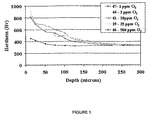
- the 900°C treatments produced a much higher surface hardness and resulted in a greater depth of penetration for an equivalent exposure time, as would have been expected from Fick's Law.
- the heat treatments conducted at 900°C produced an improvement in the depth of penetration and the formation of the appropriate surface oxide.
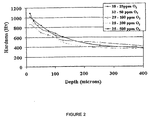
- Five oxygen concentrations were evaluated at this temperature.
- the hardness profiles obtained for oxygen concentrations of 25, 50, 100, 200 and 500 ppm are shown in Figure 2. It can be seen that, for these conditions, the depth of penetration was in excess of 250 microns. The maximum hardness obtained was in excess of 1000 Hv for some of the conditions.
- the heat treatment at 500 ppm again produced a spalled surface oxide, a condition considered unacceptable for an engineering component.
- the 100 and 200 ppm surfaces were fairly uniform and adherent and no spalling occurred after removal from the furnace.
- the weight gains for the 900°C treatments were significantly greater than those observed for the 850°C treatments.
- the average gains were 21.7 mg at 25 ppm; 58.1 mg at 50 ppm; 68.4 mg at 100 ppm; and 85.0 mg at 200 ppm. Based solely on the surface films produced and the depth of penetration this increase in weight was within the expected range.
- the second double treatment of 100 ppm followed by 10 ppm produced an extremely hard surface and an enhanced depth of penetration. It is believed that the lower partial pressure reduced some of the scale formed during the initial 100 ppm exposure and allowed for further oxygen penetration. This treatment produced the greatest depth of hardening.
- the average weight gain for these two samples was 62.1 mg, a value slightly less than that observed for the single 24 hour 100 ppm treatment (68.4 mg).
- X-ray diffraction data revealed that some treatments did result in rutile, TiO 2 , on the surface of the specimens.
- the single treatments at 900°C of 100 ppm and 200 ppm oxygen resulted in a rutile scale on top of the alpha case.
- examination of this sample showed that the alpha peaks were shifted due to the interstitial oxygen in the hexagonal close packed lattice. This shift made identifying the alpha peaks in other samples easier.
- the single 900°C treatments at oxygen concentrations of 100 ppm and 200 ppm oxygen resulted in a rutile surface after 24 hours of exposure.
- the double treatment that ended with 8 hours at 100 ppm only formed a small amount of rutile indicating that extended times are required to obtain the equilibrium oxide of rutile.
- the two double treatments although producing an excellent alpha-case, are not effective in forming duplex surfaces. It is believed that by modifying the atmosphere to the oxygen composition of air (i.e. from 75 to 85% by volume argon; 15 to 25% by volume oxygen) for the last 20 minutes of treatment at 850°C would produce a rutile layer of optimum thickness over the alpha case produced at 900°C.
Landscapes
- Chemical & Material Sciences (AREA)
- Chemical Kinetics & Catalysis (AREA)
- Engineering & Computer Science (AREA)
- Materials Engineering (AREA)
- Mechanical Engineering (AREA)
- Metallurgy (AREA)
- Organic Chemistry (AREA)
- Solid-Phase Diffusion Into Metallic Material Surfaces (AREA)
- Other Surface Treatments For Metallic Materials (AREA)
- Crystals, And After-Treatments Of Crystals (AREA)
Claims (6)
- Verfahren zum Einsatzhärten eines Gegenstands aus Titan oder einer Titanbasislegierung oder aus Zirkonium oder einer Zirkoniumbasislegierung, wobei der Gegenstand während einer Zeitdauer von mindestens 12 Stunden auf einer oder mehreren Temperaturen im Bereich von 850°C bis 900°C und bei einem Druck im Bereich des atmosphärischen Drucks in einer Sauerstoffdiffusionsatmosphäre wärmebehandelt wird, die umfasst:a) ein Trägergas, das mit dem Gegenstand in dem genannten Temperaturbereich nicht chemisch reagiert, undb) molekularem Sauerstoff, wobei die Konzentration von Sauerstoff in der Sauerstoffdiffusionsatmosphäre von 10 Volumenteilen pro Million bis 400 Volumenteilen pro Million liegt.
- Verfahren nach Anspruch 1, wobei die Sauerstoffkonzentration im Bereich von 75 bis 300 Volumenteilen pro Million liegt.
- Verfahren nach Anspruch 2, wobei die Sauerstoffkonzentration im Bereich von 100 bis 200 Volumenteilen pro Million liegt.
- Verfahren nach einem der vorhergehenden Ansprüche, wobei der einsatzgehärtete Gegenstand einer weiteren Wärmebehandlung auf einer Temperatur im Bereich von 500°C bis 900°C in einer Atmosphäre mit einer Sauerstoffkonzentration von mindestens 500 Volumenteilen pro Million unterzogen wird, um so eine sichtbare Oberflächenoxidschicht auf dem Gegenstand zu bilden, welche seine tribologischen Eigenschaften verbessert.
- Verfahren nach Anspruch 4, wobei die Atmosphäre, in welcher die drevologische Oberflächenoxidschicht gebildet wird, 15 bis 25 Volumenprozent Sauerstoff und 75 bis 85 Volumenprozent Argon enthält.
- Verfahren nach einem der vorhergehenden Ansprüche, wobei das genannte Trägergas Argon ist.
Applications Claiming Priority (3)
| Application Number | Priority Date | Filing Date | Title |
|---|---|---|---|
| GB0216527 | 2002-07-16 | ||
| GBGB0216527.2A GB0216527D0 (en) | 2002-07-16 | 2002-07-16 | Thermal treatment method |
| PCT/GB2003/003077 WO2004007788A1 (en) | 2002-07-16 | 2003-07-14 | Method of case hardening titanium and zirconium alloys |
Publications (2)
| Publication Number | Publication Date |
|---|---|
| EP1540029A1 EP1540029A1 (de) | 2005-06-15 |
| EP1540029B1 true EP1540029B1 (de) | 2005-12-28 |
Family
ID=9940577
Family Applications (1)
| Application Number | Title | Priority Date | Filing Date |
|---|---|---|---|
| EP03764017A Expired - Lifetime EP1540029B1 (de) | 2002-07-16 | 2003-07-14 | Verfahren zum einsatzhärten von titan- und zirkonium-legierungen |
Country Status (7)
| Country | Link |
|---|---|
| US (1) | US7208055B2 (de) |
| EP (1) | EP1540029B1 (de) |
| AT (1) | ATE314503T1 (de) |
| AU (1) | AU2003255719A1 (de) |
| DE (1) | DE60303044T2 (de) |
| GB (1) | GB0216527D0 (de) |
| WO (1) | WO2004007788A1 (de) |
Families Citing this family (10)
| Publication number | Priority date | Publication date | Assignee | Title |
|---|---|---|---|---|
| CA2597266A1 (en) | 2005-02-16 | 2006-08-24 | Mitsubishi Heavy Industries, Ltd. | Surface treatment method of titanium alloy member for aerospace equipment |
| FR2925522B1 (fr) * | 2007-12-21 | 2010-08-20 | Areva Np | Procede de traitement superficiel d'un alliage de zirconium ou de hafnium, et piece ainsi traitee |
| GB0805224D0 (en) * | 2008-03-20 | 2008-04-30 | Minebea Co Ltd | An aerospace bearing component |
| GB0813667D0 (en) | 2008-07-25 | 2008-09-03 | Boc Group Plc | Case hardening titanium and its alloys |
| DE102014205413A1 (de) | 2014-03-24 | 2015-09-24 | Siemens Aktiengesellschaft | Beschichtungsverfahren und Bauteil |
| WO2017207794A1 (en) | 2016-06-02 | 2017-12-07 | Danmarks Tekniske Universitet | A case hardened component of titanium |
| US11661645B2 (en) | 2018-12-20 | 2023-05-30 | Expanite Technology A/S | Method of case hardening a group IV metal |
| CN109706421B (zh) * | 2019-03-07 | 2020-08-18 | 苏州微创关节医疗科技有限公司 | 制备锆及锆合金表面氧化陶瓷层的方法及应用 |
| EP4018010A1 (de) * | 2019-08-23 | 2022-06-29 | Elos Medtech Pinol A/S | Oberflächenhärtung für ein dentalimplantat |
| CN111826603B (zh) * | 2020-07-21 | 2022-09-30 | 苏州微创关节医疗科技有限公司 | 制备金属基底表面氧化陶瓷层的方法及应用 |
Family Cites Families (9)
| Publication number | Priority date | Publication date | Assignee | Title |
|---|---|---|---|---|
| US4263060A (en) * | 1973-11-09 | 1981-04-21 | Centre Stephanois De Recherches Mecanique Hydromecanique Et Frottement | Method for treating parts made of titanium or titanium alloy, and parts produced thereby |
| US5051140A (en) * | 1989-03-23 | 1991-09-24 | Mitsubishi Jidosha Kogyo Kabushiki Kaisha | Surface treatment method for titanium or titanium alloy |
| JPH0336257A (ja) * | 1989-06-30 | 1991-02-15 | Mitsubishi Motors Corp | チタンおよびチタン合金の酸化処理方法 |
| US5316594A (en) * | 1990-01-18 | 1994-05-31 | Fike Corporation | Process for surface hardening of refractory metal workpieces |
| US5451366A (en) | 1992-07-17 | 1995-09-19 | Sumitomo Light Metal Industries, Ltd. | Product of a halogen containing Ti-Al system intermetallic compound having a superior oxidation and wear resistance |
| JP3077867B2 (ja) * | 1993-12-24 | 2000-08-21 | トヨタ自動車株式会社 | 耐摩耗性に優れた摺動部材用TiAl金属間化合物の酸化処理方法 |
| AU5295396A (en) | 1995-01-31 | 1996-08-21 | Smith & Nephew Richards Inc. | Wear resistant tribosystem |
| GB9614967D0 (en) | 1996-07-17 | 1996-09-04 | Univ Birmingham | Surface treatment process |
| GB9715175D0 (en) | 1997-07-19 | 1997-09-24 | Univ Birmingham | Method of case hardening |
-
2002
- 2002-07-16 GB GBGB0216527.2A patent/GB0216527D0/en not_active Ceased
-
2003
- 2003-07-14 AU AU2003255719A patent/AU2003255719A1/en not_active Abandoned
- 2003-07-14 EP EP03764017A patent/EP1540029B1/de not_active Expired - Lifetime
- 2003-07-14 DE DE60303044T patent/DE60303044T2/de not_active Expired - Fee Related
- 2003-07-14 WO PCT/GB2003/003077 patent/WO2004007788A1/en not_active Ceased
- 2003-07-14 US US10/521,526 patent/US7208055B2/en not_active Expired - Fee Related
- 2003-07-14 AT AT03764017T patent/ATE314503T1/de not_active IP Right Cessation
Also Published As
| Publication number | Publication date |
|---|---|
| AU2003255719A1 (en) | 2004-02-02 |
| US20060099435A1 (en) | 2006-05-11 |
| ATE314503T1 (de) | 2006-01-15 |
| DE60303044D1 (de) | 2006-02-02 |
| GB0216527D0 (en) | 2002-08-28 |
| DE60303044T2 (de) | 2006-08-17 |
| EP1540029A1 (de) | 2005-06-15 |
| US7208055B2 (en) | 2007-04-24 |
| WO2004007788A1 (en) | 2004-01-22 |
Similar Documents
| Publication | Publication Date | Title |
|---|---|---|
| US5334264A (en) | Titanium plasma nitriding intensified by thermionic emission source | |
| EP1540029B1 (de) | Verfahren zum einsatzhärten von titan- und zirkonium-legierungen | |
| US6210807B1 (en) | Surface oxidation of a titanium or titanium alloy article | |
| US5580398A (en) | Method of forming passive oxide film based on chromium oxide, and stainless steel | |
| EP0510950B1 (de) | Behandlung von Sinterlegierungen | |
| Xia et al. | Corrosion behavior and wear resistance of Zr-2.5 Nb alloy after thermal oxy-nitriding treatment | |
| Rubly et al. | Internal nitridation of nickel-chromium alloys | |
| US11060175B2 (en) | Case hardened component of titanium | |
| EP0388710A1 (de) | Oberflächenbehandlung von Titan oder einer Titanlegierung | |
| Li et al. | Enhancement of pitting corrosion resistance of austenitic stainless steel through deposition of amorphous/nanocrystalline oxy-nitrided phases by active screen plasma treatment | |
| EP1306468A1 (de) | Titaniummaterial mit geringerer anfälligkeit für entfärbung und herstellungsverfahren dafür | |
| Kilner et al. | The effects of nitrogen additions to a cobalt-chromium surgical implant alloy: Part 1 Processing and microstructure | |
| EP2154263A1 (de) | Gehäusehärtendes Titanium und seine Legierungen | |
| Gomes et al. | Comparison of the kinetics and morphologic properties of titanium, Ti-1.5 Ni and Ti-2.5 Cu during oxidation in pure oxygen between 600 and 820° C | |
| US20240229207A9 (en) | Surface hardening of group iv metals | |
| US11661645B2 (en) | Method of case hardening a group IV metal | |
| JP7525784B2 (ja) | チタン材およびチタン材の製造方法 | |
| US7422804B2 (en) | Metal dusting resistant stable-carbide forming alloy surfaces | |
| CN114174550A (zh) | 用于牙植入物的表面硬化 | |
| Kim et al. | Effect of the holding time on the mechanical properties of gradient-hardened pure titanium | |
| Riffard et al. | In situ and glancing angle X-ray diffraction of the structure change during and after the high temperature oxidation at 1000$^{\circ} $ C in air of an yttrium-implanted 304 steel | |
| Cueff et al. | High Temperature Oxidation of Kanthal A1 Alumina Forming Alloy: Effect of Yttrium Ion Implantation on the Oxide Layer Properties | |
| Taniguchi et al. | Oxidation resistance of TiAl improved by ion implantation of beta-former elements | |
| WO2003074752A1 (en) | Case hardening of titanium | |
| Bryar et al. | Surface modification of tial based intermetallics by pressure nitriding |
Legal Events
| Date | Code | Title | Description |
|---|---|---|---|
| PUAI | Public reference made under article 153(3) epc to a published international application that has entered the european phase |
Free format text: ORIGINAL CODE: 0009012 |
|
| 17P | Request for examination filed |
Effective date: 20050112 |
|
| AK | Designated contracting states |
Kind code of ref document: A1 Designated state(s): AT BE BG CH CY CZ DE DK EE ES FI FR GB GR HU IE IT LI LU MC NL PT RO SE SI SK TR |
|
| AX | Request for extension of the european patent |
Extension state: AL LT LV MK |
|
| GRAP | Despatch of communication of intention to grant a patent |
Free format text: ORIGINAL CODE: EPIDOSNIGR1 |
|
| GRAS | Grant fee paid |
Free format text: ORIGINAL CODE: EPIDOSNIGR3 |
|
| DAX | Request for extension of the european patent (deleted) | ||
| GRAA | (expected) grant |
Free format text: ORIGINAL CODE: 0009210 |
|
| AK | Designated contracting states |
Kind code of ref document: B1 Designated state(s): AT BE BG CH CY CZ DE DK EE ES FI FR GB GR HU IE IT LI LU MC NL PT RO SE SI SK TR |
|
| PG25 | Lapsed in a contracting state [announced via postgrant information from national office to epo] |
Ref country code: AT Free format text: LAPSE BECAUSE OF FAILURE TO SUBMIT A TRANSLATION OF THE DESCRIPTION OR TO PAY THE FEE WITHIN THE PRESCRIBED TIME-LIMIT Effective date: 20051228 Ref country code: SK Free format text: LAPSE BECAUSE OF FAILURE TO SUBMIT A TRANSLATION OF THE DESCRIPTION OR TO PAY THE FEE WITHIN THE PRESCRIBED TIME-LIMIT Effective date: 20051228 Ref country code: SI Free format text: LAPSE BECAUSE OF FAILURE TO SUBMIT A TRANSLATION OF THE DESCRIPTION OR TO PAY THE FEE WITHIN THE PRESCRIBED TIME-LIMIT Effective date: 20051228 Ref country code: CH Free format text: LAPSE BECAUSE OF FAILURE TO SUBMIT A TRANSLATION OF THE DESCRIPTION OR TO PAY THE FEE WITHIN THE PRESCRIBED TIME-LIMIT Effective date: 20051228 Ref country code: BE Free format text: LAPSE BECAUSE OF FAILURE TO SUBMIT A TRANSLATION OF THE DESCRIPTION OR TO PAY THE FEE WITHIN THE PRESCRIBED TIME-LIMIT Effective date: 20051228 Ref country code: IT Free format text: LAPSE BECAUSE OF FAILURE TO SUBMIT A TRANSLATION OF THE DESCRIPTION OR TO PAY THE FEE WITHIN THE PRESCRIBED TIME-LIMIT;WARNING: LAPSES OF ITALIAN PATENTS WITH EFFECTIVE DATE BEFORE 2007 MAY HAVE OCCURRED AT ANY TIME BEFORE 2007. THE CORRECT EFFECTIVE DATE MAY BE DIFFERENT FROM THE ONE RECORDED. Effective date: 20051228 Ref country code: NL Free format text: LAPSE BECAUSE OF FAILURE TO SUBMIT A TRANSLATION OF THE DESCRIPTION OR TO PAY THE FEE WITHIN THE PRESCRIBED TIME-LIMIT Effective date: 20051228 Ref country code: FI Free format text: LAPSE BECAUSE OF FAILURE TO SUBMIT A TRANSLATION OF THE DESCRIPTION OR TO PAY THE FEE WITHIN THE PRESCRIBED TIME-LIMIT Effective date: 20051228 Ref country code: LI Free format text: LAPSE BECAUSE OF FAILURE TO SUBMIT A TRANSLATION OF THE DESCRIPTION OR TO PAY THE FEE WITHIN THE PRESCRIBED TIME-LIMIT Effective date: 20051228 Ref country code: CZ Free format text: LAPSE BECAUSE OF FAILURE TO SUBMIT A TRANSLATION OF THE DESCRIPTION OR TO PAY THE FEE WITHIN THE PRESCRIBED TIME-LIMIT Effective date: 20051228 Ref country code: RO Free format text: LAPSE BECAUSE OF FAILURE TO SUBMIT A TRANSLATION OF THE DESCRIPTION OR TO PAY THE FEE WITHIN THE PRESCRIBED TIME-LIMIT Effective date: 20051228 |
|
| REG | Reference to a national code |
Ref country code: GB Ref legal event code: FG4D |
|
| REG | Reference to a national code |
Ref country code: CH Ref legal event code: EP |
|
| REG | Reference to a national code |
Ref country code: IE Ref legal event code: FG4D |
|
| REF | Corresponds to: |
Ref document number: 60303044 Country of ref document: DE Date of ref document: 20060202 Kind code of ref document: P |
|
| PG25 | Lapsed in a contracting state [announced via postgrant information from national office to epo] |
Ref country code: SE Free format text: LAPSE BECAUSE OF FAILURE TO SUBMIT A TRANSLATION OF THE DESCRIPTION OR TO PAY THE FEE WITHIN THE PRESCRIBED TIME-LIMIT Effective date: 20060328 Ref country code: DK Free format text: LAPSE BECAUSE OF FAILURE TO SUBMIT A TRANSLATION OF THE DESCRIPTION OR TO PAY THE FEE WITHIN THE PRESCRIBED TIME-LIMIT Effective date: 20060328 Ref country code: GR Free format text: LAPSE BECAUSE OF FAILURE TO SUBMIT A TRANSLATION OF THE DESCRIPTION OR TO PAY THE FEE WITHIN THE PRESCRIBED TIME-LIMIT Effective date: 20060328 Ref country code: BG Free format text: LAPSE BECAUSE OF FAILURE TO SUBMIT A TRANSLATION OF THE DESCRIPTION OR TO PAY THE FEE WITHIN THE PRESCRIBED TIME-LIMIT Effective date: 20060328 |
|
| PG25 | Lapsed in a contracting state [announced via postgrant information from national office to epo] |
Ref country code: ES Free format text: LAPSE BECAUSE OF FAILURE TO SUBMIT A TRANSLATION OF THE DESCRIPTION OR TO PAY THE FEE WITHIN THE PRESCRIBED TIME-LIMIT Effective date: 20060408 |
|
| PG25 | Lapsed in a contracting state [announced via postgrant information from national office to epo] |
Ref country code: PT Free format text: LAPSE BECAUSE OF FAILURE TO SUBMIT A TRANSLATION OF THE DESCRIPTION OR TO PAY THE FEE WITHIN THE PRESCRIBED TIME-LIMIT Effective date: 20060529 |
|
| NLV1 | Nl: lapsed or annulled due to failure to fulfill the requirements of art. 29p and 29m of the patents act | ||
| PG25 | Lapsed in a contracting state [announced via postgrant information from national office to epo] |
Ref country code: HU Free format text: LAPSE BECAUSE OF FAILURE TO SUBMIT A TRANSLATION OF THE DESCRIPTION OR TO PAY THE FEE WITHIN THE PRESCRIBED TIME-LIMIT Effective date: 20060629 |
|
| PG25 | Lapsed in a contracting state [announced via postgrant information from national office to epo] |
Ref country code: IE Free format text: LAPSE BECAUSE OF NON-PAYMENT OF DUE FEES Effective date: 20060714 |
|
| REG | Reference to a national code |
Ref country code: CH Ref legal event code: PL |
|
| PG25 | Lapsed in a contracting state [announced via postgrant information from national office to epo] |
Ref country code: MC Free format text: LAPSE BECAUSE OF NON-PAYMENT OF DUE FEES Effective date: 20060731 |
|
| ET | Fr: translation filed | ||
| PLBE | No opposition filed within time limit |
Free format text: ORIGINAL CODE: 0009261 |
|
| STAA | Information on the status of an ep patent application or granted ep patent |
Free format text: STATUS: NO OPPOSITION FILED WITHIN TIME LIMIT |
|
| 26N | No opposition filed |
Effective date: 20060929 |
|
| REG | Reference to a national code |
Ref country code: IE Ref legal event code: MM4A |
|
| PG25 | Lapsed in a contracting state [announced via postgrant information from national office to epo] |
Ref country code: EE Free format text: LAPSE BECAUSE OF FAILURE TO SUBMIT A TRANSLATION OF THE DESCRIPTION OR TO PAY THE FEE WITHIN THE PRESCRIBED TIME-LIMIT Effective date: 20051228 |
|
| PG25 | Lapsed in a contracting state [announced via postgrant information from national office to epo] |
Ref country code: LU Free format text: LAPSE BECAUSE OF NON-PAYMENT OF DUE FEES Effective date: 20060714 Ref country code: TR Free format text: LAPSE BECAUSE OF FAILURE TO SUBMIT A TRANSLATION OF THE DESCRIPTION OR TO PAY THE FEE WITHIN THE PRESCRIBED TIME-LIMIT Effective date: 20051228 |
|
| PG25 | Lapsed in a contracting state [announced via postgrant information from national office to epo] |
Ref country code: CY Free format text: LAPSE BECAUSE OF FAILURE TO SUBMIT A TRANSLATION OF THE DESCRIPTION OR TO PAY THE FEE WITHIN THE PRESCRIBED TIME-LIMIT Effective date: 20051228 |
|
| PGFP | Annual fee paid to national office [announced via postgrant information from national office to epo] |
Ref country code: FR Payment date: 20090710 Year of fee payment: 7 |
|
| PGFP | Annual fee paid to national office [announced via postgrant information from national office to epo] |
Ref country code: DE Payment date: 20090709 Year of fee payment: 7 Ref country code: GB Payment date: 20090708 Year of fee payment: 7 |
|
| GBPC | Gb: european patent ceased through non-payment of renewal fee |
Effective date: 20100714 |
|
| REG | Reference to a national code |
Ref country code: FR Ref legal event code: ST Effective date: 20110331 |
|
| PG25 | Lapsed in a contracting state [announced via postgrant information from national office to epo] |
Ref country code: DE Free format text: LAPSE BECAUSE OF NON-PAYMENT OF DUE FEES Effective date: 20110201 |
|
| REG | Reference to a national code |
Ref country code: DE Ref legal event code: R119 Ref document number: 60303044 Country of ref document: DE Effective date: 20110201 |
|
| PG25 | Lapsed in a contracting state [announced via postgrant information from national office to epo] |
Ref country code: FR Free format text: LAPSE BECAUSE OF NON-PAYMENT OF DUE FEES Effective date: 20100802 |
|
| PG25 | Lapsed in a contracting state [announced via postgrant information from national office to epo] |
Ref country code: GB Free format text: LAPSE BECAUSE OF NON-PAYMENT OF DUE FEES Effective date: 20100714 |