EP1540377B1 - Verfahren zum komprimieren und filtrieren von geophysischen ereignissen zwecks extrahierung von bodenartdaten - Google Patents
Verfahren zum komprimieren und filtrieren von geophysischen ereignissen zwecks extrahierung von bodenartdaten Download PDFInfo
- Publication number
- EP1540377B1 EP1540377B1 EP03758244A EP03758244A EP1540377B1 EP 1540377 B1 EP1540377 B1 EP 1540377B1 EP 03758244 A EP03758244 A EP 03758244A EP 03758244 A EP03758244 A EP 03758244A EP 1540377 B1 EP1540377 B1 EP 1540377B1
- Authority
- EP
- European Patent Office
- Prior art keywords
- variables
- seismic
- families
- geophysical
- synthetic
- Prior art date
- Legal status (The legal status is an assumption and is not a legal conclusion. Google has not performed a legal analysis and makes no representation as to the accuracy of the status listed.)
- Expired - Lifetime
Links
- 238000000034 method Methods 0.000 title claims abstract description 49
- 238000001914 filtration Methods 0.000 title claims abstract description 10
- 238000012856 packing Methods 0.000 title claims abstract 3
- 238000004458 analytical method Methods 0.000 claims abstract description 20
- 238000005259 measurement Methods 0.000 claims abstract description 16
- 230000015572 biosynthetic process Effects 0.000 claims abstract description 13
- 238000012545 processing Methods 0.000 claims description 5
- 238000000513 principal component analysis Methods 0.000 claims description 4
- 238000010276 construction Methods 0.000 claims 1
- 238000005755 formation reaction Methods 0.000 description 8
- 239000011159 matrix material Substances 0.000 description 8
- 230000006870 function Effects 0.000 description 6
- 238000003909 pattern recognition Methods 0.000 description 4
- 208000035126 Facies Diseases 0.000 description 3
- 238000013459 approach Methods 0.000 description 3
- 238000005056 compaction Methods 0.000 description 3
- 238000004364 calculation method Methods 0.000 description 2
- 239000006185 dispersion Substances 0.000 description 2
- 239000012530 fluid Substances 0.000 description 2
- 238000004519 manufacturing process Methods 0.000 description 2
- 230000000704 physical effect Effects 0.000 description 2
- 238000012360 testing method Methods 0.000 description 2
- 238000004422 calculation algorithm Methods 0.000 description 1
- 230000005465 channeling Effects 0.000 description 1
- 238000010835 comparative analysis Methods 0.000 description 1
- 230000005484 gravity Effects 0.000 description 1
- 238000012625 in-situ measurement Methods 0.000 description 1
- 230000008520 organization Effects 0.000 description 1
- 239000003208 petroleum Substances 0.000 description 1
- 239000010802 sludge Substances 0.000 description 1
- 230000009466 transformation Effects 0.000 description 1
Images


Classifications
-
- G—PHYSICS
- G01—MEASURING; TESTING
- G01V—GEOPHYSICS; GRAVITATIONAL MEASUREMENTS; DETECTING MASSES OR OBJECTS; TAGS
- G01V1/00—Seismology; Seismic or acoustic prospecting or detecting
- G01V1/28—Processing seismic data, e.g. for interpretation or for event detection
Definitions
- the present invention relates to a method for compacting and filtering geophysical data for the purpose of extracting at best information on the nature of the subsoil.
- This methodology applies to the compaction and filtering of multidomain geophysical data sets, ie either pre-summation seismic data from a 3D seismic survey grouped into a certain number of data cubes each corresponding for example to the same offset ( cubes of seismic traces called iso-offsets) or at the same angle of incidence (so-called iso-angle of incidence cubes), or cubes of seismic attributes obtained by processing the seismic amplitudes, for example cubes of elastic properties resulting from a combined stratigraphic inversion of seismic data before summation, these cubes being obtained by the implementation of the method described for example in the patent FR 2,800,473 ( EP 1 096 270 ) of the applicant.
- Geophysical measurements are conventionally used to provide additional information, relative to direct observations in wells, on variations in the geological properties of subsoil formations.
- the seismic interpretation for example, is based on the analysis of attributes in order to extract these geological properties from the seismic information, and this in a zone of interest of an underground formation (reservoir zone for example ).
- Another example is the logging interpretation where the various measurements are analyzed simultaneously to deduce the petrophysical characteristics of the underground formation studied.
- a standard approach for the analysis of seismic or logging attributes involves the use of statistical form recognition and estimation methods in order to calibrate the relevant attributes with the available information obtained at the right of different wells drilled.
- the seismic attributes that are the subject of this type of interpretation are calculated in the domain after summation, or in the domain before summation.
- the classical attributes are calculated from the amplitudes at the reservoir, or from the impedance P estimated using a stratigraphic inversion.
- the number of relevant attributes can increase significantly.
- the attributes are either the amplitudes at different offsets or angles of incidence, or the parameters resulting from a summed stratigraphic inversion before summation (P and S impedances, specific mass, product of the parameters of Lamé with the specific mass, etc.).
- This method is limited to the study of two groups of variables and therefore does not generally apply to multicubic seismic information or to multidomain logging information.
- it defines synthetic variables in each of the subspaces associated with the two groups, and not a single vector base that makes it possible to compact all the initial variables and to describe the relations between the two groups.
- the formation of synthetic variables is obtained for example by combining a principal component analysis technique or its derivative techniques based on the diagonalization of a norm (search for eigenvectors) and a simple regression technique.
- the synthetic variables can be rotated to improve the correlations between initial variables, ie geophysical attributes, and synthetic variables.
- the synthetic variables can be formed from families comprising for example one or more cubes of seismic traces obtained at the end of a 3D seismic campaign, each corresponding to the same offset or offset.
- Synthetic variables can also be formed from families consisting of cubes of seismic traces obtained at the end of a 3D seismic survey, each corresponding to the same angle of incidence.
- Synthetic variables can also be formed from families consisting of seismic attribute cubes formed by processing the seismic trace amplitude obtained at the end of a 3D seismic survey.
- Synthetic variables can also be formed from families consisting of cubes of seismic traces obtained at the end of successive seismic surveys of the zone.
- Synthetic variables can also be formed from families consisting of cubes of seismic attributes formed by processing seismic trace amplitudes obtained at the end of successive seismic surveys of the zone.
- Synthetic variables can also be formed from families consisting of measurements of logging attributes of a different physical nature, such as the family of resistivity measurements, the family of measurements related to the radioactivity of the terrain, the family of measures related to porosity land, etc.
- the new geophysical attributes thus formed can then be analyzed in order to extract the geological properties of the seismic or logging information.
- Two classes of methods can conventionally be used for this purpose: a first that uses statistical estimation techniques and provides a quantitative interpretation in terms of geological properties, and a second that uses form recognition techniques to analyze the seismic facies or the logging facies (electrofacies) and provide a qualitative interpretation.
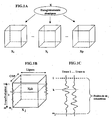
- Geophysical events that are to be compacted / filtered are characterized by geophysical attributes often organized in groups or families with particular physical significance ( Figures 1A to 1C ). These attributes may be the succession of the values of the amplitudes of seismic trace portions or of elastic parameters resulting from a summed elastic inversion before summation, obtained for example by means of the method described in the patent FR 2,800,473 ( EP 1 096 270 ) already cited along the time window studied. These attributes can be, for a given depth, the measurements of the same set of logs recorded along a well, such as for example the values of the different resistivity tools, the values of the various tools measuring the porosity, etc. .
- this family is in the form of a cube of values corresponding to this property, indicated by their spatial position (line, cdp, time / depth), ( Figures 1B and 1C ).
- These cubes can be formed, for example, by a set of amplitude values of n traces or portions of traces associated with a common offset or at a common angle, or the spatial distribution of the values of a common attribute derived from these amplitudes such that for example, the acoustic impedance in P or S waves, the specific mass or Lamé parameters, in a chosen time window of size m j .
- each variable X j, k gathers the values of the seismic attribute considered (seismic amplitude or elastic property) for a time sample inside the analysis window.
- a cube includes as many individuals as traces available.
- this family is in the form of a series of m j series of values, indicated by their position along the well (time or depth).
- This series can be formed, for example, by the set of log measurements of tools of the same physical nature, such as the various tools measuring the porosity of the formation, or the tools measuring different types of resistivity, over a set of n depth dimensions. or time along one or more wells at the subterranean formation studied.
- each variable X j, k gathers the values of the logging attribute considered (resistivity, porosity, radioactivity, ...) for a depth or time dimension inside the analysis window.
- a sequence includes as many individuals as depth or time dimensions available along the wells analyzed.
- the m j variables X j, k X j of a table define a space and denoted S j are assumed centered.
- D n be the diagonal matrix of the weights of individuals.
- Rotation methods well known to those skilled in the art can be implemented in each of the spaces thus found, in order to optimize the correlation coefficients between the new variables and the initial variables.
- the first variable Z (1) is a normal eigenvector of the covariance matrix XX t D n corresponding to the largest eigenvalue.
- Z (1) is then projected onto p spaces S j and, in each space, the regression of the variable m j by Z j (1) is computed.
- the matrix of p juxtaposed residues X j (2) defines the new study space. This new space corresponds to the initial space from which the influence of Z j (1) has been removed in each group S j .
- the m j variables of the table X j (2) define a subspace S j (2) of S j .
- the second component Z (2) is the normalized eigenvector of the covariance matrix X (2) X (2) t D n of the residues corresponding to the largest eigenvalue.
- Z (2) is projected onto p spaces S j (2) .
- the regression of the m j variables by Z j (2) is computed in each space S j (2) .
- the regression performed in each space S j ensures that the projection of Z (2) on the space S j (2) is orthogonal to the projection of Z (1) on the space S j .
- the calculation of the eigenvectors is carried out by any method known to those skilled in the art.
- the matrix XX t D n being of order n, n being able to be very large
- the normed eigenvector V (k) of the matrix X (k) t D n X (k) is calculated. associated with the greatest eigenvalue.
- Each group can be reconstituted with a small number of attributes.
- the initial variables of group j can be expressed as the sum of a linear combination of the variables Z j (k) and a residual. If all the variables Z j (k) of a group are used, the residual is zero.
- the coefficients of the linear combination are none other than the coefficients calculated at the end of each regression in the spaces S j .
- the method according to the invention has the property, inter alia, that the variables Z (k) are orthogonal two by two.
- the correlations between the variables Z (k) and the initial variables X j, k are also calculated to highlight possible relations between the X j, k .
- the correlations between the variables Z j (k) and X j, k of the same group j, or the correlations between variables Z j (k) for the same k can also be calculated.
- the new synthetic variables thus created constitute the new geophysical attributes sought.
- the method according to the invention has been applied to three cubes of elastic properties (impedance P noted Ip, impedance S denoted by Is and specific gravity noted ⁇ ) obtained after joined elastic inversion before summation using the method described in the patent FR 2,800,473 already cited seismic records grouped in cubes common angles of incidence.
- Each elastic property generates a group of variables or seismic attributes.
- the analysis time window consists of 19 signal samples taken from the seismic recordings.
- variables the values of the elastic property for a time sample inside the analysis window.
- Each group is then composed of 19 variables composed of as many individuals as available traces. Since there are three groups of variables, we have a total of 57 variables.
- the three parameter cubes have been previously horizontalized with respect to a reference surface.
- Table 1 gives the proportion of percentage variance explained by the projections of the first 8 synthetic variables Z (1) to Z (8) in the three groups. It shows that 8 variables are sufficient to summarize 87.4% of the variance of the impedance P, 94.4% of the variance of the impedance S and 88.4% of the variance of the specific mass.
- Z (1) Z (2) Z (3)
- Z (4) Z (5)
- Z (6) Z (7)
- Z (8) ⁇ ip 23.4 24.5 6.3 13.1 9.8 3.1 3.8 3.4 87.4 is 26.6 14.2 15.2 12.6 5.7 7.2 5.8 7.1 94.4 ⁇ 16.9 14.1 13.6 10.2 8.0 9.4 10.1 6.1 88.4
- Table 2 gives the square of the correlation between the synthetic variables Z (k) and their projections on the three groups. This value indicates the degree of proximity between the variable and the group. The closer the value is to 1, the closer the variable is to its projection and therefore to the group.
- Z (1) Z (2)
- Z (3) Z (4)
- Z (5) Z (6)
- Z (7) Z (8) ip 0.48 0.79 0.38 0.72 0.71 0.24 0.02 0.30 is 0.91 0.43 0.86 0.53 0.36 0.59 0.09 0.73 ⁇ 0.78 0.49 0.77 0.46 0.65 0.79 0.96 0.46
- Z (1) is very close to Is and close to ⁇ , but far from Ip.
- Z (2) is close to Ip, but far from Is and ⁇ .
- Z (k) three are close to Ip alone, two are close to both Is and ⁇ , one is close to Is alone, and two are close to ⁇ alone.
- the three elastic properties can be reconstructed with a small number of new seismic attributes.
- the number of synthetic variables used for the reconstitution can be different from one group to another: it depends on the percentage of inertia that one wishes to reconstitute / filter.
- the new seismic attributes can be interpreted geologically through facies analysis with a supervised or unformatted shape recognition algorithm.
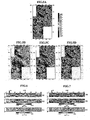
- a first class corresponding to the wells W1 and W2 represent turbiditic sands
- a second class corresponding to well W3 represents turbiditic sludge
- a third class represents hemipelagites.
- Wells W1 and W2 showing near geological characteristics, only the seismic events located around the well W2 are used, the well W1 serving as a blind test. Since the location of the W3 well is uncertain, the seismic events used to characterize the class 2 are located around a virtual well defined near W3.
- a virtual well is defined from our general geological knowledge.
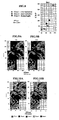
- the Fig.7 shows the geographical location of the three learning classes. Each class consists of 121 seismic events (11 ⁇ 11). These events are used to calibrate a ranking function that is then applied to all seismic events.
- the Fig.8A, 8B show respectively the assignments obtained and the assignments most likely, that is to say having a probability of allocation greater than or equal to 80%.
- the well W1 used in blind test, is correctly assigned to the same class as the well W2.
- Well W3 is located on the edge of classes 1 and 2.
- Class 2 is distributed along a channeling form.
- the map of the Figure 8B shows that the results are stable: few events have a poor probability of assignment.
- the learning classes are formed using the modes of a multivariate probability density function computed from the set of seismic events, in a space generated by the first eight new attributes.
- the higher probability density seismic events constituting the peaks of this density function are selected to perform the learning of the ranking function.
- This function is then applied to all the seismic events considered to assign them to one of the classes: Fig.9A, 9B show the assignments obtained, as well as the assignments most likely, that is to say having a probability of allocation greater than or equal to 80%.
- the maps obtained are very close to the maps of the Fig. 8A, 8B .
- Class 3 of the supervised analysis corresponds to classes 3, 4 and 5 of the unsupervised analysis.
- the wells W1 and W2 are assigned to the same class and the well W3 is always located on the boundary between the classes 3, and especially 1 and 2. This convergence of the results validates the interpretation of the supervised approach.
Landscapes
- Engineering & Computer Science (AREA)
- Remote Sensing (AREA)
- Physics & Mathematics (AREA)
- Life Sciences & Earth Sciences (AREA)
- Acoustics & Sound (AREA)
- Environmental & Geological Engineering (AREA)
- Geology (AREA)
- General Life Sciences & Earth Sciences (AREA)
- General Physics & Mathematics (AREA)
- Geophysics (AREA)
- Geophysics And Detection Of Objects (AREA)
Claims (12)
- Verfahren zum Komprimieren und Filtern geophysikalischer Ereignisse, die aus mehreren verfügbaren geophysikalischen Datensätzen gelesen werden können, die durch Erforschung einer unterirdischen Zone erhalten werden, dadurch gekennzeichnet, dass das Verfahren Folgendes umfasst:- die Aufteilung dieser geophysikalischen Ereignisse in eine bestimmte Anzahl p von Familien von geophysikalischen Variablen, die jeweils eine bestimmte physikalische Bedeutung haben;- die Bildung der seismischen Variablen durch Kombination von synthetischen Variablen in einer viel geringeren Anzahl als der Anzahl der Variablen, die durch Erstellung einer orthogonalen Vektorbasis in jeder der p Analysemengen erzielt wird, die von den Daten jeder der Familien gebildet werden, aus denen sich die Bildung einer orthonormalen Vektorbasis ergibt, die die p Analysemengen beschreibt; und- die Verwendung dieser orthonormalen Vektorbasis zum Filtern und Beschreiben der geophysikalischen Ereignisse.
- Verfahren nach Anspruch 1, dadurch gekennzeichnet, dass die Bildung synthetischer Variablen erzielt wird, indem eine Technik zur Analyse wesentlicher Komponenten oder von abgeleiteten Verfahren zur Diagonalisierung einer Norm und eine einfache Regressionstechnik kombiniert werden.
- Verfahren nach Anspruch 1 oder 2, dadurch gekennzeichnet, dass die synthetischen Variablen einer Rotation unterzogen werden, um die Korrelationen zwischen Anfangsvariablen und synthetischen Variablen zu verbessern.
- Verfahren nach Anspruch 1 oder 2 oder 3, dadurch gekennzeichnet, dass synthetische Variable aus Familien gebildet werden, die aus Kuben von seismischen Spuren bestehen, die nach einer seismischen 3D-Kampagne erhalten werden, wobei jeder demselben Versatz oder Offset entspricht.
- Verfahren nach Anspruch 1 oder 2 oder 3, dadurch gekennzeichnet, dass synthetische Variable aus Familien gebildet werden, die aus Kuben von seismischen Spuren bestehen, die nach einer seismischen 3D-Kampagne erhalten werden, wobei jeder demselben Einfallwinkel entspricht.
- Verfahren nach Anspruch 1 oder 2 oder 3, dadurch gekennzeichnet, dass synthetische Variable aus Familien gebildet werden, die aus Kuben von seismischen Attributen bestehen, die durch Behandlung von Amplituden von seismischen Spuren erhalten werden, die nach einer seismischen 3D-Kampagne erhalten werden.
- Verfahren nach einem der vorhergehenden Ansprüche, dadurch gekennzeichnet, dass synthetische Variable aus Familien gebildet werden, die aus Kuben von seismischen Spuren bestehen, die durch aufeinander folgende seismische Erforschungen der Zone erhalten werden.
- Verfahren nach einem der vorhergehenden Ansprüche, dadurch gekennzeichnet, dass synthetische Variable aus Familien gebildet werden, die aus Kuben von seismischen Attributen bestehen, die durch Behandlung von Amplituden von seismischen Spuren gebildet werden, die durch aufeinander folgende seismische Erforschungen der Zone erhalten werden.
- Verfahren nach Anspruch 1 oder 2 oder 3, dadurch gekennzeichnet, dass synthetische Variable aus Familien gebildet werden, die aus Messungen von Bohrlochuntersuchungsattributen unterschiedlicher physikalischer Beschaffenheit bestehen.
- Verfahren nach Anspruch 9, dadurch gekennzeichnet, dass synthetische Variable aus Familien von Messungen des Widerstands gebildet werden.
- Verfahren nach Anspruch 9, dadurch gekennzeichnet, dass synthetische Variable aus Familien von Messungen gebildet werden, die mit der Radioaktivität von Terrains verknüpft sind.
- Verfahren nach Anspruch 9, dadurch gekennzeichnet, dass synthetische Variable aus Familien von Messungen gebildet werden, die mit der Porosität von Terrains verknüpft sind.
Applications Claiming Priority (5)
| Application Number | Priority Date | Filing Date | Title |
|---|---|---|---|
| FR0211200A FR2844362B1 (fr) | 2002-09-10 | 2002-09-10 | Methode pour compacter et filtrer des evenements sismiques dans le but d'en extraire des informations sur la nature du sous-sol |
| FR0211200 | 2002-09-10 | ||
| FR0301900A FR2844363B1 (fr) | 2002-09-10 | 2003-02-17 | Methode pour compacter et filtrer des evenements geophysiques dans le but d'en extraire des informations sur la nature du sous-sol |
| FR0301900 | 2003-02-17 | ||
| PCT/FR2003/002543 WO2004025327A1 (fr) | 2002-09-10 | 2003-08-18 | Methode pour compacter et filtrer des evenements geophysiques dans le but d'en extraire des informations sur la nature du sous-sol |
Publications (2)
| Publication Number | Publication Date |
|---|---|
| EP1540377A1 EP1540377A1 (de) | 2005-06-15 |
| EP1540377B1 true EP1540377B1 (de) | 2011-10-12 |
Family
ID=31889636
Family Applications (1)
| Application Number | Title | Priority Date | Filing Date |
|---|---|---|---|
| EP03758244A Expired - Lifetime EP1540377B1 (de) | 2002-09-10 | 2003-08-18 | Verfahren zum komprimieren und filtrieren von geophysischen ereignissen zwecks extrahierung von bodenartdaten |
Country Status (7)
| Country | Link |
|---|---|
| US (1) | US7289910B2 (de) |
| EP (1) | EP1540377B1 (de) |
| AU (1) | AU2003274260A1 (de) |
| CA (1) | CA2498029C (de) |
| FR (1) | FR2844363B1 (de) |
| NO (1) | NO336964B1 (de) |
| WO (1) | WO2004025327A1 (de) |
Families Citing this family (3)
| Publication number | Priority date | Publication date | Assignee | Title |
|---|---|---|---|---|
| CA2767689C (en) * | 2009-08-07 | 2018-01-02 | Exxonmobil Upstream Research Company | Drilling advisory systems and methods based on at least two controllable drilling parameters |
| US9702995B2 (en) | 2011-06-17 | 2017-07-11 | Exxonmobil Upstream Research Company | Domain freezing in joint inversion |
| CN112068221B (zh) * | 2020-09-07 | 2023-09-08 | 中国煤炭地质总局地球物理勘探研究院 | 一种煤层富水性分析方法 |
Family Cites Families (2)
| Publication number | Priority date | Publication date | Assignee | Title |
|---|---|---|---|---|
| US4937747A (en) * | 1988-02-16 | 1990-06-26 | Amoco Corporation | Iterative disjoint cluster and discriminant function processing of formation log responses and other data |
| FR2768818B1 (fr) * | 1997-09-22 | 1999-12-03 | Inst Francais Du Petrole | Methode statistique de classement d'evenements lies au proprietes physiques d'un milieu complexe tel que le sous-sol |
-
2003
- 2003-02-17 FR FR0301900A patent/FR2844363B1/fr not_active Expired - Fee Related
- 2003-08-18 EP EP03758244A patent/EP1540377B1/de not_active Expired - Lifetime
- 2003-08-18 CA CA2498029A patent/CA2498029C/fr not_active Expired - Fee Related
- 2003-08-18 WO PCT/FR2003/002543 patent/WO2004025327A1/fr not_active Ceased
- 2003-08-18 AU AU2003274260A patent/AU2003274260A1/en not_active Abandoned
- 2003-08-18 US US10/527,082 patent/US7289910B2/en not_active Expired - Fee Related
-
2005
- 2005-02-24 NO NO20051007A patent/NO336964B1/no not_active IP Right Cessation
Also Published As
| Publication number | Publication date |
|---|---|
| WO2004025327A1 (fr) | 2004-03-25 |
| FR2844363B1 (fr) | 2004-10-15 |
| US7289910B2 (en) | 2007-10-30 |
| FR2844363A1 (fr) | 2004-03-12 |
| EP1540377A1 (de) | 2005-06-15 |
| US20060155470A1 (en) | 2006-07-13 |
| NO20051007D0 (no) | 2005-02-24 |
| CA2498029C (fr) | 2013-10-15 |
| CA2498029A1 (fr) | 2004-03-25 |
| NO336964B1 (no) | 2015-12-07 |
| AU2003274260A1 (en) | 2004-04-30 |
| NO20051007L (no) | 2005-06-09 |
Similar Documents
| Publication | Publication Date | Title |
|---|---|---|
| Zheng et al. | Applications of supervised deep learning for seismic interpretation and inversion | |
| Latimer et al. | An interpreter's guide to understanding and working with seismic-derived acoustic impedance data | |
| CA2670384C (fr) | Methode d'inversion conjointe de donnees sismiques representees sur des echelles de temps differentes | |
| EP1096270B1 (de) | Methode zur 2D oder 3D Modellerstellung einer heterogenen Umgebung, wie z.B. des Bodenuntergrundes, beschrieben durch einen oder mehrere physikalische Parameter | |
| CA2357117C (fr) | Methode pour faciliter la reconnaissance d'objets, notamment geologiques, par une technique d'analyse discriminante | |
| CA2149647C (fr) | Methode d'analyse des traces sismiques utilisant une technique de calibrage statistique pour en deduire des proprietes geologiques | |
| AU703006B2 (en) | Determination of formation properties from seismic attributes | |
| FR2980897A1 (fr) | Procede de validation d'image d'entrainement pour la modelisation geostatistique multipoint du sous-sol | |
| FR2654515A1 (fr) | Methode d'evaluation lithologique a partir de donnees sismiques. | |
| US11852768B2 (en) | Multimodal approach to target stratigraphic plays through seismic sequence stratigraphy, rock physics, seismic inversion and machine learning | |
| EP1253443B1 (de) | Verfahren zur Erleichterung der Zeitüberwachung der Evolution eines unterirdischen Gebiets mit einer vergleichenden Auswertung von verschiedenen seismischen Datensätzen | |
| EP1963886B1 (de) | Quantitative evaluierungsmethode von flüssigkeitsdrücken und zur entdeckung von überdrücken im untergrund | |
| Avants et al. | A new probe of ULVZ S‐wave velocity structure: Array stacking of ScS waveforms | |
| EP1452889B1 (de) | Verfahren zur Messung lokaler Änlichkeiten zwischen mehreren Kuben die seismische Spuren enthalten | |
| Folesky et al. | Stress drop variations in the region of the 2014 MW8. 1 Iquique earthquake, northern Chile | |
| FR2753800A1 (fr) | Procede et appareil pour exploiter des paires de donnees collectees au cours d'une operation sismique, lesquelles representent des caracteristiques d'une formation terrestre et pour generer un enregistrement de sortie | |
| Raji et al. | Wavefield analysis of crosswell seismic data | |
| FR3132320A1 (fr) | Détection et correction de fausses classifications positives à partir d’un outil de détection de sable de produit | |
| CA2498029C (fr) | Methode pour compacter et filtrer des evenements geophysiques dans le but d'en extraire des informations sur la nature du sous-sol | |
| Bakulin et al. | Evaluating strategies for estimation of local kinematic parameters in noisy land data: quality versus performance trade-offs | |
| Lu | Deep learning realm for geophysics: Seismic acquisition, processing, interpretation, and inversion | |
| Septyana et al. | Multi-channel waveform clustering: a first look at microseismic multiplets from coalbed methane stimulation | |
| EP0923051B1 (de) | Multivariables statistisches Verfahren zum Charakterisieren von aus einem komplexen Medium wie eine Sub-Oberfläche gebildeten Bildern | |
| Johann et al. | Spectral decomposition reveals geological hidden features in the amplitude maps from a deep water reservoir in the campos basin | |
| CN113495291A (zh) | 基于深度学习的偏前道集保幅性智能量化评价方法 |
Legal Events
| Date | Code | Title | Description |
|---|---|---|---|
| PUAI | Public reference made under article 153(3) epc to a published international application that has entered the european phase |
Free format text: ORIGINAL CODE: 0009012 |
|
| 17P | Request for examination filed |
Effective date: 20050411 |
|
| AK | Designated contracting states |
Kind code of ref document: A1 Designated state(s): AT BE BG CH CY CZ DE DK EE ES FI FR GB GR HU IE IT LI LU MC NL PT RO SE SI SK TR |
|
| AX | Request for extension of the european patent |
Extension state: AL LT LV MK |
|
| DAX | Request for extension of the european patent (deleted) | ||
| RBV | Designated contracting states (corrected) |
Designated state(s): BE CH DE GB IT LI NL |
|
| RIN1 | Information on inventor provided before grant (corrected) |
Inventor name: FOURNIER, FREDERIQUE Inventor name: ROYER, JEAN-JACQUES Inventor name: VOUTAY, OLIVIER |
|
| GRAP | Despatch of communication of intention to grant a patent |
Free format text: ORIGINAL CODE: EPIDOSNIGR1 |
|
| GRAS | Grant fee paid |
Free format text: ORIGINAL CODE: EPIDOSNIGR3 |
|
| RAP1 | Party data changed (applicant data changed or rights of an application transferred) |
Owner name: IFP ENERGIES NOUVELLES |
|
| GRAA | (expected) grant |
Free format text: ORIGINAL CODE: 0009210 |
|
| AK | Designated contracting states |
Kind code of ref document: B1 Designated state(s): BE CH DE GB IT LI NL |
|
| REG | Reference to a national code |
Ref country code: GB Ref legal event code: FG4D Free format text: NOT ENGLISH |
|
| REG | Reference to a national code |
Ref country code: CH Ref legal event code: EP |
|
| REG | Reference to a national code |
Ref country code: DE Ref legal event code: R096 Ref document number: 60338752 Country of ref document: DE Effective date: 20120105 |
|
| REG | Reference to a national code |
Ref country code: NL Ref legal event code: VDEP Effective date: 20111012 |
|
| PG25 | Lapsed in a contracting state [announced via postgrant information from national office to epo] |
Ref country code: NL Free format text: LAPSE BECAUSE OF FAILURE TO SUBMIT A TRANSLATION OF THE DESCRIPTION OR TO PAY THE FEE WITHIN THE PRESCRIBED TIME-LIMIT Effective date: 20111012 |
|
| PLBE | No opposition filed within time limit |
Free format text: ORIGINAL CODE: 0009261 |
|
| STAA | Information on the status of an ep patent application or granted ep patent |
Free format text: STATUS: NO OPPOSITION FILED WITHIN TIME LIMIT |
|
| PG25 | Lapsed in a contracting state [announced via postgrant information from national office to epo] |
Ref country code: IT Free format text: LAPSE BECAUSE OF FAILURE TO SUBMIT A TRANSLATION OF THE DESCRIPTION OR TO PAY THE FEE WITHIN THE PRESCRIBED TIME-LIMIT Effective date: 20111012 |
|
| 26N | No opposition filed |
Effective date: 20120713 |
|
| REG | Reference to a national code |
Ref country code: DE Ref legal event code: R097 Ref document number: 60338752 Country of ref document: DE Effective date: 20120713 |
|
| BERE | Be: lapsed |
Owner name: IFP ENERGIES NOUVELLES Effective date: 20120831 |
|
| REG | Reference to a national code |
Ref country code: CH Ref legal event code: PL |
|
| PG25 | Lapsed in a contracting state [announced via postgrant information from national office to epo] |
Ref country code: CH Free format text: LAPSE BECAUSE OF NON-PAYMENT OF DUE FEES Effective date: 20120831 Ref country code: LI Free format text: LAPSE BECAUSE OF NON-PAYMENT OF DUE FEES Effective date: 20120831 |
|
| PG25 | Lapsed in a contracting state [announced via postgrant information from national office to epo] |
Ref country code: BE Free format text: LAPSE BECAUSE OF NON-PAYMENT OF DUE FEES Effective date: 20120831 |
|
| PG25 | Lapsed in a contracting state [announced via postgrant information from national office to epo] |
Ref country code: DE Free format text: LAPSE BECAUSE OF NON-PAYMENT OF DUE FEES Effective date: 20130301 |
|
| REG | Reference to a national code |
Ref country code: DE Ref legal event code: R119 Ref document number: 60338752 Country of ref document: DE Effective date: 20130301 |
|
| PGFP | Annual fee paid to national office [announced via postgrant information from national office to epo] |
Ref country code: GB Payment date: 20170821 Year of fee payment: 15 |
|
| GBPC | Gb: european patent ceased through non-payment of renewal fee |
Effective date: 20180818 |
|
| PG25 | Lapsed in a contracting state [announced via postgrant information from national office to epo] |
Ref country code: GB Free format text: LAPSE BECAUSE OF NON-PAYMENT OF DUE FEES Effective date: 20180818 |