EP1541193B1 - Medizinisches behandlungssystem basierend auf nativer biologischer regulierungsfunktion, schrittmachersystem auf basis des medizinischen behandlungssystems, blutdruckreguliersystem und system zur behandlung von herzkrankheiten - Google Patents
Medizinisches behandlungssystem basierend auf nativer biologischer regulierungsfunktion, schrittmachersystem auf basis des medizinischen behandlungssystems, blutdruckreguliersystem und system zur behandlung von herzkrankheiten Download PDFInfo
- Publication number
- EP1541193B1 EP1541193B1 EP02755821.2A EP02755821A EP1541193B1 EP 1541193 B1 EP1541193 B1 EP 1541193B1 EP 02755821 A EP02755821 A EP 02755821A EP 1541193 B1 EP1541193 B1 EP 1541193B1
- Authority
- EP
- European Patent Office
- Prior art keywords
- nerve
- signals
- blood pressure
- activity
- stimulation
- Prior art date
- Legal status (The legal status is an assumption and is not a legal conclusion. Google has not performed a legal analysis and makes no representation as to the accuracy of the status listed.)
- Expired - Lifetime
Links
- 230000036772 blood pressure Effects 0.000 title claims description 86
- 230000000747 cardiac effect Effects 0.000 title claims description 52
- 230000001105 regulatory effect Effects 0.000 title claims description 30
- 230000033228 biological regulation Effects 0.000 title claims description 16
- 208000019622 heart disease Diseases 0.000 title description 17
- 238000011282 treatment Methods 0.000 title description 14
- 208000020446 Cardiac disease Diseases 0.000 title description 11
- 210000005036 nerve Anatomy 0.000 claims description 90
- 210000002216 heart Anatomy 0.000 claims description 86
- 230000008035 nerve activity Effects 0.000 claims description 79
- 230000002889 sympathetic effect Effects 0.000 claims description 79
- 230000004071 biological effect Effects 0.000 claims description 63
- 230000001515 vagal effect Effects 0.000 claims description 51
- 230000004936 stimulating effect Effects 0.000 claims description 48
- 230000000638 stimulation Effects 0.000 claims description 47
- 230000004044 response Effects 0.000 claims description 31
- 230000002159 abnormal effect Effects 0.000 claims description 29
- 230000029865 regulation of blood pressure Effects 0.000 claims description 21
- 230000007383 nerve stimulation Effects 0.000 claims description 19
- 201000010099 disease Diseases 0.000 claims description 15
- 208000037265 diseases, disorders, signs and symptoms Diseases 0.000 claims description 15
- 230000005792 cardiovascular activity Effects 0.000 claims description 12
- 238000000034 method Methods 0.000 claims description 12
- 230000008569 process Effects 0.000 claims description 10
- 238000012546 transfer Methods 0.000 claims description 10
- 230000002792 vascular Effects 0.000 claims description 7
- 210000000331 sympathetic ganglia Anatomy 0.000 claims description 5
- 210000005037 parasympathetic nerve Anatomy 0.000 claims description 4
- 230000036760 body temperature Effects 0.000 claims description 3
- 210000004556 brain Anatomy 0.000 claims description 3
- 230000017531 blood circulation Effects 0.000 claims description 2
- 210000000748 cardiovascular system Anatomy 0.000 claims description 2
- 238000001647 drug administration Methods 0.000 claims description 2
- 210000000278 spinal cord Anatomy 0.000 claims description 2
- 241000700159 Rattus Species 0.000 description 46
- 230000000694 effects Effects 0.000 description 32
- 208000010125 myocardial infarction Diseases 0.000 description 17
- 108091008698 baroreceptors Proteins 0.000 description 15
- 210000001774 pressoreceptor Anatomy 0.000 description 15
- 230000006870 function Effects 0.000 description 12
- 238000012360 testing method Methods 0.000 description 12
- 230000035581 baroreflex Effects 0.000 description 9
- 230000009711 regulatory function Effects 0.000 description 9
- 210000001326 carotid sinus Anatomy 0.000 description 8
- 230000003247 decreasing effect Effects 0.000 description 8
- BASFCYQUMIYNBI-UHFFFAOYSA-N platinum Chemical compound [Pt] BASFCYQUMIYNBI-UHFFFAOYSA-N 0.000 description 8
- 230000001457 vasomotor Effects 0.000 description 8
- 210000004351 coronary vessel Anatomy 0.000 description 7
- 230000001771 impaired effect Effects 0.000 description 7
- 230000008844 regulatory mechanism Effects 0.000 description 7
- 206010002091 Anaesthesia Diseases 0.000 description 5
- 206010040744 Sinus headache Diseases 0.000 description 5
- 230000037005 anaesthesia Effects 0.000 description 5
- 230000002146 bilateral effect Effects 0.000 description 5
- 210000000056 organ Anatomy 0.000 description 5
- 210000001679 solitary nucleus Anatomy 0.000 description 5
- 238000001356 surgical procedure Methods 0.000 description 5
- 230000004083 survival effect Effects 0.000 description 5
- 241001465754 Metazoa Species 0.000 description 4
- 230000007423 decrease Effects 0.000 description 4
- 230000007774 longterm Effects 0.000 description 4
- 229910052697 platinum Inorganic materials 0.000 description 4
- NJRXVEJTAYWCQJ-UHFFFAOYSA-N thiomalic acid Chemical compound OC(=O)CC(S)C(O)=O NJRXVEJTAYWCQJ-UHFFFAOYSA-N 0.000 description 4
- 230000007384 vagal nerve stimulation Effects 0.000 description 4
- 230000002861 ventricular Effects 0.000 description 4
- 210000002376 aorta thoracic Anatomy 0.000 description 3
- 230000008859 change Effects 0.000 description 3
- 230000004087 circulation Effects 0.000 description 3
- 230000002596 correlated effect Effects 0.000 description 3
- 230000002746 orthostatic effect Effects 0.000 description 3
- 238000012545 processing Methods 0.000 description 3
- 238000005316 response function Methods 0.000 description 3
- 230000035945 sensitivity Effects 0.000 description 3
- 230000001052 transient effect Effects 0.000 description 3
- 206010019280 Heart failures Diseases 0.000 description 2
- 208000001953 Hypotension Diseases 0.000 description 2
- 208000001089 Multiple system atrophy Diseases 0.000 description 2
- 241000283977 Oryctolagus Species 0.000 description 2
- 241000283973 Oryctolagus cuniculus Species 0.000 description 2
- 239000004698 Polyethylene Substances 0.000 description 2
- 208000009106 Shy-Drager Syndrome Diseases 0.000 description 2
- 206010047139 Vasoconstriction Diseases 0.000 description 2
- 208000033774 Ventricular Remodeling Diseases 0.000 description 2
- 230000001746 atrial effect Effects 0.000 description 2
- 239000008280 blood Substances 0.000 description 2
- 210000004369 blood Anatomy 0.000 description 2
- 210000001715 carotid artery Anatomy 0.000 description 2
- 210000004720 cerebrum Anatomy 0.000 description 2
- 238000010586 diagram Methods 0.000 description 2
- 230000036543 hypotension Effects 0.000 description 2
- 210000001767 medulla oblongata Anatomy 0.000 description 2
- 230000003387 muscular Effects 0.000 description 2
- 210000004165 myocardium Anatomy 0.000 description 2
- 229960003379 pancuronium bromide Drugs 0.000 description 2
- NPIJXCQZLFKBMV-YTGGZNJNSA-L pancuronium bromide Chemical compound [Br-].[Br-].C[N+]1([C@@H]2[C@@H](OC(C)=O)C[C@@H]3CC[C@H]4[C@@H]5C[C@@H]([C@@H]([C@]5(CC[C@@H]4[C@@]3(C)C2)C)OC(=O)C)[N+]2(C)CCCCC2)CCCCC1 NPIJXCQZLFKBMV-YTGGZNJNSA-L 0.000 description 2
- -1 polyethylene Polymers 0.000 description 2
- 229920000573 polyethylene Polymers 0.000 description 2
- 229920002379 silicone rubber Polymers 0.000 description 2
- 239000004945 silicone rubber Substances 0.000 description 2
- 238000002054 transplantation Methods 0.000 description 2
- UCTWMZQNUQWSLP-VIFPVBQESA-N (R)-adrenaline Chemical compound CNC[C@H](O)C1=CC=C(O)C(O)=C1 UCTWMZQNUQWSLP-VIFPVBQESA-N 0.000 description 1
- 229930182837 (R)-adrenaline Natural products 0.000 description 1
- KWTSXDURSIMDCE-QMMMGPOBSA-N (S)-amphetamine Chemical compound C[C@H](N)CC1=CC=CC=C1 KWTSXDURSIMDCE-QMMMGPOBSA-N 0.000 description 1
- 208000007204 Brain death Diseases 0.000 description 1
- 208000001778 Coronary Occlusion Diseases 0.000 description 1
- 206010011086 Coronary artery occlusion Diseases 0.000 description 1
- 208000003098 Ganglion Cysts Diseases 0.000 description 1
- WTDRDQBEARUVNC-LURJTMIESA-N L-DOPA Chemical compound OC(=O)[C@@H](N)CC1=CC=C(O)C(O)=C1 WTDRDQBEARUVNC-LURJTMIESA-N 0.000 description 1
- WTDRDQBEARUVNC-UHFFFAOYSA-N L-Dopa Natural products OC(=O)C(N)CC1=CC=C(O)C(O)=C1 WTDRDQBEARUVNC-UHFFFAOYSA-N 0.000 description 1
- 206010065508 Orthostatic hypertension Diseases 0.000 description 1
- 206010037211 Psychomotor hyperactivity Diseases 0.000 description 1
- 206010038743 Restlessness Diseases 0.000 description 1
- 208000005400 Synovial Cyst Diseases 0.000 description 1
- 239000004809 Teflon Substances 0.000 description 1
- 229920006362 Teflon® Polymers 0.000 description 1
- 230000007488 abnormal function Effects 0.000 description 1
- 230000001133 acceleration Effects 0.000 description 1
- 230000009471 action Effects 0.000 description 1
- 206010000891 acute myocardial infarction Diseases 0.000 description 1
- 239000000048 adrenergic agonist Substances 0.000 description 1
- 229940025084 amphetamine Drugs 0.000 description 1
- 230000003321 amplification Effects 0.000 description 1
- 238000004458 analytical method Methods 0.000 description 1
- 239000002473 artificial blood Substances 0.000 description 1
- 230000008827 biological function Effects 0.000 description 1
- 230000023555 blood coagulation Effects 0.000 description 1
- 230000037396 body weight Effects 0.000 description 1
- 208000006218 bradycardia Diseases 0.000 description 1
- 230000036471 bradycardia Effects 0.000 description 1
- 230000002612 cardiopulmonary effect Effects 0.000 description 1
- 210000003169 central nervous system Anatomy 0.000 description 1
- 210000001638 cerebellum Anatomy 0.000 description 1
- 230000001684 chronic effect Effects 0.000 description 1
- 230000008602 contraction Effects 0.000 description 1
- 238000012937 correction Methods 0.000 description 1
- 238000005314 correlation function Methods 0.000 description 1
- 230000034994 death Effects 0.000 description 1
- 231100000517 death Toxicity 0.000 description 1
- 230000018044 dehydration Effects 0.000 description 1
- 238000006297 dehydration reaction Methods 0.000 description 1
- 230000001419 dependent effect Effects 0.000 description 1
- 229960005139 epinephrine Drugs 0.000 description 1
- 210000001105 femoral artery Anatomy 0.000 description 1
- 210000003191 femoral vein Anatomy 0.000 description 1
- 230000004217 heart function Effects 0.000 description 1
- 229920000669 heparin Polymers 0.000 description 1
- ZFGMDIBRIDKWMY-PASTXAENSA-N heparin Chemical compound CC(O)=N[C@@H]1[C@@H](O)[C@H](O)[C@@H](COS(O)(=O)=O)O[C@@H]1O[C@@H]1[C@@H](C(O)=O)O[C@@H](O[C@H]2[C@@H]([C@@H](OS(O)(=O)=O)[C@@H](O[C@@H]3[C@@H](OC(O)[C@H](OS(O)(=O)=O)[C@H]3O)C(O)=O)O[C@@H]2O)CS(O)(=O)=O)[C@H](O)[C@H]1O ZFGMDIBRIDKWMY-PASTXAENSA-N 0.000 description 1
- 229960001008 heparin sodium Drugs 0.000 description 1
- 238000002513 implantation Methods 0.000 description 1
- 230000006872 improvement Effects 0.000 description 1
- 230000036540 impulse transmission Effects 0.000 description 1
- 210000005248 left atrial appendage Anatomy 0.000 description 1
- 229960004502 levodopa Drugs 0.000 description 1
- 239000003589 local anesthetic agent Substances 0.000 description 1
- 238000012423 maintenance Methods 0.000 description 1
- 238000005259 measurement Methods 0.000 description 1
- 230000002107 myocardial effect Effects 0.000 description 1
- 238000003199 nucleic acid amplification method Methods 0.000 description 1
- 210000000496 pancreas Anatomy 0.000 description 1
- 238000011458 pharmacological treatment Methods 0.000 description 1
- 239000002504 physiological saline solution Substances 0.000 description 1
- 238000011084 recovery Methods 0.000 description 1
- 230000009467 reduction Effects 0.000 description 1
- 230000004346 regulation of heart rate Effects 0.000 description 1
- 230000001020 rhythmical effect Effects 0.000 description 1
- 150000003839 salts Chemical class 0.000 description 1
- 238000004088 simulation Methods 0.000 description 1
- 210000002466 splanchnic nerve Anatomy 0.000 description 1
- 210000004686 stellate ganglion Anatomy 0.000 description 1
- 208000024891 symptom Diseases 0.000 description 1
- 210000001186 vagus nerve Anatomy 0.000 description 1
- 230000025033 vasoconstriction Effects 0.000 description 1
- 210000003462 vein Anatomy 0.000 description 1
- 238000009423 ventilation Methods 0.000 description 1
Images



Classifications
-
- A—HUMAN NECESSITIES
- A61—MEDICAL OR VETERINARY SCIENCE; HYGIENE
- A61N—ELECTROTHERAPY; MAGNETOTHERAPY; RADIATION THERAPY; ULTRASOUND THERAPY
- A61N1/00—Electrotherapy; Circuits therefor
- A61N1/18—Applying electric currents by contact electrodes
- A61N1/32—Applying electric currents by contact electrodes alternating or intermittent currents
- A61N1/36—Applying electric currents by contact electrodes alternating or intermittent currents for stimulation
- A61N1/3605—Implantable neurostimulators for stimulating central or peripheral nerve system
- A61N1/3606—Implantable neurostimulators for stimulating central or peripheral nerve system adapted for a particular treatment
- A61N1/36114—Cardiac control, e.g. by vagal stimulation
-
- A—HUMAN NECESSITIES
- A61—MEDICAL OR VETERINARY SCIENCE; HYGIENE
- A61N—ELECTROTHERAPY; MAGNETOTHERAPY; RADIATION THERAPY; ULTRASOUND THERAPY
- A61N1/00—Electrotherapy; Circuits therefor
- A61N1/18—Applying electric currents by contact electrodes
- A61N1/32—Applying electric currents by contact electrodes alternating or intermittent currents
- A61N1/36—Applying electric currents by contact electrodes alternating or intermittent currents for stimulation
- A61N1/3605—Implantable neurostimulators for stimulating central or peripheral nerve system
- A61N1/3606—Implantable neurostimulators for stimulating central or peripheral nerve system adapted for a particular treatment
- A61N1/36114—Cardiac control, e.g. by vagal stimulation
- A61N1/36117—Cardiac control, e.g. by vagal stimulation for treating hypertension
-
- A—HUMAN NECESSITIES
- A61—MEDICAL OR VETERINARY SCIENCE; HYGIENE
- A61N—ELECTROTHERAPY; MAGNETOTHERAPY; RADIATION THERAPY; ULTRASOUND THERAPY
- A61N1/00—Electrotherapy; Circuits therefor
- A61N1/18—Applying electric currents by contact electrodes
- A61N1/32—Applying electric currents by contact electrodes alternating or intermittent currents
- A61N1/36—Applying electric currents by contact electrodes alternating or intermittent currents for stimulation
- A61N1/362—Heart stimulators
- A61N1/365—Heart stimulators controlled by a physiological parameter, e.g. heart potential
-
- A—HUMAN NECESSITIES
- A61—MEDICAL OR VETERINARY SCIENCE; HYGIENE
- A61N—ELECTROTHERAPY; MAGNETOTHERAPY; RADIATION THERAPY; ULTRASOUND THERAPY
- A61N1/00—Electrotherapy; Circuits therefor
- A61N1/18—Applying electric currents by contact electrodes
- A61N1/32—Applying electric currents by contact electrodes alternating or intermittent currents
- A61N1/36—Applying electric currents by contact electrodes alternating or intermittent currents for stimulation
- A61N1/362—Heart stimulators
- A61N1/365—Heart stimulators controlled by a physiological parameter, e.g. heart potential
- A61N1/36514—Heart stimulators controlled by a physiological parameter, e.g. heart potential controlled by a physiological quantity other than heart potential, e.g. blood pressure
Definitions
- the present invention is related to a system to treat diseases by substituting native biological regulatory function. More particularly, the present invention provides a system to treat diseases by substituting native biological regulatory function that is capable of regulating organs as if their central controllers were normally functioning even if the central controllers themselves become abnormal due to various causes.
- the invention includes a cardiac pacing system, a blood pressure regulating system, and a cardiac disease treatment system, all of which are particular embodiments of the medical treatment system.
- the number of heart donors is definitely small, and the shortage of hearts for transplantation has been seriously discussed worldwide.
- Pacemakers have been used for the treatment of patients with bradycardia. Pacemakers enable necessary rhythmic myocardial contraction by electrically stimulating the myocardium artificially.
- rate-responsive pacemakers in which stimulation rate changes according to the estimated native heart rate from e.g., electrocardiographic QT time, body temperature, or body acceleration.
- specificity, sensitivity and transient response of heart rate regulation compared to native heart rate regulation by such pacemakers have not always been satisfactory.
- abnormal native regulatory function promotes disease processes.
- abnormal native regulatory mechanisms participate in the progression of heart disease, and it is well known that sympathetic nerve overactivation and abnormal vagal nerve withdrawal occur after the onset of acute myocardial infarction, and worsens the outcome.
- Such abnormal native regulatory function can also be observed in circulatory diseases other than heart diseases.
- Adrenergic agonists such as epinephrine, levodopa and amphetamine, are used for pharmacological treatment of Shy-Drager syndrome with severe orthostatic hypertension, and excessive salt is administered for symptomatic relief. Although symptoms can be alleviated to some extent, it is impossible to treat Shy-Drager syndrome and restore full function.
- a system according to the preamble of claim 1 is known from US2002/032469 .
- the present invention provides a system to treat diseases that is capable of regulating organs as if their central controllers were normally functioning even if the central controllers themselves become abnormal by various causes.
- the present invention includes embodiments directed to a cardiac pacing system, a blood pressure regulating system, and a cardiac disease treatment system, all of which are based on the above medical treatment system.
- stimulating means which receives the signals calculated by the calculating means, and stimulates the organism on the basis of the signals.
- the calculating means includes a discriminating means which determines whether the received biosignals are caused by normal biological activities or by abnormal biological activities. When the received biosignals are determined to be caused by normal biological activities, the calculating means does not output signals to stimulate the organism. In contrast, when the received biosignals are determined to be caused by abnormal biological activities, the calculating means outputs signals to stimulate the organism.
- the signals are calculated by a convolution integral between an impulse response previously obtained from normal biological activities and the biosignals sensed by the biological activity sensing means.
- a cardiac pacing system based on biological activities includes a nerve activity sensing means which senses nerve activities of the cardiac sympathetic nerve and/or the vagal nerve, and outputs nerve activity signals.
- a calculating means receives the nerve activity signals sensed by the nerve activity sensing means, analyzes and processes the nerve activity signals to calculate pacing signals to control the heart rate, and outputs the pacing signals.
- a pacing means receives the pacing signals, and stimulates the heart on the basis of the pacing signals to regulate heart rate.
- a blood pressure regulating system which uses the native regulation rule to estimate nerve activities in response to blood pressure changes, includes a blood pressure sensing means, which senses blood pressure and outputs a blood pressure signal.
- a calculating means receives the blood pressure signal sensed by the blood pressure sensing means, analyzes and processes the blood pressure signal to calculate a sympathetic nerve stimulation signal for the regulation of blood pressure by the stimulation of sympathetic nerve innervating vascular beds, and outputs the sympathetic nerve stimulation signal.
- a nerve stimulating means receives the sympathetic nerve stimulation signal calculated by the calculating means, and stimulates the sympathetic nerve innervating vascular beds on the basis of the sympathetic nerve stimulation signal to regulate blood pressure.
- a system to treat cardiac diseases includes a cardiovascular activity sensing means which senses cardiovascular activity information issued by the cardiovascular system, and outputs cardiovascular activity signals.
- a calculating means receives the cardiovascular activity signals sensed by the cardiovascular activity sensing means, analyzes and processes the cardiovascular activity signals to calculate nerve stimulation signals, and outputs the nerve simulation signals.
- a nerve stimulating means receives the nerve stimulation signals, and stimulates the nerve on the basis of the nerve stimulation signals.
- the system to treat diseases in the present invention is capable of restoring native regulatory function as if the lost or abnormal native regulatory functions became normally functioning by substituting the lost or abnormal native functions with the system.
- Figure 1(a) is a schematic illustration showing the components of a native baroreflex or blood pressure regulation system. Information about the changes in blood pressure is transmitted from baroreceptors to the solitary tract nucleus in the medulla oblongata. The solitary tract nucleus then in turn changes sympathetic nerve activity to regulate blood pressure by e.g., vasoconstriction.
- Figure 1(b) is a schematic illustration where the system (1) of the present invention was applied to maintain normal blood pressure regulation even when the native vasomotor center fails to achieve normal function by various causes.
- Blood pressure can be maintained in a normal way by sensing blood pressure with a blood pressure sensing means (2), by converting the blood pressure signal into the signal for nerve stimulation with a nerve stimulating means (4) by a calculating means (3), and by stimulating the nerve with the nerve stimulating means (4) according to the calculated signals.
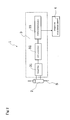
- Figure 2 is a block diagram depicting an outline of the system of the present invention.
- the disease treatment system (1) disclosed herein includes at least a biological activity sensing means (2), a calculating means (3), and an organism stimulating means (4).
- the biological activity sensing means (2) can output biosignals to the calculating means (3) by sensing biological activity information issued by biological activities of organisms (S).
- Some examples of the biological activity sensing means (2) include, but are not limited to, electrodes and pressure sensors.
- Biosignals sensed by the biological activity sensing means (2) include, but are not limited to, sympathetic nerve activities and parasympathetic nerve activities, blood flow, blood pressure, body temperature, electrocardiogram, electroenchephalogram, and various biochemical markers. One can choose any necessary biosignals that are required for the system to achieve the purpose.
- the number of the biological activity sensing means (2) of the system is not limited. Although only one biological activity sensing means (2) is shown in Figure 2 , two or more biological activity sensing means may be supplied to meet the requirements of the system. If there are multiple biological activity sensing means in the system, they may be located at the same site or at different sites within the organism.
- the calculating means (3) can analyze and process biosignals sensed by the biological activity sensing means (2) and transferred to the calculating means, to calculate the signals to stimulate the organism.
- the calculated signals are transferred to the organism stimulation means (4).
- the biosignals sensed by the biological activity sensing means (2) are fed into amplifiers (31) in the calculating means (3) for signal amplification.
- These amplifiers (31) preferably include filters (not shown) capable of eliminating unnecessary higher or lower frequency biosignals or power line noises.
- the amplified signals are converted from analog to digital signals with the aid of analog-to-digital (A/D) converters (32), and then transferred to analyzers/processors (33).
- the analyzers/processors (33) process data to calculate signals to be transferred to organism stimulating means (4).
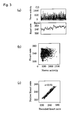
- Figure 3 is a graph showing the relationship between sympathetic nerve activity and heart rate of a representative rabbit.
- Figure 3(a) is a graph showing simultaneously measured changes in cardiac sympathetic nerve activity and heart rate with time.
- FIG. 3(c) is a scatter plot between the heart rate estimated from impulse response function and measured sympathetic nerve activity on one hand, and measured heart rate on the other. As shown in this figure, measured and estimated heart rate correlated well (correlation function 0.93).
- the heart rate actually required by organisms can be obtained.
- one can regulate heart rate by stimulating the heart electrically according to the estimated heart rate, as if it were regulated by the normal central nervous system.
- Discriminating means (not shown), judging whether biosignals coming into the calculating means (3) arise from normal biological activities or from abnormal biological activities, may also optionally be provided in the calculating means (3).
- information about normal-activity biosignals are stored in memory means (not shown), and the input biosignals are compared with the stored information. When the difference exceeds a previously determined threshold for a given time period, the signals are judged to be abnormal-activity signals.
- the calculating means does not output signals to the organism stimulating means for input of normal-activity biosignals, and the native regulatory system itself works.
- the system works so that the signals to stimulate the organism are prepared for the organism stimulating means by analyzing and processing biosignals to correct the abnormal biological activity.
- the system needs to perform no action to maintain normal activities.
- the system outputs signals to correct abnormal biological activities to normal biological activities.
- the organism stimulating means (4) receives the signals to stimulate the organism from the calculating means (3), and stimulates the organism based on the signals.
- Examples of stimulation by the organism stimulating means (4) may include, but are not limited to, electrical stimulation of nerves, myocardium, cerebrum and cerebellum, stimulation with the use of devices for drug administration, artificial pancreas, artificial hearts, and artificial ventilators.
- the basic structure of the cardiac pacing system according to the first embodiment is the same as the system (1) shown in Figure 2 .
- the cardiac pacing system includes at least the biological activity (in this case, nerve activity) sensing means (2), the calculating means (3) and the organism stimulating (in this case, cardiac pacing) means (4).
- the biological activity (nerve activity) sensing means (2) senses the nerve activity of the cardiac sympathetic nerve and/or the vagal nerve, and outputs nerve activity signals.
- the biological activity (nerve activity) sensing means (2) are preferably installed in both the cardiac sympathetic nerve and the vagal nerve in order to sense both the activities of the cardiac sympathetic nerve and the vagus nerve. This is because it is known that regulation of heart rate is usually related to both the cardiac sympathetic nerve and the vagal nerve. Installing the sensing devices in both the cardiac sympathetic nerve and the vagal nerve enables heart rate to be regulated less when the vagal activity is enhanced, and to be regulated more when the sympathetic activity is enhanced. In other words, since the heart is regulated by the two nerve systems, it is difficult to regulate heart rate to an arbitrary target by only one nerve system.
- any one of the means may be provided depending on the purpose of the system.
- the biological activity (nerve activity) sensing means (2) is exemplified by an electrode but is not limited thereto so long as it is able to sense the nerve activity and output the nerve activity signals.
- the calculating means (3) receives the nerve activity signals sensed by the nerve activity sensing means (2), analyzes and processes the nerve activity signals, and calculates and outputs pacing signals for regulating heart rate.
- the nerve activity signals sensed by the nerve activity sensing means (2) and the simultaneously measured heart rate are not correlated in a one-to-one manner. Therefore, it is necessary to calculate the pacing signals for regulating heart rate from the nerve activity signals by the calculating means (3).
- pacing signals for regulating heart rate from the nerve activity signals
- the pacing signals derived from the calculating means (3) are fed into the organism stimulating (pacing) means (4).
- the organism stimulating (pacing) means stimulates the heart based on the pacing signals to regulate heart rate.
- the organism stimulating (pacing) means (4) is exemplified by a cardiac pacemaker but not limited thereto so long as it can regulate heart rate by stimulating the heart based on the pacing signals.
- the cardiac pacing system is based on the nerve activities of the cardiac sympathetic nerve and/or vagal nerve, but does not use the nerve activities themselves as the pacing signals.
- the system instead paces the heart based on the pacing signals with heart rate estimated from the nerve activities. Therefore, the system is excellent in specificity, sensitivity and transient response.
- the basic structure of the blood pressure regulating system according to the second embodiment is the same as the system (1) shown in Figure 2 .
- the blood pressure regulating system includes at least the biological activity (in this case, blood pressure) sensing means (2), the calculating means (3) and the organism (in this case, nerve) stimulating means (4).
- the biological activity (blood pressure) sensing means (2) senses blood pressure, and outputs the blood pressure signal.
- the biological activity (blood pressure) sensing means (2) is exemplified as a pressure sensor but is not limited thereto so long as it can output the blood pressure signal by sensing blood pressure.
- Baroreceptors distributed in the carotid sinus and aortic arch sense extension of arterial walls with increases in blood pressure, and cause increased impulse transmission to the solitary tract nucleus of the medulla oblongata.
- the solitary tract nucleus suppresses sympathetic nerve activity and stimulates parasympathetic nerve activity.
- stimulation of baroreceptors decreases, the solitary tract nucleus is suppressed, parasympathetic nerve activity is suppressed, and sympathetic nerve activity is stimulated.
- the blood pressure regulating system can be used for patients who are unable to maintain normal blood pressure due to failures in the blood pressure regulating system.
- the calculating means (3) receives the blood pressure signals sensed by the biological activity (blood pressure) sensing means (2), analyzes the blood pressure signals, calculates signals to stimulate the sympathetic nerve that can regulate blood pressure by stimulating the sympathetic nerve innervating vascular beds, and outputs the calculated signals to stimulate the sympathetic nerve. Similar to heart rate regulation, the blood pressure signals sensed by the biological activity (blood pressure) sensing means (2) and the sympathetic nerve activity signals are not correlated in a one-to-one manner in blood pressure regulation. Therefore, it is necessary to calculate the signals to stimulate sympathetic nerve innervating vascular beds for blood pressure regulation from blood pressure signals by the calculating means (2).
- the signals to stimulate the sympathetic nerve innervating vascular beds for blood pressure regulation one can use, for example, the impulse response of changes in sympathetic nerve activity in response to changes in blood pressure. These may be used to calculate the signals to stimulate the sympathetic nerve that can regulate the blood pressure.
- the organism (nerve) stimulating means (4) receives the signals to stimulate the sympathetic nerve calculated by the calculating means (3), and regulates blood pressure by stimulating the sympathetic nerve innervating vascular beds based on those signals.
- the sympathetic nerve stimulating sites are exemplified by sympathetic ganglia, surface of the spinal cord, and preferred sites in the brain, but are not limited thereto so long as they can stimulate the sympathetic nerve.
- the blood pressure regulating system is based on blood pressure, but does not use blood pressure itself as the signals to stimulate the sympathetic nerve.
- the system instead stimulates the sympathetic nerve based on the signals to stimulate the sympathetic nerve estimated from the blood pressure. Therefore, the system can perform stable blood pressure regulation as native pressure regulation.
- a third embodiment of the present invention is a cardiac disease treating system.
- the basic structure of the cardiac disease treating system is the same as the system (1) shown in Figure 2 .
- the cardiac disease treating system includes at least the biological activity (in this case, cardiac activity) sensing means (2), the calculating means (3) and the organism (in this case, nerve) stimulating means (4).
- the cardiac disease treating system is effective for correcting the cardiac function, which has become abnormal due to any one of a number of various diseases.
- abnormal native regulation is involved in the progression of cardiac diseases, and abnormal sympathetic overactivities and vagal withdrawal have been shown with myocardial infarction. It is possible to prevent the progression of various diseases by correcting the abnormal native functional state with the system according to the present invention.
- the biological activity (cardiac activity) sensing means (2) senses cardiac activity information issued by native cardiac activity and outputs cardiac activity signals.
- Cardiac activity information sensed by the biological activity (cardiac activity) sensing means (2) is exemplified by heart rate and electrocardiogram information.
- the calculating means (3) receives cardiac activity signals sensed by the biological activity (cardiac activity) sensing means (2), analyzes and processes the cardiac activity signals, calculates signals to stimulate the nerve that can regulate cardiac activities by stimulating nerves, and outputs the signals to stimulate the nerve.
- the native regulatory mechanism Before patients get ill, the native regulatory mechanism is normally operating in patients to whom the cardiac disease treating system according to the present invention may be applied. Once falling ill due to any one of a number of various cardiac diseases, however, the native regulatory mechanism does not help the patient recover.
- the calculating means (3) includes a discriminating means (not shown) to discriminate between cardiac activity information fed into the calculating means (3) that arises from normal biological activities and cardiac activity information from abnormal biological activities. In this manner, the calculating means does not calculate signals to stimulate nerve stimulating signals and does not output the signals to stimulate the nerve to the organism (nerve) stimulating means (4) when it is determined that the heart is functioning normally by inputting cardiac activity information sensed by the biological (cardiac) activity sensing means (2). In this situation, the organism is regulated by its native regulatory mechanism.
- the calculating means calculates the nerve stimulating signals to correct the abnormal function of the heart, and outputs the signals to the organism (nerve) stimulating means (4).
- the signals to stimulate the nerve derived from the calculating means (3) are fed into the organism (nerve) stimulating means (4).
- the organism (nerve) stimulating means (4) stimulates the nerve based on the signals to stimulate the nerve and to regulate cardiac activities.
- the organism (nerve) stimulating means (4) is exemplified by an electrode, but is not limited thereto so long as it is able to regulate cardiac activities by stimulating the nerve based on the signals to stimulate the nerve.
- Nerve stimulating sites are exemplified by the vagal nerve, the aortic depressor nerve, and preferred sites in the brain, but are not limited thereto so long as they are able to regulate cardiac activities.
- the anterior descending branch of the left coronary artery in 20 anesthetized rats was ligated to create rats with myocardial infarction. Mortality was periodically tabulated in this group.
- heart rate was decreased by stimulating the vagal nerve (pulse width: 2 msec, pulse voltage: 2 V, pulse frequency: 2 Hz) from 2 minutes after the onset of myocardial infarction. Mortality was also periodically tabulated in this group.
- heart rate was decreased by stimulating the vagal nerve (pulse width: 2 msec, pulse voltage: 2 V, pulse frequency: 5 Hz) from 2 minutes after the onset of myocardial infarction. Mortality was periodically tabulated in this group.
- Example 1 Since Example 1 was performed under anesthesia, the following test was performed to exclude the effects of anesthesia.
- Blood pressure telemeter, vagal nerve tele-stimulating device and coronary artery cuff occluders to create myocardial infarction were implanted in 32 rats.
- vagal nerve was stimulated (pulse width: 0.2 msec, pulse current: 0.1 mA, pulse frequency: 20 Hz) immediately after the occlusion of the coronary artery with cuff occluders for 60 minutes. Mortality was tabulated periodically with vagal nerve stimulation.
- vagal nerve stimulation was performed (pulse width: 0.2 msec, pulse current: 0.2 mA, pulse frequency: 20 Hz) immediately after the occlusion of the coronary artery with cuff occluders for 60 minutes.
- Vagal nerve stimulation was performed with local anesthetic application proximal to the stimulation site to prevent afferent vagal stimulation to the cerebrum (to prevent rats from being restless with the stimulation of 0.2 mA). Mortality was tabulated periodically with vagal nerve stimulation.
- Myocardial infarction was created under anesthesia in the same manner as in Example 1. Surviving rats after every attempt of resuscitation (survival rate after 1 week being ⁇ 40%) underwent another surgery 1 week after the first surgery. Blood pressure telemeter, vagal nerve tele-stimulating device and coronary artery cuff occluders to create myocardial infarction were implanted in these rats in the same manner as in Example 2.
- vagal stimulation was started with the stimulation condition to decrease the heart rate by 20 beats (pulse width: 0.2 msec, pulse current: 0.1 to 0.13 mA, pulse frequency: 20 Hz), and the vagal nerve was stimulated for 10 seconds every 1 minute. The test was continued for 5 weeks. No vagal stimulation was applied to the remaining half of the rats (13 rats). No rat deaths were observed in 5 weeks.
- ventricular weight was significantly smaller in rats with vagal stimulation, indicating ventricular remodeling after myocardial infarction was suppressed. Since ventricular remodeling is known to correlate with mortality in the chronic phase of myocardial infarction, the above results indicate that vagal stimulation enables the correction of the abnormal regulatory mechanism, resulting in a decrease in long-term mortality.
- Myocardial infarction was created under anesthesia in the same manner as in Example 1.
- Surviving rats after every attempt of resuscitation (survival rate after 1 week being ⁇ 40%) underwent another surgery 1 week after the first surgery.
- Blood pressure telemeter, vagal nerve tele-stimulating device and coronary artery cuff occluders to create myocardial infarction were implanted in these rats in the same manner as in Example 2.
- vagal stimulation was started with the stimulation condition to decrease heart rate by 20 beats (pulse width: 0.2 msec, pulse current: 0.1 to 0.13 mA, pulse frequency: 20 Hz), and the vagal nerve was stimulated for 10 seconds every minute for 40 days. The test was continued for 180 days. No vagal stimulation was applied to the remaining half of the rats (23 rats).
- heart rate In anesthetized Japanese white rabbits, the impulse response function of heart rate in response to cardiac sympathetic nerve activity was obtained from measured heart rate and cardiac sympathetic nerve activity. Since heart rate fluctuation is not large enough in anesthetized animals compared to conscious animals, heart rate was artificially altered by randomly changing pressure imposed on baroreceptors.
- Pancuronium bromide and heparin sodium were intravenously injected to eliminate contaminated muscular activities and to prevent blood coagulation, respectively.
- Bilateral carotid arteries, aortic depressor nerves, and vagal nerves were exposed by neck incision in rabbits.
- Bilateral carotid arteries were cannulated with silicone rubber tubes connected to a servo-controlled piston pump. Carotid sinus pressure was randomly changed by applying a band-limited white noise to the servo-pump.
- bilateral vagal nerves and bilateral aortic depressor nerves were cut. After thoracotomy, the left cardiac sympathetic nerve was separated and cut.
- SNA cardiac sympathetic nerve activity
- Atrial electrocardiogram was measured by attaching electrodes to the left atrial appendage. Atrial electrocardiogram was fed into a tachometer to measure instantaneous heart rate (HR). Measured heart rate and cardiac sympathetic nerve activity are exemplified in Figure 3(a) .
- Heart rate was predicted from sympathetic nerve activity using a convolution integral between the above-obtained impulse response and the measured sympathetic nerve activity (Equation 2).
- the correlation coefficient between measured and predicted heart rate was calculated to be as high as 0.80 to 0.96 (median: 0.88), and the error between measured and predicted heart rate was 1.4 to 6.6 beats/minutes (median: 3.1 beats/minutes), which was as small as 1.2 ⁇ 0.7 % of the average heart rate.
- heart rate can be accurately predicted from cardiac sympathetic nerve activity.
- the rule or the logic how the native blood pressure regulatory center (vasomotor center) determines the sympathetic nerve activity in response to blood pressure information was obtained in 10 rats.
- baroreceptors of animals were isolated from the rest of the circulation, and changes in blood pressure caused by the regulatory function of vasomotor center in response to changes in pressure imposed on baroreceptors were measured.
- Open-loop transfer function (H native ) of baroreflex system was determined from the relation between the input (pressure on baroreceptors) and output (blood pressure).
- H STM ⁇ SAP transfer function from sympathetic nerve activity (STM) to blood pressure (SAP) was determined from these data.
- Transfer function (H BRP ⁇ STM ) of the vasomotor center which characterizes the changes in sympathetic nerve activity (STM) in response to pressure on baroreceptors (BRP), was determined as H native /H STM ⁇ SAP .
- Pancuronium bromide was intravenously injected to eliminate contaminating muscular activities.
- Arterial blood gas was monitored with a blood gas measurement device.
- a polyethylene tube was inserted into the right femoral vein and physiological saline was infused to avoid dehydration.
- a micromanometer-tipped catheter was inserted into the aortic arch via the right femoral artery.
- Bilateral carotid sinuses were isolated from the rest of the circulation to open the baroreflex feedback loop, and vagal nerves and aortic depressor nerves were cut.
- Carotid sinuses were connected to a transducer and to a servo-controlled pump system with a short polyethylene tube.
- the left greater splanchnic nerve was separated and was cut at the level of diaphragm.
- a pair of teflon-coated platinum wires was attached to the distal end.
- the attached ends of platinum wires were embedded in silicone rubber.
- the free ends of the platinum wires were connected to a constant voltage stimulator, controlled by a computer through a D/A converter.
- Carotid sinus pressure was changed at random between 100 to 120 mmHg using a servo-controlled system to determine open-loop baroreflex transfer function (H native ). Carotid sinus pressure and blood pressure were measured for the determination of the transfer function.
- H BRP ⁇ STM The transfer function (H BRP ⁇ STM ) of vasomotor center, which characterizes the changes in sympathetic nerve activity (STM) in response to pressure on baroreceptors (BRP) was determined as H native /H STM ⁇ SAP . Because in native animals the same pressure as blood pressure acts on baroreceptors, the required instantaneous sympathetic nerve activity (STM) to reproduce vasomotor center for given blood pressure changes (SAP) was programmed to calculate according to the following Equation (3).
- STM t ⁇ 0 ⁇ h ⁇ ⁇ SAP ⁇ t - ⁇ ⁇ d ⁇ (where h( ⁇ ) is impulse response obtained by inverse Fourier transform of H BRP ⁇ STM )
- sympathetic nerve activity was predicted by a convolution integral between blood pressure change and the impulse response of the native vasomotor center, and stimulated celiac ganglion, a sympathetic nerve ganglion, according to the predicted value.
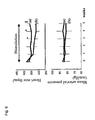
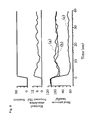
- Figure 8(a) shows the changes in blood pressure of the rats receiving celiac ganglion stimulation
- Figure 8(b) shows the changes in blood pressure of the normal rats
- Figure 8(c) shows the changes in blood pressure of the rats with impaired blood pressure regulation.
- blood pressure decreased by 34 ⁇ 6 mmHg in 2 seconds after head-up tilt, and by 52 ⁇ 5 mmHg in 10 seconds in the rats with impaired blood pressure regulation.
- blood pressure decreased by 21 ⁇ 5 mmHg in 2 seconds and by 15 ⁇ 6 mmHg in 10 seconds when artificial blood pressure regulation was applied.
- biosignals based on the biological activity of the organism, and can stimulate the organism with signals to stimulate organisms, i.e., signals calculated from the biosignals as required signals to simulate the native regulation.
- each organ can be regulated as if the central controller were normally functioning even if the central controller itself is unable to perform normal regulations due to various causes.
- This invention can be used for various interventions such as cardiac pacing, blood pressure regulation and treatment of cardiac diseases.
- signals to stimulate organisms are calculated with the impulse response obtained from the normal biological activity in advance, signals to stimulate organisms can be obtained as required signals to simulate the native regulation.
- the heart is paced according to the information from cardiac sympathetic nerve and/or vagal nerve activity, but not based on the nerve activity itself. Instead, it is based on the heart rate estimated from the nerve activity. Therefore, the system is excellent in specificity, sensitivity and transient response.
- sympathetic nerve stimulating signals simulating native regulation are estimated from blood pressure, and the estimated sympathetic nerve stimulating signals, but not blood pressure itself, are used for blood pressure regulation. Therefore, stable blood pressure regulation is possible in the same manner as native regulation.
- the heart is regulated by the native regulatory mechanism when the activity of the heart is normal.
- the heart is regulated to restore the normal activity when the activity of the heart is abnormal.
- the present invention can provide systems to treat diseases by substituting native biological regulatory function.
- This system can regulate organs as if their central controllers were normally functioning even if the central controllers themselves become abnormal by various causes.
- Some particular systems of the present invention include, but are not limited to, a cardiac pacing system, a blood pressure regulating system, and a cardiac disease treatment system, all of which are based on the above medical treatment system.
Landscapes
- Health & Medical Sciences (AREA)
- Cardiology (AREA)
- Life Sciences & Earth Sciences (AREA)
- Heart & Thoracic Surgery (AREA)
- Public Health (AREA)
- General Health & Medical Sciences (AREA)
- Biomedical Technology (AREA)
- Nuclear Medicine, Radiotherapy & Molecular Imaging (AREA)
- Radiology & Medical Imaging (AREA)
- Veterinary Medicine (AREA)
- Animal Behavior & Ethology (AREA)
- Engineering & Computer Science (AREA)
- Biophysics (AREA)
- Physiology (AREA)
- Neurology (AREA)
- Neurosurgery (AREA)
- Hematology (AREA)
- Electrotherapy Devices (AREA)
Claims (11)
- Ein auf biologischen Aktivitäten basierendes System zur Behandlung von Erkrankungen, umfassend:a) mindestens ein Mittel zur Erkennung biologischer Aktivität, das durch biologische Aktivitäten herausgegebene Information biologischer Aktivität erkennt und eine Vielzahl von Biosignalen ausgibt;b) ein Mittel zur Berechnung, das die Biosignale empfängt, unter Verwendung eines Faltungsintegrals zwischen mindestens einer zuvor von normalen biologischen Aktivitäten erhaltenen Impulsantwort und den Biosignalen eine Vielzahl von Signalen zur Stimulation eines Organismus berechnet, und die Signale zur Stimulation des Organismus ausgibt; undc) ein Mittel zur Organismus-Stimulation, das die Signale zur Stimulation des Organismus empfängt und den Organismus anhand dieser Signale stimuliert;dadurch gekennzeichnet, dass
die Impulsantwort aus der inversen Fourier-Transformation der Übertragungsfunktion berechnet wird, welche aus der Fourier-Transformation der Biosignale erhalten wird;
wobei das Mittel zur Berechnung ein Mittel zur Unterscheidung beinhaltet, welches bestimmt, ob die Biosignale durch normale biologische Aktivitäten oder durch abnorme biologische Aktivitäten verursacht werden; und
wobei das Mittel zur Berechnung die Signale zur Stimulation des Organismus nicht ausgibt, wenn die Biosignale als durch normale biologische Aktivitäten verursachte Biosignale bestimmt werden, und die Signale zur Stimulation des Organismus ausgibt, wenn die Biosignale als durch abnorme biologische Aktivitäten verursachte Biosignale bestimmt werden. - Das System nach Anspruch 1, wobei das Mittel zur Erkennung biologischer Aktivität aus der Gruppe bestehend aus Elektroden und Drucksensoren gewählt wird.
- Das System nach Anspruch 1, wobei die Biosignale aus der Gruppe bestehend aus Sympathikus-Aktivitäten, Parasympathikus-Aktivitäten, Blutströmung, Blutdruck, Körpertemperatur, Elektrokardiogramm, Elektroenzephalogramm und verschiedenen biochemischen Markern gewählt werden.
- Das System nach Anspruch 1, wobei das Mittel zur Organismus-Stimulation auf eine Weise stimuliert, die aus der Gruppe bestehend aus elektrischer Stimulation und Stimulation mit Nutzung von Vorrichtungen zur Verabreichung von Medikamenten gewählt wird.
- Das System nach Anspruch 1, wobei das Mittel zur Berechnung- mindestens einen Verstärker zur Verstärkung des Biosignals;- mindestens einen Analog-Digital-Wandler, um das Biosignal von einem analogen Signal in ein digitales Signal umzuwandeln; und- mindestens einen Analysator zur Verarbeitung von Daten zur Berechnung von an das Mittel zur Organismus-Stimulation zu übertragenden Signalenumfasst.
- Das System nach Anspruch 1, wobei:das genannte Mittel zur Erkennung biologischer Aktivität ein Mittel zur Erkennung von Nervenaktivität ist, das Nervenaktivität eines kardialen Sympathikus und/oder eines Nervus vagus erkennt, und eine Vielzahl von Nervenaktivitätsbiosignalen ausgibt;das genannte Mittel zur Berechnung die Nervenaktivitätssignale empfängt, unter Verwendung eines Faltungsintegrals zwischen einer zuvor von normalen Nervenaktivitäten erhaltener Impulsantwort und den Nervenaktivitätsbiosignalen eine Vielzahl von Schrittsteuerungssignalen zur Kontrolle einer Herzfrequenz berechnet, und Schrittsteuerungssignale ausgibt;die Schrittsteuerungssignale die genannten Signale zur Stimulation des Organismus sind; unddas genannte Mittel zur Organismus-Stimulation ein Mittel zur Schrittsteuerung ist, welches die Schrittsteuerungssignale empfängt, und das Herz anhand der Schrittsteuerungssignale derart stimuliert, dass die Herzfrequenz reguliert wird.
- Das System nach Anspruch 6, wobei das Mittel zur Organismus-Stimulation ein Herzschrittmacher ist.
- Das System nach Anspruch 1, wobei eine arteigene Regulationsregel genutzt wird, um mindestens eine Nervenaktivität in Reaktion auf Blutdruckänderungen zu schätzen;
und wobei:das genannte Mittel zur Erkennung biologischer Aktivität ein Mittel zur Blutdruckerkennung ist, das den Blutdruck erkennt und ein Blutdruckbiosignal ausgibt;das genannte Mittel zur Berechnung das Blutdruckbiosignal empfängt, unter Verwendung eines Faltungsintegrals zwischen einer zuvor von normalem Blutdruck erhaltener Impulsantwort und dem Blutdruckbiosignal ein Sympathikus-Stimulationssignal zur Blutdruckregulation berechnet, und ein Sympathikus-Stimulationssignal ausgibt;das Sympathikus-Stimulationssignal das genannte Signal zur Stimulation des Organismus ist; unddas genannte Mittel zur Stimulation das Sympathikus-Stimulationssignal empfängt, und den Sympathikus, der die Gefäßbetten innerviert, anhand des Sympathikus-Stimulationssignals derart stimuliert, dass der Blutdruck reguliert wird. - Das System nach Anspruch 8, wobei das Mittel zur Erkennung biologischer Aktivität ein Drucksensor ist.
- Das System nach Anspruch 8, wobei eine Stelle zur Sympathikus-Stimulation aus der Gruppe bestehend aus Sympathikus-Ganglien, einer Oberfläche eines Rückenmarks, und mindestens einer Stelle im Gehirn gewählt wird.
- Das System nach Anspruch 1, wobei:das genannte Mittel zur Erkennung biologischer Aktivität ein Mittel zur Erkennung kardiovaskulärer Aktivität ist, das durch ein kardiovaskuläres System herausgegebene Information kardiovaskulärer Aktivität erkennt, und eine Vielzahl von Biosignalen kardiovaskulärer Aktivität ausgibt;das genannte Mittel zur Berechnung die Biosignale kardiovaskulärer Aktivität erkennt, unter Verwendung eines Faltungsintegrals zwischen einer zuvor von normaler kardiovaskulärer Aktivität erhaltener Impulsantwort und den Biosignalen kardiovaskulärer Aktivität eine Vielzahl von Nervenstimulationssignalen berechnet, und Nervenstimulationssignale ausgibt; unddas genannte Mittel zur Stimulation ein Mittel zur Nervenstimulation ist, das die Nervenstimulationssignale empfängt, und einen Nerv anhand der Nervenstimulationssignale stimuliert.
Applications Claiming Priority (1)
| Application Number | Priority Date | Filing Date | Title |
|---|---|---|---|
| PCT/JP2002/007963 WO2004012814A1 (ja) | 2002-08-05 | 2002-08-05 | 生体調節機能代替を用いた治療用システム並びに該システムに基づく心臓ペーシングシステム、血圧調節システム及び心疾患治療用システム |
Publications (3)
| Publication Number | Publication Date |
|---|---|
| EP1541193A1 EP1541193A1 (de) | 2005-06-15 |
| EP1541193A4 EP1541193A4 (de) | 2008-04-23 |
| EP1541193B1 true EP1541193B1 (de) | 2015-11-18 |
Family
ID=31217257
Family Applications (1)
| Application Number | Title | Priority Date | Filing Date |
|---|---|---|---|
| EP02755821.2A Expired - Lifetime EP1541193B1 (de) | 2002-08-05 | 2002-08-05 | Medizinisches behandlungssystem basierend auf nativer biologischer regulierungsfunktion, schrittmachersystem auf basis des medizinischen behandlungssystems, blutdruckreguliersystem und system zur behandlung von herzkrankheiten |
Country Status (7)
| Country | Link |
|---|---|
| US (4) | US7835791B2 (de) |
| EP (1) | EP1541193B1 (de) |
| JP (1) | JP4189448B2 (de) |
| CN (1) | CN1646189A (de) |
| AU (1) | AU2002323810A1 (de) |
| IL (1) | IL166571A (de) |
| WO (1) | WO2004012814A1 (de) |
Families Citing this family (58)
| Publication number | Priority date | Publication date | Assignee | Title |
|---|---|---|---|---|
| EP2008581B1 (de) | 2003-08-18 | 2011-08-17 | Cardiac Pacemakers, Inc. | Patientenüberwachungs-, Diagnose- und/oder Therapiesysteme und -verfahren |
| US8002553B2 (en) | 2003-08-18 | 2011-08-23 | Cardiac Pacemakers, Inc. | Sleep quality data collection and evaluation |
| US7887493B2 (en) | 2003-09-18 | 2011-02-15 | Cardiac Pacemakers, Inc. | Implantable device employing movement sensing for detecting sleep-related disorders |
| US8606356B2 (en) | 2003-09-18 | 2013-12-10 | Cardiac Pacemakers, Inc. | Autonomic arousal detection system and method |
| US7572226B2 (en) | 2003-10-28 | 2009-08-11 | Cardiac Pacemakers, Inc. | System and method for monitoring autonomic balance and physical activity |
| US7657312B2 (en) | 2003-11-03 | 2010-02-02 | Cardiac Pacemakers, Inc. | Multi-site ventricular pacing therapy with parasympathetic stimulation |
| US7783353B2 (en) | 2003-12-24 | 2010-08-24 | Cardiac Pacemakers, Inc. | Automatic neural stimulation modulation based on activity and circadian rhythm |
| US8396560B2 (en) | 2004-11-18 | 2013-03-12 | Cardiac Pacemakers, Inc. | System and method for closed-loop neural stimulation |
| US7647114B2 (en) | 2003-12-24 | 2010-01-12 | Cardiac Pacemakers, Inc. | Baroreflex modulation based on monitored cardiovascular parameter |
| US8126560B2 (en) | 2003-12-24 | 2012-02-28 | Cardiac Pacemakers, Inc. | Stimulation lead for stimulating the baroreceptors in the pulmonary artery |
| US20050149132A1 (en) | 2003-12-24 | 2005-07-07 | Imad Libbus | Automatic baroreflex modulation based on cardiac activity |
| US7769450B2 (en) * | 2004-11-18 | 2010-08-03 | Cardiac Pacemakers, Inc. | Cardiac rhythm management device with neural sensor |
| US7460906B2 (en) | 2003-12-24 | 2008-12-02 | Cardiac Pacemakers, Inc. | Baroreflex stimulation to treat acute myocardial infarction |
| US7643875B2 (en) | 2003-12-24 | 2010-01-05 | Cardiac Pacemakers, Inc. | Baroreflex stimulation system to reduce hypertension |
| US8024050B2 (en) | 2003-12-24 | 2011-09-20 | Cardiac Pacemakers, Inc. | Lead for stimulating the baroreceptors in the pulmonary artery |
| US7509166B2 (en) | 2003-12-24 | 2009-03-24 | Cardiac Pacemakers, Inc. | Automatic baroreflex modulation responsive to adverse event |
| US9020595B2 (en) | 2003-12-24 | 2015-04-28 | Cardiac Pacemakers, Inc. | Baroreflex activation therapy with conditional shut off |
| US8200331B2 (en) | 2004-11-04 | 2012-06-12 | Cardiac Pacemakers, Inc. | System and method for filtering neural stimulation |
| US7486991B2 (en) | 2003-12-24 | 2009-02-03 | Cardiac Pacemakers, Inc. | Baroreflex modulation to gradually decrease blood pressure |
| US7706884B2 (en) | 2003-12-24 | 2010-04-27 | Cardiac Pacemakers, Inc. | Baroreflex stimulation synchronized to circadian rhythm |
| US7869881B2 (en) | 2003-12-24 | 2011-01-11 | Cardiac Pacemakers, Inc. | Baroreflex stimulator with integrated pressure sensor |
| US7260431B2 (en) | 2004-05-20 | 2007-08-21 | Cardiac Pacemakers, Inc. | Combined remodeling control therapy and anti-remodeling therapy by implantable cardiac device |
| US7747323B2 (en) | 2004-06-08 | 2010-06-29 | Cardiac Pacemakers, Inc. | Adaptive baroreflex stimulation therapy for disordered breathing |
| US8676326B1 (en) | 2004-10-21 | 2014-03-18 | Pacesetter, Inc | Implantable device with responsive vascular and cardiac controllers |
| ATE468154T1 (de) * | 2004-11-18 | 2010-06-15 | Cardiac Pacemakers Inc | Vorrichtung für herzrhythmusmanagement mit neurosensor |
| JP5060304B2 (ja) * | 2004-11-18 | 2012-10-31 | カーディアック ペースメイカーズ, インコーポレイテッド | 閉ループ神経刺激のためのシステム |
| US8332047B2 (en) | 2004-11-18 | 2012-12-11 | Cardiac Pacemakers, Inc. | System and method for closed-loop neural stimulation |
| US7587238B2 (en) | 2005-03-11 | 2009-09-08 | Cardiac Pacemakers, Inc. | Combined neural stimulation and cardiac resynchronization therapy |
| US7660628B2 (en) * | 2005-03-23 | 2010-02-09 | Cardiac Pacemakers, Inc. | System to provide myocardial and neural stimulation |
| US7555341B2 (en) | 2005-04-05 | 2009-06-30 | Cardiac Pacemakers, Inc. | System to treat AV-conducted ventricular tachyarrhythmia |
| US7493161B2 (en) | 2005-05-10 | 2009-02-17 | Cardiac Pacemakers, Inc. | System and method to deliver therapy in presence of another therapy |
| US7499748B2 (en) | 2005-04-11 | 2009-03-03 | Cardiac Pacemakers, Inc. | Transvascular neural stimulation device |
| US7617003B2 (en) | 2005-05-16 | 2009-11-10 | Cardiac Pacemakers, Inc. | System for selective activation of a nerve trunk using a transvascular reshaping lead |
| US7616990B2 (en) | 2005-10-24 | 2009-11-10 | Cardiac Pacemakers, Inc. | Implantable and rechargeable neural stimulator |
| US7570999B2 (en) | 2005-12-20 | 2009-08-04 | Cardiac Pacemakers, Inc. | Implantable device for treating epilepsy and cardiac rhythm disorders |
| US9566447B2 (en) * | 2005-12-28 | 2017-02-14 | Cardiac Pacemakers, Inc. | Neural stimulation system for reducing atrial proarrhythmia |
| US20070299476A1 (en) * | 2006-06-23 | 2007-12-27 | Euljoon Park | Sympathetic afferent activation for adjusting autonomic tone |
| US8170668B2 (en) | 2006-07-14 | 2012-05-01 | Cardiac Pacemakers, Inc. | Baroreflex sensitivity monitoring and trending for tachyarrhythmia detection and therapy |
| US8457734B2 (en) | 2006-08-29 | 2013-06-04 | Cardiac Pacemakers, Inc. | System and method for neural stimulation |
| US8731665B1 (en) | 2007-10-24 | 2014-05-20 | Pacesetter, Inc. | Posture detection using pressure and other physiologic sensors |
| US7848816B1 (en) * | 2007-12-27 | 2010-12-07 | Pacesetter, Inc. | Acquiring nerve activity from carotid body and/or sinus |
| US7949398B1 (en) | 2007-12-27 | 2011-05-24 | Pacesetter, Inc. | Acquiring nerve activity from carotid body and/or sinus |
| US20090287305A1 (en) * | 2008-05-19 | 2009-11-19 | Amalaha Leonard D | Wholly implantable non-natural heart for humans |
| EP2459064A1 (de) * | 2009-07-27 | 2012-06-06 | Cardiac Pacemakers, Inc. | Medizinische vorrichtung zur behandlung von herzinsuffizienz mittels umverteilung des blutvolumens |
| EP2493560A1 (de) * | 2009-10-30 | 2012-09-05 | Cardiac Pacemakers, Inc. | Herzschrittmacher mit vagaler druckanstiegsüberwachung und -reaktion |
| JP5624672B2 (ja) | 2010-04-15 | 2014-11-12 | カーディアック ペースメイカーズ, インコーポレイテッド | 断続的神経刺激による過渡反応を使用する自律神経調節 |
| WO2012039420A1 (ja) * | 2010-09-21 | 2012-03-29 | 国立大学法人九州大学 | 動脈圧反射機能障害に関連した疾患を治療するためのバイオニック動脈圧反射システム |
| US20150111918A1 (en) | 2012-03-08 | 2015-04-23 | Medtronic Ardian Luxembourg S.a.r.l | Immune system neuromodulation and associated systems and methods |
| US10076384B2 (en) | 2013-03-08 | 2018-09-18 | Symple Surgical, Inc. | Balloon catheter apparatus with microwave emitter |
| US9454158B2 (en) | 2013-03-15 | 2016-09-27 | Bhushan Somani | Real time diagnostics for flow controller systems and methods |
| US9629565B2 (en) * | 2014-08-18 | 2017-04-25 | Cameron Health, Inc. | Peak selection for self correlation analysis of cardiac rate in an implantable medical devices |
| DE102014014942A1 (de) * | 2014-10-07 | 2016-04-07 | Neuroloop GmbH | Implantierbare Anordnung |
| EP3226795B1 (de) | 2014-12-03 | 2020-08-26 | Metavention, Inc. | Systeme zur modulation von nerven oder anderem gewebe |
| US10524859B2 (en) | 2016-06-07 | 2020-01-07 | Metavention, Inc. | Therapeutic tissue modulation devices and methods |
| RU2642384C1 (ru) * | 2016-12-08 | 2018-01-24 | Общество с ограниченной ответственностью "Косима" (ООО "Косима") | Способ регуляции висцеральных функций пациента путем неинвазивной стимуляции спинного мозга |
| US10983537B2 (en) | 2017-02-27 | 2021-04-20 | Flow Devices And Systems Inc. | Systems and methods for flow sensor back pressure adjustment for mass flow controller |
| JP7233069B2 (ja) * | 2017-09-14 | 2023-03-06 | 株式会社ニューロシューティカルズiVNS | 心筋梗塞処置用制御装置、及び心筋梗塞処置用制御方法 |
| US11338143B2 (en) * | 2019-03-20 | 2022-05-24 | Neuroceuticals, Inc. | Control apparatus for treating myocardial infarction and control method for treating myocardial infarction |
Family Cites Families (17)
| Publication number | Priority date | Publication date | Assignee | Title |
|---|---|---|---|---|
| SE346468B (de) * | 1969-02-24 | 1972-07-10 | Lkb Medical Ab | |
| US4006351A (en) * | 1974-11-11 | 1977-02-01 | James Nickolas Constant | Recursive filter implemented as a matched clutter filter |
| US5016635A (en) * | 1988-11-29 | 1991-05-21 | Sigmedics, Inc. Of Delaware | Control of FNS via pattern variations of response EMG |
| US5111815A (en) | 1990-10-15 | 1992-05-12 | Cardiac Pacemakers, Inc. | Method and apparatus for cardioverter/pacer utilizing neurosensing |
| US5199428A (en) | 1991-03-22 | 1993-04-06 | Medtronic, Inc. | Implantable electrical nerve stimulator/pacemaker with ischemia for decreasing cardiac workload |
| US5423325A (en) * | 1993-03-12 | 1995-06-13 | Hewlett-Packard Corporation | Methods for enhancement of HRV and late potentials measurements |
| RU2111771C1 (ru) | 1993-10-21 | 1998-05-27 | Благотворительный общественный фонд развития научной медицины | Электростимулятор желудочно-кишечного тракта |
| EP0688579B1 (de) | 1994-06-24 | 2001-08-22 | St. Jude Medical AB | Herztherapievorrichtung |
| US5700282A (en) | 1995-10-13 | 1997-12-23 | Zabara; Jacob | Heart rhythm stabilization using a neurocybernetic prosthesis |
| WO1998005379A1 (en) | 1996-08-01 | 1998-02-12 | Chou Ones C | Energetic healer - a method and apparatus for improving the well-being of a human body |
| FR2760369B1 (fr) | 1997-03-07 | 1999-04-30 | Ela Medical Sa | Stimulateur cardiaque multisites pour le traitement des insuffisances cardiaques par stimulation |
| US6129744A (en) | 1997-12-04 | 2000-10-10 | Vitatron Medical, B.V. | Cardiac treatment system and method for sensing and responding to heart failure |
| JP2907211B1 (ja) | 1998-07-01 | 1999-06-21 | 日本電気株式会社 | 心臓刺激装置,方法および記録媒体 |
| RU2155079C2 (ru) | 1998-08-19 | 2000-08-27 | Ярославцев Алексей Юрьевич | Электростимулятор |
| US6223078B1 (en) * | 1999-03-12 | 2001-04-24 | Cardiac Pacemakers, Inc. | Discrimination of supraventricular tachycardia and ventricular tachycardia events |
| AU2003212640A1 (en) * | 2002-03-14 | 2003-09-22 | Brainsgate Ltd. | Technique for blood pressure regulation |
| US7079888B2 (en) * | 2002-04-11 | 2006-07-18 | Ansar, Inc. | Method and apparatus for monitoring the autonomic nervous system using non-stationary spectral analysis of heart rate and respiratory activity |
-
2002
- 2002-08-05 WO PCT/JP2002/007963 patent/WO2004012814A1/ja not_active Ceased
- 2002-08-05 EP EP02755821.2A patent/EP1541193B1/de not_active Expired - Lifetime
- 2002-08-05 IL IL166571A patent/IL166571A/en not_active IP Right Cessation
- 2002-08-05 CN CN02829413.0A patent/CN1646189A/zh active Pending
- 2002-08-05 AU AU2002323810A patent/AU2002323810A1/en not_active Abandoned
- 2002-08-05 US US10/523,539 patent/US7835791B2/en not_active Expired - Lifetime
- 2002-08-05 JP JP2004525760A patent/JP4189448B2/ja not_active Expired - Lifetime
-
2008
- 2008-04-16 US US12/103,786 patent/US7962216B2/en not_active Expired - Lifetime
-
2011
- 2011-02-18 US US13/030,200 patent/US8010195B2/en not_active Expired - Fee Related
- 2011-02-23 US US13/032,923 patent/US8010199B2/en not_active Expired - Fee Related
Also Published As
| Publication number | Publication date |
|---|---|
| US8010199B2 (en) | 2011-08-30 |
| US20050288718A1 (en) | 2005-12-29 |
| CN1646189A (zh) | 2005-07-27 |
| IL166571A0 (en) | 2006-01-15 |
| US20110144710A1 (en) | 2011-06-16 |
| AU2002323810A1 (en) | 2004-02-23 |
| EP1541193A1 (de) | 2005-06-15 |
| JPWO2004012814A1 (ja) | 2006-09-21 |
| IL166571A (en) | 2012-05-31 |
| WO2004012814A1 (ja) | 2004-02-12 |
| US20110144714A1 (en) | 2011-06-16 |
| US8010195B2 (en) | 2011-08-30 |
| EP1541193A4 (de) | 2008-04-23 |
| US7835791B2 (en) | 2010-11-16 |
| US20080215107A1 (en) | 2008-09-04 |
| US7962216B2 (en) | 2011-06-14 |
| JP4189448B2 (ja) | 2008-12-03 |
Similar Documents
| Publication | Publication Date | Title |
|---|---|---|
| EP1541193B1 (de) | Medizinisches behandlungssystem basierend auf nativer biologischer regulierungsfunktion, schrittmachersystem auf basis des medizinischen behandlungssystems, blutdruckreguliersystem und system zur behandlung von herzkrankheiten | |
| US11446501B2 (en) | Systems and methods for delivering vagal nerve stimulation | |
| US8050753B2 (en) | Safety control system for implantable neural stimulator | |
| US9409025B2 (en) | Cardiac rhythm management device with neural sensor | |
| EP1871469B1 (de) | Nervenstimulationssystem für herzfettpolster | |
| JP2620819B2 (ja) | 心臓虚血制御装置 | |
| ES3047091T3 (en) | System for closed loop control of autonomic function | |
| EP1812108B1 (de) | Vorrichtung für herzrhythmusmanagement mit neurosensor | |
| KR100726825B1 (ko) | 생체조절기능의 대치에 의한 치료용 장치 및 이 장치를 기초한 심장페이징장치, 혈압조절장치 및 심장질환치료용 장치 | |
| RU2295985C2 (ru) | Система медицинского лечения, использующая альтернативную функцию биологического регулирования; система электрокардиостимуляции, основанная на системе медицинского лечения, система регулирования артериального давления и система лечения сердечных заболеваний | |
| AU2012261486B2 (en) | Systems for delivering vagal nerve stimulation | |
| KR100752247B1 (ko) | 생체조절기능의 대치를 이용한 심부전치료용 장치 |
Legal Events
| Date | Code | Title | Description |
|---|---|---|---|
| PUAI | Public reference made under article 153(3) epc to a published international application that has entered the european phase |
Free format text: ORIGINAL CODE: 0009012 |
|
| 17P | Request for examination filed |
Effective date: 20050204 |
|
| AK | Designated contracting states |
Kind code of ref document: A1 Designated state(s): AT BE BG CH CY CZ DE DK EE ES FI FR GB GR IE IT LI LU MC NL PT SE SK TR |
|
| AX | Request for extension of the european patent |
Extension state: AL LT LV MK RO SI |
|
| RAP1 | Party data changed (applicant data changed or rights of an application transferred) |
Owner name: JAPAN AS REPRESENTED BY PRESIDENT OF NATIONALCARDI Owner name: FUJIKIN INCORPORATED |
|
| DAX | Request for extension of the european patent (deleted) | ||
| RIN1 | Information on inventor provided before grant (corrected) |
Inventor name: SUNAGAWA, KENJI Inventor name: SATO, TAKAYUKI Inventor name: SUGIMACHI, MASARU |
|
| RIN1 | Information on inventor provided before grant (corrected) |
Inventor name: SATO, TAKAYUKI Inventor name: SUNAGAWA, KENJI Inventor name: SUGIMACHI, MASARU |
|
| A4 | Supplementary search report drawn up and despatched |
Effective date: 20080326 |
|
| 17Q | First examination report despatched |
Effective date: 20080729 |
|
| RAP1 | Party data changed (applicant data changed or rights of an application transferred) |
Owner name: NATIONAL CEREBRAL AND CARDIOVASCULAR CENTER Owner name: FUJIKIN INCORPORATED |
|
| GRAP | Despatch of communication of intention to grant a patent |
Free format text: ORIGINAL CODE: EPIDOSNIGR1 |
|
| INTG | Intention to grant announced |
Effective date: 20150609 |
|
| GRAS | Grant fee paid |
Free format text: ORIGINAL CODE: EPIDOSNIGR3 |
|
| GRAA | (expected) grant |
Free format text: ORIGINAL CODE: 0009210 |
|
| AK | Designated contracting states |
Kind code of ref document: B1 Designated state(s): AT BE BG CH CY CZ DE DK EE ES FI FR GB GR IE IT LI LU MC NL PT SE SK TR |
|
| REG | Reference to a national code |
Ref country code: GB Ref legal event code: FG4D |
|
| REG | Reference to a national code |
Ref country code: CH Ref legal event code: EP |
|
| REG | Reference to a national code |
Ref country code: AT Ref legal event code: REF Ref document number: 761208 Country of ref document: AT Kind code of ref document: T Effective date: 20151215 |
|
| REG | Reference to a national code |
Ref country code: IE Ref legal event code: FG4D |
|
| REG | Reference to a national code |
Ref country code: DE Ref legal event code: R096 Ref document number: 60247636 Country of ref document: DE |
|
| REG | Reference to a national code |
Ref country code: NL Ref legal event code: MP Effective date: 20160218 |
|
| REG | Reference to a national code |
Ref country code: AT Ref legal event code: MK05 Ref document number: 761208 Country of ref document: AT Kind code of ref document: T Effective date: 20151118 |
|
| PG25 | Lapsed in a contracting state [announced via postgrant information from national office to epo] |
Ref country code: ES Free format text: LAPSE BECAUSE OF FAILURE TO SUBMIT A TRANSLATION OF THE DESCRIPTION OR TO PAY THE FEE WITHIN THE PRESCRIBED TIME-LIMIT Effective date: 20151118 Ref country code: NL Free format text: LAPSE BECAUSE OF FAILURE TO SUBMIT A TRANSLATION OF THE DESCRIPTION OR TO PAY THE FEE WITHIN THE PRESCRIBED TIME-LIMIT Effective date: 20151118 Ref country code: IT Free format text: LAPSE BECAUSE OF FAILURE TO SUBMIT A TRANSLATION OF THE DESCRIPTION OR TO PAY THE FEE WITHIN THE PRESCRIBED TIME-LIMIT Effective date: 20151118 |
|
| PG25 | Lapsed in a contracting state [announced via postgrant information from national office to epo] |
Ref country code: SE Free format text: LAPSE BECAUSE OF FAILURE TO SUBMIT A TRANSLATION OF THE DESCRIPTION OR TO PAY THE FEE WITHIN THE PRESCRIBED TIME-LIMIT Effective date: 20151118 Ref country code: AT Free format text: LAPSE BECAUSE OF FAILURE TO SUBMIT A TRANSLATION OF THE DESCRIPTION OR TO PAY THE FEE WITHIN THE PRESCRIBED TIME-LIMIT Effective date: 20151118 Ref country code: PT Free format text: LAPSE BECAUSE OF FAILURE TO SUBMIT A TRANSLATION OF THE DESCRIPTION OR TO PAY THE FEE WITHIN THE PRESCRIBED TIME-LIMIT Effective date: 20160318 Ref country code: FI Free format text: LAPSE BECAUSE OF FAILURE TO SUBMIT A TRANSLATION OF THE DESCRIPTION OR TO PAY THE FEE WITHIN THE PRESCRIBED TIME-LIMIT Effective date: 20151118 Ref country code: GR Free format text: LAPSE BECAUSE OF FAILURE TO SUBMIT A TRANSLATION OF THE DESCRIPTION OR TO PAY THE FEE WITHIN THE PRESCRIBED TIME-LIMIT Effective date: 20160219 |
|
| PG25 | Lapsed in a contracting state [announced via postgrant information from national office to epo] |
Ref country code: CZ Free format text: LAPSE BECAUSE OF FAILURE TO SUBMIT A TRANSLATION OF THE DESCRIPTION OR TO PAY THE FEE WITHIN THE PRESCRIBED TIME-LIMIT Effective date: 20151118 |
|
| REG | Reference to a national code |
Ref country code: DE Ref legal event code: R097 Ref document number: 60247636 Country of ref document: DE |
|
| PG25 | Lapsed in a contracting state [announced via postgrant information from national office to epo] |
Ref country code: DK Free format text: LAPSE BECAUSE OF FAILURE TO SUBMIT A TRANSLATION OF THE DESCRIPTION OR TO PAY THE FEE WITHIN THE PRESCRIBED TIME-LIMIT Effective date: 20151118 Ref country code: EE Free format text: LAPSE BECAUSE OF FAILURE TO SUBMIT A TRANSLATION OF THE DESCRIPTION OR TO PAY THE FEE WITHIN THE PRESCRIBED TIME-LIMIT Effective date: 20151118 Ref country code: SK Free format text: LAPSE BECAUSE OF FAILURE TO SUBMIT A TRANSLATION OF THE DESCRIPTION OR TO PAY THE FEE WITHIN THE PRESCRIBED TIME-LIMIT Effective date: 20151118 |
|
| PLBE | No opposition filed within time limit |
Free format text: ORIGINAL CODE: 0009261 |
|
| STAA | Information on the status of an ep patent application or granted ep patent |
Free format text: STATUS: NO OPPOSITION FILED WITHIN TIME LIMIT |
|
| 26N | No opposition filed |
Effective date: 20160819 |
|
| PG25 | Lapsed in a contracting state [announced via postgrant information from national office to epo] |
Ref country code: BE Free format text: LAPSE BECAUSE OF FAILURE TO SUBMIT A TRANSLATION OF THE DESCRIPTION OR TO PAY THE FEE WITHIN THE PRESCRIBED TIME-LIMIT Effective date: 20151118 |
|
| PG25 | Lapsed in a contracting state [announced via postgrant information from national office to epo] |
Ref country code: MC Free format text: LAPSE BECAUSE OF FAILURE TO SUBMIT A TRANSLATION OF THE DESCRIPTION OR TO PAY THE FEE WITHIN THE PRESCRIBED TIME-LIMIT Effective date: 20151118 |
|
| REG | Reference to a national code |
Ref country code: CH Ref legal event code: PL |
|
| GBPC | Gb: european patent ceased through non-payment of renewal fee |
Effective date: 20160805 |
|
| PG25 | Lapsed in a contracting state [announced via postgrant information from national office to epo] |
Ref country code: LI Free format text: LAPSE BECAUSE OF NON-PAYMENT OF DUE FEES Effective date: 20160831 Ref country code: CH Free format text: LAPSE BECAUSE OF NON-PAYMENT OF DUE FEES Effective date: 20160831 |
|
| REG | Reference to a national code |
Ref country code: FR Ref legal event code: ST Effective date: 20170428 |
|
| REG | Reference to a national code |
Ref country code: IE Ref legal event code: MM4A |
|
| PG25 | Lapsed in a contracting state [announced via postgrant information from national office to epo] |
Ref country code: GB Free format text: LAPSE BECAUSE OF NON-PAYMENT OF DUE FEES Effective date: 20160805 Ref country code: FR Free format text: LAPSE BECAUSE OF NON-PAYMENT OF DUE FEES Effective date: 20160831 Ref country code: IE Free format text: LAPSE BECAUSE OF NON-PAYMENT OF DUE FEES Effective date: 20160805 |
|
| PG25 | Lapsed in a contracting state [announced via postgrant information from national office to epo] |
Ref country code: LU Free format text: LAPSE BECAUSE OF NON-PAYMENT OF DUE FEES Effective date: 20160805 |
|
| PG25 | Lapsed in a contracting state [announced via postgrant information from national office to epo] |
Ref country code: CY Free format text: LAPSE BECAUSE OF FAILURE TO SUBMIT A TRANSLATION OF THE DESCRIPTION OR TO PAY THE FEE WITHIN THE PRESCRIBED TIME-LIMIT Effective date: 20151118 |
|
| PG25 | Lapsed in a contracting state [announced via postgrant information from national office to epo] |
Ref country code: TR Free format text: LAPSE BECAUSE OF FAILURE TO SUBMIT A TRANSLATION OF THE DESCRIPTION OR TO PAY THE FEE WITHIN THE PRESCRIBED TIME-LIMIT Effective date: 20151118 |
|
| PG25 | Lapsed in a contracting state [announced via postgrant information from national office to epo] |
Ref country code: BG Free format text: LAPSE BECAUSE OF FAILURE TO SUBMIT A TRANSLATION OF THE DESCRIPTION OR TO PAY THE FEE WITHIN THE PRESCRIBED TIME-LIMIT Effective date: 20151118 |
|
| PGFP | Annual fee paid to national office [announced via postgrant information from national office to epo] |
Ref country code: DE Payment date: 20210826 Year of fee payment: 20 |
|
| REG | Reference to a national code |
Ref country code: DE Ref legal event code: R071 Ref document number: 60247636 Country of ref document: DE |