EP1542242B1 - Noyau en poudre comprime et son moyen de production - Google Patents
Noyau en poudre comprime et son moyen de production Download PDFInfo
- Publication number
- EP1542242B1 EP1542242B1 EP03784478.4A EP03784478A EP1542242B1 EP 1542242 B1 EP1542242 B1 EP 1542242B1 EP 03784478 A EP03784478 A EP 03784478A EP 1542242 B1 EP1542242 B1 EP 1542242B1
- Authority
- EP
- European Patent Office
- Prior art keywords
- powder
- iron powder
- powdered
- thermosetting
- reduced iron
- Prior art date
- Legal status (The legal status is an assumption and is not a legal conclusion. Google has not performed a legal analysis and makes no representation as to the accuracy of the status listed.)
- Expired - Lifetime
Links
- 238000000034 method Methods 0.000 title description 3
- 239000000428 dust Substances 0.000 title description 2
- XEEYBQQBJWHFJM-UHFFFAOYSA-N Iron Chemical compound [Fe] XEEYBQQBJWHFJM-UHFFFAOYSA-N 0.000 claims description 324
- 239000000843 powder Substances 0.000 claims description 197
- 229920001187 thermosetting polymer Polymers 0.000 claims description 86
- 229920005989 resin Polymers 0.000 claims description 67
- 239000011347 resin Substances 0.000 claims description 67
- 229910052742 iron Inorganic materials 0.000 claims description 65
- 229920001343 polytetrafluoroethylene Polymers 0.000 claims description 45
- 239000004810 polytetrafluoroethylene Substances 0.000 claims description 45
- 239000000203 mixture Substances 0.000 claims description 37
- 239000002245 particle Substances 0.000 claims description 16
- -1 phosphate compound Chemical class 0.000 claims description 12
- 238000003754 machining Methods 0.000 claims description 10
- 239000011230 binding agent Substances 0.000 claims description 8
- 239000004642 Polyimide Substances 0.000 claims description 7
- 238000010438 heat treatment Methods 0.000 claims description 7
- 229920001721 polyimide Polymers 0.000 claims description 7
- 239000000314 lubricant Substances 0.000 claims description 6
- 238000004519 manufacturing process Methods 0.000 claims description 6
- 229910019142 PO4 Inorganic materials 0.000 claims description 5
- 239000010452 phosphate Substances 0.000 claims description 5
- 238000005520 cutting process Methods 0.000 claims description 2
- 229920006259 thermoplastic polyimide Polymers 0.000 claims 6
- 238000000227 grinding Methods 0.000 claims 1
- 238000004513 sizing Methods 0.000 claims 1
- 230000004907 flux Effects 0.000 description 68
- 229920001169 thermoplastic Polymers 0.000 description 41
- 239000004416 thermosoftening plastic Substances 0.000 description 41
- 239000000463 material Substances 0.000 description 35
- 238000002474 experimental method Methods 0.000 description 15
- 230000007423 decrease Effects 0.000 description 9
- 230000000694 effects Effects 0.000 description 8
- 239000004734 Polyphenylene sulfide Substances 0.000 description 7
- 229920000069 polyphenylene sulfide Polymers 0.000 description 7
- 238000012360 testing method Methods 0.000 description 4
- 230000007547 defect Effects 0.000 description 3
- LFQSCWFLJHTTHZ-UHFFFAOYSA-N Ethanol Chemical compound CCO LFQSCWFLJHTTHZ-UHFFFAOYSA-N 0.000 description 2
- 238000005553 drilling Methods 0.000 description 2
- 229910052751 metal Inorganic materials 0.000 description 2
- 239000002184 metal Substances 0.000 description 2
- 239000007769 metal material Substances 0.000 description 2
- 238000002360 preparation method Methods 0.000 description 2
- IJGRMHOSHXDMSA-UHFFFAOYSA-N Atomic nitrogen Chemical compound N#N IJGRMHOSHXDMSA-UHFFFAOYSA-N 0.000 description 1
- OKTJSMMVPCPJKN-UHFFFAOYSA-N Carbon Chemical compound [C] OKTJSMMVPCPJKN-UHFFFAOYSA-N 0.000 description 1
- 230000002730 additional effect Effects 0.000 description 1
- 230000015572 biosynthetic process Effects 0.000 description 1
- 238000013329 compounding Methods 0.000 description 1
- 238000005336 cracking Methods 0.000 description 1
- 229910001873 dinitrogen Inorganic materials 0.000 description 1
- 239000006185 dispersion Substances 0.000 description 1
- 238000001035 drying Methods 0.000 description 1
- 239000003822 epoxy resin Substances 0.000 description 1
- 235000019441 ethanol Nutrition 0.000 description 1
- 239000010439 graphite Substances 0.000 description 1
- 229910002804 graphite Inorganic materials 0.000 description 1
- 239000011874 heated mixture Substances 0.000 description 1
- 239000011810 insulating material Substances 0.000 description 1
- 238000009413 insulation Methods 0.000 description 1
- 239000006249 magnetic particle Substances 0.000 description 1
- 238000000691 measurement method Methods 0.000 description 1
- 239000010445 mica Substances 0.000 description 1
- 229910052618 mica group Inorganic materials 0.000 description 1
- CWQXQMHSOZUFJS-UHFFFAOYSA-N molybdenum disulfide Chemical compound S=[Mo]=S CWQXQMHSOZUFJS-UHFFFAOYSA-N 0.000 description 1
- 229910052982 molybdenum disulfide Inorganic materials 0.000 description 1
- IZUPBVBPLAPZRR-UHFFFAOYSA-N pentachlorophenol Chemical compound OC1=C(Cl)C(Cl)=C(Cl)C(Cl)=C1Cl IZUPBVBPLAPZRR-UHFFFAOYSA-N 0.000 description 1
- 239000005011 phenolic resin Substances 0.000 description 1
- 229920000647 polyepoxide Polymers 0.000 description 1
- 239000012256 powdered iron Substances 0.000 description 1
- 238000012545 processing Methods 0.000 description 1
- 229910052761 rare earth metal Inorganic materials 0.000 description 1
- 150000002910 rare earth metals Chemical class 0.000 description 1
- 239000012260 resinous material Substances 0.000 description 1
- 238000007790 scraping Methods 0.000 description 1
- 229920006345 thermoplastic polyamide Polymers 0.000 description 1
- XOOUIPVCVHRTMJ-UHFFFAOYSA-L zinc stearate Chemical compound [Zn+2].CCCCCCCCCCCCCCCCCC([O-])=O.CCCCCCCCCCCCCCCCCC([O-])=O XOOUIPVCVHRTMJ-UHFFFAOYSA-L 0.000 description 1
- 229910000859 α-Fe Inorganic materials 0.000 description 1
Images




Classifications
-
- H—ELECTRICITY
- H01—ELECTRIC ELEMENTS
- H01F—MAGNETS; INDUCTANCES; TRANSFORMERS; SELECTION OF MATERIALS FOR THEIR MAGNETIC PROPERTIES
- H01F1/00—Magnets or magnetic bodies characterised by the magnetic materials therefor; Selection of materials for their magnetic properties
- H01F1/01—Magnets or magnetic bodies characterised by the magnetic materials therefor; Selection of materials for their magnetic properties of inorganic materials
- H01F1/03—Magnets or magnetic bodies characterised by the magnetic materials therefor; Selection of materials for their magnetic properties of inorganic materials characterised by their coercivity
- H01F1/12—Magnets or magnetic bodies characterised by the magnetic materials therefor; Selection of materials for their magnetic properties of inorganic materials characterised by their coercivity of soft-magnetic materials
- H01F1/14—Magnets or magnetic bodies characterised by the magnetic materials therefor; Selection of materials for their magnetic properties of inorganic materials characterised by their coercivity of soft-magnetic materials metals or alloys
- H01F1/20—Magnets or magnetic bodies characterised by the magnetic materials therefor; Selection of materials for their magnetic properties of inorganic materials characterised by their coercivity of soft-magnetic materials metals or alloys in the form of particles, e.g. powder
- H01F1/22—Magnets or magnetic bodies characterised by the magnetic materials therefor; Selection of materials for their magnetic properties of inorganic materials characterised by their coercivity of soft-magnetic materials metals or alloys in the form of particles, e.g. powder pressed, sintered, or bound together
- H01F1/24—Magnets or magnetic bodies characterised by the magnetic materials therefor; Selection of materials for their magnetic properties of inorganic materials characterised by their coercivity of soft-magnetic materials metals or alloys in the form of particles, e.g. powder pressed, sintered, or bound together the particles being insulated
- H01F1/26—Magnets or magnetic bodies characterised by the magnetic materials therefor; Selection of materials for their magnetic properties of inorganic materials characterised by their coercivity of soft-magnetic materials metals or alloys in the form of particles, e.g. powder pressed, sintered, or bound together the particles being insulated by macromolecular organic substances
-
- H—ELECTRICITY
- H01—ELECTRIC ELEMENTS
- H01F—MAGNETS; INDUCTANCES; TRANSFORMERS; SELECTION OF MATERIALS FOR THEIR MAGNETIC PROPERTIES
- H01F27/00—Details of transformers or inductances, in general
- H01F27/24—Magnetic cores
- H01F27/255—Magnetic cores made from particles
-
- H—ELECTRICITY
- H01—ELECTRIC ELEMENTS
- H01F—MAGNETS; INDUCTANCES; TRANSFORMERS; SELECTION OF MATERIALS FOR THEIR MAGNETIC PROPERTIES
- H01F41/00—Apparatus or processes specially adapted for manufacturing or assembling magnets, inductances or transformers; Apparatus or processes specially adapted for manufacturing materials characterised by their magnetic properties
- H01F41/02—Apparatus or processes specially adapted for manufacturing or assembling magnets, inductances or transformers; Apparatus or processes specially adapted for manufacturing materials characterised by their magnetic properties for manufacturing cores, coils, or magnets
- H01F41/0206—Manufacturing of magnetic cores by mechanical means
- H01F41/0246—Manufacturing of magnetic circuits by moulding or by pressing powder
Definitions
- This invention relates to a powdered core and a method for producing the same.
- Powdered cores are made of magnetic particles of highly pure iron powder and they are used as the iron cores for electric motors, transformers, and so forth.
- the term "powdered core” herein referred to is also known as “dust core”, “powdered magnetic core”, “powdered-iron core” and “ferrite core”. It is known that the powdered cores of this kind have comparatively high magnetic flux density and low iron loss.
- These powdered cores are made by compacting of iron powder containing a binder resin of insulating material and the obtained green compacts are then subjected to heat treatment. The products are sometimes further subjected to drilling or thread cutting process.
- the magnetic flux density of powdered core depends upon its physical density, so that atomized iron powder is generally used as an iron powder material because it is possible to produce high-density products.
- the surfaces of the iron powder particles are coated with a phosphate compound.
- the iron powder of this kind is available on the market such as "Somaloy 500", trade name of Höganäs AB.
- thermosetting phenol resin thermoplastic polyamide
- epoxy resin polyimide
- PPS polyphenylene sulfide
- powdered cores of this kind are used under the condition of relatively high frequency, there is growing tendency to demand the powdered cores which generate higher magnetic flux density and have lower iron loss.
- conventional powdered cores have a problem to be solved in that cracking or chipping is liable to occur during the machining or drilling process.
- the present invention is related to powdered cores as defined in claims 1-5 and to a method for producing powdered cores as defined in claim 6.
- Thermoplastic PI powder 20 ⁇ m in average particle diameter
- Thermosetting PI powder 20 ⁇ m in average particle diameter
- PTFE powder 5 ⁇ m in average particle diameter
- a dispersion of 5% in ethyl alcohol of lubricant powder (zinc stearate) was applied to the wall surfaces of a compacting die at 100°C. After drying the coated surface, the die was fed with heated mixture of iron powder and resin powder and compacting was carried out at a temperature of 100°C and a pressure of 1560 MPa.
- Heat-treated articles were subjected to boring and end face scraping to form cylindrical test pieces of 10 mm in inner diameter, 23 mm in outer diameter and 10 mm in length.
- Powdered cores were produced by using iron powders of both atomized iron powder and reduced iron powder, and resin powders of thermosetting PI and thermoplastic PI, and comparison test were carried out. It was understood that the thermosetting PI is suitable when the preparation of powdered cores having iron loss of 3000 kW/m 3 or less are intended. Meanwhile, thermoplastic PI can be used when the iron loss is acceptable up to about 3500 kW/m 3 .
- the machined surfaces of powdered cores are satisfactorily smooth.
- the powdered cores made by using reduced iron powder hardly have high magnetic flux density, because it is difficult to form higher density products by using reduced iron powder owing to the fact that the reduced iron powder is relatively inferior in compressibility.
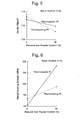
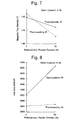
- Figures 5 to 8 show the characteristics of powdered cores made by using only atomized powder, which correspond to the point of 0% in reduced iron powder, and 1:1 by mass mixture of atomized iron powder and reduced iron powder, with using a binding resin of thermosetting PI or thermoplastic PI at a content of 0.1% relative to the whole quantity of the powder mixture.
- Figure 5 shows densities, in which as compared with the powdered cores made of only atomized iron powder (reduced iron powder is 0%), the powdered cores containing 50% reduced iron powder are low in densities. In the case of powdered core containing reduced iron powder and thermosetting PI, the lowering of the density of powdered core is larger.
- Figure 6 shows radial crushing strengths.
- the powdered cores containing reduced iron powder have higher radial crushing strengths.
- the increase in the radial crushing strength is smaller.
- Figure 7 shows magnetic flux densities and the values are low when the powdered cores contain reduced iron powder.
- the powdered core containing reduced iron powder and thermosetting PI largely decreases in the magnetic flux density.
- Figure 8 shows iron losses and the values are higher when the powdered cores contain reduced iron powder.
- the iron loss of the powdered core containing the reduced iron powder and thermoplastic PI is extremely high, the iron loss of powdered core containing only atomized iron powder and thermosetting PI is low and that value hardly increases with the addition of reduced iron powder.
- the iron loss of a powdered core containing thermosetting PI does hardly increase, even if the thermosetting PI is used in combination with the additional reduced iron powder.
- the powdered core containing reduced iron powder apparently excels in the machinability.
- thermosetting PI thermosetting PI
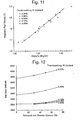
- Figures 9 to 12 show the characteristics of powdered cores containing atomized iron powder, reduced iron powder, and thermosetting PI, in which contents of them were varied.
- Figure 9 shows densities of powdered cores. It is understood that when the content of reduced iron powder or the content of thermosetting PI increases, the densities are lowered.
- Figure 10 shows magnetic flux densities of powdered cores. In the like manner as the densities shown in Figure 9 , the magnetic flux densities become low with the increase of the content of reduced iron powder or thermosetting PI.
- Figure 12 shows iron losses of powdered cores.
- the iron losses increase with the increase of reduced iron powder content. Although the iron losses are almost on a similar level when the contents of thermosetting PI are in the range of 0.10% to 0.30%, the iron loss values increase when the content of thermosetting PI is made 0.05% or less.
- the preferable content of reduced iron powder is in the range of 5 to 50% and thermosetting PI is in the range of 0.10 to 0.15% in order to obtain powdered cores having improved machinability, 1.8 T or more of magnetic flux density and 3000 kW/m 3 or less of iron loss.
- powdered cores have magnetic flux density of 1.75 T or higher and comparatively high iron loss is acceptable, it is possible to achieve the object by using powder material containing reduced iron powder of 5 to 70% and thermosetting PI of 0.15% or less.
- thermosetting PI When higher magnetic flux density is required but relatively high iron loss is accepted, the content of thermosetting PI can be the lowest value of 0.01%, at which the lowering in iron loss is observed.
- the powdered core desirably has a higher magnetic flux density and lower iron loss, so that it is preferable that the reduced iron powder content does not exceed 50%.
- the machinability of the powdered core can be improved by the addition of reduced iron powder, however, the compressibility of powder material becomes worse as compared with the powder material composed of sole atomized iron powder. Accordingly, it is necessary to increase the compressive load applied to the powder material in order to produce powdered cores having a higher magnetic flux density.
- the effect of lubricant powder was examined in order to increase easily the density (i.e., the improvement in compressibility) and, as a result, to increase the magnetic flux density.
- the lubricant powder used herein was PTFE (polytetrafluoroethylene).
- Figures 13 to 15 show characteristics of powdered cores made by using only thermosetting PI and those made by using a mixture of thermosetting PI and PTFE in the ratio of 1 : 1 by mass.
- the ratios of atomized iron powder and reduced iron powder were varied with the resin contents of 0.10% and 0.15% relative to the total amount of powder materials.
- These powdered cores were produced in the like manner as in the foregoing experiments.
- the heat treatments were carried out also in the like manner as in the foregoing experiments using thermosetting PI.
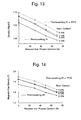
- Figure 13 shows densities, in which the densities of powdered cores made by using the mixture of thermosetting PI and PTFE are higher by 0.02 Mg/cm 3 than the results of the powdered cores made by using only thermosetting PI.
- Figure 14 shows magnetic flux densities, in which the resultant values of powdered cores that were made by using the mixture of thermosetting PI and PTFE are increased as a result of the increase in densities. Even in the cases of powdered cores made of powder material containing reduced iron powder of 70% and the mixture of thermosetting PI and PTFE of 0.10%, the magnetic flux densities exceed the value of 1.8 T.
- Figure 15 shows iron losses.
- the iron losses of powdered cores made by using the mixture of thermosetting PI and PTFE are slightly higher than those made by using only thermosetting PI. Even in the powdered core made of the powder material containing reduced iron powder of 70% and the mixture of thermosetting PI and PTFE of 0.10%, the iron loss is lower than 3000 kW/m 3 .
- thermosetting PI a powdered core of high density and high magnetic flux density
- PTFE a powdered core of 0.10 to 0.15%
- the powder material contains PTFE, it is possible to improve the compressibility of powder mixture, thereby facilitating the production of powdered cores having a high magnetic flux density.
- thermosetting PI to PTFE was 1 : 1 by mass, however, any ratios such as 3 : 1 or 1 : 3 can be adopted in order to make the iron loss satisfactory in accordance with the content of reduced iron powder.
- the content of PTFE is three-fourths (3/4) or less relative to the whole content of resins because the PTFE makes the iron loss large as compared with the thermosetting PI.
- the heat treatment of green compacts is carried out at temperatures of 150 to 250°C, preferably at 200°C, which is suitable for treating the material containing thermosetting PI.
- the thermosetting PI is deteriorated to lose insulating property and the iron loss becomes large. For this reason, the heat treatment is carried out at temperatures in the range of 150°C to 250°C.
- the machined surfaces of powdered cores can be improved by using both the atomized iron powder and the reduced iron powder.
- the used resin powder is thermosetting PI
- obtained products excel in the magnetic flux density and iron loss.
- the resin powder of thermosetting PI is partially replaced by PTFE, the compressibility of powder material is improved, and accordingly, powdered cores having higher magnetic flux density can be obtained.
- thermosetting PI thermosetting PI
- powdered cores having excellent magnetic characteristics can be obtained by using the powder material, in which the resin content is 0.01% to 0.15%, preferably 0.10 to 0.15% and the ratio of atomized iron powder to reduced iron powder is in the range of 95 : 5 to 30 : 70.
- the powder material When the used powder material contains both the thermosetting PI and the PTFE, the powder material is prepared such that the total content of resins is 0.01 to 0.15%, preferably 0.10 to 0.15% and the ratio of atomized iron powder to reduced iron powder is in the range of 95 : 5 to 30 : 70, in addition, the content of PTFE is preferably three-fourths or less to the whole quantity of resins, thereby obtaining powdered cores having excellent magnetic characteristics.
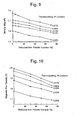
- Figures 16 to 19 show various kinds of characteristics on the powdered cores that are made of iron powder containing only atomized iron powder, or both the atomized iron powder and the reduced iron powder by changing their compounding ratios, and a resin of thermoplastic PI also by changing its contents.
- Figure 16 shows the densities of powdered cores.
- the Figure corresponds to the relationship that is shown in Figure 9 , except that the thermosetting PI in Figure 9 is replaced by thermoplastic PI in Figure 16 .
- the densities also become lower with the increase of the contents of reduced iron powder or the contents of thermosetting PI.
- Figure 17 shows magnetic flux densities of powdered cores.
- the magnetic flux densities become low with the increase of the contents of reduced iron powder and the increase of the contents of thermoplastic PI, in the like manner as the tendency in densities shown in Figure 16 .
- the densities correlate to the magnetic flux densities regardless of the contents of resin and the content of reduced iron powder.
- the magnetic flux density is 1.79 T at the content of 0% of reduced iron powder (only atomized iron powder) and 0.3% of the resin, as shown in Figure 17 . So that, it is understood that the thermoplastic PI is superior to PPS.
- thermoplastic PI in order to obtain powdered cores having higher magnetic flux density, it is preferable to reduce the content of thermoplastic PI and the content of reduced iron powder.
- Figure 18 shows iron losses of powdered cores, in which when the content of reduced iron powder is increased, the values in iron loss increases. On the other hand, it is desirable in that the more the resin contents, the lower the iron losses. Furthermore, even if the powder material contains more than 0.3% of the resin material, the iron loss decreases only by a little extent.
- thermoplastic PI in order to prepare powdered cores having the iron loss of less than about 3500 kW/m 3 , it is possible to select about 0.08% or more of thermoplastic PI in a powder material containing 10% of reduced iron powder; about 0.125% or more in a powder material containing 20% of reduced iron powder; and about 0.15% or more in a powder material containing 30% of reduced iron powder.
- the iron powder material is a mixture of atomized iron powder and 30% or less of reduced iron powder.
- the content of thermoplastic PI is desirably 0.3% or less relative to the total quantity of the powder mixture.
- the content of resin material can be determined in view of the linear correlation, which is plotted between the point of 10% of reduced iron powder with 0.3% of resin content and the point of 30% of reduced iron powder with 0.15% of resin content, wherein an actually adopted resin content may be an appropriate value which is larger than the above linear correlation.
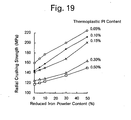
- Figure 19 shows radial crushing strengths of powdered cores.
- the value of radial crushing strength is improved with the increase in the content of reduced iron powder.
- the radial crushing strength is lowered when the content of thermoplastic PI is increases.
- high density powdered cores can be obtained by reducing the frictional resistance among iron particles in the compacting of powder mixture, so as to obtain powdered cores having higher magnetic flux density.
- the well-known lubricants are exemplified by mica, graphite, molybdenum disulfide and PTFE.
- PTFE was tested as a lubricant of resinous material.
- powdered cores were prepared in the like manner as in the foregoing examples using powder mixtures of both atomized iron powder and reduced iron powder, and a resin material.
- the used powder mixture contained 10% and 30% of reduced iron powder and 0.15% of resin material.
- the resin material was thermoplastic PI in one group of powdered cores and, in another group, a half of the thermoplastic PI was replaced by PTFE.
- the powdered core made of the powder mixture containing PTFE has a higher magnetic flux density by 0.02 T owning to the fact that the density is higher by 0.01 Mg/m 3 with improved compressibility of the powder mixture. In other words, it enables to choose a condition of low pressures in compacting. In addition, the iron loss is slightly low, which indicates that the PTFE has better insulating property as compared with the thermoplastic PI.
- thermoplastic PI thermoplastic PI
- PTFE thermoplastic PI
- Table 1 Use of PTFE PTFE is Contained PTFE is not Contained Reduced Iron Powder Qty. (%) 10 30 10 30 Density (Mg/m 3 ) 7.66 7.64 7.65 7.63 Magnetic Flux Density (T) 1.89 1.85 1.87 1.83 Iron Loss (kW/m 3 ) 3050 3350 3100 3500
- the powdered cores produced according to the present invention excel in machinability, so that the invention is suitable for producing the powdered cores of complicated shapes or of precise dimensions such as those which are finished by machining. Furthermore, because it is possible to provide powdered cores of high magnetic flux density and low iron loss, the present invention is suitable for producing electromagnetic products made by using downsized or power-saving powdered cores.
Landscapes
- Engineering & Computer Science (AREA)
- Power Engineering (AREA)
- Manufacturing & Machinery (AREA)
- Physics & Mathematics (AREA)
- Spectroscopy & Molecular Physics (AREA)
- Chemical & Material Sciences (AREA)
- Dispersion Chemistry (AREA)
- Soft Magnetic Materials (AREA)
- Powder Metallurgy (AREA)
Claims (6)
- Noyau en poudre qui est constitué d'un mélange de poudre de fer et de poudre de résine en tant que liant, ledit mélange étant compacté afin de former un comprimé cru, dans lequel ladite poudre de fer est composée d'une poudre de fer atomisée et d'une poudre de fer réduite selon un rapport de 95:5 à 30:70% en masse comme représenté par poudre de fer atomisée:poudre de fer réduite, les surfaces de particules des deux poudres de fer atomisée et réduite sont enduites d'un composé de phosphate, et ladite poudre de résine est au moins un élément choisi dans le groupe constitué d'une poudre de polyimide thermodurcissable, d'un mélange d'une poudre de polyimide thermodurcissable et d'une poudre de polytétrafluoroéthylène, d'une poudre de polyimide thermoplastique, et d'un mélange d'une poudre de polyimide thermoplastique et d'une poudre de polytétrafluoroéthylène, le comprimé cru ayant été soumis à un traitement thermique.
- Noyau en poudre selon la revendication 1, dans lequel ladite poudre en résine est une poudre de polyamide thermodurcissable de 0,01 à 0,15% en masse par rapport à la quantité totale dudit mélange de poudres.
- Noyau en poudre selon la revendication 1, dans lequel ladite poudre en résine comporte à la fois une poudre de polyamide thermodurcissable et une poudre de polytétrafluoroéthylène de 0,01 à 0,15% en masse par rapport à la quantité totale dudit mélange de poudres.
- Noyau en poudre selon la revendication 1, dans lequel ladite poudre de fer contient de 5 à 50% en masse de poudre de fer réduite, et ladite poudre de résine est une poudre de polyimide thermoplastique de 0,3% en masse ou moins par rapport à la quantité totale dudit mélange de poudres.
- Noyau en poudre selon la revendication 1, dans lequel ladite poudre de fer contient 5 à 50% en masse de la poudre de fer réduite et ladite poudre de résine est un mélange d'une poudre de polyimide thermoplastique et d'une poudre de polytétrafluoroéthylène de 0,3% en masse ou moins par rapport à la quantité totale dudit mélange de poudres.
- Procédé pour produire des noyaux en poudre, lequel comporte les étapes consistant à :mélanger ensemble de la poudre de fer atomisée et de la poudre de fer réduite selon un rapport de 95:5 à 30:70% en masse comme représenté par poudre de fer atomisée:poudre de fer réduite, les surfaces de particules des deux poudres de fer atomisée et réduite étant enduites d'un composé de phosphate, ajouter ensuite audit mélange de poudre de fer au moins un élément choisi dans le groupe constitué d'une poudre de polyimide thermodurcissable, d'un mélange d'une poudre de polyimide thermodurcissable et d'une poudre de polytétrafluoroéthylène, d'une poudre de polyimide thermoplastique, et d'un mélange d'une poudre de polyimide thermoplastique et d'une poudre de polytétrafluoroéthylène,soumettre ensuite le mélange ainsi formé à un compactage à l'aide d'une matrice de compactage, les surfaces de paroi de celle-ci étant enduites d'un lubrifiant, afin d'obtenir un comprimé cru, etsoumettre ledit comprimé cru à un traitement thermique et, si les circonstances l'exigent, soumettre ensuite le produit traité thermiquement à un usinage de calibrage, de coupe ou de meulage.
Applications Claiming Priority (5)
| Application Number | Priority Date | Filing Date | Title |
|---|---|---|---|
| JP2002229712A JP4284042B2 (ja) | 2002-08-07 | 2002-08-07 | 圧粉磁心 |
| JP2002229712 | 2002-08-07 | ||
| JP2002229713A JP4284043B2 (ja) | 2002-08-07 | 2002-08-07 | 圧粉磁心及びその製造方法 |
| JP2002229713 | 2002-08-07 | ||
| PCT/JP2003/008730 WO2004015724A1 (fr) | 2002-08-07 | 2003-07-09 | Noyau en poudre comprime et son moyen de production |
Publications (3)
| Publication Number | Publication Date |
|---|---|
| EP1542242A1 EP1542242A1 (fr) | 2005-06-15 |
| EP1542242A4 EP1542242A4 (fr) | 2008-12-10 |
| EP1542242B1 true EP1542242B1 (fr) | 2013-09-11 |
Family
ID=31719839
Family Applications (1)
| Application Number | Title | Priority Date | Filing Date |
|---|---|---|---|
| EP03784478.4A Expired - Lifetime EP1542242B1 (fr) | 2002-08-07 | 2003-07-09 | Noyau en poudre comprime et son moyen de production |
Country Status (4)
| Country | Link |
|---|---|
| US (1) | US20050265883A1 (fr) |
| EP (1) | EP1542242B1 (fr) |
| CN (1) | CN100350519C (fr) |
| WO (1) | WO2004015724A1 (fr) |
Families Citing this family (8)
| Publication number | Priority date | Publication date | Assignee | Title |
|---|---|---|---|---|
| CN1787133B (zh) * | 2005-12-15 | 2010-04-14 | 北京科技大学 | 一种使用热塑-热固粘结剂制备注射成形稀土永磁材料的方法 |
| JP4970899B2 (ja) * | 2006-10-27 | 2012-07-11 | 株式会社日立製作所 | 高抵抗圧粉磁心の製造方法 |
| JP4650450B2 (ja) * | 2007-04-10 | 2011-03-16 | 株式会社日立製作所 | 圧粉磁心,圧粉磁心の製造方法、及びこれを用いたモータ |
| JP5976284B2 (ja) * | 2010-07-23 | 2016-08-23 | 株式会社豊田中央研究所 | 圧粉磁心の製造方法および磁心用粉末の製造方法 |
| CN103646775B (zh) * | 2013-11-26 | 2016-05-04 | 宝鸡烽火诺信科技有限公司 | 一种用热塑注射成型铁基复合材料制备异形磁芯的方法 |
| CN104183381B (zh) * | 2014-08-04 | 2016-08-24 | 太仓市武锋金属制品有限公司 | 一种变压器铁芯的制备方法 |
| CN105427996B (zh) * | 2015-12-16 | 2017-10-31 | 东睦新材料集团股份有限公司 | 一种高频软磁复合材料及其采用该材料制备导磁体构件的方法 |
| CN115171995B (zh) * | 2022-07-26 | 2025-10-17 | 横店集团东磁股份有限公司 | 一种铁基软磁复合材料及其制备方法 |
Family Cites Families (12)
| Publication number | Priority date | Publication date | Assignee | Title |
|---|---|---|---|---|
| US4543208A (en) * | 1982-12-27 | 1985-09-24 | Tokyo Shibaura Denki Kabushiki Kaisha | Magnetic core and method of producing the same |
| WO1986007489A1 (fr) * | 1985-06-10 | 1986-12-18 | Takeuchi Press Industries Co., Ltd. | Composition magnetique liee par de la resine et procede de production d'un moulage magnetique a partir de ladite composition |
| DE69404195T2 (de) * | 1993-04-09 | 1997-10-30 | Gen Motors Corp | Magnetkörper aus eingebetteten ferromagnetischen Partikeln und Herstellungsverfahren dafür |
| US5595609A (en) * | 1993-04-09 | 1997-01-21 | General Motors Corporation | Annealed polymer-bonded soft magnetic body |
| US5589010A (en) * | 1993-04-09 | 1996-12-31 | General Motors Corporation | Annealed polymer-bonded soft magnetic body |
| US5472661A (en) * | 1994-12-16 | 1995-12-05 | General Motors Corporation | Method of adding particulate additives to metal particles |
| US5767426A (en) * | 1997-03-14 | 1998-06-16 | Hoeganaes Corp. | Ferromagnetic powder compositions formulated with thermoplastic materials and fluoric resins and compacted articles made from the same |
| JPH11126721A (ja) * | 1997-10-24 | 1999-05-11 | Tokin Corp | 圧粉磁心の製造方法 |
| JP3421944B2 (ja) * | 1998-06-10 | 2003-06-30 | 株式会社日立製作所 | 圧粉磁心の製造方法及び製造装置 |
| JP2000036403A (ja) * | 1998-07-21 | 2000-02-02 | Seiko Epson Corp | 希土類ボンド磁石用組成物、希土類ボンド磁石および希土類ボンド磁石の製造方法 |
| JP3709292B2 (ja) * | 1998-10-16 | 2005-10-26 | ミネベア株式会社 | 樹脂結合型希土類磁石 |
| JP2002020801A (ja) * | 2000-07-07 | 2002-01-23 | Kawasaki Steel Corp | 粉末冶金用鉄基混合粉 |
-
2003
- 2003-07-09 US US10/520,119 patent/US20050265883A1/en not_active Abandoned
- 2003-07-09 CN CNB038190877A patent/CN100350519C/zh not_active Expired - Fee Related
- 2003-07-09 WO PCT/JP2003/008730 patent/WO2004015724A1/fr not_active Ceased
- 2003-07-09 EP EP03784478.4A patent/EP1542242B1/fr not_active Expired - Lifetime
Also Published As
| Publication number | Publication date |
|---|---|
| CN1675723A (zh) | 2005-09-28 |
| CN100350519C (zh) | 2007-11-21 |
| WO2004015724A1 (fr) | 2004-02-19 |
| EP1542242A4 (fr) | 2008-12-10 |
| US20050265883A1 (en) | 2005-12-01 |
| EP1542242A1 (fr) | 2005-06-15 |
Similar Documents
| Publication | Publication Date | Title |
|---|---|---|
| EP0406580B1 (fr) | Matériau composite et son procédé de préparation | |
| US7422697B2 (en) | Composite sintered magnetic material, its manufacturing method, and magnetic element using composite sintered magnetic material | |
| EP2147445B1 (fr) | Poudre de materiau magnetique doux | |
| EP1744329B1 (fr) | Méthode de fabrication d'un élément magnétique comprenant un corps magnétique composite | |
| US5594186A (en) | High density metal components manufactured by powder metallurgy | |
| EP1447824B1 (fr) | Procede de production d'un materiau magnetique composite | |
| US5306524A (en) | Thermoplastic coated magnetic powder compositions and methods of making same | |
| EP1542242B1 (fr) | Noyau en poudre comprime et son moyen de production | |
| EP1700319B1 (fr) | Composition de poudre, procede de fabrication d'element magnetique doux et element composite magnetique doux | |
| EP1663549B1 (fr) | Poudre magnetique douce a base de fer | |
| EP1737003B1 (fr) | Matériau magnétique doux et noyau de poudre | |
| EP1551040B1 (fr) | Procede de production d'un noyaux de poudre | |
| EP0716053A2 (fr) | Matériau oxyde magnétique | |
| US6689183B2 (en) | Ferrite powder coating insulating layer for molding a powder metal core | |
| US5518641A (en) | Magnetic material and manufacturing method thereof | |
| JP4721456B2 (ja) | 圧粉磁心の製造方法 | |
| JPH1174140A (ja) | 圧粉磁芯の製造方法 | |
| JP4284043B2 (ja) | 圧粉磁心及びその製造方法 | |
| US11948715B2 (en) | Magnetic composite | |
| EP1675137B1 (fr) | Procédé de production de matériau magnétique doux | |
| JP4284042B2 (ja) | 圧粉磁心 | |
| JP2006310873A (ja) | 圧粉磁心及びその製造方法 | |
| JPH0374811A (ja) | フェライト磁性体 | |
| CA1172006A (fr) | Methode de fabrication de noyaux pour materiel a courant alternatif | |
| Krause et al. | Alternating current magnetic properties of cores made from pressed acicular steel particles |
Legal Events
| Date | Code | Title | Description |
|---|---|---|---|
| PUAI | Public reference made under article 153(3) epc to a published international application that has entered the european phase |
Free format text: ORIGINAL CODE: 0009012 |
|
| 17P | Request for examination filed |
Effective date: 20041223 |
|
| AK | Designated contracting states |
Kind code of ref document: A1 Designated state(s): AT BE BG CH CY CZ DE DK EE ES FI FR GB GR HU IE IT LI LU MC NL PT RO SE SI SK TR |
|
| RBV | Designated contracting states (corrected) |
Designated state(s): DE FR GB IT |
|
| A4 | Supplementary search report drawn up and despatched |
Effective date: 20081112 |
|
| 17Q | First examination report despatched |
Effective date: 20090213 |
|
| REG | Reference to a national code |
Ref country code: DE Ref legal event code: R079 Ref document number: 60344916 Country of ref document: DE Free format text: PREVIOUS MAIN CLASS: H01F0001260000 Ipc: H01F0027255000 |
|
| GRAP | Despatch of communication of intention to grant a patent |
Free format text: ORIGINAL CODE: EPIDOSNIGR1 |
|
| RIC1 | Information provided on ipc code assigned before grant |
Ipc: H01F 1/26 20060101ALI20130107BHEP Ipc: H01F 41/02 20060101ALI20130107BHEP Ipc: H01F 27/255 20060101AFI20130107BHEP |
|
| GRAS | Grant fee paid |
Free format text: ORIGINAL CODE: EPIDOSNIGR3 |
|
| GRAA | (expected) grant |
Free format text: ORIGINAL CODE: 0009210 |
|
| AK | Designated contracting states |
Kind code of ref document: B1 Designated state(s): DE FR GB IT |
|
| REG | Reference to a national code |
Ref country code: GB Ref legal event code: FG4D |
|
| REG | Reference to a national code |
Ref country code: DE Ref legal event code: R096 Ref document number: 60344916 Country of ref document: DE Effective date: 20131107 |
|
| REG | Reference to a national code |
Ref country code: DE Ref legal event code: R097 Ref document number: 60344916 Country of ref document: DE |
|
| PLBE | No opposition filed within time limit |
Free format text: ORIGINAL CODE: 0009261 |
|
| STAA | Information on the status of an ep patent application or granted ep patent |
Free format text: STATUS: NO OPPOSITION FILED WITHIN TIME LIMIT |
|
| 26N | No opposition filed |
Effective date: 20140612 |
|
| REG | Reference to a national code |
Ref country code: DE Ref legal event code: R097 Ref document number: 60344916 Country of ref document: DE Effective date: 20140612 |
|
| REG | Reference to a national code |
Ref country code: FR Ref legal event code: PLFP Year of fee payment: 14 |
|
| REG | Reference to a national code |
Ref country code: FR Ref legal event code: PLFP Year of fee payment: 15 |
|
| REG | Reference to a national code |
Ref country code: FR Ref legal event code: PLFP Year of fee payment: 16 |
|
| PGFP | Annual fee paid to national office [announced via postgrant information from national office to epo] |
Ref country code: FR Payment date: 20190619 Year of fee payment: 17 |
|
| PGFP | Annual fee paid to national office [announced via postgrant information from national office to epo] |
Ref country code: DE Payment date: 20190625 Year of fee payment: 17 Ref country code: IT Payment date: 20190719 Year of fee payment: 17 |
|
| PGFP | Annual fee paid to national office [announced via postgrant information from national office to epo] |
Ref country code: GB Payment date: 20190703 Year of fee payment: 17 |
|
| REG | Reference to a national code |
Ref country code: DE Ref legal event code: R119 Ref document number: 60344916 Country of ref document: DE |
|
| GBPC | Gb: european patent ceased through non-payment of renewal fee |
Effective date: 20200709 |
|
| PG25 | Lapsed in a contracting state [announced via postgrant information from national office to epo] |
Ref country code: GB Free format text: LAPSE BECAUSE OF NON-PAYMENT OF DUE FEES Effective date: 20200709 Ref country code: FR Free format text: LAPSE BECAUSE OF NON-PAYMENT OF DUE FEES Effective date: 20200731 |
|
| PG25 | Lapsed in a contracting state [announced via postgrant information from national office to epo] |
Ref country code: DE Free format text: LAPSE BECAUSE OF NON-PAYMENT OF DUE FEES Effective date: 20210202 |
|
| PG25 | Lapsed in a contracting state [announced via postgrant information from national office to epo] |
Ref country code: IT Free format text: LAPSE BECAUSE OF NON-PAYMENT OF DUE FEES Effective date: 20200709 |