EP1542376A2 - MIMO Empfänger mit einem oder mehreren zusätzlichen Empfangswegen - Google Patents
MIMO Empfänger mit einem oder mehreren zusätzlichen Empfangswegen Download PDFInfo
- Publication number
- EP1542376A2 EP1542376A2 EP04257463A EP04257463A EP1542376A2 EP 1542376 A2 EP1542376 A2 EP 1542376A2 EP 04257463 A EP04257463 A EP 04257463A EP 04257463 A EP04257463 A EP 04257463A EP 1542376 A2 EP1542376 A2 EP 1542376A2
- Authority
- EP
- European Patent Office
- Prior art keywords
- signals
- signal
- receive
- subcarrier signals
- carrier signals
- Prior art date
- Legal status (The legal status is an assumption and is not a legal conclusion. Google has not performed a legal analysis and makes no representation as to the accuracy of the status listed.)
- Withdrawn
Links
Images


Classifications
-
- H—ELECTRICITY
- H04—ELECTRIC COMMUNICATION TECHNIQUE
- H04B—TRANSMISSION
- H04B7/00—Radio transmission systems, i.e. using radiation field
- H04B7/02—Diversity systems; Multi-antenna system, i.e. transmission or reception using multiple antennas
- H04B7/04—Diversity systems; Multi-antenna system, i.e. transmission or reception using multiple antennas using two or more spaced independent antennas
- H04B7/08—Diversity systems; Multi-antenna system, i.e. transmission or reception using multiple antennas using two or more spaced independent antennas at the receiving station
- H04B7/0837—Diversity systems; Multi-antenna system, i.e. transmission or reception using multiple antennas using two or more spaced independent antennas at the receiving station using pre-detection combining
- H04B7/0842—Weighted combining
- H04B7/0848—Joint weighting
-
- H—ELECTRICITY
- H04—ELECTRIC COMMUNICATION TECHNIQUE
- H04J—MULTIPLEX COMMUNICATION
- H04J11/00—Orthogonal multiplex systems, e.g. using WALSH codes
- H04J11/0023—Interference mitigation or co-ordination
- H04J11/0026—Interference mitigation or co-ordination of multi-user interference
- H04J11/0036—Interference mitigation or co-ordination of multi-user interference at the receiver
-
- H—ELECTRICITY
- H04—ELECTRIC COMMUNICATION TECHNIQUE
- H04B—TRANSMISSION
- H04B7/00—Radio transmission systems, i.e. using radiation field
- H04B7/02—Diversity systems; Multi-antenna system, i.e. transmission or reception using multiple antennas
- H04B7/04—Diversity systems; Multi-antenna system, i.e. transmission or reception using multiple antennas using two or more spaced independent antennas
- H04B7/0413—MIMO systems
-
- H—ELECTRICITY
- H04—ELECTRIC COMMUNICATION TECHNIQUE
- H04L—TRANSMISSION OF DIGITAL INFORMATION, e.g. TELEGRAPHIC COMMUNICATION
- H04L27/00—Modulated-carrier systems
- H04L27/26—Systems using multi-frequency codes
- H04L27/2601—Multicarrier modulation systems
- H04L27/2647—Arrangements specific to the receiver only
Definitions
- the present invention relates to wireless communications, and, in particular, to receivers for multiple-input, multiple-output (MIMO) systems, such as MIMO orthogonal frequency division multiplexing (OFDM) wireless local area network (WLAN) systems.
- MIMO multiple-input, multiple-output
- OFDM orthogonal frequency division multiplexing
- WLAN wireless local area network
- a transmitter with M transmit antennas transmits MOFDM signals (a type of multi-carrier signal) to a receiver having M receive paths that are used to generate M recovered versions of the transmitted OFDM signals.
- MOFDM signals a type of multi-carrier signal
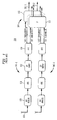
- 2x2 receiver 100 has two receive paths 102 and a processor 104 .
- Each receive path 102 has a receive antenna 106 , an RF/analog block 108 , an analog-to-digital converter (ADC) 110 , a cyclic-prefix (CP) removal block 112 , and a fast Fourier transform (FFT) block 114 .
- ADC analog-to-digital converter
- CP cyclic-prefix
- FFT fast Fourier transform
- receive antenna 106 receives mixed versions of the M OFDM signals transmitted by a two-antenna MIMO-OFDM WLAN transmitter.
- RF/analog block 108 downconverts the analog RF OFDM signals from receive antenna 106 to an intermediate frequency (IF) or baseband
- ADC 110 digitizes the resulting downconverted analog OFDM signals to form a digital stream consisting of OFDM symbols separated by cyclic prefixes.
- CP removal block 112 removes the cyclic prefixes from between the OFDM symbols in the digital stream.
- FFT block 114 converts frames (e.g., 20 msec) of digital OFDM symbols in the time domain into frequency-domain coefficients for different OFDM subcarrier signals.
- Processor 104 has a matrix 116 for each subcarrier in the multi-carrier OFDM signals.
- Each matrix 116 receives, from the different FFT blocks 114 , all of the coefficients for one of the OFDM subcarriers. Note that the data from each FFT block 114 typically contains information for OFDM signals transmitted from all of the transmit antennas.
- Each matrix 116 is adapted to process the set of corresponding subcarrier coefficients to recover separate and equalized subcarrier coefficient streams 118 , each different recovered subcarrier coefficient stream 118 corresponding to the OFDM signal transmitted from a different transmit antenna.
- the recovered OFDM subcarrier coefficient streams 118 can then be processed using conventional OFDM decoding techniques, e.g., to detect the data encoded in the received OFDM signals.
- CCI co-channel interference
- a receiver simultaneously receives signals from spatial locations other than those of the transmitters of interest.
- CCI can occur when one or more additional transmitters operate at the same channels (e.g., using the same OFDM subcarriers) as the transmitters of interest, such that signals from the additional transmitter(s) interfere with the recovery of the desired signals from the transmitters of interest.
- Another scenario of CCI occurrence may be due to poor channel selectivity filtering of the receiver, where adjacent channel signals fold into the channel of the interest.
- a MIMO-OFDM WLAN system having an M -antenna transmitter and a receiver having ( M +1) receive paths.
- the additional receive path in the receiver of a MIMO-OFDM WLAN system can be used to reduce co-channel interference.
- the present invention is a receiver for receiving M multi-carrier signals transmitted from M transmit antennas, where M >1.
- the receiver comprises at least ( M +1) receive paths and a processor.
- Each receive path is adapted to receive the M multi-carrier signals and separate the received signals into separate subcarrier signals, and the processor is adapted to process the separate subcarrier signals to generate a recovered version of each of the M transmitted multi-carrier signals.
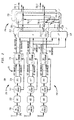
- Fig. 2 shows a block diagram of the front end of a receiver 200 , according to one embodiment of the present invention.
- receiver 200 has three receive paths 202 and a processor 204 .
- Receiver 200 is designed to receive and process two OFDM signals transmitted from a transmitter having two transmit antennas, where the receiver generates recovered versions of those two OFDM signals. As such, in this particular embodiment, receiver 200 has one more receive path than the number of transmitted OFDM signals it is designed to recover.
- Each receive path 202 has a receive antenna 206 , an RF/analog block 208 , an ADC 210 , a CP removal block 212 , and an FFT block 214 , each of which is analogous to the corresponding element in the receive paths of prior-art receiver 100 of Fig. 1.
- each receive path 202 has a filterbank 216 , which generates subcarrier coefficient streams in the frequency domain for application to processor 204 .
- CP removal block 212 removes the cyclic prefixes from between the OFDM symbols in the digital stream received from ADC 210 . In addition, however, CP removal block 212 provides these removed CP portions 218 from the guard-time intervals between consecutive OFDM symbols to filterbank 216 . In alternative implementations, the entire digital stream from ADC 210 can be used by filterbank 216 .
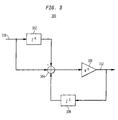
- Fig. 3 shows a block diagram of a filter 300 that can be used for each subcarrier in each filterbank 216 of Fig. 2.
- Filter 300 comprises delays 302 and 308 , summation node 304 , and amplifier 306 .
- Input signal 310 is applied to delay 302 and to summation node 304 .
- Delay 302 delays input signal 310 for N cycles, where N is the size of the FFT and is typically set equal to the number of subcarriers.
- the output from delay 302 is inverted and applied to summation node 304 .
- the output from summation node is output signal 312 , which is also applied to amplifier 306 .
- the output from amplifier 306 is applied to one-cycle delay 308 , whose output is also applied to summation node 304 .
- Input signal 310 for filter 300 is indicated in Fig. 2 by signal 218 , while filter 300 is initialized using the kth subcarrier signal 220 from FFT 214 of Fig. 2 as X k (0) in Equation (1). Since W -k has a fixed value, amplifier 306 can be efficiently implemented using adders without requiring any multipliers.
- Fig. 3 shows one possible filter structure for a discrete Fourier transform (DFT) filterbank.
- the DFT filterbank of Fig. 3 may be viewed as an ( N -1)-tap finite impulse response (FIR) filter, whose frequency response sample is shown in Fig. 4.
- FIR finite impulse response
- filterbank 216 can be implemented using any suitable filter structure that implements a sliding-window DFT.
- each receive path 202 the subcarrier coefficients from filterbank 216 of each receive path 202 are applied to corresponding P blocks 222 (also referred to as the master blocks) and P ⁇ (pronounced "P-orthogonal") blocks 224 (also referred to as the slave blocks) of processor 204 .
- P blocks 222 converts the three corresponding coefficient streams from the three receive paths into two (signal + CCI) coefficient streams 226 , each corresponding to a different one of the two transmitted OFDM signals and each containing the corresponding desired signal as well as possibly co-channel interference.
- each P ⁇ block 224 converts the three corresponding coefficient streams from the three receive paths into a single CCI coefficient stream 228 , corresponding to the possible co-channel interference.
- the operations of master and slave blocks P and P ⁇ are estimated during the OFDM long-preamble training phase.
- H -1 does not exist, and the master block P has a slightly different meaning.
- Equation (8) has no bias term and no self-interference.
- Equation (6) may require singular value decomposition, which may be implemented using the CORDIC-based VLSI architecture described by Y. Hu, "CORDIC-based VLSI architectures for digital signal processing," IEEE Signal Processing Magazine, vol. 9, no. 3, pp.16-35, July 1992, the teachings of which are incorporated herein by reference.
- the rank of Y may vary from 1 to M+1 depending on the channel condition and whether any CCI is present. If the repeated-preamble is adopted, then successive cancellation may be used.
- Fig. 5 shows a flow diagram of one possible successive cancellation algorithm for a 2x3 MIMO system.
- step 502 construct two signal null spaces as follows: (null out TX1 when TX1 is on) (null out TX2 when TX2 is on) where y 1:2,i+1 denotes the received signals at the ( i+ 1)th receiver when the first transmitter (TX1) is on, while y 3:4 ,i+1 denotes the received signals at the ( i +1)th receiver when the second transmitter (TX2) is on.
- X (1) Y 1:2,1:3 Z 2
- X (2) Y 3:4,1:3 Z 1
- interference space as follows: , (null out both TX1 and TX2)
- SNIR tr ( S H S ) ( Y 1:2 Z 2 E 1 - S 1:2,1 ) H ( Y 1:2 Z 2 E 1 - S 1:2,1 ) + ( Y 3:4 Z 1 E 2 - S 3:4,2 ) H ( Y 3:4 Z 1 E 2 - S 3:4,2 )
- step 512 if the SNIR is less than 22 (27dB), then there is CCI present, implying the following:
- each cancellation block 230 applies an adaptive scheme based on a typical Wiener-Hopf solution, where each pair of P blocks 222 are master blocks and the corresponding P ⁇ block 224 is a slave block whose output 228 is used as a reference signal in the adaptive cancellation scheme.
- Information from each output coefficient stream 232 is fed back to determine how to distribute CCI coefficient stream 228 between the two (signal + CCI) coefficient streams 226 .
- each output coefficient stream 232 is fed back to a corresponding scaler 234 , which applies an appropriate scale factor to CCI coefficient stream 228 based on the energy or power level of the output coefficient stream.
- the resulting scaled coefficient stream 236 is then subtracted from the corresponding (signal + CCI) coefficient stream 226 at a subtraction node 238 to generate the corresponding output coefficient stream 232 .
- the scale factors can be calculated in a batch way (e.g., using direct projection) or in a recursive way (e.g., using a least mean squares (LMS) algorithm or a sign algorithm (SA)).
- LMS least mean squares
- SA is a simplified LMS, where only the sign of the error is fed back, while LMS also feeds back the magnitude of the error. See, e.g., Simon Haykin, Adaptive Filter Theory, (4th Edition), Prentice Hall, 2001 (ISBN: 0130901261), the teachings of which are incorporated herein by reference.
- the present invention has been described in the context of a MIMO-OFDM WLAN system having a two-antenna transmitter and a receiver having three receive paths, the invention is not so limited. In general, the invention can be extended to any number M , where the system has an M -antenna transmitter and a receiver having ( M +1) receive paths. Moreover, for a system having an M -antenna transmitter, the invention can be implemented as a receiver having more than ( M +1) receive paths. These additional receive paths could be used to trade off between additional diversity gain and suppression of co-channel interference, where diversity gain refers to an increase in robustness against channel fading.
- the present invention can be implemented in the context of MIMO systems based on suitable modulation schemes other than OFDM, such as code-division multiple-access (CDMA) modulation.
- CDMA code-division multiple-access
- the present invention can be implemented in the context of suitable systems other than WLANs, such as wireless wide area networks (WWANs).
- WLANs wireless wide area networks
- SDM space-division multiplexing
- SDMA space-division multiple-access
- the present invention may be implemented as circuit-based processes, including possible implementation as a single integrated circuit (such as an ASIC or an FPGA), a multi-chip module, a single card, or a multi-card circuit pack.
- a single integrated circuit such as an ASIC or an FPGA
- a multi-chip module such as a single card, or a multi-card circuit pack.
- various functions of circuit elements may also be implemented as processing steps in a software program.
- Such software may be employed in, for example, a digital signal processor, micro-controller, or general-purpose computer.
- the present invention can be embodied in the form of methods and apparatuses for practicing those methods.
- the present invention can also be embodied in the form of program code embodied in tangible media, such as floppy diskettes, CD-ROMs, hard drives, or any other machine-readable storage medium, wherein, when the program code is loaded into and executed by a machine, such as a computer, the machine becomes an apparatus for practicing the invention.
- the present invention can also be embodied in the form of program code, for example, whether stored in a storage medium, loaded into and/or executed by a machine, or transmitted over some transmission medium or carrier, such as over electrical wiring or cabling, through fiber optics, or via electromagnetic radiation, wherein, when the program code is loaded into and executed by a machine, such as a computer, the machine becomes an apparatus for practicing the invention.
- program code When implemented on a general-purpose processor, the program code segments combine with the processor to provide a unique device that operates analogously to specific logic circuits.
Landscapes
- Engineering & Computer Science (AREA)
- Computer Networks & Wireless Communication (AREA)
- Signal Processing (AREA)
- Radio Transmission System (AREA)
- Noise Elimination (AREA)
Applications Claiming Priority (4)
| Application Number | Priority Date | Filing Date | Title |
|---|---|---|---|
| US52817003P | 2003-12-09 | 2003-12-09 | |
| US528170P | 2003-12-09 | ||
| US952400 | 2004-09-28 | ||
| US10/952,400 US7453949B2 (en) | 2003-12-09 | 2004-09-28 | MIMO receivers having one or more additional receive paths |
Publications (2)
| Publication Number | Publication Date |
|---|---|
| EP1542376A2 true EP1542376A2 (de) | 2005-06-15 |
| EP1542376A3 EP1542376A3 (de) | 2009-06-24 |
Family
ID=34527126
Family Applications (1)
| Application Number | Title | Priority Date | Filing Date |
|---|---|---|---|
| EP04257463A Withdrawn EP1542376A3 (de) | 2003-12-09 | 2004-12-01 | MIMO Empfänger mit einem oder mehreren zusätzlichen Empfangswegen |
Country Status (4)
| Country | Link |
|---|---|
| US (2) | US7453949B2 (de) |
| EP (1) | EP1542376A3 (de) |
| JP (1) | JP4673616B2 (de) |
| KR (1) | KR101114270B1 (de) |
Cited By (2)
| Publication number | Priority date | Publication date | Assignee | Title |
|---|---|---|---|---|
| EP2129026A4 (de) * | 2007-02-16 | 2011-12-21 | Nec Corp | Funkübertragungsverfahren und interferenzausgleichsverfahren |
| CN103326979A (zh) * | 2012-03-21 | 2013-09-25 | 华为技术有限公司 | 一种多载波接收装置及方法 |
Families Citing this family (13)
| Publication number | Priority date | Publication date | Assignee | Title |
|---|---|---|---|---|
| US7978759B1 (en) * | 2005-03-24 | 2011-07-12 | Marvell International Ltd. | Scalable equalizer for multiple-in-multiple-out (MIMO) wireless transmission |
| WO2007043459A1 (ja) | 2005-10-07 | 2007-04-19 | Nec Corporation | 複数の基地局と移動局によるmimo無線通信システム及び方法 |
| US20070098088A1 (en) * | 2005-10-31 | 2007-05-03 | Chih-Yuan Lin | Equalizer applied in mimo-ofdm system and related method |
| US7593754B2 (en) * | 2005-12-08 | 2009-09-22 | Samsung Electronics Co., Ltd. | Receiving apparatus and receiving method of communication system with multiple antennas |
| CN101375567B (zh) * | 2006-03-16 | 2013-01-23 | 英特尔公司 | 采用递归滤波的信道估计方法和具有干扰感知解调的多载波接收器 |
| GB2442263B (en) * | 2006-09-26 | 2011-03-09 | Iti Scotland Ltd | Uwb apparatus and method |
| KR100873173B1 (ko) * | 2007-02-06 | 2008-12-10 | 인하대학교 산학협력단 | 셀룰러 직교 주파수 분할 다중화 시스템에서의 동일 채널간섭 제거 시스템 및 방법 |
| US7675847B2 (en) * | 2007-07-10 | 2010-03-09 | Wipro Limited | Hardware implementation of a programmable FFT based on a half length FFT core |
| US7970067B1 (en) | 2007-10-31 | 2011-06-28 | Samsung Electronics Co., Ltd. | OFDM receiver and method for enhancing channel estimation performance in communication environment where high doppler frequency exists |
| KR101455992B1 (ko) * | 2007-11-14 | 2014-11-03 | 엘지전자 주식회사 | 다중 안테나 시스템에서 신호 전송 방법 |
| US8787762B2 (en) * | 2011-02-22 | 2014-07-22 | Nec Laboratories America, Inc. | Optical-layer traffic grooming at an OFDM subcarrier level with photodetection conversion of an input optical OFDM to an electrical signal |
| JP6506919B2 (ja) | 2013-06-04 | 2019-04-24 | 三星電子株式会社Samsung Electronics Co.,Ltd. | マルチホップネットワークにおける干渉制御方法、及び該干渉制御方法を用いたリレーノード |
| CN106302273B (zh) * | 2016-08-12 | 2019-07-09 | 扬智科技股份有限公司 | 同频信道干扰的处理方法及其处理电路 |
Family Cites Families (24)
| Publication number | Priority date | Publication date | Assignee | Title |
|---|---|---|---|---|
| US4199660A (en) * | 1977-11-07 | 1980-04-22 | Communications Satellite Corporation | FDM/TDM Transmultiplexer |
| US5991273A (en) * | 1997-05-01 | 1999-11-23 | Nortel Networks Corporation | Determining SINR in a communications system |
| JP2000022838A (ja) * | 1998-06-30 | 2000-01-21 | Fujitsu Ltd | 加入者線伝送システムの遅延抑制方式 |
| US7023938B1 (en) * | 1999-04-08 | 2006-04-04 | Nec Usa, Inc. | Receiver for discrete multitone modulated signals having window function |
| US6370129B1 (en) * | 1999-06-28 | 2002-04-09 | Lucent Technologies, Inc. | High-speed data services using multiple transmit antennas |
| EP1217770A1 (de) * | 1999-09-30 | 2002-06-26 | Fujitsu Limited | Sender, empfänger und übertragungsverfahren in einem mehrträgerübertragungssystem |
| US6600796B1 (en) * | 1999-11-12 | 2003-07-29 | Lucent Technologies Inc. | Method and apparatus for receiving wireless transmissions using multiple-antenna arrays |
| US6947509B1 (en) * | 1999-11-30 | 2005-09-20 | Verance Corporation | Oversampled filter bank for subband processing |
| JP3857009B2 (ja) * | 2000-02-15 | 2006-12-13 | 三菱電機株式会社 | マルチキャリア無線受信装置およびマルチキャリア無線伝送装置 |
| EP1152576B8 (de) | 2000-05-05 | 2009-12-23 | Agere Systems, Inc. | Gesamtschätzung unter Verwendung des M- beziehungsweise T-algorithmus in Mehrantennensystemen |
| EP1152548A1 (de) | 2000-05-05 | 2001-11-07 | Lucent Technologies Inc. | Erhöhte Datenübertragungskapazität für Schnurloses Netzwerk mit hoher Datenrate |
| US7068628B2 (en) * | 2000-05-22 | 2006-06-27 | At&T Corp. | MIMO OFDM system |
| US6985434B2 (en) * | 2000-09-01 | 2006-01-10 | Nortel Networks Limited | Adaptive time diversity and spatial diversity for OFDM |
| EP1206061B1 (de) | 2000-11-13 | 2009-06-17 | Lucent Technologies Inc. | Kanalschätzung für Raumdiversitätskommunikationssystemen |
| US8290098B2 (en) * | 2001-03-30 | 2012-10-16 | Texas Instruments Incorporated | Closed loop multiple transmit, multiple receive antenna wireless communication system |
| US7706458B2 (en) * | 2001-04-24 | 2010-04-27 | Mody Apurva N | Time and frequency synchronization in Multi-Input, Multi-Output (MIMO) systems |
| JP2003069529A (ja) * | 2001-08-28 | 2003-03-07 | Nippon Telegr & Teleph Corp <Ntt> | Ofdm信号受信装置、ofdm信号受信方法、ofdm信号伝送装置およびofdm信号伝送方法 |
| US7269127B2 (en) * | 2001-10-04 | 2007-09-11 | Bae Systems Information And Electronic Systems Integration Inc. | Preamble structures for single-input, single-output (SISO) and multi-input, multi-output (MIMO) communication systems |
| US20030125040A1 (en) * | 2001-11-06 | 2003-07-03 | Walton Jay R. | Multiple-access multiple-input multiple-output (MIMO) communication system |
| US6636568B2 (en) * | 2002-03-01 | 2003-10-21 | Qualcomm | Data transmission with non-uniform distribution of data rates for a multiple-input multiple-output (MIMO) system |
| US7197084B2 (en) * | 2002-03-27 | 2007-03-27 | Qualcomm Incorporated | Precoding for a multipath channel in a MIMO system |
| US7327800B2 (en) * | 2002-05-24 | 2008-02-05 | Vecima Networks Inc. | System and method for data detection in wireless communication systems |
| JP4412926B2 (ja) * | 2002-09-27 | 2010-02-10 | 株式会社エヌ・ティ・ティ・ドコモ | 適応等化装置及びそのプログラム |
| US7317680B2 (en) * | 2002-10-01 | 2008-01-08 | Nortel Networks Limited | Channel mapping for OFDM |
-
2004
- 2004-09-28 US US10/952,400 patent/US7453949B2/en active Active
- 2004-12-01 EP EP04257463A patent/EP1542376A3/de not_active Withdrawn
- 2004-12-09 KR KR1020040103336A patent/KR101114270B1/ko not_active Expired - Fee Related
- 2004-12-09 JP JP2004356127A patent/JP4673616B2/ja not_active Expired - Fee Related
-
2008
- 2008-10-14 US US12/250,795 patent/US7672391B2/en not_active Expired - Fee Related
Cited By (3)
| Publication number | Priority date | Publication date | Assignee | Title |
|---|---|---|---|---|
| EP2129026A4 (de) * | 2007-02-16 | 2011-12-21 | Nec Corp | Funkübertragungsverfahren und interferenzausgleichsverfahren |
| US8805282B2 (en) | 2007-02-16 | 2014-08-12 | Nec Corporation | Radio transmission system and interference compensation method |
| CN103326979A (zh) * | 2012-03-21 | 2013-09-25 | 华为技术有限公司 | 一种多载波接收装置及方法 |
Also Published As
| Publication number | Publication date |
|---|---|
| JP2005176376A (ja) | 2005-06-30 |
| US7672391B2 (en) | 2010-03-02 |
| EP1542376A3 (de) | 2009-06-24 |
| JP4673616B2 (ja) | 2011-04-20 |
| US7453949B2 (en) | 2008-11-18 |
| US20090041153A1 (en) | 2009-02-12 |
| US20050122998A1 (en) | 2005-06-09 |
| KR101114270B1 (ko) | 2012-03-05 |
| KR20050056152A (ko) | 2005-06-14 |
Similar Documents
| Publication | Publication Date | Title |
|---|---|---|
| US7672391B2 (en) | MIMO receivers having one or more additional receive paths | |
| JP4847874B2 (ja) | マルチユーザ適応型アレイ受信機および方法 | |
| Gao et al. | Blind channel estimation for MIMO OFDM systems via nonredundant linear precoding | |
| US8126097B2 (en) | Method and system for cluster processing using conjugate gradient-based MMSE equalizer and multiple transmit and/or receive antennas for HSDPA, STTD, closed-loop and normal mode | |
| US8000424B2 (en) | Method and system for low complexity conjugate gradient based equalization in a wireless system | |
| WO2011078726A1 (en) | Method and apparatus for downlink multiuser mimo transmission in a wireless network | |
| US20040142665A1 (en) | Method and apparatus for diversity combining using a least squares approach | |
| EP1530333A1 (de) | Verfahren zur Kanalschätzung in einem MIMO-OFDM System | |
| JP5859913B2 (ja) | 無線受信装置、無線送信装置、無線通信システム、プログラムおよび集積回路 | |
| CN106233685A (zh) | 用于大规模mimo系统的混合模拟数字预编码的方法 | |
| US7050490B2 (en) | Blind adaptive filtering method for receivers of communication systems | |
| US8779979B2 (en) | Multi-antenna signal receiving device processing multi-path interference | |
| Gazzah et al. | Blind ZF equalization with controlled delay robust to order over estimation | |
| WO2007029142A2 (en) | Method and apparatus for estimating channel based on implicit training sequences | |
| EP2244432A1 (de) | Kompensation von Trägerfrequenzoffsets in OFDM Systemen | |
| Masmoudi et al. | A digital subspace-based self-interference cancellation in full-duplex MIMO transceivers | |
| JP2009171564A (ja) | 無線受信装置及び無線受信方法 | |
| JP2006222836A (ja) | 受信装置、受信回路、受信方法及び受信プログラム | |
| Tang et al. | A Model-Driven Dimension-Elevating OAMP Detector for MIMO-OTFS Communications | |
| WO1999062197A1 (en) | Communications receiver and method of detecting data from received signals | |
| Shi et al. | Blind equalization of MIMO systems based on orthogonal constant modulus algorithm | |
| Dong et al. | MIMO channel estimation based on ambiguity resistant filtering and decimated feedback | |
| Moazzami et al. | Application of a blind channel estimator for source separation in MIMO systems | |
| Wang | A recursive least-squares ASIC for broadband 8 x 8 multiple-input multiple-output wireless communications | |
| Tadisetti et al. | Blind equalization for MIMO FIR channel in wireless communications |
Legal Events
| Date | Code | Title | Description |
|---|---|---|---|
| PUAI | Public reference made under article 153(3) epc to a published international application that has entered the european phase |
Free format text: ORIGINAL CODE: 0009012 |
|
| AK | Designated contracting states |
Kind code of ref document: A2 Designated state(s): AT BE BG CH CY CZ DE DK EE ES FI FR GB GR HU IE IS IT LI LT LU MC NL PL PT RO SE SI SK TR |
|
| AX | Request for extension of the european patent |
Extension state: AL BA HR LV MK YU |
|
| PUAL | Search report despatched |
Free format text: ORIGINAL CODE: 0009013 |
|
| AK | Designated contracting states |
Kind code of ref document: A3 Designated state(s): AT BE BG CH CY CZ DE DK EE ES FI FR GB GR HU IE IS IT LI LT LU MC NL PL PT RO SE SI SK TR |
|
| AX | Request for extension of the european patent |
Extension state: AL BA HR LV MK YU |
|
| 17P | Request for examination filed |
Effective date: 20091124 |
|
| AKX | Designation fees paid |
Designated state(s): DE GB |
|
| 17Q | First examination report despatched |
Effective date: 20100730 |
|
| STAA | Information on the status of an ep patent application or granted ep patent |
Free format text: STATUS: THE APPLICATION IS DEEMED TO BE WITHDRAWN |
|
| 18D | Application deemed to be withdrawn |
Effective date: 20101210 |