EP1542476A2 - Farbraumkodierungsumgebung - Google Patents
Farbraumkodierungsumgebung Download PDFInfo
- Publication number
- EP1542476A2 EP1542476A2 EP04026085A EP04026085A EP1542476A2 EP 1542476 A2 EP1542476 A2 EP 1542476A2 EP 04026085 A EP04026085 A EP 04026085A EP 04026085 A EP04026085 A EP 04026085A EP 1542476 A2 EP1542476 A2 EP 1542476A2
- Authority
- EP
- European Patent Office
- Prior art keywords
- stream
- enhanced
- base
- bit stream
- format
- Prior art date
- Legal status (The legal status is an assumption and is not a legal conclusion. Google has not performed a legal analysis and makes no representation as to the accuracy of the status listed.)
- Withdrawn
Links
Images







Classifications
-
- H—ELECTRICITY
- H04—ELECTRIC COMMUNICATION TECHNIQUE
- H04N—PICTORIAL COMMUNICATION, e.g. TELEVISION
- H04N11/00—Colour television systems
- H04N11/04—Colour television systems using pulse code modulation
-
- H—ELECTRICITY
- H04—ELECTRIC COMMUNICATION TECHNIQUE
- H04N—PICTORIAL COMMUNICATION, e.g. TELEVISION
- H04N1/00—Scanning, transmission or reproduction of documents or the like, e.g. facsimile transmission; Details thereof
- H04N1/46—Colour picture communication systems
- H04N1/64—Systems for the transmission or the storage of the colour picture signal; Details therefor, e.g. coding or decoding means therefor
- H04N1/646—Transmitting or storing colour television type signals, e.g. PAL, Lab; Their conversion into additive or subtractive colour signals or vice versa therefor
-
- H—ELECTRICITY
- H04—ELECTRIC COMMUNICATION TECHNIQUE
- H04N—PICTORIAL COMMUNICATION, e.g. TELEVISION
- H04N19/00—Methods or arrangements for coding, decoding, compressing or decompressing digital video signals
- H04N19/10—Methods or arrangements for coding, decoding, compressing or decompressing digital video signals using adaptive coding
- H04N19/102—Methods or arrangements for coding, decoding, compressing or decompressing digital video signals using adaptive coding characterised by the element, parameter or selection affected or controlled by the adaptive coding
- H04N19/117—Filters, e.g. for pre-processing or post-processing
-
- H—ELECTRICITY
- H04—ELECTRIC COMMUNICATION TECHNIQUE
- H04N—PICTORIAL COMMUNICATION, e.g. TELEVISION
- H04N19/00—Methods or arrangements for coding, decoding, compressing or decompressing digital video signals
- H04N19/10—Methods or arrangements for coding, decoding, compressing or decompressing digital video signals using adaptive coding
- H04N19/169—Methods or arrangements for coding, decoding, compressing or decompressing digital video signals using adaptive coding characterised by the coding unit, i.e. the structural portion or semantic portion of the video signal being the object or the subject of the adaptive coding
- H04N19/17—Methods or arrangements for coding, decoding, compressing or decompressing digital video signals using adaptive coding characterised by the coding unit, i.e. the structural portion or semantic portion of the video signal being the object or the subject of the adaptive coding the unit being an image region, e.g. an object
- H04N19/176—Methods or arrangements for coding, decoding, compressing or decompressing digital video signals using adaptive coding characterised by the coding unit, i.e. the structural portion or semantic portion of the video signal being the object or the subject of the adaptive coding the unit being an image region, e.g. an object the region being a block, e.g. a macroblock
-
- H—ELECTRICITY
- H04—ELECTRIC COMMUNICATION TECHNIQUE
- H04N—PICTORIAL COMMUNICATION, e.g. TELEVISION
- H04N19/00—Methods or arrangements for coding, decoding, compressing or decompressing digital video signals
- H04N19/10—Methods or arrangements for coding, decoding, compressing or decompressing digital video signals using adaptive coding
- H04N19/169—Methods or arrangements for coding, decoding, compressing or decompressing digital video signals using adaptive coding characterised by the coding unit, i.e. the structural portion or semantic portion of the video signal being the object or the subject of the adaptive coding
- H04N19/186—Methods or arrangements for coding, decoding, compressing or decompressing digital video signals using adaptive coding characterised by the coding unit, i.e. the structural portion or semantic portion of the video signal being the object or the subject of the adaptive coding the unit being a colour or a chrominance component
-
- H—ELECTRICITY
- H04—ELECTRIC COMMUNICATION TECHNIQUE
- H04N—PICTORIAL COMMUNICATION, e.g. TELEVISION
- H04N19/00—Methods or arrangements for coding, decoding, compressing or decompressing digital video signals
- H04N19/30—Methods or arrangements for coding, decoding, compressing or decompressing digital video signals using hierarchical techniques, e.g. scalability
-
- H—ELECTRICITY
- H04—ELECTRIC COMMUNICATION TECHNIQUE
- H04N—PICTORIAL COMMUNICATION, e.g. TELEVISION
- H04N19/00—Methods or arrangements for coding, decoding, compressing or decompressing digital video signals
- H04N19/40—Methods or arrangements for coding, decoding, compressing or decompressing digital video signals using video transcoding, i.e. partial or full decoding of a coded input stream followed by re-encoding of the decoded output stream
-
- H—ELECTRICITY
- H04—ELECTRIC COMMUNICATION TECHNIQUE
- H04N—PICTORIAL COMMUNICATION, e.g. TELEVISION
- H04N19/00—Methods or arrangements for coding, decoding, compressing or decompressing digital video signals
- H04N19/50—Methods or arrangements for coding, decoding, compressing or decompressing digital video signals using predictive coding
- H04N19/59—Methods or arrangements for coding, decoding, compressing or decompressing digital video signals using predictive coding involving spatial sub-sampling or interpolation, e.g. alteration of picture size or resolution
-
- H—ELECTRICITY
- H04—ELECTRIC COMMUNICATION TECHNIQUE
- H04N—PICTORIAL COMMUNICATION, e.g. TELEVISION
- H04N19/00—Methods or arrangements for coding, decoding, compressing or decompressing digital video signals
- H04N19/60—Methods or arrangements for coding, decoding, compressing or decompressing digital video signals using transform coding
- H04N19/61—Methods or arrangements for coding, decoding, compressing or decompressing digital video signals using transform coding in combination with predictive coding
-
- H—ELECTRICITY
- H04—ELECTRIC COMMUNICATION TECHNIQUE
- H04N—PICTORIAL COMMUNICATION, e.g. TELEVISION
- H04N19/00—Methods or arrangements for coding, decoding, compressing or decompressing digital video signals
- H04N19/60—Methods or arrangements for coding, decoding, compressing or decompressing digital video signals using transform coding
- H04N19/63—Methods or arrangements for coding, decoding, compressing or decompressing digital video signals using transform coding using sub-band based transform, e.g. wavelets
- H04N19/635—Methods or arrangements for coding, decoding, compressing or decompressing digital video signals using transform coding using sub-band based transform, e.g. wavelets characterised by filter definition or implementation details
-
- H—ELECTRICITY
- H04—ELECTRIC COMMUNICATION TECHNIQUE
- H04N—PICTORIAL COMMUNICATION, e.g. TELEVISION
- H04N19/00—Methods or arrangements for coding, decoding, compressing or decompressing digital video signals
- H04N19/80—Details of filtering operations specially adapted for video compression, e.g. for pixel interpolation
Definitions
- This invention relates to multimedia, and in particular to a color space coding framework for handling video formats.
- the consumer electronics market is constantly changing.
- One reason that the market is constantly changing is that consumers are demanding higher video quality in their electronic devices.
- manufacturers are designing higher resolution video devices.
- better video formats are being designed that provide better visual quality.
- RGB Red Green Blue
- RGB Red Green Blue
- RGB Red Green Blue
- YUV YCbCr color space
- RGB YCbCr color space
- U and V color value
- U (Cb) represents the blue chrominance difference between B-Y and the value of V (Cr) represents the red chrominance difference between R-Y
- a value for the green chrominance may be derived from the Y, U, and V values.
- YUV color space has been used primarily in video coding field.
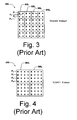
- FIGURES 1-5 illustrate five of the more common YUV formats: YUV444, YUV422, YUV420, YUV411, and YUV410, respectively.
- FIGURES 1-5 graphically illustrate arrays 100-500, respectively.
- the illustrated arrays are each eight by eight array of blocks. However, the arrays may be of any dimension and do not necessarily need to be square.
- Each block in the array (denoted by a dot) represents an array of pixels.
- each block represents one pixel (e.g., pixels P 1 -P 4 ). Therefore, hereinafter, the term pixel will be used interchangeably with the term block when referring to arrays 100-500.
- the pixels are grouped into macroblocks (e.g., macroblocks MB 1 -MB N ) based on the sampling that is desired for the target video format.
- FIGURES 1-3 illustrate each macroblock having four pixels (e.g., P 1 -P 4 ).
- FIGURES 4-5 illustrate each macroblock having sixteen pixels (e.g., P 1 -P 16 ).
- Each of the YUV formats will now be described in more detail.
- FIGURE 1 graphically illustrates the YUV444 format.
- each pixel is represented by a Y, U, and V value.
- the YUV444 format includes eight bits for the Y 1 value, eight bits for the U 1 value, and eight bits for the V 1 value.
- each pixel is represented by twenty-four bits. Because this format consumes twenty-four bits for each pixel, other YUV formats are down-sampled from the YUV444 format so that the number of bits per pixel is reduced. The reduction in bits per pixel provides improvement in streaming efficiency. However, down-sampling results in a corresponding degradation in video quality.
- FIGURE 2 graphically illustrates the YUV422 format.
- each pixel is represented by a Y value.
- the U and V values are optionally filtered and then down-sampled. The filtering and down-sampling may be performed simultaneously using known techniques.
- Array 200 conceptually illustrates the results from the down-sampling by illustrating every second horizontal pixel in the array 200 as sampled. The sampled pixels are denoted with an "X" in array 200.
- pixels P 1 and P 3 are each represented by twenty-four bits.
- pixels P 2 and P 4 are each represented by eight bits (Y value only).
- the average number of bits per pixel in the YUV422 format is sixteen bits ((24+24+8+8)/4).
- the YUV422 is a packed YUV color space, which means that the Y, U, and V samples are interleaved.
- standards that support the YUV422 format such as MPEG-2 and MPEG-4, code all the chrominance blocks together.
- the YUV422 format for MPEG-2 stores the YUV422 data in memory as Y1 U1 Y2 V1, where Y1 and Y2 represent the luminance value for pixels P 1 and P 2 , respectively.
- Y1 and Y2 represent two luminance blocks.
- U1 and V1 represent two chrominance blocks.
- FIGURE 3 graphically illustrates the YUV420 format.
- Array 300 conceptually illustrates the results from the optional filtering and down-sampling from the YUV444 format by illustrating every second horizontal and every second vertical pixel in the array 300 as sampled. Again, the sampled pixels are denoted with an "X" in array 300.
- pixel P 1 is represented by twenty-four bits.
- Pixels P 2 -P 4 is each represented by eight bits (Y value only).
- the average number of bits per pixel in the YUV420 format is twelve bits ((24+8+8+8)/4).
- the YUV420 is a planar format, not a packed format.
- the YUV420 data is stored in memory such that all of the Y data is stored first, then the U data, then all of the V data. Therefore, there are four luminance blocks, one U chrominance block and one V chrominance block.
- FIGURE 4 graphically illustrates the YUV411 format.
- Array 400 conceptually illustrates the results from the optional filtering and down-sampling from the YUV444 format by illustrating every fourth horizontal pixel in array 400 as sampled.
- pixels P 1 , P 5 , P 9 , and P 13 are each represented by twenty-four bits and the other twelve pixels are represented by eight bits.
- the average number of bits per pixel in the YUV411 format is twelve bits.
- FIGURE 5 graphically illustrates the YUV410 format.
- Array 500 conceptually illustrates the results from the optional filtering and down-sampling from the YUV444 format by illustrating every fourth horizontal pixel and every fourth vertical pixel in array 500 as sampled.
- pixel P 1 is represented by twenty-four bits and the other fifteen pixels are represented by eight bits.
- the average number of bits per pixel in the YUV410 format is 10 bits.
- an electronic device manufacturer may design their electronic devices to operate with any of these and other formats.
- the existing electronic devices will not support the higher quality video format.
- currently many digital televisions, set-top boxes, and other devices are designed to operate with the YUV420 video format.
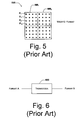
- FIGURE 6 is a block diagram illustrating the transcoding process.
- a transcoder 600 accepts an input format, such as Format A (e.g., YUV422), and outputs an output format, such as Format B (e.g., YUV420).
- Format A e.g., YUV422
- Format B e.g., YUV420
- the Y component must be decoded along with the UV components because the UV components are motion compensated and the resultant motion vectors can only be obtained by decoding the Y component.
- the luminance blocks and all the chrominance blocks are decoded to get a reconstructed version of the original video in the input format.
- chrominance components are down-sampled to convert the input format to the desired output format.
- the newly generated video is encoded again to generate a bit stream in the output format (Format B).
- This transcoding process is expensive because it is generally equivalent to an encoder plus a decoder. Fast transcoding methods exist, but generally result in quality loss.
- the transcoder 600 may exist at the client side, the server side, or at another location. If the transcoding process is performed at the client side, consumers that subscribe to the high quality video may access the high quality video while other consumers can access the lower quality video. If the transcoding process is performed at the server, none of the consumers can access the high quality video. Neither option is optimal because the transcoding process is very expensive and generally leads to quality degradation. Therefore, there is a need for a better solution for providing high quality video while maintaining operation with existing lower quality video devices.
- the present color space coding framework provides conversions between one or more video formats without the use of a transcoder.
- a video information stream that includes color information formatted in accordance with a first color space sampling format is split into a base stream and an enhanced stream.
- the base stream is formatted in accordance with a second color space sampling format.
- the enhanced stream includes enhanced information that when combined with the base stream re-constructs the first format.
- the enhanced stream may be encoded using spatial information related to the base information stream.
- An output stream of the encoded base stream and encoded enhanced stream may be interleaved, concatenated, or may include independent files for the encoded base stream and the encoded enhanced stream.
- the present color space coding framework provides a method for creating multiple streams of data from an input video encoded format.
- the multiple streams of data includes a base stream that corresponds to a second video encoded format and at least one enhanced stream that contains enhanced information obtained from the input video encoded format.
- multimedia systems may overcome the need to transcode the input video format into other video formats in order to support various electronic devices.
- an electronic device configured to operate using a lower quality format may easily discard periodic chrominance blocks and still have the resulting video displayed correctly.
- the following discussion uses the YUV422 and YUV420 video formats to describe the present coding framework.
- the present coding framework may operate with other video formats and with other multimedia formats that can be separated into blocks with information similar to the information contained within the chromo blocks for video formats.
- exemplary coding frameworks may include features of this specific embodiment and/or other features, which aim to eliminate the need for transcoding multimedia formats (e.g., video formats) and aim to provide multiple multimedia formats to electronic devices.
- a first section describes an exemplary computing device which incorporates aspects of the present coding framework.
- a second section describes individual elements within the coding framework.
- a third section describes the exemplary bit streams that are encoded and decoded in accordance with the present color space coding framework.
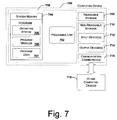
- FIGURE 7 illustrates an exemplary computing device that may utilize the present exemplary coding framework.
- An example of a computing device includes a set-top box that enables a television set to become a user interface to the Internet and enables the television set to receive and decode digital television (DTV) broadcasts.
- the exemplary computing device may be separate from the set-top box and provide input to the set-top box.
- Another example of a computing device includes a video recording device, such as a digital camcorder or digital camera.
- computing device 700 typically includes at least one processing unit 702 and system memory 704 .
- system memory 704 may be volatile (such as RAM), non-volatile (such as ROM, flash memory, etc.) or some combination of the two.
- System memory 704 typically includes an operating system 705 , one or more program modules 706 , and may include program data 707 .
- a Web browser may be included within the operating system 705 or be one of the program modules 706 . The Web browser allows the computing device to communicate via the Internet.
- Computing device 700 may have additional features or functionality.
- computing device 700 may also include additional data storage devices (removable and/or non-removable) such as, for example, magnetic disks, optical disks, or tape.
- additional storage is illustrated in FIGURE 7 by removable storage 709 and non-removable storage 710 .
- Computer storage media may include volatile and nonvolatile, removable and non-removable media implemented in any method or technology for storage of information, such as computer readable instructions, data structures, program modules, or other data.
- System memory 704 , removable storage 709 and non-removable storage 710 are all examples of computer storage media.
- Computer storage media includes, but is not limited to, RAM, ROM, EEPROM, flash memory or other memory technology, CD-ROM, digital versatile disks (DVD) or other optical storage, magnetic cassettes, magnetic tape, magnetic disk storage or other magnetic storage devices, or any other medium which can be used to store the desired information and which can be accessed by computing device 700 . Any such computer storage media may be part of device 700 .
- Computing device 700 may also have input device(s) 712 such as keyboard, mouse, pen, voice input device, touch input device, etc.
- Output device(s) 714 such as a display, speakers, printer, etc. may also be included. These devices are well know in the art and need not be discussed at length here.
- Computing device 700 may also have one or more devices (e.g., chips) for video and audio decoding and for processing performed in accordance with the present coding framework.
- Computing device 700 may also contain communication connections 716 that allow the device to communicate with other computing devices 718 , such as over a network.
- Communication connections 716 are one example of communication media.
- Communication media may typically be embodied by computer readable instructions, data structures, program modules, or other data in a modulated data signal, such as a carrier wave or other transport mechanism, and includes any information delivery media.
- modulated data signal means a signal that has one or more of its characteristics set or changed in such a manner as to encode information in the signal.
- communication media includes wired media such as a wired network or direct-wired connection, and wireless media such as acoustic, RF, infrared and other wireless media.
- communication media includes telephone lines and cable.
- computer readable media as used herein includes both storage media and communication media.
- FIGURE 8 is a block diagram of a chroma separator 800 for separating a first video encoded format (e.g., Format A) into multiple streams (e.g., base format B stream and enhanced format B stream).
- a first video encoded format e.g., Format A
- multiple streams e.g., base format B stream and enhanced format B stream.
- the process for separating the base stream from format A is now described.
- the chroma separator 800 may include an optional low pass filter 804.
- the low pass filter may be any of the various commercial low pass filters.
- the low pass filter proposed to the Moving Picture Experts Group (MPEG) for MPEG-4 may be used.
- MPEG Moving Picture Experts Group
- the chroma separator 800 may keep the YUV values without processing the YUV values through low pass filter 804.
- the process for separating the base stream from format A also includes a down-sampler 808.
- Down-sampler 808 is configured to keep the chrominance blocks for each line and row specified for the desired output format.
- the conversion of format A into base format B is known to those skilled in the art and is commonly performed today.
- the outcome of down-sampler 808 is the base format B stream (e.g., YUV420).
- filter 804 and the down-sampler 808 may also be combined into a convolution operation.
- convolution includes a combination of multiplication, summarization, and shifting.
- mirror extension may be applied.
- ⁇ -2 ⁇ 2
- ⁇ -1 ⁇ 1
- ⁇ 2n ⁇ 2n-2
- ⁇ 2n+1 ⁇ 2n-3
- n is the vertical dimension of the UV signal and ⁇ k corresponds to the pixel value at position k in format A chrominance blocks.
- L k and H k represent pixel values at position k of the resulting base format B and enhanced format B streams.
- the chroma separator 800 may include an optional high pass filter 806.
- the chroma separator 800 may keep the YUV values from the first video encoded format without applying filter 806.
- the process for separating the enhanced stream from format A includes a down-sampler 810.
- down-sampler 810 is configured to keep all the lines which down-sampler 808 did not keep. For example, when converting YUV424 to YUV420, down-sampler 810 may keep all the even lines of the output of the high pass filter.
- the filter 806 and the down sampler 810 may be combined into a convolution operation similar to the convolution operation described above with equations 1-4 and the corresponding text.
- a wavelet transform i.e., decomposition and down sampling
- base format B i.e., base format B
- enhanced format B i.e., base format B
- a modified 9/7 Daubechies wavelet transform may be applied. Additional information describing the 9/7 wavelet may be obtained from the JPEG-2000 reference.
- the standard 9/7 Daubechies wavelet transform i.e., filtering plus down-sampling converts Format A to Format B and Enhanced Format B.
- the low pass analysis filter coefficients and high pass analysis filter coefficients are:
- an integer lifting scheme is used to achieve 9/7 wavelet transform.
- the integer lifting scheme takes every intermediate result during the process and converts the results to an integer either by rounding, ceiling, flooring, or clipping.
- An exemplary integer lifting structure 1500 is illustrated in FIGURE 15. Processing is performed from left to right.
- dots x 0 ⁇ x 9 represent the original pixels of Format A.
- Dots l 0 ⁇ l 4 represent pixels in Format B.
- Dots h 0 ⁇ h 4 represent pixels in Enhanced Format B.
- a curved arrow represents a mirror extension.
- a directional branch with a symbol represents the application of a multiplication operation with a first multiplier being a coefficient associated with the applicable symbol and a second multiplier being the value of the node it leaves.
- a horizontal branch represents the application of a carry operation for the value of one node to the next stage without scaling. Branches merging at one node means all the values carried in these branches are summed together to generate the value of the merging node. A modification to the value k may be applied to ensure that the resulting coefficients of Format B are in the range of [0, 255].
- FIGURE 10 illustrates array 200 that has been sampled in accordance with a first video encoded format (e.g., video encoded format YUV422) as illustrated in FIGURE 2.
- Each macroblock e.g., macroblock MB 1
- Each macroblock includes four luminance blocks and two chrominance blocks: one for U and one for V
- the memory layout for one macroblock in format YUV422 entails four luminance blocks and four chrominance blocks: Y1 Y2 Y3 Y4 U1 V1 U2 V2.
- this YUV422 format needs to be utilized by a electronic device that accepts YUV420 format (illustrated in FIGURE 3), in the past, the YUV422 format was input into a transcoder that decoded each chromo block, manipulated the chromo blocks, and then encoded the chromo blocks again.
- the YUV422 is encoded in a new manner, graphically depicted in array 10000 as format B, which includes base B and enhanced B.
- the present color space coding framework rearranges the chrominance blocks such that the output has essentially two or more streams.
- the first stream includes the chrominance blocks for a base format, such as YUV420, generated within the chromo separator 800 via the optional low pass filter 804 and the down-sampler 806.
- the second stream includes the extra chrominance blocks from the input format, but which are not used by the base format.
- the first stream comprises a full set of chrominance blocks associated with the base format to ensure that the base format is fully self-contained.
- the second stream is generated within the chromo separator 800 via the optional high pass filter 806 and the down-sampler 810.
- the second stream represents an enhanced stream, which, together with the first stream, reconstructs the input stream (format A).
- the creation of the base stream and the enhanced stream may occur by shuffling the chrominance blocks (pixels), which manipulate the layout of the chrominance components.
- FIGURE 9 is a block diagram of a chroma compositor for merging the base format B stream and the enhanced format B stream into the first video encoded format (e.g., format A).
- the chroma compositor 900 includes an up-sampler 904 and an optional synthesis filter 908 for processing the base format B stream that is input into the chroma compositor 900.
- chroma compositor 900 includes an up-sampler 906 and an optional synthesis filter 910 for processing the enhanced format B stream that is input into the chroma compositor 900.
- the chroma compositor 900 also includes a merger 912 that merges the output after up-sampling and filtering into the desired first video encoded format.
- merger 912 sums up the output of two synthesis filters to reconstructs the YUV424 video stream.
- Up-sampler 904 pads the incoming stream as needed.
- Up-sampler 906 also pads its incoming stream as need.
- Up-sampler 904 and 906 performs exactly the reverse operation of the down-sampler 806 and 810 respectively. For those lines discarded in 806 and 810, 904 and 906 will fill zero. After the up-sampler, the signal is restored to the original resolution.
- mirror extension may be applied.
- n is the vertical dimension of the UV signal and ⁇ k corresponds to the pixel value at position k of Format A chrominance.
- L k and H k represent pixel values at position k of the resulting base format B and enhanced format B streams.
- an inverse 9/7 wavelet transform (i.e., up-sampling and filtering) is performed to reconstruct Format A video from the base Format B and the Enhanced Format B.
- the low pass synthesis filter coefficients and high pass synthesis filter coefficients are as follows:
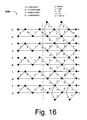
- FIGURE 16 illustrates the corresponding integer lifting structure 1600 associated with the inverse modified 9/7 Daubechies wavelet transform.
- the symbols as defined for FIGURE 15 describe integer lifting structure 1600.
- the encoder 1100 and decoder 1200 may be implemented using various wavelet transforms.
- a modified 5/3 Daubechies wavelet transform may be used.
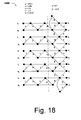
- FIGURES 17-18 illustrate the integer lifting structures 1700 and 1800 associated with the modified 5/3 Daubechies wavelet transform and the inverse modified 5/3 Daubechies wavelet transform, respectively. Again, the symbols as defined for FIGURE 15 describe integer lifting structures 1700 and 1800.
- the low pass synthesis filter coefficients and high pass synthesis filter coefficients are:
- FIGURES 19-20 illustrate the integer lifting structures 1900 and 2000 associated with the 7/5 wavelet transform and the inverse 7/5 wavelet transform, respectively. Again, the symbols as defmed for FIGURE 15 describe integer lifting structures 1900 and 2000.
- the low pass synthesis filter coefficients and high pass synthesis filter coefficients are as follows:
- FIGURE 11 is a block diagram of an encoder 1100 which operates in accordance with the present color space coding framework.
- the encoder 1100 includes a base format encoder (represented generally within box 1120), an enhanced format encoder (represented generally within box 1140), and an output bit stream formulator 1160.
- encoder 1100 may include a chroma separator 800 as shown in FIGURE 8 and described above.
- the encoder 1100 is a computing device, such as shown in FIGURE 7, which implements the functionality of the base format encoder, the enhanced format encoder, the bit stream formulator, and the optional chroma separator 800 in hardware, software or in any combination of hardware/software in a manner that produces the desired bit streams that are input into an associated decoder shown in FIGURE 12 and described below.
- encoder 1100 processes two streams, the base stream and the enhanced stream, in accordance with the present color space coding framework.
- One advantage of encoder 1100 is the ability to provide an additional prediction coding mode, spatial prediction (SP), along with the Intra and Inter prediction coding modes.
- SP spatial prediction
- encoder 1100 provides the spatial prediction for the enhanced chrominance blocks using the base chrominance blocks from the same frame. Due to the high correlation between the enhanced chrominance blocks and the base chrominance blocks, the spatial prediction (SP) can provide a very efficient prediction mode.
- encoder 1100 accepts the output streams generated from the chroma separator 800.
- chroma separator 800 is included within encoder 1100.
- chroma separator 800 accepts input encoded in a first encoded format 1106, referred to as format A.
- the generation of the first encoded format 1106 is performed in a conventional manner known to those skilled in the art of video encoding. In certain situations, the generation of the first encoded format is accomplished by converting a format from another color space, such as the RGB color space. When this occurs, a color space converter (CSC) 1104 is used.
- the color space converter 1104 accepts an input 1102 (e.g., RGB input) associated with the other color space.
- the color space converter 1104 then converts the input 1102 into the desired first encoded format 1106.
- the color space converter 1104 may use any conventional mechanism for converting from one color space to another color space. For example, when the conversion is between the RGB color space and the YUV color space, the color space converter 1104 may apply known transforms that are often represented as a set of three equations or by a matrix.
- the transform is also reversible, such that given a set of YUV values, a set of RGB values may be obtained.
- the processing performed by the chroma separator 800 may be combined with the processing performed in the color space converter 1104.
- the chroma separator 800 and color space conversion 1804 may be included as elements with encoder 1100.
- encoder 1100 may accept the outputs generated by the chroma separator 800.
- the chroma separator 800 is configured to output a base format stream 1108 and at least one enhanced format stream 1110.
- the base format stream 1108 is processed through the base encoder 1120 and the enhanced format stream is processed through the enhanced encoder 1140.
- Base encoder 1120 is any conventional encoder for the base format stream 1108. In general, base encoder 1120 attempts to minimize the amount of data that is output as the base bit stream (B-BS), which will typically be transmitted through some media so that the encoded video may be played.
- the conventional base encoder 1120 includes conventional elements, such as a discrete cosine transform (DCT) 1122, a quantization (Q) process 1124, a variable length coding (VLC) process 1126, an inverse quantization (Q -1 ) process 1128, an inverse DCT (IDCT) 1130, a frame buffer 1132, a motion compensated prediction (MCP) process 1134, and a motion estimation (ME) process 1136. While the elements of the base encoder 1120 are well known, the elements will be briefly described to aid in the understanding of the present color space coding framework.
- a frame refers to the lines that make up an image.
- An Intraframe (I-frame) refers to a frame that is encoded using only information from within one frame.
- An Interframe also referred to as a Predicted frame (P-frame) refers to a frame that uses information from more than one frame.
- Base encoder 1120 accepts a frame of the base format 1108.
- the frame will be encoded using only information from itself. Therefore, the frame is referred to as an I-frame.
- the I-frame proceeds through the discrete cosine transform 1122 that converts the I-frame into DCT coefficients.
- These DCT coefficients are input into a quantization process 1124 to form quantized DCT coefficients.
- the quantized DCT coefficients are then input into a variable length coder (VLC) 1126 to generate a portion of the base bit stream (B-BS).
- VLC variable length coder
- the quantized DCT coefficients are also input into an inverse quantization process 1128 and an inverse DCT 1130.
- the result is stored in frame buffer 1132 to serve as a reference for P-frames.
- the base encoder 1120 processes P-frames by applying the motion estimation (ME) process 1134 to the results stored in the frame buffer 1132.
- the motion estimation process 1134 is configured to locate a temporal prediction (TP), which is referred to as the motion compensated prediction (MCP) 1134.
- TP temporal prediction
- MCP motion compensated prediction
- the MCP 1134 is compared to the I-frame and the difference (i.e., the residual) proceeds through the same process as the I-frame.
- the motion compensated prediction (MCP) 1134 in the form of a motion vector (MV) is input into the variable length coder (VLC) 1126 and generates another portion of the base bit stream (B-BS). Finally, the inverse quantized difference data is added to the MCP 1134 to form the reconstructed frame.
- VLC variable length coder
- the frame buffer is updated with the reconstructed frame, which serves as the reference for the next P-frame. It is important to note that the resulting base bit stream (B-BS) is fully syntactically compatible with conventional decoders available in existing devices today that decode base stream B format.
- Enhanced encoder 1140 attempts to minimize the amount of data that is output as the enhanced bit stream (E-BS). This enhanced bit stream is typically transmitted through some media, and optionally decoded, in order to play the higher quality encoded video. While having an enhanced encoder 1140 within encoder 1100 has not previously been envisioned, enhanced encoder 1140 includes several conventional elements that operate in the same manner as described above for the base encoder.
- the conventional elements include as a discrete cosine transform (DCT) 1142, a quantization (Q) process 1144, a variable length coding (VLC) process 1146, an inverse quantization (Q -1 ) process 1148, an inverse DCT (IDCT) 1150, a frame buffer 1152, and a motion compensated prediction (MCP) process 1154.
- DCT discrete cosine transform
- Q quantization
- VLC variable length coding
- IDP inverse quantization
- MCP motion compensated prediction
- MVs motion vectors
- enhanced encoder 1140 includes a mode selection switch 1158 that selectively predicts a P-frame.
- Switch 1158 may select to predict the P-frame from a previous reference generated from the enhanced stream stored in frame buffer 1152 or may select to "spatially" predict (SP) the P-frame using a reference from the base stream that is stored in the frame buffer 1132 for the current frame. Spatial prediction provides a very efficient prediction method due to the high correlation between enhanced chrominance blocks in the enhanced stream and chrominance blocks in the base stream. Thus, the present color space coding framework provides greater efficiency in prediction coding and results in a performance boost in comparison to traditional encoding mechanisms.
- the output of enhanced encoder 1140 is the enhanced bit stream (E-BS).
- the base encoder 1120 and the enhanced encoder 1140 may share one or more of the same conventional elements.
- one DCT may be used by both the base encoder 1120 and by the enhanced encoder 1140.
- developing an encoder 1100 in accordance with the present color space coding framework requires minimal extra effort in either hardware, software, or any combination to accommodate the enhanced stream.
- other advanced encoding techniques developed for the base encoder 1220 can be easily applied to the present color space coding framework.
- the present color space coding framework operates when there are bi-directionally predicted frames (B-frames).
- the output bit stream formulator 1160 combines the enhanced bit stream (E-BS) with the base bit stream (B-BS) to form a final output bit stream. Exemplary formats for the final output bit stream are illustrated in FIGURES 13 and 14 and are described in conjunction with those figures.
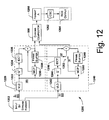
- FIGURE 12 is a block diagram of a decoder which incorporates the present color space coding framework.
- the decoder 1200 may perform a simple bit stream truncation to obtain the lower quality video format. Thus, the expensive transcoding process is not necessary.
- decoder 1200 reverses the process performed by encoder 1100.
- Decoder 1200 accepts the base bit stream (B-BS) and the enhanced bit stream (E-BS).
- B-BS base bit stream
- E-BS enhanced bit stream
- the base bit stream and the enhanced bit stream may have been parsed with an input bit stream parser 1202 included within the decoder or external to the decoder.
- the decoder 1200 includes a base format decoder (represented generally within box 1220) and an enhanced format decoder (represented generally within box 1240).
- the base decoder 1220 processes the base bit stream and the enhanced decoder 1240 processes the enhanced bit stream.
- decoder 1200 may include a chroma compositor 900 as shown in FIGURE 9 and described above.
- the decoder 1200 is a computing device, such as shown in FIGURE 7, which implements the functionality of the base format decoder, the enhanced format decoder, and the optional chroma compositor 900 in hardware, software or in any combination of hardware/software in a manner that produces the desired format A 1260.
- decoder 1200 inputs two streams, the base bit stream (B-BS) and the enhanced bit stream (E-BS) generated in accordance with the present color space coding framework.
- the decoder 1200 has the ability to decode the prediction coding mode, spatial prediction (SP), provided by the encoder 1100.
- SP spatial prediction
- decoder 1200 includes the chroma compositor 900.
- the chroma compositor 900 is a separate device from the decoder 1200.
- chroma compositor 900 accepts the two streams containing the values for the luminance blocks and chrominance blocks for a base format and the values for the chrominance blocks for the enhanced format and merges them into format A 1260 as explained in conjunction with FIGURE 9.
- format A 1260 is converted into a format of another color space, such as the RGB color space.
- a color space converter (CSC) 1262 is used.
- CSC color space converter
- the color space converter 1262 accepts format A 1260 as an input and converts input 1260 into output 1264 (e.g., RGB output), which is associated with the other color space.
- the color space converter 1262 may use any conventional mechanism for converting from one color space to another color space. For example, when the conversion is between the RGB color space and the YUV color space, the color space converter 1262 may apply known transforms as described above.
- the processing performed by the chroma compositor 900 may be combined with the processing performed in the color space converter 1262.
- the chroma compositor 900 and color space conversion 1262 may be included as elements within decoder 1200. Alternatively, decoder 1200 may supply inputs to an external the chroma compositor 900.
- Base decoder 1220 is any conventional encoder for the base bit stream (B-BS). In general, base decoder 1220 reconstructs the YUV values that were encoded by the base encoder 1120.
- the conventional base decoder 1220 includes conventional elements, such as a variable length decoding (VLD) process 1222, an inverse quantization (Q -1 ) process 1224, an inverse discrete cosine transform (IDCT) 1226, a frame buffer 1228, and a motion compensated prediction (MCP) process 1230.
- VLD variable length decoding
- Q -1 inverse quantization
- IDCT inverse discrete cosine transform
- MCP motion compensated prediction
- the base decoder 1220 inputs the base bit stream into the variable length decoder (VLD) 1222 to retrieve the motion vectors (MV) and the quantized DCT coefficients.
- the quantized DCT coefficient are input into the inverse quantization process 1224 and the inverse DCT 1226 to form the difference data.
- the difference data is added to its motion compensated prediction 1230 to form the reconstructed base stream that is input into the chromo compositor 900.
- the result is also stored in the frame buffer 1228 to server as a reference for decoding P-frames.
- Enhanced decoder 1240 reconstructs the UV values that were encoded by the enhanced encoder 1140. While having an enhanced decoder 1240 within decoder 1200 has not been previously envisioned, enhanced decoder 1240 includes several conventional elements that operate in the same manner as described above for the base decoder 1220.
- the enhanced decoder 1240 includes conventional elements, such as a variable length decoding (VLD) process 1242, an inverse quantization (Q -1 ) process 1244, an inverse discrete cosine transform (DCT) 1246, a frame buffer 1248, and a motion compensated prediction (MCP) process 1250.
- VLD variable length decoding
- Q -1 inverse quantization
- DCT inverse discrete cosine transform
- MCP motion compensated prediction
- the flow of the enhanced bit stream through the enhanced decoder 1240 is identical to the base decoder 1220, except that the difference data may be selectively added to its motion compensated prediction (MCP) or added to its spatial prediction (SP), as determined by the mode information switch 1252.
- MCP motion compensated prediction
- SP spatial prediction
- the outcome of the enhanced decoder 1240 is the reconstructed enhanced stream that contains the values for the "extra" chrominance blocks for the current frame.
- the base stream and the enhanced stream are then input into the chroma compositor, which processes the streams as described above to reconstruct format A.
- the conventional elements in the base decoder 1220 and the enhanced decoder 1240 are illustrated separately, in one embodiment, the base decoder 1220 and the enhanced decoder 1240 may share one or more of the same conventional elements.
- one inverse DCT may be used by both the base decoder 1420 and by the enhanced decoder 1240.
- developing a decoder in accordance with the present color space coding framework requires minimal extra effort in either hardware, software, or any combination to accommodate the enhanced stream.
- other advanced decoding techniques developed for the base decoder 1420 can be easily applied to the present color space coding framework.
- the present color space coding framework operates when there are bi-directionally predicted frames (B-frames).
- the conversion between two formats may be achieved via bit truncation, rather than the expensive transcoding process.
- FIGURE 11 may organize the resulting base bit stream (B-BS) and the enhanced bit stream (E-BS) in numerous ways.
- FIGURES 13 and 14 illustrate two exemplary bit streams.
- the exemplary bit streams illustrate the organization of the base bit stream, in relation to the enhanced bit stream, and omit other information that is commonly included in transport stream packets, such as packet identifiers, sequence numbers, and the like.
- exemplary bit streams may include an indicator that indicates that the bit stream supports format A and base format B.
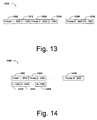
- FIGURE 13 is a graphical representation of an exemplary bit stream 1300 for transmitting the multiple bit streams shown in FIGURES 11 and 12.
- bit stream 1300 embeds the enhanced bit stream (E-BS) within the base bit stream (B-BS).
- bit stream 1300 includes B-BS information 1302, 1304, and 1306, which alternates with E-BS information 1312, 1314, and 1316.
- the base bit stream corresponds to YUV420 format and the enhanced bit stream includes chrominance blocks for YUV422 format
- bit stream 1300 allows a YUV422 decoder to sequentially decode all the frames.
- a YUV420 decoder that decodes bit stream 1300 must skip the E-BS frames.
- Bit stream 1300 is suitable for streaming/broadcasting applications.
- FIGURE 14 is a graphical representation of another exemplary bit stream 1400 for transmitting the multiple bit streams shown in FIGURES 11 and 12.
- bit stream 1400 concatenates the enhanced bit stream to the end of the base bit stream.
- bit stream 1400 includes consecutive frames of base bit stream (e.g., frames 1402, 1404, 1406) followed by consecutive frames of enhanced bit stream (e.g., frames 1412, 1414, 1416).
- base bit stream corresponds to the YUV420 format and the enhanced bit stream includes chrominance blocks for the YUV422 format
- bit stream 1400 allows a YUV420 decoder to sequentially decode all the frames without encountering the enhanced bit stream.
- the YUV420 can terminate the decoding process after all the base bit frames (e.g., 1402, 1404, and 1406) are decoded. However, a YUV422 decoder must seek and decode the base bit stream and the enhanced bit stream before proceeding to the next frame. The YUV422 decoder may utilize two pointers to sequentially access the base bit stream and the enhanced bit stream. Bit stream 1400 is suitable for down-and-play applications.
- Bit stream 1400 may also be separated into different individual files.
- the base bit stream represents a standalone stream and would be fully decodable by a YUV420 decoder and would not require any modifications to existing YUV420 decoders.
- a YUV422 decoder would process the two bit stream files simultaneously.
- Bit stream 1400 may be advantageously implemented within video recording devices, such as digital video camcorders. Bit stream 1400 would allow recording both a high quality and low quality stream. If a consumer realizes that additional recording is desirable but the current media has been consumed, an option on the digital video camcorder may allow the consumer to conveniently delete the high quality stream and keep the low quality stream so that additional recording may resume.
Landscapes
- Engineering & Computer Science (AREA)
- Multimedia (AREA)
- Signal Processing (AREA)
- Compression Or Coding Systems Of Tv Signals (AREA)
- Color Television Systems (AREA)
Applications Claiming Priority (2)
| Application Number | Priority Date | Filing Date | Title |
|---|---|---|---|
| US10/733,876 US20050129130A1 (en) | 2003-12-10 | 2003-12-10 | Color space coding framework |
| US733876 | 2003-12-10 |
Publications (2)
| Publication Number | Publication Date |
|---|---|
| EP1542476A2 true EP1542476A2 (de) | 2005-06-15 |
| EP1542476A3 EP1542476A3 (de) | 2008-02-20 |
Family
ID=34523073
Family Applications (1)
| Application Number | Title | Priority Date | Filing Date |
|---|---|---|---|
| EP04026085A Withdrawn EP1542476A3 (de) | 2003-12-10 | 2004-11-03 | Farbraumkodierungsumgebung |
Country Status (10)
| Country | Link |
|---|---|
| US (1) | US20050129130A1 (de) |
| EP (1) | EP1542476A3 (de) |
| JP (1) | JP2005176383A (de) |
| KR (1) | KR20050056857A (de) |
| CN (1) | CN1627830A (de) |
| AU (1) | AU2004229092A1 (de) |
| BR (1) | BRPI0404879A (de) |
| CA (1) | CA2486612A1 (de) |
| MX (1) | MXPA04011273A (de) |
| RU (1) | RU2004132772A (de) |
Cited By (12)
| Publication number | Priority date | Publication date | Assignee | Title |
|---|---|---|---|---|
| EP1950975A4 (de) * | 2005-10-11 | 2008-12-17 | Huawei Tech Co Ltd | Upsampling-verfahren und -system für räumlich geschichtete codierung von videobildern |
| EP2165530A4 (de) * | 2007-06-27 | 2011-12-21 | Samsung Electronics Co Ltd | Verfahren, medium und vorrichtung zum codieren und/oder decodieren von videodaten |
| EP2201770A4 (de) * | 2007-10-24 | 2011-12-21 | Samsung Electronics Co Ltd | Verfahren, medium und vorrichtung zum codieren und/oder decodieren von video |
| CN102724472A (zh) * | 2012-06-20 | 2012-10-10 | 杭州海康威视数字技术股份有限公司 | 用于图像处理的图像数据格式转换方法及其系统 |
| WO2014055310A1 (en) * | 2012-10-01 | 2014-04-10 | Microsoft Corporation | Frame packing and unpacking higher-resolution chroma sampling formats |
| WO2014109998A1 (en) * | 2013-01-08 | 2014-07-17 | Microsoft Corporation | Method for converting the format of a frame into a chroma subsampling format |
| EP2910023A1 (de) * | 2012-10-22 | 2015-08-26 | Microsoft Technology Licensing, LLC | Bandtrennungsfilterung / inverse filterung zur frame-komprimierung / dekomprimierung eines chromaabtastformats mit höherer auflösung |
| EP2919471A4 (de) * | 2012-11-12 | 2016-07-13 | Lg Electronics Inc | Vorrichtung zum senden/empfangen von signalen und verfahren zum enden/empfangen von signalen |
| US9749646B2 (en) | 2015-01-16 | 2017-08-29 | Microsoft Technology Licensing, Llc | Encoding/decoding of high chroma resolution details |
| US9807431B2 (en) | 2006-10-20 | 2017-10-31 | Nokia Technologies Oy | Generic indication of adaptation paths for scalable multimedia |
| US9854201B2 (en) | 2015-01-16 | 2017-12-26 | Microsoft Technology Licensing, Llc | Dynamically updating quality to higher chroma sampling rate |
| US10368080B2 (en) | 2016-10-21 | 2019-07-30 | Microsoft Technology Licensing, Llc | Selective upsampling or refresh of chroma sample values |
Families Citing this family (21)
| Publication number | Priority date | Publication date | Assignee | Title |
|---|---|---|---|---|
| EP1743298B1 (de) * | 2004-04-27 | 2013-04-17 | Callahan Cellular L.L.C. | Verfahren zum unterabtasten von datenwerten |
| JP4277793B2 (ja) * | 2004-12-17 | 2009-06-10 | ソニー株式会社 | 画像処理装置、符号化装置およびそれらの方法 |
| JP4215014B2 (ja) * | 2005-03-17 | 2009-01-28 | ソニー株式会社 | 画像処理装置および画像処理プログラム |
| KR101237608B1 (ko) * | 2005-08-26 | 2013-02-26 | 파나소닉 주식회사 | 다중화 방법 및 기록 매체 |
| WO2007084418A2 (en) * | 2006-01-13 | 2007-07-26 | Surmodics, Inc. | Microparticle containing matrices for drug delivery |
| JP5101522B2 (ja) * | 2006-01-13 | 2012-12-19 | フラウンホッファー−ゲゼルシャフト ツァ フェルダールング デァ アンゲヴァンテン フォアシュンク エー.ファオ | 適応色空間変換を用いた画像符号化 |
| EP1859630B1 (de) * | 2006-03-22 | 2014-10-22 | Fraunhofer-Gesellschaft zur Förderung der angewandten Forschung e.V. | Präzisionsskalierbarkeit ermöglichendes codierungsschema |
| US8401071B2 (en) * | 2007-12-19 | 2013-03-19 | Sony Corporation | Virtually lossless video data compression |
| PT2656507T (pt) | 2010-12-21 | 2017-06-15 | Ntt Docomo Inc | Codificação com intra-predição melhorada utilizando representações planares |
| US8891894B2 (en) * | 2011-09-30 | 2014-11-18 | Apple Inc. | Psychovisual image compression |
| WO2013132902A1 (ja) * | 2012-03-06 | 2013-09-12 | インターナショナル・ビジネス・マシーンズ・コーポレーション | 画像信号処理方法および装置 |
| JP5873395B2 (ja) * | 2012-06-14 | 2016-03-01 | Kddi株式会社 | 動画像符号化装置、動画像復号装置、動画像符号化方法、動画像復号方法、およびプログラム |
| US20140267919A1 (en) * | 2013-03-15 | 2014-09-18 | Quanta Computer, Inc. | Modifying a digital video signal to mask biological information |
| US9609336B2 (en) * | 2013-04-16 | 2017-03-28 | Fastvdo Llc | Adaptive coding, transmission and efficient display of multimedia (acted) |
| US20150124873A1 (en) * | 2013-11-01 | 2015-05-07 | Microsoft Corporation | Chroma Down-Conversion and Up-Conversion Processing |
| JP2017060004A (ja) * | 2015-09-16 | 2017-03-23 | 株式会社東芝 | エンコード装置、デコード装置、エンコードプログラム、デコードプログラム及びストリーミングシステム |
| WO2017211306A1 (zh) * | 2016-06-08 | 2017-12-14 | 同济大学 | 视频数据压缩码流的解码、视频数据的编码方法及装置 |
| US10861405B2 (en) * | 2018-07-09 | 2020-12-08 | Samsung Display Co., Ltd. | Color transform for RGBG subpixel format |
| CN112995664B (zh) * | 2021-04-20 | 2021-08-13 | 南京美乐威电子科技有限公司 | 图像采样格式转换方法、计算机可读存储介质和编码器 |
| CN117528098B (zh) * | 2024-01-08 | 2024-03-26 | 北京小鸟科技股份有限公司 | 基于深压缩码流提升画质的编解码系统、方法及设备 |
| CN119562065A (zh) * | 2025-01-21 | 2025-03-04 | 邦彦技术股份有限公司 | 一种基于分层编码的图像传输方法、装置及存储介质 |
Family Cites Families (15)
| Publication number | Priority date | Publication date | Assignee | Title |
|---|---|---|---|---|
| KR0134871B1 (ko) * | 1992-07-17 | 1998-04-22 | 사또오 후미오 | 고능률 부호화 복호화 시스템 |
| JP3381855B2 (ja) * | 1992-12-28 | 2003-03-04 | ソニー株式会社 | 画像信号符号化方法および画像信号符号化装置、並びに画像信号復号化方法および画像信号復号化装置 |
| US6571016B1 (en) * | 1997-05-05 | 2003-05-27 | Microsoft Corporation | Intra compression of pixel blocks using predicted mean |
| US6233017B1 (en) * | 1996-09-16 | 2001-05-15 | Microsoft Corporation | Multimedia compression system with adaptive block sizes |
| US6639945B2 (en) * | 1997-03-14 | 2003-10-28 | Microsoft Corporation | Method and apparatus for implementing motion detection in video compression |
| US6728775B1 (en) * | 1997-03-17 | 2004-04-27 | Microsoft Corporation | Multiple multicasting of multimedia streams |
| US6091777A (en) * | 1997-09-18 | 2000-07-18 | Cubic Video Technologies, Inc. | Continuously adaptive digital video compression system and method for a web streamer |
| JPH11127138A (ja) * | 1997-10-24 | 1999-05-11 | Sony Corp | 誤り訂正符号化方法及びその装置並びにデータ伝送方法 |
| US6829301B1 (en) * | 1998-01-16 | 2004-12-07 | Sarnoff Corporation | Enhanced MPEG information distribution apparatus and method |
| US6340994B1 (en) * | 1998-08-12 | 2002-01-22 | Pixonics, Llc | System and method for using temporal gamma and reverse super-resolution to process images for use in digital display systems |
| US6954214B2 (en) * | 2000-10-30 | 2005-10-11 | Microsoft Corporation | Efficient perceptual/physical color space conversion |
| JP3762655B2 (ja) * | 2001-04-06 | 2006-04-05 | インターナショナル・ビジネス・マシーンズ・コーポレーション | 情報埋め込み装置、検出装置、データ処理方法、プログラム及び記憶媒体 |
| US6803922B2 (en) * | 2002-02-14 | 2004-10-12 | International Business Machines Corporation | Pixel formatter for two-dimensional graphics engine of set-top box system |
| US7116831B2 (en) * | 2002-04-10 | 2006-10-03 | Microsoft Corporation | Chrominance motion vector rounding |
| US7136417B2 (en) * | 2002-07-15 | 2006-11-14 | Scientific-Atlanta, Inc. | Chroma conversion optimization |
-
2003
- 2003-12-10 US US10/733,876 patent/US20050129130A1/en not_active Abandoned
-
2004
- 2004-11-03 EP EP04026085A patent/EP1542476A3/de not_active Withdrawn
- 2004-11-03 CA CA002486612A patent/CA2486612A1/en not_active Abandoned
- 2004-11-09 BR BR0404879-2A patent/BRPI0404879A/pt not_active IP Right Cessation
- 2004-11-10 RU RU2004132772/09A patent/RU2004132772A/ru not_active Application Discontinuation
- 2004-11-10 KR KR1020040091333A patent/KR20050056857A/ko not_active Withdrawn
- 2004-11-12 MX MXPA04011273A patent/MXPA04011273A/es active IP Right Grant
- 2004-11-15 AU AU2004229092A patent/AU2004229092A1/en not_active Abandoned
- 2004-11-29 CN CNA2004100974965A patent/CN1627830A/zh active Pending
- 2004-12-10 JP JP2004358958A patent/JP2005176383A/ja active Pending
Cited By (22)
| Publication number | Priority date | Publication date | Assignee | Title |
|---|---|---|---|---|
| EP1950975A4 (de) * | 2005-10-11 | 2008-12-17 | Huawei Tech Co Ltd | Upsampling-verfahren und -system für räumlich geschichtete codierung von videobildern |
| US8718130B2 (en) | 2005-10-11 | 2014-05-06 | Huawei Technologies Co., Ltd. | Method and system for upsampling a spatial layered coded video image |
| US9807431B2 (en) | 2006-10-20 | 2017-10-31 | Nokia Technologies Oy | Generic indication of adaptation paths for scalable multimedia |
| EP2165530A4 (de) * | 2007-06-27 | 2011-12-21 | Samsung Electronics Co Ltd | Verfahren, medium und vorrichtung zum codieren und/oder decodieren von videodaten |
| EP2201770A4 (de) * | 2007-10-24 | 2011-12-21 | Samsung Electronics Co Ltd | Verfahren, medium und vorrichtung zum codieren und/oder decodieren von video |
| KR101365597B1 (ko) * | 2007-10-24 | 2014-02-20 | 삼성전자주식회사 | 영상 부호화장치 및 방법과 그 영상 복호화장치 및 방법 |
| US8743955B2 (en) | 2007-10-24 | 2014-06-03 | Samsung Electronics Co., Ltd. | Method, medium, and apparatus for encoding and/or decoding video by generating scalable bitstream with adaptive bit-depth and video format |
| CN102724472A (zh) * | 2012-06-20 | 2012-10-10 | 杭州海康威视数字技术股份有限公司 | 用于图像处理的图像数据格式转换方法及其系统 |
| WO2014055310A1 (en) * | 2012-10-01 | 2014-04-10 | Microsoft Corporation | Frame packing and unpacking higher-resolution chroma sampling formats |
| US9979960B2 (en) | 2012-10-01 | 2018-05-22 | Microsoft Technology Licensing, Llc | Frame packing and unpacking between frames of chroma sampling formats with different chroma resolutions |
| EP2910023A1 (de) * | 2012-10-22 | 2015-08-26 | Microsoft Technology Licensing, LLC | Bandtrennungsfilterung / inverse filterung zur frame-komprimierung / dekomprimierung eines chromaabtastformats mit höherer auflösung |
| US9661340B2 (en) | 2012-10-22 | 2017-05-23 | Microsoft Technology Licensing, Llc | Band separation filtering / inverse filtering for frame packing / unpacking higher resolution chroma sampling formats |
| EP2919471A4 (de) * | 2012-11-12 | 2016-07-13 | Lg Electronics Inc | Vorrichtung zum senden/empfangen von signalen und verfahren zum enden/empfangen von signalen |
| US9554162B2 (en) | 2012-11-12 | 2017-01-24 | Lg Electronics Inc. | Apparatus for transreceiving signals and method for transreceiving signals |
| CN104995918A (zh) * | 2013-01-08 | 2015-10-21 | 微软公司 | 用于将帧的格式转换成色度子采样格式的方法 |
| US8817179B2 (en) | 2013-01-08 | 2014-08-26 | Microsoft Corporation | Chroma frame conversion for the video codec |
| WO2014109998A1 (en) * | 2013-01-08 | 2014-07-17 | Microsoft Corporation | Method for converting the format of a frame into a chroma subsampling format |
| CN104995918B (zh) * | 2013-01-08 | 2019-05-17 | 微软技术许可有限责任公司 | 用于将帧的格式转换成色度子采样格式的方法 |
| US9749646B2 (en) | 2015-01-16 | 2017-08-29 | Microsoft Technology Licensing, Llc | Encoding/decoding of high chroma resolution details |
| US9854201B2 (en) | 2015-01-16 | 2017-12-26 | Microsoft Technology Licensing, Llc | Dynamically updating quality to higher chroma sampling rate |
| US10044974B2 (en) | 2015-01-16 | 2018-08-07 | Microsoft Technology Licensing, Llc | Dynamically updating quality to higher chroma sampling rate |
| US10368080B2 (en) | 2016-10-21 | 2019-07-30 | Microsoft Technology Licensing, Llc | Selective upsampling or refresh of chroma sample values |
Also Published As
| Publication number | Publication date |
|---|---|
| BRPI0404879A (pt) | 2005-08-30 |
| AU2004229092A1 (en) | 2005-06-30 |
| EP1542476A3 (de) | 2008-02-20 |
| CA2486612A1 (en) | 2005-06-10 |
| US20050129130A1 (en) | 2005-06-16 |
| KR20050056857A (ko) | 2005-06-16 |
| MXPA04011273A (es) | 2005-08-16 |
| JP2005176383A (ja) | 2005-06-30 |
| RU2004132772A (ru) | 2006-04-27 |
| CN1627830A (zh) | 2005-06-15 |
Similar Documents
| Publication | Publication Date | Title |
|---|---|---|
| US20050129130A1 (en) | Color space coding framework | |
| EP3787286B1 (de) | Videodekodierer, videodekodierungsverfahren, und programm | |
| US8170097B2 (en) | Extension to the AVC standard to support the encoding and storage of high resolution digital still pictures in series with video | |
| US20090141809A1 (en) | Extension to the AVC standard to support the encoding and storage of high resolution digital still pictures in parallel with video | |
| US20070160126A1 (en) | System and method for improved scalability support in mpeg-2 systems | |
| US20060126744A1 (en) | Two pass architecture for H.264 CABAC decoding process | |
| US6665343B1 (en) | Methods and arrangements for a converting a high definition image to a lower definition image using wavelet transforms | |
| US20100328425A1 (en) | Texture compression in a video decoder for efficient 2d-3d rendering | |
| KR20010102228A (ko) | 엠피이지-2 4:2:2-프로파일 비트스트림을 메인-프로파일비트스트림으로 컨버팅 하기 위한 방법 및 아키텍처 | |
| US20100118982A1 (en) | Method and apparatus for transrating compressed digital video | |
| EP2910023A1 (de) | Bandtrennungsfilterung / inverse filterung zur frame-komprimierung / dekomprimierung eines chromaabtastformats mit höherer auflösung | |
| KR101285168B1 (ko) | 비디오 트랜스코딩을 위한 변환 도메인 서브-샘플링 방법및 장치 | |
| JP2026053376A (ja) | エンコーダ、デコーダ、および対応する方法 | |
| JP4541896B2 (ja) | 多重記述符合化のための装置及び方法 | |
| US7379498B2 (en) | Reconstructing a compressed still image by transformation to a compressed moving picture image | |
| KR101147744B1 (ko) | 비디오 트랜스 코딩 방법 및 장치와 이를 이용한 pvr | |
| KR100323676B1 (ko) | 디지털 동영상 수신 장치 | |
| US20240314329A1 (en) | Intra Prediction Using Downscaling | |
| US6510178B1 (en) | Compensating for drift in the down conversion of high definition sequences to lower resolution sequences | |
| CN115336275A (zh) | 视频数据编码和解码 | |
| CN119452653A (zh) | 根据亮度的色度(CfL)模式的偏置值确定 | |
| JP4193252B2 (ja) | 信号処理装置及び方法、信号復号装置、並びに信号符号化装置 | |
| FI116350B (fi) | Menetelmä, laite ja tietokoneohjelma siirtovälineellä digitaalisen kuvan koodaamiseen | |
| WO2026093140A1 (en) | Data encoding and decoding | |
| CN121312133A (zh) | 多假设交叉分量预测 |
Legal Events
| Date | Code | Title | Description |
|---|---|---|---|
| PUAI | Public reference made under article 153(3) epc to a published international application that has entered the european phase |
Free format text: ORIGINAL CODE: 0009012 |
|
| AK | Designated contracting states |
Kind code of ref document: A2 Designated state(s): AT BE BG CH CY CZ DE DK EE ES FI FR GB GR HU IE IS IT LI LU MC NL PL PT RO SE SI SK TR |
|
| AX | Request for extension of the european patent |
Extension state: AL HR LT LV MK YU |
|
| PUAL | Search report despatched |
Free format text: ORIGINAL CODE: 0009013 |
|
| AK | Designated contracting states |
Kind code of ref document: A3 Designated state(s): AT BE BG CH CY CZ DE DK EE ES FI FR GB GR HU IE IS IT LI LU MC NL PL PT RO SE SI SK TR |
|
| AX | Request for extension of the european patent |
Extension state: AL HR LT LV MK YU |
|
| RIC1 | Information provided on ipc code assigned before grant |
Ipc: H04N 7/26 20060101ALI20080116BHEP Ipc: H04N 11/04 20060101AFI20050324BHEP |
|
| 17P | Request for examination filed |
Effective date: 20080306 |
|
| 17Q | First examination report despatched |
Effective date: 20080626 |
|
| AKX | Designation fees paid |
Designated state(s): AT BE BG CH CY CZ DE DK EE ES FI FR GB GR HU IE IS IT LI LU MC NL PL PT RO SE SI SK TR |
|
| STAA | Information on the status of an ep patent application or granted ep patent |
Free format text: STATUS: THE APPLICATION IS DEEMED TO BE WITHDRAWN |
|
| 18D | Application deemed to be withdrawn |
Effective date: 20081107 |