EP1543500B1 - Sprachsynthese durch verkettung von sprachsignalformen - Google Patents
Sprachsynthese durch verkettung von sprachsignalformen Download PDFInfo
- Publication number
- EP1543500B1 EP1543500B1 EP03797416A EP03797416A EP1543500B1 EP 1543500 B1 EP1543500 B1 EP 1543500B1 EP 03797416 A EP03797416 A EP 03797416A EP 03797416 A EP03797416 A EP 03797416A EP 1543500 B1 EP1543500 B1 EP 1543500B1
- Authority
- EP
- European Patent Office
- Prior art keywords
- interval
- fade
- speech
- speech unit
- signal
- Prior art date
- Legal status (The legal status is an assumption and is not a legal conclusion. Google has not performed a legal analysis and makes no representation as to the accuracy of the status listed.)
- Expired - Lifetime
Links
- 230000015572 biosynthetic process Effects 0.000 title description 13
- 238000003786 synthesis reaction Methods 0.000 title description 13
- 238000000034 method Methods 0.000 claims abstract description 24
- 230000002194 synthesizing effect Effects 0.000 claims abstract description 7
- 238000004590 computer program Methods 0.000 claims description 4
- 239000003550 marker Substances 0.000 claims description 4
- MQJKPEGWNLWLTK-UHFFFAOYSA-N Dapsone Chemical compound C1=CC(N)=CC=C1S(=O)(=O)C1=CC=C(N)C=C1 MQJKPEGWNLWLTK-UHFFFAOYSA-N 0.000 description 35
- 230000006870 function Effects 0.000 description 10
- 238000010586 diagram Methods 0.000 description 9
- 239000012634 fragment Substances 0.000 description 5
- 230000007704 transition Effects 0.000 description 5
- 230000006978 adaptation Effects 0.000 description 4
- 238000012545 processing Methods 0.000 description 4
- 230000004048 modification Effects 0.000 description 3
- 238000012986 modification Methods 0.000 description 3
- 230000008901 benefit Effects 0.000 description 2
- 230000000694 effects Effects 0.000 description 2
- 230000005236 sound signal Effects 0.000 description 2
- 238000013459 approach Methods 0.000 description 1
- 238000004891 communication Methods 0.000 description 1
- 230000003247 decreasing effect Effects 0.000 description 1
- 238000009499 grossing Methods 0.000 description 1
- 238000004519 manufacturing process Methods 0.000 description 1
- 230000000737 periodic effect Effects 0.000 description 1
- 230000008569 process Effects 0.000 description 1
- 230000003362 replicative effect Effects 0.000 description 1
- 230000003595 spectral effect Effects 0.000 description 1
- 230000001360 synchronised effect Effects 0.000 description 1
Images



Classifications
-
- G—PHYSICS
- G10—MUSICAL INSTRUMENTS; ACOUSTICS
- G10L—SPEECH ANALYSIS TECHNIQUES OR SPEECH SYNTHESIS; SPEECH RECOGNITION; SPEECH OR VOICE PROCESSING TECHNIQUES; SPEECH OR AUDIO CODING OR DECODING
- G10L13/00—Speech synthesis; Text to speech systems
- G10L13/06—Elementary speech units used in speech synthesisers; Concatenation rules
- G10L13/07—Concatenation rules
Definitions
- Present invention relates to the field of synthesizing of speech or music, and more particularly without limitation, to the field of text-to-speech synthesis.
- TTS text-to-speech
- the polyphones comprise groups of two (diphones), three (triphones) or more phones and may be determined from nonsense words, by segmenting the desired grouping of phones at stable spectral regions.
- the conversation of the transition between two adjacent phones is crucial to assure the quality of the synthesized speech.
- the transition between two adjacent phones is preserved in the recorded subunits, and the concatenation is carried out between similar phones.
- TD-PSOLA time-domain pitch-synchronous overlap-add
- the speech signal is first submitted to a pitch marking algorithm.
- This algorithm assigns marks at the peaks of the signal in the voiced segments and assigns marks 10 ms apart in the unvoiced segments.
- the synthesis is made by a superposition of Hanning windowed segments centered at the pitch marks and extending from the previous pitch mark to the next one.
- the duration modification is provided by deleting or replicating some of the windowed segments.
- the pitch period modification is provided by increasing or decreasing the superposition between windowed segments.
- Example of such PSOLA methods are those defined in documents U.S. Pat. No. 6,067,519, EP-0363233, U.S. Pat. No. 5,479,564, EP-0706170.
- a specific example is also the MBR-PSOLA method as published by T. Dutoit and H. Leich, in Speech Communication, Elsevier Publisher, November 1993, vol. 13, N.degree. 3-4, 1993.
- the method described in document U.S. Pat. No. 5,479,564 suggests a means of modifying the frequency by overlap-adding short-term signals extracted from this signal.
- the length of the weighting windows used to obtain the short-term signals is approximately equal to two times the period of the audio signal and their position within the period can be set to any value (provided the time shift between successive windows is equal to the period of the audio signal).
- Document U.S. Pat. No. 5,479,564 also describes a means of interpolating waveforms between segments to concatenate, so as to smooth out discontinuities.
- text-to-speech systems a set of pre-recorded speech fragments can be concatenated in a specific order to convert a certain text into natural sounding speech. Text-to-speech systems that use small speech fragments have many such concatenation points.
- these joins produce artefacts that reduce the intelligibility.
- the resulting speech can have a discontinuity at the joint of the two segments. For example, when a vowel is synthesized, the left part mostly comes from a different recording than the right part. This makes it impossible to reproduce the exact color of a vowel.
- the present invention aims to provide an improved method of synthesizing of a speech signal, the speech signal having at least a first diphone and a second diphone.
- the present invention further aims to provide a corresponding computer program product and computer system, in particular text-to-speech system.
- the present invention provides for a method of synthesizing of speech signal based on first and second diphone signals which are superposed at their joint.
- the invention enables a smooth concatenation of the diphone signals without any audible artefacts. This is accomplished by appending periods of an end interval of the first diphone signal in inverted order at the end of the first diphone signal and by appending periods of a front interval of the second diphone signal at the beginning of the second diphone signal. The end and front intervals are overlapped to produce the smooth transition.
- the end and front intervals of the first and second diphone signal are identified by a marker.
- the end and front intervals contain periods which are about steady, i.e. which have approximately the same information content and signal form.
- Such end and front intervals can be identified by a human expert or by means of a corresponding computer program.
- the first analysis is performed by means of a computer program and the result if reviewed by a human expert for increased precision.
- the last period of the end interval and the first period of the front interval are not appended. This has the advantage that no periodicity is introduced into the signal by the immediate repetition of two identical periods.
- a windowing operation is performed on the end and front intervals as well as on the respective appended periods by means of fade-out and fade-in windows, respectively.
- a raised cosine window function is used for voiced end intervals and the appended periods, whereas for unvoiced end intervals and the appended periods a sine window is used as a fade-out window.
- a raised cosine is used as a window function for smoothening the beginning of a voiced segment of the second diphone or a sine window for unvoiced segments.
- a duration adaptation is performed for the intervals to be overlapped. Especially if the intervals have different durations this is advantageous in order to avoid the introduction of abrupt signal transitions.
- text-to-speech processing is performed by concatenating diphones in accordance with the principles of the present invention. This way a natural sounding speech output can be produced.
- the present invention is not restricted to the concatenation of diphones but can also be advantageously employed for the concatenation of other speech units such as triphones, polyphones or words.
- Fig. 1 shows a flow diagram which illustrates a preferred embodiment of a method of the present invention.
- a first diphone signal A is provided.
- the diphone signal A has at least one marker which identifies an end interval of the diphone A signal.
- step 102 periods within the end interval of the diphone signal A are repeated in inverted order in order to provide a fade-out interval which is appended at the end of the end interval.
- step 104 the end interval with its' appended fade-out interval are windowed by means of a fade-out window function in order to smoothly fade out the diphone signal at its' end.
- a diphone signal B is provided in step 106.
- the diphone signal B has at least one associated marker in order to identify a front segment of the diphone signal B.
- step 108 at least some of the front intervals periods are appended at the beginning of the front interval of the diphone signal B in inverted order. This way a fade-in interval is provided.
- step 110 the front interval and the appended fade-in interval are windowed by means of a fade-in window. This way a smooth beginning of the diphone signal B is provided.
- step 112 a duration adaptation is performed. This means that the durations of the end and front intervals of the diphone signals A and B are modified such that the end and fade-in intervals have the same duration. Likewise the durations of the fade-out and front intervals are adapted.
- step 114 an overlap and add operation is performed on the diphone signals A and B with the processed end and fade-in intervals and the fade-out and front intervals. This way a smooth concatenation of the diphone signals A and B is accomplished.
- w [ n ] 0.5 ⁇ 0.5 ⁇ cos ⁇ ( ⁇ ( n + 0.5 ) m ) , 0 ⁇ n ⁇ m where m is the total number of periods in the smoothing range.
- w [ n ] sin ⁇ ( 0.5 ⁇ ⁇ ⁇ ( n + 0.5 ) m ) , 0 ⁇ n ⁇ m
- the advantage of using a sine-window is that this ensures that the total signal envelope in power-domain remains constant. Unlike a periodic signal, when two noise samples are added, the total sum can be smaller than the absolute value of any of the two samples. This is because the signals are (mostly) not in-phase.
- the sine-window adjusts for this effect and removes the envelope-modulation.
- Fig. 2 illustrates the process of appending interval periods in inverted order (cf. steps 102 and 108 of figure 1).
- Time axis 200 illustrates the time domain of diphone signal A.
- the diphone signal A has an end interval 202 which contains periods p 1 , p 2 , ... , p i , ..., p N-1 , P N .
- P i of the end interval 202 are appended at the end of the end interval 202 in inverted order.
- the last period P N of the end interval 202 is not appended in order to avoid a repetition of two identical periods which would introduce an unintended periodicity. Such a periodicity could become audible under certain circumstances.
- the first period p' 1 of the fade-out interval 204 is provided by copying the signal of period p N-1 .
- Time axis 206 is illustrative of the time domain of diphone signal B. Diphone signal B has a front interval 208 containing periods P 1 , P 2 ,... , P i ,..., P N-1 , P N .
- Fade-in interval 210 is provided by appending periods from front interval 208 at the beginning of front interval 208 in inverted order. Again it is preferred not to append the first period P 1 of the front interval 208 to avoid the introduction of unintended periodicity.
- the end interval 202 and the fade-in interval 210 are overlapped and added as well as the fade-out interval 204 and front interval 210. In the example considered here this can be done without adapting the durations of the respective intervals, as the durations of the end interval 202 and the fade-in interval 210 as well as the durations of the fade-out interval 204 and the front interval 208 are the same.
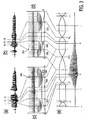
- Fig. 3 shows an example for the various synthesis steps for the word 'young'.
- This word is made of the phonemes /j/, /V/, /N/ and the silence /_/.
- a) and b) are the recorded nonsense words that contain the transitions from /j/ to /V/ and /V/ to /N/.
- Five markers are placed.
- the outer markers are the diphone borders (labels j-, -V, V- and -N).
- the markers in the middle show where a new phoneme starts (labels V, and N).
- the other labels are used to mark the segments that will be used for overlap-add.
- the periods of the end interval 300 are repeated in inverted order to provide a fade-out interval 302. All the periods within end interval 300 are appended after period 304 which is the last period of the end interval 300. Period 304 itself is not appended to avoid the repetition of the same period which would introduce an unintended periodicity.
- the periods within front interval 306 are appended at the beginning of the front interval 306 in inverted order. This applies for all of the period within the front interval 306 except the first period 310 at the beginning of the front interval 306. Again this period 310 is not appended in order to avoid two consecutive identical periods which would introduce an unintended periodicity.
- w [ n ] 0.5 ⁇ 0.5 ⁇ cos ⁇ ( ⁇ ⁇ ( n + 0.5 ) m ) , 0 ⁇ n ⁇ m
- m is the total number of periods in the smoothening range.
- the corresponding raised cosine is shown as raised cosine 316 in diagram (d).
- a corresponding window function is used to provide raised cosine 318 for the end and fade-out intervals 300 and 302.
- the durations of the intervals to be overlapped and added, i.e. intervals 300/308 and intervals 302/306 are rescaled in order to bring them to an equal length.
- the following superposition of the required diphone provides the synthesis of the word 'young'.
- Fig. 4 shows a block diagram of computer system 400, which is a text-to-speech system.
- the computer system 400 has module 402 which serves to store diphones and markers for the diphones to indicate front and end intervals.
- Module 404 serves to repeat periods contained in the end and front intervals in inverted order in order to provide fade-in and fade-out intervals.
- Module 406 serves to provide a window function for windowing the end/fade-out and fade-in/front intervals for the purposes of smoothening.
- Module 408 serves for duration adaptation of the intervals to be superposed. Such a duration adaptation is required if the intervals to be superposed are not of equal length.
- Module 410 serves for the superposition of the end/fade-in and of the fade-out/front intervals in order to concatenate their required diphones.
- the required diphones to be concatenated are selected from module 402. These diphones are processed by means of modules 404, 406 and 408 before they are overlapped and added by means of module 410, which results in the required synthesized speech signal.
Landscapes
- Engineering & Computer Science (AREA)
- Computational Linguistics (AREA)
- Health & Medical Sciences (AREA)
- Audiology, Speech & Language Pathology (AREA)
- Human Computer Interaction (AREA)
- Physics & Mathematics (AREA)
- Acoustics & Sound (AREA)
- Multimedia (AREA)
- Electrophonic Musical Instruments (AREA)
- Machine Translation (AREA)
- Mobile Radio Communication Systems (AREA)
- Stereo-Broadcasting Methods (AREA)
- Stereophonic System (AREA)
- Telephonic Communication Services (AREA)
Claims (14)
- Verfahren zur synthetischen Erzeugung eines Sprachsignals, wobei das Sprachsignal mindestens eine erste Spracheinheit und eine zweite Spracheinheit aufweist, wobei das Verfahren die folgenden Schritte umfasst:- Zuführen eines ersten Spracheinheitsignals (100), wobei das erste Spracheinheitsignal ein Endintervall aufweist,- Zuführen eines zweiten Spracheinheitsignals (106), wobei das zweite Spracheinheitsignal ein Anfangsintervall aufweist,- Anhängen von mindestens einigen der Perioden des Endintervalls in umgekehrter Reihenfolge an das Ende des ersten Spracheinheitsignals zum Schaffen eines Ausblendintervalls (102, 104),- Anhängen von mindestens einigen der Perioden des Anfangsintervalls in umgekehrter Reihenfolge an den Anfang des zweiten Spracheinheitsignals zum Schaffen eines Einblendintervalls (108, 110),- Überlagern der End- und Einblendintervalle und der Ausblend- und Anfangsintervalle (112, 114).
- Verfahren nach Anspruch 1, wobei die End- und Anfangsintervalle ungefähr konstante Perioden aufweisen.
- Verfahren nach Anspruch 1 oder 2, wobei die End- und Anfangsintervalle durch eine Markierung gekennzeichnet werden.
- Verfahren nach Anspruch 1, 2 oder 3, wobei die letzte Periode des Endintervalls und die erste Periode des Anfangsintervalls nicht angehängt werden.
- Verfahren nach einem der vorhergehenden Ansprüche 1 bis 4, das ferner das Fenstern der End- bzw. Ausblendintervalle mit einem Ausblendfenster umfasst.
- Verfahren nach Anspruch 5, wobei ein angehobenes Kosinus-Fenster als Ausblendfenster verwendet wird.
- Verfahren nach Anspruch 6, wobei die folgende Fensterfunktion für stimmhafte Intervalle verwendet wird:

wobei m die Gesamtzahl der Perioden im Glättungsbereich angibt. - Verfahren nach Anspruch 5, wobei ein Sinus-Fenster als Ausblendfenster für stimmlose Intervalle verwendet wird.
- Verfahren nach Anspruch 8, wobei die folgende Fensterfunktion verwendet wird:

wobei m die Gesamtzahl der Perioden im Glättungsbereich angibt. - Verfahren nach einem der vorhergehenden Ansprüche 1 bis 9, wobei die erste und die zweite Spracheinheit Diphone bzw. Triphone bzw. Polyphone, im Besonderen Wörter sind.
- Verfahren nach einem der vorhergehenden Ansprüche 1 bis 10, das ferner die Anpassung der Dauer der End- und Einblendintervalle und der Ausblend- und Anfangsintervalle umfasst.
- Verfahren nach einem der vorhergehenden Ansprüche 1 bis 11, wobei das Sprachsignal mit Hilfe einer Überlappungs- und Additionsoperation synthetisch erzeugt wird.
- Computerprogrammprodukt, das Programmmittel zur synthetischen Erzeugung eines Sprachsignals umfasst, wobei das Sprachsignal mindestens eine erste und eine zweite Spracheinheit aufweist, wobei die Programmmittel so ausgelegt sind, dass sie, wenn sie in einen Computer geladen sind, folgende Schritte durchführen:- Zuführen eines ersten Spracheinheitsignals (100), wobei das erste Spracheinheitsignal ein Endintervall aufweist,- Zuführen eines zweiten Spracheinheitsignals (106), wobei das zweite Spracheinheitsignal ein Anfangsintervall aufweist,- Anhängen von mindestens einigen der Perioden des Endintervalls in umgekehrter Reihenfolge an das Ende des ersten Spracheinheitsignals zum Schaffen eines Ausblendintervalls (102, 104),- Anhängen von mindestens einigen der Perioden des Anfangsintervalls in umgekehrter Reihenfolge an den Anfang des zweiten Spracheinheitsignals zum Schaffen eines Einblendintervalls (108, 110),- Überlagern der End- und Einblendintervalle und der Ausblend- und Anfangsintervalle (112, 114).
- Computersystem, im Besonderen Text/Sprache-System, zur synthetischen Erzeugung eines Sprachsignals, wobei das Sprachsignal mindestens eine erste Spracheinheit und eine zweite Spracheinheit aufweist, wobei das Computersystem Folgendes umfasst:- Mittel zum Speichern eines erste Spracheinheitsignals (100), wobei das erste Spracheinheitsignal ein Endintervall aufweist, und zum Speichern eines zweiten Spracheinheitsignals (106), wobei das zweite Spracheinheitsignal ein Anfangsintervall aufweist,- Mittel zum Anhängen von mindestens einigen der Perioden des Endintervalls in umgekehrter Reihenfolge an das Ende des ersten Spracheinheitsignals zum Schaffen eines Ausblendintervalls (102, 104),- Mittel zum Anhängen von mindestens einigen der Perioden des Anfangsintervalls in umgekehrter Reihenfolge an den Anfang des zweiten Spracheinheitsignals zum Schaffen eines Einblendintervalls (106, 108),- Mittel zum Überlagern der End- und Einblendintervalle und der Ausblend- und Anfangsintervalle (112, 114).
Priority Applications (1)
| Application Number | Priority Date | Filing Date | Title |
|---|---|---|---|
| EP03797416A EP1543500B1 (de) | 2002-09-17 | 2003-08-08 | Sprachsynthese durch verkettung von sprachsignalformen |
Applications Claiming Priority (4)
| Application Number | Priority Date | Filing Date | Title |
|---|---|---|---|
| EP02078872 | 2002-09-17 | ||
| EP02078872 | 2002-09-17 | ||
| PCT/IB2003/003624 WO2004027756A1 (en) | 2002-09-17 | 2003-08-08 | Speech synthesis using concatenation of speech waveforms |
| EP03797416A EP1543500B1 (de) | 2002-09-17 | 2003-08-08 | Sprachsynthese durch verkettung von sprachsignalformen |
Publications (2)
| Publication Number | Publication Date |
|---|---|
| EP1543500A1 EP1543500A1 (de) | 2005-06-22 |
| EP1543500B1 true EP1543500B1 (de) | 2006-02-22 |
Family
ID=32010992
Family Applications (1)
| Application Number | Title | Priority Date | Filing Date |
|---|---|---|---|
| EP03797416A Expired - Lifetime EP1543500B1 (de) | 2002-09-17 | 2003-08-08 | Sprachsynthese durch verkettung von sprachsignalformen |
Country Status (8)
| Country | Link |
|---|---|
| US (1) | US7529672B2 (de) |
| EP (1) | EP1543500B1 (de) |
| JP (1) | JP4510631B2 (de) |
| CN (1) | CN100388357C (de) |
| AT (1) | ATE318440T1 (de) |
| AU (1) | AU2003255914A1 (de) |
| DE (1) | DE60303688T2 (de) |
| WO (1) | WO2004027756A1 (de) |
Families Citing this family (6)
| Publication number | Priority date | Publication date | Assignee | Title |
|---|---|---|---|---|
| US7558727B2 (en) * | 2002-09-17 | 2009-07-07 | Koninklijke Philips Electronics N.V. | Method of synthesis for a steady sound signal |
| US20070106513A1 (en) * | 2005-11-10 | 2007-05-10 | Boillot Marc A | Method for facilitating text to speech synthesis using a differential vocoder |
| JP6047922B2 (ja) * | 2011-06-01 | 2016-12-21 | ヤマハ株式会社 | 音声合成装置および音声合成方法 |
| US10382143B1 (en) * | 2018-08-21 | 2019-08-13 | AC Global Risk, Inc. | Method for increasing tone marker signal detection reliability, and system therefor |
| US10790829B2 (en) * | 2018-09-27 | 2020-09-29 | Intel Corporation | Logic circuits with simultaneous dual function capability |
| CN109686358B (zh) * | 2018-12-24 | 2021-11-09 | 广州九四智能科技有限公司 | 高保真的智能客服语音合成方法 |
Family Cites Families (11)
| Publication number | Priority date | Publication date | Assignee | Title |
|---|---|---|---|---|
| FR2636163B1 (fr) | 1988-09-02 | 1991-07-05 | Hamon Christian | Procede et dispositif de synthese de la parole par addition-recouvrement de formes d'onde |
| US5220629A (en) * | 1989-11-06 | 1993-06-15 | Canon Kabushiki Kaisha | Speech synthesis apparatus and method |
| JP3089715B2 (ja) * | 1991-07-24 | 2000-09-18 | 松下電器産業株式会社 | 音声合成装置 |
| DE69228211T2 (de) | 1991-08-09 | 1999-07-08 | Koninklijke Philips Electronics N.V., Eindhoven | Verfahren und Apparat zur Handhabung von Höhe und Dauer eines physikalischen Audiosignals |
| IT1266943B1 (it) | 1994-09-29 | 1997-01-21 | Cselt Centro Studi Lab Telecom | Procedimento di sintesi vocale mediante concatenazione e parziale sovrapposizione di forme d'onda. |
| EP0820626B1 (de) * | 1995-04-12 | 2001-10-10 | BRITISH TELECOMMUNICATIONS public limited company | Sprachsynthese mit wellenformen |
| JP2000181452A (ja) * | 1998-10-06 | 2000-06-30 | Roland Corp | 波形再生装置 |
| DE69925932T2 (de) * | 1998-11-13 | 2006-05-11 | Lernout & Hauspie Speech Products N.V. | Sprachsynthese durch verkettung von sprachwellenformen |
| US6202049B1 (en) * | 1999-03-09 | 2001-03-13 | Matsushita Electric Industrial Co., Ltd. | Identification of unit overlap regions for concatenative speech synthesis system |
| ATE357042T1 (de) * | 2000-09-15 | 2007-04-15 | Lernout & Hauspie Speechprod | Schnelle wellenformsynchronisation für die verkettung und zeitskalenmodifikation von sprachsignalen |
| JP4067762B2 (ja) * | 2000-12-28 | 2008-03-26 | ヤマハ株式会社 | 歌唱合成装置 |
-
2003
- 2003-08-08 AU AU2003255914A patent/AU2003255914A1/en not_active Abandoned
- 2003-08-08 US US10/527,951 patent/US7529672B2/en not_active Expired - Lifetime
- 2003-08-08 AT AT03797416T patent/ATE318440T1/de not_active IP Right Cessation
- 2003-08-08 EP EP03797416A patent/EP1543500B1/de not_active Expired - Lifetime
- 2003-08-08 JP JP2004537379A patent/JP4510631B2/ja not_active Expired - Lifetime
- 2003-08-08 WO PCT/IB2003/003624 patent/WO2004027756A1/en not_active Ceased
- 2003-08-08 DE DE60303688T patent/DE60303688T2/de not_active Expired - Lifetime
- 2003-08-08 CN CNB038220024A patent/CN100388357C/zh not_active Expired - Fee Related
Also Published As
| Publication number | Publication date |
|---|---|
| EP1543500A1 (de) | 2005-06-22 |
| DE60303688D1 (de) | 2006-04-27 |
| JP4510631B2 (ja) | 2010-07-28 |
| DE60303688T2 (de) | 2006-10-19 |
| US20060059000A1 (en) | 2006-03-16 |
| WO2004027756A1 (en) | 2004-04-01 |
| US7529672B2 (en) | 2009-05-05 |
| JP2005539267A (ja) | 2005-12-22 |
| CN100388357C (zh) | 2008-05-14 |
| AU2003255914A1 (en) | 2004-04-08 |
| CN1682275A (zh) | 2005-10-12 |
| ATE318440T1 (de) | 2006-03-15 |
Similar Documents
| Publication | Publication Date | Title |
|---|---|---|
| US8326613B2 (en) | Method of synthesizing of an unvoiced speech signal | |
| JP2006106741A (ja) | 対話型音声応答システムによる音声理解を防ぐための方法および装置 | |
| EP1543500B1 (de) | Sprachsynthese durch verkettung von sprachsignalformen | |
| EP1543503B1 (de) | Verfahren zur steuerung der dauer bei der sprachsynthese | |
| EP1543497B1 (de) | Verfahren zur synthese eines stationären klangsignals | |
| EP0912975B1 (de) | Syntheseverfahren für stimmlose konsonanten | |
| JP3310217B2 (ja) | 音声合成方法とその装置 | |
| US20060074675A1 (en) | Method of synthesizing creaky voice | |
| May et al. | Speech synthesis using allophones | |
| Juergen | Text-to-Speech (TTS) Synthesis | |
| Butler et al. | Articulatory constraints on vocal tract area functions and their acoustic implications | |
| Sorace | The dialogue terminal | |
| Randolph et al. | Synthesis of continuous speech by concatenation of isolated words | |
| Yea et al. | Formant synthesis: Technique to account for source/tract interaction | |
| Goudie et al. | Implementation of a prosody scheme in a constructive synthesis environment | |
| HK1090162B (en) | Method and apparatus for preventing speech comprehension by interactive voice response systems |
Legal Events
| Date | Code | Title | Description |
|---|---|---|---|
| PUAI | Public reference made under article 153(3) epc to a published international application that has entered the european phase |
Free format text: ORIGINAL CODE: 0009012 |
|
| 17P | Request for examination filed |
Effective date: 20050418 |
|
| AK | Designated contracting states |
Kind code of ref document: A1 Designated state(s): AT BE BG CH CY CZ DE DK EE ES FI FR GB GR HU IE IT LI LU MC NL PT RO SE SI SK TR |
|
| AX | Request for extension of the european patent |
Extension state: AL LT LV MK |
|
| GRAP | Despatch of communication of intention to grant a patent |
Free format text: ORIGINAL CODE: EPIDOSNIGR1 |
|
| DAX | Request for extension of the european patent (deleted) | ||
| GRAS | Grant fee paid |
Free format text: ORIGINAL CODE: EPIDOSNIGR3 |
|
| GRAA | (expected) grant |
Free format text: ORIGINAL CODE: 0009210 |
|
| AK | Designated contracting states |
Kind code of ref document: B1 Designated state(s): AT BE BG CH CY CZ DE DK EE ES FI FR GB GR HU IE IT LI LU MC NL PT RO SE SI SK TR |
|
| PG25 | Lapsed in a contracting state [announced via postgrant information from national office to epo] |
Ref country code: IT Free format text: LAPSE BECAUSE OF FAILURE TO SUBMIT A TRANSLATION OF THE DESCRIPTION OR TO PAY THE FEE WITHIN THE PRESCRIBED TIME-LIMIT;WARNING: LAPSES OF ITALIAN PATENTS WITH EFFECTIVE DATE BEFORE 2007 MAY HAVE OCCURRED AT ANY TIME BEFORE 2007. THE CORRECT EFFECTIVE DATE MAY BE DIFFERENT FROM THE ONE RECORDED. Effective date: 20060222 Ref country code: BE Free format text: LAPSE BECAUSE OF FAILURE TO SUBMIT A TRANSLATION OF THE DESCRIPTION OR TO PAY THE FEE WITHIN THE PRESCRIBED TIME-LIMIT Effective date: 20060222 Ref country code: CH Free format text: LAPSE BECAUSE OF FAILURE TO SUBMIT A TRANSLATION OF THE DESCRIPTION OR TO PAY THE FEE WITHIN THE PRESCRIBED TIME-LIMIT Effective date: 20060222 Ref country code: LI Free format text: LAPSE BECAUSE OF FAILURE TO SUBMIT A TRANSLATION OF THE DESCRIPTION OR TO PAY THE FEE WITHIN THE PRESCRIBED TIME-LIMIT Effective date: 20060222 Ref country code: RO Free format text: LAPSE BECAUSE OF FAILURE TO SUBMIT A TRANSLATION OF THE DESCRIPTION OR TO PAY THE FEE WITHIN THE PRESCRIBED TIME-LIMIT Effective date: 20060222 Ref country code: SI Free format text: LAPSE BECAUSE OF FAILURE TO SUBMIT A TRANSLATION OF THE DESCRIPTION OR TO PAY THE FEE WITHIN THE PRESCRIBED TIME-LIMIT Effective date: 20060222 Ref country code: NL Free format text: LAPSE BECAUSE OF FAILURE TO SUBMIT A TRANSLATION OF THE DESCRIPTION OR TO PAY THE FEE WITHIN THE PRESCRIBED TIME-LIMIT Effective date: 20060222 Ref country code: SK Free format text: LAPSE BECAUSE OF FAILURE TO SUBMIT A TRANSLATION OF THE DESCRIPTION OR TO PAY THE FEE WITHIN THE PRESCRIBED TIME-LIMIT Effective date: 20060222 Ref country code: AT Free format text: LAPSE BECAUSE OF FAILURE TO SUBMIT A TRANSLATION OF THE DESCRIPTION OR TO PAY THE FEE WITHIN THE PRESCRIBED TIME-LIMIT Effective date: 20060222 Ref country code: FI Free format text: LAPSE BECAUSE OF FAILURE TO SUBMIT A TRANSLATION OF THE DESCRIPTION OR TO PAY THE FEE WITHIN THE PRESCRIBED TIME-LIMIT Effective date: 20060222 |
|
| REG | Reference to a national code |
Ref country code: GB Ref legal event code: FG4D |
|
| REG | Reference to a national code |
Ref country code: CH Ref legal event code: EP |
|
| REG | Reference to a national code |
Ref country code: IE Ref legal event code: FG4D |
|
| REF | Corresponds to: |
Ref document number: 60303688 Country of ref document: DE Date of ref document: 20060427 Kind code of ref document: P |
|
| PG25 | Lapsed in a contracting state [announced via postgrant information from national office to epo] |
Ref country code: SE Free format text: LAPSE BECAUSE OF FAILURE TO SUBMIT A TRANSLATION OF THE DESCRIPTION OR TO PAY THE FEE WITHIN THE PRESCRIBED TIME-LIMIT Effective date: 20060522 Ref country code: DK Free format text: LAPSE BECAUSE OF FAILURE TO SUBMIT A TRANSLATION OF THE DESCRIPTION OR TO PAY THE FEE WITHIN THE PRESCRIBED TIME-LIMIT Effective date: 20060522 Ref country code: BG Free format text: LAPSE BECAUSE OF FAILURE TO SUBMIT A TRANSLATION OF THE DESCRIPTION OR TO PAY THE FEE WITHIN THE PRESCRIBED TIME-LIMIT Effective date: 20060522 |
|
| PG25 | Lapsed in a contracting state [announced via postgrant information from national office to epo] |
Ref country code: ES Free format text: LAPSE BECAUSE OF FAILURE TO SUBMIT A TRANSLATION OF THE DESCRIPTION OR TO PAY THE FEE WITHIN THE PRESCRIBED TIME-LIMIT Effective date: 20060602 |
|
| PG25 | Lapsed in a contracting state [announced via postgrant information from national office to epo] |
Ref country code: PT Free format text: LAPSE BECAUSE OF FAILURE TO SUBMIT A TRANSLATION OF THE DESCRIPTION OR TO PAY THE FEE WITHIN THE PRESCRIBED TIME-LIMIT Effective date: 20060724 |
|
| NLV1 | Nl: lapsed or annulled due to failure to fulfill the requirements of art. 29p and 29m of the patents act | ||
| PG25 | Lapsed in a contracting state [announced via postgrant information from national office to epo] |
Ref country code: IE Free format text: LAPSE BECAUSE OF NON-PAYMENT OF DUE FEES Effective date: 20060808 |
|
| PG25 | Lapsed in a contracting state [announced via postgrant information from national office to epo] |
Ref country code: MC Free format text: LAPSE BECAUSE OF NON-PAYMENT OF DUE FEES Effective date: 20060831 |
|
| REG | Reference to a national code |
Ref country code: CH Ref legal event code: PL |
|
| ET | Fr: translation filed | ||
| PLBE | No opposition filed within time limit |
Free format text: ORIGINAL CODE: 0009261 |
|
| STAA | Information on the status of an ep patent application or granted ep patent |
Free format text: STATUS: NO OPPOSITION FILED WITHIN TIME LIMIT |
|
| 26N | No opposition filed |
Effective date: 20061123 |
|
| PG25 | Lapsed in a contracting state [announced via postgrant information from national office to epo] |
Ref country code: GR Free format text: LAPSE BECAUSE OF FAILURE TO SUBMIT A TRANSLATION OF THE DESCRIPTION OR TO PAY THE FEE WITHIN THE PRESCRIBED TIME-LIMIT Effective date: 20060523 Ref country code: CZ Free format text: LAPSE BECAUSE OF FAILURE TO SUBMIT A TRANSLATION OF THE DESCRIPTION OR TO PAY THE FEE WITHIN THE PRESCRIBED TIME-LIMIT Effective date: 20060222 |
|
| PG25 | Lapsed in a contracting state [announced via postgrant information from national office to epo] |
Ref country code: EE Free format text: LAPSE BECAUSE OF FAILURE TO SUBMIT A TRANSLATION OF THE DESCRIPTION OR TO PAY THE FEE WITHIN THE PRESCRIBED TIME-LIMIT Effective date: 20060222 |
|
| PG25 | Lapsed in a contracting state [announced via postgrant information from national office to epo] |
Ref country code: HU Free format text: LAPSE BECAUSE OF FAILURE TO SUBMIT A TRANSLATION OF THE DESCRIPTION OR TO PAY THE FEE WITHIN THE PRESCRIBED TIME-LIMIT Effective date: 20060823 Ref country code: LU Free format text: LAPSE BECAUSE OF NON-PAYMENT OF DUE FEES Effective date: 20060808 Ref country code: TR Free format text: LAPSE BECAUSE OF FAILURE TO SUBMIT A TRANSLATION OF THE DESCRIPTION OR TO PAY THE FEE WITHIN THE PRESCRIBED TIME-LIMIT Effective date: 20060222 |
|
| PG25 | Lapsed in a contracting state [announced via postgrant information from national office to epo] |
Ref country code: CY Free format text: LAPSE BECAUSE OF FAILURE TO SUBMIT A TRANSLATION OF THE DESCRIPTION OR TO PAY THE FEE WITHIN THE PRESCRIBED TIME-LIMIT Effective date: 20060222 |
|
| REG | Reference to a national code |
Ref country code: DE Ref legal event code: R082 Ref document number: 60303688 Country of ref document: DE Representative=s name: VOLMER, GEORG, DIPL.-ING., DE |
|
| REG | Reference to a national code |
Ref country code: DE Ref legal event code: R082 Ref document number: 60303688 Country of ref document: DE Representative=s name: MEISSNER, BOLTE & PARTNER GBR, DE Effective date: 20140328 Ref country code: DE Ref legal event code: R082 Ref document number: 60303688 Country of ref document: DE Representative=s name: MEISSNER BOLTE PATENTANWAELTE RECHTSANWAELTE P, DE Effective date: 20140328 Ref country code: DE Ref legal event code: R081 Ref document number: 60303688 Country of ref document: DE Owner name: KONINKLIJKE PHILIPS N.V., NL Free format text: FORMER OWNER: KONINKLIJKE PHILIPS ELECTRONICS N.V., EINDHOVEN, NL Effective date: 20140328 Ref country code: DE Ref legal event code: R082 Ref document number: 60303688 Country of ref document: DE Representative=s name: VOLMER, GEORG, DIPL.-ING., DE Effective date: 20140328 |
|
| REG | Reference to a national code |
Ref country code: FR Ref legal event code: CD Owner name: KONINKLIJKE PHILIPS N.V., NL Effective date: 20141126 Ref country code: FR Ref legal event code: CA Effective date: 20141126 |
|
| REG | Reference to a national code |
Ref country code: DE Ref legal event code: R082 Ref document number: 60303688 Country of ref document: DE Representative=s name: MITSCHERLICH, PATENT- UND RECHTSANWAELTE PARTM, DE Ref country code: DE Ref legal event code: R082 Ref document number: 60303688 Country of ref document: DE Representative=s name: MEISSNER, BOLTE & PARTNER GBR, DE Ref country code: DE Ref legal event code: R082 Ref document number: 60303688 Country of ref document: DE Representative=s name: MEISSNER BOLTE PATENTANWAELTE RECHTSANWAELTE P, DE |
|
| REG | Reference to a national code |
Ref country code: FR Ref legal event code: PLFP Year of fee payment: 14 |
|
| REG | Reference to a national code |
Ref country code: FR Ref legal event code: PLFP Year of fee payment: 15 |
|
| REG | Reference to a national code |
Ref country code: FR Ref legal event code: PLFP Year of fee payment: 16 |
|
| REG | Reference to a national code |
Ref country code: DE Ref legal event code: R082 Ref document number: 60303688 Country of ref document: DE Representative=s name: MITSCHERLICH, PATENT- UND RECHTSANWAELTE PARTM, DE Ref country code: DE Ref legal event code: R081 Ref document number: 60303688 Country of ref document: DE Owner name: HUAWEI TECHNOLOGIES CO., LTD., SHENZHEN, CN Free format text: FORMER OWNER: KONINKLIJKE PHILIPS N.V., EINDHOVEN, NL |
|
| REG | Reference to a national code |
Ref country code: GB Ref legal event code: 732E Free format text: REGISTERED BETWEEN 20190418 AND 20190426 |
|
| PGFP | Annual fee paid to national office [announced via postgrant information from national office to epo] |
Ref country code: GB Payment date: 20220630 Year of fee payment: 20 |
|
| PGFP | Annual fee paid to national office [announced via postgrant information from national office to epo] |
Ref country code: DE Payment date: 20220608 Year of fee payment: 20 |
|
| PGFP | Annual fee paid to national office [announced via postgrant information from national office to epo] |
Ref country code: FR Payment date: 20220709 Year of fee payment: 20 |
|
| REG | Reference to a national code |
Ref country code: DE Ref legal event code: R071 Ref document number: 60303688 Country of ref document: DE |
|
| REG | Reference to a national code |
Ref country code: GB Ref legal event code: PE20 Expiry date: 20230807 |
|
| PG25 | Lapsed in a contracting state [announced via postgrant information from national office to epo] |
Ref country code: GB Free format text: LAPSE BECAUSE OF EXPIRATION OF PROTECTION Effective date: 20230807 |