EP1544169A1 - Aktiven sauerstoff enthaltende anorganische verbindung und herstellungsverfahren daf r - Google Patents
Aktiven sauerstoff enthaltende anorganische verbindung und herstellungsverfahren daf r Download PDFInfo
- Publication number
- EP1544169A1 EP1544169A1 EP03792734A EP03792734A EP1544169A1 EP 1544169 A1 EP1544169 A1 EP 1544169A1 EP 03792734 A EP03792734 A EP 03792734A EP 03792734 A EP03792734 A EP 03792734A EP 1544169 A1 EP1544169 A1 EP 1544169A1
- Authority
- EP
- European Patent Office
- Prior art keywords
- aluminosilicate
- catalyst
- active oxygen
- hydrogarnet
- cobalt oxide
- Prior art date
- Legal status (The legal status is an assumption and is not a legal conclusion. Google has not performed a legal analysis and makes no representation as to the accuracy of the status listed.)
- Withdrawn
Links
Images






Classifications
-
- B—PERFORMING OPERATIONS; TRANSPORTING
- B01—PHYSICAL OR CHEMICAL PROCESSES OR APPARATUS IN GENERAL
- B01J—CHEMICAL OR PHYSICAL PROCESSES, e.g. CATALYSIS OR COLLOID CHEMISTRY; THEIR RELEVANT APPARATUS
- B01J37/00—Processes, in general, for preparing catalysts; Processes, in general, for activation of catalysts
- B01J37/08—Heat treatment
-
- B—PERFORMING OPERATIONS; TRANSPORTING
- B01—PHYSICAL OR CHEMICAL PROCESSES OR APPARATUS IN GENERAL
- B01D—SEPARATION
- B01D53/00—Separation of gases or vapours; Recovering vapours of volatile solvents from gases; Chemical or biological purification of waste gases, e.g. engine exhaust gases, smoke, fumes, flue gases, aerosols
- B01D53/34—Chemical or biological purification of waste gases
- B01D53/74—General processes for purification of waste gases; Apparatus or devices specially adapted therefor
- B01D53/86—Catalytic processes
-
- B—PERFORMING OPERATIONS; TRANSPORTING
- B01—PHYSICAL OR CHEMICAL PROCESSES OR APPARATUS IN GENERAL
- B01D—SEPARATION
- B01D53/00—Separation of gases or vapours; Recovering vapours of volatile solvents from gases; Chemical or biological purification of waste gases, e.g. engine exhaust gases, smoke, fumes, flue gases, aerosols
- B01D53/34—Chemical or biological purification of waste gases
- B01D53/92—Chemical or biological purification of waste gases of engine exhaust gases
- B01D53/94—Chemical or biological purification of waste gases of engine exhaust gases by catalytic processes
-
- B—PERFORMING OPERATIONS; TRANSPORTING
- B01—PHYSICAL OR CHEMICAL PROCESSES OR APPARATUS IN GENERAL
- B01J—CHEMICAL OR PHYSICAL PROCESSES, e.g. CATALYSIS OR COLLOID CHEMISTRY; THEIR RELEVANT APPARATUS
- B01J20/00—Solid sorbent compositions or filter aid compositions; Sorbents for chromatography; Processes for preparing, regenerating or reactivating thereof
- B01J20/02—Solid sorbent compositions or filter aid compositions; Sorbents for chromatography; Processes for preparing, regenerating or reactivating thereof comprising inorganic material
- B01J20/10—Solid sorbent compositions or filter aid compositions; Sorbents for chromatography; Processes for preparing, regenerating or reactivating thereof comprising inorganic material comprising silica or silicate
- B01J20/16—Alumino-silicates
-
- B—PERFORMING OPERATIONS; TRANSPORTING
- B01—PHYSICAL OR CHEMICAL PROCESSES OR APPARATUS IN GENERAL
- B01J—CHEMICAL OR PHYSICAL PROCESSES, e.g. CATALYSIS OR COLLOID CHEMISTRY; THEIR RELEVANT APPARATUS
- B01J21/00—Catalysts comprising the elements, oxides, or hydroxides of magnesium, boron, aluminium, carbon, silicon, titanium, zirconium, or hafnium
- B01J21/16—Clays or other mineral silicates
-
- B—PERFORMING OPERATIONS; TRANSPORTING
- B01—PHYSICAL OR CHEMICAL PROCESSES OR APPARATUS IN GENERAL
- B01J—CHEMICAL OR PHYSICAL PROCESSES, e.g. CATALYSIS OR COLLOID CHEMISTRY; THEIR RELEVANT APPARATUS
- B01J23/00—Catalysts comprising metals or metal oxides or hydroxides, not provided for in group B01J21/00
- B01J23/70—Catalysts comprising metals or metal oxides or hydroxides, not provided for in group B01J21/00 of the iron group metals or copper
- B01J23/74—Iron group metals
- B01J23/75—Cobalt
-
- B—PERFORMING OPERATIONS; TRANSPORTING
- B01—PHYSICAL OR CHEMICAL PROCESSES OR APPARATUS IN GENERAL
- B01J—CHEMICAL OR PHYSICAL PROCESSES, e.g. CATALYSIS OR COLLOID CHEMISTRY; THEIR RELEVANT APPARATUS
- B01J23/00—Catalysts comprising metals or metal oxides or hydroxides, not provided for in group B01J21/00
- B01J23/70—Catalysts comprising metals or metal oxides or hydroxides, not provided for in group B01J21/00 of the iron group metals or copper
- B01J23/76—Catalysts comprising metals or metal oxides or hydroxides, not provided for in group B01J21/00 of the iron group metals or copper combined with metals, oxides or hydroxides provided for in groups B01J23/02 - B01J23/36
- B01J23/78—Catalysts comprising metals or metal oxides or hydroxides, not provided for in group B01J21/00 of the iron group metals or copper combined with metals, oxides or hydroxides provided for in groups B01J23/02 - B01J23/36 with alkali- or alkaline earth metals
-
- B—PERFORMING OPERATIONS; TRANSPORTING
- B01—PHYSICAL OR CHEMICAL PROCESSES OR APPARATUS IN GENERAL
- B01J—CHEMICAL OR PHYSICAL PROCESSES, e.g. CATALYSIS OR COLLOID CHEMISTRY; THEIR RELEVANT APPARATUS
- B01J29/00—Catalysts comprising molecular sieves
- B01J29/03—Catalysts comprising molecular sieves not having base-exchange properties
- B01J29/0308—Mesoporous materials not having base exchange properties, e.g. Si-MCM-41
- B01J29/0316—Mesoporous materials not having base exchange properties, e.g. Si-MCM-41 containing iron group metals, noble metals or copper
- B01J29/0333—Iron group metals or copper
-
- C—CHEMISTRY; METALLURGY
- C01—INORGANIC CHEMISTRY
- C01B—NON-METALLIC ELEMENTS; COMPOUNDS THEREOF; METALLOIDS OR COMPOUNDS THEREOF NOT COVERED BY SUBCLASS C01C
- C01B13/00—Oxygen; Ozone; Oxides or hydroxides in general
- C01B13/02—Preparation of oxygen
-
- C—CHEMISTRY; METALLURGY
- C01—INORGANIC CHEMISTRY
- C01B—NON-METALLIC ELEMENTS; COMPOUNDS THEREOF; METALLOIDS OR COMPOUNDS THEREOF NOT COVERED BY SUBCLASS C01C
- C01B13/00—Oxygen; Ozone; Oxides or hydroxides in general
- C01B13/02—Preparation of oxygen
- C01B13/0203—Preparation of oxygen from inorganic compounds
-
- C—CHEMISTRY; METALLURGY
- C01—INORGANIC CHEMISTRY
- C01B—NON-METALLIC ELEMENTS; COMPOUNDS THEREOF; METALLOIDS OR COMPOUNDS THEREOF NOT COVERED BY SUBCLASS C01C
- C01B15/00—Peroxides; Peroxyhydrates; Peroxyacids or salts thereof; Superoxides; Ozonides
- C01B15/04—Metal peroxides or peroxyhydrates thereof; Metal superoxides; Metal ozonides; Peroxyhydrates thereof
- C01B15/043—Metal peroxides or peroxyhydrates thereof; Metal superoxides; Metal ozonides; Peroxyhydrates thereof of alkali metals, alkaline earth metals or magnesium or beryllium or aluminium
-
- C—CHEMISTRY; METALLURGY
- C01—INORGANIC CHEMISTRY
- C01B—NON-METALLIC ELEMENTS; COMPOUNDS THEREOF; METALLOIDS OR COMPOUNDS THEREOF NOT COVERED BY SUBCLASS C01C
- C01B33/00—Silicon; Compounds thereof
- C01B33/20—Silicates
- C01B33/26—Aluminium-containing silicates, i.e. silico-aluminates
-
- B—PERFORMING OPERATIONS; TRANSPORTING
- B01—PHYSICAL OR CHEMICAL PROCESSES OR APPARATUS IN GENERAL
- B01D—SEPARATION
- B01D2255/00—Catalysts
- B01D2255/90—Physical characteristics of catalysts
- B01D2255/908—O2-storage component incorporated in the catalyst
Definitions
- This invention relates to a method for manufacturing an inorganic compound including active oxygen, and more particularly relates to a novel active oxygen developing substance including or occluding both a superoxide anion (O 2 - ) and a peroxide anion (O 2 2- ), and to a method for manufacturing this substance, and applications therefor.
- Inorganic compounds including or occluding both a superoxide anion and a peroxide anion were not known in the past, but the present invention is useful in that it provides a novel material that includes or occludes both of these.
- the active oxygen developing substance of the present invention is useful as a constituent component of oxidation catalysts, solid electrolyte fuel cell electrodes, antimicrobial agents, ion conductors, and so forth, and a molded article of the active oxygen developing substance of the present invention, is useful in that it provides a new type of exhaust gas purification catalyst for two-wheeled vehicles, a solid electrolyte for secondary cells, an oxygen occlusion carrier, or the like.
- the present invention also relates to an aluminosilicate catalyst supporting cobalt oxide, to a method for manufacturing this catalyst, and to applications for this catalyst, and more particularly relates to a new aluminosilicate catalyst supporting cobalt oxide that has more active oxidation capability at lower temperatures than conventional oxidation or combustion catalysts, and to a method for manufacturing this catalyst, to a method for the oxidative decomposition of volatile organic compounds with this catalyst, and so forth.
- the novel aluminosilicate that is the catalyst component of the present invention has a zeolite-like structure in which active oxygen (superoxide: O 2 - , peroxide: O 2 2- ) is encapsulated, and can be used in oxidation reactions of hydrocarbons and the like by means of the active oxygen included in the structure. Examples of such reactions include epoxidation, complete oxidation, partial oxidation, and coupling.
- active oxygen superoxide: O 2 - , peroxide: O 2 2-
- examples of such reactions include epoxidation, complete oxidation, partial oxidation, and coupling.
- a formed or molded article of the aluminosilicate supporting cobalt oxide of the present invention is useful, for example, in that it provides a new type of exhaust gas purification catalyst for two-wheeled vehicles, a solid electrolyte for secondary cells, an oxygen occlusion carrier, or the like.
- platinum, palladium, platinum/rhodium, palladium/rhodium, platinum/palladium/rhodium, and the like are supported on a monolithic carrier made from cordierite, and used as a three-way catalytic converter. Further, ceria, which is an oxygen-storing substance, has been used as an auxiliary catalyst in order to absorb fluctuations in the air-fuel ratio.
- the above noble metals have high catalytic activity, but they are costly, and moreover need to be used in large quantities, so they are recovered and reused.
- An example of substances known and put to use in the past as active oxygen developing substances is a photocatalyst typified by titanium oxide. Electrons and holes are formed when light (UV rays) is absorbed by titanium oxide. Because the oxidative strength resulting from holes is greater than the reductive strength resulting from excited electrons with titanium oxide, adsorbed water on the catalyst surface is oxidized by the holes, producing hydroxy radicals ( ⁇ OH). Meanwhile, a reaction proceeds in which the oxygen in the air is reduced, producing active oxygen (O 2 - ). It is believed that active oxygen becomes water via hydrogen peroxide (H 2 O 2 ) or the formation of a peroxide of an intermediate of the oxidation reaction. There are also cases in which active oxygen acts directly on carbon-carbon bonds and decomposes harmful organic substances.
- Another substance known to develop active oxygen is a 12CaO ⁇ 7Al 2 O 3 compound that encloses active oxygen species (Japanese Laid-Open Patent Application No.2002-3218).
- This 12CaO ⁇ 7Al 2 O 3 compound is manufactured from a raw material mixture of calcium and aluminum in an atomic equivalent ratio of 12:14, which are subjected to solid phase reaction in a dry oxidative atmosphere controlled to an oxygen partial pressure of at least 10 4 Pa, and preferably at least 10 5 Pa, and a water vapor partial pressure of no more than 1 Pa, and at a high firing temperature of at least 1200°C, and preferably 1300°C.
- the active oxygen enclosed by a 12CaO ⁇ 7Al 2 O 3 compound manufactured in an atmosphere in which the oxygen partial pressure and water vapor partial pressure are strictly managed, which requires a large quantity of thermal energy, is O 2 - and/or O - .
- combustion catalysts oxides of cobalt, copper, manganese, chromium, and the like have been supported on porous alumina, allowing the combustion temperature to be lowered to between 300 and 600°C (see, for example, (1) Y.M. Kang and B.Z. Wan, Appl. Cat. A, Vol. 114 (1994), p. 35, (2) R.S. Drago, K. Jurczyk, D.L. Singh, and V.
- Hydrocarbons which are environmental pollutants emitted from internal combustion engines, are emitted as a result of the incomplete combustion of gasoline, and their emission by two-wheeled vehicles is more than ten times that by passenger vehicles, accounting for some 20% of the total emissions of four- and two-wheeled vehicles combined.
- the use of the same catalytic converters in two-wheeled vehicles as those used in passenger vehicles has been studied, but existing catalytic converters would be disproportionately costly on inexpensive two-wheeled vehicles, and a less expensive exhaust gas purification catalyst that does not make use of noble metals needs to be developed in this field of technology.
- the inventors arrived at the present invention upon discovering for the first time that after the active oxygen moves, the oxygen in the air is taken into the structure, regenerating it, and that active oxygen can be supplied continuously and incessantly, and that active oxygen is a powerful oxidant and is extremely effective in the oxidative decomposition or combustion of volatile organic compounds and so forth, and when cobalt oxide, which has long been known as an oxidation catalyst, is supported on an aluminosilicate that develops active oxygen, even higher oxidation capability can be imparted at low temperature.
- the method of the present invention for manufacturing a novel active oxygen developing substance does not require control of the oxygen partial pressure or water vapor partial pressure, and the heating may be at a relatively low temperature of 1000°C or lower.
- An example of this manufacture will now be given, but the method of the present invention for manufacturing a novel active oxygen developing substance is not limited to just the following method.
- the active oxygen developing substance of the present invention is manufactured by using hydrogarnet as a precursor substance, and heating it to at least 700°C in an electric furnace or the like under an air atmosphere.
- the chemical compositional formula of the hydrogarnet used as the precursor is Ca 3 Al 2 (SiO 4 ) 3-Y (OH) 4Y , where the value of Y is in the range of 0 ⁇ Y ⁇ 3.
- the chemical compositional formula of the aluminosilicate having a novel active oxygen developing function is Ca 12 (Al 14-X Si X )O 33+0.5X , where the value of X is in the range of 0 ⁇ X ⁇ 4.
- the hydrogarnet is synthesized as follows.
- a calcia source, an alumina source, and a silica source are mixed so as to match the hydrogarnet composition, that is, the composition of hydrogarnet with the desired Y value, and an excess of water is added to this to prepare a mixture.
- the calcia source here can be slaked lime, unslaked lime, calcium carbonate, gypsum, or the like;
- the alumina source can be kaolin, alumina sol, boehmite, aluminum hydroxide, aluminum oxide, or the like;
- the silica source can be kaolin, silica, amorphous silica, diatomaceous earth, silica sand, quartz, or the like.
- the prepared mixture is subjected to a wet heat treatment in an autoclave for at least 5 hours at a temperature of from 100 to 200°C to synthesize hydrogarnet.
- the reaction will not proceed adequately if the temperature is below 100°C, but too much thermal energy will be consumed if the temperature is over 200°C.
- the heating time can be shorter than 5 hours, but at least 5 hours is preferable in order to obtain hydrogarnet with good crystallinity.
- An aluminosilicate that is a novel active oxygen developing substance can be obtained by heating hydrogarnet to 700°C or higher and 1200°C or lower in an air atmosphere. Heating at a temperature under 700°C is undesirable because pyrolysis will be inadequate. The heating may be performed at an even higher temperature, but this will consume too much thermal energy, so the limit is set at 1200°C or lower.
- the Ca 12 Al 10 Si 4 O 35 , Ca 12 Al 12 Si 2 O 34 , and so forth obtained from the above reaction formulas are examples of aluminosilicates that are the novel active oxygen developing substance of the present invention.
- the novel active oxygen developing substance of the present invention is obtained within the range of 0 ⁇ X ⁇ 4, and is produced by the pyrolysis of hydrogarnet, which is a precursor thereof.
- unslaked lime (CaO) is admixed as a by-product, but unslaked lime does not participate in the development or inclusion of active oxygen. CaO can be easily removed by dissolving it with a dilute acid such as hydrochloric acid or nitric acid.
- ESR measurement and Raman spectroscopy are two ways to check whether or not the hydrogarnet pyrolyzate, that is, the aluminosilicate that is the novel active oxygen developing substance, includes or occludes active oxygen such as superoxide anions (O 2 - ) and peroxide anions (O 2 2- ).
- active oxygen such as superoxide anions (O 2 - ) and peroxide anions (O 2 2- ).
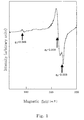
- Fig. 1 shows the ESR measurement results.
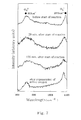
- Fig. 2 shows the results of Raman spectroscopy at room temperature.
- the presence of superoxide anions is confirmed from a peak at 1075 cm -1 .
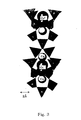
- Fig. 3 shows the crystal structure of Ca 12 Al 10 Si 4 O 35 .
- This is a zeolite-like structure in which (Al,Si)O 4 tetrahedra are formed in the form of a framework, and active oxygen O 2 - and O 2 2- are present in the voids (spaces of about 4 ⁇ ) in this framework.
- the active oxygen included or occluded by the aluminosilicate that is the novel active oxygen developing substance of the present invention is a powerful oxidant, is discharged from within the structure when heated to 400°C or higher, and participates in chemical reactions and so forth.
- the active oxygen included or occluded by the aluminosilicate that is the novel active oxygen developing substance of the present invention is able to move at a temperature of 400°C or higher.
- the novel active oxygen developing substance has the ability to completely oxidize and decompose volatile organic compounds (VOCs) into CO 2 or H 2 O at a low temperature of 400 to 600°C. Because of this, the active oxygen developing substance of the present invention can be used as the active component of an oxidation catalyst.
- VOCs volatile organic compounds
- the active oxygen in the structure is gradually consumed as an oxidative decomposition reaction continues under an oxygen-free atmosphere, and if the reaction continues long enough, the active oxygen is completely used up, after which no more is supplied.
- air or oxygen is supplied to the novel active oxygen developing substance after active oxygen ceases to be supplied, active oxygen will be produced again in the structure and the powerful oxidizing action will be restored.
- Fig. 4 shows experimental results. Therefore, if air or oxygen is continually supplied during the oxidative decomposition of VOCs and the like, the supply of active oxygen from the novel active oxygen developing substance will never run out.
- the novel active oxygen developing substance of the present invention having the above advantages can be obtained as a powder in its manufacturing method. In addition to utilizing this substance as a powder, many other conveniences and new functions as a molded article will likely be realized.
- the form of the molded article will be determined by the intended use, and the molding method can be any one that is used in the manufacture of molded ceramics. Possible forms of the molded article include granules, a sheet, a rod, a tube, hollow fibers, a monolith, and a honeycomb, and examples of molding methods include casting, press molding, dry CIP molding, injection molding, and sheet molding. Naturally, whether the molded article will be solid or porous is taken into account along with the desired form in molding. As an example, of the various molded articles that are possible, the following is a description of the oxidation catalyst function of samples in the form of pellets and sheets.
- Fig. 5 is a simplified view of the measurement apparatus used to examine the oxidation catalyst performance of the substance of the present invention.
- This apparatus consists of (1) a gas supply unit, (2) a heating unit, and (3) a gas analysis unit.
- the gas supply unit supplies the hydrocarbons to be subjected to oxidative decomposition, and the air or oxygen used as a combustion auxiliary.
- the heating unit heats a reaction tube filled with the sample to a specific temperature.
- the gas analysis unit analyzes the composition of the supply gas that has passed through the sample.
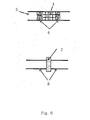
- the reaction tube is modified according to the form of the sample, and Fig. 6 shows a simplified example thereof.
- the center of a silica glass reaction tube (5) is packed with the sample, and the ends of the sample are held in place with rock wool (6).
- the ends of the sheet are held in place with silica glass tubes (8) via a sealant, and the silica glass tubes are fixed to the sample sheet.
- the oxidation catalyst function of a powder and a molded article was examined for propylene, benzene, and methane, which revealed that all of these hydrocarbons are decomposed at a temperature of 400°C or higher.
- a conductive material and a binder were mixed into Ca 12 (Al 14-X Si X )O 33+0.5X (the powdered substance of the present invention; 0 ⁇ X ⁇ 4) to prepare a mix in the form of a paste, and this was use to coat the surface of an aluminum foil collector to produce an electrode.
- the conductive material is used to ensure electrical conductivity, and can be, for example, carbon black, acetylene black, graphite, or the like, either singly or in mixtures of two or more materials.
- the binder is used to bind the conductive material particles together with the powdered substance of the present invention, and can be, for example, Teflon®, polytetrafluoroethylene, polyvinylidene fluoride, or a fluororubber.
- An electrode coated with the substance of the present invention is disposed across from a metallic lithium with a separator (nonwoven cloth) in between.
- a constant current of 0.1 mA/cm 2 was allowed to flow for a specific length of time up to 4.5 V between the metallic lithium and the electrode in an organic solvent containing a lithium salt, after which the substance of the present invention was recovered and washed and its composition examined and found to be LiyCa 12 (Al 14-X Si X )O 33+0.5X (where 0 ⁇ y ⁇ 30), which confirmed that the substance of the present invention had the characteristics of lithium ions being inserted.
- the present invention relates to an aluminosilicate having a zeolite-like structure in which active oxygen (superoxide: O 2 - , peroxide: O 2 2- ) is encapsulated, and more specifically, to a novel active oxygen developing substance and a molded article thereof.
- the effects of the present invention are (1) the active oxygen included or occluded in the structure produces a hydrocarbon oxidation reaction (such as epoxidation, complete oxidation, partial oxidation, and coupling), and the novel aluminosilicate catalyst supporting cobalt oxide of the present invention can be utilized in a wide range of technological fields dealing with the environment, energy, the chemical industry (manufacturing process), and so forth, and (2) the molded inorganic compound of the present invention is useful, for example, as an exhaust gas purification catalyst for two-wheeled vehicles, a solid electrolyte for secondary cells, an oxygen occlusion carrier, and so on.
- the novel catalyst of the present invention can be produced by using an aluminosilicate as a support, and supporting microparticles of cobalt oxide on the surface of this aluminosilicate.
- This aluminosilicate has a compositional formula of Ca 12 (Al 14-X Si X )O 33+0.5X , and the value of X in the compositional formula is in the range of 0 ⁇ X ⁇ 4.
- An example of the supporting method is to immersion the aluminosilicate in a cobalt nitrite aqueous solution and perform evaporative drying.
- the cobalt nitrate supported on the aluminosilicate surface decomposes into cobalt oxide, creating an aluminosilicate catalyst supporting cobalt oxide.
- nickel oxide, iron oxide, or another metal oxide can be used instead of cobalt oxide, for example.
- the novel catalyst of the present invention is obtained by synthesizing cobalt-containing hydrogarnet as a precursor substance by a wet heat method, and heating this product at 300°C or higher.
- the chemical composition thereof is expressed by (Ca 3-Y CO Y )Al 2 (SiO 4 ) 3-Z (OH) 4Z .
- the novel catalyst of the present invention is characterized in that the Y value in the compositional formula is in the range of 0 ⁇ Y ⁇ 0.10, and Z in the range of 0 ⁇ Z ⁇ 2.2.
- the novel catalyst of the present invention can be utilized as an oxidation catalyst or the like.
- the aluminosilicate catalyst supporting cobalt oxide of the present invention is manufactured by synthesizing a cobalt-containing hydrogarnet in which some of the Ca 2+ ions (a constituent element of hydrogarnet) have been replaced with Co 2+ ions, and then heating and decomposing this product.
- hydrogarnet itself will first be described.
- Hydrogarnet has a garnet structure, and its compositional formula is Ca 3 Al 2 (SiO 4 ) 3-Y (OH) 4Y .
- the value of Y here is in the range of 0 ⁇ Y ⁇ 3.
- the compositional formula of hydrogarnet varies with the Y value.
- the Ca 2+ ions in the hydrogarnet structure can be substituted with other cations of similar ion radius, such as Co 2+ ions.
- the method for manufacturing the aluminosilicate catalyst supporting cobalt oxide of the present invention will now be described, but this is not intended to limit the method for manufacturing the aluminosilicate catalyst supporting cobalt oxide of the present invention.
- the cobalt-containing hydrogarnet used as a precursor of the aluminosilicate catalyst supporting cobalt oxide is prepared as follows. First, a cobalt source, a calcia source, an alumina source, and a silica source are mixed so as to match the hydrogarnet composition, that is, the composition of cobalt-containing hydrogarnet with the desired X and Y values, and an excess of water is added to this to prepare a mixture.
- the cobalt source here can be cobalt hydroxide, cobalt oxide, or the like;
- the calcia source can be slaked lime, unslaked lime, calcium carbonate, gypsum, or the like;
- the alumina source can be kaolin, alumina sol, boehmite, aluminum hydroxide, aluminum oxide, or the like;
- the silica source can be kaolin, silica, amorphous silica, diatomaceous earth, silica sand, quartz, or the like.
- the combined amount of cobalt and calcium is set to be "3" in the compositional formula (Ca 3-X Co X )Al 2 (SiO 4 ) 3-Y (OH) 4Y .
- the range is 0 ⁇ X ⁇ 0.10.
- the Y value is preferably in the range of 0 ⁇ Y ⁇ 2.2.
- the prepared mixture is subjected to a wet heat treatment in an autoclave for at least 5 hours at a temperature of from 100 to 200°C to synthesize cobalt-containing hydrogarnet.
- the reaction will not proceed adequately if the temperature is below 100°C, but too much thermal energy will be consumed if the temperature is over 200°C, so 100 to 200°C is the preferred range.
- the heating time can be shorter than 5 hours, but at least 5 hours is preferable in order to obtain cobalt-containing hydrogarnet with good crystallinity.
- an aluminosilicate catalyst supporting cobalt oxide in which the cobalt oxide is highly dispersed can be manufactured by heating the cobalt-containing hydrogarnet to between 300°C and 1000°C in an air atmosphere. The decomposition of the cobalt-containing hydrogarnet will be inadequate if the heating is at a temperature below 300°C, and while the heating may be performed at a temperature over 1000°C, this is undesirable from the standpoint of conserving energy.
- the ion used for substitution need not be limited to cobalt, and any other ion that can be substituted may be used instead. It is well known that a high-performance catalyst in which the catalyst particles are highly dispersed can be synthesized by substituting metal ions in the crystal structure and pyrolyzing.
- This catalyst manufacturing method is a proven technology in the case of using a layered double hydroxide (LDH) as a catalyst precursor (see, for example, F. Cavani, F. Trifiro, and A. Vaccari, Catal. Today, Vol. 11 (1991), p. 173; B. Chen and J.L. Falconer, J. Catal ., Vol. 144 (1993), p . 214; S. Velu, R. Veda, A.
- LDH layered double hydroxide
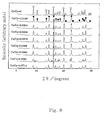
- Fig. 8 shows the XRD results for cobalt-containing hydrogarnet synthesized by the above method, with the Co/Ca ratio varied from 0 to 0.0714.
- the white circles are the diffraction peaks originating in hydrogarnet (Ca 3 Al 2 (SiO 4 ) 0.8 (OH) 8.8 ), the black circles are those originating in cobalt-containing hydrogarnet ((Ca 3-X Co X )Al 2 (SiO 4 ) 0.8 (OH) 8.8 ), and the triangles are those originating in cobalt oxide (Co 3 O 4 ).
- the compositional formula here is (Ca 2.9 Co 0.1 )Al 2 (SiO 4 ) 0.8 (OH) 8.8 .
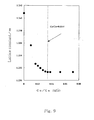
- the results in Fig. 8 were used to plot the graph of Fig. 9, which shows the relationship between lattice constant and Co/Ca ratio. Up to a Co/Ca ratio of 0.0344, the lattice constant steadily decreases from 1.2408 nm to 1.2313 nm, after which it remains at 1.2313 nm until the Co/Ca ratio is 0.0714.
- Lattice constants of cobalt-containing hydrogarnet [(Ca 3-X Co X )Al 2 (SiO 4 ) 0.8 (OH) 8.8 : 0 ⁇ X ⁇ 0.10] Co/Ca X Compositional formula a/nm V/nm 3 0 0 Ca 3 Al 2 (SiO 4 ) 0.8 (OH) 8.8 1.24078(15) 1.910 0.0101 0.03 (Ca 2.97 Co 0.03 )Al 2 (SiO 4 ) 0.8 (OH) 8.8 1.23563(6) 1.886 0.0169 0.05 (Ca 2.95 Co 0.05 )Al 2 (SiO 4 ) 0.8 (OH) 8.8 1.23263(6) 1.872 0.0204 0.06 (Ca 2.94 Co 0.06 )Al 2 (SiO 4 ) 0.8 (OH) 8.8 1.23231(7) 1.871 0.0238 0.07 (Ca 2.93 Co 0.07 )Al 2 (SiO 4 ) 0.8 (OH)
- Table 2 shows the specific surface area and the cobalt oxide particle size when four types of cobalt-containing hydrogarnet were synthesized with different Co/Ca ratios of 0.0169, 0.0238, 0.0344, and 0.0714, and then heated at 400°C.
- the specific surface area was at its maximum of 6.5 m 2 /g when the hydrogarnet had a Co/Ca ratio of 0.0344, and was about 2 to 3 m 2 /g with other hydrogarnets.
- a larger cobalt oxide particle size is undesirable because it leads to a decrease in dispersibility, that is, a decrease in catalyst activity, so the particle size of the cobalt oxide needs to be as small as possible.
- Specific surface area and cobalt oxide particle size of four types of cobalt-containing hydrogarnet (with different Co/Ca ratios of 0.0169, 0.0238, 0.0344, and 0.0714) after heating at 400°C.
- Co/Ca 0.0169 0.0238 0.0344 0.0714
- Table 3 shows the relationship of specific surface area and cobalt oxide particle size to the heating temperature of cobalt-containing hydrogarnet with a Co/Ca ratio of 0.0344.
- the specific surface area was roughly the same (5.7 and 6.5 m 2 /g) after heating at 350 and 400°C, but decreased steadily after heating at 450°C and above.
- the cobalt oxide particle size was roughly the same (260 and 275 ⁇ ) after heating at 350 and 400°C, but increased steadily from 447 ⁇ after heating at 450°C and above.
- the above results indicate that a Co/Ca ratio of 0.0344 and a heating temperature of 400°C or lower are preferable for manufacturing an aluminosilicate catalyst supporting cobalt oxide.
- the reaction apparatus was a normal pressure, compact, fixed bed, flow through type.
- the catalyst particle size was 300 to 500 ⁇ m
- the reaction temperature was from room temperature to 500°C
- three types of reaction gas propylene, benzene, and toluene
- the reaction gas concentration was 1000 ppm
- the flow-through gas was air
- the gas flux was 100 mL/min
- the space velocity was 10,000 h -1
- gas analysis was performed by gas chromatography (packing material: Porapak P, 5A molsieve, activated carbon, column: 2 m ⁇ 3).
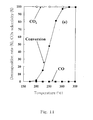
- Fig. 11 shows the results of subjecting propylene to oxidative decomposition at various reaction temperatures using (Ca 2.9 Co 0.1 )Al 2 (SiO 4 ) 0.8 (OH) 8.8 as the catalyst.
- the decomposition rate was 2% at a reaction temperature of 200°C, but the decomposition rate rose along with temperature, reaching 100% at 325°C.
- the product after decomposition was only CO 2 . H 2 O was produced, but was not analyzed. Meanwhile, with a catalyst not substituted with cobalt, that is, just an aluminosilicate, the decomposition rate was zero at a reaction temperature of 325°C, was 2% at 400°C, and reached 100% at 625°C.
- the above results mean that it is possible to lower the combustion temperature by using an aluminosilicate as a catalyst, and that the catalytic activity of an aluminosilicate increases by about 200°C when part of its calcium is substituted with cobalt, and the present invention makes it possible to realize even lower temperatures in these oxidative decomposition reactions.
- the catalyst of the present invention is useful as an oxidation catalyst for the oxidative decomposition of volatile organic compounds, hydrocarbons, and other such materials to be treated.
- An aluminosilicate catalyst supporting cobalt oxide that has the above features can be obtained as a powder in the manufacturing method thereof.
- the form of the molded article will be determined by the intended use, and the molding method can be any one that is used in the manufacture of molded ceramics.
- Possible forms of the molded article include pellets, granules, a sheet, a rod, a tube, hollow fibers, a monolith, and a honeycomb, and examples of molding methods include casting, press molding, dry CIP molding, injection molding, and sheet molding. Naturally, whether the molded article will be solid or porous is taken into account along with the desired form in molding.
- Fig. 12 is a simplified view of an example of the measurement apparatus used to examine the oxidation catalyst performance of the substance of the present invention.
- This apparatus consists of (1) a gas supply unit, (2) a heating unit, and (3) a gas analysis unit.
- the gas supply unit supplies the hydrocarbons to be subjected to oxidative decomposition, and the air or oxygen used as a combustion auxiliary.
- the heating unit heats a reaction tube filled with the sample to a specific temperature.
- the gas analysis unit analyzes the composition of the supply gas that has passed through the sample.
- the reaction tube is modified according to the form of the sample, and Fig. 13 shows a simplified example thereof.
- the center of a silica glass reaction tube (5) is packed with the sample, and the ends of the sample are held in place with rock wool (6).
- the ends of the sheet are held in place with silica glass tubes (8) via a sealant, and the silica glass tubes are fixed to the sample sheet.
- the present invention relates to an aluminosilicate catalyst supporting cobalt oxide, and to a method for manufacturing this catalyst, and with the present invention, 1) it is possible to provide a catalyst with higher activity than conventional oxidation or combustion catalysts, 2) higher oxidation capability can be achieved at lower temperatures than with conventional catalysts, 3) an aluminosilicate catalyst supporting cobalt oxide can be manufactured by a simple process under lower temperature conditions (at least 300°C and no higher than 1000°C), and 4) this catalyst is useful as a way to oxidatively decompose volatile organic compounds and the like.
- FIGs. 1 and 2 show the ESR and Raman spectroscopy results at room temperature for the Ca 12 Al 10 Si 4 O 35 produced by this method. As discussed above, Ca 12 Al 10 Si 4 O 35 was confirmed to include or occlude active oxygen in its structure.
- the decomposition rate rose along with the reaction temperature, reaching 50% at 500°C, 95% at 550°C, and 100% at over 600°C.
- the only gases produced by the decomposition of the propylene were CO 2 and H 2 O, indicating that a propylene oxidative decomposition reaction had occurred.
- the decomposition rate rose along with the reaction temperature, reaching 10% at 450°C, 37% at 500°C, 86% at 550°C, 98% at 600°C, and 100% at over 625°C.
- the only gases produced by the decomposition of the benzene were CO 2 , CO, and H 2 O, indicating that a benzene oxidative decomposition reaction had occurred.
- the decomposition rate rose along with the reaction temperature, reaching 60% at 500°C and 100% at over 600°C.
- the only gases produced by the decomposition of the propylene were CO 2 and H 2 O, indicating that a propylene oxidative decomposition reaction had occurred.
- a mix was prepared by mixing 25 weight parts ketjen black (as a conductive material) and 5 weight parts Teflon® (as a binder) into 70 weight parts Ca 12 Al 10 Si 4 O 35 .
- the mix was press molded on the surface of an aluminum foil collector with a thickness of 22 ⁇ m, producing a sheet with a thickness of 50 ⁇ m, and this sheet was then punched out in a diameter of 15 mm to produce a disk-shaped electrode.
- This electrode was disposed across from a disk of metallic lithium with a thickness of 0.1 mm and a diameter of 15 mm, and a piece of nonwoven cloth with a thickness of 100 ⁇ m was disposed as a separator between the electrode and the metallic lithium.
- a solution produced by dissolving 1 mol of LiPF 6 in a mixed solvent of ethylene carbonate and diethyl carbonate (3:7 volumetric ratio) was used for the electrolyte.
- the composition of the electrode material was analyzed after the material was washed with diethyl carbonate, which revealed it to be Li 30 Ca 12 (Al 14-X Si X ) 33+0.5X .
- Fig. 11 shows the results when the oxidative decomposition of propylene was carried out at various reaction temperatures using an aluminosilicate catalyst supporting cobalt oxide.
- the catalyst reaction experiment was conducted as follows.
- the reaction apparatus was a normal pressure, compact, fixed bed, flow through type, the catalyst particle size was 300 to 500 ⁇ m, the reaction temperature was from room temperature to 500°C, the reaction gas concentration was 1000 ppm, the flow-through gas was air, the gas flux was 100 mL/min, the space velocity was 10,000 h -1 , and gas analysis was performed by gas chromatography (packing material: Porapak P, 5A molsieve, activated carbon, column: 2 m ⁇ 3).
- the decomposition rate was 2% at a reaction temperature of 200°C, but the decomposition rate rose along with temperature, reaching 100% at 325°C.
- the product after decomposition was only CO 2 . H 2 O was produced, but was not analyzed.
- FIG. 14 shows the results of subjecting benzene to oxidative decomposition at various reaction temperatures.
- the decomposition rate was 0% at a reaction temperature of 200°C and 13% at 225°C, but the decomposition rate rose along with temperature, reaching 100% at 300°C.
- the product after decomposition was only CO 2 . H 2 O was produced, but was not analyzed.
- FIG. 15 shows the results of subjecting toluene to oxidative decomposition at various reaction temperatures.
- the decomposition rate was 0% at a reaction temperature of 225°C and 25% at 250°C, but the decomposition rate rose along with temperature, reaching 100% at 325°C.
- the products after decomposition were CO 2 and benzene. H 2 O was produced, but was not analyzed.
- the present invention relates to an aluminosilicate having a zeolite-like structure in which active oxygen (superoxide: O 2 - , peroxide: O 2 2- ) is encapsulated, that is, a novel active oxygen developing substance, and to a molded article of this substance.
- active oxygen included or occluded in the structure of this substance induces hydrocarbon oxidation reactions (such as epoxidation, complete oxidation, partial oxidation, and coupling), and the novel active oxygen developing substance of the present invention can be utilized in a wide range of technological fields dealing with the environment, energy, the chemical industry (manufacturing process), and so forth.
- a molded article of inorganic compound of the present invention is useful, for example, as an exhaust gas purification catalyst for two-wheeled vehicles, a solid electrolyte for secondary cells, an oxygen occlusion carrier, or the like.
- the present invention further relates to an aluminosilicate catalyst supporting cobalt oxide, and to a method for manufacturing this catalyst, and the present invention provides a catalyst with higher activity than conventional oxidation or combustion catalysts.
- the action of the active oxygen included or occluded in the structure of the aluminosilicate results in a higher oxidation capability at lower temperatures than conventional catalysts.
- An aluminosilicate catalyst supporting cobalt oxide can be manufactured by a simple process under lower temperature conditions (at least 300°C and no higher than 1000°C). This catalyst is useful as a way to oxidatively decompose volatile organic compounds and the like.
Landscapes
- Chemical & Material Sciences (AREA)
- Organic Chemistry (AREA)
- Engineering & Computer Science (AREA)
- Chemical Kinetics & Catalysis (AREA)
- Materials Engineering (AREA)
- Inorganic Chemistry (AREA)
- Environmental & Geological Engineering (AREA)
- Analytical Chemistry (AREA)
- Biomedical Technology (AREA)
- Dispersion Chemistry (AREA)
- Health & Medical Sciences (AREA)
- General Chemical & Material Sciences (AREA)
- Oil, Petroleum & Natural Gas (AREA)
- Physics & Mathematics (AREA)
- Thermal Sciences (AREA)
- Geology (AREA)
- Combustion & Propulsion (AREA)
- Life Sciences & Earth Sciences (AREA)
- General Life Sciences & Earth Sciences (AREA)
- Catalysts (AREA)
Applications Claiming Priority (5)
| Application Number | Priority Date | Filing Date | Title |
|---|---|---|---|
| JP2002240374 | 2002-08-21 | ||
| JP2002240374 | 2002-08-21 | ||
| JP2002246318 | 2002-08-27 | ||
| JP2002246318 | 2002-08-27 | ||
| PCT/JP2003/010497 WO2004018361A1 (ja) | 2002-08-21 | 2003-08-20 | 活性酸素を包含した無機化合物及びその製造法 |
Publications (2)
| Publication Number | Publication Date |
|---|---|
| EP1544169A1 true EP1544169A1 (de) | 2005-06-22 |
| EP1544169A4 EP1544169A4 (de) | 2010-02-24 |
Family
ID=31949550
Family Applications (1)
| Application Number | Title | Priority Date | Filing Date |
|---|---|---|---|
| EP03792734A Withdrawn EP1544169A4 (de) | 2002-08-21 | 2003-08-20 | Aktiven sauerstoff enthaltende anorganische verbindung und herstellungsverfahren daf r |
Country Status (4)
| Country | Link |
|---|---|
| US (1) | US7514384B2 (de) |
| EP (1) | EP1544169A4 (de) |
| AU (1) | AU2003257608A1 (de) |
| WO (1) | WO2004018361A1 (de) |
Cited By (1)
| Publication number | Priority date | Publication date | Assignee | Title |
|---|---|---|---|---|
| WO2011158188A1 (fr) * | 2010-06-16 | 2011-12-22 | Commissariat A L'energie Atomique Et Aux Energies Alternatives | Utilisation de nanoparticules pour le stockage "sec" longue duree de radicaux peroxydes |
Families Citing this family (6)
| Publication number | Priority date | Publication date | Assignee | Title |
|---|---|---|---|---|
| JP2007083126A (ja) * | 2005-09-20 | 2007-04-05 | Hirosaki Univ | 酸素貯蔵物質および自動車排ガス浄化用三元触媒における酸素貯蔵方法 |
| KR20090049562A (ko) * | 2006-08-21 | 2009-05-18 | 아사히 가라스 가부시키가이샤 | 플라즈마 디스플레이 패널 및 그 제조 방법 |
| JP2012243473A (ja) * | 2011-05-17 | 2012-12-10 | Toyota Motor Corp | 電極の製造方法 |
| JP5655769B2 (ja) | 2011-12-09 | 2015-01-21 | トヨタ自動車株式会社 | 電極の製造方法 |
| JP7141361B2 (ja) * | 2019-04-17 | 2022-09-22 | デンカ株式会社 | カルシウムアルミノシリケート、及び、水硬性組成物 |
| KR102574042B1 (ko) * | 2021-09-30 | 2023-09-07 | 한국전력공사 | 산소전달입자 제조용 원료 조성물, 이를 이용하여 제조된 산소전달입자 및 산소전달입자 제조방법 |
Family Cites Families (3)
| Publication number | Priority date | Publication date | Assignee | Title |
|---|---|---|---|---|
| JP3082855B1 (ja) | 1999-08-24 | 2000-08-28 | 高温酸性ガス固定化技術研究組合 | ハイドロガーネットの製造法及びハイドロガーネットによる高温酸性排ガスの除去法 |
| JP3531868B2 (ja) * | 2000-04-18 | 2004-05-31 | 独立行政法人 科学技術振興機構 | 活性酸素種を包接する12CaO・7Al2O3化合物およびその製造方法 |
| JP3475204B2 (ja) | 2000-12-28 | 2003-12-08 | 独立行政法人産業技術総合研究所 | 炭化水素及びハロゲン含有有機物燃焼分解除去剤 |
-
2003
- 2003-08-20 AU AU2003257608A patent/AU2003257608A1/en not_active Abandoned
- 2003-08-20 US US10/524,833 patent/US7514384B2/en not_active Expired - Fee Related
- 2003-08-20 WO PCT/JP2003/010497 patent/WO2004018361A1/ja not_active Ceased
- 2003-08-20 EP EP03792734A patent/EP1544169A4/de not_active Withdrawn
Cited By (3)
| Publication number | Priority date | Publication date | Assignee | Title |
|---|---|---|---|---|
| WO2011158188A1 (fr) * | 2010-06-16 | 2011-12-22 | Commissariat A L'energie Atomique Et Aux Energies Alternatives | Utilisation de nanoparticules pour le stockage "sec" longue duree de radicaux peroxydes |
| FR2961503A1 (fr) * | 2010-06-16 | 2011-12-23 | Commissariat Energie Atomique | Utilisation de nanoparticules pour le stockage "sec" longue duree de radicaux peroxydes. |
| CN103118972A (zh) * | 2010-06-16 | 2013-05-22 | 原子能和替代能源委员会 | 纳米粒子在过氧自由基的长期“干燥”储存中的应用 |
Also Published As
| Publication number | Publication date |
|---|---|
| WO2004018361A1 (ja) | 2004-03-04 |
| US20060045834A1 (en) | 2006-03-02 |
| AU2003257608A1 (en) | 2004-03-11 |
| US7514384B2 (en) | 2009-04-07 |
| EP1544169A4 (de) | 2010-02-24 |
Similar Documents
| Publication | Publication Date | Title |
|---|---|---|
| Chen et al. | Porous Mn-based oxides for complete ethanol and toluene catalytic oxidation: the relationship between structure and performance | |
| KR101485201B1 (ko) | 배기 가스 스트림의 NOx를 환원시키는 촉매 및 제조 방법 | |
| Zhang et al. | MnO x–CeO 2 supported on a three-dimensional and networked SBA-15 monolith for NO x-assisted soot combustion | |
| Xie et al. | Catalytic performance of a Bi 2 O 3–Fe 2 O 3 system in soot combustion | |
| JP2013252465A (ja) | 排気ガス浄化用触媒担体及び排気ガス浄化用触媒 | |
| Challagulla et al. | Low temperature catalytic reduction of NO over porous Pt/ZIF-8 | |
| KR20090028689A (ko) | 전기화학 촉매계를 포함하는 정제 구조체 | |
| Kashif et al. | Fully selective catalytic oxidation of NO to NO2 over most active Ga-PCH catalyst | |
| Trivedi et al. | Design of active NiCo2O4‐δ spinel catalyst for abatement of CO‐CH4 emissions from CNG fueled vehicles | |
| WO1998000223A1 (en) | Nitrogen oxide adsorbing material | |
| Deng et al. | Synthesis, stability, and sulfation properties of sol− gel-derived regenerative sorbents for flue gas desulfurization | |
| Bahamonde et al. | Pillared clay and zirconia-based monolithic catalysts for selective catalytic reduction of nitric oxide by methane | |
| CN104302389B (zh) | 废气处理催化剂 | |
| US7514384B2 (en) | Inorganic compound containing active oxygen and process for producing the same | |
| JP4210750B2 (ja) | 活性酸素を包含した無機化合物及びその製造法 | |
| JPH08229404A (ja) | 排ガス浄化触媒および排ガス浄化装置 | |
| Díaz-Verde et al. | Copper catalysts supported on barium deficient perovskites for CO oxidation reaction | |
| Ye et al. | Sintering-resistant CuO/CeO 2 catalysts prepared via the reversed impregnation method for ethyl acetate oxidation | |
| Li et al. | Silicalite-1 zeolite encapsulated Pt nanoparticles via ligand-protected in-situ construction for boosting auto-exhaust carbon particle oxidation | |
| KR20130131214A (ko) | 혼합 세륨 산화물계 nox 환원 촉매계의 용도 | |
| Zhang et al. | Catalytic degradation of acetone by AMn2O5 based on A-site substitution | |
| Qu et al. | Three-dimensional ordered macroporous cerium–manganese composite oxide for NO oxidation | |
| JP2013530041A (ja) | 電気化学的触媒系 | |
| EP1020405B1 (de) | Produkt auf Basis von Aluminiumoxid, geeignet zur Verwendung als NOx Absorber | |
| JP4281061B2 (ja) | 活性酸素吸蔵物質及びその製造方法 |
Legal Events
| Date | Code | Title | Description |
|---|---|---|---|
| PUAI | Public reference made under article 153(3) epc to a published international application that has entered the european phase |
Free format text: ORIGINAL CODE: 0009012 |
|
| 17P | Request for examination filed |
Effective date: 20050316 |
|
| AK | Designated contracting states |
Kind code of ref document: A1 Designated state(s): AT BE BG CH CY CZ DE DK EE ES FI FR GB GR HU IE IT LI LU MC NL PT RO SE SI SK TR |
|
| AX | Request for extension of the european patent |
Extension state: AL LT LV MK |
|
| DAX | Request for extension of the european patent (deleted) | ||
| RBV | Designated contracting states (corrected) |
Designated state(s): DE GB |
|
| A4 | Supplementary search report drawn up and despatched |
Effective date: 20100125 |
|
| 17Q | First examination report despatched |
Effective date: 20100526 |
|
| STAA | Information on the status of an ep patent application or granted ep patent |
Free format text: STATUS: THE APPLICATION IS DEEMED TO BE WITHDRAWN |
|
| 18D | Application deemed to be withdrawn |
Effective date: 20141108 |