EP1544236A1 - Anordnung zur Lösung von abgenutzten Reifen zur gewinnung von Ölen, Kohlenstoff und Stahl - Google Patents
Anordnung zur Lösung von abgenutzten Reifen zur gewinnung von Ölen, Kohlenstoff und Stahl Download PDFInfo
- Publication number
- EP1544236A1 EP1544236A1 EP20040380257 EP04380257A EP1544236A1 EP 1544236 A1 EP1544236 A1 EP 1544236A1 EP 20040380257 EP20040380257 EP 20040380257 EP 04380257 A EP04380257 A EP 04380257A EP 1544236 A1 EP1544236 A1 EP 1544236A1
- Authority
- EP
- European Patent Office
- Prior art keywords
- tires
- dissolving
- coal
- steel
- unuseable
- Prior art date
- Legal status (The legal status is an assumption and is not a legal conclusion. Google has not performed a legal analysis and makes no representation as to the accuracy of the status listed.)
- Withdrawn
Links
- 239000003921 oil Substances 0.000 title claims description 44
- 229910000831 Steel Inorganic materials 0.000 title claims description 25
- 239000010959 steel Substances 0.000 title claims description 25
- 239000003245 coal Substances 0.000 title claims description 24
- 239000012530 fluid Substances 0.000 claims abstract description 57
- 238000010438 heat treatment Methods 0.000 claims abstract description 23
- 239000007789 gas Substances 0.000 claims abstract description 19
- 239000002184 metal Substances 0.000 claims description 10
- 238000000354 decomposition reaction Methods 0.000 claims description 6
- 239000000446 fuel Substances 0.000 claims description 6
- 239000003208 petroleum Substances 0.000 claims description 6
- 238000004064 recycling Methods 0.000 claims description 4
- 239000002699 waste material Substances 0.000 claims description 4
- 239000004033 plastic Substances 0.000 claims 1
- 239000000306 component Substances 0.000 description 7
- 238000000034 method Methods 0.000 description 6
- 230000000694 effects Effects 0.000 description 2
- 230000007613 environmental effect Effects 0.000 description 2
- 230000033001 locomotion Effects 0.000 description 2
- 238000004519 manufacturing process Methods 0.000 description 2
- 238000000197 pyrolysis Methods 0.000 description 2
- 239000002904 solvent Substances 0.000 description 2
- 230000000386 athletic effect Effects 0.000 description 1
- 230000015572 biosynthetic process Effects 0.000 description 1
- 239000004568 cement Substances 0.000 description 1
- 238000006243 chemical reaction Methods 0.000 description 1
- 230000002301 combined effect Effects 0.000 description 1
- 238000002485 combustion reaction Methods 0.000 description 1
- 230000002950 deficient Effects 0.000 description 1
- 238000010586 diagram Methods 0.000 description 1
- 238000005265 energy consumption Methods 0.000 description 1
- 239000003344 environmental pollutant Substances 0.000 description 1
- 239000003517 fume Substances 0.000 description 1
- 239000002480 mineral oil Substances 0.000 description 1
- 231100000719 pollutant Toxicity 0.000 description 1
- 238000005381 potential energy Methods 0.000 description 1
- 238000011084 recovery Methods 0.000 description 1
Images

Classifications
-
- C—CHEMISTRY; METALLURGY
- C08—ORGANIC MACROMOLECULAR COMPOUNDS; THEIR PREPARATION OR CHEMICAL WORKING-UP; COMPOSITIONS BASED THEREON
- C08J—WORKING-UP; GENERAL PROCESSES OF COMPOUNDING; AFTER-TREATMENT NOT COVERED BY SUBCLASSES C08B, C08C, C08F, C08G or C08H
- C08J11/00—Recovery or working-up of waste materials
- C08J11/04—Recovery or working-up of waste materials of polymers
- C08J11/06—Recovery or working-up of waste materials of polymers without chemical reactions
- C08J11/08—Recovery or working-up of waste materials of polymers without chemical reactions using selective solvents for polymer components
-
- C—CHEMISTRY; METALLURGY
- C10—PETROLEUM, GAS OR COKE INDUSTRIES; TECHNICAL GASES CONTAINING CARBON MONOXIDE; FUELS; LUBRICANTS; PEAT
- C10G—CRACKING HYDROCARBON OILS; PRODUCTION OF LIQUID HYDROCARBON MIXTURES, e.g. BY DESTRUCTIVE HYDROGENATION, OLIGOMERISATION, POLYMERISATION; RECOVERY OF HYDROCARBON OILS FROM OIL-SHALE, OIL-SAND, OR GASES; REFINING MIXTURES MAINLY CONSISTING OF HYDROCARBONS; REFORMING OF NAPHTHA; MINERAL WAXES
- C10G1/00—Production of liquid hydrocarbon mixtures from oil-shale, oil-sand, or non-melting solid carbonaceous or similar materials, e.g. wood, coal
- C10G1/10—Production of liquid hydrocarbon mixtures from oil-shale, oil-sand, or non-melting solid carbonaceous or similar materials, e.g. wood, coal from rubber or rubber waste
-
- C—CHEMISTRY; METALLURGY
- C08—ORGANIC MACROMOLECULAR COMPOUNDS; THEIR PREPARATION OR CHEMICAL WORKING-UP; COMPOSITIONS BASED THEREON
- C08J—WORKING-UP; GENERAL PROCESSES OF COMPOUNDING; AFTER-TREATMENT NOT COVERED BY SUBCLASSES C08B, C08C, C08F, C08G or C08H
- C08J2321/00—Characterised by the use of unspecified rubbers
-
- Y—GENERAL TAGGING OF NEW TECHNOLOGICAL DEVELOPMENTS; GENERAL TAGGING OF CROSS-SECTIONAL TECHNOLOGIES SPANNING OVER SEVERAL SECTIONS OF THE IPC; TECHNICAL SUBJECTS COVERED BY FORMER USPC CROSS-REFERENCE ART COLLECTIONS [XRACs] AND DIGESTS
- Y02—TECHNOLOGIES OR APPLICATIONS FOR MITIGATION OR ADAPTATION AGAINST CLIMATE CHANGE
- Y02W—CLIMATE CHANGE MITIGATION TECHNOLOGIES RELATED TO WASTEWATER TREATMENT OR WASTE MANAGEMENT
- Y02W30/00—Technologies for solid waste management
- Y02W30/50—Reuse, recycling or recovery technologies
- Y02W30/62—Plastics recycling; Rubber recycling
Definitions
- the invention consists of a system provided for the partial conversion into fuel of the tires that are now unuseable.
- the invention carries out the decomposition of discarded tires into each one of the components that form the tires in order to allow reuse thereof in different ways.
- the system of the invention carries out the decomposition of discarded tires into each one of the components thereof by means of a dissolving system that is carried out at medium temperatures and at atmospheric pressures.
- One embodiment of the invention provides for a reactor vessel wherein the tires are introduced and inside the reactor there is a heat carrying working fluid.
- the working fluid is heated by external heating of the reactor vessel.
- the fluid progressively soaks the tires until it is verified that they have begun to dissolve.
- the arrangement permits energy to be saved as the heat carrying fluid is heated by direct heating of the reactor tank.
- the working fluid is heated previously, until the fluid semivaporizes. Afterwards, the fluid is introduced into the reactor tire storage tank through small holes distributed in a pipe provided in the top part of the tank.
- the invention carries out solvolosis of the tires, in other words, dissolving in a dissolving medium, by the combined effect of the dissolving power of the working fluid and the temperature which the working fluid is at, the tires into their essential components, oil, coal and steel, which will later be recovered separately.
- the invention consists of a system that comprises a reactor tank, preferably with a cylindrical shape, wherein discarded tires are stored and wherein a heat carrying fluid, which gradually comes into contact with the surface of the tires is introduced. Likewise, the tires absorb the fluid and gradually soften until they dissolve.
- the invention provides for means for heating the heat carrying fluid, means which are selected among external heating means of the reactor tank in order to heat by direct contact the heat carrying fluid is in inside the reactor; means for previously heating the heat carrying fluid before it is introduced in the reactor tank and the combination thereof.
- the means for heating the reactor tank are defined by external heaters that are located in the bottom part of the reactor.
- the invention provides that the heaters can also comprise a connection to exhaust pipes of cogeneration engines for the heating thereof. Furthermore, there is an outlet to eliminate the gases introduced in said heaters coming from the exhaust pipe.
- the external heaters are comprised of electric, gas, gas oil, fuel heaters or a combination thereof.
- the temperature range at which the heat carrying fluid is heated is between 275°C and 350°C, which is a relatively low temperature, which represents an energy savings.
- the means for previously heating the heat carrying fluid before it is introduced in the reactor tank comprise a heat exchanger wherein the heat carrying fluid is heated to a previously established temperature between 350°C-450°C, in such a way that by effect of the temperature, the fluid passes to a semivaporization state in order to be introduced in the reactor tank.
- the working temperature is higher than in the previous case and consequently the energy savings is lower, but even so the temperature is not high and consequently, the energy consumption is not high either.
- the invention provides some means for introducing the heat carrying fluid which are selected among a duct, means for providing a shower of the heat carrying fluid, means located in the top part of the reactor tank and a combination thereof.
- the means for providing a shower of the heat carrying fluid are comprised of a pipe provided with a plurality of homogeneously distributed holes.
- the heat carrying fluid used is comprised of a product selected from among oils derived from petroleum stable at a temperature range of 275°C-350°C, fuel, used car oil, commercial locomotion or heating gas oil, oils derived from petroleum with a viscosity range similar to that of commercial gas oil and due to the properties thereof they can be useful as solvents.
- oils derived from petroleum stable at a temperature range of 275°C-350°C fuel, used car oil, commercial locomotion or heating gas oil
- This is the oil itself from tires that the invention obtains upon dissolving the tires and the combination thereof.
- the tank is reinforced with a flange and closed by means of a top cover and it is at atmospheric pressure.
- the feeding of the tires into the reactor tank can be done by an automatic feeder that can feed whole tires or previously cut up tires.
- the automatic feeder is located under the means for providing the heat carrying fluid so that the heat carrying fluid drops directly on the tires or pieces of tires as these tires or pieces of tires drop through the tank.
- the tires absorb the heat carrying fluid until it is verified that they gradually begin to dissolve.
- the tires decompose into their different components, all in such a way that as the level of tires drops, the tank is filled with tires through the cited automatic feeder.
- the invention provides for means for removing the product resulting from the dissolving of the tires that are selected between an overflow pipe placed in the top part of the reactor tank through which said product resulting from the dissolving of the tires comes out; a cone-shaped bottom of the tank that discharges into a horizontal pipe that permits the discharge of the heat carrying fluid and of the oil obtained from the decomposition of the tire, along with powdered coal dissolved therein, and a combination thereof; all in such a way that after the tire is dissolved its metal structure is stacked in the reactor, from which said structure is removed for recycling by some means for collecting the metal structure.
- the collecting means are provided for in the top part of the reactor tank and they preferably comprise a removable metal screen wherein the complete steel structure of the tires or the pieces of steel that form part of the pieces of the tire structure, is deposited. The screen is periodically removed and then put back in place in order to permit this component to be continuously eliminated.
- the above-cited heat exchanger is heated by means of a burner or by means of an exhaust pipe of a cogeneration engine, in this way taking advantage of the temperature of the exhaust fumes.
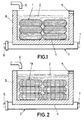
- Figures 1 and 2 describe an embodiment of the system of the invention that comprises a reactor tank (8) where the tires (1) are stored and which is filled with a heat carrying fluid (2), for example, by means of some filling means defined by a duct (6), in such a way that the fluid bathes the tires (1) deposited in the reactor tank (8).
- the fluid (2) is selected among used car oil, locomotion or heating gas oil, oils derived from petroleum with a viscosity range similar to that of commercial gas oil and which due to their properties, are considered as solvents, or else the oil itself of the tire obtained when the tire is decomposed according to the invention.
- the invention provides for the inclusion of external heaters (3) that carry out the heating of the reactor tank (8), and consequently, they produce the heating of the heat carrying fluid (2), which causes the gradual dissolving of the tires (1).
- the different products that comprise the tires such as oil and powdered coal that partially dissolve in the heat carrying fluid (2) are obtained.
- the oil floats and the powdered coal is dissolved, and they are recovered by an overflow pipe (5) where they are expelled outside for their recovery.
- the overflow pipe (5) In order to expel them through the overflow pipe (5), more tires are added to the inside of the reactor tank (8) until the fluid overflows.
- the metal structure (1a) of the tires is deposited, a structure that is removed through the top part of the reactor (8) for reuse.
- the heaters (3) be electric, gas, gas oil or fuel heaters or a combination thereof.
- Another embodiment of the invention provides for the heaters being provided with an inlet (7) for connection to the exhaust pipes of cogeneration engines, so that these engines provide the energy that causes the heating of the heaters.
- the heaters (3) are provided with an outlet (9) through which the gases coming from the exhaust pipe of the vehicle are eliminated.
- the system comprises a pipe (10) through which a cold heat carrying fluid is introduced in a heat exchanger (11), by means of which the fluid is heated and discharged through a pipe (12) that is connected to a pipe (13) included in the top part of the reactor tank (8) where cut up tires (14) are stored.
- the heat for the heat exchanger is introduced through the inlet (15) and comes out through the inlet (16) in order to close the heating circuit.
- the pieces of tire (14) are introduced inside the tank (8) by an automatic feeding system (17) that introduces the previously cut up tires inside the tank.
- This same system can be used in the description of figures 1 and 2, in order to introduce whole or cut up tires into the reactor tank.
- the tank comprises a screen (not represented) wherein the pieces of steel in each piece of tire (14) are deposited, in such a way that the screen is periodically removed in order to remove the accumulated pieces of steel and then put back into place so that the process is carried out continuously.
- This same screen can be used in the embodiment described in figures 1 and 2, in order to withdraw the steel structure once the tire has dissolved.
Landscapes
- Chemical & Material Sciences (AREA)
- Life Sciences & Earth Sciences (AREA)
- Oil, Petroleum & Natural Gas (AREA)
- Engineering & Computer Science (AREA)
- Chemical Kinetics & Catalysis (AREA)
- Organic Chemistry (AREA)
- Polymers & Plastics (AREA)
- Medicinal Chemistry (AREA)
- Health & Medical Sciences (AREA)
- Wood Science & Technology (AREA)
- General Chemical & Material Sciences (AREA)
- Sustainable Development (AREA)
- Separation, Recovery Or Treatment Of Waste Materials Containing Plastics (AREA)
- Production Of Liquid Hydrocarbon Mixture For Refining Petroleum (AREA)
Applications Claiming Priority (4)
| Application Number | Priority Date | Filing Date | Title |
|---|---|---|---|
| ES200401058 | 2003-12-15 | ||
| ES200401058A ES2249127B1 (es) | 2003-12-15 | 2003-12-15 | Sistema de disolucion de neumaticos fuera de uso para obtencion de aceites, carbon y acero. |
| ES200401717A ES2258383B1 (es) | 2003-12-15 | 2004-07-14 | Mejoras en la patente 200401058, por: sistema de disolucion de neumaticos fuera de uso para obtencion de aceites, carbon y acero. |
| ES200401717 | 2004-07-14 |
Publications (1)
| Publication Number | Publication Date |
|---|---|
| EP1544236A1 true EP1544236A1 (de) | 2005-06-22 |
Family
ID=34524935
Family Applications (1)
| Application Number | Title | Priority Date | Filing Date |
|---|---|---|---|
| EP20040380257 Withdrawn EP1544236A1 (de) | 2003-12-15 | 2004-12-13 | Anordnung zur Lösung von abgenutzten Reifen zur gewinnung von Ölen, Kohlenstoff und Stahl |
Country Status (1)
| Country | Link |
|---|---|
| EP (1) | EP1544236A1 (de) |
Cited By (5)
| Publication number | Priority date | Publication date | Assignee | Title |
|---|---|---|---|---|
| EP1770148A1 (de) * | 2005-10-03 | 2007-04-04 | CHUNG BONG, ChOON | Verfahren und Vorrichtung zur Herstellung von Öl aus Kunststoffabfällen |
| FR2909678A1 (fr) * | 2006-12-07 | 2008-06-13 | Inst Francais Du Petrole | Procede et dispositif pour la conversion de pneus usages en matiere valorisable par solvolyse |
| ES2335258A1 (es) * | 2008-07-11 | 2010-03-23 | Innovacion Y Nuevas Energias, S.A. | Procedimiento de recuperacion de neumaticos y aceites usados, y reactor para la puesta en practica del mismo. |
| WO2013077727A1 (en) * | 2011-11-24 | 2013-05-30 | Universiti Malaya | Method of producing graphene, carbon nano-dendrites, nano-hexacones and nanostructured materials using waste tyres |
| JP2014172934A (ja) * | 2013-03-06 | 2014-09-22 | Kyushu Institute Of Technology | 未加硫ゴム組成物の分離方法 |
Citations (8)
| Publication number | Priority date | Publication date | Assignee | Title |
|---|---|---|---|---|
| FR2490992A1 (fr) * | 1980-09-29 | 1982-04-02 | Inst Francais Du Petrole | Procede et installation pour la conversion thermique des pneus usages ou au rebut en matieres utilisables notamment comme combustibles |
| US4384150A (en) * | 1981-08-20 | 1983-05-17 | Lyakhevich Genrikh D | Method of making either a softener for rubber mixtures or a furnace fuel oil |
| DE3313470A1 (de) * | 1983-04-14 | 1984-10-18 | Morstadt, Werner, 7600 Offenburg | Verfahren zum aufarbeiten von altgummi, insbesondere reifengummi |
| EP0165585A2 (de) * | 1984-06-20 | 1985-12-27 | Fuchs Recycling Gmbh & Co Kg | Verfahren und Vorrichtung zum Entfernen von Gummi und/oder Kunststoff aus Verbundkörpern aus Metall und wenigstens einem dieser Materialien |
| WO1994008768A1 (en) * | 1992-10-08 | 1994-04-28 | Carpenter Roland K | Apparatus and methods for processing scrap tires |
| EP0652275A1 (de) * | 1993-10-28 | 1995-05-10 | Texaco Development Corporation | Reaktor und Verfahren zur Herstellung von Öl aus zerkleinerten Reifen |
| WO1999009092A1 (en) * | 1997-08-21 | 1999-02-25 | Edsview Belleggings (Proprietary) Limited | The reprocessing of polymeric products |
| WO2003052029A1 (en) * | 2001-12-19 | 2003-06-26 | Igor Skworcow | Method and installation for production of technological carbon and motor fuel during a processing of worn tires and other polymer waste materials |
-
2004
- 2004-12-13 EP EP20040380257 patent/EP1544236A1/de not_active Withdrawn
Patent Citations (8)
| Publication number | Priority date | Publication date | Assignee | Title |
|---|---|---|---|---|
| FR2490992A1 (fr) * | 1980-09-29 | 1982-04-02 | Inst Francais Du Petrole | Procede et installation pour la conversion thermique des pneus usages ou au rebut en matieres utilisables notamment comme combustibles |
| US4384150A (en) * | 1981-08-20 | 1983-05-17 | Lyakhevich Genrikh D | Method of making either a softener for rubber mixtures or a furnace fuel oil |
| DE3313470A1 (de) * | 1983-04-14 | 1984-10-18 | Morstadt, Werner, 7600 Offenburg | Verfahren zum aufarbeiten von altgummi, insbesondere reifengummi |
| EP0165585A2 (de) * | 1984-06-20 | 1985-12-27 | Fuchs Recycling Gmbh & Co Kg | Verfahren und Vorrichtung zum Entfernen von Gummi und/oder Kunststoff aus Verbundkörpern aus Metall und wenigstens einem dieser Materialien |
| WO1994008768A1 (en) * | 1992-10-08 | 1994-04-28 | Carpenter Roland K | Apparatus and methods for processing scrap tires |
| EP0652275A1 (de) * | 1993-10-28 | 1995-05-10 | Texaco Development Corporation | Reaktor und Verfahren zur Herstellung von Öl aus zerkleinerten Reifen |
| WO1999009092A1 (en) * | 1997-08-21 | 1999-02-25 | Edsview Belleggings (Proprietary) Limited | The reprocessing of polymeric products |
| WO2003052029A1 (en) * | 2001-12-19 | 2003-06-26 | Igor Skworcow | Method and installation for production of technological carbon and motor fuel during a processing of worn tires and other polymer waste materials |
Non-Patent Citations (1)
| Title |
|---|
| AUDIBERT F ; BEAUFILS J P: "THERMAL DEPOLYMERISATION OF WASTE TIRES BY HEAVY OILS: CONVERSION INTO FUELS", COMMIS EUR COMMUN REP EUR, 1983, DORDRECHT, NETH, pages 275 - 285, XP009044088 * |
Cited By (6)
| Publication number | Priority date | Publication date | Assignee | Title |
|---|---|---|---|---|
| EP1770148A1 (de) * | 2005-10-03 | 2007-04-04 | CHUNG BONG, ChOON | Verfahren und Vorrichtung zur Herstellung von Öl aus Kunststoffabfällen |
| FR2909678A1 (fr) * | 2006-12-07 | 2008-06-13 | Inst Francais Du Petrole | Procede et dispositif pour la conversion de pneus usages en matiere valorisable par solvolyse |
| ES2335258A1 (es) * | 2008-07-11 | 2010-03-23 | Innovacion Y Nuevas Energias, S.A. | Procedimiento de recuperacion de neumaticos y aceites usados, y reactor para la puesta en practica del mismo. |
| ES2335258B1 (es) * | 2008-07-11 | 2010-12-30 | Innovacion Y Nuevas Energias, S.A. | Procedimiento de recuperacion de neumaticos y aceites usados, y reactor para la puesta en practica del mismo. |
| WO2013077727A1 (en) * | 2011-11-24 | 2013-05-30 | Universiti Malaya | Method of producing graphene, carbon nano-dendrites, nano-hexacones and nanostructured materials using waste tyres |
| JP2014172934A (ja) * | 2013-03-06 | 2014-09-22 | Kyushu Institute Of Technology | 未加硫ゴム組成物の分離方法 |
Similar Documents
| Publication | Publication Date | Title |
|---|---|---|
| CN101824332A (zh) | 废旧塑料、轮胎、废机油的再生能源综合利用生产装备 | |
| CN104445815B (zh) | 一种兰炭生产废水资源化利用工艺方法及装置 | |
| CN105202546A (zh) | 固体有机废弃物资源化装置 | |
| Aziz et al. | Design and fabrication of a fixed-bed batch type pyrolysis reactor for pilot scale pyrolytic oil production in Bangladesh | |
| CN106635079A (zh) | 一种固废rdf处理方法 | |
| CN102268274A (zh) | 将城市污泥转换成气、液、固燃料方法及全封闭设备系统 | |
| CN109517612A (zh) | 一种连续高效绿色的废轮胎过热蒸汽能源转化方法 | |
| CN106867559B (zh) | 一种多级裂解连续生产的炼油方法 | |
| CN109990301B (zh) | 一种油类污染物负压反烧设备及回收油的方法 | |
| CN205261566U (zh) | 固体有机废弃物资源化装置 | |
| EP1544236A1 (de) | Anordnung zur Lösung von abgenutzten Reifen zur gewinnung von Ölen, Kohlenstoff und Stahl | |
| CN204281524U (zh) | 污泥处理系统 | |
| KR101699057B1 (ko) | 폐자원 전량 유용 에너지 전환시스템 | |
| CN101805636A (zh) | 一种废轮胎气化装置和方法 | |
| CN201713491U (zh) | 废旧塑料、轮胎、废机油的再生能源综合利用生产装备 | |
| CN107434978A (zh) | 一种废旧轮胎裂解气处理方法 | |
| CN105295985A (zh) | 一种废旧轮胎制取燃料油和可燃气的方法 | |
| CN1923957A (zh) | 废塑料热裂解制取柴油的设备和工艺方法 | |
| CN113429994A (zh) | 一种聚烯烃废塑料自放热相变热裂解工艺 | |
| US20150167968A1 (en) | Process and apparatus for covering the energy needs of communities using organic waste | |
| TW201206580A (en) | Production equipment for renewable energy released from waste plastics, tyres, and engine oil | |
| RU2662218C1 (ru) | Способ получения легкой нефти | |
| CN103145305A (zh) | 利用含油污泥制备合成气及合成天然气或合成汽油的工艺及焚烧装置 | |
| CN209412150U (zh) | 一种连续高效绿色的废轮胎自主过热蒸汽能源转化系统 | |
| CN201729800U (zh) | 煤物质的伞状支撑立式分解设备 |
Legal Events
| Date | Code | Title | Description |
|---|---|---|---|
| PUAI | Public reference made under article 153(3) epc to a published international application that has entered the european phase |
Free format text: ORIGINAL CODE: 0009012 |
|
| AK | Designated contracting states |
Kind code of ref document: A1 Designated state(s): AT BE BG CH CY CZ DE DK EE ES FI FR GB GR HU IE IS IT LI LT LU MC NL PL PT RO SE SI SK TR |
|
| AX | Request for extension of the european patent |
Extension state: AL BA HR LV MK YU |
|
| STAA | Information on the status of an ep patent application or granted ep patent |
Free format text: STATUS: THE APPLICATION HAS BEEN WITHDRAWN |
|
| 18W | Application withdrawn |
Effective date: 20051122 |