EP1544763A1 - Surveillance de processus - Google Patents
Surveillance de processus Download PDFInfo
- Publication number
- EP1544763A1 EP1544763A1 EP03029396A EP03029396A EP1544763A1 EP 1544763 A1 EP1544763 A1 EP 1544763A1 EP 03029396 A EP03029396 A EP 03029396A EP 03029396 A EP03029396 A EP 03029396A EP 1544763 A1 EP1544763 A1 EP 1544763A1
- Authority
- EP
- European Patent Office
- Prior art keywords
- status
- task
- rules
- computer
- sub
- Prior art date
- Legal status (The legal status is an assumption and is not a legal conclusion. Google has not performed a legal analysis and makes no representation as to the accuracy of the status listed.)
- Ceased
Links
Images


Classifications
-
- G—PHYSICS
- G06—COMPUTING OR CALCULATING; COUNTING
- G06Q—INFORMATION AND COMMUNICATION TECHNOLOGY [ICT] SPECIALLY ADAPTED FOR ADMINISTRATIVE, COMMERCIAL, FINANCIAL, MANAGERIAL OR SUPERVISORY PURPOSES; SYSTEMS OR METHODS SPECIALLY ADAPTED FOR ADMINISTRATIVE, COMMERCIAL, FINANCIAL, MANAGERIAL OR SUPERVISORY PURPOSES, NOT OTHERWISE PROVIDED FOR
- G06Q10/00—Administration; Management
- G06Q10/10—Office automation; Time management
-
- G—PHYSICS
- G06—COMPUTING OR CALCULATING; COUNTING
- G06Q—INFORMATION AND COMMUNICATION TECHNOLOGY [ICT] SPECIALLY ADAPTED FOR ADMINISTRATIVE, COMMERCIAL, FINANCIAL, MANAGERIAL OR SUPERVISORY PURPOSES; SYSTEMS OR METHODS SPECIALLY ADAPTED FOR ADMINISTRATIVE, COMMERCIAL, FINANCIAL, MANAGERIAL OR SUPERVISORY PURPOSES, NOT OTHERWISE PROVIDED FOR
- G06Q10/00—Administration; Management
- G06Q10/06—Resources, workflows, human or project management; Enterprise or organisation planning; Enterprise or organisation modelling
- G06Q10/063—Operations research, analysis or management
- G06Q10/0631—Resource planning, allocation, distributing or scheduling for enterprises or organisations
-
- G—PHYSICS
- G06—COMPUTING OR CALCULATING; COUNTING
- G06Q—INFORMATION AND COMMUNICATION TECHNOLOGY [ICT] SPECIALLY ADAPTED FOR ADMINISTRATIVE, COMMERCIAL, FINANCIAL, MANAGERIAL OR SUPERVISORY PURPOSES; SYSTEMS OR METHODS SPECIALLY ADAPTED FOR ADMINISTRATIVE, COMMERCIAL, FINANCIAL, MANAGERIAL OR SUPERVISORY PURPOSES, NOT OTHERWISE PROVIDED FOR
- G06Q10/00—Administration; Management
- G06Q10/08—Logistics, e.g. warehousing, loading or distribution; Inventory or stock management
- G06Q10/087—Inventory or stock management, e.g. order filling, procurement or balancing against orders
Definitions
- the present invention relates to a computer-implemented method for providing process monitoring functionality.
- the invention relates in particular to product development process, which may be aided by software.
- the invention also relates to a computer program, and a computer program product for providing process monitoring functionality.
- the present invention relates to a computer for providing process monitoring functionality as well as to a data structure for providing process monitoring functionality.
- a trial is an action for testing a product in order to achieve the required product quality/specification.
- a trial allows finding product specifications for a product on a defined product line at optimal cost. More specifically, a trial is the manufacture of a product by using a recipe.
- a recipe may consist of formula, processing conditions, quality inspection parameters, in-process control, and equipment specification. Not all of these parameters are required.
- a recipe also allows the subsequent evaluation of all trial results. The trial may be carried out on a bench scale, pilot plant scale, or industrial scale.
- a trial management software and trial design formulation has to provide functionality for supported recipe and process definition, scheduling, preparation, and execution. Furthermore, functionality for planning and carrying out in-process, and post-process analyses has to be provided. In order to facilitate decisions, a reporting, and evaluation functionality should be available.
- a cross-area business process may comprise different tasks, and activities involving different business objects.
- An employee has different tasks to perform during a certain process. However, some tasks may be dependent on certain other tasks being completed by other employees.
- the employee In order to perform his tasks, the employee should be able to check, whether any pre-requisite tasks are already finished, or what their statuses are. In particular, when more than one sub-tasks have to be performed, their inter dependence should be defined by rules. For instance, a certain task may be started while some other tasks are still on execution, but with some finished sub-tasks. It may also be possible that a task may only be started, in case some other tasks, which are a pre-requisite for the certain task, are already finished. A detailed status of individual activities should therefore be summarised and visualized using rules.
- Various different business objects comprising activities and tasks, may be combined to define a process.
- This process is defined by a process flow.
- certain tasks which have to be fulfilled may be defined as pre-requisites, to achieve a certain process stage.
- a business process may be designed using various business objects. To test a process, it may be defined as a trial process. Within this trial process, the different business objects may be defined with different attributes. Within a trial, the inter dependence of different business objects and a process flow may be tested. Different objects from different business unites may be used, thereby providing a cross-business trial environment.
- the invention proposes a computer-implemented method for providing process monitoring functionality, with the steps of defining a process object comprising at least one task object, defining for said task object at least one activity status, providing rules within said process object, said rules defining a process object status based on said at least one activity status, and executing said rules on said at least one activity status of said at least one task object to determine said process object status.
- the pre-requisites to achieve a certain process stage may be monitored.
- the tasks necessary to achieve a certain process status may have various activity statutes. These activity statutes may comprise information about the progress of the certain task.
- rules may be defined, which represent the interdependence of the tasks. When applying these rules, a summarised process status may be determined. This process status may be used for controlling the progress of a business process, e.g. product development.
- the inventive method allows a responsible or interested person, such as a project leader or product manager, to control the accomplishment of milestones of a project, and which milestones are still open.
- This monitoring tool supports the project leader to control and run, for instance, a trial process.
- the method allows providing a simplified view on different, and possibly complex tasks of a business process, such as a trial process.
- the different activities, and tasks of a trial process may be executed using a simplified interface.
- a task monitor presenting a business object may be provided. Within this business object, tasks, which depend on the respective type of the objects, may be defined.
- the business object may be split into several tasks that have to be performed in a certain sequence. Each task has an overall status, which may be visualised by certain icons.
- the project leader, or any other user may see the progress of a process, such as a trial by monitoring the status of the tasks. For each task, the project leader may see detailed status information about the related sub-tasks, which cause the overall status.
- a transfer of results for factory production may be possible out of a trail. Its results may at any stage, in particular during or after pilot plant trials, be transferred into a factory for production. The results may provide all necessary information for production.
- sub-task objects may define sub-tasks, e.g. activities to be done to finish the main task.
- the activity status of a task may depend on the statuses of the sub-tasks. To get an overview of the statuses of a task, it is proposed that each sub-task provides a status, and that said sub-task status determines said activity status.
- a task object which may be a business object comprised of various items, may be comprised of different statuses. It is therefore proposed that a status relevant for said process object status is extracted from said task object. Not all statuses within a task object are relevant for the business process. Therefore, only the relevant statuses should be extracted.
- each task the user may see detailed status information about the related sub-tasks, which cause the overall status.
- a double click on the task may then forward the process to the next task.
- a process may be shown on a work bench. In this case, each task may use a single row or column to show its status. By selecting the task, the sub-tasks may be presented.
- said task and/or said sub-task is selectably visualised and that upon selection of said task and/or said sub-task the respective status is editable.
- a user Upon selection a user my edit the status, which may be advancing the status to the next stage.
- a task and/or a sub-task may be provided with any other appropriate status. Editing the status may depend on user authorisation, which may be defined in user roles.
- said process object status and/or said activity status and/or said sub-task status is visualised.
- visualising the status a user may directly see the progress of a process.
- a summarised task status is determined and that said summarised task status is visualised. Determining a summarised task status may be done depending on said defined rules and the statuses of tasks and sub-tasks.
- the rules may define, which activity statuses and sub-task statuses result in which overall status.
- the result may be visualised as a summarised status.
- the summarised task status information may also be stored for future monitoring.
- a detailed task status is determined, and said detailed task status is visualised.
- Said detailed task status provides information about the progress of a status, e.g. the statuses of the sub-tasks.
- said rules define a process flow and that said status is calculated based on said rules.
- the various tasks within a process object may define a process flow.
- the succession of tasks within a process flow may then be defined by said rules.
- the rules may be applied on the activity statuses. According to the rules, the process flow is reproduced and the resulting object status may be calculated.
- said rules define pre-requisites of sub-task statuses and/or activity statuses which have to be matched to reach a certain process object status and/or activity status, respectively. Thereby, the rules may be used to determine a process object status or activity status. The user does not have to take sub-task statuses and/or activity statuses into account to determine the process object status or activity status, respectively.
- said rules are defined to lock a task in case at least one sub-task has a pre-defined status. For example, in case a sub-task has not yet been finished, the superordinate task may not be advanced to the next stage. Then, the rules may be defined to lock this task, e.g. not allowing this task to proceed to the next stage.
- Possible statuses of said activity status and/or said sub-task status may be indicated as error, warning, requirement, locked, OK, incomplete, or info. Each of this indications results in certain accessibility conditions of the tasks and sub-tasks.
- a further aspect of the invention is a computer program for providing process monitoring functionality, operable to cause a processor to store a process object definition comprising at least one task object, at least one activity status defined for said task object, and rules provided within said process object, said rules defining a process object status based on said at least one activity status, and execute said rules on said at least one activity status of said at least one task object to determine said process object status.
- Another aspect of the invention is a computer program product for providing process monitoring functionality, with a computer program stored thereon operable to cause a processor to store a process object definition comprising at least one task object, at least one activity status defined for said task object, and rules provided within said process object, said rules defining a process object status based on said at least one activity status, and execute said rules on said at least one activity status of said at least one task object to determine said process object status.
- Yet another aspect of the invention is a computer for providing process monitoring functionality, comprising storage means to store a process object definition comprising at least one task object, at least one activity status defined for said task object, and rules provided within said process object, said rules defining a process object status based on said at least one activity status, and computing means to execute said rules on said at least one activity status of said at least one task object to determine said process object status.
- another aspect of the invention is a data structure for providing process monitoring functionality, with definitions for a process object comprising at least one task object, at least one activity status for said task object, rules within said process object, said rules defining a process object status based on said at least one activity status, whereby said definitions provide executing said rules on said at least one activity status of said at least one task object to determine said process object status.
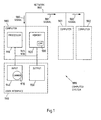
- Fig. 1 illustrates a simplified block diagram of exemplary computer system 999 having a plurality of computers 900, 901, 902 (or even more).
- the present invention is implemented by computers, within a computer network.
- An example is illustrated in connection with figure 1.
- Computer 900 can communicate with computers 901 and 902 over network 990.
- Computer 900 has processor 910, memory 920, bus 930, and, optionally, input device 940 and output device 950 (I/O devices, user interface 960).
- the invention is implemented by computer program product 100 (CPP), carrier 970 and signal 980.
- computer 901/902 is sometimes referred to as "remote computer", computer 901/902 is, for example, a server, a peer device or other common network node, and typically has many or all of the elements described relative to computer 900.
- Computer 900 is, for example, a conventional personal computer (PC), a desktop device or a hand-held device, a multiprocessor computer, a pen computer, a microprocessor-based or programmable consumer electronics device, a minicomputer, a mainframe computer, a personal mobile computing device, a mobile phone, a portable or stationary personal computer, a palmtop computer or the like.
- Processor 910 is, for example, a central processing unit (CPU), a micro-controller unit (MCU), digital signal processor (DSP), or the like.
- Memory 920 is elements that temporarily or permanently store data and instructions. Although memory 920 is illustrated as part of computer 900, memory can also be implemented in network 990, in computers 901/902 and in processor 910 itself (e.g., cache, register), or elsewhere. Memory 920 can be a read only memory (ROM), a random access memory (RAM), or a memory with other access options. Memory 920 is physically implemented by computer-readable media, for example: (a) magnetic media, like a hard disk, a floppy disk, or other magnetic disk, a tape, a cassette tape; (b) optical media, like optical disk (CD-ROM, digital versatile disk - DVD); (c) semiconductor media, like DRAM, SRAM, EPROM, EEPROM, memory stick.
- ROM read only memory
- RAM random access memory
- Memory 920 is physically implemented by computer-readable media, for example: (a) magnetic media, like a hard disk, a floppy disk, or other magnetic disk, a tape, a cassette tape; (b) optical media, like
- memory 920 is distributed. Portions of memory 920 can be removable or non-removable.
- computer 900 uses well-known devices, for example, disk drives, or tape drives.
- Memory 920 stores modules such as, for example, a basic input output system (BIOS), an operating system (OS), a program library, a compiler, an interpreter, and a text-processing tool. Modules are commercially available and can be installed on computer 900. For simplicity, these modules are not illustrated.
- BIOS basic input output system
- OS operating system
- program library a program library
- compiler a compiler
- interpreter a text-processing tool
- CPP 100 has program instructions and - optionally - data that cause processor 910 to execute method steps of the present invention.
- CPP 100 can control the operation of computer 900 and its interaction in network system 999 so that is operates to perform in accordance with the invention.
- CPP 100 can be available as source code in any programming language, and as object code ("binary code") in a compiled form.
- CPP 100 is illustrated as being stored in memory 920, CPP 100 can be located elsewhere. CPP 100 can also be embodied in carrier 970.
- Carrier 970 is illustrated outside computer 900. For communicating CPP 100 to computer 900, carrier 970 is conveniently inserted into input device 940. Carrier 970 is implemented as any computer readable medium, such as a medium largely explained above (cf. memory 920). Generally, carrier 970 is an article of manufacture having a computer readable medium with computer readable program code to cause the computer to perform methods of the present invention. Further, signal 980 can also embody computer program product 100.
- CPP 100 carrier 970, and signal 980 in connection with computer 900 is convenient.
- further carriers and further signals embody computer program products (CPP) to be executed by further processors in computers 901 and 902.
- CPP computer program products
- Input device 940 provides data and instructions for processing by computer 900.
- Device 940 can be a keyboard, a pointing device (e.g., mouse, trackball, cursor direction keys), microphone, joystick, game pad, scanner, or disc drive.
- a wireless receiver e.g., with satellite dish or terrestrial antenna
- a sensor e.g., a thermometer
- a counter e.g., a goods counter in a factory.
- Input device 940 can serve to read carrier 970.
- Output device 950 presents instructions and data that have been processed. For example, this can be a monitor or a display, (cathode ray tube (CRT), flat panel display, liquid crystal display (LCD), speaker, printer, plotter, vibration alert device. Output device 950 can communicate with the user, but it can also communicate with further computers.
- CTR cathode ray tube
- LCD liquid crystal display
- Output device 950 can communicate with the user, but it can also communicate with further computers.
- Input device 940 and output device 950 can be combined to a single device. Any device 940 and 950 can be provided optional.
- Bus 930 and network 990 provide logical and physical connections by conveying instruction and data signals. While connections inside computer 900 are conveniently referred to as “bus 930", connections between computers 900-902 are referred to as “network 990". Optionally, network 990 includes gateways which are computers that specialize in data transmission and protocol conversion.
- Devices 940 and 950 are coupled to computer 900 by bus 930 (as illustrated) or by network 990 (optional). While the signals inside computer 900 are mostly electrical signals, the signals in network are electrical, electromagnetic, optical or wireless (radio) signals.
- Networks are commonplace in offices, enterprise-wide computer networks, intranets and the Internet (e.g., world wide web WWW).
- Network 990 can be a wired or a wireless network.
- network 990 can be, for example, a local area network (LAN), a wide area network (WAN), a public switched telephone network (PSTN); a Integrated Services Digital Network (ISDN), an infra-red (IR) link, a radio link, like Universal Mobile Telecommunications System (UMTS), Global System for Mobile Communication (GSM), Code Division Multiple Access (CDMA), or satellite link.
- LAN local area network
- WAN wide area network
- PSTN public switched telephone network
- ISDN Integrated Services Digital Network
- IR infra-red
- radio link like Universal Mobile Telecommunications System (UMTS), Global System for Mobile Communication (GSM), Code Division Multiple Access (CDMA), or satellite link.
- UMTS Universal Mobile Telecommunications System
- GSM Global System for Mobile Communication
- CDMA Code Division Multiple Access
- TCP/IP transmission control protocol/internet protocol
- HTTP hypertext transfer protocol
- WAP wireless application protocol
- URL unique resource locator
- URL unique resource identifier
- HTTP hypertext markup language
- XML extensible markup language
- XHTML extensible hypertext markup language
- WML wireless markup language
- An interface can be, for example, a serial port interface, a parallel port interface, a game port, a universal serial bus (USB) interface, an internal or external modem, a video adapter, or a sound card.
- USB universal serial bus
- Process management in particular trial management, plays a important part throughout a product development process. From the early stages of product design, and development to industrialisation, it is important to have the proper tools to prove product quality and to evaluate the production process of trials in a consistent way.
- a trial business object runs through different stages, each stage defined by a certain status. These statuses may be visualised to allow a quick overview about the progress of a process.
- a process object Prior to running a trial, a process object, its activities and rules, have to be defined and the process has to be initiated.
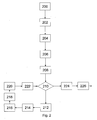
- first of all a process is defined (200).
- Bench scale trials include mostly only steps in the laboratory. Pilot plant trials include mostly the production on the line in the production environment. But this are only two types of trials, which may be configured when the software is shipped. The customer is able to define additional trial types and link additional processes.
- This process definition allows defining object type, e.g. trial, object scope, e.g. bench scale trial, pilot plant trial, factory trial and various other relevant parameters for the respective trial.
- the various tasks which have to be executed, have to be defined (202).
- These tasks comprise activities, and objects.
- the activities may be trial definition, planning order, transfer planning order into process order, preparation, release process order for production, execution, confirmation of results, quality management, evaluation, and other.
- certain business objects are defined. These may be recipes, tools, material, resources, etc.
- sub-tasks may also be defined (204). These sub-tasks may also comprise activities and objects. Tasks and sub-tasks have defined statuses. The status represents progress information of the respective task.
- rules have to be defined, which allow simulating a process flow.
- the process flow may be characterised by pre-requisites certain tasks and sub-tasks have to fulfil for respective statuses of the hierarchically higher ordered tasks and processes.
- the rules define the interdependence of the statuses of the respective tasks and sub-tasks.
- the project leader or any other interested user may provide reminders to the respective teams of tasks, which have not been accomplished yet (216).
- an employee or a team may input results of tests and trials (218), and change the statuses of the respective tasks (220).
- the rules are applied to the tasks and sub-tasks, and their statuses (222), and the respective status of the process or the tasks are determined.
- the results may again be shown on a display device.
- the process is finalised (224) and the process leader is informed. Also, trial results may be exported to factory planning and production planning. This may also be done at any stage.
- the results are put out (226), and may be written into a data sheet, or a data structure, which might be printed out.
- the results are structured, and searchable. By that, various trials may be compared with each other.
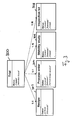
- multiple objects 302-308 may be linked to one trial object 300. These multiple objects 302-308 may be, for example, recipe 302, process order 304, stability study, and inspection lot 308. Further objects are also possible.
- a trial business process object 300 is provided. For this trial business process object 300, one recipe object 302, and one process order 304 may be created.
- a plurality of stability study objects 306 and a plurality of inspection lots 308, may be linked to this trial business process object 300. It may also be possible to create more than one process order object 304. By this, processes with multiple recipes in multiple stages might be supported within a trial.
- the trial business process object 300 may have the statuses 'created' and 'definition closed'.
- the recipe object 302 may have the status 'in work' and 'release'.
- the process order object 304 may have the statuses 'created', ⁇ released', 'control recipe created'.
- the stability study objects 306 may have the statuses 'created', 'released', 'closed'.
- the inspection lot objects 308 may also have the statuses 'created', 'released', 'closed'. Any other statuses are possible and may be applied, if necessary.
- the statuses of the linked objects may change. This change may be initiated by users. This may be done by clicking an appropriate button to process a progression of a status to the next stage. The change may be initiated also by activities in the system, in background, e.g. a status change of a material by other departments may influence the object status and will be taken into account to change an object status.
- a rule based process flow may be defined. This process flow allows determining the status of process object 300 based on the individual statuses of the objects 302-308. The results may be controlled by visualising the statuses of the respective objects.
- Each task may have a configurable set of activity rules. These activity rules define, how a status of an object may be processed to a next stage. For instance, a task is locked if a specific sub-task status is set. After locking a task, it is not executable any longer, and may not be processed to a further stage.
- the available activities may be checked by the previously defined rules.
- a task may not to be available if it is neither locked nor executed.
- the rules may define a process flow, it may be defined that one task may depend on multiple statuses of multiple linked objects. Each assigned sub-task of a task may provide an individual status. It may be visualised, which sub-task has which status. By providing the rules, an overall status for a task may be determined from the statuses of the sub-tasks. These rules may define that, if one sub-task provides an error status, the summarised status shows error. If a warning is provided by a sub-task, the summarised task may show a warning. In case not all requested statuses of sub-tasks are set, the task may show incomplete. In case all sub-task are completed and do not show any warnings, the summarised task status may be indicated as OK.
- Figure 4 depicts a screenshot of summarised statuses.
- a monitoring window 400 shows all available tasks. These may be trial definition, planning order, transfer planning order into process order, preparation, release process order for production, execution, confirm results, close quality management planning, confirm quality management results, evaluate trial, etc.
- task conditions 404 representing task statuses may be shown. These task conditions 404 may be depicted as icons showing different conditions. Available icons may be 'locked', 'executable' and 'currently not available'.
- a task status icon 402 may be shown on the right hand side of the task description. This task status icon 402 depicts within an icon the status of a task, which may be 'OK', 'in progress', 'warning', 'problem', 'error', etc.
- the task conditions 404 may be calculated using the specified rules. As can be seen, for the tasks, which task status icons 402 show OK, the task conditions 404 are locked. The following tasks have a task condition 404 of executable. Tasks which follow-up later, are currently not available, as pre-conditionally the previous tasks have to be finished.
- Figure 5 again depicts a more detailed view of the tasks.
- the respective sub-tasks may be shown.
- the sub-tasks to be processed are presented in ascending order. For example, for the task 'trial definition', the sub-tasks 'trial created', 'recipe assigned', and 'trial definition locked', are defined. These sub-tasks have to be accomplished in order to complete the trial definition.
- a task status icon 504 is depicted, showing the detailed status of a sub-task.
- Column 602 provides information about certain trials. It may be possible to select one of these trials to get an detailed overview of the corresponding processes of this trial. This allows easy navigation. It may also be possible to have a personalised table comprising tasks and trials related to a certain user. The user may thus easily monitor his own processes.
- the summarised tasks status for the assigned tasks are depicted. For instance, for a first trial, the tasks trial definition, planning order, transfer planning, preparation, release process order, execution, confirm results, quality team management planning, quality management results, evaluation are all finished. This status is depicted in the first row by icons. For a second trial, the first four tasks are finished and the task release process order has a problem. These statuses are also depicted within the second row.
- the inventive method, computer, computer program, and data structure allows easy monitoring of projects. Users may control the progress of certain processes necessary for the project. Team members, and users may provide results of their tasks, and change statuses of the tasks. Depending on the statuses of tasks, and sub-tasks, the respective overall status and task conditions may be determined using pre-defined rules.
- the invention allows integration of cross-area processes within a trial as well as control of trial progress.
Landscapes
- Business, Economics & Management (AREA)
- Engineering & Computer Science (AREA)
- Human Resources & Organizations (AREA)
- Economics (AREA)
- Entrepreneurship & Innovation (AREA)
- Strategic Management (AREA)
- Tourism & Hospitality (AREA)
- Operations Research (AREA)
- Quality & Reliability (AREA)
- Marketing (AREA)
- Physics & Mathematics (AREA)
- General Business, Economics & Management (AREA)
- General Physics & Mathematics (AREA)
- Theoretical Computer Science (AREA)
- Development Economics (AREA)
- Data Mining & Analysis (AREA)
- Finance (AREA)
- Accounting & Taxation (AREA)
- Educational Administration (AREA)
- Game Theory and Decision Science (AREA)
- Management, Administration, Business Operations System, And Electronic Commerce (AREA)
Priority Applications (2)
| Application Number | Priority Date | Filing Date | Title |
|---|---|---|---|
| EP03029396A EP1544763A1 (fr) | 2003-12-19 | 2003-12-19 | Surveillance de processus |
| US10/741,241 US20050137928A1 (en) | 2003-12-19 | 2003-12-19 | Process management monitoring |
Applications Claiming Priority (2)
| Application Number | Priority Date | Filing Date | Title |
|---|---|---|---|
| EP03029396A EP1544763A1 (fr) | 2003-12-19 | 2003-12-19 | Surveillance de processus |
| US10/741,241 US20050137928A1 (en) | 2003-12-19 | 2003-12-19 | Process management monitoring |
Publications (1)
| Publication Number | Publication Date |
|---|---|
| EP1544763A1 true EP1544763A1 (fr) | 2005-06-22 |
Family
ID=34828553
Family Applications (1)
| Application Number | Title | Priority Date | Filing Date |
|---|---|---|---|
| EP03029396A Ceased EP1544763A1 (fr) | 2003-12-19 | 2003-12-19 | Surveillance de processus |
Country Status (2)
| Country | Link |
|---|---|
| US (1) | US20050137928A1 (fr) |
| EP (1) | EP1544763A1 (fr) |
Cited By (2)
| Publication number | Priority date | Publication date | Assignee | Title |
|---|---|---|---|---|
| GB2433615A (en) * | 2005-12-23 | 2007-06-27 | Promptt Technologies Ltd | A method of managing a task |
| CN111241477A (zh) * | 2020-01-07 | 2020-06-05 | 支付宝(杭州)信息技术有限公司 | 构建监控基准线的方法、监控数据对象状态的方法及装置 |
Families Citing this family (34)
| Publication number | Priority date | Publication date | Assignee | Title |
|---|---|---|---|---|
| US20070186214A1 (en) * | 2005-12-23 | 2007-08-09 | Promptt Technologies Ltd. | Method of managing a task |
| CA2649449A1 (fr) * | 2006-04-14 | 2007-10-25 | Advanced Solutions, Inc. | Procede, systeme et support lisible par ordinateur destine a fournir une classification personnalisee de documents dans un systeme de gestion de fichiers |
| US20070294155A1 (en) * | 2006-05-31 | 2007-12-20 | Renegade Swish, Llc | Apparatus, system, method, and computer program for managing transactions involving aviation assets |
| US8122063B2 (en) * | 2006-06-30 | 2012-02-21 | Sap Ag | Using status models in a computer system |
| US8365200B1 (en) | 2006-06-30 | 2013-01-29 | Sap Ag | Using cancellation status models in a computer system |
| US8200715B1 (en) * | 2006-06-30 | 2012-06-12 | Sap Ag | Using status models with adaptable process steps in a computer system |
| US8020172B2 (en) | 2006-06-30 | 2011-09-13 | Sap Ag | Using status models having status derivations in a computer system |
| US8522261B2 (en) * | 2006-06-30 | 2013-08-27 | Sap Ag | Using status models with state guards in a computer system |
| US20080005739A1 (en) * | 2006-06-30 | 2008-01-03 | Wasim Sadiq | Defining a Status Model for a Computer System |
| US8706776B1 (en) | 2006-06-30 | 2014-04-22 | Sap Ag | Extending status models in a computer system |
| US8621418B2 (en) * | 2006-07-25 | 2013-12-31 | International Business Machines Corporation | Interlinked change-request computer system and method having role-based tabular interface |
| US8677319B2 (en) * | 2006-07-25 | 2014-03-18 | International Business Machines Corporation | Computer method and system for composite state management of software change requests |
| US20080065460A1 (en) * | 2006-08-23 | 2008-03-13 | Renegade Swish, Llc | Apparatus, system, method, and computer program for task and process management |
| US8219650B2 (en) * | 2006-12-28 | 2012-07-10 | Sap Ag | Communicating with a status management component in a computer system |
| US8892454B2 (en) * | 2007-09-27 | 2014-11-18 | Sap Se | Configuration of web services |
| US8504942B2 (en) * | 2007-12-31 | 2013-08-06 | Anthony Vallone | Icon-based facilitation of service task performance |
| US8478627B2 (en) * | 2008-02-28 | 2013-07-02 | International Business Machines Corporation | Method for reducing risk associated with a task |
| US8504980B1 (en) | 2008-04-14 | 2013-08-06 | Sap Ag | Constraining data changes during transaction processing by a computer system |
| WO2010010723A1 (fr) * | 2008-07-22 | 2010-01-28 | トヨタ自動車株式会社 | Système à noyaux multiples, unité de commande électronique de véhicule et procédé de commutation de tâches |
| GB0915863D0 (en) * | 2009-09-10 | 2009-10-14 | Smart Overseas Inc | Improvements in or relating to a virtual management system and method |
| US20110145037A1 (en) * | 2009-12-16 | 2011-06-16 | Vertafore, Inc. | Document management method and apparatus to process a workflow task by parallel or serially processing subtasks thereof |
| US9063932B2 (en) * | 2009-12-18 | 2015-06-23 | Vertafore, Inc. | Apparatus, method and article to manage electronic or digital documents in a networked environment |
| US8700682B2 (en) * | 2009-12-24 | 2014-04-15 | Vertafore, Inc. | Systems, methods and articles for template based generation of markup documents to access back office systems |
| US20120136693A1 (en) * | 2010-11-30 | 2012-05-31 | Sap Ag | System and method for a process overview diagram |
| US9384198B2 (en) | 2010-12-10 | 2016-07-05 | Vertafore, Inc. | Agency management system and content management system integration |
| US8731973B2 (en) | 2011-04-19 | 2014-05-20 | Vertafore, Inc. | Overlaying images in automated insurance policy form generation |
| US8996472B2 (en) | 2012-04-16 | 2015-03-31 | Sap Se | Verification of status schemas based on business goal definitions |
| US8996473B2 (en) | 2012-08-06 | 2015-03-31 | Sap Se | Checking compatibility of extended and core SAM schemas based on complex goals |
| US10417594B2 (en) | 2013-05-02 | 2019-09-17 | Sap Se | Validation of functional correctness of SAM schemas including action chains |
| US10311212B2 (en) | 2013-08-12 | 2019-06-04 | Sap Se | Nutrient value loss tracking system and method |
| US9507814B2 (en) | 2013-12-10 | 2016-11-29 | Vertafore, Inc. | Bit level comparator systems and methods |
| US9367435B2 (en) | 2013-12-12 | 2016-06-14 | Vertafore, Inc. | Integration testing method and system for web services |
| US9747556B2 (en) | 2014-08-20 | 2017-08-29 | Vertafore, Inc. | Automated customized web portal template generation systems and methods |
| US9600400B1 (en) | 2015-10-29 | 2017-03-21 | Vertafore, Inc. | Performance testing of web application components using image differentiation |
Citations (7)
| Publication number | Priority date | Publication date | Assignee | Title |
|---|---|---|---|---|
| US6101481A (en) * | 1996-01-25 | 2000-08-08 | Taskey Pty Ltd. | Task management system |
| DE10060177A1 (de) * | 2000-12-04 | 2002-06-20 | Siemens Ag | Verfahren und Datenverarbeitungssystem zum wissensbasierten Beraten, Managen und/oder Steuern eines Geschäftsprozesses |
| US20020156671A1 (en) * | 2000-11-08 | 2002-10-24 | The Boeing Company | System and method for collaborative action |
| US20030014409A1 (en) * | 2001-07-11 | 2003-01-16 | Shabina Shukoor | Method and system for managing projects utilizing histogrammatical representations of real-time tasking and statusing |
| US20030033191A1 (en) * | 2000-06-15 | 2003-02-13 | Xis Incorporated | Method and apparatus for a product lifecycle management process |
| US20030061330A1 (en) * | 2000-09-29 | 2003-03-27 | Frisco Lynn A. | Web-based collaborative project and process management solution |
| US20030126003A1 (en) * | 2001-11-20 | 2003-07-03 | Nxn Software Ag | Method for monitoring and controlling workflow of a project, applications program and computer product embodying same and related computer systems |
Family Cites Families (9)
| Publication number | Priority date | Publication date | Assignee | Title |
|---|---|---|---|---|
| US6078982A (en) * | 1998-03-24 | 2000-06-20 | Hewlett-Packard Company | Pre-locking scheme for allowing consistent and concurrent workflow process execution in a workflow management system |
| US6720990B1 (en) * | 1998-12-28 | 2004-04-13 | Walker Digital, Llc | Internet surveillance system and method |
| US20030182170A1 (en) * | 2000-03-09 | 2003-09-25 | Thomas Rozsa | Computer sofware program for an interactive multi-media calendar |
| US7031930B2 (en) * | 2000-12-29 | 2006-04-18 | General Electric Capital Corporation | Project management for complex construction projects by monitoring subcontractors in real time |
| US6854088B2 (en) * | 2001-04-04 | 2005-02-08 | Spinoza Technology, Inc. | Graphical user interface for project data |
| US7212987B2 (en) * | 2001-10-23 | 2007-05-01 | International Business Machines Corporation | System and method for planning a design project, coordinating project resources and tools and monitoring project progress |
| US7051036B2 (en) * | 2001-12-03 | 2006-05-23 | Kraft Foods Holdings, Inc. | Computer-implemented system and method for project development |
| US7107285B2 (en) * | 2002-03-16 | 2006-09-12 | Questerra Corporation | Method, system, and program for an improved enterprise spatial system |
| WO2004008284A2 (fr) * | 2002-07-12 | 2004-01-22 | Checkspert, Inc. | Systeme et procede de supervision et d'authentification a distance d'activites d'utilisateurs au niveau de postes de travail en reseau de communication |
-
2003
- 2003-12-19 US US10/741,241 patent/US20050137928A1/en not_active Abandoned
- 2003-12-19 EP EP03029396A patent/EP1544763A1/fr not_active Ceased
Patent Citations (7)
| Publication number | Priority date | Publication date | Assignee | Title |
|---|---|---|---|---|
| US6101481A (en) * | 1996-01-25 | 2000-08-08 | Taskey Pty Ltd. | Task management system |
| US20030033191A1 (en) * | 2000-06-15 | 2003-02-13 | Xis Incorporated | Method and apparatus for a product lifecycle management process |
| US20030061330A1 (en) * | 2000-09-29 | 2003-03-27 | Frisco Lynn A. | Web-based collaborative project and process management solution |
| US20020156671A1 (en) * | 2000-11-08 | 2002-10-24 | The Boeing Company | System and method for collaborative action |
| DE10060177A1 (de) * | 2000-12-04 | 2002-06-20 | Siemens Ag | Verfahren und Datenverarbeitungssystem zum wissensbasierten Beraten, Managen und/oder Steuern eines Geschäftsprozesses |
| US20030014409A1 (en) * | 2001-07-11 | 2003-01-16 | Shabina Shukoor | Method and system for managing projects utilizing histogrammatical representations of real-time tasking and statusing |
| US20030126003A1 (en) * | 2001-11-20 | 2003-07-03 | Nxn Software Ag | Method for monitoring and controlling workflow of a project, applications program and computer product embodying same and related computer systems |
Cited By (3)
| Publication number | Priority date | Publication date | Assignee | Title |
|---|---|---|---|---|
| GB2433615A (en) * | 2005-12-23 | 2007-06-27 | Promptt Technologies Ltd | A method of managing a task |
| CN111241477A (zh) * | 2020-01-07 | 2020-06-05 | 支付宝(杭州)信息技术有限公司 | 构建监控基准线的方法、监控数据对象状态的方法及装置 |
| CN111241477B (zh) * | 2020-01-07 | 2023-10-20 | 支付宝(杭州)信息技术有限公司 | 构建监控基准线的方法、监控数据对象状态的方法及装置 |
Also Published As
| Publication number | Publication date |
|---|---|
| US20050137928A1 (en) | 2005-06-23 |
Similar Documents
| Publication | Publication Date | Title |
|---|---|---|
| US20050137928A1 (en) | Process management monitoring | |
| CN108351883B (zh) | 动态上下文枢纽网格分析的显示 | |
| US7313564B2 (en) | Web-interactive software testing management method and computer system including an integrated test case authoring tool | |
| US20070168918A1 (en) | Software Development Planning and Management System | |
| CN104216701B (zh) | 用于在制造执行系统内创建图形用户界面的系统和方法 | |
| US20120260254A1 (en) | Visual scripting of web services for task automation | |
| CN101180598A (zh) | 用于提供过程指南的方法和装置 | |
| US11494713B2 (en) | Robotic process automation analytics platform | |
| US12236211B2 (en) | Providing resolution suggestions in a program development tool | |
| JP2012208664A (ja) | ソフトウェア設計・運用統合管理システム | |
| CN103177074A (zh) | 定制制造执行系统屏幕的图形用户界面 | |
| US20210349450A1 (en) | Hierarchical assessment of processes for implementing robotic process automation | |
| US7757203B2 (en) | Automated process flow in product development | |
| US9547505B2 (en) | Adaptive contextual graphical representation of development entities | |
| EP1548621A1 (fr) | Interface de modification de recettes | |
| US8066194B2 (en) | System and method for managing information | |
| Czerniak et al. | The Influence of task-oriented human-machine interface design on usability objectives | |
| Horozal et al. | Tool support for architectural pattern selection and application in cloud-centric service-oriented ides | |
| Yaseen | Equipping steel fabrication floor planning with interactive visualization for legacy systems | |
| US20060080279A1 (en) | Customized and customizable engineering calculation and project detailing system | |
| de Menezes et al. | Using Logs to Mitigate Process Variability and Dependence on Practitioners in Traditional Business Process Automation Software | |
| Fowler et al. | Systems Integration for Manufacturing Applications, Technical Program Plan | |
| Landry | Directed Graphs for Task Analysis of Human-Machine Systems | |
| Chang et al. | Solving the service composition puzzle | |
| Lepratti et al. | Toward the Knowledge-based Enterprise |
Legal Events
| Date | Code | Title | Description |
|---|---|---|---|
| PUAI | Public reference made under article 153(3) epc to a published international application that has entered the european phase |
Free format text: ORIGINAL CODE: 0009012 |
|
| AK | Designated contracting states |
Kind code of ref document: A1 Designated state(s): AT BE BG CH CY CZ DE DK EE ES FI FR GB GR HU IE IT LI LU MC NL PT RO SE SI SK TR |
|
| AX | Request for extension of the european patent |
Extension state: AL LT LV MK |
|
| RAP1 | Party data changed (applicant data changed or rights of an application transferred) |
Owner name: SAP AG |
|
| 17P | Request for examination filed |
Effective date: 20051026 |
|
| AKX | Designation fees paid |
Designated state(s): AT BE BG CH CY CZ DE DK EE ES FI FR GB GR HU IE IT LI LU MC NL PT RO SE SI SK TR |
|
| 17Q | First examination report despatched |
Effective date: 20051118 |
|
| APBN | Date of receipt of notice of appeal recorded |
Free format text: ORIGINAL CODE: EPIDOSNNOA2E |
|
| APAF | Appeal reference modified |
Free format text: ORIGINAL CODE: EPIDOSCREFNE |
|
| APBR | Date of receipt of statement of grounds of appeal recorded |
Free format text: ORIGINAL CODE: EPIDOSNNOA3E |
|
| APBT | Appeal procedure closed |
Free format text: ORIGINAL CODE: EPIDOSNNOA9E |
|
| STAA | Information on the status of an ep patent application or granted ep patent |
Free format text: STATUS: THE APPLICATION HAS BEEN REFUSED |
|
| 18R | Application refused |
Effective date: 20130109 |