EP1544937A1 - Procede pour retirer un film de sulfate de plomb forme dans un accumulateur au plomb - Google Patents
Procede pour retirer un film de sulfate de plomb forme dans un accumulateur au plomb Download PDFInfo
- Publication number
- EP1544937A1 EP1544937A1 EP03798410A EP03798410A EP1544937A1 EP 1544937 A1 EP1544937 A1 EP 1544937A1 EP 03798410 A EP03798410 A EP 03798410A EP 03798410 A EP03798410 A EP 03798410A EP 1544937 A1 EP1544937 A1 EP 1544937A1
- Authority
- EP
- European Patent Office
- Prior art keywords
- lead
- lead sulfate
- battery
- electrodes
- membranous
- Prior art date
- Legal status (The legal status is an assumption and is not a legal conclusion. Google has not performed a legal analysis and makes no representation as to the accuracy of the status listed.)
- Withdrawn
Links
Images


Classifications
-
- H—ELECTRICITY
- H01—ELECTRIC ELEMENTS
- H01M—PROCESSES OR MEANS, e.g. BATTERIES, FOR THE DIRECT CONVERSION OF CHEMICAL ENERGY INTO ELECTRICAL ENERGY
- H01M10/00—Secondary cells; Manufacture thereof
- H01M10/42—Methods or arrangements for servicing or maintenance of secondary cells or secondary half-cells
-
- H—ELECTRICITY
- H01—ELECTRIC ELEMENTS
- H01M—PROCESSES OR MEANS, e.g. BATTERIES, FOR THE DIRECT CONVERSION OF CHEMICAL ENERGY INTO ELECTRICAL ENERGY
- H01M10/00—Secondary cells; Manufacture thereof
- H01M10/42—Methods or arrangements for servicing or maintenance of secondary cells or secondary half-cells
- H01M10/4242—Regeneration of electrolyte or reactants
-
- H—ELECTRICITY
- H02—GENERATION; CONVERSION OR DISTRIBUTION OF ELECTRIC POWER
- H02J—ELECTRIC POWER NETWORKS; CIRCUIT ARRANGEMENTS OR SYSTEMS FOR SUPPLYING OR DISTRIBUTING ELECTRIC POWER; SYSTEMS FOR STORING ELECTRIC ENERGY
- H02J7/00—Circuit arrangements for charging or discharging batteries or for supplying loads from batteries
- H02J7/875—Charging or discharging for charge maintenance, battery initiation or rejuvenation
-
- H—ELECTRICITY
- H02—GENERATION; CONVERSION OR DISTRIBUTION OF ELECTRIC POWER
- H02J—ELECTRIC POWER NETWORKS; CIRCUIT ARRANGEMENTS OR SYSTEMS FOR SUPPLYING OR DISTRIBUTING ELECTRIC POWER; SYSTEMS FOR STORING ELECTRIC ENERGY
- H02J7/00—Circuit arrangements for charging or discharging batteries or for supplying loads from batteries
- H02J7/90—Regulation of charging or discharging current or voltage
- H02J7/927—Regulation of charging or discharging current or voltage with introduction of pulses during the charging process
-
- Y—GENERAL TAGGING OF NEW TECHNOLOGICAL DEVELOPMENTS; GENERAL TAGGING OF CROSS-SECTIONAL TECHNOLOGIES SPANNING OVER SEVERAL SECTIONS OF THE IPC; TECHNICAL SUBJECTS COVERED BY FORMER USPC CROSS-REFERENCE ART COLLECTIONS [XRACs] AND DIGESTS
- Y02—TECHNOLOGIES OR APPLICATIONS FOR MITIGATION OR ADAPTATION AGAINST CLIMATE CHANGE
- Y02E—REDUCTION OF GREENHOUSE GAS [GHG] EMISSIONS, RELATED TO ENERGY GENERATION, TRANSMISSION OR DISTRIBUTION
- Y02E60/00—Enabling technologies; Technologies with a potential or indirect contribution to GHG emissions mitigation
- Y02E60/10—Energy storage using batteries
-
- Y—GENERAL TAGGING OF NEW TECHNOLOGICAL DEVELOPMENTS; GENERAL TAGGING OF CROSS-SECTIONAL TECHNOLOGIES SPANNING OVER SEVERAL SECTIONS OF THE IPC; TECHNICAL SUBJECTS COVERED BY FORMER USPC CROSS-REFERENCE ART COLLECTIONS [XRACs] AND DIGESTS
- Y02—TECHNOLOGIES OR APPLICATIONS FOR MITIGATION OR ADAPTATION AGAINST CLIMATE CHANGE
- Y02W—CLIMATE CHANGE MITIGATION TECHNOLOGIES RELATED TO WASTEWATER TREATMENT OR WASTE MANAGEMENT
- Y02W30/00—Technologies for solid waste management
- Y02W30/50—Reuse, recycling or recovery technologies
- Y02W30/84—Recycling of batteries or fuel cells
Definitions
- This invention relates to a method for removing membranous lead sulfate (PbSO 4 ) formed on electrodes of a lead-acid battery due to sulfation.
- PbSO 4 membranous lead sulfate
- the sulfation is a phenomenon in which lead sulfate (PbSO 4 ), which is formed by a discharge of a lead-acid battery, precipitates on polar plates of the battery because of vibration or fluctuation of discharging condition or an ambient temperature at which the battery is left to stand, consequently to develop to a nonconducting film layer. This phenomenon may possibly cause increase in internal resistance leading to performance deterioration of the battery or inability to use.
- PbSO 4 lead sulfate
- a battery activating device which incorporates a circuit for generating a pulse current for exfoliating lead sulfate deposited on the polar plates of the lead-acid battery, is disclosed in Japanese Patent Application Publication No. 2000-156247(A).
- Japanese Patent Application Publication No. 2000-323188(A) there is disclosed a conventional lead-acid battery activating method featured in that a charging pulse current having larger electric quantity than a discharging pulse current is given immediately after applying the discharging pulse current.
- the electric quantity of the discharging pulse current is over 0.1 C and the pulse width thereof is 0.0001 sec. to 1 sec.
- the conventional arts thus disclosed all have a mere function of physically exfoliating the membranous lead sulfate from the polar plate, thus to temporarily renovate the lead-acid battery. That is, such a mere measure of physically exfoliating the membranous lead sulfate has a fundamental problem such that lead sulfate flakes exfoliating away in consequence of applying the pulse current fall onto the peripheries of the lower parts of the polar plates or are suspended without dissolving in electrolytic solution in the battery, consequently to be again deposited to the polar plates of the battery during discharging.
- the conventional methods have a further disadvantage in that the exfoliated lead sulfate flakes sunk onto the peripheries of the lower parts of the polar plates are gradually dissolved into the electrolytic solution after supplying the dilute sulfuric acid into the battery, consequently to elevate the specific gravity of the electrolytic solution in excess, resulting in damaging the polar plates to decrease the life of lead-acid battery.
- the present invention seeks to provide a novel method capable of removing membranous lead sulfate deposited on electrodes of a lead-acid battery by dissolving the membranous lead sulfate on the electrodes into fine particles without causing the membranous lead sulfate to fall off or be suspended in the electrolytic solution, so that the performance of the battery can be recovered to prolong the battery life.
- the present invention further seeks to provide a novel method capable of removing membranous lead sulfate without damaging the electrodes and emitting noise to the outside environment.
- a method for removing membranous lead sulfate deposited on electrodes of a lead-acid battery due to sulfation which method is featured by using a pulse current having a short pulse width to bring about a conductor skin effect for intensively dissolving the surface layer of the membranous lead sulfate deposited on the electrodes of the battery.
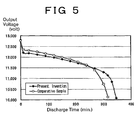
- FIG 5 is a graph showing the results of performance measurements of Embodiment 1 of the invention.
- the present invention provides a method for removing lead sulfate deposited in a film or membrane on electrodes of the lead-acid battery due to sulfation.
- the method of the invention is featured by using the pulse current having a short pulse width, which brings about a conductor skin effect of intensively dissolving the surface layer of the membranous lead sulfate deposited on the electrodes of the battery.
- the lead sulfate formed in a film or membrane on the electrode of the lead-acid battery is sequentially dissolved into lead ion and sulfate ion as the result of concentration of electrical charge into the surface layer (skin depth) of the lead sulfate, which is caused by applying a pulse current having a pulse width which is so short as to give rise to a conductor superficial effect (skin effect) on the electrode with the membranous lead sulfate.
- the method for removing membranous lead sulfate according to the invention is further featured by charging the battery to again resolve the lead sulfate once dissolved by applying the pulse current.
- lead ion and sulfate ion produced as the result of application of the pulse current of a short pulse width can be reproduced into substrates of the electrodes of the battery or sulfuric acid in the battery, thus to recover the performance of the lead-acid battery.
- the method for removing membranous lead sulfate deposited on the electrodes of the lead-acid battery according to the invention is further featured by using the pulse current with a pulse width of less than 1 ⁇ s.
- the pulse width of the pulse current to be applied to the electrodes can be made appropriate so as to effectively dissolve only the surface layer part of the membranous lead sulfate in membrane on the electrodes without damaging the electrodes. Furthermore, because the pulse current applied to the method of the invention is very faint in intensity, no noise is emitted to the outside environment.
- the method according to this invention is featured by using the pulse current having a short pulse width, which brings about a conductor skin effect of intensively dissolving the surface layer of the membranous lead sulfate deposited on the electrodes of the battery.
- the conductor skin effect herein is a phenomenon in which the high-frequency current is localized in the surface layer of a conductor and does not penetrate deep into the conductor.
- the electrical charge is concentrated in the skin depth defined by the pulse width, so that the surface layer of the membranous lead sulfate, can be sequentially dissolved into fine particles.
- the lead sulfate is dissolved in order from the pointed tips of crystallized protuberances thereof.
- the method according to this invention can prevent the lead sulfate deposit on the electrode from exfoliating or falling off in clusters and suspending the lead sulfate dissolved in fine particles in an electrolytic solution of the battery, remaining the crystallized state.
- the pulse current with a pulse width which is so short as to give rise to the conductor skin effect, is very faint in intensity, and therefore, does not damage to the electrodes.
- the method of the invention has an advantage of producing little noise, thus not to affect the outside environment adversely.
- the method of the invention serves to suppress generation of Joule heat, thus to preventing the electrodes from deforming and the battery from drying due to heat.
- the pulse width of the pulse current used in this method may be determined in a range capable of bringing about the conductor skin effect
- the pulse width may preferably be of less than 1 ⁇ s, particularly, in the range of 0.1 ⁇ s to 1 ⁇ s.
- the surface thickness calculated with the pulse width in the range specified herein is to come to the order of 0.01 mm, so that the electrical charge can be concentrated on the surface part without permitting the electrical charge to penetrate into the inside of the membranous lead sulfate deposit.
- the pulse current with a pulse width of over 1 ⁇ s is ineligible because it causes thermal oscillation in a boundary face between the membranous lead sulfate deposit and the electrode, consequently to permit the lead sulfate deposit on the electrodes to exfoliate and fall off.
- the pulse number of the pulse current With increase of pulse number of the pulse current to be applied, a rate of dissolving the membranous lead sulfate deposited on the electrodes is increased, but there is a case where heat is generated. Hence, this condition must be taken into account to determine the pulse number. Concretely speaking, it is preferable to determine the pulse number of the pulse current to be the order of 8000 to 12000 per second.
- the pulse current with excessively small voltage and current values makes it impossible to dissolve the membranous lead sulfate. Inversely, the pulse current with excessively large voltage and current values generates heat bringing about an adverse affect. Hence, this condition must be taken into account to determine the voltage and current values of the pulse current to be applied. To be more specific, it is preferable to determine the voltage and current values to be in the ranges of 12 to 108 volts and 10 to 120 mA. However, the optimum values, which depend on the pulse width and pulse number, should not be understood as limitative.
- the method of the invention is featured by charging the lead-acid battery while or after applying the pulse current to the battery.
- lead ion being resoluble by the pulse current resolves itself to recover as an electrode of lead or lead dioxide.
- the specific gravity of the electrolytic solution of the battery turns back to its original optimum value, thus to swiftly recover the performance of the battery.
- This function of effectively removing the lead sulfate from the electrodes of the lead-acid battery could be eventually achieved by the present invention enabling the surface part of the membranous lead sulfate to be dissolved into fine particles, but cannot be materialized by any conventional removing method using electric shock for exfoliating the lead sulfate from the electrodes because the crystallized lead sulfate fragments exfoliated by the electric shock are again deposited onto the electrodes even by charging the battery.
- the membranous lead sulfate deposit on the electrodes are constantly dissolved and resolved, thus to suppress growth of the sulfation, with the result of which the performance of the lead-acid battery can be maintained over a long period of time.
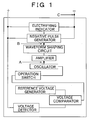
- FIG 1 One embodiment of the circuitry of the device using the method for removing the membranous lead sulfate according to the invention is shown in FIG 1.
- the device of FIG 1 comprises a voltage detector, reference voltage generator, voltage comparator, operation/nonoperation switch, oscillator, amplifier, waveform shaping circuit, negative pulse generator, and electrifying indicator.
- the operation/nonoperation switch serves to switching on or off the device and therefore is not indispensable for the device of the invention.
- FIG 2 the waveforms at the points A, B and C in FIG 1 are illustrated.
- a negative pulse current with a pulse width which is so short as to give rise to the conductor skin effect, is brought about at the point C and applied to the lead-acid battery, consequently to dissolve the membranous lead sulfate deposited on the electrode into fine particles.
- the power source for the device shown in FIG 1 may be replaced with an external power supply, but it is desirable to use the lead-acid battery in itself to which the device of the invention is attached.
- the device mentioned above can be mounted on the lead-acid battery by being merely connected to the battery or in the other manner selected properly.
- a cigarette lighter's socket can be used as illustrated in FIG 3.
- terminals shown in FIG 4 may be brought in direct connection to the lead-acid battery by use of screws.
- the method for moving the membranous lead sulfate deposit according to the present invention is applicable to various kinds of lead-acid batteries.
- the device using the method of the invention may suitably be used for passenger motor cars, motor tracks, buses, yachts, motor boats, fish boats, ships, farm machineries and implements, construction tools and machines, fork lift trucks, electric carts, road sweepers, electric wheelchairs, and backup power supplying systems for hospitals, police stations and fire stations, but the present invention does not contemplate imposing any limitation on applications and uses.
- a lead-acid battery with a dedicated pulse generator (12 volts; 120 mW) incorporating a circuitry shown in FIG 1 was discharged while a pulse current with a pulse width (T neg. in FIG 2) of less than 1 ⁇ s was applied with a pulse rate of 10000 pulses per second to the battery. At that time, the value of the pulse current applied to the battery was set to 10 mA.
- the lead-acid battery connected to the device using the method of the invention could maintain its output voltage constant over a prolonged period of time in comparison with the comparative example. Furthermore, as shown in Table 2, the lead-acid battery with the device using the method of the invention could be more increased in capacity than the comparative example. As a result, it turned out that the device using the method of the invention contributes to extension of the life of the lead-acid battery.
- the method for removing membranous lead sulfate according to the present invention serves to concentrate the electrical charge in the surface layer of the membranous lead sulfate by the conductor skin effect, which is brought about by applying the pulse current with the short pulse width of less than 1 ⁇ s to the lead-acid battery.
- the method of the invention makes it possible to prevent the lead sulfate deposit on the electrode from exfoliating or falling off in clusters and be resoluble into fine particles from the surface layer part near a boundary face between dilute sulfuric acid and itself
- the method of the invention makes it possible to retrieve the performance of a lead-acid battery deteriorated due to the lead sulfate deposit on the electrodes and block recrystallization of lead sulfate, consequently to prevent growth of sulfation, so that the battery life of the lead-acid battery can be prolonged
- the pulse current applied in the method of the invention is very faint in intensity, no noise is emitted to the outside environment.
Landscapes
- Engineering & Computer Science (AREA)
- Power Engineering (AREA)
- Manufacturing & Machinery (AREA)
- Chemical & Material Sciences (AREA)
- Chemical Kinetics & Catalysis (AREA)
- Electrochemistry (AREA)
- General Chemical & Material Sciences (AREA)
- Secondary Cells (AREA)
Applications Claiming Priority (3)
| Application Number | Priority Date | Filing Date | Title |
|---|---|---|---|
| JP2002315069 | 2002-09-24 | ||
| JP2002315069 | 2002-09-24 | ||
| PCT/JP2003/011839 WO2004030138A1 (fr) | 2002-09-24 | 2003-09-17 | Procede pour retirer un film de sulfate de plomb forme dans un accumulateur au plomb |
Publications (2)
| Publication Number | Publication Date |
|---|---|
| EP1544937A1 true EP1544937A1 (fr) | 2005-06-22 |
| EP1544937A4 EP1544937A4 (fr) | 2007-11-14 |
Family
ID=32040873
Family Applications (2)
| Application Number | Title | Priority Date | Filing Date |
|---|---|---|---|
| EP03798409A Withdrawn EP1544936A4 (fr) | 2002-09-24 | 2003-09-17 | Dispositif pour eliminer un film de sulfate de plomb forme dans une batterie au plomb |
| EP03798410A Withdrawn EP1544937A4 (fr) | 2002-09-24 | 2003-09-17 | Procede pour retirer un film de sulfate de plomb forme dans un accumulateur au plomb |
Family Applications Before (1)
| Application Number | Title | Priority Date | Filing Date |
|---|---|---|---|
| EP03798409A Withdrawn EP1544936A4 (fr) | 2002-09-24 | 2003-09-17 | Dispositif pour eliminer un film de sulfate de plomb forme dans une batterie au plomb |
Country Status (8)
| Country | Link |
|---|---|
| US (2) | US20060065547A1 (fr) |
| EP (2) | EP1544936A4 (fr) |
| JP (2) | JPWO2004030138A1 (fr) |
| KR (2) | KR20050057543A (fr) |
| CN (2) | CN1319205C (fr) |
| AU (2) | AU2003266524B8 (fr) |
| CA (2) | CA2500008A1 (fr) |
| WO (2) | WO2004030138A1 (fr) |
Cited By (3)
| Publication number | Priority date | Publication date | Assignee | Title |
|---|---|---|---|---|
| US9893396B2 (en) | 2013-10-14 | 2018-02-13 | Fluidic Inc. | Method of operating and conditioning electrochemical cells comprising electrodeposited fuel |
| US10461554B2 (en) | 2014-02-12 | 2019-10-29 | Nantenergy, Inc. | Method of operating electrochemical cells comprising electrodeposited fuel |
| US12476479B2 (en) | 2016-09-15 | 2025-11-18 | Form Energy, Inc. | Hybrid battery system |
Families Citing this family (26)
| Publication number | Priority date | Publication date | Assignee | Title |
|---|---|---|---|---|
| JPWO2004030138A1 (ja) * | 2002-09-24 | 2006-01-26 | 株式会社エルマ | 鉛蓄電池に生ずる硫酸鉛皮膜の除去方法 |
| JP2006032065A (ja) * | 2004-07-14 | 2006-02-02 | Eco Just:Kk | 二次電池再生装置 |
| JP4774713B2 (ja) * | 2004-10-18 | 2011-09-14 | 株式会社エルマ | 蓄電池の過充電防止装置 |
| JP2007134267A (ja) * | 2005-11-14 | 2007-05-31 | Eruma:Kk | 金属酸化状態還元装置及び金属酸化状態還元方法 |
| CN100428558C (zh) * | 2006-09-22 | 2008-10-22 | 北京清大华美环保节能技术研究院 | 一种铅酸蓄电池检测修复方法及系统 |
| WO2008047956A1 (fr) * | 2006-10-18 | 2008-04-24 | Baretec Co., Ltd. | Procédé de recyclage pour batterie usagée |
| KR100950594B1 (ko) * | 2007-10-31 | 2010-04-01 | 이재천 | 납축전지의 황산납 피막 방지 회로 |
| CN101453042B (zh) * | 2007-12-03 | 2011-01-19 | 黄思伦 | 一种用于铅酸电池的还原硫酸铅化合物的方法及装置 |
| JP5248201B2 (ja) * | 2007-12-27 | 2013-07-31 | エレクトロンスプリング株式会社 | 鉛蓄電池を再生させるための装置及び方法 |
| JP5341398B2 (ja) * | 2008-06-03 | 2013-11-13 | エレクトロンスプリング株式会社 | エンジンのトルク及び出力を改善するための装置 |
| JP2010226885A (ja) * | 2009-03-24 | 2010-10-07 | Jae-Han Jung | バッテリ電圧安定化装置 |
| JP4565362B1 (ja) | 2010-02-16 | 2010-10-20 | 株式会社Jsv | 鉛蓄電池の電気処理による蓄電能力劣化防止と再生装置 |
| JP5096538B2 (ja) | 2010-08-25 | 2012-12-12 | 株式会社テック | 硫酸塩被膜除去装置および硫酸塩被膜除去方法 |
| JP5289595B2 (ja) | 2011-03-17 | 2013-09-11 | 株式会社Jsv | 充放電に基づく電極絶縁体不活性化皮膜の除去再生充電装置 |
| WO2012126252A1 (fr) * | 2011-04-18 | 2012-09-27 | Hu Alicia Xiao | Procédé et dispositif de réparation d'un accumulateur |
| JP5462847B2 (ja) * | 2011-09-29 | 2014-04-02 | センシンテクノ株式会社 | 鉛蓄電池の硫酸鉛皮膜除去装置 |
| WO2013049879A1 (fr) * | 2011-10-03 | 2013-04-11 | Megapulse Australia Pty Ltd | Appareil conditionneur de batterie amélioré |
| KR101201220B1 (ko) * | 2012-01-27 | 2012-11-13 | 주식회사 에스와이텍 | 배터리의 노화방지장치 |
| CN102931444A (zh) * | 2012-11-23 | 2013-02-13 | 辽宁国兴科技有限公司 | 通讯基站蓄电池智能在线除硫器 |
| US9461482B2 (en) * | 2014-04-15 | 2016-10-04 | Win Sheng Cheng | Multi-chemistry battery pack system |
| JP2015228280A (ja) * | 2014-05-30 | 2015-12-17 | 株式会社Gsユアサ | 硫酸鉛の還元反応可能距離の評価方法と還元方法 |
| CN104588799B (zh) * | 2014-12-08 | 2017-01-11 | 清华大学 | 具有辅助电极脉间输出的微细电解加工电源及其加工方法 |
| CN107293813B (zh) * | 2017-07-12 | 2023-05-26 | 成都启特安全技术有限责任公司 | 一种电池自毁系统 |
| CN108987831B (zh) * | 2018-08-28 | 2021-05-14 | 双登集团股份有限公司 | 用于容量不足的铅酸蓄电池活化方法 |
| CN111416162B (zh) * | 2020-03-05 | 2021-10-15 | 天能电池集团股份有限公司 | 一种电动自行车电池的修复方法 |
| CN112809108B (zh) * | 2021-01-07 | 2022-09-16 | 广东工业大学 | 离子/分子震荡放电加工装置及加工方法 |
Family Cites Families (22)
| Publication number | Priority date | Publication date | Assignee | Title |
|---|---|---|---|---|
| US3808481A (en) * | 1972-04-14 | 1974-04-30 | Electric Fuel Propulsion Corp | Commutating circuit for electrical vehicle |
| US4746852A (en) * | 1984-10-29 | 1988-05-24 | Christie Electric Corp. | Controller for battery charger |
| US4829225A (en) * | 1985-10-23 | 1989-05-09 | Electronic Power Devices, Corp. | Rapid battery charger, discharger and conditioner |
| USRE35643E (en) * | 1990-10-16 | 1997-10-28 | Motor Products International, Inc. | Lead acid battery rejuvenator and charger |
| US5633575A (en) * | 1994-03-31 | 1997-05-27 | Gali; Carl E. | Battery reclaimer and charger |
| US5648714A (en) * | 1994-11-30 | 1997-07-15 | 3266991 Manitoba Ltd. | Method and device for charging and conditioning batteries |
| CN2225724Y (zh) * | 1995-09-14 | 1996-04-24 | 王永生 | 一种铅蓄电池延生器 |
| US5677612A (en) * | 1996-08-02 | 1997-10-14 | The United States Of America As Represented By The Secretary Of The Army | Lead-acid battery desulfator/rejuvenator |
| US5998968A (en) * | 1997-01-07 | 1999-12-07 | Ion Control Solutions, Llc | Method and apparatus for rapidly charging and reconditioning a battery |
| US5783929A (en) * | 1997-03-27 | 1998-07-21 | Taricco; Todd | Apparatus and method for recharging a battery |
| WO2001056106A1 (fr) * | 1998-07-24 | 2001-08-02 | T & K Co., Ltd. | Procede de regeneration d'accumulateurs au plomb |
| JP3510795B2 (ja) * | 1998-07-24 | 2004-03-29 | 株式会社テック | 鉛蓄電池の再生方法 |
| JP2000323188A (ja) * | 1999-05-15 | 2000-11-24 | Jec Service Kk | 鉛電池の活性化法 |
| US6172486B1 (en) * | 1999-09-24 | 2001-01-09 | The United States Of America As Represented By The Secretary Of The Army | Battery life extender with engine heat |
| JP2001118611A (ja) * | 1999-10-15 | 2001-04-27 | New & S:Kk | 電気処理による鉛蓄電池の再生方法 |
| US6307352B1 (en) * | 1999-10-19 | 2001-10-23 | Enrev Corporation | High energy charge and depolarization pulse conditioner for an enhanced-reliability lead-acid battery charger |
| US6184650B1 (en) * | 1999-11-22 | 2001-02-06 | Synergistic Technologies, Inc. | Apparatus for charging and desulfating lead-acid batteries |
| US20010019257A1 (en) * | 2000-02-04 | 2001-09-06 | Randy Bynum | Battery charging controller and conditioning system for lead acid batteries |
| US6479966B2 (en) * | 2000-07-10 | 2002-11-12 | Tachiang Technology Corp. | Method and apparatus for reconditioning a battery |
| JP2002100415A (ja) * | 2000-09-26 | 2002-04-05 | Norihiro Oishi | 鉛蓄電池再生方法および鉛蓄電池再生装置、鉛蓄電池のセル単位の再生方法 |
| CN2450789Y (zh) * | 2000-11-14 | 2001-09-26 | 游得宏 | 铅酸电池维护装置 |
| JPWO2004030138A1 (ja) * | 2002-09-24 | 2006-01-26 | 株式会社エルマ | 鉛蓄電池に生ずる硫酸鉛皮膜の除去方法 |
-
2003
- 2003-09-17 JP JP2004539466A patent/JPWO2004030138A1/ja active Pending
- 2003-09-17 EP EP03798409A patent/EP1544936A4/fr not_active Withdrawn
- 2003-09-17 EP EP03798410A patent/EP1544937A4/fr not_active Withdrawn
- 2003-09-17 US US10/528,909 patent/US20060065547A1/en not_active Abandoned
- 2003-09-17 KR KR1020057004909A patent/KR20050057543A/ko not_active Withdrawn
- 2003-09-17 CA CA002500008A patent/CA2500008A1/fr not_active Abandoned
- 2003-09-17 KR KR1020057004910A patent/KR20050057544A/ko not_active Ceased
- 2003-09-17 WO PCT/JP2003/011839 patent/WO2004030138A1/fr not_active Ceased
- 2003-09-17 WO PCT/JP2003/011838 patent/WO2004030137A1/fr not_active Ceased
- 2003-09-17 JP JP2004539465A patent/JP3902212B2/ja not_active Expired - Lifetime
- 2003-09-17 AU AU2003266524A patent/AU2003266524B8/en not_active Ceased
- 2003-09-17 CN CNB038228114A patent/CN1319205C/zh not_active Expired - Fee Related
- 2003-09-17 AU AU2003264467A patent/AU2003264467A1/en not_active Abandoned
- 2003-09-17 CN CNB038228122A patent/CN1320691C/zh not_active Expired - Fee Related
- 2003-09-17 CA CA002500007A patent/CA2500007A1/fr not_active Abandoned
- 2003-09-17 US US10/528,838 patent/US20060065548A1/en not_active Abandoned
Cited By (3)
| Publication number | Priority date | Publication date | Assignee | Title |
|---|---|---|---|---|
| US9893396B2 (en) | 2013-10-14 | 2018-02-13 | Fluidic Inc. | Method of operating and conditioning electrochemical cells comprising electrodeposited fuel |
| US10461554B2 (en) | 2014-02-12 | 2019-10-29 | Nantenergy, Inc. | Method of operating electrochemical cells comprising electrodeposited fuel |
| US12476479B2 (en) | 2016-09-15 | 2025-11-18 | Form Energy, Inc. | Hybrid battery system |
Also Published As
| Publication number | Publication date |
|---|---|
| HK1082986A1 (en) | 2006-06-23 |
| WO2004030137A1 (fr) | 2004-04-08 |
| JPWO2004030137A1 (ja) | 2006-01-26 |
| AU2003266524A1 (en) | 2004-04-19 |
| CN1320691C (zh) | 2007-06-06 |
| KR20050057543A (ko) | 2005-06-16 |
| CA2500008A1 (fr) | 2004-04-08 |
| AU2003264467A1 (en) | 2004-04-19 |
| AU2003266524B8 (en) | 2008-08-07 |
| CN1685558A (zh) | 2005-10-19 |
| EP1544937A4 (fr) | 2007-11-14 |
| CN1319205C (zh) | 2007-05-30 |
| CA2500007A1 (fr) | 2004-04-08 |
| AU2003266524B2 (en) | 2007-07-19 |
| EP1544936A1 (fr) | 2005-06-22 |
| HK1082985A1 (en) | 2006-06-23 |
| US20060065548A1 (en) | 2006-03-30 |
| EP1544936A4 (fr) | 2007-11-14 |
| JP3902212B2 (ja) | 2007-04-04 |
| KR20050057544A (ko) | 2005-06-16 |
| CN1685557A (zh) | 2005-10-19 |
| US20060065547A1 (en) | 2006-03-30 |
| WO2004030138A1 (fr) | 2004-04-08 |
| JPWO2004030138A1 (ja) | 2006-01-26 |
Similar Documents
| Publication | Publication Date | Title |
|---|---|---|
| EP1544937A1 (fr) | Procede pour retirer un film de sulfate de plomb forme dans un accumulateur au plomb | |
| EP3459155B1 (fr) | Charge par impulsions modulées | |
| JP7325790B1 (ja) | 硫酸鉛被膜除去装置、方法、及び、システム | |
| EP2685589A2 (fr) | Bloc de batterie, son procédé de charge et véhicule comprenant ledit bloc | |
| JPWO2019058613A1 (ja) | 充電可能電池短絡予測装置および充電可能電池短絡予測方法 | |
| JP2015176829A (ja) | 鉛蓄電池の充放電装置 | |
| CN1367947A (zh) | 用于电池的方法和装置 | |
| JP2004342567A (ja) | プラス電圧値E(v)よりマイナス方向に針状突起を有する電圧の印加ショックによる鉛電池の電極表面に付着する硫化鉛(PbSO4)の除去装置 | |
| JP3723795B2 (ja) | 鉛蓄電池の再生処理方法 | |
| JP6647986B2 (ja) | 二次電池の劣化判定装置、二次電池の劣化判定方法、及び二次電池の制御装置 | |
| JP2006032065A (ja) | 二次電池再生装置 | |
| KR101499816B1 (ko) | 납축전지 성능 개선형 복합 펄스파워 충전장치 | |
| JP2005327737A (ja) | 蓄電池の再生処理方法 | |
| JP2010129538A (ja) | 鉛蓄電池再生方法及び再生装置 | |
| JP2018117485A (ja) | 蓄電池モジュール及びこれを備える蓄電池システム | |
| JP2009048870A (ja) | 二次電池再生方法 | |
| JP6751879B2 (ja) | 鉛蓄電池再生装置 | |
| HK1082986B (en) | Method for removing lead sulfate film formed in lead-acid battery | |
| KR20170105672A (ko) | 납축전지의 효율적 사용을 위한 수명연장장치 | |
| KR20170105673A (ko) | 배터리 복원기의 제어방법 | |
| KR20110090382A (ko) | 배터리의 복원 관리기 | |
| KR20100059075A (ko) | 배터리 복원기 |
Legal Events
| Date | Code | Title | Description |
|---|---|---|---|
| PUAI | Public reference made under article 153(3) epc to a published international application that has entered the european phase |
Free format text: ORIGINAL CODE: 0009012 |
|
| 17P | Request for examination filed |
Effective date: 20050321 |
|
| AK | Designated contracting states |
Kind code of ref document: A1 Designated state(s): AT BE BG CH CY CZ DE DK EE ES FI FR GB GR HU IE IT LI LU MC NL PT RO SE SI SK TR |
|
| AX | Request for extension of the european patent |
Extension state: AL LT LV MK |
|
| DAX | Request for extension of the european patent (deleted) | ||
| RBV | Designated contracting states (corrected) |
Designated state(s): CH DE FR GB IT LI SE |
|
| A4 | Supplementary search report drawn up and despatched |
Effective date: 20071011 |
|
| 17Q | First examination report despatched |
Effective date: 20081222 |
|
| STAA | Information on the status of an ep patent application or granted ep patent |
Free format text: STATUS: THE APPLICATION IS DEEMED TO BE WITHDRAWN |
|
| 18D | Application deemed to be withdrawn |
Effective date: 20090505 |