EP1545071B1 - Verfahren zur verbesserten Behandlung von dynamischen Bandbreitenveränderungen in einem Transportnetz mit inversem Multiplexen - Google Patents
Verfahren zur verbesserten Behandlung von dynamischen Bandbreitenveränderungen in einem Transportnetz mit inversem Multiplexen Download PDFInfo
- Publication number
- EP1545071B1 EP1545071B1 EP03293249A EP03293249A EP1545071B1 EP 1545071 B1 EP1545071 B1 EP 1545071B1 EP 03293249 A EP03293249 A EP 03293249A EP 03293249 A EP03293249 A EP 03293249A EP 1545071 B1 EP1545071 B1 EP 1545071B1
- Authority
- EP
- European Patent Office
- Prior art keywords
- point
- inverse multiplexing
- atm
- network
- traffic
- Prior art date
- Legal status (The legal status is an assumption and is not a legal conclusion. Google has not performed a legal analysis and makes no representation as to the accuracy of the status listed.)
- Expired - Lifetime
Links
Images

Classifications
-
- H—ELECTRICITY
- H04—ELECTRIC COMMUNICATION TECHNIQUE
- H04L—TRANSMISSION OF DIGITAL INFORMATION, e.g. TELEGRAPHIC COMMUNICATION
- H04L12/00—Data switching networks
- H04L12/54—Store-and-forward switching systems
- H04L12/56—Packet switching systems
- H04L12/5601—Transfer mode dependent, e.g. ATM
- H04L12/5602—Bandwidth control in ATM Networks, e.g. leaky bucket
-
- H—ELECTRICITY
- H04—ELECTRIC COMMUNICATION TECHNIQUE
- H04L—TRANSMISSION OF DIGITAL INFORMATION, e.g. TELEGRAPHIC COMMUNICATION
- H04L47/00—Traffic control in data switching networks
- H04L47/10—Flow control; Congestion control
- H04L47/24—Traffic characterised by specific attributes, e.g. priority or QoS
-
- H—ELECTRICITY
- H04—ELECTRIC COMMUNICATION TECHNIQUE
- H04L—TRANSMISSION OF DIGITAL INFORMATION, e.g. TELEGRAPHIC COMMUNICATION
- H04L47/00—Traffic control in data switching networks
- H04L47/10—Flow control; Congestion control
- H04L47/24—Traffic characterised by specific attributes, e.g. priority or QoS
- H04L47/2408—Traffic characterised by specific attributes, e.g. priority or QoS for supporting different services, e.g. a differentiated services [DiffServ] type of service
-
- H—ELECTRICITY
- H04—ELECTRIC COMMUNICATION TECHNIQUE
- H04L—TRANSMISSION OF DIGITAL INFORMATION, e.g. TELEGRAPHIC COMMUNICATION
- H04L47/00—Traffic control in data switching networks
- H04L47/10—Flow control; Congestion control
- H04L47/26—Flow control; Congestion control using explicit feedback to the source, e.g. choke packets
- H04L47/263—Rate modification at the source after receiving feedback
-
- H—ELECTRICITY
- H04—ELECTRIC COMMUNICATION TECHNIQUE
- H04L—TRANSMISSION OF DIGITAL INFORMATION, e.g. TELEGRAPHIC COMMUNICATION
- H04L47/00—Traffic control in data switching networks
- H04L47/10—Flow control; Congestion control
- H04L47/28—Flow control; Congestion control in relation to timing considerations
-
- H—ELECTRICITY
- H04—ELECTRIC COMMUNICATION TECHNIQUE
- H04L—TRANSMISSION OF DIGITAL INFORMATION, e.g. TELEGRAPHIC COMMUNICATION
- H04L47/00—Traffic control in data switching networks
- H04L47/10—Flow control; Congestion control
- H04L47/30—Flow control; Congestion control in combination with information about buffer occupancy at either end or at transit nodes
-
- H—ELECTRICITY
- H04—ELECTRIC COMMUNICATION TECHNIQUE
- H04L—TRANSMISSION OF DIGITAL INFORMATION, e.g. TELEGRAPHIC COMMUNICATION
- H04L47/00—Traffic control in data switching networks
- H04L47/10—Flow control; Congestion control
- H04L47/31—Flow control; Congestion control by tagging of packets, e.g. using discard eligibility [DE] bits
-
- H—ELECTRICITY
- H04—ELECTRIC COMMUNICATION TECHNIQUE
- H04L—TRANSMISSION OF DIGITAL INFORMATION, e.g. TELEGRAPHIC COMMUNICATION
- H04L47/00—Traffic control in data switching networks
- H04L47/70—Admission control; Resource allocation
-
- H—ELECTRICITY
- H04—ELECTRIC COMMUNICATION TECHNIQUE
- H04L—TRANSMISSION OF DIGITAL INFORMATION, e.g. TELEGRAPHIC COMMUNICATION
- H04L47/00—Traffic control in data switching networks
- H04L47/70—Admission control; Resource allocation
- H04L47/74—Admission control; Resource allocation measures in reaction to resource unavailability
- H04L47/746—Reaction triggered by a failure
-
- H—ELECTRICITY
- H04—ELECTRIC COMMUNICATION TECHNIQUE
- H04L—TRANSMISSION OF DIGITAL INFORMATION, e.g. TELEGRAPHIC COMMUNICATION
- H04L47/00—Traffic control in data switching networks
- H04L47/70—Admission control; Resource allocation
- H04L47/76—Admission control; Resource allocation using dynamic resource allocation, e.g. in-call renegotiation requested by the user or requested by the network in response to changing network conditions
- H04L47/762—Admission control; Resource allocation using dynamic resource allocation, e.g. in-call renegotiation requested by the user or requested by the network in response to changing network conditions triggered by the network
-
- H—ELECTRICITY
- H04—ELECTRIC COMMUNICATION TECHNIQUE
- H04L—TRANSMISSION OF DIGITAL INFORMATION, e.g. TELEGRAPHIC COMMUNICATION
- H04L47/00—Traffic control in data switching networks
- H04L47/70—Admission control; Resource allocation
- H04L47/80—Actions related to the user profile or the type of traffic
- H04L47/805—QOS or priority aware
-
- H—ELECTRICITY
- H04—ELECTRIC COMMUNICATION TECHNIQUE
- H04L—TRANSMISSION OF DIGITAL INFORMATION, e.g. TELEGRAPHIC COMMUNICATION
- H04L47/00—Traffic control in data switching networks
- H04L47/70—Admission control; Resource allocation
- H04L47/82—Miscellaneous aspects
- H04L47/824—Applicable to portable or mobile terminals
-
- H—ELECTRICITY
- H04—ELECTRIC COMMUNICATION TECHNIQUE
- H04W—WIRELESS COMMUNICATION NETWORKS
- H04W28/00—Network traffic management; Network resource management
- H04W28/02—Traffic management, e.g. flow control or congestion control
- H04W28/0247—Traffic management, e.g. flow control or congestion control based on conditions of the access network or the infrastructure network
-
- H—ELECTRICITY
- H04—ELECTRIC COMMUNICATION TECHNIQUE
- H04W—WIRELESS COMMUNICATION NETWORKS
- H04W28/00—Network traffic management; Network resource management
- H04W28/02—Traffic management, e.g. flow control or congestion control
- H04W28/0289—Congestion control
-
- H—ELECTRICITY
- H04—ELECTRIC COMMUNICATION TECHNIQUE
- H04W—WIRELESS COMMUNICATION NETWORKS
- H04W8/00—Network data management
- H04W8/02—Processing of mobility data, e.g. registration information at HLR [Home Location Register] or VLR [Visitor Location Register]; Transfer of mobility data, e.g. between HLR, VLR or external networks
- H04W8/04—Registration at HLR or HSS [Home Subscriber Server]
-
- H—ELECTRICITY
- H04—ELECTRIC COMMUNICATION TECHNIQUE
- H04L—TRANSMISSION OF DIGITAL INFORMATION, e.g. TELEGRAPHIC COMMUNICATION
- H04L12/00—Data switching networks
- H04L12/54—Store-and-forward switching systems
- H04L12/56—Packet switching systems
- H04L12/5601—Transfer mode dependent, e.g. ATM
- H04L2012/5619—Network Node Interface, e.g. tandem connections, transit switching
- H04L2012/5624—Path aspects, e.g. path bundling
-
- H—ELECTRICITY
- H04—ELECTRIC COMMUNICATION TECHNIQUE
- H04L—TRANSMISSION OF DIGITAL INFORMATION, e.g. TELEGRAPHIC COMMUNICATION
- H04L12/00—Data switching networks
- H04L12/54—Store-and-forward switching systems
- H04L12/56—Packet switching systems
- H04L12/5601—Transfer mode dependent, e.g. ATM
- H04L2012/5629—Admission control
- H04L2012/5631—Resource management and allocation
- H04L2012/5632—Bandwidth allocation
-
- H—ELECTRICITY
- H04—ELECTRIC COMMUNICATION TECHNIQUE
- H04W—WIRELESS COMMUNICATION NETWORKS
- H04W92/00—Interfaces specially adapted for wireless communication networks
- H04W92/04—Interfaces between hierarchically different network devices
- H04W92/12—Interfaces between hierarchically different network devices between access points and access point controllers
Definitions
- the present invention is generally concerned with communication systems.
- the present invention in particular applies to mobile communication systems, in particular third generation mobile communication systems, such as in particular UMTS (« Universal Mobile Telecommunication System »).
- third generation mobile communication systems such as in particular UMTS ( « Universal Mobile Telecommunication System »).
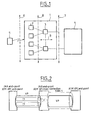
- the RAN comprises network elements such as base stations 2 and base station controllers 3.
- the RAN is in relation, on the one hand with mobile terminals 5, via an interface 6, and on the other hand with the CN via an interface 7.
- the CN is in relation with external networks (not illustrated specifically).
- the base stations communicate with the base station controllers via an interface 8.
- the RAN In systems of UMTS type, the RAN is called UTRAN (UMTS Terrestrial Radio Access Network), the base stations are called Node B, the base station controllers are called RNC (Radio Network Controller), and the mobile terminals are called UE (User Equipment).
- the interface 6 is called Uu interface
- the interface 7 is called lu interface
- the interface 8 is called lub interface
- an interface 9 between RNCs, called lur interface is also introduced.
- the interface 6 is also called radio interface
- the interfaces 7, 8, 9, are also called terrestrial interfaces.
- the network elements of UTRAN are connected via a transport network (not illustrated specifically). A logical link within this transport network enables two network elements to communicate via one of the terrestrial interfaces lub, lur, lu.
- ATM Asynchronous Transfer Mode
- ATM Asynchronous Transfer Mode
- the protocol layers in an ATM network include, besides a physical layer, an ATM layer and an ATM Adaptation Layer (AAL).
- AAL ATM Adaptation Layer
- the ATM layer is connection oriented, and performs cell transmission on a logical connection between a source and a destination, this logical connection also being called Virtual Channel (VC).
- VC Virtual Channel
- VCs can be regrouped to form a Virtual Path (VP).
- the source and destination are also called ATM Virtual Path Connection (VPC) end-points, and the nodes of the transport network between ATM VPC end-points are also called ATM VP cross-connects.
- VPC ATM Virtual Path Connection
- IMA Inverse Multiplexing for ATM
- VPC ATM connection
- IMA Inverse Multiplexing for ATM
- IMA Inverse Multiplexing for ATM
- the process in inverse multiplexing for ATM is the reverse of multiplexing.
- IMA performs a distribution of ATM cells over a group of physical links, also called IMA group or IMA bundle.
- the ATM layer remains transparent to the functions performed by IMA, which belong to the physical layer.
- IMA is for instance potentially useful on E1 interfaces, offering 2.048 Mbit/s bit rate, out of which 1.920 Mbit/s can be used with usual ATM mapping (see ITU-T recommendation G.804 : ATM cell mapping into Plesiochronous Digital Hierarchy (PDH)). Without IMA, a VP is thus limited to at most 1.920 Mbit/s for its Peak Cell Rate, whereas it can go up to almost twice more if two E1 interfaces are used with IMA.
- IMA also gives more flexibility, allowing to offer bandwidth on demand, depending on the needs.
- IMA also allows to offer in-built redundancy: if an IMA bundle is made of « n » physical links, and a failure affects one (or several) of these links, the ATM connection carried on it may still use the « p » links that remain operational. However, there is of course an impact on the available bandwidth, which is roughly the previous bandwidth multiplied by « p » and divided by « n culinary
- PPP Multilink protocol is defined in RFC 1990, which states in its general overview section "the goal of multilink operation is to coordinate multiple independent links between a fixed pair of systems, providing a virtual link with greater bandwidth than any of the constituent members noted. All packets received over links identified as belonging to the multilink arrangement are presented to the same network-layer protocol preocessing machine, whether they have multilink headers or not.”
- RFC 2686 defines the multi-class extension to multi-link PPP, and aims at providing improvements for transmitting high priority packets over multi-link PPP.
- PPP Multilink protocol presents the same drawbacks as IMA, when the endpoint of the connection, does not correspond to the endpoints of PPP multilink protocol.
- a connection established between two connection end-points uses inverse multiplexing for ATM such that a first connection end-point corresponds to an inverse multiplexing for ATM end-point and a second connection end-point does not correspond to an inverse multiplexing for ATM end-point.
- the first connection end-point is the one shown on the left side of the figure
- the second connection end-point is the one shown on the right side of the figure
- an ATM VP Cross-Connection is shown in the middle of the figure.
- a VP is carried between the ATM VPC end-point of the left side and the ATM VP Cross-Connection using IMA (the IMA group in this example is using two E1 links).
- a VP is carried between the ATM VP Cross-Connection and the ATM VPC end-point of the right side using a STM-1 (Synchronous Transport Module 1) of the SDH (Synchronous Digital Hierarchy).
- one problem to solve is to find a way to detect the failure of link(s) in IMA bundle by an ATM VPC end-point not supporting IMA.
- This problem in particular arises in the case of the lub interface defined in UMTS, connecting a Node B (assumed here to support IMA), and a Radio Network Controller (RNC) (assumed here not to support IMA), with the use of an intermediate ATM VP cross-connect, terminating the IMA.
- RNC Radio Network Controller
- figure 2 only illustrates one example where such a problem arises. Such a problem could also arise in other examples, for instance in the case where IMA would not be terminated in an ATM connection end-point, but in an intermediary (not illustrated) node.
- a first solution to this problem is to rely on existing ATM maintenance flows, in particular Performance Monitoring (PM) flows (F4 for the example provided above of a VP Connection, or F5 for the supervision of the VCs supported on this VP). This allows detecting ATM cell losses if they occur.
- PM Performance Monitoring
- the implementation of the first solution is complex and consumes a significant part of resources. It is not always available in ATM equipment. In addition, it does not provide a clear information on the reason of the ATM cell losses. It also does not provide reliable information, in case the traffic at the time of the failure is low enough to allow it to go through the remaining operational links. At the very moment of the failure, the ATM cells already queued to be transmitted on a physical link will be lost, but as soon as the failure is detected at the IMA termination, the traffic will not be routed via this (or these) links any longer. If the physical capacity remaining operational is big enough compared to the current ATM traffic, no more losses will be detected by F4/F5.
- the implementation of the second solution provides means to detect the failure. However, they cannot be assumed to be reliable (the O&M chain does not have the same reliability requirements as the telecom part), and they are likely to provide information too slowly compared to the real time requirements of a telecom application.
- Another problem to solve is to optimize the handling of congestion situations due to IMA link(s) failure, in a way that IMA link(s) failure has as little impact as possible on the traffic.
- the present invention in particular enables to solve part or all of the above-mentioned problems, or to avoid part or all of the above-mentioned drawbacks. More generally the aim of the present invention is to improve the handling of link(s) failure (or more generally dynamic bandwidth changes) in connection with the use of inverse multiplexing (such as in particular IMA) in a transport network (such as in particular the Radio Access Network of a mobile communication system).
- inverse multiplexing such as in particular IMA
- transport network such as in particular the Radio Access Network of a mobile communication system.
- IMA is only an example of inverse multiplexing technique to which the present invention applies and for which the present invention will, by way of example, be more particularly disclosed, but that the present invention also applies to other inverse multiplexing techniques such as for example, in the case where the transport technology used on the transport network is IP (Internet Protocol), multilink/multiclass PPP (Point-to-Point Protocol) as defined in particular in RFC 2686 and RFC 1990.
- IP Internet Protocol
- PPP Point-to-Point Protocol
- EP 0920236 discloses a system and method for managing data traffic through a path that includes a transmission link having a transport rate that is subject to change with time.
- An example of transmission link having a dynamically varying transport rate is an inverse multiplexing over ATM (IMA) system.
- IMA inverse multiplexing over ATM
- EP 0892577 relates to automatic control of ATM dynamic connection bandwidth in ATM interfaces and more particularly inverse multiplexers. It discloses a mechanism for managing bandwidth loading on a communication interface.
- a method for improved handling of dynamic bandwidth changes in a transport network using inverse multiplexing such that at least one connection end-point of a connection does not correspond to an inverse multiplexing end-point, a method including a step wherein said at least one connection end-point is informed of a bandwidth change by at least one inverse multiplexing end-point aware of said bandwidth change.
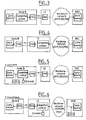
- figures 3 and 4 correspond to the example presented in relation with figure 2 , i.e. to the case of the lub interface defined in UMTS, connecting a Node B (assumed here to support IMA), and a Radio Network Controller (RNC) (assumed here not to support IMA), with the use of an intermediate ATM VP cross-connect (noted CC), terminating the IMA.
- Figure 3 illustrates the case of the uplink direction
- figure 4 illustrates the case of the downlink direction.
- IMA terminating means (noted IMA) and congestion control means (noted Congestion Control) have been illustrated in the IMA end-points, i.e. Node B and CC, and a data source has been illustrated in the ATM connection end-points, i.e. Node B and RNC.
- Congestion Control congestion control means
- VCC defined with a bandwidth of 5 Mbit/s, going over an IMA group of three E1 links. If one of the three E1 links fails either in a termination point or in an intermediate cross-connect, the available bandwidth suddenly drops to about 4 Mbit/s. If the bandwidth of the VCC is used at its maximum at the moment of the failure, the buffers of the equipment at the point of failure will rapidly overflow. This will result in rapid cell loss (in that equipment), and cell delay for the cells which will not be discarded. Because of real time constraints in UMTS on the lub interface, cell delay will likely result in cell discard in the Node B (for downlink direction), so that it is quite possible that a large part of the VCC is lost, until the source reacts.
- AAL2 is a specific ATM Adaptation Layer (AAL) which allows several low bit rate connections to share a same ATM connection, by multiplexing several short packets called CPS packets into a same ATM cell. It is possible (and it is often the case in high load situation) that AAL 2 CPS packets are spread over several ATM cells. If this is the case, the loss of one ATM cell results in the loss, not only of the data contained in this ATM cell, but also of the data contained in all the CPS packets spread over several ATM cells including this ATM cell.
- AAL 2 CPS packets are spread over several ATM cells. If this is the case, the loss of one ATM cell results in the loss, not only of the data contained in this ATM cell, but also of the data contained in all the CPS packets spread over several ATM cells including this ATM cell.
- AAL2 SSSAR SDU Service Specific Segmentation And Reassembly Service Data Unit, AAL2 SSSAR being specified in ITU-T 1.366.1
- AAL2 SSSAR being specified in ITU-T 1.366.1
- IMA link failure There are two areas where action may be required in case of IMA link failure: one is for prevention; the other is for immediate (or very short term) defence.
- the high priority traffic and lower priority traffic should be distinguished (possibly with several levels). This has no effect as long as no congestion is experienced. Only in case of congestion, the lower priority traffic may be impacted, depending on the level of congestion.
- the indication of the priority in case of congestion can be performed at application layer, and exchanged between end points when the corresponding connections are established.
- the highest priority traffic can be protected by the use of the CLP (Cell Loss Priority) bit set to 0 by the ATM connection termination point.
- CLP Cell Loss Priority
- ML-MC PPP offers four classes.
- ATM-CLP can be read as service class in the ML/MC-PPP case.
- CLP Cell Loss Priority
- At least the cells of the control plane should be marked with CLP 0. It is also possible to mark important cells of the user plane with CLP 0, but care should be taken that if too many cells are marked, the efficiency of the mechanism may be lost. For instance, if an IMA bundle is made of two links, no more than half the cells should be marked with CLP 0. If the bundle is made of four links, and if the protection needs to be efficient even if the case of loss of three out of the four links, then no more than 25% of the cells should be marked with CLP 0.
- Distinguishing important cells with CLP bit can be a way to guarantee that even in case of link failure inside an IMA group, the bandwidth of the bundle made of the remaining links is still sufficient to enable important cells to go through. This of course assumes that the congestion mechanisms implemented in the crossed ATM nodes follow ITU-T recommendation 1.371.
- the RNC has to inform the Node B of the importance of the user plane traffic with regard to potential congestion, as illustrated by way of example in figure 7 with information noted 11 sent from RNC to Node B.
- NBAP Node B Application Part
- This parameter is called "Allocation/Retention Priority" and indicates the priority level in the allocation and retention of Node B internal resources.
- the Node B could extend the use of this parameter to select which user plane traffic needs to be protected against congestion.
- NBAP is a signalling protocol used on the lub interface of UTRAN, at a radio network layer, i.e. for the handling of radio network related issues (see 3GPP TS 25.433 : UTRAN lub interface NBAP signalling).
- Use of a specific new parameter defined in NBAP could also be considered.
- Use of ALCAP protocol information could also be considered.
- ALCAP « Access Link Control Application Part »
- ALCAP is a signalling protocol used in UTRAN, at a transport network layer, i.e. for the handling of transport technology related issues (including the establishing of AAL2 connections); see :
- the RNC may indicate its priority by the information element "Allocation/Retention Priority". This information element is normally used in case of radio congestion, when a higher priority radio link needs to be established, if this cannot be done without releasing an already existing radio link. Several priority levels are defined in 3GPP TS 25. 433, and the lower priority radio links should be released first.
- the same information element can be used to cover the transport congestion problem.
- the Node B can locally decide to release the connections corresponding to the low priority radio links.
- the CLP bit can be used in case of congestion, as defined in ITU-T recommendation 1.371.
- cells marked with CLP 0 will in principle be handled with higher priority than cells with CLP 1 by any ATM equipment.
- one endpoint If one endpoint is aware of the IMA link failure, it can decide to release part or all of the low priority traffic, depending on the level of congestion.
- the Node B can inform the RNC, as illustrated by way of example in figure 8 with information noted 12 sent by the Node B to the RNC.
- the Node B can inform the RNC by transferring information at a level above ATM to the RNC. More generally the point terminating the IMA bundle and detecting the failure indicates the loss of the link, in a form or another.
- a convenient form is in particular an indication of the percentage of the total bandwidth of the concerned VP, which remains available (or in an equivalent way, the percentage that becomes unavailable).
- IMA has parameters P TX , P RX , which indicate the minimum number of links required for IMA group.
- P TX parameters
- P RX parameters which indicate the minimum number of links required for IMA group.
- the IMA group stops Tx/Rx of any ATM cells even if one or more physical links is still alive in the group. What is described here is an example, which does not come under this case. That is, it is the case when the number of "Active" links is still more (or equal) than P TX and P RX , after the link is failed.
- An example of method could for example include the following steps:
- the message should contain the information, which may affect the available bandwidth. Following information is proposed to be included in this message.
- the message is to be sent to RNC on the change of any element, which affects its available bandwidth.
- Node B informs RNC of its information. This will allow RNC to control available bandwidth dynamically without manual operation, e.g. when:
- the Node B can locally decide to release low priority connections, based on the priority of the corresponding radio link, as indicated by the RNC at radio link establishment time.
- the present invention is not limited to the example presented in relation figure 2 or 3 to 6 .
- a solution could be that the Node B is first informed of an IMA link failure by said intermediary node, and the Node B then informs the RNC of said link failure.
- This solution would of course require that the intermediary Node can inform the Node B of the IMA link failure, such as for example by means of an application defined above ATM layer between that intermediary node and the Node B.
- a method according to the present invention provides at least one step wherein said at least one connection end-point is informed of a bandwidth change by at least one inverse multiplexing end-point aware of said bandwidth change.
Landscapes
- Engineering & Computer Science (AREA)
- Computer Networks & Wireless Communication (AREA)
- Signal Processing (AREA)
- Databases & Information Systems (AREA)
- Data Exchanges In Wide-Area Networks (AREA)
- Two-Way Televisions, Distribution Of Moving Picture Or The Like (AREA)
Claims (50)
- Ein Verfahren zur Behandlung von dynamischen Bandbreitenveränderungen in einem Transportnetz mit Inversmultiplex-Betrieb, in welchem mindestens ein Verbindungsendpunkt, ATM VPC-Endpunkt, nicht einem Inversmultiplex-Endpunkt, IMA-Endpunkt, entspricht, wobei das Verfahren einen Schritt umfasst, in welchem der besagte mindestens eine Verbindungsendpunkt von mindestens einem Inversmultiplex-Endpunkt, welcher eine Bandbreitenveränderung erfasst hat, über die besagte Bandbreitenveränderung informiert wird, wobei der besagte Schritt, in welchem der besagte mindestens eine Verbindungsendpunkt von mindestens einem Inversmultiplex-Endpunkt, welcher eine Bandbreitenveränderung erfasst hat, über die besagte Bandbreitenveränderung informiert wird, einen Schritt umfasst, in welchem die Informationen, die eine Bandbreitenveränderung anzeigen, über ein an der besagten gegebenen Schnittstelle verwendetes Signalisierungsprotokoll gesendet werden.
- Ein Verfahren nach Anspruch 1, wobei der Inversmultiplex-Betrieb dem Inversmultiplex-Betrieb für ATM, IMA entspricht.
- Ein Verfahren nach Anspruch 1, wobei der Inversmultiplex-Betrieb dem Multilink/Multiclass-PPP entspricht.
- Ein Verfahren nach einem beliebigen der Ansprüche 1 bis 3, weiterhin umfassend einen Schritt, in welchem ein Verbindungsendpunkt, welcher einem Inversmultiplex-Endpunkt entspricht, den besagten Verbindungsendpunkt, welcher nicht einem Inversmultiplex-Endpunkt entspricht, über eine von ihm erkannte Bandbreitenveränderung informiert.
- Ein Verfahren nach einem beliebigen der Ansprüche 1 bis 3, weiterhin umfassend einen ersten Schritt, in welchem ein erster Verbindungsendpunkt, welcher nicht einem Inversmultiplex-Endpunkt entspricht, von einem Inversmultiplex-Endpunkt, welcher eine Bandbreitenveränderung erkannt hat, über die besagte Bandbreitenversnderung informiert wird, sowie einen zweiten Schritt, in welchem der besagte erste Verbindungsendpunkt einen zweiten Verbindungsendpunkt, welcher nicht einem Inversmultiplex-Endpunkt entspricht, über die besagte Sandbreitenvetänderung informiert.
- Ein Verfahren nach einem beliebigen der Ansprüche 1 bis 5, wobei die von dem besagten mindestens einen Verbindungsendpunkt empfangenen Informationen, welche eine Bandbreitenveranderung anzeigen, eine aktuell verfügbare Bandbreite enthalten.
- Ein Verfahren nach einem beliebigen der Ansprüche 1 bis 6, wobei eine Bandbreitenveränderung einem Ausfall mindestens eines Links in einer Gruppe von Links zwischen zwei Inversmultiplex-Endpunkten entspricht.
- Ein Verfahren nach Anspruch 7, weiterhin umfassend einen Schritt, in welchem der besagte Inversmultiplex-Endpunkt bei Ausfall eines Links in der Übertragungsrichtung von dem besagten Inversmultiplex-Endpunkt den besagten Ausfall des Links durch Überwachen der Übertragungslink-Statusinformationen erkennt.
- Ein Verfahren nach Anspruch 7, weiterhin umfassend einen Schritt, in welchem der besagte Inversmultiplex-Endpunkt bei Ausfall eines Links in der Übertragungsrichtung von dem besagten Inversmultiplex-Endpunkt den besagten Ausfall des Links durch Erfassen eines Pufferüberlaufs erkennt.
- Ein Verfahren nach Anspruch 7, weiterhin umfassend einen Schritt, in welchem der besagte Inversmultiplex-Endpunkt bei Ausfall eines Links in der Übertragungsrichtung zu dem besagten Inversmultiplex-Endpunkt den besagten Ausfall des Links durch Erfassen der Empfangsverzögerung erkennt.
- Ein Verfahren nach einem beliebigen der Ansprüche 1 bis 10, weiterhin umfassend einen Schritt, in welchem der besagte mindestens eine Verbindungsendpunkt die von dem besagten mindestens einen Inversmultiplex-Endpunkt empfangenen Informationen, welche eine Bandbreitenveränderung anzeigen, verwendet, um die Verkehrslast entsprechend anzupassen.
- Ein Verfahren nach einem beliebigen der Ansprüche 7 bis 11, weiterhin umfassend einen Schritt, in welchem der besagte mindestens eine Verbindungsendpunkt die von dem besagten mindestens einen Inversmultiplex-Endpunkt empfangenen Informationen, welche eine Bandbreitenveränderung anzeigen, verwendet, um Schutzmaßnahmen gegen eine von dem besagten Ausfall eines Links verursachte Überlastung zu ergreifen.
- Ein Verfahren nach einem beliebigen der Ansprüche 1 bis 12, wobei das besagte Tränsportnetz dem Funkzugangsnetz (1) eines mobilen Kommunikationssystems entspricht, und ein erster und ein zweiter Verbindungsendpunkt jeweils einem ersten und einem zweiten Netzwerkelement entspricht, welche über eine gegebene Schnittstelle des besagten Funkzugangsnetzes kommunizieren.
- Ein Verfahren nach Anspruch 1, wobei das besagte Signalisierungsprotokoll einem Signalisierungsprotokoll auf einer Funknetzschicht entspricht.
- Ein Verfahren nach Anspruch 1, wobei das besagte Signalisierungsprotokoll einem Signalisierungsprotokoll auf einer Transportnetzschicht entspricht.
- Ein Verfahren nach einem beliebigen der Ansprüche 13 bis 15, wobei das besagte erste und das besagte zweite Netzwerkelement jeweils einer Basisstation (Knoten B) und einer Basisstations-Steuereinrichtung (RNC) entsprechen.
- Ein Verfahren nach Anspruch 16, weiterhin umfassend einen Schritt, in welchem die besagte Basisstations-Steuereinrichtung (RNC) die von der besagten Basisstation empfangenen Informationen, welche eine Bandbrotefweranderung anzeigen, verwendet, um die Verkehrslast dementsprechend anzupassen.
- Ein Verfahren nach Anspruch 17, wobei die besagte Lastanpassung die Freigabe von Rufen mit niedriger Priorität umfasst.
- Ein Verfahren nach Anspruch 17, wobei die besagte Lastanpassung die Aktualisierung der Verbindungszulassungssteuerungsparameter umfasst.
- Ein Verfahren nach Anspruch 1, wobei das besagte Signalisierungsprotokoll auf einer Funknetzschicht dem Node B Application Part, NBAP, entspricht.
- Ein Verfahren nach Anspruch 20, wobei die besagten Informationen in einer von dem NBAP-Protokoll verwendeten "Resource Status Indication"-Nachricht gesendet werden.
- Ein Verfahren nach Anspruch 1, wobei das besagte Signalisierungsprotokoll auf einer Transportnetzschicht dem Access Link Control Application Part, ALCAP, entspricht.
- Ein Netzwerkelement für das Funkzugangsnetz (1) eines mobilen Kommunikationssystems, mit Mitteln zum Durchführen eines Verfahrens gemäß einem beliebigen der Ansprüche 1 bis 12.
- Eine Basisstation (Knoten B) für das Funkzugangsnetz (1) eines mobilen Kommunikationssystems, mit Mitteln zum Durchführen eines Verfahrens gemäß einem beliebigen der Ansprüche 13 bis 22.
- Eine Basisstations-Steuereinrichtung (RNC) für das Funkzugangsnetz (1) eines mobilen Kommunikationssystems, mit Mitteln zum Durchführen eines Verfahrens gemäß einem beliebigen der Ansprüche 13 bis 22.
- Ein Verfahren nach einem beliebigen der Ansprüche 1 bis 22, wobei das Verfahren weiterhin einen Schritt umfasst, in welchem das besagte Transportnetz Vorbeuge-und/oder Schutzmaßnahmen gegen eine von dem besagten Ausfall eines Links verursachte Überlastung ergreift, basierend auf einem Verkehrsprioritätskriterium, um den Verkehr mit hoher Priorität gegen die besagte Überlastung zu schützen.
- Ein Verfahren nach Anspruch 26, wobei der Inversmultiplex-Betrieb dem IMA (Inversmultiplex für ATM) entspricht.
- Ein Verfahren nach Anspruch 26, wobei der Inversmultiplex-Betrieb dem Multilink/Multiclass-PPP entspricht.
- Ein Verfahren nach einem beliebigen der Ansprüche 26 bis 28, wobei die besagten Vorbeugungsmaßnahmen das Markieren der Verkehrspriorität umfassen.
- Ein Verfahren nach Anspruch 29, wobei das besagte Markieren auf der Transportebene erfolgt.
- Ein Verfahren nach Anspruch 30, wobei das besagte Transportnetz ATM als Transporttechnologie benutzt, wobei das besagte Markieren der Verkehrspriorität das Markieren von ATM-Zellen mit einem Zellenverlustprioritäts-, CLP, Bit umfasst.
- Ein Verfahren nach einem beliebigen der Ansprüche 30 oder 31, wobei das besagte Transportnetz ATM als Transporttechnologie benutzt, und wobei, wenn AAL2-Verbindungen mit verschiedenen Prioritäten auf einer selben VC gemultiplext sind, eine ATM-Zelle, welche mindestens einen Teil eines CPS-Pakets mit hoher Priorität enthält, als eine Zelle mit hoher Priorität betrachtet wird.
- Ein Verfahren nach Anspruch 29, wobei das besagte Markieren auf der Anwendungsebene erfolgt.
- Ein Verfahren nach einem beliebigen der Anspruche 26 bis 33, wobei das besagte Transportnetz ATM als Transporttechnologie benutzt und die Schutzmaßnahmen das Ausrangieren von ATM-Zellen umfassen.
- Ein Verfahren nach einem beliebigen der Ansprüche 26 bis 34, wobei der gegen die besagte Überlastung zu schützende Verkehr mit hoher Priorität unter Berücksichtigung des geringsten zulässigen Verkehrs, welcher der höchsten Anzahl von Ausfällen eines Links in einem Inversmultiplex-Betrieb für die ATM-Gruppe entspricht, bestimmt wird.
- Ein Verfahren nach einem beliebigen der Ansprüche 26 bis 35, wobei der Verkehr mit hoher Priorität einen Verkehr auf der Steuerungsebene umfasst.
- Ein Verfahren nach einem beliebigen der Ansprüche 26 bis 35, wobei der Verkehr mit hoher Priorität einen bedeutenden Verkehr auf der Benutzerebene umfasst.
- Ein Verfahren nach einem beliebigen der Ansprüche 29 bis 37, wobei das Markieren der Verkehrspriorität in beiden Übertragungsrichtungen erfolgt.
- Ein Verfahren nach einem beliebigen der Ansprüche 26 bis 38, wobei das besagte Transportnetz dem Funkzugangsnetz (1) eines mobilen Kommunikationssystems entspricht, wobei das Verfahren die Kommunikation zwischen zwei Netzwerkelementen über eine gegebene Schnittstelle des besagten Funkzugangsnetzes ermöglicht.
- Ein Verfahren nach Anspruch 39, umfassend einen Schritt, in welchem ein erstes Metzwerkelementvon einem zweiten Netzwerkelement Informationen, welche für eine als das besagte Kriterium zu verwendende Verkehrspriorität repräsentativ sind, empfängt.
- Ein Verfahren nach Anspruch 40, wobei das besagte erste Netzwerkelement die besagten Informationen von dem besagten zweiten Netzwerkelement über ein an der besagten gegebenen Schnittstelle verwendetes Signalisierungsprotokoll empfängt.
- Ein Verfahren nach Anspruch 41, wobei das besagte Signalisierungsprotokoll einem Signalisierungsprotokoll auf einer Funknetzschicht entspricht.
- Ein Verfahren nach Anspruch 41, wobei das besagte Signalisierungsprotokoll einem Signalisierungsprotokoll auf einer Transportnetzschicht entspricht.
- Ein Verfahren nach einem beliebigen der Ansprüche 40 bis 43, wobei das besagte erste und das besagte zweite Netzwerkelementjeweils einer Basisstation (Knoten B) und einer Basisstations-Steuiereinrichtung (RNC) entsprechen.
- Ein Verfahren nach Anspruch 41, wobei das besagte Signalisierungsprotokoll auf einer Funknetzschicht dem Node B Application Part, NBAP, entspricht.
- Ein Verfahren nach Anspruch 45, wobei die besagten Informationen dem von dem NBAP-Protokoll verwendeten Zuweisungs-/Erhaltungsprioritäts-Parameter entsprechen.
- Ein Verfahren nach Anspruch 41, wobei das besagte Signalisierungsprotokoll auf einer Transportnetzschicht dem Access Link Control Application Part, ALCAP, entspricht.
- Ein Netzwerkelement für das Funkzugangsnetz (1) eines mobilen Kommunikationssystems, mit Mitteln zum Durchführen eines Verfahrens gemäß einem beliebigen der Ansprüche 26 bis 38.
- Eine Basisstation (Knoten B) für das Funkzugangsnetz (1) eines mobilen Kommunikationssystems, mit Mitteln zum Durchführen eines Verfahrens gemäß einem beliebigen der Ansprüche 39 bis 47.
- Eine Funknetzwerk-Steuereinrichtung (RNC) für das Funkzugangsnetz (1) eines mobilen Kommunikationssystems, mit Mitteln zum Durchführen eines Verfahrens gemäß einem beliebigen der Ansprüche 39 bis 47.
Priority Applications (5)
| Application Number | Priority Date | Filing Date | Title |
|---|---|---|---|
| AT03293249T ATE436135T1 (de) | 2003-12-19 | 2003-12-19 | Verfahren zur verbesserten behandlung von dynamischen bandbreitenveränderungen in einem transportnetz mit inversem multiplexen |
| DE60328300T DE60328300D1 (de) | 2003-12-19 | 2003-12-19 | Verfahren zur verbesserten Behandlung von dynamischen Bandbreitenveränderungen in einem Transportnetz mit inversem Multiplexen |
| EP03293249A EP1545071B1 (de) | 2003-12-19 | 2003-12-19 | Verfahren zur verbesserten Behandlung von dynamischen Bandbreitenveränderungen in einem Transportnetz mit inversem Multiplexen |
| US11/013,445 US20050185650A1 (en) | 2003-12-19 | 2004-12-17 | Method for improved handling of dynamic bandwidth changes in a transport network using inverse multiplexing |
| CNB2004101016713A CN100471126C (zh) | 2003-12-19 | 2004-12-20 | 利用反向复用的传输网络中改进处理动态带宽改变的方法 |
Applications Claiming Priority (1)
| Application Number | Priority Date | Filing Date | Title |
|---|---|---|---|
| EP03293249A EP1545071B1 (de) | 2003-12-19 | 2003-12-19 | Verfahren zur verbesserten Behandlung von dynamischen Bandbreitenveränderungen in einem Transportnetz mit inversem Multiplexen |
Publications (2)
| Publication Number | Publication Date |
|---|---|
| EP1545071A1 EP1545071A1 (de) | 2005-06-22 |
| EP1545071B1 true EP1545071B1 (de) | 2009-07-08 |
Family
ID=34486498
Family Applications (1)
| Application Number | Title | Priority Date | Filing Date |
|---|---|---|---|
| EP03293249A Expired - Lifetime EP1545071B1 (de) | 2003-12-19 | 2003-12-19 | Verfahren zur verbesserten Behandlung von dynamischen Bandbreitenveränderungen in einem Transportnetz mit inversem Multiplexen |
Country Status (5)
| Country | Link |
|---|---|
| US (1) | US20050185650A1 (de) |
| EP (1) | EP1545071B1 (de) |
| CN (1) | CN100471126C (de) |
| AT (1) | ATE436135T1 (de) |
| DE (1) | DE60328300D1 (de) |
Families Citing this family (9)
| Publication number | Priority date | Publication date | Assignee | Title |
|---|---|---|---|---|
| US7760646B2 (en) * | 2005-02-09 | 2010-07-20 | Nokia Corporation | Congestion notification in 3G radio access |
| EP1770918A1 (de) * | 2005-09-30 | 2007-04-04 | Evolium Sas | Datenflusssteuerung für Schnittstellen eines Funkzugangsnetzes |
| WO2008010750A1 (en) * | 2006-07-17 | 2008-01-24 | Telefonaktiebolaget Lm Ericsson (Publ) | Enhanced up-link |
| US8767530B2 (en) | 2007-02-07 | 2014-07-01 | Futurewei Technologies, Inc. | Hierarchical processing and propagation of partial faults in a packet network |
| DE102008007497B4 (de) * | 2008-02-05 | 2011-05-26 | Fraunhofer-Gesellschaft zur Förderung der angewandten Forschung e.V. | Verfahren und Vorrichtung zur Datenübertragung |
| US8203938B2 (en) * | 2008-05-22 | 2012-06-19 | Level 3 Communications, Llc | Multi-router IGP fate sharing |
| CN103312626B (zh) * | 2012-03-06 | 2018-03-30 | 中兴通讯股份有限公司 | 一种发送异步转移模式反向复用业务的方法及装置 |
| CN103686839A (zh) * | 2012-09-20 | 2014-03-26 | 中兴通讯股份有限公司 | 一种传输带宽上报方法、装置和系统 |
| CN103024826B (zh) * | 2012-12-10 | 2016-08-03 | 华为技术有限公司 | 带宽调整的方法、设备及系统 |
Family Cites Families (12)
| Publication number | Priority date | Publication date | Assignee | Title |
|---|---|---|---|---|
| KR100278573B1 (ko) * | 1995-12-13 | 2001-01-15 | 포만 제프리 엘 | 접속 승인 제어 방법 및 이를 수행하는 장치 |
| US5875192A (en) * | 1996-12-12 | 1999-02-23 | Pmc-Sierra Ltd. | ATM inverse multiplexing system |
| US6128280A (en) * | 1997-07-16 | 2000-10-03 | Nortel Networks Corporation | Dynamic connection bandwidth control |
| US6408005B1 (en) * | 1997-09-05 | 2002-06-18 | Nec Usa, Inc. | Dynamic rate control scheduler for ATM networks |
| CA2240596A1 (en) * | 1997-11-28 | 1999-05-28 | Newbridge Networks Corporation | Controlling atm layer transfer characteristics based on physical layer dynamic rate adaptation |
| US6002670A (en) * | 1997-12-12 | 1999-12-14 | Nortel Networks Corporation | Optimization and recovery techniques in IMA networks |
| US7200110B1 (en) * | 1999-03-24 | 2007-04-03 | Alcatel Canada Inc. | Method and apparatus for prioritized release of connections in a communications network |
| US7046623B2 (en) * | 2000-12-29 | 2006-05-16 | Nokia Inc. | Fault recovery system and method for inverse multiplexed digital subscriber lines |
| US6963533B2 (en) * | 2000-12-29 | 2005-11-08 | Nokia Inc. | Method and system for establishing link bit rate for inverse multiplexed data streams |
| WO2003047276A2 (en) * | 2001-11-26 | 2003-06-05 | Nokia Corporation | High-speed aal2 transport service |
| EP2222113B1 (de) * | 2001-11-26 | 2011-12-28 | Intellectual Ventures I LLC | Mac-Schicht-Multiplexumkehr in einem RAN der dritten Generation |
| US7212548B2 (en) * | 2002-06-21 | 2007-05-01 | Adtran, Inc. | Multiple T1 channel inverse multiplexing method and apparatus |
-
2003
- 2003-12-19 AT AT03293249T patent/ATE436135T1/de not_active IP Right Cessation
- 2003-12-19 EP EP03293249A patent/EP1545071B1/de not_active Expired - Lifetime
- 2003-12-19 DE DE60328300T patent/DE60328300D1/de not_active Expired - Lifetime
-
2004
- 2004-12-17 US US11/013,445 patent/US20050185650A1/en not_active Abandoned
- 2004-12-20 CN CNB2004101016713A patent/CN100471126C/zh not_active Expired - Fee Related
Also Published As
| Publication number | Publication date |
|---|---|
| DE60328300D1 (de) | 2009-08-20 |
| CN1630254A (zh) | 2005-06-22 |
| ATE436135T1 (de) | 2009-07-15 |
| US20050185650A1 (en) | 2005-08-25 |
| CN100471126C (zh) | 2009-03-18 |
| EP1545071A1 (de) | 2005-06-22 |
Similar Documents
| Publication | Publication Date | Title |
|---|---|---|
| EP0795259B1 (de) | Atm invertiertes multiplexerverfahren | |
| KR100949245B1 (ko) | 3g 무선 접속 네트워크에서의 정체 표시 방법 | |
| EP1121776B1 (de) | Ein ecn-basierter ansatz zur verstopfungsverwaltung in hybriden atm-ip netzwerken | |
| EP0931402B1 (de) | Breitbandfernmeldesystem | |
| US6614756B1 (en) | Method of detecting and recovering from signaling congestion in an asynchronous transfer mode network | |
| US20050281253A1 (en) | Method for transporting data in telecommunication system, and network element | |
| Chitre et al. | Asynchronous transfer mode (ATM) operation via satellite: Issues, challenges and resolutions | |
| EP1545071B1 (de) | Verfahren zur verbesserten Behandlung von dynamischen Bandbreitenveränderungen in einem Transportnetz mit inversem Multiplexen | |
| EP1289334B1 (de) | Verfahren und Vorrichtung zur Multiplexübertragung | |
| US6064648A (en) | Method for notifying a frame relay network of traffic congestion in an ATM network | |
| US7327740B2 (en) | Facilitating reliable connection admission control for telecommunications system using AAL2 signaling | |
| CN100375461C (zh) | 在网络中进行虚通路环保护倒换的方法 | |
| AU2211600A (en) | Mechanism and method for dynamically allocating atm connections between exchanges | |
| EP1264510B1 (de) | Anpassung der übertragungskapazität in paketvermittelten netzen unter verwendung von atm-zellen | |
| KR100558514B1 (ko) | 에이티엠 망에서의 폭주 제어 방법 | |
| Filipiak et al. | Routing and bandwidth management options in high speed integrated services networks | |
| Mostamary | Transmission Phase in 3G, using ATM | |
| KR19990058026A (ko) | 복합형 프로토콜 변환장치의 셀우선순위를 이용한 트래픽제어 방법 |
Legal Events
| Date | Code | Title | Description |
|---|---|---|---|
| PUAI | Public reference made under article 153(3) epc to a published international application that has entered the european phase |
Free format text: ORIGINAL CODE: 0009012 |
|
| AK | Designated contracting states |
Kind code of ref document: A1 Designated state(s): AT BE BG CH CY CZ DE DK EE ES FI FR GB GR HU IE IT LI LU MC NL PT RO SE SI SK TR |
|
| AX | Request for extension of the european patent |
Extension state: AL LT LV MK |
|
| 17P | Request for examination filed |
Effective date: 20051214 |
|
| AKX | Designation fees paid |
Designated state(s): AT BE BG CH CY CZ DE DK EE ES FI FR GB GR HU IE IT LI LU MC NL PT RO SE SI SK TR |
|
| GRAP | Despatch of communication of intention to grant a patent |
Free format text: ORIGINAL CODE: EPIDOSNIGR1 |
|
| RAP1 | Party data changed (applicant data changed or rights of an application transferred) |
Owner name: ALCATEL LUCENT |
|
| GRAS | Grant fee paid |
Free format text: ORIGINAL CODE: EPIDOSNIGR3 |
|
| GRAA | (expected) grant |
Free format text: ORIGINAL CODE: 0009210 |
|
| AK | Designated contracting states |
Kind code of ref document: B1 Designated state(s): AT BE BG CH CY CZ DE DK EE ES FI FR GB GR HU IE IT LI LU MC NL PT RO SE SI SK TR |
|
| REG | Reference to a national code |
Ref country code: GB Ref legal event code: FG4D |
|
| REG | Reference to a national code |
Ref country code: CH Ref legal event code: EP |
|
| REG | Reference to a national code |
Ref country code: IE Ref legal event code: FG4D |
|
| REF | Corresponds to: |
Ref document number: 60328300 Country of ref document: DE Date of ref document: 20090820 Kind code of ref document: P |
|
| PG25 | Lapsed in a contracting state [announced via postgrant information from national office to epo] |
Ref country code: SI Free format text: LAPSE BECAUSE OF FAILURE TO SUBMIT A TRANSLATION OF THE DESCRIPTION OR TO PAY THE FEE WITHIN THE PRESCRIBED TIME-LIMIT Effective date: 20090708 |
|
| NLV1 | Nl: lapsed or annulled due to failure to fulfill the requirements of art. 29p and 29m of the patents act | ||
| PG25 | Lapsed in a contracting state [announced via postgrant information from national office to epo] |
Ref country code: ES Free format text: LAPSE BECAUSE OF FAILURE TO SUBMIT A TRANSLATION OF THE DESCRIPTION OR TO PAY THE FEE WITHIN THE PRESCRIBED TIME-LIMIT Effective date: 20091019 Ref country code: AT Free format text: LAPSE BECAUSE OF FAILURE TO SUBMIT A TRANSLATION OF THE DESCRIPTION OR TO PAY THE FEE WITHIN THE PRESCRIBED TIME-LIMIT Effective date: 20090708 Ref country code: FI Free format text: LAPSE BECAUSE OF FAILURE TO SUBMIT A TRANSLATION OF THE DESCRIPTION OR TO PAY THE FEE WITHIN THE PRESCRIBED TIME-LIMIT Effective date: 20090708 |
|
| PG25 | Lapsed in a contracting state [announced via postgrant information from national office to epo] |
Ref country code: NL Free format text: LAPSE BECAUSE OF FAILURE TO SUBMIT A TRANSLATION OF THE DESCRIPTION OR TO PAY THE FEE WITHIN THE PRESCRIBED TIME-LIMIT Effective date: 20090708 |
|
| PG25 | Lapsed in a contracting state [announced via postgrant information from national office to epo] |
Ref country code: PT Free format text: LAPSE BECAUSE OF FAILURE TO SUBMIT A TRANSLATION OF THE DESCRIPTION OR TO PAY THE FEE WITHIN THE PRESCRIBED TIME-LIMIT Effective date: 20091109 Ref country code: BG Free format text: LAPSE BECAUSE OF FAILURE TO SUBMIT A TRANSLATION OF THE DESCRIPTION OR TO PAY THE FEE WITHIN THE PRESCRIBED TIME-LIMIT Effective date: 20091008 |
|
| PG25 | Lapsed in a contracting state [announced via postgrant information from national office to epo] |
Ref country code: EE Free format text: LAPSE BECAUSE OF FAILURE TO SUBMIT A TRANSLATION OF THE DESCRIPTION OR TO PAY THE FEE WITHIN THE PRESCRIBED TIME-LIMIT Effective date: 20090708 Ref country code: CZ Free format text: LAPSE BECAUSE OF FAILURE TO SUBMIT A TRANSLATION OF THE DESCRIPTION OR TO PAY THE FEE WITHIN THE PRESCRIBED TIME-LIMIT Effective date: 20090708 Ref country code: DK Free format text: LAPSE BECAUSE OF FAILURE TO SUBMIT A TRANSLATION OF THE DESCRIPTION OR TO PAY THE FEE WITHIN THE PRESCRIBED TIME-LIMIT Effective date: 20090708 Ref country code: RO Free format text: LAPSE BECAUSE OF FAILURE TO SUBMIT A TRANSLATION OF THE DESCRIPTION OR TO PAY THE FEE WITHIN THE PRESCRIBED TIME-LIMIT Effective date: 20090708 |
|
| PLBE | No opposition filed within time limit |
Free format text: ORIGINAL CODE: 0009261 |
|
| STAA | Information on the status of an ep patent application or granted ep patent |
Free format text: STATUS: NO OPPOSITION FILED WITHIN TIME LIMIT |
|
| PG25 | Lapsed in a contracting state [announced via postgrant information from national office to epo] |
Ref country code: SK Free format text: LAPSE BECAUSE OF FAILURE TO SUBMIT A TRANSLATION OF THE DESCRIPTION OR TO PAY THE FEE WITHIN THE PRESCRIBED TIME-LIMIT Effective date: 20090708 Ref country code: BE Free format text: LAPSE BECAUSE OF FAILURE TO SUBMIT A TRANSLATION OF THE DESCRIPTION OR TO PAY THE FEE WITHIN THE PRESCRIBED TIME-LIMIT Effective date: 20090708 |
|
| 26N | No opposition filed |
Effective date: 20100409 |
|
| PG25 | Lapsed in a contracting state [announced via postgrant information from national office to epo] |
Ref country code: MC Free format text: LAPSE BECAUSE OF NON-PAYMENT OF DUE FEES Effective date: 20100701 |
|
| REG | Reference to a national code |
Ref country code: CH Ref legal event code: PL |
|
| PG25 | Lapsed in a contracting state [announced via postgrant information from national office to epo] |
Ref country code: LI Free format text: LAPSE BECAUSE OF NON-PAYMENT OF DUE FEES Effective date: 20091231 Ref country code: IE Free format text: LAPSE BECAUSE OF NON-PAYMENT OF DUE FEES Effective date: 20091219 Ref country code: CH Free format text: LAPSE BECAUSE OF NON-PAYMENT OF DUE FEES Effective date: 20091231 Ref country code: GR Free format text: LAPSE BECAUSE OF FAILURE TO SUBMIT A TRANSLATION OF THE DESCRIPTION OR TO PAY THE FEE WITHIN THE PRESCRIBED TIME-LIMIT Effective date: 20091009 |
|
| PG25 | Lapsed in a contracting state [announced via postgrant information from national office to epo] |
Ref country code: IT Free format text: LAPSE BECAUSE OF FAILURE TO SUBMIT A TRANSLATION OF THE DESCRIPTION OR TO PAY THE FEE WITHIN THE PRESCRIBED TIME-LIMIT Effective date: 20090708 |
|
| PG25 | Lapsed in a contracting state [announced via postgrant information from national office to epo] |
Ref country code: LU Free format text: LAPSE BECAUSE OF NON-PAYMENT OF DUE FEES Effective date: 20091219 |
|
| PG25 | Lapsed in a contracting state [announced via postgrant information from national office to epo] |
Ref country code: HU Free format text: LAPSE BECAUSE OF FAILURE TO SUBMIT A TRANSLATION OF THE DESCRIPTION OR TO PAY THE FEE WITHIN THE PRESCRIBED TIME-LIMIT Effective date: 20100109 |
|
| PG25 | Lapsed in a contracting state [announced via postgrant information from national office to epo] |
Ref country code: TR Free format text: LAPSE BECAUSE OF FAILURE TO SUBMIT A TRANSLATION OF THE DESCRIPTION OR TO PAY THE FEE WITHIN THE PRESCRIBED TIME-LIMIT Effective date: 20090708 |
|
| PG25 | Lapsed in a contracting state [announced via postgrant information from national office to epo] |
Ref country code: CY Free format text: LAPSE BECAUSE OF FAILURE TO SUBMIT A TRANSLATION OF THE DESCRIPTION OR TO PAY THE FEE WITHIN THE PRESCRIBED TIME-LIMIT Effective date: 20090708 |
|
| PG25 | Lapsed in a contracting state [announced via postgrant information from national office to epo] |
Ref country code: SE Free format text: LAPSE BECAUSE OF FAILURE TO SUBMIT A TRANSLATION OF THE DESCRIPTION OR TO PAY THE FEE WITHIN THE PRESCRIBED TIME-LIMIT Effective date: 20090708 |
|
| REG | Reference to a national code |
Ref country code: FR Ref legal event code: GC Effective date: 20131018 |
|
| REG | Reference to a national code |
Ref country code: FR Ref legal event code: RG Effective date: 20141016 |
|
| REG | Reference to a national code |
Ref country code: FR Ref legal event code: CA Effective date: 20150521 |
|
| REG | Reference to a national code |
Ref country code: FR Ref legal event code: CA Effective date: 20150521 |
|
| REG | Reference to a national code |
Ref country code: FR Ref legal event code: PLFP Year of fee payment: 13 |
|
| REG | Reference to a national code |
Ref country code: FR Ref legal event code: PLFP Year of fee payment: 14 |
|
| PGFP | Annual fee paid to national office [announced via postgrant information from national office to epo] |
Ref country code: DE Payment date: 20161213 Year of fee payment: 14 Ref country code: GB Payment date: 20161222 Year of fee payment: 14 |
|
| PGFP | Annual fee paid to national office [announced via postgrant information from national office to epo] |
Ref country code: FR Payment date: 20161222 Year of fee payment: 14 |
|
| REG | Reference to a national code |
Ref country code: DE Ref legal event code: R119 Ref document number: 60328300 Country of ref document: DE |
|
| GBPC | Gb: european patent ceased through non-payment of renewal fee |
Effective date: 20171219 |
|
| REG | Reference to a national code |
Ref country code: FR Ref legal event code: ST Effective date: 20180831 |
|
| PG25 | Lapsed in a contracting state [announced via postgrant information from national office to epo] |
Ref country code: FR Free format text: LAPSE BECAUSE OF NON-PAYMENT OF DUE FEES Effective date: 20180102 Ref country code: DE Free format text: LAPSE BECAUSE OF NON-PAYMENT OF DUE FEES Effective date: 20180703 |
|
| PG25 | Lapsed in a contracting state [announced via postgrant information from national office to epo] |
Ref country code: GB Free format text: LAPSE BECAUSE OF NON-PAYMENT OF DUE FEES Effective date: 20171219 |
|
| REG | Reference to a national code |
Ref country code: DE Ref legal event code: R081 Ref document number: 60328300 Country of ref document: DE Owner name: WSOU INVESTMENTS, LLC, LOS ANGELES, US Free format text: FORMER OWNER: ALCATEL LUCENT, PARIS, FR Ref country code: DE Ref legal event code: R082 Ref document number: 60328300 Country of ref document: DE Representative=s name: BARKHOFF REIMANN VOSSIUS, DE |
|
| REG | Reference to a national code |
Ref country code: GB Ref legal event code: 732E Free format text: REGISTERED BETWEEN 20200820 AND 20200826 |