EP1547977B1 - Procédé pour le traitement d'eaux usées - Google Patents
Procédé pour le traitement d'eaux usées Download PDFInfo
- Publication number
- EP1547977B1 EP1547977B1 EP20030104877 EP03104877A EP1547977B1 EP 1547977 B1 EP1547977 B1 EP 1547977B1 EP 20030104877 EP20030104877 EP 20030104877 EP 03104877 A EP03104877 A EP 03104877A EP 1547977 B1 EP1547977 B1 EP 1547977B1
- Authority
- EP
- European Patent Office
- Prior art keywords
- heat exchanger
- wastewater
- temperature
- water
- thermal disinfection
- Prior art date
- Legal status (The legal status is an assumption and is not a legal conclusion. Google has not performed a legal analysis and makes no representation as to the accuracy of the status listed.)
- Expired - Lifetime
Links
- 239000002351 wastewater Substances 0.000 title claims description 37
- 238000000034 method Methods 0.000 title claims description 24
- XLYOFNOQVPJJNP-UHFFFAOYSA-N water Substances O XLYOFNOQVPJJNP-UHFFFAOYSA-N 0.000 claims description 49
- 238000004659 sterilization and disinfection Methods 0.000 claims description 34
- 238000001556 precipitation Methods 0.000 claims description 31
- 238000006065 biodegradation reaction Methods 0.000 claims description 15
- 238000000926 separation method Methods 0.000 claims description 9
- NKWPZUCBCARRDP-UHFFFAOYSA-L calcium bicarbonate Chemical compound [Ca+2].OC([O-])=O.OC([O-])=O NKWPZUCBCARRDP-UHFFFAOYSA-L 0.000 claims description 5
- 229910000020 calcium bicarbonate Inorganic materials 0.000 claims description 5
- 235000010216 calcium carbonate Nutrition 0.000 claims 2
- VTYYLEPIZMXCLO-UHFFFAOYSA-L calcium carbonate Substances [Ca+2].[O-]C([O-])=O VTYYLEPIZMXCLO-UHFFFAOYSA-L 0.000 claims 2
- 238000011144 upstream manufacturing Methods 0.000 claims 2
- 239000012528 membrane Substances 0.000 description 32
- MHAJPDPJQMAIIY-UHFFFAOYSA-N Hydrogen peroxide Chemical compound OO MHAJPDPJQMAIIY-UHFFFAOYSA-N 0.000 description 18
- 230000015556 catabolic process Effects 0.000 description 13
- 238000006731 degradation reaction Methods 0.000 description 13
- 241000894006 Bacteria Species 0.000 description 10
- 230000000903 blocking effect Effects 0.000 description 6
- OSGAYBCDTDRGGQ-UHFFFAOYSA-L calcium sulfate Inorganic materials [Ca+2].[O-]S([O-])(=O)=O OSGAYBCDTDRGGQ-UHFFFAOYSA-L 0.000 description 6
- 239000012141 concentrate Substances 0.000 description 6
- 235000008733 Citrus aurantifolia Nutrition 0.000 description 5
- 235000011941 Tilia x europaea Nutrition 0.000 description 5
- QVGXLLKOCUKJST-UHFFFAOYSA-N atomic oxygen Chemical compound [O] QVGXLLKOCUKJST-UHFFFAOYSA-N 0.000 description 5
- 230000008021 deposition Effects 0.000 description 5
- 230000000694 effects Effects 0.000 description 5
- 239000003344 environmental pollutant Substances 0.000 description 5
- 239000004571 lime Substances 0.000 description 5
- 231100000719 pollutant Toxicity 0.000 description 5
- 239000000047 product Substances 0.000 description 5
- 230000001954 sterilising effect Effects 0.000 description 5
- UIIMBOGNXHQVGW-UHFFFAOYSA-M Sodium bicarbonate Chemical compound [Na+].OC([O-])=O UIIMBOGNXHQVGW-UHFFFAOYSA-M 0.000 description 4
- 239000000126 substance Substances 0.000 description 4
- ZAMOUSCENKQFHK-UHFFFAOYSA-N Chlorine atom Chemical compound [Cl] ZAMOUSCENKQFHK-UHFFFAOYSA-N 0.000 description 3
- 230000003115 biocidal effect Effects 0.000 description 3
- 239000003139 biocide Substances 0.000 description 3
- 229910001424 calcium ion Inorganic materials 0.000 description 3
- 239000000460 chlorine Substances 0.000 description 3
- 229910052801 chlorine Inorganic materials 0.000 description 3
- 230000000249 desinfective effect Effects 0.000 description 3
- 230000002349 favourable effect Effects 0.000 description 3
- 230000004907 flux Effects 0.000 description 3
- 229910052602 gypsum Inorganic materials 0.000 description 3
- 239000010440 gypsum Substances 0.000 description 3
- 229910052751 metal Inorganic materials 0.000 description 3
- 239000002184 metal Substances 0.000 description 3
- 244000005700 microbiome Species 0.000 description 3
- 239000012466 permeate Substances 0.000 description 3
- 239000010802 sludge Substances 0.000 description 3
- 238000004065 wastewater treatment Methods 0.000 description 3
- XKMRRTOUMJRJIA-UHFFFAOYSA-N ammonia nh3 Chemical class N.N XKMRRTOUMJRJIA-UHFFFAOYSA-N 0.000 description 2
- 244000052616 bacterial pathogen Species 0.000 description 2
- 230000008901 benefit Effects 0.000 description 2
- 230000015572 biosynthetic process Effects 0.000 description 2
- 238000009835 boiling Methods 0.000 description 2
- 238000006243 chemical reaction Methods 0.000 description 2
- 238000001914 filtration Methods 0.000 description 2
- 150000002430 hydrocarbons Chemical class 0.000 description 2
- 239000004615 ingredient Substances 0.000 description 2
- 239000012774 insulation material Substances 0.000 description 2
- 230000002906 microbiologic effect Effects 0.000 description 2
- 238000001728 nano-filtration Methods 0.000 description 2
- 230000003647 oxidation Effects 0.000 description 2
- 238000007254 oxidation reaction Methods 0.000 description 2
- 239000001301 oxygen Substances 0.000 description 2
- 229910052760 oxygen Inorganic materials 0.000 description 2
- 230000035515 penetration Effects 0.000 description 2
- 238000001223 reverse osmosis Methods 0.000 description 2
- 229910000030 sodium bicarbonate Inorganic materials 0.000 description 2
- 235000017557 sodium bicarbonate Nutrition 0.000 description 2
- 125000006850 spacer group Chemical group 0.000 description 2
- 239000004215 Carbon black (E152) Substances 0.000 description 1
- 241000700605 Viruses Species 0.000 description 1
- 125000004429 atom Chemical group 0.000 description 1
- 230000001580 bacterial effect Effects 0.000 description 1
- 230000004071 biological effect Effects 0.000 description 1
- -1 calcium sulfate anhydride Chemical class 0.000 description 1
- 238000003776 cleavage reaction Methods 0.000 description 1
- 238000011109 contamination Methods 0.000 description 1
- 238000000354 decomposition reaction Methods 0.000 description 1
- 239000000645 desinfectant Substances 0.000 description 1
- 238000005265 energy consumption Methods 0.000 description 1
- 238000005189 flocculation Methods 0.000 description 1
- 230000016615 flocculation Effects 0.000 description 1
- 230000002070 germicidal effect Effects 0.000 description 1
- 238000010438 heat treatment Methods 0.000 description 1
- 229930195733 hydrocarbon Natural products 0.000 description 1
- 239000003295 industrial effluent Substances 0.000 description 1
- 239000010842 industrial wastewater Substances 0.000 description 1
- 239000007788 liquid Substances 0.000 description 1
- 238000005555 metalworking Methods 0.000 description 1
- 230000006911 nucleation Effects 0.000 description 1
- 238000010899 nucleation Methods 0.000 description 1
- 150000002894 organic compounds Chemical class 0.000 description 1
- 230000001590 oxidative effect Effects 0.000 description 1
- 125000004430 oxygen atom Chemical group O* 0.000 description 1
- 239000002244 precipitate Substances 0.000 description 1
- 238000000746 purification Methods 0.000 description 1
- 239000002994 raw material Substances 0.000 description 1
- 239000000376 reactant Substances 0.000 description 1
- 230000009257 reactivity Effects 0.000 description 1
- 150000003839 salts Chemical class 0.000 description 1
- 230000007017 scission Effects 0.000 description 1
- 239000013049 sediment Substances 0.000 description 1
- 229910001220 stainless steel Inorganic materials 0.000 description 1
- 239000010935 stainless steel Substances 0.000 description 1
- 239000000758 substrate Substances 0.000 description 1
- 150000003467 sulfuric acid derivatives Chemical class 0.000 description 1
- 238000000108 ultra-filtration Methods 0.000 description 1
Images
Classifications
-
- B—PERFORMING OPERATIONS; TRANSPORTING
- B01—PHYSICAL OR CHEMICAL PROCESSES OR APPARATUS IN GENERAL
- B01D—SEPARATION
- B01D65/00—Accessories or auxiliary operations, in general, for separation processes or apparatus using semi-permeable membranes
- B01D65/08—Prevention of membrane fouling or of concentration polarisation
-
- B—PERFORMING OPERATIONS; TRANSPORTING
- B01—PHYSICAL OR CHEMICAL PROCESSES OR APPARATUS IN GENERAL
- B01D—SEPARATION
- B01D61/00—Processes of separation using semi-permeable membranes, e.g. dialysis, osmosis or ultrafiltration; Apparatus, accessories or auxiliary operations specially adapted therefor
- B01D61/02—Reverse osmosis; Hyperfiltration ; Nanofiltration
- B01D61/025—Reverse osmosis; Hyperfiltration
-
- B—PERFORMING OPERATIONS; TRANSPORTING
- B01—PHYSICAL OR CHEMICAL PROCESSES OR APPARATUS IN GENERAL
- B01D—SEPARATION
- B01D61/00—Processes of separation using semi-permeable membranes, e.g. dialysis, osmosis or ultrafiltration; Apparatus, accessories or auxiliary operations specially adapted therefor
- B01D61/02—Reverse osmosis; Hyperfiltration ; Nanofiltration
- B01D61/027—Nanofiltration
-
- B—PERFORMING OPERATIONS; TRANSPORTING
- B01—PHYSICAL OR CHEMICAL PROCESSES OR APPARATUS IN GENERAL
- B01D—SEPARATION
- B01D61/00—Processes of separation using semi-permeable membranes, e.g. dialysis, osmosis or ultrafiltration; Apparatus, accessories or auxiliary operations specially adapted therefor
- B01D61/02—Reverse osmosis; Hyperfiltration ; Nanofiltration
- B01D61/04—Feed pretreatment
-
- B—PERFORMING OPERATIONS; TRANSPORTING
- B01—PHYSICAL OR CHEMICAL PROCESSES OR APPARATUS IN GENERAL
- B01D—SEPARATION
- B01D61/00—Processes of separation using semi-permeable membranes, e.g. dialysis, osmosis or ultrafiltration; Apparatus, accessories or auxiliary operations specially adapted therefor
- B01D61/14—Ultrafiltration; Microfiltration
- B01D61/16—Feed pretreatment
-
- B—PERFORMING OPERATIONS; TRANSPORTING
- B01—PHYSICAL OR CHEMICAL PROCESSES OR APPARATUS IN GENERAL
- B01D—SEPARATION
- B01D65/00—Accessories or auxiliary operations, in general, for separation processes or apparatus using semi-permeable membranes
- B01D65/02—Membrane cleaning or sterilisation ; Membrane regeneration
- B01D65/022—Membrane sterilisation
-
- C—CHEMISTRY; METALLURGY
- C02—TREATMENT OF WATER, WASTE WATER, SEWAGE, OR SLUDGE
- C02F—TREATMENT OF WATER, WASTE WATER, SEWAGE, OR SLUDGE
- C02F1/00—Treatment of water, waste water, or sewage
- C02F1/02—Treatment of water, waste water, or sewage by heating
-
- C—CHEMISTRY; METALLURGY
- C02—TREATMENT OF WATER, WASTE WATER, SEWAGE, OR SLUDGE
- C02F—TREATMENT OF WATER, WASTE WATER, SEWAGE, OR SLUDGE
- C02F1/00—Treatment of water, waste water, or sewage
- C02F1/44—Treatment of water, waste water, or sewage by dialysis, osmosis or reverse osmosis
- C02F1/441—Treatment of water, waste water, or sewage by dialysis, osmosis or reverse osmosis by reverse osmosis
-
- C—CHEMISTRY; METALLURGY
- C02—TREATMENT OF WATER, WASTE WATER, SEWAGE, OR SLUDGE
- C02F—TREATMENT OF WATER, WASTE WATER, SEWAGE, OR SLUDGE
- C02F1/00—Treatment of water, waste water, or sewage
- C02F1/44—Treatment of water, waste water, or sewage by dialysis, osmosis or reverse osmosis
- C02F1/444—Treatment of water, waste water, or sewage by dialysis, osmosis or reverse osmosis by ultrafiltration or microfiltration
-
- C—CHEMISTRY; METALLURGY
- C02—TREATMENT OF WATER, WASTE WATER, SEWAGE, OR SLUDGE
- C02F—TREATMENT OF WATER, WASTE WATER, SEWAGE, OR SLUDGE
- C02F5/00—Softening water; Preventing scale; Adding scale preventatives or scale removers to water, e.g. adding sequestering agents
- C02F5/02—Softening water by precipitation of the hardness
- C02F5/025—Hot-water softening devices
-
- B—PERFORMING OPERATIONS; TRANSPORTING
- B01—PHYSICAL OR CHEMICAL PROCESSES OR APPARATUS IN GENERAL
- B01D—SEPARATION
- B01D2311/00—Details relating to membrane separation process operations and control
- B01D2311/04—Specific process operations in the feed stream; Feed pretreatment
-
- B—PERFORMING OPERATIONS; TRANSPORTING
- B01—PHYSICAL OR CHEMICAL PROCESSES OR APPARATUS IN GENERAL
- B01D—SEPARATION
- B01D2311/00—Details relating to membrane separation process operations and control
- B01D2311/06—Specific process operations in the permeate stream
-
- B—PERFORMING OPERATIONS; TRANSPORTING
- B01—PHYSICAL OR CHEMICAL PROCESSES OR APPARATUS IN GENERAL
- B01D—SEPARATION
- B01D2321/00—Details relating to membrane cleaning, regeneration, sterilization or to the prevention of fouling
- B01D2321/08—Use of hot water or water vapor
-
- B—PERFORMING OPERATIONS; TRANSPORTING
- B01—PHYSICAL OR CHEMICAL PROCESSES OR APPARATUS IN GENERAL
- B01D—SEPARATION
- B01D2321/00—Details relating to membrane cleaning, regeneration, sterilization or to the prevention of fouling
- B01D2321/16—Use of chemical agents
-
- C—CHEMISTRY; METALLURGY
- C02—TREATMENT OF WATER, WASTE WATER, SEWAGE, OR SLUDGE
- C02F—TREATMENT OF WATER, WASTE WATER, SEWAGE, OR SLUDGE
- C02F1/00—Treatment of water, waste water, or sewage
- C02F1/52—Treatment of water, waste water, or sewage by flocculation or precipitation of suspended impurities
-
- C—CHEMISTRY; METALLURGY
- C02—TREATMENT OF WATER, WASTE WATER, SEWAGE, OR SLUDGE
- C02F—TREATMENT OF WATER, WASTE WATER, SEWAGE, OR SLUDGE
- C02F1/00—Treatment of water, waste water, or sewage
- C02F1/66—Treatment of water, waste water, or sewage by neutralisation; pH adjustment
-
- C—CHEMISTRY; METALLURGY
- C02—TREATMENT OF WATER, WASTE WATER, SEWAGE, OR SLUDGE
- C02F—TREATMENT OF WATER, WASTE WATER, SEWAGE, OR SLUDGE
- C02F2103/00—Nature of the water, waste water, sewage or sludge to be treated
- C02F2103/16—Nature of the water, waste water, sewage or sludge to be treated from metallurgical processes, i.e. from the production, refining or treatment of metals, e.g. galvanic wastes
-
- C—CHEMISTRY; METALLURGY
- C02—TREATMENT OF WATER, WASTE WATER, SEWAGE, OR SLUDGE
- C02F—TREATMENT OF WATER, WASTE WATER, SEWAGE, OR SLUDGE
- C02F2209/00—Controlling or monitoring parameters in water treatment
- C02F2209/02—Temperature
-
- C—CHEMISTRY; METALLURGY
- C02—TREATMENT OF WATER, WASTE WATER, SEWAGE, OR SLUDGE
- C02F—TREATMENT OF WATER, WASTE WATER, SEWAGE, OR SLUDGE
- C02F2303/00—Specific treatment goals
- C02F2303/04—Disinfection
-
- C—CHEMISTRY; METALLURGY
- C02—TREATMENT OF WATER, WASTE WATER, SEWAGE, OR SLUDGE
- C02F—TREATMENT OF WATER, WASTE WATER, SEWAGE, OR SLUDGE
- C02F3/00—Biological treatment of water, waste water, or sewage
- C02F3/02—Aerobic processes
-
- C—CHEMISTRY; METALLURGY
- C02—TREATMENT OF WATER, WASTE WATER, SEWAGE, OR SLUDGE
- C02F—TREATMENT OF WATER, WASTE WATER, SEWAGE, OR SLUDGE
- C02F9/00—Multistage treatment of water, waste water or sewage
-
- Y—GENERAL TAGGING OF NEW TECHNOLOGICAL DEVELOPMENTS; GENERAL TAGGING OF CROSS-SECTIONAL TECHNOLOGIES SPANNING OVER SEVERAL SECTIONS OF THE IPC; TECHNICAL SUBJECTS COVERED BY FORMER USPC CROSS-REFERENCE ART COLLECTIONS [XRACs] AND DIGESTS
- Y02—TECHNOLOGIES OR APPLICATIONS FOR MITIGATION OR ADAPTATION AGAINST CLIMATE CHANGE
- Y02W—CLIMATE CHANGE MITIGATION TECHNOLOGIES RELATED TO WASTEWATER TREATMENT OR WASTE MANAGEMENT
- Y02W10/00—Technologies for wastewater treatment
- Y02W10/10—Biological treatment of water, waste water, or sewage
Definitions
- the invention relates to a process for the treatment of wastewater, which is fed to a biological degradation stage, which is followed by a filter unit.
- the invention also relates to a plant for the treatment of wastewater with a biological degradation stage and a filter system.
- the WO02 / 074698 deals with the removal of sulphates from a liquid raw material. It is disclosed that water is to be heated by means of different heat exchangers to temperatures well above the boiling point of water, whereby a correspondingly high pressure must be set to prevent boiling of the water. It is also described to use a high pressure boiler in which calcium sulfate anhydride precipitated becomes. For this purpose, the water is a plate heat exchanger, a tube heat exchanger and another heat exchanger in the form of a steam condenser, and only then fed to the high pressure vessel or the precipitation.
- EP 1 293 485 A1 discloses a process for the treatment of industrial effluents in which the effluent undergoes at least one chemical / physical flocculation / precipitation, a filtration system, a biological effluent purification stage and a nanofiltration unit. This method has proven itself in practice. However, depending on the operating state of the plant, this process can lead to a strong contamination of the wastewater behind the biological wastewater treatment stage, which can lead to a blockage of a membrane plant.
- Wastewater treatment processes in combination with a biodegradation stage are known. Common to these methods is the basic principle that the wastewater is first introduced into a biodegradation stage after a chemical / physical pretreatment. In the biodegradation step, substantially organic hydrocarbon compounds and ammonium-nitrogen compounds are treated and biodegraded. After the biodegradation stage, the wastewater is generally fed via suitable filtration processes to a membrane plant, in which residual pollutants and salts are then removed by means of ultra or nanofiltration or reverse osmosis.
- the wastewater is flushed in a high speed cycle across a membrane surface. Only the water permeating through the membrane (permeate) is replaced in this cycle. This leads to a concentration of pollutants in this cycle (concentrate).
- concentration concentration of pollutants in this cycle
- the concentrate is fed after leaving the membrane plant to a part or completely back to the biodegradation stage.
- a major drawback of these processes is that the wastewater downstream of the biodegradation stage is contaminated with microorganisms, the concentration of which increases the more effectively the biodegradation stage operates.
- it is precisely this microbiological load on the water that inevitably causes bacteria and other microorganisms to be flushed into the membrane unit and settle on the membrane surface and a spacer in the membrane module and multiply.
- the bacteria settled in the membrane module due to the process sufficient oxygen and substrate supplied so that forms its own biocenosis in no time, which leads to a blocking of the membrane module.
- This blocking takes place in two stages: First, a biofilm forms on the membrane surface, which prevents penetration of the water through the membrane. Thereafter, due to the growth cycle of the bacteria, an excess sludge of dead microorganisms is formed, which settles in the spacer and obstructs the flow through the membrane.
- the microbiological activity of the wastewater to be treated has a significant influence on the performance, especially on the flux rate of the membrane plant.
- the present invention has for its object to provide an improved method and an improved plant for the treatment of waste water, in which a blocking of the membrane is avoided.
- the object is achieved on the one hand by a method having the features of claim 1 and on the other by a system having the features of claim 3.
- the invention is based on the finding that to avoid blocking of the membrane, a disinfection, for example with biocide, by means of hydrogen peroxide, with chlorine or by means of an electrolytic disinfection is not suitable because z.
- a disinfection for example with biocide, by means of hydrogen peroxide, with chlorine or by means of an electrolytic disinfection is not suitable because z.
- the biocide does not act locally, but entered by the circulating water behind the membrane plant in the biological degradation stage and destroy them sustainable.
- the atom Due to the high reactivity of the atomic oxygen, the atom not only reacts with the DNA of the bacteria, but also with other partners with an oxidation potential. These are mainly the organic ingredients in the wastewater. This reaction is not selective in a known manner.
- the disinfection of bacteria is proportional to the oxidation of all other pollutants. Only a fraction of the hydrogen peroxide used actually benefits the bacteria disinfection. It follows that this method is very costly, since depending on the organic load of the wastewater uneconomical amounts of hydrogen peroxide must be used.
- Disinfection with chlorine leads to the same disadvantages as disinfecting with biocide, as described above.
- a depot effect of the chlorine in the wastewater will permanently destroy the biological degradation stage in a circulation process.
- electrolytic disinfection by an electrolytic process produces atomic oxygen through the splitting of water.
- the effect on bacteria and ingredients is similar to that for disinfecting with hydrogen peroxide, which has been described above.
- the use of an electrolytic disinfection is only suitable for very small volume flows, since the investment costs are very high.
- the invention is further based on the finding that sufficient sterilization for continuous operation at 60 ° C can be achieved, but at relatively short time must be sterilized at higher temperatures (up to 80 ° C) in order to detect more thermostable bacterial strains can ,
- the thermal disinfection is carried out directly downstream of the biofilter in order to thermally sterilize the water.
- the wastewater is passed to the biological degradation stage in the thermal disinfection.
- the water is passed through a filter unit in a storage tank of the membrane unit.
- a volume flow from the biological degradation stage is minimized, wherein the volume flow should be about 120% of a permeate amount behind the membrane plant.
- the water is filtered out, whereby the pollutants remain in the concentrate and are enriched in the container.
- the treated water is discharged via a Permeatablauf.
- the concentrate is split at a control valve. A main stream is returned to the feed tank, with a partial stream being returned to the biodegradation stage for further biological treatment.
- the wastewater coming from the biofilter is first fed via a feed pump into a preheat exchanger.
- the wastewater is heated in a first step to a temperature below the failure temperature of calcium bicarbonate. This is below 52 ° C.
- the water enters a precipitation chamber and then into a separation chamber.
- At least the precipitation chamber is designed as a closed, pressureless container. It is possible that both precipitation chamber and the deposition chamber are arranged in a common container, preferably a closed, non-pressurized container.
- sodium bicarbonate is metered introduced via a metering unit to eliminate calcium sulfate in the precipitation chamber. This minimizes formation of gypsum in thermal disinfection.
- suitable chemicals which are suitable for chemically changing CaSO 4 .2H 2 O so that it can not precipitate as gypsum.
- a battery of heat exchanger plates is arranged in the precipitation chamber.
- the size of the heat exchanger plates is designed so that the incoming water is heated at a control range of 50 to 60 ° C in a second step to a temperature of about 55 ° C ⁇ 1 ° C.
- the water is kept in motion via a submersible mixer.
- the first and the last heat exchanger plate of the heat exchanger plate battery are connected to a DC power source and charged with a DC voltage of about 2 volts. This ensures that one of the heat exchanger plate anodically and a heat exchanger plate opposite thereto acts cathodically.
- the water is passed through a drain in a suitable sediment separator or other suitable filter system, preferably a slant clarifier, which is arranged in the deposition chamber. Sedimentable substances, in particular sparingly soluble lime flakes, are deposited in the oblique clarifier.
- a pump can be used.
- the water is heated by a primary energy source in a third step to 60 to 80 ° C, preferably up to 75 ° C to achieve a complete sterilization.
- the high-temperature heat exchanger is preferably designed such that a sufficient residence time for complete sterilization is ensured.
- the sterilized water is passed on the primary side after the high-temperature heat exchanger in the heat exchanger battery to warm the precipitation chamber.
- the heat exchanger plates are hollow and connected by means of distribution lines.
- the water is introduced into the preheat exchanger to heat the incoming waste water in the preheat exchanger. This is favorable because it uses the heat energy from the high-temperature heat exchanger.
- the water is supplied to the further treatment in the filter system.
- thermostat which measures the target value for the precipitation chamber.
- the thermostat By controlling the primary energy supply by means of the thermostat is set via the sterilization temperature in the high-temperature heat exchanger, the required flow temperature in the heat exchanger battery.
- this is suitably designed such that the individual heat exchanger plates are electrically separated from each other.
- This is preferably achieved in that the distribution lines to the individual plates made of non-conductive plastic.
- each heat exchanger plate is connected to the positive pole of the DC power source, wherein between each heat exchanger plate, a metal sheet, preferably a stainless steel sheet metal plate is arranged, which is connected to the negative terminal of the DC power source.
- a metal sheet preferably a stainless steel sheet metal plate
- the heat exchanger plates act anodically and the metal plates arranged therebetween act cathodically.
- the positively charged Ca ions will now endeavor to attach to the cathode. This is particularly advantageous prevents lime deposits form on the heat exchanger plates.
- the separated lime sludge from the oblique clarifier is withdrawn at regular intervals on a bottom valve of a funnel, which is assigned to the deposition chamber.
- biologically active wastewater is disinfected from the effluent of the biological degradation stage before it is conducted into the membrane circulation.
- a biological growth is at least reduced or even completely prevented.
- the energy input at a sterilization temperature of 60 ° C can be limited to an energy consumption of about 8.9 kWh / m 3 of water. It is highly advantageous that no additional primary energy is consumed by the fact that in addition to the degermination, other organic compounds are degraded in the water.
- An additionally advantageous aspect of the invention is seen in the partial decalcification of the water, thereby improving the conditions for the membranes.
- an average flux can be increased by more than 15%.
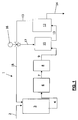
- FIG. 1 a plant 1 for the treatment of wastewater.
- the plant 1 can preferably be used for the treatment of waste water of the metalworking industry.
- the wastewater is fed to a biological degradation stage 3.
- the biodegradation step 3 is a conventional, known biodegradation step.
- the wastewater is supplied from the biological degradation stage 3 via a supply line 4 of a thermal disinfection 6.
- the thermal disinfection 6 will be closer to below FIG. 2 described.
- the wastewater is passed via a line 7 and a filter unit 8 by means of a supply line 9 in a storage tank 11 of a membrane system 12.
- the storage tank 11 and the membrane unit 12 are combined in a circuit 13.
- the filter unit 8, the storage tank 11 and the membrane unit 12 form an example of a filter system.
- Within the diaphragm circuit 11, 12, 13, the water is filtered out. Pollutants remain in a concentrate and are enriched in the reservoir 11.
- the treated water is discharged via a permeate effluent 14.
- the concentrate is split at a control valve 16.
- a main stream 17 is passed back into the feed tank 11, wherein a partial flow is conducted within a feed line 18 back to the biological degradation stage 3 for further biological treatment.
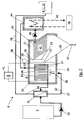
- the embodiment of the thermal disinfection 6 is in FIG. 2 shown.
- the thermal disinfection 6 has a precipitation chamber 19 and a separation chamber 21. Between the precipitation chamber 19 and the separation chamber 21 is on the one hand a septum 22 and on the other a weir 23 is arranged.
- the septum 22 extends from a broad side wall of the container, which is exemplified as a foot wall 24, to one of theticianwandung 24 opposite broad side wall of the container, which is exemplified as the top wall 26.
- an overflow opening 27 in the vicinity of the top wall 26 is arranged.
- the Weir 23 extends from the head wall 26 towards the foot wall 24 and ends shortly before a funnel 28, which will be explained below.
- the precipitation chamber 19 is separated from the separation chamber 21. Between the septum 22 and the weir 23, a drain 30 is formed.
- the wastewater coming from the biological decomposition stage 3 is first conducted via a feed pump 29 into a preheat exchanger 31. From the preheat exchanger 31, the water enters the precipitation chamber 19. At a feed line 32 to the precipitation chamber 19, a metering unit 33 is arranged for metering sodium bicarbonate. However, the dosing unit 33 can also be arranged such that it opens directly into the precipitation chamber 19 with a supply line.
- heat exchanger plates 34 are arranged.
- a plurality of heat exchanger plates 34 are combined to form a heat exchanger battery 36.
- the individual heat exchanger plates 34 are electrically separated from each other. This is achieved by e.g. Distribution lines 37 to the individual heat exchanger plates 34 are made of non-conductive plastic.
- the control of the thermal disinfection is via a thermostat 38.
- the thermostat 38 is arranged such that the temperature in the drain 30 can be controlled to control a primary energy source 46, which will be discussed below.
- the water is kept in motion by means of a submersible agitator 39.
- the submersible agitator 39 cooperates with baffles not shown in such a way that a uniform flow over the heat exchanger plates 34 is ensured.
- two of the heat exchanger plates 34 preferably the respective outer heat exchanger plates 34 are connected to a DC power source 41.
- the heat exchanger battery 36 may be configured such that all heat exchanger plates 34 are connected to the positive pole of the DC power source 41, wherein between the respective heat exchanger plates 34 suitable plates are arranged, which are connected to the negative pole of the DC power source 41st are connected.
- the heat exchanger plates 34 and the sheets are in this case electrically separated from each other.
- the water is passed through the drain 30 into the separation chamber 21 in which a slanting device 42 is arranged.
- a drain 43 is arranged, through which the water is passed into a high-temperature heat exchanger 44.
- a pump 48 is provided in the high-temperature heat exchanger 44.
- a heating element 45 is arranged, which is connected to a primary energy source 46.
- the thermal disinfection 6 has successively the preheat exchanger 31, the precipitation chamber 19, the deposition chamber 21 and the high-temperature heat exchanger 44.
- the sterilized water is passed after the high-temperature heat exchanger 44 on the primary side in the heat exchanger battery 36 to heat the precipitation chamber 19.
- the heat exchanger plates 34 are hollow for this purpose and connected by means of the distribution lines 37.
- the water is introduced into the preheat exchanger 31 to heat the incoming waste water in this.
- the precipitation chamber 19, the separation chamber 21 and / or the high-temperature heat exchanger 44 it is expedient for the preheat exchanger 31, the precipitation chamber 19, the separation chamber 21 and / or the high-temperature heat exchanger 44 to be thermally insulated with a thermal insulation material or the like. This further minimizes the primary energy input.
- the water is supplied to the further treatment in the filter system.
- the path of the sterilized water from the high-temperature heat exchanger 44, via the heat exchanger plates 34 and the preheat exchanger 31 to the filter system is in FIG. 2 exemplified by the line 49.
- the separated lime sludge from the oblique clarifier 42 is withdrawn at regular intervals on a bottom valve 47, which is arranged on the hopper 28.
Landscapes
- Chemical & Material Sciences (AREA)
- Engineering & Computer Science (AREA)
- Water Supply & Treatment (AREA)
- Chemical Kinetics & Catalysis (AREA)
- Nanotechnology (AREA)
- Life Sciences & Earth Sciences (AREA)
- Hydrology & Water Resources (AREA)
- Environmental & Geological Engineering (AREA)
- Organic Chemistry (AREA)
- Heat Treatment Of Water, Waste Water Or Sewage (AREA)
- Separation Using Semi-Permeable Membranes (AREA)
Claims (5)
- Procédé de conditionnement d'une eau résiduaire, qui est introduite dans une étape de décomposition biologique (3), à laquelle une unité de filtration est connectée en aval, caractérisé par
une désinfection thermique (6), qui est en aval de l'étape de décomposition biologique (3) et en amont de l'unité de filtration, l'eau résiduaire étant stérilisée dans la désinfection thermique (6), l'eau résiduaire étant,
lors d'une première étape dans un pré-échangeur de chaleur (31), portée à une température inférieure à la température de précipitation de l'hydrogénocarbonate de calcium,
lors d'une deuxième étape dans une chambre de précipitation (19) dans une plage de réglage de 50 °C à 60 °C, portée à une température de 55 °C ± 1 °C, et lors d'une troisième étape dans un échangeur de chaleur (44), portée à une température de 60 °C à 80 °C. - Procédé selon la revendication 1, caractérisé en ce qu'après la troisième étape, l'eau stérilisée issue de l'échangeur de chaleur (44) est principalement introduite dans des plaques d'échange de chaleur (34) qui sont placées dans la chambre de précipitation (19) afin de chauffer la chambre de précipitation (19), puis introduite dans le pré-échangeur de chaleur (31) afin de chauffer l'eau résiduaire arrivant dans celui-ci, l'eau stérilisée après la sortie du pré-échangeur de chaleur (31) étant introduite dans l'unité de filtration pour le traitement supplémentaire.
- Unité de conditionnement d'une eau résiduaire comprenant une étape de décomposition biologique (3) et une unité de filtration, notamment pour la réalisation du procédé selon les revendications précédentes, caractérisée par
une désinfection thermique (6), qui est en aval de l'étape de décomposition biologique (3) et en amont de l'unité de filtration, la désinfection thermique (6) comprenant successivement un pré-échangeur de chaleur (31), une chambre de précipitation (19), une chambre de séparation (21) et un échangeur de chaleur (44), l'eau résiduaire étant chauffée en plusieurs étapes, et ce lors d'une première étape dans le pré-échangeur de chaleur (31) à une température inférieure à la température de précipitation de l'hydrogénocarbonate de calcium, lors d'une deuxième étape dans la chambre de précipitation (19) dans une plage de réglage de 50 °C à 60 °C à une température de 55 °C ± 1 °C, et lors d'une troisième étape dans l'échangeur de chaleur (44) à une température de 60 °C à 80 °C, de manière à ce que l'eau résiduaire puisse être stérilisée dans la désinfection thermique (6). - Unité selon la revendication 3, caractérisée en ce que la désinfection thermique (6) comprend dans sa chambre de précipitation (19) plusieurs plaques d'échange de chaleur (34), qui sont de préférence regroupées en une batterie de plaques d'échange de chaleur (36).
- Unité selon la revendication 3 ou 4, caractérisée en ce qu'une source de courant continu (41) raccordée aux plaques d'échange de chaleur (34) placées dans sa chambre de précipitation (19) est attribuée à la désinfection thermique (6).
Priority Applications (1)
| Application Number | Priority Date | Filing Date | Title |
|---|---|---|---|
| EP20030104877 EP1547977B1 (fr) | 2003-12-22 | 2003-12-22 | Procédé pour le traitement d'eaux usées |
Applications Claiming Priority (1)
| Application Number | Priority Date | Filing Date | Title |
|---|---|---|---|
| EP20030104877 EP1547977B1 (fr) | 2003-12-22 | 2003-12-22 | Procédé pour le traitement d'eaux usées |
Publications (2)
| Publication Number | Publication Date |
|---|---|
| EP1547977A1 EP1547977A1 (fr) | 2005-06-29 |
| EP1547977B1 true EP1547977B1 (fr) | 2011-11-23 |
Family
ID=34530797
Family Applications (1)
| Application Number | Title | Priority Date | Filing Date |
|---|---|---|---|
| EP20030104877 Expired - Lifetime EP1547977B1 (fr) | 2003-12-22 | 2003-12-22 | Procédé pour le traitement d'eaux usées |
Country Status (1)
| Country | Link |
|---|---|
| EP (1) | EP1547977B1 (fr) |
Cited By (1)
| Publication number | Priority date | Publication date | Assignee | Title |
|---|---|---|---|---|
| US10927014B1 (en) * | 2018-06-06 | 2021-02-23 | Raymond C. Sherry | Waste water treatment to reduce BOD/COD |
Families Citing this family (2)
| Publication number | Priority date | Publication date | Assignee | Title |
|---|---|---|---|---|
| DE102006015538A1 (de) * | 2006-03-31 | 2007-10-11 | H. C. Starck Gmbh & Co. Kg | Vorrichtung und Verfahren zur Herstellung von Verbindungen durch Fällung |
| CN118359250A (zh) * | 2024-05-22 | 2024-07-19 | 贵州金泽新能源科技有限公司 | 一种灭菌装置、生产回用水循环利用系统及灭菌方法 |
Family Cites Families (5)
| Publication number | Priority date | Publication date | Assignee | Title |
|---|---|---|---|---|
| US3850801A (en) * | 1973-06-07 | 1974-11-26 | Mcquay Perfex Inc | Waste water purification system |
| WO2002074698A1 (fr) * | 2001-03-20 | 2002-09-26 | Water Minerals Limited | Extraction de sulfates a partir d'une charge d'alimentation |
| DE10156289A1 (de) * | 2001-11-19 | 2003-06-18 | Nocado Armaturenfab Gmbh & Co | Vorrichtung und Verfahren zur Reinwasseraufbereitung |
| FR2833938B1 (fr) * | 2001-12-20 | 2004-03-12 | S C R D Esteve Patrick | Procede de traitement d'effluents charges en graisses et unite de traitement mettant en oeuvre le procede |
| DE50206295D1 (de) * | 2002-01-31 | 2006-05-18 | Ford Global Tech Inc | Verfahren zur Aufbereitung von Industrieabwässern |
-
2003
- 2003-12-22 EP EP20030104877 patent/EP1547977B1/fr not_active Expired - Lifetime
Cited By (2)
| Publication number | Priority date | Publication date | Assignee | Title |
|---|---|---|---|---|
| US10927014B1 (en) * | 2018-06-06 | 2021-02-23 | Raymond C. Sherry | Waste water treatment to reduce BOD/COD |
| US11618691B1 (en) | 2018-06-06 | 2023-04-04 | Raymond C. Sherry | Waste water treatment to reduce BOD/COD |
Also Published As
| Publication number | Publication date |
|---|---|
| EP1547977A1 (fr) | 2005-06-29 |
Similar Documents
| Publication | Publication Date | Title |
|---|---|---|
| EP0779829B1 (fr) | Procede et dispositif de dessalement d'eau de mer | |
| Valderrama et al. | Winery wastewater treatment for water reuse purpose: Conventional activated sludge versus membrane bioreactor (MBR): A comparative case study | |
| Ma et al. | Effects of dissolved organic matter size fractions on trihalomethanes formation in MBR effluents during chlorine disinfection | |
| CN107055713A (zh) | 一种基于单价阳离子选择性电渗析的高硬度含盐水浓缩方法 | |
| US12012347B2 (en) | Cooling pond water treatment system | |
| EP1293485B1 (fr) | Procédé de traitement des eaux résiduaires industrielles | |
| DE102008004663B4 (de) | Verfahren zur elektrochemischen Hygienisierung und Keimminderung von biologisch gereinigtem Abwasser, insbesondere häuslichem Abwasser, und von Abwasserteilströmen und Vorrichtung dazu | |
| Wisniewski et al. | Use of a membrane bioreactor for denitrification of brine from an electrodialysis process | |
| DE102009026375A1 (de) | Ankopplungs- und Umschalteinheit für Leitungen zum Transport von Fluiden | |
| CN108046482A (zh) | 一种高盐分高硬度难降解有机浓缩废水处理方法及系统 | |
| DE102015006706A1 (de) | Kontinuierliches Verfahren zur Entfernung von Mikro-Verunreinigungen aus biologisch geklärtem, kommunalen Abwasser | |
| EP2078174B1 (fr) | Système de traitement de l'eau | |
| EP1547977B1 (fr) | Procédé pour le traitement d'eaux usées | |
| DE10247686B3 (de) | Reaktor zum Entkalken und gleichzeitigem Entfernen von Schadstoffen | |
| EP0990622A2 (fr) | Procédé et dispositif pour la purification biologique des eaux usées | |
| EP3429968B1 (fr) | Procédé et dispositif pour le traitement de l'eau pour un nettoyage effectif de l'eau usée | |
| US20250091915A1 (en) | Methods and Systems For Wastewater Treatment | |
| AT519319B1 (de) | Aufbereitung von Abwasser zu Trinkwasser mittels Ozon | |
| DE102009026377A1 (de) | Anlage zur Desinfektion und Sanitisierung | |
| EP0971858B1 (fr) | Procede pour le traitement des eaux usees, notamment de malteries et de brasseries | |
| EP2464447A1 (fr) | Dispositif d'introduction de gaz dans des liquides | |
| Miquel et al. | A newly developed process for nitrate removal from drinking water | |
| BR112021000632A2 (pt) | Anólito como um aditivo para tratamento de água residual | |
| El-Ghzizel et al. | Brine recycling impact on nitrate removal and electrochemical disinfection performances: a case study of Sidi Taibi desalination plant | |
| EP2341032A2 (fr) | Dispositif et procédé destinés à la préparation d'eau pour l'alimentation d'un condensateur à écoulement traversant |
Legal Events
| Date | Code | Title | Description |
|---|---|---|---|
| PUAI | Public reference made under article 153(3) epc to a published international application that has entered the european phase |
Free format text: ORIGINAL CODE: 0009012 |
|
| AK | Designated contracting states |
Kind code of ref document: A1 Designated state(s): AT BE BG CH CY CZ DE DK EE ES FI FR GB GR HU IE IT LI LU MC NL PT RO SE SI SK TR |
|
| AX | Request for extension of the european patent |
Extension state: AL LT LV MK |
|
| 17P | Request for examination filed |
Effective date: 20051229 |
|
| AKX | Designation fees paid |
Designated state(s): DE FR GB |
|
| 17Q | First examination report despatched |
Effective date: 20090325 |
|
| GRAP | Despatch of communication of intention to grant a patent |
Free format text: ORIGINAL CODE: EPIDOSNIGR1 |
|
| GRAS | Grant fee paid |
Free format text: ORIGINAL CODE: EPIDOSNIGR3 |
|
| GRAA | (expected) grant |
Free format text: ORIGINAL CODE: 0009210 |
|
| AK | Designated contracting states |
Kind code of ref document: B1 Designated state(s): DE FR GB |
|
| REG | Reference to a national code |
Ref country code: GB Ref legal event code: FG4D Free format text: NOT ENGLISH |
|
| RAP2 | Party data changed (patent owner data changed or rights of a patent transferred) |
Owner name: FORD GLOBAL TECHNOLOGIES, LLC, A SUBSIDARY OF FORD |
|
| REG | Reference to a national code |
Ref country code: DE Ref legal event code: R096 Ref document number: 50314081 Country of ref document: DE Effective date: 20120202 |
|
| PLBE | No opposition filed within time limit |
Free format text: ORIGINAL CODE: 0009261 |
|
| STAA | Information on the status of an ep patent application or granted ep patent |
Free format text: STATUS: NO OPPOSITION FILED WITHIN TIME LIMIT |
|
| 26N | No opposition filed |
Effective date: 20120824 |
|
| REG | Reference to a national code |
Ref country code: DE Ref legal event code: R097 Ref document number: 50314081 Country of ref document: DE Effective date: 20120824 |
|
| REG | Reference to a national code |
Ref country code: FR Ref legal event code: PLFP Year of fee payment: 13 |
|
| REG | Reference to a national code |
Ref country code: FR Ref legal event code: PLFP Year of fee payment: 14 |
|
| REG | Reference to a national code |
Ref country code: FR Ref legal event code: PLFP Year of fee payment: 15 |
|
| PGFP | Annual fee paid to national office [announced via postgrant information from national office to epo] |
Ref country code: FR Payment date: 20171120 Year of fee payment: 15 |
|
| PGFP | Annual fee paid to national office [announced via postgrant information from national office to epo] |
Ref country code: GB Payment date: 20171128 Year of fee payment: 15 |
|
| PGFP | Annual fee paid to national office [announced via postgrant information from national office to epo] |
Ref country code: DE Payment date: 20171221 Year of fee payment: 15 |
|
| REG | Reference to a national code |
Ref country code: DE Ref legal event code: R119 Ref document number: 50314081 Country of ref document: DE |
|
| GBPC | Gb: european patent ceased through non-payment of renewal fee |
Effective date: 20181222 |
|
| PG25 | Lapsed in a contracting state [announced via postgrant information from national office to epo] |
Ref country code: DE Free format text: LAPSE BECAUSE OF NON-PAYMENT OF DUE FEES Effective date: 20190702 Ref country code: FR Free format text: LAPSE BECAUSE OF NON-PAYMENT OF DUE FEES Effective date: 20181231 |
|
| PG25 | Lapsed in a contracting state [announced via postgrant information from national office to epo] |
Ref country code: GB Free format text: LAPSE BECAUSE OF NON-PAYMENT OF DUE FEES Effective date: 20181222 |