EP1548009A2 - Process for the preparation of benzylimidazole derivatives and for losartan - Google Patents
Process for the preparation of benzylimidazole derivatives and for losartan Download PDFInfo
- Publication number
- EP1548009A2 EP1548009A2 EP04024761A EP04024761A EP1548009A2 EP 1548009 A2 EP1548009 A2 EP 1548009A2 EP 04024761 A EP04024761 A EP 04024761A EP 04024761 A EP04024761 A EP 04024761A EP 1548009 A2 EP1548009 A2 EP 1548009A2
- Authority
- EP
- European Patent Office
- Prior art keywords
- formula
- compound
- carried out
- process according
- group
- Prior art date
- Legal status (The legal status is an assumption and is not a legal conclusion. Google has not performed a legal analysis and makes no representation as to the accuracy of the status listed.)
- Withdrawn
Links
- 0 CCCCC(N(Cc1ccc(*)cc1)C1)=NC1=O Chemical compound CCCCC(N(Cc1ccc(*)cc1)C1)=NC1=O 0.000 description 1
Classifications
-
- C—CHEMISTRY; METALLURGY
- C07—ORGANIC CHEMISTRY
- C07D—HETEROCYCLIC COMPOUNDS
- C07D233/00—Heterocyclic compounds containing 1,3-diazole or hydrogenated 1,3-diazole rings, not condensed with other rings
- C07D233/54—Heterocyclic compounds containing 1,3-diazole or hydrogenated 1,3-diazole rings, not condensed with other rings having two double bonds between ring members or between ring members and non-ring members
- C07D233/66—Heterocyclic compounds containing 1,3-diazole or hydrogenated 1,3-diazole rings, not condensed with other rings having two double bonds between ring members or between ring members and non-ring members with hetero atoms or with carbon atoms having three bonds to hetero atoms with at the most one bond to halogen, e.g. ester or nitrile radicals, directly attached to ring carbon atoms
- C07D233/70—One oxygen atom
-
- A—HUMAN NECESSITIES
- A61—MEDICAL OR VETERINARY SCIENCE; HYGIENE
- A61P—SPECIFIC THERAPEUTIC ACTIVITY OF CHEMICAL COMPOUNDS OR MEDICINAL PREPARATIONS
- A61P9/00—Drugs for disorders of the cardiovascular system
- A61P9/12—Antihypertensives
-
- C—CHEMISTRY; METALLURGY
- C07—ORGANIC CHEMISTRY
- C07C—ACYCLIC OR CARBOCYCLIC COMPOUNDS
- C07C237/00—Carboxylic acid amides, the carbon skeleton of the acid part being further substituted by amino groups
- C07C237/02—Carboxylic acid amides, the carbon skeleton of the acid part being further substituted by amino groups having the carbon atoms of the carboxamide groups bound to acyclic carbon atoms of the carbon skeleton
- C07C237/04—Carboxylic acid amides, the carbon skeleton of the acid part being further substituted by amino groups having the carbon atoms of the carboxamide groups bound to acyclic carbon atoms of the carbon skeleton the carbon skeleton being acyclic and saturated
- C07C237/06—Carboxylic acid amides, the carbon skeleton of the acid part being further substituted by amino groups having the carbon atoms of the carboxamide groups bound to acyclic carbon atoms of the carbon skeleton the carbon skeleton being acyclic and saturated having the nitrogen atoms of the carboxamide groups bound to hydrogen atoms or to acyclic carbon atoms
-
- C—CHEMISTRY; METALLURGY
- C07—ORGANIC CHEMISTRY
- C07D—HETEROCYCLIC COMPOUNDS
- C07D233/00—Heterocyclic compounds containing 1,3-diazole or hydrogenated 1,3-diazole rings, not condensed with other rings
- C07D233/54—Heterocyclic compounds containing 1,3-diazole or hydrogenated 1,3-diazole rings, not condensed with other rings having two double bonds between ring members or between ring members and non-ring members
- C07D233/66—Heterocyclic compounds containing 1,3-diazole or hydrogenated 1,3-diazole rings, not condensed with other rings having two double bonds between ring members or between ring members and non-ring members with hetero atoms or with carbon atoms having three bonds to hetero atoms with at the most one bond to halogen, e.g. ester or nitrile radicals, directly attached to ring carbon atoms
- C07D233/68—Halogen atoms
-
- C—CHEMISTRY; METALLURGY
- C07—ORGANIC CHEMISTRY
- C07D—HETEROCYCLIC COMPOUNDS
- C07D403/00—Heterocyclic compounds containing two or more hetero rings, having nitrogen atoms as the only ring hetero atoms, not provided for by group C07D401/00
- C07D403/02—Heterocyclic compounds containing two or more hetero rings, having nitrogen atoms as the only ring hetero atoms, not provided for by group C07D401/00 containing two hetero rings
- C07D403/10—Heterocyclic compounds containing two or more hetero rings, having nitrogen atoms as the only ring hetero atoms, not provided for by group C07D401/00 containing two hetero rings linked by a carbon chain containing aromatic rings
Definitions
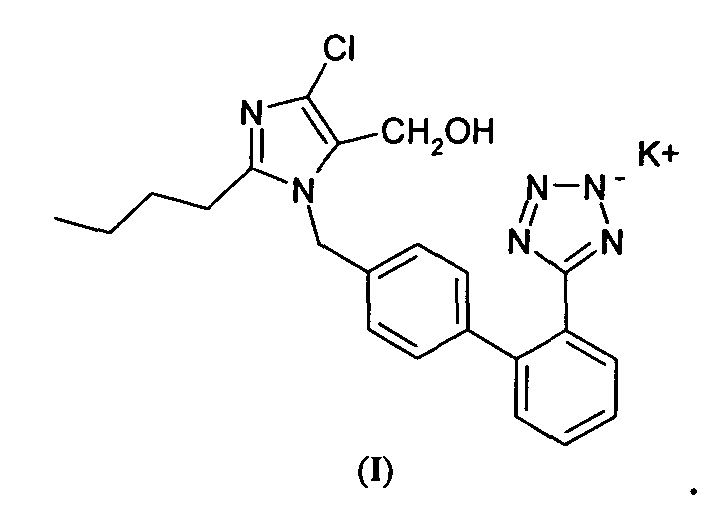
- the present invention relates to a novel process for the preparation of benzylimidazole derivatives useful for the preparation of losartan, novel intermediates for their preparation and a process for the preparation of losartan using said derivatives.
- Losartan potassium i.e. 2-n-butyl-4-chloro-1-[(2'-(tetrazol-5-yl)-1,1'-biphenyl-4-il)methyl]-1H-imidazole-5-methanol potassium salt, is a known angiotensin II antagonist widely used in therapy, for example in the treatment of hypertension, having the following formula (I)
- one of the key intermediates is 1-bromo-4-(2'-butyl-4'-chloro-5-hydroxymethylimidazole-1'H-1'-yl)methylbenzene, having the formula c) reported below.
- the preparation of this intermediate disclosed in WO 93/10106 comprises the reaction between 2-n-butyl-4-chloro-1-H-indazole-5-carboxaldehyde of formula a) and p-bromo-benzyl bromide of formula b) to give the compound of formula c).
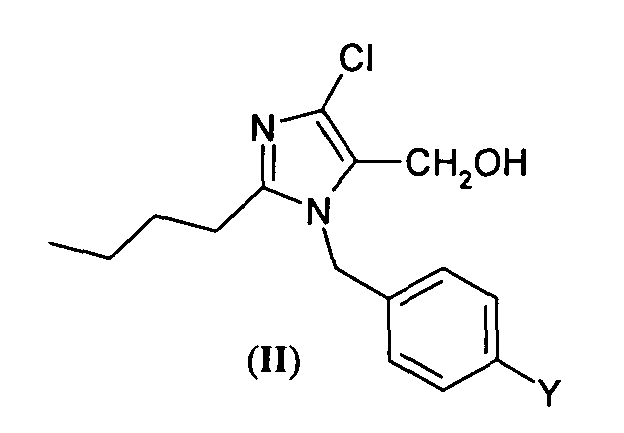
- the present invention relates to a novel process for the preparation of compounds having the following formula (II) wherein Y is a leaving group, the process comprising:
- the leaving group Y is for example a halogen atom, preferably chlorine or bromine, in particular bromine, or a hydroxy group activated to esterification, for example through an alkylsulfonyl group, typically mesylate, or an arylsulfonyl group, typically tosylate, or a perfluoroalkylsulfonyl group, for example trifluoromethanesulfonyl and nonafluorobutanesulfonyl.
- a halogen atom preferably chlorine or bromine, in particular bromine
- a hydroxy group activated to esterification for example through an alkylsulfonyl group, typically mesylate, or an arylsulfonyl group, typically tosylate, or a perfluoroalkylsulfonyl group, for example trifluoromethanesulfonyl and nonafluorobutanesulfonyl.
- the chloroformilation reaction can be carried out for example by treatment of a compound of formula (III) first with phosphorous oxychloride and then with dimethylformamide (DMF).
- the chlorination phase is carried out by treatment with phosphorous oxychloride in a molar ratio from 2 to 4, preferably 3, with the compound of formula (III), the addition being carried out at a temperature ranging from -10 to 10°C, preferably at about 5°C, followed by heating at about 90°C for a time ranging from 30 min. to 2 hours.
- DMF is added at about 90°C, in a stoichiometric ratio from 2 to 4 equivalents, preferably 3, and the reaction is refluxed for 3-5 hours.
- the solvent is typically an inert organic solvent, for example toluene or xylene, preferably toluene.
- the reaction can be carried out by treatment of a compound of formula (III) with a suitable N,N-dimethylformamide dialkylacetal, for example N,N-dimethylformamide dimethylacetal, N,N-dimethylformamide diisopropylacetal or N,N-dimethylformamide diisobutylacetal, preferably N,N-dimethylformamide dimethylacetal, followed by treatment with phosphorous oxychloride.
- the reaction is typically carried out in a inert organic solvent, for example toluene or xylene, preferably toluene.
- the formylation reaction is carried out at a temperature ranging from -50 to 100°C and the chlorination reaction is carried out at a temperature ranging from 50 to 150°C.
- the reduction of the aldehyde group to alcohol to give a compound of formula (IV) can be performed with known methods, for example by treatment with an alkali metal borohydride, preferably sodium borohydride or potassium borohydride, or with tetramethylammonium borohydride, in a molar ratio from about 0.25 to 2, preferably 1.
- the reaction is performed at a temperature ranging from -30 to 50°C, preferably from 0 to 5°C.
- Suitable solvents are for example alcohols, preferably methanol, ethanol, isopropanol and butanol; or aromatic hydrocarbons, for example toluene, halogenated hydrocarbons, for example methylene chloride; or esters, preferably ethyl acetate, isopropyl acetate or butyl acetate; or ethers, preferably tetrahydrofuran or dioxane, in mixtures with water and optionally in the presence of a phase transfer catalyst, for example tetraalkylammonium halides or hydrosulfates.
- aromatic hydrocarbons for example toluene, halogenated hydrocarbons, for example methylene chloride
- esters preferably ethyl acetate, isopropyl acetate or butyl acetate
- ethers preferably tetrahydrofuran or dioxane, in mixtures with water and optionally in the presence of a phase transfer catalyst, for
- the compounds of formula (III) are novel and are a further object of the invention.
- a compound of formula (III) can be obtained by reaction of a compound of formula (V) wherein Y is as defined above, with a trialkyl orthovalerate, for example a tri-(C 1 -C 6 )alkyl orthovalerate, preferably trimethyl valerate.
- a trialkyl orthovalerate for example a tri-(C 1 -C 6 )alkyl orthovalerate, preferably trimethyl valerate.
- the reaction of the compound of formula (V) with the trialkyl orthovalerate, typically trimethyl orthovalerate, is carried out using a stoichiometric ratio between the compound of formula (V) and the trialkyl orthovalerate from 1/1 to 1/1.5, preferably 1/1.2.
- the reaction is carried out in the presence of catalytic amounts of an acid ranging from 1 to 10% molar, preferably about 5%.
- Said acid can be a mineral acid, for example sulfuric acid, or an organic acid, for example formic, acetic, methanesulfonic or camphorsulfonic acid, preferably acetic acid.
- the reaction temperature ranges from about 65 to 120°C, preferably from 80 to 110°C, so as to remove the methanol that forms.
- the reaction can be performed in the absence of solvents, or in an organic solvent, for example a hydrocarbon, preferably toluene, or a high-boiling chloride, preferably dichloroethane.
- a hydrocarbon preferably toluene
- a high-boiling chloride preferably dichloroethane.
- the resulting compound of formula (III) is subjected chloroformylation, preferably without being recovered from the reaction mixture.
- the compound of formula (V) wherein Y is chlorine is known, for example, from J. Am. Chem. Soc., (1956), 78, 6189-92.
- the compounds of formula (V) wherein Y, being as defined above, is other than chlorine are novel and are a further object of the invention.
- the compounds of formula (V) can be obtained according to known methods, for example by reductive amination, as shown in the following scheme.
- the present invention relates also to a novel method for the preparation of losartan, or a pharmaceutically acceptable salt thereof, in particular the potassium salt, comprising:
- the protecting group Q is for example a triphenylmethyl, tert-butyl, C 1 -C 4 alkoxymethyl, methylthiomethyl, phenyl-(C 1 -C 4 )alkoxymethyl, p-methoxybenzyl, 2,4,6-trimethylbenzyl, 1-methyl-1-phenylethyl, 2-(trimethylsilyl)ethyl, tetrahydropyranyl, piperonyl or benzenesulfonyl group.
- halogenated metals represented by Z comprise -ZnCl, -MgCl, -NiCl, -CuCl, -BCl 2 , -ZnBr, -MgBr, -CuBr, and -BBr 2 .
- the synthons of formula (VI) are commercially available or can be obtained according to known methods.
- the preparation of a compound of formula (VI), as well as the reaction between a compound of formula (II) and a compound of formula (VI) can be carried out according to known methods, for example as disclosed in EP 579766, EP 539086, EP 760815, WO 93/10106 or EP 782996.
- the removal of the protecting group Q and the optional conversion of losartan into a pharmaceutically acceptable salt can be carried out according to known methods.
- a round-bottom flask is loaded with 7.5 of 1-(4-bromo-benzyl)aminoacetamide (V), 6.5 ml of trimethylorthovalerate and 0.1 ml of glacial acetic acid.
- the obtained biphasic mixture is placed into an oil bath at 120°C. The temperature is allowed to raise up to 105°C, thereafter the mixture is left under stirring for 1.5 h, then cooled and evaporated under high vacuum to remove all volatile substances.
- Compound (III) is obtained as an oil and used as such in the subsequent reaction.
- a round-bottom flask is loaded with 0.6 g of 3-(4-bromobenzyl)-2-butyl-5-chloro-3H-imidazole-4-carboxaldehyde and 5 ml of methanol.
- the mixture is cooled to 0-5°C and added with 78 mg of sodium borohydride. Stirring is continued for 30', then 5 ml of a saturated ammonium chloride solution are added.
- the solvent is evaporated off and the residue is taken up with 10 ml of ethyl acetate. After two washings with 5 ml of water the organic phase is evaporated to give 480 mg of a crude residue, which is crystallized from ethanol-water.
- 320 mg of 3-(4-bromobenzyl-2-butyl-5-chloro-3H-imidazol-4-yl)-methanol are obtained as colourless crystals.
- a round-bottom flask is loaded with 1.61 g of 1-(4-bromo-benzyl)-2-butyl-1,5-dihydroimidazol-4-one, 1.80 g of N,N-dimethylformamide dimethylacetal and 10 ml of methanol; the mixture is kept under stirring at room temperature for 3 hours, then washed with 10 ml of water and the solvent is evaporated off to remove the water. The mixture is taken up with 10 ml of toluene, added dropwise with 1.4 ml of phosphorous oxychloride at 0-5°C, then gradually heated to 100°C.
Landscapes
- Chemical & Material Sciences (AREA)
- Organic Chemistry (AREA)
- Health & Medical Sciences (AREA)
- Medicinal Chemistry (AREA)
- Engineering & Computer Science (AREA)
- Cardiology (AREA)
- Chemical Kinetics & Catalysis (AREA)
- General Chemical & Material Sciences (AREA)
- Bioinformatics & Cheminformatics (AREA)
- Nuclear Medicine, Radiotherapy & Molecular Imaging (AREA)
- Heart & Thoracic Surgery (AREA)
- Pharmacology & Pharmacy (AREA)
- Life Sciences & Earth Sciences (AREA)
- Animal Behavior & Ethology (AREA)
- General Health & Medical Sciences (AREA)
- Public Health (AREA)
- Veterinary Medicine (AREA)
- Pharmaceuticals Containing Other Organic And Inorganic Compounds (AREA)
- Plural Heterocyclic Compounds (AREA)
Abstract
Description

the process comprising:

to obtain a compound of formula (IV)

and reduction of the aldehyde group to alcohol.

with a trialkyl orthovalerate, for example a tri-(C1-C6)alkyl orthovalerate, preferably trimethyl valerate.

- reaction of a compound of formula (II), as defined above, with a
synthon of formula (VI)

- removal of the protecting group Q; and, if desired,
- conversion of losartan in a pharmaceutically acceptable salt thereof; characterised in that the compound of formula (II) is obtained according to the process described above.
Claims (11)
- A process for the preparation of compounds of formula (II)wherein Y is a leaving group,

comprising chloroformylation of a compound of formula (III)wherein Y is as defined above,
to obtain a compound of formula (IV)wherein Y is as defined above,
and reduction of the aldehyde group to alcohol. - A process according to claim 1, wherein the leaving group is a halogen atom or a hydroxy group activated to esterification.
- A process according to claim 1, wherein the chloroformylation reaction is carried out by treatment with phosphorous oxychloride and dimethylformamide, or with a N,N-dimethylformamide dialkylacetal and phosphorous oxychloride.
- A process according to claim 3, wherein the reaction is carried out in an inert organic solvent, the formylation phase is carried out at a temperature ranging from -50 to 100°C and the chlorination phase is carried out at a temperature ranging from 50 to 150°C.
- A process according to claim 1, wherein the reduction of the aldehyde group is carried out by treatment with an alkali metal borohydride.
- A process according to claim 1, wherein a compound of formula (III) is obtained by reacting a compound of formula (V)wherein Y is as defined in claim 1,

with a trialkyl orthovalerate. - A process according to claim 6, wherein the stoichiometric ratio between a compound of formula (V) and a trialkyl orthovalerate ranges from 1/1 to 1/1.2 and the reaction is carried out in the presence of a catalytic amount of an acid.
- A process according to claim 6, wherein the compound of formula (III) is not isolated.
- A compound of formula (III)wherein Y is a leaving group.

- A compound of formula (V)wherein Y is a leaving group other than chlorine.

- A process for the preparation of losartan or a pharmaceutically acceptable salt thereof comprising:characterized in that the compound of formula (II) is obtained according to the process of claim 1.reaction of a compound of formula (II), as defined in claim 1, with a synthon of formula (VI)wherein Q is a tetrazole-protecting group; and Z is a -B(R1R2) group

wherein each of R1 and R2, which can be the same or different, is halogen, hydroxy or C1-C4 alkoxy; or Z is a lithium or copper atom, or a halogenated metal;removal of the protecting group Q; and, if desired,conversion of losartan in a pharmaceutically acceptable salt thereof;
Applications Claiming Priority (2)
| Application Number | Priority Date | Filing Date | Title |
|---|---|---|---|
| IT002069A ITMI20032069A1 (en) | 2003-10-23 | 2003-10-23 | PROCEDURE FOR THE PREPARATION OF BENZYLMIDAZOLIC DERIVATIVES. |
| ITMI20032069 | 2003-10-23 |
Publications (2)
| Publication Number | Publication Date |
|---|---|
| EP1548009A2 true EP1548009A2 (en) | 2005-06-29 |
| EP1548009A3 EP1548009A3 (en) | 2005-11-16 |
Family
ID=34509457
Family Applications (1)
| Application Number | Title | Priority Date | Filing Date |
|---|---|---|---|
| EP04024761A Withdrawn EP1548009A3 (en) | 2003-10-23 | 2004-10-18 | Process for the preparation of benzylimidazole derivatives and for losartan. |
Country Status (4)
| Country | Link |
|---|---|
| US (1) | US7164029B2 (en) |
| EP (1) | EP1548009A3 (en) |
| JP (1) | JP2005126434A (en) |
| IT (1) | ITMI20032069A1 (en) |
Cited By (1)
| Publication number | Priority date | Publication date | Assignee | Title |
|---|---|---|---|---|
| EP1741711A1 (en) * | 2005-07-04 | 2007-01-10 | KRKA, D.D., Novo Mesto | A process for the preparation of losartan derivatives by chlorination and reduction of the respective 1H-imidazole-5-carbaldehydes |
Family Cites Families (3)
| Publication number | Priority date | Publication date | Assignee | Title |
|---|---|---|---|---|
| EP1384717B1 (en) * | 1991-11-18 | 2008-05-14 | E.I. Dupont De Nemours And Company | 2-(2'-triphenylmethyl-2'H-tetrazol-5'-yl)phenylboronic acid intermediates for the synthesis of A II receptor antagonists |
| CA2186606A1 (en) * | 1994-03-29 | 1995-10-05 | Edward B. Nelson | Treatment of atherosclerosis with angiotensin ii receptor blocking imidazoles |
| US6933294B2 (en) * | 2002-04-03 | 2005-08-23 | Bristol-Myers Squibb Company | Thiophene-based tricyclic compounds and pharmaceutical compositions comprising same |
-
2003
- 2003-10-23 IT IT002069A patent/ITMI20032069A1/en unknown
-
2004
- 2004-10-18 EP EP04024761A patent/EP1548009A3/en not_active Withdrawn
- 2004-10-20 JP JP2004305424A patent/JP2005126434A/en not_active Withdrawn
- 2004-10-21 US US10/969,354 patent/US7164029B2/en not_active Expired - Fee Related
Cited By (2)
| Publication number | Priority date | Publication date | Assignee | Title |
|---|---|---|---|---|
| EP1741711A1 (en) * | 2005-07-04 | 2007-01-10 | KRKA, D.D., Novo Mesto | A process for the preparation of losartan derivatives by chlorination and reduction of the respective 1H-imidazole-5-carbaldehydes |
| WO2007003280A1 (en) * | 2005-07-04 | 2007-01-11 | Krka, D.D. Novo Mesto | A process for the preparation of losartan derivatives by chlorination and reduction of the respective 1h-imidazole-5-carbaldehydes |
Also Published As
| Publication number | Publication date |
|---|---|
| JP2005126434A (en) | 2005-05-19 |
| ITMI20032069A1 (en) | 2005-04-24 |
| US20050090672A1 (en) | 2005-04-28 |
| EP1548009A3 (en) | 2005-11-16 |
| US7164029B2 (en) | 2007-01-16 |
Similar Documents
| Publication | Publication Date | Title |
|---|---|---|
| US8592474B2 (en) | Process for the preparation or purification of olmesartan medoxomil | |
| US20080119657A1 (en) | Phenyltetrazole compounds | |
| US20100249430A1 (en) | Process for preparing valsartan | |
| KR20110015703A (en) | Manufacturing Method of Valsartan | |
| JPH05239053A (en) | Quinoline derivative and method for its preparation and therapeutic application thereof | |
| JPH05140107A (en) | Pyridine compound | |
| EP3619199B1 (en) | Preparation of 2-([1,2,3]triazol-2-yl)-benzoic acid derivatives | |
| US20080076932A1 (en) | A process for the preparation of phenyltetrazole compounds | |
| US8431717B2 (en) | Process for the preparation of 5-(2-ethyl-dihydro-1H-inden-2-yl)-1H-imidazole and salts thereof | |
| PL156483B1 (en) | Method of obtaining novel 1h-imidazole derivatives | |
| US7164029B2 (en) | Process for the preparation of benzylimidazole derivatives | |
| US7923566B2 (en) | Alternative process for the preparation of losartan | |
| EP1899328B1 (en) | A process for the preparation of losartan derivatives by chlorination and reduction of the respective 1h-imidazole-5-carbaldehydes | |
| EP1294703A1 (en) | Process for the preparation of 1,2,4-triazolin-5-one derivatives | |
| EP0788487B1 (en) | Process for the preparation of tetrazoles | |
| SI21965A (en) | Preparation of tetrazole derivative | |
| EP1919469B1 (en) | Process for preparing an angiotensin ii receptor antagonist | |
| KR100408431B1 (en) | Process for the preparation of 1,2,3,9-tetrahydro-9-methyl-3-[(2-methyl-1h-imidazol-1-yl)methyl]-4h-carbazol-4-one or pharmaceutically acceptable salts thereof | |
| WO2006134078A1 (en) | Method for obtaining benzimidazole derivatives and intermediates thereof | |
| JPH06340658A (en) | Benzimidazole derivative | |
| EP2022790A1 (en) | A process for the preparation or purification of olmesartan medoxomil | |
| JP4611026B2 (en) | A novel process for the preparation of imidazolyl compounds | |
| JPH06184148A (en) | Imidazo(1,2,-a)pyridines | |
| US20230002347A1 (en) | Methods for the preparation of 5-bromo-2-(3-chloro-pyridin-2-yl)-2h-pyrazole-3-carboxylic acid | |
| KR20070117381A (en) | Rosatan's New Manufacturing Method |
Legal Events
| Date | Code | Title | Description |
|---|---|---|---|
| PUAI | Public reference made under article 153(3) epc to a published international application that has entered the european phase |
Free format text: ORIGINAL CODE: 0009012 |
|
| AK | Designated contracting states |
Kind code of ref document: A2 Designated state(s): AT BE BG CH CY CZ DE DK EE ES FI FR GB GR HU IE IT LI LU MC NL PL PT RO SE SI SK TR |
|
| AX | Request for extension of the european patent |
Extension state: AL HR LT LV MK |
|
| RTI1 | Title (correction) |
Free format text: PROCESS FOR THE PREPARATION OF BENZYLIMIDAZOLE DERIVATIVES AND FOR LOSARTAN. |
|
| PUAL | Search report despatched |
Free format text: ORIGINAL CODE: 0009013 |
|
| AK | Designated contracting states |
Kind code of ref document: A3 Designated state(s): AT BE BG CH CY CZ DE DK EE ES FI FR GB GR HU IE IT LI LU MC NL PL PT RO SE SI SK TR |
|
| AX | Request for extension of the european patent |
Extension state: AL HR LT LV MK |
|
| 17P | Request for examination filed |
Effective date: 20060428 |
|
| AKX | Designation fees paid |
Designated state(s): AT BE BG CH CY CZ DE DK EE ES FI FR GB GR HU IE IT LI LU MC NL PL PT RO SE SI SK TR |
|
| 17Q | First examination report despatched |
Effective date: 20080526 |
|
| STAA | Information on the status of an ep patent application or granted ep patent |
Free format text: STATUS: THE APPLICATION IS DEEMED TO BE WITHDRAWN |
|
| 18D | Application deemed to be withdrawn |
Effective date: 20090501 |