EP1548029A2 - Peptid- und Peptidmimetika-Derivate mit Integrin-Inhibitor-Eigenschaften III - Google Patents
Peptid- und Peptidmimetika-Derivate mit Integrin-Inhibitor-Eigenschaften III Download PDFInfo
- Publication number
- EP1548029A2 EP1548029A2 EP04011492A EP04011492A EP1548029A2 EP 1548029 A2 EP1548029 A2 EP 1548029A2 EP 04011492 A EP04011492 A EP 04011492A EP 04011492 A EP04011492 A EP 04011492A EP 1548029 A2 EP1548029 A2 EP 1548029A2
- Authority
- EP
- European Patent Office
- Prior art keywords
- lys
- arg
- phe
- asp
- gly
- Prior art date
- Legal status (The legal status is an assumption and is not a legal conclusion. Google has not performed a legal analysis and makes no representation as to the accuracy of the status listed.)
- Granted
Links
- 0 **C(NNC(*C(*)CC(O)=O)=O)=O Chemical compound **C(NNC(*C(*)CC(O)=O)=O)=O 0.000 description 1
Classifications
-
- C—CHEMISTRY; METALLURGY
- C07—ORGANIC CHEMISTRY
- C07K—PEPTIDES
- C07K14/00—Peptides having more than 20 amino acids; Gastrins; Somatostatins; Melanotropins; Derivatives thereof
- C07K14/435—Peptides having more than 20 amino acids; Gastrins; Somatostatins; Melanotropins; Derivatives thereof from animals; from humans
- C07K14/745—Blood coagulation or fibrinolysis factors
-
- A—HUMAN NECESSITIES
- A61—MEDICAL OR VETERINARY SCIENCE; HYGIENE
- A61P—SPECIFIC THERAPEUTIC ACTIVITY OF CHEMICAL COMPOUNDS OR MEDICINAL PREPARATIONS
- A61P19/00—Drugs for skeletal disorders
- A61P19/08—Drugs for skeletal disorders for bone diseases, e.g. rachitism, Paget's disease
- A61P19/10—Drugs for skeletal disorders for bone diseases, e.g. rachitism, Paget's disease for osteoporosis
-
- A—HUMAN NECESSITIES
- A61—MEDICAL OR VETERINARY SCIENCE; HYGIENE
- A61P—SPECIFIC THERAPEUTIC ACTIVITY OF CHEMICAL COMPOUNDS OR MEDICINAL PREPARATIONS
- A61P29/00—Non-central analgesic, antipyretic or antiinflammatory agents, e.g. antirheumatic agents; Non-steroidal antiinflammatory drugs [NSAID]
-
- A—HUMAN NECESSITIES
- A61—MEDICAL OR VETERINARY SCIENCE; HYGIENE
- A61P—SPECIFIC THERAPEUTIC ACTIVITY OF CHEMICAL COMPOUNDS OR MEDICINAL PREPARATIONS
- A61P37/00—Drugs for immunological or allergic disorders
- A61P37/02—Immunomodulators
- A61P37/06—Immunosuppressants, e.g. drugs for graft rejection
-
- A—HUMAN NECESSITIES
- A61—MEDICAL OR VETERINARY SCIENCE; HYGIENE
- A61P—SPECIFIC THERAPEUTIC ACTIVITY OF CHEMICAL COMPOUNDS OR MEDICINAL PREPARATIONS
- A61P7/00—Drugs for disorders of the blood or the extracellular fluid
- A61P7/02—Antithrombotic agents; Anticoagulants; Platelet aggregation inhibitors
-
- A—HUMAN NECESSITIES
- A61—MEDICAL OR VETERINARY SCIENCE; HYGIENE
- A61P—SPECIFIC THERAPEUTIC ACTIVITY OF CHEMICAL COMPOUNDS OR MEDICINAL PREPARATIONS
- A61P9/00—Drugs for disorders of the cardiovascular system
- A61P9/10—Drugs for disorders of the cardiovascular system for treating ischaemic or atherosclerotic diseases, e.g. antianginal drugs, coronary vasodilators, drugs for myocardial infarction, retinopathy, cerebrovascula insufficiency, renal arteriosclerosis
-
- C—CHEMISTRY; METALLURGY
- C07—ORGANIC CHEMISTRY
- C07K—PEPTIDES
- C07K7/00—Peptides having 5 to 20 amino acids in a fully defined sequence; Derivatives thereof
- C07K7/64—Cyclic peptides containing only normal peptide links
-
- A—HUMAN NECESSITIES
- A61—MEDICAL OR VETERINARY SCIENCE; HYGIENE
- A61K—PREPARATIONS FOR MEDICAL, DENTAL OR TOILETRY PURPOSES
- A61K38/00—Medicinal preparations containing peptides
-
- Y—GENERAL TAGGING OF NEW TECHNOLOGICAL DEVELOPMENTS; GENERAL TAGGING OF CROSS-SECTIONAL TECHNOLOGIES SPANNING OVER SEVERAL SECTIONS OF THE IPC; TECHNICAL SUBJECTS COVERED BY FORMER USPC CROSS-REFERENCE ART COLLECTIONS [XRACs] AND DIGESTS
- Y02—TECHNOLOGIES OR APPLICATIONS FOR MITIGATION OR ADAPTATION AGAINST CLIMATE CHANGE
- Y02P—CLIMATE CHANGE MITIGATION TECHNOLOGIES IN THE PRODUCTION OR PROCESSING OF GOODS
- Y02P20/00—Technologies relating to chemical industry
- Y02P20/10—Process efficiency
Definitions
- the invention was based on the object, new compounds with valuable Find properties, especially those for the production of medicines can be used.
- the compounds of the formula I and their salts possess very valuable pharmacological properties with good compatibility. Above all, they act as integrin inhibitors, in particular inhibiting the interactions of the ⁇ V ⁇ 3 or ⁇ V ⁇ 5 integrin receptors with ligands, such as, for example, B. the binding of fibrinogen to the ⁇ 3 integrin receptor.
- the compounds exhibit particular activity in the case of the integrins ⁇ V ⁇ 3 , ⁇ V ⁇ 5 , ⁇ IIb ⁇ 3 as well as ⁇ V ⁇ 1 , ⁇ V ⁇ 6 and ⁇ V ⁇ 8 , This effect can be detected, for example, by the method described by JW Smith et al. in J. Biol. Chem.
- the phosphonate is used to bind the peptides ionically or adsorptively to biocompatible surfaces of, for example, implants having oxides, such as metal surfaces (eg titanium or titanium alloys such as TiAl 6 V 4 ) or cation-containing surfaces such as amorphous or sintered Calcium phosphates (eg hydroxyapatite, bone, teeth) or calcium phosphate cements (eg biocement D).
- oxides such as metal surfaces (eg titanium or titanium alloys such as TiAl 6 V 4 ) or cation-containing surfaces such as amorphous or sintered Calcium phosphates (eg hydroxyapatite, bone, teeth) or calcium phosphate cements (eg biocement D).
- the invention therefore relates in particular to the compounds of the formula I for ionic or adsorptive binding via the functional group of the radical X 1 to biocompatible surfaces.
- the peptides of the invention now allow the biofunctionalization of biomaterials, in particular implants for human and animal Organs by their coating, with predominantly the adhesion of those cell species is stimulated, each of which tissue integration of the corresponding biomaterial.
- Such coatings is an accelerated and enhanced integration various biomaterials / implants with improved long-term stability to achieve after their introduction into the body.
- the peptides of the invention selectively bind to integrins. After immobilization on biocompatible surfaces, eg implants, they stimulate the adhesion of cells bearing integrins. After coating the compounds on the surfaces, those time species can be selectively stimulated to bind, which should also perform the implant integration after implantation in natural tissue. For example, osteoblasts, osteoclasts and endothelial cells are ⁇ V- bearing cell species.
- the invention therefore relates to the compounds of the formula I as Integrin inhibitors for selective cell enrichment on implants.
- the compounds of the formula I can be anchored to a biocompatible surface as active pharmaceutical ingredients in the human and Veterinary medicine can be used, in particular they can as Integrininhibitoren for the treatment of implants caused Diseases, defects and inflammations such as insufficient and delayed integration of biomaterials and implants, by Implants caused thrombosis, bone and tooth defects, as well as osteolytic diseases such as osteoporosis, thrombosis, Heart attack, arteriosclerosis, in wound healing in support of healing processes, as well as to speed up and strengthen the Integration process of the implant or the biocompatible surface into the tissue.
- the compounds of the formula I can be used as antimicrobial substances in operations where biomaterials, implants, catheters or cardiac pacemakers are used. They have an antiseptic effect.
- the effectiveness of antimicrobial activity can be demonstrated by the method described by P. Valentin-Weigund et al., Infection and Immunity, 2851-2855 (1988).
- the invention thus relates to the compounds of the formula I as Integrininhibitoren for the treatment of implants caused Diseases, defects, inflammations and osteolytic diseases like osteoporosis, thrombosis, myocardial infarction and arteriosclerosis, and to accelerate and strengthen the integration process of the Implant or the biocompatible surface into the tissue.
- the invention further relates to the use of compounds of formula I for the manufacture of a medicament for the treatment of Implants caused diseases, defects, inflammations and of Osteolytic disorders such as osteoporosis, thrombosis, myocardial infarction and atherosclerosis, as well as to speed up and intensify the Integration process of the implant or the biocompatible surface into the tissue.
- Corresponding phosphonate-bearing peptides can be ionic Supports with oxide-containing surfaces, e.g. Implants, affinity chromatographies, or microtiter plates or even cations Surfaces such as e.g. on amorphous or sintered calcium phosphates (e.g., hydroxyapatite, bone, teeth) or calcium phosphate cements (e.g., Biocement D).
- oxide-containing surfaces e.g. Implants, affinity chromatographies, or microtiter plates or even cations Surfaces such as e.g. on amorphous or sintered calcium phosphates (e.g., hydroxyapatite, bone, teeth) or calcium phosphate cements (e.g., Biocement D).
- the invention also provides the use of compounds of Formula 1 for coating by ionic or adsorptive bonding of Implants for human and animal organs.
- amino acids can occur in several enantiomeric forms, then above and below, for. Example, as part of the compounds of formula I, all of these forms and also their mixtures (eg., The DL forms) included. Furthermore, the amino acids, for. Example, as a component of compounds of formula I, be provided with corresponding per se known protecting groups. Above all, side chain modifications of arginine, as have been carried out, for example, in the case of the nonpeptidic ⁇ V ⁇ 3 antagonists (for example by R. Keenan et al., Abstr. Pap. 211th ACS National Meeting (New Orleans, USA) 1996, MEDI 236), can also be used in cyclopeptides such as benzimidazole derivatives instead of the guanidine group.
- prodrug derivatives included, d. H. with z.
- sugars or oligopeptides modified compounds of the formula I which in Organism rapidly to the effective compounds of the invention be split.
- the invention further relates to an implant suitable for human and animal organs consisting of a carrier matrix and one of these Matrix enveloping layer of a bioactive, cell adhesion mediating Molecule, wherein the enveloping layer of a compound of formula I is formed, and wherein between the carrier matrix and this compound an ionic or adsorptive bond is present.
- the Carrier matrix and / or its surface of a metal or metal oxide is particularly preferred.
- the carrier matrix and / or its surface from a bone or denture material such as e.g. from calcium phosphate mixtures.
- the invention further relates to a process for the preparation of compounds of the formula I according to claim 1 and their salts, characterized in that a bioactive molecule B, which may be provided with protective groups, and a protective spacer spacer molecule (QX 1 ) or anchor molecule (X 1 ) peptidisch linked together and then cleaved off the protecting groups, and / or that one converts a basic or acidic compound of formula I by treatment with an acid or base in one of its salts.
- a bioactive molecule B which may be provided with protective groups
- QX 1 protective spacer spacer molecule
- X 1 anchor molecule
- radicals B, Q and X 1 have the meaning given in the formula I, unless expressly stated otherwise.
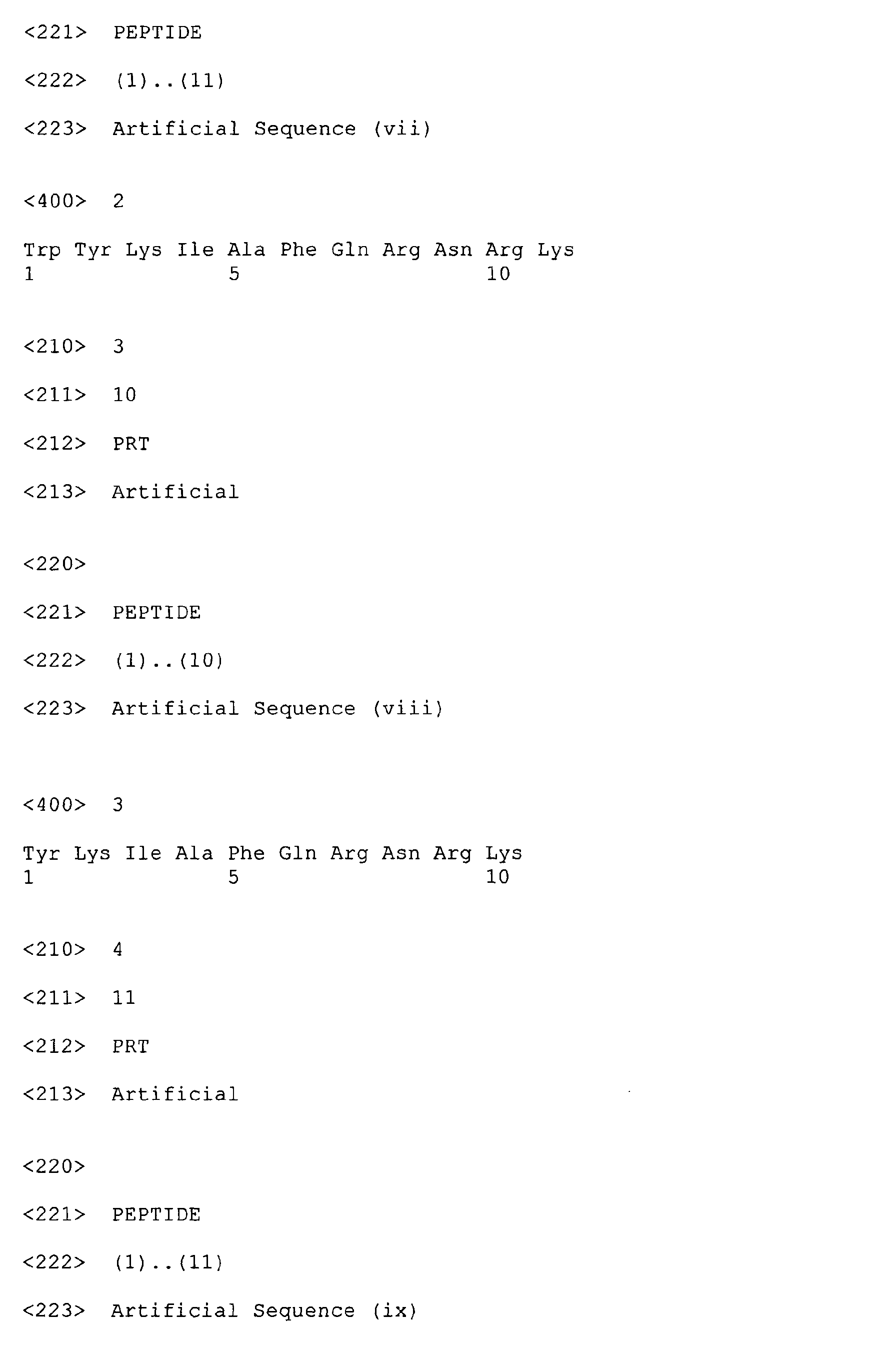
- B is preferably a cyclo (Arg-Gly-Asp-Z 1 ) -, Thr-Trp-Tyr-Lys) IIe-Ala-Phe-Gln-Arg-Asn-Arg-Lys, Trp-Tyr-Lys-Ile-Ala-Phe-Gln-Arg-Asn-Arg-Lys, Tyr-Lys-Ile-Ala-Phe-Gln-Arg-Asn-Arg-Lys, Thr-Trp-Tyr-Lys-Ile-Ala-Phe-Gln-Arg-Asn-Arg, Thr-Trp-Tyr-Lys-IIe-Ala-Phe-Gln-Arg-Asn- or a Thr-Trp-Tyr-Lys-Ile-Ala-Phe-Gln-Arg residue, wherein each Z 1 independently represents an amino acid residue or a di-
- Q is missing or means an organic spacer molecule.
- This is preferably a [CO- (CH 2 ) x -NH-] m -, [CO-CH 2 (-O-CH 2 CH 2 ) y -NH-] m -, [CO- (CH 2 ) z - CO -] -, [NH- (CH 2 ) z -NH -] -, [CO-CH 2 - (OCH 2 CH 2 ) y -O-CH 2 -CO-] - or a [NH-CH 2 CH 2- (OCH 2 CH 2 ) y -NH -] - radical and combinations thereof, wherein for the indices m, x, y and z, the ranges of values claimed in claim 3 apply.
- the abovementioned compounds which can assume values between 1 and 8 for m values, for x values between 1 and 5 and for y and z values between 1 and 6, have proved particularly advantageous.
- X 1 represents an anchor molecule, preferably from the group - W, -VW, -V [VW 2 ] 2 or -V [V- (VW 2 ) 2 ] 2 .
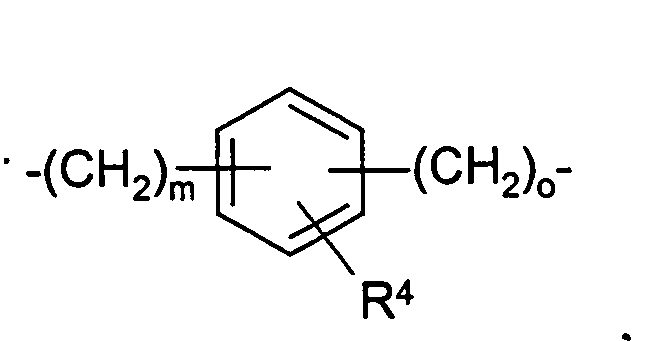
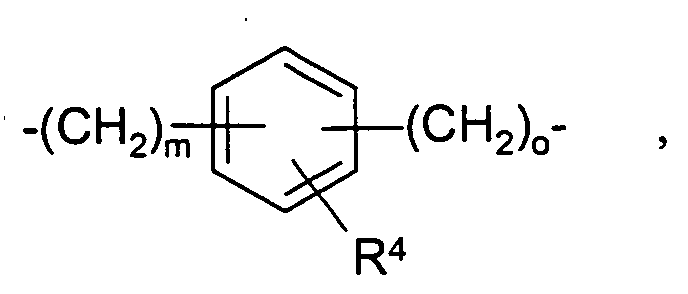
- Y is preferably - (CH 2 ) n - or - (CH 2 ) s -CH (R 4 ) - (CH 2 ) t - or - (CH 2 ) p -Het 1 - (CH 2 ) q radical.
- Z is preferably NR 2 or CH-R 2 , where R 2 may preferably be an H atom or alkyl radical having 1 to 4 C atoms.
- R 3 preferably denotes an H atom, Ar, Het or A radical, where A, Ar and Het have one of the meanings given above or below.
- R 4 preferably represents an H atom, A, Ar, OH, OA, OAr, arylalkyl, Hal, CN, NO 2 , CF 3 or OCF 3 radical.
- Arylalkyl is preferably benzyl, phenylethyl, phenylpropyl or naphthylmethyl, more preferably benzyl.
- A is preferably a COOH, NH 2 or alkyl radical having 1 to 6 C atoms, unsubstituted or substituted by COOH or NH 2 .
- A is preferably methyl, furthermore ethyl, propyl, n-butyl, isobutyl, sec-butyl or tert.
- Particularly preferred for A is methyl.
- Ar is preferably phenyl which is unsubstituted or monosubstituted, disubstituted or trisubstituted by A, OH, OA, CF 3 , OCF 3 , CN, NO 2 or Hal and is substituted by one, two or three times by A, OH, OA, NH 2 , OCF 3 , CN, NO 2 or Hal substituted phenyl may be substituted in such a way that an unsubstituted or substituted biphenyl is formed.
- Ar is therefore preferably phenyl, o-, m- or p-methylphenyl, o-, m- or p-ethylphenyl, o-m or p-propylphenyl, o-m- or p-isopropylphenyl, o-, m- or p-tert.
- Het is a saturated, partially or completely unsaturated mono- or bicyclic heterocyclic radical having 5 to 10 ring members, where 1 to 3 N and / or 1 S or O atoms can be present and the heterocyclic radical is mono- or disubstituted by CN, Hal, OH, NH 2 , COOH, OA, CF 3 , A, NO 2 , Ar or OCF 3 may be substituted.
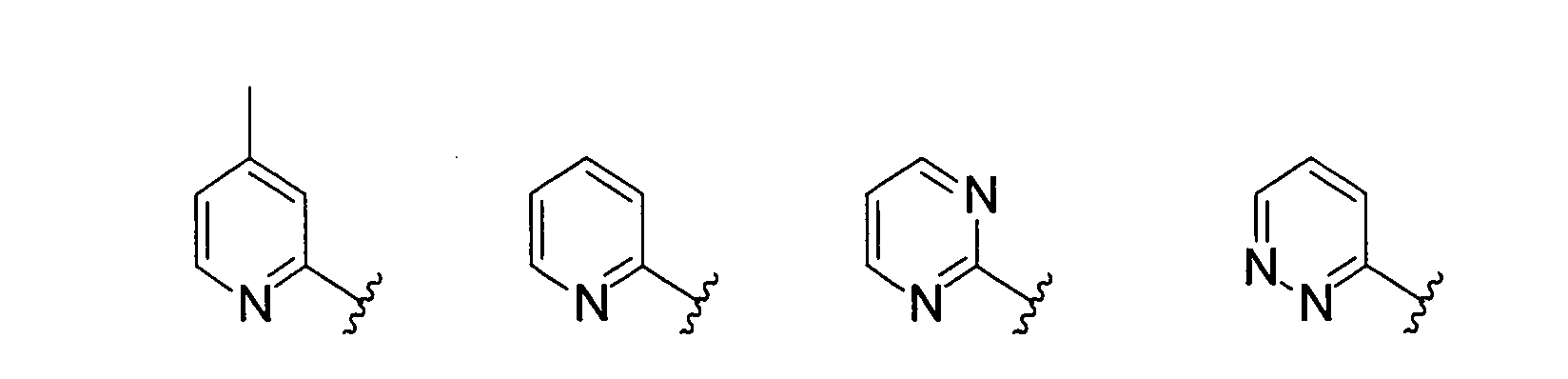
- Het is preferably an o-, m-, p-substituted pyridyl, a 2-, 4-, 5- or 6-substituted pyrimidyl or a 3-, 4-, 5- or 6-substituted pyridazyl which is preferably unsubstituted or substituted by a methyl, ethyl, propyl or methylamino, ethylamino or propylamino group (refers to all of the three heteroaromatic compounds mentioned), and a 2-substituted benzimidazolyl which is unsubstituted or substituted by a 3-methyl, 3-ethyl or 3-benzyl group, as well as a 2-substituted dihydroimidazolyl, tetrahydropyrimidyl or tetrahydropyridyl. Examples that are preferably included in Het:
- Het 1 represents a 5- or 6-membered aromatic heterocycle having 1 to 4 N, O and / or S atoms, which may be unsubstituted or monosubstituted or disubstituted by F, Cl, Br, A, OA or OCF 3 can.
- Het 1 is preferably a 2,4-, 3,5-, 2,5-disubstituted pyridyl or a 2,4-, 2,5-, 2,6-, 4,6-disubstituted pyrimidyl, a 2,4- , 2,5-disubstituted 1,3-oxazolyl or 1,3-thiazolyl.
- OA is preferably methoxy, ethoxy, propoxy or butoxy, further also pentyloxy or hexyloxy.
- Hal is preferably F, Cl, or Br, but also I.
- indices n, m, o, p, q, s and t are as defined in claim 2 Meaning, unless expressly stated otherwise.
- the compounds of formula I may contain one or more chiral centers and therefore occur in different stereoisomeric forms.
- Formula I encompasses all these forms.
- the starting materials can, if desired, also be formed in situ, so they are not isolated from the reaction mixture, but immediately further converts to the compounds of formula I.
- the fragment coupling or the coupling of ligand to linker is usually carried out in an inert solvent, with a carboxylic acid fragment (eg phosphonate linker HO- [CO- (CH 2 ) 5 -NH] 4- Lys- [Lys- (CO-C 6 H 3 (CH 2 -PO 3 H 2 ) 2 ) 2 with HATU, HOAc and 2,4,6-collidine dissolved in DMF and with an amine fragment (cyclopeptide eg c [R (Pbf) G (OtBu) fK])) is offset.
- a carboxylic acid fragment eg phosphonate linker HO- [CO- (CH 2 ) 5 -NH]
- Suitable inert solvents are e.g. Hydrocarbons such as hexane, Petroleum ether, benzene, toluene or xylene; chlorinated hydrocarbons such as Trichlorethylene, 1,2-dichloroethane, carbon tetrachloride, chloroform or dichloromethane; Alcohols such as methanol, ethanol, isopropanol, n-propanol, n-butanol or tert-butanol; Ethers, such as diethyl ether, diisopropyl ether, Tetrahydrofuran (THF) or dioxane; Glycol ethers such as ethylene glycol monomethyl or monoethyl ether (methyl glycol or ethyl glycol), Ethylene glycol dimethyl ether (diglyme); Ketones such as acetone or butanone; Amides such as acetamide, N-methylpyrrolidone, dimethylacetamide
- Cyclic compounds can be prepared by cyclization of the linear compounds, such as. In DE 43 10 643, in Houben-Weyl, Ic, Vol. 15/11, pages 1 to 806 (1974) or by S. Zimmer, E. Hoffmann, G. Jung and H. Kessler, Liebigs Ann. Chem. 1993, 497-501.
- the linear peptides can be prepared, for example, according to RB Merrifield, Angew. Chemistry 1985, 97, 801-812.
- Open-chain linear compounds such as compounds of formula I can be prepared otherwise by conventional methods of amino acid and peptide synthesis, z. Also after the solid phase synthesis according to Merrifield (see also, for example, BF Gysin and RB Merrifield, J. Am. Chem. Soc., 94, 3102 et seq. (1972)).
- the compounds of formula I can be further obtained by from their functional derivatives by solvolysis, in particular Hydrolysis, or set free by hydrogenolysis.
- Preferred starting materials for the solvolysis or hydrogenolysis are those which contain, instead of one or more free amino and / or hydroxyl groups, corresponding protected amino and / or hydroxyl groups, preferably those which, instead of an H atom, are bonded to an N atom is to carry an amino protecting group, for.
- those corresponding to Formula I but containing an NHR 'group (where R' represents an amino-protecting group, e.g., BOC or CBZ) instead of an NH 2 group.
- starting materials are preferred, which instead of the H atom of a Hydroxy group carry a hydroxy protecting group, for. B. those that the Formula I, but instead of a hydroxyphenyl a R "O-phenyl group (where R "represents a hydroxy protecting group).
- amino protecting group is well known and relates to groups that are suitable, an amino group before chemical reactions protect (block), but are easily removable, after the desired chemical reaction at other points of the Molecule has been performed. Typical of such groups are in particular unsubstituted or substituted acyl, aryl, aralkoxymethyl or aralkyl groups. Since the amino protecting groups are according to the desired Reaction (or reaction sequence) is their type and size in the other not critical; however, preferred are those with 1-20, in particular 1-8 C atoms.
- acyl group is related to be understood in the broadest sense with the present process.
- acyl groups are Alkanoyl such as acetyl, propionyl, butyryl; Aralkanoyl such as phenylacetyl; aroyl such as benzoyl or toluyl; Aryloxyalkanoyl such as POA; Alkoxycarbonyl as Methoxycarbonyl, ethoxycarbonyl, 2,2,2-trichloroethoxycarbonyl, BOC, 2-iodoethoxycarbonyl; Aralkyloxycarbonyl such as CBZ ("carbobenzoxy"), 4-methoxybenzyloxycarbonyl, FMOC; Arylsulfonyl such as Mtr, Pbf or Pmc.
- Alkanoyl such as acetyl, propionyl, butyryl
- Aralkanoyl such as phenylacetyl
- aroyl such as benzoyl or toluyl
- Aryloxyalkanoyl such as POA
- Preferred amino protecting groups are BOC and Mtr, furthermore CBZ, Fmoc, Benzyl and acetyl.
- hydroxy protecting group is also well known and refers to groups that are suitable to have a hydroxy group protect chemical reactions, but are easily removable, after the desired chemical reaction at other points of the Molecule has been performed. Typical of such groups are the above unsubstituted or substituted aryl, aralkyl or Acyl groups, and also alkyl groups.
- the nature and size of the hydroxy protecting groups is not critical, as it is the desired chemical Reaction or reaction sequence are removed again; are preferred Groups with 1-20, in particular 1-10 C-atoms. Examples of hydroxy protecting groups are u.a.
- the COOH groups in aspartic acid and glutamic acid are preferred protected in the form of their tert-butyl esters (eg Asp (OtBu)).
- inert solvents are preferably suitable organic, for example, carboxylic acids such as acetic acid, ethers such as Tetrahydrofuran or dioxane, amides such as DMF, halogenated hydrocarbons such as dichloromethane, as well as alcohols such as methanol, Ethanol or isopropanol, as well as water.
- TFA is preferably in excess used without the addition of another solvent, perchloric acid in the form of a mixture of acetic acid and 70% perchloric acid in the ratio 9: 1.
- the reaction temperatures for the cleavage are suitably between about 0 and about 50 °, preferably working one between 15 and 30 ° (room temperature).
- the groups BOC, OtBu, Pbf, Pmc and Mtr can, for. B. preferably with TFA in dichloromethane or with about 3 to 5n HCl in dioxane at 15-30 ° be split off, the FMOC group with about 5 to 50% Solution of dimethylamine, diethylamine or piperidine in DMF at 15-30 °.
- the trityl group is used to protect the amino acids histidine, asparagine, glutamine and cysteine.
- the cleavage takes place, depending on the desired end product, with TFA / 10% thiophenol, the trityl group is split off from all the amino acids mentioned, when using TFA / anisole, TFA / thioanisole or TFA / TIPS / H 2 O only the trityl group of His , Asn and Gln cleaved, whereas it remains on the Cys side chain.
- the Pbf (pentamethylbenzofuranyl) group is used to protect Arg. The cleavage takes place for example with TFA in dichloromethane.
- Hydrogenolytically removable protecting groups can z. B. by treatment with hydrogen in the presence of a catalyst (For example, a noble metal catalyst such as palladium, appropriate a carrier such as coal) are split off. Suitable solvents while the above, in particular z. For example, alcohols such as Methanol or ethanol or amides such as DMF.
- the hydrogenolysis is in usually at temperatures between about 0 and 100 ° C and pressures between about 1 and 200 bar, preferably at 10-30 ° C and 1-10 bar performed. Hydrogenolysis of the CBZ group succeeds z. Good on 5 to 10 % Pd / C in methanol or with ammonium formate (instead of Hydrogen) on Pd / C in methanol / DMF at 10-30 ° C.
- a base of formula I can with an acid in the associated acid addition salt be converted, for example by implementing equivalent Quantities of the base and the acid in an inert solvent like ethanol and then evaporation.
- acids come into question, the physiologically harmless Deliver salts.
- inorganic acids can be used, e.g. Sulfuric acid, nitric acid, hydrohalic acids such as hydrochloric acid or hydrobromic acid, phosphoric acids such as orthophosphoric acid, Sulfamic acid, further organic acids, in particular aliphatic, alicyclic, araliphatic, aromatic or heterocyclic mono- or polybasic carboxylic, sulfonic or sulfuric acids, e.g.
- Formic acid acetic acid, propionic acid, pivalic acid, diethylacetic acid, Malonic acid, succinic acid, pimelic acid, fumaric acid, maleic acid, Lactic acid, tartaric acid, malic acid, citric acid, gluconic acid, ascorbic acid, Nicotinic acid, isonicotinic acid, methane or ethanesulfonic acid, Ethanedisulfonic acid, 2-hydroxyethanesulfonic acid, benzenesulfonic acid, p-toluenesulfonic acid, Naphthalene mono- and di-sulphonic acids, laurylsulphuric acid. Salts with physiologically unacceptable acids, e.g. picrates, may be used to isolate and / or purify the compounds of Formula I can be used.
- physiologically unacceptable acids e.g. picrates
- Salts are in particular the Sodium, potassium, magnesium, calcium and ammonium salts, further substituted ammonium salts, e.g. As the dimethyl, diethyl or diisopropylammonium salts, monoethanol, diethanol or diisopropanolammonium salts, Cyclohexyl, dicyclohexylammonium salts, dibenzylethylenediammonium salts, continue z. As salts with arginine or Lysine.
- DMPP resin is 4- (2 ', 4'-dimethoxyphenyl-hydroxymethyl) phenoxy resin, which e.g. the synthesis of side chain protected peptides allowed
- TCP resin means trityl chloride-polystyrene resin.
- carboxylic acid fragment eg Phosphonate HO- [CO- (CH 2) 5 -NH] 4 -Lys- (CO-C 6 H 3 (CH 2 PO 3 H 2) 2)
- 0.98 eq HATU, 1.1 eq HOAc and 10 eq of 2,4,6-collidine are dissolved in 2 mL of DMF.
- 1 eq of amine fragment eg cyclopeptide c [R (Pbf) G (OtBu) fK]
- the mixture is stirred for 24 h at room temperature and the product is purified by preparative HPLC.
- the cleavage of the phosphonate ester groups occurs simultaneously with the cleavage of the side chain protecting groups of the peptide or peptide mimetic with 90% TFA, 5% H 2 O, and 5% TIPS. After 4 h, the solvent is removed, the residue taken up in acetic acid and precipitated in cold diethyl ether. The precipitate is separated and lyophilized from H 2 O.
- the phosphonate linkers were synthesized in a solid phase peptide synthesis according to the Fmoc strategy (see GB Fields, RL Nobie, Int. J. Pept. Protein Res. 1990, 35, 161-214).
- the last building block was 5-carboxy-m-xylene-bisphosphonic acid tetrabenzylester coupled.
- Ti or TiAl 6 V 4 shaped bodies with a diameter of 10 mm and a height of 1-2 mm are cleaned.
- the moldings are grown in 48-wells (Costar, "non-tissue culture treated"). Art. No. 3574).
- B is a cyclopeptide, peptide mimetic or may be linear peptide according to claim 2
- prepared Shaped bodies become molecules B -containing stock solutions ("B solutions") at a final concentration of 1 mM in an aqueous buffer produced.
- B solutions dilute with buffer Concentration series with the "B solutions” final concentrations of each 1 nM, 10 nM, 100 nM, 1 uM, 10 uM and 100 uM produced.
- the moldings are each with 250 .mu.l of the respective B solutions overlaid and then for 18-24 hours at room temperature incubated. The samples were removed to remove unbound B molecules washed three times with buffer and stored overnight in buffer.
- BSA Bovine Serum Albumine
- the negative controls are Ti or TiAl 6 V 4 shaped bodies which are treated instead of B solutions with appropriate buffer solutions (Tris-HCl 10 mM, pH 8.7, Tris-HClO 4 10 mM, pH 8.7, PBS, pH 7.4) ,
- the degree of coatings obtained on the moldings is evaluated analytically and the biological activity is determined by means of a cell adhesion test in vitro.
- the degree of coating obtained on the moldings is evaluated analytically and the biological effectiveness by means of a Cell adhesion tests determined in vitro.
- the amount can be bound to detect peptide on the surface.
- CD135 is cyclo (Arg-Gly-Asp-D-Phe-Lys ( ⁇ NH- [CO- (CH 2) 5 -NH] 3 - (CO-C 6 H 3 (CH 2 PO 3 H 2) 2) in JAU311003 to cyclo- (Arg-Gly-Asp-D-Phe-Lys ( ⁇ NH- [CO- (CH 2) 5 -NH] 3 - (CO- C 6 H 3 (CH 2 PO 3 H 2 ) 2 ) 2 )).
Landscapes
- Health & Medical Sciences (AREA)
- Chemical & Material Sciences (AREA)
- Organic Chemistry (AREA)
- Life Sciences & Earth Sciences (AREA)
- General Health & Medical Sciences (AREA)
- Medicinal Chemistry (AREA)
- Bioinformatics & Cheminformatics (AREA)
- Engineering & Computer Science (AREA)
- Public Health (AREA)
- Animal Behavior & Ethology (AREA)
- Veterinary Medicine (AREA)
- Chemical Kinetics & Catalysis (AREA)
- General Chemical & Material Sciences (AREA)
- Nuclear Medicine, Radiotherapy & Molecular Imaging (AREA)
- Pharmacology & Pharmacy (AREA)
- Biochemistry (AREA)
- Biophysics (AREA)
- Proteomics, Peptides & Aminoacids (AREA)
- Molecular Biology (AREA)
- Genetics & Genomics (AREA)
- Hematology (AREA)
- Immunology (AREA)
- Rheumatology (AREA)
- Physical Education & Sports Medicine (AREA)
- Zoology (AREA)
- Gastroenterology & Hepatology (AREA)
- Orthopedic Medicine & Surgery (AREA)
- Toxicology (AREA)
- Transplantation (AREA)
- Pain & Pain Management (AREA)
- Urology & Nephrology (AREA)
- Diabetes (AREA)
- Heart & Thoracic Surgery (AREA)
- Vascular Medicine (AREA)
- Cardiology (AREA)
- Peptides Or Proteins (AREA)
- Medicines That Contain Protein Lipid Enzymes And Other Medicines (AREA)
- Medicinal Preparation (AREA)
- Materials For Medical Uses (AREA)
- Dental Preparations (AREA)
Abstract

Description
- B
- ein bioaktives, zelladhäsionsvermittelndes Molekül
- Q
- fehlt oder ein organisches Spacer-Molekül und
- X1
- ein Ankermolekül, ausgewählt aus der Gruppe
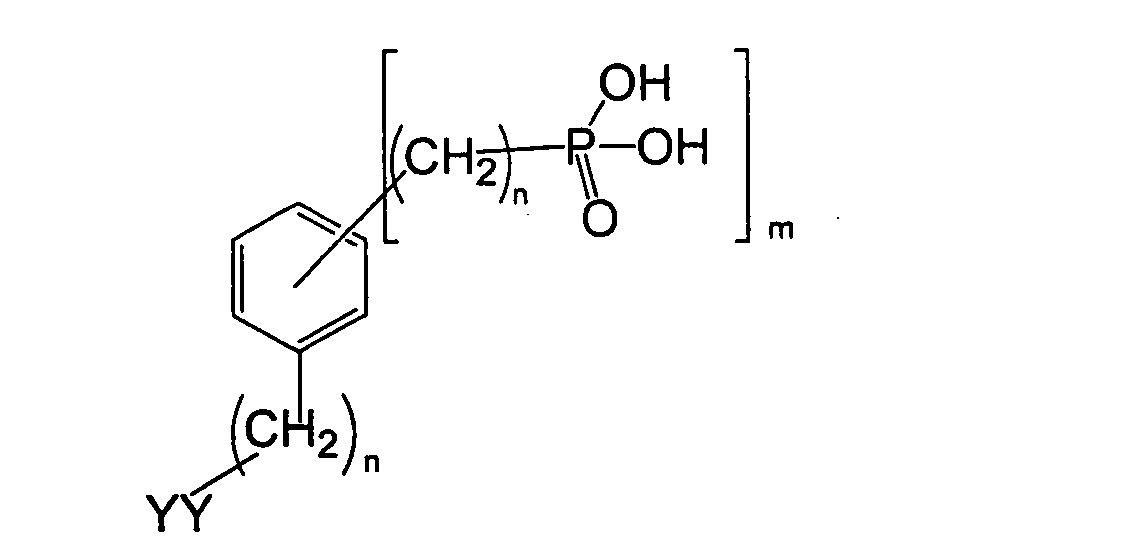
bedeutet, m 1,2 oder 3 und n jeweils unabhängig voneinander 0,1, 2, 3, 4, 5, 6, 7 oder 8 ist; YY ist eine Amino- oder eine Carboxylgruppe. Eine freie Aminogruppe der Gruppe B wird mit einer freien Carboxylgruppe des Spacer-Moleküls Q oder des Ankermoleküls X1, bzw. eine freie Aminogruppe des Restes Q mit einer freien Carboxylgruppe des Restes X1 peptidartig verknüpft,
sowie deren Salze.
Ähnliche Verbindungen sind aus DE 10040105, DE 19932796, DE 19755800 und DE 19831710 bekannt.
Diese Wirkung kann z.B. nach der Methode nachgewiesen werden, die von J.W. Smith et al. in J. Biol. Chem. 265, 12267-12271 (1990) beschrieben wird.
Die Abhängigkeit der Entstehung von Angiogenese von der Wechselwirkung zwischen vaskulären Integrinen und extrazellulären Matrixproteinen ist von P.C. Brooks, R.A. Clark und D.A. Cheresh in Science 264, 569-71 (1994) beschrieben.
Die Verbreitung von Tumorzellen von einem lokalen Tumor in das vaskuläre System erfolgt durch die Bildung von Mikroaggregaten (Mikrothromben) durch Wechselwirkung der Tumorzellen mit Blutplättchen. Die Tumorzellen sind durch den Schutz im Mikroaggregat abgeschirmt und werden von den Zellen des Immunsystems nicht erkannt.
Die Mikroaggregate können sich an Gefäßwandungen festsetzen, wodurch ein weiteres Eindringen von Tumorzellen in das Gewebe erleichtert wird. Da die Bildung der Mikrothromben durch Fibrinogenbindung an die Fibrinogenrezeptoren auf aktivierten Blutplättchen vermittelt wird, können die GPIIa/IIIb-Antagonisten als wirksame Metastase-Hemmer angesehen werden.
Nach Beschichtung der Verbindungen auf den Oberflächen, können selektiv diejenigen Zeit-Spezies zur Bindung stimuliert werden, die auch nach Implantation im natürlichen Gewebe die Implantatintegration vollführen sollen. So handelt es sich z.B. bei Osteoblasten, Osteoclasten und Endothelzellen um αV-tragende Zellspezies.
Dabei wirken sie antiseptisch. Die Wirksamkeit der antimikrobiellen Aktivität kann durch das von P.Valentin-Weigund et al., in Infection and Immunity, 2851-2855 (1988) beschriebene Verfahren nachgewiesen werden.
- Abu
- 4-Aminobuttersäure
- Aha
- 6-Aminohexansäure, 6-Aminocapronsäure
- Ala
- Alanin
- Asn
- Asparagin
- Asp
- Asparaginsäure
- Arg
- Arginin
- Cys
- Cystein
- Dab
- 2,4-Diaminobuttersäure
- Dap
- 2,3-Diaminopropionsäure
- Gln
- Glutamin
- Glp
- Pyroglutaminsäure
- Glu
- Glutaminsäure
- Gly
- Glycin
- His
- Histidin
- homo-Phe
- homo-Phenylalanin
- Ile
- Isoleucin
- Leu
- Leucin
- Lys
- Lysin
- Met
- Methionin
- Nle
- Norleucin
- Orn
- Ornithin
- Phe
- Phenylalanin
- Phg
- Phenylglycin
- 4-Hal-Phe
- 4-Halogen-phenylalanin
- Pro
- Prolin
- Ser
- Serin
- Thr
- Threonin
- Trp
- Tryptophan
- Tyr
- Tyrosin
- Val
- Valin.
- Ac
- Acetyl
- BOC
- tert.-Butoxycarbonyl
- CBZ oder Z
- Benzyloxycarbonyl
- DCCI
- Dicyclohexylcarbodiimid
- DMF
- Dimethylformamid
- EDCI
- N-Ethyl-N,N'-(dimethylaminopropyl)-carbodiimid
- Et
- Ethyl
- FCA
- Fluoresceincarbonsäure
- FITC
- Fluoresceinisothiocyanat
- Fmoc
- 9-Fluorenylmethoxycarbonyl
- FTH
- Fluoresceinthioharnstoff
- HOBt
- 1-Hydroxybenzotriazol
- Me
- Methyl
- MBHA
- 4-Methyl-benzhydrylamin
- Mtr
- 4-Methoxy-2,3,6-trimethylphenyl-sulfonyl
- HATU
- O-(7-Azabenzotriazol-1-yl)-N,N,N',N'-Tetramethyluronium-hexafluorophosphat
- HONSu
- N-Hydroxysuccinimid
- OtBu
- tert.-Butylester
- Oct
- Octanoyl
- OMe
- Methylester
- OEt
- Ethylester
- POA
- Phenoxyacetyl
- Pbf
- Pentamethylbenzofuranyl
- Pmc
- 2,2,5,7,8-Pentamethylchroman-6-sulfonyl
- Sal
- Salicyloyl
- Su
- Succinyl
- TIPS
- Triisopropylsilan
- TFA
- Trifluoressigsäure
- TMSBr
- Trimethylsilylbromid
- Trt
- Trityl (Triphenylmethyl).

Trp-Tyr-Lys-IIe-Ala-Phe-Gln-Arg-Asn-Arg-Lys-,
Tyr-Lys-IIe-Ala-Phe-Gln-Arg-Asn-Arg-Lys-,
Thr-Trp-Tyr-Lys-Ile-Ala-Phe-Gln-Arg-Asn-Arg-,
Thr-Trp-Tyr-Lys-IIe-Ala-Phe-Gln-Arg-Asn- oder ein
Thr-Trp-Tyr-Lys-IIe-Ala-Phe-Gln-Arg-Rest,
wobei Z1 jeweils unabhängig voneinander einen Aminosäurerest oder einen Di- oder Tripeptidrest bedeutet, wobei die Aminosäuren unabhängig voneinander ausgewählt sind aus der Gruppe bestehend aus Ala, Asn, Asp, Arg, Cys, Gln, Glu, Gly, His, Homo-Phe, Ile, Leu, Lys, Orn, Met, Phe, Phg, Pro, Ser, Thr, Trp, Tyr, Val.
Beispiele, die in Het bevorzugt enthalten sind:


Die linearen Peptide können z.B. nach R.B. Merrifield, Angew. Chemie 1985, 97, 801-812, synthetisiert werden.
Die Pbf (Pentamethylbenzofuranyl)-gruppe wird zum Schutz von Arg eingesetzt. Die Abspaltung erfolgt z.B. mit TFA in Dichlormethan.
Ethylacetat/Methanol 9:1.
RZ = Retentionszeit (Minuten) bei HPLC in den folgenden Systemen:
Säule: YMC ODS A RP 5C18, 250 x 4,6 mm
Eluent A: 0,1 % TFA in Wasser
Eluent B: 0,1 % TFA in Acetonitril
Fluß: 1 ml/min
Gradient: 0 - 50 % B / 30 min.
wie [A];
Gradient: 5 - 50 % B / 30 min.
wie [A];
Gradient: 10 - 50 % B / 30 min.
Massenspektrometrie (MS): EI (Elektronenstoß-Ionisation) M+
FAB (Fast Atom Bombardment) (M+H)+
ESI (Elektrospray-lonisation) (M+H)+
Protein Res. 1990, 35, 161-214).
Als letzter Baustein wurde 5-Carboxy-m-xylen-bisphosphonsäure-tetrabenzylester gekuppelt.
Als Negativkontrollen fungieren Ti- bzw. TiAl6V4-Formkörper, die anstelle von B-Lösungen mit entsprechenden Pufferlösungen (Tris-HCl 10 mM, pH 8.7; Tris-HClO4 10 mM, pH 8.7; PBS, pH 7.4) behandelt werden.
Der Grad der erhaltenen Beschichtungen auf den Formkörpern wird analytisch bewertet und die biologische Wirksamkeit mittels eines Zelladhäsionstests in vitro bestimmt.
Zellanhaftungsrate [%] = adherierte Zellen / angesäte Zellen x 100
Peptid: Zellanhaftungsrate [%]


Im ELISA ist zu erkennen, dass im Fall der Verbindung CD 135 mehr Peptid auf der Oberfläche gebunden wird, was bei der Zelladhäsion zu einer höheren Zellanhaftungsrate bei allen gemessen Konzentrationen führt.
Die Zelladhäsion zu Beginn (Leer) entspricht der Zelladhäsion bei unbeschichteten Titanplättchen. Durch die Beschichtung der Plättchen mit einer 100 µM Beschichtungslösung lässt sich die Zelladhäsion im Vergleich zu unbeschichteten Plättchen verdreifachen.




Claims (13)
- Verbindung der Formel 1
- B
- ein bioaktives, zelladhäsionsvermittelndes Molekül
- Q
- fehlt oder ein organisches Spacer-Molekül und
- X1
- ein Ankermolekül, ausgewählt aus der Gruppe
und V Lys, Asp oder Glu
bedeutet, m 1,2 oder 3, n jeweils unabhängig voneinander 0,1, 2, 3, 4, 5, 6, 7 oder 8 und YY eine Amino- oder eine Carboxylgruppe ist, wobei eine freie Aminogruppe der Gruppe B mit einer freien Carboxylgruppe des Spacer-Moleküls Q oder des Ankermoleküls X1, bzw. eine freie Aminogruppe des Restes Q mit einer freien Carboxylgruppe des Restes X1 peptidartig verknüpft ist,
sowie deren Salze. - Verbindung nach Anspruch 1, worin die Gruppe B ausgewählt ist aus der Gruppeund

- Z1
- jeweils unabhängig voneinander einen Aminosäurerest oder einen Di- oder Tripeptidrest, wobei die Aminosäuren unabhängig voneinander ausgewählt sind aus einer Gruppe bestehend aus Ala, Asn, Asp, Arg, Cys, Gln, Glu, Gly, His, Homo-Phe, Ile, Leu, Lys, Met, Orn, Phe, Phg, Pro, Ser, Thr, Trp, Tyr, Val,
- X
- H2N-C(=NH)-NH, Het-NH-, H2N-C(=NH)-, A-C(=NH)-NH oder Het-
- Y
- -(CH2)n- oder
-(CH2)s-CH(R4)-(CH2)t- oder -(CH2)p-Het1-(CH2)q-,
- Z
- N-R2 oder CH-R2
- R2
- H oder Alkyl mit 1 bis 4 C-Atomen
- R3
- H, Ar, Het oder A
- R4
- H, A, Ar, OH,OA, OAr, Arylalkyl, Hal ,CN, NO2, CF3 oder OCF3,
- A
- COOH, NH2 oder Alkyl mit 1-6 C-Atomen, unsubstituiert oder substituiert mit COOH oder NH2
- Ar
- unsubstituiertes oder ein-, zwei-oder dreifach durch A, OH, OA, CF3, OCF3, CN, NO2 oder Hal substituiertes Phenyl, welches durch ein ein-, zwei oder dreifach durch A, OH, OA, NH2, OCF3, CN, NO2 oder Hal substituiertes Phenyl in der Art substituiert sein kann, dass ein unsubstituiertes oder substituiertes Biphenyl entsteht,
- Hal
- F, Cl, Br oder I,
- Het
- einen gesättigten, teilweise oder vollständig ungesättigten mono- oder bicyclischen heterocyclischen Rest mit 5 bis 10 Ringgliedern, wobei 1 bis 3 N- und/oder 1 S- oder O-Atome vorliegen können und der heterocyclische Rest ein- oder zweifach durch CN, Hal, OH , NH2, COOH, OA, CF3, A, NO2, Ar oder OCF3 substituiert sein kann,
- Het1
- einen 5- oder 6-gliedrigen aromatischen Heterocyclus mit 1 bis 4 N- und / oder S-Atomen, der unsubstituiert oder ein- oder zweifach durch F, Cl, Br, A, OA oder OCF3 substituiert sein kann,
- n
- 4, 5 oder 6,
- m, o,p, q
- 0, 1 oder 2
- s, t
- 0,1, 2, 3, 4 oder 5
- Verbindung nach Anspruch 1 oder 2, worin Q ausgewählt ist aus der Gruppe
worin- m
- jeweils unabhängig voneinander 1- 20
- x
- 1- 12
- y
- 1- 50 und
- z
- 1- 12 ist.
- Verbindung nach Anspruch 1 oder 2, worin Q ausgewählt ist aus der Gruppe
worin- m
- jeweils unabhängig voneinander 1 bis 8
- x
- 1- 5
- y
- 1- 6 und
- z
- 1- 6 ist.
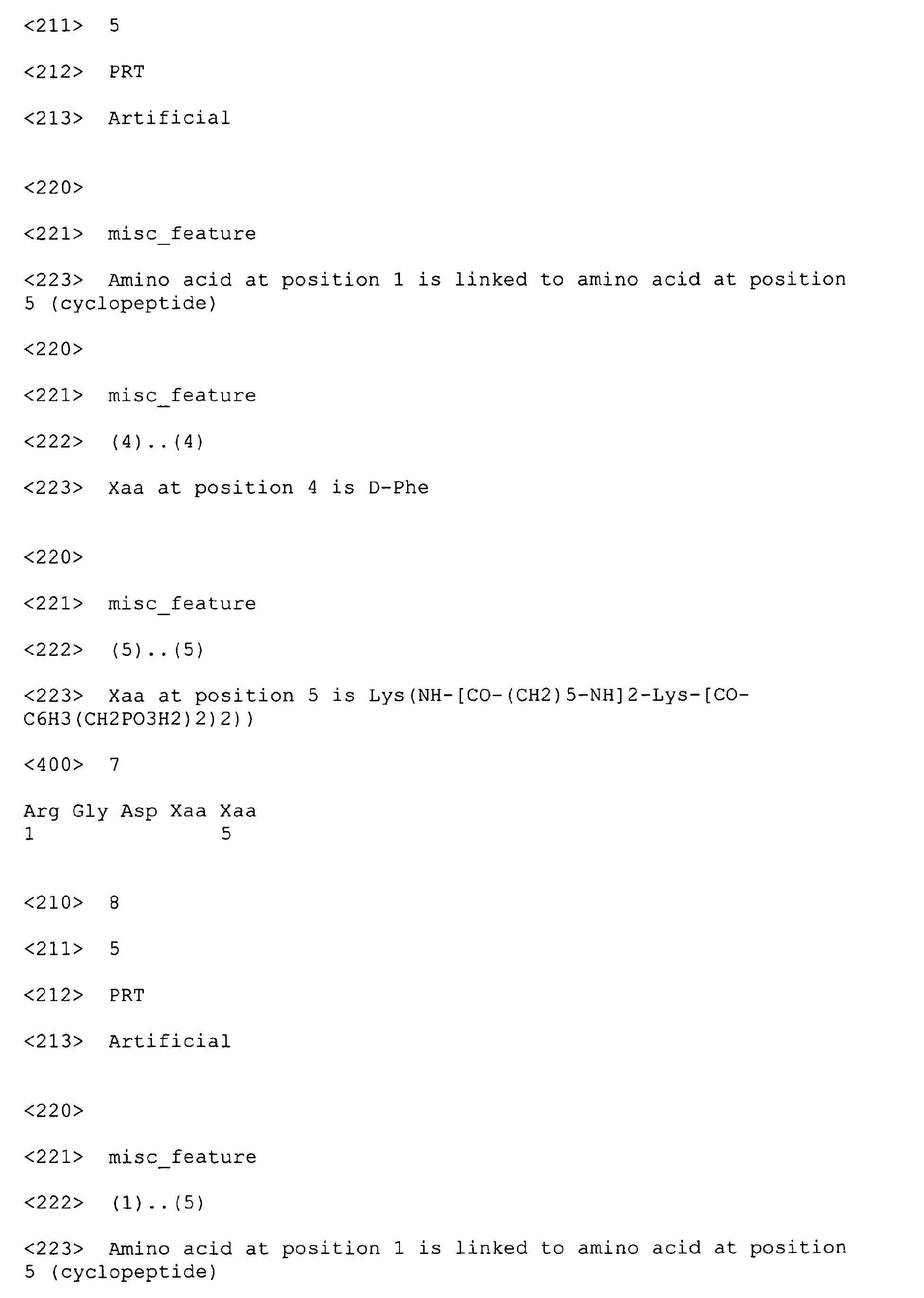
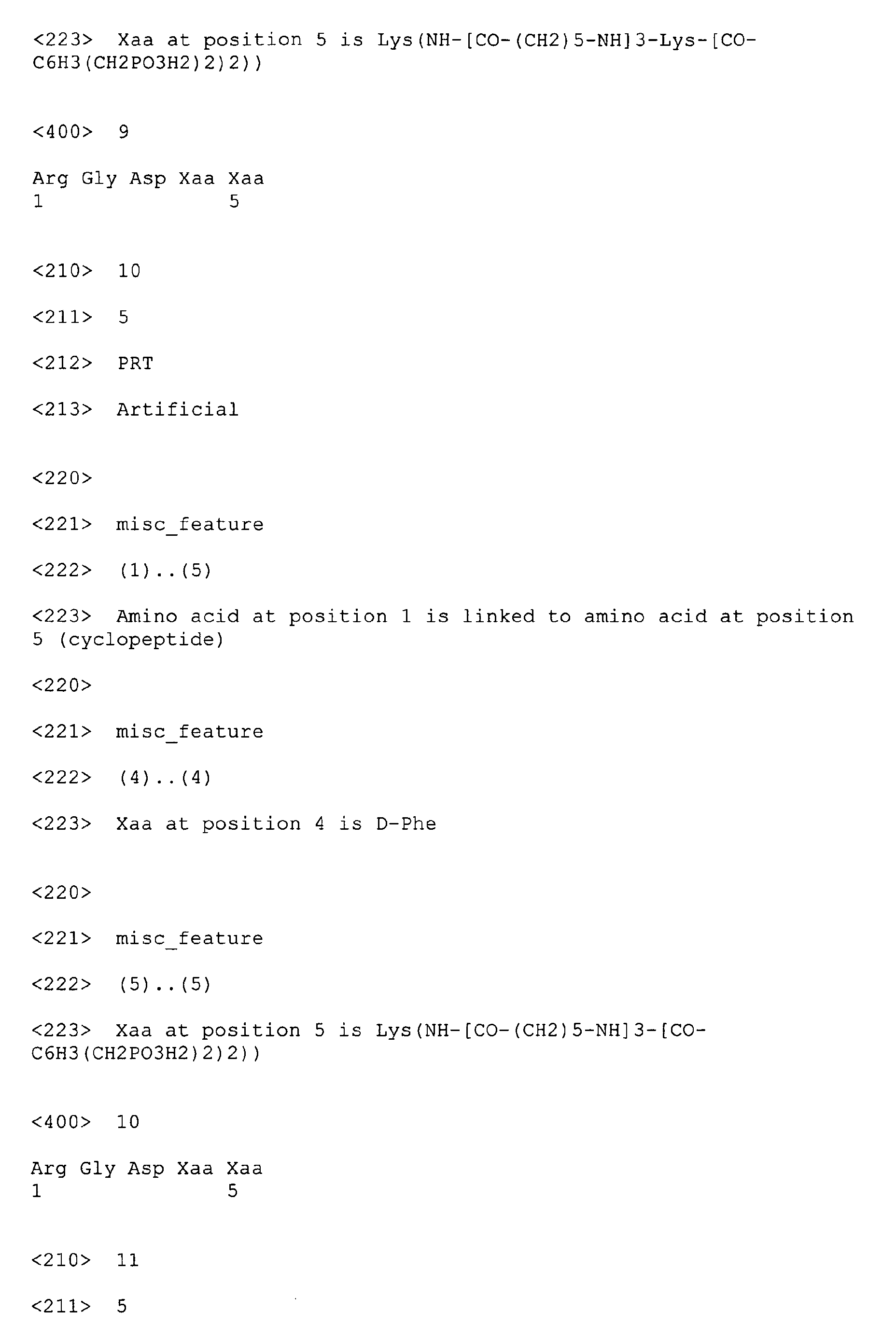
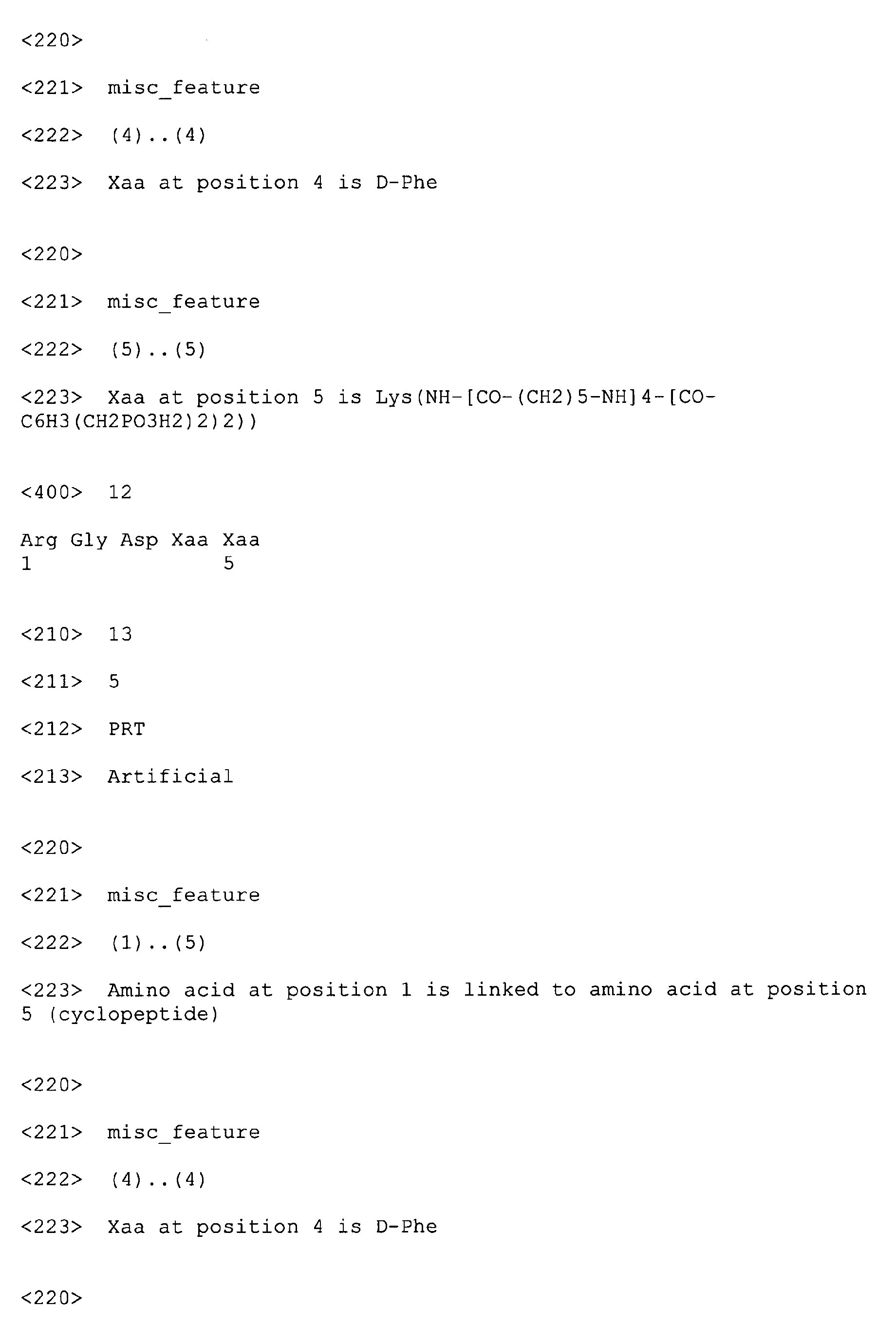
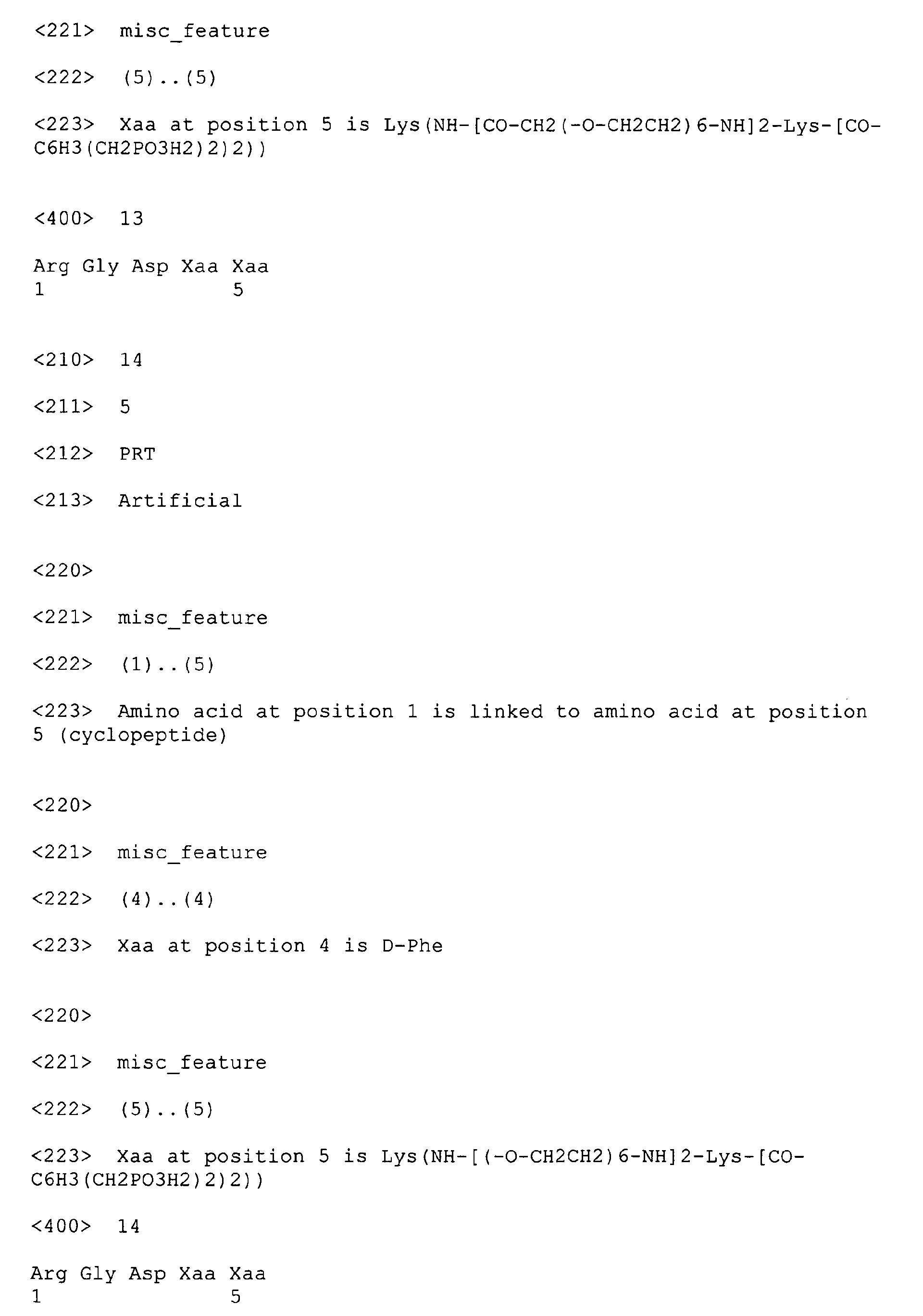
- Verbindungen der Formel 1 gemäß Anspruch 1a) Cyclo-(Arg-Gly-Asp-D-Phe-Lys(εNH-[CO-(CH2)5-NH]2-Lys-(CO-C6H3(CH2PO3H2)2)2))b) Cyclo-(Arg-Gly-Asp-D-Phe-Lys(εNH-[CO-(CH2)5-NH]2-(CO-C6H3(CH2PO3H2)2)2))c) Cyclo-(Arg-Gly-Asp-D-Phe-Lys(εNH-[CO-(CH2)5-NH]3-Lys-(CO-C6H3(CH2PO3H2)2)2))d) Cyclo-(Arg-Gly-Asp-D-Phe-Lys(εNH-(CO-(CH2)5-NH]3-(CO-C6H3(CH2PO3H2)2)2))e) Cyclo-(Arg-Gly-Asp-D-Phe-Lys(εNH-[CO-(CH2)5-NH]4-Lys-(CO-C6H3(CH2PO3H2)2)2))f) Cyclo-(Arg-Gly-Asp-D-Phe-Lys(εNH-[CO-(CH2)5-NH]4-(CO-C6H3(CH2PO3H2)2)2))g) Cyclo-(Arg-Gly-Asp-D-Phe-Lys(εNH-[CO-CH2(-O-CH2CH2)6-NH]2-Lys-(CO-C6H3(CH2PO3H2)2)2))h) Cyclo-(Arg-Gly-Asp-D-Phe-Lys(εNH-[(-O-CH2CH2)6-NH]2-Lys-(CO-C6H3(CH2PO3H2)2)2))i) Cyclo-(Arg-Gly-Asp-D-Phe-Lys(εNH-[CO-(CH2)5-NH]2-Lys-[Lys-(CO-C6H3(CH2PO3H2)2)2]2))j) Cyclo-(Arg-Gly-Asp-D-Phe-Lys(εNH-[CO-(CH2)5-NH]3-Lys-[Lys-(CO-C6H3(CH2PO3H2)2)2]2))k) Cyclo-(Arg-Gly-Asp-D-Phe-Lys(εNH-[CO-CH2(O-CH2CH2)6-NH]2-Lys-[Lys-(CO-C6H3(CH2PO3H2)2)2]2))
- Verbindung nach einem der Ansprüche 1 bis 5 als Arzneimittel zur Behandlung von durch Implantate verursachten Erkrankungen, Defekten, Entzündungen und von osteolytischen Erkrankungen wie Osteoporose, Thrombose, Herzinfarkt und Arteriosklerose, sowie zur Beschleunigung und Verstärkung des Integrationsprozesses des Implantats bzw. der biokompatiblen Oberfläche in das Gewebe.
- Implantat, geeignet für humane und tierische Organe, bestehend aus einer Trägermatrix und einer diese Matrix umhüllenden Schicht eines bioaktiven, zelladhäsionsvermittelnden Moleküls, dadurch gekennzeichnet, daß die umhüllende Schicht aus einer Verbindung gemäß der Ansprüche 1 bis 5 gebildet wird, wobei zwischen Trägermatrix und dieser Verbindung eine ionische oder adsorptive Bindung vorliegt.
- Implantat nach Anspruch 7, dadurch gekennzeichnet, dass die Trägermatrix und/oder deren Oberfläche ein Metall oder ein Metalloxid ist.
- Implantat nach Anspruch 7, dadurch gekennzeichnet, dass die Trägermatrix und/oder deren Oberfläche ein Knochen- oder Zahnersatzmaterial ist.
- Implantat nach Anspruch 9, dadurch gekennzeichnet, dass das Knochen- oder Zahnersatzmaterial aus Calciumphosphat-Mischungen besteht.
- Verfahren zur Herstellung einer Verbindung nach Anspruch 1 sowie ihrer Salze, dadurch gekennzeichnet, dass man ein bioaktives Molekül B, welches mit Schutzgruppen versehen sein kann, und ein mit Schutzgruppen versehenes Spacer-Anker-Molekül (Q-X1) bzw. Anker-Molekül (X1) peptidisch miteinander verknüpft und anschließend die Schutzgruppen abspaltet, und/oder dass man eine basische oder saure Verbindung der Formel 1 durch Behandeln mit einer Säure oder Base in eines ihrer Salze überführt.
- Verwendung einer Verbindung nach einem der Anprüche 1 bis 5 zur Herstellung eines Arzneimittels zur Behandlung von durch Implantate verursachten Erkrankungen, Defekten, Entzündungen und von osteolytischen Erkrankungen wie Osteoporose, Thrombose, Herzinfarkt und Arteriosklerose, sowie zur Beschleunigung und Verstärkung des Integrationsprozesses des Implantats bzw. der biokompatiblen Oberfläche in das Gewebe.
- Verwendung einer Verbindung nach einem der Anprüche 1 bis 5 zur Beschichtung mittels ionischer oder adsorptiver Bindung von Implantaten für humane und tierische Organe.
Applications Claiming Priority (2)
| Application Number | Priority Date | Filing Date | Title |
|---|---|---|---|
| DE10325049 | 2003-06-02 | ||
| DE10325049A DE10325049A1 (de) | 2003-06-02 | 2003-06-02 | Peptid- und Peptidmimetika-Derivate mit Integrin-Inhibitor-Eigenschaften III |
Publications (3)
| Publication Number | Publication Date |
|---|---|
| EP1548029A2 true EP1548029A2 (de) | 2005-06-29 |
| EP1548029A3 EP1548029A3 (de) | 2005-08-03 |
| EP1548029B1 EP1548029B1 (de) | 2009-04-15 |
Family
ID=33482433
Family Applications (1)
| Application Number | Title | Priority Date | Filing Date |
|---|---|---|---|
| EP04011492A Revoked EP1548029B1 (de) | 2003-06-02 | 2004-05-14 | Peptid- und Peptidmimetika-Derivate mit Integrin-Inhibitor-Eigenschaften III |
Country Status (7)
| Country | Link |
|---|---|
| US (1) | US20050261169A1 (de) |
| EP (1) | EP1548029B1 (de) |
| JP (1) | JP2004359686A (de) |
| AT (1) | ATE428723T1 (de) |
| CA (1) | CA2469528A1 (de) |
| DE (2) | DE10325049A1 (de) |
| ES (1) | ES2323238T3 (de) |
Families Citing this family (7)
| Publication number | Priority date | Publication date | Assignee | Title |
|---|---|---|---|---|
| CN101360736A (zh) * | 2005-11-23 | 2009-02-04 | 阿斯利康(瑞典)有限公司 | L-丙氨酸衍生物 |
| JP2009539815A (ja) * | 2006-06-09 | 2009-11-19 | アストラゼネカ アクチボラグ | 固形腫瘍の治療用のa5b1アンタゴニストとしてのN−(ベンゾイル)−O−[2−(ピリジン−2−イルアミノ)エチル]−L−チロシン誘導体と関連化合物 |
| DE102007003708A1 (de) * | 2007-01-25 | 2008-07-31 | Biotronik Vi Patent Ag | Mit Biomolekülen beschichtete Stents sowie Verfahren zu deren Herstellung |
| WO2008093065A1 (en) * | 2007-01-29 | 2008-08-07 | Astrazeneca Ab | L-ALANINE DERIVATIVES AS α5βL ANTAGONISTS |
| WO2008125811A1 (en) * | 2007-04-11 | 2008-10-23 | Astrazeneca Ab | N-[HETEROARYLCARBONYL]-S-THIENYL-L-ALANINE DERIVATIVES AS α5β1 ANTAGONISTS |
| WO2008143933A1 (en) * | 2007-05-15 | 2008-11-27 | Cvpath Institute, Inc. | Coating stents with integrin selective peptides or mimetics |
| EP2489344B1 (de) * | 2011-02-15 | 2021-03-24 | Ivoclar Vivadent AG | Dentalwerkstoff auf der Basis einer antimikrobiell wirksamen Verbindung |
Family Cites Families (7)
| Publication number | Priority date | Publication date | Assignee | Title |
|---|---|---|---|---|
| KR920701248A (ko) * | 1989-11-08 | 1992-08-11 | 고지마 아끼로 | 펩티드, 및 환상 펩티드의 제조 방법 |
| US6245809B1 (en) * | 1996-12-09 | 2001-06-12 | Cor Therapeutics Inc. | Integrin antagonists |
| DE19755800A1 (de) * | 1997-12-16 | 1999-06-17 | Merck Patent Gmbh | Cyclopeptidderivate |
| DE19831710A1 (de) * | 1998-07-15 | 2000-01-20 | Merck Patent Gmbh | Diacylhydrazinderivate |
| DE19932796A1 (de) * | 1999-07-14 | 2001-01-18 | Merck Patent Gmbh | Diacylhydrazinderivate |
| DE10040103A1 (de) * | 2000-08-17 | 2002-02-28 | Merck Patent Gmbh | Peptid- und Peptidmimetika-Derivate mit Integrin-Inhibitor-Eigenschaften II |
| DE10040105A1 (de) * | 2000-08-17 | 2002-02-28 | Merck Patent Gmbh | Peptid- und Peptidmimetika-Derivate mit Integrin-Inhibitor-Eigenschaften |
-
2003
- 2003-06-02 DE DE10325049A patent/DE10325049A1/de not_active Ceased
-
2004
- 2004-05-14 EP EP04011492A patent/EP1548029B1/de not_active Revoked
- 2004-05-14 ES ES04011492T patent/ES2323238T3/es not_active Expired - Lifetime
- 2004-05-14 DE DE502004009349T patent/DE502004009349D1/de not_active Expired - Lifetime
- 2004-05-14 AT AT04011492T patent/ATE428723T1/de not_active IP Right Cessation
- 2004-05-31 CA CA002469528A patent/CA2469528A1/en not_active Abandoned
- 2004-06-02 JP JP2004164843A patent/JP2004359686A/ja not_active Withdrawn
- 2004-06-02 US US10/858,480 patent/US20050261169A1/en not_active Abandoned
Also Published As
| Publication number | Publication date |
|---|---|
| DE502004009349D1 (de) | 2009-05-28 |
| EP1548029A3 (de) | 2005-08-03 |
| ATE428723T1 (de) | 2009-05-15 |
| CA2469528A1 (en) | 2004-12-02 |
| JP2004359686A (ja) | 2004-12-24 |
| EP1548029B1 (de) | 2009-04-15 |
| DE10325049A1 (de) | 2004-12-23 |
| ES2323238T3 (es) | 2009-07-09 |
| US20050261169A1 (en) | 2005-11-24 |
Similar Documents
| Publication | Publication Date | Title |
|---|---|---|
| EP0632053B1 (de) | Cyclische Adhäsionsinhibitoren | |
| EP0683173B1 (de) | Cyclische Adhäsioninhibitoren | |
| EP1754714A1 (de) | Cyclische Peptidderivate als Inhibitoren des Integrins avß6 | |
| EP1309355B1 (de) | Peptid- und peptidmimetikakonjugate mit integrin-inhibitor-eigenschaften | |
| EP1037906B1 (de) | Cyclopeptidderivate mit integrin-inhibitor-eigenschaften | |
| EP0856007B1 (de) | Cyclopeptidderivate | |
| EP1548029B1 (de) | Peptid- und Peptidmimetika-Derivate mit Integrin-Inhibitor-Eigenschaften III | |
| DE4310632A1 (de) | Lineare Adhäsionsinhibitoren | |
| EP1001979B1 (de) | Cyclische azapeptide mit angiogener wirkung | |
| EP0771818B1 (de) | Biotinderivate | |
| EP1309610B1 (de) | Peptid- und peptidmimetika-derivate mit integrin-inhibitor-eigenschaften ii |
Legal Events
| Date | Code | Title | Description |
|---|---|---|---|
| PUAI | Public reference made under article 153(3) epc to a published international application that has entered the european phase |
Free format text: ORIGINAL CODE: 0009012 |
|
| PUAL | Search report despatched |
Free format text: ORIGINAL CODE: 0009013 |
|
| 17P | Request for examination filed |
Effective date: 20040514 |
|
| AK | Designated contracting states |
Kind code of ref document: A2 Designated state(s): AT BE BG CH CY CZ DE DK EE ES FI FR GB GR HU IE IT LI LU MC NL PL PT RO SE SI SK TR |
|
| AX | Request for extension of the european patent |
Extension state: AL HR LT LV MK |
|
| AK | Designated contracting states |
Kind code of ref document: A3 Designated state(s): AT BE BG CH CY CZ DE DK EE ES FI FR GB GR HU IE IT LI LU MC NL PL PT RO SE SI SK TR |
|
| AX | Request for extension of the european patent |
Extension state: AL HR LT LV MK |
|
| AKX | Designation fees paid |
Designated state(s): AT BE BG CH CY CZ DE DK EE ES FI FR GB GR HU IE IT LI LU MC NL PL PT RO SE SI SK TR |
|
| 17Q | First examination report despatched |
Effective date: 20060508 |
|
| GRAP | Despatch of communication of intention to grant a patent |
Free format text: ORIGINAL CODE: EPIDOSNIGR1 |
|
| GRAS | Grant fee paid |
Free format text: ORIGINAL CODE: EPIDOSNIGR3 |
|
| GRAA | (expected) grant |
Free format text: ORIGINAL CODE: 0009210 |
|
| AK | Designated contracting states |
Kind code of ref document: B1 Designated state(s): AT BE BG CH CY CZ DE DK EE ES FI FR GB GR HU IE IT LI LU MC NL PL PT RO SE SI SK TR |
|
| REG | Reference to a national code |
Ref country code: CH Ref legal event code: EP Ref country code: GB Ref legal event code: FG4D Free format text: NOT ENGLISH |
|
| REG | Reference to a national code |
Ref country code: IE Ref legal event code: FG4D |
|
| REF | Corresponds to: |
Ref document number: 502004009349 Country of ref document: DE Date of ref document: 20090528 Kind code of ref document: P |
|
| REG | Reference to a national code |
Ref country code: ES Ref legal event code: FG2A Ref document number: 2323238 Country of ref document: ES Kind code of ref document: T3 |
|
| PG25 | Lapsed in a contracting state [announced via postgrant information from national office to epo] |
Ref country code: FI Free format text: LAPSE BECAUSE OF FAILURE TO SUBMIT A TRANSLATION OF THE DESCRIPTION OR TO PAY THE FEE WITHIN THE PRESCRIBED TIME-LIMIT Effective date: 20090415 Ref country code: PT Free format text: LAPSE BECAUSE OF FAILURE TO SUBMIT A TRANSLATION OF THE DESCRIPTION OR TO PAY THE FEE WITHIN THE PRESCRIBED TIME-LIMIT Effective date: 20090915 |
|
| BERE | Be: lapsed |
Owner name: BIOMET DEUTSCHLAND G.M.B.H. Effective date: 20090531 |
|
| PG25 | Lapsed in a contracting state [announced via postgrant information from national office to epo] |
Ref country code: PL Free format text: LAPSE BECAUSE OF FAILURE TO SUBMIT A TRANSLATION OF THE DESCRIPTION OR TO PAY THE FEE WITHIN THE PRESCRIBED TIME-LIMIT Effective date: 20090415 Ref country code: SI Free format text: LAPSE BECAUSE OF FAILURE TO SUBMIT A TRANSLATION OF THE DESCRIPTION OR TO PAY THE FEE WITHIN THE PRESCRIBED TIME-LIMIT Effective date: 20090415 Ref country code: SE Free format text: LAPSE BECAUSE OF FAILURE TO SUBMIT A TRANSLATION OF THE DESCRIPTION OR TO PAY THE FEE WITHIN THE PRESCRIBED TIME-LIMIT Effective date: 20090715 |
|
| REG | Reference to a national code |
Ref country code: IE Ref legal event code: FD4D |
|
| PG25 | Lapsed in a contracting state [announced via postgrant information from national office to epo] |
Ref country code: MC Free format text: LAPSE BECAUSE OF NON-PAYMENT OF DUE FEES Effective date: 20090531 |
|
| REG | Reference to a national code |
Ref country code: CH Ref legal event code: PL |
|
| PLBI | Opposition filed |
Free format text: ORIGINAL CODE: 0009260 |
|
| PG25 | Lapsed in a contracting state [announced via postgrant information from national office to epo] |
Ref country code: CH Free format text: LAPSE BECAUSE OF NON-PAYMENT OF DUE FEES Effective date: 20090531 Ref country code: CZ Free format text: LAPSE BECAUSE OF FAILURE TO SUBMIT A TRANSLATION OF THE DESCRIPTION OR TO PAY THE FEE WITHIN THE PRESCRIBED TIME-LIMIT Effective date: 20090415 Ref country code: LI Free format text: LAPSE BECAUSE OF NON-PAYMENT OF DUE FEES Effective date: 20090531 Ref country code: DK Free format text: LAPSE BECAUSE OF FAILURE TO SUBMIT A TRANSLATION OF THE DESCRIPTION OR TO PAY THE FEE WITHIN THE PRESCRIBED TIME-LIMIT Effective date: 20090415 Ref country code: IE Free format text: LAPSE BECAUSE OF FAILURE TO SUBMIT A TRANSLATION OF THE DESCRIPTION OR TO PAY THE FEE WITHIN THE PRESCRIBED TIME-LIMIT Effective date: 20090415 Ref country code: EE Free format text: LAPSE BECAUSE OF FAILURE TO SUBMIT A TRANSLATION OF THE DESCRIPTION OR TO PAY THE FEE WITHIN THE PRESCRIBED TIME-LIMIT Effective date: 20090415 Ref country code: RO Free format text: LAPSE BECAUSE OF FAILURE TO SUBMIT A TRANSLATION OF THE DESCRIPTION OR TO PAY THE FEE WITHIN THE PRESCRIBED TIME-LIMIT Effective date: 20090415 |
|
| PLAX | Notice of opposition and request to file observation + time limit sent |
Free format text: ORIGINAL CODE: EPIDOSNOBS2 |
|
| 26 | Opposition filed |
Opponent name: NANO BRIDGING MOLECULES SA Effective date: 20100115 |
|
| PG25 | Lapsed in a contracting state [announced via postgrant information from national office to epo] |
Ref country code: SK Free format text: LAPSE BECAUSE OF FAILURE TO SUBMIT A TRANSLATION OF THE DESCRIPTION OR TO PAY THE FEE WITHIN THE PRESCRIBED TIME-LIMIT Effective date: 20090415 |
|
| PG25 | Lapsed in a contracting state [announced via postgrant information from national office to epo] |
Ref country code: BG Free format text: LAPSE BECAUSE OF FAILURE TO SUBMIT A TRANSLATION OF THE DESCRIPTION OR TO PAY THE FEE WITHIN THE PRESCRIBED TIME-LIMIT Effective date: 20090715 |
|
| PLAK | Information related to reply of patent proprietor to notice(s) of opposition modified |
Free format text: ORIGINAL CODE: EPIDOSCOBS3 |
|
| PLBB | Reply of patent proprietor to notice(s) of opposition received |
Free format text: ORIGINAL CODE: EPIDOSNOBS3 |
|
| PG25 | Lapsed in a contracting state [announced via postgrant information from national office to epo] |
Ref country code: BE Free format text: LAPSE BECAUSE OF NON-PAYMENT OF DUE FEES Effective date: 20090531 |
|
| PGFP | Annual fee paid to national office [announced via postgrant information from national office to epo] |
Ref country code: AT Payment date: 20100513 Year of fee payment: 7 |
|
| PG25 | Lapsed in a contracting state [announced via postgrant information from national office to epo] |
Ref country code: GR Free format text: LAPSE BECAUSE OF FAILURE TO SUBMIT A TRANSLATION OF THE DESCRIPTION OR TO PAY THE FEE WITHIN THE PRESCRIBED TIME-LIMIT Effective date: 20090716 |
|
| REG | Reference to a national code |
Ref country code: DE Ref legal event code: R064 Ref document number: 502004009349 Country of ref document: DE Ref country code: DE Ref legal event code: R103 Ref document number: 502004009349 Country of ref document: DE |
|
| RDAF | Communication despatched that patent is revoked |
Free format text: ORIGINAL CODE: EPIDOSNREV1 |
|
| PG25 | Lapsed in a contracting state [announced via postgrant information from national office to epo] |
Ref country code: IT Free format text: LAPSE BECAUSE OF FAILURE TO SUBMIT A TRANSLATION OF THE DESCRIPTION OR TO PAY THE FEE WITHIN THE PRESCRIBED TIME-LIMIT Effective date: 20090415 |
|
| PG25 | Lapsed in a contracting state [announced via postgrant information from national office to epo] |
Ref country code: LU Free format text: LAPSE BECAUSE OF NON-PAYMENT OF DUE FEES Effective date: 20090514 |
|
| PG25 | Lapsed in a contracting state [announced via postgrant information from national office to epo] |
Ref country code: HU Free format text: LAPSE BECAUSE OF FAILURE TO SUBMIT A TRANSLATION OF THE DESCRIPTION OR TO PAY THE FEE WITHIN THE PRESCRIBED TIME-LIMIT Effective date: 20091016 |
|
| RDAG | Patent revoked |
Free format text: ORIGINAL CODE: 0009271 |
|
| STAA | Information on the status of an ep patent application or granted ep patent |
Free format text: STATUS: PATENT REVOKED |
|
| PGFP | Annual fee paid to national office [announced via postgrant information from national office to epo] |
Ref country code: FR Payment date: 20110607 Year of fee payment: 8 Ref country code: ES Payment date: 20110516 Year of fee payment: 8 |
|
| 27W | Patent revoked |
Effective date: 20110210 |
|
| GBPR | Gb: patent revoked under art. 102 of the ep convention designating the uk as contracting state |
Effective date: 20110210 |
|
| PG25 | Lapsed in a contracting state [announced via postgrant information from national office to epo] |
Ref country code: TR Free format text: LAPSE BECAUSE OF FAILURE TO SUBMIT A TRANSLATION OF THE DESCRIPTION OR TO PAY THE FEE WITHIN THE PRESCRIBED TIME-LIMIT Effective date: 20090415 |
|
| PGFP | Annual fee paid to national office [announced via postgrant information from national office to epo] |
Ref country code: GB Payment date: 20110520 Year of fee payment: 8 Ref country code: NL Payment date: 20110520 Year of fee payment: 8 |
|
| PG25 | Lapsed in a contracting state [announced via postgrant information from national office to epo] |
Ref country code: CY Free format text: LAPSE BECAUSE OF FAILURE TO SUBMIT A TRANSLATION OF THE DESCRIPTION OR TO PAY THE FEE WITHIN THE PRESCRIBED TIME-LIMIT Effective date: 20090415 |
|
| PGFP | Annual fee paid to national office [announced via postgrant information from national office to epo] |
Ref country code: DE Payment date: 20110415 Year of fee payment: 8 |
|
| REG | Reference to a national code |
Ref country code: DE Ref legal event code: R107 Ref document number: 502004009349 Country of ref document: DE Effective date: 20111006 |