EP1550548A1 - Laminating system - Google Patents
Laminating system Download PDFInfo
- Publication number
- EP1550548A1 EP1550548A1 EP02807899A EP02807899A EP1550548A1 EP 1550548 A1 EP1550548 A1 EP 1550548A1 EP 02807899 A EP02807899 A EP 02807899A EP 02807899 A EP02807899 A EP 02807899A EP 1550548 A1 EP1550548 A1 EP 1550548A1
- Authority
- EP
- European Patent Office
- Prior art keywords
- weight
- parts
- laminated
- diaphragm
- laminating apparatus
- Prior art date
- Legal status (The legal status is an assumption and is not a legal conclusion. Google has not performed a legal analysis and makes no representation as to the accuracy of the status listed.)
- Withdrawn
Links
Images



Classifications
-
- B—PERFORMING OPERATIONS; TRANSPORTING
- B32—LAYERED PRODUCTS
- B32B—LAYERED PRODUCTS, i.e. PRODUCTS BUILT-UP OF STRATA OF FLAT OR NON-FLAT, e.g. CELLULAR OR HONEYCOMB, FORM
- B32B37/00—Methods or apparatus for laminating, e.g. by curing or by ultrasonic bonding
- B32B37/10—Methods or apparatus for laminating, e.g. by curing or by ultrasonic bonding characterised by the pressing technique, e.g. using action of vacuum or fluid pressure
- B32B37/1009—Methods or apparatus for laminating, e.g. by curing or by ultrasonic bonding characterised by the pressing technique, e.g. using action of vacuum or fluid pressure using vacuum and fluid pressure
-
- B—PERFORMING OPERATIONS; TRANSPORTING
- B30—PRESSES
- B30B—PRESSES IN GENERAL
- B30B5/00—Presses characterised by the use of pressing means other than those mentioned in the preceding groups
- B30B5/02—Presses characterised by the use of pressing means other than those mentioned in the preceding groups wherein the pressing means is in the form of a flexible element, e.g. diaphragm, urged by fluid pressure
-
- B—PERFORMING OPERATIONS; TRANSPORTING
- B32—LAYERED PRODUCTS
- B32B—LAYERED PRODUCTS, i.e. PRODUCTS BUILT-UP OF STRATA OF FLAT OR NON-FLAT, e.g. CELLULAR OR HONEYCOMB, FORM
- B32B37/00—Methods or apparatus for laminating, e.g. by curing or by ultrasonic bonding
- B32B37/10—Methods or apparatus for laminating, e.g. by curing or by ultrasonic bonding characterised by the pressing technique, e.g. using action of vacuum or fluid pressure
-
- B—PERFORMING OPERATIONS; TRANSPORTING
- B32—LAYERED PRODUCTS
- B32B—LAYERED PRODUCTS, i.e. PRODUCTS BUILT-UP OF STRATA OF FLAT OR NON-FLAT, e.g. CELLULAR OR HONEYCOMB, FORM
- B32B2457/00—Electrical equipment
- B32B2457/12—Photovoltaic modules
Definitions
- the present invention relates to a laminating apparatus for producing a laminated object such as a solar battery panel.
- a laminating apparatus for producing a solar battery panel a laminating apparatus of so-called double vacuum system is publicly known, which has an upper chamber and a lower chamber partitioned by a diaphragm.
- a laminating apparatus of double vacuum system there are disclosed Japanese Patent Publication No. Hei 4-65556 "Solar Battery Module Laminating Apparatus” and Japanese Patent Publication No. Hei 6-52801 "Method of Producing Solar Battery Panel.”
- a diaphragm is pressurized downward in a state that an object to be laminated mounted on a heater board is heated, thereby pressurizing the object to be laminated from top and bottom between the heater board and the diaphragm.
- a silicon resin film is generally used as the diaphragm for pressurizing the object to be laminated.
- the diaphragm constituted of conventional silicon resin film has a problem of having low heat resistance property and poor elastic performance.
- the diaphragm when laminating a solar battery panel, the diaphragm is heated to a temperature of approximately 180°C, but in such a case, the diaphragm constituted of silicon resin would get damaged after performing about 3000 times of laminating processes.
- the diaphragm constituted of silicon resin when performing about 300 times of laminating processes in a day, the diaphragm constituted of silicon resin has a lifetime of only about ten days.
- the diaphragm constituted of silicon resin is expensive, and thus frequent replacement of which causes a cost related problem.
- an object of the present invention is to obtain a laminating apparatus having a diaphragm with a long lifetime.
- the present invention provides a laminating apparatus for laminating an object to be laminated, which includes an upper chamber and a lower chamber which are partitioned by a diaphragm, a heater board provided in the lower chamber, and a diaphragm capable of freely expanding for pressurizing the object to be laminated mounted on the heater board, in which the diaphragm is constituted of butyl rubber.
- the composition of the butyl rubber includes 100 to 0 parts by weight of halogenated butyl, 0 to 100 parts by weight of regular butyl, 1 to 5 parts by weight of magnesium oxide, 5 to 100 parts by weight of carbon black, 0 to 20 parts by weight of paraffin oil, 1 to 5 parts by weight of zinc oxide, 1 to 20 parts by weight of resin vulcanizing agent, and 0 to 10 parts by weight of processing aid.
- a holding means for holding the object to be laminated mounted on the heater board in a state that the object to be laminated is separated upward from an upper surface of the heater board while the object to be laminated is carried in.
- the holding means may be configured to hold the object to be laminated in a state that the object to be laminated is separated upward from the upper surface of the heater board also while the object to be laminated is carried out.
- the object to be laminated is a solar battery panel for example.
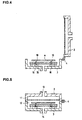
- FIG. 1 is a front view of a laminating apparatus 1 according to an example of the present invention
- FIG. 2 is a plan view of the laminating apparatus 1.
- the laminating apparatus 1 shown in the views has an upper case 2 and a lower case 3. These upper case 2 and lower case 3 are joined together via a hinge part 4 arranged on the rear side thereof, and the upper case 2 is pivoted upward about the hinge part 4 so as to open the laminating apparatus 1.
- an air cylinder or the like to lift the upper case 2 for facilitating opening may be provided.
- a loader conveyor 6 for mounting a solar battery panel a as an object to be laminated before being laminated by the laminating apparatus 1 and an unloader conveyor 7 for mounting a solar battery panel a after being laminated by the laminating apparatus 1 are arranged respectively.
- These loader conveyor 6 and unloader conveyor 7 are both configured to be raised and lowered.
- FIG. 1 shows the loader conveyor 6 in a raised state and the unloader conveyor 7 in a lowered state.
- traversers 30, 31 are arranged respectively for supporting sides of the solar battery panel a when these loader conveyor 6 and under conveyor 7 are lowered.
- the height of top surfaces of these traversers 30, 31 is set to a position lower than top surfaces of the loader conveyor 6 and the unloader conveyor 7 when these are raised, and to a position higher than the top surfaces of the loader conveyor 6 and the unloader conveyor 7 when these are lowered.
- the traverser 30 is configured to reciprocate between a position shown by solid lines 30 and a position shown by chain lines 30' in FIG. 1 and FIG. 2.
- the traverser 31 is configured to reciprocate between a position shown by solid lines 31 and a position shown by chain lines 31' in FIG. 1 and FIG. 2 (the positions shown by the chain lines 30' and the chain lines 31' are the same).
- the traverser 30 moves leftward to carry the solar battery panel a in a position between the upper case 2 and the lower case 3. Further, after receiving the solar battery panel a in the position between the upper case 2 and the lower case 3, the traverser 31 moves leftward to carry the solar battery panel a out to a position for passing the solar battery panel a to the unloader conveyor 7.
- casters 8 are attached to an under surface of the lower case 3, and the casters 8 are rolled to allow movement of the laminating apparatus 1 on a floor surface 9 with a small force.
- FIG. 3 is a view showing an A-A cross section in FIG. 2 of a main part of the laminating apparatus 1 on an enlarged scale.
- a diaphragm 10 is fitted inside the upper case 2.
- This diaphragm 10 is constituted of butyl rubber.
- the composition of the butyl rubber used for the diaphragm 10 includes 100 to 0 parts by weight of halogenated butyl, 0 to 100 parts by weight of regular butyl, 1 to 5 parts by weight of magnesium oxide, 5 to 100 parts by weight of carbon black, 0 to 20 parts by weight of paraffin oil, 1 to 5 parts by weight of zinc oxide, 1 to 20 parts by weight of resin vulcanizing agent, and 0 to 10 parts by weight of processing aid.
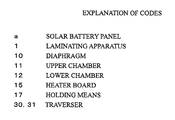
- an upper chamber 11 and a lower chamber 12 which are partitioned into an upper side and a lower side by the diaphragm 10, are formed inside the laminating apparatus 1.
- inlet/outlet ports 13, 14 are provided on a top surface of the upper case 2 and an under surface of the lower case 3.
- the inside of the upper chamber 11 and the inside of the lower chamber 12 can be evacuated via the inlet/outlet ports 13, 14 respectively, and also atmospheric pressure can be introduced into the upper chamber 11 and the lower chamber 12 via the inlet/outlet ports 13, 14 respectively.
- a heater board 15 is provided inside the lower case 3. This heater board 15 is fixed at a certain height by support posts 16 formed to project on a bottom surface of the lower case 3, and the height of a top surface of the heater board 15 is set to a position lower than the height of the top surfaces of the previously described traversers 30, 31.
- the heater board 15 is constituted of, for example, a sheathed heater made of aluminum, and in addition, the heater board 15 may have a water cooling pipe or the like for performing accurate temperature control.
- the holding means 17 are each constituted of a raising/lowering mechanism 18 and a support pin 19.
- a publicly known raising/lowering means for example, an air cylinder, a ball nut, a rack and pinion, or the like, can be appropriately used, and by the operation of the raising/lowering mechanism 18, the support pin 19 can be raised and lowered.
- Through holes 20 are formed in the heater board 15, and the support pins 19 which are raised and lowered by the operation of the raising/lowering mechanisms 18 are arranged to penetrate these through holes 20.
- the support pins 19 are raised by the operation of the raising/lowering mechanisms 18, as shown by chain lines 19' in FIG. 3, upper ends of the support pins 19 project upward and higher than the upper surface of the heater board 15 via the through holes 20. Further, the height of the upper ends of the support pins 19 thus raised is set to a position higher than the height of the upper surfaces of the previously described traversers 30, 31.
- the support pins 19 are lowered by the operation of the raising/lowering mechanisms 18, the upper ends of the support pins 19 are lowered to approximately the same height as the upper surface of the heater board 15, as shown by solid lines 19 in FIG. 3.
- the solar battery panel a as an example of a laminated object produced by the laminating apparatus 1 of the present invention has a structure such that strings are sandwiched with a filler between a reinforcing material and a cover glass.
- a reinforcing material for example, PE resin or the like are used.
- the filler for example, EVA (ethylene-vinyl acetate) resin or the like is used.
- the strings has a structure such that solar battery cells are connected between electrodes via lead wires.
- the operation of the laminating apparatus 1 will be described with the case of producing the solar battery panel a for example.
- the upper case 2 is pivoted upward about the hinge part 4 from the lower case 3 so that the upper chamber 11 is in an open state, and the support pins 19 are in a state being lowered in advance by the operation of the raising/lowering mechanisms 18.
- the loader conveyor 6 is in a raised state, and on the top surface thereof, the solar battery panels a as objects to be laminated are mounted.
- the unloader conveyor 7 is in a lowered state.
- the traversers 30, 31 are in a standby state at positions on the both sides of the loader conveyor 6 and the unloader conveyor 7 respectively.
- the loader conveyor 6 is lowered. Accordingly, the solar battery panels a, which have been mounted on the top surface of the loader conveyor 6 up to this point, are now in a state being supported by the traverser 30. Then, the traverser 30 moves to the position shown by the chain lines 30' in FIG. 1 and FIG. 2 so as to carry the solar battery panels a in the position between the upper case 2 and the lower case 3. Incidentally, after the solar battery panels a are carried in, the loader conveyor 6 is raised again, and onto the top surface thereof, next solar battery panels a will be carried in.
- the support pins 19 are raised by the operation of the raising/lowering mechanisms 18.
- the solar battery panels a are mounted on the upper ends of the support pins 19 projected upward and higher than the top surface of the heater board 15. Note that in this state, as shown in the view, the solar battery panels a are not in contact with the top surface of the heater board 15.
- the traverser 30 which passed the solar battery panels a then moves to return again to the position of both sides of the loader conveyor 6.
- the upper case 2 is pivoted downward about the hinge part 4 so as to cover the lower case 3 to thereby tightly close the laminating apparatus 1.
- the inside of the upper chamber 11 and the inside of the lower chamber 12 are then evacuated simultaneously via the inlet/outlet ports 13, 14.
- the support pins 19 are lowered by the operation of the raising/lowering mechanisms 18, as shown in FIG. 6.
- the solar battery panels a supported by the upper ends of the support pins 19 come in direct contact with the upper surface of the heater board 15, so that the solar battery panels a are heated.
- This heating facilitates chemical reaction of the EVA resin as fillers 23, 24 inside the solar battery panels a under a condition of vacuum state, and thus cross linkage takes place therein.
- the atmospheric pressure is introduced into the upper chamber 11 via the inlet/outlet port 13 to expand the diaphragm 10 downward, thereby sandwiching and pressurizing the solar battery panels a between the upper surface of the heater board 15 and the diaphragm 10.
- the atmospheric pressure is introduced into the lower chamber 12 via the inlet/outlet port 14. Further, the support pins 19 are raised by the operation of the raising/lowering mechanisms 18 to lift the solar battery panels a higher than the upper surface of the heater board 15.
- the upper case 2 is pivoted upward about the hinge part 4 from the lower case 3, so that the laminating apparatus 1 becomes an open state. Incidentally, lifting of this upper case 2 can be performed with a not-shown air cylinder or the like.
- the traverser 31 moves to the position shown by the chain lines 31' in FIG. 1 and FIG. 2 and enters the space under the solar battery panels a, which are lifted by the support pins 19. Thereafter, the support pins 19 are lowered by the operation of the raising/lowering mechanisms 18. Accordingly, the solar battery panels a supported by the upper ends of the support pins 19 are now in a state being supported by the traverser 31.
- the traverser 31 moves to return again to the position of both sides of the unloader conveyor 7 so as to remove the solar battery panels a from the position between the upper case 2 and the lower case 3. Thereafter, the unloader conveyor 7 is raised to receive the solar battery panels a on its upper surface, and appropriately carries them out. After the carrying out is completed, the unloader conveyor 7 is lowered again.
- the diaphragm 10 is constituted of butyl rubber, so that the lifetime of the diaphragm 10 becomes longer as compared with the case of using a diaphragm constituted of silicon resin, thereby reducing the labor of replacement. Further, laminated objects can be provided at a low cost.
- peroxide is generated from the EVA as a filler during lamination, but the butyl rubber barely react with the peroxide and hardly deteriorates.
- the silicon resin reacts with the peroxide and hardens, and is easy to break.
- the laminating apparatus of the present invention can perform laminating processes on various other objects.
- the laminating apparatus of the present invention can correspond to variation of thickness of an object to be laminated, and also can be used for producing integrated modules or the like, in which an outer wall material or a roofing material as a building material and a solar battery panel are integrated, which are gaining attention recently.
- the laminating apparatus of the present invention is not limited to the solar battery panel, which can be used for producing shatterproof glasses, ornament glasses, plywood, and the like.
- the composition of butyl rubber constituting the diaphragm includes 100 to 0 parts by weight of halogenated butyl, 0 to 100 parts by weight of regular butyl, 1 to 5 parts by weight of magnesium oxide, 5 to 100 parts by weight of carbon black, 0 to 20 parts by weight of paraffin oil, 1 to 5 parts by weight of zinc oxide, 1 to 20 parts by weight of resin vulcanizing agent, and 0 to 10 parts by weight of processing aid.
- the diaphragm constituted of this butyl rubber was obtained at approximately the same price as a conventionally used diaphragm constituted of silicon resin.
- the diaphragm constituted of butyl rubber did not harden even after repeating the lamination and became hard to break, and the diaphragm constituted of this butyl rubber endured approximately 6000 times of laminating processes and was capable of performing 300 times of laminating processes in a day for 20 days or more. As compared with the case of using the conventional diaphragm constituted of silicon resin, lifetime thereof became double or longer.
- a laminating apparatus having a diaphragm with a long lifetime can be provided. Further, laminated objects can be produced at a low cost.
Landscapes
- Physics & Mathematics (AREA)
- Fluid Mechanics (AREA)
- Engineering & Computer Science (AREA)
- Mechanical Engineering (AREA)
- Photovoltaic Devices (AREA)
- Lining Or Joining Of Plastics Or The Like (AREA)
- Press Drives And Press Lines (AREA)
Abstract
A laminating apparatus for laminating an object to be laminated
includes an upper chamber and a lower chamber which are partitioned by a
diaphragm, a heater board provided in the lower chamber, and a diaphragm
capable of freely expanding for pressurizing the object to be laminated
mounted on the heater board, in which the diaphragm is constituted of butyl
rubber. The composition of the butyl rubber includes, for example, 100 to 0
parts by weight of halogenated butyl, 0 to 100 parts by weight of regular
butyl, 1 to 5 parts by weight of magnesium oxide, 5 to 100 parts by weight of
carbon black, 0 to 20 parts by weight of paraffin oil, 1 to 5 parts by weight of
zinc oxide, 1 to 20 parts by weight of resin vulcanizing agent, and 0 to 10
parts by weight of processing aid. According to the present invention, the
lifetime of the diaphragm is extended, and laminated objects can be produced
at a low cost.
Description
The present invention relates to a laminating apparatus for producing
a laminated object such as a solar battery panel.
Conventionally, as a laminating apparatus for producing a solar
battery panel, a laminating apparatus of so-called double vacuum system is
publicly known, which has an upper chamber and a lower chamber
partitioned by a diaphragm. Regarding such a laminating apparatus of double
vacuum system, there are disclosed Japanese Patent Publication No. Hei 4-65556
"Solar Battery Module Laminating Apparatus" and Japanese Patent
Publication No. Hei 6-52801 "Method of Producing Solar Battery Panel."
In this laminating apparatus of double vacuum system, a diaphragm is
pressurized downward in a state that an object to be laminated mounted on a
heater board is heated, thereby pressurizing the object to be laminated from
top and bottom between the heater board and the diaphragm. In a
conventional laminating apparatus, a silicon resin film is generally used as
the diaphragm for pressurizing the object to be laminated.
However, the diaphragm constituted of conventional silicon resin film
has a problem of having low heat resistance property and poor elastic
performance. For example, when laminating a solar battery panel, the
diaphragm is heated to a temperature of approximately 180°C, but in such a
case, the diaphragm constituted of silicon resin would get damaged after
performing about 3000 times of laminating processes. For example, when
performing about 300 times of laminating processes in a day, the diaphragm
constituted of silicon resin has a lifetime of only about ten days.
Further, the diaphragm constituted of silicon resin is expensive, and
thus frequent replacement of which causes a cost related problem.
Therefore, an object of the present invention is to obtain a laminating
apparatus having a diaphragm with a long lifetime.
In order to achieve this object, the present invention provides a
laminating apparatus for laminating an object to be laminated, which includes
an upper chamber and a lower chamber which are partitioned by a diaphragm,
a heater board provided in the lower chamber, and a diaphragm capable of
freely expanding for pressurizing the object to be laminated mounted on the
heater board, in which the diaphragm is constituted of butyl rubber.
Preferably, the composition of the butyl rubber includes 100 to 0 parts
by weight of halogenated butyl, 0 to 100 parts by weight of regular butyl, 1 to
5 parts by weight of magnesium oxide, 5 to 100 parts by weight of carbon
black, 0 to 20 parts by weight of paraffin oil, 1 to 5 parts by weight of zinc
oxide, 1 to 20 parts by weight of resin vulcanizing agent, and 0 to 10 parts by
weight of processing aid.
There may be included a holding means for holding the object to be
laminated mounted on the heater board in a state that the object to be
laminated is separated upward from an upper surface of the heater board
while the object to be laminated is carried in.
The holding means may be configured to hold the object to be
laminated in a state that the object to be laminated is separated upward from
the upper surface of the heater board also while the object to be laminated is
carried out.
The object to be laminated is a solar battery panel for example.
Hereinafter, a preferred embodiment of the present invention will be
described based on the drawings. FIG. 1 is a front view of a laminating
apparatus 1 according to an example of the present invention, and FIG. 2 is a
plan view of the laminating apparatus 1. The laminating apparatus 1 shown
in the views has an upper case 2 and a lower case 3. These upper case 2 and
lower case 3 are joined together via a hinge part 4 arranged on the rear side
thereof, and the upper case 2 is pivoted upward about the hinge part 4 so as to
open the laminating apparatus 1. Although not being shown, an air cylinder
or the like to lift the upper case 2 for facilitating opening may be provided.
On the left and right sides of the lower case 3, a loader conveyor 6 for
mounting a solar battery panel a as an object to be laminated before being
laminated by the laminating apparatus 1 and an unloader conveyor 7 for
mounting a solar battery panel a after being laminated by the laminating
apparatus 1 are arranged respectively. These loader conveyor 6 and unloader
conveyor 7 are both configured to be raised and lowered. FIG. 1 shows the
loader conveyor 6 in a raised state and the unloader conveyor 7 in a lowered
state.
Further, on the both sides of the loader conveyor 6 and the unloader
conveyor 7, traversers 30, 31 are arranged respectively for supporting sides of
the solar battery panel a when these loader conveyor 6 and under conveyor 7
are lowered. The height of top surfaces of these traversers 30, 31 is set to a
position lower than top surfaces of the loader conveyor 6 and the unloader
conveyor 7 when these are raised, and to a position higher than the top
surfaces of the loader conveyor 6 and the unloader conveyor 7 when these are
lowered. The traverser 30 is configured to reciprocate between a position
shown by solid lines 30 and a position shown by chain lines 30' in FIG. 1 and
FIG. 2. Similarly, the traverser 31 is configured to reciprocate between a
position shown by solid lines 31 and a position shown by chain lines 31' in
FIG. 1 and FIG. 2 (the positions shown by the chain lines 30' and the chain
lines 31' are the same).
As will be described later, when the loader conveyor 6 is lowered so
that the solar battery panel a is passed to the traverser 30, the traverser 30
moves leftward to carry the solar battery panel a in a position between the
upper case 2 and the lower case 3. Further, after receiving the solar battery
panel a in the position between the upper case 2 and the lower case 3, the
traverser 31 moves leftward to carry the solar battery panel a out to a position
for passing the solar battery panel a to the unloader conveyor 7.
Further, casters 8 are attached to an under surface of the lower case 3,
and the casters 8 are rolled to allow movement of the laminating apparatus 1
on a floor surface 9 with a small force.
FIG. 3 is a view showing an A-A cross section in FIG. 2 of a main
part of the laminating apparatus 1 on an enlarged scale. As shown in FIG. 3,
a diaphragm 10 is fitted inside the upper case 2. This diaphragm 10 is
constituted of butyl rubber. The composition of the butyl rubber used for the
diaphragm 10 includes 100 to 0 parts by weight of halogenated butyl, 0 to
100 parts by weight of regular butyl, 1 to 5 parts by weight of magnesium
oxide, 5 to 100 parts by weight of carbon black, 0 to 20 parts by weight of
paraffin oil, 1 to 5 parts by weight of zinc oxide, 1 to 20 parts by weight of
resin vulcanizing agent, and 0 to 10 parts by weight of processing aid.
As shown by chain lines 2' in FIG. 3, in a state that the upper case 2 is
pivoted downward about the hinge part 4 so that the upper case 2 and the
lower case 3 are closed, an upper chamber 11 and a lower chamber 12, which
are partitioned into an upper side and a lower side by the diaphragm 10, are
formed inside the laminating apparatus 1. On a top surface of the upper case
2 and an under surface of the lower case 3, inlet/ outlet ports 13, 14 are
provided. In a state that the upper case 2 and the lower case 3 are closed as
shown by the chain lines 2' in FIG. 3, the inside of the upper chamber 11 and
the inside of the lower chamber 12 can be evacuated via the inlet/ outlet ports
13, 14 respectively, and also atmospheric pressure can be introduced into the
upper chamber 11 and the lower chamber 12 via the inlet/ outlet ports 13, 14
respectively.
A heater board 15 is provided inside the lower case 3. This heater
board 15 is fixed at a certain height by support posts 16 formed to project on
a bottom surface of the lower case 3, and the height of a top surface of the
heater board 15 is set to a position lower than the height of the top surfaces of
the previously described traversers 30, 31. The heater board 15 is constituted
of, for example, a sheathed heater made of aluminum, and in addition, the
heater board 15 may have a water cooling pipe or the like for performing
accurate temperature control.
Further, on the bottom surface of the lower case 3, there are arranged
holding means 17 capable of holding the solar battery panel a in a state that
the solar battery panel a is raised upward from the surface of the heater board
15. In this embodiment, the holding means 17 are each constituted of a
raising/lowering mechanism 18 and a support pin 19. As the raising/lowering
mechanism 18, a publicly known raising/lowering means, for example, an air
cylinder, a ball nut, a rack and pinion, or the like, can be appropriately used,
and by the operation of the raising/lowering mechanism 18, the support pin
19 can be raised and lowered.
Through holes 20 are formed in the heater board 15, and the support
pins 19 which are raised and lowered by the operation of the raising/lowering
mechanisms 18 are arranged to penetrate these through holes 20. When the
support pins 19 are raised by the operation of the raising/lowering
mechanisms 18, as shown by chain lines 19' in FIG. 3, upper ends of the
support pins 19 project upward and higher than the upper surface of the
heater board 15 via the through holes 20. Further, the height of the upper
ends of the support pins 19 thus raised is set to a position higher than the
height of the upper surfaces of the previously described traversers 30, 31. On
the other hand, when the support pins 19 are lowered by the operation of the
raising/lowering mechanisms 18, the upper ends of the support pins 19 are
lowered to approximately the same height as the upper surface of the heater
board 15, as shown by solid lines 19 in FIG. 3.
The solar battery panel a as an example of a laminated object
produced by the laminating apparatus 1 of the present invention has a
structure such that strings are sandwiched with a filler between a reinforcing
material and a cover glass. As the reinforcing material, for example, PE resin
or the like are used. As the filler, for example, EVA (ethylene-vinyl acetate)
resin or the like is used. The strings has a structure such that solar battery
cells are connected between electrodes via lead wires.
Next, the operation of the laminating apparatus 1 according to the
embodiment of the present invention will be described with the case of
producing the solar battery panel a for example. When inserting the solar
battery panel a into the laminating apparatus 1, as shown in FIG. 1 and FIG. 2,
the upper case 2 is pivoted upward about the hinge part 4 from the lower case
3 so that the upper chamber 11 is in an open state, and the support pins 19 are
in a state being lowered in advance by the operation of the raising/lowering
mechanisms 18. Further, as shown in FIG. 1 and FIG. 2, the loader conveyor
6 is in a raised state, and on the top surface thereof, the solar battery panels a
as objects to be laminated are mounted. The unloader conveyor 7 is in a
lowered state. Further, the traversers 30, 31 are in a standby state at positions
on the both sides of the loader conveyor 6 and the unloader conveyor 7
respectively.
In such a state, first, the loader conveyor 6 is lowered. Accordingly,
the solar battery panels a, which have been mounted on the top surface of the
loader conveyor 6 up to this point, are now in a state being supported by the
traverser 30. Then, the traverser 30 moves to the position shown by the chain
lines 30' in FIG. 1 and FIG. 2 so as to carry the solar battery panels a in the
position between the upper case 2 and the lower case 3. Incidentally, after
the solar battery panels a are carried in, the loader conveyor 6 is raised again,
and onto the top surface thereof, next solar battery panels a will be carried in.
Next, the support pins 19 are raised by the operation of the
raising/lowering mechanisms 18. Thus, as shown in FIG. 4, the solar battery
panels a are mounted on the upper ends of the support pins 19 projected
upward and higher than the top surface of the heater board 15. Note that in
this state, as shown in the view, the solar battery panels a are not in contact
with the top surface of the heater board 15. The traverser 30 which passed
the solar battery panels a then moves to return again to the position of both
sides of the loader conveyor 6.
Next, as shown in FIG. 5, the upper case 2 is pivoted downward about
the hinge part 4 so as to cover the lower case 3 to thereby tightly close the
laminating apparatus 1. The inside of the upper chamber 11 and the inside of
the lower chamber 12 are then evacuated simultaneously via the inlet/ outlet
ports 13, 14.
Subsequently, after the inside of the upper chamber 11 and the inside
of the lower the chamber 12 are evacuated to, for example, 0.7 to 1.0 Torr,
the support pins 19 are lowered by the operation of the raising/lowering
mechanisms 18, as shown in FIG. 6. Thus, the solar battery panels a
supported by the upper ends of the support pins 19 come in direct contact
with the upper surface of the heater board 15, so that the solar battery panels
a are heated. This heating facilitates chemical reaction of the EVA resin as
fillers 23, 24 inside the solar battery panels a under a condition of vacuum
state, and thus cross linkage takes place therein. Then, in this state, the
atmospheric pressure is introduced into the upper chamber 11 via the
inlet/outlet port 13 to expand the diaphragm 10 downward, thereby
sandwiching and pressurizing the solar battery panels a between the upper
surface of the heater board 15 and the diaphragm 10.
In this manner, after the laminating process by means of heating and
pressurizing is completed and the solar battery panels a are produced, the
atmospheric pressure is introduced into the lower chamber 12 via the
inlet/outlet port 14. Further, the support pins 19 are raised by the operation
of the raising/lowering mechanisms 18 to lift the solar battery panels a higher
than the upper surface of the heater board 15. Thereafter, as shown in FIG. 7,
the upper case 2 is pivoted upward about the hinge part 4 from the lower case
3, so that the laminating apparatus 1 becomes an open state. Incidentally,
lifting of this upper case 2 can be performed with a not-shown air cylinder or
the like.
Next, the traverser 31 moves to the position shown by the chain lines
31' in FIG. 1 and FIG. 2 and enters the space under the solar battery panels a,
which are lifted by the support pins 19. Thereafter, the support pins 19 are
lowered by the operation of the raising/lowering mechanisms 18.
Accordingly, the solar battery panels a supported by the upper ends of the
support pins 19 are now in a state being supported by the traverser 31.
Next, the traverser 31 moves to return again to the position of both
sides of the unloader conveyor 7 so as to remove the solar battery panels a
from the position between the upper case 2 and the lower case 3. Thereafter,
the unloader conveyor 7 is raised to receive the solar battery panels a on its
upper surface, and appropriately carries them out. After the carrying out is
completed, the unloader conveyor 7 is lowered again.
By repeating the above steps, it becomes possibly to continuously
obtain the solar battery panels a in good condition, which have no bubbles
inside. According to this laminating apparatus 1, the diaphragm 10 is
constituted of butyl rubber, so that the lifetime of the diaphragm 10 becomes
longer as compared with the case of using a diaphragm constituted of silicon
resin, thereby reducing the labor of replacement. Further, laminated objects
can be provided at a low cost. Especially, when producing the solar battery
panel a, peroxide is generated from the EVA as a filler during lamination, but
the butyl rubber barely react with the peroxide and hardly deteriorates. On
the contrary, the silicon resin reacts with the peroxide and hardens, and is
easy to break.
In the foregoing, an example of the preferred embodiment of the
present invention has been shown, but the present invention is not limited to
the embodiment that is described here. For example, in the above
embodiment, description has been given with respect to the solar battery
panel a as an example of an object to be laminated, but the laminating
apparatus of the present invention can perform laminating processes on
various other objects. Especially, the laminating apparatus of the present
invention can correspond to variation of thickness of an object to be
laminated, and also can be used for producing integrated modules or the like,
in which an outer wall material or a roofing material as a building material
and a solar battery panel are integrated, which are gaining attention recently.
Furthermore, the laminating apparatus of the present invention is not limited
to the solar battery panel, which can be used for producing shatterproof
glasses, ornament glasses, plywood, and the like.
Hereinafter, an example of the present invention will be described.
Solar battery panels were laminated using the laminating apparatus
described in FIG. 1 to FIG. 7. The composition of butyl rubber constituting
the diaphragm includes 100 to 0 parts by weight of halogenated butyl, 0 to
100 parts by weight of regular butyl, 1 to 5 parts by weight of magnesium
oxide, 5 to 100 parts by weight of carbon black, 0 to 20 parts by weight of
paraffin oil, 1 to 5 parts by weight of zinc oxide, 1 to 20 parts by weight of
resin vulcanizing agent, and 0 to 10 parts by weight of processing aid. The
diaphragm constituted of this butyl rubber was obtained at approximately the
same price as a conventionally used diaphragm constituted of silicon resin.
The diaphragm constituted of butyl rubber did not harden even after
repeating the lamination and became hard to break, and the diaphragm
constituted of this butyl rubber endured approximately 6000 times of
laminating processes and was capable of performing 300 times of laminating
processes in a day for 20 days or more. As compared with the case of using
the conventional diaphragm constituted of silicon resin, lifetime thereof
became double or longer.
According to the present invention, a laminating apparatus having a
diaphragm with a long lifetime can be provided. Further, laminated objects
can be produced at a low cost.
Claims (5)
- A laminating apparatus for laminating an object to be laminated, comprising:wherein said diaphragm is constituted of butyl rubber.an upper chamber and a lower chamber which are partitioned by a diaphragm;a heater board provided in said lower chamber; anda diaphragm capable of freely expanding for pressurizing the object to be laminated mounted on said heater board,
- The laminating apparatus according to claim 1,
wherein the composition of said butyl rubber comprises 100 to 0 parts by weight of halogenated butyl, 0 to 100 parts by weight of regular butyl, 1 to 5 parts by weight of magnesium oxide, 5 to 100 parts by weight of carbon black, 0 to 20 parts by weight of paraffin oil, 1 to 5 parts by weight of zinc oxide, 1 to 20 parts by weight of resin vulcanizing agent, and 0 to 10 parts by weight of processing aid. - The laminating apparatus according to claim 1, further comprising:a holding means for holding the object to be laminated mounted on said heater board in a state that the object to be laminated is separated upward from an upper surface of said heater board while the object to be laminated is carried in.
- The laminating apparatus according to claim 3,
wherein said holding means is configured to hold the object to be laminated in a state that the object to be laminated is separated upward from the upper surface of said heater board also while the object to be laminated is carried out. - The laminating apparatus according to claim 1,
wherein the object to be laminated is a solar battery panel.
Applications Claiming Priority (1)
| Application Number | Priority Date | Filing Date | Title |
|---|---|---|---|
| PCT/JP2002/010287 WO2004030900A1 (en) | 2002-10-02 | 2002-10-02 | Laminating system |
Publications (2)
| Publication Number | Publication Date |
|---|---|
| EP1550548A1 true EP1550548A1 (en) | 2005-07-06 |
| EP1550548A4 EP1550548A4 (en) | 2008-02-20 |
Family
ID=32051288
Family Applications (1)
| Application Number | Title | Priority Date | Filing Date |
|---|---|---|---|
| EP02807899A Withdrawn EP1550548A4 (en) | 2002-10-02 | 2002-10-02 | lamination system |
Country Status (5)
| Country | Link |
|---|---|
| US (1) | US20060289119A1 (en) |
| EP (1) | EP1550548A4 (en) |
| JP (1) | JP4308769B2 (en) |
| AU (1) | AU2002335176A1 (en) |
| WO (1) | WO2004030900A1 (en) |
Cited By (7)
| Publication number | Priority date | Publication date | Assignee | Title |
|---|---|---|---|---|
| EP1890339A1 (en) * | 2006-08-18 | 2008-02-20 | NPC Incorporated | Laminating apparatus |
| EP1920922A2 (en) | 2006-11-07 | 2008-05-14 | NPC Incorporated | Laminating apparatus |
| EP2065177A1 (en) | 2007-11-30 | 2009-06-03 | komax Holding AG | Hotplate with lifting element |
| EP2189283A1 (en) | 2008-11-21 | 2010-05-26 | komax Holding AG | Apparatus for laminating a solar cell modul |
| US8028735B2 (en) * | 2006-11-16 | 2011-10-04 | Npc Incorporated | Laminating apparatus |
| DE102010061294A1 (en) * | 2010-12-16 | 2012-06-21 | Bayerische Motoren Werke Aktiengesellschaft | Laminator e.g. multi-opening laminator for manufacturing solar cell, has laminate layer stack made of five layers, that is provided on thermally conductive insert in lower chamber |
| CN110341233A (en) * | 2019-07-23 | 2019-10-18 | 江西振态科技协同创新有限公司 | Prevent the method and device of heat-conducting oil pipes inner wall generation carbon distribution in hot press |
Families Citing this family (10)
| Publication number | Priority date | Publication date | Assignee | Title |
|---|---|---|---|---|
| US7768619B2 (en) * | 2004-08-03 | 2010-08-03 | Harris Corporation | Method and apparatus for sealing flex circuits made with an LCP substrate |
| KR101546099B1 (en) * | 2009-10-07 | 2015-08-20 | 엘지전자 주식회사 | Laminating unit and laminating apparatus including the same |
| JP5129866B2 (en) * | 2010-02-25 | 2013-01-30 | 日清紡ホールディングス株式会社 | Diaphragm sheet |
| JP5554667B2 (en) * | 2010-09-13 | 2014-07-23 | クレハエラストマー株式会社 | Diaphragm for manufacturing solar cell module, method for evaluating the same, and method for manufacturing solar cell module |
| EP2724841B1 (en) * | 2011-06-22 | 2017-11-01 | Kureha Elastomer Co., Ltd. | Diaphragm for producing solar cell module and method for producing solar cell module |
| US8865505B2 (en) | 2011-07-04 | 2014-10-21 | Nisshinbo Mechatronics Inc. | Diaphragm sheet, method for manufacturing solar cell module using diaphragm sheet, and lamination method using laminator for solar cell module manufacture |
| US20140083609A1 (en) * | 2012-09-27 | 2014-03-27 | General Electric Company | Method and apparatus for evacuation of large composite structures |
| CZ2013220A3 (en) * | 2013-03-26 | 2014-07-23 | Univerzita Tomáše Bati ve Zlíně | Pressure membrane for vacuum molding of polymer composite parts |
| JP6201913B2 (en) * | 2014-06-27 | 2017-09-27 | 新東工業株式会社 | Heating panel, heating device and heating method |
| KR102243574B1 (en) * | 2020-07-03 | 2021-04-22 | 주식회사 가이아에너지 | Low Energy-consuming Laminating Apparatus |
Family Cites Families (13)
| Publication number | Priority date | Publication date | Assignee | Title |
|---|---|---|---|---|
| US24856A (en) * | 1859-07-26 | Machine for stoning- cherries | ||
| DE2026258A1 (en) * | 1970-05-29 | 1971-12-09 | Kalle Ag | Method and device for the manufacture of a format flat structure |
| US3857775A (en) * | 1972-05-09 | 1974-12-31 | Goodyear Tire & Rubber | Electrolytic cell including a flexible sheet covering the cell base |
| CA993597A (en) | 1972-10-23 | 1976-07-20 | Eric G. Kent | Vulcanization of bromobutyl |
| CA1217122A (en) | 1983-06-01 | 1987-01-27 | John Timar | Pneumatic tire inner liner having puncture sealing characteristics |
| JP2803144B2 (en) * | 1989-04-13 | 1998-09-24 | エヌオーケー株式会社 | PVA-based laminate film |
| US4943609A (en) * | 1989-04-17 | 1990-07-24 | The Uniroyal Goodrich Tire Company | Curable rubber bladder stocks having reduced viscosity |
| JP3038818B2 (en) | 1990-06-28 | 2000-05-08 | 株式会社豊田自動織機製作所 | Weft detection device in loom |
| JP2919185B2 (en) | 1992-07-28 | 1999-07-12 | 鹿児島日本電気株式会社 | High frequency heating device for fluorescent display tubes |
| JPH09141743A (en) * | 1995-11-24 | 1997-06-03 | N P C:Kk | Laminating equipment |
| JP3655076B2 (en) * | 1998-01-07 | 2005-06-02 | 株式会社エヌ・ピー・シー | Laminating equipment |
| JP2001353600A (en) * | 2000-06-12 | 2001-12-25 | Inoac Corp | Pressure forming device |
| WO2002004112A2 (en) * | 2000-07-07 | 2002-01-17 | Symyx Technologies, Inc. | Methods for analysis of heterogeneous catalysts in a multi-variable screening reactor |
-
2002
- 2002-10-02 AU AU2002335176A patent/AU2002335176A1/en not_active Abandoned
- 2002-10-02 JP JP2004541185A patent/JP4308769B2/en not_active Expired - Fee Related
- 2002-10-02 US US10/529,916 patent/US20060289119A1/en not_active Abandoned
- 2002-10-02 WO PCT/JP2002/010287 patent/WO2004030900A1/en not_active Ceased
- 2002-10-02 EP EP02807899A patent/EP1550548A4/en not_active Withdrawn
Cited By (13)
| Publication number | Priority date | Publication date | Assignee | Title |
|---|---|---|---|---|
| EP1890339A1 (en) * | 2006-08-18 | 2008-02-20 | NPC Incorporated | Laminating apparatus |
| EP1920922A2 (en) | 2006-11-07 | 2008-05-14 | NPC Incorporated | Laminating apparatus |
| EP1920922A3 (en) * | 2006-11-07 | 2008-06-25 | NPC Incorporated | Laminating apparatus |
| US7699085B2 (en) | 2006-11-07 | 2010-04-20 | Npc Incorporated | Laminating apparatus |
| CN101179101B (en) * | 2006-11-07 | 2011-04-06 | 株式会社Npc | Laminating apparatus |
| US8028735B2 (en) * | 2006-11-16 | 2011-10-04 | Npc Incorporated | Laminating apparatus |
| EP2065177A1 (en) | 2007-11-30 | 2009-06-03 | komax Holding AG | Hotplate with lifting element |
| US8454357B2 (en) | 2007-11-30 | 2013-06-04 | Komax Holding Ag | Hotplate with lifting elements |
| EP2189284A2 (en) | 2008-11-21 | 2010-05-26 | komax Holding AG | Device for laminating a solar module |
| US8191599B2 (en) | 2008-11-21 | 2012-06-05 | Komax Holding Ag | Apparatus for laminating a solar module |
| EP2189283A1 (en) | 2008-11-21 | 2010-05-26 | komax Holding AG | Apparatus for laminating a solar cell modul |
| DE102010061294A1 (en) * | 2010-12-16 | 2012-06-21 | Bayerische Motoren Werke Aktiengesellschaft | Laminator e.g. multi-opening laminator for manufacturing solar cell, has laminate layer stack made of five layers, that is provided on thermally conductive insert in lower chamber |
| CN110341233A (en) * | 2019-07-23 | 2019-10-18 | 江西振态科技协同创新有限公司 | Prevent the method and device of heat-conducting oil pipes inner wall generation carbon distribution in hot press |
Also Published As
| Publication number | Publication date |
|---|---|
| JP4308769B2 (en) | 2009-08-05 |
| JPWO2004030900A1 (en) | 2006-02-02 |
| WO2004030900A1 (en) | 2004-04-15 |
| AU2002335176A1 (en) | 2004-04-23 |
| US20060289119A1 (en) | 2006-12-28 |
| AU2002335176A8 (en) | 2004-04-23 |
| EP1550548A4 (en) | 2008-02-20 |
Similar Documents
| Publication | Publication Date | Title |
|---|---|---|
| EP1550548A1 (en) | Laminating system | |
| US8028735B2 (en) | Laminating apparatus | |
| US6149757A (en) | Laminating apparatus | |
| JP5438121B2 (en) | Cure processing device and laminating system | |
| EP1920922B1 (en) | Laminating apparatus | |
| JP3759257B2 (en) | Lamination method | |
| JP2008296583A (en) | Plate-like workpiece laminating method and plate-like workpiece laminating apparatus | |
| WO2013005742A1 (en) | Diaphragm sheet, method for manufacturing solar cell module using diaphragm sheet, lamination method using lamination apparatus for solar cell module production | |
| TW201345725A (en) | Lamination method and laminating device | |
| JP3655076B2 (en) | Laminating equipment | |
| KR20120093254A (en) | Vacuum element and method for producing the same | |
| JP2005209883A (en) | Laminating equipment | |
| JP3037201U (en) | Laminating equipment | |
| WO2011136132A1 (en) | Hot plate for laminating device and laminating device using the hot plate | |
| JP5118082B2 (en) | Laminating equipment | |
| CN111712386B (en) | Laminating device and method for laminating at least one laminated structure | |
| JP2015100941A (en) | Fitting jig of diaphragm for laminating apparatus, and fitting method of diaphragm | |
| JP3017231U (en) | Laminating machine | |
| JP2010094889A (en) | Laminating device | |
| JPH11227145A (en) | Laminating equipment | |
| JP2001230438A (en) | Laminating method and laminating device | |
| JP2014136355A (en) | Laminate device and laminate method | |
| CN117691001A (en) | Photovoltaic module laminator and photovoltaic module lamination method | |
| JP2003318427A (en) | Photovoltaic module laminating method and apparatus | |
| JP2014008691A (en) | Laminating device and laminating method |
Legal Events
| Date | Code | Title | Description |
|---|---|---|---|
| PUAI | Public reference made under article 153(3) epc to a published international application that has entered the european phase |
Free format text: ORIGINAL CODE: 0009012 |
|
| 17P | Request for examination filed |
Effective date: 20050429 |
|
| AK | Designated contracting states |
Kind code of ref document: A1 Designated state(s): AT BE BG CH CY CZ DE DK EE ES FI FR GB GR IE IT LI LU MC NL PT SE SK TR |
|
| AX | Request for extension of the european patent |
Extension state: AL LT LV MK RO SI |
|
| DAX | Request for extension of the european patent (deleted) | ||
| A4 | Supplementary search report drawn up and despatched |
Effective date: 20080121 |
|
| 17Q | First examination report despatched |
Effective date: 20080619 |
|
| STAA | Information on the status of an ep patent application or granted ep patent |
Free format text: STATUS: THE APPLICATION IS DEEMED TO BE WITHDRAWN |
|
| 18D | Application deemed to be withdrawn |
Effective date: 20110519 |