EP1551100A2 - Dämpfungseinheit mit einer Vorrichtung zum Steuern des Dämpfungsfaktors - Google Patents
Dämpfungseinheit mit einer Vorrichtung zum Steuern des Dämpfungsfaktors Download PDFInfo
- Publication number
- EP1551100A2 EP1551100A2 EP04368077A EP04368077A EP1551100A2 EP 1551100 A2 EP1551100 A2 EP 1551100A2 EP 04368077 A EP04368077 A EP 04368077A EP 04368077 A EP04368077 A EP 04368077A EP 1551100 A2 EP1551100 A2 EP 1551100A2
- Authority
- EP
- European Patent Office
- Prior art keywords
- amplifier
- electrode
- source
- output
- current
- Prior art date
- Legal status (The legal status is an assumption and is not a legal conclusion. Google has not performed a legal analysis and makes no representation as to the accuracy of the status listed.)
- Granted
Links
- XUIMIQQOPSSXEZ-UHFFFAOYSA-N Silicon Chemical compound [Si] XUIMIQQOPSSXEZ-UHFFFAOYSA-N 0.000 description 5
- 238000004519 manufacturing process Methods 0.000 description 5
- 229910052710 silicon Inorganic materials 0.000 description 3
- 239000010703 silicon Substances 0.000 description 3
- 238000006243 chemical reaction Methods 0.000 description 2
- 239000006185 dispersion Substances 0.000 description 2
- 235000021183 entrée Nutrition 0.000 description 2
- 230000000116 mitigating effect Effects 0.000 description 2
- 230000010287 polarization Effects 0.000 description 2
- 101100114661 Mus musculus Cep250 gene Proteins 0.000 description 1
- 239000003990 capacitor Substances 0.000 description 1
- 230000007850 degeneration Effects 0.000 description 1
- 238000005516 engineering process Methods 0.000 description 1
- 230000001939 inductive effect Effects 0.000 description 1
- 238000000034 method Methods 0.000 description 1
- 230000003071 parasitic effect Effects 0.000 description 1
Images


Classifications
-
- H—ELECTRICITY
- H03—ELECTRONIC CIRCUITRY
- H03G—CONTROL OF AMPLIFICATION
- H03G1/00—Details of arrangements for controlling amplification
- H03G1/04—Modifications of control circuit to reduce distortion caused by control
-
- H—ELECTRICITY
- H03—ELECTRONIC CIRCUITRY
- H03G—CONTROL OF AMPLIFICATION
- H03G7/00—Volume compression or expansion in amplifiers
- H03G7/06—Volume compression or expansion in amplifiers having semiconductor devices
Definitions
- the present invention relates to analog circuits for the processing of signal and in particular a attenuation cell having a control device the attenuation factor, linear in dB according to a command value, voltage or current.
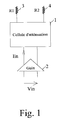
- the attenuation cell is frequently used in analog signal processing circuits. When associated with an amplifier, it makes it possible to achieve a variable gain as illustrated in FIG. 1, in which a cell 1 combined with an amplifier 2 - of transconductance type - which receives an input signal is seen differential V in . By varying the current flowing in the load, composed of two resistors 3 and 4, the gain of the entire circuit is controlled.
- WCDMA Wideband Code Division Multiple Access
- CDMA Code Division Multiple Access
- the known attenuation control cells are limited as regards the accuracy of the attenuation factor, which further depends on greatly from the operating temperature. It would be desirable to be able have an attenuation control cell for high precision and this for a wide temperature range, greater than 100 degrees Celsius.
- the present invention relates to an attenuation control circuit allowing the precise control of a gain, expressed in decibel, from a setpoint - current or input voltage.
- the attenuation cell which comprises a first differential pair fed by a first current source as well a second differential pair powered by a second current source.
- the input of the cell consists, on the one hand, of transmitters connected in a of the first pair and, on the other hand, transmitters connected in a common second differential pair.
- a gain control device applies a VA - VB potential between the bases of the two differential pairs and has a set of three diodes in which a current IA, IB and the sum IA + IB are respectively traversed of the two previous currents.
- the two diodes traversed by a current IB and IA + IB generate a potential, respectively VB and VC and the difference between these two potentials is used to generate a quantity lz used in a loop servo.
- a setpoint Vct is transformed into information lx, then into an information ly proportional to the absolute temperature T, and an amplifier of error uses the information ly - lz and generates the currents IA and IB while minimizing this difference.
- all the information lx ly and lz are currents differentials and said error amplifier is a current amplifier.
- These followers of Voltage are essential to ensure insensitivity to the manufacturing process current gain of the transistors, and to achieve high levels of attenuation.
- Figure 1 illustrates the typical scheme of a mitigation cell associated with an amplifier circuit for achieving a variable gain.
- Figure 2 illustrates the basic architecture of a mitigation cell to which the gain control device according to the invention will be applied.
- FIG. 3 illustrates the preferred embodiment of the control device gain according to the invention.
- FIG. 4 illustrates the preferred embodiment of the converter circuit 30 of the gain control device according to the invention.
- Figure 5 illustrates the preferred embodiment of the analog multiplier 40 of the gain control device according to the invention.
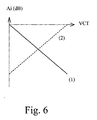
- Figure 6 illustrates the linear characteristic obtained with the control of gain of the attenuation cell.
- FIG. 2 illustrates the basic architecture of an attenuation cell to which the gain control according to the invention will be applied.
- This cell consists of two differential pairs of bipolar transistors.
- the first pair comprises a first transistor Q1 21 and a second transistor Q2 22, while the second pair consists of a third transistor Q3 23 and a fourth transistor Q4.
- the common emitter electrode of each pair of transistors Q1-Q2 and Q3-Q4 is biased by a bias current I 0 supplied by a current source, respectively 28 and 29.
- the bases of the transistors Q1 and Q4 are connected together to the same potential A and, likewise, the bases of the transistors Q2 and Q3 are connected to the same potential B.
- the potential difference between the two points A and B is fixed by a control voltage V ctrl , which controls the attenuation applied by the attenuation cell composed of the two differential pairs Q1-Q2 and Q3-Q4.
- the attenuation cell comprises two input electrodes, which consist, on the one hand, of the common emitter electrode of the pair Q1-Q2 and, on the other hand, of the common emitter common electrode of the Q3-Q4 pair.
- the collectors of transistors Q1 and Q4 provide a first and a second output electrode of the attenuation cell, to which a first resistive load 25 and a second resistive load 26 will be connected as shown in FIG. we can also consider charges of the inductive type.
- the application of a differential voltage between the two bases of the attenuation cell creates a current bypass between the emitters of the two differential pairs Q1-Q2 and Q3-Q4 as shown in Figure 2 by the current source.
- I in is the input current of the attenuation cell coming, for example, from a transconductance amplifier such as that illustrated in FIG. 1.
- Lin is thus or completely switched in Q1 (respectively Q4), either completely in Q2 (respectively Q3) or partially in Q1 or Q2, providing different attenuation levels for current I1rf (respectively l2rf).
- Figure 3 illustrates the control circuit of the attenuation factor of the cell described in Figure 2, and in particular the generation of potentials A and B of controlling the bases of transistors Q1-Q4 and Q2-Q3.
- the control circuit comprises a converter circuit 30 receiving a analog setpoint quantity, for example a voltage or a current to linearly control the attenuation factor of the cell.
- the instruction is in the form of a potential Vct that the converter circuit 30 converts in the form of a current differential Ix.
- all the magnitudes electrical devices are converted into a differential current, which simplifies considerably the design of the control circuit and increases, moreover, the accuracy of the control of the attenuation factor.
- the differential current Ix generated by the circuit 30 is then transmitted to an analog multiplier 40, which multiplies the current Ix generated by the amplifier 30 by a quantity I ptat / I 0 proportional to the temperature ( Proportional To Absolute Temperature PTAT). .
- the circuit also comprises a set of three transistors 91, 92 and 93 which are diode-mounted and whose n-p junctions are used to generate the conversion logarithmic linear allowing the linear control of the attenuation factor expressed in decibels, as shown in FIG.
- a first transistor 91, mounted diode, is traversed by a current IA and presents an emitter electrode whose potential VA is transmitted via a follower of voltage 80, to the control potential A of the common bases of the transistors Q1-Q4 of Figure 2.
- a second transistor 92 also diode mounted, is traversed by a current IB and has an emitter electrode whose potential VB is transmitted via voltage follower 70, at potential B of the common bases of transistors Q2-Q3 of Figure 2.
- the elements 70 and 80 serve to ensure that the bases of the transistors Q2-Q3 and Q1-Q4, respectively, do not disturb the accuracy of the mechanism enslavement of Figure 3. This allows control of high levels of attenuations.
- a third bipolar transistor QC 93 also diode-mounted, and in which the sum of the two currents IA + IB is generated, generated by a current source 94.
- the electrode of FIG. emitter of this transistor 93 generates a potential VC which is transmitted to a first input of an amplifier circuit 60 whose second input receives the emitter potential of the transistor QB 92.
- the potential difference VB - VC is thus directly transmitted to the amplifier 60, strongly degenerated to ensure good linearity, and the emitter potentials of the transistors 91 and 93 are thus used in the loop servo control of the gain control circuit.
- the amplifier 60 receives these two potentials at its two inputs and generates from the ddp between the points B and C a differential current Iz, which, as seen in Figure 3, is found subtracted from the differential reference current Iy generated by the multiplier 40.
- the difference ly - Iz is then used as an error quantity which is transmitted to an error amplifier 50, which generates the currents IA and IB of to reduce to zero the size ly - Iz.
- the error amplifier 50 generates the currents IA, IB and also the current IA + IB which flows in the third transistor 93.
- a factor differential control loop is thus obtained. attenuation of the attenuation cell. No mathematical approximation is performed and it is found that the control loop ensures a high accuracy of the gain control.
- the servocontrol performed by the error amplifier 50 makes it possible to compensate precisely the phenomena of dependence of temperature of the diode junctions 91-93.
- Ai (dB) 2.K1 / ⁇ .Rampli / Rs.VCT / Vo.Ro / Rp ⁇ 2.K2 / ⁇ .Rampli / Roffset
- the insensitivity to temperature that is achieved through the generation of a setpoint proportional to the absolute temperature makes it possible to reach a precision greater than 1dB for a temperature range of 125 degrees.
- FIG. 4 illustrates the preferred embodiment of the voltage-current converter circuit 30.
- This circuit comprises two amplifiers 311 and 321 each having a non-inverting input connected respectively to a reference voltage V ct and a reference voltage V 0 .
- Amplifiers 311 and 321 each have an inverting input which is connected to ground via a resistor Rp and R0 respectively. They furthermore each comprise an output electrode, which is connected to the gate of a set of three MOS transistors, 312-313-314 and 324-323-322 respectively. The source electrode of all the transistors is connected to the positive potential Vcc.
- the transistor 312 (or 322) has a drain which is connected to the input inverting amplifier 311 (resp 321).
- the drain of transistor 313 is connected to the drain of transistor 324 and also to a first output electrode of the converter circuit 30.
- the drain of the transistor 314 is connected to an input a cascode mirror circuit 301, an output of which is connected to the drain of the transistor 323 and also to a second output electrode of the converter circuit 30.
- the operation of the circuit 30 is as follows: the combination of the MOS transistor 312 and the amplifier 311 makes it possible to generate a current V ct / R p which flows in the transistor 313 (mounted in current mirror with respect to the transistor 312).
- the combination of the MOS transistor 322 and the amplifier 321 generates a current V 0 / R 0 flowing in the transistor 323.
- the transistor 324 also mounted in current mirror, makes it possible to generate a replica of this current. V0 / R0 which adds to the current V ct / R p .
- the two output electrodes of the circuit 30 are thus circulating a current V 0 / R 0 + V ct / R p and V 0 / R 0 - V ct / R p respectively.
- FIG. 5 illustrates the preferred embodiment of the analog multiplier 40.
- the multiplier comprises two input transistors 415 and 405 whose collector electrode respectively receives the currents V 0 / R 0 + V ct / R p and V 0 / R 0 - V ct / R p generated at the output of the converter 30.
- the emitter electrode of the two transistors 415 and 405 is connected via a resistor R4 401 to ground.
- the multiplier 40 further comprises two output transistors 411 and 412 traveled respectively by a current Inm and Inp which is transmitted via the collector at one of the output electrodes of the multiplier, respectively 450 and 440.
- the emitter of each of the transistors 411 and 412 is connected to a resistor R1 404 whose other electrode is connected to ground.
- the multiplier further comprises two transistors 410 and 413 traversed by a copy current Inmc and Inmp, respectively, which have a common emitter electrode connected the mass via the same resistor R2 403.
- Two buffer-type MOS transistors 406 and 416 present a gate connected respectively to the electrode 420 and 430 and see their electrodes of drain connected together.
- the source of transistor 406 is connected to the bases transistors 405, 409, 410 and 411 while the source of transistor 416 is connected to the bases of transistors 412, 413, 414 and 415.
- Two capacitors 407 and 417 respectively connected between gate and source of transistors 406 and 407 are used to stabilize the operation of these same transistors.
- An MOS transistor 408 has a gate connected to the electrode 480 receiving a Ibias reference current, and a drain connected to common drains transistors 406 and 417. Its source is connected to resistor 401.
- the set of transistors 408, 409, 414 and 402 provides the polarization of all transistors 405, 410, 411, 412, 413 and 415 allowing a low voltage on the emitters of transistors 405, 409, 410, 411, 412, 413, 414 and 417, typically 100 mV. If we had a current source in place of the transistors 402, 403 and 304, it should have been about 400mV minimum. As we see it circuit makes it possible to carry out a stack, under low voltage (2.5 Volt minimum) of function 50 above function 40.
- I 1 is a PTAT current made by a conventional circuit. It can thus be seen that the absolute datum Vct / V0 can be transformed into a quantity which is ptat I 1 .
- This current can then be directly used in the feedback loop of Figure 3 to generate the ly-lz error used by the amplifier 50 error message.
- the error amplifier 50 is used to generate the currents IA, IB and IA + IB which flow in the diodes 91, 92 and 93.
Landscapes
- Amplifiers (AREA)
- Control Of Amplification And Gain Control (AREA)
- Networks Using Active Elements (AREA)
- Attenuators (AREA)
- Fluid-Damping Devices (AREA)
- Vibration Prevention Devices (AREA)
Applications Claiming Priority (2)
| Application Number | Priority Date | Filing Date | Title |
|---|---|---|---|
| FR0315479A FR2864725A1 (fr) | 2003-12-29 | 2003-12-29 | Cellule d'attenuation presentant un dispositif de commande du facteur d'attenuation |
| FR0315479 | 2003-12-29 |
Publications (3)
| Publication Number | Publication Date |
|---|---|
| EP1551100A2 true EP1551100A2 (de) | 2005-07-06 |
| EP1551100A3 EP1551100A3 (de) | 2006-02-01 |
| EP1551100B1 EP1551100B1 (de) | 2008-04-16 |
Family
ID=34566351
Family Applications (1)
| Application Number | Title | Priority Date | Filing Date |
|---|---|---|---|
| EP04368077A Expired - Lifetime EP1551100B1 (de) | 2003-12-29 | 2004-12-28 | Dämpfungseinheit mit einer Vorrichtung zum Steuern des Dämpfungsfaktors |
Country Status (5)
| Country | Link |
|---|---|
| US (1) | US7227412B2 (de) |
| EP (1) | EP1551100B1 (de) |
| AT (1) | ATE392740T1 (de) |
| DE (1) | DE602004013114D1 (de) |
| FR (1) | FR2864725A1 (de) |
Family Cites Families (7)
| Publication number | Priority date | Publication date | Assignee | Title |
|---|---|---|---|---|
| US5757230A (en) * | 1996-05-28 | 1998-05-26 | Analog Devices, Inc. | Variable gain CMOS amplifier |
| US6084471A (en) * | 1997-12-19 | 2000-07-04 | Nokia Mobile Phones | Soft-limiting control circuit for variable gain amplifiers |
| US6124761A (en) * | 1998-09-30 | 2000-09-26 | Robinson; Trevor | Variable gain amplifier with gain linear with control voltage |
| JP3469486B2 (ja) * | 1998-12-25 | 2003-11-25 | 株式会社東芝 | 可変利得回路 |
| JP4073152B2 (ja) * | 2000-06-30 | 2008-04-09 | 富士通株式会社 | 利得可変増幅器 |
| US6456142B1 (en) * | 2000-11-28 | 2002-09-24 | Analog Devices, Inc. | Circuit having dual feedback multipliers |
| FI116870B (fi) * | 2003-06-19 | 2006-03-15 | Nokia Corp | Järjestely energian säästämiseksi lähettimessä sekä radiolaite |
-
2003
- 2003-12-29 FR FR0315479A patent/FR2864725A1/fr not_active Withdrawn
-
2004
- 2004-12-28 DE DE602004013114T patent/DE602004013114D1/de not_active Expired - Lifetime
- 2004-12-28 AT AT04368077T patent/ATE392740T1/de not_active IP Right Cessation
- 2004-12-28 EP EP04368077A patent/EP1551100B1/de not_active Expired - Lifetime
- 2004-12-29 US US11/025,848 patent/US7227412B2/en not_active Expired - Fee Related
Also Published As
| Publication number | Publication date |
|---|---|
| DE602004013114D1 (de) | 2008-05-29 |
| EP1551100B1 (de) | 2008-04-16 |
| ATE392740T1 (de) | 2008-05-15 |
| US20050195034A1 (en) | 2005-09-08 |
| US7227412B2 (en) | 2007-06-05 |
| EP1551100A3 (de) | 2006-02-01 |
| FR2864725A1 (fr) | 2005-07-01 |
Similar Documents
| Publication | Publication Date | Title |
|---|---|---|
| EP0658977B1 (de) | Verstärker mit einstellbarer Verstärkung | |
| FR2623307A1 (fr) | Source de courant a deux bornes avec compensation de temperature | |
| EP0424264B1 (de) | Stromquelle mit niedrigem Temperaturkoeffizient | |
| FR2606954A1 (fr) | Amplificateur de puissance operationnel cmos entierement differentiel | |
| EP2095502B1 (de) | Transkonduktanzverstärker mit verbesserter linearität | |
| EP2067090B1 (de) | Spannungsreferenz-elektronikschaltung | |
| FR2529411A1 (fr) | Amplificateur de courant a circuit integre avec amelioration de la linearite et la precision du coefficient de multiplication du circuit | |
| FR2621190A1 (fr) | Amplificateur d'instrumentation a gain programmable | |
| FR2527864A1 (fr) | Circuit de reduction de bruit par compression et expansion du signal | |
| EP1551100B1 (de) | Dämpfungseinheit mit einer Vorrichtung zum Steuern des Dämpfungsfaktors | |
| CA2547565C (fr) | Convertisseur analogique-numerique rapide | |
| FR2487605A1 (fr) | Circuit de commande de gain | |
| EP0524294A1 (de) | Verstärkerschaltung mit exponentieller verstärkungssteuerung. | |
| FR2470483A1 (fr) | Amplificateur a commande de courant de croisement et son procede d'utilisation | |
| FR2465367A1 (fr) | Amplificateur differentiel a gain variable et compensation thermique | |
| EP0391786B1 (de) | Verstärkungsschaltung mit linearer Steuerung der Verstärkung | |
| FR2787948A1 (fr) | Circuit amplificateur symetrique et dispositif a semi-conducteur le comportant | |
| WO2002052364A1 (fr) | Regulateur de tension a gain statique en boucle ouverte reduit | |
| EP0655176B1 (de) | Verstärkerstufe mit geringer thermischer verzerrung | |
| FR2756681A1 (fr) | Dephaseur commande en tension | |
| EP0549381B1 (de) | Stromspiegel mit niedrigem Wiedergabefehler | |
| FR2797537A1 (fr) | Amplificateur operationnel a centrage de tension de decalage, et compatible basse-tension | |
| FR2710798A1 (fr) | Chaîne d'amplification en mode de courant, amplificateur opérationnel, cellule de gain et élément d'amplification correspondants. | |
| FR2667703A1 (fr) | Source de courant a rapport donne entre courant de sortie et d'entree. | |
| FR2794582A1 (fr) | Circuit d'amplification a contre-reaction de courant et procede associe |
Legal Events
| Date | Code | Title | Description |
|---|---|---|---|
| PUAI | Public reference made under article 153(3) epc to a published international application that has entered the european phase |
Free format text: ORIGINAL CODE: 0009012 |
|
| AK | Designated contracting states |
Kind code of ref document: A2 Designated state(s): AT BE BG CH CY CZ DE DK EE ES FI FR GB GR HU IE IS IT LI LT LU MC NL PL PT RO SE SI SK TR |
|
| AX | Request for extension of the european patent |
Extension state: AL BA HR LV MK YU |
|
| RIN1 | Information on inventor provided before grant (corrected) |
Inventor name: GRASSET, JEAN-CHARLES Inventor name: BOSSU, FREDERIC |
|
| PUAL | Search report despatched |
Free format text: ORIGINAL CODE: 0009013 |
|
| AK | Designated contracting states |
Kind code of ref document: A3 Designated state(s): AT BE BG CH CY CZ DE DK EE ES FI FR GB GR HU IE IS IT LI LT LU MC NL PL PT RO SE SI SK TR |
|
| AX | Request for extension of the european patent |
Extension state: AL BA HR LV MK YU |
|
| 17P | Request for examination filed |
Effective date: 20060801 |
|
| AKX | Designation fees paid |
Designated state(s): AT BE BG CH CY CZ DE DK EE ES FI FR GB GR HU IE IS IT LI LT LU MC NL PL PT RO SE SI SK TR |
|
| GRAP | Despatch of communication of intention to grant a patent |
Free format text: ORIGINAL CODE: EPIDOSNIGR1 |
|
| GRAS | Grant fee paid |
Free format text: ORIGINAL CODE: EPIDOSNIGR3 |
|
| GRAA | (expected) grant |
Free format text: ORIGINAL CODE: 0009210 |
|
| AK | Designated contracting states |
Kind code of ref document: B1 Designated state(s): AT BE BG CH CY CZ DE DK EE ES FI FR GB GR HU IE IS IT LI LT LU MC NL PL PT RO SE SI SK TR |
|
| REG | Reference to a national code |
Ref country code: CH Ref legal event code: EP |
|
| REG | Reference to a national code |
Ref country code: IE Ref legal event code: FG4D Free format text: LANGUAGE OF EP DOCUMENT: FRENCH |
|
| REF | Corresponds to: |
Ref document number: 602004013114 Country of ref document: DE Date of ref document: 20080529 Kind code of ref document: P |
|
| PG25 | Lapsed in a contracting state [announced via postgrant information from national office to epo] |
Ref country code: SI Free format text: LAPSE BECAUSE OF FAILURE TO SUBMIT A TRANSLATION OF THE DESCRIPTION OR TO PAY THE FEE WITHIN THE PRESCRIBED TIME-LIMIT Effective date: 20080416 |
|
| NLV1 | Nl: lapsed or annulled due to failure to fulfill the requirements of art. 29p and 29m of the patents act | ||
| PG25 | Lapsed in a contracting state [announced via postgrant information from national office to epo] |
Ref country code: ES Free format text: LAPSE BECAUSE OF FAILURE TO SUBMIT A TRANSLATION OF THE DESCRIPTION OR TO PAY THE FEE WITHIN THE PRESCRIBED TIME-LIMIT Effective date: 20080727 Ref country code: PT Free format text: LAPSE BECAUSE OF FAILURE TO SUBMIT A TRANSLATION OF THE DESCRIPTION OR TO PAY THE FEE WITHIN THE PRESCRIBED TIME-LIMIT Effective date: 20080916 Ref country code: BG Free format text: LAPSE BECAUSE OF FAILURE TO SUBMIT A TRANSLATION OF THE DESCRIPTION OR TO PAY THE FEE WITHIN THE PRESCRIBED TIME-LIMIT Effective date: 20080716 Ref country code: NL Free format text: LAPSE BECAUSE OF FAILURE TO SUBMIT A TRANSLATION OF THE DESCRIPTION OR TO PAY THE FEE WITHIN THE PRESCRIBED TIME-LIMIT Effective date: 20080416 Ref country code: FI Free format text: LAPSE BECAUSE OF FAILURE TO SUBMIT A TRANSLATION OF THE DESCRIPTION OR TO PAY THE FEE WITHIN THE PRESCRIBED TIME-LIMIT Effective date: 20080416 |
|
| PG25 | Lapsed in a contracting state [announced via postgrant information from national office to epo] |
Ref country code: PL Free format text: LAPSE BECAUSE OF FAILURE TO SUBMIT A TRANSLATION OF THE DESCRIPTION OR TO PAY THE FEE WITHIN THE PRESCRIBED TIME-LIMIT Effective date: 20080416 Ref country code: AT Free format text: LAPSE BECAUSE OF FAILURE TO SUBMIT A TRANSLATION OF THE DESCRIPTION OR TO PAY THE FEE WITHIN THE PRESCRIBED TIME-LIMIT Effective date: 20080416 |
|
| REG | Reference to a national code |
Ref country code: IE Ref legal event code: FD4D |
|
| PG25 | Lapsed in a contracting state [announced via postgrant information from national office to epo] |
Ref country code: IS Free format text: LAPSE BECAUSE OF FAILURE TO SUBMIT A TRANSLATION OF THE DESCRIPTION OR TO PAY THE FEE WITHIN THE PRESCRIBED TIME-LIMIT Effective date: 20080816 |
|
| PG25 | Lapsed in a contracting state [announced via postgrant information from national office to epo] |
Ref country code: IE Free format text: LAPSE BECAUSE OF FAILURE TO SUBMIT A TRANSLATION OF THE DESCRIPTION OR TO PAY THE FEE WITHIN THE PRESCRIBED TIME-LIMIT Effective date: 20080416 Ref country code: LT Free format text: LAPSE BECAUSE OF FAILURE TO SUBMIT A TRANSLATION OF THE DESCRIPTION OR TO PAY THE FEE WITHIN THE PRESCRIBED TIME-LIMIT Effective date: 20080416 Ref country code: CZ Free format text: LAPSE BECAUSE OF FAILURE TO SUBMIT A TRANSLATION OF THE DESCRIPTION OR TO PAY THE FEE WITHIN THE PRESCRIBED TIME-LIMIT Effective date: 20080416 Ref country code: SE Free format text: LAPSE BECAUSE OF FAILURE TO SUBMIT A TRANSLATION OF THE DESCRIPTION OR TO PAY THE FEE WITHIN THE PRESCRIBED TIME-LIMIT Effective date: 20080716 Ref country code: DK Free format text: LAPSE BECAUSE OF FAILURE TO SUBMIT A TRANSLATION OF THE DESCRIPTION OR TO PAY THE FEE WITHIN THE PRESCRIBED TIME-LIMIT Effective date: 20080416 |
|
| PLBE | No opposition filed within time limit |
Free format text: ORIGINAL CODE: 0009261 |
|
| STAA | Information on the status of an ep patent application or granted ep patent |
Free format text: STATUS: NO OPPOSITION FILED WITHIN TIME LIMIT |
|
| PG25 | Lapsed in a contracting state [announced via postgrant information from national office to epo] |
Ref country code: RO Free format text: LAPSE BECAUSE OF FAILURE TO SUBMIT A TRANSLATION OF THE DESCRIPTION OR TO PAY THE FEE WITHIN THE PRESCRIBED TIME-LIMIT Effective date: 20080416 Ref country code: SK Free format text: LAPSE BECAUSE OF FAILURE TO SUBMIT A TRANSLATION OF THE DESCRIPTION OR TO PAY THE FEE WITHIN THE PRESCRIBED TIME-LIMIT Effective date: 20080416 |
|
| 26N | No opposition filed |
Effective date: 20090119 |
|
| PG25 | Lapsed in a contracting state [announced via postgrant information from national office to epo] |
Ref country code: DE Free format text: LAPSE BECAUSE OF FAILURE TO SUBMIT A TRANSLATION OF THE DESCRIPTION OR TO PAY THE FEE WITHIN THE PRESCRIBED TIME-LIMIT Effective date: 20080717 Ref country code: EE Free format text: LAPSE BECAUSE OF FAILURE TO SUBMIT A TRANSLATION OF THE DESCRIPTION OR TO PAY THE FEE WITHIN THE PRESCRIBED TIME-LIMIT Effective date: 20080416 |
|
| BERE | Be: lapsed |
Owner name: STMICROELECTRONICS S.A. Effective date: 20081231 |
|
| PG25 | Lapsed in a contracting state [announced via postgrant information from national office to epo] |
Ref country code: MC Free format text: LAPSE BECAUSE OF NON-PAYMENT OF DUE FEES Effective date: 20081231 |
|
| REG | Reference to a national code |
Ref country code: CH Ref legal event code: PL |
|
| PG25 | Lapsed in a contracting state [announced via postgrant information from national office to epo] |
Ref country code: IT Free format text: LAPSE BECAUSE OF FAILURE TO SUBMIT A TRANSLATION OF THE DESCRIPTION OR TO PAY THE FEE WITHIN THE PRESCRIBED TIME-LIMIT Effective date: 20080416 |
|
| PG25 | Lapsed in a contracting state [announced via postgrant information from national office to epo] |
Ref country code: CY Free format text: LAPSE BECAUSE OF FAILURE TO SUBMIT A TRANSLATION OF THE DESCRIPTION OR TO PAY THE FEE WITHIN THE PRESCRIBED TIME-LIMIT Effective date: 20080416 Ref country code: BE Free format text: LAPSE BECAUSE OF NON-PAYMENT OF DUE FEES Effective date: 20081231 |
|
| REG | Reference to a national code |
Ref country code: FR Ref legal event code: ST Effective date: 20090831 |
|
| PG25 | Lapsed in a contracting state [announced via postgrant information from national office to epo] |
Ref country code: LI Free format text: LAPSE BECAUSE OF NON-PAYMENT OF DUE FEES Effective date: 20081231 Ref country code: CH Free format text: LAPSE BECAUSE OF NON-PAYMENT OF DUE FEES Effective date: 20081231 |
|
| PG25 | Lapsed in a contracting state [announced via postgrant information from national office to epo] |
Ref country code: FR Free format text: LAPSE BECAUSE OF NON-PAYMENT OF DUE FEES Effective date: 20081231 |
|
| PG25 | Lapsed in a contracting state [announced via postgrant information from national office to epo] |
Ref country code: LU Free format text: LAPSE BECAUSE OF NON-PAYMENT OF DUE FEES Effective date: 20081228 Ref country code: HU Free format text: LAPSE BECAUSE OF FAILURE TO SUBMIT A TRANSLATION OF THE DESCRIPTION OR TO PAY THE FEE WITHIN THE PRESCRIBED TIME-LIMIT Effective date: 20081017 |
|
| PG25 | Lapsed in a contracting state [announced via postgrant information from national office to epo] |
Ref country code: TR Free format text: LAPSE BECAUSE OF FAILURE TO SUBMIT A TRANSLATION OF THE DESCRIPTION OR TO PAY THE FEE WITHIN THE PRESCRIBED TIME-LIMIT Effective date: 20080416 |
|
| PG25 | Lapsed in a contracting state [announced via postgrant information from national office to epo] |
Ref country code: GR Free format text: LAPSE BECAUSE OF FAILURE TO SUBMIT A TRANSLATION OF THE DESCRIPTION OR TO PAY THE FEE WITHIN THE PRESCRIBED TIME-LIMIT Effective date: 20080717 |
|
| PGFP | Annual fee paid to national office [announced via postgrant information from national office to epo] |
Ref country code: GB Payment date: 20171121 Year of fee payment: 14 |
|
| GBPC | Gb: european patent ceased through non-payment of renewal fee |
Effective date: 20181228 |
|
| PG25 | Lapsed in a contracting state [announced via postgrant information from national office to epo] |
Ref country code: GB Free format text: LAPSE BECAUSE OF NON-PAYMENT OF DUE FEES Effective date: 20181228 |