EP1551158A2 - Système et procédé de gestion d'appels dans un téléphone mobile dépendant de son fuseau horaire local - Google Patents
Système et procédé de gestion d'appels dans un téléphone mobile dépendant de son fuseau horaire local Download PDFInfo
- Publication number
- EP1551158A2 EP1551158A2 EP04023629A EP04023629A EP1551158A2 EP 1551158 A2 EP1551158 A2 EP 1551158A2 EP 04023629 A EP04023629 A EP 04023629A EP 04023629 A EP04023629 A EP 04023629A EP 1551158 A2 EP1551158 A2 EP 1551158A2
- Authority
- EP
- European Patent Office
- Prior art keywords
- caller
- call
- tod
- determining
- called party
- Prior art date
- Legal status (The legal status is an assumption and is not a legal conclusion. Google has not performed a legal analysis and makes no representation as to the accuracy of the status listed.)
- Withdrawn
Links
- 238000000034 method Methods 0.000 title claims abstract description 30
- 230000001419 dependent effect Effects 0.000 title 1
- 230000001413 cellular effect Effects 0.000 description 10
- 238000010586 diagram Methods 0.000 description 3
- 230000005540 biological transmission Effects 0.000 description 1
- 239000000969 carrier Substances 0.000 description 1
- 230000030279 gene silencing Effects 0.000 description 1
- 230000011664 signaling Effects 0.000 description 1
Images

Classifications
-
- H—ELECTRICITY
- H04—ELECTRIC COMMUNICATION TECHNIQUE
- H04M—TELEPHONIC COMMUNICATION
- H04M3/00—Automatic or semi-automatic exchanges
- H04M3/42—Systems providing special services or facilities to subscribers
- H04M3/436—Arrangements for screening incoming calls, i.e. evaluating the characteristics of a call before deciding whether to answer it
-
- H—ELECTRICITY
- H04—ELECTRIC COMMUNICATION TECHNIQUE
- H04M—TELEPHONIC COMMUNICATION
- H04M1/00—Substation equipment, e.g. for use by subscribers
- H04M1/66—Substation equipment, e.g. for use by subscribers with means for preventing unauthorised or fraudulent calling
- H04M1/663—Preventing unauthorised calls to a telephone set
-
- H—ELECTRICITY
- H04—ELECTRIC COMMUNICATION TECHNIQUE
- H04W—WIRELESS COMMUNICATION NETWORKS
- H04W4/00—Services specially adapted for wireless communication networks; Facilities therefor
- H04W4/02—Services making use of location information
- H04W4/029—Location-based management or tracking services
-
- H—ELECTRICITY
- H04—ELECTRIC COMMUNICATION TECHNIQUE
- H04M—TELEPHONIC COMMUNICATION
- H04M1/00—Substation equipment, e.g. for use by subscribers
- H04M1/72—Mobile telephones; Cordless telephones, i.e. devices for establishing wireless links to base stations without route selection
- H04M1/724—User interfaces specially adapted for cordless or mobile telephones
- H04M1/72448—User interfaces specially adapted for cordless or mobile telephones with means for adapting the functionality of the device according to specific conditions
- H04M1/72451—User interfaces specially adapted for cordless or mobile telephones with means for adapting the functionality of the device according to specific conditions according to schedules, e.g. using calendar applications
-
- H—ELECTRICITY
- H04—ELECTRIC COMMUNICATION TECHNIQUE
- H04M—TELEPHONIC COMMUNICATION
- H04M1/00—Substation equipment, e.g. for use by subscribers
- H04M1/72—Mobile telephones; Cordless telephones, i.e. devices for establishing wireless links to base stations without route selection
- H04M1/724—User interfaces specially adapted for cordless or mobile telephones
- H04M1/72448—User interfaces specially adapted for cordless or mobile telephones with means for adapting the functionality of the device according to specific conditions
- H04M1/72457—User interfaces specially adapted for cordless or mobile telephones with means for adapting the functionality of the device according to specific conditions according to geographic location
-
- H—ELECTRICITY
- H04—ELECTRIC COMMUNICATION TECHNIQUE
- H04M—TELEPHONIC COMMUNICATION
- H04M2201/00—Electronic components, circuits, software, systems or apparatus used in telephone systems
- H04M2201/14—Delay circuits; Timers
-
- H—ELECTRICITY
- H04—ELECTRIC COMMUNICATION TECHNIQUE
- H04M—TELEPHONIC COMMUNICATION
- H04M2203/00—Aspects of automatic or semi-automatic exchanges
- H04M2203/45—Aspects of automatic or semi-automatic exchanges related to voicemail messaging
- H04M2203/4527—Voicemail attached to other kind of message
-
- H—ELECTRICITY
- H04—ELECTRIC COMMUNICATION TECHNIQUE
- H04M—TELEPHONIC COMMUNICATION
- H04M2203/00—Aspects of automatic or semi-automatic exchanges
- H04M2203/65—Aspects of automatic or semi-automatic exchanges related to applications where calls are combined with other types of communication
- H04M2203/651—Text message transmission triggered by call
-
- H—ELECTRICITY
- H04—ELECTRIC COMMUNICATION TECHNIQUE
- H04M—TELEPHONIC COMMUNICATION
- H04M2207/00—Type of exchange or network, i.e. telephonic medium, in which the telephonic communication takes place
- H04M2207/18—Type of exchange or network, i.e. telephonic medium, in which the telephonic communication takes place wireless networks
-
- H—ELECTRICITY
- H04—ELECTRIC COMMUNICATION TECHNIQUE
- H04M—TELEPHONIC COMMUNICATION
- H04M2242/00—Special services or facilities
- H04M2242/30—Determination of the location of a subscriber
-
- H—ELECTRICITY
- H04—ELECTRIC COMMUNICATION TECHNIQUE
- H04M—TELEPHONIC COMMUNICATION
- H04M3/00—Automatic or semi-automatic exchanges
- H04M3/42—Systems providing special services or facilities to subscribers
- H04M3/42025—Calling or Called party identification service
- H04M3/42085—Called party identification service
- H04M3/42093—Notifying the calling party of information on the called or connected party
-
- H—ELECTRICITY
- H04—ELECTRIC COMMUNICATION TECHNIQUE
- H04M—TELEPHONIC COMMUNICATION
- H04M3/00—Automatic or semi-automatic exchanges
- H04M3/42—Systems providing special services or facilities to subscribers
- H04M3/42025—Calling or Called party identification service
- H04M3/42085—Called party identification service
- H04M3/42102—Making use of the called party identifier
-
- H—ELECTRICITY
- H04—ELECTRIC COMMUNICATION TECHNIQUE
- H04M—TELEPHONIC COMMUNICATION
- H04M3/00—Automatic or semi-automatic exchanges
- H04M3/42—Systems providing special services or facilities to subscribers
- H04M3/50—Centralised arrangements for answering calls; Centralised arrangements for recording messages for absent or busy subscribers ; Centralised arrangements for recording messages
- H04M3/53—Centralised arrangements for recording incoming messages, i.e. mailbox systems
- H04M3/533—Voice mail systems
- H04M3/53308—Message originator indirectly connected to the message centre, e.g. after detection of busy or absent state of a called party
-
- H—ELECTRICITY
- H04—ELECTRIC COMMUNICATION TECHNIQUE
- H04W—WIRELESS COMMUNICATION NETWORKS
- H04W4/00—Services specially adapted for wireless communication networks; Facilities therefor
- H04W4/02—Services making use of location information
Definitions
- the present invention is in the field of telephony and pertains more particularly to international mobile telephone use.
- a user of a mobile telephone system is assigned to a Home network area, which may be the extent of a large city or a county in a more rural area.
- a Home network area may be the extent of a large city or a county in a more rural area.
- many mobile telephone service plans offer roaming services for handling calls in parts of the USA for example, outside the user's Home area.
- a user may also subscribe in most systems to International roaming, through which the user may place and receive calls in many parts of the World completely remote from the user's Home area.
- a user with a Home area in Central California, for example, with International roaming may place and receive calls in most areas of Europe and Asia.
- a problem with International roaming as practiced by most mobile systems begins with the fact of the user having a local telephone number for the mobile telephone.
- a caller dialing that local number has no way of knowing whether the user he or she is trying to call is actually near home, or may be in some remote location in a completely different time zone. This leads to many situations where a caller may place a call to a user of a mobile network during the business day for the caller, for example, and the called party may wake to a ringing telephone in the middle of the night on the other side of the world.
- a method for call treatment comprising (a) upon receiving a call placed by a caller for a user, determining a geographic location for the user's telephone in the system; (b) determining the time-of-day (TOD) at the telephone's location; and (c) informing the caller of the TOD.
- TOD time-of-day
- the method further comprises a step for providing the caller an option of going directly to voice mail without sending a ring event, or sending a ring event for the call.
- the caller is enabled by selection to control the ring event.
- the ring events selected include at least one of a light flash, a buzz or a ring.
- a method for call treatment comprising (a) determining a geographic location for a subscriber to the system for a call placed by a caller; (b) determining the TOD at the subscriber's location; and (c) checking for and applying treatment options set by the subscriber if the TOD in step (b) falls within a preset range.
- the method further comprises setting treatment options by input from the subscriber.
- the treatment options include a password provided by the subscriber.
- the treatment options include an emergency procedure wherein the caller is prompted for the password to place a call within an otherwise restricted time of day.
- a call roaming system comprising a facility for determining a geographic location of a called party for a call placed by a caller is provided, the system determining the time-of-day (TOD) in the called party's location, and informing the caller of the destination TOD.
- TOD time-of-day
- system further provides the caller an option of going directly to voice mail without sending a ring event, or sending a ring event for the call. Also in some embodiments the system enables the caller to control the ring event by selection. Still in some embodiments the ring events selected include at least one of a light flash, a buzz or a ring.
- a call treatment system comprises a facility for determining a geographic location of a called party for a call placed by a caller, determines the time of day (TOD) in the called party's location, and checks for and applies treatment options set by the called party if the TOD determined falls within a preset range.
- TOD time of day
- system further comprises setting treatment options by input from the called party.
- treatment options include a password provided by the called party.
- treatment options include an emergency procedure wherein the caller is prompted for the password to place a call within an otherwise restricted time of day.
- a machine-readable medium having stored thereon a set of instructions that cause a machine to perform a method comprising (a) determining a geographic location of a called party for a call placed by a caller; (b) determining the TOD at the called party's location; and (c) informing the caller of the TOD.
- a machine-readable medium having stored thereon a set of instructions that cause a machine to perform a method comprising (a) determining a geographic location of a subscriber to the system for a call placed by a caller; (b) determining the TOD at the subscriber's location; and (c) checking for and applying treatment options set by the subscriber if the TOD in step (b) falls within a preset range.
- a method and apparatus that informs callers when calling mobile telephones of the time-of-day in the zone where the called party happens to be, and in some cases provides automatic or semiautomatic treatment options.
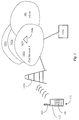
- Fig. 1 is a simplified diagram of a mobile telephone system interconnected with other networks in an embodiment of the present invention.
- a cellular telephone 110 having a keyboard 11, a display 112 and an antenna 113 is connected through a base station with appropriate equipment as is known in the art, which also has a transmission and reception tower (or antenna) 103a, to a cellular telephone network 102a.
- Cellular network 102a is connected in turn to a public switched telephone network (PSTN) 101a.
- PSTN public switched telephone network
- Other cellular networks 102b and 102c are shown as well. It will be apparent to the skilled artisan that there may be many bases stations, there may be many more networks than those illustrated in this example, and that PSTN 101a is not necessarily a single, homogeneous network, but rather a collection of many sub-networks of different telephone carriers, both local and international, long distance, and so on.
- PSTN 101a is not necessarily a single, homogeneous network, but rather a collection of many sub-networks of different telephone carriers, both local and international, long distance, and so on.
- SCP service control point
- a service control point in the cellular network
- intelligence logic
- One of the functions of SCP 104a is to determine the approximate location of telephone 110. If the SCP locates the telephone the call is then routed to the base station for the area where the telephone happens to be. The base station transmits a ring signal to the telephone to cause the telephone to alert the user by whatever alert system the telephone is configured to use, such as buzz, ring and so on.
- the signals sent to the telephone also cause information to appear on display 112 of telephone 110, such as, for example, the name and/or telephone number of the caller. With this information the user has the option to answer the call or to reject the call by pressing buttons on keyboard 111 or by other input means, and hence send the call back via SCP 104a into, for example, a voice mail system 105a.
- a voice mail system 105a State-of-the-art voice mail systems are quite intelligent and capable, and may approximate the functions of a voice response unit (VRU).
- VRU voice response unit
- a state-of-the-art voice mail system may also give the caller options such as to send a page, to edit his message, and so on.
- SCP 104a there may be many variations in the functions of SCP 104a, depending at least in part on the network host.
- the redirect of the voice message may be initiated by a switch inside cell network 102a rather than by an SCP, but an SCP may have a service profile for specific telephone 110.
- the SCP typically provides information to that switch, such as how many rings should occur before the call is bounced into voice mail. If there is no voice mail, or in case the voice mail is not available, due to such as overload, failure, and so on, the system may be programmed to play an appropriate default message to the caller.
- Figure 2 shows a situation in which a user of telephone 110 of Fig. 1 is out of the area of base station 103a, and also out of what is termed in the art the home area of telephone 110 (roaming), but is still enabled to make and receive calls.
- the roaming user has telephone 110 connected through a base station 207 to an SCP 204a in cellular telephone network 202a.
- a call 221 may originate, for example, anywhere in PSTN, the call addressed for telephone 110, and may be delivered to SCP 104a in cellular network 102a as described above.
- the PSTN system of course, has no knowledge of the user roaming, and the destination number is the number of telephone 110 in network 102a.
- SCP 104a may have logic to follow treatment option rules. SCP 104a potentially knows that telephone 110 is roaming, either by input from the user of telephone 110 or by the fact of the user placing a call through or just simply registering on network 202a. In this case SCP 104a may simply forward the incoming call to voice mail 105a (path 222). In an optional case, feature logic may be resident in voice mail 105a rather than at SCP 104a. In some cases, such as in the case that the user has subscribed to roaming service, the call may be routed to network 202a (path 223) to be delivered to the user at telephone 110 (path 224).
- the call may then transferred to voice mail system 105a either directly or, in some cases, after the caller is prompted to enter the telephone number again, because due to the translation between systems 102a and 202a, the called number may have been lost.
- system 202a may assign a temporary alias number to telephone 110, which can be used by SCP 204a to route the call, and then the configured treatment options can decide whether to deliver the call, bounce it back to network 102a immediately, or return the call as undeliverable after a certain number of rings. If system 102a has no notification of the presence of telephone 110 in any other system, it may defaults immediately to voice mail 105a.
- SCP 204a assigns a local alias number totelephone 110, it typically does so after verifying that the associated user of telephone 110 has rights and agreements to roam in system 202a, and when doing so notifies primary SCP 104a of the location of telephone 110.
- SCP 104a executing software 206b, or VRU 105a executing software 206a can know the location of telephone 110.
- the system needs to know the time of day for a network where a user may be roaming, such as the user of telephone 110 roaming through network 202a as shown in Fig. 2 and described just above.
- the time of day needed is easily determined by the geographic location of network 202a and the well-known international time zones, which may be made available to the instances of software executed by various processors in such as SCPs and VM systems in embodiments of the present invention.
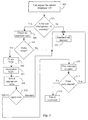
- Figure 3 illustrates a flow chart of a process of treatment options according to an embodiment the present invention.
- These treatment options may be made a part of, for example, software 206a and/or 206b of Fig. 2.
- the skilled artisan will understand that this description is exemplary, and that applicable logic to provide the treatment options described in this specification as embodiments of the present invention may be provided in a variety of ways to execute on processors or CPUs at a variety of locations, singularly or in combination(s).
- a call request for cellular telephone 110 arrives, for example at SCP 104a of Fig. 1 and Fig. 2, enhanced by logic 206b.
- step 302 If it is determined in step 302 that the called user is roaming, the process moves to step 304, and the logic checks the system for treatment rules, such as roaming and/or time-of-day rules.
- the user is enabled to enter treatment rules, for example, via a carrier-provided web site, or by selecting options from an options menu by telephone, by a combination of these two methods, or by any of many other methods of selection and configuration that are well known in the art.
- step 305 the system routes the call according to whether or not any rules are applicable. If no treatment rules are applicable (No), the call is passed back to step 303 for standard call delivery. If treatment rules are applicable (Yes at step 305) the system checks at step 306 optionally for current time-of-day (TOD) at the call origination site, then at step 307 checks for the TOD at the destination where the user is roaming, and then applies the appropriate set of treatment rules in step 308.
- TOD current time-of-day
- the call may be either routed back to step 303 for standard call delivery, or routed on (Special) to step 310 for a message to be played the caller.
- the message can take a variety of forms, one of which may be that the user is not accepting calls at this time, unless the call is an emergency.
- the caller may enter an emergency access code (if the caller knows the access code) in step 311 (Yes), and the call is then routed back to step 303 for standard call delivery. If the caller does not enter an emergency access code (No), the call is passed the call directly to voice mail, without even ringing the phone.
- certain default options may be offered as an easy-to-use model for international travelers, for coast-to-coast travelers, and so on. These models may be offered as an additional option at additional cost to certain high-end roaming customers, or in other cases may be included in certain packages as standard.
- a treatment option may apply to a local telephone, so the user may select an option saying that between 10 p.m. and 7 a.m. his telephone must not ring, or that he wants a special ring that only rings with reduced volume, or a flashing light instead of a ring, or a vibration instead of a ring, and so on.
- a service might be applied wherein, if a user is roaming, the caller is informed of the TOD at the destination and offered an option to go to voice mail or to place the call through in any case. In this option the caller has control.
- the invention is to be afforded the breadth of the claims that follow.
- the term roaming has been used to mean the user of the mobile system is away from his home area.
- the term roaming is often used to mean the user is on another network than his provided network. That is, there are now mobile networks that are national in scope, and even international in scope, and the term roaming should not be considered to limit application or scope of the invention.
- Many features of the invention may be useful wherever the user of a mobile network may be, and there is typically no need to determine whether the user is roaming; rather, determination of the user's time zone may be sufficient in most cases.
Landscapes
- Engineering & Computer Science (AREA)
- Signal Processing (AREA)
- Computer Security & Cryptography (AREA)
- Computer Networks & Wireless Communication (AREA)
- Mobile Radio Communication Systems (AREA)
- Telephonic Communication Services (AREA)
Applications Claiming Priority (2)
| Application Number | Priority Date | Filing Date | Title |
|---|---|---|---|
| US10/749,778 US20050148343A1 (en) | 2003-12-31 | 2003-12-31 | System and apparatus for time zone interrupt for world wide mobile telephone users |
| US749778 | 2003-12-31 |
Publications (2)
| Publication Number | Publication Date |
|---|---|
| EP1551158A2 true EP1551158A2 (fr) | 2005-07-06 |
| EP1551158A3 EP1551158A3 (fr) | 2005-09-28 |
Family
ID=34574797
Family Applications (1)
| Application Number | Title | Priority Date | Filing Date |
|---|---|---|---|
| EP04023629A Withdrawn EP1551158A3 (fr) | 2003-12-31 | 2004-10-04 | Système et procédé de gestion d'appels dans un téléphone mobile dépendant son fuseau horaire local |
Country Status (3)
| Country | Link |
|---|---|
| US (1) | US20050148343A1 (fr) |
| EP (1) | EP1551158A3 (fr) |
| CN (1) | CN100426921C (fr) |
Cited By (10)
| Publication number | Priority date | Publication date | Assignee | Title |
|---|---|---|---|---|
| GB2422751A (en) * | 2004-12-22 | 2006-08-02 | Symbian Software Ltd | Managing incoming calls for mobile terminals roaming away from their home network and home time zone |
| WO2007100299A3 (fr) * | 2006-03-03 | 2007-11-08 | Sony Ericsson Mobile Comm Ab | Communication d'informations de localisation |
| WO2008112095A1 (fr) * | 2007-03-08 | 2008-09-18 | Lucent Technologies Inc. | Avertissement selon l'heure pour les appels vers des téléphones mobiles itinérants |
| GB2454651A (en) * | 2007-10-31 | 2009-05-20 | Symbian Software Ltd | Communication device which calculates the present time at an intended call recipient's location |
| WO2009064525A1 (fr) * | 2007-11-13 | 2009-05-22 | Sony Ericsson Mobile Communication Ab | Surveillance de temps d'appel et génération d'alerte |
| WO2009070473A1 (fr) * | 2007-11-26 | 2009-06-04 | Scientific-Atlanta, Inc. | Blocage d'appel en fonction du temps |
| GB2478765A (en) * | 2010-03-17 | 2011-09-21 | Samsung Electronics Co Ltd | Processing of called party status information |
| EP2398215A1 (fr) * | 2010-06-21 | 2011-12-21 | Research In Motion Limited | Procédé et appareil pour la médiation à base temporelle de communications sans fil |
| US8630682B2 (en) | 2010-06-21 | 2014-01-14 | Blackberry Limited | Method and apparatus for time-based mediation of wireless communications |
| GB2513723A (en) * | 2013-03-28 | 2014-11-05 | Voxygen Ltd | Calling system |
Families Citing this family (6)
| Publication number | Priority date | Publication date | Assignee | Title |
|---|---|---|---|---|
| US8380209B1 (en) * | 2004-04-16 | 2013-02-19 | Apple Inc. | Providing information to a caller based on a called mobile terminal's temporary directory number |
| US20060003766A1 (en) * | 2004-06-30 | 2006-01-05 | Sriram Parameswar | Providing temporal information for roaming mobiles |
| US20060281443A1 (en) * | 2005-05-18 | 2006-12-14 | Michael Chen | Method and system for facilitating voice mailbox operations for a mobile phone that is capable of operating in both a CDMA and GSM environment |
| CN101395885B (zh) * | 2006-08-22 | 2012-09-05 | 索尼爱立信移动通讯股份有限公司 | 位置信息通信 |
| US20110010430A1 (en) * | 2008-03-20 | 2011-01-13 | Ke-Li Wang | Systems And Methods For Scheduling And Delivering Messages Based On Recipient's Time Zone |
| CN105827856A (zh) * | 2016-05-04 | 2016-08-03 | 廖建强 | 一种呼叫方法和终端 |
Family Cites Families (17)
| Publication number | Priority date | Publication date | Assignee | Title |
|---|---|---|---|---|
| JP3005266B2 (ja) * | 1990-09-07 | 2000-01-31 | 日本電気株式会社 | 自動車電話装置 |
| FI97596C (fi) * | 1993-12-15 | 1997-01-10 | Nokia Mobile Phones Ltd | Puhelun kohdealueen ja vastaanotettavan puhelun alkuperäalueen kellonajan määrittäminen |
| US6359636B1 (en) * | 1995-07-17 | 2002-03-19 | Gateway, Inc. | Graphical user interface for control of a home entertainment system |
| US6005870A (en) * | 1996-08-12 | 1999-12-21 | At&T Corp. | Method for called party control of telecommunications network services |
| US7769364B2 (en) * | 2001-06-01 | 2010-08-03 | Logan James D | On demand voice mail recording system |
| US5818920A (en) * | 1996-12-04 | 1998-10-06 | Telefonaktiebolaget Lm Ericsson | Apparatus for controlling communication connections based on local time |
| US6393288B1 (en) * | 1997-11-05 | 2002-05-21 | Nortel Networks Limited | Method of identifying mobile station location to establish homezone feature |
| US5920614A (en) * | 1997-11-07 | 1999-07-06 | Northern Telecom Limited | City, time and toll-charge display when calling telephone numbers |
| US6138008A (en) * | 1998-01-16 | 2000-10-24 | At&T Corp. | Wireless telephone menu system |
| WO1999039499A2 (fr) * | 1998-02-02 | 1999-08-05 | Pulsepoint Communications | Systeme de messagerie vocale permettant a l'abonne de choisir la personnalite de l'agent, l'annuaire telephonique de l'interface utilisateur et la prise en compte du fuseau horaire |
| KR100282958B1 (ko) * | 1999-01-20 | 2001-02-15 | 윤종용 | 휴대용 무선단말기에서 피호자측의 현재시간 표시방법 |
| US6600817B1 (en) * | 1999-08-19 | 2003-07-29 | Siemens Information & Communication Networks, Inc. | Method and apparatus for monitoring communication connections within and across time zones |
| GB2366947A (en) * | 2000-09-14 | 2002-03-20 | Motorola Inc | Time information on callee |
| US6687501B2 (en) * | 2000-10-10 | 2004-02-03 | Qualcomm Incorporated | System and method of dynamically calibrating based station timing using location information |
| US7155001B2 (en) * | 2001-10-24 | 2006-12-26 | Sbc Properties, L.P. | System and method for restricting and monitoring telephone calls |
| US6934543B2 (en) * | 2001-05-08 | 2005-08-23 | Nokia, Inc. | Method and apparatus for filtering incoming calls in a mobile communication system |
| US7330720B2 (en) * | 2003-09-30 | 2008-02-12 | Nortel Networks Limited | Time zone based phone services |
-
2003
- 2003-12-31 US US10/749,778 patent/US20050148343A1/en not_active Abandoned
-
2004
- 2004-10-04 EP EP04023629A patent/EP1551158A3/fr not_active Withdrawn
- 2004-12-08 CN CNB2004101006800A patent/CN100426921C/zh not_active Expired - Fee Related
Non-Patent Citations (1)
| Title |
|---|
| None * |
Cited By (13)
| Publication number | Priority date | Publication date | Assignee | Title |
|---|---|---|---|---|
| GB2422751A (en) * | 2004-12-22 | 2006-08-02 | Symbian Software Ltd | Managing incoming calls for mobile terminals roaming away from their home network and home time zone |
| RU2408151C2 (ru) * | 2006-03-03 | 2010-12-27 | Сони Эрикссон Мобайл Коммьюникейшнз Аб | Передача информации о местоположении |
| WO2007100299A3 (fr) * | 2006-03-03 | 2007-11-08 | Sony Ericsson Mobile Comm Ab | Communication d'informations de localisation |
| WO2008112095A1 (fr) * | 2007-03-08 | 2008-09-18 | Lucent Technologies Inc. | Avertissement selon l'heure pour les appels vers des téléphones mobiles itinérants |
| GB2454651A (en) * | 2007-10-31 | 2009-05-20 | Symbian Software Ltd | Communication device which calculates the present time at an intended call recipient's location |
| WO2009064525A1 (fr) * | 2007-11-13 | 2009-05-22 | Sony Ericsson Mobile Communication Ab | Surveillance de temps d'appel et génération d'alerte |
| WO2009070473A1 (fr) * | 2007-11-26 | 2009-06-04 | Scientific-Atlanta, Inc. | Blocage d'appel en fonction du temps |
| GB2478765A (en) * | 2010-03-17 | 2011-09-21 | Samsung Electronics Co Ltd | Processing of called party status information |
| GB2478765B (en) * | 2010-03-17 | 2014-08-06 | Samsung Electronics Co Ltd | Processing of called party status information |
| EP2398215A1 (fr) * | 2010-06-21 | 2011-12-21 | Research In Motion Limited | Procédé et appareil pour la médiation à base temporelle de communications sans fil |
| US8630682B2 (en) | 2010-06-21 | 2014-01-14 | Blackberry Limited | Method and apparatus for time-based mediation of wireless communications |
| US9071685B2 (en) | 2010-06-21 | 2015-06-30 | Blackberry Limited | Method and apparatus for time-based mediation of wireless communications |
| GB2513723A (en) * | 2013-03-28 | 2014-11-05 | Voxygen Ltd | Calling system |
Also Published As
| Publication number | Publication date |
|---|---|
| CN100426921C (zh) | 2008-10-15 |
| EP1551158A3 (fr) | 2005-09-28 |
| CN1649438A (zh) | 2005-08-03 |
| US20050148343A1 (en) | 2005-07-07 |
Similar Documents
| Publication | Publication Date | Title |
|---|---|---|
| JP4897876B2 (ja) | 緊急通報受付センターの受呼者によって発呼者の電話サービス機能を支配する方法 | |
| US6404858B1 (en) | Personal dial tone service with personalized call waiting | |
| US6192115B1 (en) | Obtaining information about a called telecommunications party | |
| US6556823B2 (en) | Location dependent service for mobile telephones | |
| US6434126B1 (en) | Method of performing service in mobile communication intelligent network | |
| EP1551158A2 (fr) | Système et procédé de gestion d'appels dans un téléphone mobile dépendant de son fuseau horaire local | |
| US20090252303A1 (en) | Telephone apparatus and method of making and receiving calls with urgency tags | |
| US5797103A (en) | Method and apparatus for informing a remote unit of a feature-originated call | |
| WO2000014993A1 (fr) | Procede et dispositif de blocage d'appels en itinerance | |
| US20080139184A1 (en) | Unstructured Supplementary Service Data Call Control Manager within a Wireless Network | |
| KR100707564B1 (ko) | 멤버쉽 가입자 제어 장치, 방법 및 시스템 | |
| EP0966142A2 (fr) | Appareil, méthode et système pour commander le traitement secondaire par un commutateur à distance pour sessions de télécommunication à plusieurs appels | |
| JPH08289371A (ja) | 移動している者との通信を確立するシステムおよび方法 | |
| US6188758B1 (en) | Method and device in telecommunications network | |
| US7024182B2 (en) | Subscriber activated, time limited cellular incoming call redirection system | |
| KR20020083943A (ko) | 무선 지능망에서 호출 송신자 및 특징 코드 북마크액세스로써 음성 메시지 서비스들을 지원하는 방법 및 장치 | |
| JP2003525531A (ja) | 音声メッセージングシステム | |
| KR100259773B1 (ko) | 고도 서비스 플렛폼을 이용한 통합 서비스 방법 | |
| KR100286751B1 (ko) | 이동 통신망에서의 착신 가입자 위치에 따른 이동 입 호거부 방법 | |
| KR100286752B1 (ko) | 이동 통신망에서의 착신 가입자 위치에 따른 이동 입 호거부 방법 | |
| JP3376339B2 (ja) | インテリジェントネットワークシステムを利用した通話モニタ方式 | |
| JPH08251297A (ja) | ネットワークを通して通信を確立するシステムと方法 | |
| JPH0456586A (ja) | 無線呼出装置 | |
| KR100752046B1 (ko) | 선별착신 시스템 및 방법 | |
| KR20060007311A (ko) | 발신목적에 따른 착신음 서비스 시스템 및 방법 |
Legal Events
| Date | Code | Title | Description |
|---|---|---|---|
| PUAI | Public reference made under article 153(3) epc to a published international application that has entered the european phase |
Free format text: ORIGINAL CODE: 0009012 |
|
| AK | Designated contracting states |
Kind code of ref document: A2 Designated state(s): AT BE BG CH CY CZ DE DK EE ES FI FR GB GR HU IE IT LI LU MC NL PL PT RO SE SI SK TR |
|
| AX | Request for extension of the european patent |
Extension state: AL HR LT LV MK |
|
| PUAL | Search report despatched |
Free format text: ORIGINAL CODE: 0009013 |
|
| AK | Designated contracting states |
Kind code of ref document: A3 Designated state(s): AT BE BG CH CY CZ DE DK EE ES FI FR GB GR HU IE IT LI LU MC NL PL PT RO SE SI SK TR |
|
| AX | Request for extension of the european patent |
Extension state: AL HR LT LV MK |
|
| 17P | Request for examination filed |
Effective date: 20060324 |
|
| AKX | Designation fees paid |
Designated state(s): DE ES FR GB IT |
|
| 17Q | First examination report despatched |
Effective date: 20060502 |
|
| STAA | Information on the status of an ep patent application or granted ep patent |
Free format text: STATUS: THE APPLICATION IS DEEMED TO BE WITHDRAWN |
|
| 18D | Application deemed to be withdrawn |
Effective date: 20070522 |