EP1551164A2 - Client-basierte Integration von PBX und Nachrichten Systemen - Google Patents
Client-basierte Integration von PBX und Nachrichten Systemen Download PDFInfo
- Publication number
- EP1551164A2 EP1551164A2 EP04030786A EP04030786A EP1551164A2 EP 1551164 A2 EP1551164 A2 EP 1551164A2 EP 04030786 A EP04030786 A EP 04030786A EP 04030786 A EP04030786 A EP 04030786A EP 1551164 A2 EP1551164 A2 EP 1551164A2
- Authority
- EP
- European Patent Office
- Prior art keywords
- pbx
- call
- phone
- message
- pmic
- Prior art date
- Legal status (The legal status is an assumption and is not a legal conclusion. Google has not performed a legal analysis and makes no representation as to the accuracy of the status listed.)
- Withdrawn
Links
Images






Classifications
-
- H—ELECTRICITY
- H04—ELECTRIC COMMUNICATION TECHNIQUE
- H04L—TRANSMISSION OF DIGITAL INFORMATION, e.g. TELEGRAPHIC COMMUNICATION
- H04L51/00—User-to-user messaging in packet-switching networks, transmitted according to store-and-forward or real-time protocols, e.g. e-mail
- H04L51/04—Real-time or near real-time messaging, e.g. instant messaging [IM]
-
- H—ELECTRICITY
- H04—ELECTRIC COMMUNICATION TECHNIQUE
- H04L—TRANSMISSION OF DIGITAL INFORMATION, e.g. TELEGRAPHIC COMMUNICATION
- H04L51/00—User-to-user messaging in packet-switching networks, transmitted according to store-and-forward or real-time protocols, e.g. e-mail
- H04L51/56—Unified messaging, e.g. interactions between e-mail, instant messaging or converged IP messaging [CPM]
-
- H—ELECTRICITY
- H04—ELECTRIC COMMUNICATION TECHNIQUE
- H04M—TELEPHONIC COMMUNICATION
- H04M3/00—Automatic or semi-automatic exchanges
- H04M3/42—Systems providing special services or facilities to subscribers
- H04M3/42314—Systems providing special services or facilities to subscribers in private branch exchanges
- H04M3/42323—PBX's with CTI arrangements
-
- H—ELECTRICITY
- H04—ELECTRIC COMMUNICATION TECHNIQUE
- H04M—TELEPHONIC COMMUNICATION
- H04M3/00—Automatic or semi-automatic exchanges
- H04M3/42—Systems providing special services or facilities to subscribers
- H04M3/50—Centralised arrangements for answering calls; Centralised arrangements for recording messages for absent or busy subscribers ; Centralised arrangements for recording messages
- H04M3/51—Centralised call answering arrangements requiring operator intervention, e.g. call or contact centers for telemarketing
- H04M3/5183—Call or contact centers with computer-telephony arrangements
- H04M3/5191—Call or contact centers with computer-telephony arrangements interacting with the Internet
-
- H—ELECTRICITY
- H04—ELECTRIC COMMUNICATION TECHNIQUE
- H04M—TELEPHONIC COMMUNICATION
- H04M3/00—Automatic or semi-automatic exchanges
- H04M3/42—Systems providing special services or facilities to subscribers
- H04M3/54—Arrangements for diverting calls for one subscriber to another predetermined subscriber
-
- H—ELECTRICITY
- H04—ELECTRIC COMMUNICATION TECHNIQUE
- H04M—TELEPHONIC COMMUNICATION
- H04M3/00—Automatic or semi-automatic exchanges
- H04M3/60—Semi-automatic systems, i.e. in which the numerical selection of the outgoing line is under the control of an operator
-
- H—ELECTRICITY
- H04—ELECTRIC COMMUNICATION TECHNIQUE
- H04M—TELEPHONIC COMMUNICATION
- H04M7/00—Arrangements for interconnection between switching centres
- H04M7/0024—Services and arrangements where telephone services are combined with data services
- H04M7/0027—Collaboration services where a computer is used for data transfer and the telephone is used for telephonic communication
-
- H—ELECTRICITY
- H04—ELECTRIC COMMUNICATION TECHNIQUE
- H04M—TELEPHONIC COMMUNICATION
- H04M2203/00—Aspects of automatic or semi-automatic exchanges
- H04M2203/20—Aspects of automatic or semi-automatic exchanges related to features of supplementary services
- H04M2203/2011—Service processing based on information specified by a party before or during a call, e.g. information, tone or routing selection
-
- H—ELECTRICITY
- H04—ELECTRIC COMMUNICATION TECHNIQUE
- H04M—TELEPHONIC COMMUNICATION
- H04M3/00—Automatic or semi-automatic exchanges
- H04M3/42—Systems providing special services or facilities to subscribers
- H04M3/42025—Calling or Called party identification service
- H04M3/42034—Calling party identification service
- H04M3/42059—Making use of the calling party identifier
-
- H—ELECTRICITY
- H04—ELECTRIC COMMUNICATION TECHNIQUE
- H04M—TELEPHONIC COMMUNICATION
- H04M3/00—Automatic or semi-automatic exchanges
- H04M3/42—Systems providing special services or facilities to subscribers
- H04M3/42025—Calling or Called party identification service
- H04M3/42085—Called party identification service
- H04M3/42093—Notifying the calling party of information on the called or connected party
-
- H—ELECTRICITY
- H04—ELECTRIC COMMUNICATION TECHNIQUE
- H04M—TELEPHONIC COMMUNICATION
- H04M3/00—Automatic or semi-automatic exchanges
- H04M3/42—Systems providing special services or facilities to subscribers
- H04M3/42365—Presence services providing information on the willingness to communicate or the ability to communicate in terms of media capability or network connectivity
Definitions
- the present invention relates to a technique for integrating one or more user interfaces with a PBX phone system.
- the invention relates to a method and system for providing off-hook/on-hook presence notification for a PBX phone, establishing media sessions concurrent with PBX telephonic communication, customized call treatment for a PBX phone, call transfer capability between a PBX phone and numerous other devices, and PBX call control.
- PBX Private Branch Exchange
- PSTN Public Switched Telephone Network
- PBX systems also provide a host of telephonic services to the enterprise workers including call forwarding, transferring, conferencing, voice mail, personalized greetings, and the like.
- an enterprise worker's phone resides on the desktop in immediate proximity to the worker's personal computer.
- the personal computer may provide tools for word processing, viewgraph editing, email, and web browsing, as well as other communications tools such as instant messaging, buddy lists, presence, video, and other tools for collaboration.
- Instant messaging allows people with network access to send text messages and other media to other individuals listed in a buddy or contact list.
- An instant text message is sent in near-real time to a contact where it is then displayed in a graphical user interface window within the context of an on-going text-based conversation.
- instant messaging may also be used within chat sessions and custom chat rooms where friends or co-workers can interact and share media.
- Some instant messaging applications are also enabled with a presence protocol used by a one person to determine whether a buddy or contact is "present" online and to subscribe to changes in the presence state or information.
- an enterprise worker's instant messaging application may be aware of the worker's online presence but is oblivious to the worker's telephonic presence, i.e. buddies do not know that a worker is occupied on his PBX phone.
- a worker sets up a voice session to another worker by dialing a PBX extension, an entirely separate process must be followed to setup a session for exchanging a document. Therefore, there is a need for a solution that integrates the PBX system and communications applications on enterprise workers' computers to provide greater interoperability, simplified PBX control, and enhanced sharing and collaboration.
- the invention in its several embodiments features a method and system for using a computer interface to perform off-hook/on-hook presence notification for a PBX phone, establish media sessions concurrent with PBX telephonic communication, execute custom call treatment in conjunction with a PBX phone, implement call transfer capability between a PBX phone and numerous other devices, and provide PBX call control.
- the PBX is generally enabled with computer telephony integration (CTI) capabilities and may also, depending on the embodiment, be enabled with Voice-over-Internet Protocol (VoIP) capabilities such as Session Initiation Protocol (SIP).
- CTI computer telephony integration
- VoIP Voice-over-Internet Protocol
- SIP Session Initiation Protocol
- the computer interface may be any number of computer appliances including personal computer also enabled with CTI, for example.
- the invention relates to a presence notification method for communicating an enterprise worker's on-phone/off-phone presence state to other workers using a computer interface operatively coupled to a system comprising a private branch exchange (PBX) and a first PBX phone.
- the presence notification method preferably comprises the steps of: receiving from the PBX a first message indicating an off-hook state of the first PBX phone; consulting a subscriber table including the identity of one or more presence-state subscribers; and transmitting a second message to at least one of the one or more presence-state subscribers indicating the off-hook state of the first PBX phone.
- the invention in a second embodiment, relates to a method for establishing a collateral communication session between a plurality of enterprise workers' computer interfaces in response to a call between the workers.
- the collateral communication session referred to herein as a concurrent media session, may take a number of forms including text messaging, document exchange, desktop sharing, and video, for example.
- the method for establishing concurrent media session setup using a first computer interface operatively coupled to a system comprising a private branch exchange (PBX) and a second computer interface preferably comprises the steps of: receiving from the PBX a first message signifying that the second PBX phone has called the first PBX phone; transmitting a second message from the first computer interface to the second computer interface requesting a media session; determining whether the media session request has been accepted at the second computer interface; and establishing a media session between the first computer interface and second computer interface if the session request message is accepted.
- PBX private branch exchange
- the invention in a third embodiment, relates to a method for performing custom call treatment allowing a recipient of an incoming PBX call to respond to the call by transferring the call to another device or responding with an instant message, for example, depending on various factors including the caller, the time, and date.
- the call treatment method in a first computer interface operatively coupled to a system comprising a private branch exchange (PBX) and a first PBX phone preferably comprises the steps of: receiving from the PBX a first message indicating an incoming call; determining from a call routing table maintained by the first computer interface an incoming call response to the incoming call; and transmitting a group of one or more messages based on the incoming call response, wherein the group comprises a second message answering the incoming call.
- PBX private branch exchange
- the invention in a fourth embodiment, relates to a method for transferring a call between an enterprise worker's PBX phone and an associated computer interface.
- the call transfer method in a first computer operatively coupled to a system comprising a private branch exchange (PBX) and a first PBX phone preferably comprises the steps of: transmitting to the PBX a first message for transferring a telephone call associated with the first PBX phone; establishing a voice-over-IP session between the PBX and the first computer; and replacing the telephone call to first PBX phone with a call to the first computer via the voice-over-IP session.
- PBX private branch exchange
- the present invention relates to a method of controlling PBX telephone calls to a worker's PBX phone using a computer interface operatively coupled to a system comprising a PBX and a first PBX phone.
- the PBX call control method preferably comprises the steps of: receiving from the PBX a first message indicating the presence of a telephone call associated with the first PBX phone; and transmitting to the PBX a call control message, such as a call-hold command, or call-forwarding command directing the PBX to another PBX phone or VoIP client, for example.
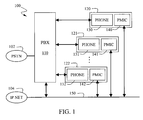
- FIG. 1 is a block diagram of a PBX system operably coupled to a data network.
- the PBX system 100 comprises a PBX 110 and a plurality of PBX phones 130-132, each phone being associated with a unique extension number.
- the PBX 110 manages calls between the plurality of user phones 131-133 and a set of trunk lines operably coupled to the Public Switch Telephone Network (PSTN) 102 while supporting call forwarding between PBX phones, conference calling, call holding, voice mail, personalized greetings, and the like.
- PSTN Public Switch Telephone Network
- the PBX system 100 is consistent with both new telephone systems and a vast number of legacy telephone systems currently located at and operated by enterprises today.
- a data communications network 150 embodied in or operably coupled to a local area network (LAN), a wide area network (WAN), a metropolitan area network (MAN), the Internet Protocol (IP) network 104, or a combination thereof.
- the communications network 150 operably couples a plurality of computers enabled with a PBX-Messaging Integration Client (PMIC) 140-142 distributed throughout the enterprise to each other and to the resources available through the World Wide Web using Ethernet and or the transmission control protocol (TCP)/IP protocol suite.
- PMICs 140-142 is generally associated with an individual enterprise worker. In most cases, an individual's PMIC is located in the immediate proximity to the individual's phone, thus giving rise to a logical association between a user PMIC and a user phone.
- the logical association between a PMIC, a phone, and a single user exist for a multiplicity of enterprise workers including a first user 120, second user 121, and third user 122, and so on.
- the PBX 110 is enabled with a computer telephone integration (CTI) protocol, which refers to a signaling convention by which the PMICs 140-142 may control and monitor PBX functions.
- CTI computer telephone integration
- the PMICs 140-142 are adapted to act as individualized clients for: (1) placing and answering PBX calls without a PBX phone, (2) routing incoming call directed PBX extensions to other devices, (3) forwarding calls away from PBX phones to other devices, and (4) placing calls on hold.
- the PBX or the CTI client associated thereto is also adapted to transmit CTI messages upon occurrence of certain events, as is described in greater detail below.
- the PMIC provides an interface to presence, instant messaging, document exchange, desktop sharing and other capabilities typically resident in applications such Microsoft's Real-Time Communications (RTC) Messenger.
- RTC Real-Time Communications
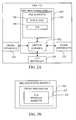
- FIG. 2A represents a functional block diagram of the PBX 110 with which the enterprise PMICs 140-142 interoperate.
- the PBX 110 generally includes a cabinet or backplane including one or more trunk interfaces 220 for converting between the signal format and voice transmission of the PSTN 102 and the internal convention used by the PBX system 100, a plurality of PBX phone interfaces or line cards 222 providing a connection to the user PBX phones 130-132, a CTI interface 224 for transmitting and receiving CTI messages transmitted via the network 150, and a switch controller 202 for creating and managing voice circuits between the trunk interfaces 220, line cards 222, and CTI interface 224.
- the switch control 202 is generally an element of a processing module 200 embodying various call management services 204 including voice mail 206 and other interactive voice response (IVR) systems 208, for example.
- IVR interactive voice response
- PDSV digital signaling and voice
- the digital protocol referred to herein a private digital signaling and voice (PDSV) protocol, comprises a signaling convention that includes operation-codes used to exchange voice communications as well control signals.
- PDSV protocols are generally proprietary implementations and differ between vendors.
- the major CTI standards are Telephony Application Programming interface (TAPI) and Telephony Services Application Programming Interface (TSAPI), as well as the European Communications Manufacturers Association (ECMA) standard for CTI, namely the Computer Supported Telecommunications Applications (CSTA) protocol.
- TAPI Telephony Application Programming interface
- TSAPI Telephony Services Application Programming Interface
- ECMA European Communications Manufacturers Association
- FIG. 2B Illustrated in FIG. 2B is a functional block diagram of a PBX processing module 200.
- the PBX processing module 200 in the preferred embodiment incorporates one or more software and or firmware components that cooperate with switch control 202 to provide the PBX services 204.
- the PBX processing module 200 may include an operating system 232, e.g. UNIX-based system or proprietary implementation, that in turn supports a CTI message handler 234 adapted to generate and respond to various CTI commands in the manner set forth in greater detail below.
- the CTI message handler 234 is adapted to transmit various event messages to the PMIC is response to various types of activities involving one or more PBX phones.
- the CTI handler 234 in the preferred embodiment is adapted to transmit a CTI off-hook event to a registered PMIC in response to an off-hook signal received from the associated PBX phone, transmit a CTI on-hook event to a registered PMIC in response to an on-hook signal from the associated PBX phone, transmit a incoming-call event to the PMIC associated with a PBX phone to which the PBX transmits a ring signal, a first call-answered event to the PMIC when the associated phone is used to answer an incoming call, and transmit a second call-answered event to the PMIC associated with the PBX phone used to place a call to another PBX phone when it is answered.
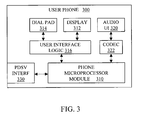
- FIG. 3 Illustrating in a FIG. 3 is a functional block diagram of a PBX phone typical of user phones 130-132.
- the user PBX phone preferably includes a handset and base unit 300 comprising a phone microprocessor module 310 that enables incoming and outgoing calls.
- the phone microprocessor module 310 in combination with the user interface logic 316, transmits input from the dial pad 314 and display relevant information at display 312.
- the phone microprocessor module 310 in cooperation with coder/decoder 322, conveys incoming voice signals to an audio user interface (AUI) 320 speaker and outgoing voice signals received at an AUI 320 microphone to the PDSV interface 330.
- AUI audio user interface
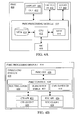
- the PMIC 400 generally includes the hardware and software necessary to provide access to and exchange voice and control signals with another VoIP client including, in some embodiments, the PBX 110.
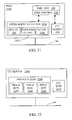
- the PMIC 400 comprises a processing module 410, display 440, tactile user interface 450 preferably including a keyboard, a AUI 460 with sound card and speaker, and a network interface card (NIC) 470 operably coupled to the data communications network 150.
- NIC network interface card
- the processing module 410 generally comprises hardware components including a central processing unit 412, computer memory 414, and random access memory (RAM). As illustrated in FIG. 4B, the processing module 410 may further comprise software and or firmware components including a PMIC controller 428 and a PMIC graphical user interface (GUI) 434 used by the enterprise worker to monitor and configure the PMIC 428 as well as bridge between the PBX domain and the VoIP domain.
- the PMIC 428 in the preferred embodiment is adapted to monitor calls involving a PBX phone 130-132, intervene in calls under certain circumstances in a manner defined by the user, and establish media sessions on behalf of an enterprise worker in parallel with a telephone call.
- the PMIC 428 Upon receipt of an incoming call, the PMIC 428 generally consults routing logic 430 to whether to forward an incoming call to another PBX phone or other device, for example, or respond with a message transmitted via the network 150. In the process of monitoring calls involving a user's PBX phone, the PMIC 428 may consult the subscriber table 432 to identify any Instant Messaging (IM) buddies in a contact list of changes in the enterprise worker's telephonic presence. In some circumstances, the PMIC 428 may also consult the concurrent media session (CMS) handler 434 to initiate transmission of an instant message, text chat or other voice and/or video media session between the PMICs of the users that are engaged in telephonic communication.
- CMS concurrent media session
- PMIC processing module 410 further comprises a CTI client 422, preferably a CTI protocol stack, and Real-Time Communications (RTC) client 426 running on top of an operating system 418 such MS WINDOWS also by Microsoft Corporation.
- the CTI client 422 together with its CTI application programming interface (API) 420 provides the underlying functionality used to implement the various call control functionality embodied in the PMIC processing of the preferred embodiment.
- the RTC client 426 with RTC API 426 provides support for the Session Initiation Protocol (SIP) used in some embodiments to enable the CMSs, as discussed in greater detail below.
- SIP Session Initiation Protocol
- PMICs 140-142 in the preferred embodiment are personal computers, one skilled in the art will appreciate that any of a variety of processing devices including desktop computers, laptop computers, personal digital assistants (PDA), Internet-enabled appliances, or mobile communication devices such as cellular phones may be adapted for purposes of this invention.
- PDA personal digital assistants
- mobile communication devices such as cellular phones
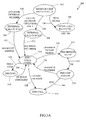
- FIGS. 5A and 5B Illustrated in FIGS. 5A and 5B is a state diagram characterizing the PBX with which the preferred embodiment interoperates.
- the PBX 110 generally monitors (state 502) the trunk lines to PSTN 102 as well as the internal phones 130-132.
- the operation of the PBX 110 characterized by the method of FIGS. 5A and 5B generally falls into at least one of three different categories, namely, an outgoing call placed by a PBX user phone 130-132 to a device external to the PBX 110, a internal call placed by a user phone 130-132 to another phone 130-132 within the PBX 110, and or an incoming call to a user phone 130-132 from a device external to the PBX 110.
- an off-hook signal is transmitted from the phone to the PBX 110 with "digits" or dual-tone multi-frequency (DTMF) signals representing a phone number or a PBX extension number.
- DTMF dual-tone multi-frequency
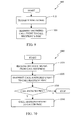
- the PBX 110 transitions to an external call-placed state 504, illustrated in greater detail in the external call process 600 of FIG. 6.
- the PBX 110 identifies the digits representing external phone number received (step 610) from user phone and transmits (step 620) a connection request out to the PSTN 102.
- the PBX 110 Since the preferred embodiment of the PBX 110 is enabled with CTI, the PBX also transmits (step 630) off-hook plus dialed-number events to the associated caller's computer 140-142 via the IP network 150.
- the off-hook and dialed-number events are messages used to notify a device registered with the PBX, i.e. the caller's PMIC, that user phone has transitioned from on-hook to off-hook to make the call.
- a client on the network 150 must have registered for the notification at the PBX 110 using a registration event, e.g. a CTI message, requesting notifications about the state of user phone 130-132 identified by its extension number.
- a registration event e.g. a CTI message
- the PBX 110 identifies the extension number received (step 710) from user phone and transmits (step 720) a ring signal to the call recipient's phone.
- the PBX also transmits (step 730) an off-hook plus dialed-number event with the recipient's extension number to the caller's PMIC 140-142 via the IP network 150.
- the off-hook dialed-number event is preferably a CTI message, used to notify the caller's computer that caller's phone is now in the off-hook state as well as the particular extension dialed.
- the off-hook plus dialed-number event including the extension is transmitted indirectly from the PBX 110 through a CTI Server to the caller's computer, although the PBX may be used to directly transmit the event to the caller's PMIC.
- the PBX 110 if the PBX 110 receives an answered signal 522 from the external call recipient, the PBX transitions from the external call-placed state 504 to the PDSV voice communication state 510. Similarly, an off-hook signal 532 from the call recipient in response to the internal call-placed 506 will also cause the PBX 110 to transition to the PDSV voice communication state 510.
- the PDSV voice communication state 510 represents the processing necessary for the PBX 110 to maintain voice communication, which may involve switch control 202 operations such as analog-to-digital conversion and filtering, signaling and the like.
- the PBX 110 may also send a call-answered event comprising the extension of the call recipient's PBX phone to the same registered client that the off-hook plus dialed-extension event was sent.
- the PDSV voice communication generally continues until a calling or called party goes on-hook 528 and terminates the voice communication (state 516) .
- the call in progress may be transferred to another device.
- the PBX 110 is enabled with a VoIP protocol, for example, the PBX can transfer the call in response to a transfer command 534, e.g. a CTI message, with an identifier specifying the device to which the voice communication is to be redirected.
- a transfer command 534 e.g. a CTI message
- the PBX 110 attempts to establish a VoIP session (state 512) and transfer the caller side of the communication to a VoIP device.
- the PBX 110 uses the identifier from the transfer command received (step 810) to determine in the transfer selection mode (step 820) where to forward the VoIP call.
- a transfer command including a universal resource (URI) designating the caller's PMIC causes the PBX 110 to issue (step 840) a session request message, e.g., a SIP INVITE, to a VoIP client in the caller's PMIC.
- a session request message e.g., a SIP INVITE
- the SIP OK testing step 850
- the PBX 110 may also be adapted to transfer calls to other resources (step 830) including other PBX phones or external phones, for example.
- a participant in the session may terminate the session and effectively end the call (state 516) by issuing a VoIP termination message such as a SIP BYE message 544.
- the participant may transfer the call back to a phone set (state 510) using a transfer command 536 including the appropriate phone extension.
- the call in progress may be placed on hold (state 518) by a hold PDSV operation code from the user's PBX phone or by a hold command 524 received by the PBX 110 from the user's PMIC 428 via the network 150. Similarly, the call may be taken off hold in response to the appropriate operation code or an un-hold command from the user's PMIC 428.
- the PBX 110 is also enabled to facilitate incoming calls.
- a call 540 is directed to a user phone 130-132 from either another PBX user phone 130-132 or external PSTN line
- the PBX 110 transitions into the initial call receiving state 508.
- the PBX 110 transmits (step 910) the incoming connection request to the recipient's phone in the form of a ring signal.
- the PBX 110 in the preferred embodiment also transmits (step 920) an incoming-call event, e.g. a CTI message, via the network 150 to notify the recipient's PMIC of the connection request.
- an incoming-call event e.g. a CTI message
- the incoming call may be answered at the recipient's PBX phone or by way of a CTI answer event received by the PBX 110 from the user's PMIC via the network 150.
- the PBX 110 Upon receipt of an off-hook signal 570 from the PBX phone, the PBX 110 transitions to the call answered (state 552) illustrated in more detail in the call answered process 1000 of FIG. 10.
- receipt of the off-hook signal causes the PBX 110 to transmit (step 1020) a first call-answered event, e.g., a CTI message, notifying the recipient's PMIC that the call has been accepted at the associated PBX phone.
- step 1030 If the call is also initiated from a PBX phone 130-132 within the PBX system 100, internal-caller testing (step 1030) is answered in the affirmative and the PBX 110 generates a second call-answered event transmitted (step 1040) to the caller's PMIC.
- the second call-answered event e.g. a CTI message, notifies the caller's PMIC when the call is answered by the call recipient at the recipient's PBX phone or other device.
- Subsequent PDSV voice communications in state 554 are analogous to that discussed above in context of PDSV voice communication state 510.
- the PBX 110 When the incoming call is answered at the call recipient's PMIC, the PBX 110 generally receives an answer command accompanied by a transfer command from the PMIC.
- the transfer command includes a URI designating the user's PMIC or a SIP user agent therein and the PBX 110 transitions to the PBX's VoIP session setup state 556 consistent with the VoIP session setup state 514 discussed above. If the session request message issued by the PBX 110 is accepted, the PBX transitions into the PBX's VoIP session (state 558) and the PDSV voice communication terminated. The recipient may subsequently transfer 586 the call between the PDSV voice communication (state 554) and the VoIP session (state 558) in the manner described above.
- the transfer command 590 received while in the initial call receiving (state 508) includes a URI designating a phone, computer, or user agent other than that of the recipient
- the PBX 110 effectively transfers the call to the other device and returns to monitoring the phone status (state 502).
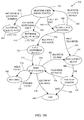
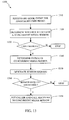
- FIG. 11 Illustrated in FIG. 11 is a state diagram characterizing the PMIC for extending the scope and control of a PBX system and extending the scope of the presence sensing into the telephonic domain.
- the PMIC process 1100 is preferably embodied in one or more user computers within an enterprise that may have a new or existing PBX system consistent with operations discussed above. Each user computer 140-142 is adapted to execute the PMIC process 1100, thereby making them PMICs.
- the plurality of PMICs that interoperate with one another and the PBX 110 constitute a PMIC system. In general, there is a one-to-one relationship between a PMIC and an enterprise worker's PBX phone.
- a PMIC generally monitors (state 1102) the IP network 150 for messages transmitted by the PBX 110 as well as other PMICs in the enterprise.
- the messages from the PBX 110 generally fall into one of two categories, namely, call-placed messages indicating that the PBX phone 130-132 with which the PMIC is associated is being used to place a call or incoming call messages indicating that the associated PBX phone is receiving a call from either another PBX user phone or external line.
- the PMIC When the PBX phone associated with the PMIC is used to place a call, the PMIC receives the off-hook event 1130 generated by PBX 102 and transitions into the on-phone presence-state (P-S) processing (state 1104).
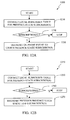
- the P-S processing (state 1104) is illustrated in greater detail in the on-phone P-S processing method 1200 of FIG. 12A.
- the PMIC consults (step 1210) its local subscriber table 432 to identify the call recipient's presence-state subscribers.
- a P-S subscriber is party that has registered to receive notice of a co-worker's online presence and or telephonic availability.
- an on-phone event e.g., a SIP message
- a SIP message is transmitted (step 1230) to each subscriber to indicate that the party whose presence-state is being monitored has picked up the PBX phone.
- the PMIC then indirectly monitors the telephonic communications (state 1106) by listening for any CTI events signifying a change in the ongoing telephonic communication.
- the PMIC When the PBX phone associated with the PMIC receives a call, the PMIC receives an incoming-call event 1140 and transitions to a call-routing mode (state 1110) in which the PMIC consults its routing logic 430.
- the routing logic 430 is customized by the user and prescribes the action to be taken in response to an incoming call.
- the PMIC is adapted to perform one or more of the following: (1) permit the incoming call to ring at the user PBX phone without intervention, (2) transfer the incoming call to the user's PMIC, (3) transfer the incoming call to another device. e.g., the user's cell phone, (4) transfer the incoming call to another PBX phone, or (5) transmit an instant message to the caller.
- the user can define individual call-routing rules that prescribe how to respond to the incoming calls as a function of when the call is received, the telephone number or extension of the caller, the time of day and day of week, and the user's presence-state, for example.
- the PMIC receives an off-hook event 1142 from the PBX 110.
- the PMIC process 1100 advances to an on-phone presence-state (state 1112), as illustrated in FIG. 12A, as well as a concurrent media session (CMS) setup (state 1114).
- the on-phone presence-state (state 1112) is consistent with the on-phone P-S processing (state 1104) described above.
- the PMIC uses the extension and or phone number from the off-hook event received (step 1310) to determine (step 1320) whether to initiate a media session concurrently with the telephonic communication that began when the phone was answered.
- a media session as used herein refers to a network-domain dialogue between the caller and call recipient established and maintained separate from the telephonic communication.
- the concurrent media session may take one of more of the following four forms: (1) a "message session” such as a SIP instant message, (2) a "text session” such as a SIP text chat session, (3) a "multimedia session” in which a SIP video or audio is exchanged, (4) a document exchange session, or (5) computer GUI interface sharing such as a window-based operating system's "desktop sharing.”
- the CMS testing (step 1330) is answered in the affirmative if, for example, call recipient's PMIC is configured to automatically attempt to initiate a CMS with all incoming PBX calls, or if the incoming call is from a PBX extension included in a group of one or more numbers pre-selected or otherwise approved by the call recipient..
- the selection of the type(s) of CMS(s) to be established are determined from user-defined CMS configuration parameters maintained by the call recipient's PMIC handler 434.
- a CMS configuration parameter may be set with a default value so that a text chat session or a video session, for example, is automatically established in response to a telephone call.
- a supplemental CMS including document share, screen share mode, or video session, for example.
- the one or more CMSs are initiated with a session request, e.g., a SIP message, directed from the recipient's PMIC to the caller's PMIC or other SIP conference calling center, e.g., a multi-point control unit known to those skilled in the art.
- a session request e.g., a SIP message
- the session request is accepted with a SIP OK message
- the session-request-answered testing is indicated in the affirmative and the media session launched (step 1370) between the PMICs of the caller and recipient.
- the CMS may be maintained or terminated separate and independent of the telephonic communication. Alternately, the CMS sessions could be terminated with the telephone communication session ended.
- the PMIC process 1100 proceeds to passively monitor (state 1106) the network 150 for any events signifying a change in the ongoing telephonic communication.
- the PBX 110 transmits an on-hook event 1136, e.g. a CTI message, to the recipient's PMIC that causes the PMIC process 1110 to transition to the off-phone P-S processing (state 1108).
- the PMIC consults (step 1250) its local subscriber table 432 to identify the call recipient's current presence-state subscribers.
- the subscriptions testing (step 1260) is answered in the affirmative and each subscribers sent (step 1270) an P-S status event, e.g., a SIP message, indicating the availability status of the call recipient immediately prior to going off-hook to answering the call.
- P-S status event e.g., a SIP message
- the availability status sent to each subscriber is on-line status.
- the PMIC in some embodiments is also adapted to issue commands to the PBX 110 to alter the telephonic communication involving the associated PBX phone.
- the caller may alter the ongoing telephonic communication by taking one of the following actions: (1) terminate the call, (2) place the call on hold, (3) transfer the call, or (4) establish a conference call with one or more additional parties.
- the user may terminate the call from the PMIC by issuing a terminate command 1162, e.g. a CTI message, that instructs the PBX 110 to end (state 124) voice communications with the user' PBX phone.
- the user may also issue a hold command 1134A, e.g., a CTI message, to temporarily discontinue the voice communications, after which the PMIC process 1100 resumes passively monitoring (state 1106) the PBX 110.
- a hold command 1134A e.g., a CTI message
- An analogous release-hold command 1134B may be issued by the user from the PMIC to remove the hold and enable voice communication.
- the user may also transfer the call from the PBX phone to another device by issuing a transfer command to the PBX 110.
- a transfer command to the PBX 110.
- the PMIC process 1100 transitions to the PMIC session setup (state 1116) in which the PMIC and PBX 110 exchange SIP INVITE and OK messages necessary to establish a VoIP session (state 1118) to replace the telephonic communication.
- the user acting through the PMIC GUI 436 can issue a PBX phone transfer command 1148 to restore the telephonic communication (state 1106), issue a SIP BYE 1158 message to end the call (state 1124), or issue an external-device transfer command 1160 causing the PBX 110 to forward (state 1120) the call to any device specified by the user.
- the call routing logic 430 may be configured to cause the PMIC in the call routing mode (state 1110) to automatically respond with one or more of the following actions: (1) transfer an incoming call to the PMIC session setup (state 1116), transfer or forward the call to an external device (state 1112), or (3) reply with a message to the caller's PMIC using an Instant Message.
- routing logic 430 is configured by the user to direct calls depending on the caller's identification, the time, and the date, for example.
- FIGS. 14 through 20 discussed below illustrate various aspects of the PMIC processing 1100 of the preferred embodiment. These figures are provided by way of example and not limitation.
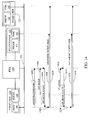
- FIG. 14 Illustrated in FIG. 14 is flow diagram depicting the method of distributing telephonic presence-state notices in the PBX system 100.
- a user Prior to configuring a user's PMIC to perform P-S notification, a user generally transmits a registration command to the PBX 110 to associate the user's PMIC with the user's phone extension. This causes the PBX 110 to transmit subsequent event messages pertaining to the user's PBX phone to the user's PMIC.
- the class of events transmitted by the PBX to a PMIC generally includes, but is not limited to: off-hook plus digits events, off-hook plus extension events, extension-dialed events, transfer events, incoming-call events, and answer events. In the following examples illustrated in FIG. 14 through FIG.
- the first user PBX phone 130 is identified by extension number x1234, the first user PMIC 140 identified by URI 1234@proxy.com, the second user PBX phone 131 is identified by extension number x5678, and the second user PMIC 141 identified by URI 5678@proxy.com.
- the registration command 1402 causes the PBX 110 to send to the first user's PMIC various CTI events relating to the first user's phone 130.
- the registration command 1402 may require that the first user 120 enter a user identifier and password, although other forms of authentication may be implemented.
- the PBX 110 is able to associate CTI commands from this first user's 120 PMIC 140 with the phone 130 extension.
- an off-hook signal 1404 is relayed by the PBX 110 to the first user PMIC 140 in the form of an off-hook event, preferably a CTI off-hook message 1406. Receipt of the CTI event stimulates the PMIC 140 to automatically change the presence-state for the first user to "on-phone" state.
- the PMIC 140 consults (method 1200) its subscriber table 432 and transmits a notify message 1408, 1410 to all subscribers 121, 122 by way of the associated PMICs 141, 142.
- the notify message is preferably a SIP on-phone message advertising the change in the first user's telephonic availability.
- the on-hook signal 1412 from the first user phone 130 causes the PBX 110 to send the first user's PMIC 140 an on-hook event 1414, preferably a CTI message.
- the PMIC 140 consults (method 1250) the subscriber table 430 and notifies all subscribers 141, 142 of the change in the presence state by way of a SIP notify messages 1416, 1418.
- the presence state indicated by the SIP notify messages 1416, 1418 is the presence state that existed just prior to the placement of the call.
- the presence state sent when the user goes off-phone may be "on-line" notice. The selection between the two embodiments might be a user-manageable setting.
- the linkage between the PBX phone operation and the presence state is performed entirely within the associated PMIC endpoint itself.
- the presence-state for the user is changed automatically based on receipt of a CTI event without the user manually changing his or her presence state via GUI interaction or other manual input.
- a principal advantage of this method of presence integration is that it can completely coexist and fully interoperate with all other presence servers, presence collection/distribution servers, and any other SIP proxy servers that might be operational within the network 150.
- the proposed method is also highly scalable, since it each PMIC is only responsible for the presence management of its associated user PBX phone.
- the PBX 110 is both the source of CTI events and recipient of CTI commands.
- the a PBX may employ a separate and external CTI server (not shown) that provides fan-out capability, user authentication, and other CTI management tasks, as well as protocol translation between the PBX and the CTI client, for example.
- FIG. 15 Illustrated in FIG. 15 is a flow diagram demonstrating the use of a networked intermediate server with which the PBX and one or more PMICs may interoperate.
- the CTI server 1502 is adapted to relay messages between the PBX 110 and one or more PMICs using CTI and/or extensible Markup Language (XML) protocols between the CTI server 1502 and the one or more PMICs 120, 121.
- the proxy server 1502 relays CTI messages between the CTI server 1502 and the PBX 110 using the CSTA CTI protocol, for example.
- Other protocol translations might also be possible including, but not limited to, HTTP using Get or Post messages via a dedicated IP socket, or SIP using textual information transmitted with SIP MESSAGEs sent between the CTI server 1502 and a PMIC.
- a first user PMIC 140 transmits a registration command 1510, preferably a CTI or XML message, to the CTI server 1502.
- the registration command 1510 comprises the extension number of the first user phone 130 and enables the CTI server 1502 to create an association between the first user PBX phone 130 and the first user PMIC 140.
- the PBX 110 relays the off-hook signal 1512 to the CTI server 1502 in the form of a CTI off-hook event 1514.
- the server 1502 forwards the CTI/XML off-hook event 1516 to the first user PMIC 140.
- CTI off-hook event 1516 stimulates a change in first user's presence state that is propagated to any subscribers via an off-phone notification event 1518, e.g., a SIP message.
- an on-hook signal 1520 is transmitted to the CTI server 1502 in the form of a CTI on-hook event 1522, then transmitted to the first user PMIC 140 in the form of CTI/XML off-hook event 1524.
- the first user identifies (step 1250) the presence state subscribers to be sent a SIP notify event 1526.
- the presence state management in the one or more PMICs of FIG 14 is functionally equivalent to those in FIG. 14, independent of whether the event messages originating from the PBX 110 are sent directly to the PMICs or indirectly via the CTI server 1502.
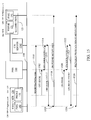
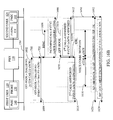
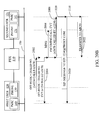
- FIG. 16A Illustrated in FIG. 16A is a flow diagram demonstrating the procedure for establishing a first category of CMS between calling parties.
- a CMS in the form of a SIP session is automatically initiated between a caller and recipient in the PBX system 100 in response to a telephone call.
- the first user phone 130 have extension number x1234 and the second user phone 131 have extension number x5678.
- DTMF Dual Tone Multi Frequency
- the PBX 110 In addition to the ring signal 1606 transmitted (step 720) to the second user's phone 131, the PBX 110 also generates (step 730) an extension-dialed event 1604 to the caller's computer, PMIC 140, as notice that a call has been placed to the extension number x5678. Similarly, the second user's PMIC 141 is notified via the incoming-call event 1608 of the incoming call from extension x1234.
- the PBX 110 If the incoming call is answered with off-hook signal 1610, the PBX 110 puts the first user phone 130 and second user phone 131 in telephonic voice communication 1616.
- the CTI-enabled PBX 110 also responds to the off-hook signal 1610 with a first call-answered event 1612 transmitted (step 1020) to the second user's PMIC 141 as well as a second call-answered event 1614 transmitted (step 1040) to the first user's PMIC 140.
- the second user's PMIC 141 In response to the first call-answered event 1612, the second user's PMIC 141 automatically initiates (step 1650) a media session, preferably a SIP chat session, concurrent with the telephonic voice communication 1616.
- a media session preferably a SIP chat session
- the process of initiating (step 1650) the media session is set forth in greater detail in CMS setup 1114 of FIG. 13.
- the media session is a SIP session including a simple SIP:MESSAGE message sent from second user's PMIC 141 to the first user's PMIC 140.
- the second user's PMIC 141 derives the SIP URI of the first user's PMIC 140 in accordance with a SIP dial-plan.
- the dial-plan associates an extension, e.g., abcd, included in an event message with a SIP URI, e.g., SIP:abcd@someproxy.com.
- a SIP URI e.g., SIP:abcd@someproxy.com.
- the second user PMIC 141 extracts the extension number 1234 from the incoming-call event 1608 and generates a SIP MESSAGE transmitted to SIP: 1234@proxy.com.
- Other suitable dial-plans that allow the call recipient's PMIC to deduce the caller's URI from the calling extension are also possible.
- another dialing plan might associate extension 1234 with SIP:user91234@proxy.com where user 1234's PMIC has this SIP URI.
- SIP text messaging windows are open on both first user's PMIC 140 and second user's PMIC 141, thereby allowing the first user 120 and second user 121 to text chat with one another concurrent with the voice communication 1616.
- first user 120 or second user 121 to appear on each other's contact lists, nor a need for either user to lookup an IP address or SIP URI. Instead, the SIP session is established automatically based on the PBX call.
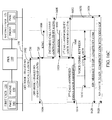
- FIG. 16B Illustrated in FIG. 16B is a flow diagram demonstrating a second procedure for establishing a CMS between calling parties.
- the various signals, CTI event messages, and SIP messages in FIG. 16B are replicated from FIG. 16A beginning with the off-hook plus dialed number signal 1602 through the SIP MESSAGE 1620.
- the presence of the SIP MESSAGE 1620, and the corresponding SIP: OK has established a line of communication between first user 120 and second user 121 that may be exploited to open additional forms of communication.
- SIP MESSAGE 1620 After the SIP session signified by SIP MESSAGE 1620 has been between established, either the first user 120 or the second user 121 may escalate the interaction to other forms of supplemental CMS using built-in capabilities of RTC, for example.
- either call participant may establish a supplemental CMS, e.g., a document exchange or a screen sharing session, that runs in parallel to the SIP:MESSAGE 1620.
- the supplemental CMS 1624 may be manually selected (step 1652) by a user via the user's PMIC GUI 436 or other form of selection input device.
- FIG. 16C Illustrated in FIG. 16C is a flow diagram demonstrating a third procedure for establishing a CMS between calling parties.
- the various signals, CTI event messages, and SIP messages are replicated from FIG. 16A beginning with the off-hook plus dialed number signal 1602 through the SIP MESSAGE 1620.
- the first user 120 and second user 121 have desktop video cameras used by the CMS handler 434 of each user's PMIC 140, 141 to automatically setup (step 1654) a supplemental CMS such as video session 1626 with the primary CMS session 1620.
- the call recipient's CMS handler 434 automatically issues an additional SIP INVITE containing video session description protocol (SDP) information.
- SDP video session description protocol
- the video session is a user-manageable setting, thereby allowing a call recipient to configure the CMS handler 434 to: (1) automatically enable and start the camera for every call, (2) fully disable the camera to prevent the camera from starting, (3) manual enable the camera to start at the discretion of the user, or (4) selectively enable the camera to start depending on the caller identification, i.e., caller ID.
- the caller identification i.e., caller ID.
- the integration of a CTI client capability into a PMIC permits the user to execute standard telephone set control functions from the individual's computer.
- the PMIC is adapted to transmit PBX call control commands including, but not limited to, make-call commands to initiate a call, answer-call commands to accept an incoming call, hold-call commands to temporarily pause an on-going call at the PBX, transfer-call commands to redirect a call between the PBX phone and user PMIC or other device, conference-call commands to establish a call with three or more parties, and forward-call commands to direct a call to a device specified by the user.
- PBX call control commands including, but not limited to, make-call commands to initiate a call, answer-call commands to accept an incoming call, hold-call commands to temporarily pause an on-going call at the PBX, transfer-call commands to redirect a call between the PBX phone and user PMIC or other device, conference-call commands to establish a call with three or more parties, and forward-call commands to direct a call
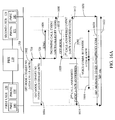
- FIG. 17 Illustrated in FIG. 17 is a flow diagram demonstrating a PBX-supported call initiated from a PMIC.
- the user enters a destination telephone number into the user's PMIC GUI and activates a make-call routine in the PMIC controller.
- the PMIC issues a make-call command 1702 that causes the PBX 110 to issue a ring signal 1704 to the user's phone 130.
- the PBX 110 places the call to the destination number corresponding to second user phone 131, for example, via a ring signal 1708.
- the parties are enabled for telephonic voice communications 1712, 1714.
- the caller's PBX phone 130 automatically enters a hands-free speakerphone mode and the recipient called immediately after the destination number is entered at the PMIC 140.
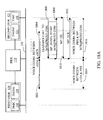
- FIG. 18A and FIG. 18B Illustrated in FIG. 18A and FIG. 18B are flow diagrams demonstrating an on-going communications being transferred between a user PBX phone and the associated PMIC.
- the PMIC is adapted to interoperate with a PBX 110 enabled with SIP or other VoIP protocol in addition to CTI client functionality.
- This PBX system referred to as a SIP-PBX, has native SIP capabilities including the ability to make and receive SIP voice calls.
- an enterprise worker may transfer an on-going call on the PBX phone to the user's PMIC.
- a user may transfer the call from to his or her PMIC 141 by issuing a PMIC transfer command 1806, preferably a CTI message, comprising the identifier of the device to which to transfer the call.
- the transfer command 1806 may include the SIP URI used by the PBX 110 to execute a call transfer to the PMIC SIP voice client.
- the PBX 110 bridges the first leg of the conversation 1814 with the first user phone 130 in the PDSV domain with the second leg of the conversation 1816 with the second user PMIC 131 in the SIP domain.
- the SIP URI is derived from extension number of the user phone with which it is associated.
- the second user 121 may at any time transfer the SIP domain call 1816 directed to the second user PMIC 141 back to the second user PBX phone 141
- a PBX phone transfer command 1818 e.g. a CTI message, comprising the 110 second user's phone extension, number x5678, is issued by the second PMIC 141 to the PBX 110.
- the PBX 110 Upon receipt, the PBX 110 terminates the SIP session with a SIP BYE message 1820 and enables the PDSV voice communication 1826 between the PBX 110 and the second user phone 131.
- a PMIC may also be used to answer an incoming call destined to a PBX phone independently of the user's PBX phone.
- the PBX 110 in the preferred embodiment transmits a ring signal 1906 an incoming-call event 1908, e.g. a CTI message, to the call recipient's PMIC 141.
- the second user 121 may then click an answered button in the PMIC GUI causing it to issue an answer command 1910 and transfer command 1912.
- the transfer command 1912 comprises the identification of the device to which the call is to be forwarded.
- the identification of the PMIC 141 is the SIP URI, SIP:5678@proxy.com.
- the PBX 110 issues a SIP INVITE message 1914, to which the PMIC 141 automatically responds with a SIP OK message 1916.
- the subsequent conversation between the caller 120 and recipient 121 includes PDSV domain voice 1920 between the caller 120 and SIP PBX 110, and SIP domain VoIP 1922 between the SIP PBX 110 and recipient's PMIC 141.
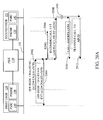
- FIG. 20A and FIG. 20B Illustrated in FIG. 20A and FIG. 20B are flow diagrams demonstrating an incoming call to a PBX phone being automatically processes by an associated PMIC without user intervention.
- the PMIC answers an incoming call to a user's PBX phone and then forwards the call to another device previously specified by the user.
- the PBX 110 in the preferred embodiment transmits ring signal 2006 to the second user phone 131 and an incoming-call event 2008 to the call recipient's PMIC 141.
- the second user PMIC 141 Upon receipt of the incoming-call event 2008, the second user PMIC 141 implements call routing processing (state 1110) that dictates how this call is to be treated. If the call routing logic 430 of FIG. 4B indicates that the call should be transferred to another device, the second user PMIC 141 issues an answer-call command 2010 preventing the PBX 110 from forwarding the call in accordance with its no-answer procedure, e.g. voice mail 206.
- the second user PMIC 141 also issues to the PBX 110 a call-transfer command 2012 identifying the destination device to which the call is to be forwarded, e.g., device ABCD.
- the destination device may be another PBX extension, a PSTN telephone, or a SIP user agent.
- the call routing logic 430 in the preferred embodiment comprises user-managed preferences include forwarding criteria and the action to be taken when the forwarding criteria are satisfied. These criteria may include the phone number or extension of the calling party and the time-of-day and date, for example.
- the call routing logic 430 may dictate that (1) on Wednesday evenings the call should be answered and transferred to PBX phone extension number x6789, on (2) Thursday evenings the call should be answered and transferred to John@acme.com, and (3) at all other times, the call is not answered by the PMIC, thereby allowing the PBX 110 to automatically forward to call voicemail 206 if not answered.
- the call routing logic 430 in some embodiments may also depend on the presence state of its user. For example, if a user's presence state is set to "away,” determined either via manual operation or automatically in the absence of keyboard activity for a period of time, the call routing logic 430 may be configured to forward to an incoming call to the extension of an administrative assistance. Similarly, an incoming call might be directed to the SIP user agent of another enterprise colleague selected by the user, thereby providing an alternative point of contact while the user is unavailable or out of the office.
- the call routing logic 430 is in the form of a script created by the user, although it may also be configured via a graphical and or menu-based interface on the PMIC GUI 436.
- the call routing logic 430 of a PMIC in some embodiments also includes the SIP text messaging and document transfer capabilities as part of the call treatment for incoming and outgoing calls at the PBX phone. Illustrated in FIG. 20B is a flow diagram demonstrating an instant message being transmitted by a PMIC in response to an incoming call.
- the PBX 110 responds to incoming call 2002 with ring signal 2006 and an incoming-call event 2008 sent to the call recipient's PMIC 141.
- the second user PMIC 141 Upon receipt of the incoming-call event 2008, the second user PMIC 141 implements call routing processing 1110 that dictates how this call is to be treated.
- the second user's PMIC 141 transmits an instant message 2020 from the user's PMIC to the caller's PMIC 140.
- the caller's SIP URI, SIP: 1234@proxy.com is derived from the caller's extension, number x1234, learned by the second user's PMIC 141 from the preceding incoming call
- the instant message may include a standardized greeting or a customized Instant Message including information specifically intended for the caller about.
- a person may, for example, generate a personal message including the anticipated return time or an alternate contact number.
- the call routing logic 430 in some embodiments is adapted to transmit a document that may contain text, graphics, spreadsheet, or other information of interest to the caller in response to an incoming call directed to a specific PBX extension.
- the incoming call may further processed in any number of ways defined by the call routing logic 430.
- the second PMIC 141 causes the PBX 110 to transfer the incoming call to device ABCD using transfer command 2022.
- the caller's PMIC may also be configured to respond to the call recipient's instant message with another instant message sent to the call recipient's PMIC 141.
- the call routing logic 432 when the second user 121 receives a telephone call from extension number x1234, the call routing logic 432 generates the appropriate URI and sends an instant message to SIP:SecondUser@pda.com to inform the second user 121 that the first user phone 131, i.e., extension number ⁇ 1234, had called.
- the call routing logic 430 may be tailored to inform a call recipient of the call and the time of the call.
- the call routing logic 430 may also be configured to automatically send an instant message when an outbound call is placed from the PBX phone associated PMIC.
- a specific SIP emergency message for example, may be sent to a pre-selected SIP user when the Emergency 911 number is dialed.
- FIG. 21 Illustrated in FIG. 21 is a functional block diagram of a user PMIC with a plurality of selectable SIP user agents.
- a PMIC 2100 may further include one or more additional SIP instant messaging applications such as a SAMETIME client 2102 by IBM Lotus Corp. and/or any other commercial SIP User Agent Client
- the user may select one of the plurality of SIP client via PMIC GUI 436, for example, by entering a user-selectable parameter causing the SIP/IM selection module 2110 to use the selected SIP client for subsequent IM exchanges.
- each individual SIP client may be indicated as present or not present, or selectable and non-selectable.
- the features that are not present in a particular client may be indicated by representing the feature in greyed-out text or icon form.
- the user experience is identical and independent of the SIP client selected.
- the CTI server 2200 in this embodiment comprises a plurality of PBX interfaces from which the network administrator may choose.
- the system administrator may configure the CTI server 2200 to use either PBX-A interface 2202, PBX-B interface 2204, or PBX-C interface 2206, depending on the hardware and vendor requirements of the PBX 110.
- CTI server 2200 capable of communicating with multiple types of PBXs using a single common CTI interface 2210 protocol to/from a C'TI client are available from Genesys Telecommunications Laboratories, Inc. of San Fransisco, CA, for example. In this manner, the PMIC is generally able to provide the functionality of the several embodiments in a manner independent of the type PBX system or vendor.
Landscapes
- Engineering & Computer Science (AREA)
- Signal Processing (AREA)
- Computer Networks & Wireless Communication (AREA)
- General Engineering & Computer Science (AREA)
- Business, Economics & Management (AREA)
- Marketing (AREA)
- Telephonic Communication Services (AREA)
Applications Claiming Priority (2)
| Application Number | Priority Date | Filing Date | Title |
|---|---|---|---|
| US10/750,795 US7804949B2 (en) | 2003-12-31 | 2003-12-31 | Client-based integration of PBX and messaging systems |
| US750795 | 2003-12-31 |
Publications (2)
| Publication Number | Publication Date |
|---|---|
| EP1551164A2 true EP1551164A2 (de) | 2005-07-06 |
| EP1551164A3 EP1551164A3 (de) | 2005-12-07 |
Family
ID=34574816
Family Applications (1)
| Application Number | Title | Priority Date | Filing Date |
|---|---|---|---|
| EP04030786A Withdrawn EP1551164A3 (de) | 2003-12-31 | 2004-12-24 | Client-basierte Integration von PBX und Nachrichten Systemen |
Country Status (2)
| Country | Link |
|---|---|
| US (5) | US7804949B2 (de) |
| EP (1) | EP1551164A3 (de) |
Cited By (12)
| Publication number | Priority date | Publication date | Assignee | Title |
|---|---|---|---|---|
| WO2007088109A1 (de) * | 2006-01-31 | 2007-08-09 | Cycos Aktiengesellschaft | Kommunikationsanordnung aus einem kommunikations-endgerät und einem kommunikations-server |
| WO2009039576A1 (en) * | 2007-09-25 | 2009-04-02 | Thebuzz Corp Pty Ltd | System, apparatus and method for communication |
| WO2008144542A3 (en) * | 2007-05-16 | 2009-04-09 | Unison Technologies Llc | Systems and methods for providing unified collaboration systems with conditional communication handling |
| WO2009090560A3 (en) * | 2008-01-18 | 2009-09-11 | Zisson As | A unified multi technology switchboard system |
| RU2414082C2 (ru) * | 2005-08-15 | 2011-03-10 | Майкрософт Корпорейшн | Ассоциирование телефонного вызова с диалогом, основанным на компьютерном протоколе, таком как sip |
| EP2015551A3 (de) * | 2007-07-10 | 2011-05-04 | Hitachi Ltd. | Telefonsystem, Server- und Proxy-Antworttelefon |
| CN108432333A (zh) * | 2015-12-30 | 2018-08-21 | 瑞典爱立信有限公司 | 用于提供经由无线局域网的增强型呼叫的建立的方法、系统和设备 |
| EP1884101B1 (de) * | 2005-05-23 | 2018-11-21 | Siemens Aktiengesellschaft | Verfahren und system zur fernsteuerung eines gerätes durch ip-strecken eines ip multimedia subsystems, ims |
| US20200146080A1 (en) * | 2015-12-30 | 2020-05-07 | Telefonaktiebolaget Lm Ericsson (Publ) | Method, System and Device for Providing a Setup of an Enhanced Call via a Wireless Local Area Network |
| WO2023211744A1 (en) * | 2022-04-25 | 2023-11-02 | Zoom Video Communications, Inc. | Third party application control of a client |
| US11889028B2 (en) | 2021-04-26 | 2024-01-30 | Zoom Video Communications, Inc. | System and method for one-touch split-mode conference access |
| US11916979B2 (en) | 2021-10-25 | 2024-02-27 | Zoom Video Communications, Inc. | Shared control of a remote client |
Families Citing this family (108)
| Publication number | Priority date | Publication date | Assignee | Title |
|---|---|---|---|---|
| US7660297B2 (en) * | 2002-06-13 | 2010-02-09 | Nice Systems Ltd. | Voice over IP forwarding |
| GB2389736B (en) * | 2002-06-13 | 2005-12-14 | Nice Systems Ltd | A method for forwarding and storing session packets according to preset and/or dynamic rules |
| US8165114B2 (en) * | 2002-06-13 | 2012-04-24 | Nice Systems Ltd. | Voice over IP capturing |
| US7746848B2 (en) * | 2002-12-05 | 2010-06-29 | Resource Consortium Limited | Virtual PBX based on feature server modules |
| JP4437013B2 (ja) * | 2003-04-14 | 2010-03-24 | Necインフロンティア株式会社 | Ip−pbxシステム及びip端末制御用プログラム |
| US20050141479A1 (en) * | 2003-12-31 | 2005-06-30 | Timucin Ozugur | Presence-based routing in a communications network environment |
| US20050141687A1 (en) * | 2003-12-31 | 2005-06-30 | Timucin Ozugur | Call treatment in a communications system based on instant messaging |
| KR100602638B1 (ko) * | 2004-01-20 | 2006-07-19 | 삼성전자주식회사 | 음성 서비스 시스템 및 그 접속 방법 |
| US7675903B2 (en) * | 2004-02-06 | 2010-03-09 | Alcatel Lucent | Dynamic contact list management system and method |
| US7073380B2 (en) * | 2004-02-17 | 2006-07-11 | Honeywell International, Inc. | Pyramid socket suspension |
| US8566422B2 (en) | 2004-03-16 | 2013-10-22 | Uppfylla, Inc. | System and method for enabling identification of network users having similar interests and facilitating communication between them |
| US7624188B2 (en) * | 2004-05-03 | 2009-11-24 | Nokia Corporation | Apparatus and method to provide conference data sharing between user agent conference participants |
| US9245236B2 (en) | 2006-02-16 | 2016-01-26 | Oracle International Corporation | Factorization of concerns to build a SDP (service delivery platform) |
| US8966498B2 (en) | 2008-01-24 | 2015-02-24 | Oracle International Corporation | Integrating operational and business support systems with a service delivery platform |
| US9038082B2 (en) | 2004-05-28 | 2015-05-19 | Oracle International Corporation | Resource abstraction via enabler and metadata |
| US7903795B2 (en) * | 2004-06-15 | 2011-03-08 | Avaya Inc. | System and method for indicating status of an incoming transmission to a user |
| US20080070560A1 (en) * | 2004-06-21 | 2008-03-20 | Matsushita Electric Industrial Co., Ltd. | Communication System and Communication Method |
| US20050289222A1 (en) * | 2004-06-28 | 2005-12-29 | Sahim Faramarz F | Flexible session initiation protocol endpoint signaling |
| JP4346519B2 (ja) * | 2004-07-13 | 2009-10-21 | 株式会社東芝 | 電話システム、その通信制御方法、およびアプリケーション制御装置 |
| US20060104259A1 (en) * | 2004-11-15 | 2006-05-18 | Cisco Technology, Inc. | System and method for executing a multi-modal transfer in a session initiation protocol (SIP) environment |
| US7783024B1 (en) | 2004-12-16 | 2010-08-24 | At&T Intellectual Property Ii, L.P. | Method and apparatus for providing special call handling for valued customers of retailers |
| US20060161620A1 (en) * | 2004-12-30 | 2006-07-20 | Microsoft Corporation | Extensible activities within collaboration sessions |
| US20060153357A1 (en) * | 2005-01-08 | 2006-07-13 | Arup Acharya | Method and apparatus for providing contextual information with telephone calls |
| KR100666956B1 (ko) * | 2005-03-08 | 2007-01-10 | 삼성전자주식회사 | 네트워크에서의 미디어 전송 장치 및 방법 |
| US8537997B2 (en) | 2005-07-27 | 2013-09-17 | Cisco Technology, Inc. | RFID for available resources not connected to the network |
| US9160861B2 (en) * | 2005-08-11 | 2015-10-13 | Avaya Inc. | Managing held telephone calls at the call-forwarding system |
| US8438235B2 (en) * | 2005-08-25 | 2013-05-07 | Cisco Technology, Inc. | Techniques for integrating instant messaging with telephonic communication |
| US7676228B2 (en) * | 2005-09-19 | 2010-03-09 | Plant Equipment Inc. | Radio interoperability system and method |
| US20070264989A1 (en) * | 2005-10-03 | 2007-11-15 | Rajesh Palakkal | Rendezvous calling systems and methods therefor |
| US20070116227A1 (en) * | 2005-10-11 | 2007-05-24 | Mikhael Vitenson | System and method for advertising to telephony end-users |
| US20090046842A1 (en) * | 2005-11-18 | 2009-02-19 | Malcolm Evatt Keith Allen | Communication system and method |
| US20070162600A1 (en) | 2005-11-18 | 2007-07-12 | Aol Llc | Promoting interoperability of presence-based systems through the use of ubiquitous online identities |
| US20070266162A1 (en) * | 2005-12-07 | 2007-11-15 | Microsoft Corporation | Session initiation protocol redirection for process recycling |
| US20070183396A1 (en) * | 2006-02-07 | 2007-08-09 | Bennett James D | Set top box supporting bridging between a packet switched network and the public switched telephone network |
| US7730192B2 (en) * | 2006-03-20 | 2010-06-01 | Microsoft Corporation | Managing parallel requests in a communications environment supporting serial and parallel request handlers |
| US8738777B2 (en) | 2006-04-04 | 2014-05-27 | Busa Strategic Partners, Llc | Management and allocation of services using remote computer connections |
| US20080317241A1 (en) * | 2006-06-14 | 2008-12-25 | Derek Wang | Code-based echo cancellation |
| US20090016333A1 (en) * | 2006-06-14 | 2009-01-15 | Derek Wang | Content-based adaptive jitter handling |
| US20080140767A1 (en) * | 2006-06-14 | 2008-06-12 | Prasad Rao | Divitas description protocol and methods therefor |
| US7565159B2 (en) * | 2006-06-14 | 2009-07-21 | Divitas Networks, Inc. | Methods and arrangement for implementing an active call handover by employing a switching component |
| US8914493B2 (en) | 2008-03-10 | 2014-12-16 | Oracle International Corporation | Presence-based event driven architecture |
| WO2008009090A1 (en) * | 2006-07-21 | 2008-01-24 | Bce Inc | Method, system and apparatus for handling establishment of a communication session |
| US8625469B2 (en) * | 2006-07-21 | 2014-01-07 | Bce Inc. | Method, system and apparatus for participant verification in a multi-party call environment |
| KR100823133B1 (ko) * | 2006-08-25 | 2008-04-21 | 삼성전자주식회사 | Cti 시스템의 호 제어 관리 방법 및 그 장치 |
| US8363794B2 (en) * | 2006-08-29 | 2013-01-29 | Nokia Corporation | Voice mail extension |
| US8385517B2 (en) * | 2006-08-29 | 2013-02-26 | Nokia Corporation | Replying through different channels |
| US20080056155A1 (en) * | 2006-08-29 | 2008-03-06 | Atte Lahtiranta | Active idle extension |
| US20080075064A1 (en) * | 2006-08-30 | 2008-03-27 | Microsoft Corporation | Device to PC authentication for real time communications |
| US20080075240A1 (en) * | 2006-09-06 | 2008-03-27 | Microsoft Corporation | Consultative call transfer using non-voice consultation modes |
| US8942363B2 (en) * | 2006-09-20 | 2015-01-27 | At&T Intellectual Property I, Lp | Method and apparatus for abstracting telephony functions |
| US8218458B2 (en) * | 2006-11-30 | 2012-07-10 | Cisco Systems, Inc. | Method and apparatus for voice conference monitoring |
| US20080137643A1 (en) * | 2006-12-08 | 2008-06-12 | Microsoft Corporation | Accessing call control functions from an associated device |
| US7920696B2 (en) * | 2006-12-14 | 2011-04-05 | Motorola Mobility, Inc. | Method and device for changing to a speakerphone mode |
| US8160029B2 (en) * | 2006-12-19 | 2012-04-17 | Alcatel Lucent | Methods for power reduction detection for enhanced dedicated channel |
| US8189570B2 (en) * | 2006-12-28 | 2012-05-29 | Alcatel Lucent | System and method for processing calls to VoIP devices using the called party's email address |
| US8611525B2 (en) * | 2007-02-05 | 2013-12-17 | Cisco Technology, Inc. | System and method to cancel a blindly-transferred call |
| US8214503B2 (en) | 2007-03-23 | 2012-07-03 | Oracle International Corporation | Factoring out dialog control and call control |
| US20080247529A1 (en) * | 2007-04-03 | 2008-10-09 | Microsoft Corporation | Incoming Call Classification And Disposition |
| US8983051B2 (en) | 2007-04-03 | 2015-03-17 | William F. Barton | Outgoing call classification and disposition |
| US8131556B2 (en) | 2007-04-03 | 2012-03-06 | Microsoft Corporation | Communications using different modalities |
| US8934475B1 (en) | 2007-04-19 | 2015-01-13 | Cisco Technology, Inc. | Distributed SIP-based transfer feature |
| US20080273678A1 (en) | 2007-05-01 | 2008-11-06 | Igor Balk | Systems and methods for phone call management |
| US20080285588A1 (en) | 2007-05-16 | 2008-11-20 | Unison Technologies Llc | Systems and methods for providing unified collaboration systems with combined communication log |
| US20080311903A1 (en) * | 2007-06-14 | 2008-12-18 | Microsoft Corporation | Techniques for managing dual-channel wireless devices |
| US8041015B2 (en) * | 2007-06-17 | 2011-10-18 | Alcatel Lucent | Presence based DTMF signaling enablement of voice communication controller and method |
| US8290138B2 (en) * | 2007-07-20 | 2012-10-16 | Ipc Systems, Inc. | Systems, methods, apparatus and computer program products for sharing resources between turret systems and PBXS using SIP |
| CN101803353B (zh) | 2007-09-20 | 2013-12-25 | 西门子企业通讯有限责任两合公司 | 用于运行通信连接的方法和通信装置 |
| US7995737B2 (en) * | 2007-11-05 | 2011-08-09 | Microsoft Corporation | Accommodation of two independent telephony systems |
| US8539097B2 (en) | 2007-11-14 | 2013-09-17 | Oracle International Corporation | Intelligent message processing |
| US20090136015A1 (en) * | 2007-11-26 | 2009-05-28 | Eric Roberts | Incoming call challenger |
| JP4302165B2 (ja) * | 2007-12-20 | 2009-07-22 | 株式会社東芝 | インタフェース装置、このインタフェース装置を備えた交換装置及びインタフェース装置で使用される制御方法 |
| US20090182819A1 (en) * | 2008-01-14 | 2009-07-16 | Microsoft Corporation | Techniques to selectively share messages |
| US9654515B2 (en) | 2008-01-23 | 2017-05-16 | Oracle International Corporation | Service oriented architecture-based SCIM platform |
| US8589338B2 (en) * | 2008-01-24 | 2013-11-19 | Oracle International Corporation | Service-oriented architecture (SOA) management of data repository |
| US20090215438A1 (en) * | 2008-02-23 | 2009-08-27 | Ajay Mittal | Methods for performing transparent callback |
| US20090238168A1 (en) * | 2008-03-18 | 2009-09-24 | Paraxip Technologies Inc. | Communication node and method for handling sip communication |
| KR100942775B1 (ko) * | 2008-05-19 | 2010-02-18 | 최현일 | 음성/영상 통화 시스템 |
| JP4445559B2 (ja) * | 2008-05-30 | 2010-04-07 | 株式会社東芝 | プレゼンスサービス提供システムとそのサーバユニット |
| US8090848B2 (en) | 2008-08-21 | 2012-01-03 | Oracle International Corporation | In-vehicle multimedia real-time communications |
| US8538003B2 (en) * | 2008-09-12 | 2013-09-17 | Hartford Fire Insurance Company | Method and apparatus for integrating call center and existing telephony infrastructure |
| US9178842B2 (en) * | 2008-11-05 | 2015-11-03 | Commvault Systems, Inc. | Systems and methods for monitoring messaging applications for compliance with a policy |
| US8467306B2 (en) | 2008-12-04 | 2013-06-18 | At&T Intellectual Property I, L. P. | Blending telephony services in an internet protocol multimedia subsystem |
| US8374169B2 (en) | 2009-01-26 | 2013-02-12 | Mitel Networks Corporation | System and method for transition of association between communication devices |
| US20100217814A1 (en) * | 2009-02-18 | 2010-08-26 | Bert Strueber | Apparatus and method for enabling network-compatible cameras to operate in instant messaging networks |
| US20100222053A1 (en) * | 2009-02-27 | 2010-09-02 | Girisrinivasarao Athulurutirumala | Arrangement and methods for establishing a telecommunication connection based on a heuristic model |
| US8175263B2 (en) * | 2009-03-26 | 2012-05-08 | Mitel Networks Corporation | Integrated thin client and telephony device |
| US8879547B2 (en) | 2009-06-02 | 2014-11-04 | Oracle International Corporation | Telephony application services |
| US8599834B2 (en) * | 2009-09-29 | 2013-12-03 | Ipc Systems, Inc. | Systems, methods, and computer program products for providing a manual ring-down communication line using session initiation protocol |
| US20110125913A1 (en) * | 2009-11-20 | 2011-05-26 | Oracle International Corporation | Interface for Communication Session Continuation |
| US9269060B2 (en) | 2009-11-20 | 2016-02-23 | Oracle International Corporation | Methods and systems for generating metadata describing dependencies for composable elements |
| US8533773B2 (en) | 2009-11-20 | 2013-09-10 | Oracle International Corporation | Methods and systems for implementing service level consolidated user information management |
| US9509790B2 (en) | 2009-12-16 | 2016-11-29 | Oracle International Corporation | Global presence |
| US9503407B2 (en) * | 2009-12-16 | 2016-11-22 | Oracle International Corporation | Message forwarding |
| US20110194466A1 (en) * | 2010-02-08 | 2011-08-11 | Microsoft Corporation | Pull Based Data Driven Consultative Transfer |
| US8880725B2 (en) * | 2010-05-26 | 2014-11-04 | Microsoft Corporation | Continuous replication for session initiation protocol based communication systems |
| EP2782313B1 (de) | 2010-12-23 | 2020-10-14 | Unify GmbH & Co. KG | Verfahren zur automatischen übertragung einer information zur inbetriebnahme eines für die sprachkommunikation eingerichteten kommunikationsendgerätes an ein für die textkommunikation eingerichtetes kommunikationsendgerät |
| US8923278B2 (en) * | 2011-01-10 | 2014-12-30 | Vtech Telecommunications Limited | Peer-to-peer, internet protocol telephone system with system-wide configuration data |
| CN103634766A (zh) * | 2012-08-28 | 2014-03-12 | 中国移动通信集团公司 | 一种来电转接方法、装置、系统及相关设备 |
| DE102013008933A1 (de) * | 2013-05-24 | 2014-12-11 | Unify Gmbh & Co. Kg | Verfahren und Anordnung zum Aufbau von Telekommunikationsverbindungen |
| CN104184715B (zh) * | 2013-05-27 | 2018-07-06 | 南京中兴软件有限责任公司 | SIP终端及其通话方法、VoIP语音通话方法 |
| US20160149959A1 (en) * | 2014-11-26 | 2016-05-26 | Microsoft Technology Licensing, Llc | Controlling a PBX Phone Call Via a Client Application |
| US10320974B2 (en) * | 2015-11-13 | 2019-06-11 | Ale International | Presence systems, presence servers and presence agents |
| US10986201B2 (en) * | 2019-08-16 | 2021-04-20 | Avaya Inc. | Unifying presence data and communication routing based thereon |
| CN112422301A (zh) * | 2020-11-18 | 2021-02-26 | 重庆无缝拼接智能科技有限公司 | 智慧办公的通信方法及相关产品 |
| US11611598B2 (en) | 2021-01-29 | 2023-03-21 | Zoom Video Communications, Inc. | Outbound call routing in an integrated voice and video platform |
| US11245790B1 (en) | 2021-01-29 | 2022-02-08 | Zoom Video Communications, Inc. | Inbound call routing in an integrated voice and video platform |
| US11895162B2 (en) | 2021-12-21 | 2024-02-06 | Bank Of America Corporation | System and method for implementing a cloud-to-enterprise voice application gateway |
| US12284582B2 (en) | 2022-03-15 | 2025-04-22 | T-Mobile Usa, Inc. | Inaudibly notifying a caller of a status of an open-line call |
Family Cites Families (12)
| Publication number | Priority date | Publication date | Assignee | Title |
|---|---|---|---|---|
| US5742670A (en) * | 1995-01-09 | 1998-04-21 | Ncr Corporation | Passive telephone monitor to control collaborative systems |
| US7295669B1 (en) * | 1999-01-21 | 2007-11-13 | Avaya Technology Corp. | Call center telephone and data flow connection system |
| US6560329B1 (en) * | 1999-04-29 | 2003-05-06 | Teloquent Communications Corporation | Automated call routing system |
| US7046789B1 (en) * | 1999-11-01 | 2006-05-16 | Aspect Software, Incc | TracM-task and resource automation for call center management |
| US7200218B1 (en) * | 1999-11-09 | 2007-04-03 | Siemens Corporation | Method and apparatus for extending PBX features via the public network |
| US7233980B1 (en) * | 1999-12-31 | 2007-06-19 | Nortel Networks Limited | System and method for dynamic queuing in an automatic call distributor |
| US6766011B1 (en) * | 2000-06-16 | 2004-07-20 | Concerto Software, Inc. | Method and apparatus for controlling a contact center |
| DE10158748A1 (de) * | 2001-11-30 | 2003-06-18 | Siemens Ag | Übermittlung Call-bezogener Daten in einem Kommunikationssystem |
| US20030215080A1 (en) * | 2002-05-17 | 2003-11-20 | Wengrovitz Michael S. | Presence-aware private branch exchange (PBX) |
| US7136480B2 (en) * | 2002-06-26 | 2006-11-14 | Siemens Communications, Inc. | Methods and apparatus for processing a call |
| GB0218708D0 (en) * | 2002-08-12 | 2002-09-18 | Mitel Knowledge Corp | Availability and location predictor using call processing indications |
| US7263183B1 (en) * | 2003-08-11 | 2007-08-28 | At&T Corp. | Method and system for assigning tasks to workers |
-
2003
- 2003-12-31 US US10/750,795 patent/US7804949B2/en not_active Expired - Fee Related
-
2004
- 2004-06-25 US US10/876,446 patent/US20050141690A1/en not_active Abandoned
- 2004-06-25 US US10/876,445 patent/US20050141691A1/en not_active Abandoned
- 2004-06-25 US US10/876,432 patent/US20050141483A1/en not_active Abandoned
- 2004-06-25 US US10/876,422 patent/US20050141689A1/en not_active Abandoned
- 2004-12-24 EP EP04030786A patent/EP1551164A3/de not_active Withdrawn
Cited By (19)
| Publication number | Priority date | Publication date | Assignee | Title |
|---|---|---|---|---|
| EP1884101B1 (de) * | 2005-05-23 | 2018-11-21 | Siemens Aktiengesellschaft | Verfahren und system zur fernsteuerung eines gerätes durch ip-strecken eines ip multimedia subsystems, ims |
| RU2414082C2 (ru) * | 2005-08-15 | 2011-03-10 | Майкрософт Корпорейшн | Ассоциирование телефонного вызова с диалогом, основанным на компьютерном протоколе, таком как sip |
| WO2007088109A1 (de) * | 2006-01-31 | 2007-08-09 | Cycos Aktiengesellschaft | Kommunikationsanordnung aus einem kommunikations-endgerät und einem kommunikations-server |
| WO2008144542A3 (en) * | 2007-05-16 | 2009-04-09 | Unison Technologies Llc | Systems and methods for providing unified collaboration systems with conditional communication handling |
| EP2015551A3 (de) * | 2007-07-10 | 2011-05-04 | Hitachi Ltd. | Telefonsystem, Server- und Proxy-Antworttelefon |
| US8208411B2 (en) | 2007-07-10 | 2012-06-26 | Hitachi, Ltd. | Telephone system, server and proxy response telephone |
| WO2009039576A1 (en) * | 2007-09-25 | 2009-04-02 | Thebuzz Corp Pty Ltd | System, apparatus and method for communication |
| WO2009090560A3 (en) * | 2008-01-18 | 2009-09-11 | Zisson As | A unified multi technology switchboard system |
| US8514780B2 (en) | 2008-01-18 | 2013-08-20 | Zisson As | Unified multi technology switchboard system |
| CN108432333A (zh) * | 2015-12-30 | 2018-08-21 | 瑞典爱立信有限公司 | 用于提供经由无线局域网的增强型呼叫的建立的方法、系统和设备 |
| US20200146080A1 (en) * | 2015-12-30 | 2020-05-07 | Telefonaktiebolaget Lm Ericsson (Publ) | Method, System and Device for Providing a Setup of an Enhanced Call via a Wireless Local Area Network |
| EP3398395B1 (de) * | 2015-12-30 | 2022-06-29 | Telefonaktiebolaget LM Ericsson (PUBL) | Verfahren und netzwerk zur bereitstellung eines aufbaus eines erweiterten anrufs über ein drahtloses lokales netzwerk |
| US12022536B2 (en) | 2015-12-30 | 2024-06-25 | Telefonaktiebolaget Lm Ericsson (Publ) | Method, system and device for providing a setup of an enhanced call via a wireless local area network |
| US11889028B2 (en) | 2021-04-26 | 2024-01-30 | Zoom Video Communications, Inc. | System and method for one-touch split-mode conference access |
| US12542855B2 (en) | 2021-04-26 | 2026-02-03 | Zoom Communications, Inc. | Split-mode conference access |
| US11916979B2 (en) | 2021-10-25 | 2024-02-27 | Zoom Video Communications, Inc. | Shared control of a remote client |
| US12477021B2 (en) | 2021-10-25 | 2025-11-18 | Zoom Communications, Inc. | Function control of a remote client |
| WO2023211744A1 (en) * | 2022-04-25 | 2023-11-02 | Zoom Video Communications, Inc. | Third party application control of a client |
| US12452329B2 (en) | 2022-04-25 | 2025-10-21 | Zoom Communications, Inc. | Third party application control of a client |
Also Published As
| Publication number | Publication date |
|---|---|
| US7804949B2 (en) | 2010-09-28 |
| EP1551164A3 (de) | 2005-12-07 |
| US20050141688A1 (en) | 2005-06-30 |
| US20050141689A1 (en) | 2005-06-30 |
| US20050141691A1 (en) | 2005-06-30 |
| US20050141690A1 (en) | 2005-06-30 |
| US20050141483A1 (en) | 2005-06-30 |
Similar Documents
| Publication | Publication Date | Title |
|---|---|---|
| US7804949B2 (en) | Client-based integration of PBX and messaging systems | |
| US6970547B2 (en) | Universal state-aware communications | |
| US7411939B1 (en) | Methods and apparatus for providing communications services between connectionless and connection-oriented networks | |
| US7920692B2 (en) | PBX call management | |
| US6078581A (en) | Internet call waiting | |
| EP1670197B1 (de) | Ratschlag für Benachrichtung in anwesenheitsbewussten Netzen | |
| US8401163B1 (en) | Methods and systems for call processing and for providing call progress status over a network | |
| US6707906B1 (en) | Outbound calling system in a contact center | |
| US8320543B2 (en) | System for effecting a telephone call over a computer network without alphanumeric keypad operation | |
| US20140169225A1 (en) | Third party call control application program interface | |
| JP2001326737A (ja) | メッセージ監視アプリケーションおよび実行 | |
| WO2001024496A9 (en) | System and method for providing user-configured telephone service in a data network telephony system | |
| US20070121865A1 (en) | Enhanced whisper feature | |
| US8358763B2 (en) | Camping on a conference or telephony port |
Legal Events
| Date | Code | Title | Description |
|---|---|---|---|
| PUAI | Public reference made under article 153(3) epc to a published international application that has entered the european phase |
Free format text: ORIGINAL CODE: 0009012 |
|
| AK | Designated contracting states |
Kind code of ref document: A2 Designated state(s): AT BE BG CH CY CZ DE DK EE ES FI FR GB GR HU IE IS IT LI LT LU MC NL PL PT RO SE SI SK TR |
|
| AX | Request for extension of the european patent |
Extension state: AL BA HR LV MK YU |
|
| RIC1 | Information provided on ipc code assigned before grant |
Ipc: 7H 04L 29/06 B Ipc: 7H 04M 3/42 A |
|
| PUAL | Search report despatched |
Free format text: ORIGINAL CODE: 0009013 |
|
| RIC1 | Information provided on ipc code assigned before grant |
Ipc: 7H 04M 7/00 B Ipc: 7H 04L 29/06 B Ipc: 7H 04M 3/42 A |
|
| AK | Designated contracting states |
Kind code of ref document: A3 Designated state(s): AT BE BG CH CY CZ DE DK EE ES FI FR GB GR HU IE IS IT LI LT LU MC NL PL PT RO SE SI SK TR |
|
| AX | Request for extension of the european patent |
Extension state: AL BA HR LV MK YU |
|
| 17P | Request for examination filed |
Effective date: 20060602 |
|
| AKX | Designation fees paid |
Designated state(s): AT BE BG CH CY CZ DE DK EE ES FI FR GB GR HU IE IS IT LI LT LU MC NL PL PT RO SE SI SK TR |
|
| RAP1 | Party data changed (applicant data changed or rights of an application transferred) |
Owner name: ALCATEL LUCENT |
|
| 17Q | First examination report despatched |
Effective date: 20080715 |
|
| RAP1 | Party data changed (applicant data changed or rights of an application transferred) |
Owner name: ALCATEL LUCENT |
|
| STAA | Information on the status of an ep patent application or granted ep patent |
Free format text: STATUS: THE APPLICATION IS DEEMED TO BE WITHDRAWN |
|
| 18D | Application deemed to be withdrawn |
Effective date: 20120209 |