EP1551165A1 - Passerelle de liaison d'un visioportier - Google Patents
Passerelle de liaison d'un visioportier Download PDFInfo
- Publication number
- EP1551165A1 EP1551165A1 EP04292673A EP04292673A EP1551165A1 EP 1551165 A1 EP1551165 A1 EP 1551165A1 EP 04292673 A EP04292673 A EP 04292673A EP 04292673 A EP04292673 A EP 04292673A EP 1551165 A1 EP1551165 A1 EP 1551165A1
- Authority
- EP
- European Patent Office
- Prior art keywords
- call
- terminal
- resident
- transfer
- transferred
- Prior art date
- Legal status (The legal status is an assumption and is not a legal conclusion. Google has not performed a legal analysis and makes no representation as to the accuracy of the status listed.)
- Withdrawn
Links
- 238000012546 transfer Methods 0.000 claims abstract description 49
- 238000004891 communication Methods 0.000 claims abstract description 37
- 238000000034 method Methods 0.000 claims description 16
- 230000008569 process Effects 0.000 claims description 8
- 230000009897 systematic effect Effects 0.000 claims description 8
- 238000006243 chemical reaction Methods 0.000 claims description 2
- 238000012550 audit Methods 0.000 claims 2
- 230000007547 defect Effects 0.000 claims 1
- 230000008901 benefit Effects 0.000 description 3
- 230000005540 biological transmission Effects 0.000 description 3
- 230000008859 change Effects 0.000 description 2
- 238000005516 engineering process Methods 0.000 description 2
- 238000006677 Appel reaction Methods 0.000 description 1
- 230000003213 activating effect Effects 0.000 description 1
- 238000013475 authorization Methods 0.000 description 1
- 230000002457 bidirectional effect Effects 0.000 description 1
- 238000013500 data storage Methods 0.000 description 1
- 239000000284 extract Substances 0.000 description 1
- 230000006872 improvement Effects 0.000 description 1
- 230000000977 initiatory effect Effects 0.000 description 1
- 238000009434 installation Methods 0.000 description 1
- 238000010295 mobile communication Methods 0.000 description 1
- 230000003287 optical effect Effects 0.000 description 1
- 238000011084 recovery Methods 0.000 description 1
- 238000011160 research Methods 0.000 description 1
- 230000004044 response Effects 0.000 description 1
- 238000005316 response function Methods 0.000 description 1
- 230000035945 sensitivity Effects 0.000 description 1
- 230000002123 temporal effect Effects 0.000 description 1
- 238000012800 visualization Methods 0.000 description 1
Images

Classifications
-
- H—ELECTRICITY
- H04—ELECTRIC COMMUNICATION TECHNIQUE
- H04M—TELEPHONIC COMMUNICATION
- H04M11/00—Telephonic communication systems specially adapted for combination with other electrical systems
- H04M11/02—Telephonic communication systems specially adapted for combination with other electrical systems with bell or annunciator systems
- H04M11/025—Door telephones
Definitions
- the present invention relates to a link gateway of a visioportier to a communication network.
- a visoportier is commonly used to control access by visitors to sites such as a residential residence, an industrial site, a set of offices, ... It consists of an access station installed at the entrance of the site, and access control posts installed in various parts of the site.
- the access control stations are installed in the different dwellings of the residence, occupied by residents respectively.
- a visitor who shows up at the entrance of the residence to return visit to one of the residents orders a call from this resident at the level of access station. This call is forwarded to the access control station of the housing of the resident, via a communication network internal to the residence.
- the called resident authorizes, or refuses, the access of the residence to the visitor.
- French patent application 2,826,820 describes a system of transfer of a controlled call to the access station of a visoportier, to a communication terminal separate from the access control station of the housing of the called resident.
- This system allows the resident to respond to the call even when it is away from the access control station of its housing, especially when he is not at home.
- the post access and the resident's terminal are connected to a communication network.
- a call transfer server is also connected to the network. When an appeal is commanded at the access station, this call is transmitted to the server.
- the server transfers the call to the resident's terminal.
- the server includes a programmable call routing unit, which is indicated with a number, an identifier, or an electronic address of the terminal to which the call is transferred.
- a disadvantage of this system results from the fact that each operation of transfer of a call requires a prior transmission of the call by the network, between the access control station and the server, before the call is transferred to a specific terminal. This operation is particularly sensitive to the state of congestion, or congestion, of the network of communication.
- An object of the present invention is to propose a system of Visoportier call transfer that is less sensitive to the condition congestion of the communication network.
- the invention relates to a linkage bridge of a visioportier of residence to a communication network.
- the bridge incorporates a unit of programmable routing.
- This routing unit includes means of transfer of a call ordered at the level of the visioportier to a resident to a first terminal connected to the network.
- This first terminal is assigned to said resident for a time interval by programming the unit routing, so that the call is forwarded if a time reference of the call belongs to the time interval associated with the first terminal program.
- Another advantage of the invention lies in the fact that in an area high concentration of residences equipped with visioportiers connected to the same communication network, the contribution of call transfer operations of visioportiers to congestion of the communication network is also scaled down.
- Another advantage of the invention lies in the fact that terminal assigned to a particular resident is associated, when programming of the routing unit, at a time interval. Thus, a change in terminal to which a call is transferred can be automatically operated without resident's intervention as he moves from one terminal to another.
- the gateway can implement standard protocols based on Internet technology for the transferred call.
- a terminal of existing communication connected to the network can then be used, as terminal to which a call is transferred at the level of the visioportier.
- the gateway further comprises a server connected to the routing unit and adapted to receive call transfer programming and programming instructions the routing unit according to these instructions.
- the programming of call transfers can be carried out from a terminal remote from the gateway, and does not require a physical movement of an operator or resident to the location of the gateway.
- the invention also relates to a method for transferring a call controlled at a visoportier, according to which a linkage bridge from the visoportier to a communication network is used, which is of the type previously described.
- the communication network may be a local network, internal to the residence. Calls can then be transferred to different terminals available for each resident inside the residence.
- Such terminals may be, for example, a computer unit, an assistant personnel, a television set, a fixed telephone set, a mobile terminal, etc., insofar as each of these terminals is connected by a wired connection or radio to the internal communication network at the residence.
- the communication network can also be a network external to the residence. An appeal can then be transferred from the visioportier to a terminal connected to the network and away from the residence.
- the gateway can still be connected to both a network of external communication to the residence, and to a communication network internal to the residence.
- a call commanded at the level of the visioportier can be transferred indifferently to a terminal located inside the residence or outside of it.
- the operation of the transfer of the call is then independent of the congestion state of the external network.
- the two networks external and internal to the residence use Internet technology, so that information flows are identical on both networks.
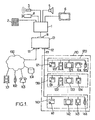
- a residence 110 includes several houses 120, 130 and 140, and is served by a communication network 111.
- Network 111 is internal to the residence.
- Terminals dedicated to response function to calls from visitors who show up at the entrance to the residence 110, or access control stations 121, 131 and 141, are arranged in each dwelling and are connected to the network 111.
- Such access control usually include a loudspeaker, a display screen visualization, as well as a button to open a door to the residence 110.
- various other communication terminals may also connected to the network 111, such as computer units 122 and 132, televisions 123, 133 and 142, a fixed telephony station 124, assistants 134 and 143, or mobile communication terminals 125 and 144.
- These terminals are distributed in dwellings 120, 130, 140 of the residence 110, so that they are each available to the occupants of the corresponding housing.
- a visioportier 1, of a known type, is installed at an entrance of the 110.
- Such a visoportier includes various means of capturing data such as a keyboard 2, a microphone 3 and a camera 4.
- the keyboard 2 allows to select one of the 120, 130 or 140 housing units for order a call to a resident occupying this dwelling.
- the keyboard 2 or the microphone 3 can also allow an input a message to the resident.
- the visoportier 1 also has means for presenting data, such as a loudspeaker 5 and a screen 6.
- bidirectional audio and / or video communication can be established between a visitor who orders a call by selecting one of the dwellings by means of the keyboard 2 and a resident present in this housing.
- the visioportier 1 is connected to the network 111 by an access gateway 10.
- the gateway 10 has a first port 11 for connection to the visoportier 1 and a second port 12 connection to the network 111.
- a specific connection cable connects the 1 to port 11. This cord ensures the electrical or optical transport of signals between the visoportier 1 and the bridge 10.
- the gateway 10 may comprise a third port 13 for a connection of the gateway to a network 100 external to the residence 110.
- the network 100 may be of several types, in particular a network switched telephone network (PSTN), or packet transmission network, by example an IP network.
- PSTN network switched telephone network
- IP network IP network
- the network 100 may in particular be adapted to support multimedia services according to H.323 and SIP standards (for Session Initiation Protocol, in English).
- terminals of different types can be connected to the network 100, among which computer unit 101, a mobile terminal 102, a telephone set 103 and a messenger 104.
- FIG. 2 illustrates an example of the gateway's internal architecture 10.
- the gateway 10 incorporates a routing unit 14, or unit routing of messages, connected to ports 11-13 of gateway 10.
- the unit 14 constitutes an access point to the networks 100 and 111 for the visioportier 1.
- Unit 14 is programmable. For this, the unit 14 is connected to a unit routing data storage 15. The data set in the unit 15 constitutes a transfer table calls.
- the gateway 10 also incorporates a server 16, adapted to receive programming data transmitted by the network 100 or the network 111, and by the unit 14. Such data is contained in messages to the server address 16.
- the server 16 extracts the data from programming of these messages and transmit them to the unit 14.
- the latter records them in the storage unit 15.
- the data thus received and registered documents constitute an initial programming or an update of the call transfer table.
- the structure of the call transfer table issued from the Visioportier 1 constitutes a second aspect of the invention. It is illustrated by the figure 3. It comprises fields distributed in four columns denoted C1-C4.
- the first column, C1 corresponds to the list of residents available at level of visoportier 1 to select one of them. It includes, by example an indication of the name of each resident (name # 1, name # 2, ). Each name may correspond to a separate dwelling, or to a person particular among the occupants of one of the dwellings.
- the second column, C2 includes, for each indication of the C1 column, an ordered list of terminal addresses or numbers addressing.
- Each of the terminals identified in column C2 is connected indifferently to one of the two networks 100 or 111.
- the third and fourth columns, respectively C3 and C4 define respectively, for each terminal indication contained in column C2, start and end indications of a time interval during which the corresponding terminal must be taken into account for a call transfer. So when a call is ordered at a time that belongs to the time interval indicated in columns C3 and C4 for a terminal, for example the terminal # 121, the call is transferred to this terminal. When the time of the call is outside the range defined by the indications contained in columns C3 and C4 for a terminal, this terminal is not taken into account.
- Each indication contained in columns C3 and C4 can be of the form date + time, to allow programming of unit 14 for a period of several days.
- a programming step of the unit 14 is then performed, when of which an identification of a resident is associated with a terminal for a time interval.
- a check can be made of so that time intervals defined by the indications in columns C3 and C4, at different lines and for the same indication of the column C1, has no recovery.
- the programming of the unit 14 can be made by a resident from any terminal connected to one of the networks 100 or 111.
- the resident can enter an authorization code to program a call transfer and then enter instructions from programming which are transmitted by the terminal used to the server 16 of the as described above.
- the programming instructions correspond to the contents of the fields in columns C1-C4.
- the programming step can be completed or modified at will by the resident at a later date.
- a resident may periodically change the programmed data that concern him, for example at the beginning of each week. Calls are then automatically transferred to the indicated terminals for intervals corresponding time, without the resident needing to resume the programming operation each time he leaves his home.
- the terminal to which a call is transferred automatically varies according to the date and time of this call and the indications in columns C3 and C4.
- the routing table described above is completed by another table, called strategy table.
- the strategy table includes, for each indication in column C1 of the routing table, a list of addresses or address numbers of terminals connected to the network 100 or to the network 111. Each list of the table of strategy is ordered according to a priority order of the corresponding terminals indicated in this list.
- the programming of the strategy table can be after the routing table, or be kept identical while the routing table is updated.
- a visitor wishes to enter residence 110, he or she a call at the level of the visioportier 1, intended for one of the residents, in order to that the latter authorizes him access to the residence.
- the choice of the resident is operated by a usual selection means available at the visoportier 1.
- the call is transmitted from from the visoportier 1 to the bridge 10. Thanks to the particular connection used between the bridge 10 and the visoportier 1, this first step of the transfer of the call does not borrow networks 100 and 111. Thus, it is not disturbed by possible congestion network 100.
- the connection itself between the bridge 10 and the visoportier 1 is not subject to congestion, since it links only those two elements of communication.
- the unit 14 looks in the transfer table for the lines thereof which correspond to the resident selected by the visitor. This research is made from the indications in column C1. Unit 14 then compares the time of the call at the times indicated in columns C3 and C4 for these lines. Several situations can then occur.
- the time of the call is intermediate between the hours, possibly also associated with dates, indicated in columns C3 and C4 for one of the lines corresponding to the selected resident.
- Unit 14 then transfer the call to the terminal identified in column C2 for that line.
- the call is made at this terminal, using one of the procedures known request for establishment of a communication.
- the call is successful, that is, a user of the terminal accepts the communication, it is established.
- the visitor can then be recognized by this user, and the user may allow him access to residence 110 in activating a command on the terminal dedicated to this function.
- the call can be held at this terminal during a specified waiting period, for example 30 seconds. At the end of this waiting period, no communication is established.
- Unit 14 then examine the list of the policy table associated with the selected resident by the visitor. The method of transferring the call is then continued in transferring the call to the terminal corresponding to the first indication of this listing. If the call is successful, a call is established. If the call does not succeed, it is then transferred by the unit 14 to the terminal corresponding to the second indication of the list of the resident's strategy table. And so after. The process is continued until the call is successful for one of the terminals in the list of the policy table associated with the selected resident by the visitor.
- the time of the call is not included in the time interval indicated in columns C3 and C4 for no line associated with an indication in column C1 that corresponds to the resident selected by the visitor.
- the transfer process of the call is then continued from the strategy table in the same way as described above, by browsing in order the list of this table associated with the resident selected.
- unit 14 has already reached the last terminal indication from the list of the strategy table corresponding to the selected resident. This situation corresponds to the case in which the call was successful for any terminal corresponding to an indication of the transfer table and / or the strategy table for the selected resident.
- the call can then be transferred by the unit 14 to a terminal determined by default for the resident. Alternatively, the call can then be transferred to the messenger 104, according to an e-mail address assigned to said resident.
- the unit 14 may further comprise a conversion module for convert a format of a communication flow according to a type of terminal. So, when the call has been successful for one of the terminals indicated in the C2 column of the transfer table or indicated in the strategy table, or when the call has been transferred to the messenger 104, the unit 14 adapts the format of the communication flow according to the type of the terminal or the messaging. An indication of this type may be recorded in the unit of storage 15 or, in known manner, it can be determined by the unit 14 in function of an identifier of the terminal or messaging.
- the unit 14 can further comprising a controller arranged call transfer means so that a call at the level of the visioportier to a determined resident is systematically transferred by unit 14 to a terminal determined.
- a controller arranged call transfer means so that a call at the level of the visioportier to a determined resident is systematically transferred by unit 14 to a terminal determined.
- the controller can be activated in response to the reception by the unit 14 or by the server 15 of a message including a transfer instruction systematic.
- This message includes an indication of the resident for whom the systematic transfer must be made, as well as a terminal identification to which calls must be systematically transferred.
- This identification can include the address or terminal addressing number in one networks, and possibly an identifier in this terminal.
- the message that includes the systematic transfer instruction of the calls to a specific terminal is transmitted from this terminal.
- such a message may be in the form of an SMS (for "Short Message Service, in English) sent via the terminal to the address unit 14 or server 15.
- SMS short Message Service
- the invention has been described in the context of an implementation for a residential residence. It is understood that it can be applied in a analogous to all types of sites whose access is controlled by means of a visioportier.
- unit 14 includes a transfer table and a strategy table. It is understood that these two tables can be presented in a different way, or even put together in a single table, while remaining within the framework of the present invention.
- the two criteria for selecting a terminal which an appeal is transferred namely the temporal criterion and the criterion of priority, can be combined in various ways known in programming.
Landscapes
- Engineering & Computer Science (AREA)
- Signal Processing (AREA)
- Data Exchanges In Wide-Area Networks (AREA)
Abstract
Description
- la figure 1 représente un visioportier équipé d'une passerelle selon l'invention ;
- la figure 2 représente une architecture interne d'une passerelle selon l'invention ;
- la figure 3 illustre une table de transfert d'appels enregistrée dans une passerelle selon l'invention.
Claims (18)
- Passerelle (10) de liaison d'un visioportier de résidence (1) à un réseau de communication (100, 111), incorporant une unité de routage programmable (14, 15), ladite unité de routage comprenant des moyens de transfert d'un appel commandé au niveau du visioportier à destination d'un résident vers un premier terminal relié au réseau (101-103, 121-125) et affecté audit résident pour un intervalle de temps par programmation de l'unité de routage, les moyens de transfert étant agencés pour transférer l'appel si une référence temporelle de l'appel appartient à l'intervalle de temps.
- Passerelle selon la revendication 1, incorporant en outre un serveur (16) relié à l'unité de routage (14, 15) et adapté pour recevoir des instructions de programmation du transfert de l'appel et pour programmer l'unité de routage en fonction desdites instructions.
- Passerelle selon la revendication 1 ou 2, dans lequel les moyens de transfert sont en outre agencés pour transférer l'appel à un second terminal affecté audit résident par programmation de l'unité de routage, lorsque l'appel transféré audit premier terminal n'aboutit pas ou lorsque la référence temporelle de l'appel n'appartient pas à l'intervalle temporel associé audit premier terminal.
- Passerelle selon l'une quelconque des revendications 1 à 3, dans lequel les moyens de transfert sont en outre agencés pour transférer l'appel à un terminal déterminé par défaut pour ledit résident, lorsque la référence temporelle de l'appel n'appartient à aucun intervalle temporel associé à un terminal affecté audit résident, et lorsque n'aboutit aucun appel transféré à un autre terminal affecté audit résident.
- Passerelle selon l'une quelconque des revendications 1 à 3, dans lequel les moyens de transfert sont en outre agencés pour transférer l'appel à une messagerie (104) selon une adresse de messagerie affectée audit résident, lorsque la référence temporelle de l'appel n'appartient à aucun intervalle temporel associé à un terminal affecté audit résident, et lorsque n'aboutit aucun appel transféré à un autre terminal affecté audit résident.
- Passerelle selon l'une quelconque des revendications précédentes, dans lequel l'unité de routage (14, 15) comprend en outre un contrôleur des moyens de transfert agencé pour commander un transfert systématique de l'appel à un terminal déterminé, lorsqu'un message contenant une consigne de transfert systématique est reçu par la passerelle pour ledit résident.
- Passerelle selon l'une quelconque des revendications précédentes, comprenant en outre des moyens de conversion agencés pour convertir un format d'un flux de communication transmis à la suite d'un appel transféré à un terminal (101-103, 121-125), en fonction d'un type dudit terminal.
- Procédé de transfert d'un appel commandé au niveau d'un visioportier de résidence (1), comprenant les étapes suivantes :et comprenant le étapes suivantes lorsqu'un appel est commandé au niveau du visioportier (1) à destination du résident :liaison du visioportier à un réseau de communication (100, 111) en utilisant une passerelle (10) connectée entre le visioportier et le réseau de communication ;programmation d'une unité de routage (14, 15) de ladite passerelle (10), de sorte qu'au moins un terminal relié au réseau (101-103, 121-125) est affecté à un résident pour un intervalle de temps ;transmission de l'appel à partir du visioportier (1) à la passerelle (10) ;transfert, par l'unité de routage (14, 15), de l'appel à un premier terminal affecté audit résident si une référence temporelle de l'appel appartient à l'intervalle de temps associé audit premier terminal.
- Procédé selon la revendication 8, dans lequel le réseau de communication (111) est interne à la résidence (110).
- Procédé selon la revendication 8, dans lequel le réseau de communication (100) est externe à la résidence (110).
- Procédé selon la revendication 8, dans lequel la passerelle (10) est reliée d'une part à un réseau de communication externe à la résidence (100) et d'autre part à un réseau de communication interne à la résidence (111).
- Procédé selon l'une quelconque des revendications 8 à 11, suivant lequel la programmation de l'unité de routage (14, 15) est effectuée à partir d'instructions envoyées par le réseau (100, 111) à la passerelle (10).
- Procédé selon l'une quelconque des revendications 8 à 12, suivant lequel, lorsque l'appel transféré audit premier terminal n'aboutit pas ou lorsque pas la référence temporelle de l'appel n'appartient pas à l'intervalle de temps associé audit premier terminal, l'appel est ensuite transféré par l'unité de routage (14, 15) à un second terminal affecté audit résident par programmation de l'unité de routage.
- Procédé selon l'une quelconque des revendications 8 à 13, suivant lequel, lorsque la référence temporelle de l'appel n'appartient à aucun intervalle de temps associé à un terminal affecté audit résident, et lorsque n'aboutit aucun appel transféré à un autre terminal affecté audit résident, l'appel est ensuite transféré par l'unité de routage (14, 15) à un terminal déterminé par défaut pour ledit résident.
- Procédé selon l'une quelconque des revendications 8 à 13, suivant lequel, lorsque la référence temporelle de l'appel n'appartient à aucun intervalle de temps associé à un terminal affecté audit résident, et lorsque n'aboutit aucun appel transféré à un autre terminal affecté audit résident, l'appel est ensuite transféré par l'unité de routage (14, 15) à une messagerie (104) selon une adresse de messagerie affectée audit résident.
- Procédé selon l'une quelconque des revendications 8 à 15, suivant lequel l'appel est systématiquement transféré par l'unité de routage (14, 15) à un terminal déterminé, lorsqu'une consigne de transfert systématique est transmise à la passerelle pour ledit résident.
- Procédé selon la revendication 16, suivant lequel ladite consigne est émise à partir dudit terminal déterminé, et comprend une identification dudit terminal déterminé.
- Procédé selon l'une quelconque des revendications 8 à 17, suivant lequel un format d'un flux de communication transmis à la suite d'un appel transféré à un terminal est converti en fonction d'un type dudit terminal.
Applications Claiming Priority (2)
| Application Number | Priority Date | Filing Date | Title |
|---|---|---|---|
| FR0314031A FR2863132A1 (fr) | 2003-11-28 | 2003-11-28 | Passerelle de liaison d'un visioportier |
| FR0314031 | 2003-11-28 |
Publications (1)
| Publication Number | Publication Date |
|---|---|
| EP1551165A1 true EP1551165A1 (fr) | 2005-07-06 |
Family
ID=34566250
Family Applications (1)
| Application Number | Title | Priority Date | Filing Date |
|---|---|---|---|
| EP04292673A Withdrawn EP1551165A1 (fr) | 2003-11-28 | 2004-11-10 | Passerelle de liaison d'un visioportier |
Country Status (2)
| Country | Link |
|---|---|
| EP (1) | EP1551165A1 (fr) |
| FR (1) | FR2863132A1 (fr) |
Cited By (2)
| Publication number | Priority date | Publication date | Assignee | Title |
|---|---|---|---|---|
| BE1017351A3 (nl) * | 2006-11-02 | 2008-06-03 | Ojomoh Clifford | Verbeterde parlofoon. |
| EP1821263A3 (fr) * | 2006-02-02 | 2010-03-17 | Actip Limited | Système de contrôle d'accès |
Citations (2)
| Publication number | Priority date | Publication date | Assignee | Title |
|---|---|---|---|---|
| WO2001013638A1 (fr) * | 1999-08-16 | 2001-02-22 | Dpf Electronique | Portier audiovideo repondeur |
| FR2826820A1 (fr) * | 2001-06-28 | 2003-01-03 | France Telecom | Procede de communication entre un visiteur et un residant par l'intermediaire d'un systeme d'interphone, serveur de mise en relation et portier pour mise en oeuvre du procede |
-
2003
- 2003-11-28 FR FR0314031A patent/FR2863132A1/fr active Pending
-
2004
- 2004-11-10 EP EP04292673A patent/EP1551165A1/fr not_active Withdrawn
Patent Citations (2)
| Publication number | Priority date | Publication date | Assignee | Title |
|---|---|---|---|---|
| WO2001013638A1 (fr) * | 1999-08-16 | 2001-02-22 | Dpf Electronique | Portier audiovideo repondeur |
| FR2826820A1 (fr) * | 2001-06-28 | 2003-01-03 | France Telecom | Procede de communication entre un visiteur et un residant par l'intermediaire d'un systeme d'interphone, serveur de mise en relation et portier pour mise en oeuvre du procede |
Cited By (2)
| Publication number | Priority date | Publication date | Assignee | Title |
|---|---|---|---|---|
| EP1821263A3 (fr) * | 2006-02-02 | 2010-03-17 | Actip Limited | Système de contrôle d'accès |
| BE1017351A3 (nl) * | 2006-11-02 | 2008-06-03 | Ojomoh Clifford | Verbeterde parlofoon. |
Also Published As
| Publication number | Publication date |
|---|---|
| FR2863132A1 (fr) | 2005-06-03 |
Similar Documents
| Publication | Publication Date | Title |
|---|---|---|
| US5764736A (en) | Method for switching between a data communication session and a voice communication session | |
| JP4463328B2 (ja) | パケットデータネットワークで通信を設定する方法 | |
| JP3628962B2 (ja) | インターネット通話待ち | |
| US20040246946A1 (en) | Telephone-based Hypertext Transport Protocol server | |
| US20070165554A1 (en) | System, Method and Portable Communication Device | |
| FR2753862A1 (fr) | Procede et systeme de communication interactive entre deux appareils telephoniques via le reseau internet | |
| US20060165092A1 (en) | Out-of-band signaling system, method and computer program product | |
| US20070064894A1 (en) | Method, system and device for relay call transfer service | |
| CN101371561A (zh) | 家庭通信服务器 | |
| FR2796796A1 (fr) | Systeme d'acces a distance a des services de telecommunications et/ou d'informatique utilisant les messages courts des telephones fixes ou mobiles | |
| EP1443727A1 (fr) | Dispositif de traitement de données pour l'établissement de communications par sélection de terminaux d'utilisateurs en fonction de leur accessibilité | |
| EP1650941B1 (fr) | Système pour distribuer des capacités VXML pour l'exécution sur des dispositifs clients | |
| EP1551165A1 (fr) | Passerelle de liaison d'un visioportier | |
| FR2814623A1 (fr) | Procede pour mettre en relation deux terminaux, a travers un reseau informatique, terminal et serveur de mise en relation associes | |
| WO2003094473A2 (fr) | Site web ayant un element d'identification evenement | |
| EP1358756A2 (fr) | Procede et equipement pour l'activation d'une fonction de communication d'informations par un equipement distant | |
| WO1999053670A2 (fr) | Systeme d'information exclusif et divers procedes d'utilisation associes | |
| KR20240030717A (ko) | E(embedded)-sim(Subscriber Identity Module) 또는 U(Universal)-sim(Subscriber Identity Module) 통신모듈과 카메라가 장착된 휴대폰 또는 카메라가 장착된 E-sim 이동통신모듈을 탑재한 이동식 CCTV장치와 그 처리방법 | |
| EP1414244B1 (fr) | Système de visualisation d'images provenant d'au moins une caméra vidéo sur un téléphone cellulaire | |
| EP1410599A2 (fr) | Systeme de mise en relation multi-protocoles, multimedia et contextuel | |
| EP1135922A1 (fr) | Procede d'etablissement d'une communication entre deux terminaux + travers l'internet par un serveur d'appel, terminal et serveur associes | |
| FR2895861A1 (fr) | Systeme de transfert de communications, procede, dispositif et programme | |
| JP2005286640A (ja) | ネットワークアクセス装置とそのプログラム、及び自動接続設定システムと方法 | |
| EP1017213A1 (fr) | Procédé de gestion de communications téléphoniques | |
| WO2004016025A2 (fr) | Systeme de telecommunication, et serveur et terminal pour ce systeme |
Legal Events
| Date | Code | Title | Description |
|---|---|---|---|
| PUAI | Public reference made under article 153(3) epc to a published international application that has entered the european phase |
Free format text: ORIGINAL CODE: 0009012 |
|
| AK | Designated contracting states |
Kind code of ref document: A1 Designated state(s): AT BE BG CH CY CZ DE DK EE ES FI FR GB GR HU IE IS IT LI LU MC NL PL PT RO SE SI SK TR |
|
| AX | Request for extension of the european patent |
Extension state: AL HR LT LV MK YU |
|
| 17P | Request for examination filed |
Effective date: 20051227 |
|
| AKX | Designation fees paid |
Designated state(s): AT BE BG CH CY CZ DE DK EE ES FI FR GB GR HU IE IS IT LI LU MC NL PL PT RO SE SI SK TR |
|
| 17Q | First examination report despatched |
Effective date: 20070731 |
|
| RAP1 | Party data changed (applicant data changed or rights of an application transferred) |
Owner name: ORANGE |
|
| STAA | Information on the status of an ep patent application or granted ep patent |
Free format text: STATUS: EXAMINATION IS IN PROGRESS |
|
| STAA | Information on the status of an ep patent application or granted ep patent |
Free format text: STATUS: THE APPLICATION IS DEEMED TO BE WITHDRAWN |
|
| 18D | Application deemed to be withdrawn |
Effective date: 20170601 |