EP1551205A1 - Kopfbezogene-Übertragungsfunktion-Virtualisierer - Google Patents
Kopfbezogene-Übertragungsfunktion-Virtualisierer Download PDFInfo
- Publication number
- EP1551205A1 EP1551205A1 EP04029805A EP04029805A EP1551205A1 EP 1551205 A1 EP1551205 A1 EP 1551205A1 EP 04029805 A EP04029805 A EP 04029805A EP 04029805 A EP04029805 A EP 04029805A EP 1551205 A1 EP1551205 A1 EP 1551205A1
- Authority
- EP
- European Patent Office
- Prior art keywords
- audio source
- microphones
- sound
- data set
- relative
- Prior art date
- Legal status (The legal status is an assumption and is not a legal conclusion. Google has not performed a legal analysis and makes no representation as to the accuracy of the status listed.)
- Granted
Links
Images




Classifications
-
- H—ELECTRICITY
- H04—ELECTRIC COMMUNICATION TECHNIQUE
- H04M—TELEPHONIC COMMUNICATION
- H04M3/00—Automatic or semi-automatic exchanges
- H04M3/42—Systems providing special services or facilities to subscribers
- H04M3/56—Arrangements for connecting several subscribers to a common circuit, i.e. affording conference facilities
- H04M3/568—Arrangements for connecting several subscribers to a common circuit, i.e. affording conference facilities audio processing specific to telephonic conferencing, e.g. spatial distribution, mixing of participants
-
- H—ELECTRICITY
- H04—ELECTRIC COMMUNICATION TECHNIQUE
- H04M—TELEPHONIC COMMUNICATION
- H04M3/00—Automatic or semi-automatic exchanges
- H04M3/42—Systems providing special services or facilities to subscribers
- H04M3/56—Arrangements for connecting several subscribers to a common circuit, i.e. affording conference facilities
- H04M3/567—Multimedia conference systems
-
- H—ELECTRICITY
- H04—ELECTRIC COMMUNICATION TECHNIQUE
- H04R—LOUDSPEAKERS, MICROPHONES, GRAMOPHONE PICK-UPS OR LIKE ACOUSTIC ELECTROMECHANICAL TRANSDUCERS; ELECTRIC HEARING AIDS; PUBLIC ADDRESS SYSTEMS
- H04R3/00—Circuits for transducers
- H04R3/12—Circuits for transducers for distributing signals to two or more loudspeakers
-
- H—ELECTRICITY
- H04—ELECTRIC COMMUNICATION TECHNIQUE
- H04S—STEREOPHONIC SYSTEMS
- H04S7/00—Indicating arrangements; Control arrangements, e.g. balance control
- H04S7/30—Control circuits for electronic adaptation of the sound field
- H04S7/302—Electronic adaptation of stereophonic sound system to listener position or orientation
- H04S7/303—Tracking of listener position or orientation
-
- H—ELECTRICITY
- H04—ELECTRIC COMMUNICATION TECHNIQUE
- H04R—LOUDSPEAKERS, MICROPHONES, GRAMOPHONE PICK-UPS OR LIKE ACOUSTIC ELECTROMECHANICAL TRANSDUCERS; ELECTRIC HEARING AIDS; PUBLIC ADDRESS SYSTEMS
- H04R2201/00—Details of transducers, loudspeakers or microphones covered by H04R1/00 but not provided for in any of its subgroups
- H04R2201/40—Details of arrangements for obtaining desired directional characteristic by combining a number of identical transducers covered by H04R1/40 but not provided for in any of its subgroups
- H04R2201/403—Linear arrays of transducers
-
- H—ELECTRICITY
- H04—ELECTRIC COMMUNICATION TECHNIQUE
- H04S—STEREOPHONIC SYSTEMS
- H04S2400/00—Details of stereophonic systems covered by H04S but not provided for in its groups
- H04S2400/01—Multi-channel, i.e. more than two input channels, sound reproduction with two speakers wherein the multi-channel information is substantially preserved
-
- H—ELECTRICITY
- H04—ELECTRIC COMMUNICATION TECHNIQUE
- H04S—STEREOPHONIC SYSTEMS
- H04S2400/00—Details of stereophonic systems covered by H04S but not provided for in its groups
- H04S2400/11—Positioning of individual sound objects, e.g. moving airplane, within a sound field
-
- H—ELECTRICITY
- H04—ELECTRIC COMMUNICATION TECHNIQUE
- H04S—STEREOPHONIC SYSTEMS
- H04S2420/00—Techniques used stereophonic systems covered by H04S but not provided for in its groups
- H04S2420/01—Enhancing the perception of the sound image or of the spatial distribution using head related transfer functions [HRTF's] or equivalents thereof, e.g. interaural time difference [ITD] or interaural level difference [ILD]
Definitions
- the invention relates to spatial audio systems and in particular relates to systems and methods of producing, adjusting and maintaining natural sounds, e.g., speaking voices, in a telecommunication environment.
- Computer Telephone Integrated (CTI) audio terminals typically have multiple speakers or a stereo headset.
- CTI Computer Telephone Integrated
- Telephone handsets and hands-free audio conferencing terminals do not take into account the relative position between the one or more speaking persons and their audience.
- Present devices simulate a single point source of an audio signal that emanates typically from a fixed position, whether it is sensed via compression diaphragm of the handset or the speaker of a teleconferencing system.
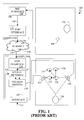
- FIG. 1 illustrates a system 100 where a listener 126 exchanges audio signals with a remote human speaker 102. While both listener 126 and human speaker 102 may have similar interposed signal processing devices, only those elements necessary for illustrating the prior are illustrated.
- the user or listener 126 perceiving his or her counterpart, the human speaker 102 or source, as a flat sound wall 128 emanating from a left audio speaker 122 and a right audio speaker 124, for example.
- the flat sound wall 128 is not a realistic representation of an actual human audio source.
- a human speaker 102 is within pickup range of a microphone 104.
- the microphone 104 connects to a computer 106 wherein the audio signals are converted into a format compatible with being transmitted to the listener.
- the microphone interface 108 may perform analog anti-aliasing filtering before sending the analog signal to a coder-decoder for sampling, quantizing, and compressing the digital stream to be expanded and converted to analog signals on the receiving end.
- the digitized audio signals may be transmitted as data packets over a network such as the Internet.
- the Voice-over Internet Protocol is an example of such an Internet protocol that may use a Session Initiation Protocol (SIP) to define the VoIP switching fabric.
- the voice data packets leave the human speaker's computer 106 and travel via the Internet 110 to the listener's computer 112.
- the listener's communication processing interface like the VoIP interface 114 of the listener's computer reconstructs the media stream into the monaural signal 117 similar to the signal recorded at the speaker's microphone 104.
- the destination processing 112 applies forms of spatial audio filtering 116 to shape the monaural signal 117 to then be sent to two or more audio speaker drivers 118. With equalization filtering alone, the pair of audio speakers 122,124 are perceived by the listener as being a flat source 128 that is equidistant between the two audio speakers 122, 124.
- the left audio speaker 122 and right audio speaker 124 of the example illustrated in FIG. 1 may be spaced, for computer-based telephony interface layouts, at +5 degrees and - 5 degrees respectively from an axis having an origin at the listener and extending to and perpendicular with the audio speaker array. For teleconferencing environments, that spacing may be increased to +30 and -30 degrees. This audio speaker spacing produces crosstalk at the left and right ears of the listener. With transaural processing applied to cancel or substantially reduce crosstalk between audio speakers channels, the perceived audio effect can be enhanced.
- the perceived effect audio source translation is adjustable by the listener.
- Psychiacoustic characteristics of the sound may be exploited in whole or part to create a perceived change in distance.
- Psychoacoustic characteristics of the sound of a source increasing in distance from the listener include: quieter due to the extra distance traveled, less high frequency content principally due to air absorption; more reverberant particularly in a reflective environment; less difference between time of direct sound and first floor reflection creating a straight wave front: and attenuated ground reflection.
- An additional spatial filter effect that follows is to lower the intensity, or volume, attenuate the higher frequencies, and add some forms of reverberation, for example, whereby the listener perceives the audio source increasing in distance from the listener. Again, this perceived effect is adjustable by the listener.
- the perceived audio source can be translated to the left for example 132, translated in added distance 130 or a combination of left translation and added distance 134.
- the Head-Related Impulse Response characterizes the impulse response, h(t), from the audio source to the ear drum, that is, the normalized sound pressure that an arbitrary source, x(t), produces at the listener's ear drum.
- the Fourier transform of h(t) is called the Head-Related Transfer Function (HRTF).
- HRTF captures all of the physical cues to source localization.
- headphones aid in synthesizing accurate binaural signals from a monaural source.
- the HRTF can be described as a function of four variables, i.e., three space coordinates and frequency.
- the source In spherical coordinates where distances are greater than about one meter, the source is said to be in the far or free field, and the HRTF falls off inversely with range. Accordingly, most HRTF measurements are free field measurements.
- Such a free field HRTF database of filter coefficients essentially reduces the HRTF to a function of azimuth, elevation and frequency. For a readily implementable system, the HRTF matrix of filter coefficients is further reduced to a function of azimuth and frequency.
- the Fourier transform of the sound pressure measured in the listener's left ear can be written as P PROBE
- the Fourier transform for the free field, independent of sound incidence can be written as P REFERENCE (j ⁇ , ⁇ , ⁇ ), where j represents the imaginary number, -1 .
- the HRTF then accounts for the sound diffraction caused by the listener's head, torso and, given manner in which measurement data are taken, outer ear effects as well.
- the left and right HRTF for a particular azimuth and elevation angle of incidence can evidence a 20 dB difference due to interaural effects as well a 600 micro second delay (where the speed of sound, c, is approximately 340 meters/second).
- the typically binaural spatial filtering may include an array of HRTFs that when implemented as impulse response filters, are convolved with the monaural signal to produce a perceived effect of hearing a natural audio source, that is one having interacted with the head, torso and outer ear of the listener.
- FIG. 2 illustrates the case of audio speakers, particularly an array having a left audio speaker 122 and a right audio speaker 124 where, as part of the listener's processing interface 112, the spatial filtering includes the convolution of filters representing HRTFs as well as transaural processing to cancel the crosstalk.
- HRTF databases most commonly for a free field plane, are available and are mechanized as filters with tunable or otherwise adjustable coefficients.
- the listener can select nominal filters for the left and right ear as listener inputs 121.
- the HRTF adjustments 216 may be for left and right translation where channel-to-channel delay may be employed, or may be for increased distance where intensity decrease, high frequency attenuation and reverberation may be introduced or may be for enhancing the natural sound of the audio speakers 122, 124 where coefficients of the filters representing the HRTF database 214 may be adjusted, or any combination thereof.
- the resulting filters, amplitudes and delays are convolved with the reconstructed monaural source 117 with the two channels being equalized, and transaurally corrected 212 before the signals are sent to the audio speakers 122, 124.
- FIG. 3 illustrates a monaural microphone and an example of its spherical coordinate system 300. From a first reference axis 302, x, one subtends an azimuth angle 304, ⁇ , one next subtends an elevation angle 306, ⁇ . Along this directional vector, the audio source 102 lies a distance, ⁇ , from the microphone origin 301, O . Other microphones have left and right microphones integral to a single device, i.e., coincident, providing directionality principally from the pressure differences.
- FIG. 4 illustrates a coincident microphone 402 having two principal sensing elements in a horizontal plane 400.
- the audio source 102 subtends an azimuth angle 304, ⁇ , from the reference axis 302, x, and lies a distance 407, ⁇ 0 , from coincident microphone 402.
- the azimuth angle 304, ⁇ can be measured.
- FIG. 5 illustrates an example of a two-dimensional microphone array that has microphones in an array 502 distributed linearly, each at an equal distance, d 504, from one another.
- ⁇ from an audio source 102 distant enough from the microphone array 502 to produce a substantially linear wave front 506
- a n may be adjusted and/or shaped with finite impulse response filtering to steer the array to an angle ⁇ 0 by inputting a time delay.
- the 2D array of microphones are steerable to ⁇ 0 .
- the n -1 nulls are available to be placed at n -1 frequencies to notch out and otherwise mitigate discrete, undesired, noise sources.
- the steerable array may employ passive sweeps, or infrared optics to augment source locations.
- Stereophonic microphones are separated by distances that often precluding steerability, but providing time delay information nonetheless. For example, with two coincident microphones separated by a known distance, d 1,2 , as illustrated in FIG. 6, the angle incidence to each, ⁇ 1 632 and ⁇ 2 630 is measured from which both ⁇ 1 606 and ⁇ 2 608 may be determined as well as the distance, s 1 614, from the array.
- a steerable array of microphones 602 can be exchanged for each to enhance coincident microphones resolution.
- FIG. 6 Also illustrated in FIG. 6 is the arrangement where an audio source 102 is directly aligned with one microphone position. In such an arrangement, any other microphone positions along a 2D array line will sense the audio source signals with delay relative to the first microphone position. This delay and known microphone positions are used to resolve the distance, s 2 612, which should be substantially the same as ⁇ 3 610, of the audio source 102 from the array 602 and can be used to refine the angle of incidence, ⁇ 1 632 and ⁇ 2 630, for those microphones not directly in line, with the audio source 102.
- the present invention in its several embodiments includes a method of and system for processing sound data received at a microphone.
- the method includes the steps of: receiving a transmission having sound data and an audio source spatial data set relative to the microphone; using a sound conditioning filter database having filters characterized by a stored set of coefficients wherein each stored set of filter coefficients is a function of at least one element of the audio source spatial data set, to determine two or more stored sets of coefficients proximate to the at least one element of the audio source spatial data set; interpolating between the determined two or more stored sets of coefficients; convolving the sound data with a shaping filter having the interpolated filter coefficients; and then transmitting the resulting signal to a sound-producing device.
- a preferred embodiment accommodates a spatial data set having a first angle of incidence relative to the microphone, a second angle of incidence relative to the microphone substantially orthogonal to the first angle of incidence, or a distance setting relative to the microphone, or any combination thereof.
- a second embodiment of the method of for processing sound data received at a microphone includes steps of: transmitting sound waves toward a subject having a torso and a head via an audio speaker array; receiving the reflected sound waves via a microphone array; processing the received sound waves to determine time-relative changes in subject head orientation and subject torso orientation; translating the determined time-relative changes in subject orientation into changes in an audio source spatial data set using a sound conditioning filter database having filters characterized by a stored set of coefficients wherein each stored set of filter coefficients is a function of at least one element of the audio source spatial data set, to determine two or more stored sets of coefficients proximate to the at least one element of the audio source spatial data set; interpolating between the determined two or more stored sets of coefficients; convolving the sound
- the several system embodiments of the present invention for spatial audio source tracking and representation include one or more microphones; a microphone processing interface for providing a sound data stream and an audio source spatial data set; a processor for modifying spatial filters based on the audio source spatial data set and for shaping the sound data stream with modified spatial filters; and a sound-producing array, e.g., headphones or an array of audio speakers.
- the spatial data set include an audio source distance setting relative to the one or more microphones and a first audio source angle of incidence relative to the one or more microphones either separately or in combination and may include a second audio source angle of incidence relative to the one or more microphones, the second audio source angle of incidence being substantially orthogonal to the first audio source angle of incidence.
- the system also includes a first communication processing interface for encapsulating the sound data and an audio source spatial data set relative to the one or more microphones into packets; and transmitting via a network the packets; and a second communication processing interface for receiving the packets and de-encapsulating sound data and the audio source spatial data set.
- the system also includes a first communication processing interface for encoding the sound data and an audio source spatial data set relative to the one or more microphones into telephone signals; and transmitting via a circuit switched network; and a second communication processing interface for receiving the telephone signal and de-encoding the sound data and the audio source spatial data set.
- FIG. 7 illustrates voice data transmission from a human speaker 102 to a human listener 126 via a first voice processing device 106 and a second voice-processing device 112 operably connected by a network such as the Internet 110.
- a coincident microphone 402 captures the voice of the human speaker 102.
- a steerable array of microphones 502 or a distributed array 602 of coincident microphones 402 or omnidirectional microphones are alternatives that may be preferred for teleconferencing.
- the microphone interface 108 may include filters necessary to shape the audio signals prior to digitization to minimizing aliasing effects, for example.
- the microphone interface 108 may include sampling and quantizing the signal to produce a digital stream.
- the microphone interface 108 may also include digital signal processing for deriving an angle of incidence of the audio source 102 in a measurable plane and may include nulling or notching filters to eliminate noise sources directionally.
- the voice data is transmitted via a data plane.
- the captured voice for example is, in the preferred embodiment, converted into a format acceptable for transmission over the Internet such a VoIP thereby encapsulating the voice data with destination information for example.
- the second voice-processing device 112 de-encapsulates the voice data from the VoIP protocol 114 into a monaural digital signal 117.
- the monaural signal 117 is convolved with spatial audio filtering 116, converted via speaker drivers 118 to drive two channels in this example each having an audio speakers 122, 124.
- the listener may have indicated 121 selections, via an interface 120 for the spatial audio filtering to draw from a bank of HRTFs that are either close to the listener in acoustical effect or tuned for the listener.
- the resulting effect is an audio source for the listener that is more natural and in this example, the audio "image" may be centered between the two audio speakers, moved left or right of center by the listener and given frequency response shaping, reverberation and amplitude reductions that may produce an effect of a more distant source.
- the HRTF has in the past been described and analyzed according to classical time and frequency domain analysis, it is important to note that the same relationships can be alternatively modeled in the wavelet domain, i.e., instead of describing the model as a function of time, space, or frequency; the same model can be described as a function of basis functions of the one or more of the same variables.
- This technique, as well as other modern mathematical techniques, such as fractal analysis, a modeling technique based on self-similarity of multivariable functions, may be applied in some embodiments with intent of achieving greater processing and storage efficiencies with greater accuracy than that the classical methodologies.
- the microphone interface 708 in addition to other signal processing functions, derives an angle of incidence, ⁇ , for the voice of the human speaker 102 preferably relative to the microphone 402 or center of the microphone array 502, 602, for example.
- this angle of incidence may be communicated on the signal plane.
- this derived angle incidence, ⁇ , as source-to-microphone relative spatial data 711 is encapsulated along with the voice data 709 with an extended VoIP 710, accommodating this data, and the data is transmitted as packets 140, 150 via a network 110 to a second VoIP processing device 112 enabled to de-encapsulate the extended VoIP data packets at the communication processing interface 714 having angle of incidence, ⁇ , data into a reconstructed monaural signal 117 and the reconstructed source-to-microphone relative spatial data 717.
- the spatial filtering of the second VoIP processing device 112 includes the angle of incidence information by interpolating 716 the selected HRTFs to account for an angle of incidence if not already overridden by the listener via listener inputs 121 at the listener interface 120.
- the human speaker 102 is left of center of a microphone assembly 402 or array 502, 602. With the listener 126 having set the source preference to be that the human speaker acoustical image is nominally facing the listener when the listener is facing the audio speaker array 122, 124, then the resulting "imaged" audio source 728 is perceived to be right of center of the audio speaker array 122, 124.
- the listener may choose to add depth cues to push off the perceived distance of the translated human speaker 730 to be aft to the audio speaker array.
- the listener 126 may select to ignore the angle of incidence information in the processing of his spatial filtering of the monaural signals, leaving the "imaged' source to be in the center 128 of the speaker array 122, 124.
- the user may add distance effects 130 if he so desires.
- the first transmitted angle of incidence, the second transmitted angle of incidence substantially orthogonal to the first transmitted angle of incidence, or a relative distance setting or any combination 717 is used to drive the interpolation 804 of the HRTF database to a solution of filter coefficients between previously quantified incident angles, i.e., those having filter coefficient arrays based on acoustical measurements, so that the convolution includes the spatial filters adjusted for one or both of the transmitted incidence angles.
- the HRTFs may be a function of frequency and azimuth angle.
- the interpolation can be a linear interpolation of the HRTF coefficients for the stored azimuth angles of incidence that bound the derived azimuth angle of incidence.
- the invention is readily extended to a three-dimensional array where the microphone array and audio speaker array is in a plane rather than linear.
- the HRTFs may be a function of frequency, azimuth and elevations angles of incidence where the range is removed in free field implementations.
- the interpolation can be a linear interpolation of the HRTF coefficients for the stored azimuth and elevation angles of incidence pairs that bound the derived azimuth angle of incidence and the derived elevation angle.
- this is interpolating to a point within a parallelogram region defined by the stored coefficients as functions of pairs of azimuth and elevation angles of incidence.
- Higher order and nonlinear interpolations may be applied where appropriate to properly scale the perceived effect. Where interpolation is inadequate to supply the shaping sought for the acoustical "image" for all expected angles of incidence, then increasing the resolution of the HRTF database may be required.
- the speaking human 102 moves from a first location to a second location during a session where the distance relative to the microphone 402 or microphone array 502, 602 is characterized as a vector 902 having time differences in measured angles of incidence and differences in perceived distance settings.
- the microphone interface processing 706 of the microphones 402 or microphone array 502, 602 in this example for the first location may yield an initial angle of incidence of sufficient quality to be included along with the voice data in data packets and transmitted over a network.
- the listener interface processor 112 processes 716 the angle of incidence and places the perceived audio source to the right of center of the two audio speakers 728. This is an automatic nominal setting.
- the listener can override this effect and may adjust the filters to induce a distancing effect 730 for a listener-selected nominal position of the acoustical "image.”
- the new position of the human speaker is derived from the microphone processing 708 and via the VoIP communication processing interface 710, whereby the new angle of incidence is transmitted to effect, in the signal processing 716, the interpolation 804 in the signal processing 716 of the coefficients of the HRTFs.
- the microphone processing also derives a relative change in the distance of the human speaker 102 relative to a reference point of the microphones 402 or microphone array 502, 602.
- the derived relative distance may be included as relative spatial data 711 along with the voice data 709 in data packets preferably the VoIP 710 and transmitted over a network 110.
- the listener interface processing 112 may then account for the change in angle of incidence 910 from a nominal derived position 728 or may then account for the change in derived relative distance 730, or account for both 912. If the listener set a perceived distance 914 or angle or both for the human speaker, then the listener interface processing may account for the change in angle of incidence 920, change in distance 916, or both 918.
- FIG. 10 illustrates an example of an embodiment of the system in one direction of transmission with the understanding that the bi-directional transmission is intended as well with each participant in the voice exchange having the necessary devices and functionality.
- the microphones or microphone array 1010 is connected with the computer 106 of the human speaker 102.
- the microphone signal processing 708 may include analog filters to mitigate aliasing for example and digital filters for setting nulls or notches and for reducing cross-talk for example. If available, the microphone signal processing 708 determines one or both of the angles of incidence and the nominal distance setting of the human speaker102 relative to the microphone array 1010, i.e., the voice origin data 711.
- the determined relative angle of incidence and relative distance settings are prepared 1012 to be added to packets according to the VoIP and then the voice data 109 are encapsulated along with the voice origin data 711 according to the enhanced VoIP communication processing interface 1014.
- the voice and voice origin data are sent to the listener via the Internet 110.
- the computer of the listener 112 receives the data packets 150 and de-encapsulates the voice data packets according to the enhanced VoIP communication processing interface 1016.
- the voice data provides the monaural signal 117 and the voice origin data 717 may be used, depending upon the settings 1040 input by the listener 126 via the HR filter interface 120, in the HRTF interpolation 804 of spatial filter coefficients 214 for the conditioning 1020 of the monaural signals 117.
- a pathway via the listener microphone or microphone array 1030 whereby the listener 126 may, in some embodiments, effect by his voice characteristics 1031, changes in the interpolation by the microphone or microphone array processing 1008 determining changes the listener' state 1042, particularly changes in the listener's relative angle of incidence to, and changes in the listener's relative distance from, the microphone or microphone array.
- This same pathway may be exploited passively in some embodiments to process acoustical waves originally emanating from the acoustical speaker array 1032 and diffusing 1034 from the listener's body and body parts particularly including the head and torso.
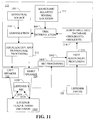
- FIG. 11 illustrates in an expanded view the functional block diagram of the passive pathway process where acoustical waves are reflected 1034 by the listener's head or torso, or both 1102, and registered by the listener's microphone or microphone array 1030.
- the frequency content of the acoustical waves are preferably selected to provide the most probative effect of the changes in the listener's orientation where interpolation may readily effect improvements and corrections to the perceived source.
- Filters downstream from the microphone or microphone array may be employed to eliminate or otherwise ameliorate unwanted sound sources proximate to the listener. The corrective potential of this passive path is enhanced with additional audio speakers, with additional microphones and with an anechoic environment.
- FIG. 12 illustrates an example array of microphones and an example array of acoustical speakers where the listener 126 originally sets 120, 121 the HR filters to a desirable acoustical "image" of the human speaker source.
- the listener moves away from the front microphone and turns to the place head and torso at an angle relative to the front line of audio speakers 1202.
- the acoustical measurements may also be augmented with passive optical sensing and by manual adjustments of the listener.
- FIG. 13 illustrates, together with FIG.
- the acoustical speaker array includes, for example, left and right audio speakers 122, 124, and additional left and right audio speakers 1222, 1224 that are responsive to the relative changes in the listener's relative translational position and rotational position 1202. If done actively, the microphone processing 1008 is principally dependent upon the voice of the listener 126. If done passively, the process is similar to the passive process as described and illustrated in FIG. 12.
- head-tracking is employed to accommodate the listener rotation in the interpolation process to "stabilize" the perceived location of the audio source.
- ISDN Integrated Services Digital Network
- the spatial data set further comprises a second audio source angle of incidence relative to the one or more microphones, the second audio source angle of incidence being substantially orthogonal to the first audio source angle of incidence;
Landscapes
- Engineering & Computer Science (AREA)
- Multimedia (AREA)
- Signal Processing (AREA)
- Physics & Mathematics (AREA)
- Acoustics & Sound (AREA)
- Health & Medical Sciences (AREA)
- General Health & Medical Sciences (AREA)
- Otolaryngology (AREA)
- Stereophonic System (AREA)
- Circuit For Audible Band Transducer (AREA)
Applications Claiming Priority (2)
| Application Number | Priority Date | Filing Date | Title |
|---|---|---|---|
| US750471 | 2003-12-30 | ||
| US10/750,471 US20050147261A1 (en) | 2003-12-30 | 2003-12-30 | Head relational transfer function virtualizer |
Publications (2)
| Publication Number | Publication Date |
|---|---|
| EP1551205A1 true EP1551205A1 (de) | 2005-07-06 |
| EP1551205B1 EP1551205B1 (de) | 2008-10-08 |
Family
ID=34574813
Family Applications (1)
| Application Number | Title | Priority Date | Filing Date |
|---|---|---|---|
| EP04029805A Expired - Lifetime EP1551205B1 (de) | 2003-12-30 | 2004-12-15 | Verfahren und Vorrichtung zur Raumklangverbesserung in einem Telekonferenzsystem |
Country Status (4)
| Country | Link |
|---|---|
| US (1) | US20050147261A1 (de) |
| EP (1) | EP1551205B1 (de) |
| AT (1) | ATE410904T1 (de) |
| DE (1) | DE602004016941D1 (de) |
Cited By (21)
| Publication number | Priority date | Publication date | Assignee | Title |
|---|---|---|---|---|
| WO2007031906A2 (en) | 2005-09-13 | 2007-03-22 | Koninklijke Philips Electronics N.V. | A method of and a device for generating 3d sound |
| WO2007062840A1 (de) * | 2005-11-30 | 2007-06-07 | Miriam Noemi Valenzuela | Verfahren zur aufnahme einer tonquelle mit zeitlich variabler richtcharakteristik und zur wiedergabe |
| EP1811755A1 (de) * | 2006-01-19 | 2007-07-25 | Oki Electric Industry Company, Limited | Sprachantwortsystem |
| WO2007119058A1 (en) * | 2006-04-19 | 2007-10-25 | Big Bean Audio Limited | Processing audio input signals |
| EP1850639A1 (de) * | 2006-04-25 | 2007-10-31 | Clemens Par | signalsysteme zur gewinnung multipler audiosignale aus wenigstens einem audiosignal |
| WO2008014697A1 (en) * | 2006-07-25 | 2008-02-07 | Huawei Technologies Co., Ltd. | A method and an apparatus for obtaining acoustic source location information and a multimedia communication system |
| EP1983799A1 (de) * | 2007-04-17 | 2008-10-22 | Harman Becker Automotive Systems GmbH | Akustische Lokalisierung eines Sprechers |
| WO2008129351A1 (en) * | 2007-04-20 | 2008-10-30 | Sony Ericsson Mobile Communication Ab | Electronic apparatus and system with conference call spatializer |
| WO2011002729A1 (en) * | 2009-06-30 | 2011-01-06 | Alcatel-Lucent Usa Inc. | Method and apparatus for improved matching of auditory space to visual space in video viewing applications |
| WO2012164153A1 (en) * | 2011-05-23 | 2012-12-06 | Nokia Corporation | Spatial audio processing apparatus |
| US8385233B2 (en) | 2007-06-12 | 2013-02-26 | Microsoft Corporation | Active speaker identification |
| KR20140081712A (ko) * | 2012-12-21 | 2014-07-01 | 인텔 코포레이션 | 통합형 음향 위상 어레이 |
| US9351070B2 (en) | 2009-06-30 | 2016-05-24 | Nokia Technologies Oy | Positional disambiguation in spatial audio |
| EP2936829A4 (de) * | 2012-12-18 | 2016-08-10 | Nokia Technologies Oy | Raumklangvorrichtung |
| CN105979470A (zh) * | 2016-05-30 | 2016-09-28 | 北京奇艺世纪科技有限公司 | 全景视频的音频处理方法、装置和播放系统 |
| WO2017075589A1 (en) * | 2015-10-30 | 2017-05-04 | Google Inc. | Method and apparatus for recreating directional cues in beamformed audio |
| WO2018084769A1 (en) * | 2016-11-04 | 2018-05-11 | Dirac Research Ab | Constructing an audio filter database using head-tracking data |
| EP3322200A1 (de) * | 2016-11-10 | 2018-05-16 | Nokia Technologies OY | Audiowiedergabe in echtzeit |
| CN108141665A (zh) * | 2015-10-26 | 2018-06-08 | 索尼公司 | 信号处理装置、信号处理方法和程序 |
| EP2920979B1 (de) * | 2012-11-16 | 2019-08-14 | Orange | Erfassung von raumklangdaten |
| KR20210043660A (ko) * | 2018-08-20 | 2021-04-21 | 후아웨이 테크놀러지 컴퍼니 리미티드 | 오디오 처리 방법 및 장치 |
Families Citing this family (81)
| Publication number | Priority date | Publication date | Assignee | Title |
|---|---|---|---|---|
| KR20050064442A (ko) * | 2003-12-23 | 2005-06-29 | 삼성전자주식회사 | 이동통신 시스템에서 입체음향 신호 생성 장치 및 방법 |
| US8638946B1 (en) * | 2004-03-16 | 2014-01-28 | Genaudio, Inc. | Method and apparatus for creating spatialized sound |
| US7792311B1 (en) * | 2004-05-15 | 2010-09-07 | Sonos, Inc., | Method and apparatus for automatically enabling subwoofer channel audio based on detection of subwoofer device |
| KR20060022968A (ko) * | 2004-09-08 | 2006-03-13 | 삼성전자주식회사 | 음향재생장치 및 음향재생방법 |
| US20060277034A1 (en) * | 2005-06-01 | 2006-12-07 | Ben Sferrazza | Method and system for processing HRTF data for 3-D sound positioning |
| JP2007019907A (ja) * | 2005-07-08 | 2007-01-25 | Yamaha Corp | 音声伝達システム、および通信会議装置 |
| US12167216B2 (en) | 2006-09-12 | 2024-12-10 | Sonos, Inc. | Playback device pairing |
| US8788080B1 (en) | 2006-09-12 | 2014-07-22 | Sonos, Inc. | Multi-channel pairing in a media system |
| US9202509B2 (en) | 2006-09-12 | 2015-12-01 | Sonos, Inc. | Controlling and grouping in a multi-zone media system |
| US8483853B1 (en) | 2006-09-12 | 2013-07-09 | Sonos, Inc. | Controlling and manipulating groupings in a multi-zone media system |
| EP1947471B1 (de) * | 2007-01-16 | 2010-10-13 | Harman Becker Automotive Systems GmbH | Vorrichtung und Verfahren zum Verfolgen von surround Kopfhörern unter Verwendung von Audiosignalen unterhalb der maskierten Hörschwelle |
| EP1962559A1 (de) * | 2007-02-21 | 2008-08-27 | Harman Becker Automotive Systems GmbH | Objektive Quantifizierung einer Hörquellenweite eines Lautsprecher-Raumsystems |
| US8520873B2 (en) * | 2008-10-20 | 2013-08-27 | Jerry Mahabub | Audio spatialization and environment simulation |
| US20080273476A1 (en) * | 2007-05-02 | 2008-11-06 | Menachem Cohen | Device Method and System For Teleconferencing |
| US20090018826A1 (en) * | 2007-07-13 | 2009-01-15 | Berlin Andrew A | Methods, Systems and Devices for Speech Transduction |
| US8660280B2 (en) | 2007-11-28 | 2014-02-25 | Qualcomm Incorporated | Methods and apparatus for providing a distinct perceptual location for an audio source within an audio mixture |
| US8515106B2 (en) * | 2007-11-28 | 2013-08-20 | Qualcomm Incorporated | Methods and apparatus for providing an interface to a processing engine that utilizes intelligent audio mixing techniques |
| WO2009075085A1 (ja) * | 2007-12-10 | 2009-06-18 | Panasonic Corporation | 収音装置、収音方法、収音プログラム、および集積回路 |
| KR100947027B1 (ko) * | 2007-12-28 | 2010-03-11 | 한국과학기술원 | 가상음장을 이용한 다자간 동시 통화 방법 및 그 기록매체 |
| TWI475896B (zh) * | 2008-09-25 | 2015-03-01 | Dolby Lab Licensing Corp | 單音相容性及揚聲器相容性之立體聲濾波器 |
| JP2011120028A (ja) * | 2009-12-03 | 2011-06-16 | Canon Inc | 音声再生装置、及びその制御方法 |
| US20120035940A1 (en) * | 2010-08-06 | 2012-02-09 | Samsung Electronics Co., Ltd. | Audio signal processing method, encoding apparatus therefor, and decoding apparatus therefor |
| US8923997B2 (en) | 2010-10-13 | 2014-12-30 | Sonos, Inc | Method and apparatus for adjusting a speaker system |
| US11429343B2 (en) | 2011-01-25 | 2022-08-30 | Sonos, Inc. | Stereo playback configuration and control |
| US11265652B2 (en) | 2011-01-25 | 2022-03-01 | Sonos, Inc. | Playback device pairing |
| US10009706B2 (en) * | 2011-12-07 | 2018-06-26 | Nokia Technologies Oy | Apparatus and method of audio stabilizing |
| US9084058B2 (en) | 2011-12-29 | 2015-07-14 | Sonos, Inc. | Sound field calibration using listener localization |
| US9729115B2 (en) | 2012-04-27 | 2017-08-08 | Sonos, Inc. | Intelligently increasing the sound level of player |
| US9264812B2 (en) * | 2012-06-15 | 2016-02-16 | Kabushiki Kaisha Toshiba | Apparatus and method for localizing a sound image, and a non-transitory computer readable medium |
| US9668049B2 (en) | 2012-06-28 | 2017-05-30 | Sonos, Inc. | Playback device calibration user interfaces |
| US9219460B2 (en) | 2014-03-17 | 2015-12-22 | Sonos, Inc. | Audio settings based on environment |
| US9690271B2 (en) | 2012-06-28 | 2017-06-27 | Sonos, Inc. | Speaker calibration |
| US9106192B2 (en) | 2012-06-28 | 2015-08-11 | Sonos, Inc. | System and method for device playback calibration |
| US9706323B2 (en) | 2014-09-09 | 2017-07-11 | Sonos, Inc. | Playback device calibration |
| US9690539B2 (en) | 2012-06-28 | 2017-06-27 | Sonos, Inc. | Speaker calibration user interface |
| US9008330B2 (en) | 2012-09-28 | 2015-04-14 | Sonos, Inc. | Crossover frequency adjustments for audio speakers |
| US9763004B2 (en) | 2013-09-17 | 2017-09-12 | Alcatel Lucent | Systems and methods for audio conferencing |
| US9226073B2 (en) | 2014-02-06 | 2015-12-29 | Sonos, Inc. | Audio output balancing during synchronized playback |
| US9226087B2 (en) | 2014-02-06 | 2015-12-29 | Sonos, Inc. | Audio output balancing during synchronized playback |
| US9264839B2 (en) | 2014-03-17 | 2016-02-16 | Sonos, Inc. | Playback device configuration based on proximity detection |
| JP6430626B2 (ja) * | 2014-07-22 | 2018-11-28 | ホアウェイ・テクノロジーズ・カンパニー・リミテッド | 入力音声信号を操作するための装置および方法 |
| US9952825B2 (en) | 2014-09-09 | 2018-04-24 | Sonos, Inc. | Audio processing algorithms |
| US9910634B2 (en) | 2014-09-09 | 2018-03-06 | Sonos, Inc. | Microphone calibration |
| US9891881B2 (en) | 2014-09-09 | 2018-02-13 | Sonos, Inc. | Audio processing algorithm database |
| US10127006B2 (en) | 2014-09-09 | 2018-11-13 | Sonos, Inc. | Facilitating calibration of an audio playback device |
| US10225814B2 (en) * | 2015-04-05 | 2019-03-05 | Qualcomm Incorporated | Conference audio management |
| US10664224B2 (en) | 2015-04-24 | 2020-05-26 | Sonos, Inc. | Speaker calibration user interface |
| WO2016172593A1 (en) | 2015-04-24 | 2016-10-27 | Sonos, Inc. | Playback device calibration user interfaces |
| US10248376B2 (en) | 2015-06-11 | 2019-04-02 | Sonos, Inc. | Multiple groupings in a playback system |
| GB2543276A (en) * | 2015-10-12 | 2017-04-19 | Nokia Technologies Oy | Distributed audio capture and mixing |
| US9538305B2 (en) | 2015-07-28 | 2017-01-03 | Sonos, Inc. | Calibration error conditions |
| US9693165B2 (en) | 2015-09-17 | 2017-06-27 | Sonos, Inc. | Validation of audio calibration using multi-dimensional motion check |
| EP3531714B1 (de) | 2015-09-17 | 2022-02-23 | Sonos Inc. | Erleichtern der kalibrierung einer audiowiedergabevorrichtung |
| BR112018013526A2 (pt) * | 2016-01-08 | 2018-12-04 | Sony Corporation | aparelho e método para processamento de áudio, e, programa |
| US9743207B1 (en) | 2016-01-18 | 2017-08-22 | Sonos, Inc. | Calibration using multiple recording devices |
| US10003899B2 (en) | 2016-01-25 | 2018-06-19 | Sonos, Inc. | Calibration with particular locations |
| US11106423B2 (en) | 2016-01-25 | 2021-08-31 | Sonos, Inc. | Evaluating calibration of a playback device |
| US9860662B2 (en) | 2016-04-01 | 2018-01-02 | Sonos, Inc. | Updating playback device configuration information based on calibration data |
| US9864574B2 (en) | 2016-04-01 | 2018-01-09 | Sonos, Inc. | Playback device calibration based on representation spectral characteristics |
| US9584653B1 (en) * | 2016-04-10 | 2017-02-28 | Philip Scott Lyren | Smartphone with user interface to externally localize telephone calls |
| US9763018B1 (en) | 2016-04-12 | 2017-09-12 | Sonos, Inc. | Calibration of audio playback devices |
| KR102513586B1 (ko) * | 2016-07-13 | 2023-03-27 | 삼성전자주식회사 | 전자 장치 및 전자 장치의 오디오 출력 방법 |
| US9794710B1 (en) | 2016-07-15 | 2017-10-17 | Sonos, Inc. | Spatial audio correction |
| US9860670B1 (en) | 2016-07-15 | 2018-01-02 | Sonos, Inc. | Spectral correction using spatial calibration |
| US10372406B2 (en) | 2016-07-22 | 2019-08-06 | Sonos, Inc. | Calibration interface |
| US10459684B2 (en) | 2016-08-05 | 2019-10-29 | Sonos, Inc. | Calibration of a playback device based on an estimated frequency response |
| US10712997B2 (en) | 2016-10-17 | 2020-07-14 | Sonos, Inc. | Room association based on name |
| EP3422744B1 (de) * | 2017-06-30 | 2021-09-29 | Nokia Technologies Oy | Vorrichtung und zugehörige verfahren |
| DE112019004139T5 (de) * | 2018-08-17 | 2021-05-06 | Sony Corporation | Signalverarbeitungsvorrichtung, signalverarbeitungsverfahren und programm |
| US10299061B1 (en) | 2018-08-28 | 2019-05-21 | Sonos, Inc. | Playback device calibration |
| US11206484B2 (en) | 2018-08-28 | 2021-12-21 | Sonos, Inc. | Passive speaker authentication |
| US20200077190A1 (en) * | 2018-08-29 | 2020-03-05 | Soniphi Llc | Earbuds With Vocal Frequency-Based Equalization |
| EP4462821A3 (de) | 2018-11-13 | 2024-12-25 | Dolby Laboratories Licensing Corporation | Darstellung von räumlichem audio mittels eines audiosignals und zugehörige metadaten |
| EP3881559B1 (de) * | 2018-11-13 | 2024-02-14 | Dolby Laboratories Licensing Corporation | Audioverarbeitung in immersiven audiodiensten |
| US20200304933A1 (en) * | 2019-03-19 | 2020-09-24 | Htc Corporation | Sound processing system of ambisonic format and sound processing method of ambisonic format |
| US10734965B1 (en) | 2019-08-12 | 2020-08-04 | Sonos, Inc. | Audio calibration of a portable playback device |
| EP4179737A1 (de) * | 2020-07-07 | 2023-05-17 | Telefonaktiebolaget LM ERICSSON (PUBL) | Effiziente erzeugung von kopfbezogenen filtern |
| WO2023056258A1 (en) | 2021-09-30 | 2023-04-06 | Sonos, Inc. | Conflict management for wake-word detection processes |
| US20230362579A1 (en) * | 2022-05-05 | 2023-11-09 | EmbodyVR, Inc. | Sound spatialization system and method for augmenting visual sensory response with spatial audio cues |
| CN116700659B (zh) * | 2022-09-02 | 2024-03-08 | 荣耀终端有限公司 | 一种界面交互方法及电子设备 |
| JPWO2024084920A1 (de) * | 2022-10-19 | 2024-04-25 |
Citations (6)
| Publication number | Priority date | Publication date | Assignee | Title |
|---|---|---|---|---|
| US5335011A (en) * | 1993-01-12 | 1994-08-02 | Bell Communications Research, Inc. | Sound localization system for teleconferencing using self-steering microphone arrays |
| US5500900A (en) * | 1992-10-29 | 1996-03-19 | Wisconsin Alumni Research Foundation | Methods and apparatus for producing directional sound |
| US5659619A (en) * | 1994-05-11 | 1997-08-19 | Aureal Semiconductor, Inc. | Three-dimensional virtual audio display employing reduced complexity imaging filters |
| US5959667A (en) * | 1996-05-09 | 1999-09-28 | Vtel Corporation | Voice activated camera preset selection system and method of operation |
| US6078669A (en) * | 1997-07-14 | 2000-06-20 | Euphonics, Incorporated | Audio spatial localization apparatus and methods |
| US6125115A (en) * | 1998-02-12 | 2000-09-26 | Qsound Labs, Inc. | Teleconferencing method and apparatus with three-dimensional sound positioning |
Family Cites Families (2)
| Publication number | Priority date | Publication date | Assignee | Title |
|---|---|---|---|---|
| JP3258195B2 (ja) * | 1995-03-27 | 2002-02-18 | シャープ株式会社 | 音像定位制御装置 |
| US6223090B1 (en) * | 1998-08-24 | 2001-04-24 | The United States Of America As Represented By The Secretary Of The Air Force | Manikin positioning for acoustic measuring |
-
2003
- 2003-12-30 US US10/750,471 patent/US20050147261A1/en not_active Abandoned
-
2004
- 2004-12-15 EP EP04029805A patent/EP1551205B1/de not_active Expired - Lifetime
- 2004-12-15 DE DE602004016941T patent/DE602004016941D1/de not_active Expired - Lifetime
- 2004-12-15 AT AT04029805T patent/ATE410904T1/de not_active IP Right Cessation
Patent Citations (6)
| Publication number | Priority date | Publication date | Assignee | Title |
|---|---|---|---|---|
| US5500900A (en) * | 1992-10-29 | 1996-03-19 | Wisconsin Alumni Research Foundation | Methods and apparatus for producing directional sound |
| US5335011A (en) * | 1993-01-12 | 1994-08-02 | Bell Communications Research, Inc. | Sound localization system for teleconferencing using self-steering microphone arrays |
| US5659619A (en) * | 1994-05-11 | 1997-08-19 | Aureal Semiconductor, Inc. | Three-dimensional virtual audio display employing reduced complexity imaging filters |
| US5959667A (en) * | 1996-05-09 | 1999-09-28 | Vtel Corporation | Voice activated camera preset selection system and method of operation |
| US6078669A (en) * | 1997-07-14 | 2000-06-20 | Euphonics, Incorporated | Audio spatial localization apparatus and methods |
| US6125115A (en) * | 1998-02-12 | 2000-09-26 | Qsound Labs, Inc. | Teleconferencing method and apparatus with three-dimensional sound positioning |
Cited By (53)
| Publication number | Priority date | Publication date | Assignee | Title |
|---|---|---|---|---|
| US8515082B2 (en) | 2005-09-13 | 2013-08-20 | Koninklijke Philips N.V. | Method of and a device for generating 3D sound |
| WO2007031906A3 (en) * | 2005-09-13 | 2007-09-13 | Koninkl Philips Electronics Nv | A method of and a device for generating 3d sound |
| CN102395098B (zh) * | 2005-09-13 | 2015-01-28 | 皇家飞利浦电子股份有限公司 | 生成3d声音的方法和设备 |
| WO2007031906A2 (en) | 2005-09-13 | 2007-03-22 | Koninklijke Philips Electronics N.V. | A method of and a device for generating 3d sound |
| WO2007062840A1 (de) * | 2005-11-30 | 2007-06-07 | Miriam Noemi Valenzuela | Verfahren zur aufnahme einer tonquelle mit zeitlich variabler richtcharakteristik und zur wiedergabe |
| EP1811755A1 (de) * | 2006-01-19 | 2007-07-25 | Oki Electric Industry Company, Limited | Sprachantwortsystem |
| WO2007119058A1 (en) * | 2006-04-19 | 2007-10-25 | Big Bean Audio Limited | Processing audio input signals |
| US8688249B2 (en) | 2006-04-19 | 2014-04-01 | Sonita Logic Limted | Processing audio input signals |
| US8626321B2 (en) | 2006-04-19 | 2014-01-07 | Sontia Logic Limited | Processing audio input signals |
| US8565440B2 (en) | 2006-04-19 | 2013-10-22 | Sontia Logic Limited | Processing audio input signals |
| EP1850639A1 (de) * | 2006-04-25 | 2007-10-31 | Clemens Par | signalsysteme zur gewinnung multipler audiosignale aus wenigstens einem audiosignal |
| US8115799B2 (en) | 2006-07-25 | 2012-02-14 | Huawei Technologies Co., Ltd. | Method and apparatus for obtaining acoustic source location information and a multimedia communication system |
| WO2008014697A1 (en) * | 2006-07-25 | 2008-02-07 | Huawei Technologies Co., Ltd. | A method and an apparatus for obtaining acoustic source location information and a multimedia communication system |
| US8204248B2 (en) | 2007-04-17 | 2012-06-19 | Nuance Communications, Inc. | Acoustic localization of a speaker |
| US9338549B2 (en) | 2007-04-17 | 2016-05-10 | Nuance Communications, Inc. | Acoustic localization of a speaker |
| EP1983799A1 (de) * | 2007-04-17 | 2008-10-22 | Harman Becker Automotive Systems GmbH | Akustische Lokalisierung eines Sprechers |
| WO2008129351A1 (en) * | 2007-04-20 | 2008-10-30 | Sony Ericsson Mobile Communication Ab | Electronic apparatus and system with conference call spatializer |
| US8385233B2 (en) | 2007-06-12 | 2013-02-26 | Microsoft Corporation | Active speaker identification |
| RU2483452C2 (ru) * | 2007-06-12 | 2013-05-27 | Майкрософт Корпорейшн | Идентификация активного говорящего участника |
| US8717949B2 (en) | 2007-06-12 | 2014-05-06 | Microsoft Corporation | Active speaker identification |
| US9160775B2 (en) | 2007-06-12 | 2015-10-13 | Microsoft Technology Licensing, Llc | Active speaker identification |
| US9351070B2 (en) | 2009-06-30 | 2016-05-24 | Nokia Technologies Oy | Positional disambiguation in spatial audio |
| EP2449795B1 (de) * | 2009-06-30 | 2017-05-17 | Nokia Technologies Oy | Positionelle eindeutigkeit bei räumlichem audio |
| WO2011002729A1 (en) * | 2009-06-30 | 2011-01-06 | Alcatel-Lucent Usa Inc. | Method and apparatus for improved matching of auditory space to visual space in video viewing applications |
| WO2012164153A1 (en) * | 2011-05-23 | 2012-12-06 | Nokia Corporation | Spatial audio processing apparatus |
| EP2920979B1 (de) * | 2012-11-16 | 2019-08-14 | Orange | Erfassung von raumklangdaten |
| US9621991B2 (en) | 2012-12-18 | 2017-04-11 | Nokia Technologies Oy | Spatial audio apparatus |
| US10200788B2 (en) | 2012-12-18 | 2019-02-05 | Nokia Technologies Oy | Spatial audio apparatus |
| EP2936829A4 (de) * | 2012-12-18 | 2016-08-10 | Nokia Technologies Oy | Raumklangvorrichtung |
| US9936292B2 (en) | 2012-12-18 | 2018-04-03 | Nokia Technologies Oy | Spatial audio apparatus |
| JP2014123952A (ja) * | 2012-12-21 | 2014-07-03 | Intel Corp | 統合された音響位相アレイ |
| KR20140081712A (ko) * | 2012-12-21 | 2014-07-01 | 인텔 코포레이션 | 통합형 음향 위상 어레이 |
| KR20150064007A (ko) * | 2012-12-21 | 2015-06-10 | 인텔 코포레이션 | 통합형 음향 위상 어레이 |
| US10074357B2 (en) | 2012-12-21 | 2018-09-11 | Intel Corporation | Integrated acoustic phase array |
| US9183829B2 (en) | 2012-12-21 | 2015-11-10 | Intel Corporation | Integrated accoustic phase array |
| CN108141665A (zh) * | 2015-10-26 | 2018-06-08 | 索尼公司 | 信号处理装置、信号处理方法和程序 |
| EP3370437A4 (de) * | 2015-10-26 | 2018-10-17 | Sony Corporation | Signalverarbeitungsvorrichtung, signalverarbeitungsverfahren und programm |
| WO2017075589A1 (en) * | 2015-10-30 | 2017-05-04 | Google Inc. | Method and apparatus for recreating directional cues in beamformed audio |
| US10368162B2 (en) | 2015-10-30 | 2019-07-30 | Google Llc | Method and apparatus for recreating directional cues in beamformed audio |
| CN107925816A (zh) * | 2015-10-30 | 2018-04-17 | 谷歌有限责任公司 | 用于在波束成形的音频中重新创建方向提示的方法和装置 |
| CN107925816B (zh) * | 2015-10-30 | 2020-01-21 | 谷歌有限责任公司 | 用于在波束成形的音频中重新创建方向提示的方法和装置 |
| CN105979470A (zh) * | 2016-05-30 | 2016-09-28 | 北京奇艺世纪科技有限公司 | 全景视频的音频处理方法、装置和播放系统 |
| WO2018084770A1 (en) * | 2016-11-04 | 2018-05-11 | Dirac Research Ab | Methods and systems for determining and/or using an audio filter based on head-tracking data |
| CN109997376A (zh) * | 2016-11-04 | 2019-07-09 | 迪拉克研究公司 | 使用头部跟踪数据构建音频滤波器数据库 |
| WO2018084769A1 (en) * | 2016-11-04 | 2018-05-11 | Dirac Research Ab | Constructing an audio filter database using head-tracking data |
| US10715945B2 (en) | 2016-11-04 | 2020-07-14 | Dirac Research Ab | Methods and systems for determining and/or using an audio filter based on head-tracking data |
| US10200807B2 (en) | 2016-11-10 | 2019-02-05 | Nokia Technologies Oy | Audio rendering in real time |
| EP3322200A1 (de) * | 2016-11-10 | 2018-05-16 | Nokia Technologies OY | Audiowiedergabe in echtzeit |
| KR20210043660A (ko) * | 2018-08-20 | 2021-04-21 | 후아웨이 테크놀러지 컴퍼니 리미티드 | 오디오 처리 방법 및 장치 |
| EP3833056A4 (de) * | 2018-08-20 | 2021-10-13 | Huawei Technologies Co., Ltd. | Audioverarbeitungsverfahren und -vorrichtung |
| US11451921B2 (en) | 2018-08-20 | 2022-09-20 | Huawei Technologies Co., Ltd. | Audio processing method and apparatus |
| KR20230027335A (ko) * | 2018-08-20 | 2023-02-27 | 후아웨이 테크놀러지 컴퍼니 리미티드 | 오디오 처리 방법 및 장치 |
| US11863964B2 (en) | 2018-08-20 | 2024-01-02 | Huawei Technologies Co., Ltd. | Audio processing method and apparatus |
Also Published As
| Publication number | Publication date |
|---|---|
| US20050147261A1 (en) | 2005-07-07 |
| ATE410904T1 (de) | 2008-10-15 |
| EP1551205B1 (de) | 2008-10-08 |
| DE602004016941D1 (de) | 2008-11-20 |
Similar Documents
| Publication | Publication Date | Title |
|---|---|---|
| EP1551205B1 (de) | Verfahren und Vorrichtung zur Raumklangverbesserung in einem Telekonferenzsystem | |
| KR100416757B1 (ko) | 위치 조절이 가능한 가상 음상을 이용한 스피커 재생용 다채널오디오 재생 장치 및 방법 | |
| CN107852563B (zh) | 双耳音频再现 | |
| AU699647B2 (en) | Method and apparatus for efficient presentation of high-quality three-dimensional audio | |
| CN103220491B (zh) | 用于操作会议系统的方法以及用于会议系统的装置 | |
| CN101133679B (zh) | 个性化的头戴耳机虚拟系统和方法 | |
| EP4463760A2 (de) | Umgebungskorrektur für audiosystem mit virtueller und gemischter realität | |
| EP3837863B1 (de) | Verfahren zur gewinnung und wiedergabe einer binauralen aufzeichnung | |
| CN109587601A (zh) | 使用虚拟声学系统将声音移入和移出听者头部的系统 | |
| US7921016B2 (en) | Method and device for providing 3D audio work | |
| Kim et al. | Control of auditory distance perception based on the auditory parallax model | |
| KR20160136716A (ko) | 오디오 신호 처리 방법 및 장치 | |
| US11653163B2 (en) | Headphone device for reproducing three-dimensional sound therein, and associated method | |
| Casey et al. | Vision steered beam-forming and transaural rendering for the artificial life interactive video environment (alive) | |
| CN110225445A (zh) | 一种处理声音信号实现三维声场听觉效果的方法及装置 | |
| JPH05168097A (ja) | 頭外音像定位ステレオ受聴器受聴方法 | |
| CN119233138A (zh) | 音频换能器实现增强 | |
| CN113905323B (zh) | 适用于服务型机器人播放音频时的感知声源高度修正方法 | |
| Takane et al. | Elementary real-time implementation of a virtual acoustic display based on ADVISE | |
| Kang et al. | Realistic audio teleconferencing using binaural and auralization techniques | |
| Ranjan | 3D audio reproduction: natural augmented reality headset and next generation entertainment system using wave field synthesis | |
| Adler | Virtual audio-three-dimensional audio in virtual environments | |
| Pec et al. | Head Related Transfer Functions measurement and processing for the purpose of creating a spatial sound environment | |
| US20180288554A1 (en) | Successive decompositions of audio filters | |
| Avendano | Virtual spatial sound |
Legal Events
| Date | Code | Title | Description |
|---|---|---|---|
| PUAI | Public reference made under article 153(3) epc to a published international application that has entered the european phase |
Free format text: ORIGINAL CODE: 0009012 |
|
| AK | Designated contracting states |
Kind code of ref document: A1 Designated state(s): AT BE BG CH CY CZ DE DK EE ES FI FR GB GR HU IE IS IT LI LT LU MC NL PL PT RO SE SI SK TR |
|
| AX | Request for extension of the european patent |
Extension state: AL BA HR LV MK YU |
|
| 17P | Request for examination filed |
Effective date: 20060106 |
|
| AKX | Designation fees paid |
Designated state(s): AT BE BG CH CY CZ DE DK EE ES FI FR GB GR HU IE IS IT LI LT LU MC NL PL PT RO SE SI SK TR |
|
| RAP1 | Party data changed (applicant data changed or rights of an application transferred) |
Owner name: ALCATEL LUCENT |
|
| RIC1 | Information provided on ipc code assigned before grant |
Ipc: H04M 11/00 20060101ALN20071211BHEP Ipc: H04M 7/00 20060101ALN20071211BHEP Ipc: H04S 7/00 20060101AFI20071211BHEP Ipc: H04M 3/56 20060101ALN20071211BHEP |
|
| RTI1 | Title (correction) |
Free format text: METHOD AND DEVICE FOR ENHANCING SPATIAL AUDIO IN A TELECONFERENCE SYSTEM |
|
| GRAP | Despatch of communication of intention to grant a patent |
Free format text: ORIGINAL CODE: EPIDOSNIGR1 |
|
| GRAS | Grant fee paid |
Free format text: ORIGINAL CODE: EPIDOSNIGR3 |
|
| GRAA | (expected) grant |
Free format text: ORIGINAL CODE: 0009210 |
|
| AK | Designated contracting states |
Kind code of ref document: B1 Designated state(s): AT BE BG CH CY CZ DE DK EE ES FI FR GB GR HU IE IS IT LI LT LU MC NL PL PT RO SE SI SK TR |
|
| REG | Reference to a national code |
Ref country code: GB Ref legal event code: FG4D |
|
| REG | Reference to a national code |
Ref country code: CH Ref legal event code: EP |
|
| REG | Reference to a national code |
Ref country code: IE Ref legal event code: FG4D |
|
| REF | Corresponds to: |
Ref document number: 602004016941 Country of ref document: DE Date of ref document: 20081120 Kind code of ref document: P |
|
| PG25 | Lapsed in a contracting state [announced via postgrant information from national office to epo] |
Ref country code: SI Free format text: LAPSE BECAUSE OF FAILURE TO SUBMIT A TRANSLATION OF THE DESCRIPTION OR TO PAY THE FEE WITHIN THE PRESCRIBED TIME-LIMIT Effective date: 20081008 |
|
| NLV1 | Nl: lapsed or annulled due to failure to fulfill the requirements of art. 29p and 29m of the patents act | ||
| PG25 | Lapsed in a contracting state [announced via postgrant information from national office to epo] |
Ref country code: LT Free format text: LAPSE BECAUSE OF FAILURE TO SUBMIT A TRANSLATION OF THE DESCRIPTION OR TO PAY THE FEE WITHIN THE PRESCRIBED TIME-LIMIT Effective date: 20081008 Ref country code: BG Free format text: LAPSE BECAUSE OF FAILURE TO SUBMIT A TRANSLATION OF THE DESCRIPTION OR TO PAY THE FEE WITHIN THE PRESCRIBED TIME-LIMIT Effective date: 20090108 Ref country code: ES Free format text: LAPSE BECAUSE OF FAILURE TO SUBMIT A TRANSLATION OF THE DESCRIPTION OR TO PAY THE FEE WITHIN THE PRESCRIBED TIME-LIMIT Effective date: 20090119 Ref country code: AT Free format text: LAPSE BECAUSE OF FAILURE TO SUBMIT A TRANSLATION OF THE DESCRIPTION OR TO PAY THE FEE WITHIN THE PRESCRIBED TIME-LIMIT Effective date: 20081008 |
|
| PG25 | Lapsed in a contracting state [announced via postgrant information from national office to epo] |
Ref country code: PT Free format text: LAPSE BECAUSE OF FAILURE TO SUBMIT A TRANSLATION OF THE DESCRIPTION OR TO PAY THE FEE WITHIN THE PRESCRIBED TIME-LIMIT Effective date: 20090218 Ref country code: PL Free format text: LAPSE BECAUSE OF FAILURE TO SUBMIT A TRANSLATION OF THE DESCRIPTION OR TO PAY THE FEE WITHIN THE PRESCRIBED TIME-LIMIT Effective date: 20081008 Ref country code: IS Free format text: LAPSE BECAUSE OF FAILURE TO SUBMIT A TRANSLATION OF THE DESCRIPTION OR TO PAY THE FEE WITHIN THE PRESCRIBED TIME-LIMIT Effective date: 20090208 Ref country code: FI Free format text: LAPSE BECAUSE OF FAILURE TO SUBMIT A TRANSLATION OF THE DESCRIPTION OR TO PAY THE FEE WITHIN THE PRESCRIBED TIME-LIMIT Effective date: 20081008 Ref country code: NL Free format text: LAPSE BECAUSE OF FAILURE TO SUBMIT A TRANSLATION OF THE DESCRIPTION OR TO PAY THE FEE WITHIN THE PRESCRIBED TIME-LIMIT Effective date: 20081008 |
|
| PG25 | Lapsed in a contracting state [announced via postgrant information from national office to epo] |
Ref country code: DK Free format text: LAPSE BECAUSE OF FAILURE TO SUBMIT A TRANSLATION OF THE DESCRIPTION OR TO PAY THE FEE WITHIN THE PRESCRIBED TIME-LIMIT Effective date: 20081008 Ref country code: RO Free format text: LAPSE BECAUSE OF FAILURE TO SUBMIT A TRANSLATION OF THE DESCRIPTION OR TO PAY THE FEE WITHIN THE PRESCRIBED TIME-LIMIT Effective date: 20081008 Ref country code: BE Free format text: LAPSE BECAUSE OF FAILURE TO SUBMIT A TRANSLATION OF THE DESCRIPTION OR TO PAY THE FEE WITHIN THE PRESCRIBED TIME-LIMIT Effective date: 20081008 Ref country code: EE Free format text: LAPSE BECAUSE OF FAILURE TO SUBMIT A TRANSLATION OF THE DESCRIPTION OR TO PAY THE FEE WITHIN THE PRESCRIBED TIME-LIMIT Effective date: 20081008 Ref country code: MC Free format text: LAPSE BECAUSE OF NON-PAYMENT OF DUE FEES Effective date: 20081231 |
|
| REG | Reference to a national code |
Ref country code: CH Ref legal event code: PL |
|
| PLBE | No opposition filed within time limit |
Free format text: ORIGINAL CODE: 0009261 |
|
| STAA | Information on the status of an ep patent application or granted ep patent |
Free format text: STATUS: NO OPPOSITION FILED WITHIN TIME LIMIT |
|
| PG25 | Lapsed in a contracting state [announced via postgrant information from national office to epo] |
Ref country code: IT Free format text: LAPSE BECAUSE OF FAILURE TO SUBMIT A TRANSLATION OF THE DESCRIPTION OR TO PAY THE FEE WITHIN THE PRESCRIBED TIME-LIMIT Effective date: 20081008 Ref country code: SE Free format text: LAPSE BECAUSE OF FAILURE TO SUBMIT A TRANSLATION OF THE DESCRIPTION OR TO PAY THE FEE WITHIN THE PRESCRIBED TIME-LIMIT Effective date: 20090108 Ref country code: CZ Free format text: LAPSE BECAUSE OF FAILURE TO SUBMIT A TRANSLATION OF THE DESCRIPTION OR TO PAY THE FEE WITHIN THE PRESCRIBED TIME-LIMIT Effective date: 20081008 |
|
| 26N | No opposition filed |
Effective date: 20090709 |
|
| PG25 | Lapsed in a contracting state [announced via postgrant information from national office to epo] |
Ref country code: SK Free format text: LAPSE BECAUSE OF FAILURE TO SUBMIT A TRANSLATION OF THE DESCRIPTION OR TO PAY THE FEE WITHIN THE PRESCRIBED TIME-LIMIT Effective date: 20081008 |
|
| PG25 | Lapsed in a contracting state [announced via postgrant information from national office to epo] |
Ref country code: LI Free format text: LAPSE BECAUSE OF NON-PAYMENT OF DUE FEES Effective date: 20081231 Ref country code: CH Free format text: LAPSE BECAUSE OF NON-PAYMENT OF DUE FEES Effective date: 20081231 Ref country code: IE Free format text: LAPSE BECAUSE OF NON-PAYMENT OF DUE FEES Effective date: 20081215 |
|
| PG25 | Lapsed in a contracting state [announced via postgrant information from national office to epo] |
Ref country code: LU Free format text: LAPSE BECAUSE OF NON-PAYMENT OF DUE FEES Effective date: 20081215 Ref country code: HU Free format text: LAPSE BECAUSE OF FAILURE TO SUBMIT A TRANSLATION OF THE DESCRIPTION OR TO PAY THE FEE WITHIN THE PRESCRIBED TIME-LIMIT Effective date: 20090409 Ref country code: CY Free format text: LAPSE BECAUSE OF FAILURE TO SUBMIT A TRANSLATION OF THE DESCRIPTION OR TO PAY THE FEE WITHIN THE PRESCRIBED TIME-LIMIT Effective date: 20081008 |
|
| PG25 | Lapsed in a contracting state [announced via postgrant information from national office to epo] |
Ref country code: TR Free format text: LAPSE BECAUSE OF FAILURE TO SUBMIT A TRANSLATION OF THE DESCRIPTION OR TO PAY THE FEE WITHIN THE PRESCRIBED TIME-LIMIT Effective date: 20081008 |
|
| PG25 | Lapsed in a contracting state [announced via postgrant information from national office to epo] |
Ref country code: GR Free format text: LAPSE BECAUSE OF FAILURE TO SUBMIT A TRANSLATION OF THE DESCRIPTION OR TO PAY THE FEE WITHIN THE PRESCRIBED TIME-LIMIT Effective date: 20090109 |
|
| REG | Reference to a national code |
Ref country code: FR Ref legal event code: GC Effective date: 20131018 |
|
| REG | Reference to a national code |
Ref country code: FR Ref legal event code: RG Effective date: 20141016 |
|
| REG | Reference to a national code |
Ref country code: FR Ref legal event code: CA Effective date: 20150521 |
|
| REG | Reference to a national code |
Ref country code: FR Ref legal event code: CA Effective date: 20150521 |
|
| REG | Reference to a national code |
Ref country code: FR Ref legal event code: PLFP Year of fee payment: 12 |
|
| REG | Reference to a national code |
Ref country code: FR Ref legal event code: PLFP Year of fee payment: 13 |
|
| REG | Reference to a national code |
Ref country code: FR Ref legal event code: PLFP Year of fee payment: 14 |
|
| PGFP | Annual fee paid to national office [announced via postgrant information from national office to epo] |
Ref country code: DE Payment date: 20191203 Year of fee payment: 16 |
|
| PGFP | Annual fee paid to national office [announced via postgrant information from national office to epo] |
Ref country code: FR Payment date: 20191114 Year of fee payment: 16 |
|
| PGFP | Annual fee paid to national office [announced via postgrant information from national office to epo] |
Ref country code: GB Payment date: 20191213 Year of fee payment: 16 |
|
| REG | Reference to a national code |
Ref country code: DE Ref legal event code: R119 Ref document number: 602004016941 Country of ref document: DE |
|
| GBPC | Gb: european patent ceased through non-payment of renewal fee |
Effective date: 20201215 |
|
| PG25 | Lapsed in a contracting state [announced via postgrant information from national office to epo] |
Ref country code: FR Free format text: LAPSE BECAUSE OF NON-PAYMENT OF DUE FEES Effective date: 20201231 |
|
| PG25 | Lapsed in a contracting state [announced via postgrant information from national office to epo] |
Ref country code: DE Free format text: LAPSE BECAUSE OF NON-PAYMENT OF DUE FEES Effective date: 20210701 Ref country code: GB Free format text: LAPSE BECAUSE OF NON-PAYMENT OF DUE FEES Effective date: 20201215 |