EP1551496B1 - Verfahren zum aufbringen eines medikamentes auf eine oberfläche - Google Patents
Verfahren zum aufbringen eines medikamentes auf eine oberfläche Download PDFInfo
- Publication number
- EP1551496B1 EP1551496B1 EP03773074A EP03773074A EP1551496B1 EP 1551496 B1 EP1551496 B1 EP 1551496B1 EP 03773074 A EP03773074 A EP 03773074A EP 03773074 A EP03773074 A EP 03773074A EP 1551496 B1 EP1551496 B1 EP 1551496B1
- Authority
- EP
- European Patent Office
- Prior art keywords
- coating
- electrode
- steroid
- drug
- heating
- Prior art date
- Legal status (The legal status is an assumption and is not a legal conclusion. Google has not performed a legal analysis and makes no representation as to the accuracy of the status listed.)
- Expired - Lifetime
Links
- 0 CC(C1)C(C)CC2=C1C(C)C(CC1)C1*2C Chemical compound CC(C1)C(C)CC2=C1C(C)C(CC1)C1*2C 0.000 description 2
Images


Classifications
-
- A—HUMAN NECESSITIES
- A61—MEDICAL OR VETERINARY SCIENCE; HYGIENE
- A61N—ELECTROTHERAPY; MAGNETOTHERAPY; RADIATION THERAPY; ULTRASOUND THERAPY
- A61N1/00—Electrotherapy; Circuits therefor
- A61N1/02—Details
- A61N1/04—Electrodes
- A61N1/05—Electrodes for implantation or insertion into the body, e.g. heart electrode
- A61N1/056—Transvascular endocardial electrode systems
- A61N1/0565—Electrode heads
- A61N1/0568—Electrode heads with drug delivery
-
- A—HUMAN NECESSITIES
- A61—MEDICAL OR VETERINARY SCIENCE; HYGIENE
- A61N—ELECTROTHERAPY; MAGNETOTHERAPY; RADIATION THERAPY; ULTRASOUND THERAPY
- A61N1/00—Electrotherapy; Circuits therefor
- A61N1/02—Details
- A61N1/04—Electrodes
- A61N1/05—Electrodes for implantation or insertion into the body, e.g. heart electrode
- A61N1/056—Transvascular endocardial electrode systems
- A61N1/057—Anchoring means; Means for fixing the head inside the heart
- A61N1/0573—Anchoring means; Means for fixing the head inside the heart chacterised by means penetrating the heart tissue, e.g. helix needle or hook
- A61N1/0575—Anchoring means; Means for fixing the head inside the heart chacterised by means penetrating the heart tissue, e.g. helix needle or hook with drug delivery
Definitions
- the present invention relates to a method for coating the surface of an electrode with a drug.
- the invention relates to a method for coating a medical device electrode with a pharmaceutical agent or drug.
- Electrical stimulation of excitable body tissue is used as a method of treating various pathological conditions.
- Such stimulation generally entails making an electrical contact between excitable tissue and an electrical pulse generator through use of one or more stimulation leads.
- Various lead systems and various techniques for implanting these lead systems in contact with excitable body tissue, and particularly the heart, have been developed.
- a transvenous endocardial lead establishes electrical contact between an electrical pulse generator, such as a pacemaker or implantable cardioverter defibrillator, and a patient's heart through placement of the lead in the venous system.
- an electrical pulse generator such as a pacemaker or implantable cardioverter defibrillator
- a transvenous endocardial lead is passed through a vein, with the assistance of a fluoroscope, into the heart where it may be held in contact with the endocardium by the trabeculae of the heart chamber, such as the ventricle.
- the safety, efficacy and longevity of an electrical pulse generator depends, in part, on the performance of the associated cardiac lead(s) used in conjunction with the pulse generator.
- Stimulation threshold is the energy required in a stimulation pulse to depolarize, or "capture,” the heart tissue.
- a relatively high impedance and low threshold is desired to minimize the current drawn from a pulse generator battery in delivering a stimulation pulse. Maximizing the useful life of the pulse generator battery is important since a surgical procedure is required to replace the pulse generator once the battery has reached the end of its useful life.
- the presence of the lead activates macrophages, which attach themselves to the surface of the lead and any electrodes and form multi-nucleated giant cells. These cells, in turn, secrete various substances, such as hydrogen peroxide as well as various enzymes, in an effort to dissolve the foreign object.
- substances while intending to dissolve the foreign object, also inflict damage to the surrounding tissue. When the surrounding tissue is the myocardium, these substance cause necrosis. These areas of necrosis, in turn, impair the electrical characteristics of the electrode-tissue interface. Consequently pacing thresholds rise.
- the inflammatory response continues and approximately seven days after implant the multi-nucleated giant cells cause fibroblasts to begin laying down collagen to replace the necrotic myocardium.
- the lead and its electrodes are encapsulated by a thick layer of fibrotic tissue.
- the inflammatory response ends at this time.
- the fibrotic encapsulation of the lead and its electrodes remains. Since the fibrotic tissue is not excitable tissue, an elevated stimulation threshold can persist due to the degraded electrical properties of the electrode-tissue interface.
- the electrode disclosed in the US-A-4,506,680 was constructed of porous, sintered platinum or titanium, although carbon and ceramic compositions were mentioned.
- a plug of silicone rubber impregnated with the sodium salt of dexamethasone phosphate or a water soluble form of another glucocorti-costeroid was placed in a chamber.
- the silicone rubber plug allowed the release of the steroid through the interstitial gaps in the porous sintered metal electrode to reach into the tissue and prevent or reduce inflammation, irritability and subsequent excess fibrosis of the tissue adjacent to the electrode itself.
- pacing leads to have a source impedance substantially lower as compared to leads featuring similarly sized solid electrodes.
- Leads which elute steroid also presented significantly lower peak and chronic pacing thresholds than similarly sized solid or porous electrodes.
- One example of a lead which eluted steroid meeting widespread commercial success is the Medtronic Model 5534 CAPSURE ZTM lead.
- the electrode was fabricated of platinized porous platinum and equipped with an annular shaped monolithic controlled release device (MCRD) loaded with an anti-inflammatory agent soluble in water, e.g. the steroid dexamethasone sodium phosphate.
- MCRD monolithic controlled release device
- the steroid would elute out of the lead and into the surrounding tissue. This water soluble steroid also was deposited within the pores of the porous platinum electrode.
- Incorporating steroid so that it will elute from a lead increased the complexity of lead construction as compared to past, non-steroid eluting leads.
- leads which elute steroid typically require an MCRD to contain the steroid and to thereafter slowly leach out the water soluble steroid into the surrounding tissue.
- MCRDs were constructed from silicone rubber.
- Steroid eluting leads also required an area near the electrode in which to house the MCRD, as well as a high degree of dimensional control over the electrode in order to ensure proper steroid elution. Setting aside a volume near the electrode tip to house the MCRD, however, also tended to increase lead body stiffness in that area.
- the MCRD typically swells over time as the drug elutes from the polymer structure and is replaced by water and electrolytes.
- EP-A-0414233 , US-A-4,506,680 and WO 99/53994 also disclose methods of applying steroids to medical devices.
- a solution mixed from an organic solvent and a steroid that is no more than sparingly soluble in water is applied to a lead.
- the solution is dried to drive off the organic solvent.
- the remaining steroid because it is no more than sparingly soluble in water, will not quickly dissolve away from the electrode surface once in contact with bodily fluids and will remain at the electrode-tissue interface long enough to have a desired pharmacological effect.
- Advantages of this method include elimination of additional structures for carrying the steroid and the presentation of the steroid directly at the tissue-electrode interface.
- a steroid in solution to an electrode, however, is that the steroid remaining on the electrode surface after the solvent has evaporated generally forms a crystalline coating.
- the surface morphology of this crystalline coating is generally rough, where the roughness is a function of the crystal growth rate and crystal orientation. When two adjacent crystals impinge, further growth is suppressed.
- a micro-crack can form at the crystal-crystal boundary due to slight orientational misalignment of the crystals. These micro-cracks often propagate under small loads. Upon exposure to fluids, capillary forces cause fluid to enter the micro-cracks. Forces imparted by the fluid within the micro-cracks cause the cracks to dilate and grow in length, resulting in mechanical deterioration of the coating.
- a solution-deposited drug coating is generally not well adhered to the electrode surface and may easily flake or brush away during handling of the lead for manufacturing and implant procedures.
- the amount of steroid remaining on the electrode surface once delivered to an implant site may, therefore, be uncertain. It would be desirable to provide an electrode with a steroid coating that is durable enough to remain well-attached to the electrode surface during lead handling and still have the advantages of steroid elution directly at the electrode-tissue interface with elimination of additional structures required for carrying the steroid.
- US-A-3 886 103 discloses a method of coating a metal substrate with a polymer. The coating is heated to prevent the formation of cracks and then heated again at a higher temperature to eliminate the organic solvent.
- the present invention is aimed at a method for coating a surface with a drug that allows the amount of drug present and the resulting surface morphology of the drug coating to be controlled and reproducible.
- the invention is aimed at providing a medical electrical lead having a drug-coated electrode surface and a method for manufacturing the same.
- the method generally includes depositing a drug on a medical device surface, heating the drug to cause a phase change and healing of micro-cracks, and allowing the drug to cool such that it forms a crystalline coating that is better conformed to the electrode surface.
- the present invention provides an improved method for applying a drug coating to an implantable medical device, such as an electrode.
- a saturated solution is prepared by dissolving an anti-inflammatory steroid in an organic solvent.
- the drug solution is dispensed onto a medical electrode.
- the solvent is allowed to evaporate leaving a crystalline coating of the steroid on the electrode surface.
- Heat is then applied to the crystalline coating to increase the molecular mobility causing a reorganization of the crystalline structure resulting in micro-crack healing and producing a conformable coating.
- Focused, localized heat is preferably applied to the crystalline coating at a controlled temperature for a controlled amount of time such that the coating is quickly heated to a point that causes a solid-state phase change and micro-crack healing without degrading the drug.
- the drug flows over the electrode surface and, upon cooling, forms a uniform, smooth, conformable coating.
- the methods included in the present invention allow a drug coating to be applied to an electrode surface in which the amount of drug deposited and the resulting surface morphology are controlled and reproducible.
- the conformable crystalline coating is well attached and more durable than the rougher crystalline coating obtained prior to heating because the thermal processing has significantly reduced the defect density of the drug coating. Reorganization of the crystalline structure during thermal processing is thus expected to increase the durability of the coating in at least two ways. First, the surface area in direct contact with the electrode surface may be increased as the coating conforms to the electrode surface, resulting in an apparent increase in adhesion. Second, the cohesive strength of the drug coating may be improved through the elimination of defects. The drug-coated electrode is therefore expected to have improved manufacturability and handling properties after thermal processing. Because the coating is less likely to break or flake away during manufacturing and implant, greater confidence is achieved in providing a known amount of drug at an electrode- or device-tissue interface.
- a drug coating applied to an electrode surface of a medical lead may be heated to induce a solid-state phase change that results in micro-crack healing of the inter-crystalline grain boundaries and a transition from an opaque, relatively fragile coating to a translucent, conformable coating, without degradation of the drug.
- Thermally induced re-organization of the crystalline structure produces a conformable coating that has a much lower defect density than its precursor, and consequently yields higher effective adhesion and durability than the coating that was deposited from solution.
- Prior attempts at heating a drug coating to create a smooth, more durable, surface coating on an electrode have been less successful due to chemical decomposition of the drug.
- Certain attempts at heating a drug coating on an electrode surface including heating a drug-coated electrode in an oven or applying hot forceps to a drug-coated electrode, either resulted in drug degradation or incomplete phase change and reorganization of the crystalline structure.
- the defect density was not significantly reduced, producing inconsistent results with a coating that was generally bubbled and opaque in appearance.
- the methods that will be described herein advantageously provide a steroid-coated electrode having a coating that is smooth, uniform, and well-attached to the electrode surface.
- a method for coating a medical device with a drug is provided.
- Energy preferably thermal energy
- solution evaporation methods are used to deposit a crystalline coating of an anti-inflammatory steroid on a medical electrode.
- Heat applied at a controlled temperature, for a predetermined amount of time induces a solid-state phase change of the drug coating providing a smooth, uniform, well-attached, conformable coating to form a layer that will elute from the electrode over time when implanted in a patient's body
- FIGS. 1A and 1B depict exemplary medical leads of the type that may be used with the present invention.
- FIG. 1A is a plan view of a medical lead 10 that may typically be used for cardiac pacing and/or sensing.
- Lead 10 is provided with an elongated lead body 12, a helical tip electrode 14 located at the distal end of the lead and a ring electrode 16 spaced proximally from tip electrode 14.
- a connector assembly 18 at the proximal end of lead 10 is used to connect the lead to a medical device, such as a pacemaker.
- Conductors extending the length of lead body 12 electrically couple the tip electrode 14 and ring electrode 16 to respective connectors carried by the connector assembly 18.
- FIG. 1B is a plan view of the distal end of a medical lead 20 of the type that may be used for pacing, sensing, cardioversion and/or defibrillation.
- Lead 20 is provided with a tip electrode 22 and a ring electrode 24, which are generally used for pacing and/or sensing, and two defibrillation coil electrodes 26 and 28 for delivering high-energy shocking pulses for cardioversion or defibrillation.
- a medical electrode used with the present invention is preferably fabricated from a conductive biocompatible material, such as platinum, iridium, titanium or alloys thereof.
- the electrode surface may also be treated or coated in a way that reduces polarization effects at the electrode-tissue interface, for example as disclosed in the US-A-4,506,680 and US-A-4,502,492 .
- the exemplary leads 10 and 20 of FIGS. 1A and 1B illustrate various electrode structures, including ring electrodes 16 and 24, coil electrodes 26 and 28, helical electrodes 14, or generally hemispherical electrodes 22, with which the present invention may be used.
- the performance of other electrodes of various geometries may also be improved when the electrode is treated according to the methods provided by the present invention for applying a drug coating to a medical device.
- the application of the present invention is therefore not limited to the types of electrodes depicted in FIGS. 1A and 1B . Rather, the present invention may also be used in conjunction with other types of cardiac electrodes or electrodes for neurological stimulation or sensing, smooth or skeletal muscle stimulation or sensing, or any other types of medical electrodes.
- the methods provided by the present invention may be applied to other types of implantable medical devices such as stents, prosthetic devices, implantable pulse generator housings, or any other medical device with which a drug coating is desired for providing a local pharmaceutical effect in tissue in contact with the device.
- implantable medical devices such as stents, prosthetic devices, implantable pulse generator housings, or any other medical device with which a drug coating is desired for providing a local pharmaceutical effect in tissue in contact with the device.
- FIG. 2 is a flow chart providing an overview of the general steps included in a method for coating a medical device with a pharmaceutical agent in accordance with the present invention.
- the method generally includes: depositing a drug on the surface of a medical device at step 52; applying heat at step 54 to increase the molecular mobility and allow micro-crack healing of the inter-crystalline grain boundaries in the drug coating; and cooling the drug at step 56 to form a uniform, smooth drug coating that generally conforms to the device surface.
- Imparting energy in the form of heat to the crystalline drug deposit increases the molecular mobility of the drug allowing reorganization of its crystalline structure, probably to a lower free energy state.
- Thermal processing is expected to increase the durability of the coating in at least two ways. First, the surface area in direct contact with the electrode surface may be increased as the crystalline coating conforms to the electrode surface, resulting in an apparent increase in adhesion. Second, the cohesive strength of the drug coating may be improved through the elimination of micro-cracks or other defects that normally degrade the toughness of the coating. The drug-coated electrode is therefore expected to have improved manufacturability and handling properties after thermal processing.
- Radio-frequency energy or microwave energy may be applied to a deposited drug coating to produce a conformable drug coating.
- the type of energy selected will partly depend on the material from which the medical device is formed.
- Polymeric structures, for example, may withstand microwave processing to produce a conformable drug coating.
- metallic structures, such as metal electrodes, may more easily undergo thermal processing as will be described herein.
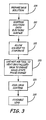
- FIG. 3 is a more detailed flow chart describing the steps included in one embodiment of the method of FIG. 2 , which may be used for coating a medical electrode with an anti-inflammatory steroid for preventing inflammation at the electrode implantation site.
- a drug solution is prepared.
- the drug solution is preferably a saturated solution of a non-aqueous organic solvent and a steroid that is no more than sparingly soluble in water.
- One preferred steroid for use with the present invention is beclomethasone dipropionate anhydrous because it is very slightly soluble in water and will therefore not dissolve quickly away from the electrode surface once it is in contact with bodily fluids.
- Beclomethasone dipropionate anhydrous may be dissolved in an appropriate organic solvent such as acetone.
- a suitable form of beclomethasone dipropionate anhydrous may be obtained from Vinchem, Inc., 301 Main Street, Chatham, NJ, 07928.
- a suitable form of acetone meets American Chemical Society specifications and may be obtained from Fisher Scientific, 711 Forbes Avenue, Pittsburgh, PA, 15219-4785.
- Other types of organic solvents may also be used for preparing a solution of a drug that is no more than sparingly soluble in water, such as methanol or chloroform.
- steroids may be used with the present invention such as betamethasone benzoate, halcinonide, diflorasone diacetate, dexamethasone or dipropionate anhydrous.
- other pharmaceutical agents other than anti-inflammatory steroids, may be applied to the surface of an electrode or other medical device or device component using methods as generally described herein.
- a pharmaceutical agent that is no more than sparingly soluble in water is generally preferred such that the drug will elute over time, however, drugs that are more soluble in water could also conceivably be used.
- the drug solution is prepared, it is dispensed onto an electrode surface at step 110.
- a controlled amount of solution preferably on the order of 1 to 2 microliters, is dispensed onto the electrode surface, either manually or automatically, using a syringe or other appropriate device.
- the amount of solution dispensed onto the electrode should sufficiently coat the electrode without significant run-off.
- the solution is allowed to dry such that the solvent evaporates away from the electrode surface and the remaining drug crystallizes on the electrode surface.
- the drying procedure may be performed at room temperature and generally requires several minutes. At this point, the crystalline coating, like prior art methods, may produce a generally rough, loosely attached coating.
- a method for applying a steroid solution to an electrode may be performed as generally described in the US-A-5,987,746 .
- the drug may be deposited onto an electrode surface using methods other than the solution evaporation methods described above.
- a suspension may be prepared using a generally low solubility drug suspended in a liquid medium. After dispensing the suspension onto an electrode surface, the liquid medium may be driven off through passive evaporation or other methods leaving a deposition of the drug on the electrode surface.
- a drug suspension or solution may alternatively be dip-coated onto an electrode surface and allowed to dry.
- a drug suspension or solution may also be applied to an electrode surface by immersing the electrode in the suspension or solution and allowing the solvent to evaporate leaving a deposit of the drug coating on the electrode surface.
- a drug could alternatively be deposited to an electrode surface in a dry form.
- a pure powdered form of the drug may be deposited on the electrode surface by dipping the electrode into the powdered drug.
- the electrode surface may be prepared to promote adherence of the drug to the electrode surface, for example by wetting the electrode surface with an appropriate liquid medium, such as a solvent that would easily evaporate and not interfere with the pharmacological properties of the drug or the electrical properties of the electrode.
- the drug coating is heated at step 120 to increase molecular mobility and thereby allow micro-crack healing within the crystalline structure.
- the drug coating is heated to a transition point that results in a phase change, preferably a solid-state phase change.
- the increased molecular mobility allows the crystalline structure to reorganize, probably to a lower free energy state, producing a crystalline coating that is conformable to the electrode surface.
- Heating of the crystalline coating is preferably achieved using a focused heat source that allows the coating to be heated relatively quickly, e.g. within several seconds and, more preferably within approximately one second or less, at a moderately high temperature that is below a temperature at which the drug will degrade.
- heating is performed using a heating device, such as a hot air tool, that allows heat to be applied directly to the drug coating at a controlled temperature for a controlled amount of time.
- the temperature of the applied heat is preferably high enough to increase the molecular mobility to a point that induces a phase change, causing a significant decrease in the defect density of the drug coating.
- An effective temperature may be below the melting point, at a point that induces a solid-state phase change.
- Differential scanning calorimetry may be performed to determine the thermal properties of a pharmaceutical agent of interest and aid in selecting a processing temperature.
- the melting point of beclomethasone dipropionate for example, is specified as 205 to 210 degrees Celsius. Degradation of the drug occurs at temperatures just slightly greater than the melting point.
- a solid-state phase change which results in a transformation from a white powder to a clear form of the drug, occurs between 144 and 146 degrees Celsius.
- the total heating time is also preferably controlled. Heat may be applied for a controlled amount of time by either removing the heat source or withdrawing the electrode from the heat source once the rough, crystalline coating is changed to a conformable, crystalline coating.
- the drug coating Upon heating, the drug coating will flow over the surface of the electrode as the molecular mobility is increased.
- a solid-state phase change assisted in providing a lower free energy state that drove an increase in molecular mobility as the transition occurred.
- the high-energy state micro-cracks healed during the solid-to-solid state transition. The result was that that the drug coating that was white and fragile turned into a translucent, conformable crystalline coating.
- the heated coating is then allowed to cool at step 125 such that a translucent, conformable drug coating uniformly covers the electrode.
- the coated electrode may be cooled at room temperature, and is preferably cooled under a vacuum.
- the electrode, now coated with a steroid may be used in assembling a lead at step 130, such as lead 10 or 20 shown in FIGS. 1A or 1B , respectively. Because the conformable coating achieved by the methods described herein is more durable and better attached to the electrode surface than its precursor, lead assembly may be performed after the electrode is coated with a drug.
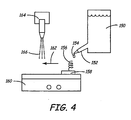
- FIG. 4 is a schematic diagram of apparatus that may be used for performing the methods included in FIG. 3 .
- a helical electrode 156 is shown mounted in a fixture 158 designed for holding the electrode 156 upright during the coating process.
- a syringe 152 is loaded with a prepared drug solution 150 and dispenses a small, controlled amount 154, onto the electrode 156.
- the syringe may be depressed by mechanical drug dispensing equipment that is commercially available, for example the Microlab Syringe Dispenser available from Hamilton Company, Reno, NV.
- the electrode 156 and fixture 158 are moved past a narrow stream of heated air 166 on motorized platform 160 at a controlled speed in the direction shown by arrow 162.
- the motorized platform 160 may be set at a desired speed, such that the electrode is held in the heated air stream 166 just long enough to induce the desired phase change.
- a hot air tool 164 generates the stream of heated air 166 at a controlled temperature, selected based on the thermal properties of the drug used.
- An effective selected temperature may be anywhere in the range from a temperature that induces a solid-state phase change to a temperature less than the degradation point of the drug.
- One advantage of the present invention is that the controlled heating process, using a focused, direct heat source, achieves a change in solid state and micro-crack healing forming a conformable crystalline coating with a decrease in the defect density, without degrading the drug.
- high performance liquid chromatography HPLC
- test solution samples were identical to those of the control samples with regards to retention time of the major peak. In addition no peaks associated with degradation products were observed with the test sample.
Landscapes
- Health & Medical Sciences (AREA)
- Heart & Thoracic Surgery (AREA)
- Engineering & Computer Science (AREA)
- Cardiology (AREA)
- Biomedical Technology (AREA)
- Life Sciences & Earth Sciences (AREA)
- Vascular Medicine (AREA)
- Bioinformatics & Cheminformatics (AREA)
- Chemical & Material Sciences (AREA)
- Nuclear Medicine, Radiotherapy & Molecular Imaging (AREA)
- Radiology & Medical Imaging (AREA)
- Medicinal Chemistry (AREA)
- Animal Behavior & Ethology (AREA)
- General Health & Medical Sciences (AREA)
- Public Health (AREA)
- Veterinary Medicine (AREA)
- Materials For Medical Uses (AREA)
- Pharmaceuticals Containing Other Organic And Inorganic Compounds (AREA)
- Electrotherapy Devices (AREA)
Claims (17)
- Verfahren zum Aufbringen einer Steroidbeschichtung auf eine Elektrode einer medizinischen Vorrichtung mit folgenden Schritten:Zubereiten einer gesättigten Lösung, die ein Steroid enthält, das in einem organischen Lösungsmittel gelöst ist; undAufbringen bzw. Ablagerung der Lösung auf eine Oberfläche der Elektrode;Trocknen der Lösung, um das Lösungsmittel zu entfernen bzw. abzuziehen und hierdurch eine Beschichtung mit einer kristallinen Struktur auf der Elektrodenoberfläche auszubilden; wobei das Verfahren gekennzeichnet ist durchInduzieren des Verschlusses bzw. der Heilung von Mikrobrüchen in der Beschichtung durch Erhitzen der Beschichtung, nachdem das organische Lösungsmittel entfernt wurde.
- Verfahren nach Anspruch 1, das ferner den Schritt umfasst, die Oberfläche der Elektrode vor dem Aufbringschritt vorzubereiten, um die Adhäsion des Steroids zu fördern.
- Verfahren nach Anspruch 1, bei dem das Lösungsmittel Aceton enthält.
- Verfahren nach Anspruch 1, bei dem das Lösungsmittel Methanol enthält.
- Verfahren nach Anspruch 1, bei dem das Lösungsmittel Chloroform enthält.
- Verfahren nach einem der vorstehenden Ansprüche, bei dem das Steroid schwer wasserlöslich ist.
- Verfahren nach Anspruch 6, bei dem das Steroid wasserfreies Beclomethason-Diproprionat enthält.
- Verfahren nach einem der Ansprüche 1-5, bei dem das Steroid Dexamethason enthält.
- Verfahren nach einem der vorstehenden Ansprüche, bei dem der Erhitzungsschritt die Beschichtung bis zu einem Übergangspunkt, der zu einer Festphasenveränderung der Beschichtung führt, erhitzt.
- Verfahren nach einem der vorstehenden Ansprüche, bei dem der Erhitzungsschritt das Leiten eines Stroms heißer Luft über die Beschichtung umfasst.
- Verfahren nach einem der Ansprüche 1-9, bei dem der Erhitzungsschritt die Aufbringung von Hochfrequenzenergie auf die Beschichtung umfasst.
- Verfahren nach einem der Ansprüche 1-9, bei dem der Erhitzungsschritt die Aufbringung von Mikrowellenenergie auf die Beschichtung umfasst.
- Verfahren nach Anspruch 9, bei dem das Steroid wasserfreies Beclomethason-Diproprionat enthält und der Erhitzungsschritt das Erhitzen der Beschichtung auf eine Temperatur zwischen etwa 144°C und etwa 146°C umfasst.
- Verfahren nach Anspruch 1, bei dem der Aufbringschritt das Tauchen der Elektrode in die Mischung aus dem Steroid und dem organischen Lösungsmittel umfasst.
- Verfahren nach Anspruch 1, bei dem der Aufbringschritt das Dispensieren der Mischung aus dem Steroid und dem organischen Lösungsmittel aus einer Spritze umfasst.
- Verfahren nach Anspruch 10, das ferner den Schritt des Anbringens der Elektrode an einer Halterung vor dem Erhitzungsschritt umfasst und der Erhitzungsschritt ferner das Steuern der Erhitzungszeit durch eine motorisierte Plattform umfasst, mit der die Halterung, an der die Elektrode angebracht ist, verbunden ist.
- Verfahren nach einem der vorstehenden Ansprüche, das ferner den Schritt umfasst, die Elektrode für eine medizinische Vorrichtung in eine Leitung zusammenzubauen bzw. zu montieren.
Applications Claiming Priority (3)
| Application Number | Priority Date | Filing Date | Title |
|---|---|---|---|
| US260659 | 2002-09-30 | ||
| US10/260,659 US7282213B2 (en) | 2002-09-30 | 2002-09-30 | Method for applying a drug coating to a medical device |
| PCT/US2003/031040 WO2004028620A1 (en) | 2002-09-30 | 2003-09-30 | A system to deposit a drug on a surface and a method for coating a surface with a drug |
Publications (2)
| Publication Number | Publication Date |
|---|---|
| EP1551496A1 EP1551496A1 (de) | 2005-07-13 |
| EP1551496B1 true EP1551496B1 (de) | 2008-10-22 |
Family
ID=32029742
Family Applications (1)
| Application Number | Title | Priority Date | Filing Date |
|---|---|---|---|
| EP03773074A Expired - Lifetime EP1551496B1 (de) | 2002-09-30 | 2003-09-30 | Verfahren zum aufbringen eines medikamentes auf eine oberfläche |
Country Status (6)
| Country | Link |
|---|---|
| US (1) | US7282213B2 (de) |
| EP (1) | EP1551496B1 (de) |
| JP (1) | JP2006517111A (de) |
| CA (1) | CA2500501A1 (de) |
| DE (1) | DE60324297D1 (de) |
| WO (1) | WO2004028620A1 (de) |
Families Citing this family (135)
| Publication number | Priority date | Publication date | Assignee | Title |
|---|---|---|---|---|
| US6302875B1 (en) | 1996-10-11 | 2001-10-16 | Transvascular, Inc. | Catheters and related devices for forming passageways between blood vessels or other anatomical structures |
| US6702811B2 (en) | 1999-04-05 | 2004-03-09 | Medtronic, Inc. | Ablation catheter assembly with radially decreasing helix and method of use |
| US7616997B2 (en) | 2000-09-27 | 2009-11-10 | Kieval Robert S | Devices and methods for cardiovascular reflex control via coupled electrodes |
| US8086314B1 (en) * | 2000-09-27 | 2011-12-27 | Cvrx, Inc. | Devices and methods for cardiovascular reflex control |
| US7623926B2 (en) | 2000-09-27 | 2009-11-24 | Cvrx, Inc. | Stimulus regimens for cardiovascular reflex control |
| US7499742B2 (en) * | 2001-09-26 | 2009-03-03 | Cvrx, Inc. | Electrode structures and methods for their use in cardiovascular reflex control |
| US7840271B2 (en) * | 2000-09-27 | 2010-11-23 | Cvrx, Inc. | Stimulus regimens for cardiovascular reflex control |
| US20080213331A1 (en) | 2002-04-08 | 2008-09-04 | Ardian, Inc. | Methods and devices for renal nerve blocking |
| US20070129761A1 (en) | 2002-04-08 | 2007-06-07 | Ardian, Inc. | Methods for treating heart arrhythmia |
| US7653438B2 (en) | 2002-04-08 | 2010-01-26 | Ardian, Inc. | Methods and apparatus for renal neuromodulation |
| US7617005B2 (en) | 2002-04-08 | 2009-11-10 | Ardian, Inc. | Methods and apparatus for thermally-induced renal neuromodulation |
| US20140018880A1 (en) | 2002-04-08 | 2014-01-16 | Medtronic Ardian Luxembourg S.A.R.L. | Methods for monopolar renal neuromodulation |
| US20070135875A1 (en) | 2002-04-08 | 2007-06-14 | Ardian, Inc. | Methods and apparatus for thermally-induced renal neuromodulation |
| US8150519B2 (en) | 2002-04-08 | 2012-04-03 | Ardian, Inc. | Methods and apparatus for bilateral renal neuromodulation |
| US9636174B2 (en) | 2002-04-08 | 2017-05-02 | Medtronic Ardian Luxembourg S.A.R.L. | Methods for therapeutic renal neuromodulation |
| US20060111626A1 (en) * | 2003-03-27 | 2006-05-25 | Cvrx, Inc. | Electrode structures having anti-inflammatory properties and methods of use |
| DE202004021954U1 (de) | 2003-09-12 | 2013-06-19 | Vessix Vascular, Inc. | Auswählbare exzentrische Remodellierung und/oder Ablation von atherosklerotischem Material |
| JP4696067B2 (ja) * | 2004-07-23 | 2011-06-08 | パナソニック株式会社 | 3次元形状描画装置及び3次元形状描画方法 |
| US8396548B2 (en) | 2008-11-14 | 2013-03-12 | Vessix Vascular, Inc. | Selective drug delivery in a lumen |
| US8920414B2 (en) | 2004-09-10 | 2014-12-30 | Vessix Vascular, Inc. | Tuned RF energy and electrical tissue characterization for selective treatment of target tissues |
| US9713730B2 (en) | 2004-09-10 | 2017-07-25 | Boston Scientific Scimed, Inc. | Apparatus and method for treatment of in-stent restenosis |
| WO2006063021A2 (en) | 2004-12-07 | 2006-06-15 | Surmodics, Inc. | Coatngs with crystallized active agents (s) |
| US7803168B2 (en) | 2004-12-09 | 2010-09-28 | The Foundry, Llc | Aortic valve repair |
| US20060235499A1 (en) * | 2005-04-14 | 2006-10-19 | Cardiac Pacemakers, Inc. | Coated lead fixation electrode |
| US7477946B2 (en) * | 2005-04-26 | 2009-01-13 | Cardiac Pacemakers, Inc. | Fixation device for coronary venous lead |
| US8175724B2 (en) * | 2005-04-26 | 2012-05-08 | Cardiac Pacemakers, Inc. | Vascular fixation device |
| US7729781B2 (en) * | 2006-03-16 | 2010-06-01 | Greatbatch Ltd. | High efficiency neurostimulation lead |
| US8019435B2 (en) | 2006-05-02 | 2011-09-13 | Boston Scientific Scimed, Inc. | Control of arterial smooth muscle tone |
| DE102006032240A1 (de) * | 2006-07-12 | 2008-01-17 | Biotronik Crm Patent Ag | Implantierbare Elektrodenvorrichtung |
| US20080027526A1 (en) * | 2006-07-27 | 2008-01-31 | Cardic Pacemakers, Inc. | Lead comprising a drug region shared by more than one electrode |
| WO2008049082A2 (en) | 2006-10-18 | 2008-04-24 | Minnow Medical, Inc. | Inducing desirable temperature effects on body tissue |
| JP5559539B2 (ja) | 2006-10-18 | 2014-07-23 | べシックス・バスキュラー・インコーポレイテッド | 身体組織に望ましい温度作用を誘発するシステム |
| US20080276935A1 (en) | 2006-11-20 | 2008-11-13 | Lixiao Wang | Treatment of asthma and chronic obstructive pulmonary disease with anti-proliferate and anti-inflammatory drugs |
| US9737640B2 (en) | 2006-11-20 | 2017-08-22 | Lutonix, Inc. | Drug releasing coatings for medical devices |
| US8414909B2 (en) | 2006-11-20 | 2013-04-09 | Lutonix, Inc. | Drug releasing coatings for medical devices |
| US8414526B2 (en) | 2006-11-20 | 2013-04-09 | Lutonix, Inc. | Medical device rapid drug releasing coatings comprising oils, fatty acids, and/or lipids |
| US8414910B2 (en) | 2006-11-20 | 2013-04-09 | Lutonix, Inc. | Drug releasing coatings for medical devices |
| US9700704B2 (en) | 2006-11-20 | 2017-07-11 | Lutonix, Inc. | Drug releasing coatings for balloon catheters |
| US8998846B2 (en) | 2006-11-20 | 2015-04-07 | Lutonix, Inc. | Drug releasing coatings for balloon catheters |
| US8425459B2 (en) | 2006-11-20 | 2013-04-23 | Lutonix, Inc. | Medical device rapid drug releasing coatings comprising a therapeutic agent and a contrast agent |
| US8430055B2 (en) | 2008-08-29 | 2013-04-30 | Lutonix, Inc. | Methods and apparatuses for coating balloon catheters |
| US8414525B2 (en) | 2006-11-20 | 2013-04-09 | Lutonix, Inc. | Drug releasing coatings for medical devices |
| US20080183255A1 (en) * | 2007-01-30 | 2008-07-31 | Cardiac Pacemakers, Inc. | Side port lead delivery system |
| US7917230B2 (en) * | 2007-01-30 | 2011-03-29 | Cardiac Pacemakers, Inc. | Neurostimulating lead having a stent-like anchor |
| US8244378B2 (en) | 2007-01-30 | 2012-08-14 | Cardiac Pacemakers, Inc. | Spiral configurations for intravascular lead stability |
| US7949409B2 (en) * | 2007-01-30 | 2011-05-24 | Cardiac Pacemakers, Inc. | Dual spiral lead configurations |
| US20080183187A1 (en) * | 2007-01-30 | 2008-07-31 | Cardiac Pacemakers, Inc. | Direct delivery system for transvascular lead |
| US8000810B2 (en) * | 2007-03-20 | 2011-08-16 | Cardiac Pacemakers, Inc. | Systems and methods for transvenous lead implantation |
| US8496653B2 (en) | 2007-04-23 | 2013-07-30 | Boston Scientific Scimed, Inc. | Thrombus removal |
| US8594794B2 (en) | 2007-07-24 | 2013-11-26 | Cvrx, Inc. | Baroreflex activation therapy with incrementally changing intensity |
| US8271101B2 (en) | 2007-08-29 | 2012-09-18 | Advanced Bionics | Modular drug delivery system for minimizing trauma during and after insertion of a cochlear lead |
| WO2009029866A2 (en) | 2007-08-29 | 2009-03-05 | Advanced Bionics, Llc | Minimizing trauma during and after insertion of a cochlear lead |
| US20090112962A1 (en) * | 2007-10-31 | 2009-04-30 | Research In Motion Limited | Modular squaring in binary field arithmetic |
| EP2344207B1 (de) * | 2008-09-22 | 2013-12-25 | Boston Scientific Neuromodulation Corporation | Implantierbare oder einführbare medizinische vorrichtungen |
| KR20110104504A (ko) | 2008-11-17 | 2011-09-22 | 미노우 메디컬, 인코포레이티드 | 조직 토폴로지의 지식 여하에 따른 에너지의 선택적 축적 |
| US20120231037A1 (en) * | 2009-02-02 | 2012-09-13 | Yissum Research Development Companyof the Hebrew U | Crystalline drug-containing coatings |
| US8551096B2 (en) * | 2009-05-13 | 2013-10-08 | Boston Scientific Scimed, Inc. | Directional delivery of energy and bioactives |
| US8788062B2 (en) * | 2009-08-04 | 2014-07-22 | Cardiac Pacemakers, Inc. | Polymer compression joining in implantable lead |
| AU2011238925B2 (en) | 2010-04-09 | 2016-06-16 | Vessix Vascular, Inc. | Power generating and control apparatus for the treatment of tissue |
| US9192790B2 (en) | 2010-04-14 | 2015-11-24 | Boston Scientific Scimed, Inc. | Focused ultrasonic renal denervation |
| US8473067B2 (en) | 2010-06-11 | 2013-06-25 | Boston Scientific Scimed, Inc. | Renal denervation and stimulation employing wireless vascular energy transfer arrangement |
| US9358365B2 (en) | 2010-07-30 | 2016-06-07 | Boston Scientific Scimed, Inc. | Precision electrode movement control for renal nerve ablation |
| US9084609B2 (en) | 2010-07-30 | 2015-07-21 | Boston Scientific Scime, Inc. | Spiral balloon catheter for renal nerve ablation |
| US9463062B2 (en) | 2010-07-30 | 2016-10-11 | Boston Scientific Scimed, Inc. | Cooled conductive balloon RF catheter for renal nerve ablation |
| US9408661B2 (en) | 2010-07-30 | 2016-08-09 | Patrick A. Haverkost | RF electrodes on multiple flexible wires for renal nerve ablation |
| US9155589B2 (en) | 2010-07-30 | 2015-10-13 | Boston Scientific Scimed, Inc. | Sequential activation RF electrode set for renal nerve ablation |
| US8974451B2 (en) | 2010-10-25 | 2015-03-10 | Boston Scientific Scimed, Inc. | Renal nerve ablation using conductive fluid jet and RF energy |
| CN202665687U (zh) | 2010-10-25 | 2013-01-16 | 美敦力Af卢森堡有限责任公司 | 用于通过肾去神经支配治疗人类患者的导管装置 |
| US9220558B2 (en) | 2010-10-27 | 2015-12-29 | Boston Scientific Scimed, Inc. | RF renal denervation catheter with multiple independent electrodes |
| US9028485B2 (en) | 2010-11-15 | 2015-05-12 | Boston Scientific Scimed, Inc. | Self-expanding cooling electrode for renal nerve ablation |
| US9089350B2 (en) | 2010-11-16 | 2015-07-28 | Boston Scientific Scimed, Inc. | Renal denervation catheter with RF electrode and integral contrast dye injection arrangement |
| US9668811B2 (en) | 2010-11-16 | 2017-06-06 | Boston Scientific Scimed, Inc. | Minimally invasive access for renal nerve ablation |
| US9326751B2 (en) | 2010-11-17 | 2016-05-03 | Boston Scientific Scimed, Inc. | Catheter guidance of external energy for renal denervation |
| US9060761B2 (en) | 2010-11-18 | 2015-06-23 | Boston Scientific Scime, Inc. | Catheter-focused magnetic field induced renal nerve ablation |
| US9192435B2 (en) | 2010-11-22 | 2015-11-24 | Boston Scientific Scimed, Inc. | Renal denervation catheter with cooled RF electrode |
| US9023034B2 (en) | 2010-11-22 | 2015-05-05 | Boston Scientific Scimed, Inc. | Renal ablation electrode with force-activatable conduction apparatus |
| US20120157993A1 (en) | 2010-12-15 | 2012-06-21 | Jenson Mark L | Bipolar Off-Wall Electrode Device for Renal Nerve Ablation |
| WO2012100095A1 (en) | 2011-01-19 | 2012-07-26 | Boston Scientific Scimed, Inc. | Guide-compatible large-electrode catheter for renal nerve ablation with reduced arterial injury |
| US20120259269A1 (en) | 2011-04-08 | 2012-10-11 | Tyco Healthcare Group Lp | Iontophoresis drug delivery system and method for denervation of the renal sympathetic nerve and iontophoretic drug delivery |
| AU2012283908B2 (en) | 2011-07-20 | 2017-02-16 | Boston Scientific Scimed, Inc. | Percutaneous devices and methods to visualize, target and ablate nerves |
| WO2013016203A1 (en) | 2011-07-22 | 2013-01-31 | Boston Scientific Scimed, Inc. | Nerve modulation system with a nerve modulation element positionable in a helical guide |
| EP2765942B1 (de) | 2011-10-10 | 2016-02-24 | Boston Scientific Scimed, Inc. | Medizinische vorrichtungen mit ablationselektroden |
| EP2765940B1 (de) | 2011-10-11 | 2015-08-26 | Boston Scientific Scimed, Inc. | Wandferne elektrodenvorrichtung zur nervenmodulation |
| US9420955B2 (en) | 2011-10-11 | 2016-08-23 | Boston Scientific Scimed, Inc. | Intravascular temperature monitoring system and method |
| US9364284B2 (en) | 2011-10-12 | 2016-06-14 | Boston Scientific Scimed, Inc. | Method of making an off-wall spacer cage |
| WO2013059202A1 (en) | 2011-10-18 | 2013-04-25 | Boston Scientific Scimed, Inc. | Integrated crossing balloon catheter |
| US9162046B2 (en) | 2011-10-18 | 2015-10-20 | Boston Scientific Scimed, Inc. | Deflectable medical devices |
| CN108095821B (zh) | 2011-11-08 | 2021-05-25 | 波士顿科学西美德公司 | 孔部肾神经消融 |
| US9119600B2 (en) | 2011-11-15 | 2015-09-01 | Boston Scientific Scimed, Inc. | Device and methods for renal nerve modulation monitoring |
| US9119632B2 (en) | 2011-11-21 | 2015-09-01 | Boston Scientific Scimed, Inc. | Deflectable renal nerve ablation catheter |
| US9265969B2 (en) | 2011-12-21 | 2016-02-23 | Cardiac Pacemakers, Inc. | Methods for modulating cell function |
| JP6158830B2 (ja) | 2011-12-23 | 2017-07-05 | べシックス・バスキュラー・インコーポレイテッド | 身体通路の組織又は身体通路に隣接する組織をリモデリングするためのシステム、方法及び装置 |
| US9433760B2 (en) | 2011-12-28 | 2016-09-06 | Boston Scientific Scimed, Inc. | Device and methods for nerve modulation using a novel ablation catheter with polymeric ablative elements |
| US9050106B2 (en) | 2011-12-29 | 2015-06-09 | Boston Scientific Scimed, Inc. | Off-wall electrode device and methods for nerve modulation |
| WO2013169927A1 (en) | 2012-05-08 | 2013-11-14 | Boston Scientific Scimed, Inc. | Renal nerve modulation devices |
| KR20150018801A (ko) | 2012-05-11 | 2015-02-24 | 메드트로닉 아르디언 룩셈부르크 에스에이알엘 | 신장 신경조절용 다중-전극 카테터 어셈블리, 관련 시스템 및 방법 |
| WO2014032016A1 (en) | 2012-08-24 | 2014-02-27 | Boston Scientific Scimed, Inc. | Intravascular catheter with a balloon comprising separate microporous regions |
| WO2014043687A2 (en) | 2012-09-17 | 2014-03-20 | Boston Scientific Scimed, Inc. | Self-positioning electrode system and method for renal nerve modulation |
| US10398464B2 (en) | 2012-09-21 | 2019-09-03 | Boston Scientific Scimed, Inc. | System for nerve modulation and innocuous thermal gradient nerve block |
| WO2014047454A2 (en) | 2012-09-21 | 2014-03-27 | Boston Scientific Scimed, Inc. | Self-cooling ultrasound ablation catheter |
| WO2014059165A2 (en) | 2012-10-10 | 2014-04-17 | Boston Scientific Scimed, Inc. | Renal nerve modulation devices and methods |
| WO2014163987A1 (en) | 2013-03-11 | 2014-10-09 | Boston Scientific Scimed, Inc. | Medical devices for modulating nerves |
| WO2014143571A1 (en) | 2013-03-11 | 2014-09-18 | Boston Scientific Scimed, Inc. | Medical devices for modulating nerves |
| US9808311B2 (en) | 2013-03-13 | 2017-11-07 | Boston Scientific Scimed, Inc. | Deflectable medical devices |
| US10265122B2 (en) | 2013-03-15 | 2019-04-23 | Boston Scientific Scimed, Inc. | Nerve ablation devices and related methods of use |
| US9179974B2 (en) | 2013-03-15 | 2015-11-10 | Medtronic Ardian Luxembourg S.A.R.L. | Helical push wire electrode |
| EP2967725B1 (de) | 2013-03-15 | 2019-12-11 | Boston Scientific Scimed, Inc. | Steuervorrichtung zur leckstromdetektion zwischen elektrodenpads und anlage mit einer solchen steuervorrichtung |
| EP2967734B1 (de) | 2013-03-15 | 2019-05-15 | Boston Scientific Scimed, Inc. | Verfahren und vorrichtungen zur gewebeneumodellierung in oder neben einem körperdurchgang |
| US10022182B2 (en) | 2013-06-21 | 2018-07-17 | Boston Scientific Scimed, Inc. | Medical devices for renal nerve ablation having rotatable shafts |
| US9943365B2 (en) | 2013-06-21 | 2018-04-17 | Boston Scientific Scimed, Inc. | Renal denervation balloon catheter with ride along electrode support |
| US9707036B2 (en) | 2013-06-25 | 2017-07-18 | Boston Scientific Scimed, Inc. | Devices and methods for nerve modulation using localized indifferent electrodes |
| WO2015002787A1 (en) | 2013-07-01 | 2015-01-08 | Boston Scientific Scimed, Inc. | Medical devices for renal nerve ablation |
| WO2015006480A1 (en) | 2013-07-11 | 2015-01-15 | Boston Scientific Scimed, Inc. | Devices and methods for nerve modulation |
| US10413357B2 (en) | 2013-07-11 | 2019-09-17 | Boston Scientific Scimed, Inc. | Medical device with stretchable electrode assemblies |
| CN105682594B (zh) | 2013-07-19 | 2018-06-22 | 波士顿科学国际有限公司 | 螺旋双极电极肾脏去神经支配气囊 |
| CN105555220B (zh) | 2013-07-22 | 2019-05-17 | 波士顿科学国际有限公司 | 用于肾神经消融的医疗器械 |
| JP6122217B2 (ja) | 2013-07-22 | 2017-04-26 | ボストン サイエンティフィック サイムド,インコーポレイテッドBoston Scientific Scimed,Inc. | 腎神経アブレーション用医療器具 |
| EP4049605A1 (de) | 2013-08-22 | 2022-08-31 | Boston Scientific Scimed Inc. | Flexibler kreislauf mit verbesserter haftung an einem nierennervenmodulationsballon |
| CN105555218B (zh) | 2013-09-04 | 2019-01-15 | 波士顿科学国际有限公司 | 具有冲洗和冷却能力的射频(rf)球囊导管 |
| US20150073515A1 (en) | 2013-09-09 | 2015-03-12 | Medtronic Ardian Luxembourg S.a.r.I. | Neuromodulation Catheter Devices and Systems Having Energy Delivering Thermocouple Assemblies and Associated Methods |
| CN105530885B (zh) | 2013-09-13 | 2020-09-22 | 波士顿科学国际有限公司 | 具有气相沉积覆盖层的消融球囊 |
| US11246654B2 (en) | 2013-10-14 | 2022-02-15 | Boston Scientific Scimed, Inc. | Flexible renal nerve ablation devices and related methods of use and manufacture |
| US9687166B2 (en) | 2013-10-14 | 2017-06-27 | Boston Scientific Scimed, Inc. | High resolution cardiac mapping electrode array catheter |
| US9770606B2 (en) | 2013-10-15 | 2017-09-26 | Boston Scientific Scimed, Inc. | Ultrasound ablation catheter with cooling infusion and centering basket |
| EP3057520A1 (de) | 2013-10-15 | 2016-08-24 | Boston Scientific Scimed, Inc. | Ballon für medizinische vorrichtung |
| JP6259099B2 (ja) | 2013-10-18 | 2018-01-10 | ボストン サイエンティフィック サイムド,インコーポレイテッドBoston Scientific Scimed,Inc. | 可撓性を備える導電性ワイヤを備えるバルーン・カテーテル、並びに関連する使用および製造方法 |
| WO2015061457A1 (en) | 2013-10-25 | 2015-04-30 | Boston Scientific Scimed, Inc. | Embedded thermocouple in denervation flex circuit |
| US11202671B2 (en) | 2014-01-06 | 2021-12-21 | Boston Scientific Scimed, Inc. | Tear resistant flex circuit assembly |
| JP6325121B2 (ja) | 2014-02-04 | 2018-05-16 | ボストン サイエンティフィック サイムド,インコーポレイテッドBoston Scientific Scimed,Inc. | 双極電極上の温度センサの代替配置 |
| US11000679B2 (en) | 2014-02-04 | 2021-05-11 | Boston Scientific Scimed, Inc. | Balloon protection and rewrapping devices and related methods of use |
| EP4371512A3 (de) | 2014-04-24 | 2024-08-14 | Medtronic Ardian Luxembourg S.à.r.l. | Neuromodulationskatheter mit geflochtenen wellen sowie zugehörige systeme und verfahren |
| WO2015181826A1 (en) | 2014-05-27 | 2015-12-03 | Yissum Research Development Company Of The Hebrew University Of Jerusalem Ltd. | Crystalline coating and release of bioactive agents |
| US11116561B2 (en) | 2018-01-24 | 2021-09-14 | Medtronic Ardian Luxembourg S.A.R.L. | Devices, agents, and associated methods for selective modulation of renal nerves |
| WO2023085618A1 (ko) | 2021-11-10 | 2023-05-19 | 삼성전자 주식회사 | 접착 부재를 포함하는 전자 장치 |
| CN119424922A (zh) * | 2024-05-28 | 2025-02-14 | 苏州新云医疗设备有限公司 | 植入式神经刺激器的电极引线及植入式神经刺激器系统 |
Citations (1)
| Publication number | Priority date | Publication date | Assignee | Title |
|---|---|---|---|---|
| US3886103A (en) * | 1970-03-19 | 1975-05-27 | Daikin Ind Ltd | Method for coating metal substrate with a composition containing vinylidene fluoride polymer or vinyl fluoride polymer |
Family Cites Families (13)
| Publication number | Priority date | Publication date | Assignee | Title |
|---|---|---|---|---|
| US4506680A (en) | 1983-03-17 | 1985-03-26 | Medtronic, Inc. | Drug dispensing body implantable lead |
| US4502492A (en) | 1983-04-28 | 1985-03-05 | Medtronic, Inc. | Low-polarization low-threshold electrode |
| US4606118A (en) | 1985-02-27 | 1986-08-19 | Medtronic, Inc. | Method of making a drug dispensing body |
| US4577642A (en) | 1985-02-27 | 1986-03-25 | Medtronic, Inc. | Drug dispensing body implantable lead employing molecular sieves and methods of fabrication |
| US4972848A (en) | 1989-08-23 | 1990-11-27 | Medtronic, Inc. | Medical electrical lead with polymeric monolithic controlled release device and method of manufacture |
| US4953564A (en) | 1989-08-23 | 1990-09-04 | Medtronic, Inc. | Screw-in drug eluting lead |
| US5324325A (en) | 1991-06-27 | 1994-06-28 | Siemens Pacesetter, Inc. | Myocardial steroid releasing lead |
| US5522874A (en) | 1994-07-28 | 1996-06-04 | Gates; James T. | Medical lead having segmented electrode |
| US5658327A (en) | 1995-12-19 | 1997-08-19 | Ventritex, Inc. | Intracardiac lead having a compliant fixation device |
| US5776178A (en) | 1996-02-21 | 1998-07-07 | Medtronic, Inc. | Medical electrical lead with surface treatment for enhanced fixation |
| US5987746A (en) * | 1996-02-21 | 1999-11-23 | Medtronic, Inc. | Method of making medical electrical lead |
| WO1999053994A1 (en) | 1998-04-20 | 1999-10-28 | Medtronic, Inc. | Medical leads with enhanced biocompatibility and biostability |
| US6567704B2 (en) | 2000-12-20 | 2003-05-20 | Medtronic, Inc. | Medical electrical lead and method of use |
-
2002
- 2002-09-30 US US10/260,659 patent/US7282213B2/en not_active Expired - Fee Related
-
2003
- 2003-09-30 EP EP03773074A patent/EP1551496B1/de not_active Expired - Lifetime
- 2003-09-30 JP JP2004540318A patent/JP2006517111A/ja active Pending
- 2003-09-30 WO PCT/US2003/031040 patent/WO2004028620A1/en not_active Ceased
- 2003-09-30 DE DE60324297T patent/DE60324297D1/de not_active Expired - Lifetime
- 2003-09-30 CA CA002500501A patent/CA2500501A1/en not_active Abandoned
Patent Citations (1)
| Publication number | Priority date | Publication date | Assignee | Title |
|---|---|---|---|---|
| US3886103A (en) * | 1970-03-19 | 1975-05-27 | Daikin Ind Ltd | Method for coating metal substrate with a composition containing vinylidene fluoride polymer or vinyl fluoride polymer |
Also Published As
| Publication number | Publication date |
|---|---|
| WO2004028620A9 (en) | 2006-03-09 |
| CA2500501A1 (en) | 2004-04-08 |
| WO2004028620B1 (en) | 2006-05-18 |
| WO2004028620A1 (en) | 2004-04-08 |
| DE60324297D1 (de) | 2008-12-04 |
| JP2006517111A (ja) | 2006-07-20 |
| US7282213B2 (en) | 2007-10-16 |
| EP1551496A1 (de) | 2005-07-13 |
| US20040062852A1 (en) | 2004-04-01 |
Similar Documents
| Publication | Publication Date | Title |
|---|---|---|
| US7282213B2 (en) | Method for applying a drug coating to a medical device | |
| JP2838480B2 (ja) | 人体刺激/感知リード、同電極及びこの電極の製造方法 | |
| EP0791372B1 (de) | Medizinische Elektrode | |
| US7529592B2 (en) | Subcutaneous electrode and lead with temporary pharmacological agents | |
| US6078840A (en) | Medical electrical lead having improved fixation | |
| US5902329A (en) | Explantable lead | |
| US6212434B1 (en) | Single pass lead system | |
| US6298272B1 (en) | High impedance electrode tip with internal drug delivery capability | |
| US6516232B2 (en) | Ring electrode with porous member | |
| EP0795343A2 (de) | Medizinische elektrische Leitung mit Oberflächenbehandlung der schraubenförmigen Befestigung | |
| US20070265692A1 (en) | Porous surface electrode for coronary venous applications | |
| US20090054961A1 (en) | Drug eluting coatings for a medical lead and method | |
| US6671562B2 (en) | High impedance drug eluting cardiac lead | |
| US20100125319A1 (en) | Cell-repelling polymeric electrode having a structured surface | |
| US20050070988A1 (en) | Active fixation assembly for an implantable device | |
| US20040230272A1 (en) | Subcutaneous lead with temporary pharmacological agents | |
| AU652377B2 (en) | Miniature steroid eluting pacing lead electrode |
Legal Events
| Date | Code | Title | Description |
|---|---|---|---|
| PUAI | Public reference made under article 153(3) epc to a published international application that has entered the european phase |
Free format text: ORIGINAL CODE: 0009012 |
|
| 17P | Request for examination filed |
Effective date: 20050422 |
|
| AK | Designated contracting states |
Kind code of ref document: A1 Designated state(s): AT BE BG CH CY CZ DE DK EE ES FI FR GB GR HU IE IT LI LU MC NL PT RO SE SI SK TR |
|
| RBV | Designated contracting states (corrected) |
Designated state(s): CH DE FR LI NL SE |
|
| 17Q | First examination report despatched |
Effective date: 20070221 |
|
| RTI1 | Title (correction) |
Free format text: A METHOD FOR COATING A SURFACE WITH A DRUG |
|
| GRAP | Despatch of communication of intention to grant a patent |
Free format text: ORIGINAL CODE: EPIDOSNIGR1 |
|
| GRAS | Grant fee paid |
Free format text: ORIGINAL CODE: EPIDOSNIGR3 |
|
| GRAA | (expected) grant |
Free format text: ORIGINAL CODE: 0009210 |
|
| AK | Designated contracting states |
Kind code of ref document: B1 Designated state(s): CH DE FR LI NL SE |
|
| REG | Reference to a national code |
Ref country code: CH Ref legal event code: EP |
|
| REF | Corresponds to: |
Ref document number: 60324297 Country of ref document: DE Date of ref document: 20081204 Kind code of ref document: P |
|
| NLV1 | Nl: lapsed or annulled due to failure to fulfill the requirements of art. 29p and 29m of the patents act | ||
| PG25 | Lapsed in a contracting state [announced via postgrant information from national office to epo] |
Ref country code: NL Free format text: LAPSE BECAUSE OF FAILURE TO SUBMIT A TRANSLATION OF THE DESCRIPTION OR TO PAY THE FEE WITHIN THE PRESCRIBED TIME-LIMIT Effective date: 20081022 |
|
| PLBE | No opposition filed within time limit |
Free format text: ORIGINAL CODE: 0009261 |
|
| STAA | Information on the status of an ep patent application or granted ep patent |
Free format text: STATUS: NO OPPOSITION FILED WITHIN TIME LIMIT |
|
| PG25 | Lapsed in a contracting state [announced via postgrant information from national office to epo] |
Ref country code: SE Free format text: LAPSE BECAUSE OF FAILURE TO SUBMIT A TRANSLATION OF THE DESCRIPTION OR TO PAY THE FEE WITHIN THE PRESCRIBED TIME-LIMIT Effective date: 20090122 |
|
| 26N | No opposition filed |
Effective date: 20090723 |
|
| REG | Reference to a national code |
Ref country code: CH Ref legal event code: PL |
|
| PG25 | Lapsed in a contracting state [announced via postgrant information from national office to epo] |
Ref country code: CH Free format text: LAPSE BECAUSE OF NON-PAYMENT OF DUE FEES Effective date: 20090930 Ref country code: LI Free format text: LAPSE BECAUSE OF NON-PAYMENT OF DUE FEES Effective date: 20090930 |
|
| REG | Reference to a national code |
Ref country code: FR Ref legal event code: PLFP Year of fee payment: 14 |
|
| REG | Reference to a national code |
Ref country code: FR Ref legal event code: PLFP Year of fee payment: 15 |
|
| REG | Reference to a national code |
Ref country code: FR Ref legal event code: PLFP Year of fee payment: 16 |
|
| PGFP | Annual fee paid to national office [announced via postgrant information from national office to epo] |
Ref country code: FR Payment date: 20190820 Year of fee payment: 17 |
|
| REG | Reference to a national code |
Ref country code: DE Ref legal event code: R082 Ref document number: 60324297 Country of ref document: DE Representative=s name: DEHNSGERMANY PARTNERSCHAFT VON PATENTANWAELTEN, DE |
|
| PG25 | Lapsed in a contracting state [announced via postgrant information from national office to epo] |
Ref country code: FR Free format text: LAPSE BECAUSE OF NON-PAYMENT OF DUE FEES Effective date: 20200930 |
|
| PGFP | Annual fee paid to national office [announced via postgrant information from national office to epo] |
Ref country code: DE Payment date: 20210818 Year of fee payment: 19 |
|
| REG | Reference to a national code |
Ref country code: DE Ref legal event code: R119 Ref document number: 60324297 Country of ref document: DE |
|
| PG25 | Lapsed in a contracting state [announced via postgrant information from national office to epo] |
Ref country code: DE Free format text: LAPSE BECAUSE OF NON-PAYMENT OF DUE FEES Effective date: 20230401 |