EP1551892B1 - Wässrige lösung eines phenolformaldehydaminoalkoholharzes, verfahren zu ihrer herstellung, leimungszusammensetzung für mineralfaser - Google Patents
Wässrige lösung eines phenolformaldehydaminoalkoholharzes, verfahren zu ihrer herstellung, leimungszusammensetzung für mineralfaser Download PDFInfo
- Publication number
- EP1551892B1 EP1551892B1 EP03756503A EP03756503A EP1551892B1 EP 1551892 B1 EP1551892 B1 EP 1551892B1 EP 03756503 A EP03756503 A EP 03756503A EP 03756503 A EP03756503 A EP 03756503A EP 1551892 B1 EP1551892 B1 EP 1551892B1
- Authority
- EP
- European Patent Office
- Prior art keywords
- resin
- formaldehyde
- phenolic compound
- aminoalcohol
- phenol
- Prior art date
- Legal status (The legal status is an assumption and is not a legal conclusion. Google has not performed a legal analysis and makes no representation as to the accuracy of the status listed.)
- Expired - Lifetime
Links
- 229920005989 resin Polymers 0.000 title claims abstract description 83
- 239000011347 resin Substances 0.000 title claims abstract description 83
- 239000000203 mixture Substances 0.000 title claims abstract description 52
- 238000004513 sizing Methods 0.000 title claims abstract description 42
- ISWSIDIOOBJBQZ-UHFFFAOYSA-N phenol group Chemical group C1(=CC=CC=C1)O ISWSIDIOOBJBQZ-UHFFFAOYSA-N 0.000 title claims description 39
- -1 preparation method Substances 0.000 title claims description 12
- 238000002360 preparation method Methods 0.000 title claims description 7
- 239000002557 mineral fiber Substances 0.000 title abstract description 17
- 239000007864 aqueous solution Substances 0.000 title description 6
- WSFSSNUMVMOOMR-UHFFFAOYSA-N Formaldehyde Chemical compound O=C WSFSSNUMVMOOMR-UHFFFAOYSA-N 0.000 claims abstract description 173
- 150000002989 phenols Chemical class 0.000 claims abstract description 34
- AVXURJPOCDRRFD-UHFFFAOYSA-N Hydroxylamine Chemical compound ON AVXURJPOCDRRFD-UHFFFAOYSA-N 0.000 claims abstract description 25
- XLYOFNOQVPJJNP-UHFFFAOYSA-N water Substances O XLYOFNOQVPJJNP-UHFFFAOYSA-N 0.000 claims abstract description 21
- 238000009413 insulation Methods 0.000 claims abstract description 8
- 239000007788 liquid Substances 0.000 claims abstract description 8
- 238000006683 Mannich reaction Methods 0.000 claims abstract description 5
- 239000000835 fiber Substances 0.000 claims description 20
- KRKNYBCHXYNGOX-UHFFFAOYSA-N citric acid Chemical compound OC(=O)CC(O)(C(O)=O)CC(O)=O KRKNYBCHXYNGOX-UHFFFAOYSA-N 0.000 claims description 12
- 150000001875 compounds Chemical class 0.000 claims description 10
- 238000000034 method Methods 0.000 claims description 10
- 238000006243 chemical reaction Methods 0.000 claims description 9
- 230000008569 process Effects 0.000 claims description 9
- HZAXFHJVJLSVMW-UHFFFAOYSA-N 2-Aminoethan-1-ol Chemical compound NCCO HZAXFHJVJLSVMW-UHFFFAOYSA-N 0.000 claims description 8
- 239000003431 cross linking reagent Substances 0.000 claims description 7
- WSFSSNUMVMOOMR-NJFSPNSNSA-N methanone Chemical compound O=[14CH2] WSFSSNUMVMOOMR-NJFSPNSNSA-N 0.000 claims description 7
- 239000011541 reaction mixture Substances 0.000 claims description 7
- 239000002253 acid Substances 0.000 claims description 6
- 150000001412 amines Chemical class 0.000 claims description 6
- 238000001816 cooling Methods 0.000 claims description 6
- 229910052799 carbon Inorganic materials 0.000 claims description 5
- KKEYFWRCBNTPAC-UHFFFAOYSA-N Terephthalic acid Chemical compound OC(=O)C1=CC=C(C(O)=O)C=C1 KKEYFWRCBNTPAC-UHFFFAOYSA-N 0.000 claims description 4
- 150000007513 acids Chemical class 0.000 claims description 4
- 239000000654 additive Substances 0.000 claims description 4
- 125000002887 hydroxy group Chemical group [H]O* 0.000 claims description 4
- QQVIHTHCMHWDBS-UHFFFAOYSA-N isophthalic acid Chemical compound OC(=O)C1=CC=CC(C(O)=O)=C1 QQVIHTHCMHWDBS-UHFFFAOYSA-N 0.000 claims description 4
- XNGIFLGASWRNHJ-UHFFFAOYSA-N phthalic acid Chemical compound OC(=O)C1=CC=CC=C1C(O)=O XNGIFLGASWRNHJ-UHFFFAOYSA-N 0.000 claims description 4
- GHMLBKRAJCXXBS-UHFFFAOYSA-N resorcinol Chemical compound OC1=CC=CC(O)=C1 GHMLBKRAJCXXBS-UHFFFAOYSA-N 0.000 claims description 4
- 239000011521 glass Substances 0.000 claims description 3
- 239000003365 glass fiber Substances 0.000 claims description 3
- 239000011435 rock Substances 0.000 claims description 3
- QTWJRLJHJPIABL-UHFFFAOYSA-N 2-methylphenol;3-methylphenol;4-methylphenol Chemical compound CC1=CC=C(O)C=C1.CC1=CC=CC(O)=C1.CC1=CC=CC=C1O QTWJRLJHJPIABL-UHFFFAOYSA-N 0.000 claims description 2
- OKTJSMMVPCPJKN-UHFFFAOYSA-N Carbon Chemical group [C] OKTJSMMVPCPJKN-UHFFFAOYSA-N 0.000 claims description 2
- 150000008064 anhydrides Chemical class 0.000 claims description 2
- 150000001721 carbon Chemical group 0.000 claims description 2
- 229930003836 cresol Natural products 0.000 claims description 2
- ZBCBWPMODOFKDW-UHFFFAOYSA-N diethanolamine Chemical compound OCCNCCO ZBCBWPMODOFKDW-UHFFFAOYSA-N 0.000 claims description 2
- VKYKSIONXSXAKP-UHFFFAOYSA-N hexamethylenetetramine Chemical compound C1N(C2)CN3CN1CN2C3 VKYKSIONXSXAKP-UHFFFAOYSA-N 0.000 claims description 2
- 229910052500 inorganic mineral Inorganic materials 0.000 claims 6
- 239000011707 mineral Substances 0.000 claims 6
- 125000001183 hydrocarbyl group Chemical group 0.000 claims 3
- SMZOUWXMTYCWNB-UHFFFAOYSA-N 2-(2-methoxy-5-methylphenyl)ethanamine Chemical compound COC1=CC=C(C)C=C1CCN SMZOUWXMTYCWNB-UHFFFAOYSA-N 0.000 claims 1
- NIXOWILDQLNWCW-UHFFFAOYSA-N 2-Propenoic acid Natural products OC(=O)C=C NIXOWILDQLNWCW-UHFFFAOYSA-N 0.000 claims 1
- 125000003277 amino group Chemical group 0.000 claims 1
- 150000001732 carboxylic acid derivatives Chemical class 0.000 claims 1
- 230000001747 exhibiting effect Effects 0.000 claims 1
- 125000000524 functional group Chemical group 0.000 claims 1
- QGZKDVFQNNGYKY-UHFFFAOYSA-N Ammonia Chemical compound N QGZKDVFQNNGYKY-UHFFFAOYSA-N 0.000 description 16
- XSQUKJJJFZCRTK-UHFFFAOYSA-N Urea Chemical compound NC(N)=O XSQUKJJJFZCRTK-UHFFFAOYSA-N 0.000 description 12
- 239000004202 carbamide Substances 0.000 description 11
- 239000003921 oil Substances 0.000 description 10
- BLRPTPMANUNPDV-UHFFFAOYSA-N Silane Chemical compound [SiH4] BLRPTPMANUNPDV-UHFFFAOYSA-N 0.000 description 9
- 229910000077 silane Inorganic materials 0.000 description 9
- 229910021529 ammonia Inorganic materials 0.000 description 7
- 239000007789 gas Substances 0.000 description 7
- 229920001568 phenolic resin Polymers 0.000 description 7
- 239000000243 solution Substances 0.000 description 7
- HEMHJVSKTPXQMS-UHFFFAOYSA-M Sodium hydroxide Chemical compound [OH-].[Na+] HEMHJVSKTPXQMS-UHFFFAOYSA-M 0.000 description 6
- 239000007787 solid Substances 0.000 description 6
- VHUUQVKOLVNVRT-UHFFFAOYSA-N Ammonium hydroxide Chemical compound [NH4+].[OH-] VHUUQVKOLVNVRT-UHFFFAOYSA-N 0.000 description 4
- 229920001807 Urea-formaldehyde Polymers 0.000 description 4
- 238000009833 condensation Methods 0.000 description 4
- 230000005494 condensation Effects 0.000 description 4
- 238000006482 condensation reaction Methods 0.000 description 4
- 239000000470 constituent Substances 0.000 description 4
- 238000004132 cross linking Methods 0.000 description 4
- ODGAOXROABLFNM-UHFFFAOYSA-N polynoxylin Chemical compound O=C.NC(N)=O ODGAOXROABLFNM-UHFFFAOYSA-N 0.000 description 4
- 239000000758 substrate Substances 0.000 description 4
- 239000003054 catalyst Substances 0.000 description 3
- SLGWESQGEUXWJQ-UHFFFAOYSA-N formaldehyde;phenol Chemical compound O=C.OC1=CC=CC=C1 SLGWESQGEUXWJQ-UHFFFAOYSA-N 0.000 description 3
- 238000010438 heat treatment Methods 0.000 description 3
- 150000002430 hydrocarbons Chemical group 0.000 description 3
- 238000006068 polycondensation reaction Methods 0.000 description 3
- 238000003860 storage Methods 0.000 description 3
- KXGFMDJXCMQABM-UHFFFAOYSA-N 2-methoxy-6-methylphenol Chemical compound [CH]OC1=CC=CC([CH])=C1O KXGFMDJXCMQABM-UHFFFAOYSA-N 0.000 description 2
- NLXLAEXVIDQMFP-UHFFFAOYSA-N Ammonium chloride Substances [NH4+].[Cl-] NLXLAEXVIDQMFP-UHFFFAOYSA-N 0.000 description 2
- QAOWNCQODCNURD-UHFFFAOYSA-N Sulfuric acid Chemical compound OS(O)(=O)=O QAOWNCQODCNURD-UHFFFAOYSA-N 0.000 description 2
- 230000009471 action Effects 0.000 description 2
- 238000004026 adhesive bonding Methods 0.000 description 2
- 230000032683 aging Effects 0.000 description 2
- 235000011114 ammonium hydroxide Nutrition 0.000 description 2
- BFNBIHQBYMNNAN-UHFFFAOYSA-N ammonium sulfate Chemical compound N.N.OS(O)(=O)=O BFNBIHQBYMNNAN-UHFFFAOYSA-N 0.000 description 2
- 229910052921 ammonium sulfate Inorganic materials 0.000 description 2
- 239000001166 ammonium sulphate Substances 0.000 description 2
- 235000011130 ammonium sulphate Nutrition 0.000 description 2
- 239000003153 chemical reaction reagent Substances 0.000 description 2
- 229960004106 citric acid Drugs 0.000 description 2
- 239000000428 dust Substances 0.000 description 2
- 239000008098 formaldehyde solution Substances 0.000 description 2
- 229930195733 hydrocarbon Natural products 0.000 description 2
- 239000012212 insulator Substances 0.000 description 2
- 238000005461 lubrication Methods 0.000 description 2
- RLSSMJSEOOYNOY-UHFFFAOYSA-N m-cresol Chemical compound CC1=CC=CC(O)=C1 RLSSMJSEOOYNOY-UHFFFAOYSA-N 0.000 description 2
- 238000004519 manufacturing process Methods 0.000 description 2
- 238000002156 mixing Methods 0.000 description 2
- QWVGKYWNOKOFNN-UHFFFAOYSA-N o-cresol Chemical compound CC1=CC=CC=C1O QWVGKYWNOKOFNN-UHFFFAOYSA-N 0.000 description 2
- IWDCLRJOBJJRNH-UHFFFAOYSA-N p-cresol Chemical compound CC1=CC=C(O)C=C1 IWDCLRJOBJJRNH-UHFFFAOYSA-N 0.000 description 2
- 239000005011 phenolic resin Substances 0.000 description 2
- 238000011084 recovery Methods 0.000 description 2
- 230000009467 reduction Effects 0.000 description 2
- FZHAPNGMFPVSLP-UHFFFAOYSA-N silanamine Chemical class [SiH3]N FZHAPNGMFPVSLP-UHFFFAOYSA-N 0.000 description 2
- 150000004756 silanes Chemical class 0.000 description 2
- 238000005507 spraying Methods 0.000 description 2
- 229920001187 thermosetting polymer Polymers 0.000 description 2
- WYTZZXDRDKSJID-UHFFFAOYSA-N (3-aminopropyl)triethoxysilane Chemical compound CCO[Si](OCC)(OCC)CCCN WYTZZXDRDKSJID-UHFFFAOYSA-N 0.000 description 1
- WEHZNZTWKUYVIY-UHFFFAOYSA-N 3-oxabicyclo[3.2.2]nona-1(7),5,8-triene-2,4-dione Chemical compound O=C1OC(=O)C2=CC=C1C=C2 WEHZNZTWKUYVIY-UHFFFAOYSA-N 0.000 description 1
- LNYYKKTXWBNIOO-UHFFFAOYSA-N 3-oxabicyclo[3.3.1]nona-1(9),5,7-triene-2,4-dione Chemical compound C1=CC(C(=O)OC2=O)=CC2=C1 LNYYKKTXWBNIOO-UHFFFAOYSA-N 0.000 description 1
- QGZKDVFQNNGYKY-UHFFFAOYSA-O Ammonium Chemical compound [NH4+] QGZKDVFQNNGYKY-UHFFFAOYSA-O 0.000 description 1
- 239000004215 Carbon black (E152) Substances 0.000 description 1
- QAOWNCQODCNURD-UHFFFAOYSA-L Sulfate Chemical compound [O-]S([O-])(=O)=O QAOWNCQODCNURD-UHFFFAOYSA-L 0.000 description 1
- 229920006397 acrylic thermoplastic Polymers 0.000 description 1
- 150000001335 aliphatic alkanes Chemical class 0.000 description 1
- 150000001414 amino alcohols Chemical class 0.000 description 1
- 238000004458 analytical method Methods 0.000 description 1
- 229960004543 anhydrous citric acid Drugs 0.000 description 1
- 230000008901 benefit Effects 0.000 description 1
- JHIWVOJDXOSYLW-UHFFFAOYSA-N butyl 2,2-difluorocyclopropane-1-carboxylate Chemical compound CCCCOC(=O)C1CC1(F)F JHIWVOJDXOSYLW-UHFFFAOYSA-N 0.000 description 1
- 238000005119 centrifugation Methods 0.000 description 1
- 239000003795 chemical substances by application Substances 0.000 description 1
- 239000011248 coating agent Substances 0.000 description 1
- 238000000576 coating method Methods 0.000 description 1
- 230000000052 comparative effect Effects 0.000 description 1
- 230000006835 compression Effects 0.000 description 1
- 238000007906 compression Methods 0.000 description 1
- 238000002425 crystallisation Methods 0.000 description 1
- 239000008367 deionised water Substances 0.000 description 1
- 229910021641 deionized water Inorganic materials 0.000 description 1
- 238000001514 detection method Methods 0.000 description 1
- 238000010790 dilution Methods 0.000 description 1
- 239000012895 dilution Substances 0.000 description 1
- 230000000694 effects Effects 0.000 description 1
- 230000007613 environmental effect Effects 0.000 description 1
- 239000011152 fibreglass Substances 0.000 description 1
- 125000002485 formyl group Chemical class [H]C(*)=O 0.000 description 1
- 230000006870 function Effects 0.000 description 1
- 230000036541 health Effects 0.000 description 1
- 239000000314 lubricant Substances 0.000 description 1
- 239000000463 material Substances 0.000 description 1
- 125000000325 methylidene group Chemical group [H]C([H])=* 0.000 description 1
- 239000012768 molten material Substances 0.000 description 1
- 235000015097 nutrients Nutrition 0.000 description 1
- 230000002093 peripheral effect Effects 0.000 description 1
- 229920003229 poly(methyl methacrylate) Polymers 0.000 description 1
- 230000000750 progressive effect Effects 0.000 description 1
- 239000012429 reaction media Substances 0.000 description 1
- 239000011134 resol-type phenolic resin Substances 0.000 description 1
- 150000003839 salts Chemical class 0.000 description 1
- 230000035807 sensation Effects 0.000 description 1
- 239000011734 sodium Substances 0.000 description 1
- 239000002689 soil Substances 0.000 description 1
- 239000007921 spray Substances 0.000 description 1
- 239000007858 starting material Substances 0.000 description 1
- 238000003756 stirring Methods 0.000 description 1
- ISXSCDLOGDJUNJ-UHFFFAOYSA-N tert-butyl prop-2-enoate Chemical compound CC(C)(C)OC(=O)C=C ISXSCDLOGDJUNJ-UHFFFAOYSA-N 0.000 description 1
- 231100000331 toxic Toxicity 0.000 description 1
- 230000002588 toxic effect Effects 0.000 description 1
- 230000002110 toxicologic effect Effects 0.000 description 1
- 231100000027 toxicology Toxicity 0.000 description 1
Classifications
-
- C—CHEMISTRY; METALLURGY
- C03—GLASS; MINERAL OR SLAG WOOL
- C03C—CHEMICAL COMPOSITION OF GLASSES, GLAZES OR VITREOUS ENAMELS; SURFACE TREATMENT OF GLASS; SURFACE TREATMENT OF FIBRES OR FILAMENTS MADE FROM GLASS, MINERALS OR SLAGS; JOINING GLASS TO GLASS OR OTHER MATERIALS
- C03C25/00—Surface treatment of fibres or filaments made from glass, minerals or slags
- C03C25/10—Coating
- C03C25/24—Coatings containing organic materials
- C03C25/26—Macromolecular compounds or prepolymers
- C03C25/32—Macromolecular compounds or prepolymers obtained otherwise than by reactions involving only carbon-to-carbon unsaturated bonds
- C03C25/34—Condensation polymers of aldehydes, e.g. with phenols, ureas, melamines, amides or amines
-
- C—CHEMISTRY; METALLURGY
- C08—ORGANIC MACROMOLECULAR COMPOUNDS; THEIR PREPARATION OR CHEMICAL WORKING-UP; COMPOSITIONS BASED THEREON
- C08G—MACROMOLECULAR COMPOUNDS OBTAINED OTHERWISE THAN BY REACTIONS ONLY INVOLVING UNSATURATED CARBON-TO-CARBON BONDS
- C08G14/00—Condensation polymers of aldehydes or ketones with two or more other monomers covered by at least two of the groups C08G8/00 - C08G12/00
- C08G14/02—Condensation polymers of aldehydes or ketones with two or more other monomers covered by at least two of the groups C08G8/00 - C08G12/00 of aldehydes
- C08G14/04—Condensation polymers of aldehydes or ketones with two or more other monomers covered by at least two of the groups C08G8/00 - C08G12/00 of aldehydes with phenols
- C08G14/06—Condensation polymers of aldehydes or ketones with two or more other monomers covered by at least two of the groups C08G8/00 - C08G12/00 of aldehydes with phenols and monomers containing hydrogen attached to nitrogen
-
- Y—GENERAL TAGGING OF NEW TECHNOLOGICAL DEVELOPMENTS; GENERAL TAGGING OF CROSS-SECTIONAL TECHNOLOGIES SPANNING OVER SEVERAL SECTIONS OF THE IPC; TECHNICAL SUBJECTS COVERED BY FORMER USPC CROSS-REFERENCE ART COLLECTIONS [XRACs] AND DIGESTS
- Y10—TECHNICAL SUBJECTS COVERED BY FORMER USPC
- Y10T—TECHNICAL SUBJECTS COVERED BY FORMER US CLASSIFICATION
- Y10T428/00—Stock material or miscellaneous articles
- Y10T428/24—Structurally defined web or sheet [e.g., overall dimension, etc.]
-
- Y—GENERAL TAGGING OF NEW TECHNOLOGICAL DEVELOPMENTS; GENERAL TAGGING OF CROSS-SECTIONAL TECHNOLOGIES SPANNING OVER SEVERAL SECTIONS OF THE IPC; TECHNICAL SUBJECTS COVERED BY FORMER USPC CROSS-REFERENCE ART COLLECTIONS [XRACs] AND DIGESTS
- Y10—TECHNICAL SUBJECTS COVERED BY FORMER USPC
- Y10T—TECHNICAL SUBJECTS COVERED BY FORMER US CLASSIFICATION
- Y10T428/00—Stock material or miscellaneous articles
- Y10T428/24—Structurally defined web or sheet [e.g., overall dimension, etc.]
- Y10T428/24355—Continuous and nonuniform or irregular surface on layer or component [e.g., roofing, etc.]
-
- Y—GENERAL TAGGING OF NEW TECHNOLOGICAL DEVELOPMENTS; GENERAL TAGGING OF CROSS-SECTIONAL TECHNOLOGIES SPANNING OVER SEVERAL SECTIONS OF THE IPC; TECHNICAL SUBJECTS COVERED BY FORMER USPC CROSS-REFERENCE ART COLLECTIONS [XRACs] AND DIGESTS
- Y10—TECHNICAL SUBJECTS COVERED BY FORMER USPC
- Y10T—TECHNICAL SUBJECTS COVERED BY FORMER US CLASSIFICATION
- Y10T428/00—Stock material or miscellaneous articles
- Y10T428/24—Structurally defined web or sheet [e.g., overall dimension, etc.]
- Y10T428/24355—Continuous and nonuniform or irregular surface on layer or component [e.g., roofing, etc.]
- Y10T428/24364—Continuous and nonuniform or irregular surface on layer or component [e.g., roofing, etc.] with transparent or protective coating
-
- Y—GENERAL TAGGING OF NEW TECHNOLOGICAL DEVELOPMENTS; GENERAL TAGGING OF CROSS-SECTIONAL TECHNOLOGIES SPANNING OVER SEVERAL SECTIONS OF THE IPC; TECHNICAL SUBJECTS COVERED BY FORMER USPC CROSS-REFERENCE ART COLLECTIONS [XRACs] AND DIGESTS
- Y10—TECHNICAL SUBJECTS COVERED BY FORMER USPC
- Y10T—TECHNICAL SUBJECTS COVERED BY FORMER US CLASSIFICATION
- Y10T428/00—Stock material or miscellaneous articles
- Y10T428/24—Structurally defined web or sheet [e.g., overall dimension, etc.]
- Y10T428/24479—Structurally defined web or sheet [e.g., overall dimension, etc.] including variation in thickness
- Y10T428/24595—Structurally defined web or sheet [e.g., overall dimension, etc.] including variation in thickness and varying density
- Y10T428/24603—Fiber containing component
-
- Y—GENERAL TAGGING OF NEW TECHNOLOGICAL DEVELOPMENTS; GENERAL TAGGING OF CROSS-SECTIONAL TECHNOLOGIES SPANNING OVER SEVERAL SECTIONS OF THE IPC; TECHNICAL SUBJECTS COVERED BY FORMER USPC CROSS-REFERENCE ART COLLECTIONS [XRACs] AND DIGESTS
- Y10—TECHNICAL SUBJECTS COVERED BY FORMER USPC
- Y10T—TECHNICAL SUBJECTS COVERED BY FORMER US CLASSIFICATION
- Y10T428/00—Stock material or miscellaneous articles
- Y10T428/24—Structurally defined web or sheet [e.g., overall dimension, etc.]
- Y10T428/24479—Structurally defined web or sheet [e.g., overall dimension, etc.] including variation in thickness
- Y10T428/24612—Composite web or sheet
-
- Y—GENERAL TAGGING OF NEW TECHNOLOGICAL DEVELOPMENTS; GENERAL TAGGING OF CROSS-SECTIONAL TECHNOLOGIES SPANNING OVER SEVERAL SECTIONS OF THE IPC; TECHNICAL SUBJECTS COVERED BY FORMER USPC CROSS-REFERENCE ART COLLECTIONS [XRACs] AND DIGESTS
- Y10—TECHNICAL SUBJECTS COVERED BY FORMER USPC
- Y10T—TECHNICAL SUBJECTS COVERED BY FORMER US CLASSIFICATION
- Y10T428/00—Stock material or miscellaneous articles
- Y10T428/249921—Web or sheet containing structurally defined element or component
-
- Y—GENERAL TAGGING OF NEW TECHNOLOGICAL DEVELOPMENTS; GENERAL TAGGING OF CROSS-SECTIONAL TECHNOLOGIES SPANNING OVER SEVERAL SECTIONS OF THE IPC; TECHNICAL SUBJECTS COVERED BY FORMER USPC CROSS-REFERENCE ART COLLECTIONS [XRACs] AND DIGESTS
- Y10—TECHNICAL SUBJECTS COVERED BY FORMER USPC
- Y10T—TECHNICAL SUBJECTS COVERED BY FORMER US CLASSIFICATION
- Y10T428/00—Stock material or miscellaneous articles
- Y10T428/249921—Web or sheet containing structurally defined element or component
- Y10T428/249924—Noninterengaged fiber-containing paper-free web or sheet which is not of specified porosity
- Y10T428/249928—Fiber embedded in a ceramic, glass, or carbon matrix
- Y10T428/249929—Fibers are aligned substantially parallel
- Y10T428/24993—Fiber is precoated
-
- Y—GENERAL TAGGING OF NEW TECHNOLOGICAL DEVELOPMENTS; GENERAL TAGGING OF CROSS-SECTIONAL TECHNOLOGIES SPANNING OVER SEVERAL SECTIONS OF THE IPC; TECHNICAL SUBJECTS COVERED BY FORMER USPC CROSS-REFERENCE ART COLLECTIONS [XRACs] AND DIGESTS
- Y10—TECHNICAL SUBJECTS COVERED BY FORMER USPC
- Y10T—TECHNICAL SUBJECTS COVERED BY FORMER US CLASSIFICATION
- Y10T428/00—Stock material or miscellaneous articles
- Y10T428/29—Coated or structually defined flake, particle, cell, strand, strand portion, rod, filament, macroscopic fiber or mass thereof
- Y10T428/2913—Rod, strand, filament or fiber
- Y10T428/2933—Coated or with bond, impregnation or core
- Y10T428/2938—Coating on discrete and individual rods, strands or filaments
-
- Y—GENERAL TAGGING OF NEW TECHNOLOGICAL DEVELOPMENTS; GENERAL TAGGING OF CROSS-SECTIONAL TECHNOLOGIES SPANNING OVER SEVERAL SECTIONS OF THE IPC; TECHNICAL SUBJECTS COVERED BY FORMER USPC CROSS-REFERENCE ART COLLECTIONS [XRACs] AND DIGESTS
- Y10—TECHNICAL SUBJECTS COVERED BY FORMER USPC
- Y10T—TECHNICAL SUBJECTS COVERED BY FORMER US CLASSIFICATION
- Y10T428/00—Stock material or miscellaneous articles
- Y10T428/29—Coated or structually defined flake, particle, cell, strand, strand portion, rod, filament, macroscopic fiber or mass thereof
- Y10T428/2913—Rod, strand, filament or fiber
- Y10T428/2933—Coated or with bond, impregnation or core
- Y10T428/2964—Artificial fiber or filament
- Y10T428/2967—Synthetic resin or polymer
Definitions
- the present invention relates to the field of resins to be used for the preparation of sizing compositions for mineral fibers. More specifically, it relates to the preparation of a resin formed by condensation of a phenolic compound, formaldehyde and an aminoalcohol, aqueous sizing comprising such a resin and mineral fiber-based products formed therefrom. sizings.
- Phenolic resins are part of the thermosetting resins capable of forming a three-dimensional network and, as such, they are often used as basic constituents of the mineral fiber sizing compositions, which fibers make it possible to manufacture thermal and acoustic insulators, fiberglass sails as well as soil-less culture substrates.
- the sizing composition is applied to fibers which can be obtained by different processes, for example according to the known technique of internal or external centrifugal fiberization.
- Internal centrifugation consists in introducing the molten material (usually glass or rock) into a centrifugal device comprising a multitude of small orifices, the material being projected towards the peripheral wall of the device under the action of the centrifugal force and 'escaping in the form of filaments.
- the filaments are drawn and driven by a gas stream of high temperature and velocity to a receiving member to form a web of fibers.
- the sizing composition containing the thermosetting resin is sprayed onto the fibers at the outlet of the centrifugal device.
- the layer of fibers coated with the sizing is subjected to a heat treatment (at a temperature above 100 ° C) in order to carry out the polycondensation of the resirie and thus obtain a cured product having the properties required to form a thermal and / or sound insulating product, in particular dimensional stability, tensile strength, recovery of thickness after compression and a homogeneous color.
- the sizing composition intended to be sprayed on the fibers consists of the resin, which is generally in the form of an aqueous solution to which is added a catalyst and optionally additives which play a particular role (lubrication, dust reduction, viscosity regulation, ).
- phenolic resins those belonging to the family of resols are particularly sought after, in addition to being able to crosslink under the action of heat, they are very soluble in water; have good affinity for mineral fibers, especially glass fibers, and are relatively inexpensive.
- the properties desired for the sizing composition depend essentially on the characteristics of the resin. From the point of view of application, a sizing composition must have good spraying ability, be able to deposit on the surface of the fibers and bind them together.
- the sprayability is directly related to the ability of the resin to be diluted in a large amount of water. This dilution ability is characterized by "dilutability" which is defined as the volume of deionized water that is possible at a given temperature to add to a unit volume of the aqueous resin solution. before the appearance of a permanent disorder.
- a resin is suitable for use as a sizing when its dilutability is equal to or greater than 1000%, at 20 ° C, for at least 8 days, or more preferably at or above 2000% (dilutability infinite).
- compositions which also meet environmental and toxicological requirements, that is to say compositions which contain or generate as little as possible of undesirable gases or products which may affect human health.
- resol type phenolic resins are not entirely satisfactory. They are obtained by condensation, in a basic medium, of phenol and formaldehyde in excess, and therefore the residual content of starting materials, especially formaldehyde, is generally high.
- the urea-formaldehyde condensates are thermally unstable and are degraded to formaldehyde and urea during this same polycondensation step.
- Another disadvantage is that the urea-formaldehyde condensates are poorly soluble in water, which requires keeping the resin at a low temperature (of the order of 14-16 ° C.) in order to prevent crystallisation thereof. and form deposits that may clog the transfer lines and spray nozzles of the sizing.
- EP-A-0 480 778 it has been proposed to reduce the content of free phenol and formaldehyde by substituting the urea with an amine which reacts with the residual phenol and formaldehyde according to the Mannich reaction to form a product of condensation whose thermal stability is improved.
- the free formaldehyde content of this resin is less than 0.5%.
- the resins which have just been described are all obtained by first reacting phenol and formaldehyde to form phenol-formaldehyde condensates, then in a next step, by condensing the formaldehyde and, if appropriate, the phenol which does not reacted with urea or amine.
- the resin consists essentially of phenol-formaldehyde condensates containing methylol groups.
- the fibers coated with the sizing are brought to a temperature above 100 ° C. in order to carry out the crosslinking. Under the effect of temperature, the methylol groups of the resin react together or with the residual phenol to form bridges methylenes, or are degraded, which in all cases results in the release of formaldehyde and therefore an increase in undesirable gases.
- the present invention relates to a novel resin which has satisfactory characteristics for use in a sprayable sizing composition and which has a low capacity to produce undesirable gaseous emissions, especially with regard to formaldehyde, namely that the resin has a low content of free formaldehyde and furthermore it does not allow it to be released during the treatment of fibers for crosslinking the sizing which covers them.
- Another object of the invention is a process for producing the resin from a phenolic compound, formaldehyde and an aminoalcohol which does not require the use of urea or an amine to reduce the formaldehyde content. free.
- the subject of the invention is also a sizing composition comprising said resin, its use for sizing mineral fibers in order to form heat and / or sound insulation products and the products thus obtained.
- the liquid resin according to the invention for use in a sizing composition for mineral fibers essentially contains condensates of phenolic compound-formaldehyde-aminoalcohol. This has a free formaldehyde content preferably less than 0.4% of the total weight of the resin. It has a dilutability, measured at 20 ° C, at least equal to 1000% and also contains a free phenol content of less than 0.02% of the total weight of the resin.
- the resin is furthermore thermally stable, that is to say it is practically free of methylol groups capable of generating formaldehyde under the crosslinking conditions applied to the fibers coated with the sizing composition.
- the sizing composition containing the resin is subjected to a test simulating the thermal conditions imposed for the manufacture of an insulation product as described above. It is considered that the resin is thermally stable and not able to release undesirable gases if the amount of formaldehyde released is less than or equal to 5 g per 1 kg of dry matter of a sizing solution at 26.6% by weight in the water.
- the resin is formed by Mannich reaction which proceeds by condensation of a phenolic compound, formaldehyde and an aminoalcohol.
- the phenol compound may be for example phenol, a cresol such as o-cresol, m-cresol or p-cresol, resorcinol and mixtures of these compounds. Phenol is preferred.
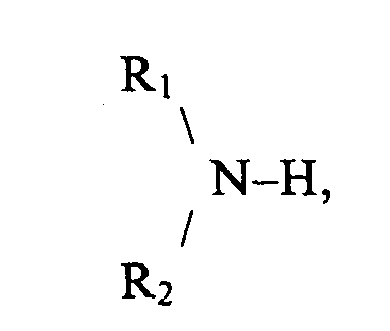
- the aminoalcohol according to the invention is chosen from the compounds corresponding to the following formula: in which R 1 and R 2 , which are identical or different, represent H, a linear or branched C 1 -C 10 and preferably C 2 -C 5 hydrocarbon-based chain which may contain one or more unsaturations and one or more OH radicals, at least one of R 1 or R 2 containing at least one OH radical.
- the OH radical is carried by the terminal carbon atom of the hydrocarbon chain and preferably each R 1 and R 2 radical carries a hydroxyl function on the terminal carbon of the hydrocarbon chain.
- the total number of OH radicals does not exceed 8.
- aminoalcohols examples include monoethanolamine and diethanolamine. Monoethanolamine is preferred.
- the invention provides a process which consists in reacting the phenolic compound simultaneously with formaldehyde and the aminoalcohol in a formaldehyde / phenol compound molar ratio greater than 1, and cooling the reaction mixture.
- the invention is characterized in that the formaldehyde and the aminoalcohol are reacted simultaneously with the phenolic compound, and advantageously in a progressive manner which allows a better control of the release of heat related to the exothermic nature of the condensation reaction.
- the formaldehyde, the aminoalcohol and the phenolic compound are reacted in a molar ratio of formaldehyde / phenolic compound and aminoalcohol / phenolic compound of between 2 and 3, preferably equal to about 3, until the a phenol compound conversion of at least 99%.
- the conversion rate of the phenolic compound is the percentage of phenolic compound that participated in the phenol-formaldehyde-aminoalcohol condensation reaction relative to 100% of the initial phenolic compound.
- the condensation reaction is then stopped, by cooling the reaction mixture, to a stage which corresponds to a resin having a diluablility greater than 1000%, and generally greater than 2000%.
- the addition of formaldehyde and aminoalcohol is simultaneously and advantageously progressively in the phenolic compound.
- Formaldehyde and aminoalcohol are preferably introduced separately, but it is also possible to add them as a mixture. In this case, it is recommended to operate at a relatively low temperature to prevent the compounds from reacting with each other before coming into contact with the phenol compound.
- the reaction according to the invention between the phenolic compound, the aldehyde and the aminoalcohol is carried out in a quasi-stoichiometric manner which makes it possible to reach particularly low levels of formaldehyde and phenol residual. Therefore, it is no longer necessary to trap excess phenolic compound and / or formaldehyde with urea or amine.
- the resin has a content of free formaldehyde which remains less than 0.4%, preferably less than 0.25% and a free phenol content of less than 0.02%, preferably less than 0.01% with respect to the liquid resin. This is made possible by the fact that the introduction of formaldehyde and aminoalcohol is done gradually, thus making it possible to have a particularly high conversion rate of phenolic compound, and to reduce by the same amount of free phenolic compound in the final resin.
- the condensation reaction does not require a catalyst, which is a significant advantage over conventional resols requiring the addition of a base, and this base must then be neutralized with an acid at the end of the reaction to prevent the resin from evolving. in time.
- the salts formed, especially when they contain Na, are known to decrease the aging resistance of the products formed of fibers bonded with this type of resin.
- the resin since it is not necessary to use an inorganic catalyst, the resin has a very low ash content, generally less than 0.04% by weight relative to the dry resin or less than 0.02% with respect to the liquid resin.
- the preparation of the resin takes place according to a temperature cycle which is schematically divided into three phases: a heating phase, a phase comprising a temperature step and a cooling phase.
- the phenolic compound is reacted simultaneously with the formaldehyde and the aminoalcohol while gradually heating the reaction mixture to a temperature of between 60 and 100 ° C, and preferably about 75 ° C.
- molar ratios formaldehyde / phenolic compound and aminoalcohol / phenolic compound being advantageously between 2 and 3, preferably of the order of about 3.
- the temperature of the reaction medium reached during the first phase is maintained until a conversion of the phenolic compound of at least 99% corresponding to an infinite dilutability is obtained. (greater than 2000%).
- the duration of this stage is preferably of the order of 100 to 200 minutes.
- the third cooling stage is conducted in such a way that the temperature of the reaction mixture reaches 20 to 25 ° C.
- the cooling rate is not critical and can be for example 1 ° C per minute.
- the resulting resin consists essentially of phenol-formaldehyde-aminoalcohol compound condensates.
- phenol-formaldehyde-aminoalcohol condensates represent at least 70% of the total weight of the resin, calculated on the basis of the dry resin, preferably at least 90%.
- the subject of the invention is also a sizing composition intended to coat mineral fibers, in particular glass or rock fibers, as well as the obtained sized fibers, these fibers serving more particularly to produce insulation products.
- the sizing composition comprises the resin according to the invention, an agent for crosslinking, and optionally additives.
- the sizing composition according to the invention comprises, expressed in parts of dry matter, from 18 to 65 parts by weight of resin and from 10 to 82 parts by weight of crosslinking agent.
- the crosslinking agent is a compound containing at least two functions capable of reacting with the amine functions or the hydroxyl functions of the resin.
- formaldehyde amines such as HMTA
- acids such as phthalic acid, isophthalic acid, terephthalic acid, citric acid, polycarboxylic acids or acrylics
- citric acid and / or phthalic, isophthalic or terephthalic anhydride are used.
- the silane is an aminosilane, in particular ⁇ -aminopropyltriethoxysilane, sold under the reference Silquest® A1100 by Crompton.
- the oil is composed of hydrocarbons extracted from oil, essentially alkanes, such as Mulrex® 88 oil marketed by Mobil Oil.
- these products are also an object of the invention.
- these products may take the form of a sheet or a veil of mineral fibers and they are formed by topping of mineral fibers bonded together by the sizing which, in its crosslinked form, is solid, infusible and insoluble in water:
- the web of mineral fibers in particular glass fibers, generally has a basis weight of between 10 and 300 g / m 2 , and preferably it comprises at least 1%, or even at least 2% and even more than 4% by weight. gluing. Although it can be used alone, the web is more particularly intended to be disposed on at least one outer face of an insulating web as described above.
- thermal and acoustic insulators are in particular intended to form thermal and acoustic insulators, in particular for buildings and for household ovens and above-ground cultivation substrates.
- the reactor is maintained at this temperature for a period of 60 minutes during which 255.75 g of formaldehyde (3.15 moles) and 194 g of monoethanolamine (3.14 moles) are added via the metering pumps.
- the reaction mixture is maintained at this temperature for an additional 80 minutes and then cooled.
- the resin is recovered in the form of a clear aqueous solution having a infinite dilutability.
- the resin solution After 8 days storage at 20 ° C, the resin solution has a free phenol content of less than 0.01%, a free formaldehyde content of less than 0.25%, a dilutability at 20 ° C, infinite and a weight content in solids (dry extract) equal to 53.3%.
- the amount of formaldehyde released is equal to 1.9 g, that of total phenol is equal to 0.24 g and the amount of ammonia is equal to 0.17 g.
- the temperature of the reaction mixture is adjusted to 30-35 ° C in 3 hours, then the mixture is cooled.
- a liquid resin is recovered which, after 40 days storage at 20 ° C., has an infinite dilutability, a free phenol content of less than 0.01%, a free formaldehyde content of less than 0.25% and a solids content by weight (solids content) of 50%.
- the sizing composition has a dry matter content of 10%. It remains stable for several days.
- the resin is in the form of a clear aqueous composition having a water dilutability at 20 ° C, infinite after 6 days of storage at 16 ° C.
- the level of free phenol and formaldehyde is equal to 0.45% and 0.3%, respectively.
- the resin is subjected to the undesirable gas emission test described in Example 1.
- a composition comprising 100 g of resin is prepared.
- the amount of formaldehyde released is equal to 2 g, that of free phenol is equal to 5 g and the amount of ammonia is equal to 15 g.
- the sizing composition is stable for several hours.
- the sizing composition containing the resin according to the invention makes it possible to obtain substantially lower phenol and ammonia release rates, and the in formaldehyde being slightly lower.
- the reduction of the phenol content is 95.2% and that of the ammonia is 98.8% relative to said standard composition.
- the resins according to the invention can be used in sizing for insulation products, they can profitably be used to form off-soil culture substrates.
- the plant is deposited on the substrate impregnated with a nutrient solution and it is necessary that the release of formaldehyde and phenol is as low as possible because they are toxic to the plant.
- the resin according to the invention meets these requirements, the level of free formaldehyde being less than 0.4% and the phenol content remaining below 0.02% as indicated above.
Landscapes
- Chemical & Material Sciences (AREA)
- Organic Chemistry (AREA)
- Chemical Kinetics & Catalysis (AREA)
- Life Sciences & Earth Sciences (AREA)
- General Chemical & Material Sciences (AREA)
- Health & Medical Sciences (AREA)
- Geochemistry & Mineralogy (AREA)
- General Life Sciences & Earth Sciences (AREA)
- Polymers & Plastics (AREA)
- Materials Engineering (AREA)
- Medicinal Chemistry (AREA)
- Engineering & Computer Science (AREA)
- Treatments For Attaching Organic Compounds To Fibrous Goods (AREA)
- Compositions Of Macromolecular Compounds (AREA)
- Surface Treatment Of Glass Fibres Or Filaments (AREA)
- Phenolic Resins Or Amino Resins (AREA)
Claims (24)
- Flüssiges Harz, das insbesondere zum Verkleben von Mineralfasern vorgesehen ist und bei 20 °C eine Verdünnbarkeit in Wasser von wenigstens 1000 % aufweist, dadurch gekennzeichnet, dass es von mindestens 70 Gew.-% Kondensaten gebildet wird, die aus einer Phenolverbindung, Formaldehyd und einem Aminoalkohol gemäß der Mannich-Reaktion erhalten werden.
- Harz nach Anspruch 1, dadurch gekennzeichnet, dass die Phenolverbindung Phenol, Kresol, Resorcin oder ein Gemisch aus diesen Verbindungen ist.
- Harz nach Anspruch 1 oder 2, dadurch gekennzeichnet, dass der Aminoalkohol aus Verbindungen mit der Formel
- Harz nach Anspruch 3, dadurch gekennzeichnet, dass der OH-Rest von dem terminalen Kohlenstoffatom der Kohlenwasserstoffkette getragen wird, wobei vorzugsweise jeder Rest R1 und R2 eine Hydroxy-Funktion am terminalen Kohlenstoffatom der Kohlenwasserstoffkette trägt.
- Harz nach Anspruch 4, dadurch gekennzeichnet, dass der Aminoalkohol Monoethanolamin oder Diethanolamin ist.
- Harz nach einem der Ansprüche 1 bis 5, dadurch gekennzeichnet, dass es einen freien Formaldehydanteil von unter 0,4 % aufweist.
- Harz nach einem der Ansprüche 1 bis 6, dadurch gekennzeichnet, dass es einen Anteil an freier Phenolverbindung von unter 0,02 % aufweist.
- Harz nach einem der Ansprüche 1 bis 7, dadurch gekennzeichnet, dass es einen freien Formaldehydanteil von unter 0,25 %, einen Anteil an der Phenolverbindung von unter 0,01 % und unendliche Verdünnbarkeit aufweist.
- Harz nach einem der Ansprüche 1 bis 8, dadurch gekennzeichnet, dass es einen Aschegehalt von unter 0,04 Gew.-% des trockenen Harzes aufweist.
- Verfahren zur Herstellung des Harzes nach einem der Ansprüche 1 bis 9, das darin besteht:- eine Phenolverbindung, Formaldehyd und einen Aminoalkohol gemäß der Mannich-Reaktion mit einem Molverhältnis von Formaldehyd/Phenolverbindung von über 1 umzusetzen, wobei Formaldehyd und Aminoalkohol zeitgleich mit der Phenolverbindung umgesetzt werden, und- das Reaktionsgemisch abzukühlen.
- Verfahren nach Anspruch 10, dadurch gekennzeichnet, dass Formaldehyd und Aminoalkohol fortschreitend mit dem Phenol umgesetzt werden.
- Verfahren nach Anspruch 10 oder 11, dadurch gekennzeichnet, dass Formaldehyd, Aminoalkohol und Phenolverbindung mit einem Molverhältnis von Formaldehyd/Phenolverbindung und Aminoalkohol/Phenolverbindung von 2 bis 3 und vorzugsweise etwa 3 umgesetzt werden, bis ein Umsatz der Phenolverbindung von 99 % oder darüber erhalten wird.
- Verfahren nach einem der Ansprüche 10 bis 12, dadurch gekennzeichnet, dass die Reaktionstemperatur 60 bis 100 °C und vorzugsweise etwa 75 °C beträgt.
- Verfahren nach Anspruch 10, dadurch gekennzeichnet, dass Formaldehyd und Aminoalkohol getrennt in die Phenolverbindung geleitet werden.
- Verfahren nach Anspruch 10, dadurch gekennzeichnet, dass Formaldehyd und Aminoalkohol in die Phenolverbindung geleitet werden, nachdem sie zuvor miteinander vermischt worden sind.
- Bindemittelzusammensetzung für Mineralfasern, die ein Harz nach einem der Ansprüche 1 bis 9, ein Vernetzungsmittel und gegebenenfalls Additive umfasst.
- Zusammensetzung nach Anspruch 16, dadurch gekennzeichnet, dass sie, angegeben als Teile Trockensubstanz, 18 bis 65 Gew.-T1. Harz und 10 bis 82 Gew.-T1. Vernetzungsmittel umfasst.
- Zusammensetzung nach Anspruch 16 oder 17, dadurch gekennzeichnet, dass das Vernetzungsmittel eine Verbindung ist, die mindestens zwei Funktionen enthält, die in der Lage sind, mit den Aminfunktionen oder Hydroxy-Funktionen des Harzes zu reagieren.
- Zusammensetzung nach Anspruch 18, dadurch gekennzeichnet, dass das Vernetzungsmittel Formaldehyd, ein Amin wie HMTA, eine Säure wie Phthal-, Isophthal-, Terephthal- und Citronensäure, eine Polycarbon- bzw. Polyacrylsäure mit einem hohen Molekulargewicht von etwa 500 und vorzugsweise 1000 bis 5000, ein Anhydrid dieser Säuren oder ein Gemisch aus diesen Verbindungen ist.
- Mineralfasern, die mit der Bindemittelzusammensetzung nach einem der Ansprüche 16 bis 19 beschichtet sind.
- Mineralfasern nach Anspruch 20, dadurch gekennzeichnet, dass sie aus Glas oder Gestein gebildet sind.
- Mineralfaservlies, insbesondere aus Glasfasern, dadurch gekennzeichnet, dass es Fasern nach Anspruch 20 oder 21 umfasst, und dass es ein Flächengewicht von 10 bis 300 g/m2 besitzt.
- Wärme- und/oder Schalldämmerzeugnis, das durch die Bildung einer Bahn aus verklebten Mineralfasern nach Anspruch 20 oder 21 erhalten ist.
- Erzeugnis nach Anspruch 23, dadurch gekennzeichnet, dass es außerdem ein Faservlies nach Anspruch 22, das auf mindestens einer Außenseite aufgebracht worden ist, umfasst.
Applications Claiming Priority (3)
| Application Number | Priority Date | Filing Date | Title |
|---|---|---|---|
| FR0209727 | 2002-07-25 | ||
| FR0209727A FR2842815B1 (fr) | 2002-07-25 | 2002-07-25 | Solution aqueuse de resine compose phenolique-formaldhehyde- aminoalcool, procede de preparation, composition d'encollage de fibres minerales renfermant ladite resine et produits resultants |
| PCT/FR2003/002326 WO2004011519A1 (fr) | 2002-07-25 | 2003-07-23 | Solution aqueuse de resine compose phenolique-formaldehyde-aminoalcool, procede de preparation, composition d'encollage de fibres minerales renfermant ladite resine et produits resultants |
Publications (2)
| Publication Number | Publication Date |
|---|---|
| EP1551892A1 EP1551892A1 (de) | 2005-07-13 |
| EP1551892B1 true EP1551892B1 (de) | 2006-08-16 |
Family
ID=30011607
Family Applications (1)
| Application Number | Title | Priority Date | Filing Date |
|---|---|---|---|
| EP03756503A Expired - Lifetime EP1551892B1 (de) | 2002-07-25 | 2003-07-23 | Wässrige lösung eines phenolformaldehydaminoalkoholharzes, verfahren zu ihrer herstellung, leimungszusammensetzung für mineralfaser |
Country Status (8)
| Country | Link |
|---|---|
| US (1) | US7704603B2 (de) |
| EP (1) | EP1551892B1 (de) |
| AT (1) | ATE336530T1 (de) |
| AU (1) | AU2003281682A1 (de) |
| DE (1) | DE60307661T2 (de) |
| ES (1) | ES2271635T3 (de) |
| FR (1) | FR2842815B1 (de) |
| WO (1) | WO2004011519A1 (de) |
Families Citing this family (11)
| Publication number | Priority date | Publication date | Assignee | Title |
|---|---|---|---|---|
| FR2907122B1 (fr) * | 2006-10-11 | 2008-12-05 | Saint Gobain Isover Sa | Resine phenolique, procede de preparation, composition d'encollage pour fibres minerales et produits resultants |
| FR2907123B1 (fr) * | 2006-10-11 | 2008-12-05 | Saint Gobain Isover Sa | Resine phenolique, procede de preparation, composition d'encollage pour fibres minerales et produits resultants |
| WO2009073703A2 (en) * | 2007-12-04 | 2009-06-11 | Saint-Gobain Abrasives, Inc. | Alkanolamine-modified phenolic resin formulation and coatings for abrasive products |
| FR2929952B1 (fr) * | 2008-04-11 | 2011-02-11 | Saint Gobain Isover | Composition d'encollage pour fibres minerales et produits resultants |
| FR2929953B1 (fr) * | 2008-04-11 | 2011-02-11 | Saint Gobain Isover | Composition d'encollage pour fibres minerales et produits resultants |
| US20100117265A1 (en) * | 2008-11-10 | 2010-05-13 | Klaus Friedrich Gleich | Sizing composition for fibers, sized fibers and method of using to make molding compounds and frp molded products |
| FR2964105B1 (fr) | 2010-08-27 | 2012-09-28 | Saint Gobain Isover | Resine phenolique, procede de preparation, composition d'encollage pour fibres minerales et produit resultant. |
| CN103965422B (zh) * | 2014-05-28 | 2016-04-06 | 贵阳学院 | 热固性酚醛树脂的制备方法 |
| FR3111900B1 (fr) * | 2020-06-29 | 2022-12-23 | Saint Gobain Isover | Résine résol stabilisée par un polyol aromatique |
| FR3151324A1 (fr) | 2023-07-20 | 2025-01-24 | Saint-Gobain Isover | Composite conformé comprenant une laine minérale |
| EP4685120A1 (de) | 2024-07-22 | 2026-01-28 | Saint-Gobain Isover | Geformter verbundstoff aus mineralwolle-recyclaten und einem nicht-zementierten kaliumträger |
Family Cites Families (8)
| Publication number | Priority date | Publication date | Assignee | Title |
|---|---|---|---|---|
| US3876405A (en) * | 1973-08-02 | 1975-04-08 | Ppg Industries Inc | Glass fiber coating process |
| CA1076727A (en) * | 1976-03-22 | 1980-04-29 | Ashland Oil | Modified phenolic tackifier |
| US4282330A (en) * | 1979-08-03 | 1981-08-04 | Texaco Inc. | Energy management polyether polyurethane foam |
| US4525488A (en) * | 1984-09-13 | 1985-06-25 | Texaco Inc. | Preparation of polyaddition products of Mannich condensates and polyisocyanates in polyols and their use in polyurethanes |
| US5270434A (en) * | 1990-10-12 | 1993-12-14 | Isover Saint-Gobain | Phenolic resin, procedure for preparation of the resin, and sizing composition for mineral fibers containing this resin |
| US6270539B1 (en) * | 1999-08-31 | 2001-08-07 | Ethyl Corporation | Mannich dispersants with enhanced lubricity |
| WO2001023655A1 (en) * | 1999-09-27 | 2001-04-05 | Owens Corning | Making a fibrous insulation product using a multicomponent polymer binder fiber |
| US6395819B1 (en) * | 2000-06-19 | 2002-05-28 | Saint-Gobain Isover | Insulation product, especially thermal insulation product, and its manufacturing process |
-
2002
- 2002-07-25 FR FR0209727A patent/FR2842815B1/fr not_active Expired - Fee Related
-
2003
- 2003-07-23 DE DE2003607661 patent/DE60307661T2/de not_active Expired - Lifetime
- 2003-07-23 EP EP03756503A patent/EP1551892B1/de not_active Expired - Lifetime
- 2003-07-23 AT AT03756503T patent/ATE336530T1/de active
- 2003-07-23 ES ES03756503T patent/ES2271635T3/es not_active Expired - Lifetime
- 2003-07-23 US US10/522,188 patent/US7704603B2/en not_active Expired - Fee Related
- 2003-07-23 WO PCT/FR2003/002326 patent/WO2004011519A1/fr not_active Ceased
- 2003-07-23 AU AU2003281682A patent/AU2003281682A1/en not_active Abandoned
Also Published As
| Publication number | Publication date |
|---|---|
| DE60307661D1 (de) | 2006-09-28 |
| FR2842815B1 (fr) | 2007-06-22 |
| FR2842815A1 (fr) | 2004-01-30 |
| US20060128888A1 (en) | 2006-06-15 |
| US7704603B2 (en) | 2010-04-27 |
| AU2003281682A1 (en) | 2004-02-16 |
| EP1551892A1 (de) | 2005-07-13 |
| WO2004011519A1 (fr) | 2004-02-05 |
| ES2271635T3 (es) | 2007-04-16 |
| ATE336530T1 (de) | 2006-09-15 |
| DE60307661T2 (de) | 2007-08-09 |
Similar Documents
| Publication | Publication Date | Title |
|---|---|---|
| EP1618238B2 (de) | Mineralfaserplatten schlichtezusammensetzung mit einem polysaure und einer polyamin, verfahren zur herstellung sowie deren produkte | |
| EP2609129B1 (de) | Phenolharz, herstellungsverfahren dafür, schlichtungszusammensetzung für mineralfasern und auf diese weise gewonnenes produkt | |
| EP2079771B1 (de) | Phenolharz, herstellungsverfahren, bindemittelzusammensetzung für mineralfasern und auf diese weise gewonnene produkte | |
| EP1551892B1 (de) | Wässrige lösung eines phenolformaldehydaminoalkoholharzes, verfahren zu ihrer herstellung, leimungszusammensetzung für mineralfaser | |
| EP2079770A1 (de) | Phenolharz, herstellungsverfahren, schlichtungszusammensetzung für mineralfasern und auf diese weise gewonnene produkte | |
| EP2736995A1 (de) | Schlichtezusammensetzung für mineralwolle auf maltitolbasis und daraus erzeugte isolierprodukte | |
| EP2268589B1 (de) | Schlichtungszusammensetzung für mineralfasern und auf diese weise gewonnene produkte | |
| WO2010029266A1 (fr) | Composition d'encollage pour laine minerale a base de sucre hydrogene et produits isolants obtenus | |
| WO1999003906A1 (fr) | Resine phenolique pour composition d'encollage, procede de preparation et composition d'encollage la contenant | |
| EP2384315A1 (de) | Feuerbeständiges isolierprodukt aus steinwolle, verfahren zu dessen herstellung und geeignete bindungszusammensetzung | |
| CA2720924A1 (fr) | Composition d'encollage pour fibres minerales et produits resultants | |
| EP0480778B1 (de) | Phenolharz, Verfahren zur Herstellung dieses Harzes, und dieses Harz enthaltende Mischung zum Verkleben von Mineralfasern | |
| EP2091986A2 (de) | Leimzusammensetzung für mineralfasern mit einem phenolharz und daraus gewonnene produkte | |
| EP3570845A1 (de) | Schlichtezusammensetzung für mineralwolle auf basis von hydriertem zucker und erhaltene isolierende produkte | |
| EP1022263B1 (de) | Verfahren zur Herstellung von Wärmedämmkörper | |
| WO2020016530A1 (fr) | Composition de liant pour laine minerale |
Legal Events
| Date | Code | Title | Description |
|---|---|---|---|
| PUAI | Public reference made under article 153(3) epc to a published international application that has entered the european phase |
Free format text: ORIGINAL CODE: 0009012 |
|
| 17P | Request for examination filed |
Effective date: 20050113 |
|
| AK | Designated contracting states |
Kind code of ref document: A1 Designated state(s): AT BE BG CH CY CZ DE DK EE ES FI FR GB GR HU IE IT LI LU MC NL PT RO SE SI SK TR |
|
| AX | Request for extension of the european patent |
Extension state: AL LT LV MK |
|
| DAX | Request for extension of the european patent (deleted) | ||
| GRAP | Despatch of communication of intention to grant a patent |
Free format text: ORIGINAL CODE: EPIDOSNIGR1 |
|
| GRAS | Grant fee paid |
Free format text: ORIGINAL CODE: EPIDOSNIGR3 |
|
| GRAA | (expected) grant |
Free format text: ORIGINAL CODE: 0009210 |
|
| AK | Designated contracting states |
Kind code of ref document: B1 Designated state(s): AT BE BG CH CY CZ DE DK EE ES FI FR GB GR HU IE IT LI LU MC NL PT RO SE SI SK TR |
|
| PG25 | Lapsed in a contracting state [announced via postgrant information from national office to epo] |
Ref country code: IT Free format text: LAPSE BECAUSE OF FAILURE TO SUBMIT A TRANSLATION OF THE DESCRIPTION OR TO PAY THE FEE WITHIN THE PRESCRIBED TIME-LIMIT;WARNING: LAPSES OF ITALIAN PATENTS WITH EFFECTIVE DATE BEFORE 2007 MAY HAVE OCCURRED AT ANY TIME BEFORE 2007. THE CORRECT EFFECTIVE DATE MAY BE DIFFERENT FROM THE ONE RECORDED. Effective date: 20060816 Ref country code: GB Free format text: LAPSE BECAUSE OF FAILURE TO SUBMIT A TRANSLATION OF THE DESCRIPTION OR TO PAY THE FEE WITHIN THE PRESCRIBED TIME-LIMIT Effective date: 20060816 Ref country code: IE Free format text: LAPSE BECAUSE OF FAILURE TO SUBMIT A TRANSLATION OF THE DESCRIPTION OR TO PAY THE FEE WITHIN THE PRESCRIBED TIME-LIMIT Effective date: 20060816 Ref country code: SK Free format text: LAPSE BECAUSE OF FAILURE TO SUBMIT A TRANSLATION OF THE DESCRIPTION OR TO PAY THE FEE WITHIN THE PRESCRIBED TIME-LIMIT Effective date: 20060816 Ref country code: NL Free format text: LAPSE BECAUSE OF FAILURE TO SUBMIT A TRANSLATION OF THE DESCRIPTION OR TO PAY THE FEE WITHIN THE PRESCRIBED TIME-LIMIT Effective date: 20060816 Ref country code: SI Free format text: LAPSE BECAUSE OF FAILURE TO SUBMIT A TRANSLATION OF THE DESCRIPTION OR TO PAY THE FEE WITHIN THE PRESCRIBED TIME-LIMIT Effective date: 20060816 Ref country code: RO Free format text: LAPSE BECAUSE OF FAILURE TO SUBMIT A TRANSLATION OF THE DESCRIPTION OR TO PAY THE FEE WITHIN THE PRESCRIBED TIME-LIMIT Effective date: 20060816 Ref country code: CZ Free format text: LAPSE BECAUSE OF FAILURE TO SUBMIT A TRANSLATION OF THE DESCRIPTION OR TO PAY THE FEE WITHIN THE PRESCRIBED TIME-LIMIT Effective date: 20060816 |
|
| REG | Reference to a national code |
Ref country code: GB Ref legal event code: FG4D Free format text: NOT ENGLISH |
|
| REG | Reference to a national code |
Ref country code: CH Ref legal event code: EP |
|
| REG | Reference to a national code |
Ref country code: IE Ref legal event code: FG4D Free format text: LANGUAGE OF EP DOCUMENT: FRENCH |
|
| REF | Corresponds to: |
Ref document number: 60307661 Country of ref document: DE Date of ref document: 20060928 Kind code of ref document: P |
|
| PG25 | Lapsed in a contracting state [announced via postgrant information from national office to epo] |
Ref country code: DK Free format text: LAPSE BECAUSE OF FAILURE TO SUBMIT A TRANSLATION OF THE DESCRIPTION OR TO PAY THE FEE WITHIN THE PRESCRIBED TIME-LIMIT Effective date: 20061116 Ref country code: SE Free format text: LAPSE BECAUSE OF FAILURE TO SUBMIT A TRANSLATION OF THE DESCRIPTION OR TO PAY THE FEE WITHIN THE PRESCRIBED TIME-LIMIT Effective date: 20061116 Ref country code: BG Free format text: LAPSE BECAUSE OF FAILURE TO SUBMIT A TRANSLATION OF THE DESCRIPTION OR TO PAY THE FEE WITHIN THE PRESCRIBED TIME-LIMIT Effective date: 20061116 |
|
| PG25 | Lapsed in a contracting state [announced via postgrant information from national office to epo] |
Ref country code: PT Free format text: LAPSE BECAUSE OF FAILURE TO SUBMIT A TRANSLATION OF THE DESCRIPTION OR TO PAY THE FEE WITHIN THE PRESCRIBED TIME-LIMIT Effective date: 20070116 |
|
| NLV1 | Nl: lapsed or annulled due to failure to fulfill the requirements of art. 29p and 29m of the patents act | ||
| GBV | Gb: ep patent (uk) treated as always having been void in accordance with gb section 77(7)/1977 [no translation filed] |
Effective date: 20060816 |
|
| REG | Reference to a national code |
Ref country code: IE Ref legal event code: FD4D |
|
| REG | Reference to a national code |
Ref country code: ES Ref legal event code: FG2A Ref document number: 2271635 Country of ref document: ES Kind code of ref document: T3 |
|
| PLBE | No opposition filed within time limit |
Free format text: ORIGINAL CODE: 0009261 |
|
| STAA | Information on the status of an ep patent application or granted ep patent |
Free format text: STATUS: NO OPPOSITION FILED WITHIN TIME LIMIT |
|
| 26N | No opposition filed |
Effective date: 20070518 |
|
| BERE | Be: lapsed |
Owner name: SAINT-GOBAIN ISOVER Effective date: 20070731 |
|
| REG | Reference to a national code |
Ref country code: CH Ref legal event code: PL |
|
| PG25 | Lapsed in a contracting state [announced via postgrant information from national office to epo] |
Ref country code: GR Free format text: LAPSE BECAUSE OF FAILURE TO SUBMIT A TRANSLATION OF THE DESCRIPTION OR TO PAY THE FEE WITHIN THE PRESCRIBED TIME-LIMIT Effective date: 20061117 Ref country code: LI Free format text: LAPSE BECAUSE OF NON-PAYMENT OF DUE FEES Effective date: 20070731 Ref country code: MC Free format text: LAPSE BECAUSE OF NON-PAYMENT OF DUE FEES Effective date: 20070731 Ref country code: CH Free format text: LAPSE BECAUSE OF NON-PAYMENT OF DUE FEES Effective date: 20070731 |
|
| PG25 | Lapsed in a contracting state [announced via postgrant information from national office to epo] |
Ref country code: EE Free format text: LAPSE BECAUSE OF FAILURE TO SUBMIT A TRANSLATION OF THE DESCRIPTION OR TO PAY THE FEE WITHIN THE PRESCRIBED TIME-LIMIT Effective date: 20060816 |
|
| PG25 | Lapsed in a contracting state [announced via postgrant information from national office to epo] |
Ref country code: BE Free format text: LAPSE BECAUSE OF NON-PAYMENT OF DUE FEES Effective date: 20070731 |
|
| PG25 | Lapsed in a contracting state [announced via postgrant information from national office to epo] |
Ref country code: LU Free format text: LAPSE BECAUSE OF NON-PAYMENT OF DUE FEES Effective date: 20070723 Ref country code: CY Free format text: LAPSE BECAUSE OF FAILURE TO SUBMIT A TRANSLATION OF THE DESCRIPTION OR TO PAY THE FEE WITHIN THE PRESCRIBED TIME-LIMIT Effective date: 20060816 |
|
| PG25 | Lapsed in a contracting state [announced via postgrant information from national office to epo] |
Ref country code: HU Free format text: LAPSE BECAUSE OF FAILURE TO SUBMIT A TRANSLATION OF THE DESCRIPTION OR TO PAY THE FEE WITHIN THE PRESCRIBED TIME-LIMIT Effective date: 20070217 Ref country code: TR Free format text: LAPSE BECAUSE OF FAILURE TO SUBMIT A TRANSLATION OF THE DESCRIPTION OR TO PAY THE FEE WITHIN THE PRESCRIBED TIME-LIMIT Effective date: 20060816 |
|
| REG | Reference to a national code |
Ref country code: FR Ref legal event code: PLFP Year of fee payment: 14 |
|
| REG | Reference to a national code |
Ref country code: FR Ref legal event code: PLFP Year of fee payment: 15 |
|
| REG | Reference to a national code |
Ref country code: FR Ref legal event code: PLFP Year of fee payment: 16 |
|
| PGFP | Annual fee paid to national office [announced via postgrant information from national office to epo] |
Ref country code: ES Payment date: 20190801 Year of fee payment: 17 Ref country code: FI Payment date: 20190709 Year of fee payment: 17 Ref country code: FR Payment date: 20190718 Year of fee payment: 17 Ref country code: DE Payment date: 20190710 Year of fee payment: 17 |
|
| PGFP | Annual fee paid to national office [announced via postgrant information from national office to epo] |
Ref country code: AT Payment date: 20200625 Year of fee payment: 18 |
|
| REG | Reference to a national code |
Ref country code: DE Ref legal event code: R119 Ref document number: 60307661 Country of ref document: DE |
|
| REG | Reference to a national code |
Ref country code: FI Ref legal event code: MAE |
|
| PG25 | Lapsed in a contracting state [announced via postgrant information from national office to epo] |
Ref country code: FI Free format text: LAPSE BECAUSE OF NON-PAYMENT OF DUE FEES Effective date: 20200723 Ref country code: FR Free format text: LAPSE BECAUSE OF NON-PAYMENT OF DUE FEES Effective date: 20200731 |
|
| PG25 | Lapsed in a contracting state [announced via postgrant information from national office to epo] |
Ref country code: DE Free format text: LAPSE BECAUSE OF NON-PAYMENT OF DUE FEES Effective date: 20210202 |
|
| REG | Reference to a national code |
Ref country code: ES Ref legal event code: FD2A Effective date: 20211203 |
|
| PG25 | Lapsed in a contracting state [announced via postgrant information from national office to epo] |
Ref country code: ES Free format text: LAPSE BECAUSE OF NON-PAYMENT OF DUE FEES Effective date: 20200724 |
|
| REG | Reference to a national code |
Ref country code: AT Ref legal event code: MM01 Ref document number: 336530 Country of ref document: AT Kind code of ref document: T Effective date: 20210723 |
|
| PG25 | Lapsed in a contracting state [announced via postgrant information from national office to epo] |
Ref country code: AT Free format text: LAPSE BECAUSE OF NON-PAYMENT OF DUE FEES Effective date: 20210723 |