EP1551913B1 - Silica-rubber mixtures having improved hardness - Google Patents
Silica-rubber mixtures having improved hardness Download PDFInfo
- Publication number
- EP1551913B1 EP1551913B1 EP03763461.5A EP03763461A EP1551913B1 EP 1551913 B1 EP1551913 B1 EP 1551913B1 EP 03763461 A EP03763461 A EP 03763461A EP 1551913 B1 EP1551913 B1 EP 1551913B1
- Authority
- EP
- European Patent Office
- Prior art keywords
- nxt
- silica
- hardness
- rubber
- phr
- Prior art date
- Legal status (The legal status is an assumption and is not a legal conclusion. Google has not performed a legal analysis and makes no representation as to the accuracy of the status listed.)
- Expired - Lifetime
Links
Images




Classifications
-
- C—CHEMISTRY; METALLURGY
- C08—ORGANIC MACROMOLECULAR COMPOUNDS; THEIR PREPARATION OR CHEMICAL WORKING-UP; COMPOSITIONS BASED THEREON
- C08K—Use of inorganic or non-macromolecular organic substances as compounding ingredients
- C08K5/00—Use of organic ingredients
- C08K5/54—Silicon-containing compounds
- C08K5/548—Silicon-containing compounds containing sulfur
-
- B—PERFORMING OPERATIONS; TRANSPORTING
- B60—VEHICLES IN GENERAL
- B60C—VEHICLE TYRES; TYRE INFLATION; TYRE CHANGING; CONNECTING VALVES TO INFLATABLE ELASTIC BODIES IN GENERAL; DEVICES OR ARRANGEMENTS RELATED TO TYRES
- B60C1/00—Tyres characterised by the chemical composition or the physical arrangement or mixture of the composition
-
- C—CHEMISTRY; METALLURGY
- C08—ORGANIC MACROMOLECULAR COMPOUNDS; THEIR PREPARATION OR CHEMICAL WORKING-UP; COMPOSITIONS BASED THEREON
- C08K—Use of inorganic or non-macromolecular organic substances as compounding ingredients
- C08K3/00—Use of inorganic substances as compounding ingredients
- C08K3/34—Silicon-containing compounds
- C08K3/36—Silica
-
- C—CHEMISTRY; METALLURGY
- C08—ORGANIC MACROMOLECULAR COMPOUNDS; THEIR PREPARATION OR CHEMICAL WORKING-UP; COMPOSITIONS BASED THEREON
- C08K—Use of inorganic or non-macromolecular organic substances as compounding ingredients
- C08K5/00—Use of organic ingredients
- C08K5/54—Silicon-containing compounds
-
- C—CHEMISTRY; METALLURGY
- C08—ORGANIC MACROMOLECULAR COMPOUNDS; THEIR PREPARATION OR CHEMICAL WORKING-UP; COMPOSITIONS BASED THEREON
- C08K—Use of inorganic or non-macromolecular organic substances as compounding ingredients
- C08K5/00—Use of organic ingredients
- C08K5/54—Silicon-containing compounds
- C08K5/549—Silicon-containing compounds containing silicon in a ring
-
- C—CHEMISTRY; METALLURGY
- C08—ORGANIC MACROMOLECULAR COMPOUNDS; THEIR PREPARATION OR CHEMICAL WORKING-UP; COMPOSITIONS BASED THEREON
- C08L—COMPOSITIONS OF MACROMOLECULAR COMPOUNDS
- C08L21/00—Compositions of unspecified rubbers
-
- C—CHEMISTRY; METALLURGY
- C08—ORGANIC MACROMOLECULAR COMPOUNDS; THEIR PREPARATION OR CHEMICAL WORKING-UP; COMPOSITIONS BASED THEREON
- C08L—COMPOSITIONS OF MACROMOLECULAR COMPOUNDS
- C08L9/00—Compositions of homopolymers or copolymers of conjugated diene hydrocarbons
- C08L9/06—Copolymers with styrene
-
- C—CHEMISTRY; METALLURGY
- C08—ORGANIC MACROMOLECULAR COMPOUNDS; THEIR PREPARATION OR CHEMICAL WORKING-UP; COMPOSITIONS BASED THEREON
- C08K—Use of inorganic or non-macromolecular organic substances as compounding ingredients
- C08K3/00—Use of inorganic substances as compounding ingredients
- C08K3/01—Use of inorganic substances as compounding ingredients characterized by their specific function
- C08K3/013—Fillers, pigments or reinforcing additives
-
- C—CHEMISTRY; METALLURGY
- C08—ORGANIC MACROMOLECULAR COMPOUNDS; THEIR PREPARATION OR CHEMICAL WORKING-UP; COMPOSITIONS BASED THEREON
- C08L—COMPOSITIONS OF MACROMOLECULAR COMPOUNDS
- C08L9/00—Compositions of homopolymers or copolymers of conjugated diene hydrocarbons
Definitions
- the present invention relates to elastomers containing inorganic fillers and silane coupling agents. More particularly, the present invention pertains to such elastomer compositions containing inorganic fillers that have improved dynamic and static hardness coupled with desirable strength, wear resistance, fatigue resistance, improved hysteresis, and the like and to pneumatic tires in which these elastomers are used in the tread.
- hardness is used herein in its broadest technical sense and includes Shore A (ASTM D2240) hardness, IRHD (ASTM D1415, ISO standard) hardness, or other common methods of hardness measurement.
- Shore A ASTM D2240
- IRHD ASTM D1415, ISO standard
- hardness the modulus of the rubber compound (G' shear, E' Extensional) measured under small dynamic strains (anywhere from 0 to 10% strain, but preferably closer to 0% strain) will be referred to herein as hardness.
- organofunctional silanes as coupling agents in silica-filled tire tread compounds results in substantial performance benefits, including lower hysteresis, improved wet and ice traction, and high abrasion resistance.
- these improvements in performance are usually accompanied by a loss in dynamic stiffness (hardness) of the filled rubber.
- Polysulfide silanes currently used in silica-filled tire treads lead to lower hardness of the compound and blocked mercaptosilanes (e.g., 3-octanoylthio-l-propyltriethoxysilane) amplify this effect.
- silanes containing one or more of the following chemical bond types S-H (mercapto) and S-S (disulfide or polysulfide).
- S-H mercapto
- S-S disulfide or polysulfide
- 3,922,436 discloses organosilanes useful as coupling agents for glass fibers and as flame retardants, formed by reaction of an epoxy, a mercapto, or an amino silane with a carboxylic acid or anhydride, or formed by a Diels-Alder reaction of a halogenated cyclopentadiene with an unsaturated silane.
- U.S. Patent No. 3,957,718 discloses silica-containing mixtures for the improvement of the adhesion of vulcanizable mixtures of natural and/or synthetic rubber to reinforcing fillers or supports of textile and/or metallic fabrics after the vulcanization that substantially consist of (A) active synthetically produced silica or silicates having a specific surface area according to the BET procedure of about 50 to 500 m 2 /g and an average primary particle size of from about 5 to 100 and at least one of (B) phenolic resin or aminoplast forming components, namely on the one hand phenols and/or amines and on the other hand aldehydes or aldehyde donors, and/or at least (C) one organosilane which can be a bisalkoxysilylalkyl-oligosulfide of a given formula.
- A active synthetically produced silica or silicates having a specific surface area according to the BET procedure of about 50 to 500 m 2 /g and an average
- U.S. Patent No. 4,184,998 discloses the bonding of rubber or other plastics to mineral reinforcements, such as silica pigment, that is brought about by a mercapto alkyl silane without production of foul odors from the mercapto compound by preliminary reversible coupling of the mercapto compound with a material capable of addition reaction, such as toluene diisocyanate.
- U.S. Patent No. 4,519,430 discloses a pneumatic radial tire with a tread having from 1 part by weight of hydrated amorphous fine-particle silica per 3 parts of carbon black tread reinforcing filler, to about 3 parts by weight of the silica to 1 part of the carbon black.
- the amount of silica present is preferably in the range from about 18 parts to about 50 parts by weight per 100 parts of natural or synthetic rubber.
- the blocking group in this case can be an aromatic isocyanate group or any other organic group that can readily unblock under vulcanization conditions.
- U.S. Patent No. 4,942,192 discloses a rubber composition for use in tires, particularly bead filler, comprising 2 to about 30 parts by weight of a particular modified novolak resin having a self-curability based on 100 parts by weight of rubber ingredient.
- U.S. Patent No. 5,266,620 discloses a rubber composition for the manufacture of automotive vehicle tires suitably as a bead filler therefor.
- the composition comprises specified proportions of carbon black, a modified novolak phenolic resin, hexamethylenetetramine and a polymeric cardanol based on a starting rubber component such that the resulting rubber composition has a relatively low rigidity prior to vulcanization and a relatively high dynamic modulus after vulcanization.
- U.S. Patent No. 5,387,637 discloses polybutadiene compositions suitable for molded golf ball core construction.
- the compositions contain specific naturally occurring, essentially non-reinforcing, crystalline (preferably microcrystalline) silica particles, which have the effect of increasing the resilience and/or hardness of the resulting molded cores.
- U.S. Patent No. 5,886,074 discloses rubber compositions containing o-salicylsalicyclic acid of the formula:
- U.S. Patent No. 6,005,027 discloses blends of silanes and specific silicas, characterized in that when the blend is compounded into a rubber formulation even after four months of storage following formation of the blend, an unexpectedly high proportion of the silane present is available as a coupling and reinforcing agent for the rubber formulation. Over 80 % and even over 90 % of the silica can be extracted from the blend even four months after formation of the blend, and rubber formulation properties indicate high availability of the silane for coupling and reinforcement.
- U.S. Patent No. 6,028,143 discloses a rubber composition in which the coexistence of low heat build-up, heat resistance and high hardness can be achieved without damaging failure characteristics.
- a rubber composition comprising 100 parts by weight of matrix rubber and 2-75 parts by weight of a polyethylene composition which contains 0-80% by weight of polyethylene and 20% by weight or more of a composite comprising a polyethylene component and a rubber component previously bonded via a coupling agent to the polyethylene component, said rubber component is crosslinked with the matrix rubber.
- the compound is kneaded so that the maximum temperature of the compound of the kneading of that stage is higher than the melting point of the polyethylene component mixed, preferably, by 10° C or more.
- U.S. Patent No. 6,037,418 discloses a resin-reinforced elastomer which comprises as principal components, a rubber and a polyolefin having an average particle diameter of at most 1 micrometer, and in which the rubber and the polyolefin are linked together; a process for producing the resin-reinforced elastomer by melt kneading a polyolefin, a No.1 rubber and a binding agent to prepare a thermoplastic composition, adding a No.2 rubber to the resultant thermoplastic composition and melt kneading the mixture thus formed to disperse the polyolefin in the rubber components; and a pneumatic tire using the resin-reinforced elastomer in its tread.
- the above resin-reinforced elastomer is said to have a uniform modulus and a low density, to be minimized in directionality, and to have excellent tensile strength, fatigue resistance and abrasion resistance.
- Japanese Patent Publication No. 78155/1995 describes a thermoplastic elastomer composition that provides molded articles such as a car bumper that are minimized in dependence of tensile strength on thickness and in anisotropy and have favorable moldability as well as excellent external-appearance, while maintaining impact resistance.
- Japanese Patent Provisional Publication No. 186606/1995 discloses a pneumatic tire that comprises a rubber composition containing a thermoplastic resin in its tread rubber and that is improved in rolling resistance, while maintaining favorable traction characteristics.
- Japanese Patent Publication No. 10204221 discloses studless tires comprising treads prepared by mixing hard rubber showing hardness (HD) at 0°of ⁇ 70 with ⁇ 40 parts of inorganic fillers per 100 parts of hard rubber, partly vulcanizing the compositions, particularizing the compositions to form particles (A), kneading matrix rubber having a glass transition temperature (T g ) of -40° C with 5 - 50 parts of A particles per 100 parts of matrix rubber, and extruding the compositions to form treads containing A particles.
- a hard rubber composition with HD 70 and 50 phr ceramic particles with diameters of 150 (micrometers) were mixed, vulcanized, and particularized to form particles.
- Korean Patent Publication No. 2000031877 discloses a rubber composition for tire treads said to have improved wear, driving, braking, and handling performance comprising 50 wt % styrene butadiene rubber (SBR) containing 23.5 % styrene, 20 - 30 wt % SBR containing 40 - 50 % styrene, 70 - 80 wt % carbon black, and 3 - 5 wt % toluol rosin, which is said to improve composition hardness, and additives.
- SBR styrene butadiene rubber
- the synthetic rubber used comprises 59 wt % SBR with 23.5 % styrene, 20 - 30 wt % styrene with 40 - 50 wt % styrene and 20 -30 wt % BR, wherein the SBR content increases driving/braking performance, but decreases wear performance.
- EP 894819 discloses a method for decreasing dynamic modulus without decreasing hardness in silica tread compounds in tires.
- the tread composition comprises an elastomer including a performance-enhancing package comprising silica, carbon black, and a silica replacement.
- the replacement replaces up to 40 percent by weight of the silica and yet maintains one or more selected performance properties as if the performance enhancement package were pure carbon black and silica.
- the replacement is kaolin clay present in conjunction with a silane coupling agent.
- EP 964028 discloses compositions of triazoles, such as benzotriazole or tolyltriazole, in silica reinforced rubber compositions for tire components and tires made of such compounds. It is said that this results in high cure rate, cure efficiency, hardness, static and dynamic moduli without deleteriously affecting hysteresis. Methods for optimizing silica reinforced tire properties utilizing triazoles, brass powder and carbon black are also provided.
- EP 1172406 discloses a rubber composition for a tire tread that comprises (a) a diene rubber, (b) glass fibers, (c) a reinforcing agent, and 1 to 15 parts by weight of (d-1) inorganic powders having a mohs hardness of less than 6.5 and an average particle size of less than 25 micrometers and/or (d-2) silicone rubber powders based on 100 parts by weight of the diene rubber.
- WO99/22951 discloses a pneumatic tire that has belts, gum strips and an overlay that contains 2 to 15 phr thermoplastic reinforcing polymer as an addition to the compound, or as a replacement for 5 to 25 phr carbon black.
- the tire is said to have good high speed properties.
- Structures formed by carbon black and bound rubber surrounding the surface of the carbon black provide necessary reinforcement and rigidity to the rubber compound. It is possible that thixotropy from this network contributes more towards hardness in the low strain region, whereas bound rubber provides reinforcement in the high strain regions. Nevertheless, there are hydrodynamic interactions that also provide a hardness boost. If carbon black were replaced by precipitated silica (no coupling agent), owing to the extreme thixotropic effects from the silica filler network, the hardness of the system would be very high, but at the expense of poor dispersion and reinforcement. Incorporating a coupling agent eliminates or reduces the filler network effects, thereby leading to a decrease in hardness at low strains.
- a silane such as 3-octanoylthio-1-propyltriethoxysilane (also referred to herein as NXT silane), amplifies this effect beyond that found with polysulfidic (TESPT and TESPD) silanes. Adjusting the crosslink density up to the optimal point will help improve this hardness to a certain extent. Then, a reduction of small amounts of oil accompanied by small increases in carbon black loading might bring the hardness values to a level comparable with the controls. In some formulations, it might be impossible to adopt these changes.
- the present invention is directed to a method as defined in claim 1 for increasing the hardness of silica/rubber mixtures comprising blending with said mixture at least one silane and a hardness-increasing amount of at least one member selected from the group consisting of precipitated silica; an MQ resin wherein Q is SiO 4/2 , M is R 1 R 2 R 3 SiO 1/2 , and R 1 , R 2 , and R 3 are the same or different functional or non-functional organic groups; a thermoplastic resin; and a thermosetting resin.
- the present invention is directed to an article of manufacture comprising a silica/rubber mixture hardened by said method.
- silane In silica filled rubber compounds, the addition of silane causes reduction of filler-filler interactions, which can be observed as an improved dispersion of the filler in the rubber.
- Blocked mercaptosilanes such as 3-octanoylthio-l-propyltriethoxysilane, amplify this effect beyond the levels of conventional polysulfidic silanes, such as triethoxysilylpropyltetrasulfide (TESPT) and triethoxysilylpropyldisulfide (TESPD). Separation of filler-filler interactions reduces the network effects and consequently the hardness of the rubber compound.
- TESPT triethoxysilylpropyltetrasulfide
- TESPD triethoxysilylpropyldisulfide
- silica-rubber bonds via the coupling agent enhances the bound rubber content and the hydrodynamic interactions of the filler. This leads to an increase in hardness.
- the hardness decrease from lowered network effects is more than the evolving hydrodynamic hardness due to silica dispersion and silica-rubber coupling.
- One way of increasing the hardness is to increase the loading of precipitated silica beyond the levels normally used in conventional tire-tread compounds.
- the hardness of 3-octanoylthio-l-propyltriethoxysilane-containing compounds can be brought to the level obtained with polysulfidic silane compounds that contain conventional loadings of silica.
- transient network is defined as a structure formed in the rubber compound that provides the necessary hardness increase, while not deleteriously affecting hysteresis. From these discussions, those skilled in the art will understand that there is a need to introduce interfacial area and/or a transient network into the rubber compound with 3-octanoylthio-l-propyltriethoxysilane. A wide range of inorganic and organic (oligomeric and polymeric) materials can be mixed into the rubber compound in order to achieve this goal.
- An option of increasing the hardness of the compound according to the invention would be to increase the loading of precipitated silica (the main filler component in the rubber matrix) beyond those typically employed in silica-rubber compounds for tire treads (85 phr).
- Fine particle reinforcing silica is precipitated by the controlled neutralization of sodium silicate solution (water glass) by either sulfuric or carbonic acids.
- the basic raw materials are those required for the silicate: sand, soda ash (or caustic soda), and water. Dilution with water provides a concentration suitable to produce, together with proper reaction rates, a precipitate of particulates rather than gel agglomerates. Reaction temperature is the major determinant of particle size. Precipitation produces a low solids content slurry of silica and sodium sulfate or sodium carbonate from which the salts are removed by washing, either in a counter current decantation system or during a filter press concentration step.
- U.S. Patent No. 4,704,425 and French Patent No. 2,556,709 exemplify some methods of preparation of precipitated highly dispersible silicas.
- Some non-limiting examples of such preferred highly dispersible silicas are: the silica Perkasil KS 430 from Akzo, the silicas Zeosil 1165 MP and 85 MP from Rhodia, the silica Hi-Sil 2000 from PPG, the silicas Zeopol 8741 and 8745 from Huber, and Ultrasil VN3 GR from Degussa.
- the silicas that are used according to the invention have a CTAB specific surface of between 120 and 200 m 2 /g, more preferably between 140 and 180 m 2 /g.
- a BET specific surface of between 120 and 200 m 2 /g, more preferably between 150 and 190 m 2 /g can also be desired.
- the hardness of the rubber compound is increased by blending with thermoplastic, thermosetting, and high glass transition resins.
- thermoplastic thermosetting
- high glass transition resins An overview of many of these polymers is given in " Handbook of Plastic Materials and Technology", Ed. I. Rubin, John Wiley & Sons, Inc. 1990 .
- HDPE high density polyethylene
- UHMW PE ultra high molecular weight polyethylene
- HDPE is a partially crystalline, partially amorphous material.
- UHMW PE has very high molecular weight, and can be used as high modulus filler in the rubber compound. Both these resins, if present, are mixed with rubber in the range of 0.1 to 80 phr, with 1 to 20 phr being a more preferred range.
- Phenolic resins are thermosetting resins, typically hard, stiff (high-modulus) polymers. They are most commonly the reaction products of phenol and formaldehyde. There are two types of phenolic resins: Novolaks - two step resins and Resols - one step resins. When these materials are blended with the rubber compound, a loading of 0.1 to 50 phr is used according to the invention to increase the hardness, with 0.1 to 30 phr being more preferred.
- high glass transition polymers are: 6 (PMMA). Preferred loading levels for these components is between 0.1 phr and 50 phr.
- TEOS tetraethoxysilane
- TMOS tetramethoxysilane
- polyhedral oligomeric silsesquioxanes are also non-limiting examples of this invention.
- the loading levels used for these components according to the invention is between 0.1 phr and 50 phr.
- MQ resins are low molecular weight, hyperbranched polymers having the hydrophobic character of organosilicones and a rigidity similar to colloidal silica. With regard to the hardness of the rubber compound, these materials can offer a substantial improvement in hydrodynamic reinforcement. The presence of M groups, e.g., trimethyl siloxy surface, imparts a relatively neutral nature to their surface. MQ resins are used in a variety of applications, such as, for example, pressure sensitive adhesives, liquid injection molding applications, paper release coatings, and personal care products.
- the "MQ" resins employed in practice of the present invention are macromolecular polymers comprising R 1 R 2 R 3 SiO1/2 and SiO 4/2 units (the M and Q units, respectively) wherein R 1 , R 2 , and R 3 are the same or different and are functional or non-functional organic groups, including, but not limited to, alkyl, alkenyl, aryl, and arylalkyl groups.
- R 1 , R 2 , and R 3 are the same or different and are functional or non-functional organic groups, including, but not limited to, alkyl, alkenyl, aryl, and arylalkyl groups.
- MQ resin The structure of an MQ resin is defined by three characterization parameters: M/Q ratio, molecular weight, and % OH. Most commercially useful MQ resins have an M/Q ratio between 0.6 and 1. Ratios lower than 0.6 result in insoluble solids, whereas those greater than 1 produce liquids. Molecular weight is related to M/Q ratio: higher molecular weights are associated with lower MQ ratios. The silanol content (% OH by weight) of these resins, typically ranging between 0 and 3%, is process dependent. IR studies indicate that OH groups are intramolecularly associated through hydrogen bonding.
- U.S. Patent Nos. 5,510,430 ; 6,072,012 ; and European Patent 1016442 A2 disclose the preparation of MQ resins and their use in foam control compositions.
- U.S. Patent No. 6,075,087 relates to resin-fillers having monofunctional siloxane (M) units and tetrafunctional siloxane (Q) units that are chemically linked. These resins have properties more similar to those of silica fillers and less like those of MQ resins with trimethyl siloxy units. These resin fillers have been reported to form homogeneous blends with silicone polymers, and dramatically impact modulus and viscosity of a polymer even at low loading levels.
- EP 1113036 A2 describes a continuous process for producing a silicon resin (MQ resin).
- the process of this invention comprises continuously capping the quenched silica hydrosol in a reaction medium comprising water and a liquid selected from the group consisting of organic solvents, siloxane fluids, and mixtures thereof with an organosilicon capping compound to form the MQ resin.
- This process permits consistent, reproducible production of silicon resins having narrow molecular weight distributions and high silanol content.
- U.S. Patent No. 5,324,806 describes a method for making free-flowing silicone resin powder that can be blended with a silicone fluid to produce a stable dispersion.
- the presence of an organofunctional silane will normally increase the dispersion of the silica in the rubber.
- the hardness of the rubber composition is decreased.
- the present invention is thus directed to overcoming this problem by the addition of various additives to the composition.
- Any organofunctional group-substituted silane with at least one alkoxy group per silicon atom and preferably two or three alkoxy groups per silicon atom is suitable for use herein.
- specifically are 3-octanoylthio-1-propyltriethoxysilane is used.
- the blocked mercaptosilane described herein is useful as a coupling agent for organic polymers (i.e., rubbers) and inorganic fillers.
- the blocked mercaptosilane is unique in that the high efficiency of the mercapto group can be utilized without the detrimental side effects typically associated with the use of mercaptosilanes, such as high processing viscosity, less than desirable filler dispersion, premature curing (scorch), and odor. These benefits are accomplished because the mercaptan group initially is nonreactive because of the blocking group.
- the blocking group substantially prevents the silane from coupling to the organic polymer during the compounding of the rubber.
- the blocked mercaptosilane is mixed with the organic polymer before, during, or after the compounding of the filler into the organic polymer. It is preferred to add the silane before or during the compounding of the filler into the organic polymer, because the silane facilitates and improves the dispersion of the filler.
- the total amount of silane present in the resulting combination should be about 0.05 to about 25 parts by weight per hundred parts by weight of organic polymer (phr), more preferably 1 to 10 phr. Fillers can be used in quantities ranging from about 5 to 100 phr, more preferably from 25 to 80 phr.
- a deblocking agent is added to the mixture to deblock the blocked mercaptosilane.
- the deblocking agent may be added at quantities ranging from about 0.1 to about 5 phr, more preferably in the range of from 0.5 to 3 phr.
- a catalyst e.g., tertiary amines, Lewis acids, or thiols
- the deblocking agent may be a nucleophile containing a hydrogen atom sufficiently labile such that the hydrogen atom could be transferred to the site of the original blocking group to form the mercaptosilane.
- a blocking group acceptor molecule an exchange of hydrogen from the nucleophile would occur with the blocking group of the blocked mercaptosilane to form the mercaptosilane and the corresponding derivative of the nucleophile containing the original blocking group.
- This transfer of the blocking group from the silane to the nucleophile could be driven, for example, by a greater thermodynamic stability of the products (mercaptosilane and nucleophile containing the blocking group) relative to the initial reactants (blocked mercaptosilane and nucleophile).
- a greater thermodynamic stability of the products mercaptosilane and nucleophile containing the blocking group
- the initial reactants blocked mercaptosilane and nucleophile
- carboxyl blocking groups deblocked by amines would yield amides
- sulfonyl blocking groups deblocked by amines would yield sulfonamides
- sulfinyl blocking groups deblocked by amines would yield sulfinamides
- phosphonyl blocking groups deblocked by amines would yield phosphonamides
- phosphinyl blocking groups deblocked by amines would yield phosphinamides.
- the initially substantially inactive (from the standpoint of coupling to the organic polymer) blocked mercaptosilane is substantially converted at the desired point in the rubber compounding procedure to the active mercaptosilane.
- partial amounts of the nucleophile may be used (i.e., a stoichiometric deficiency), if one were to deblock only part of the blocked mercaptosilane to control the degree of vulcanization of a specific formulation.
- Water typically is present on the inorganic filler as a hydrate, or bound to filler in the form of a hydroxyl group.
- the deblocking agent could be added in the curative package or, alternatively, at any other stage in the compounding process as a single component.
- guanidines, amines, and imines well known in the art, which are useful as components in curatives for rubber, are cited in J.
- Van Alphen Rubber Chemicals, (Plastics and Rubber Research Institute TNO, Delft, Holland, 1973 ).
- Some examples include N,N'-diphenylguanidine, N,N',N"-triphenylguanidine, N,N'-di-ortho-tolylguanidine, orthobiguanide, hexamethylenetetramine, cyclohexylethylamine, dibutylamine, and 4,4'-diaminodiphenylmethane.
- sulfur vulcanized rubber products typically are prepared by thermomechanically mixing rubber and various ingredients in a sequentially stepwise manner followed by shaping and curing the compounded rubber to form a vulcanized product.
- the rubber(s) and various rubber compounding ingredients typically are blended in at least one, and often (in the case of silica-filled low rolling resistance tires) two, preparatory thermomechanical mixing stage(s) in suitable mixers.
- Such preparatory mixing is referred to as nonproductive mixing or nonproductive mixing steps or stages.
- Such preparatory mixing usually is conducted at temperatures up to 140° to 200° C, preferably up to 150° to 180° C. Subsequent to such preparatory mix stages, in a final mixing stage, sometimes referred to as a productive mix stage, deblocking agent, curing agents, and possibly one or more additional ingredients are mixed with the rubber compound or composition, typically at a temperature in a range of 50° to 130° C. This temperature range is a lower range than the temperatures utilized in the preparatory mix stages to prevent or retard premature curing of the sulfur curable rubber, which is sometimes referred to as scorching of the rubber composition.
- the rubber mixture typically is allowed to cool, sometimes after or during a process intermediate mill mixing, between the aforesaid various mixing steps, for example, to a temperature of about 50° C or lower.
- the rubber is placed into the appropriate mold at about at least 130° C and up to about 200° C, which will cause the vulcanization of the rubber by the mercapto groups on the mercaptosilane and any other free sulfur sources in the rubber mixture.
- Thermomechanical mixing means that the rubber compound, or composition of rubber and rubber compounding ingredients, is mixed in a rubber mixture under high shear conditions where it autogenously heats up as a result of the mixing, primarily owing to shear and associated friction within the rubber mixture in the rubber mixer. Several chemical reactions may occur at various steps in the mixing and curing processes.
- the first reaction is a relatively fast reaction and is considered herein to take place between the filler and the SiX 3 group of the blocked mercaptosilane. Such reaction may occur at a relatively low temperature such as, for example, at about 120° C.
- the second and third reactions are considered herein to be the deblocking of the mercaptosilane and the reaction which takes place between the sulfuric part of the organosilane (after deblocking), and the sulfur vulcanizable rubber at a higher temperature, for example, above about 140° C.
- a sulfur source may be used, for example, in the form of elemental sulfur as S 8 .
- a sulfur donor is considered herein as a sulfur containing compound which liberates free, or elemental, sulfur at a temperature in a range of 140° to 190° C.
- sulfur donors include, but are not limited to, polysulfide vulcanization accelerators and organosilane polysulfides with at least two connecting sulfur atoms in its polysulfide bridge.
- the amount of free sulfur source addition to the mixture can be controlled or manipulated as a matter of choice relatively independently from the addition of the aforesaid blocked mercaptosilane.
- the independent addition of a sulfur source may be manipulated by the amount of addition thereof and by sequence of addition relative to addition of other ingredients to the rubber mixture.
- a rubber composition is prepared by a process which comprises the sequential steps of:
- the process may also comprise the additional steps of preparing an assembly of a tire or sulfur vulcanizable rubber with a tread comprised of the rubber composition prepared according to this invention and vulcanizing the assembly at a temperature in a range of 130° to 200° C.
- Suitable organic polymers and fillers are well known in the art and are described in numerous texts, of which two examples include The Vanderbilt Rubber Handbook, R.F. Ohm, ed. (Vanderbilt Company, Inc., Norwalk, Connecticut, 1990 ), and Manual for the Rubber Industry, T. Kempermann, S. Koch, and J. Sumner, eds. (Bayer AG, Leverkusen, Germany, 1993 ).
- suitable polymers include solution styrene-butadiene rubber (SSBR), styrene-butadiene rubber (SBR), natural rubber (NR), polybutadiene (BR), ethylene-propylene co- and terpolymers (EP, EPDM), and acrylonitrile-butadiene rubber (NBR).
- the rubber composition is comprised of at least one diene-based elastomer, or rubber.
- Suitable conjugated dienes are isoprene and 1,3-butadiene and suitable vinyl aromatic compounds are styrene and ⁇ - methyl styrene.
- the rubber is a sulfur curable rubber.
- Such diene-based elastomer, or rubber may be selected, for example, from at least one of cis-1,4-polyisoprene rubber (natural and/or synthetic, and preferably natural rubber), emulsion polymerization prepared styrene/butadiene copolymer rubber, organic solution polymerization prepared styrene/butadiene rubber, 3,4-polyisoprene rubber, isoprene/butadiene rubber, styrene/isoprene/butadiene terpolymer rubber, cis-1,4-polybutadiene, medium vinyl polybutadiene rubber (35 percent to 50 percent vinyl), high vinyl polybutadiene rubber (50 percent to 75 percent vinyl), styrene/isoprene copolymers, emulsion polymerization prepared styrene/butadiene/acrylonitrile terpolymer rubber and butadiene/acrylonitrile copolymer rubber
- E-SBR emulsion polymerization derived styrene/butadiene
- An E-SBR emulsion polymerization derived styrene/butadiene
- E-SBR emulsion polymerization derived styrene/butadiene
- Emulsion polymerization prepared styrene/butadiene/acrylonitrile terpolymer rubbers containing 2 to 40 weight percent bound acrylonitrile in the terpolymer are also contemplated as diene-based rubbers for use in this invention.
- S-SBR solution polymerization prepared SBR
- S-SBR polystyrene content in a range of 5 to 50 percent, preferably 9 to 36 percent.
- Polybutadiene elastomer may be conveniently characterized, for example, by having at least a 90 weight percent cis-1,4-content.
- the vulcanized rubber composition should contain a sufficient amount of filler to contribute a reasonably high hardness and high resistance to tear.
- the combined weight of the filler may be as low as about 5 to 100 phr, but is more preferably from 25 phr to 85 phr.
- Precipitated silicas are preferred as the primary filler.
- the silica may be characterized by having a BET surface area, as measured using nitrogen gas, preferably in the range of 40 to 600 m 2 /g, and more usually in a range of 50 to 300 m 2 /g.
- the silica typically may also be characterized by having a dibutylphthalate (DBP) absorption value in a range of 100 to 350, and more usually 150 to 300.
- DBP dibutylphthalate
- the silica when used according to the invention, has a CTAB surface area as described further above.
- the CTAB surface area is the external surface area as evaluated by cetyl trimethylammonium bromide with a pH of 9. The method is described in ASTM D 3849.
- Mercury porosity surface area is the specific surface area determined by mercury porosimetry. For such technique, mercury is penetrated into the pores of the sample after a thermal treatment to remove volatiles. Set up conditions may be suitably described as using a 100 mg sample, removing volatiles during two hours at 105° C and ambient atmospheric pressure, ambient to 200 bars pressure measuring range. Such evaluation may be performed according to the method described by Winslow, Shapiro in ASTM bulletin, page 39 (1959 ) or according to DIN 66133. For such an evaluation, a CARLO-ERBA Porosimeter 2000 might be used. The average mercury porosity specific surface area for the silica should be in a range of 100 to 300 m 2 /g.
- a suitable pore size distribution for the silica, alumina, and aluminosilicate according to such mercury porosity evaluation is considered herein to be:
- the silica might be expected to have an average ultimate particle size, for example, in the range of 0.01 to 0.05 ⁇ m as determined by the electron microscope, although the silica particles may be even smaller, or possibly larger, in size.
- Various commercially available silicas may be considered for use in this invention, such as, from PPG Industries under the HI-SIL trademark with designations HI-SIL 210, 243, etc.; silicas available from Rhone-Poulenc, with, for example, the designation of ZEOSIL 1165MP; silicas available from Degussa with, for example, the designations VN2 and VN3, etc.; and silicas commercially available from Huber having, for example, the designation of HUBERSIL 8745.
- the rubber composition which contains both a siliceous filler, such as silica, alumina and/or aluminosilicates, and also carbon black reinforcing pigments, to be primarily reinforced with silica as the reinforcing pigment
- a siliceous filler such as silica, alumina and/or aluminosilicates
- carbon black reinforcing pigments it is often preferable that the weight ratio of such siliceous fillers to carbon black is at least 3/1 and preferably at least 10/1 and, thus, in a range of 3/1 to 30/1.
- the filler may be comprised of 15 to 95 weight percent precipitated silica, alumina, and/or aluminosilicate and, correspondingly 5 to 85 weight percent carbon black, wherein the carbon black has a CTAB value in a range of 80 to 150.
- the filler can be comprised of 60 to 95 weight percent of said silica, alumina, and/or aluminosilicate and, correspondingly, 40 to 5 weight percent carbon black.
- the siliceous filler and carbon black may be pre-blended or blended together in the manufacture of the vulcanized rubber.
- the rubber composition may be compounded by methods known in the rubber compounding art, such as mixing the various sulfur-vulcanizable constituent rubbers with various commonly used additive materials.
- common used additive materials are curing aids, such as sulfur, activators, retarders and accelerators; processing additives, such as oils, resins including tackifying resins, silicas, plasticizers, fillers, pigments, fatty acid, zinc oxide, waxes, antioxidants and antiozonants, peptizing agents; and reinforcing materials, such as carbon black.
- curing aids such as sulfur, activators, retarders and accelerators
- processing additives such as oils, resins including tackifying resins, silicas, plasticizers, fillers, pigments, fatty acid, zinc oxide, waxes, antioxidants and antiozonants, peptizing agents
- reinforcing materials such as carbon black.
- the additives mentioned above are selected and commonly used in conventional amounts.
- the vulcanization may be conducted in the presence of an additional sulfur vulcanizing agent.
- suitable sulfur vulcanizing agents include, for example, elemental sulfur (free sulfur) or sulfur donating vulcanizing agents, for example, an amino disulfide, polymeric polysulfide or sulfur olefin adducts that are conventionally added in the final, productive, rubber composition mixing step.
- the sulfur vulcanizing agents which are common in the art, are used, or added in the productive mixing stage, in an amount ranging from 0.4 to 3 phr, or even in some circumstances up to about 8 phr, with a range of 1.5 to 2.5 phr, sometimes 2 to 2.5 phr, being preferred.
- Vulcanization accelerators i.e., additional sulfur donors, may be used herein. It is appreciated that they may be, for example, of the type such as benzothiazole, alkyl thiuram disulfide, guanidine derivatives, and thiocarbamates.
- accelerators include, but are not limited to, mercapto benzothiazole, tetramethyl thiuram disulfide, benzothiazole disulfide, disulfide, diphenylguanidine, zinc dithiocarbamate, alkylphenoldisulfide, zinc butyl xanthate, N-dicyclohexyl-2-benzothiazolesulfenamide, N-cyclohexyl-2-benzothiazolesulfenamide, N-oxydiethylenebenzothiazole-2-sulfenamide, N,N-diphenylthiourea, dithiocarbamylsulfenamide, N,N-diisopropylbenzothiozole-2-sulfenamide, zinc-2-mercaptotoluimidazole, dithiobis(N-methyl piperazine), dithiobis(N- ⁇ -hydroxy ethyl piperazine) and dithiobis(dibenzyl amine).
- additional sulfur donors may be, for example, thiuram and morpholine derivatives.
- additional sulfur donors include, but are not limited to, dimorpholine disulfide, dimorpholine tetrasulfide, tetramethyl thiuram tetrasulfide, benzothiazyl-2,N-dithiomorpholide, thioplasts, dipentamethylenethiuram hexasulfide, and disulfidecaprolactam.
- Accelerators are used to control the time and/or temperature required for vulcanization and to improve the properties of the vulcanizate.
- a single accelerator system may be used, i.e., a primary accelerator.
- the primary accelerator(s) is used in total amounts ranging from 0.5 to 4 phr, preferably 0.8 to 1.5 phr.
- Combinations of a primary and a secondary accelerator might be used with the secondary accelerator being used in smaller amounts (of 0.05 to 3 phr) in order to activate and to improve the properties of the vulcanizate. Delayed action accelerators may be used.
- Vulcanization retarders might also be used.
- Suitable types of accelerators are amines, disulfides, guanidines, thioureas, thiazoles, thiurams, sulfenamides, dithiocarbamates, and xanthates.
- the primary accelerator is a sulfenamide.
- the secondary accelerator is preferably a guanidine, dithiocarbamate, or thiuram compound.
- Typical amounts of tackifier resins comprise 0.5 to 10 phr, usually 1 to 5 phr.
- processing aids comprise 1 to 50 phr. Examples of such processing aids include aromatic, naphthenic, and/or paraffinic processing oils.
- Typical amounts of antioxidants comprise 1 to 5 phr. Representative antioxidants may be, for example, diphenyl-p-phenylenediamine and others such as those disclosed in the Vanderbilt Rubber Handbook (1978), pages 344-46 .
- Typical amounts of antiozonants comprise 1 to 5 phr.
- Typical amounts of fatty acids, which can include stearic acid comprise 0.5 to 3 phr, if used.
- Typical amounts of zinc oxide comprise 2 to 5 phr.
- Typical amounts of waxes comprise 1 to 5 phr. Often microcrystalline waxes are used.
- Typical amounts of peptizers comprise 0.1 to 1 phr.
- Typical peptizers may be, for example, pentachlorothiophenol and dibenzamidodiphenyl disulfide.
- the rubber composition of this invention can be used for various purposes. For example, it can be used for various tire compounds. Such tires can be built, shaped, molded, and cured by various methods, which are known and will be readily apparent to those having skill in such art.
- the mixture was filtered two times, first through a 0.1 ⁇ m filter and then through a 0.01 ⁇ m filter, using a pressure filter to remove the salt. The solvent was removed under vacuum. The remaining yellow liquid was vacuum distilled to yield 1,349 grams of octanoylthiopropyltriethoxysilane as a clear, very light yellow liquid. The yield was 87 percent.
- the model formulation used to mix silica with rubber is shown in Table 1.
- Mixing was done in a 1.6 liter "B" type Banbury with tangential rotors.
- Silquest A-1289 (TESPT) and Silquest A-1589 (TESPD) were chosen as controls.
- the silane loadings were adjusted so as to deliver equal moles of alkoxy groups to the silica.
- DPG 3 - (Uniroyal, Crompton) 1 PPD is diphenyl-p-phenylenediamine.
- 2 CBS is N-cyclohexyl-2-benzothiazole sulfenamide.
- 3 DPG is di-phenyl guanidine.
- step 2 of the second pass For the single pass procedure, combine the first and second passes of the two-pass mix sequence by going to step 2 of the second pass immediately after completing step 4 of the first pass. This eliminates the intermediate cooling step.
- the rpm of the rotors is raised so as to achieve the desired silanization temperature.
- the mix is then held at that temperature for 8 minutes.
- a cooling step is needed before this silanization step, sometimes even multiple cooling steps.
- the 3-octanoylthio-1-propyltriethoxysilane eliminates this need.
- the mix procedures have been shown above. Curing and testing were done according to ASTM standards. In addition, small strain dynamic tests were carried out on a Rheometrics Dynamic Analyzer (ARES - Rheometrics Inc.).
- Payne effect strain sweeps were carried out from dynamic strain amplitudes of 0.01 % to about 25% shear strain amplitude at 10 Hz and 60° C.
- the dynamic parameters, G' initial , ⁇ G', G" max , tan ⁇ max were extracted from the non-linear responses of the rubber compounds at small strains.
- steady state values of tan ⁇ were measured after 15 minutes of dynamic oscillations at strain amplitudes of 35% at 60° C.
- Temperature dependence of dynamic properties were also measured from about -80° C to +80° C at small strain amplitudes (1 or 2%) at a frequency of 10 Hz.
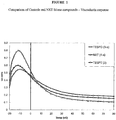
- the NXT silane compound exhibits lower Mooney viscosity, and decreased non-linearity (lower G', ⁇ G' and tan ⁇ max ) compared to TESPD (tetrasulfide silane and TESPD (di-sulfide silane). While non-linearity and hysteresis at 60° C are improved, the hardness of NXT silane-containing rubber compound is lower. Due to reduced filler-filler interactions, the modulus of NXT silane compound is reduced over the entire strain range. However, the coupling strength, as indicated by M300/M100, is in the range of polysulfide silanes. Figure 1 shows temperature dependence of viscoelastic properties of these rubber compounds.
- NXT silane containing compound shows reduced tan ⁇ values at 60° C, and high tan ⁇ values in the +5 to B20° C range. This is an indication that rubber compounds made with NXT silane will lead to tire treads with lower rolling resistance and better wet traction characteristics.
- Example 2 demonstrates this test with lower NXT silane loading levels. From the results of this experiment, in order to increase the hardness of NXT silane compound up to the levels of the TESPD compound, it would be necessary to reduce the NXT silane loading below 40% molar loading levels (below 3.9 phr in this formulation). At this loading of NXT silane, the filler-filler "structure" is comparable to that of TESPD compound B as indicated by the dynamic properties. However, the amount of silane delivered to couple the silica to rubber is insufficient.
- NXT-6 and NXT-7 The low reinforcing properties of NXT silane compounds (NXT-6 and NXT-7) indicate this fact. From this experiment, it can be noted that reducing the NXT silane loading cannot improve the hardness of the compound without sacrificing the reinforcing properties.
- Example 3 the effect of sulfur loading in NXT silane compounds is studied.
- Polysulfide silanes (TESPT and TESPD) contain on an average more than one sulfur atom (average sulfur rank of TESPT is about ⁇ 3.7 and that of TESPD is ⁇ 2.2).
- TESPT and TESPD contain on an average more than one sulfur atom (average sulfur rank of TESPT is about ⁇ 3.7 and that of TESPD is ⁇ 2.2).
- the relatively weak S-S linkage in polysulfide silanes might cleave. This can be triggered as the thermo-mechanical energy distribution in the rubber develops "hot spots". Under such conditions, free sulfur is released into the rubber compound, leading to premature scorch. While this scorching occurs, crosslinks are formed in the bulk rubber from the sulfur donated by the silanes. This additional cross-linking leads to an increased hardness of the rubber compound.
- NXT silane on the other hand does not show any premature scorching tendency. It has a higher thermo-mechanical threshold compared to polysulfide silanes. Following this direction, there may be a need to add extra sulfur into the rubber compound containing NXT silane so as to get optimal cross-link density network. The increased crosslink density also results in increase of hardness.
- Example 3 investigates the effects of extra sulfur in the NXT silane compound. The extra sulfur is added in the productive mix step, along with the conventional vulcanization package (that also includes elemental sulfur). From the table of Example 3, it is observed that addition of extra sulfur does impact the hardness of NXT silane rubber compound.
- NXT silane compound Other methods that follow a similar approach to increasing hardness of NXT silane compound include addition of certain accelerators.
- These accelerators e.g. MBTS B bis mercapto-benzo-thiozole, arazates - zinc dibutyldithiocarbamate
- MBTS B bis mercapto-benzo-thiozole, arazates - zinc dibutyldithiocarbamate increase the speed of vulcanization and lead to a higher equilibrium modulus in the final fully cured state.
- the hardness increase with these accelerators occurs via modification of the cross-link density of the system. It can be noted from Examples 4 and 5 that even small addition of the accelerators result in substantial changes in the rubber compound. With increased accelerator loading, the modulus values rise sharply and the elongation at rupture of the compounds decreases rapidly. Compared to
- Examples 6, 7 and 8 illustrate the improvement of hardness in NXT silane compounds via addition of carbon black.
- the mechanism of hardness increase in this case is thought to be hydrodynamic in nature and/or via formation of bound rubber. While addition of carbon black leads to an increase in hardness, due to the interactions of polymer chains with the surface of carbon-black, new hysteresis sources are generated in the compound. This causes an increased non-linearity under small strains that also result in an increase tan ⁇ max (indication of higher rolling resistance).
- tan ⁇ max value for NXT compound without any modification is 0.11, and in the case of control-TESPD it is 0.21.
- the tan ⁇ max values are 0.16 and 0.17.
- the hardness of the NXT compound is 58.
- an addition of 8 phr of N-234 leads to an increase in hardness of NXT compound up to 61 (same hardness as TESPD compound).
- tan ⁇ max value is 0.16.
- the hardness of NXT compound is increased up to the level of TESPD compound by addition of 8 phr of N-121 (Example 8).
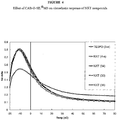
- Examples 9 through 12 and Figures 2 and 3 display results obtained with NXT silane compounds wherein an attempt was made to improve the hardness of the compound by increasing the loading of precipitated silica in the formulation.
- the control TESPD (3-d) and NXT (4-d) contain 80 phr of precipitated silica.
- Compounding variations NXT(23), NXT(24), and NXT (25) contain 90, 95, and 100 phr of silica. With increasing silica content, it can be seen that the hardness of the NXT compound increases. At 100 phr silica loading, the hardness of the NXT compound is already higher than the control (TESPD).
- tan ⁇ max for NXT is 0.17 (as against 0.20 for TESPD). This implies that high temperature hysteresis properties at 100 phr silica loaded NXT compound will be slightly better than the control TESPD with 80 phr silica loading.
- the tan ⁇ max values with NXT silane compounds become comparable with TESPD compound only at silica loading of 110 phr. This is not very surprising, since NXT silane is expected to improve the dispersion of silica.
- One more advantageous feature of increasing the silica loading is the positive shift in high and low temperature hysteresis.
- Figure 2 indicates that with increasing silica content, the tan ⁇ values near 0° C improve progressively with added silica.
- the NXT compound not only shows equal hardness with better tan ⁇ max at 60° C compared to TESPD, but also a substantial improvement in low temperature hysteresis. This increase in tan ⁇ values near 0° C indicates enhanced wet traction properties with NXT compounds.
- the viscosity of NXT compound at 100 phr loading is close to that of the TESPD compound.
- the reinforcement level (M300/100) with 100 phr silica in the NXT compound is higher than the control indicating superior coupling strength.
- Example 9 The NXT compounds cited in Example 9 were mixed in two non-productive mix steps. Also, the loading levels were kept at 9.7 phr (which is the molar equivalent of 6.2 phr of TESPD in an 80 phr silica loaded formulation).
- Example 10 shows results of comparison of NXT compound with 100 phr silica mixed in both, two and one non-productive mix steps. It also examines the effect of increased NXT silane loading level to compensate for any deterioration in coupling strength. From the results, it is observed that mixing NXT rubber compounds containing 100 phr silica in one non-productive step leads to an equivalent set of physical properties (with some improvements in reinforcing properties).
- NXT silane shows the potential to provide equal hardness, slightly better rolling resistance, and substantially enhanced wet traction when compared to TESPT and TESPD silanes.
- Examples 13-16 (not according to the invention) describe experiments of hardness adjustment in NXT silane compounds via addition of fumed silica. Fumed (pyrogenic) silica, with a relatively low concentration of silanols on its surface offers a good solution (closer to purely hydrodynamic) to the hardness problem.
- the fumed silicas used were of the type:
- NXT compound shows proportionate increases in hardness.
- the highest loading of fumed silica in the examples (8 phr) is not enough to match the hardness of the NXT compounds with those of TESPD.
- addition of about 5-8 phr fumed silica (in total 13-16 phr) may be necessary to raise the NXT compound hardness to 61 points.
- fumed silica additions cause relatively less increase in hysteresis at high temperatures (tan ⁇ max at 60° C).
- fumed silicas CAB-O-SIL M-5 and CAB-O-SIL TS-530 additions lead to an increase in tan ⁇ values near 0° C. This is an indication of expansion of the performance envelope of NXT compounds, i.e., minimal sacrifice in high temperature hysteresis (indicating better rolling resistance) and an improvement in low temperature hysteresis (indicating improved traction properties).
- addition of fumed silica also causes an increase in Mooney viscosities. With the addition of fumed silicas, the reinforcing properties are not affected negatively.
- Examples 17-20 demonstrate the use of MQ resins in NXT silane compounds.
- the M groups in these MQ resins can be described as having the structure R 1 R 2 R 3 SiO 1/2 , wherein R 1 , R 2 , and R 3 are methyl groups.
- MQ resin was added to the rubber compound along with NXT silane (2:1, 1:1, and 3:1 mixtures of MQ/NXT silane).
- NXT silane 2:1, 1:1, and 3:1 mixtures of MQ/NXT silane.
- MQ is mixed with NXT silane in a 2:1 ratio by weight, and then added to the rubber compound.
- the effective loading of NXT silane is kept at 8.2 phr, while the effective loadings of MQ are varied, 16.4, 12.0, 8.0, 4.0, and 2.0 phr, respectively.
- MQ loadings of 4 phr and higher provide the necessary hardness increase to the NXT compound. From the example table, it is also easily observed that, with the addition of MQ resin, not only is the hardness increase observed, but at the same time, a favorable balance between hysteresis properties at 60° C and 0° C (as indicated by tan ⁇ max and tan ⁇
- Example 18 MQ is mixed with NXT silane in a 1:1 ratio by weight, and then added to the rubber compound.
- the effective loading of NXT silane is kept at 8.2 phr, while the effective loadings of MQ are varied, 8.2, 6.0, 4.0, and 2.0 phr, respectively. It is easily seen that MQ loadings of 4 phr and higher provide the necessary hardness increase to the NXT compound. From the example table it is also easily observed that, with the addition of MQ resin, not only the hardness increase is observed, but, at the same time, a favorable balance between hysteresis properties at 60° C and 0° C (as indicated by tan ⁇ max and tan ⁇
- MQ siloxane Due to the incorporation of MQ siloxane into the rubber compound, the modulus values at low strains increase, whereas the modulus values at high strains are similar to those of the TESPD compound.
- the use of MQ resins does not cause any detrimental effects on the ability to mix NXT silane in reduced mixing steps and at higher mixing temperatures.
- Example 19 MQ is mixed with NXT silane in a 3:1 ratio by weight, and then added to the rubber compound.
- the effective loading of NXT silane is kept at 8.2 phr, while the effective loadings of MQ are varied, 14.9 and 8.0 phr, respectively. It is easily noticed that MQ loadings of 8 phr and higher provide the necessary hardness increase to the NXT compound. From the example table it is also easily observed that, with the addition of MQ resin, not only the hardness increase is observed, but, at the same time, a favorable balance between hysteresis properties at can be maintained.
- MQ siloxane Due to the incorporation of MQ siloxane into the rubber compound, the modulus values at low strains increase, whereas the modulus values at high strains are similar to those of the TESPD compound.
- the use of MQ resins does not cause any detrimental effects on the ability to mix NXT silane in reduced mixing steps and at higher mixing temperatures.
- Example 20 the best performing MQ:NXT mixtures from examples 17, 18, and 19 are compared with NXT compounds wherein hardness re-formulation is achieved via addition of precipitated and fumed silica. From the example table, it is evident that MQ resins when added to the NXT rubber compounds provide a substantial benefit of improved hardness, while maximizing the performance balance between hysteresis properties at 60° C and 0° C (as indicated by tan ⁇ max and tan ⁇
- the enhancement of NXT compound performance with MQ resins is more neutral when compared to the enhancement of performance via using higher amounts of precipitated silica or by addition of fumed silica to the compound.
- the use of MQ resins does not cause any detrimental effects on the ability to mix NXT silane in reduced mixing steps and at higher mixing temperatures.
- NXT (4a) NXT (5) NXT (6) NXT (7) TESPD (3a) solution SBR 103.2 103.2 103.2 103.2 103.2 butadiene rubber 25.0 25.0 25.0 25.0 25.0 25.0 Silica 80.0 80.0 80.0 80.0 TESPD 6.2 (100%) NXT Silane 9.7 (100%) 7.8 (80%) 3.9 (40%) 1.9 (20%) Aromatic Oil 5.0 5.0 5.0 5.0 5.0 Zinc Oxide 2.5 2.5 2.5 2.5 2.5 2.5 2.5 2.5 2.5 2.5 Stearic acid 1.0 1.0 1.0 1.0 1.0 1.0 1.0 1.0 1.0 1.0 1.0 Antiozonant 2.0 2.0 2.0 2.0 2.0 Wax 1.5 1.5 1.5 1.5 1.5 1.5 1.5 Sulfur 1.4 1.4 1.4 1.4 1.4 1.4 1.4 CBS 1.7 1.7 1.7 1.7 1.7 1.7 DPG 2.0 2.0 2.0 2.0 2.0 2.0 2.0 2.0 No.
- NXT (4a) NXT (8) NXT (9) NXT (10) TESPD (3a) solution SBR 103.2 103.2 103.2 103.2 103.2 butadiene rubber 25.0 25.0 25.0 25.0 25.0 25.0 Silica 80.0 80.0 80.0 80.0 TESPD 6.2 NXT Silane 9.7 9.7 9.7 9.7 Aromatic Oil 5.0 5.0 5.0 5.0 5.0 Zinc Oxide 2.5 2.5 2.5 2.5 2.5 Stearic acid 1.0 1.0 1.0 1.0 1.0 1.0 1.0 1.0 1.0 1.0 1.0 1.0 Antiozonant 2.0 2.0 2.0 2.0 2.0 Wax 1.5 1.5 1.5 1.5 1.5 1.5 1.5 1.5 Sulfur 1.4 2.0 2.5 3.0 1.4 CBS 1.7 1.7 1.7 1.7 1.7 1.7 DPG 2.0 2.0 2.0 2.0 2.0 2.0 2.0 2.0 No.
- NXT (4-c) NXT (19) NXT (20) TESPD (3-c) solution S BR 103.2 103.2 103.2 103.2 Butadiene rubber 25.0 25.0 25.0 25.0 25.0 Silica TESPD 80.0 80.0 80.0 6.2 NXT Silane 9.7 9.7 9.7 Aromatic Oil 5.0 5.0 5.0 5.0 Zinc Oxide 2.5 2.5 2.5 2.5 Stearic add 1.0 1.0 1.0 1.0 1.0 Antiozonant 2.0 2.0 2.0 2.0 2.0 Wax 1.5 1.5 1.5 1.5 1.5 N-330 3.0 3.0 3.0 N-234 - 4.0 8.0 - Sulfur 1.4 1.4 1.4 1.4 1.4 CBS 1.7 1.7 1.7 1.7 DPG 2.0 2.0 2.0 2.0 2.0 2.0 2.0 2.0 2.0 No.
- NXT (4-c) NXT (21) NXT (22) TESPD (3-c) solution S BR 103.2 103.2 103.2 103.2 butadiene rubber 25.0 25.0 25.0 25.0 25.0 Silica 80.0 80.0 80.0 TESPD 6.2 NXT Silane 9.7 9.7 9.7 Aromatic Oil 5.0 5.0 5.0 5.0 5.0 Zinc Oxide 2.5 2.5 2.5 2.5 Stearic acid 1.0 1.0 1.0 1.0 1.0 Antiozonant 2.0 2.0 2.0 2.0 Wax 1.5 1.5 1.5 1.5 1.5 N-330 3.0 3.0 3.0 3.0 N-121 - 4.0 8.0 - Sulfur 1.4 1.4 1.4 1.4 1.4 CBS 1.7 1.7 1.7 1.7 DPG 2.0 2.0 2.0 2.0 2.0 2.0 2.0 2.0 2.0 2.0 No. of Mixing steps 1 1 1 2 Mixing temperature 170°C 170°C 170°C 160°C
- NXT (4-e) NXT (34) NXT (35) NXT (36) TESPD (3-e) solution SBR 103.2 103.2 103.2 103.2 103.2 butadiene rubber 25.0 25.0 25.0 25.0 25.0 25.0 25.0 Silica 80.0 80.0 80.0 80.0 TESPD 6.2 NXT Silane 9.7 9.7 9.7 9.7 Aromatic Oil 5.0 5.0 5.0 5.0 5.0 5.0 Zinc Oxide 2.5 2.5 2.5 2.5 2.5 2.5 2.5 2.5 2.5 2.5 2.5 2.5 2.5 2.5 2.5 2.5 2.5 2.5 2.5 2.5 2.5 2.5 2.5 2.5 2.5 2.5 2.5 2.5 2.5 2.5 2.5 2.5 2.5 Stearic acid 1.0 1.0 1.0 1.0 1.0 1.0 1.0 1.0 1.0 1.0 1.0 Antiozonant 2.0 2.0 2.0 2.0 2.0 2.0 Wax 1.5 1.5 1.5 1.5 1.5 1.5 N-330 3.0 3.0 3.0 3.0 3.0 Fumed Silica M-5 - 4.0 6.0 8.0 - Sulfur 1.4 1.4 1.4 1.4 1.4 CBS 1.7 1.7 1.7 1.7 1.7 1.7 DPG 2.0 2.0 2.0 2.0 2.0 2.0 2.0 2.0 2.0 No.
- NXT (4-e) NXT (40) NXT (41) NXT (42) TESPD (3-e) solution SBR 103.2 103.2 103.2 103.2 103.2 butadiene rubber 25.0 25.0 25.0 25.0 25.0 25.0 Silica 80.0 80.0 80.0 80.0 TESPD 6.2 NXT Silane 9.7 9.7 9.7 9.7 Aromatic Oil 5.0 5.0 5.0 5.0 5.0 Zinc Oxide 2.5 2.5 2.5 2.5 2.5 Stearic acid 1.0 1.0 1.0 1.0 1.0 1.0 1.0 1.0 1.0 1.0 1.0 Antiozonant 2.0 2.0 2.0 2.0 2.0 2.0 Wax 1.5 1.5 1.5 1.5 1.5 1.5 N-330 3.0 3.0 3.0 3.0 3.0 Fumed Silica TS-610 - 3.0 6.0 8.0 - Sulfur 1.4 1.4 1.4 1.4 1.4 1.4 CBS 1.7 1.7 1.7 1.7 1.7 1.7 DPG 2.0 2.0 2.0 2.0 2.0 2.0 2.0 2.0 2.0 2.0 2.0 2.0 2.0 2.0 2.0 2.0 2.0 2.0 No.
- tand max value for NXT compound without any modification is 0.11, and in the case of control-TESPD it is 0.21.
- the tan * max values are 0.16 and 0.17.
- the hardness of the NXT compound is 58.
- an addition of 8 phr of N-234 leads to an increase in hardness of NXT compound up to 61 (same hardness as TESPD compound).
- tan * max value is 0.16.
- NXT compound is increased up to the level of TESPD compound by addition of 8 phr of N-121 (Example 8).
- addition of carbon black offers a relatively easy solution the problem.
- N-330 low structure carbon black
- N-121 relatively high structure carbon black
- This method of hardness adjustment can be termed, as a partly neutral way of adjusting the hardness since it has minimal influence on the cross-link network structure, and it leads to an increase in hysteresis.
- Examples 9 through 12 and Figures 2 and 3 display results obtained with NXT silane compounds wherein an attempt was made to improve the hardness of the compound by increasing the loading of precipitated silica in the formulation.
- the control TESPD (3-d) and NXT (4-d) contain 80 phr of precipitated silica.
- Compounding variations NXT(23), NXT(24), and NXT (25) contain 90, 95, and 100 phr of silica. With increasing silica content, it can be seen that the hardness of the NXT compound increases. At 100 phr silica loading, the hardness of the NXT compound is already higher than the control (TESPD).
- tan * max for NXT is 0.17 (as against 0.20 for TESPD). This implies that high temperature hysteresis properties at 100 phr silica loaded NXT compound will be slightly better than the control TESPD with 80 phr silica loading.
- the tan * max values with NXT silane compounds become comparable with TESPD compound only at silica loading of 110 phr. This is not very surprising, since NXT silane is expected to improve the dispersion of silica.
- One more advantageous feature of increasing the silica loading is the positive shift in high and low temperature hysteresis.
- Figure 2 indicates that with increasing silica content, the tan * values near 0° C improve progressively with added silica.
- the NXT compound not only shows equal hardness with better tan * max at 60° C compared to TESPD, but also a substantial improvement in low temperature hysteresis. This increase in tan * values near 0° C indicates enhanced wet traction properties with NXT compounds.
- the viscosity of NXT compound at 100 phr loading is close to that of the TESPD compound.
- the reinforcement level (M3 00/100) with 100 phr silica in the NXT compound is higher than the control indicating superior coupling strength.
- Example 9 The NXT compounds cited in Example 9 were mixed in two non-productive mix steps. Also, the loading levels were kept at 9.7 phr (which is the molar equivalent of 6.2 phr of TESPD in an 80 phr silica loaded formulation).
- Example 10 shows results of comparison of NXT compound with 100 phr silica mixed in both, two and one non-productive mix steps. It also examines the effect of increased NXT silane loading level to compensate for any deterioration in coupling strength. From the results, it is observed that mixing NXT rubber compounds containing 100 phr silica in one non-productive step leads to an equivalent set of physical properties (with some improvements in reinforcing properties).
- NXT silane shows the potential to provide equal hardness, slightly better rolling resistance, and substantially enhanced wet traction when compared to TESPT and TESPD silanes.
- Examples 13-16 describe experiments of hardness adjustment in NXT silane compounds via addition of fumed silica. Fumed (pyrogenic) silica, with a relatively low concentration of silanols on its surface offers a good solution (closer to purely hydrodynamic) to the hardness problem.
- the fumed silicas used were of the type:
- NXT compound shows proportionate increases in hardness.
- the highest loading of fumed silica in the examples (8 phr) is not enough to match the hardness of the NXT compounds with those of TESPD.
- addition of about 5-8 phr fumed silica (in total 13-16 phr) may be necessary to raise the NXT compound hardness to 61 points.
- fumed silica additions cause relatively less increase in hysteresis at high temperatures (tan * max at 60° C).
- fumed silicas CAB-O-SIL M-5 and CAB-O-SIL TS-530 additions lead to an increase in tan d values near 0° C. This is an indication of expansion of the performance envelope of NXT compounds, i.e., minimal sacrifice in high temperature hysteresis (indicating better rolling resistance) and an improvement in low temperature hysteresis (indicating improved traction properties).
- addition of fumed silica also causes an increase in Mooney viscosities. With the addition of fumed silicas, the reinforcing properties are not affected negatively.
- Examples 17-20 demonstrate the use of MQ resins in NXT silane compounds.
- the M groups in these MQ resins can be described as having the structure R 1 R 2 R 3 SiO 1/2 , wherein R 1 , R 2 , and R 3 are methyl groups.
- MQ resin was added to the rubber compound along with NXT silane (2:1, 1:1, and 3:1 mixtures of MQ/NXT silane).
- NXT silane 2:1, 1:1, and 3:1 mixtures of MQ/NXT silane.
- MQ is mixed with NXT silane in a 2:1 ratio by weight, and then added to the rubber compound.
- the effective loading of NXT silane is kept at 8.2 phr, while the effective loadings of MQ are varied, 16.4, 12.0, 8.0, 4.0, and 2.0 phr, respectively.
- MQ loadings of 4 phr and higher provide the necessary hardness increase to the NXT compound. From the example table, it is also easily observed that, with the addition of MQ resin, not only is the hardness increase observed, but at the same time, a favorable balance between hysteresis properties at 60° C and 0° C (as indicated by tan * max and tan *
- Example 18 MQ is mixed with NXT silane in a 1:1 ratio by weight, and then added to the rubber compound.
- the effective loading of NXT silane is kept at 8.2 phr, while the effective loadings of MQ are varied, 8.2, 6.0, 4.0, and 2.0 phr, respectively. It is easily seen that MQ loadings of 4 phr and higher provide the necessary hardness increase to the NXT compound. From the example table it is also easily observed that, with the addition of MQ resin, not only the hardness increase is observed, but, at the same time, a favorable balance between hysteresis properties at 60° C and 0° C (as indicated by tan * max and tan *
- MQ siloxane Due to the incorporation of MQ siloxane into the rubber compound, the modulus values at low strains increase, whereas the modulus values at high strains are similar to those of the TESPD compound.
- the use of MQ resins does not cause any detrimental effects on the ability to mix NXT silane in reduced mixing steps and at higher mixing temperatures.
- Example 19 MQ is mixed with NXT silane in a 3:1 ratio by weight, and then added to the rubber compound.
- the effective loading of NXT silane is kept at 8.2 phr, while the effective loadings of MQ are varied, 14.9 and 8.0 phr, respectively. It is easily noticed that MQ loadings of 8 phr and higher provide the necessary hardness increase to the NXT compound. From the example table it is also easily observed that, with the addition of MQ resin, not only the hardness increase is observed, but, at the same time, a favorable balance between hysteresis properties at can be maintained.
- MQ siloxane Due to the incorporation of MQ siloxane into the rubber compound, the modulus values at low strains increase, whereas the modulus values at high strains are similar to those of the TESPD compound.
- the use of MQ resins does not cause any detrimental effects on the ability to mix NXT silane in reduced mixing steps and at higher mixing temperatures.
- Example 20 the best performing MQ:NXT mixtures from examples 17, 18, and 19 are compared with NXT compounds wherein hardness re-formulation is achieved via addition of precipitated and fumed silica. From the example table, it is evident that MQ resins when added to the NXT rubber compounds provide a substantial benefit of improved hardness, while maximizing the performance balance between hysteresis properties at 60° C and 0° C (as indicated by tan * max and tan *
- the enhancement of NXT compound performance with MQ resins is more neutral when compared to the enhancement of performance via using higher amounts of precipitated silica or by addition of fumed silica to the compound.
- the use of MQ resins does not cause any detrimental effects on the ability to mix NXT silane in reduced mixing steps and at higher mixing temperatures.
- NXT (4a) NXT (5) NXT (6) NXT TESPD (3a) solution SBR 103.2 103.2 103.2 103.2 103.2 butadene rubber 25.0 25.0 25.0 25.0 25.0 25.0 Silica 80.0 80.0 80.0 80.0 TESPD 6.2 (100%) NXT Silane 9.7(100%) 7.8 (80%) 3.9(40%) 1.9 (20%) AromaticOil 5.0 5.0 5.0 5.0 5.0 Zinc Oxide 2.5 2.5 2.5 2.5 2.5 2.5 2.5 2.5 2.5 2.5 2.5 2.5 2.5 Stearic acid 1.0 1.0 1.0 1.0 1.0 1.0 1.0 1.0 1.0 1.0 1.0 Antiozonant 2.0 2.0 2.0 2.0 2.0 Wax 1.5 1.5 1.5 1.5 1.5 1.5 1.5 Sulfur 1.4 1.4 1.4 1.4 1.4 1.4 1.4 CBS 1.7 1.7 1.7 1.7 1.7 1.7 DPG 2.0 2.0 2.0 2.0 2.0 2.0 2.0 2.0 2.0 No.
- NXT (4a) NXT (8) NXT (9) NXT (10) TESPD (3a) solution SBR 103.2 103.2 103.2 103.2 103.2 butadene rubber 25.0 25.0 25.0 25.0 25.0 25.0 Silica 80.0 80.0 80.0 80.0 TESPD 6.2 NXT Silane 9.7 9.7 9.7 9.7 Aromatic Oil 5.0 5.0 5.0 5.0 5.0 Zinc Oxide 2.5 2.5 2.5 2.5 2.5 Stearic acid 1.0 1.0 1.0 1.0 1.0 1.0 1.0 1.0 1.0 1.0 1.0 1.0 Antiozonant 2.0 2.0 2.0 2.0 2.0 Wax 1.5 1.5 1.5 1.5 1.5 1.5 1.5 S Sulfur 1.4 2.0 2.5 3.0 1.4 CBS 1.7 1.7 1.7 1.7 1.7 DPG 2.0 2.0 2.0 2.0 2.0 2.0 2.0 2.0 2.0 No.
- NXT (4-b) NXT (13) NXT (14) TESPD (3-b) solution S BR 103.2 103.2 103.2 103.2 Butadiene rubber 25.0 25.0 25.0 25.0 Silica 80.0 80.0 80.0 TESPD 6.2 NXT Silane 9.7 9.7 9.7 Aromatic Oil 5.0 5.0 5.0 5.0 Zinc Oxide 2.5 2.5 2.5 2.5 Stearic add 1.0 1.0 1.0 1.0 1.0 Antiozonant 2.0 2.0 2.0 2.0 2.0 Wax 1.5 1.5 1.5 1.5 1.5 1.5 Sulfur 1.4 1.4 1.4 1.4 1.4 CBS 1.7 1.7 1.7 1.7 DPG 2.0 2.0 2.0 2.0 2.0 2.0 Arazate - 0.6 1.4 - No.
- NXT (4-c) NXT (21) NXT (22) TESPD (3-c) solution SBR 103.2 103.2 103.2 103.2 Butadiene rubber 25.0 25.0 25.0 25.0 25.0 Silica 80.0 80.0 80.0 TESPD 6.2 NXT Silane 9.7 9.7 9.7 Aromatic Oil 5.0 5.0 5.0 5.0 Zinc Oxide 2.5 2.5 2.5 2.5 Stearic add 1.0 1.0 1.0 1.0 1.0 Antiozonant 2.0 2.0 2.0 2.0 2.0 Wax 1.5 1.5 1.5 1.5 1.5 N-330 3.0 3.0 3.0 N-121 - 4.0 8.0 - Sulfur 1.4 1.4 1.4 1.4 1.4 CBS 1.7 1.7 1.7 1.7 DPG 2.0 2.0 2.0 2.0 2.0 2.0 2.0 2.0 2.0 No.
- NXT (4-e) NXT (34) NXT (35) NXT (36) TESPD (3-e) solution SBR 103.2 103.2 103.2 103.2 103.2 butadiene rubber 25.0 25.0 25.0 25.0 25.0 25.0 25.0 Silica 80.0 80.0 80.0 80.0 TESPD 6.2 NXT Silane 9.7 9.7 9.7 9.7 Aromatic Oil 5.0 5.0 5.0 5.0 5.0 5.0 Zinc Oxide 2.5 2.5 2.5 2.5 2.5 2.5 2.5 2.5 2.5 2.5 2.5 2.5 2.5 2.5 2.5 2.5 2.5 2.5 2.5 2.5 2.5 2.5 2.5 2.5 2.5 2.5 2.5 2.5 2.5 2.5 2.5 2.5 2.5 Stearic acid 1.0 1.0 1.0 1.0 1.0 1.0 1.0 1.0 1.0 1.0 1.0 Antiozonant 2.0 2.0 2.0 2.0 2.0 2.0 Wax 1.5 1.5 1.5 1.5 1.5 1.5 N-330 3.0 3.0 3.0 3.0 3.0 Fumed Silica M-5 - 4.0 6.0 8.0 - Sulfur 1.4 1.4 1.4 1.4 1.4 CBS 1.7 1.7 1.7 1.7 1.7 1.7 DPG 2.0 2.0 2.0 2.0 2.0 2.0 2.0 2.0 2.0 No.
Landscapes
- Chemical & Material Sciences (AREA)
- Health & Medical Sciences (AREA)
- Chemical Kinetics & Catalysis (AREA)
- Medicinal Chemistry (AREA)
- Polymers & Plastics (AREA)
- Organic Chemistry (AREA)
- Engineering & Computer Science (AREA)
- Mechanical Engineering (AREA)
- Compositions Of Macromolecular Compounds (AREA)
- Tires In General (AREA)
Description
- The present invention relates to elastomers containing inorganic fillers and silane coupling agents. More particularly, the present invention pertains to such elastomer compositions containing inorganic fillers that have improved dynamic and static hardness coupled with desirable strength, wear resistance, fatigue resistance, improved hysteresis, and the like and to pneumatic tires in which these elastomers are used in the tread.
- The term "hardness" is used herein in its broadest technical sense and includes Shore A (ASTM D2240) hardness, IRHD (ASTM D1415, ISO standard) hardness, or other common methods of hardness measurement. Alternatively, the modulus of the rubber compound (G' shear, E' Extensional) measured under small dynamic strains (anywhere from 0 to 10% strain, but preferably closer to 0% strain) will be referred to herein as hardness.
- The use of organofunctional silanes as coupling agents in silica-filled tire tread compounds results in substantial performance benefits, including lower hysteresis, improved wet and ice traction, and high abrasion resistance. Unfortunately, these improvements in performance are usually accompanied by a loss in dynamic stiffness (hardness) of the filled rubber. Polysulfide silanes currently used in silica-filled tire treads lead to lower hardness of the compound and blocked mercaptosilanes (e.g., 3-octanoylthio-l-propyltriethoxysilane) amplify this effect. Chemical interaction of silanes with the silica surface results in a weaker silica "network",i.e., an improved dispersion of the silica in the rubber, thereby reducing the thixotropic benefits of the system. The lack of adequate bound rubber and hydrodynamic interactions between the filler and polymer also causes a reduction in hardness of the rubber. Since hardness of the tread compound is a very important parameter that dictates many of a tire's performance properties, an increase in hardness of compounds containing these silanes is necessary.
- From the early 1960's to the present, two families of sulfur-containing silanes have been the most common coupling agents to provide reinforcement in mineral-filled rubbers. The first to be introduced, mercapto-functional silanes, are widely used for effective coupling, but tend to create scorchy compounds and often have noticeable odors. The polysulfidic bis-alkoxysilanes, introduced in the 1970's, provided improved processability and odor. The tradeoff was the requirement to use higher loadings in some formulations. Variations of this family with reduced sulfur content have appeared, providing easier compounding, due to reduced sulfur donation in the high temperature non-productive mix stages typically used for silica compounds. The major growth in recent years in silica/silane-reinforced passenger tire tread formulations using up to 100% silica filler has placed new demands on compounding technology.
- Much of the art relating to the use of sulfur-containing coupling agents in rubber involves silanes containing one or more of the following chemical bond types: S-H (mercapto) and S-S (disulfide or polysulfide). Mercaptosilanes have offered superior coupling at substantially reduced loadings. However, their high chemical reactivity with organic polymers leads to unacceptably high viscosities during processing and premature curing (scorch). This undesirability is aggravated by their odor. Hence, a compromise must be found between coupling and the associated final properties, processability, and required loading levels. Polysulfidic silane coupling agents provide this optimal balance of processing and performance characteristics to a certain extent.
- Voronkov et al. in Inst. Org. Khim., Irkutsk, Russia and
U.S. Patent No. 3,922,436 disclose acylthioalkyl silanes, such as CH3C(=O)S(CH2)1-3Si(OR)3 and HOC(=O)CH2CH2C(=O)S(CH2)3Si(OC2H3)3. In particular,U.S. Patent No. 3,922,436 discloses organosilanes useful as coupling agents for glass fibers and as flame retardants, formed by reaction of an epoxy, a mercapto, or an amino silane with a carboxylic acid or anhydride, or formed by a Diels-Alder reaction of a halogenated cyclopentadiene with an unsaturated silane. -
U.S. Patent No. 3,957,718 discloses silica-containing mixtures for the improvement of the adhesion of vulcanizable mixtures of natural and/or synthetic rubber to reinforcing fillers or supports of textile and/or metallic fabrics after the vulcanization that substantially consist of (A) active synthetically produced silica or silicates having a specific surface area according to the BET procedure of about 50 to 500 m2/g and an average primary particle size of from about 5 to 100 and at least one of (B) phenolic resin or aminoplast forming components, namely on the one hand phenols and/or amines and on the other hand aldehydes or aldehyde donors, and/or at least (C) one organosilane which can be a bisalkoxysilylalkyl-oligosulfide of a given formula. -
U.S. Patent No. 4,184,998 discloses the bonding of rubber or other plastics to mineral reinforcements, such as silica pigment, that is brought about by a mercapto alkyl silane without production of foul odors from the mercapto compound by preliminary reversible coupling of the mercapto compound with a material capable of addition reaction, such as toluene diisocyanate.U.S. Patent No. 4,519,430 discloses a pneumatic radial tire with a tread having from 1 part by weight of hydrated amorphous fine-particle silica per 3 parts of carbon black tread reinforcing filler, to about 3 parts by weight of the silica to 1 part of the carbon black. The amount of silica present is preferably in the range from about 18 parts to about 50 parts by weight per 100 parts of natural or synthetic rubber. When such a tread is compounded with a mercaptosilane in which the mercapto group is reversibly blocked with an isocyanate group, the tread is said to provide reduced rolling resistance without loss of traction. The blocking group in this case can be an aromatic isocyanate group or any other organic group that can readily unblock under vulcanization conditions. -
U.S. Patent No. 4,942,192 discloses a rubber composition for use in tires, particularly bead filler, comprising 2 to about 30 parts by weight of a particular modified novolak resin having a self-curability based on 100 parts by weight of rubber ingredient. -
U.S. Patent No. 5,266,620 discloses a rubber composition for the manufacture of automotive vehicle tires suitably as a bead filler therefor. The composition comprises specified proportions of carbon black, a modified novolak phenolic resin, hexamethylenetetramine and a polymeric cardanol based on a starting rubber component such that the resulting rubber composition has a relatively low rigidity prior to vulcanization and a relatively high dynamic modulus after vulcanization. -
U.S. Patent No. 5,387,637 discloses polybutadiene compositions suitable for molded golf ball core construction. The compositions contain specific naturally occurring, essentially non-reinforcing, crystalline (preferably microcrystalline) silica particles, which have the effect of increasing the resilience and/or hardness of the resulting molded cores. -
U.S. Patent No. 5,886,074 discloses rubber compositions containing o-salicylsalicyclic acid of the formula:
-
U.S. Patent No. 6,005,027 discloses blends of silanes and specific silicas, characterized in that when the blend is compounded into a rubber formulation even after four months of storage following formation of the blend, an unexpectedly high proportion of the silane present is available as a coupling and reinforcing agent for the rubber formulation. Over 80 % and even over 90 % of the silica can be extracted from the blend even four months after formation of the blend, and rubber formulation properties indicate high availability of the silane for coupling and reinforcement. -
U.S. Patent No. 6,028,143 discloses a rubber composition in which the coexistence of low heat build-up, heat resistance and high hardness can be achieved without damaging failure characteristics. A rubber composition comprising 100 parts by weight of matrix rubber and 2-75 parts by weight of a polyethylene composition which contains 0-80% by weight of polyethylene and 20% by weight or more of a composite comprising a polyethylene component and a rubber component previously bonded via a coupling agent to the polyethylene component, said rubber component is crosslinked with the matrix rubber. At least at one of the kneading stages before the final stage, the compound is kneaded so that the maximum temperature of the compound of the kneading of that stage is higher than the melting point of the polyethylene component mixed, preferably, by 10° C or more. -
U.S. Patent No. 6,037,418 discloses a resin-reinforced elastomer which comprises as principal components, a rubber and a polyolefin having an average particle diameter of at most 1 micrometer, and in which the rubber and the polyolefin are linked together; a process for producing the resin-reinforced elastomer by melt kneading a polyolefin, a No.1 rubber and a binding agent to prepare a thermoplastic composition, adding a No.2 rubber to the resultant thermoplastic composition and melt kneading the mixture thus formed to disperse the polyolefin in the rubber components; and a pneumatic tire using the resin-reinforced elastomer in its tread. The above resin-reinforced elastomer is said to have a uniform modulus and a low density, to be minimized in directionality, and to have excellent tensile strength, fatigue resistance and abrasion resistance. - Australian Patent
AU-A-10082/97 - Japanese Patent Publication No.
78155/1995 - Japanese Patent Provisional Publication No.
186606/1995 - Japanese Patent Publication No.
10204221 HD - Japanese Patent
JP 63270751 A2 - Korean Patent Publication No.
2000031877 -
EP 894819 -
EP 964028 -
EP 1172406 discloses a rubber composition for a tire tread that comprises (a) a diene rubber, (b) glass fibers, (c) a reinforcing agent, and 1 to 15 parts by weight of (d-1) inorganic powders having a mohs hardness of less than 6.5 and an average particle size of less than 25 micrometers and/or (d-2) silicone rubber powders based on 100 parts by weight of the diene rubber. -
WO99/22951 - Structures formed by carbon black and bound rubber surrounding the surface of the carbon black provide necessary reinforcement and rigidity to the rubber compound. It is possible that thixotropy from this network contributes more towards hardness in the low strain region, whereas bound rubber provides reinforcement in the high strain regions. Nevertheless, there are hydrodynamic interactions that also provide a hardness boost. If carbon black were replaced by precipitated silica (no coupling agent), owing to the extreme thixotropic effects from the silica filler network, the hardness of the system would be very high, but at the expense of poor dispersion and reinforcement. Incorporating a coupling agent eliminates or reduces the filler network effects, thereby leading to a decrease in hardness at low strains. A silane, such as 3-octanoylthio-1-propyltriethoxysilane (also referred to herein as NXT silane), amplifies this effect beyond that found with polysulfidic (TESPT and TESPD) silanes. Adjusting the crosslink density up to the optimal point will help improve this hardness to a certain extent. Then, a reduction of small amounts of oil accompanied by small increases in carbon black loading might bring the hardness values to a level comparable with the controls. In some formulations, it might be impossible to adopt these changes.
- The present invention is directed to a method as defined in
claim 1 for increasing the hardness of silica/rubber mixtures comprising blending with said mixture at least one silane and a hardness-increasing amount of at least one member selected from the group consisting of precipitated silica; an MQ resin wherein Q is SiO4/2, M is R1R2R3SiO1/2, and R1, R2, and R3 are the same or different functional or non-functional organic groups; a thermoplastic resin; and a thermosetting resin. - In another aspect, the present invention is directed to an article of manufacture comprising a silica/rubber mixture hardened by said method.
-
-
Figure 1 is a graph depicting a comparison of controls and NXT silane compounds for viscoelastic response. -
Figure 2 is a graph depicting the effect of high silica loading on viscoelastic response of NXT compounds. -
Figure 3 is a graph depicting the viscoelastic response as a function of mixing variations with 100 phr silica loaded NXT compounds. -
Figure 4 is a graph depicting the effect of CAB-O-SIL M5 on the viscoelastic response of NXT compounds. -
Figure 5 is a graph depicting the effect of CAB-O-SIL TS-530 on the viscoelastic response of NXT compounds. -
Figure 6 is a graph depicting the effect of CAB-O-SIL TS-610 on the viscoelastic response of NXT compounds - In silica filled rubber compounds, the addition of silane causes reduction of filler-filler interactions, which can be observed as an improved dispersion of the filler in the rubber. Blocked mercaptosilanes, such as 3-octanoylthio-l-propyltriethoxysilane, amplify this effect beyond the levels of conventional polysulfidic silanes, such as triethoxysilylpropyltetrasulfide (TESPT) and triethoxysilylpropyldisulfide (TESPD). Separation of filler-filler interactions reduces the network effects and consequently the hardness of the rubber compound. On the other hand, creation of silica-rubber bonds via the coupling agent enhances the bound rubber content and the hydrodynamic interactions of the filler. This leads to an increase in hardness. In the case of 3-octanoylthio-l-propyltriethoxysilane, the hardness decrease from lowered network effects is more than the evolving hydrodynamic hardness due to silica dispersion and silica-rubber coupling. One way of increasing the hardness is to increase the loading of precipitated silica beyond the levels normally used in conventional tire-tread compounds. With a corresponding increase in silane loading, the hardness of 3-octanoylthio-l-propyltriethoxysilane-containing compounds can be brought to the level obtained with polysulfidic silane compounds that contain conventional loadings of silica.
- Another means of improving hardness is by introducing a "transient network". The term "transient network" as used herein is defined as a structure formed in the rubber compound that provides the necessary hardness increase, while not deleteriously affecting hysteresis. From these discussions, those skilled in the art will understand that there is a need to introduce interfacial area and/or a transient network into the rubber compound with 3-octanoylthio-l-propyltriethoxysilane. A wide range of inorganic and organic (oligomeric and polymeric) materials can be mixed into the rubber compound in order to achieve this goal.
- Following is a description of each of the components that, when mixed and blended into the rubber compound, lead to an increase of hardness.
- An option of increasing the hardness of the compound according to the invention would be to increase the loading of precipitated silica (the main filler component in the rubber matrix) beyond those typically employed in silica-rubber compounds for tire treads (85 phr).
- The following is a brief description of the preparation and physical characteristics of precipitated and fumed silicas.
- Fine particle reinforcing silica is precipitated by the controlled neutralization of sodium silicate solution (water glass) by either sulfuric or carbonic acids. The basic raw materials are those required for the silicate: sand, soda ash (or caustic soda), and water. Dilution with water provides a concentration suitable to produce, together with proper reaction rates, a precipitate of particulates rather than gel agglomerates. Reaction temperature is the major determinant of particle size. Precipitation produces a low solids content slurry of silica and sodium sulfate or sodium carbonate from which the salts are removed by washing, either in a counter current decantation system or during a filter press concentration step. Further filtration, drying, and micronizing steps lead to precipitated silicas that can be used as inorganic fillers for rubber.
U.S. Patent No. 4,704,425 and French Patent No.2,556,709 - In the case where precipitated silica loading is increased beyond the conventional phr levels, an increase of 2 to 30 phr, of silica beyond the currently used levels is applied according to the invention to achieve the desired hardness improvement.
- In another embodiment of this invention, the hardness of the rubber compound is increased by blending with thermoplastic, thermosetting, and high glass transition resins. An overview of many of these polymers is given in "Handbook of Plastic Materials and Technology", Ed. I. Rubin, John Wiley & Sons, Inc. 1990.
- HDPE (high density polyethylene) and UHMW PE (ultra high molecular weight polyethylene) are thermoplastic materials that can be blended with the rubber compound, so as to improve the hardness of the final tread compound. HDPE is a partially crystalline, partially amorphous material. UHMW PE has very high molecular weight, and can be used as high modulus filler in the rubber compound. Both these resins, if present, are mixed with rubber in the range of 0.1 to 80 phr, with 1 to 20 phr being a more preferred range.
- Phenolic resins are thermosetting resins, typically hard, stiff (high-modulus) polymers. They are most commonly the reaction products of phenol and formaldehyde. There are two types of phenolic resins: Novolaks - two step resins and Resols - one step resins. When these materials are blended with the rubber compound, a loading of 0.1 to 50 phr is used according to the invention to increase the hardness, with 0.1 to 30 phr being more preferred.
- Some non-limiting examples of high glass transition polymers are: 6 (PMMA). Preferred loading levels for these components is between 0.1 phr and 50 phr.
- Derivatives of TEOS (tetraethoxysilane), TMOS (tetramethoxysilane) - termed the "MQ" resins, and polyhedral oligomeric silsesquioxanes are also non-limiting examples of this invention. The loading levels used for these components according to the invention is between 0.1 phr and 50 phr.
- MQ resins are low molecular weight, hyperbranched polymers having the hydrophobic character of organosilicones and a rigidity similar to colloidal silica. With regard to the hardness of the rubber compound, these materials can offer a substantial improvement in hydrodynamic reinforcement. The presence of M groups, e.g., trimethyl siloxy surface, imparts a relatively neutral nature to their surface. MQ resins are used in a variety of applications, such as, for example, pressure sensitive adhesives, liquid injection molding applications, paper release coatings, and personal care products. The "MQ" resins employed in practice of the present invention are macromolecular polymers comprising R1R2R3SiO1/2 and SiO4/2 units (the M and Q units, respectively) wherein R1, R2, and R3 are the same or different and are functional or non-functional organic groups, including, but not limited to, alkyl, alkenyl, aryl, and arylalkyl groups. A computer generated molecular structure of a common commercially prepared MQ resin has been reported by Wengrovius et al. at the XXIIth Organosilicon symposium, Troy NY March 1994.
- The structure of an MQ resin is defined by three characterization parameters: M/Q ratio, molecular weight, and % OH. Most commercially useful MQ resins have an M/Q ratio between 0.6 and 1. Ratios lower than 0.6 result in insoluble solids, whereas those greater than 1 produce liquids. Molecular weight is related to M/Q ratio: higher molecular weights are associated with lower MQ ratios. The silanol content (% OH by weight) of these resins, typically ranging between 0 and 3%, is process dependent. IR studies indicate that OH groups are intramolecularly associated through hydrogen bonding.
- More detailed descriptions of MQ resins can be found in the conference proceedings from the 215th ACS National meeting, Dallas, March 29-April 2 (1998) by Wengrovius et al. In this article the performance of MQ-PDMS interpenetrating networks (IPN=s) in silicone products is discussed on the basis of molecular level interactions between the rigid MQ resin and flexible PDMS components. Yet another article by B.C. Copley in Polymer Science and Technology (Plenum) 1984, 29 (Adhesion Chemistry) 257-67 discusses the use of MQ resins in silicone pressure adhesives.
- Reference to or use of MQ resins appears in several patents. For example,
U.S. Patent Nos. 5,510,430 ;6,072,012 ; and European Patent1016442 A2 disclose the preparation of MQ resins and their use in foam control compositions.U.S. Patent No. 6,075,087 relates to resin-fillers having monofunctional siloxane (M) units and tetrafunctional siloxane (Q) units that are chemically linked. These resins have properties more similar to those of silica fillers and less like those of MQ resins with trimethyl siloxy units. These resin fillers have been reported to form homogeneous blends with silicone polymers, and dramatically impact modulus and viscosity of a polymer even at low loading levels.EP 1113036 A2 describes a continuous process for producing a silicon resin (MQ resin). In a preferred embodiment, the process of this invention comprises continuously capping the quenched silica hydrosol in a reaction medium comprising water and a liquid selected from the group consisting of organic solvents, siloxane fluids, and mixtures thereof with an organosilicon capping compound to form the MQ resin. This process permits consistent, reproducible production of silicon resins having narrow molecular weight distributions and high silanol content.U.S. Patent No. 5,324,806 describes a method for making free-flowing silicone resin powder that can be blended with a silicone fluid to produce a stable dispersion. - As noted above, the presence of an organofunctional silane will normally increase the dispersion of the silica in the rubber. However, with increased dispersion, the hardness of the rubber composition is decreased. The present invention is thus directed to overcoming this problem by the addition of various additives to the composition.
- Any organofunctional group-substituted silane with at least one alkoxy group per silicon atom and preferably two or three alkoxy groups per silicon atom is suitable for use herein. According to the invention, specifically are 3-octanoylthio-1-propyltriethoxysilane is used.
- The blocked mercaptosilane described herein is useful as a coupling agent for organic polymers (i.e., rubbers) and inorganic fillers. The blocked mercaptosilane is unique in that the high efficiency of the mercapto group can be utilized without the detrimental side effects typically associated with the use of mercaptosilanes, such as high processing viscosity, less than desirable filler dispersion, premature curing (scorch), and odor. These benefits are accomplished because the mercaptan group initially is nonreactive because of the blocking group. The blocking group substantially prevents the silane from coupling to the organic polymer during the compounding of the rubber. Generally, only the reaction of the silane, -SiX3, group with the filler can occur at this stage of the compounding process. Thus, substantial coupling of the filler to the polymer is precluded during mixing, thereby minimizing the undesirable premature curing (scorch) and the associated undesirable increase in viscosity. One can achieve better cured filled rubber properties, such as a balance of processing characteristics and final mechanical properties because of the avoidance of premature curing.
- In use, the blocked mercaptosilane is mixed with the organic polymer before, during, or after the compounding of the filler into the organic polymer. It is preferred to add the silane before or during the compounding of the filler into the organic polymer, because the silane facilitates and improves the dispersion of the filler. The total amount of silane present in the resulting combination should be about 0.05 to about 25 parts by weight per hundred parts by weight of organic polymer (phr), more preferably 1 to 10 phr. Fillers can be used in quantities ranging from about 5 to 100 phr, more preferably from 25 to 80 phr.
- When reaction of the mixture to couple the filler to the polymer is desired, a deblocking agent is added to the mixture to deblock the blocked mercaptosilane. The deblocking agent may be added at quantities ranging from about 0.1 to about 5 phr, more preferably in the range of from 0.5 to 3 phr. If alcohol or water is present (as is common) in the mixture, a catalyst (e.g., tertiary amines, Lewis acids, or thiols) may be used to initiate and promote the loss of the blocking group by hydrolysis or alcoholysis to liberate the corresponding mercaptosilane. Alternatively, the deblocking agent may be a nucleophile containing a hydrogen atom sufficiently labile such that the hydrogen atom could be transferred to the site of the original blocking group to form the mercaptosilane. Thus, with a blocking group acceptor molecule, an exchange of hydrogen from the nucleophile would occur with the blocking group of the blocked mercaptosilane to form the mercaptosilane and the corresponding derivative of the nucleophile containing the original blocking group. This transfer of the blocking group from the silane to the nucleophile could be driven, for example, by a greater thermodynamic stability of the products (mercaptosilane and nucleophile containing the blocking group) relative to the initial reactants (blocked mercaptosilane and nucleophile). For example, if the nucleophile were an amine containing an N-H bond, transfer of the blocking group from the blocked mercaptosilane would yield the mercaptosilane and one of several classes of amides corresponding to the type of blocking group used. For example, carboxyl blocking groups deblocked by amines would yield amides, sulfonyl blocking groups deblocked by amines would yield sulfonamides, sulfinyl blocking groups deblocked by amines would yield sulfinamides, phosphonyl blocking groups deblocked by amines would yield phosphonamides, phosphinyl blocking groups deblocked by amines would yield phosphinamides. What is important is that regardless of the blocking group initially present on the blocked mercaptosilane and regardless of the deblocking agent used, the initially substantially inactive (from the standpoint of coupling to the organic polymer) blocked mercaptosilane is substantially converted at the desired point in the rubber compounding procedure to the active mercaptosilane. It is noted that partial amounts of the nucleophile may be used (i.e., a stoichiometric deficiency), if one were to deblock only part of the blocked mercaptosilane to control the degree of vulcanization of a specific formulation.
- Water typically is present on the inorganic filler as a hydrate, or bound to filler in the form of a hydroxyl group. The deblocking agent could be added in the curative package or, alternatively, at any other stage in the compounding process as a single component. Examples of nucleophiles would include any primary or secondary amines, or amines containing C=N double bonds, such as imines or guanidines, with the proviso that said amine contains at least one N-H (nitrogen-hydrogen) bond. Numerous specific examples of guanidines, amines, and imines well known in the art, which are useful as components in curatives for rubber, are cited in J. Van Alphen, Rubber Chemicals, (Plastics and Rubber Research Institute TNO, Delft, Holland, 1973). Some examples include N,N'-diphenylguanidine, N,N',N"-triphenylguanidine, N,N'-di-ortho-tolylguanidine, orthobiguanide, hexamethylenetetramine, cyclohexylethylamine, dibutylamine, and 4,4'-diaminodiphenylmethane. Any general acid catalysts used to transesterify esters, such as Bronsted or Lewis acids, could be used as catalysts.
- In practice, sulfur vulcanized rubber products typically are prepared by thermomechanically mixing rubber and various ingredients in a sequentially stepwise manner followed by shaping and curing the compounded rubber to form a vulcanized product. First, for the aforesaid mixing of the rubber and various ingredients, typically exclusive of sulfur and sulfur vulcanization accelerators (collectively "curing agents"), the rubber(s) and various rubber compounding ingredients typically are blended in at least one, and often (in the case of silica-filled low rolling resistance tires) two, preparatory thermomechanical mixing stage(s) in suitable mixers. Such preparatory mixing is referred to as nonproductive mixing or nonproductive mixing steps or stages. Such preparatory mixing usually is conducted at temperatures up to 140° to 200° C, preferably up to 150° to 180° C. Subsequent to such preparatory mix stages, in a final mixing stage, sometimes referred to as a productive mix stage, deblocking agent, curing agents, and possibly one or more additional ingredients are mixed with the rubber compound or composition, typically at a temperature in a range of 50° to 130° C. This temperature range is a lower range than the temperatures utilized in the preparatory mix stages to prevent or retard premature curing of the sulfur curable rubber, which is sometimes referred to as scorching of the rubber composition. The rubber mixture, sometimes referred to as a rubber compound or composition, typically is allowed to cool, sometimes after or during a process intermediate mill mixing, between the aforesaid various mixing steps, for example, to a temperature of about 50° C or lower. When it is desired to mold and to cure the rubber, the rubber is placed into the appropriate mold at about at least 130° C and up to about 200° C, which will cause the vulcanization of the rubber by the mercapto groups on the mercaptosilane and any other free sulfur sources in the rubber mixture.
- Thermomechanical mixing means that the rubber compound, or composition of rubber and rubber compounding ingredients, is mixed in a rubber mixture under high shear conditions where it autogenously heats up as a result of the mixing, primarily owing to shear and associated friction within the rubber mixture in the rubber mixer. Several chemical reactions may occur at various steps in the mixing and curing processes.
- The first reaction is a relatively fast reaction and is considered herein to take place between the filler and the SiX3 group of the blocked mercaptosilane. Such reaction may occur at a relatively low temperature such as, for example, at about 120° C. The second and third reactions are considered herein to be the deblocking of the mercaptosilane and the reaction which takes place between the sulfuric part of the organosilane (after deblocking), and the sulfur vulcanizable rubber at a higher temperature, for example, above about 140° C.
- Another sulfur source may be used, for example, in the form of elemental sulfur as S8. A sulfur donor is considered herein as a sulfur containing compound which liberates free, or elemental, sulfur at a temperature in a range of 140° to 190° C. Examples of such sulfur donors include, but are not limited to, polysulfide vulcanization accelerators and organosilane polysulfides with at least two connecting sulfur atoms in its polysulfide bridge. The amount of free sulfur source addition to the mixture can be controlled or manipulated as a matter of choice relatively independently from the addition of the aforesaid blocked mercaptosilane. Thus, for example, the independent addition of a sulfur source may be manipulated by the amount of addition thereof and by sequence of addition relative to addition of other ingredients to the rubber mixture.
- A rubber composition is prepared by a process which comprises the sequential steps of:
- (A) thermomechanically mixing, in at least one preparatory mixing step, to a temperature of 140° to 200° C, preferably to 140° to 190° C, for a total mixing time of 2 to 20 minutes, preferably 4 to 15 minutes, for such mixing step(s);
- (i) 100 parts by weight of at least one sulfur vulcanizable rubber selected from conjugated diene homopolymers and copolymers, and copolymers of at least one conjugated diene and aromatic vinyl compound,
- (ii) 5 to 100 phr (parts per hundred rubber), preferably 25 to 100 phr, of particulate filler, wherein preferably the filler contains 1 to 85 weight percent carbon black,
- (iii) 0.05 to 20 parts by weight filler of at least one blocked mercaptosilane;
- (B) subsequently blending therewith, in a final thermomechanical mixing step at a temperature to 50° to 130° C for a time sufficient to blend the rubber, preferably between 1 to 30 minutes, more preferably 1 to 3 minutes, at least one deblocking agent at about 0.05 to 20 parts by weight of the filler and a curing agent at 0 to 5 phr; and, optionally,
- (C) curing said mixture at a temperature of 130° to 200° C for about 5 to 60 minutes.
- The process may also comprise the additional steps of preparing an assembly of a tire or sulfur vulcanizable rubber with a tread comprised of the rubber composition prepared according to this invention and vulcanizing the assembly at a temperature in a range of 130° to 200° C.
- Suitable organic polymers and fillers are well known in the art and are described in numerous texts, of which two examples include The Vanderbilt Rubber Handbook, R.F. Ohm, ed. (Vanderbilt Company, Inc., Norwalk, Connecticut, 1990), and Manual for the Rubber Industry, T. Kempermann, S. Koch, and J. Sumner, eds. (Bayer AG, Leverkusen, Germany, 1993). Representative examples of suitable polymers include solution styrene-butadiene rubber (SSBR), styrene-butadiene rubber (SBR), natural rubber (NR), polybutadiene (BR), ethylene-propylene co- and terpolymers (EP, EPDM), and acrylonitrile-butadiene rubber (NBR). The rubber composition is comprised of at least one diene-based elastomer, or rubber. Suitable conjugated dienes are isoprene and 1,3-butadiene and suitable vinyl aromatic compounds are styrene and α- methyl styrene. Thus, the rubber is a sulfur curable rubber. Such diene-based elastomer, or rubber, may be selected, for example, from at least one of cis-1,4-polyisoprene rubber (natural and/or synthetic, and preferably natural rubber), emulsion polymerization prepared styrene/butadiene copolymer rubber, organic solution polymerization prepared styrene/butadiene rubber, 3,4-polyisoprene rubber, isoprene/butadiene rubber, styrene/isoprene/butadiene terpolymer rubber, cis-1,4-polybutadiene, medium vinyl polybutadiene rubber (35 percent to 50 percent vinyl), high vinyl polybutadiene rubber (50 percent to 75 percent vinyl), styrene/isoprene copolymers, emulsion polymerization prepared styrene/butadiene/acrylonitrile terpolymer rubber and butadiene/acrylonitrile copolymer rubber. An emulsion polymerization derived styrene/butadiene (E-SBR) might be used having a relatively conventional styrene content of 20 percent to 28 percent bound styrene or, for some applications, an E-SBR having a medium to relatively high bound styrene content, namely, a bound styrene content of 30 percent to 45 percent. Emulsion polymerization prepared styrene/butadiene/acrylonitrile terpolymer rubbers containing 2 to 40 weight percent bound acrylonitrile in the terpolymer are also contemplated as diene-based rubbers for use in this invention.
- The solution polymerization prepared SBR (S-SBR) typically has a bound styrene content in a range of 5 to 50 percent, preferably 9 to 36 percent. Polybutadiene elastomer may be conveniently characterized, for example, by having at least a 90 weight percent cis-1,4-content.
- The vulcanized rubber composition should contain a sufficient amount of filler to contribute a reasonably high hardness and high resistance to tear. The combined weight of the filler may be as low as about 5 to 100 phr, but is more preferably from 25 phr to 85 phr.
- Precipitated silicas are preferred as the primary filler. The silica may be characterized by having a BET surface area, as measured using nitrogen gas, preferably in the range of 40 to 600 m2/g, and more usually in a range of 50 to 300 m2/g. The silica typically may also be characterized by having a dibutylphthalate (DBP) absorption value in a range of 100 to 350, and more usually 150 to 300. Further, the silica, when used according to the invention, has a CTAB surface area as described further above. The CTAB surface area is the external surface area as evaluated by cetyl trimethylammonium bromide with a pH of 9. The method is described in ASTM D 3849.
- Mercury porosity surface area is the specific surface area determined by mercury porosimetry. For such technique, mercury is penetrated into the pores of the sample after a thermal treatment to remove volatiles. Set up conditions may be suitably described as using a 100 mg sample, removing volatiles during two hours at 105° C and ambient atmospheric pressure, ambient to 200 bars pressure measuring range. Such evaluation may be performed according to the method described by Winslow, Shapiro in ASTM bulletin, page 39 (1959) or according to DIN 66133. For such an evaluation, a CARLO-ERBA Porosimeter 2000 might be used. The average mercury porosity specific surface area for the silica should be in a range of 100 to 300 m2/g.
- A suitable pore size distribution for the silica, alumina, and aluminosilicate according to such mercury porosity evaluation is considered herein to be:
- 5 percent or less of its pores have a diameter of less than about 10 nm;
- 60 percent to 90 percent of its pores have a diameter of 10 to 100 nm;
- 10 percent to 30 percent of its pores have a diameter at 100 to 1,000 nm; and
- 5 percent to 20 percent of its pores have a diameter of greater than about 1,000 nm.
- The silica might be expected to have an average ultimate particle size, for example, in the range of 0.01 to 0.05 µm as determined by the electron microscope, although the silica particles may be even smaller, or possibly larger, in size. Various commercially available silicas may be considered for use in this invention, such as, from PPG Industries under the HI-SIL trademark with designations HI-SIL 210, 243, etc.; silicas available from Rhone-Poulenc, with, for example, the designation of ZEOSIL 1165MP; silicas available from Degussa with, for example, the designations VN2 and VN3, etc.; and silicas commercially available from Huber having, for example, the designation of HUBERSIL 8745.
- Where it is desired for the rubber composition, which contains both a siliceous filler, such as silica, alumina and/or aluminosilicates, and also carbon black reinforcing pigments, to be primarily reinforced with silica as the reinforcing pigment, it is often preferable that the weight ratio of such siliceous fillers to carbon black is at least 3/1 and preferably at least 10/1 and, thus, in a range of 3/1 to 30/1. The filler may be comprised of 15 to 95 weight percent precipitated silica, alumina, and/or aluminosilicate and, correspondingly 5 to 85 weight percent carbon black, wherein the carbon black has a CTAB value in a range of 80 to 150. Alternatively, the filler can be comprised of 60 to 95 weight percent of said silica, alumina, and/or aluminosilicate and, correspondingly, 40 to 5 weight percent carbon black. The siliceous filler and carbon black may be pre-blended or blended together in the manufacture of the vulcanized rubber.
- The rubber composition may be compounded by methods known in the rubber compounding art, such as mixing the various sulfur-vulcanizable constituent rubbers with various commonly used additive materials. Examples of such common used additive materials are curing aids, such as sulfur, activators, retarders and accelerators; processing additives, such as oils, resins including tackifying resins, silicas, plasticizers, fillers, pigments, fatty acid, zinc oxide, waxes, antioxidants and antiozonants, peptizing agents; and reinforcing materials, such as carbon black. Depending on the intended use of the sulfur vulcanizable and sulfur vulcanized material (rubbers), the additives mentioned above are selected and commonly used in conventional amounts.
- The vulcanization may be conducted in the presence of an additional sulfur vulcanizing agent. Examples of suitable sulfur vulcanizing agents include, for example, elemental sulfur (free sulfur) or sulfur donating vulcanizing agents, for example, an amino disulfide, polymeric polysulfide or sulfur olefin adducts that are conventionally added in the final, productive, rubber composition mixing step. The sulfur vulcanizing agents, which are common in the art, are used, or added in the productive mixing stage, in an amount ranging from 0.4 to 3 phr, or even in some circumstances up to about 8 phr, with a range of 1.5 to 2.5 phr, sometimes 2 to 2.5 phr, being preferred.
- Vulcanization accelerators, i.e., additional sulfur donors, may be used herein. It is appreciated that they may be, for example, of the type such as benzothiazole, alkyl thiuram disulfide, guanidine derivatives, and thiocarbamates. Examples of such accelerators include, but are not limited to, mercapto benzothiazole, tetramethyl thiuram disulfide, benzothiazole disulfide, disulfide, diphenylguanidine, zinc dithiocarbamate, alkylphenoldisulfide, zinc butyl xanthate,
N-dicyclohexyl-2-benzothiazolesulfenamide, N-cyclohexyl-2-benzothiazolesulfenamide, N-oxydiethylenebenzothiazole-2-sulfenamide, N,N-diphenylthiourea, dithiocarbamylsulfenamide, N,N-diisopropylbenzothiozole-2-sulfenamide, zinc-2-mercaptotoluimidazole, dithiobis(N-methyl piperazine), dithiobis(N-β-hydroxy ethyl piperazine) and dithiobis(dibenzyl amine). Other additional sulfur donors, may be, for example, thiuram and morpholine derivatives. Examples of such donors include, but are not limited to, dimorpholine disulfide, dimorpholine tetrasulfide, tetramethyl thiuram tetrasulfide, benzothiazyl-2,N-dithiomorpholide, thioplasts, dipentamethylenethiuram hexasulfide, and disulfidecaprolactam. - Accelerators are used to control the time and/or temperature required for vulcanization and to improve the properties of the vulcanizate. In one embodiment, a single accelerator system may be used, i.e., a primary accelerator. Conventionally and preferably, the primary accelerator(s) is used in total amounts ranging from 0.5 to 4 phr, preferably 0.8 to 1.5 phr. Combinations of a primary and a secondary accelerator might be used with the secondary accelerator being used in smaller amounts (of 0.05 to 3 phr) in order to activate and to improve the properties of the vulcanizate. Delayed action accelerators may be used. Vulcanization retarders might also be used. Suitable types of accelerators are amines, disulfides, guanidines, thioureas, thiazoles, thiurams, sulfenamides, dithiocarbamates, and xanthates. Preferably, the primary accelerator is a sulfenamide. If a second accelerator is used, the secondary accelerator is preferably a guanidine, dithiocarbamate, or thiuram compound.
- Typical amounts of tackifier resins, if used, comprise 0.5 to 10 phr, usually 1 to 5 phr. Typical amounts of processing aids comprise 1 to 50 phr. Examples of such processing aids include aromatic, naphthenic, and/or paraffinic processing oils. Typical amounts of antioxidants comprise 1 to 5 phr. Representative antioxidants may be, for example, diphenyl-p-phenylenediamine and others such as those disclosed in the Vanderbilt Rubber Handbook (1978), pages 344-46. Typical amounts of antiozonants comprise 1 to 5 phr. Typical amounts of fatty acids, which can include stearic acid, comprise 0.5 to 3 phr, if used. Typical amounts of zinc oxide comprise 2 to 5 phr. Typical amounts of waxes comprise 1 to 5 phr. Often microcrystalline waxes are used. Typical amounts of peptizers comprise 0.1 to 1 phr. Typical peptizers may be, for example, pentachlorothiophenol and dibenzamidodiphenyl disulfide.
- The rubber composition of this invention can be used for various purposes. For example, it can be used for various tire compounds. Such tires can be built, shaped, molded, and cured by various methods, which are known and will be readily apparent to those having skill in such art.
- The invention may be better understood by reference to the following examples in which the parts and percentages are by weight unless otherwise indicated.
- Into a 12-liter, three-necked round bottom flask equipped with mechanical stirrer, addition funnel, thermocouple, heating mantle, N2 inlet, and temperature controller were charged 1,021 grams of 3-mercaptopropyltriethoxysilane (SILQUEST7 A-1891 silane from Crompton Corp.), 433 grams of triethylamine, and 3,000 mL of hexane. The solution was cooled in an ice bath, and 693 grams of octanoyl chloride were added over a two hour period via the addition funnel. After addition of the acid chloride was complete, the mixture was filtered two times, first through a 0.1 µm filter and then through a 0.01 µm filter, using a pressure filter to remove the salt. The solvent was removed under vacuum. The remaining yellow liquid was vacuum distilled to yield 1,349 grams of octanoylthiopropyltriethoxysilane as a clear, very light yellow liquid. The yield was 87 percent.
- The model formulation used to mix silica with rubber is shown in Table 1. Mixing was done in a 1.6 liter "B" type Banbury with tangential rotors. Silquest A-1289 (TESPT) and Silquest A-1589 (TESPD) were chosen as controls. The silane loadings were adjusted so as to deliver equal moles of alkoxy groups to the silica.
Table 1 Silica-Silane/Rubber Formulation PHR INGREDIENT 103.2 Solution SBR (Buna VSL 5525-1) - (Bayer AG) 25 BR (Budene 1207) - (Goodyear) Variable Silica - Zeosil 1165MP - (Rhodia) Variable A-1289 (TESPT) / A-1589 (TESPD / 3-Octanoylthio-1-propyltriethoxysilane (NXT silane) 5.0 Oil - Sundex 8125 - (Sun Oil) 2.5 Zinc Oxide - Kadox 720C - (Zinc Corp.) 1.0 Stearic Acid - Industrene R - (Witco, Crompton) 2.0 6 PPD1 - Flexzone 7P - (Uniroyal, Crompton) 1.5 Wax - Sunproof Improved - (Uniroyal, Crompton) Variable Hardness modifiers (carbon black, fumed silica, and accelerators.) FINAL MIX INGREDIENTS 1.46 Rubbermakers Sulfur 104, Harwick 1.7 CBS2 - Delac S (Uniroyal, Crompton) 1. DPG3 - (Uniroyal, Crompton) 1 PPD is diphenyl-p-phenylenediamine.
2 CBS is N-cyclohexyl-2-benzothiazole sulfenamide.
3 DPG is di-phenyl guanidine. - The following is the procedure for two- and one- non-productive mix steps: Two Pass Procedure
- Cooling with water @ 25° C, 72% fill factor.
- 1. Add polymers, RDM (ram down mix) 30 seconds @ 117 RPM.
- 2. Add 50% silica, all silane,
RDM 30 seconds. - 3. Add remaining 50% silica, oil,
RDM 30 seconds. - 4. Dust down,
RDM 20 seconds. - 5. Dust down,
RDM 20 seconds. - 6. Dust down, RDM @ higher speeds to 160-170° C (approximately 1 minute). Total time for first pass is approximately 5-6 minutes.
- 7. Dump, sheet off roll mill @ 50-60° C, cool below 60° C.
- Second Banbury Pass:
- 1. Add compound from 1st pass,
RDM 30 seconds @ 117 RPM. - 2. Add remainder of ingredients,
RDM 30 seconds. - 3. Dust down, RDM to 160-170°C (in approx. 2 minutes) by increasing rotor speed.
- 4. Hold at 170° C (or higher temperature) for 8 minutes by changing speeds on mixer. Total time for second Banbury pass is approximately 11-12 minutes.
- 5. Dump, sheet off roll mill @ 50-60° C to cool.
- For the single pass procedure, combine the first and second passes of the two-pass mix sequence by going to step 2 of the second pass immediately after completing
step 4 of the first pass. This eliminates the intermediate cooling step. - For the productive mix, add sulfur and accelerators (primary and secondary) into the above masterbatch on a two-roll mill at 50-60° C.
- The controls, TESPT and TESPD, were mixed in two non-productive mix steps, which included an intermediate cooling step. The 3-octanoylthio-1-propyltriethoxysilane-containing compound was mixed in one step, without any intermediate cooling step.
- After all silica, silane, and oil are incorporated into the mix, the rpm of the rotors is raised so as to achieve the desired silanization temperature. The mix is then held at that temperature for 8 minutes. For polysulfide silanes, a cooling step is needed before this silanization step, sometimes even multiple cooling steps. The 3-octanoylthio-1-propyltriethoxysilane eliminates this need. The mix procedures have been shown above. Curing and testing were done according to ASTM standards. In addition, small strain dynamic tests were carried out on a Rheometrics Dynamic Analyzer (ARES - Rheometrics Inc.).
-
Mooney viscosity and scorch: ASTM D1646 Oscillating disc rheometer: ASTM D2084 Curing of test plaques: ASTM D3182 Stress-strain properties: ASTM D412 Heat build-up: ASTM D623 - Payne effect strain sweeps were carried out from dynamic strain amplitudes of 0.01 % to about 25% shear strain amplitude at 10 Hz and 60° C. The dynamic parameters, G'initial, ΔG', G"max, tan δmax were extracted from the non-linear responses of the rubber compounds at small strains. In some cases, steady state values of tan δ were measured after 15 minutes of dynamic oscillations at strain amplitudes of 35% at 60° C. Temperature dependence of dynamic properties were also measured from about -80° C to +80° C at small strain amplitudes (1 or 2%) at a frequency of 10 Hz.
- As seen from Example 1, the NXT silane compound exhibits lower Mooney viscosity, and decreased non-linearity (lower G', ΔG' and tan δmax) compared to TESPD (tetrasulfide silane and TESPD (di-sulfide silane). While non-linearity and hysteresis at 60° C are improved, the hardness of NXT silane-containing rubber compound is lower. Due to reduced filler-filler interactions, the modulus of NXT silane compound is reduced over the entire strain range. However, the coupling strength, as indicated by M300/M100, is in the range of polysulfide silanes.
Figure 1 shows temperature dependence of viscoelastic properties of these rubber compounds. Compared to the controls, NXT silane containing compound shows reduced tan δ values at 60° C, and high tan δ values in the +5 to B20° C range. This is an indication that rubber compounds made with NXT silane will lead to tire treads with lower rolling resistance and better wet traction characteristics. - One way of increasing the hardness of the NXT silane compound is to reduce the amount of silane so as to increase filler-filler interactions (enhance thixotropy). Example 2 demonstrates this test with lower NXT silane loading levels. From the results of this experiment, in order to increase the hardness of NXT silane compound up to the levels of the TESPD compound, it would be necessary to reduce the NXT silane loading below 40% molar loading levels (below 3.9 phr in this formulation). At this loading of NXT silane, the filler-filler "structure" is comparable to that of TESPD compound B as indicated by the dynamic properties. However, the amount of silane delivered to couple the silica to rubber is insufficient. The low reinforcing properties of NXT silane compounds (NXT-6 and NXT-7) indicate this fact. From this experiment, it can be noted that reducing the NXT silane loading cannot improve the hardness of the compound without sacrificing the reinforcing properties.
- In Example 3, the effect of sulfur loading in NXT silane compounds is studied. Polysulfide silanes (TESPT and TESPD) contain on an average more than one sulfur atom (average sulfur rank of TESPT is about ∼3.7 and that of TESPD is ∼2.2). During in-situ mixing, the relatively weak S-S linkage in polysulfide silanes might cleave. This can be triggered as the thermo-mechanical energy distribution in the rubber develops "hot spots". Under such conditions, free sulfur is released into the rubber compound, leading to premature scorch. While this scorching occurs, crosslinks are formed in the bulk rubber from the sulfur donated by the silanes. This additional cross-linking leads to an increased hardness of the rubber compound. NXT silane on the other hand does not show any premature scorching tendency. It has a higher thermo-mechanical threshold compared to polysulfide silanes. Following this direction, there may be a need to add extra sulfur into the rubber compound containing NXT silane so as to get optimal cross-link density network. The increased crosslink density also results in increase of hardness. With this idea, Example 3 investigates the effects of extra sulfur in the NXT silane compound. The extra sulfur is added in the productive mix step, along with the conventional vulcanization package (that also includes elemental sulfur). From the table of Example 3, it is observed that addition of extra sulfur does impact the hardness of NXT silane rubber compound. An additional 1.5 phr of elemental sulfur results in an increase of 4 points in hardness (Shore A hardness test). The objective of this experiment however is to bring the cross-link density of the NXT silane compound up to the levels of TESPD, and not to over cross-link the system. In that respect, an addition of 0.3 to 0.6 phr of extra sulfur to the NXT compound may bring the cross-link density to the optimum levels. Beyond 0.6 phr extra sulfur, the elongation at rupture of the rubber compound containing NXT silane is reduced drastically.
- Other methods that follow a similar approach to increasing hardness of NXT silane compound include addition of certain accelerators. These accelerators (e.g. MBTS B bis mercapto-benzo-thiozole, arazates - zinc dibutyldithiocarbamate) increase the speed of vulcanization and lead to a higher equilibrium modulus in the final fully cured state. The hardness increase with these accelerators occurs via modification of the cross-link density of the system. It can be noted from Examples 4 and 5 that even small addition of the accelerators result in substantial changes in the rubber compound. With increased accelerator loading, the modulus values rise sharply and the elongation at rupture of the compounds decreases rapidly. Compared to zinc dibutyldithiocarbamate, MBTS results in hardness improvements with less damage on the ultimate properties.
- These methods of hardness improvement via cross-link structure modification offer a limited solution to the problem. They can only be used to adjust the cross-link density of the NXT silane compound and bring it up to the levels of TESPD and TESPT. While doing so, a part of the hardness difference between NXT and polysulfide compounds will be reduced. Any further increase in hardness via these routes (added sulfur or accelerators) may cause deleterious effects on the NXT silane compound. Therefore other neutral methods that follow hydrodynamic/thixotropic/bound rubber routes should be followed to improve the hardness of NXT compound up to the levels of controls.
- Examples 6, 7 and 8 (not according to the invention) illustrate the improvement of hardness in NXT silane compounds via addition of carbon black. The mechanism of hardness increase in this case is thought to be hydrodynamic in nature and/or via formation of bound rubber. While addition of carbon black leads to an increase in hardness, due to the interactions of polymer chains with the surface of carbon-black, new hysteresis sources are generated in the compound. This causes an increased non-linearity under small strains that also result in an increase tan δmax (indication of higher rolling resistance). In the case of Example 6 (additions of N-330), tanδmax value for NXT compound without any modification is 0.11, and in the case of control-TESPD it is 0.21. Upon addition of 4 and 8 phr of N-330 into the NXT compound (NXT-17 and NXT-18 respectively), the tan δmax values are 0.16 and 0.17. With 8 parts of added N-330, the hardness of the NXT compound is 58. In Example 7, an addition of 8 phr of N-234 leads to an increase in hardness of NXT compound up to 61 (same hardness as TESPD compound). In this case again, tan δmax value is 0.16. Similarly, the hardness of NXT compound is increased up to the level of TESPD compound by addition of 8 phr of N-121 (Example 8). With some sacrifices in the hysteresis advantages at 60° C, addition of carbon black offers a relatively easy solution the problem. As would be expected, from comparison of a low structure carbon black (N-330) to a relatively high structure carbon black (N-121), it is indicative that higher structure carbon black would be more effective in hardness improvement. If it were preferred to use lower structure carbon black, more parts of the low structure carbon black would be needed to achieve the same amount of hardness increase. This method of hardness adjustment can be termed, as a partly neutral way of adjusting the hardness since it has minimal influence on the cross-link network structure, and it leads to an increase in hysteresis.
- Examples 9 through 12 and
Figures 2 and3 display results obtained with NXT silane compounds wherein an attempt was made to improve the hardness of the compound by increasing the loading of precipitated silica in the formulation. In Example 9, the control TESPD (3-d) and NXT (4-d) contain 80 phr of precipitated silica. Compounding variations NXT(23), NXT(24), and NXT (25) contain 90, 95, and 100 phr of silica. With increasing silica content, it can be seen that the hardness of the NXT compound increases. At 100 phr silica loading, the hardness of the NXT compound is already higher than the control (TESPD). At this silica level, the value of tan δmax for NXT (25) is 0.17 (as against 0.20 for TESPD). This implies that high temperature hysteresis properties at 100 phr silica loaded NXT compound will be slightly better than the control TESPD with 80 phr silica loading. The tan δmax values with NXT silane compounds become comparable with TESPD compound only at silica loading of 110 phr. This is not very surprising, since NXT silane is expected to improve the dispersion of silica. One more advantageous feature of increasing the silica loading is the positive shift in high and low temperature hysteresis.Figure 2 indicates that with increasing silica content, the tan δ values near 0° C improve progressively with added silica. At 100 phr silica, the NXT compound not only shows equal hardness with better tan δmax at 60° C compared to TESPD, but also a substantial improvement in low temperature hysteresis. This increase in tan δ values near 0° C indicates enhanced wet traction properties with NXT compounds. The viscosity of NXT compound at 100 phr loading is close to that of the TESPD compound. The reinforcement level (M300/100) with 100 phr silica in the NXT compound is higher than the control indicating superior coupling strength. The NXT compounds cited in Example 9 were mixed in two non-productive mix steps. Also, the loading levels were kept at 9.7 phr (which is the molar equivalent of 6.2 phr of TESPD in an 80 phr silica loaded formulation). Example 10 shows results of comparison of NXT compound with 100 phr silica mixed in both, two and one non-productive mix steps. It also examines the effect of increased NXT silane loading level to compensate for any deterioration in coupling strength. From the results, it is observed that mixing NXT rubber compounds containing 100 phr silica in one non-productive step leads to an equivalent set of physical properties (with some improvements in reinforcing properties). The dosage level increase from 9.7 to 10.9 phr of NXT provides some benefits to the compound. These experiments on high silica clearly demonstrate the expansion of the performance envelope of rubber compounds (Rolling Resistance-Traction) with NXT silane. With high silica loadings, NXT silane shows the potential to provide equal hardness, slightly better rolling resistance, and substantially enhanced wet traction when compared to TESPT and TESPD silanes. - Examples 13-16 (not according to the invention) describe experiments of hardness adjustment in NXT silane compounds via addition of fumed silica. Fumed (pyrogenic) silica, with a relatively low concentration of silanols on its surface offers a good solution (closer to purely hydrodynamic) to the hardness problem. In these experiments, the fumed silicas used were of the type:
- CAB-O-SIL M5 (200_25 m2/g) - Untreated
- CAB-O-SIL TS-530 (base silica HS-5 with surface area 325 _ 25 m2/g)
- Treated with Hexamethyldisilazane
- CAB-O-SIL TS-610 (base silica LM-130 with surface area 130 _ 15 m2/g)
- Treated with Dimethyldichlorosilane, and
- CAB-O-SIL TS-720 (base silica M-5 with surface area 200_25 m2/g)
- Treated with Polydimethylsiloxane.
- From Examples 13-16, it can be seen that with increasing addition of fumed silicas, NXT compound shows proportionate increases in hardness. The highest loading of fumed silica in the examples (8 phr) is not enough to match the hardness of the NXT compounds with those of TESPD. In this case, addition of about 5-8 phr fumed silica (in total 13-16 phr) may be necessary to raise the NXT compound hardness to 61 points. Compared to carbon black and precipitated silicas, fumed silica additions cause relatively less increase in hysteresis at high temperatures (tan δmax at 60° C). Furthermore, it should also be noted that fumed silicas CAB-O-SIL M-5 and CAB-O-SIL TS-530 additions lead to an increase in tan δ values near 0° C. This is an indication of expansion of the performance envelope of NXT compounds, i.e., minimal sacrifice in high temperature hysteresis (indicating better rolling resistance) and an improvement in low temperature hysteresis (indicating improved traction properties). As expected, addition of fumed silica also causes an increase in Mooney viscosities. With the addition of fumed silicas, the reinforcing properties are not affected negatively.
- Examples 17-20 demonstrate the use of MQ resins in NXT silane compounds. The M groups in these MQ resins can be described as having the structure R1R2R3SiO1/2, wherein R1, R2, and R3 are methyl groups. MQ resin was added to the rubber compound along with NXT silane (2:1, 1:1, and 3:1 mixtures of MQ/NXT silane). In Example 17, MQ is mixed with NXT silane in a 2:1 ratio by weight, and then added to the rubber compound. The effective loading of NXT silane is kept at 8.2 phr, while the effective loadings of MQ are varied, 16.4, 12.0, 8.0, 4.0, and 2.0 phr, respectively. It is easily seen that MQ loadings of 4 phr and higher provide the necessary hardness increase to the NXT compound. From the example table, it is also easily observed that, with the addition of MQ resin, not only is the hardness increase observed, but at the same time, a favorable balance between hysteresis properties at 60° C and 0° C (as indicated by tan δmax and tan δ| 0° C) can be maintained. Due to the incorporation of MQ siloxane into the rubber compound, the modulus values at low strains increase, whereas the modulus values at high strains are similar to those of the TESPD compound. The use of MQ resins does not cause any detrimental effects on the ability to mix NXT silane in reduced mixing steps and at higher mixing temperatures.
- In Example 18, MQ is mixed with NXT silane in a 1:1 ratio by weight, and then added to the rubber compound. The effective loading of NXT silane is kept at 8.2 phr, while the effective loadings of MQ are varied, 8.2, 6.0, 4.0, and 2.0 phr, respectively. It is easily seen that MQ loadings of 4 phr and higher provide the necessary hardness increase to the NXT compound. From the example table it is also easily observed that, with the addition of MQ resin, not only the hardness increase is observed, but, at the same time, a favorable balance between hysteresis properties at 60° C and 0° C (as indicated by tan δmax and tan δ| 0° C) can be maintained. Due to the incorporation of MQ siloxane into the rubber compound, the modulus values at low strains increase, whereas the modulus values at high strains are similar to those of the TESPD compound. The use of MQ resins does not cause any detrimental effects on the ability to mix NXT silane in reduced mixing steps and at higher mixing temperatures.
- In Example 19, MQ is mixed with NXT silane in a 3:1 ratio by weight, and then added to the rubber compound. The effective loading of NXT silane is kept at 8.2 phr, while the effective loadings of MQ are varied, 14.9 and 8.0 phr, respectively. It is easily noticed that MQ loadings of 8 phr and higher provide the necessary hardness increase to the NXT compound. From the example table it is also easily observed that, with the addition of MQ resin, not only the hardness increase is observed, but, at the same time, a favorable balance between hysteresis properties at can be maintained. Due to the incorporation of MQ siloxane into the rubber compound, the modulus values at low strains increase, whereas the modulus values at high strains are similar to those of the TESPD compound. The use of MQ resins does not cause any detrimental effects on the ability to mix NXT silane in reduced mixing steps and at higher mixing temperatures.
- In Example 20, the best performing MQ:NXT mixtures from examples 17, 18, and 19 are compared with NXT compounds wherein hardness re-formulation is achieved via addition of precipitated and fumed silica. From the example table, it is evident that MQ resins when added to the NXT rubber compounds provide a substantial benefit of improved hardness, while maximizing the performance balance between hysteresis properties at 60° C and 0° C (as indicated by tan δmax and tan δ| 0° C), and cause the least amount of viscosity increase in the rubber compound. The enhancement of NXT compound performance with MQ resins is more neutral when compared to the enhancement of performance via using higher amounts of precipitated silica or by addition of fumed silica to the compound. The use of MQ resins does not cause any detrimental effects on the ability to mix NXT silane in reduced mixing steps and at higher mixing temperatures.
-
Ingredient (phr) No-Silane (1) TESPT (2) TESPD (3a) NXT (4a) solution S BR 103.2 103.2 103.2 103.2 Butadiene rubber 25.0 25.0 25.0 25.0 Silica 80.0 80.0 80.0 80.0 TESPT - 7.0 TESPD 6.2 NXT Silane 9.7 Aromatic Oil 5.0 5.0 5.0 5.0 Zinc Oxide 2.5 2.5 2.5 2.5 Stearic acid 1.0 1.0 1.0 1.0 Antiozonant 2.0 2.0 2.0 2.0 Wax 1.5 1.5 1.5 1.5 Sulfur 1.4 1.4 1.4 1.4 CBS 1.7 1.7 1.7 1.7 DPG 2.0 2.0 2.0 2.0 No. of Mixing steps 1 2 2 1 Mixing temperature 160°C 160°C 160°C 170°C Compound properties No-Silane (1) TESPT (2) TESPD (3a) NXT (4a) Processing Mooney Viscosity 116 69 65 52 Soorch time (min) 8.3 8.3 11.3 13.0 Cure time t90 (min) 17.5 20.2 17.1 15.1 ML (dNm) - 10.9 9.3 7.1 MH (dNm) 45.3 33.6 29.9 27.9 Properties in the cured state - Non-linearity (0-10%) @ 60oC G'initial (MPa) 8.30 2.30 2.70 1.46 ΔG' (MPa) 5.00 0.86 1.26 0.35 G"max (MPa) 1.14 0.25 0.36 0.14 tanδ max 0.23 0.15 0.20 0.11 tanδ |35% DSA 0.22 0.13 0.16 0.10 Wet-Skid Indicator, 10 Hz, 1% DSA tanδ |0°C 0.40 0.497 0.524 0.543 - Reinforcement Hardness (Shore A) 64.0 59.0 59.0 53.0 M25% (MPa) - 0.89 0.83 0.78 M 100% (MPa) 2.1 2.23 1.72 1.69 M300% (MPa) 3 14.38 9.64 10.2 M 300%/M100% 1.4 6.5 5.6 6.0 Elongation at rupture (%) 900.0 415.0 531.0 536.0 Stress at rupture (MPa) 11.7 22.8 23.9 24.1 -
Ingredient (phr) NXT (4a) NXT (5) NXT (6) NXT (7) TESPD (3a) solution SBR 103.2 103.2 103.2 103.2 103.2 Butadiene rubber 25.0 25.0 25.0 25.0 25.0 Silica 80.0 80.0 80.0 80.0 80.0 TESPD 6.2 (100%) NXT Silane 9.7 (100%) 7.8 (80%) 3.9 (40%) 1.9 (20%) Aromatic Oil 5.0 5.0 5.0 5.0 5.0 Zinc Oxide 2.5 2.5 2.5 2.5 2.5 Stearic acid 1.0 1.0 1.0 1.0 1.0 Antiozonant 2.0 2.0 2.0 2.0 2.0 Wax 1.5 1.5 1.5 1.5 1.5 Sulfur 1.4 1.4 1.4 1.4 1.4 CBS 1.7 1.7 1.7 1.7 1.7 DPG 2.0 2.0 2.0 2.0 2.0 No. of Mixing steps 1 1 1 1 2 Mixing temperature 170°C 170°C 170°C 170°C 160°C Compound properties NXT (4a) NXT (5) NXT (6) NXT (7) TESPD (3a) Processing Mooney Viscosity 52 55 61 76 65 Search time (min) 13.0 14.3 11.4 9.4 11.3 Cure time t90 (min) 15.1 18.1 25.3 18.2 17.1 ML (dNm) 7.1 7.4 8.3 - 9.3 MH (dNm) 27.9 27.2 25.3 37.1 29.9 Properties in the cured state - Non-linearity (0-10%) G'initial (MPa) 1.46 1.74 2.24 4.65 2.70 ΔG' (MPa) 0.35 0.55 0.87 2.65 1.26 G"max (MPa) 0.14 0.18 0.28 0.62 0.36 tanδmax 0.11 0.13 0.16 0.21 0.20 tanδ|35% DSA 0.099 0.109 0.146 0.182 0.159 - Reinforcement Hardness (Shore A) 53 52 54 63 59 M25% (MPa) 0.78 0.79 0.76 0.9 0.83 M100% (MPa) 1.69 1.71 1.51 1.52 1.72 M300% (MPa) 10.2 10.23 7.85 6.54 9.64 M300%/M100% 6.0 6.0 5.2 4.3 5.6 Elongation at rupture (%) 536.0 513.0 559.0 608.0 531.0 Stress at rupture (MPa) 24.1 22.9 21.6 19.1 23.9 -
Ingredient (phr) NXT (4a) NXT (8) NXT (9) NXT (10) TESPD (3a) solution SBR 103.2 103.2 103.2 103.2 103.2 Butadiene rubber 25.0 25.0 25.0 25.0 25.0 Silica 80.0 80.0 80.0 80.0 80.0 TESPD 6.2 NXT Silane 9.7 9.7 9.7 9.7 Aromatic Oil 5.0 5.0 5.0 5.0 5.0 Zinc Oxide 2.5 2.5 2.5 2.5 2.5 Stearic acid 1.0 1.0 1.0 1.0 1.0 Antiozonant 2.0 2.0 2.0 2.0 2.0 Wax 1.5 1.5 1.5 1.5 1.5 Sulfur 1.4 2.0 2.5 3.0 1.4 CBS 1.7 1.7 1.7 1.7 1.7 DPG 2.0 2.0 2.0 2.0 2.0 No. of Mixing steps 1 1 1 1 2 Mixing temperature 170°C 170°C 170°C 170°C 160°C Compound properties NXT (4a) NXT (8) NXT (9) NXT (10) TESPD (3a) Processing Mooney Viscosity 52 51 51 51 65 Soorch time (min) 13.0 11.4 11.1 10.4 11.3 Cure time 190 (min) 15.1 13.2 14.6 15.4 17.1 ML (dNm) 7.1 7.3 7.2 7.1 9.3 MH (dNm) 27.9 31.5 34.0 36.1 29.9 Properties in the cured state - Non-linearity (0-10%) G'initial (MPa) 1.46 1.70 2.05 1.80 2.70 ΔG' (MPa) 0.35 0.50 0.73 0.51 1.26 G"max (MPa) 0.14 0.16 0.17 0.15 0.36 tanδ max 0.11 0.11 0.11 0.11 0.20 tanδ |35% DSA 0.099 0.093 0.080 0.076 0.159 - Reinforcement Hardness (Shore A) 53 54 56 57 59 M25% (MPa) 0.78 0.84 0.87 0.92 0.83 M100% (MPa) 1.69 2.01 2.33 2.59 1.72 M300% (MPa) 10.2 12.92 15.14 16.18 9.64 M300%/M100% 6.0 6.4 6.5 6.3 5.6 Elongation at rupture (%) 536.0 463.0 410.0 369.0 531.0 Stress at rupture (MPa) 24.1 23.5 22.6 21.2 23.9 -
Ingredient (phr) NXT (4-b) NXT (11) NXT (12) TESPD (3-b) solution SBR 103.2 103.2 103.2 103.2 Butadiene rubber 25.0 25.0 25.0 25.0 Silica 80.0 80.0 80.0 80.0 TESPD 6.2 NXT Silane 9.7 9.7 9.7 Aromatic Oil 5.0 5.0 5.0 5.0 Zinc Oxide 2.5 2.5 2.5 2.5 Stearic acid 1.0 1.0 1.0 1.0 Antiozonant 2.0 2.0 2.0 2.0 Wax 1.5 1.5 1.5 1.5 Sulfur 1.4 1.4 1.4 1.4 CBS 1.7 1.7 1.7 1.7 DPG 2.0 2.0 2.0 2.0 MBTS - 0.6 1.4 - No. of Mixing steps 1 1 1 2 Mixing temperature 170°C 170°C 170°C 160°C Compound properties NXT (4-b) NXT (11) NXT (12) TESPD (3-b) Processing Mooney Viscosity 54 53 54 66 Scorch time (min) 15.4 12.1 10.5 12.4 Cure time t90 (min) 16.2 12.5 13.3 19.2 ML (dNm) 7.0 6.9 6.8 9.4 MH (dNm) 27.7 31.5 33.8 31.5 Properties in the cured state - Non-linearity (0-10%) G'initial (MPa) 1.80 1.75 2.08 2.97 ΔG' (MPa) 0.58 0.49 0.68 1.39 G"max (MPa) 0.19 0.15 0.18 0.40 tanδ max 0.13 0.11 0.11 0.20 tanδ |35% DSA 0.110 0.085 0.081 0.156 - Reinforcement Hardness (Shore A) 55 57 58 62 M 25% (MPa) 0.709 0.85 0.895 0.875 M 100% (MPa) 1.68 2.19 2.569 1.94 M 300% (MPa) 9.928 13.166 15.81 11.04 M 300%/M100% 5.9 6.0 6.2 5.7 Elongation at rupture (%) 555.0 471.0 394.0 511.0 Stress at rupture (MPa) 23.9 22.3 22.9 23.5 -
Ingredient (phr) NXT NXT (13) NXT (14) TESPD (3-b) solution SBR 103.2 103.2 103.2 103.2 Butadiene rubber 25.0 25.0 25.0 25.0 Silica 80.0 80.0 80.0 80.0 TESPD 6.2 NXT Silane 9.7 9.7 9.7 Aromatic Oil 5.0 5.0 5.0 5.0 Zinc Oxide 2.5 2.5 2.5 2.5 Stearic add 1.0 1.0 1.0 1.0 Antiozonant 2.0 2.0 2.0 2.0 Wax 1.5 1.5 1.5 1.5 Sulfur 1.4 1.4 1.4 1.4 CBS 1.7 1.7 1.7 1.7 DPG 2.0 2.0 2.0 2.0 Arazate - 0.6 1.4 - No. of Mixing steps 1 1 1 2 Mixing temperature 170°C 170°C 170°C 160°C Compound properties NXT (4-b) NXT (13) NXT (14) TESPD (3-b) Processing Mooney Viscosity 54 54 54 66 Scorch time (min) 15.4 7.2 4.0 12.4 Cure time t90 (min) 16.2 6.6 4.2 19.2 ML (dNm) 7.0 7.2 7.5 9.4 MH (dNm) 27.7 31.1 31.9 31.5 Properties in the cured state - Non-linearity (0-10%) G'initial (MPa) 1.80 1.93 1.80 2.97 ΔG' (MPa) 0.58 0.58 0.50 1.39 G"max (MPa) 0.19 0.17 0.16 0.40 tanδ max 0.13 0.11 0.11 0.20 tanδ |35% DSA 0.110 0.083 0.076 0.156 - Reinforcement Hardness (Shore A) 55 56 56 62 M 25% (MPa) 0.709 0.88 0.88 0.875 M 100% (MPa) 1.68 2.33 2.67 1.94 M 300% (MPa) 9.928 14.33 13.26 11.04 M 300% /M100% 5.9 6.1 5.0 5.7 Elongation at rupture (%) 555.0 312.0 297.0 511.0 Stress at rupture (MPa) 23.9 14.8 15.7 23.5 -
Ingredient (phr) NXT (4-c) NXT (17) NXT (18) TESPD (3-c) solution S BR 103.2 103.2 103.2 103.2 Butadiene rubber 25.0 25.0 25.0 25.0 Silica 80.0 80.0 80.0 80.0 TESPD 6.2 NXT Silane 9.7 9.7 9.7 Aromatic Oil 5.0 5.0 5.0 5.0 Zinc Oxide 2.5 2.5 2.5 2.5 Stearic acid 1.0 1.0 1.0 1.0 Antiozonant 2.0 2.0 2.0 2.0 Wax 1.5 1.5 1.5 1.5 N-330 3.0 7.0 11.0 3.0 Sulfur 1.4 1.4 1.4 1.4 CBS 1.7 1.7 1.7 1.7 DPG 2.0 2.0 2.0 2.0 No. of Mixing steps 1 1 1 2 Mixing temperature 170°C 170°C 170°C 160°C Compound properties NXT (4-c) NXT (17) NXT (18) TESPD (3-c) Processing Mooney Viscosity 56 57 61 68 Scorch time (min) 10.3 9.0 7.4 9.6 Cure time t90 (min) 12.6 11.5 10.5 18.2 ML (dNm) 6.8 6.8 7.2 8.4 MH (dNm) 26.8 27.4 28.6 29.1 Properties in the cured state - Non-linearity (0-10%) G'initial (MPa) 1.75 3.62 3.29 4.64 ΔG' (MPa) 0.41 1.86 1.56 2.80 G"max (MPa) 0.17 0.38 0.38 0.56 tanδ max 0.11 0.16 0.17 0.21 - Reinforcement Hardness (Shore A) 55 56 58 61 M 25% (MPa) 0.82 0.83 0.88 0.85 M 100% (MPa) 1.94 2 2.28 1.87 M 300% (MPa) 10.91 11.58 12.95 9.94 M 300%/M100% 5.6 5.8 5.7 5.3 Elongation at rupture (%) 530.0 510.0 450.0 520.0 Stress at rupture (MPa) 23.4 23.1 25.5 22.2 Heat Build up (°C) +17 +18 +17 +23 -
Ingredient (phr) NXT (4-c) NXT (19) NXT (20) TESPD (3-c) solution S BR 103.2 103.2 103.2 103.2 Butadiene rubber 25.0 25.0 25.0 25.0 Silica TESPD 80.0 80.0 80.0 80.0 6.2 NXT Silane 9.7 9.7 9.7 Aromatic Oil 5.0 5.0 5.0 5.0 Zinc Oxide 2.5 2.5 2.5 2.5 Stearic add 1.0 1.0 1.0 1.0 Antiozonant 2.0 2.0 2.0 2.0 Wax 1.5 1.5 1.5 1.5 N-330 3.0 3.0 3.0 3.0 N-234 - 4.0 8.0 - Sulfur 1.4 1.4 1.4 1.4 CBS 1.7 1.7 1.7 1.7 DPG 2.0 2.0 2.0 2.0 No. of Mixing steps 1 1 1 2 Mixing temperature 170°C 170°C 170°C 160°C Compound properties NXT (4-c) NXT (19) NXT (20) TESPD (3-c) Processing Mooney Viscosity 56 58 64 68 Scorch time (min) 10.3 8.1 7.0 9.6 Cure time t90 (min) 12.6 11.3 10.4 18.2 ML (dNm) 6.8 6.8 7.6 8.4 MH (dNm) 26.8 27.6 29.0 29.1 Propertiesin the cured sta - Non-linearity (0-10%) G'initial (MPa) 1.75 3.95 3.58 4.64 ΔG' (MPa) 0.41 2.10 1.78 2.80 G"max (MPa) 0.17 0.43 0.38 0.56 tanδmax 0.11 0.15 0.16 0.21 - Reinforcement Hardness (Shore A) 55 57 61 61 M 25% (MPa) 0.82 0.85 0.93 0.85 M 100% (MPa) 1.94 2.09 2.3 1.87 M 300% (MPa) 10.91 11.59 12.3 9.94 M 300%/M100% 5.6 5.5 5.3 5.3 Elongation at rupture (%) 530.0 510.0 460.0 520.0 Stress at rupture (MPa) 23.4 23.0 20.7 22.2 Heat Build up (°C) +17 +19 +17 +23 -
Ingredient (phr) NXT (4-c) NXT (21) NXT (22) TESPD (3-c) solution S BR 103.2 103.2 103.2 103.2 Butadiene rubber 25.0 25.0 25.0 25.0 Silica 80.0 80.0 80.0 80.0 TESPD 6.2 NXT Silane 9.7 9.7 9.7 Aromatic Oil 5.0 5.0 5.0 5.0 Zinc Oxide 2.5 2.5 2.5 2.5 Stearic acid 1.0 1.0 1.0 1.0 Antiozonant 2.0 2.0 2.0 2.0 Wax 1.5 1.5 1.5 1.5 N-330 3.0 3.0 3.0 3.0 N-121 - 4.0 8.0 - Sulfur 1.4 1.4 1.4 1.4 CBS 1.7 1.7 1.7 1.7 DPG 2.0 2.0 2.0 2.0 No. of Mixing steps 1 1 1 2 Mixing temperature 170°C 170°C 170°C 160°C 
-
Ingredient (phr) NXT (4-d) NXT (23) NXT (24) NXT (25) TESPD (3-d) solution SBR 103.2 103.2 103.2 103.2 103.2 Butadene rubber 25.0 25.0 25.0 25.0 25.0 Silica 80.0 90.0 95.0 100.0 80.0 TESPD 6.2 NXT Silane 9.7 9.7 9.7 9.7 Aromatic Oil 5.0 5.0 5.0 5.0 5.0 Zinc Oxide 2.5 2.5 2.5 2.5 2.5 Stearic acid 1.0 1.0 1.0 1.0 1.0 Antiozonant 2.0 2.0 2.0 2.0 2.0 Wax 1.5 1.5 1.5 1.5 1.5 N-330 3.0 3.0 3.0 3.0 3.0 Sulfur 1.4 1.4 1.4 1.4 1.4 CBS 1.7 1.7 1.7 1.7 1.7 DPG 2.0 2.0 2.0 2.0 2.0 No. of Mixing steps 2 2 2 2 2 Mixing temperature 170°C 170°C 170°C 170°C 160°C Compound properties NXT (4-d) NXT (23) NXT (24) NXT (25) TESPD (3-d) Processing Mooney Viscosity 50 54 57 63 64 Scorch time (min) 13.7 15.6 15.7 13.6 12.6 Cure time t90 (min) 14.4 17.3 19.2 20.0 16.9 ML (dNm) 5.9 6.2 6.9 6.9 8.2 MH (dNm) 25.0 24.7 24.3 24.5 26.3 Properties in the cured state - Non-linearity (0-10%) G'initial (MPa) 1.47 1.75 2.07 2.50 2.80 ΔG' (MPa) 0.33 0.50 0.72 1.03 1.35 G"max (MPa) 0.15 0.21 0.26 0.31 0.38 tanδmax 0.12 0.15 0.17 0.17 0.20 Wet-Skid Indicator, 10 Hz, 1% DSA tanδ |0°C 0.54 0.564 0.588 0.616 0.524 - Reinforcement Hardness (Share A) 54 56 57 59 58 M 25% (MPa) 0.71 0.75 0.83 0.76 0.76 M 100% (MPa) 1.69 1.72 1.81 1.86 1.63 M 300% (MPa) 9.83 9.74 9.76 10.14 8.62 M 300%/M100% 5.8 5.7 5.4 5.5 5.3 Elongation at rupture (%) 541.0 504.0 521.0 512.0 576.0 Stress at rupture (MPa) 22.4 21.1 21.7 22.0 23.0 -
Ingredient (phr) NXT (4-d) NXT (25) NXT (26) NXT (27) TESPD (3-d) solution SBR 103.2 103.2 103.2 103.2 103.2 Butadiene rubber 25.0 25.0 25.0 25.0 25.0 Silica 80.0 100.0 100.0 100.0 80.0 TESPD 6.2 NXT Silane 9.7 9.7 9.7 10.9 Aromatic Oil 5.0 5.0 5.0 5.0 5.0 Zinc Oxide 2.5 2.5 2.5 2.5 2.5 Stearic acid 1.0 1.0 1.0 1.0 1.0 Antiozonant 2.0 2.0 2.0 2.0 2.0 Wax 1.5 1.5 1.5 1.5 1.5 N-330 3.0 3.0 3.0 3.0 3.0 Sulfur 1.4 1.4 1.4 1.4 1.4 CBS 1.7 1.7 1.7 1.7 1.7 DPG 2.0 2.0 2.0 2.0 2.0 No. of Mixing steps 2 2 1 1 2 Mixing temperature 170°C 170°C 170°C 170°C 160°C Compound properties NXT (4-d) NXT (25) NXT (26) NXT (27) TESPD (3-d) Processing Mooney Viscosity 50 63 62 61 64 Scorch time (min) 13.7 13.6 14.8 14.6 12.6 Cure time t90 (min) 14.4 20.0 19.8 18.4 16.9 ML (dNm) 5.9 6.9 7.5 7.6 8.2 MH (dNm) 25.0 24.5 25.0 26.0 26.3 Properties In the cured state - Non-linearity (0-10%) G'initial (MPa) 1.47 2.50 2.10 2.00 2.80 ΔG' (MPa) 0.33 1.03 0.70 0.60 1.35 G"max (MPa) 0.15 0.31 0.27 0.25 0.38 tanδmax 0.12 0.17 0.17 0.15 0.20 Wet-Skid Indicator, 10 Hz, 1% DSA tanδ |0°C 0.54 0.616 0.588 0.616 0.524 - Reinforcement Hardness (Share A) 54 59 58 58 58 M 25% (MPa) 0.71 0.76 0.71 0.76 0.76 M 100% (MPa) 1.69 1.86 1.83 1.96 1.63 M 300% (MPa) 9.83 10.14 10.44 11.41 8.62 M 300%/M100% 5.8 5.5 5.7 5.8 5.3 Elongation at rupture (%) 541.0 512.0 493.0 455.0 576.0 Stress at rupture (MPa) 22.4 22.0 21.6 20.8 23.0 -
Ingredient (phr) NXT (4-d) NXT (28) NXT (29) NXT (30) NXT (31) TESPD (3-d) solution SBR 103.2 103.2 103.2 103.2 103.2 103.2 Butadiene rubber 25.0 25.0 25.0 25.0 25.0 25.0 Silica 80.0 105.0 105.0 105.0 105.0 80.0 TESPD 6.2 NXT Silane 9.7 9.7 10.2 9.7 10.2 Aromatic Oil 5.0 5.0 5.0 5.0 5.0 5.0 Zinc Oxide 2.5 2.5 2.5 2.5 2.5 2.5 Stearic acid 1.0 1.0 1.0 1.0 1.0 1.0 Antiozonant 2.0 2.0 2.0 2.0 2.0 2.0 Wax 1.5 1.5 1.5 1.5 1.5 1.5 N-330 3.0 3.0 3.0 3.0 3.0 3.0 Sulfur 1.4 1.4 1.4 1.4 1.4 1.4 CBS 1.7 1.7 1.7 1.7 1.7 1.7 DPG 2.0 2.0 2.0 2.0 2.0 2.0 No. of Mixing steps 2 2 2 1 1 2 Mixing temperature 170°C 170°C 170°C 170°C 170°C 160°C Compound properties NXT (4-d) NXT (28) NXT (29) NXT (30) NXT (31) TESPD (3-d) Processing Mooney Viscosity 50 67 66.2 68 68.8 64 Search time (min) 13.7 12.3 14.5 14.5 14.0 12.6 Cure time t90 (min) 14.4 21.1 21.4 21.0 21.0 16.9 ML (dNm) 5.9 7.4 7.3 8.1 8.2 8.2 MH (dNm) 26.0 24.8 24.6 25.1 25.4 26.3 Properties in the cured state - Non-linearity (0-10%) G'initial (MPa) 1.47 2.20 2.08 2.08 1.97 2.80 ΔG' (MPa) 0.33 0.73 0.65 0.67 0.57 1.35 G"max (MPa) 0.15 0.30 0.28 0.28 0.26 0.38 tanδmax 0.12 0.17 0.16 0.17 0.16 0.20 Wet-Skid indicator, 10 Hz, 1% DSA tanδ |0°C 0.54 0.660 0.664 0.655 0.645 0.524 - Reinforcement Hadness (Share A) 54 61 61 61 60 58 M 25% (MPa) 0.71 0.85 0.83 0.8 0.81 0.76 M 100% (MPa) 1.69 2.04 1.98 1.94 2.01 1.63 M 300% (MPa) 9.83 10.64 10.34 10.43 10.84 8.62 M 300%/M100% 5.8 5.2 5.2 5.4 5.4 5.3 Elongation at rupture (%) 541.0 489.0 4B4.0 467.0 471.0 576.0 Stress at rupture (MPa) 22.4 21.0 20.5 19.8 20.5 23.0 -
Ingredient (phr) NXT (4-d) NXT (32) NXT (33) TESPD (3-d) solution SBR 103.2 103.2 103.2 103.2 Butadiene rubber 25.0 25.0 25.0 25.0 Silica 80.0 110.0 110.0 80.0 TESPD 6.2 NXT Silane 9.7 9.7 10.7 Aromatic Oil 5.0 5.0 5.0 5.0 Zinc Oxide 2.5 2.5 2.5 2.5 Stearic acid 1.0 1.0 1.0 1.0 Antiozonant 2.0 2.0 2.0 2.0 Wax 1.5 1.5 1.5 1.5 N-330 3.0 3.0 3.0 3.0 Sulfur 1.4 1.4 1.4 1.4 CBS 1.7 1.7 1.7 1.7 DPG 2.0 2.0 2.0 2.0 No. of Mixing steps 2 2 2 2 Mixing temperature 170°C 170°C 170°C 160°C Compound properties NXT (4-d) NXT (28) NXT (29) TESPD (3-d) Processing Mooney Viscosity 50 70.4 70 64 Scorch time (min) 13.7 12.6 15.0 12.6 Cure time t90 (min) 14.4 22.3 21.0 16.9 ML (dNm) 5.9 7.7 7.6 8.2 MH (dNm) 25.0 24.4 25.4 26.3 Properties in the cured state - Non-linearity (0-10%) G'initial (MPa) 1.47 2.44 2.15 2.80 ΔG' (MPa) 0.33 0.94 0.65 1.35 G"max (MPa) 0.15 0.35 0.30 0.38 tanδmax 0.12 0.19 0.17 0.20 Wet Skid Indicator, 10 Hz, 1% DSA tanδ|0°C 0.54 0.639 0.673 0.524 - Reinforcement Hardness (Share A) 54 63 63 58 M 25% (MPa) 0.71 0.89 0.9 0.76 M 100% (MPa) 1.69 2.12 2.17 1.63 M 300% (MPa) 9.83 10.69 11.19 8.62 M 300%/M100% 5.8 5.0 5.2 5.3 Elongalion at rupture (%) 541.0 477.0 459.0 576.0 Stress at rupture (MPa) 22.4 20.6 19.7 23.0 -
Ingredient (phr) NXT (4-e) NXT (34) NXT (35) NXT (36) TESPD (3-e) solution SBR 103.2 103.2 103.2 103.2 103.2 Butadiene rubber 25.0 25.0 25.0 25.0 25.0 Silica 80.0 80.0 80.0 80.0 80.0 TESPD 6.2 NXT Silane 9.7 9.7 9.7 9.7 Aromatic Oil 5.0 5.0 5.0 5.0 5.0 Zinc Oxide 2.5 2.5 2.5 2.5 2.5 Stearic acid 1.0 1.0 1.0 1.0 1.0 Antiozonant 2.0 2.0 2.0 2.0 2.0 Wax 1.5 1.5 1.5 1.5 1.5 N-330 3.0 3.0 3.0 3.0 3.0 Fumed Silica M-5 - 4.0 6.0 8.0 - Sulfur 1.4 1.4 1.4 1.4 1.4 CBS 1.7 1.7 1.7 1.7 1.7 DPG 2.0 2.0 2.0 2.0 2.0 No. of Mixing steps 1 1 1 1 2 Mixing temperature 170°C 170°C 170°C 170°C 160°C Compound properties NXT (4-e) NXT (34) NXT (35) NXT (36) TESPD (3-e) Processing Mooney Viscosity 54.0 56.0 57.0 60.0 63.0 Scorch time (min) 11.1 11.2 11.3 11.6 10.6 Cure time †90 (min) 13.1 14.3 14.3 15.2 15.0 ML (dNm) 6.2 6.4 6.5 6.8 7.7 MH (dNm) 24.8 25.2 25.3 25.9 27.5 Properties in the cured state - Non-linearity (0-10%) G'initial (MPa) 2.04 2.49 2.34 2.21 4.70 ΔG' (MPa) 0.68 1.03 0.89 0.77 2.91 G"max (MPa) 0.21 0.26 0.25 0.24 0.65 tanδmax 0.13 0.14 0.14 0.13 0.24 Wet-Skid Indicator, 10 Hz, 1% DSA tanδ |0°C 0.52 0.550 0.556 0.573 0.460 - Reinforcement Hardness (Shore A) 52 55 56 57 61 M 25% (MPa) 0.75 0.78 0.79 0.83 0.89 M 100% (MPa) 1.76 1.86 1.85 1.9 1.81 M 300% (MPa) 10.56 10.87 11.06 10.81 9.84 M 300%/M100% 6.0 5.8 6.0 5.7 5.4 Elongation at rupture (%) 504.0 521.0 502.0 516.0 557.0 Stress at rupture (MPa) 23.4 23.5 22.7 23.6 24.3 Abrasion loss DIN (mm3) 128.0 122.0 121.0 124.0 126.0 -
Ingredient (phr) NXT (4-e) NXT (37) NXT (38) NXT (39) TESPD (3-e) solution SBR 103.2 103.2 103.2 103.2 103.2 Butadiene rubber 25.0 25.0 25.0 25.0 25.0 Silica 80.0 80.0 80.0 80.0 80.0 TESPD 6.2 NXT Slane 9.7 9.7 9.7 9.7 Aromatic Oil 5.0 5.0 5.0 5.0 5.0 Zinc Oxide 2.5 2.5 2.5 2.5 2.5 Stearic acid 1.0 1.0 1.0 1.0 1.0 Antiozonant 2.0 2.0 2.0 2.0 2.0 Wax 1.5 1.5 1.5 1.5 1.5 N-330 3.0 3.0 3.0 3.0 3.0 Fumed Silica TS-530 - 3.0 6.0 8.0 - Sulfur 1.4 1.4 1.4 1.4 1.4 CBS 1.7 1.7 1.7 1.7 1.7 DPG 2.0 2.0 2.0 2.0 2.0 No. of Mixing steps 1 1 1 1 2 Mixing temperature 170°C 170°C 170°C 170°C 160°C Compound properties NXT (4-e) NXT (37) NXT (38) NXT (39) TESPD (3-e) Processing Mooney Viscosity 54.0 55.0 56.0 58.0 63.0 Scorch time(min) 11.1 11.2 12.3 11.2 10.6 Cure time t90 (min) 13.1 14.0 14.4 14.1 15.0 ML (dNm) 6.2 6.1 6.2 6.4 7.7 MH (dNm) 24.8 25.3 25.4 26.2 27.5 Properties in the cured state - Non-linecrity (0-10%) G'initial (MPa) 2.04 2.46 2.63 2.52 4.70 ΔG' (MPa) 0.68 0.99 1.19 1.11 2.91 G"max (MPa) 0.21 0.25 0.29 0.27 0.65 tanδmax 0.13 0.13 0.16 0.14 0.24 Wet-Skid Indicator, 10Hz, 1% DSA tanδ |0°C 0.52 0.536 0.546 0.561 0.460 - Reinforcement Hardness (Shore A) 52 55 56 57 61 M25% (MPa) 0.75 0.76 0.81 0.81 0.89 M100% (MPa) 1.76 1.78 1.83 1.9 1.81 M300% (MPa) 10.56 10.34 10.63 10.94 9.84 M 300%/M100% 6.0 5.8 5.8 5.8 5.4 Elongation at rupture (%) 504.0 553.0 545.0 532.0 557.0 Stress at rupture (MPa) 23.4 24.1 24.4 23.9 24.3 Abrasion loss DIN (mm3) 128.0 126.0 127.0 124.0 126.0 -
Ingredient (phr) NXT (4-e) NXT (40) NXT (41) NXT (42) TESPD (3-e) solution SBR 103.2 103.2 103.2 103.2 103.2 Butadiene rubber 25.0 25.0 25.0 25.0 25.0 Silica 80.0 80.0 80.0 80.0 80.0 TESPD 6.2 NXT Silane 9.7 9.7 9.7 9.7 Aromatic Oil 5.0 5.0 5.0 5.0 5.0 Zinc Oxide 2.5 2.5 2.5 2.5 2.5 Stearic acid 1.0 1.0 1.0 1.0 1.0 Antiozonant 2.0 2.0 2.0 2.0 2.0 Wax 1.5 1.5 1.5 1.5 1.5 N-330 3.0 3.0 3.0 3.0 3.0 Fumed Silica TS-610 - 3.0 6.0 8.0 - Sulfur 1.4 1.4 1.4 1.4 1.4 CBS 1.7 1.7 1.7 1.7 1.7 DPG 2.0 2.0 2.0 2.0 2.0 No. of Mixing steps 1 1 1 1 2 Mixing temperature 170°C 170°C 170°C 170°C 160°C Compound properties NXT (4-e) NXT (40) NXT (41) NXT (42) TESPD (3-e) Processing Mooney Viscosity 54.0 56.0 57.0 58.0 63.0 Scorch time (min) 11.1 10.3 10.3 10.3 10.6 Cure time t90 (min) 13.1 13.1 13.3 13.3 15.0 ML (dNm) 6.2 6.4 6.6 6.7 7.7 MH (dNm) 24.8 25.5 26.1 26.0 27.5 Properties in the cured state - Non-linearity (0-10%) G'initial (MPa) 2.04 2.38 2.61 2.11 4.70 AG' (MPa) 0.68 1.03 1.16 0.71 2.91 G"max (MPa) 0.21 0.25 0.32 0.22 0.65 tanδ max 0.13 0.14 0.17 0.14 0.24 Wet-Skid Indicator, 10 Hz, 1% DSA tanδ |0°C 0.52 0.500 0.488 0.570 0.460 - Reinforcement Hardness (Shore A) 52 55 56 56 61 M25% (MPa) 0.75 0.78 0.81 0.82 0.89 M 100% (MPa) 1.76 1.85 1.94 1.97 1.81 M300% (MPa) 10.56 10.75 11.72 11.77 9.84 M 300%/M100% 6.0 5.8 6.0 6.0 5.4 Elongalion at rupture (%) 504.0 525.0 504.0 469.0 557.0 Stress at rupture (MPa) 23.4 24.1 23.9 22.2 24.3 Abrasion loss DIN (mm3) 128.0 113.0 121.0 124.0 126.0 -
Ingredient (phr) NXT (4-f) NXT (43) NXT (44) TESPD (3-f) solution S BR 103.2 103.2 103.2 103.2 Butadiene rubber 25.0 25.0 25.0 25.0 Silica 80.0 80.0 80.0 80.0 TESPD 6.2 NXT Silane 9.7 9.7 9.7 Aromatic Oil 5.0 5.0 5.0 5.0 Zinc Oxide 2.5 2.5 2.5 2.5 Stearic acid 1.0 1.0 1.0 1.0 Antiozonant 2.0 2.0 2.0 2.0 Wax 1.5 1.5 1.5 1.5 N-330 3.0 3.0 3.0 3.0 Fumed Silica T S-720 - 1.5 3.0 - Sulfur 1.4 1.4 1.4 1.4 CBS 1.7 1.7 1.7 1.7 DPG 2.0 2.0 2.0 2.0 No. of Mixing steps 1 1 1 2 Mixing temperature 170°C 170°C 170°C 160°C Compound properties NXT (4-f) NXT (43) NXT (44) TESPD (3-f) Processing Mooney Viscosity 52.4 49.6 52.4 62.3 Scorch time (min) 12.2 12.2 12.6 10.1 Cure time t90 (min) 13.5 14.1 14.1 15.5 ML (dNm) 6.3 6.1 6.4 7.8 MH (dNm) 25.1 24.9 25.8 26.4 Properties in the cured state - Non-linearity (0-10%) G'initial (MPa) 1.65 2.20 1.94 3.40 ΔG' (MPa) 0.41 0.80 0.61 1.75 G"max (MPa) 0.16 0.25 0.21 0.48 tanδmax 0.12 0.15 0.14 0.22 Wet-Skid Indicator, 10 Hz, 1% DSA tanδ |0°C 0.54 0.585 0.484 0.485 - Reinforcement Hardness (Share A) 54 55 56 61 M 25% (MPa) 0.72 0.76 0.77 0.82 M 100%(MPa) 1.81 1.82 1.91 1.77 M 300% (MPa) 11.01 10.76 10.84 9.26 M 300%/M100% 6.1 5.9 5.7 5.2 Elongation at rupture (%) 543.0 520.0 539.0 586.0 Stress at rupture (MPa) 24.8 23.3 23.9 24.1 Abrasion loss DIN (mm3) 147.0 149.0 148.0 154.0 -

Compound properties TESPD (3-f) NXT (40) NXT:MQ (A) 1 NXT:MQ (A) 2 NXT:MQ (A) 3 NXT:MQ (A) 4 NXT:MQ (A) 5 Processing Mooney Viscosity 60.0 54.0 61.0 62.0 56.0 53.0 52.0 Scorch time (min) 7.5 10.2 14.5 14.0 13.6 13.4 12.2 Cure time 190 (min) 20.0 13.1 14.3 13.5 14.0 14.1 14.1 ML (dNm) 7.1 6.4 6.7 6.7 6.1 6.2 6.0 MH (dNm) 25.9 24.9 29.0 28.8 27.8 26.6 25.4 Propertiesin the cured state - Non-linearity (0-10%) G'initid (MPa) 4.23 2.88 3.64 3.75 2.97 3.48 4.16 ΔG'(MPa) 2.46 1.42 1.99 2.05 1.41 1.88 2.42 G"max (MPa) 0.55 0.32 0.41 0.43 0.31 0.36 0.48 tanδmax 0.22 0.14 0.17 0.18 0.16 0.14 0.15 Wet Skid Indicator, 10 Hz, 2% DSA tanδ 10°C 0.48 0.491 0.549 0.509 0.568 0.532 0.486 Dynamic Modulus 10 Hz, 2% DSA G'(MPa)|60°C 2.83 1.930 2.460 2.510 2.090 2.240 2.630 - Reinforcement Hardness (Shore A) 57 53 58 59 58 56 55 M25% (MPa) 1.42 1.32 1.64 1.66 1.56 1.42 1.36 M100% (MPa) 2.8 2.78 3.22 3.39 3.29 3.02 2.9 M300% (MPa) 12.07 12.26 10.86 11.16 11.8 12 12.24 M300%/M100% 4.3 4.4 3.4 3.3 3.6 4.0 4.2 Elongation at rupture (%) 481.0 437.0 442.0 510.0 472.0 471.0 484.0 Stress at rupture (MPa) 21.7 19.8 16.3 19.5 19.7 20.1 21.0 -

Compound properties TESPD (3-f) NXT (40) NXT:MQ (B) 1 NXT:MQ (B) 2 NXT:MQ (B) 3 NXT:MQ (B) 4 Processing Mooney Viscosity 60.0 54.0 56.0 55.0 53.0 51.0 Scorch time (min) 7.5 10.2 12.1 12.1 12.1 11.2 Cure time 190 (min) 20.0 13.1 13.2 13.1 13.5 13.5 ML (cNm) 7.1 6.4 6.3 6.2 6.2 6.0 MH (cNm) 25.9 24.9 27.8 27.1 27.1 25.5 Properties in the cured state - Non-linearity (0-10%) G'initial (MPa) 4.23 2.88 3.68 3.54 3.18 3.23 ΔG' (MPa) 2.46 1.42 2.00 1.90 1.66 1.62 G"max (MPa) 0.55 0.32 0.40 0.39 0.33 0.34 tanδ max 0.22 0.14 0.15 0.16 0.15 0.14 Wet-Skid Indicator 10Hz, 1 % DSA tanδ|0°C 0.48 0.491 0.548 0.525 0.535 0.493 Dynamic Modulus,10 Hz, 1% DSA G'(MPa)|160°C 2.83 1.930 2.370 2.360 2.100 2.150 - Reinforcement Hardness (Shore A) 57 53 56 56 56 54 M 25% (MPa) 1.42 1.32 1.53 1.5 1.5 1.38 M 100% (MPa) 2.8 2.78 3.37 3.24 3.21 2.96 M 300% (MPa) 12.07 12.26 12.24 12.38 12.51 12.65 M 300% /M100% 4.3 4.4 3.6 3.8 3.9 4.3 Elongation at rupture (%) 481.0 437.0 500.0 460.0 444.0 472.0 Stress at rupture(MPa) 21.7 19.8 21.1 19.6 19.4 21.6 -

Compound properties TESPD (3-f) NXT (40) NXT:MQ (C) 1 NXT:MQ (C) 2 Processing Mooney Viscosity 60.0 54.0 56.0 56.0 Scorch time (min) 7.5 10.2 14.2 14.2 Cure time t90 (min) 20.0 13.1 14.5 15.1 ML (dNm) 7.1 6.4 6.3 6.3 MH (dNm) 25.9 24.9 28.1 27.0 Propertiesin the cured state - Non-linearity (0-10%) G'initial (MPa) 4.23 2.88 4.35 3.31 ΔG' (MPa) 2.46 1.42 2.62 1.67 G"max (MPa) 0.55 0.32 0.49 0.35 tanδ max 0.22 0.14 0.17 0.16 Wet-Skid Indicator, 10Hz, 1% DSA tanδ|0°C 0.48 0.491 0.521 0.548 Dynamic Modulus, 10 Hz, 1 % DSA G'(MPa)|60°C 2.83 1.930 2.650 2.310 - Reinforcement Hardness (Shore A) 57 53 58 57 M 25% (MPa) 1.42 1.32 1.59 1.47 M 100% (MPa) 2.8 2.78 3.19 3.01 M 300% (MPa) 12.07 12.26 10.75 11.66 M 300%/M100% 4.3 4.4 3.4 3.9 Elongation at rupture (%) 481.0 437.0 484.0 494.0 Stress at rupture (MPa) 21.7 19.8 17.7 20.4 -

Compound proprerties TESPD (3-f) NXT (High Silica) NXT (Fumed Silica) NXT:MQ (A) 4 NXT:MQ (B) 1 NXT:MQ (C) 2 Processing Mooney Viscosity 60.0 60.0 59.0 53.0 56.0 56.0 Scorch time (min) 7.5 11.2 12.3 13.4 12.1 14.2 Cure time t90 (min) 20.0 20.3 16.1 14.1 13.2 15.1 ML (dNm) 7.1 7.0 6.5 6.2 6.3 6.3 MH (dNm) 25.9 23.8 26.1 26.6 27.8 27.0 Propertiesin the cured state - Non-linearity (0-10%) G'initial (MPa) 4.23 2.67 2.95 3.48 3.68 3.31 ΔG' (MPa) 2.46 1.37 1.46 1.88 2.00 1.67 G"max (MPa) 0.55 0.34 0.33 0.36 0.40 0.35 tanδmax 0.22 0.20 0.15 0.14 0.15 0.16 Wet-Skid Indicator, 10 Hz, 2% DSA tanδ |0°C 0.48 0.527 0.543 0.532 0.548 0.548 Dynamic Modulus, 10 Hz, 2% DSA G'(MPa) 160°C 2.83 1.800 2.130 2.240 2.370 2.310 - Reinforcement Hardness (Share A) 57 56 55 56 56 57 M 25% (MPa) 1.42 1.36 1.51 1.42 1.53 1.47 M100% (MPa) 2.8 2.58 3.22 3.02 3.37 3.01 M300% (MPa) 12.07 10.87 13.7 12 12.24 11.66 M300%/M100% 4.3 4.2 4.3 4.0 3.6 3.9 Elongation at rupture (%) 481.0 457.0 423.0 471.0 500.0 494.0 Stress at rupture (MPa) 21.7 18.7 20.1 20.1 21.1 20.4 - Examples 9 through 12 and
Figures 2 and3 display results obtained with NXT silane compounds wherein an attempt was made to improve the hardness of the compound by increasing the loading of precipitated silica in the formulation. In Example 9, the control TESPD (3-d) and NXT (4-d) contain 80 phr of precipitated silica. Compounding variations NXT(23), NXT(24), and NXT (25) contain 90, 95, and 100 phr of silica. With increasing silica content, it can be seen that the hardness of the NXT compound increases. At 100 phr silica loading, the hardness of the NXT compound is already higher than the control (TESPD). At this silica level, the value of tan *max for NXT (25) is 0.17 (as against 0.20 for TESPD). This implies that high temperature hysteresis properties at 100 phr silica loaded NXT compound will be slightly better than the control TESPD with 80 phr silica loading. The tan *max values with NXT silane compounds become comparable with TESPD compound only at silica loading of 110 phr. This is not very surprising, since NXT silane is expected to improve the dispersion of silica. One more advantageous feature of increasing the silica loading is the positive shift in high and low temperature hysteresis.Figure 2 indicates that with increasing silica content, the tan * values near 0° C improve progressively with added silica. At 100 phr silica, the NXT compound not only shows equal hardness with better tan *max at 60° C compared to TESPD, but also a substantial improvement in low temperature hysteresis. This increase in tan * values near 0° C indicates enhanced wet traction properties with NXT compounds. The viscosity of NXT compound at 100 phr loading is close to that of the TESPD compound. The reinforcement level (M3 00/100) with 100 phr silica in the NXT compound is higher than the control indicating superior coupling strength. The NXT compounds cited in Example 9 were mixed in two non-productive mix steps. Also, the loading levels were kept at 9.7 phr (which is the molar equivalent of 6.2 phr of TESPD in an 80 phr silica loaded formulation). Example 10 shows results of comparison of NXT compound with 100 phr silica mixed in both, two and one non-productive mix steps. It also examines the effect of increased NXT silane loading level to compensate for any deterioration in coupling strength. From the results, it is observed that mixing NXT rubber compounds containing 100 phr silica in one non-productive step leads to an equivalent set of physical properties (with some improvements in reinforcing properties). The dosage level increase from 9.7 to 10.9 phr of NXT provides some benefits to the compound. These experiments on high silica clearly demonstrate the expansion of the performance envelope of rubber compounds (Rolling Resistance-Traction) with NXT silane. With high silica loadings, NXT silane shows the potential to provide equal hardness, slightly better rolling resistance, and substantially enhanced wet traction when compared to TESPT and TESPD silanes. - Examples 13-16 describe experiments of hardness adjustment in NXT silane compounds via addition of fumed silica. Fumed (pyrogenic) silica, with a relatively low concentration of silanols on its surface offers a good solution (closer to purely hydrodynamic) to the hardness problem. In these experiments, the fumed silicas used were of the type:
- CAB-O-SIL M5 (200 ± 25 m2/g) - Untreated
- CAB-O-SIL TS-530 (base silica HS-5 with surface area 325 ± 25 m2/g)
- Treated with Hexamethyldisilazane
- CAB-O-SIL TS-610 (base silica LM-130 with surface area 130 ± 15 m2/g)
- Treated with Dimethyldichlorosilane, and
- CAB-O-SIL TS-720 (base silica M-5 with surface area 200 ± 25 m2/g)
- Treated with Polydimethylsiloxane.
- From Examples 13-16, it can be seen that with increasing addition of fumed silicas, NXT compound shows proportionate increases in hardness. The highest loading of fumed silica in the examples (8 phr) is not enough to match the hardness of the NXT compounds with those of TESPD. In this case, addition of about 5-8 phr fumed silica (in total 13-16 phr) may be necessary to raise the NXT compound hardness to 61 points. Compared to carbon black and precipitated silicas, fumed silica additions cause relatively less increase in hysteresis at high temperatures (tan *max at 60° C). Furthermore, it should also be noted that fumed silicas CAB-O-SIL M-5 and CAB-O-SIL TS-530 additions lead to an increase in tan d values near 0° C. This is an indication of expansion of the performance envelope of NXT compounds, i.e., minimal sacrifice in high temperature hysteresis (indicating better rolling resistance) and an improvement in low temperature hysteresis (indicating improved traction properties). As expected, addition of fumed silica also causes an increase in Mooney viscosities. With the addition of fumed silicas, the reinforcing properties are not affected negatively.
- Examples 17-20 demonstrate the use of MQ resins in NXT silane compounds. The M groups in these MQ resins can be described as having the structure R1R2R3SiO1/2, wherein R1, R2, and R3 are methyl groups. MQ resin was added to the rubber compound along with NXT silane (2:1, 1:1, and 3:1 mixtures of MQ/NXT silane). In Example 17, MQ is mixed with NXT silane in a 2:1 ratio by weight, and then added to the rubber compound. The effective loading of NXT silane is kept at 8.2 phr, while the effective loadings of MQ are varied, 16.4, 12.0, 8.0, 4.0, and 2.0 phr, respectively. It is easily seen that MQ loadings of 4 phr and higher provide the necessary hardness increase to the NXT compound. From the example table, it is also easily observed that, with the addition of MQ resin, not only is the hardness increase observed, but at the same time, a favorable balance between hysteresis properties at 60° C and 0° C (as indicated by tan *max and tan *| 0° C) can be maintained. Due to the incorporation of MQ siloxane into the rubber compound, the modulus values at low strains increase, whereas the modulus values at high strains are similar to those of the TESPD compound. The use of MQ resins does not cause any detrimental effects on the ability to mix NXT silane in reduced mixing steps and at higher mixing temperatures.
- In Example 18, MQ is mixed with NXT silane in a 1:1 ratio by weight, and then added to the rubber compound. The effective loading of NXT silane is kept at 8.2 phr, while the effective loadings of MQ are varied, 8.2, 6.0, 4.0, and 2.0 phr, respectively. It is easily seen that MQ loadings of 4 phr and higher provide the necessary hardness increase to the NXT compound. From the example table it is also easily observed that, with the addition of MQ resin, not only the hardness increase is observed, but, at the same time, a favorable balance between hysteresis properties at 60° C and 0° C (as indicated by tan *max and tan *| 0° C) can be maintained. Due to the incorporation of MQ siloxane into the rubber compound, the modulus values at low strains increase, whereas the modulus values at high strains are similar to those of the TESPD compound. The use of MQ resins does not cause any detrimental effects on the ability to mix NXT silane in reduced mixing steps and at higher mixing temperatures.
- In Example 19, MQ is mixed with NXT silane in a 3:1 ratio by weight, and then added to the rubber compound. The effective loading of NXT silane is kept at 8.2 phr, while the effective loadings of MQ are varied, 14.9 and 8.0 phr, respectively. It is easily noticed that MQ loadings of 8 phr and higher provide the necessary hardness increase to the NXT compound. From the example table it is also easily observed that, with the addition of MQ resin, not only the hardness increase is observed, but, at the same time, a favorable balance between hysteresis properties at can be maintained. Due to the incorporation of MQ siloxane into the rubber compound, the modulus values at low strains increase, whereas the modulus values at high strains are similar to those of the TESPD compound. The use of MQ resins does not cause any detrimental effects on the ability to mix NXT silane in reduced mixing steps and at higher mixing temperatures.
- In Example 20, the best performing MQ:NXT mixtures from examples 17, 18, and 19 are compared with NXT compounds wherein hardness re-formulation is achieved via addition of precipitated and fumed silica. From the example table, it is evident that MQ resins when added to the NXT rubber compounds provide a substantial benefit of improved hardness, while maximizing the performance balance between hysteresis properties at 60° C and 0° C (as indicated by tan *max and tan *|0° C), and cause the least amount of viscosity increase in the rubber compound. The enhancement of NXT compound performance with MQ resins is more neutral when compared to the enhancement of performance via using higher amounts of precipitated silica or by addition of fumed silica to the compound. The use of MQ resins does not cause any detrimental effects on the ability to mix NXT silane in reduced mixing steps and at higher mixing temperatures.
-
Ingredient (phr) No-Silane (1) TESPT (2) TESPD (3a) NXT (4a) solution S BR 103.2 103.2 103.2 103.2 B utadiene rubber 25.0 25.0 25.0 25.0 Silica 80.0 80.0 80.0 80.0 TESPT - 7.0 TESPD 6.2 NXT Silane 9.7 Aromatic Oil 5.0 5.0 5.0 5.0 Zinc Oxide 2.5 2.5 2.5 2.5 Stearic acid 1.0 1.0 1.0 1.0 Antiozonant 2.0 2.0 2.0 2.0 Wax 1.5 1.5 1.5 1.5 Sulfur 1.4 1.4 1.4 1.4 CBS 1.7 1.7 1.7 1.7 DPG 2.0 2.0 2.0 2.0 No. of Mixing steps 1 2 2 1 Mixing temperature 160°C 160°C 160°C 170°C Compound properties No-Silane (1) TESPT (2) TESPD (3a) NXT (4a) Processing Mooney Vis cosity 116 69 65 52 Scorch time (min) 8.3 8.3 11.3 13.0 Cure time t90 (min) 17.5 20.2 17.1 15.1 ML (dNm) - 10.9 9.3 7.1 MH (dNm) 45.3 33.6 29.9 27.9 Properties in the cured state - Non-linearity (0-10%) @ 60oC G'initial (MPa) 8.30 2.30 2.70 1.46 ΔG' (MPa) 5.00 0.86 1.26 0.35 G"max (MPa) 1.14 0.25 0.36 0.14 tanδmax 0.23 0.15 0.20 0.11 tanδ |35% DSA 0.22 0.13 0.16 0.10 Wet-Skid Indicator, 10 Hz, 1% DSA tanδ |0°C 0.40 0.497 0.524 0.543 - Reinforcement Hardness (Share A) 64.0 59.0 59.0 53.0 M 25% (MPa) - 0.89 0.83 0.78 M 100% (MPa) 2.1 2.23 1.72 1.69 M 300% (MPa) 3 14.38 9.64 10.2 M 300%/M100% 1.4 6.5 5.6 6.0 Elongation at rupture (%) 900.0 415.0 531.0 536.0 Stress at rupture (MPa) 11.7 22.8 23.9 24.1 -
Ingredient (phr) NXT (4a) NXT (5) NXT (6) NXT TESPD (3a) solution SBR 103.2 103.2 103.2 103.2 103.2 Butadene rubber 25.0 25.0 25.0 25.0 25.0 Silica 80.0 80.0 80.0 80.0 80.0 TESPD 6.2 (100%) NXT Silane 9.7(100%) 7.8 (80%) 3.9(40%) 1.9 (20%) AromaticOil 5.0 5.0 5.0 5.0 5.0 Zinc Oxide 2.5 2.5 2.5 2.5 2.5 Stearic acid 1.0 1.0 1.0 1.0 1.0 Antiozonant 2.0 2.0 2.0 2.0 2.0 Wax 1.5 1.5 1.5 1.5 1.5 Sulfur 1.4 1.4 1.4 1.4 1.4 CBS 1.7 1.7 1.7 1.7 1.7 DPG 2.0 2.0 2.0 2.0 2.0 No. of Mixing steps 1 1 1 1 2 Mixing temperature 170°C 170°C 170°C 170°C 160°C Compound properties NXT (4a) NXT (5) NXT (6) NXT (7) TESPD (3a) Processing Mooney Viscosity 52 55 61 76 65 Scorch time (min) 13.0 14.3 11.4 9.4 11.3 Cure time 190 (min) 15.1 18.1 25.3 18.2 17.1 ML (dNm) 7.1 7.4 8.3 - 9.3 MH (dNm) 27.9 27.2 25.3 37.1 29.9 Properties in the cured state - Non-linearity (0-10%) G'initial (MPa) 1.46 1.74 2.24 4.65 2.70 ΔG' (MPa) 0.35 0.55 0.87 2.65 1.26 G"max (MPa) 0.14 0.18 0.28 0.62 0.36 tanδmax 0.11 0.13 0.16 0.21 0.20 tanδ|35% DSA 0.099 0.109 0.146 0.182 0.159 - Reinforcement Hardness (Shore A) 53 52 54 63 59 M 25% (MPa) 0.78 0.79 0.76 0.9 0.83 M 100% (MPa) 1.69 1.71 1.51 1.52 1.72 M 300% (MPa) 10.2 10.23 7.85 6.54 9.64 M 300%/M100% 6.0 6.0 5.2 4.3 5.6 Elongation at rupture (%) 536.0 513.0 559.0 608.0 531.0 Stress at rupture (MPa) 24.1 22.9 21.6 19.1 23.9 -
Ingredient (phr) NXT (4a) NXT (8) NXT (9) NXT (10) TESPD (3a) solution SBR 103.2 103.2 103.2 103.2 103.2 Butadene rubber 25.0 25.0 25.0 25.0 25.0 Silica 80.0 80.0 80.0 80.0 80.0 TESPD 6.2 NXT Silane 9.7 9.7 9.7 9.7 Aromatic Oil 5.0 5.0 5.0 5.0 5.0 Zinc Oxide 2.5 2.5 2.5 2.5 2.5 Stearic acid 1.0 1.0 1.0 1.0 1.0 Antiozonant 2.0 2.0 2.0 2.0 2.0 Wax 1.5 1.5 1.5 1.5 1.5 S Sulfur 1.4 2.0 2.5 3.0 1.4 CBS 1.7 1.7 1.7 1.7 1.7 DPG 2.0 2.0 2.0 2.0 2.0 No. of Mixing steps 1 1 1 1 2 Mixing temperature 170°C 170°C 170°C 170°C 160°C Compound properties NXT (4a) NXT (8) NXT (9) NXT (10) TESPD (3a) Processing Mooney Viscosity 52 51 51 51 65 Scorch time (min) 13.0 11.4 11.1 10.4 11.3 Cure time t90 (min) 15.1 13.2 14.6 15.4 17.1 ML (dNm) 7.1 7.3 7.2 7.1 9.3 MH (dNm) 27.9 31.5 34.0 36.1 29.9 Properties in the cured state - Non-linearity (0-10%) G'initial (MPa) 1.46 1.70 2.05 1.80 2.70 ΔG' (MPa) 0.35 0.50 0.73 0.51 1.26 G"max (MPa) 0.14 0.16 0.17 0.15 0.36 tanδmax 0.11 0.11 0.11 0.11 0.20 tanδ35% DSA 0.099 0.093 0.080 0.076 0.159 - Reinforcement Hardness (ShoreA) 53 54 56 57 59 M 25% (MPa) 0.78 0.84 0.87 0.92 0.83 M 100% (MPa) 1.69 2.01 2.33 2.59 1.72 M 300% (MPa) 10.2 12.92 15.14 16.18 9.64 M 300%/M100% 6.0 6.4 6.5 6.3 5.6 Elongation at rupture (%) 536.0 463.0 410.0 369.0 531.0 Stress at rupture (MPa) 24.1 23.5 22.6 21.2 23.9 -
Ingredient (phr) NXT (4-b) NXT (11) NXT (12) TESPD (3-b) solution S BR 103.2 103.2 103.2 103.2 Butadiene rubber 25.0 25.0 25.0 25.0 Silica 80.0 80.0 80.0 80.0 TESPD 6.2 NXT Silane 9.7 9.7 9.7 Aromatic Oil 5.0 5.0 5.0 5.0 Zinc Oxide 2.5 2.5 2.5 2.5 Stearic add 1.0 1.0 1.0 1.0 Antiozonant 2.0 2.0 2.0 2.0 Wax 1.5 1.5 1.5 1.5 Sulfur 1.4 1.4 1.4 1.4 CBS 1.7 1.7 1.7 1.7 DPG 2.0 2.0 2.0 2.0 MBTS - 0.6 1.4 - No. of Mixing steps 1 1 1 2 Mixing temperature 170°C 170°C 170°C 160°C Compound properties NXT (4-b) NXT (11) NXT (12) TESPD (3-b) Processing Mooney Viscosity 54 53 54 66 Scorch time (min) 15.4 12.1 10.5 12.4 Cure time t90 (min) 16.2 12.5 13.3 19.2 ML (dNm) 7.0 6.9 6.8 9.4 MH (dNm) 27.7 31.5 33.8 31.5 Properties in the cured state - Non-linearity (0-10%) G'inltial (MPa) 1.80 1.75 2.08 2.97 ΔG' (MPa) 0.58 0.49 0.68 1.39 G"max (MPa) 0.19 0.15 0.18 0.40 tanδmax 0.13 0.11 0.11 0.20 tanδ|35% DSA 0.110 0.085 0.081 0.156 - Reinforcement Hardness (Shore A) 55 57 58 62 M 25% (MPa) 0.709 0.85 0.895 0.875 M 100% (MPa) 1.68 2.19 2.569 1.94 M 300% (MPa) 9.928 13.166 15.81 11.04 M 300%/M100% 5.9 6.0 6.2 5.7 Elongation at rupture (%) 555.0 471.0 394.0 511.0 Stress at rupture (MPa) 23.9 22.3 22.9 23.5 -
Ingredient (phr) NXT (4-b) NXT (13) NXT (14) TESPD (3-b) solution S BR 103.2 103.2 103.2 103.2 Butadiene rubber 25.0 25.0 25.0 25.0 Silica 80.0 80.0 80.0 80.0 TESPD 6.2 NXT Silane 9.7 9.7 9.7 Aromatic Oil 5.0 5.0 5.0 5.0 Zinc Oxide 2.5 2.5 2.5 2.5 Stearic add 1.0 1.0 1.0 1.0 Antiozonant 2.0 2.0 2.0 2.0 Wax 1.5 1.5 1.5 1.5 Sulfur 1.4 1.4 1.4 1.4 CBS 1.7 1.7 1.7 1.7 DPG 2.0 2.0 2.0 2.0 Arazate - 0.6 1.4 - No. of Mixing steps 1 1 1 2 Mixing temperature 170°C 170°C 170°C 160°C Compound properties NXT (4-b) NXT (13) NXT (14) TESPD (3-b) Processing Mooney Viscosity 54 54 54 66 Scorch time (min) 15.4 7.2 4.0 12.4 Cure time t90 (min) 16.2 6.6 4.2 19.2 ML (dNm) 7.0 7.2 7.5 9.4 MH (dNm) 27.7 31.1 31.9 31.5 Properties in the cured state - Non-linearity (0-10%) G'initial (MPa) 1.80 1.93 1.80 2.97 ΔG' (MPa) 0.58 0.58 0.50 1.39 G"max (MPa) 0.19 0.17 0.16 0.40 tanδ max 0.13 0.11 0.11 0.20 tanδ35% DSA 0.110 0.083 0.076 0.156 - Reinforcement Hardness (Share A) 55 56 56 62 M 25% (MPa) 0.709 0.88 0.88 0.875 M 100% (MPa) 1.68 2.33 2.67 1.94 M 300% (MPa) 9.928 14.33 13.26 11.04 M 300% /M100% 5.9 6.1 5.0 5.7 Elongation at rupture (%) 555.0 312.0 297.0 511.0 Stress at rupture (MPa) 23.9 14.8 15.7 23.5 -
Ingredient (phr) NXT (4-c) NXT (17) NXT (18) TESPD (3-c) solution S BR 103.2 103.2 103.2 103.2 Butadiene rubber 25.0 25.0 25.0 25.0 Silica 80.0 80.0 80.0 80.0 TESPD 6.2 NXT Silane 9.7 9.7 9.7 Aromatic Oil 5.0 5.0 5.0 5.0 Zinc Oxide 2.5 2.5 2.5 2.5 S tearic acid 1.0 1.0 1.0 1.0 Antiozonant 2.0 2.0 2.0 2.0 Wax 1.5 1.5 1.5 1.5 N-330 3.0 7.0 11.0 3.0 Sulfur 1.4 1.4 1.4 1.4 CBS 1.7 1.7 1.7 1.7 DPG 2.0 2.0 2.0 2.0 No. of Mixing steps 1 1 1 2 Mixing temperature 170°C 170°C 170°C 160°C Compound properties NXT (4-c) NXT (17) NXT (18) TESPD (3-c) Processing Mooney Viscosity 56 57 61 68 Scorch time (min) 10.3 9.0 7.4 9.6 Cure time t90 (min) 12.6 11.5 10.5 18.2 ML (dNm) 6.8 6.8 7.2 8.4 MH (dNm) 26.8 27.4 28.6 29.1 Properties in the cured state - Non-linearity (0-10%) G'initial (MPa) 1.75 3.62 3.29 4.64 ΔG' (MPa) 0.41 1.86 1.56 2.80 G"max (MPa) 0.17 0.38 0.38 0.56 tanδ max 0.11 0.16 0.17 0.21 - Reinforcement Hardness (Share A) 55 56 58 61 M 25% (MPa)0.82 0.83 0.88 0.85 M 100% (MPa)1.94 2 2.28 1.87 M 300% (MPa) 10.91 11.58 12.95 9.94 M 300%/M100% 5.6 5.8 5.7 5.3 Elongation at rupture (%) 530.0 510.0 450.0 520.0 S tress at rupture (MPa) 23.4 23.1 25.5 22.2 Heat Build up (°C) +17 +18 +17 +23 -
Ingredient (phr) NXT (4-c) NXT (19) NXT (20 ) TESPD (3-c) solution S BR 103.2 103.2 103.2 103.2 Butadiene rubber 25.0 25.0 25.0 25.0 Silica 80.0 80.0 80.0 80.0 TESPD 6.2 NXT Silane 9.7 9.7 9.7 Aromatic Oil 5.0 5.0 5.0 5.0 Zinc Oxide 2.5 2.5 2.5 2.5 Stearic add 1.0 1.0 1.0 1.0 Antiozonant 2.0 2.0 2.0 2.0 Wax 1.5 1.5 1.5 1.5 N-330 3.0 3.0 3.0 3.0 N-234 - 4.0 8.0 - Sulfur 1.4 1.4 1.4 1.4 CBS 1.7 1.7 1.7 1.7 DPG 2.0 2.0 2.0 2.0 No. of Mixing steps 1 1 1 2 Mixing temperature 170°C 170°C 170°C 160°C Compound properties NXT (4-c) NXT (19) NXT (20) TESPD (3-c) Processing Mooney Viscosity 56 58 64 68 Scorch time (min) 10.3 8.1 7.0 9.6 Cure time t90 (min) 12.6 11.3 10.4 18.2 ML (dNm) 6.8 6.8 7.6 8.4 MH (dNm) 26.8 27.6 29.0 29.1 Properties in the cured sta - Non-linearity (0-10%) G'initial (MPa) 1.75 3.95 3.58 4.64 ΔG' (MPa) 0.41 2.10 1.78 2.80 G"max (MPa) 0.17 0.43 0.38 0.56 tanδ max 0.11 0.15 0.16 0.21 - Reinforcement Hardness (Shore A) 55 57 61 61 M 25% (MPa)0.82 0.85 0.93 0.85 M 100% (MPa)1.94 2.09 2.3 1.87 M 300% (MPa) 10.91 11.59 12.3 9.94 M 300%/M100% 5.6 5.5 5.3 5.3 Elongation at rupture (%) 530.0 510.0 460.0 520.0 Stress at rupture (MPa) 23.4 23.0 20.7 22.2 Heat Buildup (°C) +17 +19 +17 +23 -
Ingredient (phr) NXT (4-c) NXT (21) NXT (22) TESPD (3-c) solution SBR 103.2 103.2 103.2 103.2 Butadiene rubber 25.0 25.0 25.0 25.0 Silica 80.0 80.0 80.0 80.0 TESPD 6.2 NXT Silane 9.7 9.7 9.7 Aromatic Oil 5.0 5.0 5.0 5.0 Zinc Oxide 2.5 2.5 2.5 2.5 Stearic add 1.0 1.0 1.0 1.0 Antiozonant 2.0 2.0 2.0 2.0 Wax 1.5 1.5 1.5 1.5 N-330 3.0 3.0 3.0 3.0 N-121 - 4.0 8.0 - Sulfur 1.4 1.4 1.4 1.4 CBS 1.7 1.7 1.7 1.7 DPG 2.0 2.0 2.0 2.0 No. of Mixing steps 1 1 1 2 Mixing temperature 170°C 170°C 170°C 160°C Compound properties NXT (4-c) NXT (21) NXT (22) TESPD (3-c) Processing Mooney Viscosity 56 61 64 68 Scorch time (min) 10.3 8.1 7.0 9.6 Cure time t90 (min) 12.6 11.2 10.2 18.2 ML (dNm) 6.8 7.1 7.3 8.4 MH (dNm) 26.8 28.3 29.3 29.1 Properties in the cured state - Non-linearity (0-10%) G'initial (MPa) 1.75 3.20 3.70 4.64 ΔG' (MPa) 0.41 1.52 1.80 2.80 G"max (MP a) 0.17 0.38 0.41 0.56 tanδmax 0.11 0.18 0.16 0.21 - Reinforcement Hardness (Shore A) 55 58 61 61 M 25% (MPa)0.82 0.86 0.99 0.85 M 100% (MPa)1.94 2.14 2.47 1.87 M 300% (MPa) 10.91 11.47 12.92 9.94 M 300%/M100% 5.6 5.4 5.2 5.3 Elongation at rupture (%) 530.0 540.0 470.0 520.0 Stress at rupture (MPa) 23.4 23.9 22.3 22.2 Heat Build up(°C) +17 +19 +16 +23 -
Ingredient (phr) NXT (4-d) NXT (23) NXT (24) NXT (25) TESPD (3-d) solution SBR 103.2 103.2 103.2 103.2 103.2 Butadene rubber 25.0 25.0 25.0 25.0 25.0 Silica 80.0 90.0 95.0 100.0 80.0 TESPD 6.2 NXT Silane 9.7 9.7 9.7 9.7 Aromatic Oil 5.0 5.0 5.0 5.0 5.0 Zinc Oxide 2.5 2.5 2.5 2.5 2.5 Stecric acid 1.0 1.0 1.0 1.0 1.0 Antiozonant 2.0 2.0 2.0 2.0 2.0 Wax 1.5 1.5 1.5 1.5 1.5 N-330 3.0 3.0 3.0 3.0 3.0 Sulfur 1.4 1.4 1.4 1.4 1.4 CBS 1.7 1.7 1.7 1.7 1.7 DPG 2.0 2.0 2.0 2.0 2.0 No. of Mixingsteps 2 2 2 2 2 Mixing temperature 170°C 170°C 170°C 170°C 160°C Compound properties NXT (4-d) NXT (23) NXT (24) NXT (25) TESPD (3-d) Processing Mooney Viscosity 50 54 57 63 64 Soorach time (min) 13.7 15.6 15.7 13.6 12.6 Cure time t90 (min) 14.4 17.3 19.2 20.0 16.9 ML (cNm) 5.9 6.2 6.9 6.9 8.2 MH (cNm) 25.0 24.7 24.3 24.5 26.3 Properties in the cured state - Non-linearity (0-10%) G'initial (MPa) 1.47 1.75 2.07 2.50 2.80 ΔG' (MPa) 0.33 0.50 0.72 1.03 1.35 G"max (MPa) 0.15 0.21 0.26 0.31 0.38 tanδmax 0.12 0.15 0.17 0.17 0.20 Wet-Skid Indicator, 10Hz, 1% DSA tanδ 10°C0.54 0.564 0.588 0.616 0.524 - Reinforcement Harchess (Share A) 54 56 57 59 58 M25% (MPa) 0.71 0.75 0.83 0.76 0.76 M100% (MPa) 1.69 1.72 1.81 1.86 1.63 M300% (MPa) 9.83 9.74 9.76 10.14 8.62 M300%/M100% 5.8 5.7 5.4 5.5 5.3 Elongation at rupture (%) 541.0 504.0 521.0 512.0 576.0 Stress at rupture (MPa) 22.4 21.1 21.7 22.0 23.0 -
Ingredient (phr) NXT (4-d) NXT (25) NXT (26) NXT(27) TESPD (3-d) solution SBR 103.2 103.2 103.2 103.2 103.2 Butadiene rubber 25.0 25.0 25.0 25.0 25.0 Silica 80.0 100.0 100.0 100.0 80.0 TESPD 6.2 NXT Silane 9.7 9.7 9.7 10.9 Aromatic Oil 5.0 5.0 5.0 5.0 5.0 Zinc Oxide 2.5 2.5 2.5 2.5 2.5 Stearic acid 1.0 1.0 1.0 1.0 1.0 Antiozonant 2.0 2.0 2.0 2.0 2.0 Wax 1.5 1.5 1.5 1.5 1.5 N-330 3.0 3.0 3.0 3.0 3.0 Sulfur 1.4 1.4 1.4 1.4 1.4 CBS 1.7 1.7 1.7 1.7 1.7 DPG 2.0 2.0 2.0 2.0 2.0 No. of Mixing steps 2 2 1 1 2 Mixing temperature 170°C 170°C 170°C 170°C 160°C Compound properties NXT (4-d) NXT (25) NXT (26) NXT (27) TESPD (3-d) Processing Mooney Viscosity 50 63 62 61 64 Scorch time (min) 13.7 13.6 14.8 14.6 12.6 Cure time t90 (min) 14.4 20.0 19.8 18.4 16.9 ML (cNm) 5.9 6.9 7.5 7.6 8.2 MH (dNm) 25.0 24.5 25.0 26.0 26.3 Properties in the cured state - Non-linearity (0-10%) G'initial (MPa) 1.47 2.50 2.10 2.00 2.80 ΔG' (MPa) 0.33 1.03 0.70 0.60 1.35 G"max (MPa) 0.15 0.31 0.27 0.25 0.38 tanδ max 0.12 0.17 0.17 0.15 0.20 Wet-Skid Indicator, 10 Hz, 1% DSA tan δ |0°C 0.54 0.616 0.588 0.616 0.524 - Reinforcement Horchess (Shore A) 54 59 58 58 58 M25% (MPa) 0.71 0.76 0.71 0.76 0.76 M 100% (MPa)1.69 1.86 1.83 1.96 1.63 M300% (MPa) 9.83 10.14 10.44 11.41 8.62 M 300%/M100% 5.8 5.5 5.7 5.8 5.3 Elongation at rupture (%) 541.0 512.0 493.0 455.0 576.0 Stress at rupture (MPa) 22.4 22.0 21.6 20.8 23.0 -
Ingredient (phr) NXT (4-d) NXT (28) NXT (29) NXT (30) NXT (31) TESPD (3-d) solution SBR 103.2 103.2 103.2 103.2 103.2 103.2 Butadiene rubber 25.0 25.0 25.0 25.0 25.0 25.0 Silica 80.0 105.0 105.0 105.0 105.0 80.0 TESPD 6.2 NXT Silane 9.7 9.7 10.2 9.7 10.2 Aromatic Oil 5.0 5.0 5.0 5.0 5.0 5.0 Zinc Oxide 2.5 2.5 2.5 2.5 2.5 2.5 Stearic acid 1.0 1.0 1.0 1.0 1.0 1.0 Antiozonant 2.0 2.0 2.0 2.0 2.0 2.0 Wax 1.5 1.5 1.5 1.5 1.5 1.5 N-330 3.0 3.0 3.0 3.0 3.0 3.0 Sulfur 1.4 1.4 1.4 1.4 1.4 1.4 CBS 1.7 1.7 1.7 1.7 1.7 1.7 DPG 2.0 2.0 2.0 2.0 2.0 2.0 No. of Mixing steps 2 2 2 1 1 2 Mixing temperature 170°C 170°C 170°C 170°C 170°C 160°C Compound properties NXT (4-d) NXT (28) NXT (29) NXT (30) NXT (31) TESPD (3-d) Processing Mooney Viscosity 50 67 66.2 68 68.8 64 Scorch time (mln) 13.7 12.3 14.5 14.5 14.0 12.6 Cure time 190 (min) 14.4 21.1 21.4 21.0 21.0 16.9 ML (dNm) 5.9 7.4 7.3 8.1 8.2 8.2 MH (dNm) 25.0 24.8 24.6 25.1 25.4 26.3 Properties in the cured state Non-linearity (0-10%) G'initial (MPa) 1.47 2.20 2.08 2.08 1.97 2.80 ΔG' (MPa) 0.33 0.73 0.65 0.67 0.57 1.35 G"max (MPa) 0.15 0.30 0.28 0.28 0.26 0.38 tanδmax 0.12 0.17 0.16 0.17 0.16 0.20 Wet-S kid Indicator, 10 Hz, 1% DSA tanδ |0°C 0.54 0.660 0.664 0.655 0.645 0.524 - Reinforcement Hardness (Shore A) 54 61 61 61 60 58 M25% (MPa) 0.71 0.85 0.83 0.8 0.81 0.76 M 100% (MPa)1.69 2.04 1.98 1.94 2.01 1.63 M 300% (MPa) 9.83 10.64 10.34 10.43 10.84 8.62 M 300% /M100% 5.8 5.2 5.2 5.4 5.4 5.3 Elongation at rupture (%) 541.0 489.0 484.0 467.0 471.0 576.0 Stress at rupture (MPa) 22.4 21.0 20.5 19.8 20.5 23.0 -
Ingredient (phr) NXT (4-d) NXT (32) NXT (33) TESPD (3-d) solution S BR 103.2 103.2 103.2 103.2 Butadiene rubber 25.0 25.0 25.0 25.0 Silica 80.0 110.0 110.0 80.0 TESPD 6.2 NXT Silane 9.7 9.7 10.7 Aromatic Oil 5.0 5.0 5.0 5.0 Zinc Oxide 2.5 2.5 2.5 2.5 Stearic acid 1.0 1.0 1.0 1.0 Antiozonant 2.0 2.0 2.0 2.0 Wax 1.5 1.5 1.5 1.5 N-330 3.0 3.0 3.0 3.0 Sulfur 1.4 1.4 1.4 1.4 CBS 1.7 1.7 1.7 1.7 DPG 2.0 2.0 2.0 2.0 No. of Mixing steps 2 2 2 2 Mixing temperature 170°C 170°C 170°C 160°C Compound properties NXT (4-d) NXT (28) NXT (29) TESPD (3-d) Processing Mooney Vis cosity 50 70.4 70 64 Soorch time (min) 13.7 12.6 15.0 12.6 Cure time t90 (min) 14.4 22.3 21.0 16.9 ML (dNm) 5.9 7.7 7.6 8.2 MH (dNm) 25.0 24.4 25.4 26.3 Properties in the cured state - Non-linearity (0-10%) G'Initial (MPa) 1.47 2.44 2.15 2.80 ΔG' (MPa) 0.33 0.94 0.65 1.35 G"max (MPa) 0.15 0.35 0.30 0.38 tanδmax 0.12 0.19 0.17 0.20 Wet-Skid Indicator, 10 Hz, 1% DSA tanδ |0°C 0.54 0.639 0.673 0.524 - Reinforcement Hardness (Shore A) 54 63 63 58 M 25% (MPa)0.71 0.89 0.9 0.76 M 100% (MPa)1.69 2.12 2.17 1.63 M 300% (MPa) 9.83 10.69 11.19 8.62 M 300% /M100% 5.8 5.0 5.2 5.3 Elongation at rupture (%) 541.0 477.0 459.0 576.0 Stress at rupture (MPa) 22.4 20.6 19.7 23.0 -
Ingredient (phr) NXT (4-e) NXT (34) NXT (35) NXT (36) TESPD (3-e) solution SBR 103.2 103.2 103.2 103.2 103.2 Butadiene rubber 25.0 25.0 25.0 25.0 25.0 Silica 80.0 80.0 80.0 80.0 80.0 TESPD 6.2 NXT Silane 9.7 9.7 9.7 9.7 Aromatic Oil 5.0 5.0 5.0 5.0 5.0 Zinc Oxide 2.5 2.5 2.5 2.5 2.5 Stearic acid 1.0 1.0 1.0 1.0 1.0 Antiozonant 2.0 2.0 2.0 2.0 2.0 Wax 1.5 1.5 1.5 1.5 1.5 N-330 3.0 3.0 3.0 3.0 3.0 Fumed Silica M-5 - 4.0 6.0 8.0 - Sulfur 1.4 1.4 1.4 1.4 1.4 CBS 1.7 1.7 1.7 1.7 1.7 DPG 2.0 2.0 2.0 2.0 2.0 No. of Mixing steps 1 1 1 1 2 Mixing temperature 170°C 170°C 170°C 170°C 160°C Compound properties NXT (4-e) NXT (34) NXT (35) NXT (36) TESPD (3-e) Processing Mooney Viscosity 54.0 56.0 57.0 60.0 63.0 Scorch time (min) 11.1 11.2 11.3 11.6 10.6 Cure time t90 (min) 13.1 14.3 14.3 15.2 15.0 ML (dNm) 6.2 6.4 6.5 6.8 7.7 MH (dNm) 24.8 25.2 25.3 25.9 27.5 Properties in the cured state - Non-linearity (0-10%) G'initial (MPa) 2.04 2.49 2.34 2.21 4.70 ΔG' (MPa) 0.68 1.03 0.89 0.77 2.91 G"max (MPa) 0.21 0.26 0.25 0.24 0.65 tanδmax 0.13 0.14 0.14 0.13 0.24 Wet-Skid Indicator, 10 Hz, 1% DSA 0.24 tanδ |0°C 0.52 0.550 0.556 0.573 0.460 - Reinforcement Harchness (Shore A) 52 55 56 57 61 M 25% (MPa)0.75 0.78 0.79 0.83 0.89 M 100% (MPa)1.76 1.86 1.85 1.9 1.81 M 300% (MPa) 10.56 10.87 11.06 10.81 9.84 M 300% /M100% 6.0 5.8 6.0 5.7 5.4 Elongation at rupture (%) 504.0 521.0 502.0 516.0 557.0 Stress at rupture (MPa) 23.4 23.5 22.7 23.6 24.3 Abrasion loss DIN (mm3) 128.0 122.0 121.0 124.0 126.0 -
Ingredient (phr) NXT (4-e) NXT (37) NXT (38) NXT (39) TESPD (3-e) solution SBR 103.2 103.2 103.2 103.2 103.2 Butadiene rubber 25.0 25.0 25.0 25.0 25.0 Silica 80.0 80.0 80.0 80.0 80.0 TESPD 6.2 NXT Silane 9.7 9.7 9.7 9.7 Aromatic Oil 5.0 5.0 5.0 5.0 5.0 Zinc Oxide 2.5 2.5 2.5 2.5 2.5 Stearic acid 1.0 1.0 1.0 1.0 1.0 Antiazonant 2.0 2.0 2.0 2.0 2.0 Wax 1.5 1.5 1.5 1.5 1.5 N-330 3.0 3.0 3.0 3.0 3.0 Fumed Silica TS-530 - 3.0 6.0 8.0 - Sulfur 1.4 1.4 1.4 1.4 1.4 CBS 1.7 1.7 1.7 1.7 1.7 DPG 2.0 2.0 2.0 2.0 2.0 No. of Mixing steps 1 1 1 1 2 Mixing temperature 170°C 170°C 170°C 170°C 160°C Compound properties NXT (4-e) NXT (37) NXT (38) NXT (39) TESPD (3-e) Processing Mooney Viscosity 54.0 55.0 56.0 58.0 63.0 Scorch time (min) 11.1 11.2 12.3 11.2 10.6 Cure time t90 (min) 13.1 14.0 14.4 14.1 15.0 ML (dNm) 6.2 6.1 6.2 6.4 7.7 MH (dNm) 24.8 25.3 25.4 26.2 27.5 Properties in the cured state - Non-linearity (0-10%) G'initial (MPa) 2.04 2.46 2.63 2.52 4.70 ΔG' (MPa) 0.68 0.99 1.19 1.11 2.91 G"mat (MPa) 0.21 0.25 0.29 0.27 0.65 tanδmax 0.13 0.13 0.16 0.14 0.24 Wet-Skid Indicator, 10 Hz, 1% PSA tanδ |0°C 0.52 0.536 0.546 0.561 0.460 - Reinforcement Hardness (Shore A) 52 55 56 57 61 M25% (MPa) 0.75 0.76 0.81 0.81 0.89 M 100% (MPa)1.76 1.78 1.83 1.9 1.81 M 300% (MPa) 10.56 10.34 10.63 10.94 9.84 M300%A/M100% 6.0 5.8 5.8 5.8 5.4 Elongation at rupture (%) 504.0 553.0 545.0 532.0 557.0 Stress at rupture (MPa) 23.4 24.1 24.4 23.9 24.3 Abrasion loss DIN (mm3) 128.0 126.0 127.0 124.0 126.0 - Effect of CAB-O-SILTS-610 on hardness of NXT compounds

Ingredient (phr) NXT (4-e) NXT (40) NXT (41) NXT (42) TESPD (3-e) solution SBR 103.2 103.2 103.2 103.2 103.2 Butadiene rubber 25.0 25.0 25.0 25.0 25.0 Silica 80.0 80.0 80.0 80.0 80.0 TESPD 6.2 NXT Silane 9.7 9.7 9.7 9.7 Aromatic Oil 5.0 5.0 5.0 5.0 5.0 Zinc Oxide 2.5 2.5 2.5 2.5 2.5 Stearic acid 1.0 1.0 1.0 1.0 1.0 Antiozonant 2.0 2.0 2.0 2.0 2.0 Wax 1.5 1.5 1.5 1.5 1.5 N-330 3.0 3.0 3.0 3.0 3.0 Fumed SilicaTS-610 - 3.0 6.0 8.0 - Sulfur 1.4 1.4 1.4 1.4 1.4 CBS 1.7 1.7 1.7 1.7 1.7 DPG 2.0 2.0 2.0 2.0 2.0 No. of Mixing steps 1 1 1 1 2 Mixing temperature 170°C 170°C 170°C 170°C 160°C Compound properties NXT (4-e) NXT (40) NXT (41) NXT (42) TESPD (3-e) Processing Mooney Vis cosity 54.0 56.0 57.0 58.0 63.0 Scorch time (min) 11.1 10.3 10.3 10.3 10.6 Cure time t90 (min) 13.1 13.1 13.3 13.3 15.0 ML (dNm) 6.2 6.4 6.6 6.7 7.7 MH (dNm) 24.8 25.5 26.1 26.0 27.5 Properties in the cured state - Non-linearity (0-10%) G'initial (MPa) 2.04 2.38 2.61 2.11 4.70 ΔG'(MPa) 0.68 1.03 1.16 0.71 2.91 G"max (MPa) 0.21 0.25 0.32 0.22 0.65 tanδ max 0.13 0.14 0.17 0.14 0.24 Wet-Skid Indicator, 10 Hz, 1% DSA tanδ |0°C 0.52 0.500 0.488 0.570 0.460 - Reinforcement Hardness (Shore A) 52 55 56 56 61 M 25% (MPa)0.75 0.78 0.81 0.82 0.89 M100% (MPa) 1.76 1.85 1.94 1.97 1.81 M 300% (MPa) 10.56 10.75 11.72 11.77 9.84 M 300%/M100% 6.0 5.8 6.0 6.0 5.4 Elongation at rupture (%) 504.0 525.0 504.0 469.0 557.0 Stress at rupture (MPa) 23.4 24.1 23.9 22.2 24.3 Abrasion loss DIN (mm3) 128.0 113.0 121.0 124.0 126.0
Example 16
Effect of CAB-O-SILTS-720 silica on hardness of NXT compounds -
In gredient (phr) MXT (4-f) NXT (43) NXT (44) TESPD (3-f) solution SBR 103.2 103.2 103.2 103.2 Butadiene rubber 25.0 25.0 25.0 25.0 Silica 80.0 80.0 80.0 80.0 TESPD 6.2 NXT Silane 9.7 9.7 9.7 Aromatic Oil 5.0 5.0 5.0 5.0 Zinc Oxide 2.5 2.5 2.5 2.5 Stearic add 1.0 1.0 1.0 1.0 Antiozonant 2.0 2.0 2.0 2.0 Wax 1.5 1.5 1.5 1.5 N-330 3.0 3.0 3.0 3.0 Fumed Silica TS-720 - 1.5 3.0 - Sulfur 1.4 1.4 1.4 1.4 CBS 1.7 1.7 1.7 1.7 DPG 2.0 2.0 2.0 2.0 No. of Mixing steps 1 1 1 2 Mixing temperature 170°C 170°C 170°C 160°C Compound properties NXT (4-f) NXT (43) NXT (44) TESPD (3-f) Processing Mooney Viscosity 52.4 49.6 52.4 62.3 Scorch time (min) 12.2 12.2 12.6 10.1 Cure time t90 (min) 13.5 14.1 14.1 15.5 ML (dNm) 6.3 6.1 6.4 7.8 MH (dNm) 25.1 24.9 25.8 26.4 Properties in the cured state - Non-linearity (0-10%) G'initial (MPa) 1.65 2.20 1.94 3.40 ΔG' (MPa) 0.41 0.80 0.61 1.75 G"max (MPa) 0.16 0.25 0.21 0.48 tanδmax 0.12 0.15 0.14 0.22 Wet-Skid Indicator, 10 Hz. 1% DSA tanδ |0°C 0.54 0.585 0.484 0.485 - Reinforcement Hardnes s (Shore A) 54 55 56 61 M 25% (MPa)0.72 0.76 0.77 0.82 M 100% (MPa)1.81 1.82 1.91 1.77 M 300% (MPa) 11.01 10.76 10.84 9.26 M 300%/M100% 6.1 5.9 5.7 5.2 Elongation at rupture (%) 543.0 520.0 539.0 586.0 Stress at rupture (MPa) 24.8 23.3 23.9 24.1 Abrasion loss DIN (mm3) 147.0 149.0 148.0 154.0 -

Compound properties TESPD (3-f) NXT (48) NXT:MQ (A) 1 NXT:MQ (A) 2 NXT:MQ (A) 3 NXT:MQ (A) 4 NXT:MQ (A) 5 Processing Mooney Viscosity 60.0 54.0 61.0 62.0 56.0 53.0 52.0 Scorch time (min) 7.5 10.2 14.5 14.0 13.6 13.4 12.2 Cure time 190 (min) 20.0 13.1 14.3 13.5 14.0 14.1 14.1 ML (dNm) 7.1 6.4 6.7 6.7 6.1 6.2 6.0 MH (dNm) 25.9 24.9 29.0 28.8 27.8 26.6 25.4 Properties in the aured state - Non-linearity (0-10%) G'initial (MPa) 4.23 2.88 3.64 3.75 2.97 3.48 4.16 ΔG' (MPa) 2.46 1.42 1.99 2.05 1.41 1.88 2.42 G"max (MPa) 0.55 0.32 0.41 0.43 0.31 0.36 0.48 tanδ max 0.22 0.14 0.17 0.18 0.15 0.14 0.15 Wet-S kid Indicator, 10 Hz 2% DSAtanδ |0°C 0.48 0.491 0.549 0.509 0.568 0.532 0.486 Dynamic Modulus. 10 Hz 2% DSAG'(MPa)|60°C 2.83 1.930 2.460 2.510 2.090 2.240 2.630 - Reinforcement Hardness (Shore A) 57 53 58 59 58 56 55 M25% (MPa) 1.42 1.32 1.64 1.66 1.56 1.42 1.36 M100% (MPa) 2.8 2.78 3.22 3.39 3.29 3.02 2.9 M300% (MPa) 12.07 12.26 10.86 11.16 11.8 12 12.24 M300%/M100% 4.3 4.4 3.4 3.3 3.6 4.0 4.2 Elongation at rupture (%) 481.0 437.0 442.0 510.0 472.0 471.0 484.0 Stress at rupture (MPa) 21.7 19.8 16.3 19.5 19.7 20.1 21.0 -

Compound properties TESPD (3-f) NXT (40) NXT:MQ (B) 1 NXT:MQ (B) 2 NXT:MQ (B) 3 NXT:MQ (B) 4 Processing Mooney Viscosity 60.0 54.0 56.0 55.0 53.0 51.0 Scorch time (min) 7.5 10.2 12.1 12.1 12.1 11.2 Cure time 190 (min) 20.0 13.1 13.2 13.1 13.5 13.5 ML (cNm) 7.1 6.4 6.3 6.2 6.2 6.0 MH (dNm) 25.9 24.9 27.8 27.1 27.1 25.5 Properties in the aured state - Non-linearity (0-10%) G'initid (MPa) 4.23 2.88 3.68 3.54 3.18 3.23 ΔG' (MPa) 2.46 1.42 2.00 1.90 1.66 1.62 G"max (MPa) 0.55 0.32 0.40 0.39 0.33 0.34 tanδ max 0.22 0.14 0.15 0.16 0.15 0.14 Wet- Skid Indicator 10 Hz, 1% DSAtanδ 10°C0.48 0.491 0.548 0.525 0.535 0.493 Dynamic Modulus, 10 Hz, 1% DSA G'(MPa) |60°C 2.83 1.930 2.370 2.360 2.100 2.150 - Reinforcement Hardness (Shore A) 57 53 56 56 56 54 M 25% (MPa)1.42 1.32 1.53 1.5 1.5 1.38 M 100% (MPa)2.8 2.78 3.37 3.24 3.21 2.96 M 300% (MPa) 12.07 12.26 12.24 12.38 12.51 12.65 M 300%/M100% 4.3 4.4 3.6 3.8 3.9 4.3 Elongation at rupture (%) 481.0 437.0 500.0 460.0 444.0 472.0 Stress at rupture (MPa) 21.7 19.8 21.1 19.6 19.4 21.6 -

Compound properties TESPD (3-f) NXT (40) NXT:MQ (C) 1 NXT:MQ (C) 2 Processing Mooney Viscosity 60.0 54.0 56.0 56.0 Scorch time (mln) 7.5 10.2 14.2 14.2 Cure time t90 (min) 20.0 13.1 14.5 15.1 ML (dNm) 7.1 6.4 6.3 6.3 MH (dNm) 25.9 24.9 28.1 27.0 Properties in the cured state - Non-linearity (0-10%) G'initial (MPa) 4.23 2.88 4.35 3.31 ΔG' (MPa) 2.46 1.42 2.62 1.67 G"max (MPa) 0.55 0.32 0.49 0.35 tanδ max 0.22 0.14 0.17 0.16 Wet-Skid Indicator, 10 Hz, 1% DSA tanδ |0°C 0.48 0.491 0.521 0.548 Dynamic Modulus, 10 Hz, 1% DSA G'(MPa) |60°C 2.83 1.930 2.650 2.310 - Reinforcement Hardness (Shore A) 57 53 58 57 M 25% (MPa)1.42 1.32 1.59 1.47 M 100% (MPa)2.8 2.78 3.19 3.01 M 300% (MPa) 12.07 12.26 10.75 11.66 M 300%/M100% 4.3 4.4 3.4 3.9 Elongation at rupture (%) 481.0 437.0 484.0 494.0 Stress at rupture (MPa) 21.7 19.8 17.7 20.4 -

Compound properties TESPD (3-f) NXT (High Silica) NXT (Fumed Silica) NXT:MQ (A) 4 NXT:MQ (B) 1. NXT:MQ (C) 2 Processing Mooney Viscosity 60.0 60.0 59.0 53.0 56.0 56.0 Scorch time (min) 7.5 11.2 12.3 13.4 12.1 14.2 Cure time t90 (min) 20.0 20.3 16.1 14.1 13.2 15.1 ML (dNm) 7.1 7.0 6.5 6.2 6.3 6.3 MH (dNm) 25.9 23.8 26.1 26.6 27.8 27.0 Properties in the aured state - Non-linearity (0-10%) G'initid (MPa) 4.23 2.67 2.95 3.48 3.68 3.31 ΔG' (MPa) 2.46 1.37 1.46 1.88 2.00 1.67 G"max (MPa) 0.55 0.34 0.33 0.36 0.40 0.35 tanδ max 0.22 0.20 0.15 0.14 0.15 0.16 Wet-Skid Indicator, 10 Hz. 2% DSA tanδ |0°C 0.48 0.527 0.543 0.532 0.548 0.548 Dynamic Modulus, 10 Hz, 2% DSA G'(MPa) |60°C 2.83 1.800 2.130 2.240 2.37.0 2.310 - Reinforcement Hardness (Share A) 57 56 55 56 56 57 M25% (MPa) 1.42 1.36 1.51 1.42 1.53 1.47 M 100% (MPa)2.8 2.58 3.22 3.02 3.37 3.01 M 300% (MPa) 12.07 10.87 13.7 12 12.24 11.66 M 300%/100% 4.3 4.2 4.3 4.0 3.6 3.9 Elongation at rupture (%) 481.0 457.0 423.0 471.0 500.0 494.0 Stress at rupture (MPa) 21.7 18.7 20.1 20.1 21.1 20.4 - In view of the many changes and modifications that can be made without departing from principles underlying the invention, reference should be made to the appended claims for an understanding of the scope of the protection afforded the invention.
Claims (6)
- A method for increasing the hardness of silica/rubber mixtures comprising blending with said mixture:(i) at least one silane, which is 3-octanoylthio-1-propyltriethoxysilane; and(ii) a hardness-increasing amount of from 0.1 to 50 phr of an MQ resin wherein Q is SiO4/2, M is R1R2R3SiO1/2, and R1, R2, and R3 are the same or different alkyl groups containing from 1 to 10 carbon atoms, a hardness-increasing amount of from 0.1 to 80 phr of high density polyethylene or an ultra high molecular weight polyethylene a thermoplastic resin or a hardness-increasing amount of from 0.1 to 50 phr of a phenolic thermosetting resin.
- A method for increasing the hardness of silica/rubber mixtures comprising blending with said mixture:(i) at least one silane, which is 3-octanoylthio-1-propyltriethoxysilane; and(ii) a hardness-increasing amount of from 2 to 30 phr of a precipitated silica having a cetyl trimethylammonium bromide with a pH of 9 surface area according to ASTM D3849 of between 120 to 200 m2/g, wherein the total amount of silica present in the resulting composition is of at least 87 phr.
- The method of claim 1 or 2 wherein the silica/rubber mixture further comprises an inorganic filler selected from the group consisting of titanium dioxide, aluminosilicate, alumina, calcium carbonate, carbon fibers, glass fibers, kaolin clay, mica, talc, wollastonite alumina, calcium carbonate, carbon fibers, glass fibers, kaolin clay, mica, talc and wollastonite
- The method of claim 1 or 2 wherein the rubber/silica mixture further comprises carbon black.
- An article of manufacture comprising a silica/rubber mixture as defined in any preceding claim.
- The article of claim 5 wherein said article is a tire.
Applications Claiming Priority (5)
| Application Number | Priority Date | Filing Date | Title |
|---|---|---|---|
| US39426402P | 2002-07-09 | 2002-07-09 | |
| US394264P | 2002-07-09 | ||
| US45144903P | 2003-03-03 | 2003-03-03 | |
| US451449P | 2003-03-03 | ||
| PCT/US2003/021616 WO2004005395A2 (en) | 2002-07-09 | 2003-07-08 | Silica-rubber mixtures having improved hardness |
Publications (2)
| Publication Number | Publication Date |
|---|---|
| EP1551913A2 EP1551913A2 (en) | 2005-07-13 |
| EP1551913B1 true EP1551913B1 (en) | 2021-03-31 |
Family
ID=30118407
Family Applications (1)
| Application Number | Title | Priority Date | Filing Date |
|---|---|---|---|
| EP03763461.5A Expired - Lifetime EP1551913B1 (en) | 2002-07-09 | 2003-07-08 | Silica-rubber mixtures having improved hardness |
Country Status (12)
| Country | Link |
|---|---|
| US (1) | US7432321B2 (en) |
| EP (1) | EP1551913B1 (en) |
| JP (1) | JP4722482B2 (en) |
| KR (1) | KR101053009B1 (en) |
| CN (2) | CN1681876B (en) |
| AU (1) | AU2003249019A1 (en) |
| MX (1) | MXPA05000523A (en) |
| NZ (1) | NZ537861A (en) |
| RU (1) | RU2323230C2 (en) |
| TW (1) | TWI324623B (en) |
| WO (1) | WO2004005395A2 (en) |
| ZA (1) | ZA200500747B (en) |
Families Citing this family (108)
| Publication number | Priority date | Publication date | Assignee | Title |
|---|---|---|---|---|
| CN1681876B (en) | 2002-07-09 | 2012-05-30 | 莫门蒂夫性能材料股份有限公司 | Silica-rubber compound with improved hardness |
| EP1559744A1 (en) * | 2004-01-30 | 2005-08-03 | Rhodia Chimie | Use of a pretreated precipitated silica as a reinforcing filler for silicone elastomer and curable compositions thus obtained |
| GB0402972D0 (en) * | 2004-02-11 | 2004-03-17 | Dow Corning Ltd | Process for making filled silicone rubber compositions |
| JP4555011B2 (en) * | 2004-07-20 | 2010-09-29 | 東洋ゴム工業株式会社 | Rubber composition for studless tire and studless tire |
| KR20070050078A (en) * | 2004-08-11 | 2007-05-14 | 다우 코닝 도레이 캄파니 리미티드 | Silane coupling agent-treated silica, a method for preparing the same, and a rubber composition for dustproofing and dustproofing comprising the same |
| US7928258B2 (en) | 2004-08-20 | 2011-04-19 | Momentive Performance Materials Inc. | Cyclic diol-derived blocked mercaptofunctional silane compositions |
| JP4643207B2 (en) * | 2004-09-08 | 2011-03-02 | 東洋ゴム工業株式会社 | Rubber composition for pneumatic tire and pneumatic tire |
| JP5006532B2 (en) * | 2004-09-08 | 2012-08-22 | 東洋ゴム工業株式会社 | Rubber composition for winter pneumatic tire and winter pneumatic tire |
| JP4762562B2 (en) * | 2005-02-01 | 2011-08-31 | 東洋ゴム工業株式会社 | Rubber composition for pneumatic tire |
| JP4762563B2 (en) * | 2005-02-02 | 2011-08-31 | 東洋ゴム工業株式会社 | Rubber composition for pneumatic tire |
| JP4421547B2 (en) * | 2005-02-10 | 2010-02-24 | 住友ゴム工業株式会社 | Rubber composition and tire having tread using the same |
| EP2277939B1 (en) * | 2005-03-24 | 2017-02-22 | Bridgestone Corporation | Compounding silica-reinforced rubber with low volatile organic compound (VOC) emission |
| KR100608139B1 (en) * | 2005-06-09 | 2006-08-02 | 금호타이어 주식회사 | Silica-Friendly Tire Tread Rubber Composition |
| JP5044903B2 (en) * | 2005-08-01 | 2012-10-10 | 横浜ゴム株式会社 | Rubber composition for tire |
| JP4813845B2 (en) * | 2005-08-09 | 2011-11-09 | 東洋ゴム工業株式会社 | Rubber composition for pneumatic tire and pneumatic tire |
| EP1913075B1 (en) * | 2005-08-09 | 2014-12-17 | Arizona Chemical Company | Rubber compositions containing improved tackifiers |
| JP2007051170A (en) * | 2005-08-12 | 2007-03-01 | Toyo Tire & Rubber Co Ltd | Rubber composition for tire tread and pneumatic tire |
| JP5006531B2 (en) * | 2005-09-06 | 2012-08-22 | 東洋ゴム工業株式会社 | Rubber composition for winter pneumatic tire and winter pneumatic tire |
| US7919650B2 (en) | 2006-02-21 | 2011-04-05 | Momentive Performance Materials Inc. | Organofunctional silanes and their mixtures |
| US7510670B2 (en) | 2006-02-21 | 2009-03-31 | Momentive Performance Materials Inc. | Free flowing filler composition based on organofunctional silane |
| US7504456B2 (en) | 2006-02-21 | 2009-03-17 | Momentive Performance Materials Inc. | Rubber composition containing organofunctional silane |
| US7514494B2 (en) * | 2006-04-26 | 2009-04-07 | The Goodyear Tire & Rubber Company | Pneumatic tire containing a silica pretreated with a fluorinated silane |
| US10273352B2 (en) * | 2006-08-03 | 2019-04-30 | The Yokohama Rubber Co., Ltd. | Pneumatic tire |
| US7550540B2 (en) | 2006-08-14 | 2009-06-23 | Momentive Performance Materials Inc. | Rubber composition and articles therefrom both comprising mercapto-functional silane |
| US7368584B2 (en) | 2006-08-14 | 2008-05-06 | Momentive Performance Materials Inc. | Mercapto-functional silane |
| US7550524B2 (en) * | 2006-10-06 | 2009-06-23 | Momentive Performance Materials Inc. | Elastomer composition containing mercaptofunctional silane and process for making same |
| US20080114134A1 (en) | 2006-11-14 | 2008-05-15 | General Electric Company | Process for crosslinking thermoplastic polymers with silanes employing peroxide blends, the resulting crosslinked thermoplastic polymer composition and articles made therefrom |
| US7968634B2 (en) | 2006-12-28 | 2011-06-28 | Continental Ag | Tire compositions and components containing silated core polysulfides |
| US7968636B2 (en) | 2006-12-28 | 2011-06-28 | Continental Ag | Tire compositions and components containing silated cyclic core polysulfides |
| US7960460B2 (en) | 2006-12-28 | 2011-06-14 | Momentive Performance Materials, Inc. | Free-flowing filler composition and rubber composition containing same |
| US8592506B2 (en) * | 2006-12-28 | 2013-11-26 | Continental Ag | Tire compositions and components containing blocked mercaptosilane coupling agent |
| US7696269B2 (en) | 2006-12-28 | 2010-04-13 | Momentive Performance Materials Inc. | Silated core polysulfides, their preparation and use in filled elastomer compositions |
| US7687558B2 (en) | 2006-12-28 | 2010-03-30 | Momentive Performance Materials Inc. | Silated cyclic core polysulfides, their preparation and use in filled elastomer compositions |
| US7968635B2 (en) | 2006-12-28 | 2011-06-28 | Continental Ag | Tire compositions and components containing free-flowing filler compositions |
| US7968633B2 (en) | 2006-12-28 | 2011-06-28 | Continental Ag | Tire compositions and components containing free-flowing filler compositions |
| US7592384B2 (en) * | 2006-12-29 | 2009-09-22 | Shaun Fox | Elatomeric composition containing multiple silane coupling agents |
| JP4843549B2 (en) * | 2007-04-04 | 2011-12-21 | 住友ゴム工業株式会社 | Rubber composition |
| US8501895B2 (en) | 2007-05-23 | 2013-08-06 | Bridgestone Corporation | Method for making alkoxy-modified silsesquioxanes and amino alkoxy-modified silsesquioxanes |
| US7915368B2 (en) | 2007-05-23 | 2011-03-29 | Bridgestone Corporation | Method for making alkoxy-modified silsesquioxanes |
| US10023723B2 (en) * | 2007-06-05 | 2018-07-17 | Momentive Performance Materials Inc. | Process for preparing rubber compositions and articles made therefrom |
| CN101687962B (en) * | 2007-07-03 | 2011-09-14 | 横滨橡胶株式会社 | Sulfur-containing conjugated diolefin copolymer rubber, and rubber composition comprising the same |
| FR2918384A1 (en) * | 2007-07-06 | 2009-01-09 | Rhodia Operations Sas | LOW DENSITY COMPOSITE MATERIAL |
| CN101157844B (en) * | 2007-09-20 | 2010-07-07 | 卢儒 | Special organosilicon adhesive for fire-resistant isinglass belt and production method |
| KR100869904B1 (en) * | 2007-09-21 | 2008-11-24 | 금호타이어 주식회사 | Rubber composition for tire treads with improved wear resistance |
| US7816435B2 (en) | 2007-10-31 | 2010-10-19 | Momentive Performance Materials Inc. | Halo-functional silane, process for its preparation, rubber composition containing same and articles manufactured therefrom |
| GB0723384D0 (en) | 2007-11-29 | 2008-01-09 | Dow Corning | Filled rubber compositions |
| US8962746B2 (en) | 2007-12-27 | 2015-02-24 | Bridgestone Corporation | Methods of making blocked-mercapto alkoxy-modified silsesquioxane compounds |
| US8794282B2 (en) | 2007-12-31 | 2014-08-05 | Bridgestone Corporation | Amino alkoxy-modified silsesquioxane adhesives for improved metal adhesion and metal adhesion retention to cured rubber |
| US8097674B2 (en) | 2007-12-31 | 2012-01-17 | Bridgestone Corporation | Amino alkoxy-modified silsesquioxanes in silica-filled rubber with low volatile organic chemical evolution |
| US8641731B2 (en) * | 2008-01-02 | 2014-02-04 | East Carolina University | Emergency snake bite treatment devices, medical kits and related methods |
| JP5414182B2 (en) * | 2008-01-11 | 2014-02-12 | 株式会社ブリヂストン | Rubber composition and tire using the same |
| JP5463042B2 (en) * | 2008-01-17 | 2014-04-09 | 株式会社ブリヂストン | Rubber composition and tire using the same |
| DE102008016338A1 (en) * | 2008-03-28 | 2009-10-01 | Continental Aktiengesellschaft | Rubber compound and tires made therefrom |
| JP5656366B2 (en) * | 2008-04-30 | 2015-01-21 | 株式会社ブリヂストン | Tire using rubber composition containing modified polymer |
| US8227538B2 (en) * | 2008-06-05 | 2012-07-24 | Continental Ag | Rubber mixture with improved abrasion |
| JP5487566B2 (en) * | 2008-06-23 | 2014-05-07 | 横浜ゴム株式会社 | Rubber composition for tire tread |
| JP5711870B2 (en) * | 2008-11-05 | 2015-05-07 | 株式会社森清化工 | Sealing material |
| FR2940302B1 (en) * | 2008-12-22 | 2012-07-27 | Michelin Soc Tech | RUBBER COMPOSITION COMPRISING A BLOCKED MERCAPTOSILANE COUPLING AGENT |
| FR2940301B1 (en) * | 2008-12-22 | 2012-07-27 | Michelin Soc Tech | RUBBER COMPOSITION COMPRISING A BLOCKED MERCAPTOSILANE COUPLING AGENT |
| US7935283B2 (en) | 2009-01-09 | 2011-05-03 | Honeywell International Inc. | Melt spinning blends of UHMWPE and HDPE and fibers made therefrom |
| TWI491619B (en) * | 2009-10-21 | 2015-07-11 | Jsr Corp | A method for producing a conjugated diene rubber, a modified conjugated diene rubber, and a rubber composition |
| US20110105669A1 (en) * | 2009-10-30 | 2011-05-05 | Flexsys America L.P. | Process of forming vulcanizable elastomeric compositions using ultra accelerators and products formed therefrom |
| US8642691B2 (en) | 2009-12-28 | 2014-02-04 | Bridgestone Corporation | Amino alkoxy-modified silsesquioxane adhesives for improved metal adhesion and metal adhesion retention to cured rubber |
| TWI404874B (en) * | 2010-06-18 | 2013-08-11 | Sanwu Rubber Mfg Co Ltd | V-ribbed power transmission belt and method for manufacturing the same |
| JP2012057001A (en) * | 2010-09-07 | 2012-03-22 | Yokohama Rubber Co Ltd:The | Rubber composition for conveyer belt, and conveyer belt |
| IT1403424B1 (en) * | 2010-12-23 | 2013-10-17 | Bridgestone Corp | METHOD FOR THE PREPARATION OF A TREAD MIXTURE |
| JP5698050B2 (en) * | 2011-03-29 | 2015-04-08 | 住友ゴム工業株式会社 | Rubber composition for tire and pneumatic tire |
| US9493637B2 (en) * | 2011-04-22 | 2016-11-15 | The Yokohama Rubber Co., Ltd. | Tire rubber composition and studless tire |
| EP2703437B1 (en) * | 2011-04-28 | 2016-04-06 | Bridgestone Corporation | Rubber composition |
| EP2703441B1 (en) * | 2011-04-28 | 2016-03-30 | Bridgestone Corporation | Rubber composition |
| US9267019B2 (en) | 2011-06-15 | 2016-02-23 | Lion Copolymer Holdings, Llc | Functionalized silica for silica wet masterbatches and styrene butadiene rubber compositions |
| RU2491306C2 (en) * | 2011-07-20 | 2013-08-27 | Федеральное государственное бюджетное образовательное учреждение высшего профессионального образования "Московский государственный университет тонких химических технологий имени М.В. Ломоносова" (МИТХТ им. М.В.Ломоносова) | Rubber mixtures based on diene and ethylenepropylene caoutchoucs, filled with silica white |
| US8927652B2 (en) * | 2012-12-07 | 2015-01-06 | Ppg Industries Ohio, Inc. | Coating compositions for food and beverage containers |
| CN102492190B (en) * | 2011-11-21 | 2014-08-13 | 夏华松 | Material for manufacturing fireproof and high temperature resistant special safety tire |
| US8835536B2 (en) | 2012-02-02 | 2014-09-16 | Lion Copolymer Holdings, Llc | Highly silica loaded styrene butadiene rubber masterbatch |
| MX345946B (en) * | 2012-07-27 | 2017-02-27 | Lion Copolymer Holdings Llc | Functionalized silica for silica wet masterbatches and styrene butadiene rubber compositions. |
| US9434870B2 (en) | 2012-09-19 | 2016-09-06 | Momentive Performance Materials Inc. | Thermally conductive plastic compositions, extrusion apparatus and methods for making thermally conductive plastics |
| US20150274930A1 (en) * | 2012-09-19 | 2015-10-01 | Momentive Performance Materials Inc. | Masterbatch comprising boron nitride, composite powders thereof, and compositions and articles comprising such materials |
| US20140080951A1 (en) | 2012-09-19 | 2014-03-20 | Chandrashekar Raman | Thermally conductive plastic compositions, extrusion apparatus and methods for making thermally conductive plastics |
| CN103865379A (en) * | 2012-12-11 | 2014-06-18 | 深圳富泰宏精密工业有限公司 | Polydimethylsiloxane sol, method for surface treatment of metal matrix by using polydimethylsiloxane sol, and product obtained through method |
| ITRM20130398A1 (en) * | 2013-07-08 | 2015-01-09 | Bridgestone Corp | METHOD FOR THE PREPARATION OF A RUBBER COMPOUND FOR TIRES |
| ITRM20130424A1 (en) * | 2013-07-18 | 2015-01-19 | Bridgestone Corp | METHOD FOR THE PREPARATION OF A RUBBER COMPOUND FOR TIRES |
| KR101572106B1 (en) * | 2013-08-20 | 2015-11-26 | 한국타이어 주식회사 | Rubber composition for tire tread and tire manufactured by using the same |
| US9463997B2 (en) * | 2013-08-28 | 2016-10-11 | Shin-Etsu Chemical Co., Ltd. | Composite particle, method of producing same, resin composition containing the particle, reflector formed from the composition, and light-emitting semiconductor device using the reflector |
| US8813802B1 (en) | 2013-11-13 | 2014-08-26 | The Goodyear Tire & Rubber Company | Pneumatic tire with rubber component containing thermoplastic/filler composite |
| JP6181529B2 (en) | 2013-11-25 | 2017-08-16 | 住友ゴム工業株式会社 | Pneumatic tire |
| EP3086928B1 (en) | 2013-12-27 | 2019-09-11 | Bridgestone Corporation | Vulcanizates and tire components prepared from compositions including mercapto-functional siloxanes |
| JP6481255B2 (en) * | 2014-03-24 | 2019-03-13 | 横浜ゴム株式会社 | Rubber composition for tire |
| EP3689638B1 (en) * | 2014-10-24 | 2023-03-29 | ExxonMobil Chemical Patents Inc. | Chain end functionalized polyolefins for improving wet traction and rolling resistance of tire treads |
| JP2015096614A (en) * | 2014-12-08 | 2015-05-21 | 株式会社森清化工 | Sealing material |
| US11401440B2 (en) | 2014-12-31 | 2022-08-02 | Bridgestone Corporation | Amino alkoxy-modified silsesquioxane adhesives for adhering steel alloy to rubber |
| CN105037895A (en) * | 2015-08-21 | 2015-11-11 | 安徽吉安特种线缆制造有限公司 | Novel high-temperature-resistant low-smoke flame-retardant composite cable material and preparation method thereof |
| JP6633972B2 (en) * | 2016-05-27 | 2020-01-22 | 株式会社ブリヂストン | Pneumatic tire |
| KR101878260B1 (en) * | 2016-09-22 | 2018-07-13 | 금호타이어 주식회사 | Rubber composition for tire tread |
| WO2018128141A1 (en) * | 2017-01-06 | 2018-07-12 | 住友ゴム工業株式会社 | Vulcanized rubber composition and pneumatic tire |
| JP6890475B2 (en) * | 2017-06-07 | 2021-06-18 | 株式会社ブリヂストン | Rubber composition for tires and tires |
| US10328311B2 (en) | 2017-06-09 | 2019-06-25 | Acushnet Company | Golf ball incorporating at least one cast layer of thermoset polymer mixture having a centering time that is independent of cure time and is lower than the centering time of the thermoset polymer composition portion of the mixture |
| US10427003B2 (en) | 2017-06-28 | 2019-10-01 | Acushnet Company | Golf ball having at least one layer consisting of a mixture of a thermoset or thermoplastic composition and a plurality of alkoxylated siloxane-surface treated particles and/or polyether-modified siloxane-surface treated particles |
| WO2019013145A1 (en) | 2017-07-12 | 2019-01-17 | 大塚化学株式会社 | Rubber composition and tire |
| WO2019025410A1 (en) | 2017-08-04 | 2019-02-07 | Rhodia Operations | Elastomer composition comprising precipitated silica and a sulfur-containing aromatic polymer |
| ES3011957T3 (en) * | 2018-11-05 | 2025-04-08 | Momentive Performance Mat Inc | Polymer network forming silane compositions |
| US20220315736A1 (en) * | 2019-05-28 | 2022-10-06 | Kao Corporation | Additive for rubber |
| CN114174399B (en) | 2019-06-05 | 2023-11-07 | 超越莲花有限责任公司 | tire tread |
| CN110467366B (en) * | 2019-08-23 | 2022-01-04 | 广东中南建设有限公司 | Energy-saving and environment-friendly machine-made sand for building construction |
| KR20220063373A (en) | 2020-11-10 | 2022-05-17 | 현대자동차주식회사 | A composition for a tire tread, and a tire tread manufactured using the composition |
| JP2022107374A (en) * | 2021-01-08 | 2022-07-21 | 昭和電工マテリアルズ株式会社 | Method for producing thermosetting resin composition, thermosetting resin composition, and electronic component device |
| CN114106033B (en) * | 2021-12-02 | 2024-02-27 | 山东阳谷华泰化工股份有限公司 | 3-alkyl propyl thioether triethoxysilane, and preparation method and application thereof |
| CN114479294A (en) * | 2022-03-25 | 2022-05-13 | 厦门万新橡胶有限公司 | Modified SiO2Ethylene propylene diene monomer material and preparation method thereof |
Family Cites Families (73)
| Publication number | Priority date | Publication date | Assignee | Title |
|---|---|---|---|---|
| NL128384C (en) * | 1965-07-15 | 1900-01-01 | ||
| DE2035778C3 (en) * | 1970-07-18 | 1980-06-19 | Deutsche Gold- Und Silber-Scheideanstalt Vormals Roessler, 6000 Frankfurt | Thiocyanatopropyl-organooxysilanes and molding compounds containing them |
| US3692812A (en) * | 1971-04-21 | 1972-09-19 | Gen Electric | Method of producing alkoxy-substituted mercaptoalkyl silanes |
| BE790735A (en) * | 1971-11-03 | 1973-02-15 | Dynamit Nobel Ag | APPLICATION OF PHOSPHORO-ORGANOSILANES AS ADHESION PROMOTERS |
| SU443881A1 (en) * | 1973-03-09 | 1974-09-25 | Предприятие П/Я Г-4236 | Vulcanized rubber compound |
| AT332642B (en) * | 1973-10-11 | 1976-10-11 | Degussa | VULCANIZABLE RUBBER MIXTURES FOR TIRE TREADS AND PRE-MIXTURE HIEFUR |
| AR207457A1 (en) * | 1974-01-10 | 1976-10-08 | Degussa | ADHESIVE RUBBER MIXTURE TO IMPROVE ADHESIVENESS OF VULCANIZABLE MIXTURES OF TEXTILES OR METALLIC FABRICS AFTER VULCANIZING |
| US3922436A (en) * | 1974-09-13 | 1975-11-25 | Owens Corning Fiberglass Corp | Silanes useful as coupling agents and flame retardants |
| DE2508931A1 (en) | 1975-03-01 | 1976-09-09 | Dynamit Nobel Ag | ORGANIC SULFUR SILICON COMPOUNDS - PROCESS FOR THEIR PRODUCTION AND USE AS ADHESION PROMOTERS |
| DE2658368C2 (en) * | 1976-12-23 | 1982-09-23 | Degussa Ag, 6000 Frankfurt | Organosilicon compounds containing sulfur and phosphorus, process for their preparation and their use |
| US4184998A (en) * | 1977-11-30 | 1980-01-22 | The B. F. Goodrich Company | Non odorous silane coupling agent |
| FR2471947A1 (en) * | 1979-12-20 | 1981-06-26 | Rhone Poulenc Ind | PRECIPITATION SILICE, IN PARTICULAR AS A REINFORCING LOAD |
| US4519430A (en) * | 1982-07-29 | 1985-05-28 | The B. F. Goodrich Company | Energy saving tire with silica-rich tread |
| BR8307103A (en) | 1983-12-19 | 1985-07-30 | Rhodia Sa | PROCESS OF OBTAINING A PRECIPITATION SILICA AND ELASTOMER REINFORCEMENT PROCESS USING THIS SILICA |
| GB8400149D0 (en) * | 1984-01-05 | 1984-02-08 | Bp Chem Int Ltd | Polymer composition |
| JPS62235368A (en) | 1986-04-04 | 1987-10-15 | Nitsuko Corp | Undercoating agent for resin-coated film capacitor |
| US4675349A (en) * | 1986-09-02 | 1987-06-23 | Gencorp Inc. | Method of preparing composition for tire tread cap |
| US5006603A (en) | 1986-09-26 | 1991-04-09 | Ube Industries, Ltd. | Fiber-reinforced rubber composition and production process and use thereof |
| JPH068366B2 (en) * | 1987-04-23 | 1994-02-02 | 株式会社ブリヂストン | Rubber composition for tires |
| JPH0819266B2 (en) | 1987-04-30 | 1996-02-28 | 株式会社ブリヂストン | Rubber composition for tire tread |
| JPH0689067B2 (en) | 1987-05-07 | 1994-11-09 | 東亞合成化学工業株式会社 | Cyanoacrylate composition |
| JPS6454043A (en) * | 1987-08-26 | 1989-03-01 | Bridgestone Corp | Rubber composition for tire |
| DE4004781A1 (en) * | 1990-02-16 | 1991-08-22 | Degussa | Modifying surface of natural or synthetic oxidic or silicate fillers - using organo:silicon cpds. useful in vulcanisable natural rubber mixts. to improve rubber properties |
| DE69119125T3 (en) * | 1990-03-02 | 2001-01-11 | Bridgestone Corp., Tokio/Tokyo | tire |
| JP3175016B2 (en) * | 1991-10-08 | 2001-06-11 | 横浜ゴム株式会社 | High hardness rubber composition |
| KR100195658B1 (en) * | 1992-03-17 | 1999-06-15 | 제이 엘. 차스킨, 버나드 스나이더, 아더엠. 킹 | Transparent Thermosetting Silicone Rubber Composition With Resin To Match Refractive Index |
| US5387637A (en) * | 1992-08-20 | 1995-02-07 | Lisco, Inc. | Golf ball core compositions |
| US5324806A (en) * | 1993-03-12 | 1994-06-28 | General Electric Company | Free flowing silicone resin powder and method for making |
| US5341863A (en) * | 1993-05-17 | 1994-08-30 | The Goodyear Tire & Rubber Company | Tire with tread composition |
| JPH0778155A (en) | 1993-06-18 | 1995-03-20 | N T T Data Tsushin Kk | Document recognition device |
| CA2105719A1 (en) | 1993-06-28 | 1994-12-29 | Rene Jean Zimmer | Silica based aggregates, elastomers reinforced therewith and tire with tread thereof |
| US5378754A (en) | 1993-09-28 | 1995-01-03 | The Goodyear Tire & Rubber Company | Tires having improved rolling resistance |
| JP2865577B2 (en) * | 1993-11-26 | 1999-03-08 | 住友ゴム工業株式会社 | Tread rubber composition |
| JP3553632B2 (en) * | 1994-03-16 | 2004-08-11 | ダウ コーニング アジア株式会社 | Curable organopolysiloxane composition |
| US5580919A (en) * | 1995-03-14 | 1996-12-03 | The Goodyear Tire & Rubber Company | Silica reinforced rubber composition and use in tires |
| US5510430A (en) * | 1995-03-31 | 1996-04-23 | General Electric Company | Method of functionalizing organosiloxane condensation products |
| US5869550A (en) * | 1995-05-22 | 1999-02-09 | Cabot Corporation | Method to improve traction using silicon-treated carbon blacks |
| CA2228625C (en) * | 1995-08-16 | 2003-11-18 | Osi Specialties, Inc. | Stable silane compositions on silica carrier |
| US5623028A (en) * | 1995-12-01 | 1997-04-22 | General Electric Company | Heat cured rubbers |
| FR2743565B1 (en) * | 1996-01-11 | 1998-02-20 | Rhone Poulenc Chimie | USE OF A COMBINATION OF SILICON COMPOUNDS AS A COUPLING AGENT IN SILICA-LOADED ELASTOMER COMPOSITIONS |
| FR2743564A1 (en) | 1996-01-11 | 1997-07-18 | Michelin & Cie | RUBBER COMPOSITIONS FOR SILICA-BASED TIRE CASINGS CONTAINING A REINFORCING ADDITIVE BASED ON A FUNCTIONALIZED POLYORGANOSILOXANE AND AN ORGANOSILANE COMPOUND. |
| US5780538A (en) * | 1996-03-11 | 1998-07-14 | The Goodyear Tire & Rubber Company | Silica reinforced rubber composition and tire with tread |
| DE19610281A1 (en) * | 1996-03-15 | 1997-09-18 | Bayer Ag | Process for the preparation of polysulfidic silyl ethers |
| US6028143A (en) * | 1996-05-16 | 2000-02-22 | Bridgestone Corporation | Rubber composition containing cross linkable polyethylene |
| US6036800A (en) * | 1996-08-28 | 2000-03-14 | The Goodyear Tire & Rubber Company | Method of preparing tire with tread of cap/base construction |
| US5785927A (en) | 1996-10-24 | 1998-07-28 | Eli Lilly And Company | Vessel handling system useful for combinatorial chemistry |
| JPH10204221A (en) | 1997-01-21 | 1998-08-04 | Bridgestone Corp | Studless tire and its production |
| US5886074A (en) * | 1997-03-04 | 1999-03-23 | The Goodyear Tire & Rubber Company | Rubber compositions containing o-salicylsalicyclic acid |
| JP3601569B2 (en) * | 1997-03-26 | 2004-12-15 | 株式会社ブリヂストン | Resin-reinforced elastomer, method for producing the same, and pneumatic tire using the same |
| US6080809A (en) | 1997-07-30 | 2000-06-27 | Bridgestone/Firestone, Inc. | Kaolin clay in silica tread compounds technical field |
| JP3592899B2 (en) * | 1997-08-20 | 2004-11-24 | 株式会社ブリヂストン | Heavy duty pneumatic tires |
| EP1679315A1 (en) | 1997-08-21 | 2006-07-12 | General Electric Company | Blocked mercaptosilane coupling agents for filled rubbers |
| WO1999022951A1 (en) | 1997-10-30 | 1999-05-14 | The Goodyear Tire & Rubber Company | Tires having improved high speed properties |
| FR2770849B1 (en) * | 1997-11-10 | 1999-12-03 | Michelin & Cie | RUBBER COMPOSITION FOR THE MANUFACTURE OF ELASTOMER-BASED TIRE CASES COMPRISING OXYGENIC AND FILLER-LIKE FUNCTIONS |
| KR20010032104A (en) * | 1997-12-15 | 2001-04-16 | 엑손 케미칼 패턴츠 인코포레이티드 | Transparent and colorable elastomeric compositions |
| US6075096A (en) * | 1998-02-27 | 2000-06-13 | The Goodyear Tire & Rubber Company | Rubber compounds containing aromatic ketone polysulfides |
| DE19814655A1 (en) * | 1998-04-01 | 1999-10-07 | Bayer Ag | Rubber mixtures containing trimethylolpropane distillation residues |
| DE19814839A1 (en) * | 1998-04-02 | 1999-10-07 | Bayer Ag | Emulsion rubber mixtures containing hydrophobic oxidic or silicate fillers and their use for the production of tires |
| US6014998A (en) | 1998-06-09 | 2000-01-18 | Pirelli Pneumatici S.P.A. | Silica-reinforced tire compositions containing triazoles |
| JP4363697B2 (en) * | 1998-06-25 | 2009-11-11 | 株式会社ブリヂストン | Rubber composition for tire tread and pneumatic tire using the rubber composition |
| KR100505325B1 (en) | 1998-11-11 | 2005-10-14 | 한국타이어 주식회사 | A rubber composition for tire tread |
| JP2000189710A (en) | 1998-12-31 | 2000-07-11 | Dow Corning Corp | Defoaming composition containing ultra-high-molecular- weight resin |
| US6072012A (en) * | 1998-12-31 | 2000-06-06 | Dow Corning Corporation | Ultra-high molecular weight, soluble siloxane resins |
| US6075087A (en) * | 1998-12-31 | 2000-06-13 | Dow Corning Corporation | Resin-fillers produced in-situ in silicone polymer compositions method for preparation of the compositions |
| JP4344041B2 (en) * | 1999-05-12 | 2009-10-14 | 住友ゴム工業株式会社 | Tread rubber composition and studless tire |
| KR100487707B1 (en) * | 1999-09-27 | 2005-05-04 | 아사히 가세이 가부시키가이샤 | Process for the preparation of a diene-based rubber polymer and rubber composition |
| DE19954815C1 (en) * | 1999-11-13 | 2001-06-07 | Degussa | Process for the production of sulfur and phosphorus-containing organosilicon compounds |
| EP1113036B1 (en) | 1999-12-28 | 2005-12-21 | General Electric Company | Continuous process for producing a silicon resin |
| CA2352927C (en) | 2000-07-14 | 2008-03-18 | Sumitomo Rubber Industries, Ltd. | Rubber composition for tyre tread |
| JP5357371B2 (en) * | 2000-07-31 | 2013-12-04 | コンパニー ゼネラール デ エタブリッスマン ミシュラン | Tire tread |
| US7301042B2 (en) * | 2002-04-23 | 2007-11-27 | Cruse Richard W | Blocked mercaptosilane hydrolyzates as coupling agents for mineral-filled elastomer compositions |
| CN1681876B (en) | 2002-07-09 | 2012-05-30 | 莫门蒂夫性能材料股份有限公司 | Silica-rubber compound with improved hardness |
| US7138537B2 (en) * | 2003-04-02 | 2006-11-21 | General Electric Company | Coupling agents for mineral-filled elastomer compositions |
-
2003
- 2003-07-08 CN CN038213427A patent/CN1681876B/en not_active Expired - Lifetime
- 2003-07-08 AU AU2003249019A patent/AU2003249019A1/en not_active Abandoned
- 2003-07-08 RU RU2005103236/04A patent/RU2323230C2/en not_active IP Right Cessation
- 2003-07-08 US US10/617,165 patent/US7432321B2/en not_active Expired - Lifetime
- 2003-07-08 WO PCT/US2003/021616 patent/WO2004005395A2/en not_active Ceased
- 2003-07-08 NZ NZ537861A patent/NZ537861A/en unknown
- 2003-07-08 JP JP2004520123A patent/JP4722482B2/en not_active Expired - Lifetime
- 2003-07-08 MX MXPA05000523A patent/MXPA05000523A/en unknown
- 2003-07-08 EP EP03763461.5A patent/EP1551913B1/en not_active Expired - Lifetime
- 2003-07-08 CN CN2010102296295A patent/CN101880415B/en not_active Expired - Lifetime
- 2003-07-08 KR KR1020057000489A patent/KR101053009B1/en not_active Expired - Lifetime
- 2003-07-09 TW TW092118707A patent/TWI324623B/en not_active IP Right Cessation
-
2005
- 2005-01-25 ZA ZA200500747A patent/ZA200500747B/en unknown
Non-Patent Citations (1)
| Title |
|---|
| None * |
Also Published As
| Publication number | Publication date |
|---|---|
| MXPA05000523A (en) | 2005-04-19 |
| US7432321B2 (en) | 2008-10-07 |
| TW200417569A (en) | 2004-09-16 |
| EP1551913A2 (en) | 2005-07-13 |
| CN101880415B (en) | 2013-05-22 |
| WO2004005395A2 (en) | 2004-01-15 |
| CN1681876B (en) | 2012-05-30 |
| TWI324623B (en) | 2010-05-11 |
| AU2003249019A1 (en) | 2004-01-23 |
| RU2005103236A (en) | 2005-08-27 |
| JP4722482B2 (en) | 2011-07-13 |
| US20050277717A1 (en) | 2005-12-15 |
| KR101053009B1 (en) | 2011-07-29 |
| RU2323230C2 (en) | 2008-04-27 |
| JP2005533140A (en) | 2005-11-04 |
| NZ537861A (en) | 2008-09-26 |
| CN1681876A (en) | 2005-10-12 |
| WO2004005395A3 (en) | 2004-08-05 |
| ZA200500747B (en) | 2006-04-26 |
| KR20050025962A (en) | 2005-03-14 |
| CN101880415A (en) | 2010-11-10 |
Similar Documents
| Publication | Publication Date | Title |
|---|---|---|
| US7432321B2 (en) | Silica-rubber mixtures having improved hardness | |
| EP1341843B2 (en) | Mineral-filled elastomer compositions | |
| EP2099857B1 (en) | Tire compositions and components containing free-flowing filler compositions | |
| EP1613636B1 (en) | Coupling agents for mineral-filled elastomer compositions | |
| EP2152799B1 (en) | Process for preparing rubber compositions and articles made therefrom | |
| EP2099859B1 (en) | Tire compositions and components containing free-flowing filler compositions | |
| EP2109642B1 (en) | Free-flowing filler composition and rubber composition containing same | |
| US7169872B2 (en) | Hybrid silicon-containing coupling agents for filled elastomer compositions | |
| US7625965B2 (en) | Rubber composition, process of preparing same and articles made therefrom | |
| KR19980063659A (en) | Silica Reinforced Rubber Compositions and Uses in Tires thereof | |
| US20030114601A1 (en) | Blends of polysulfide silanes with tetraethoxysilane as coupling agents for mineral-filled elastomer compositions | |
| US20070093612A1 (en) | Composition, cured article, and associated method | |
| US7368490B2 (en) | Rubber compositions comprising unsaturated imidoalkoxysilanes |
Legal Events
| Date | Code | Title | Description |
|---|---|---|---|
| PUAI | Public reference made under article 153(3) epc to a published international application that has entered the european phase |
Free format text: ORIGINAL CODE: 0009012 |
|
| 17P | Request for examination filed |
Effective date: 20050209 |
|
| AK | Designated contracting states |
Kind code of ref document: A2 Designated state(s): AT BE BG CH CY CZ DE DK EE ES FI FR GB GR HU IE IT LI LU MC NL PT RO SE SI SK TR |
|
| AX | Request for extension of the european patent |
Extension state: AL LT LV MK |
|
| DAX | Request for extension of the european patent (deleted) | ||
| RBV | Designated contracting states (corrected) |
Designated state(s): DE FR GB IT NL |
|
| 17Q | First examination report despatched |
Effective date: 20060518 |
|
| STAA | Information on the status of an ep patent application or granted ep patent |
Free format text: STATUS: EXAMINATION IS IN PROGRESS |
|
| GRAP | Despatch of communication of intention to grant a patent |
Free format text: ORIGINAL CODE: EPIDOSNIGR1 |
|
| STAA | Information on the status of an ep patent application or granted ep patent |
Free format text: STATUS: GRANT OF PATENT IS INTENDED |
|
| INTG | Intention to grant announced |
Effective date: 20200819 |
|
| GRAS | Grant fee paid |
Free format text: ORIGINAL CODE: EPIDOSNIGR3 |
|
| GRAA | (expected) grant |
Free format text: ORIGINAL CODE: 0009210 |
|
| STAA | Information on the status of an ep patent application or granted ep patent |
Free format text: STATUS: THE PATENT HAS BEEN GRANTED |
|
| REG | Reference to a national code |
Ref country code: DE Ref legal event code: R081 Ref document number: 60352630 Country of ref document: DE Owner name: MOMENTIVE PERFORMANCE MATERIALS INC., WATERFOR, US Free format text: FORMER OWNER: GENERAL ELECTRIC CO., SCHENECTADY, N.Y., US |
|
| RAP1 | Party data changed (applicant data changed or rights of an application transferred) |
Owner name: MOMENTIVE PERFORMANCE MATERIALS INC. |
|
| AK | Designated contracting states |
Kind code of ref document: B1 Designated state(s): DE FR GB IT NL |
|
| REG | Reference to a national code |
Ref country code: GB Ref legal event code: FG4D |
|
| REG | Reference to a national code |
Ref country code: DE Ref legal event code: R096 Ref document number: 60352630 Country of ref document: DE |
|
| REG | Reference to a national code |
Ref country code: NL Ref legal event code: FP |
|
| REG | Reference to a national code |
Ref country code: DE Ref legal event code: R097 Ref document number: 60352630 Country of ref document: DE |
|
| PLBE | No opposition filed within time limit |
Free format text: ORIGINAL CODE: 0009261 |
|
| STAA | Information on the status of an ep patent application or granted ep patent |
Free format text: STATUS: NO OPPOSITION FILED WITHIN TIME LIMIT |
|
| 26N | No opposition filed |
Effective date: 20220104 |
|
| PGFP | Annual fee paid to national office [announced via postgrant information from national office to epo] |
Ref country code: NL Payment date: 20220726 Year of fee payment: 20 |
|
| PGFP | Annual fee paid to national office [announced via postgrant information from national office to epo] |
Ref country code: IT Payment date: 20220721 Year of fee payment: 20 Ref country code: GB Payment date: 20220727 Year of fee payment: 20 Ref country code: DE Payment date: 20220727 Year of fee payment: 20 |
|
| PGFP | Annual fee paid to national office [announced via postgrant information from national office to epo] |
Ref country code: FR Payment date: 20220725 Year of fee payment: 20 |
|
| P01 | Opt-out of the competence of the unified patent court (upc) registered |
Effective date: 20230513 |
|
| REG | Reference to a national code |
Ref country code: DE Ref legal event code: R071 Ref document number: 60352630 Country of ref document: DE |
|
| REG | Reference to a national code |
Ref country code: NL Ref legal event code: MK Effective date: 20230707 |
|
| REG | Reference to a national code |
Ref country code: GB Ref legal event code: PE20 Expiry date: 20230707 |
|
| PG25 | Lapsed in a contracting state [announced via postgrant information from national office to epo] |
Ref country code: GB Free format text: LAPSE BECAUSE OF EXPIRATION OF PROTECTION Effective date: 20230707 |