EP1552746A1 - Selektive Herbizide auf Basis von Heteroaryloxy-acetamiden - Google Patents
Selektive Herbizide auf Basis von Heteroaryloxy-acetamiden Download PDFInfo
- Publication number
- EP1552746A1 EP1552746A1 EP05005219A EP05005219A EP1552746A1 EP 1552746 A1 EP1552746 A1 EP 1552746A1 EP 05005219 A EP05005219 A EP 05005219A EP 05005219 A EP05005219 A EP 05005219A EP 1552746 A1 EP1552746 A1 EP 1552746A1
- Authority
- EP
- European Patent Office
- Prior art keywords
- methyl
- ethyl
- chloro
- phenyl
- amino
- Prior art date
- Legal status (The legal status is an assumption and is not a legal conclusion. Google has not performed a legal analysis and makes no representation as to the accuracy of the status listed.)
- Granted
Links
Classifications
-
- A—HUMAN NECESSITIES
- A01—AGRICULTURE; FORESTRY; ANIMAL HUSBANDRY; HUNTING; TRAPPING; FISHING
- A01N—PRESERVATION OF BODIES OF HUMANS OR ANIMALS OR PLANTS OR PARTS THEREOF; BIOCIDES, e.g. AS DISINFECTANTS, AS PESTICIDES OR AS HERBICIDES; PEST REPELLANTS OR ATTRACTANTS; PLANT GROWTH REGULATORS
- A01N43/00—Biocides, pest repellants or attractants, or plant growth regulators containing heterocyclic compounds
- A01N43/72—Biocides, pest repellants or attractants, or plant growth regulators containing heterocyclic compounds having rings with nitrogen atoms and oxygen or sulfur atoms as ring hetero atoms
- A01N43/82—Biocides, pest repellants or attractants, or plant growth regulators containing heterocyclic compounds having rings with nitrogen atoms and oxygen or sulfur atoms as ring hetero atoms five-membered rings with three ring hetero atoms
Definitions
- the invention relates to novel selective herbicidal, synergistic active ingredient combinations which are known from Heteroaryloxy-acetamides on the one hand and known, herbicidally active compounds and / or the crop-plant-compatibility-improving compounds, on the other hand and with particular success for selective weed control in various crops can be used.
- Heteroaryloxyacetamides are potent, especially effective against monocotyledonous weeds Herbicidal subject matter of a number of patent applications (see EP-A 5501, EP-A 18497, EP-A 29171, EP-A 94514, EP-A 100044, EP-A 100045, EP-A 161602, EP-A 195237, EP-A 348734, EP-A 348737, DE-A 4317323). The effect of these compounds and / or their compatibility however, crops are not always completely satisfactory.
- compound (I-1) N-i-Propyl-N- (4-fluoro-phenyl) - ⁇ - (5-trifluoromethyl-1,3,4-thiadiazol-2-yl-oxy) -acetamide (Flufenacet) - hereinafter referred to as compound (I-1) - be as a mixture component of formula (I).
- the active substances of group 2 can according to their chemical structure according to the following drug classes be assigned:
- Amides e.g., beflubutamide
- arylheterocycles e.g., azafenidine, benzfendizone, butafenacil-allyl, Cinidon-ethyl, fluazolates, flumioxazine, oxaziclomefones, profluazole, pyraflufen-ethyl, pyridatole
- Aryloxyphenoxypropionates e.g., fenoxaprop-P-ethyl, fluazifop-p-butyl, haloxyfop-P-methyl, Quizalofop-P-ethyl
- carboxylic acid derivatives e.g., quinclorac, triclopyr
- chloroacetamides e.g., dimethenamid-P, Propisochlor
- cyclohexanediones e.g., butroxydim, clef
- Cinidon-ethyl as a compound component of this group is also very special Interest.
- Cloransulam-methyl as a compound component of this group is also very special Interest.
- Imazamox as a compound component of this group is also very special Interest.
- Oxaziclomefone is further as a mixture component of very special Interest.
- the agents according to the invention preferably contain one or two active substances of group 1, one to three active substances of group 2 and optionally one active substance of group 3.
- compositions according to the invention contain a group 1 active substance, one or more two active substances of group 2 and optionally one active substance of group 3.
- the above-defined drug combinations from the Heteroaryloxy-acetamides of the formula (I) and the above-mentioned group 2 active ingredients largely good crop compatibility have a particularly high herbicidal activity and in different crops, especially in barley, potatoes, corn, rice, soy and Wheat may be used for the selective control of monocotyledonous and dicotyledonous weeds and that they can also be used to control monocotyledonous and dicotyledonous weeds in the semi-annual and non-selective area can be used.
- the new drug combinations are well tolerated in many cultures, with the new active ingredient combinations also fight otherwise difficult to control weeds well.
- the new drug combinations thus represent a valuable enrichment of herbicides.
- the synergistic effect of the active compound combinations according to the invention is in certain Concentration ratios particularly pronounced.
- the weight ratios can be the active ingredients in the drug combinations are varied in relatively large areas.
- 1 part by weight of active substance of the formula (I) contains from 0.01 to 1000 parts by weight, preferably 0.02 to 500 parts by weight and more preferably 0.05 to 100 parts by weight Active substance or active substances of group 2.
- active ingredients of group 3 were also inventively without the addition of a Active ingredient of group 2 as outstanding suitable, the crop compatibility of the active ingredients of formula (I): 1-dichloroacetyl-hexahydro-3,3,8a-trimethylpyrrolo [1,2-a] -pyrimidine-6 (2H) -one (dicyclonone, BAS-145138), Ethyl 4,5-dihydro-5,5-diphenyl-3-isoxazolecarboxylate (isoxadifen-ethyl), diethyl 1- (2,4-dichlorophenyl) -4,5-dihydro-5-methyl-1H-pyrazole-3 , 5-dicarboxylate (Mefenpyr-diethyl), 3-dichloroacetyl-2,2-dimethyl-oxazolidine (R-28725), 3-dichloroacetyl-2,2,5-trimethyl-oxazolidine (R-29148) and 1- (2-chlor
- the advantageous effect of the crop plant compatibility of the active compound combinations according to the invention is also particularly pronounced in certain concentration ratios.
- the weight ratios of the active ingredients in the drug combinations in relative large areas are varied. In general, account for 1 part by weight of active ingredient of the formula (I) or mixtures thereof with group 2 active ingredients 0.001 to 1000 parts by weight, preferably 0.01 to 100 parts by weight and more preferably 0.1 to 10 parts by weight of active ingredient or Active substances of group 3.
- plants and parts of plants can be treated. Under plants In this case, all plants and plant populations are understood as desirable and undesirable Wild plants or crops (including naturally occurring crops).
- Crop plants can be plants produced by conventional breeding and Optimization methods or by biotechnological and genetic engineering methods or Combinations of these methods can be obtained, including transgenic plants and including plant varieties that can be protected or not protected by plant variety rights.
- Under plant parts are all above-ground and underground plant parts and organs the plants, such as shoot, leaf, flower and root are understood, with examples leaves, Needles, stems, stems, flowers, fruiting bodies, fruits and seeds as well as roots, tubers and Rhiozome be listed.
- the plant parts also include vegetative and generative propagation material, For example, cuttings, tubers, rhizomes, offshoots and seeds.
- the treatment according to the invention of the plants and plant parts with the active ingredients takes place directly or by acting on their environment, habitat or storage space according to the usual treatment methods, e.g. by dipping, spraying, evaporating, misting, spreading, Spread and continue to propagate material, especially in seeds by or multi-layer wrapping.
- the active compounds of the invention may e.g. used in the following plants:
- the active compound combinations to be used according to the invention can be used both in conventional Cultivation method (row crops with suitable row width) in plantation crops (for example, wine, fruit, citrus) as well as in industrial and railway tracks, on paths and squares, but also used for stubble treatment and the minimum tillage method. They are suitable furthermore as a burn-off (killing of herbs, for example in potatoes) or as defoliants (for example in cotton). Furthermore, they are suitable for use on fallow land. Further applications are nurseries, forestry, grassland and ornamental plants.
- the active ingredient combinations can be converted into the customary formulations, such as Solutions, emulsions, wettable powders, suspensions, powders, dusts, pastes, soluble powders, Granules, suspension-emulsion concentrates, active ingredient-impregnated natural and synthetic Substances and fine encapsulation in polymeric substances.
- formulations are prepared in a known manner, e.g. by mixing the active ingredients with extenders, that is to say liquid solvents and / or solid carriers, if appropriate using surface-active agents, ie emulsifiers and / or Dispersants and / or foaming agents.
- extenders that is to say liquid solvents and / or solid carriers, if appropriate using surface-active agents, ie emulsifiers and / or Dispersants and / or foaming agents.
- Aromatics such as xylene, toluene, or alkylnaphthalenes, chlorinated aromatics and chlorinated aliphatic hydrocarbons, such as chlorobenzenes, chloroethylenes or methylene chloride, aliphatic Hydrocarbons, such as cyclohexane or paraffins, e.g.
- Petroleum fractions mineral and vegetable oils, alcohols such as butanol or glycol, and their ethers and esters, ketones such as Acetone, methyl ethyl ketone, methyl isobutyl ketone or cyclohexanone, strongly polar solvents, such as dimethylformamide and dimethyl sulfoxide, as well as water.
- alcohols such as butanol or glycol
- ketones such as Acetone, methyl ethyl ketone, methyl isobutyl ketone or cyclohexanone
- strongly polar solvents such as dimethylformamide and dimethyl sulfoxide, as well as water.
- Suitable solid carriers are:
- Ammonium salts and ground natural minerals such as kaolins, clays, talc, chalk, Quartz, attapulgite, montmorillonite or diatomaceous earth, and ground synthetic minerals, such as fumed silica, alumina and silicates as solid carriers for granules are suitable: e.g. broken and fractionated natural rocks such as calcite, marble, Pumice, sepiolite, dolomite and synthetic granules of inorganic and organic Flours and granules of organic material such as sawdust, coconut shells, corn on the cob and tobacco stems; suitable emulsifiers and / or foam formers are: e.g.
- nonionic and anionic emulsifiers such as polyoxyethylene fatty acid esters, polyoxyethylene fatty alcohol ethers, e.g. Alkylaryl polyglycol ethers, alkylsulfonates, alkylsulfates, arylsulfonates as well as protein hydrolysates; suitable dispersants are: e.g. Lignin-sulphite liquors and Methylcellulose.
- adhesives such as carboxymethylcellulose, natural and synthetic powdery, granular or latex-shaped polymers are used, such as gum arabic, Polyvinyl alcohol, polyvinyl acetate, and natural phospholipids such as cephalins and lecithins and synthetic phospholipids.
- Other additives may be mineral and vegetable oils.
- Dyes such as inorganic pigments, e.g. Iron oxide, titanium oxide, ferrocyan blue and organic dyes such as alizarin, azo and metal phthalocyanine dyes and trace nutrients how salts of iron, manganese, boron, copper, cobalt, molybdenum and zinc are used.
- inorganic pigments e.g. Iron oxide, titanium oxide, ferrocyan blue and organic dyes such as alizarin, azo and metal phthalocyanine dyes and trace nutrients how salts of iron, manganese, boron, copper, cobalt, molybdenum and zinc are used.
- the formulations generally contain between 0.1 and 95% by weight of active ingredients, preferably between 0.5 and 90%.
- the active compound combinations according to the invention are generally in the form of finished formulations applied.
- the contained in the drug combinations However, active ingredients may also be mixed in single formulations in the application, i. in shape of tank mixes are used.
- the new drug combinations may continue as such or in their formulations also in mixture with other known herbicides use, in turn Ready-to-use formulations or tank mixes are possible. Also a mix with others known active ingredients, such as fungicides, insecticides, acaricides, nematicides, protective substances bird repellants, growth factors, plant nutrients and soil conditioners possible. For certain applications, especially postemergence, it may Furthermore, be advantageous in the formulations as further additives plant-compatible mineral or vegetable oils (e.g., the commercial preparation "Oleo DuPont 11E") or ammonium salts such as. Ammonium sulfate or ammonium thiocyanate.
- plant-compatible mineral or vegetable oils e.g., the commercial preparation "Oleo DuPont 11E”
- ammonium salts such as. Ammonium sulfate or ammonium thiocyanate.
- novel drug combinations can be used as such, in the form of their formulations or the resulting from further dilution, such as ready-to-use solutions, Suspensions, emulsions, powders, pastes and granules are applied.
- the application happens in the usual way, e.g. by pouring, spraying, spraying, dusts or spreading.
- the active compound combinations according to the invention can before and after emergence of the Plants are applied, so in the pre-emergence and post-emergence procedure. You can also front the seeds are incorporated into the soil.
- a synergistic effect is always present in herbicides when the herbicidal action of Active ingredient combination is greater than that of the individual applied active ingredients.
- the active ingredient combinations of the present invention do indeed have the property of that their found herbicidal activity is stronger than the calculated, that is, the new Active ingredient combinations act synergistically.
Landscapes
- Life Sciences & Earth Sciences (AREA)
- Agronomy & Crop Science (AREA)
- Pest Control & Pesticides (AREA)
- Plant Pathology (AREA)
- Health & Medical Sciences (AREA)
- Engineering & Computer Science (AREA)
- Dentistry (AREA)
- General Health & Medical Sciences (AREA)
- Wood Science & Technology (AREA)
- Zoology (AREA)
- Environmental Sciences (AREA)
- Agricultural Chemicals And Associated Chemicals (AREA)
- Heterocyclic Carbon Compounds Containing A Hetero Ring Having Nitrogen And Oxygen As The Only Ring Hetero Atoms (AREA)
Abstract
Description

- Ar
- für gegebenenfalls durch Halogen, C1-C4-Alkyl oder C1-C4-Halogenalkyl substituiertes Phenyl steht,
- Het
- für Thiadiazolyl steht, welches durch Halogen oder durch jeweils gegebenenfalls durch Halogen substituiertes C1-C4-Alkyl oder Phenyl substituiert ist, und
- R
- für Alkyl, Alkenyl oder Alkinyl mit jeweils bis zu 4 Kohlenstoffatomen steht,
1H-1,2,4-triazol-3-amin (Amitrole), 2-[2,4-Dichlor-5-(2-propinyloxy)-phenyl]-5,6,7,8-tetrahydro-1,2,4-triazolo-[4,3-a]-pyridin-3(2H)-on (Azafenidin), N-(4,6-Dimethoxy-pyrimidin-2-yl)-N'-[1-methyl-4-(2-methyl-2H-tetrazol-5-yl)-1H-pyrazol-5-ylsulfonyl]-harnstoff (Azimsulfuron), N-Benzyl-2-(4-fluor-3-trifluormethyl-phenoxy)-butanamid (Beflubutamid), N-Butyl-N-ethyl-2,6-dinitro-4-trifluormethyl-benzenamin (Benfluralin), 2-[2-[4-(3,6-Dihydro-3-methyl-2,6-dioxo-4-trifluormethyl-1(2H)-pyrimidinylphenoxy]methyl]-5-ethyl-phenoxy-propansäure-methylester (Benzfendizone), 3-(2-Chlor-4-methylsulfonylbenzoyl)-4-phenylthio-bicyclo-[3.2.1]-oct-3-en-2-on (Benzobicyclon), 2-Chlor-5-(3,6-dihydro-3-methyl-2,6-dioxo-4-trifluormethyl-1(2H)-pyrimidinyl)-benzoesäure-[1,1-dimethyl-2-oxo-2-(2-propenyloxy)]-ethylester (Butafenacil-allyl), 2-(1-Ethoximino-propyl)-3-hydroxy-5-[2,4,6-trimethyl-3-(1-oxo-butyl)-phenyl]-2-cyclohexen-1-on (Butroxydim), 2-[1-[(3-Chlor-2-propenyl)-oxy-imino]-propyl]-3-hydroxy-5-(tetrahydro-2H-pyran-4-yl)-2-cyclohexen-1-on (Caloxydim, Tepraloxydim), 2-Chlor-3-[2-chlor-5-(1,3,4,5,6,7-hexahydro-1,3-dioxo-2H-isoindol-2-yl)-phenyl]-2-propansäure-ethylester (Cinidon-ethyl), 2-[1-[2-(4-Chlor-phenoxy)]-propoxyaminobutyl]-5-(tetrahydro-2H-thiopyran-3-yl)-1,3-cyclohexandion (Clefoxydim), (E,E)-(+)-2-[1-[[(3-Chlor-2-propenyl)-oxy]-imino]-propyl]-3-hydroxy-2-cyclohexen-1-on (Clethodim), 3-chloro-2-[[(5-ethoxy-7-fluoro[1,2,4]-triazolo[1,5-c]pyrimidin-2-yl) sulfonyl]amino]-benzoesäuremethylester (Cloransulam-methyl), 2-(1-Ethoximinobutyl)-3-hydroxy-5-(tetrahydro-2H-thiopyran-3-yl)-2-cyclohexen-1-on (Cycloxydim), N-(2,6-Dichlor-phenyl)-5-ethoxy-7-fluor-[1,2,4]-triazolo-[1,5-c]-pyrimidin-2-sulfonamid (Diclosulam), 2-[1-[(3,5-Difluor-phenyl)-amino-carbonylhydrazono]-ethyl]-pyridin-3-carbonsäure (Diflufenzopyr), (S)-2-Chlor-N-(2,4-dimethyl-3-thienyl)-N-(2-methoxy-1-methyl-ethyl)-acetamid (Dimethenamid-P), 2-[2-(3-Chlor-phenyl)-oxiranylmethyl]-2-ethyl-1H-inden-1,3(2H)-dion (Epropodan), (R)-Ethyl-2-[4-(6-chlorbenzoxazol-2-yl-oxy)-phenoxy]-propanoat (Fenoxaprop-P-ethyl), N-(2,6-Difluor-phenyl)-8-fluor-5-methoxy-[1,2,4]-triazolo-[1,5-c]-pyrimidin-2-sulfonamid (Florasulam), (R)-2-[4-(5-Trifluormethyl-pyridin-2-yl-oxy)-phenoxy]-propansäure-butylester (Fluazifop-P-butyl), 4,5-Dihydro-3-methoxy-4-methyl-5-oxo-N-[(2-trifluormethoxy-phenyl)-sulfonyl]-1H-1,2,4-triazol-1-carboxamid-Natriumsalz (Flucarbazone-sodium), Ethyl-[2-chloro-4-fluoro-5-(5-methyl-6-oxo-4-trifluoromethyl-1(6H)-pyridazinyl)-phenoxy]-acetate (Flufenpyr), 2-[7-Fluor-3,4-dihydro-3-oxo-4-(2-propinyl)-2H-1,4-benzoxazin-6-yl]-4,5,6,7-tetrahydro-1H-isoindol-1,3-dion (Flumioxazin), N-(4,6-Dimethoxy-pyrimidin-2-yl)-N'-(3-methoxycarbonyl-6-trifluormethyl-pyridin-2-yl-sulfonyl)-harnstoff-Natriumsatz (Flupyrsulfuron-methyl-sodium), 2-[[[[(4,6-Dimethoxy-2-pyrimidinyl)-amino]-carbonyl]-amino]-sulfonyl]-4-formylamino-N,N-dimethyl-benzamid (Foramsulfuron), (R)-2-[4-(3-Chlor-5-trifluormethyl-pyridin-2-yl-oxy)-phenoxy]-propansäure (-methylester, -2-ethoxy-ethylester, -butylester) (Haloxyfop, -methyl, -P-methyl, -ethoxyethyl, -butyl), 2-[4,5-dihydro-4-methyl-4-(1-methylethyl)-5-oxo-1H-imidazol-2-yl]-5- (methoxymethyl)-3-pyridincarbonsäure (Imazamox), N-(4-Methoxy-6-methyl-1,3,5-triazin-2-yl)-N'-(5-iod-2-methoxycarbonyl-phenylsulfonyl)-harnstoff-Natriumsalz (Iodosulfuronme- thyl-sodium), (4-Chlor-2-methylsulfonyl-phenyl)-(5-cyclopropyl-isoxazol-4-yl)-methanon (Isoxachlortole), 2-[[[[(4,6-Dimethoxy-2-pyrimidinyl)-amino]-carbonyl]-amino]-sulfonyl]-4-[[(methylsulfonyl)-amino]methyl]-benzoesäure-methylester (Mesosulfuron), 2-(4-Methylsulfonyl-2-nitrobenzoyl)-1,3-cyclohexandion (Mesotrione), 3-[1-(3,5-Dichlor-phenyl)-1-i-propyl]-2,3-dihydro-6-methyl-5-phenyl-4H-1,3-oxazin-4-on (Oxaziclomefone), 2-Chlor-1-(3-ethoxy-4-nitro-phenoxy)-4-trifluormethyl-benzen (Oxyfluorfen), 2-(2,2-Difluor-ethoxy)-N-(5,8-dimethoxy[1,2,4]triazolo[1,5-c]pyrimidin-2-yl)-6-trifluormethyl-benzolsulfonamid (Penoxsulam), 2-Chloro-N-(2-ethoxy-ethyl)-N-(2-methyl-1-phenyl-1-propenyl)-acetamide (Pethoxamid), 2-[[[(4,5-Dihydro-4-methyl-5-oxo-3-propoxy-1H-1,2,4-triazol-1-yl)-carbonyl]-amino]-sulfonyl]-benzoesäure-methylester-Natriumsalz (Procarbazone-sodium), 1-Chlor-N-[2-chlor-4-fluor-5-[(6S,7aR)-6-fluor-tetrahydro-1,3-dioxo-1H-pyrrolo[1,2-c]imidazol-2(3H)-yl]-phenyl]-methansulfonamid (Profluazol), (R)-[2-[[(1-Methyl-ethyliden)-amino]-oxy]-ethyl]-2-[4-(6-chlor-2-chinoxalinyloxy)-phenoxy]-propanoat (Propaquizafop), 2-Chlor-N-(2-ethyl-6-methyl-phenyl)-N-[(1-methyl-ethoxy)-methyl]-acetamid (Propisochlor), 1-(3-Chlor-4,5,6,7-tetrahydropyrazolo[1,5-a]pyridin-2-yl)-5-(methyl-2-propinylamino)-1H-pyrazol-4-carbonitril (Pyraclonil), Ethyl [2-Chloro-5-(4-chloro-5-difluoromethoxy-1-methyl-1H-pyrazol-3-yl)-4-fluoro-phenoxy]-acetate (Pyraflufen-ethyl), 6-Chlor-3-phenyl-pyridazin-4-ol (Pyridatol), 7-[(4,6-Dimethoxy-2-pyrimidinyl)-thio]-3-methyl-1-(3H)-isobenzofuranon (Pyriftalid), 2-(4,6-Dimethoxy-pyrimidin-2-yl-oxy)-benzoesäuremethylester (Pyriminobac-methyl), 2-Chlor-6-(4,6-dimethoxy-pyrimidin-2-ylthio)-benzoesäure-Natriumsalz (Pyrithiobac-sodium), 3,7-Dichlor-chinolin-8-carbonsäure (Quinchlorac), (R)-2-[4-(6-Chlor-2-chinoxalinyloxy)-phenoxy]-propansäure (-ethylester, -tetrahydro-2-furanyl-methylester) (Quizalofop-P-ethyl, -P-tefuryl), 2-Difluormethyl-5-(4,5-dihydro-thiazol-2-yl)-4-(2-methyl-propyl)-6-trifluormethyl-pyridin-3-carbonsäure-methylester (Thiazopyr), (3,5,6-Trichlor)-pyridin-2-yl-oxy-essigsäure (Triclopyr), N-[[(4,6-Dimethoxy-2-pyrimidinyl)-amino]-carbonyl]-3-(2,2,2-trifluor-ethoxy)-2-pyridinsulfonamid-Natriumsalz (Trifloxysulfuron), N-[4-Dimethylamino-6-(2,2,2-trifluor-ethoxy)-1,3,5-triazin-2-yl]-N'-(2-methoxycarbonyl-phenylsulfonyl)-harnstoff (Triflusulfuron-methyl), N-[[(4,6-Dimethoxy-2-pyrimidinyl)-amino]-carbonyl]-3-(N-methyl-N-methylsulfonylamino])-2-pyridinsulfonamid (vgl. WO-A-92/10660),
("Wirkstoffe der Gruppe 2")
sowie gegebenenfalls zusätzlich
4-Dichloracetyl-1-oxa-4-aza-spiro[4.5]-decan (AD-67), 1-Dichloracetyl-hexahydro-3,3,8atrimethylpyrrolo[1,2-a]-pyrimidin-6(2H)-on (Dicyclonon, BAS-145138), 4-Dichloracetyl-3,4-dihydro-3-methyl-2H-1,4-benzoxazin (Benoxacor), 5-Chlor-chinolin-8-oxy-essigsäure-(1-methyl-hexylester) (Cloquintocet-mexyl), α-(Cyanomethoximino)-phenylacetonitril (Cyometrinil), 2,2-Dichlor-N-(2-oxo-2-(2-propenylamino)-ethyl)-N-(2-propenyl)-acetamid (DKA-24), 2,2-Dichlor-N,N-di-2-propenyl-acetamid (Dichlormid), N-(4-Methyl-phenyl)-N'-(1-methyl-1-phenyl-ethyl)-harnstoff (Dymron), 4,6-Dichlor-2-phenyl-pyrimidin (Fenclorim), 1-(2,4-Dichlor-phenyl)-5-trichlormethyl-1H-1,2,4-triazol-3-carbonsäure-ethylester (Fenchlorazol-ethyl), 2-Chlor-4-trifluormethyl-thiazol-5-carbonsäure-phenylmethylester (Flurazole), 4-Chlor-N-(1,3-dioxolan-2-yl-methoxy)-α-trifluor-acetophenonoxim (Fluxofenim), 3-Dichloracetyl-5-(2-furanyl)-2,2-dimethyl-oxazolidin (Furilazole, MON-13900), Ethyl-4,5-dihydro-5,5-diphenyl-3-isoxazolcarboxylat (Isoxadifen-ethyl), Diethyl-1-(2,4-dichlorphenyl)-4,5-dihydro-5-methyl-1H-pyrazol-3,5-dicarboxylat (Mefenpyr-diethyl), 2-Dichlormethyl-2-methyl-1,3-dioxolan (MG-191), 1,8-Naphthalsäureanhydrid, α-(1,3-Dioxolan-2-yl-methoximino)-phenylacetonitril (Oxabetrinil), 2,2-Dichlor-N-(1,3-dioxolan-2-yl-methyl)-N-(2-propenyl)-acetamid (PPG-1292), 3-Dichloracetyl-2,2-dimethyl-oxazolidin (R-28725), 3-Dichloracetyl-2,2,5-trimethyl-oxazolidin (R-29148), 1-(2-Chlor-phenyl)-5-phenyl-1H-pyrazol-3-carbonsäure-methylester und N-(2-Methoxy-benzoyl)-4-[(methylamino-carbonyl)-amino]-benzolsulfonamid
("Wirkstoffe der Gruppe 3").
- Ar
- steht bevorzugt für gegebenenfalls durch Fluor, Chlor, Brom, Methyl, Ethyl oder Trifluormethyl substituiertes Phenyl.
- Het
- steht bevorzugt für 1,2,4-Thiadiazolyl oder 1,3,4-Thiadiazolyl, welches durch Fluor, Chlor, Brom oder durch jeweils gegebenenfalls durch Fluor und/oder Chlor substituiertes Methyl, Ethyl, n- oder i-Propyl oder Phenyl substituiert ist.
- R
- steht bevorzugt für Methyl, Ethyl, n- oder i-Propyl, n-, i-, s- oder t-Butyl, 2-Propenyl, 1-Methyl-2-propenyl, 2-Butenyl, 2-Propinyl, 1-Methyl-2-propinyl, 2-Butinyl.
- Ar
- steht besonders bevorzugt für gegebenenfalls durch Fluor, Chlor, Brom, Methyl oder Trifluormethyl substituiertes Phenyl.
- Het
- steht besonders bevorzugt für 1,2,4-Thiadiazolyl oder 1,3,4-Thiadiazolyl, welches durch Fluor, Chlor, Brom oder durch jeweils gegebenenfalls durch Fluor und/oder Chlor substituiertes Methyl, Ethyl oder Phenyl substituiert ist.
- R
- steht besonders bevorzugt für Methyl, Ethyl, n- oder i-Propyl, n-, i-, s- oder t-Butyl, 2-Propenyl, 1-Methyl-2-propenyl, 2-Butenyl, 2-Propinyl, 1-Methyl-2-propinyl, 2-Butinyl.
- Ar
- steht ganz besonders bevorzugt für gegebenenfalls durch Fluor oder Chlor substituiertes Phenyl.
- Het
- steht ganz besonders bevorzugt für 1,3,4-Thiadiazolyl, welches durch Chlor, Brom oder durch Fluor- und/oder Chlor-substituiertes Methyl substituiert ist.
- R
- steht ganz besonders bevorzugt für Methyl, Ethyl, n- oder i-Propyl, n-, i-, s- oder t-Butyl.
- X =
- % Schädigung durch Herbizid A (Wirkstoff der Formel I) bei p kg/ha Aufwandmenge
- Y =
- % Schädigung durch Herbizid B (Wirkstoff der Formel II) bei q kg/ha Aufwandmenge
- E =
- die erwartete Schädigung der Herbizide A und B bei p und q kg/ha Aufwandmenge,
Claims (11)
- Mittel enthaltend einen wirksamen Gehalt an einer Wirkstoffkombination bestehend aus(a) einem Heteroaryloxy-acetamid der allgemeinen Formel (I)in welcher
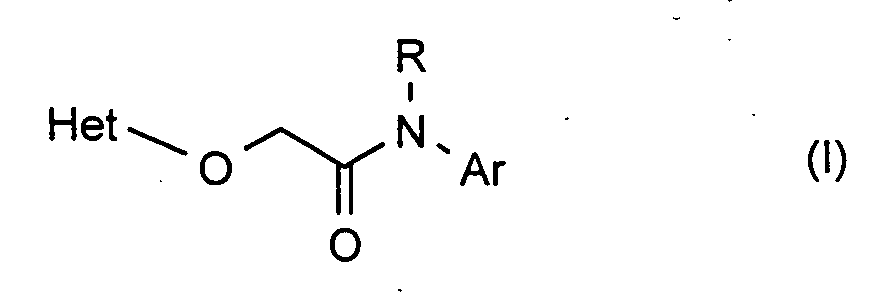
- Ar
- für gegebenenfalls durch Halogen, C1-C4-Alkyl oder C1-C4-Halogenalkyl substituiertes Phenyl steht,
- Het
- für Thiadiazolyl steht, welches durch Halogen oder durch jeweils gegebenenfalls durch Halogen substituiertes C1-C4-Alkyl oder Phenyl substituiert ist, und
- R
- für Alkyl, Alkenyl oder Alkinyl mit jeweils bis zu 4 Kohlenstoffatomen steht,
(b) einer oder mehrerer Verbindungen aus einer zweiten Gruppe von Herbiziden, welche die nachstehend genannten Wirkstoffe enthält:2-[[[(4,5-Dihydro-4-methyl-5-oxo-3-propoxy-1H-1,2,4-triazol-1-yl)-carbonyl]-amino]sulfonyl]-benzoesäure-methylester-Natriumsalz (Procarbazone-sodium), 1H-1,2,4-triazol-3-amin (Amitrole), 2-[2,4-Dichlor-5-(2-propinyloxy)-phenyl]-5,6,7,8-tetrahydro-1,2,4-triazolo-[4,3-a]-pyridin-3(2H)-on (Azafenidin), N-(4,6-Dimethoxy-pyrimidin-2-yl)-N'-[1-methyl-4-(2-methyl-2H-tetrazol-5-yl)-1H-pyrazol-5-ylsulfonyl]-harnstoff (Azimsulfuron), N-Benzyl-2-(4-fluor-3-trifluormethylphenoxy)-butanamid (Beflubutamid), N-Butyl-N-ethyl-2,6-dinitro-4-trifluormethyl-benzenamin (Benfluralin), 2-[2-[4-(3,6-Dihydro-3-methyl-2,6-dioxo-4-trifluormethyl-1(2H)-pyrimidinylphenoxy]methyl]-5-ethyl-phenoxy-propansäuremethylester (Benzfendizone), 3-(2-Chlor-4-methylsulfonyl-benzoyl)-4-phenylthiobicyclo-[3.2.1]-oct-3-en-2-on (Benzobicyclon), 2-Chlor-5-(3,6-dihydro-3-methyl-2,6-dioxo-4-trifluormethyl-1(2H)-pyrimidinyl)-benzoesäure-[1,1-dimethyl-2-oxo-2-(2-propenyloxy)]-ethylester (Butafenacil-allyl), 2-(1-Ethoximino-propyl)-3-hydroxy-5-[2,4,6-trimethyl-3-(1-oxo-butyl)-phenyl]-2-cyclohexen-1-on (Butroxydim), 2-[1-[(3-Chlor-2-propenyl)-oxy-imino]-propyl]-3-hydroxy-5-(tetrahydro-2Hpyran-4-yl)-2-cyclohexen-1-on (Caloxydim, Tepraloxydim), 2-Chlor-3-[2-chlor-5-(1,3,4,5,6,7-hexahydro-1,3-dioxo-2H-isoindol-2-yl)-phenyl]-2-propansäure-ethylester (Cinidon-ethyl), 2-[1-[2-(4-Chlor-phenoxy)]-propoxyaminobutyl]-5-(tetrahydro-2H-thiopyran-3-yl)-1,3-cyclohexandion (Clefoxydim), (E,E)-(+)-2-[1-[[(3-Chlor-2-propenyl)-oxy]-imino]-propyl]-3-hydroxy-2-cyclohexen-1-on (Clethodim), 3-chloro-2-[[(5-ethoxy-7-fluoro[1,2,4]triazolo[1,5-c]pyrimidin-2-yl) sulfonyl]amino]-benzoesäuremethylester (Cloransulam-methyl), 2-(1-Ethoximinobutyl)-3-hydroxy-5-(tetrahydro-2H-thiopyran-3-yl)-2-cyclohexen-1-on (Cycloxydim), N-(2,6-Dichlor-phenyl)-5-ethoxy-7-fluor-[1,2,4]-triazolo-[1,5-c]-pyrimidin-2-sulfonamid (Diclosulam), 2-[1-[(3,5-Difluor-phenyl)-amino-carbonylhydrazono]-ethyl]-pyridin-3-carbonsäure (Diflufenzopyr), (S)-2-Chlor-N-(2,4-dimethyl-3-thienyl)-N-(2-methoxy-1-methyl-ethyl)-acetamid (Dimethenamid-P), 2-[2-(3-Chlor-phenyl)-oxiranylmethyl]-2-ethyl-1H-inden-1,3(2H)-dion (Epropodan), (R)-Ethyl-2-[4-(6-chlor-benzoxazol-2-yl-oxy)-phenoxy]-propanoat (Fenoxaprop-P-ethyl), N-(2,6-Difluor-phenyl)-8-fluor-5-methoxy-[1,2,4]-triazolo-[1,5-c]-pyrimidin-2-sulfonamid (Florasulam), (R)-2-[4-(5-Trifluormethyl-pyridin-2-yl-oxy)-phenoxy]-propansäure-butylester (Fluazifop-P-butyl), 4,5-Dihydro-3-methoxy-4-methyl-5-oxo-N-[(2-trifluormethoxy-phenyl)-sulfonyl]-1H-1,2,4-triazol-1-carboxamid-Natriumsalz (Flucarbazone-sodium), Ethyl-[2-chloro-4-fluoro-5-(5-methyl-6-oxo-4-trifluoromethyl-1(6H)-pyridazinyl)-phenoxy]-acetate (Flufenpyr), 2-[7-Fluor-3,4-dihydro-3-oxo-4-(2-propinyl)-2H-1,4-benzoxazin-6-yl]-4,5,6,7-tetrahydro-1H-isoindol-1,3-dion (Flumioxazin), N-(4,6-Dimethoxy-pyrimidin-2-yl)-N'-(3-methoxycarbonyl-6-trifluormethyl-pyridin-2-yl-sulfonyl)-harnstoff-Natriumsalz (Flupyrsulfuron-methyl-sodium), 2-[[[[(4,6-Dimethoxy-2-pyrimidinyl)-amino]-carbonyl]-amino]-sulfonyl]-4-formylamino-N,N-dimethyl-benzamid (Foramsulfuron), (R)-2-[4-(3-Chlor-5-trifluormethyl-pyridin-2-yl-oxy)-phenoxy]-propansäure (-methylester, -2-ethoxy-ethylester, -butylester) (Haloxyfop, -methyl, -P-methyl, -ethoxyethyl, -butyl), 2-[4,5-dihydro-4-methyl-4-(1-methylethyl)-5-oxo-1H-imidazol-2-yl]-5-(methoxymethyl)-3-pyridincarbonsäure (Imazamox), (4-Chlor-2-methylsulfonyl-phenyl)-(5-cyclopropyl-isoxazol-4-yl)-methanon (Isoxachlortole), 2-[[[[(4,6-Dimethoxy-2-pyrimidinyl)-amino]-carbonyl]-amino]-sulfonyl]-4-[[(methylsulfonyl)-amino]methyl]-benzoesäure-methylester (Mesosulfuron), 2-(4-Methylsulfonyl-2-nitro-benzoyl)-1,3-cyclohexandion (Mesotrione), 3-[1-(3,5-Dichlor-phenyl)-1-i-propyl]-2,3-dihydro-6-methyl-5-phenyl-4H-1,3-oxazin-4-on (Oxaziclomefone), 2-Chlor-1-(3-ethoxy-4-nitro-phenoxy)-4-trifluormethyl-benzen (Oxyfluorfen), 2-(2,2-Difluor-ethoxy)-N-(5,8-dimethoxy[1,2,4]triazolo[1,5-c]-pyrimidin-2-yl)-6-trifluormethyl-benzolsulfonamid (Penoxsulam), 2-Chloro-N-(2-ethoxy-ethyl)-N-(2-methyl-1-phenyl-1-propenyl)-acetamide (Pethoxamid), 1-Chlor-N-[2-chlor-4-fluor-5-[(6S,7aR)-6-fluor-tetrahydro-1,3-dioxo-1H-pyrrolo[ 1,2-c]imidazol-2(3H)-yl]-phenyl]-methansulfonamid (Profluazol), (R)-[2-[[(1-Methylethyliden)-amino]-oxy]-ethyl]-2-[4-(6-chlor-2-chinoxalinyloxy)-phenoxy]-propanoat (Propaquizafop), 2-Chlor-N-(2-ethyl-6-methyl-phenyl)-N-[(1-methyl-ethoxy)-methyl]-acetamid (Propisochlor), 1-(3-Chlor-4,5,6,7-tetrahydropyrazolo[1,5-a]pyridin-2-yl)-5-(methyl-2-propinylamino)-1H-pyrazol-4-carbonitril (Pyraclonil), Ethyl [2-Chloro-5-(4-chloro-5-difluoromethoxy-1-methyl-1H-pyrazol-3-yl)-4-fluoro-phenoxy]-acetate (Pyraflufen-ethyl), 6-Chlor-3-phenyl-pyridazin-4-ol (Pyridatol), 7-[(4,6-Dimethoxy-2-pyrimidinyl)-thio]-3-methyl-1(3H)-isobenzofuranon (Pyriftalid), 2-(4,6-Dimethoxy-pyrimidin-2-yl-oxy)-benzoesäure-methylester (Pyriminobac-methyl), 2-Chlor-6-(4,6-dimethoxy-pyrimidin-2-ylthio)-benzoesäure-Natriumsalz (Pyrithiobac-sodium), 3,7-Dichlor-chinolin-8-carbonsäure (Quinchlorac), (R)-2-[4-(6-Chlor-2-chinoxalinyloxy)-phenoxy]-propansäure (-ethylester, -tetrahydro-2-furanyl-methylester) (Quizalofop-P-ethyl, -P-tefuryl), 2-Difluormethyl-5-(4,5-dihydro-thiazol-2-yl)-4-(2-methyl-propyl)-6-trifluormethylpyridin-3-carbonsäure-methylester (Thiazopyr), (3,5,6-Trichlor)-pyridin-2-yl-oxyessigsäure (Triclopyr), N-[[(4,6-Dimethoxy-2-pyrimidinyl)-amino]-carbonyl]-3-(2,2,2-trifluor-ethoxy)-2-pyridinsulfonamid-Natriumsalz (Trifloxysulfuron), N-[4-Dimethylamino-6-(2,2,2-trifluor-ethoxy)-1,3,5-triazin-2-yl]-N'-(2-methoxycarbonyl-phenylsulfonyl)-harnstoff (Triflusulfuron-methyl), N-[[(4,6-Dimethoxy-2-pyrimidinyl)-amino]-carbonyl]-3-(N-methyl-N-methylsulfonyl-amino])-2-pyridinsulfonamid (vgl. WO-A-92/10660),
("Wirkstoffe der Gruppe 2")
sowie gegebenenfalls zusätzlich(c) einer die Kulturpflanzen-Verträglichkeit verbessernde Verbindung aus der folgenden Gruppe von Verbindungen:("Wirkstoffe der Gruppe 3").4-Dichloracetyl-1-oxa-4-aza-spiro[4.5]-decan (AD-67), 1-Dichloracetyl-hexahydro-3,3,8a-trimethylpyrrolo[1,2-a]-pyrimidin-6(2H)-on (Dicyclonon, BAS-145138), 4-Dichloracetyl-3,4-dihydro-3-methyl-2H-1,4-benzoxazin (Benoxacor), 5-Chlor-chinolin-8-oxy-essigsäure-(1-methyl-hexylester) (Cloquintocet-mexyl), α-(Cyanomethoximino)-phenylacetonitril (Cyometrinil), 2,2-Dichlor-N-(2-oxo-2-(2-propenylamino)-ethyl)-N-(2-propenyl)-acetamid (DKA-24), 2,2-Dichlor-N,N-di-2-propenyl-acetamid (Dichlormid), N-(4-Methyl-phenyl)-N'-(1-methyl-1-phenylethyl)-harnstoff (Dymron), 4,6-Dichlor-2-phenyl-pyrimidin (Fenclorim), 1-(2,4-Dichlor-phenyl)-5-trichlormethyl-1H-1,2,4-triazol-3-carbonsäure-ethylester (Fenchlorazol-ethyl), 2-Chlor-4-trifluormethyl-thiazol-5-carbonsäure-phenylmethylester (Flurazole), 4-Chlor-N-(1,3-dioxolan-2-yl-methoxy)-α-trifluor-acetophenonoxim (Fluxofenim), 3-Dichloracetyl-5-(2-furanyl)-2,2-dimethyl-oxazolidin (Furilazole, MON-13900), Ethyl-4,5-dihydro-5,5-diphenyl-3-isoxazolcarboxylat (Isoxadifen-ethyl), Diethyl-1-(2,4-dichlorphenyl)-4,5-dihydro-5-methyl-1H-pyrazol-3,5-dicarboxylat (Mefenpyr-diethyl), 2-Dichlormethyl-2-methyl-1,3-dioxolan (MG-191), 1,8-Naphthalsäureanhydrid, α-(1,3-Dioxolan-2-yl-methoximino)-phenylacetonitril (Oxabetrinil), 2,2-Dichlor-N-(1,3-dioxolan-2-yl-methyl)-N-(2-propenyl)-acetamid (PPG-1292), 3-Dichloracetyl-2,2-dimethyl-oxazolidin (R-28725), 3-Dichloracetyl-2,2,5-trimethyl-oxazolidin (R-29148), 1-(2-Chlor-phenyl)-5-phenyl-1H-pyrazol-3-carbonsäure-methylester und N-(2-Methoxy-benzoyl)-4-[(methylamino-carbonyl)-amino]-benzolsulfonamid - Mittel nach Anspruch 1, dadurch gekennzeichnet, dass in der Formel (I)
- Ar
- für gegebenenfalls durch Fluor, Chlor, Brom, Methyl, Ethyl oder Trifluormethyl substituiertes Phenyl steht,
- Het
- für 1,2,4-Thiadiazolyl oder 1,3,4-Thiadiazolyl steht, welches durch Fluor, Chlor, Brom oder durch jeweils gegebenenfalls durch Fluor und/oder Chlor substituiertes Methyl, Ethyl, n- oder 1-Propyl oder Phenyl substituiert ist, und
- R
- für Methyl, Ethyl, n- oder i-Propyl, n-, i-, s- oder t-Butyl, 2-Propenyl, 1-Methyl-2-propenyl, 2-Butenyl, 2-Propinyl, 1-Methyl-2-propinyl, 2-Butinyl steht.
- Mittel nach Anspruch 1, dadurch gekennzeichnet, dass das Heteroaryloxy-acetamid der allgemeinen Formel (I) die Verbindung N-i-Propyl-N-(4-fluor-phenyl)-α-(5-trifluormethyl-1,3,4-thiadiazol-2-yl-oxy)-acetamid (Flufenacet) ist.
- Mittel nach einem der Ansprüche 1 bis 3, dadurch gekennzeichnet, dass die Verbindungen aus der zweiten Gruppe von Herbiziden (Komponente (b)) aus den nachstehend genannten Wirkstoffe ausgewählt sind:Procarbazone-sodium, Azimsulfuron, Beflubutamid, Butafenacil-allyl, Cinidon-ethyl, Clefoxydim, Cloransulam-methyl, Diclosulam, Fenoxaprop-P-ethyl, Florasulam, Flupyrsulfuron-methyl-sodium, Foramsulfuron, Imazamox, Isoxachlortole, Mesosulfuron, Oxaziclomefone, Pyriftalid, Pyrithiobac-sodium, Quinclorac, Trifloxysulfuron.
- Mittel nach einem der Ansprüche 1 bis 4, dadurch gekennzeichnet, dass die Verbindungen aus der zweiten Gruppe von Herbiziden (Komponente (b)) Procarbazone-sodium ist.
- Mittel nach einem der Ansprüche 1 bis 5, dadurch gekennzeichnet, dass die die Kulturpflanzen-Verträglichkeit verbessernden Verbindungen (Komponente (c)) aus den nachstehend genannten Wirkstoffen ausgewählt sind:5-Chlor-chinolin-8-oxy-essigsäure-(1-methyl-hexylester) (Cloquintocet-mexyl), Ethyl-4,5-dihydro-5,5-diphenyl-3-isoxazolcarboxylat (Isoxadifen-ethyl) und Diethyl-1-(2,4-dichlorphenyl)-4,5-dihydro-5-methyl-1H-pyrazol-3,5-dicarboxylat (Mefenpyr-diethyl) zu Verbesserung der Verträglichkeit in Getreide, sowie 4-Dichloracetyl-1-oxa-4-aza-spiro[4.5]-decan (AD-67), 1-Dichloracetyl-hexahydro-3,3,8a-trimethylpyrrolo[1,2-a]-pyrimidin-6(2H)-on (BAS-145138), 4-Dichloracetyl-3,4-dihydro-3-methyl-2H-1,4-benzoxazin (Benoxacor), 2,2-Dichlor-N,N-di-2-propenyl-acetamid (Dichlormid), 2,2-Dichlor-N-(2-oxo-2-(2-propenylamino)-ethyl)-N-(2-propenyl)-acetamid (DKA-24), 3-Dichloracetyl-5-(2-furanyl)-2,2-dimethyl-oxazolidin (Furilazole, MON-13900), 3-Dichloracetyl-2,2,5-trimethyloxazolidin (R-29148).
- Mittel nach einem der Ansprüche 1 bis 6, dadurch gekennzeichnet, dass auf einen Gewichtsteil Wirkstoff der Formel (I) 0,01 bis 1000 Gewichtsteile des Wirkstoffs oder der Wirkstoffe aus der zweiten Gruppe von Herbiziden (Komponente (b)) entfallen.
- Mittel nach einem der Ansprüche 1 bis 6, dadurch gekennzeichnet, dass auf einen Gewichtsteil Wirkstoff der Formel (I) oder dessen Mischungen mit Wirkstoffen aus der zweiten Gruppe von Herbiziden (Komponente (b)) 0,001 bis 1000 Gewichtsteile des die die Kulturpflanzen-Verträglichkeit verbessernden Wirkstoffs oder der die Kulturpflanzen-Verträglichkeit verbessernden Wirkstoffe (Komponente (c)) entfallen.
- Verwendung eines Mittels gemäß einem der Ansprüche 1 bis 8 zur Bekämpfung von unerwünschten Pflanzen.
- Verfahren zur Bekämpfung von unerwünschten Pflanzen, dadurch gekennzeichnet, dass man Mittel gemäß einem der Ansprüche 1 bis 7 auf die unerwünschten Pflanzen und/oder ihren Lebensraum einwirken lässt.
- Verfahren zur Herstellung eines herbiziden Mittels, dadurch gekennzeichnet, dass man ein Mittel gemäß einem der Ansprüche 1 bis 7 mit oberflächenaktiven Mitteln und/oder Streckmitteln vermischt.
Priority Applications (14)
| Application Number | Priority Date | Filing Date | Title |
|---|---|---|---|
| EP10158924A EP2243366A3 (de) | 2000-05-22 | 2001-05-09 | Selektive Herbizide auf Basis von Heteroaryloxy-acetamiden |
| EP10158925A EP2243367A3 (de) | 2000-05-22 | 2001-05-09 | Selektive Herbizide auf Basis von Heteroaryloxy-acetamiden |
| EP10158917.4A EP2243364B1 (de) | 2000-05-22 | 2001-05-09 | Selektive Herbizide auf Basis von Heteroaryloxy-acetamiden |
| EP10158916.6A EP2243363B1 (de) | 2000-05-22 | 2001-05-09 | Selektive Herbizide auf Basis von Heteroaryloxy-acetamiden |
| DK10158913T DK2243361T3 (en) | 2000-05-22 | 2001-05-09 | Selective herbicides from heteroaryloxy-acetamides |
| EP10158933A EP2243370A2 (de) | 2000-05-22 | 2001-05-09 | Selektive Herbizide auf Basis von Heteroaryloxy-acetamiden |
| DK10158916T DK2243363T3 (en) | 2000-05-22 | 2001-05-09 | Selective herbicides from heteroaryloxy-acetamides |
| EP10158929A EP2243368A3 (de) | 2000-05-22 | 2001-05-09 | Selektive Herbizide auf Basis von Heteroaryloxy-acetamiden |
| DK10158915T DK2243362T3 (en) | 2000-05-22 | 2001-05-09 | Selective herbicides from heteroaryloxy-acetamides |
| EP10158915.8A EP2243362B1 (de) | 2000-05-22 | 2001-05-09 | Selektive Herbizide auf Basis von Heteroaryloxy-acetamiden |
| DK10158917T DK2243364T3 (en) | 2000-05-22 | 2001-05-09 | Selective herbicides from heteroaryloxy-acetamides |
| EP10158913.3A EP2243361B1 (de) | 2000-05-22 | 2001-05-09 | Selektive Herbizide auf Basis von Heteroaryloxy-acetamiden |
| EP10158932A EP2243369A3 (de) | 2000-05-22 | 2001-05-09 | Selektive Herbizide auf Basis von Heteroaryloxy-acetamiden |
| EP10158918A EP2243365A3 (de) | 2000-05-22 | 2001-05-09 | Selektive Herbizide auf Basis von Heteroaryloxy-acetamiden |
Applications Claiming Priority (5)
| Application Number | Priority Date | Filing Date | Title |
|---|---|---|---|
| DE10025306 | 2000-05-22 | ||
| DE10025306 | 2000-05-22 | ||
| DE10041619 | 2000-08-24 | ||
| DE10041619A DE10041619A1 (de) | 2000-05-22 | 2000-08-24 | Selektive Herbizide auf Basis von Heteroaryloxyacetamiden |
| EP01943335A EP1298996A1 (de) | 2000-05-22 | 2001-05-09 | Selektive herbizide auf basis von heteroaryloxy-acetamiden |
Related Parent Applications (1)
| Application Number | Title | Priority Date | Filing Date |
|---|---|---|---|
| EP01943335A Division EP1298996A1 (de) | 2000-05-22 | 2001-05-09 | Selektive herbizide auf basis von heteroaryloxy-acetamiden |
Related Child Applications (14)
| Application Number | Title | Priority Date | Filing Date |
|---|---|---|---|
| EP10158932A Division-Into EP2243369A3 (de) | 2000-05-22 | 2001-05-09 | Selektive Herbizide auf Basis von Heteroaryloxy-acetamiden |
| EP10158916.6A Division-Into EP2243363B1 (de) | 2000-05-22 | 2001-05-09 | Selektive Herbizide auf Basis von Heteroaryloxy-acetamiden |
| EP10158916.6A Division EP2243363B1 (de) | 2000-05-22 | 2001-05-09 | Selektive Herbizide auf Basis von Heteroaryloxy-acetamiden |
| EP10158929A Division-Into EP2243368A3 (de) | 2000-05-22 | 2001-05-09 | Selektive Herbizide auf Basis von Heteroaryloxy-acetamiden |
| EP10158924A Division-Into EP2243366A3 (de) | 2000-05-22 | 2001-05-09 | Selektive Herbizide auf Basis von Heteroaryloxy-acetamiden |
| EP10158933A Division-Into EP2243370A2 (de) | 2000-05-22 | 2001-05-09 | Selektive Herbizide auf Basis von Heteroaryloxy-acetamiden |
| EP10158915.8A Division-Into EP2243362B1 (de) | 2000-05-22 | 2001-05-09 | Selektive Herbizide auf Basis von Heteroaryloxy-acetamiden |
| EP10158915.8A Division EP2243362B1 (de) | 2000-05-22 | 2001-05-09 | Selektive Herbizide auf Basis von Heteroaryloxy-acetamiden |
| EP10158913.3A Division EP2243361B1 (de) | 2000-05-22 | 2001-05-09 | Selektive Herbizide auf Basis von Heteroaryloxy-acetamiden |
| EP10158913.3A Division-Into EP2243361B1 (de) | 2000-05-22 | 2001-05-09 | Selektive Herbizide auf Basis von Heteroaryloxy-acetamiden |
| EP10158925A Division-Into EP2243367A3 (de) | 2000-05-22 | 2001-05-09 | Selektive Herbizide auf Basis von Heteroaryloxy-acetamiden |
| EP10158918A Division-Into EP2243365A3 (de) | 2000-05-22 | 2001-05-09 | Selektive Herbizide auf Basis von Heteroaryloxy-acetamiden |
| EP10158917.4A Division EP2243364B1 (de) | 2000-05-22 | 2001-05-09 | Selektive Herbizide auf Basis von Heteroaryloxy-acetamiden |
| EP10158917.4A Division-Into EP2243364B1 (de) | 2000-05-22 | 2001-05-09 | Selektive Herbizide auf Basis von Heteroaryloxy-acetamiden |
Publications (2)
| Publication Number | Publication Date |
|---|---|
| EP1552746A1 true EP1552746A1 (de) | 2005-07-13 |
| EP1552746B1 EP1552746B1 (de) | 2015-02-11 |
Family
ID=7643120
Family Applications (11)
| Application Number | Title | Priority Date | Filing Date |
|---|---|---|---|
| EP10158925A Withdrawn EP2243367A3 (de) | 2000-05-22 | 2001-05-09 | Selektive Herbizide auf Basis von Heteroaryloxy-acetamiden |
| EP10158932A Withdrawn EP2243369A3 (de) | 2000-05-22 | 2001-05-09 | Selektive Herbizide auf Basis von Heteroaryloxy-acetamiden |
| EP10158929A Withdrawn EP2243368A3 (de) | 2000-05-22 | 2001-05-09 | Selektive Herbizide auf Basis von Heteroaryloxy-acetamiden |
| EP10158917.4A Expired - Lifetime EP2243364B1 (de) | 2000-05-22 | 2001-05-09 | Selektive Herbizide auf Basis von Heteroaryloxy-acetamiden |
| EP10158918A Withdrawn EP2243365A3 (de) | 2000-05-22 | 2001-05-09 | Selektive Herbizide auf Basis von Heteroaryloxy-acetamiden |
| EP10158933A Withdrawn EP2243370A2 (de) | 2000-05-22 | 2001-05-09 | Selektive Herbizide auf Basis von Heteroaryloxy-acetamiden |
| EP10158916.6A Expired - Lifetime EP2243363B1 (de) | 2000-05-22 | 2001-05-09 | Selektive Herbizide auf Basis von Heteroaryloxy-acetamiden |
| EP10158915.8A Revoked EP2243362B1 (de) | 2000-05-22 | 2001-05-09 | Selektive Herbizide auf Basis von Heteroaryloxy-acetamiden |
| EP10158924A Withdrawn EP2243366A3 (de) | 2000-05-22 | 2001-05-09 | Selektive Herbizide auf Basis von Heteroaryloxy-acetamiden |
| EP10158913.3A Expired - Lifetime EP2243361B1 (de) | 2000-05-22 | 2001-05-09 | Selektive Herbizide auf Basis von Heteroaryloxy-acetamiden |
| EP05005219.0A Expired - Lifetime EP1552746B1 (de) | 2000-05-22 | 2001-05-09 | Selektive Herbizide auf Basis von Heteroaryloxy-acetamiden |
Family Applications Before (10)
| Application Number | Title | Priority Date | Filing Date |
|---|---|---|---|
| EP10158925A Withdrawn EP2243367A3 (de) | 2000-05-22 | 2001-05-09 | Selektive Herbizide auf Basis von Heteroaryloxy-acetamiden |
| EP10158932A Withdrawn EP2243369A3 (de) | 2000-05-22 | 2001-05-09 | Selektive Herbizide auf Basis von Heteroaryloxy-acetamiden |
| EP10158929A Withdrawn EP2243368A3 (de) | 2000-05-22 | 2001-05-09 | Selektive Herbizide auf Basis von Heteroaryloxy-acetamiden |
| EP10158917.4A Expired - Lifetime EP2243364B1 (de) | 2000-05-22 | 2001-05-09 | Selektive Herbizide auf Basis von Heteroaryloxy-acetamiden |
| EP10158918A Withdrawn EP2243365A3 (de) | 2000-05-22 | 2001-05-09 | Selektive Herbizide auf Basis von Heteroaryloxy-acetamiden |
| EP10158933A Withdrawn EP2243370A2 (de) | 2000-05-22 | 2001-05-09 | Selektive Herbizide auf Basis von Heteroaryloxy-acetamiden |
| EP10158916.6A Expired - Lifetime EP2243363B1 (de) | 2000-05-22 | 2001-05-09 | Selektive Herbizide auf Basis von Heteroaryloxy-acetamiden |
| EP10158915.8A Revoked EP2243362B1 (de) | 2000-05-22 | 2001-05-09 | Selektive Herbizide auf Basis von Heteroaryloxy-acetamiden |
| EP10158924A Withdrawn EP2243366A3 (de) | 2000-05-22 | 2001-05-09 | Selektive Herbizide auf Basis von Heteroaryloxy-acetamiden |
| EP10158913.3A Expired - Lifetime EP2243361B1 (de) | 2000-05-22 | 2001-05-09 | Selektive Herbizide auf Basis von Heteroaryloxy-acetamiden |
Country Status (13)
| Country | Link |
|---|---|
| EP (11) | EP2243367A3 (de) |
| AR (1) | AR035572A1 (de) |
| BG (1) | BG65940B1 (de) |
| DE (1) | DE10041619A1 (de) |
| DK (5) | DK2243364T3 (de) |
| ES (5) | ES2531196T3 (de) |
| HU (9) | HU230840B1 (de) |
| PL (2) | PL218352B1 (de) |
| PT (5) | PT2243361E (de) |
| RU (1) | RU2273994C2 (de) |
| UA (1) | UA73175C2 (de) |
| YU (1) | YU87402A (de) |
| ZA (1) | ZA200208479B (de) |
Families Citing this family (8)
| Publication number | Priority date | Publication date | Assignee | Title |
|---|---|---|---|---|
| PL3412358T3 (pl) | 2014-02-06 | 2022-09-19 | Gambro Lundia Ab | Membrana do oczyszczania krwi |
| KR102316246B1 (ko) | 2014-02-06 | 2021-10-25 | 감브로 룬디아 아베 | 혈액 정화를 위한 혈액 투석기 |
| GB2532218B (en) * | 2014-11-11 | 2019-11-20 | Rotam Agrochem Int Co Ltd | Herbicidal composition and method for controlling plant growth |
| GB2532217B (en) * | 2014-11-11 | 2019-05-15 | Rotam Agrochem Int Co Ltd | Herbicidal composition and method for controlling plant growth |
| RU2698056C1 (ru) * | 2018-12-26 | 2019-08-21 | АО "Щелково Агрохим" | Синергетическая гербицидная композиция |
| BR102020019868A2 (pt) | 2020-09-28 | 2022-04-12 | Upl Do Brasil Industria E Comercio De Insumos Agropecuarios S.A. | Combinações de herbicidas triazolonas com fitoprotetores |
| BR102020019866A2 (pt) * | 2020-09-28 | 2022-04-12 | Upl Do Brasil Industria E Comercio De Insumos Agropecuarios S.A. | Combinações de herbicidas cloroacetanilida com fitoprotetores |
| BE1028935B1 (nl) | 2020-12-22 | 2022-07-19 | Globachem | Herbicide preparaten |
Citations (23)
| Publication number | Priority date | Publication date | Assignee | Title |
|---|---|---|---|---|
| EP0005501A2 (de) | 1978-05-20 | 1979-11-28 | Bayer Ag | Heteroaryl-oxyessigsäureamide, Verfahren zu ihrer Herstellung und ihre Verwendung als Herbizide |
| EP0018497A1 (de) | 1979-04-06 | 1980-11-12 | Bayer Ag | Azolyloxy-essigsäureamide, Verfahren zu ihrer Herstellung und ihre Verwendung als Herbizide |
| EP0029171A1 (de) | 1979-11-17 | 1981-05-27 | Bayer Ag | Azolyloxy-carbonsäure-N-oxy-amide, Verfahren und Zwischenprodukte zu ihrer Herstellung, ihre Verwendung, sie enthaltende herbizide Mittel und deren Herstellung |
| EP0094514A2 (de) | 1982-05-17 | 1983-11-23 | International Business Machines Corporation | Fussnotenbezeichnung und Fussnotenreferenzen |
| EP0100044A1 (de) | 1982-07-28 | 1984-02-08 | Bayer Ag | Substituierte 3-Trihalogenmethyl-1,2,4-thiadiazol-5-yl-oxyessigsäureamide, Verfahren zu ihrer Herstellung und ihre Verwendung als Herbizide |
| EP0100045A1 (de) | 1982-07-28 | 1984-02-08 | Bayer Ag | Substituierte 3-Trichlormethyl-1,2,4-thiadiazol-5-yl-oxyessigsäureamide, Verfahren zu ihrer Herstellung und ihre Verwendung als Herbizide |
| EP0161602A2 (de) | 1984-05-16 | 1985-11-21 | Bayer Ag | 6-Chlorbenzazolyloxyacetamide |
| DE3418167A1 (de) | 1984-05-16 | 1985-11-21 | Bayer Ag, 5090 Leverkusen | Verwendung von amiden zur verbesserung der kulturpflanzen-vertraeglichkeit von herbizid wirksamen heteroaryloxyacetamiden |
| EP0195237A1 (de) | 1985-02-21 | 1986-09-24 | Bayer Ag | 4,5-disubstituierte 1,3-Thiazol-2-yloxyacetamide |
| EP0348734A1 (de) | 1988-06-27 | 1990-01-03 | Bayer Ag | Neue Difluormethyl-thiadiazolyl-oxyessigsäureamiden |
| EP0348737A1 (de) | 1988-06-27 | 1990-01-03 | Bayer Ag | Heteroaryloxyessigsäure-N-isopropylanilide |
| WO1994002014A2 (de) | 1992-07-16 | 1994-02-03 | Bayer Aktiengesellschaft | Herbizide mittel auf basis von heteroaryloxyacetamiden |
| DE4317323A1 (de) | 1993-05-25 | 1994-12-01 | Bayer Ag | N-(4-Fluor-phenyl)-heteroaryloxyacetamide |
| WO1996007323A1 (de) | 1994-09-02 | 1996-03-14 | Bayer Aktiengesellschaft | Selektive herbizide auf basis von aryluracilen |
| WO1996011575A1 (de) | 1994-10-17 | 1996-04-25 | Bayer Aktiengesellschaft | Selektive herbizide auf basis von carbamoyltriazolinonen und heteroaryloxyacetamiden |
| WO1996017519A1 (en) | 1994-12-09 | 1996-06-13 | Rhone-Poulenc Agrochimie | New herbicidal compositions |
| DE19728568A1 (de) * | 1996-07-17 | 1998-01-22 | Bayer Ag | Herbizide Mittel auf Basis von (5-Trifluormethyl-1,3,4-thiadiazol-2-yl-oxy)-essigsäure-N-isopropyl-N-(4fluorphenyl)-amid |
| WO1998008383A1 (de) | 1996-08-28 | 1998-03-05 | Bayer Aktiengesellschaft | Herbizide mittel auf basis von 4-brom-1-methyl-5-trifluormethyl-3-(2-fluor-4-chlor-5-isopropoxycarbonylphenyl)pyrazol |
| US5858920A (en) | 1994-12-23 | 1999-01-12 | Bayer Aktiengesellschaft | Selective herbicides based on heteroaryloxy-acetamides E.G., fluthiamide |
| US5945379A (en) | 1996-05-24 | 1999-08-31 | Bayer Aktiengesellschaft | Herbicides based on heteroaryloxy-acetamides for use in rice cultivation |
| US5985797A (en) | 1996-07-17 | 1999-11-16 | Bayer Aktiengesellschaft | Herbicidal compositions based on N-isopropyl-N-(4-fluorophenyl) (5-trifluoromethyl-1,3,4-thiadiazol-2-yloxy)acetamide |
| US6001774A (en) | 1997-05-06 | 1999-12-14 | Sumitomo Chemical Company, Limited | Herbicidal composition |
| EP1123654A1 (de) | 1998-10-23 | 2001-08-16 | Sumitomo Chemical Company, Limited | Herbizidmittel |
Family Cites Families (2)
| Publication number | Priority date | Publication date | Assignee | Title |
|---|---|---|---|---|
| DE4039810C1 (de) | 1990-12-13 | 1991-10-17 | Mtu Muenchen Gmbh | |
| FR2722371B1 (fr) * | 1994-07-12 | 1996-08-30 | Salomon Sa | Ensemble chaussure/ dispositif de retenue de la chaussure sur un organe de glisse |
-
2000
- 2000-08-24 DE DE10041619A patent/DE10041619A1/de not_active Withdrawn
-
2001
- 2001-04-27 AR ARP010102005A patent/AR035572A1/es active IP Right Grant
- 2001-05-09 EP EP10158925A patent/EP2243367A3/de not_active Withdrawn
- 2001-05-09 EP EP10158932A patent/EP2243369A3/de not_active Withdrawn
- 2001-05-09 DK DK10158917T patent/DK2243364T3/en active
- 2001-05-09 RU RU2002134758/04A patent/RU2273994C2/ru active
- 2001-05-09 EP EP10158929A patent/EP2243368A3/de not_active Withdrawn
- 2001-05-09 ES ES10158916T patent/ES2531196T3/es not_active Expired - Lifetime
- 2001-05-09 EP EP10158917.4A patent/EP2243364B1/de not_active Expired - Lifetime
- 2001-05-09 EP EP10158918A patent/EP2243365A3/de not_active Withdrawn
- 2001-05-09 ES ES10158917.4T patent/ES2535751T3/es not_active Expired - Lifetime
- 2001-05-09 ES ES05005219.0T patent/ES2535708T3/es not_active Expired - Lifetime
- 2001-05-09 HU HU1500637A patent/HU230840B1/hu unknown
- 2001-05-09 DK DK05005219.0T patent/DK1552746T3/en active
- 2001-05-09 EP EP10158933A patent/EP2243370A2/de not_active Withdrawn
- 2001-05-09 HU HU1500635A patent/HU230475B1/hu unknown
- 2001-05-09 DK DK10158915T patent/DK2243362T3/en active
- 2001-05-09 EP EP10158916.6A patent/EP2243363B1/de not_active Expired - Lifetime
- 2001-05-09 EP EP10158915.8A patent/EP2243362B1/de not_active Revoked
- 2001-05-09 PT PT10158913T patent/PT2243361E/pt unknown
- 2001-05-09 PT PT50052190T patent/PT1552746E/pt unknown
- 2001-05-09 ES ES10158913T patent/ES2531261T3/es not_active Expired - Lifetime
- 2001-05-09 PL PL390259A patent/PL218352B1/pl unknown
- 2001-05-09 HU HU1500630A patent/HU230836B1/hu unknown
- 2001-05-09 HU HU1500634A patent/HU230521B1/hu unknown
- 2001-05-09 PT PT10158916T patent/PT2243363E/pt unknown
- 2001-05-09 DK DK10158916T patent/DK2243363T3/en active
- 2001-05-09 ES ES10158915.8T patent/ES2533496T3/es not_active Expired - Lifetime
- 2001-05-09 EP EP10158924A patent/EP2243366A3/de not_active Withdrawn
- 2001-05-09 YU YU87402A patent/YU87402A/sh unknown
- 2001-05-09 PL PL394461A patent/PL394461A1/pl not_active Application Discontinuation
- 2001-05-09 PT PT101589174T patent/PT2243364E/pt unknown
- 2001-05-09 EP EP10158913.3A patent/EP2243361B1/de not_active Expired - Lifetime
- 2001-05-09 HU HU1500636A patent/HU230839B1/hu unknown
- 2001-05-09 DK DK10158913T patent/DK2243361T3/en active
- 2001-05-09 EP EP05005219.0A patent/EP1552746B1/de not_active Expired - Lifetime
- 2001-05-09 PT PT101589158T patent/PT2243362E/pt unknown
- 2001-05-09 HU HU1500632A patent/HU230838B1/hu unknown
- 2001-05-09 HU HU1500631A patent/HU230837B1/hu unknown
- 2001-05-09 HU HU1500629A patent/HU230520B1/hu unknown
- 2001-05-09 HU HU1500628A patent/HU230835B1/hu unknown
- 2001-09-05 UA UA20021210398A patent/UA73175C2/uk unknown
-
2002
- 2002-10-21 ZA ZA200208479A patent/ZA200208479B/en unknown
- 2002-11-14 BG BG107274A patent/BG65940B1/bg unknown
Patent Citations (23)
| Publication number | Priority date | Publication date | Assignee | Title |
|---|---|---|---|---|
| EP0005501A2 (de) | 1978-05-20 | 1979-11-28 | Bayer Ag | Heteroaryl-oxyessigsäureamide, Verfahren zu ihrer Herstellung und ihre Verwendung als Herbizide |
| EP0018497A1 (de) | 1979-04-06 | 1980-11-12 | Bayer Ag | Azolyloxy-essigsäureamide, Verfahren zu ihrer Herstellung und ihre Verwendung als Herbizide |
| EP0029171A1 (de) | 1979-11-17 | 1981-05-27 | Bayer Ag | Azolyloxy-carbonsäure-N-oxy-amide, Verfahren und Zwischenprodukte zu ihrer Herstellung, ihre Verwendung, sie enthaltende herbizide Mittel und deren Herstellung |
| EP0094514A2 (de) | 1982-05-17 | 1983-11-23 | International Business Machines Corporation | Fussnotenbezeichnung und Fussnotenreferenzen |
| EP0100044A1 (de) | 1982-07-28 | 1984-02-08 | Bayer Ag | Substituierte 3-Trihalogenmethyl-1,2,4-thiadiazol-5-yl-oxyessigsäureamide, Verfahren zu ihrer Herstellung und ihre Verwendung als Herbizide |
| EP0100045A1 (de) | 1982-07-28 | 1984-02-08 | Bayer Ag | Substituierte 3-Trichlormethyl-1,2,4-thiadiazol-5-yl-oxyessigsäureamide, Verfahren zu ihrer Herstellung und ihre Verwendung als Herbizide |
| EP0161602A2 (de) | 1984-05-16 | 1985-11-21 | Bayer Ag | 6-Chlorbenzazolyloxyacetamide |
| DE3418167A1 (de) | 1984-05-16 | 1985-11-21 | Bayer Ag, 5090 Leverkusen | Verwendung von amiden zur verbesserung der kulturpflanzen-vertraeglichkeit von herbizid wirksamen heteroaryloxyacetamiden |
| EP0195237A1 (de) | 1985-02-21 | 1986-09-24 | Bayer Ag | 4,5-disubstituierte 1,3-Thiazol-2-yloxyacetamide |
| EP0348737A1 (de) | 1988-06-27 | 1990-01-03 | Bayer Ag | Heteroaryloxyessigsäure-N-isopropylanilide |
| EP0348734A1 (de) | 1988-06-27 | 1990-01-03 | Bayer Ag | Neue Difluormethyl-thiadiazolyl-oxyessigsäureamiden |
| WO1994002014A2 (de) | 1992-07-16 | 1994-02-03 | Bayer Aktiengesellschaft | Herbizide mittel auf basis von heteroaryloxyacetamiden |
| DE4317323A1 (de) | 1993-05-25 | 1994-12-01 | Bayer Ag | N-(4-Fluor-phenyl)-heteroaryloxyacetamide |
| WO1996007323A1 (de) | 1994-09-02 | 1996-03-14 | Bayer Aktiengesellschaft | Selektive herbizide auf basis von aryluracilen |
| WO1996011575A1 (de) | 1994-10-17 | 1996-04-25 | Bayer Aktiengesellschaft | Selektive herbizide auf basis von carbamoyltriazolinonen und heteroaryloxyacetamiden |
| WO1996017519A1 (en) | 1994-12-09 | 1996-06-13 | Rhone-Poulenc Agrochimie | New herbicidal compositions |
| US5858920A (en) | 1994-12-23 | 1999-01-12 | Bayer Aktiengesellschaft | Selective herbicides based on heteroaryloxy-acetamides E.G., fluthiamide |
| US5945379A (en) | 1996-05-24 | 1999-08-31 | Bayer Aktiengesellschaft | Herbicides based on heteroaryloxy-acetamides for use in rice cultivation |
| DE19728568A1 (de) * | 1996-07-17 | 1998-01-22 | Bayer Ag | Herbizide Mittel auf Basis von (5-Trifluormethyl-1,3,4-thiadiazol-2-yl-oxy)-essigsäure-N-isopropyl-N-(4fluorphenyl)-amid |
| US5985797A (en) | 1996-07-17 | 1999-11-16 | Bayer Aktiengesellschaft | Herbicidal compositions based on N-isopropyl-N-(4-fluorophenyl) (5-trifluoromethyl-1,3,4-thiadiazol-2-yloxy)acetamide |
| WO1998008383A1 (de) | 1996-08-28 | 1998-03-05 | Bayer Aktiengesellschaft | Herbizide mittel auf basis von 4-brom-1-methyl-5-trifluormethyl-3-(2-fluor-4-chlor-5-isopropoxycarbonylphenyl)pyrazol |
| US6001774A (en) | 1997-05-06 | 1999-12-14 | Sumitomo Chemical Company, Limited | Herbicidal composition |
| EP1123654A1 (de) | 1998-10-23 | 2001-08-16 | Sumitomo Chemical Company, Limited | Herbizidmittel |
Non-Patent Citations (1)
| Title |
|---|
| COLBY, S.R.: "Calculating synergistic and antago- nistic responses of herbicide combinations", WEEDS, vol. 15, 1967, pages 20 - 22 |
Also Published As
Similar Documents
| Publication | Publication Date | Title |
|---|---|---|
| EP2272353B1 (de) | Herbizide enthaltend substituierte Thien-3-yl-Sulfonylamino(thio)carbonyltriazolin(thi)one und Dicamba | |
| EP1298996A1 (de) | Selektive herbizide auf basis von heteroaryloxy-acetamiden | |
| AU767405B2 (en) | Carbamoyl triazolinone-based herbicides | |
| EP1221848B1 (de) | Selektive herbizide auf basis eines n-aryl-triazolinons | |
| DE10031825A1 (de) | Selektive Herbizide auf Basis von Arylsulfonylaminocarbonyltriazolinonen | |
| EP1423010A2 (de) | Selektive herbizide enthaltend ein tetrazolinon-derivat | |
| EP2243367A2 (de) | Selektive Herbizide auf Basis von Heteroaryloxy-acetamiden |
Legal Events
| Date | Code | Title | Description |
|---|---|---|---|
| PUAI | Public reference made under article 153(3) epc to a published international application that has entered the european phase |
Free format text: ORIGINAL CODE: 0009012 |
|
| AC | Divisional application: reference to earlier application |
Ref document number: 1298996 Country of ref document: EP Kind code of ref document: P |
|
| AK | Designated contracting states |
Kind code of ref document: A1 Designated state(s): AT BE CH CY DE DK ES FI FR GB GR IE IT LI LU MC NL PT SE TR |
|
| AX | Request for extension of the european patent |
Extension state: LT RO SI |
|
| 17P | Request for examination filed |
Effective date: 20060113 |
|
| AKX | Designation fees paid |
Designated state(s): AT BE CH CY DE DK ES FI FR GB GR IE IT LI LU MC NL PT SE TR |
|
| AXX | Extension fees paid |
Extension state: SI Payment date: 20060113 Extension state: LT Payment date: 20060113 Extension state: RO Payment date: 20060113 |
|
| 17Q | First examination report despatched |
Effective date: 20110720 |
|
| GRAP | Despatch of communication of intention to grant a patent |
Free format text: ORIGINAL CODE: EPIDOSNIGR1 |
|
| RIC1 | Information provided on ipc code assigned before grant |
Ipc: A01N 43/836 20060101ALI20140729BHEP Ipc: A01P 13/02 20060101ALI20140729BHEP Ipc: A01N 43/824 20060101AFI20140729BHEP Ipc: A01N 43/82 20060101ALI20140729BHEP |
|
| INTG | Intention to grant announced |
Effective date: 20140813 |
|
| TPAC | Observations filed by third parties |
Free format text: ORIGINAL CODE: EPIDOSNTIPA |
|
| GRAS | Grant fee paid |
Free format text: ORIGINAL CODE: EPIDOSNIGR3 |
|
| RAP1 | Party data changed (applicant data changed or rights of an application transferred) |
Owner name: BAYER INTELLECTUAL PROPERTY GMBH |
|
| GRAA | (expected) grant |
Free format text: ORIGINAL CODE: 0009210 |
|
| AC | Divisional application: reference to earlier application |
Ref document number: 1298996 Country of ref document: EP Kind code of ref document: P |
|
| AK | Designated contracting states |
Kind code of ref document: B1 Designated state(s): AT BE CH CY DE DK ES FI FR GB GR IE IT LI LU MC NL PT SE TR |
|
| AX | Request for extension of the european patent |
Extension state: LT RO SI |
|
| REG | Reference to a national code |
Ref country code: GB Ref legal event code: FG4D Free format text: NOT ENGLISH |
|
| REG | Reference to a national code |
Ref country code: CH Ref legal event code: EP |
|
| REG | Reference to a national code |
Ref country code: IE Ref legal event code: FG4D Free format text: LANGUAGE OF EP DOCUMENT: GERMAN |
|
| REG | Reference to a national code |
Ref country code: AT Ref legal event code: REF Ref document number: 709637 Country of ref document: AT Kind code of ref document: T Effective date: 20150315 |
|
| REG | Reference to a national code |
Ref country code: DE Ref legal event code: R096 Ref document number: 50116455 Country of ref document: DE Effective date: 20150319 |
|
| REG | Reference to a national code |
Ref country code: DK Ref legal event code: T3 Effective date: 20150428 |
|
| REG | Reference to a national code |
Ref country code: ES Ref legal event code: FG2A Ref document number: 2535708 Country of ref document: ES Kind code of ref document: T3 Effective date: 20150514 |
|
| REG | Reference to a national code |
Ref country code: SE Ref legal event code: TRGR |
|
| REG | Reference to a national code |
Ref country code: PT Ref legal event code: SC4A Free format text: AVAILABILITY OF NATIONAL TRANSLATION Effective date: 20150428 |
|
| REG | Reference to a national code |
Ref country code: GR Ref legal event code: EP Ref document number: 20150400917 Country of ref document: GR Effective date: 20150518 |
|
| REG | Reference to a national code |
Ref country code: LT Ref legal event code: MG9D |
|
| REG | Reference to a national code |
Ref country code: DE Ref legal event code: R097 Ref document number: 50116455 Country of ref document: DE |
|
| PLBE | No opposition filed within time limit |
Free format text: ORIGINAL CODE: 0009261 |
|
| STAA | Information on the status of an ep patent application or granted ep patent |
Free format text: STATUS: NO OPPOSITION FILED WITHIN TIME LIMIT |
|
| 26N | No opposition filed |
Effective date: 20151112 |
|
| PG25 | Lapsed in a contracting state [announced via postgrant information from national office to epo] |
Ref country code: MC Free format text: LAPSE BECAUSE OF FAILURE TO SUBMIT A TRANSLATION OF THE DESCRIPTION OR TO PAY THE FEE WITHIN THE PRESCRIBED TIME-LIMIT Effective date: 20150211 Ref country code: LU Free format text: LAPSE BECAUSE OF FAILURE TO SUBMIT A TRANSLATION OF THE DESCRIPTION OR TO PAY THE FEE WITHIN THE PRESCRIBED TIME-LIMIT Effective date: 20150509 |
|
| REG | Reference to a national code |
Ref country code: FR Ref legal event code: PLFP Year of fee payment: 16 |
|
| REG | Reference to a national code |
Ref country code: FR Ref legal event code: PLFP Year of fee payment: 17 |
|
| PG25 | Lapsed in a contracting state [announced via postgrant information from national office to epo] |
Ref country code: CY Free format text: LAPSE BECAUSE OF FAILURE TO SUBMIT A TRANSLATION OF THE DESCRIPTION OR TO PAY THE FEE WITHIN THE PRESCRIBED TIME-LIMIT Effective date: 20150211 |
|
| REG | Reference to a national code |
Ref country code: FR Ref legal event code: PLFP Year of fee payment: 18 |
|
| REG | Reference to a national code |
Ref country code: DE Ref legal event code: R081 Ref document number: 50116455 Country of ref document: DE Owner name: BAYER CROPSCIENCE AKTIENGESELLSCHAFT, DE Free format text: FORMER OWNER: BAYER INTELLECTUAL PROPERTY GMBH, 40789 MONHEIM, DE |
|
| PGFP | Annual fee paid to national office [announced via postgrant information from national office to epo] |
Ref country code: ES Payment date: 20200601 Year of fee payment: 20 Ref country code: GR Payment date: 20200429 Year of fee payment: 20 Ref country code: CH Payment date: 20200515 Year of fee payment: 20 Ref country code: TR Payment date: 20200508 Year of fee payment: 20 Ref country code: DK Payment date: 20200512 Year of fee payment: 20 Ref country code: FR Payment date: 20200505 Year of fee payment: 20 Ref country code: PT Payment date: 20200428 Year of fee payment: 20 Ref country code: IE Payment date: 20200513 Year of fee payment: 20 Ref country code: DE Payment date: 20200428 Year of fee payment: 20 Ref country code: NL Payment date: 20200513 Year of fee payment: 20 Ref country code: FI Payment date: 20200511 Year of fee payment: 20 |
|
| PGFP | Annual fee paid to national office [announced via postgrant information from national office to epo] |
Ref country code: GB Payment date: 20200429 Year of fee payment: 20 Ref country code: SE Payment date: 20200512 Year of fee payment: 20 Ref country code: BE Payment date: 20200424 Year of fee payment: 20 Ref country code: IT Payment date: 20200428 Year of fee payment: 20 |
|
| PGFP | Annual fee paid to national office [announced via postgrant information from national office to epo] |
Ref country code: AT Payment date: 20200428 Year of fee payment: 20 |
|
| REG | Reference to a national code |
Ref country code: DE Ref legal event code: R071 Ref document number: 50116455 Country of ref document: DE |
|
| REG | Reference to a national code |
Ref country code: DK Ref legal event code: EUP Expiry date: 20210509 |
|
| REG | Reference to a national code |
Ref country code: CH Ref legal event code: PL |
|
| REG | Reference to a national code |
Ref country code: GB Ref legal event code: PE20 Expiry date: 20210508 |
|
| REG | Reference to a national code |
Ref country code: AT Ref legal event code: MK07 Ref document number: 709637 Country of ref document: AT Kind code of ref document: T Effective date: 20210509 Ref country code: FI Ref legal event code: MAE |
|
| REG | Reference to a national code |
Ref country code: NL Ref legal event code: MK Effective date: 20210508 |
|
| REG | Reference to a national code |
Ref country code: BE Ref legal event code: MK Effective date: 20210509 |
|
| REG | Reference to a national code |
Ref country code: IE Ref legal event code: MK9A |
|
| REG | Reference to a national code |
Ref country code: SE Ref legal event code: EUG |
|
| PG25 | Lapsed in a contracting state [announced via postgrant information from national office to epo] |
Ref country code: PT Free format text: LAPSE BECAUSE OF EXPIRATION OF PROTECTION Effective date: 20210519 |
|
| PG25 | Lapsed in a contracting state [announced via postgrant information from national office to epo] |
Ref country code: GB Free format text: LAPSE BECAUSE OF EXPIRATION OF PROTECTION Effective date: 20210508 Ref country code: IE Free format text: LAPSE BECAUSE OF EXPIRATION OF PROTECTION Effective date: 20210509 |
|
| REG | Reference to a national code |
Ref country code: ES Ref legal event code: FD2A Effective date: 20220128 |
|
| PG25 | Lapsed in a contracting state [announced via postgrant information from national office to epo] |
Ref country code: ES Free format text: LAPSE BECAUSE OF EXPIRATION OF PROTECTION Effective date: 20210510 |