EP1552915A2 - Mousse de polyuréthane pour des tuyaux calorifuges - Google Patents
Mousse de polyuréthane pour des tuyaux calorifuges Download PDFInfo
- Publication number
- EP1552915A2 EP1552915A2 EP04029285A EP04029285A EP1552915A2 EP 1552915 A2 EP1552915 A2 EP 1552915A2 EP 04029285 A EP04029285 A EP 04029285A EP 04029285 A EP04029285 A EP 04029285A EP 1552915 A2 EP1552915 A2 EP 1552915A2
- Authority
- EP
- European Patent Office
- Prior art keywords
- polyurethane
- pipe
- polyurethane system
- foam
- polyol mixture
- Prior art date
- Legal status (The legal status is an assumption and is not a legal conclusion. Google has not performed a legal analysis and makes no representation as to the accuracy of the status listed.)
- Withdrawn
Links
Images
Classifications
-
- B—PERFORMING OPERATIONS; TRANSPORTING
- B29—WORKING OF PLASTICS; WORKING OF SUBSTANCES IN A PLASTIC STATE IN GENERAL
- B29C—SHAPING OR JOINING OF PLASTICS; SHAPING OF MATERIAL IN A PLASTIC STATE, NOT OTHERWISE PROVIDED FOR; AFTER-TREATMENT OF THE SHAPED PRODUCTS, e.g. REPAIRING
- B29C44/00—Shaping by internal pressure generated in the material, e.g. swelling or foaming ; Producing porous or cellular expanded plastics articles
- B29C44/02—Shaping by internal pressure generated in the material, e.g. swelling or foaming ; Producing porous or cellular expanded plastics articles for articles of definite length, i.e. discrete articles
- B29C44/12—Incorporating or moulding on preformed parts, e.g. inserts or reinforcements
- B29C44/1228—Joining preformed parts by the expanding material
- B29C44/1242—Joining preformed parts by the expanding material the preformed parts being concentric
-
- C—CHEMISTRY; METALLURGY
- C08—ORGANIC MACROMOLECULAR COMPOUNDS; THEIR PREPARATION OR CHEMICAL WORKING-UP; COMPOSITIONS BASED THEREON
- C08G—MACROMOLECULAR COMPOUNDS OBTAINED OTHERWISE THAN BY REACTIONS ONLY INVOLVING UNSATURATED CARBON-TO-CARBON BONDS
- C08G18/00—Polymeric products of isocyanates or isothiocyanates
- C08G18/06—Polymeric products of isocyanates or isothiocyanates with compounds having active hydrogen
- C08G18/28—Polymeric products of isocyanates or isothiocyanates with compounds having active hydrogen characterised by the compounds used containing active hydrogen
- C08G18/40—High-molecular-weight compounds
- C08G18/48—Polyethers
-
- F—MECHANICAL ENGINEERING; LIGHTING; HEATING; WEAPONS; BLASTING
- F16—ENGINEERING ELEMENTS AND UNITS; GENERAL MEASURES FOR PRODUCING AND MAINTAINING EFFECTIVE FUNCTIONING OF MACHINES OR INSTALLATIONS; THERMAL INSULATION IN GENERAL
- F16L—PIPES; JOINTS OR FITTINGS FOR PIPES; SUPPORTS FOR PIPES, CABLES OR PROTECTIVE TUBING; MEANS FOR THERMAL INSULATION IN GENERAL
- F16L59/00—Thermal insulation in general
- F16L59/14—Arrangements for the insulation of pipes or pipe systems
- F16L59/143—Pre-insulated pipes
-
- C—CHEMISTRY; METALLURGY
- C08—ORGANIC MACROMOLECULAR COMPOUNDS; THEIR PREPARATION OR CHEMICAL WORKING-UP; COMPOSITIONS BASED THEREON
- C08G—MACROMOLECULAR COMPOUNDS OBTAINED OTHERWISE THAN BY REACTIONS ONLY INVOLVING UNSATURATED CARBON-TO-CARBON BONDS
- C08G2101/00—Manufacture of cellular products
-
- C—CHEMISTRY; METALLURGY
- C08—ORGANIC MACROMOLECULAR COMPOUNDS; THEIR PREPARATION OR CHEMICAL WORKING-UP; COMPOSITIONS BASED THEREON
- C08G—MACROMOLECULAR COMPOUNDS OBTAINED OTHERWISE THAN BY REACTIONS ONLY INVOLVING UNSATURATED CARBON-TO-CARBON BONDS
- C08G2110/00—Foam properties
- C08G2110/0041—Foam properties having specified density
- C08G2110/0058—≥50 and <150kg/m3
Definitions
- the invention relates to polyurethane foams obtainable by reacting an isocyanate component (a) with a polyol mixture (b), wherein the polyol mixture is polyols having a hydroxyl value of greater than 70 mg KOH / g and a viscosity less as 3000 mPas, measured according to DIN 53019 at 20 ° C, and their use for pipe insulation. Furthermore, the invention relates to insulated pipes containing the polyurethanes of the invention, and a process for their preparation.
- insulated Piping systems are assembled from individual pipe segments. By default For this purpose, pipe lengths of 6 m, 12 m and 16 m are used. needed Overhang lengths are specially made or cut from existing ready-made goods. The individual pipe segments are welded together with existing ones Cuff technology in the area of the weld seam post-insulated. These socket joints carry a greater potential for damage than the pipe itself. This difference results from the fact that the tube lengths below specified, controllable Conditions are produced in production halls. The sleeve joints will be (often under time pressure) with wind and weather on site at the construction site. influences temperature, soiling and humidity often affect the quality the socket joints. Furthermore, the number of socket joints a large Cost factor in the installation of piping systems dar.
- the object of the invention was therefore to provide a polyurethane system which can be used advantageously in the manufacture of insulated pipes and There leads to a polyurethane foam with uniform density distribution. Furthermore, the occurrence of a "sliding zone" should be avoided.
- the task was achieved by the development of polyurethane systems containing polyols with a low overall viscosity, in addition to a good flow behavior characterized by an excellent pre-distribution, and on the other hand with enough high OH number to meet the required physical properties, be solved.
- the invention also polyurethane foams, available by Implementation of the polyurethane system according to the invention, i. the isocyanate component (a) and the polyol mixture (b) is caused to react by mixing.
- the isocyanate component (a) used are the customary aliphatic, cycloaliphatic and in particular aromatic di- and / or polyisocyanates. Preferably used are tolylene diisocyanate (TDI), diphenylmethane diisocyanate (MDI) and in particular mixtures of diphenylmethane diisocyanate and polyphenylene polymethylene polyisocyanates (crude MDI).
- the isocyanates may also be modified, for example by incorporation of uretdione, carbamate, isocyanurate, carbodiimide, allophanate and in particular urethane groups.
- the isocyanate component (a) can also be used in the form of polyisocyanate prepolymers.
- prepolymers are known in the art.
- the preparation is carried out in a manner known per se by reacting polyisocyanates (a) described above, for example at temperatures of about 80 ° C., with compounds containing isocyanate-reactive hydrogen atoms, preferably polyols, to form polyisocyanate prepolymers.
- the polyol-polyisocyanate ratio is generally chosen so that the NCO content of the prepolymer 8 to 25 wt .-%, preferably 10 to 22 wt .-%, particularly preferably 13 to 20 wt .-% is.
- the isocyanate component (a) is chosen that it has a viscosity less than 600 mPas, preferably from 100 to 450, especially preferably from 120 to 350, in particular from 180 to 320 mPas, measured according to DIN 53019 at 20 ° C, has.
- isocyanurate groups in the polyisocyanate install.
- isocyanurate group-forming catalysts for example, alkali metal salts alone or in combination with tertiary Amines used.
- Isocyanurate formation leads to flame-retardant polyisocyanurate (PIR) foams, which preferably in technical hard foam, for example used in construction as insulation board or sandwich panels.
- PIR flame-retardant polyisocyanurate
- the polyurethane systems of the invention and polyurethane foams substantially free of isocyanurate groups are.
- the ratio of isocyanurate group is preferably to Urethane group less than 1:10, more preferably less than 1: 100.
- the polyol mixture (b) contains polyols as component (b1), optionally catalysts as component (b2) and optionally chemical blowing agents as component (b3).
- the polyol mixture contains (b) no physical blowing agents.
- the polyol mixture (b) has a viscosity of less than 3000 mPas less than 2400 mPas, more preferably less than 2200 mPas, more preferably less than 1900 mPas, measured according to DIN 53019 at 20 ° C, has.
- Lower limit of the viscosity have values of 200 mPas, preferably 400 mPas, Particularly preferred 600 mPas, measured according to DIN 53019 at 20 ° C, as useful proved.
- Suitable polyols are generally compounds having at least two isocyanate-reactive groups, ie having at least two isocyanate-reactive hydrogen atoms. Examples include compounds with OH groups, SH groups, NH groups and / or NH 2 groups.
- polyols are preferably compounds based on polyesterols or polyetherols used.
- the functionality of the polyetherols and / or Polyesterols is generally from 1.9 to 8, preferably from 2.4 to 7, particularly preferably 2.9 to 6.
- the polyols (b1) have a hydroxyl number of greater than 70 mg KOH / g, preferably greater than 100 mg KOH / g, more preferably greater than 120 mg KOH / g.
- the upper limit of the hydroxyl number is generally 1000 mg KOH / g, preferably 900 mg KOH / g, especially 800 mg KOH / g proven.
- the OH numbers given above refer to the totality of polyols (b1), which does not exclude that individual components of the mixture have higher or lower values.
- Component (b1) preferably comprises polyether polyols which are prepared by known processes, for example, by anionic polymerization with alkali hydroxides, such as sodium or potassium hydroxide or alkali alcoholates such as sodium methylate, sodium or potassium ethylate or potassium isopropylate as catalysts and with the addition of at least one Starch molecule, the 2 to 8, preferably 3 to 8 reactive hydrogen atoms bound or by cationic polymerization with Lewis acids, such as antimony pentachloride, Borofluoride etherate, etc. or bleaching earth as catalysts from one or a plurality of alkylene oxides having 2 to 4 carbon atoms in the alkylene radical become.
- alkali hydroxides such as sodium or potassium hydroxide or alkali alcoholates such as sodium methylate, sodium or potassium ethylate or potassium isopropylate
- Lewis acids such as antimony pentachloride, Borofluoride etherate, etc. or bleaching earth as catalysts from one or
- Suitable alkylene oxides are, for example, tetrahydrofuran, 1,3-propylene oxide, 1,2-resp. 2,3-butylene oxide, styrene oxide and preferably ethylene oxide and 1,2-propylene oxide.
- the alkylene oxides can be used individually, alternately in succession or as mixtures become.
- Suitable starter molecules are alcohol, such as glycerol, trimethylolpropane (TMP), pentaerythritol, sucrose, sorbitol, and amines, such as Methylamine, ethylamine, isopropylamine, butylamine, benzylamine, aniline, toluidine, Toluenediamine, naphthylamine, ethylenediamine, diethylenetriamine, 4,4'-methylenedianiline, 1,3, -propandiamine, 1,6-hexanediamine, ethanolamine, diethanolamine, triethanolamine and similar.
- alcohol such as glycerol, trimethylolpropane (TMP), pentaerythritol, sucrose, sorbitol
- amines such as Methylamine, ethylamine, isopropylamine, butylamine, benzylamine, aniline, toluidine, Toluenediamine, naphth
- condensation products of formaldehyde, Phenol and diethanolamine or ethanolamine, formaldehyde, alkylphenols and Diethanolamine or ethanolamine, formaldehyde, bisphenol A and diethanolamine or Ethanolamine, formaldehyde, aniline and diethanolamine or ethanolamine, formaldehyde, Cresol and diethanolamine or ethanolamine, formaldehyde, toluidine and diethanolamine or ethanolamine and formaldehyde, toluenediamine (TDA) and diethanolamine or ethanolamine and the like can be used.
- the starter molecule used is preferably TMP and TDA.
- the polyol mixture may optionally contain catalysts as component (b2).
- Catalysts (b2) are usually compounds which are the reaction the hydroxyl-containing compounds of components (b) with the Accelerate isocyanate groups.
- organic tin compounds such as tin (II) salts of organic carboxylic acids, and / or basic amine compounds, preferably tertiary Amines such as triethylamine, and / or 1,4-diaza-bicyclo- (2,2,2) octane.
- the catalysts are generally used in an amount of 0.001 to 5 wt .-%, in particular from 0.05 to 2.5% by weight of catalyst, based on the weight of the Component (b) used.
- the polyol mixture may further optionally contain as component (b3) chemical blowing agents contain.
- chemical blowing agents are water or carboxylic acids, in particular Formic acid is preferred as the chemical blowing agent.
- the chemical blowing agent is generally in an amount of 0.1 to 5 wt .-%, in particular from 1.0 to 3.0 wt .-%, based on the weight of component (b) used.
- the polyol mixture may contain physical blowing agent.
- These are compounds which are found in the starting materials of polyurethane production dissolved or emulsified and under the conditions of polyurethane formation evaporate. These are, for example, hydrocarbons, halogenated hydrocarbons, and other compounds such as perfluorinated Alkanes, such as perfluorohexane, chlorofluorocarbons, and ethers, esters, Ketones and / or acetals. These are usually in an amount of 1 to 30 wt .-%, preferably 2 to 25 wt .-%, particularly preferably 3 to 20 wt .-%, based on the total weight of components b) used.
- the polyol mixture contains (b) as an ingredient (b4) crosslinker.
- Crosslinkers are understood as meaning compounds which have a molecular weight from 60 to less than 400 g / mol and at least 3 opposite Isocyanates have reactive hydrogen atoms. An example of this is glycerin.
- the crosslinkers are generally in an amount of 1 to 10 wt .-%, preferably from 2 to 6 wt .-%, based on the total weight of the polyol mixture (b) (but without physical blowing agents).
- the polyol mixture contains (b) as Component (b5) chain extender, the increase of crosslink density serve.
- Chain extenders are understood to mean compounds which have a Have molecular weight of 60 to less than 400 g / mol and 2 to isocyanates having reactive hydrogen atoms. Examples are butanediol, Diethylene glycol, dipropylene glycol and ethylene glycol.
- the chain extenders are generally used in an amount of 2 to 20 wt .-%, preferably from 4 to 15 wt .-%, based on the total weight of Polyol mixture (b) (but without physical blowing agents) used.
- the components (b4) and (b5) may be used in the polyol mixture singly or in combination be used.
- the inventive Polyurethane foams available.
- the polyisocyanates (a) and the polyol mixture (b) generally in such amounts for the reaction brought that the isocyanate index of the foam 90 to 250, preferred 100 to 180, more preferably 110 to 149.
- the components (a) and (b) of the polyurethane system are chosen so that the resulting foam a compressive strength (density 60 kg / m 3 ) of greater than 0.2 N / mm 2 , preferably greater than 0.25 N / mm 2 , particularly preferably greater than 0.3 N / mm 2 , measured according to DIN 53421.
- the polyurethane system of the invention may optionally also Additives (b6) are incorporated.
- additives (b6) those in the state The art known and customary auxiliaries and additives understood, but without physical blowing agents. Examples include surface-active substances, Foam stabilizers, cell regulators, fillers, dyes, pigments, flame retardants, Antistatic, hydrolysis and / or fungistatic and bacteriostatic acting Substances. It should be noted that the above essential to the invention Viscosity ranges of component (b) to include a polyol mixture (b) inclusive optionally added additives (b6) (but excluding, where appropriate, added physical blowing agent).
- the polyurethane systems according to the invention are preferably used for the preparation of insulated pipes, such as district heating pipes, application.
- object The invention thus relates to the use of the polyurethane system according to the invention for the production of insulated pipes.
- the polyurethane system according to the invention for the production of insulated composite casing pipes for buried district heating networks used according to DIN EN 253.
- the medium pipe (i) is generally a steel pipe with a Outer diameter of 1 to 120 cm, preferably 4 to 110 cm and a length of 1 to 24 meters, preferably 6 to 16 meters.
- a layer of insulating material (ii) containing the polyurethane foam of the invention Arranged on the outside of the medium pipe is a layer of insulating material (ii) containing the polyurethane foam of the invention.
- This layer faces in general, a thickness of 1 to 10 cm, preferably 2 to 5 cm.
- the layer of insulating material has a total raw density of less than 90 kg / m 3 , preferably from 70 to 87 kg / m 3 .
- Total gross density refers here to the raw density distribution over the pipe cross-section and the pipe length.
- the layer of insulating material (ii) containing the polyurethane foam of the invention has a thermal conductivity of less than 27 mW / mK, preferably from 22 to 26.9, measured according to EN ISO 8497.
- the jacket tube (iii) surrounds the layer of insulating material and consists in general made of plastic, for example polyethylene, and usually has a thickness of 1 to 30 mm.
- the inner diameter of the jacket tube is generally 6 to 140 cm, preferably 10 to 120 cm.
- the jacket tube (iii) may optionally consist of several layers, the Extrusion process be merged.
- An example of this is the introduction of multilayer foils between PUR foam and PE sheath, wherein the foil contains at least one metallic layer to improve the barrier effect.
- Suitable jacket tubes of this type are described in EP-A-960 723.
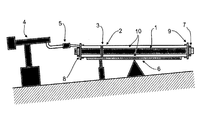
- a process according to FIG. 1 is a discontinuous process.
- the medium pipe 1 usually steel
- the outer jacket tube 3 usually Polyethylene
- the double tube which is usually inclined by means of tiltable foaming table 6, preferably inclined at an angle of 1 ° to 10 °, preferably 1.5 ° to 7 °, equipped with end caps 9, which are equipped with vent holes.
- the liquid reaction mixture i. the polyurethane system according to the invention, filled which flows down in a still liquid form in the tube gap until the foaming reaction starts. From this point on, the further distribution takes place by flowing the slowly increasing in viscosity foam until the material has reacted.
- the PUR system is highly compressed in the pipe, so that without clamps 7, the end caps 9 would be pushed away. Without seal 8 would Material pushed out between medium pipe 1 and end cap 9.
- the ventilation holes The end caps are at the beginning of foam exit with stopper or automatic Valves closed.
Landscapes
- Chemical & Material Sciences (AREA)
- Engineering & Computer Science (AREA)
- General Engineering & Computer Science (AREA)
- Health & Medical Sciences (AREA)
- Chemical Kinetics & Catalysis (AREA)
- Medicinal Chemistry (AREA)
- Polymers & Plastics (AREA)
- Organic Chemistry (AREA)
- Mechanical Engineering (AREA)
- Polyurethanes Or Polyureas (AREA)
Applications Claiming Priority (2)
| Application Number | Priority Date | Filing Date | Title |
|---|---|---|---|
| DE102004001317A DE102004001317A1 (de) | 2004-01-07 | 2004-01-07 | Polyurethanschaumstoffe zur Rohrdämmung |
| DE102004001317 | 2004-01-07 |
Publications (2)
| Publication Number | Publication Date |
|---|---|
| EP1552915A2 true EP1552915A2 (fr) | 2005-07-13 |
| EP1552915A3 EP1552915A3 (fr) | 2008-03-05 |
Family
ID=34585361
Family Applications (1)
| Application Number | Title | Priority Date | Filing Date |
|---|---|---|---|
| EP04029285A Withdrawn EP1552915A3 (fr) | 2004-01-07 | 2004-12-10 | Mousse de polyuréthane pour des tuyaux calorifuges |
Country Status (2)
| Country | Link |
|---|---|
| EP (1) | EP1552915A3 (fr) |
| DE (1) | DE102004001317A1 (fr) |
Cited By (10)
| Publication number | Priority date | Publication date | Assignee | Title |
|---|---|---|---|---|
| EP1777244A1 (fr) * | 2005-10-19 | 2007-04-25 | Basf Aktiengesellschaft | Mousse de polyuréthane pour des tuyaux calorifuges |
| CN102259404A (zh) * | 2011-06-09 | 2011-11-30 | 海尔集团公司 | 热水器保温层的注塑设备和注塑方法 |
| WO2013030203A2 (fr) | 2011-08-31 | 2013-03-07 | Basf Se | Procédé de fabrication de tuyaux isolés à propriétés améliorées |
| WO2013057227A1 (fr) | 2011-10-21 | 2013-04-25 | Basf Se | Procédé pour améliorer les propriétés physiques lors de la fabrication de tube de gainage en plastique |
| WO2013079455A1 (fr) | 2011-11-28 | 2013-06-06 | Basf Se | Procédé de fabrication de tubes extérieurs isolés dans un processus de fabrication en continu |
| WO2014012877A1 (fr) | 2012-07-17 | 2014-01-23 | Basf Se | Procédé de production en continu de produit mousse dans des conduites |
| US8986801B2 (en) | 2011-01-27 | 2015-03-24 | Basf Se | Polyurethane having improved insulating properties |
| US9261223B2 (en) | 2011-10-21 | 2016-02-16 | Basf Se | Method of improving the physical properties in the production of PSPs (plastic-sheathed pipes) |
| US9421571B2 (en) | 2011-11-28 | 2016-08-23 | Basf Se | Process for producing insulated jacketed pipes by a continuous production process |
| EP3578582A1 (fr) | 2018-06-05 | 2019-12-11 | Covestro Deutschland AG | Mousses dures en polyuréthanne à durcissement thermique amélioré |
Families Citing this family (3)
| Publication number | Priority date | Publication date | Assignee | Title |
|---|---|---|---|---|
| DE102005053101A1 (de) * | 2005-11-04 | 2007-05-10 | Basf Ag | Gedämmte Rohre |
| WO2008119388A1 (fr) * | 2007-04-02 | 2008-10-09 | Basf Se | Tubes isolés |
| KR101903816B1 (ko) | 2011-03-22 | 2018-10-02 | 바스프 에스이 | 낮은 열 전도율 및 우수한 열 안정성을 갖는 pu 경질 폼 |
Family Cites Families (4)
| Publication number | Priority date | Publication date | Assignee | Title |
|---|---|---|---|---|
| EP0450197A1 (fr) * | 1990-04-02 | 1991-10-09 | Shell Internationale Researchmaatschappij B.V. | Compositions moussantes utilisables pour la préparation d'un matériau thermo-isolant expansé par l'action de l'eau utilisant des polyols pour l'amélioration du point de ramollissement et matériau thermo-isolant à partir de celles-ci |
| DE4318962A1 (de) * | 1993-06-08 | 1994-12-15 | Basf Ag | Verfahren zur Herstellung von Polyurethan-Hartschaumstoffen |
| US5478494A (en) * | 1993-09-22 | 1995-12-26 | Basf Corporation | Polyol composition having good flow and formic acid blown rigid polyurethane foams made thereby having good dimensional stability |
| DE19742012A1 (de) * | 1997-09-24 | 1999-03-25 | Basf Ag | Temperaturstabile Hartschaumstoffe auf Isocyanatbasis mit geringer Sprödigkeit und niedriger Wärmeleitfähigkeit |
-
2004
- 2004-01-07 DE DE102004001317A patent/DE102004001317A1/de not_active Withdrawn
- 2004-12-10 EP EP04029285A patent/EP1552915A3/fr not_active Withdrawn
Cited By (17)
| Publication number | Priority date | Publication date | Assignee | Title |
|---|---|---|---|---|
| EP1777244A1 (fr) * | 2005-10-19 | 2007-04-25 | Basf Aktiengesellschaft | Mousse de polyuréthane pour des tuyaux calorifuges |
| US8986801B2 (en) | 2011-01-27 | 2015-03-24 | Basf Se | Polyurethane having improved insulating properties |
| CN102259404B (zh) * | 2011-06-09 | 2016-09-14 | 海尔集团公司 | 热水器保温层的注塑设备和注塑方法 |
| CN102259404A (zh) * | 2011-06-09 | 2011-11-30 | 海尔集团公司 | 热水器保温层的注塑设备和注塑方法 |
| WO2013030203A3 (fr) * | 2011-08-31 | 2013-07-18 | Basf Se | Procédé de fabrication de tuyaux isolés à propriétés améliorées |
| JP2015502499A (ja) * | 2011-08-31 | 2015-01-22 | ビーエーエスエフ ソシエタス・ヨーロピアBasf Se | 性質が改善された絶縁パイプの製造方法 |
| WO2013030203A2 (fr) | 2011-08-31 | 2013-03-07 | Basf Se | Procédé de fabrication de tuyaux isolés à propriétés améliorées |
| RU2626895C2 (ru) * | 2011-08-31 | 2017-08-02 | Басф Се | Способ изготовления изолированных труб с улучшенными свойствами |
| WO2013057227A1 (fr) | 2011-10-21 | 2013-04-25 | Basf Se | Procédé pour améliorer les propriétés physiques lors de la fabrication de tube de gainage en plastique |
| US9261223B2 (en) | 2011-10-21 | 2016-02-16 | Basf Se | Method of improving the physical properties in the production of PSPs (plastic-sheathed pipes) |
| WO2013079455A1 (fr) | 2011-11-28 | 2013-06-06 | Basf Se | Procédé de fabrication de tubes extérieurs isolés dans un processus de fabrication en continu |
| US9421571B2 (en) | 2011-11-28 | 2016-08-23 | Basf Se | Process for producing insulated jacketed pipes by a continuous production process |
| WO2014012877A1 (fr) | 2012-07-17 | 2014-01-23 | Basf Se | Procédé de production en continu de produit mousse dans des conduites |
| CN104684722A (zh) * | 2012-07-17 | 2015-06-03 | 巴斯夫欧洲公司 | 用于在管中连续制备泡沫的方法 |
| RU2632689C2 (ru) * | 2012-07-17 | 2017-10-09 | Басф Се | Способ непрерывного получения пневмоматериалов в трубах |
| RU2632689C9 (ru) * | 2012-07-17 | 2017-10-19 | Басф Се | Способ непрерывного получения пеноматериалов в трубах |
| EP3578582A1 (fr) | 2018-06-05 | 2019-12-11 | Covestro Deutschland AG | Mousses dures en polyuréthanne à durcissement thermique amélioré |
Also Published As
| Publication number | Publication date |
|---|---|
| EP1552915A3 (fr) | 2008-03-05 |
| DE102004001317A1 (de) | 2005-08-04 |
Similar Documents
| Publication | Publication Date | Title |
|---|---|---|
| EP2134762B1 (fr) | Tubes isolés | |
| EP2870188B1 (fr) | Préparation de matériaux expansés à propriétés améliorées | |
| WO2013117541A1 (fr) | Procédé pour produire une mousse rigide à base de polyuréthane-polyisocyanurate | |
| EP3350242B1 (fr) | Procede de fabrication d'une mousse dure de polyurethane-polyisocyanurate | |
| EP2786059B1 (fr) | Procédé de fabrication de tubes extérieurs isolés dans un processus de fabrication en continu | |
| EP2526333B1 (fr) | Enveloppe de mousse de polyuréthane rigide pour l'assemblage de tubes | |
| DE102004001317A1 (de) | Polyurethanschaumstoffe zur Rohrdämmung | |
| EP2668237B1 (fr) | Polyuréthane présentant des propriétés d'isolation améliorées | |
| EP2751157B1 (fr) | Procédé de fabrication de tuyaux isolés à propriétés améliorées | |
| EP3947501B1 (fr) | Tube isolé contenant de la mousse de polyuréthane peu fragile expansée à l'aide d'un agent d'expansion respectueux de l'environnement | |
| EP2874808B1 (fr) | Procédé de fabrication continue de mousse dans des tuyaux | |
| EP1783152A2 (fr) | Tuyaux isolés | |
| EP3630481B1 (fr) | Procédé de fabrication de tuyaux isolés | |
| EP1777242B1 (fr) | Mousse de polyuréthane pour des tuyaux calorifuges | |
| EP1777051B1 (fr) | Mousse de polyuréthane pour des tuyaux calorifuges | |
| EP2768650B1 (fr) | Procédé pour améliorer les propriétés physiques lors de la fabrication de tube de gainage en plastique | |
| DE102004023881A1 (de) | Gedämmtes Rohr, enthaltend mit Ameisensäure hergestelltes Polyurethan | |
| DE102005050410A1 (de) | Polyurethanschaumstoffe zur Rohrdämmung | |
| WO2005056630A1 (fr) | Polyurethannes syntactiques contenant de l'huile, de preference de l'huile de ricin | |
| WO2008025660A1 (fr) | Raccords de conduites revêtues | |
| DE69117082T2 (de) | Wärmeisoliermaterial für Rohren hergestellt aus Wasser expandierten Wärmeisoliermaterials geeigneter Schaumformulierungen unter Verwendung von Polyolen zur Verbesserung der Erweichungstemperatur. | |
| EP3578582A1 (fr) | Mousses dures en polyuréthanne à durcissement thermique amélioré |
Legal Events
| Date | Code | Title | Description |
|---|---|---|---|
| PUAI | Public reference made under article 153(3) epc to a published international application that has entered the european phase |
Free format text: ORIGINAL CODE: 0009012 |
|
| AK | Designated contracting states |
Kind code of ref document: A2 Designated state(s): AT BE BG CH CY CZ DE DK EE ES FI FR GB GR HU IE IS IT LI LT LU MC NL PL PT RO SE SI SK TR |
|
| AX | Request for extension of the european patent |
Extension state: AL BA HR LV MK YU |
|
| PUAL | Search report despatched |
Free format text: ORIGINAL CODE: 0009013 |
|
| AK | Designated contracting states |
Kind code of ref document: A3 Designated state(s): AT BE BG CH CY CZ DE DK EE ES FI FR GB GR HU IE IS IT LI LT LU MC NL PL PT RO SE SI SK TR |
|
| AX | Request for extension of the european patent |
Extension state: AL BA HR LV MK YU |
|
| RAP1 | Party data changed (applicant data changed or rights of an application transferred) |
Owner name: BASF SE |
|
| RIC1 | Information provided on ipc code assigned before grant |
Ipc: F16L 59/14 20060101ALI20080128BHEP Ipc: C08G 18/48 20060101ALI20080128BHEP Ipc: C08G 18/66 20060101ALI20080128BHEP Ipc: B29C 44/32 20060101AFI20050503BHEP |
|
| 17P | Request for examination filed |
Effective date: 20080905 |
|
| AKX | Designation fees paid |
Designated state(s): AT BE BG CH CY CZ DE DK EE ES FI FR GB GR HU IE IS IT LI LT LU MC NL PL PT RO SE SI SK TR |
|
| 17Q | First examination report despatched |
Effective date: 20081125 |
|
| STAA | Information on the status of an ep patent application or granted ep patent |
Free format text: STATUS: THE APPLICATION IS DEEMED TO BE WITHDRAWN |
|
| 18D | Application deemed to be withdrawn |
Effective date: 20160226 |