EP1553524B1 - Préparation et exécution des services par une unité de traitement de données - Google Patents
Préparation et exécution des services par une unité de traitement de données Download PDFInfo
- Publication number
- EP1553524B1 EP1553524B1 EP05000051.2A EP05000051A EP1553524B1 EP 1553524 B1 EP1553524 B1 EP 1553524B1 EP 05000051 A EP05000051 A EP 05000051A EP 1553524 B1 EP1553524 B1 EP 1553524B1
- Authority
- EP
- European Patent Office
- Prior art keywords
- services
- service
- implemented
- determining
- franking machine
- Prior art date
- Legal status (The legal status is an assumption and is not a legal conclusion. Google has not performed a legal analysis and makes no representation as to the accuracy of the status listed.)
- Expired - Lifetime
Links
Images


Classifications
-
- G—PHYSICS
- G06—COMPUTING OR CALCULATING; COUNTING
- G06Q—INFORMATION AND COMMUNICATION TECHNOLOGY [ICT] SPECIALLY ADAPTED FOR ADMINISTRATIVE, COMMERCIAL, FINANCIAL, MANAGERIAL OR SUPERVISORY PURPOSES; SYSTEMS OR METHODS SPECIALLY ADAPTED FOR ADMINISTRATIVE, COMMERCIAL, FINANCIAL, MANAGERIAL OR SUPERVISORY PURPOSES, NOT OTHERWISE PROVIDED FOR
- G06Q50/00—Information and communication technology [ICT] specially adapted for implementation of business processes of specific business sectors, e.g. utilities or tourism
- G06Q50/60—Business processes related to postal services
-
- G—PHYSICS
- G07—CHECKING-DEVICES
- G07B—TICKET-ISSUING APPARATUS; FARE-REGISTERING APPARATUS; FRANKING APPARATUS
- G07B17/00—Franking apparatus
- G07B17/00016—Relations between apparatus, e.g. franking machine at customer or apparatus at post office, in a franking system
- G07B17/0008—Communication details outside or between apparatus
-
- G—PHYSICS
- G07—CHECKING-DEVICES
- G07B—TICKET-ISSUING APPARATUS; FARE-REGISTERING APPARATUS; FRANKING APPARATUS
- G07B17/00—Franking apparatus
- G07B17/00016—Relations between apparatus, e.g. franking machine at customer or apparatus at post office, in a franking system
- G07B17/0008—Communication details outside or between apparatus
- G07B2017/00153—Communication details outside or between apparatus for sending information
- G07B2017/00161—Communication details outside or between apparatus for sending information from a central, non-user location, e.g. for updating rates or software, or for refilling funds
Definitions
- the present invention relates to a method for preparing the execution of a number of services to be performed from a number of available services for a postage meter by a remote data center, wherein in a first setting step the sequence of the services to be performed is determined. It further relates to a corresponding data processing system.
- services for a computing device are provided and executed by a remote data center.
- This can be any services that influence the state of the data processing unit.
- the data center generally reads data on the use of the franking machine from the franking machine as a further service.
- the data center can influence the functionality and the functional scope of the franking machines via corresponding services. For example, new software versions, new postage tables and other information for the user of the franking machine can be loaded into the franking machine by the data center. Finally, the franking machine can be locked by the data center for further use.
- the loading of postage into the franking machine as one of the available services is usually carried out on request of the franking machine, which contacts the data center for this purpose. As part of this communication, other services are then usually carried out, which are currently to be performed for each franking machine. This happens in part automatically, without there being a requirement of the franking machines themselves.
- the sequence of services to be performed and their interdependencies have generally been defined once during the establishment of the data center or franking machine.
- Comparable methods for preparing to perform a number of services to be performed are, for example, from EP 0 986 028 A2 , of the US 4,933,849 as well as the EP 1 037 172 A2 known.
- the present invention is therefore based on the object to provide a method or data processing system of the type mentioned, which does not have the disadvantages mentioned above, or at least to a lesser extent and in particular allows flexible implementation of services.
- the present invention solves this problem starting from a method according to the preamble of claim 1 by the features stated in the characterizing part of claim 1. It solves this problem further starting from a data processing system according to the preamble of claim 10 by the features stated in the characterizing part of claim 10.
- the present invention is based on the technical teaching that a flexible, easily adaptable to changing boundary conditions preparation and implementation of services is achieved if the determination of the sequence of services to be performed in the first setting step triggered by an incoming in the data center request for a first service done by the franking machine. This makes it possible to influence at any time points on the sequence of services to be performed.
- an order is hereby defined for the requested first service and further services to be performed as being performed, according to which they are processed. It is understood that the requested first service may also be denied. Instead, one or more other services may be performed. This may, for example, be the blocking of the franking machine for further operation if information is present in the data center based on the results of a previously performed service or from other sources that the franking machine may have been manipulated.
- a first checking step of the first setting step the fulfillment of at least one first setting rule is checked by the franking machine.
- the determination of the sequence of services to be performed then takes place in dependence on the fulfillment of the first determination rule by the franking machine.
- the determination rule can be any rule to be defined.
- the definition rules it is possible, for example, to form any categories, groups, etc., of franking machines on the basis of common features of different franking machines. For such categories, groups, etc., services to be performed and not to be performed can be defined without this having to be done individually for each franking machine. As a result, corresponding adjustments in the specification of services to be carried out are particularly simple and inexpensive.
- the first determination rule relates to the affiliation of the franking machine to a first specification category.
- Each classification category is then subject to a separate rule.
- an arbitrarily fine subdivision of the franking machines and thus on the associated determination rules a gradation of the services to be performed is possible.
- services that are to be performed for all franking machines can be defined, while other services are only to be carried out for certain franking machine classes and groups.
- services can be defined which are only to be carried out for a single franking machine.
- the allocation of the postage meter machine to a certain specification category can be made via any features of the postage meter machine. These features can be, for example, the type of franking machine, the model, the model version up to the individual serial number of the franking machine. Likewise, a gradation according to different software versions etc. is possible with which the franking machine is operated.
- a first specification is made as to whether the respective service is a service to be performed or a service to be performed when the first setting rule is fulfilled.
- the selection of the be performed services in response to the first default made in the first step.
- the verification of the determination rules can be realized in any suitable manner.
- an examination matrix is predefined which at least allocates the first stipulation rule to at least a part of the available services in a matrix-like manner.
- the audit matrix has a commitment value. This setting value is then representative of whether the service is a service to be performed or a service not to be performed by the postage meter upon fulfillment of the fixing rule.
- the selection of the services to be performed in the first checking step can be done independently of the requested first service. However, the selection of the services to be carried out preferably takes place in the first checking step depending on the requested first service. As a result, a particularly fine gradation of service preparation or service implementation is possible.
- the selection depending on the requested service may be done in any suitable manner. For example, different audit matrices may be provided for individual or groups of requested services. Depending on the requested service, the corresponding check matrix is then selected, on the basis of which the check of the determination rules then takes place.
- the selected services can in principle be brought into a suitable order in any suitable manner. Thus, for example, it is possible simply to have them followed in the order of their selection as a service to be performed in the examination of the determination rules.
- the respective service is assigned a priority value for its execution.
- the order of the selected services to be carried out is then determined as a function of the second specification.
- the priority values can be subdivided arbitrarily fine, so that a simple unique sorting is possible. Likewise it can be provided that services with the same priority value are again subjected to a further sorting according to specific criteria. However, provision may also be made for services with the same priority value to simply follow one another in the order in which they are selected.
- the second specification can be made at any point before the sorting step. It is particularly advantageous, if it takes place before the first test step, that it may then possibly already be taken into account in the standard test, whereby the effort for this is reduced.
- the requested service can always be reserved the first place.
- the position of the requested service is determined as a function of the priority value assigned for this service. This is particularly useful when constellations are possible in which the requested service can be performed only if previously other services would be performed. It also makes sense, if appropriate, to provide that instead of the requested service other services are to be performed.
- the second specification of the priority values can take place in any suitable manner.
- an examination matrix is used. Therefore, it is preferably provided that in the first predetermining step a test matrix is assigned, which assigns at least the first stipulation rule to at least a part of the available services and has the priority value at the intersection between the stipulation rule and the respective service.
- the present invention further relates to a method for carrying out at least one service for a franking machine by a remote data center, in which the preparation of the performance of the service is carried out with a method according to the invention for preparing the implementation described above.
- the implementation of the services is rigid in the predetermined sequence.
- the performance of the services to be performed takes place in the service execution step as a function of the execution result of at least one service to be carried out. It can be determined that if a service fails, each of the subsequent services to be performed is not executed or the entire sequence is aborted.
- This variant can be implemented particularly simply in connection with the sorting of the services according to priority values, since in such a case services whose successful conclusion is a prerequisite for the performance of further services can be assigned a correspondingly high priority.
- the sequence of services to be performed is performed in a second setting step subsequent to the first execution step as a function of the execution result of at least one service to be performed in the first execution step.
- the present invention further relates to a data processing system comprising at least one postage meter machine and a remote data center connectable therewith, configured to perform a number of services to be performed for the postage meter machine from a number of available services in a predetermined sequence.
- the data center for determining the sequence of services to be carried out is triggered by a request of a first service arriving in the data center by the postage meter machine.
- the data center has a defining unit with a first memory, at least a first setting rule being stored in the first memory and the determining unit for checking the fulfillment of at least the first setting rule by the franking machine and determining the sequence of the services to be performed as a function of the fulfillment the first fixing rule is formed by the franking machine.
- the first determination rule is changeably stored in the first memory so that it can be modified at arbitrary times.
- the determination unit is then preferably designed to select the services to be performed as a function of the first specification.
- this examination matrix is preferably stored in the first memory.
- the determination unit is then designed to select the services to be performed as a function of the respective setting value.
- the determining unit for selecting the services to be performed is formed as a function of the requested first service.
- the determining unit is preferably designed for determining the order of the selected services to be performed as a function of the second specification.
- the data center has a service implementation unit connected to the setting unit, which is designed to carry out the services to be performed as a function of the sequence defined by the setting unit.
- the service execution unit is configured to perform the services to be performed in the service execution step in dependence on the performance of at least one service to be performed.
- the data center is designed to determine the sequence of the services to be performed in dependence on the execution result of at least one preceding service to be performed.
- the present invention further relates to a data center for a data processing system according to the invention which has the features described above in connection with the data processing system according to the invention.
- FIG. 1 shows a schematic representation of a preferred embodiment of the data processing system 1 according to the invention for carrying out a preferred embodiment of the method according to the invention.
- the data processing system 1 comprises a data center 2 and a plurality of data processing units arranged in the form of franking machines, of which in FIG. 1 a first franking machine 3 and a second franking machine 4 are shown.
- the franking machines 3 and 4 can be connected via a suitable telecommunication connection to an interface device 2.1 of the data center 2 in order to communicate with the data center 2.
- the franking machines 3 and 4 contact the data center 2 in order to request from the data center 2 the execution of one or more services for the respective franking machine 3 or 4.
- a service requested by the franking machine 3 or 4 may be, for example, the loading of postage from the data center 2 into the respective franking machine 3 or 4. It may also be the loading of other data in the respective franking machine 3 or 4, for example, the loading of new software, new postage tables, new cliché data, other information, such as advertising, etc.
- it may be the reading of certain data from the respective Postage meter 3 or 4 act, for example, the reading of the register statuses or other status data of the franking machine.
- such a service can also be the remote maintenance of the respective franking machine 3 or 4.
- any activity of the data center include over which either the state of the franking machine 3 or 4 is acted upon or at least the state of the respective franking machine 3 or 4 is detected or analyzed.
- the data center 2 has a service implementation unit 2.2.
- This service implementation unit 2.2 has a first processing unit 2.3 which accesses service modules associated with it for performing the respective service, of which in FIG. 1 the service modules 2.4 to 2.6 are shown.
- the service execution unit 2.2 carries out the services to be performed in a sequence predetermined by a selection data record.
- the service implementation unit 2.2 receives this selection data record from an associated determination unit 2.7, which generates the selection data record triggered by the request for a service by one of the franking machines 3 or 4.
- the selection data set is created using a test matrix whose function will be explained in more detail below.
- the exam matrix is selected from a number of available exam matrices depending on the requested service.
- the exam matrices - of which in FIG. 1 and 2 only exam matrices 5.1, 5.2 and 5.3 are shown - are stored in a first memory 2.8 of the fixing unit 2.7.
- FIGS. 1 to 3 the implementation of the method according to the invention for the preparation or implementation of services described in the context of the present application.
- test matrices 5.1 to 5.3 are introduced into the first memory 2.8 in a first predefined step 6.2.
- Each test matrix is assigned to one or more requested services.
- the verification matrix 5.1 is assigned to the requested service D1.
- the test matrix 5.2 is assigned to the requested services D2, D4 and D8.
- the audit matrix 5.3 is associated with the requested service DQ.
- Each audit matrix allocates a number of policy rules R1 to RS to a number of services.
- the examination matrix 5.1 assigns the specification rules R1 to RS to all available services D1 to DR for the requested service D1.
- the audit matrix 5.3 for the requested service DQ assigns only a portion of the commitment rules to only a portion of the available services.
- the respective stipulation rule relates to the affiliation of the requesting franking machine to a specific specification category.
- the specification categories are the membership of the requesting franking machine to a particular group of franking machines, which is defined on the basis of certain features of the franking machine. These features are identifiable based on information that is transmitted to the data center 2 with the request of the service. If the affiliation of the requesting franking machines to the respective specification category is determined, then the associated determination rule is fulfilled.
- the first determination rule R1 relates to the affiliation with all of the franking machines registered in the data center 2.
- the second determination rule R2 relates to the affiliation of the requesting franking machine 3 or 4 to a franking machine class 1.
- the further fixing rules R3 to RI-1 relate to the affiliation of the requesting franking machine to other postage meter classes 2 to N.
- These postage meter classes can be, for example, different types of devices , different Models, certain models with different equipment, for example, different software versions, etc. act.
- Rules RI to RS-1 apply to individual franking machines defined, for example, by their serial number.
- the affiliation of a requesting postage meter machine to a certain specification category can be readily determined on the basis of the serial number of the postage meter machine. It is therefore sufficient that the request contains this serial number. It is understood, however, that the requirement may also include any other features of the requesting meter, by means of which it may be classified in the categories of commitment.
- the determination rules may also apply to rules that are not dependent on the requesting meter.
- the determination rule RS relates to a time rule, i. H. the respective rule RS is fulfilled when the current request for a service arrives at the data center at a certain point in time, for example in a specific time interval.
- the respective rule RS is fulfilled when the current request for a service arrives at the data center at a certain point in time, for example in a specific time interval.
- certain rules may also provide for the combined testing of franking machine dependent and non-franking machine dependent criteria.
- a priority value P is stored. This represents a first specification and a second specification.
- the second requirement is that the numerical value assigned to the priority value represents a measure of the priority of the respective service when the associated determination rule is fulfilled. The higher the associated numerical value of P, the more senior the associated service.
- the respective examination matrix is stored in the first memory in any suitable form. It is understood, however, that in other variants of the present invention, the first specification and the second specification may be made in other suitable ways. In particular, a separation of the first and second specifications may be provided. Furthermore, a separate second predetermining step may also be provided for the second specification.
- the exam matrices can be modified at any time. This allows you to change, delete or add rules and / or services. Furthermore, of course, the individual priority values can be modified.
- the above modifications may depend on internal constraints, such as the successful performance of certain services. However, they can also depend on external boundary conditions or events, for example the notification of an external authority, which relates to the creditworthiness of the operator of the franking machine. Of course, the above modifications may also be at least partially automated. As a result, a simple and extremely flexible flow control of the services to be performed is possible, which can be easily adapted to changing conditions.
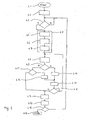
- a step 6.3 following the first specification step 6.2 it is checked whether there is a request for the execution of a service from a number of available services by one of the franking machines 3 or 4. If, for example, a request of the service D1 by the postage meter machine 3 occurs, this triggers the determination of the sequence of the services to be performed in a setting step 6.4.
- the checking matrix 5.1 is first selected as a function of the requested service D1. This ensures that the selection of the services to be performed depends on the requested service. As a result, a shortening of the processing time can possibly be achieved since, depending on the requested service, it may not be necessary to record all available services or rules. However, it should be understood that in other variants of the present invention, such selection may also be absent depending on the requested service. In this case, then only a single examination matrix can be provided.
- the second processing unit 2.9 of the determining unit 2.7 checks sequentially all setting rules R1 to RS of the checking matrix 5.1 by accessing the first memory 2.8.
- those services to which a priority value P> 0 is assigned are included in the selection data record together with their assigned priority value. In other words, this results in a selection of the services to be performed as a function of the first specification previously made in the first predetermining step.
- the second processing unit 2.9 sorts the services included in the selection data record by accessing a sorting module 2.10 (fair copy) KA / sv 030864EP
- a sorting module 2.10 fair copy
- Services with numerically equal priority values P are sorted on the basis of further sorting criteria stored in the sorting module 2.10, so that at the end of the sorting step 6.7 in the selection data record the order of the selected services to be performed is determined. If individual services have possibly been selected several times with different priority values, then the relevant service is only arranged once in the selection data record with the highest assigned priority value.
- a first service execution step 6.8 the execution of the service record in the selection record at the foremost place, which is to be executed, takes place.
- the first processing unit 2.3 accesses the service module 2.4 to 2.6 associated with this service.
- a step 6.9 it is then checked whether the service to be performed has been carried out successfully. If this is the case, in a step 6.10 the signaling that the service has been carried out successfully takes place. In a step 6.11, the service is then marked as non-executable.
- a step 6.12 it is then checked whether there are more services marked as to be executed in the selection data record. If this is the case, it is jumped back to the first service execution step 6.8. If this is not the case, the first processing unit 2.3 of the service implementation unit 2.2, in a logging step 6.13, logs the result of the service execution in a second memory 2.11 connected to it.
- the first processing unit 2.3 checks in a step 6.14 the consequences of such an unsuccessful execution of the relevant service. For this purpose, she accesses a result code module 2.12 connected to her, in which for each available service a result code is stored, which among other things defines the consequences of an unsuccessful execution of the relevant service.
- step 13 If the result code again indicates that the execution of all other services is inadmissible if the performance of the relevant service fails, the logging step 13 is jumped immediately. If the result code indicates that the execution of the service concerned is inadmissible, the performance of individual further services is inadmissible is, the respective further services, if they are included in the selection data set, are marked as non-executable services in the selection data set in a step 6.15. Subsequently, jump to step 6.11.
- an automatic modification of the check matrices is then carried out as a function of the logged result of the implementation of the services to be performed by accessing the result codes of the result code module 2.12. This makes it possible to make automatic adjustments to the examination matrix.
- step 6.15 it is then checked whether a stop signal for the termination of the operation of the data center 2 is present. If so, the operation ended in step 6.16. Otherwise, the operation is continued and jumped to step 6.3.
Landscapes
- Physics & Mathematics (AREA)
- General Physics & Mathematics (AREA)
- Business, Economics & Management (AREA)
- Health & Medical Sciences (AREA)
- Economics (AREA)
- General Health & Medical Sciences (AREA)
- Human Resources & Organizations (AREA)
- Marketing (AREA)
- Primary Health Care (AREA)
- Strategic Management (AREA)
- Tourism & Hospitality (AREA)
- General Business, Economics & Management (AREA)
- Engineering & Computer Science (AREA)
- Theoretical Computer Science (AREA)
- Telephonic Communication Services (AREA)
- Devices For Checking Fares Or Tickets At Control Points (AREA)
- Communication Control (AREA)
Claims (20)
- Procédé de préparation de l'exécution d'un certain nombre de prestations à exécuter, sur un certain nombre de prestations disponibles pour une machine à affranchir (3, 4), par le biais d'un centre de données distant (2), dans lequel la séquence des prestations à exécuter est déterminée lors d'une première étape de détermination (6.4),
caractérisé en ce que- la détermination de la séquence des prestations à exécuter lors de la première étape de détermination (6.4) est déclenchée par la demande, émise dans le centre de données, d'une première prestation par la machine à affranchir (3, 4), dans lequel- lors d'une première étape de vérification (6.6) de la première étape de détermination (6.4), l'accomplissement d'au moins une première règle de détermination par la machine à affranchir (3, 4) est vérifié, et la détermination de la séquence des prestations à exécuter s'effectue en fonction de l'accomplissement de la première règle de détermination par la machine à affranchir (3, 4),- la première règle de détermination concerne l'appartenance de la machine à affranchir (3, 4) à une première catégorie de détermination,- lors d'une première étape de spécification (6.2) préalable à la première étape de vérification (6.6), pour au moins une partie des prestations disponibles, une première spécification s'effectue pour définir si la prestation en question est une prestation à exécuter ou à ne pas exécuter lors de l'accomplissement de la première règle de détermination, et- lors de l'accomplissement de la première règle de détermination par la machine à affranchir lors de la première étape de vérification (6.6), le choix des prestations à exécuter s'effectue en fonction de la première spécification émise lors de la première étape de spécification (6.2). - Procédé selon la revendication 1, caractérisé en ce que la première règle de détermination concerne l'appartenance de la machine à affranchir (3, 4) à la première catégorie de détermination et un critère indépendant de la machine à affranchir (3, 4).
- Procédé selon la revendication 1 ou 2, caractérisé en ce que dans la première étape de spécification (6.2), il a été spécifié une matrice de vérification qui assigne au moins la première règle de détermination à au moins une partie des prestations disponibles et qui présente, au point d'interception entre la règle de détermination et la prestation en question, une valeur de détermination indiquant si la prestation, lors de l'accomplissement de la règle de détermination par la machine à affranchir (3, 4), est une prestation à exécuter ou à ne pas exécuter.
- Procédé selon une quelconque des revendications précédentes, caractérisé en ce que le choix des prestations à exécuter lors de la première étape de vérification (6.6) s'effectue en fonction de la première prestation demandée.
- Procédé selon une quelconque des revendications précédentes, caractérisé en ce que- lors de la première étape de spécification (6.2) ou lors d'une deuxième étape de spécification pour au moins une partie des prestations disponibles, une deuxième spécification est effectuée lors de laquelle il est attribué à la prestation en question une valeur de priorité pour son exécution, la deuxième étape de spécification en particulier précédant la première étape de vérification (6.6), et- lors d'une étape de classement consécutive à la première étape de vérification (6.6), l'ordre des prestations sélectionnées à exécuter est déterminé en fonction de la deuxième spécification.
- Procédé selon la revendication 5, caractérisé en ce que lors de l'étape de détermination, il a été spécifié une matrice de vérification (5.1, 5.2, 5.3) qui assigne au moins la première règle de détermination à au moins une partie des prestations disponibles et qui présente la valeur de priorité au point d'interception entre la règle de détermination et la prestation en question.
- Procédé d'exécution d'au moins une prestation pour une machine à affranchir (3, 4) par un centre de données distant (2), dans lequel la préparation de l'exécution de la prestation s'effectue par un procédé conforme à l'une des revendications qui précèdent, caractérisé en ce que l'exécution des prestations à exécuter s'effectue lors d'une première étape d'exécution de prestation (6.8) consécutive à la première étape de détermination (6.4) en fonction de la séquence déterminée lors de la première étape de détermination (6.4).
- Procédé selon la revendication 7, caractérisé en ce que l'exécution des prestations à exécuter s'effectue lors de l'étape d'exécution de prestation (6.8), en fonction du résultat de l'exécution d'au moins une prestation à exécuter.
- Procédé selon la revendication 7 ou 8, caractérisé en ce que la détermination de la séquence des prestations à exécuter s'effectue lors d'une deuxième étape de détermination consécutive à la première étape d'exécution (6.8), en fonction du résultat de l'exécution d'au moins une prestation à exécuter.
- Système informatique comprenant au moins une machine à affranchir (3, 4) et un centre de données distant pouvant y être relié (2), conçu pour exécuter un certain nombre de prestations à exécuter pour la machine à affranchir (3, 4), sur un certain nombre de prestations disponibles, dans une séquence déterminée,
caractérisé en ce que- le centre de données (2) est conçu pour la détermination de la séquence des prestations à exécuter déclenchées par une demande, émise dans le centre de données (2), d'une première prestation par la machine à affranchir (3, 4), étant précisé que- le centre de données (2) comporte une unité de détermination (2.7) avec une première mémoire (2.8),- au moins une première règle de détermination est enregistrée dans la première mémoire (2.8),- l'unité de détermination (2.7) est conçue pour la vérification de l'accomplissement d'au moins la première règle de détermination par la machine à affranchir (3, 4) et pour la détermination de la séquence des prestations à exécuter en fonction de l'accomplissement de la première règle de détermination par la machine à affranchir (3, 4),- la première règle de détermination concerne l'appartenance de la machine à affranchir (3, 4) à une première catégorie de détermination,- la première règle de détermination spécifie, pour au moins une partie des prestations disponibles, en tant que première spécification, si la prestation concernée, lors de l'accomplissement de la première règle de détermination, est une prestation à exécuter ou à ne pas exécuter, et- l'unité de détermination (2.7) est conçue pour sélectionner les prestations à exécuter en fonction de la première spécification. - Système informatique selon la revendication 10, caractérisé en ce que la première règle de détermination est enregistrée dans la première mémoire (2.8) de manière modifiable.
- Système informatique selon la revendication 10 ou 11, caractérisé en ce que la première règle de détermination concerne l'appartenance de la machine à affranchir (3, 4) à la première catégorie de détermination et un critère indépendant de la machine à affranchir (3, 4).
- Système informatique selon une quelconque des revendications 10 à 12, caractérisé en ce que- la première mémoire (2.8) contient l'enregistrement d'une matrice de vérification (5.1, 5.2, 5.3) qui assigne au moins la première règle de détermination à au moins une partie des prestations disponibles et qui présente, au point d'interception entre la règle de détermination et la prestation en question, une valeur de détermination indiquant si la prestation, lors de l'accomplissement de la règle de détermination par la machine à affranchir (3, 4), est une prestation à exécuter ou à ne pas exécuter.- l'unité de détermination (2.7) est conçue pour sélectionner les prestations à exécuter en fonction de la valeur de détermination respective.
- Système informatique selon une quelconque des revendications 10 à 13, caractérisé en ce que l'unité de détermination (2.7) est conçue pour sélectionner les prestations à exécuter en fonction de la première prestation commandée.
- Système informatique selon une quelconque des revendications 10 à 14, caractérisé en ce que- la première règle de détermination pour au moins une partie des prestations disponibles spécifie une valeur de priorité en tant que deuxième spécification pour l'exécution des prestations concernées et- l'unité de détermination (2.7) est conçue pour la détermination de l'ordre des prestations sélectionnées à effectuer en fonction de la deuxième spécification.
- Système informatique selon la revendication 15, caractérisé en ce que la première mémoire (2.8) contient l'enregistrement d'une matrice de vérification (5.1, 5.2, 5.3) qui assigne au moins la première règle de détermination à une partie au moins des prestations disponibles et qui présente la valeur de priorité au point d'interception entre la règle de détermination et la prestation en question.
- Système informatique selon une quelconque des revendications 10 à 16, caractérisé en ce que le centre de données (2) comprend une unité d'exécution de prestations (2.2) reliée à l'unité de détermination (2.7) et qui est conçue pour l'exécution des prestations à exécuter en fonction de la séquence définie par l'unité de détermination (2.7).
- Système informatique selon la revendication 17, caractérisé en ce que l'unité d'exécution de prestations (2.2) est conçue pour l'exécution des prestations à exécuter en fonction du résultat de l'exécution d'au moins une prestation à exécuter.
- Système informatique selon la revendication 17 ou 18, caractérisé en ce que le centre de données (2) est conçu pour la détermination de la séquence des prestations à exécuter en fonction du résultat de l'exécution d'au moins une prestation précédente à exécuter.
- Un centre de données, caractérisé en ce qu'il est conçu comme le centre de données distant du système informatique selon les revendications 10 à 19.
Applications Claiming Priority (2)
| Application Number | Priority Date | Filing Date | Title |
|---|---|---|---|
| DE102004001622A DE102004001622A1 (de) | 2004-01-09 | 2004-01-09 | Vorbereitung und Durchführung von Diensten für eine Datenverarbeitungseinheit |
| DE102004001622 | 2004-01-09 |
Publications (3)
| Publication Number | Publication Date |
|---|---|
| EP1553524A2 EP1553524A2 (fr) | 2005-07-13 |
| EP1553524A3 EP1553524A3 (fr) | 2007-10-31 |
| EP1553524B1 true EP1553524B1 (fr) | 2013-07-24 |
Family
ID=34585393
Family Applications (1)
| Application Number | Title | Priority Date | Filing Date |
|---|---|---|---|
| EP05000051.2A Expired - Lifetime EP1553524B1 (fr) | 2004-01-09 | 2005-01-04 | Préparation et exécution des services par une unité de traitement de données |
Country Status (3)
| Country | Link |
|---|---|
| US (1) | US7577744B2 (fr) |
| EP (1) | EP1553524B1 (fr) |
| DE (1) | DE102004001622A1 (fr) |
Families Citing this family (2)
| Publication number | Priority date | Publication date | Assignee | Title |
|---|---|---|---|---|
| DE102004054648A1 (de) | 2004-11-11 | 2006-05-24 | Francotyp-Postalia Ag & Co. Kg | Verfahren zum Bereitstellen von Diensten zwischen Datenverarbeitungseinrichtungen |
| US20090132557A1 (en) * | 2007-11-19 | 2009-05-21 | Cohen Richard J | Using hierarchical groupings to organize grc guidelines, policies, categories, and rules |
Family Cites Families (12)
| Publication number | Priority date | Publication date | Assignee | Title |
|---|---|---|---|---|
| US677565A (en) * | 1898-12-12 | 1901-07-02 | Jesse Austin Dunn | Dental clamp. |
| US4933849A (en) | 1987-07-16 | 1990-06-12 | Pitney Bowes | Security system for use with an indicia printing authorization device |
| US5008827A (en) * | 1988-12-16 | 1991-04-16 | Pitney Bowes Inc. | Central postage data communication network |
| DE4213278C2 (de) * | 1992-04-16 | 1998-02-19 | Francotyp Postalia Gmbh | Anordnung zum Frankieren von Postgut |
| DE4447404C2 (de) * | 1994-12-23 | 1998-08-20 | Francotyp Postalia Gmbh | Verfahren zur Dateneingabe in eine Waage und Anordnung zur Durchführung des Verfahrens |
| DE19549305A1 (de) * | 1995-12-22 | 1997-07-03 | Francotyp Postalia Gmbh | Verfahren und Anordnung zur Dateneingabe in eine Frankiermaschine |
| DE19617557A1 (de) * | 1996-05-02 | 1997-11-06 | Francotyp Postalia Gmbh | Verfahren zur Ermittlung des günstigsten Beförderers und Postverarbeitungssystem mit Personalcomputer und mit einem Verfahren zur Datenverarbeitung |
| DE19843249A1 (de) * | 1998-09-11 | 2000-03-16 | Francotyp Postalia Gmbh | Verfahren zur Dateneingabe in ein Dienstgerät und Anordnung zur Durchführung des Verfahrens |
| DE19913067A1 (de) | 1999-03-17 | 2000-09-21 | Francotyp Postalia Gmbh | Verfahren zur automatischen Installation von Frankiereinrichtungen und Anordnung zur Durchführung des Verfahrens |
| JP4199670B2 (ja) * | 2002-01-15 | 2008-12-17 | アバイア テクノロジー コーポレーション | 収束通信サービスのための通信アプリケーション・サーバ |
| US20050192913A1 (en) * | 2003-07-29 | 2005-09-01 | International Business Machies Corporation | Postal services method and system |
| DE102004014427A1 (de) * | 2004-03-19 | 2005-10-27 | Francotyp-Postalia Ag & Co. Kg | Verfahren für ein servergesteuertes Sicherheitsmanagement von erbringbaren Dienstleistungen und Anordnung zur Bereitstellung von Daten nach einem Sicherheitsmanagement für ein Frankiersystem |
-
2004
- 2004-01-09 DE DE102004001622A patent/DE102004001622A1/de not_active Withdrawn
-
2005
- 2005-01-04 EP EP05000051.2A patent/EP1553524B1/fr not_active Expired - Lifetime
- 2005-01-10 US US11/032,667 patent/US7577744B2/en active Active
Also Published As
| Publication number | Publication date |
|---|---|
| US7577744B2 (en) | 2009-08-18 |
| DE102004001622A1 (de) | 2005-08-04 |
| US20050154610A1 (en) | 2005-07-14 |
| EP1553524A2 (fr) | 2005-07-13 |
| EP1553524A3 (fr) | 2007-10-31 |
Similar Documents
| Publication | Publication Date | Title |
|---|---|---|
| DE69213809T2 (de) | Verfahren und Vorrichtung zur Erzeugung von Kalibrierinformationen für ein elektronisches Motorsteuermodul | |
| EP0915435B1 (fr) | Procédé pour stocker en sécurité des données variables | |
| DE102006028695A1 (de) | Elektronisches Steuersystem mit Fehlfunktionsüberwachung | |
| EP1553524B1 (fr) | Préparation et exécution des services par une unité de traitement de données | |
| DE19623145B4 (de) | Verfahren zum Betreiben eines Steuergerätes mit einer über eine Programmiervorrichtung programmierbaren Speichereinrichtung | |
| DE102007010114A1 (de) | Verfahren und Anordnung zur Sicherung von nutzerdefinierbaren Daten einer Frankiermaschine | |
| EP3732608B1 (fr) | Procédé de paramétrage assisté par ordinateur d'un système technique | |
| DE10108233A1 (de) | Steuereinheit für die Funktionalitätsprüfung eines technischen Aggregats und Verfahren für die Funktionalitätsprüfung | |
| EP3399375B1 (fr) | Procédé de configuration d'appareils de commande | |
| DE112019007853T5 (de) | Steuereinrichtung | |
| DE102022128804A1 (de) | Verfahren und System zum Aktualisieren einer Betriebssoftware von Teilkomponenten eines Kraftfahrzeugs | |
| DE2708244B2 (de) | Anordnung und Verfahren zur Steuerung eines Vermittlungssystems mit einer Gruppe von Kleinrechnern | |
| EP1819551B1 (fr) | Procédé de mise en mémoire structurée d'enregistrements de défaillances | |
| EP4144003B1 (fr) | Procédé de fabrication d'un composant logiciel pour un dispositif informatique électronique d'un véhicule automobile, produit de programme informatique, support de stockage lisible par ordinateur et système de mise à jour externe de véhicule automobile | |
| DE2516909C2 (de) | Datenverarbeitungsanlage zur Verarbeitung verschachtelter Programme | |
| DE102022130306A1 (de) | Verfahren zum Verarbeiten von Nachrichten, Verfahren zum Betreiben zumindest einer Einrichtung eines Kraftfahrzeugs, Vorrichtung zum Verarbeiten von Nachrichten sowie Kraftfahrzeug | |
| EP1529257A2 (fr) | Procede pour transferer au moins un enregistrement provenant d'une source de donnees externe dans une unite de calcul et unite de calcul correspondante | |
| DE102009039440A1 (de) | Verfahren und Systeme zum Sichern von Fahrzeugdaten | |
| DE102023100382A1 (de) | Verfahren zum Bereitstellen von Daten von Steuergeräten einer Mehrzahl von Kraftfahrzeugen, Verfahren zum Überprüfen von Steuergeräten, Steuergerät, Kraftfahrzeug und Vorrichtung zum Überprüfen von Steuergeräten | |
| DE10030208A1 (de) | Verfahren zur vergleichenden Bewertung einer Anzahl von Modifikationen der Parameter einer Systembeschreibung | |
| WO2022117305A1 (fr) | Procédé de stockage de données de programme dans une base de données | |
| EP3306507B1 (fr) | Composants pour une chaîne fonctionnelle critique pour la sécurité | |
| EP3690689A1 (fr) | Système et procédé d'exécution sécurisée des programmes d'application | |
| DE102023133057A1 (de) | Verfahren zum nachkorrigieren eines bestehenden signalnetzes und computerprogrammprodukt | |
| DE102020208331A1 (de) | Verfahren zum Betreiben eines Hardware-Sicherheits-Moduls |
Legal Events
| Date | Code | Title | Description |
|---|---|---|---|
| PUAI | Public reference made under article 153(3) epc to a published international application that has entered the european phase |
Free format text: ORIGINAL CODE: 0009012 |
|
| AK | Designated contracting states |
Kind code of ref document: A2 Designated state(s): AT BE BG CH CY CZ DE DK EE ES FI FR GB GR HU IE IS IT LI LT LU MC NL PL PT RO SE SI SK TR |
|
| AX | Request for extension of the european patent |
Extension state: AL BA HR LV MK YU |
|
| RAP1 | Party data changed (applicant data changed or rights of an application transferred) |
Owner name: FRANCOTYP-POSTALIA GMBH |
|
| PUAL | Search report despatched |
Free format text: ORIGINAL CODE: 0009013 |
|
| AK | Designated contracting states |
Kind code of ref document: A3 Designated state(s): AT BE BG CH CY CZ DE DK EE ES FI FR GB GR HU IE IS IT LI LT LU MC NL PL PT RO SE SI SK TR |
|
| AX | Request for extension of the european patent |
Extension state: AL BA HR LV MK YU |
|
| 17P | Request for examination filed |
Effective date: 20080208 |
|
| 17Q | First examination report despatched |
Effective date: 20080314 |
|
| AKX | Designation fees paid |
Designated state(s): AT BE BG CH CY CZ DE DK EE ES FI FR GB GR HU IE IS IT LI LT LU MC NL PL PT RO SE SI SK TR |
|
| GRAP | Despatch of communication of intention to grant a patent |
Free format text: ORIGINAL CODE: EPIDOSNIGR1 |
|
| GRAS | Grant fee paid |
Free format text: ORIGINAL CODE: EPIDOSNIGR3 |
|
| GRAA | (expected) grant |
Free format text: ORIGINAL CODE: 0009210 |
|
| AK | Designated contracting states |
Kind code of ref document: B1 Designated state(s): AT BE BG CH CY CZ DE DK EE ES FI FR GB GR HU IE IS IT LI LT LU MC NL PL PT RO SE SI SK TR |
|
| REG | Reference to a national code |
Ref country code: GB Ref legal event code: FG4D Free format text: NOT ENGLISH |
|
| REG | Reference to a national code |
Ref country code: CH Ref legal event code: EP |
|
| REG | Reference to a national code |
Ref country code: AT Ref legal event code: REF Ref document number: 623813 Country of ref document: AT Kind code of ref document: T Effective date: 20130815 |
|
| REG | Reference to a national code |
Ref country code: IE Ref legal event code: FG4D Free format text: LANGUAGE OF EP DOCUMENT: GERMAN |
|
| REG | Reference to a national code |
Ref country code: DE Ref legal event code: R096 Ref document number: 502005013857 Country of ref document: DE Effective date: 20130919 |
|
| REG | Reference to a national code |
Ref country code: CH Ref legal event code: NV Representative=s name: ROTTMANN, ZIMMERMANN + PARTNER AG, CH |
|
| REG | Reference to a national code |
Ref country code: SE Ref legal event code: TRGR |
|
| REG | Reference to a national code |
Ref country code: NL Ref legal event code: T3 |
|
| REG | Reference to a national code |
Ref country code: LT Ref legal event code: MG4D |
|
| PG25 | Lapsed in a contracting state [announced via postgrant information from national office to epo] |
Ref country code: PT Free format text: LAPSE BECAUSE OF FAILURE TO SUBMIT A TRANSLATION OF THE DESCRIPTION OR TO PAY THE FEE WITHIN THE PRESCRIBED TIME-LIMIT Effective date: 20131125 Ref country code: LT Free format text: LAPSE BECAUSE OF FAILURE TO SUBMIT A TRANSLATION OF THE DESCRIPTION OR TO PAY THE FEE WITHIN THE PRESCRIBED TIME-LIMIT Effective date: 20130724 Ref country code: IS Free format text: LAPSE BECAUSE OF FAILURE TO SUBMIT A TRANSLATION OF THE DESCRIPTION OR TO PAY THE FEE WITHIN THE PRESCRIBED TIME-LIMIT Effective date: 20131124 Ref country code: CY Free format text: LAPSE BECAUSE OF FAILURE TO SUBMIT A TRANSLATION OF THE DESCRIPTION OR TO PAY THE FEE WITHIN THE PRESCRIBED TIME-LIMIT Effective date: 20130703 |
|
| PG25 | Lapsed in a contracting state [announced via postgrant information from national office to epo] |
Ref country code: GR Free format text: LAPSE BECAUSE OF FAILURE TO SUBMIT A TRANSLATION OF THE DESCRIPTION OR TO PAY THE FEE WITHIN THE PRESCRIBED TIME-LIMIT Effective date: 20131025 Ref country code: FI Free format text: LAPSE BECAUSE OF FAILURE TO SUBMIT A TRANSLATION OF THE DESCRIPTION OR TO PAY THE FEE WITHIN THE PRESCRIBED TIME-LIMIT Effective date: 20130724 Ref country code: SI Free format text: LAPSE BECAUSE OF FAILURE TO SUBMIT A TRANSLATION OF THE DESCRIPTION OR TO PAY THE FEE WITHIN THE PRESCRIBED TIME-LIMIT Effective date: 20130724 Ref country code: ES Free format text: LAPSE BECAUSE OF FAILURE TO SUBMIT A TRANSLATION OF THE DESCRIPTION OR TO PAY THE FEE WITHIN THE PRESCRIBED TIME-LIMIT Effective date: 20130724 Ref country code: PL Free format text: LAPSE BECAUSE OF FAILURE TO SUBMIT A TRANSLATION OF THE DESCRIPTION OR TO PAY THE FEE WITHIN THE PRESCRIBED TIME-LIMIT Effective date: 20130724 |
|
| PG25 | Lapsed in a contracting state [announced via postgrant information from national office to epo] |
Ref country code: CY Free format text: LAPSE BECAUSE OF FAILURE TO SUBMIT A TRANSLATION OF THE DESCRIPTION OR TO PAY THE FEE WITHIN THE PRESCRIBED TIME-LIMIT Effective date: 20130724 |
|
| PG25 | Lapsed in a contracting state [announced via postgrant information from national office to epo] |
Ref country code: CZ Free format text: LAPSE BECAUSE OF FAILURE TO SUBMIT A TRANSLATION OF THE DESCRIPTION OR TO PAY THE FEE WITHIN THE PRESCRIBED TIME-LIMIT Effective date: 20130724 Ref country code: SK Free format text: LAPSE BECAUSE OF FAILURE TO SUBMIT A TRANSLATION OF THE DESCRIPTION OR TO PAY THE FEE WITHIN THE PRESCRIBED TIME-LIMIT Effective date: 20130724 Ref country code: DK Free format text: LAPSE BECAUSE OF FAILURE TO SUBMIT A TRANSLATION OF THE DESCRIPTION OR TO PAY THE FEE WITHIN THE PRESCRIBED TIME-LIMIT Effective date: 20130724 Ref country code: RO Free format text: LAPSE BECAUSE OF FAILURE TO SUBMIT A TRANSLATION OF THE DESCRIPTION OR TO PAY THE FEE WITHIN THE PRESCRIBED TIME-LIMIT Effective date: 20130724 Ref country code: EE Free format text: LAPSE BECAUSE OF FAILURE TO SUBMIT A TRANSLATION OF THE DESCRIPTION OR TO PAY THE FEE WITHIN THE PRESCRIBED TIME-LIMIT Effective date: 20130724 |
|
| PLBE | No opposition filed within time limit |
Free format text: ORIGINAL CODE: 0009261 |
|
| STAA | Information on the status of an ep patent application or granted ep patent |
Free format text: STATUS: NO OPPOSITION FILED WITHIN TIME LIMIT |
|
| 26N | No opposition filed |
Effective date: 20140425 |
|
| BERE | Be: lapsed |
Owner name: FRANCOTYP-POSTALIA G.M.B.H. Effective date: 20140131 |
|
| REG | Reference to a national code |
Ref country code: DE Ref legal event code: R097 Ref document number: 502005013857 Country of ref document: DE Effective date: 20140425 |
|
| PG25 | Lapsed in a contracting state [announced via postgrant information from national office to epo] |
Ref country code: LU Free format text: LAPSE BECAUSE OF FAILURE TO SUBMIT A TRANSLATION OF THE DESCRIPTION OR TO PAY THE FEE WITHIN THE PRESCRIBED TIME-LIMIT Effective date: 20140104 Ref country code: MC Free format text: LAPSE BECAUSE OF FAILURE TO SUBMIT A TRANSLATION OF THE DESCRIPTION OR TO PAY THE FEE WITHIN THE PRESCRIBED TIME-LIMIT Effective date: 20130724 |
|
| REG | Reference to a national code |
Ref country code: IE Ref legal event code: MM4A |
|
| PG25 | Lapsed in a contracting state [announced via postgrant information from national office to epo] |
Ref country code: BE Free format text: LAPSE BECAUSE OF NON-PAYMENT OF DUE FEES Effective date: 20140131 Ref country code: IE Free format text: LAPSE BECAUSE OF NON-PAYMENT OF DUE FEES Effective date: 20140104 |
|
| REG | Reference to a national code |
Ref country code: DE Ref legal event code: R082 Ref document number: 502005013857 Country of ref document: DE Representative=s name: COHAUSZ & FLORACK PATENT- UND RECHTSANWAELTE P, DE |
|
| REG | Reference to a national code |
Ref country code: DE Ref legal event code: R081 Ref document number: 502005013857 Country of ref document: DE Owner name: FRANCOTYP-POSTALIA GMBH, DE Free format text: FORMER OWNER: FRANCOTYP-POSTALIA AG & CO. KG, 16547 BIRKENWERDER, DE Effective date: 20130729 Ref country code: DE Ref legal event code: R081 Ref document number: 502005013857 Country of ref document: DE Owner name: FRANCOTYP-POSTALIA GMBH, DE Free format text: FORMER OWNER: FRANCOTYP-POSTALIA GMBH, 16547 BIRKENWERDER, DE Effective date: 20150330 Ref country code: DE Ref legal event code: R082 Ref document number: 502005013857 Country of ref document: DE Representative=s name: COHAUSZ & FLORACK PATENT- UND RECHTSANWAELTE P, DE Effective date: 20150330 |
|
| REG | Reference to a national code |
Ref country code: FR Ref legal event code: PLFP Year of fee payment: 12 |
|
| PG25 | Lapsed in a contracting state [announced via postgrant information from national office to epo] |
Ref country code: BG Free format text: LAPSE BECAUSE OF FAILURE TO SUBMIT A TRANSLATION OF THE DESCRIPTION OR TO PAY THE FEE WITHIN THE PRESCRIBED TIME-LIMIT Effective date: 20130724 |
|
| PG25 | Lapsed in a contracting state [announced via postgrant information from national office to epo] |
Ref country code: TR Free format text: LAPSE BECAUSE OF FAILURE TO SUBMIT A TRANSLATION OF THE DESCRIPTION OR TO PAY THE FEE WITHIN THE PRESCRIBED TIME-LIMIT Effective date: 20130724 Ref country code: HU Free format text: LAPSE BECAUSE OF FAILURE TO SUBMIT A TRANSLATION OF THE DESCRIPTION OR TO PAY THE FEE WITHIN THE PRESCRIBED TIME-LIMIT; INVALID AB INITIO Effective date: 20050104 |
|
| REG | Reference to a national code |
Ref country code: CH Ref legal event code: PCAR Free format text: NEW ADDRESS: GARTENSTRASSE 28 A, 5400 BADEN (CH) |
|
| REG | Reference to a national code |
Ref country code: FR Ref legal event code: PLFP Year of fee payment: 13 |
|
| REG | Reference to a national code |
Ref country code: FR Ref legal event code: PLFP Year of fee payment: 14 |
|
| P01 | Opt-out of the competence of the unified patent court (upc) registered |
Effective date: 20230807 |
|
| PGFP | Annual fee paid to national office [announced via postgrant information from national office to epo] |
Ref country code: NL Payment date: 20240119 Year of fee payment: 20 |
|
| PGFP | Annual fee paid to national office [announced via postgrant information from national office to epo] |
Ref country code: AT Payment date: 20240122 Year of fee payment: 20 |
|
| PGFP | Annual fee paid to national office [announced via postgrant information from national office to epo] |
Ref country code: DE Payment date: 20231207 Year of fee payment: 20 Ref country code: CH Payment date: 20240202 Year of fee payment: 20 Ref country code: GB Payment date: 20240123 Year of fee payment: 20 |
|
| PGFP | Annual fee paid to national office [announced via postgrant information from national office to epo] |
Ref country code: SE Payment date: 20240119 Year of fee payment: 20 Ref country code: IT Payment date: 20240129 Year of fee payment: 20 Ref country code: FR Payment date: 20240124 Year of fee payment: 20 |
|
| REG | Reference to a national code |
Ref country code: DE Ref legal event code: R071 Ref document number: 502005013857 Country of ref document: DE |
|
| REG | Reference to a national code |
Ref country code: NL Ref legal event code: MK Effective date: 20250103 |
|
| REG | Reference to a national code |
Ref country code: CH Ref legal event code: PL |
|
| REG | Reference to a national code |
Ref country code: GB Ref legal event code: PE20 Expiry date: 20250103 |
|
| REG | Reference to a national code |
Ref country code: AT Ref legal event code: MK07 Ref document number: 623813 Country of ref document: AT Kind code of ref document: T Effective date: 20250104 |
|
| REG | Reference to a national code |
Ref country code: SE Ref legal event code: EUG |
|
| PG25 | Lapsed in a contracting state [announced via postgrant information from national office to epo] |
Ref country code: GB Free format text: LAPSE BECAUSE OF EXPIRATION OF PROTECTION Effective date: 20250103 |