EP1553594A1 - Appareil et méthode de contrôle d'enregistrement et de gestion de zone d'espace pour enregistrer des données supplémentaires sur un support optique réenregistrable - Google Patents
Appareil et méthode de contrôle d'enregistrement et de gestion de zone d'espace pour enregistrer des données supplémentaires sur un support optique réenregistrable Download PDFInfo
- Publication number
- EP1553594A1 EP1553594A1 EP04257565A EP04257565A EP1553594A1 EP 1553594 A1 EP1553594 A1 EP 1553594A1 EP 04257565 A EP04257565 A EP 04257565A EP 04257565 A EP04257565 A EP 04257565A EP 1553594 A1 EP1553594 A1 EP 1553594A1
- Authority
- EP
- European Patent Office
- Prior art keywords
- space
- recording
- data
- block
- target
- Prior art date
- Legal status (The legal status is an assumption and is not a legal conclusion. Google has not performed a legal analysis and makes no representation as to the accuracy of the status listed.)
- Withdrawn
Links
Images






Classifications
-
- G—PHYSICS
- G11—INFORMATION STORAGE
- G11B—INFORMATION STORAGE BASED ON RELATIVE MOVEMENT BETWEEN RECORD CARRIER AND TRANSDUCER
- G11B7/00—Recording or reproducing by optical means, e.g. recording using a thermal beam of optical radiation by modifying optical properties or the physical structure, reproducing using an optical beam at lower power by sensing optical properties; Record carriers therefor
- G11B7/004—Recording, reproducing or erasing methods; Read, write or erase circuits therefor
- G11B7/0045—Recording
-
- G—PHYSICS
- G11—INFORMATION STORAGE
- G11B—INFORMATION STORAGE BASED ON RELATIVE MOVEMENT BETWEEN RECORD CARRIER AND TRANSDUCER
- G11B27/00—Editing; Indexing; Addressing; Timing or synchronising; Monitoring; Measuring tape travel
- G11B27/02—Editing, e.g. varying the order of information signals recorded on, or reproduced from, record carriers
- G11B27/031—Electronic editing of digitised analogue information signals, e.g. audio or video signals
- G11B27/034—Electronic editing of digitised analogue information signals, e.g. audio or video signals on discs
-
- G—PHYSICS
- G11—INFORMATION STORAGE
- G11B—INFORMATION STORAGE BASED ON RELATIVE MOVEMENT BETWEEN RECORD CARRIER AND TRANSDUCER
- G11B20/00—Signal processing not specific to the method of recording or reproducing; Circuits therefor
- G11B20/10—Digital recording or reproducing
-
- G—PHYSICS
- G11—INFORMATION STORAGE
- G11B—INFORMATION STORAGE BASED ON RELATIVE MOVEMENT BETWEEN RECORD CARRIER AND TRANSDUCER
- G11B27/00—Editing; Indexing; Addressing; Timing or synchronising; Monitoring; Measuring tape travel
- G11B27/02—Editing, e.g. varying the order of information signals recorded on, or reproduced from, record carriers
- G11B27/031—Electronic editing of digitised analogue information signals, e.g. audio or video signals
- G11B27/036—Insert-editing
-
- G—PHYSICS
- G11—INFORMATION STORAGE
- G11B—INFORMATION STORAGE BASED ON RELATIVE MOVEMENT BETWEEN RECORD CARRIER AND TRANSDUCER
- G11B27/00—Editing; Indexing; Addressing; Timing or synchronising; Monitoring; Measuring tape travel
- G11B27/10—Indexing; Addressing; Timing or synchronising; Measuring tape travel
- G11B27/11—Indexing; Addressing; Timing or synchronising; Measuring tape travel by using information not detectable on the record carrier
-
- G—PHYSICS
- G11—INFORMATION STORAGE
- G11B—INFORMATION STORAGE BASED ON RELATIVE MOVEMENT BETWEEN RECORD CARRIER AND TRANSDUCER
- G11B27/00—Editing; Indexing; Addressing; Timing or synchronising; Monitoring; Measuring tape travel
- G11B27/10—Indexing; Addressing; Timing or synchronising; Measuring tape travel
- G11B27/19—Indexing; Addressing; Timing or synchronising; Measuring tape travel by using information detectable on the record carrier
- G11B27/28—Indexing; Addressing; Timing or synchronising; Measuring tape travel by using information detectable on the record carrier by using information signals recorded by the same method as the main recording
- G11B27/32—Indexing; Addressing; Timing or synchronising; Measuring tape travel by using information detectable on the record carrier by using information signals recorded by the same method as the main recording on separate auxiliary tracks of the same or an auxiliary record carrier
- G11B27/327—Table of contents
- G11B27/329—Table of contents on a disc [VTOC]
-
- H—ELECTRICITY
- H04—ELECTRIC COMMUNICATION TECHNIQUE
- H04N—PICTORIAL COMMUNICATION, e.g. TELEVISION
- H04N5/00—Details of television systems
- H04N5/76—Television signal recording
- H04N5/84—Television signal recording using optical recording
- H04N5/85—Television signal recording using optical recording on discs or drums
-
- H—ELECTRICITY
- H04—ELECTRIC COMMUNICATION TECHNIQUE
- H04N—PICTORIAL COMMUNICATION, e.g. TELEVISION
- H04N9/00—Details of colour television systems
- H04N9/79—Processing of colour television signals in connection with recording
- H04N9/80—Transformation of the television signal for recording, e.g. modulation, frequency changing; Inverse transformation for playback
- H04N9/804—Transformation of the television signal for recording, e.g. modulation, frequency changing; Inverse transformation for playback involving pulse code modulation of the colour picture signal components
- H04N9/8042—Transformation of the television signal for recording, e.g. modulation, frequency changing; Inverse transformation for playback involving pulse code modulation of the colour picture signal components involving data reduction
-
- G—PHYSICS
- G11—INFORMATION STORAGE
- G11B—INFORMATION STORAGE BASED ON RELATIVE MOVEMENT BETWEEN RECORD CARRIER AND TRANSDUCER
- G11B2220/00—Record carriers by type
- G11B2220/20—Disc-shaped record carriers
- G11B2220/21—Disc-shaped record carriers characterised in that the disc is of read-only, rewritable, or recordable type
- G11B2220/215—Recordable discs
- G11B2220/216—Rewritable discs
-
- G—PHYSICS
- G11—INFORMATION STORAGE
- G11B—INFORMATION STORAGE BASED ON RELATIVE MOVEMENT BETWEEN RECORD CARRIER AND TRANSDUCER
- G11B2220/00—Record carriers by type
- G11B2220/20—Disc-shaped record carriers
- G11B2220/25—Disc-shaped record carriers characterised in that the disc is based on a specific recording technology
- G11B2220/2537—Optical discs
- G11B2220/2562—DVDs [digital versatile discs]; Digital video discs; MMCDs; HDCDs
-
- G—PHYSICS
- G11—INFORMATION STORAGE
- G11B—INFORMATION STORAGE BASED ON RELATIVE MOVEMENT BETWEEN RECORD CARRIER AND TRANSDUCER
- G11B2220/00—Record carriers by type
- G11B2220/20—Disc-shaped record carriers
- G11B2220/25—Disc-shaped record carriers characterised in that the disc is based on a specific recording technology
- G11B2220/2537—Optical discs
- G11B2220/2562—DVDs [digital versatile discs]; Digital video discs; MMCDs; HDCDs
- G11B2220/2575—DVD-RAMs
-
- G—PHYSICS
- G11—INFORMATION STORAGE
- G11B—INFORMATION STORAGE BASED ON RELATIVE MOVEMENT BETWEEN RECORD CARRIER AND TRANSDUCER
- G11B2220/00—Record carriers by type
- G11B2220/20—Disc-shaped record carriers
- G11B2220/25—Disc-shaped record carriers characterised in that the disc is based on a specific recording technology
- G11B2220/2537—Optical discs
- G11B2220/2583—Optical discs wherein two standards are used on a single disc, e.g. one DVD section and one CD section
Definitions
- the present invention relates generally to a recording control method and a space area management method for recording additional data on a rewritable optical medium.
- a rewritable optical medium is an optical storage medium capable of writing/erasing/rewiting information by an optical means.
- CD compact Disc
- DVD Digital Versatile Disc or Digital Video Disk
- AOD Advanced Optical Disc
- BD Blue Ray Disc
- DVDs depending on a physical structure and recording mode, Digital Video Disk-Random Access Memory (DVD-RAM), Digital Video Disk-Rewritable(DVD-RW), and ), Digital Video Disk+Rewritable (DVD+RW) are well known as the rewritable DVD.
- DVD-RAM Digital Video Disk-Random Access Memory
- DVD-RW Digital Video Disk-Rewritable
- DVD+RW Digital Video Disk+Rewritable
- the disc comprises a Power Calibration Area (PCA), a Record Management Area (RMA), a Lead-in (L/I) Area, a Data Area and a Lead-out (L/O) Area.
- PCA Power Calibration Area
- RMA Record Management Area
- L/I Lead-in
- L/O Lead-out
- the Data Area includes a file system (F/S) and a plurality of titles (T1 - T5).
- FIG 17 (c) illustrates one title T3 of the plurality of titles being erased.
- FIG 17 (d) illustrates a new title T6 being added according to DVD-RW industry standards. Where additional data is recorded according to DVD-RW standards, the additional data is always recorded immediately after the last written title.
- FIG 17 (e) illustrates a new title T7 being added according to DVD+RW standards.
- additional data is recorded according to DVD+RW standards, the additional data can be written in the space area, but even an area in which the title has previously been written is overwritten until the recording of additional data is completed.
- the present invention has been developed in order to solve the above drawbacks and other problems associated with the conventional arrangement. Accordingly, the present invention provides a recording control method for recording additional data by efficiently utilizing space in which valid data is not written.
- the present invention provides a management method for efficiently utilizing space.
- a recording control method comprising the steps of recognizing space blocks in which physically continuous valid data are not written and writing additional data in the recognized space block, wherein if that space block is full, the recording operation is no longer performed, thereby the recording operation is terminated.
- the space block preferably refers to an area in which valid data is physically not written in succession.
- the valid data is preferably defined as data registered in a file system or data that can be reproduced by a normal operation.
- the space block indicates an area in which new data can be physically written in succession.
- the space area management method may comprise the steps of updating the space area information for every recording and erasing data; and may comprise recording the space area information in the optical medium when a prescribed command is input.
- space area information having the positional information of the space block By keeping the space area information having the positional information of the space block in the optical medium, it is possible to read and use the space area information when recording additional data later.
- the prescribed commands may include, for example, a disc eject command, as well as finalize command and user's recording command. Of course, it is possible to automatically record and store the space area information for a certain period. Also, the prescribed area includes an area near the area in which data is written or RMA defined in Digital Video Disc-Random Access Memory/-ReWritable/+ReWritable (DVD-RAM/-RW/+RW). Of course, it is possible to record the space area information in other areas.
- a recording control method is characterized by comprising the steps of reading out space area information from a prescribed area of an optical disc, determining the target space block to initiate the recording operation when the recording command is input, ending the recording operation if all the data are recorded or the target space block is full, and registering the recorded data as new title to update the file system.
- the recording control method may comprise the steps of providing a user with space area information, and writing data in the space blocks selected by the user. Further, when the user selects a plurality of space blocks, the recording operation may be sequentially performed on the selected space blocks.
- An embodiment of the present invention relates to a recording control method and a space area management method for recording additional data later on a rewritable optical medium.
- DVD-RAM Digital Video Disc-Random Access Memory
- -RW -ReWritable
- +RW +ReWritable
- FIG. 1 is a diagram illustrating various forms of DVD-recording devices to which the present invention is applicable.
- FIG. 1 (b) shows a broadcasting receiving antenna 220 and DVD reproducing/recording device 200 connected to a TV.
- DVD reproducing/recording device 200 performs reproducing/recording operations according to commands input via buttons provided on its body or a remote control, wherein the recorded data includes mainly the broadcasting data input via the broadcasting receiving antenna 220, but it is possible to receive data via an external input terminal and record the data on the disc.
- FIG. 1 (c) shows DVD recording device 300 that is connected to a hard disk drive 310.
- the user may record data stored in the hard disk drive 310 on the disc, wherein the recorded data mainly includes, but is not limited to, broadcast data.
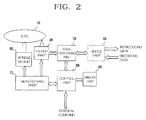
- FIG. 2 is a diagram illustrating a configuration of an optical recording device to which the present invention is suitably applied.
- the optical recording device comprises a spindle motor 80 for rotating a loaded disc 10, a pickup part 20 for reading/writing information from/to the disc 10, a signal processing part 30 for performing signal processing such as error correction, an ENDEC part 40 for performing compression/decompression operations on data, a control part 50 for controlling recording/reproducing operations, a memory part 60, and a servo driving part 70.
- ENDEC part 40 may be incorporated in the main frame of the computer.
- the brief process for reproducing data is as follows: When the pickup part 20 reads-in data that is recorded in the disc 10 and sends it to the signal processing part 30, the signal processing part 30 performs the processing such as error correction on the data and then sends the data having the error correction processed to ENDEC part 40.
- ENDEC part 40 decompresses the compressed data and outputs the data.
- ENDEC part 40 compresses the data and sends the compressed data to the signal processing part 30, and the signal processing part 30 performs a predetermined signal processing and then sends the processed data to the pickup part 20.
- the pickup part 20 emits laser beam depending on the input signal on the disc and records the data.
- the reproducing/recording processes described above are performed by the control part 50.
- the control part 50 recognizes a space area, determines a target space block in which additional data is to be written, and then allows the input additional data to be recorded in the target space block of the disc via the ENDEC part 40, the signal processing part 30, and the pickup part 20.
- the control part 50 monitors the position where the recording operation is currently performed, and allows the recording operation to end if the target space block is full.
- the space area is recognized by reading-out the space area information from the disc, or generating the space area information and storing it in the memory part 60. Each time the recording and erasing operations are performed on the data, the control part 50 allows the space area information stored in the memory part 60 to be updated.
- Fig. 3 is a flow chart for explaining one embodiment of the present invention.
- the recording control method recognizes space area at step S350, determines target space block in which additional data is to be written later at step S400, and begins the recording at step S450. Then, the method confirms that all of the additional data are written at step S500 and ends the recording operation if the recording has been completed at step S600. If not, the method confirms that the target space block is full while continuing the recording operation at step (S550) and ends the recording operation if the space block is full (S600).
- the space area may be recognized in different ways. In the simplest manner, it is possible to scan and recognize the disc, but in accordance with the standards of the current DVD-RAM, -RW, and +RW, since only the file system is updated without the real data being erased even if the title is erased, it is not possible to completely recognize the space area only by scanning the disc. Accordingly, in the case employing the standards of DVD-RAM, -RW, and +RW, it is desirable to reference the file system and recognize the space area. Of course, in the case of the space area information being previously stored in the disc, it is possible to read the space area information to recognize the space area.
- the space area information collectively refers to the positional information on each of the space blocks constituting the space area.
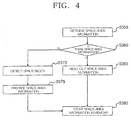
- FIG. 4 shows a preferred example for recognizing space area.
- the space area information is retrieved from the disc at step S355, and it is confirmed that the space area information was previously written in the disc at step S360. If the space area information was previously written, the information is read at step S365 and stored in the memory at step S380. If the information is not found in the disc, after detecting the space block at step S370, the space area information is newly prepared at step S375, and then the information is stored in the memory at step S380.
- the target space block may be also determined in different ways. Simply, it is possible to display the space area information to a user and allow the user to select the target space block. Alternatively, it is also possible to uniformly define the foremost space block or the largest size of space block as the target space block.
- FIG. 5 is a flow chart illustrating an example for determining the target space block.
- the largest size of space block is calculated at step S420 and the calculated block is determined as the target space block at step S425.
- the largest size of space block is calculated at step S420 and the calculated block is determined as the target space block at step S425. If yes, the smallest space block of the space blocks having a larger size than the target data is calculated at step S415 and the calculated block is determined as the target space block.
- target data for example, data stored in the computer may be recorded as shown in FIG. 1 (a), or data stored in hard disk drive may be recorded in the disc as shown in FIG. 1 (c). If the size of target data can not be determined, for example, broadcasting data may be recorded in the disc to telerecord it as shown in FIG. 1 (b). However, since even if the data is the broadcasting data, its size may be previously determined, and even if the data is stored in the hard disk drive, its size may not be previously determined, it is not desirable to uniformly define the size of data according to the data source.
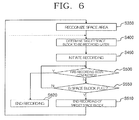
- FIG. 6 is a flow chart for explaining another embodiment according to the present invention.
- the recording operation is terminated at step S610, and then the recording operation is resumed by determining a new target space block at step S400. While recording at step 450 and determining the new target space block in this manner, if all of the data have been recorded or the cease command is input by the user, it is determined as having the recording completed at step S500, thereby the recording operation ends at step S620.
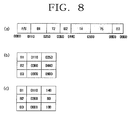
- FIG. 8 shows an example of the space area information according to an embodiment of the present invention.
- FIG. 8 (a) conceptually shows the Data Area of the optical medium, with F/S indicating a file system; T2, T4 and T5 indicating titles, respectively; B1, B2, and B3 indicating space blocks, respectively.
- the numbers indicated below each boundary line refers to an address.
- the address differs from the actual address used in the optical medium such as DVD, and for explanation is optionally defined.
- the positional information on each of the space blocks can be indicated using the physical or logical address defined in the standards.
- FIG. 8 (b) illustrates an example of the space area information for the optical medium of FIG. 8 (a).
- the space area information in FIG. 8 (b) has the starting address and ending address for each of the space blocks (B1, B2, B3) as the positional information.
- FIG. 8 (c) illustrates another example of the space area information for the optical medium of FIG. 8 (a), wherein the space area information has the starting address and size for each of the space blocks (B1, B2, B3) as the positional information.
- FIG. 9 and FIG. 10 are views for explaining the updating of the space area information according to an embodiment of the present invention.
- FIG. 9 (a) is a diagram illustrating the Data Area of the optical medium.
- FIG. 9 (a) conceptually shows the data area of the optical medium, wherein F/S indicates the file system; T2, T4 and T5 indicate valid titles, respectively; B1, B2, and B3 indicate space blocks, respectively.
- the space area information is the same as that of FIG. 10 (a).
- the space area information FIG. 10 (a) has the starting address and size for each of the space blocks.
- FIG. 9 (b) illustrates title T4 being removed from the optical medium of FIG. 9 (a).
- the space block B4 is generated by removing the title T4. However, since the space block B4 is adjacent to space block B2, it is desirable to handle these blocks as one space block without handling as individual space blocks.
- FIG. 10 (b) shows the space area information for FIG. 9 (b). The space area information is updated by changing the size value of the space block B2 without separately including the positional information for a new space block B4. That is, B2 and B4 in FIG. (b) are treated as one B2.
- FIG. 9 (c) illustrates a new title T6 being added in the optical medium of FIG. 9 (b) .
- target space block is determined by referring to the space area information of FIG. 10 (b), wherein the largest size of space block B2 is determined as the target space block in the embodiment. Since the new title T6 is not greater than the entire size of the target space block B2, the space block where the recording is not performed remains even after the recording has been completed. In this case, the remaining space is intended to indicate the space area information.
- FIG. 10 (c) shows the space area information for FIG. 9 (c).
- FIG. 10 (c) indicates the starting address and the positional information for the space block B2 having the size value changed.
- the space area information is updated for every erasing and writing of data.
- the space area information is stored in the memory, and when ejecting or finalizing the disk or according to the user's command, the space area information is regularly written to in a given area of the disk.
- the embodiment describes the recording control method of the case where the present invention is applied to DVD recording device. With reference to FIG. 11 to FIG. 13, the description will be made on the recording control method.
- space area information is retrieved from Random Access Memory or Recording Management Area (RAM) in order to recognize the space area at step S810.
- RAM Random Access Memory or Recording Management Area
- the determination on which area of the space area information is to be retrieved from depends on which area of the space area information is to be stored in. Which area of the space area information is to be stored in is a matter of choice, but it is not required to determine which area is more efficient. It is possible to store the space area information in the space area of the Data Area or in the area randomly usable by the user of the areas defined in the other standards.
- the space block is calculated at step S813 from TOC or the file system, the space area information is prepared based on the calculated space block at step S814, and then the prepared space area information is stored in the memory at step S815.
- the space area information is read at step S812, and is stored in the memory at step S815.
- the space area information After storing the space area information in the memory, whenever erasing and recording commands are input, the space area information is updated.
- step (S820) when the erasing command is input at step (S820), the selected title is erased at step S821 and the space area information is updated at step 822. Since the description on how to update the space area information has been explained above, a detailed description thereof will be omitted.
- the target space block is determined at step S831.
- the phrase "when the recording command is input” refers to the input of the additional recording command. Also, since the description on how to determine the target space block has been explained above, a detailed description thereof will be omitted.
- the recording operation is initiated at step S832, and it determines whether the recording has been completed at step S833. In the case where the recording has been not completed, it determines if the space block is full at step S834. The recording operation continues if the recording has been not completed and the space block is not full, but the recording operation ends if the recording has been completed and the space block is full at step S835.
- the space area information is written in RMA at step S841.
- the space area information is not necessary to be written in RAM.
- the user's recording command refers to the command causing the space area information to be written in the disk.
- the present embodiment describes a method for performing the recording later in the space block selected by the user with reference to FIG. 14.
- the space area information is output at step S2000.
- the selection signal for the target space block is received from the user at step S3000, data is written in the selected target space block at step S4000.
- the recording command is received at step S1000, and then the space area information is output, it is possible to receive the output command for the space area information, output the space area information, receive the selection signal for the target space block, receive the recording command from the user, and record the space area information.
- the order described above is not limited.
- the recording of data can be performed by the method described in the above embodiments.
- the message is output which indicates the end of the recording.
- titles from the user before or after the recording. At this time, if one title is input for the plurality of space blocks, for example, for data recorded in each of the space block, the titles are given such as 'title 1', 'title 2' by adding the number in sequence.
- the recording command is received at step S910, the remaining steps of performing the recording at steps S930, S940, S950, and S960 except for the step of detecting the space block at step S920 are similar to those of the embodiment 1.
- the recording control method according to the modified embodiment which one of at least one or more space blocks present in the optical medium is detected and the additional recording is performed. If there is no space block, the additional recording is not performed. If so, it is preferred to display the message of 'no additional recording is performed' and inform the user of the message.
- step S910 if an additional recording command is input at step S910, the recording operation is initiated at step S930 by detecting any space block in which data is written at step S920.
- the subsequent steps S941, S950, S962, and S965 are similar to those of the embodiment 2. That is, if that space block is full during the additional recording, the recording operation is terminated, and then another space block is detected to perform the recording.
- the processes for detecting the space block and performing the recording are repeated.
- the utilization of the embodiments of the present invention is very high, but is not limited to, when recording data, especially, video data and broadcasting data, are written to later in a rewritable optical medium.
Landscapes
- Engineering & Computer Science (AREA)
- Multimedia (AREA)
- Signal Processing (AREA)
- Signal Processing For Digital Recording And Reproducing (AREA)
- Management Or Editing Of Information On Record Carriers (AREA)
- Optical Recording Or Reproduction (AREA)
Applications Claiming Priority (2)
| Application Number | Priority Date | Filing Date | Title |
|---|---|---|---|
| KR1020040001111A KR100555945B1 (ko) | 2004-01-08 | 2004-01-08 | 재기록 가능한 광 매체에 데이터를 추가 기록하기 위한기록제어방법 및 빈 영역 관리방법 |
| KR2004001111 | 2004-01-08 |
Publications (1)
| Publication Number | Publication Date |
|---|---|
| EP1553594A1 true EP1553594A1 (fr) | 2005-07-13 |
Family
ID=34588131
Family Applications (1)
| Application Number | Title | Priority Date | Filing Date |
|---|---|---|---|
| EP04257565A Withdrawn EP1553594A1 (fr) | 2004-01-08 | 2004-12-06 | Appareil et méthode de contrôle d'enregistrement et de gestion de zone d'espace pour enregistrer des données supplémentaires sur un support optique réenregistrable |
Country Status (5)
| Country | Link |
|---|---|
| US (1) | US7606131B2 (fr) |
| EP (1) | EP1553594A1 (fr) |
| JP (1) | JP2005196960A (fr) |
| KR (1) | KR100555945B1 (fr) |
| CN (1) | CN100367391C (fr) |
Families Citing this family (1)
| Publication number | Priority date | Publication date | Assignee | Title |
|---|---|---|---|---|
| JP2008226307A (ja) * | 2007-03-09 | 2008-09-25 | Kenwood Corp | データ記録装置、データ記録方法及びデータ記録プログラム |
Citations (6)
| Publication number | Priority date | Publication date | Assignee | Title |
|---|---|---|---|---|
| JPH09147533A (ja) * | 1995-11-20 | 1997-06-06 | Sony Corp | 記録装置 |
| EP0905699A2 (fr) * | 1997-09-17 | 1999-03-31 | Matsushita Electric Industrial Co., Ltd | Appareil d'enregistrement de disque optique, support d'enregistrement lisable par ordinateur enregistrant un programme de gestion de fichiers, et disque optique |
| US6052346A (en) * | 1994-04-20 | 2000-04-18 | Sony Corporation | Methods and apparatus for recording data on and deleting already recorded data from a recording medium |
| WO2001001415A1 (fr) * | 1999-06-25 | 2001-01-04 | Koninklijke Philips Electronics N.V. | Ordre de titres dans un enregistrement video dvd en temps reel |
| EP1126454A1 (fr) * | 1999-07-07 | 2001-08-22 | Matsushita Electric Industrial Co., Ltd. | Dispositif d'enregistrement de donnees audiovisuelles, disque enregistre a l'aide de ce dispositif, et dispositif de reproduction et procede associes |
| JP2002077795A (ja) * | 2000-08-24 | 2002-03-15 | Victor Co Of Japan Ltd | ディスク記録装置及びディスク記録方法 |
Family Cites Families (16)
| Publication number | Priority date | Publication date | Assignee | Title |
|---|---|---|---|---|
| US5617380A (en) * | 1995-01-04 | 1997-04-01 | Fujitsu Limited | Apparatus and method for drive management for multi-pass storage devices |
| JPH09259576A (ja) * | 1996-03-25 | 1997-10-03 | Toshiba Corp | 複数管理領域を持つ情報記録ディスク |
| US6121974A (en) * | 1996-06-27 | 2000-09-19 | Cirrus Logic, Inc. | Priority storage system for fast memory devices |
| DE69718355T2 (de) * | 1996-09-30 | 2003-09-04 | Matsushita Electric Industrial Co., Ltd. | Aufzeichnungsverfahren zur Aufzeichnung audiovisueller Daten auf einer Platte und Informationsverarbeitungssystem |
| US5930827A (en) * | 1996-12-02 | 1999-07-27 | Intel Corporation | Method and apparatus for dynamic memory management by association of free memory blocks using a binary tree organized in an address and size dependent manner |
| JP3069324B2 (ja) | 1997-09-17 | 2000-07-24 | 松下電器産業株式会社 | 光ディスク記録装置、記録方法及びプログラム記録媒体 |
| JP2000090645A (ja) * | 1998-09-08 | 2000-03-31 | Sony Corp | ファイル管理装置および方法、並びに提供媒体 |
| JP2000268506A (ja) | 1999-03-18 | 2000-09-29 | Hitachi Maxell Ltd | 光ディスクドライブ及び光ディスク記録方法 |
| US6904229B1 (en) * | 1999-08-20 | 2005-06-07 | Canon Kabushiki Kaisha | Apparatus for recording signals on disk recording medium |
| US6643754B1 (en) * | 2000-02-15 | 2003-11-04 | International Business Machines Corporation | System and method for dynamically allocating computer memory |
| KR100800407B1 (ko) | 2000-07-12 | 2008-02-04 | 엘지전자 주식회사 | 재기록 가능 광디스크 장치에서의 데이터 기록방법 |
| JP2002050131A (ja) | 2000-08-03 | 2002-02-15 | Hitachi Ltd | 追記型記録媒体の記録制御方法 |
| JP2002117627A (ja) | 2000-10-05 | 2002-04-19 | Sony Corp | データ記録方法およびデータ記録装置 |
| JP2003059184A (ja) | 2001-08-13 | 2003-02-28 | Matsushita Electric Ind Co Ltd | Dvd−rおよびdvd−rwにおける記録位置ずれ補正方法およびその装置 |
| KR20030065160A (ko) * | 2002-01-31 | 2003-08-06 | 삼성전자주식회사 | 파이널라이즈 이후 추가 데이터 기록이 가능한 저장매체,그 기록 및 재생 장치와 방법 |
| AU2003201838A1 (en) * | 2002-04-01 | 2003-10-23 | Sony Corporation | Reproducing method, reproducing apparatus, and data accessing method |
-
2004
- 2004-01-08 KR KR1020040001111A patent/KR100555945B1/ko not_active Expired - Fee Related
- 2004-09-23 US US10/947,441 patent/US7606131B2/en not_active Expired - Fee Related
- 2004-12-06 EP EP04257565A patent/EP1553594A1/fr not_active Withdrawn
- 2004-12-10 CN CNB2004100984098A patent/CN100367391C/zh not_active Expired - Fee Related
-
2005
- 2005-01-06 JP JP2005001940A patent/JP2005196960A/ja active Pending
Patent Citations (6)
| Publication number | Priority date | Publication date | Assignee | Title |
|---|---|---|---|---|
| US6052346A (en) * | 1994-04-20 | 2000-04-18 | Sony Corporation | Methods and apparatus for recording data on and deleting already recorded data from a recording medium |
| JPH09147533A (ja) * | 1995-11-20 | 1997-06-06 | Sony Corp | 記録装置 |
| EP0905699A2 (fr) * | 1997-09-17 | 1999-03-31 | Matsushita Electric Industrial Co., Ltd | Appareil d'enregistrement de disque optique, support d'enregistrement lisable par ordinateur enregistrant un programme de gestion de fichiers, et disque optique |
| WO2001001415A1 (fr) * | 1999-06-25 | 2001-01-04 | Koninklijke Philips Electronics N.V. | Ordre de titres dans un enregistrement video dvd en temps reel |
| EP1126454A1 (fr) * | 1999-07-07 | 2001-08-22 | Matsushita Electric Industrial Co., Ltd. | Dispositif d'enregistrement de donnees audiovisuelles, disque enregistre a l'aide de ce dispositif, et dispositif de reproduction et procede associes |
| JP2002077795A (ja) * | 2000-08-24 | 2002-03-15 | Victor Co Of Japan Ltd | ディスク記録装置及びディスク記録方法 |
Non-Patent Citations (2)
| Title |
|---|
| PATENT ABSTRACTS OF JAPAN vol. 1997, no. 10 31 October 1997 (1997-10-31) * |
| PATENT ABSTRACTS OF JAPAN vol. 2002, no. 07 3 July 2002 (2002-07-03) * |
Also Published As
| Publication number | Publication date |
|---|---|
| KR20050072953A (ko) | 2005-07-13 |
| KR100555945B1 (ko) | 2006-03-03 |
| US7606131B2 (en) | 2009-10-20 |
| US20050152250A1 (en) | 2005-07-14 |
| JP2005196960A (ja) | 2005-07-21 |
| CN1637917A (zh) | 2005-07-13 |
| CN100367391C (zh) | 2008-02-06 |
Similar Documents
| Publication | Publication Date | Title |
|---|---|---|
| JP4315258B2 (ja) | 追記型記録媒体、追記型記録媒体用の記録装置および記録方法、並びに追記型記録媒体用の再生装置および再生方法 | |
| US7400565B2 (en) | Reproduction method, a program, a recording medium, and a drive apparatus | |
| US8081396B2 (en) | Processing data recorded on a tape medium | |
| US7697387B2 (en) | Information recording medium, and information recording apparatus and method | |
| MXPA06010800A (es) | Medio de grabacion tipo escritura una sola vez, aparato de grabacion y metodo para el mismo, aparato de reproduccion y metodo para el mismo y programa de computo. | |
| JP4088899B2 (ja) | 記録再生装置および記録再生方法、並びにプログラム | |
| EP1553594A1 (fr) | Appareil et méthode de contrôle d'enregistrement et de gestion de zone d'espace pour enregistrer des données supplémentaires sur un support optique réenregistrable | |
| US20100165503A1 (en) | Method and apparatus for recording and reading information | |
| JP4175356B2 (ja) | 光ディスク記録装置 | |
| KR101041062B1 (ko) | 추기형 기록 매체, 추기형 기록 매체용의 기록 장치 및 기록 방법, 및 추기형 기록 매체용의 재생 장치 및 재생 방법 | |
| US7522489B2 (en) | Initialization method, reproduction method, computer-executable program product, computer-readable recording medium, data structure, information recording apparatuses, and information reproducing apparatus | |
| US7983123B2 (en) | Methods of defect management and reproduction, program and recording medium, and apparatuses for information recording and information reproduction | |
| JP4353755B2 (ja) | 情報記録媒体、情報記録再生装置、及び情報記録方法、並びに情報記録プログラム | |
| JP4100437B2 (ja) | ディスク再生装置 | |
| JP4218662B2 (ja) | 記録装置及び記録媒体 | |
| CN100570731C (zh) | 初始化记录介质的记录装置 | |
| KR20050090289A (ko) | 광 기록기기의 데이터 기록제어방법 | |
| JP2004110964A (ja) | 情報記録再生装置および交替処理方法 | |
| JP4883631B2 (ja) | オーディオ装置 | |
| JP4651603B2 (ja) | 情報記録再生装置 | |
| JP2006119850A (ja) | 情報処理装置及び情報処理方法 | |
| JP2007142813A (ja) | ディスク記録再生装置 | |
| JP2007080361A (ja) | 光ディスク記録装置 | |
| JP2006331644A (ja) | 追記型記録媒体、追記型記録媒体用の記録装置及び記録方法、追記型記録媒体用の再生装置及び再生方法、記録又は再生制御用のコンピュータプログラム、並びにデータ構造 | |
| KR20050088658A (ko) | 광 기록기기의 기록제어방법 |
Legal Events
| Date | Code | Title | Description |
|---|---|---|---|
| PUAI | Public reference made under article 153(3) epc to a published international application that has entered the european phase |
Free format text: ORIGINAL CODE: 0009012 |
|
| 17P | Request for examination filed |
Effective date: 20050104 |
|
| AK | Designated contracting states |
Kind code of ref document: A1 Designated state(s): AT BE BG CH CY CZ DE DK EE ES FI FR GB GR HU IE IS IT LI LT LU MC NL PL PT RO SE SI SK TR |
|
| AX | Request for extension of the european patent |
Extension state: AL BA HR LV MK YU |
|
| AKX | Designation fees paid |
Designated state(s): DE GB NL |
|
| RAP1 | Party data changed (applicant data changed or rights of an application transferred) |
Owner name: SAMSUNG ELECTRONICS CO., LTD. |
|
| 17Q | First examination report despatched |
Effective date: 20140213 |
|
| STAA | Information on the status of an ep patent application or granted ep patent |
Free format text: STATUS: THE APPLICATION IS DEEMED TO BE WITHDRAWN |
|
| 18D | Application deemed to be withdrawn |
Effective date: 20140623 |