EP1553743B1 - Mehrträgerempfänger mit zuverlässiger Onlineneukonfiguration - Google Patents
Mehrträgerempfänger mit zuverlässiger Onlineneukonfiguration Download PDFInfo
- Publication number
- EP1553743B1 EP1553743B1 EP04290024A EP04290024A EP1553743B1 EP 1553743 B1 EP1553743 B1 EP 1553743B1 EP 04290024 A EP04290024 A EP 04290024A EP 04290024 A EP04290024 A EP 04290024A EP 1553743 B1 EP1553743 B1 EP 1553743B1
- Authority
- EP
- European Patent Office
- Prior art keywords
- atu
- reconfiguration
- bitswap
- carrier transceiver
- overhead
- Prior art date
- Legal status (The legal status is an assumption and is not a legal conclusion. Google has not performed a legal analysis and makes no representation as to the accuracy of the status listed.)
- Expired - Lifetime
Links
- 239000000969 carrier Substances 0.000 claims description 36
- 238000000034 method Methods 0.000 claims description 23
- 230000007246 mechanism Effects 0.000 description 8
- 230000005540 biological transmission Effects 0.000 description 6
- 230000008569 process Effects 0.000 description 4
- 230000008859 change Effects 0.000 description 3
- 230000000694 effects Effects 0.000 description 3
- 230000001360 synchronised effect Effects 0.000 description 3
- 238000004891 communication Methods 0.000 description 2
- 230000000295 complement effect Effects 0.000 description 2
- 238000010586 diagram Methods 0.000 description 2
- 238000011144 upstream manufacturing Methods 0.000 description 2
- RYGMFSIKBFXOCR-UHFFFAOYSA-N Copper Chemical compound [Cu] RYGMFSIKBFXOCR-UHFFFAOYSA-N 0.000 description 1
- 230000006978 adaptation Effects 0.000 description 1
- 230000015556 catabolic process Effects 0.000 description 1
- 229910052802 copper Inorganic materials 0.000 description 1
- 239000010949 copper Substances 0.000 description 1
- 238000006731 degradation reaction Methods 0.000 description 1
- 238000001514 detection method Methods 0.000 description 1
- 238000005516 engineering process Methods 0.000 description 1
- 239000000835 fiber Substances 0.000 description 1
- 230000001771 impaired effect Effects 0.000 description 1
- 238000009434 installation Methods 0.000 description 1
- 238000011084 recovery Methods 0.000 description 1
Images
Classifications
-
- H—ELECTRICITY
- H04—ELECTRIC COMMUNICATION TECHNIQUE
- H04L—TRANSMISSION OF DIGITAL INFORMATION, e.g. TELEGRAPHIC COMMUNICATION
- H04L27/00—Modulated-carrier systems
- H04L27/26—Systems using multi-frequency codes
- H04L27/2601—Multicarrier modulation systems
- H04L27/2602—Signal structure
- H04L27/261—Details of reference signals
-
- H—ELECTRICITY
- H04—ELECTRIC COMMUNICATION TECHNIQUE
- H04L—TRANSMISSION OF DIGITAL INFORMATION, e.g. TELEGRAPHIC COMMUNICATION
- H04L5/00—Arrangements affording multiple use of the transmission path
- H04L5/003—Arrangements for allocating sub-channels of the transmission path
- H04L5/0044—Allocation of payload; Allocation of data channels, e.g. PDSCH or PUSCH
- H04L5/0046—Determination of the number of bits transmitted on different sub-channels
-
- H—ELECTRICITY
- H04—ELECTRIC COMMUNICATION TECHNIQUE
- H04L—TRANSMISSION OF DIGITAL INFORMATION, e.g. TELEGRAPHIC COMMUNICATION
- H04L5/00—Arrangements affording multiple use of the transmission path
- H04L5/003—Arrangements for allocating sub-channels of the transmission path
- H04L5/0053—Allocation of signalling, i.e. of overhead other than pilot signals
-
- H—ELECTRICITY
- H04—ELECTRIC COMMUNICATION TECHNIQUE
- H04L—TRANSMISSION OF DIGITAL INFORMATION, e.g. TELEGRAPHIC COMMUNICATION
- H04L5/00—Arrangements affording multiple use of the transmission path
- H04L5/0091—Signalling for the administration of the divided path, e.g. signalling of configuration information
- H04L5/0094—Indication of how sub-channels of the path are allocated
-
- H—ELECTRICITY
- H04—ELECTRIC COMMUNICATION TECHNIQUE
- H04L—TRANSMISSION OF DIGITAL INFORMATION, e.g. TELEGRAPHIC COMMUNICATION
- H04L5/00—Arrangements affording multiple use of the transmission path
- H04L5/0001—Arrangements for dividing the transmission path
- H04L5/0003—Two-dimensional division
- H04L5/0005—Time-frequency
- H04L5/0007—Time-frequency the frequencies being orthogonal, e.g. OFDM(A) or DMT
Definitions
- the present invention relates to a method and means in multi-carrier transceivers for online reconfiguration in the presence of changing noise and/or changing line conditions.
- the online reconfiguration function will update the bit loading and/or the transmit power of the different carriers when for instance the reception quality of certain carriers degrade, in order to preserve optimal performance.
- Such an online reconfiguration mechanism is already known from section 10 of the ANSI T1E1.413-1998 Specification entitled "Network and Customer Installation Interfaces - Asymmetric Digital Subscriber Line (ADSL) Metallic Interface”.
- ADSL Digital Subscriber Line
- Bit Swapping online updating the number of bits assigned to carriers (named subcarriers in T1E1.413-1998) and changing the transmit energy of carriers.
- the known ADSL bit swap process makes use of the overhead control channel or so called AOC channel (Auxiliary Overhead Channel) to convey the bit swap request and bit swap acknowledge messages between the multi-carrier transceivers whose bit and power allocations will be updated as a result of the changing noise or line conditions.
- the AOC bytes are carried as overhead bytes in the ADSL frame structure.
- the bitswap commands themselves may be impaired. In that case, the multi-carrier transceiver will be unable to successfully complete online reconfiguration.
- the robustness problem of the online reconfiguration mechanism is even worse because the AOC bytes are modulated on a fixed set of carriers, as a consequence of which noise at a few particular frequencies can disturb the transfer of bit swap commands.
- the AOC bytes constitute the start of the data contents of a Discrete Multi Tone symbol, as a result of which the AOC bytes are always modulated on the carriers carrying the least bits (tone or carrier ordering principle described in section 6.7 of the above cited ANSI T1E1.413-1998 Spec).
- Those tones are usually lying at the border of the ADSL passband and do suffer most from inter-symbol and inter-carrier interference (ISI/ICI), making the AOC overhead channel and the online reconfiguration process even more vulnerable to changing noise or line conditions.
- ISI/ICI inter-symbol and inter-carrier interference
- An object of the present invention is to provide a mechanism and means for online reconfiguration in multi-carrier transceivers with increased reliability and robustness over the known bit swap technique.
- this object is realized by the method for reconfiguration as defined by claim 1, and the multi-carrier transceiver as defined by claim 7.
- bit swap bit and transmit energy reallocation
- the bit swap for the information channel can only be carried out reliably if the overhead channel conveying the bit swap commands has sufficient quality. If the loop quality degrades due to changing noise or line conditions, the first priority should therefore be to improve the quality of the overhead channel by reconfiguration of the overhead channel.
- the bit swap should first be applied to carriers that carry the data corresponding to the bit swap protocol. Only when these carriers have been successfully protected will further bit swap of the information bearing carriers be performed. Obviously, this may require repeated transmission of certain bit swap commands.
- the reconfiguration mechanism according to the current invention has the best effect when the bit swap commands, or more generally the overhead bytes, have a fixed position in the multi-carrier frame as a result of which these overhead bytes will be mapped onto a fixed set of carriers.
- the bit swap commands or more generally the overhead bytes
- a typical implementation of the invented reconfiguration method is initiated by sending a request for reconfiguration.
- the request tells the other transceiver which carriers carrying overhead data have to be modified.
- the transceiver receiving the reconfiguration request responds with an acknowledge message indicating the point in time from which the new configuration will take effect.
- Both transceivers thereupon prepare for the bitswap and at the appropriate time modify the bit assignment and/or the transmit energy assignment for the overhead data bearing carriers. It is evident however that tens of variant message sequences can be thought off leading to the same result, which is the reconfiguration of the overhead channel between two multi-carrier transceivers in order to make this overhead channel more reliable and more robust. Also, the contents of the messages could be different in variant implementations of the online configuration method according to the present invention.
- the transceiver sending the request for reconfiguration of the overhead channel shall start a time-out period from the moment it sends the request.
- the transceiver shall re-send the request for reconfiguration with the same parameter values, and shall re-start the time-out period. Only when an acknowledgement has been detected within the time-out interval shall the transceiver prepare for reconfiguration of the overhead channel at the point in time indicated in the acknowledge message.
- the information channel reconfiguration might be initiated by a request from one transceiver followed by an acknowledgement from the other transceiver.
- the request contains the parameters for the reconfiguration, e.g. the carrier indexes of information bearing carriers to be modified, as well as the amounts of bits to be reassigned and/or amounts of transmit energy to be assigned to the respective information bearing carriers.
- the acknowledge message informs on the time moment where the reconfiguration of the information channel shall take place.
- the current invention is suitable for implementation in various multi-carrier systems like Discrete Multi Tone (DMT) based multi-carrier systems such as ADSL (Asymmetric Digital Subscriber Line) or VDSL (Very High Speed Digital Subscriber Line) systems, OFDM based multi-carrier systems, DWMT based multi-carrier systems, etc.
- DMT Discrete Multi Tone
- the overhead channel can be better protected by assigning a signal to noise ratio margin to the overhead bearing tones which is larger than the signal to noise ratio margin assigned to the information bearing tones. This can be done either during initialization or at reconfiguration.
- the request for reconfiguration of the information channel will repeatedly be sent out until an acknowledge message is received within a predetermined time-out interval. Only when the acknowledge message is received within the time-out interval, shall the multi-carrier transceivers prepare for the change in bit assignments and the transmit energy assignments for the information channel.
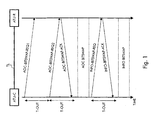
- the time diagram of Fig. 1 shows a sample sequence of messages sent over the AOC channel between a central office ADSL transceiver ATU-C and a remote ADSL transceiver unit ATU-R in order to perform a bitswap operation in a manner according to the present invention.
- Both ADSL transceivers ATU-C and ATU-R are supposed to be DMT based ADSL transceivers communication over a twisted pair copper telephone loop TL.
- the transceivers thereto modulate information data and overhead data on a set of 256 carriers, part of which are used for downstream transmission from ATU-C to ATU-R, and part of which are used for upstream transmission from ATU-R to ATU-C.
- the bit swap process enables the ADSL transceivers ATU-C and ATU-R to change the number of bits assigned to the carriers and/or to change the transmit energy of the carriers without interrupting the data flow.
- Either transceiver, ATU-C or ATU-R may initiate a bitswap upon detection of changing noise or line conditions.
- the bit swap procedures for the upstream and downstream directions are independent, but may take place simultaneously.
- the central office ADSL transceiver ATU-C initiates the bitswap by sending an overhead bitswap request message AOC-BITSWAP-REQ1.
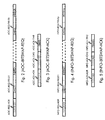
- This overhead bitswap request message AOC-BITSWAP-REQ1 consists of a message header AOC-REQ-HDR and k message fields, AOC-REQ-FIELD1 to AOC-REQ-FIELDk as shown in Fig. 2.
- the overhead bitswap request message header AOC-REQ-HDR consists of eight binary ones, whereas the k message fields AOC-REQ-FIELD1 to AOC-REQ-FIELDk each consist of an eight bit command, CMD21 to CMD2k, followed by an eight bit carrier index, INDEX21 to INDEX2k.
- the carrier indexes INDEX21 to INDEX2k correspond to indexes of tones that convey overhead channel data (AOC bits) and whose bit loading or transmit power has to be modified in order to improve the quality of the AOC channel given the changed noise or line conditions.
- the commands CMD21 to CMD2k specify for the respective tones how the bit and/or power allocation for that tone has to be modified.
- Valid commands and their meaning are supposed to be agreed upon beforehand between the transceivers ATU-C and ATU-R, or should be taken from a standardized table like table 44 in section 10.2.3 of the ANSI T1E1.413-1998 Specification .
- the central office transceiver ATU-C starts a time out period T-OUT from the moment it sends the overhead bitswap request message AOC-BITSWAP-REQ1. It receives no acknowledgement within this time out interval and therefor resends a copy AOC-BITSWAP-REQ2 of the overhead bitswap request message AOC-BITSWAP-REQ1 with the same parameter values, and restarts the time out interval T-OUT.
- the central office ADSL transceiver ATU-C can take recovery actions.
- the remote ADSL transceiver ATU-R responds to the second overhead bitswap request message AOC-BITSWAP-REQ2 with an overhead bitswap acknowledge message AOC-BITSWAP-ACK which arrives at the central office ADSL transceiver ATU-C before the time out interval T-OUT has expired.
- the overhead bitswap acknowledge message AOC-BITSWAP-ACK comprises a message header AOC-ACK-HDR and a single message field which consists of an eight bit acknowledge command AOC-ACK-CMD and an eight bit time field AOC-ACK-TIME. Both the message header AOC-ACK-HDR and the acknowledge command AOC-ACK-CMD are coded to contain eight binary ones.
- the time filed is included to indicate when the bit swap is to take place, and thereto contains a frame number FRAMEi.
- the new bit and/or power allocation for the overhead carrying tones shall take effect starting from the first frame of an ADSL superframe after the superframe counter has reached the number of FRAMEi.
- the ADSL transceivers ATU-C and ATU-R can coordinate and synchronize the bit swapping.
- superframe counting is performed modulo 256 by both the central office transceiver and remote transceiver, starting with superframe 0 at the beginning of showtime. This way, the superframe counters in ATU-C and ATU-R remain synchronized and serve well as a tool to also synchronize the bitswap process.
- the central office ADSL transceiver ATU-C in Fig. 2 Upon receipt of the overhead bitswap acknowledge message AOC-BITSWAP-ACK, the central office ADSL transceiver ATU-C in Fig. 2 waits until its superframe counter equals the value FRAMEi specified in time field AOC-ACK-TIME, and then starts the AOC BITSWAP by changing the overhead bit and power assignments for the appropriate carriers with indexes INDEX21 ... INDEX2k as specified in the commands CMD21 ... CMD2k. For example, CMD21 requires the number of overhead bits assigned to the tone with index INDEX21 to be increased by 1, ..., CMD2k requires the transmit energy allocated to the tone with index INDEX2k to be reduced by 2 dB.
- the remote transceiver ATU-R after having sent the overhead bitswap acknowledge message AOC-BITSWAP-ACK, waits until its superframe counter has reached the value FRAMEi and then also carries out the AOC BITSWAP
- the robustness of the carriers that will convey the bitswap commands for the information channel reconfiguration has increased. It is possible that further overhead bitswap requests have to be sent before the entire overhead channel is sufficiently qualitative and reliable to continue with the online reconfiguration of the information channel. According to the invention, only when the carriers that carry the overhead data (AOC channel) or at least the carriers that carry the bit swap commands have been successfully protected, will further bit swap be performed. This may require repeated transmission of overhead bitswap request and acknowledge messages.
- the central office ADSL transceiver ATU-C in Fig. 2 initiates the information channel bitswap by sending an information bitswap request message INFO-BITSWAP-REQ.
- This information bitswap request message INFO-BITSWAP-REQ comprises a message header INFO-REQ-HDR and a number of message fields, INFO-REQ-FIELD1 to INFO-REQ-FIELDp, each consisting of a bitswap command, CMD41 to CMD4p, and a carrier index, INDEX41 to INDEX4p, as illustrated by Fig. 4.
- the carrier indexes INDEX41 to INDEX4p point at tones that transport information bits and whose bit and/or energy constellation has to be adjusted as a result of the changed noise or line conditions.
- the bit swap commands CMD41 to CMD4p indicate how the bit and energy assignments of the respective carriers with indexes INDEX41 to INDEX4p have to be modified.
- the message header INFO-REQ-HDR serves the purpose of recognizing the kind of message at receiver side and is for instance coded with the eight bit sequence "11111101" (for the sake of clarity, this eight bit sequence is by example chosen different from the eight bit sequence used in the header of the overhead bitswap request message, but could have been chosen to contain exactly the same sequence "11111111” as well).
- the central office transceiver ATU-C From the moment on the information bitswap request message INFO-BITSWAP-REQ is sent, the central office transceiver ATU-C starts a time out interval T-OUT wherein it expects to receive acknowledgement. If no acknowledgement is received in time, a copy of the information bitswap request message INFO-BITSWAP REQ will be sent, and this can be repeated a finite number of times.
- the remote ADSL transceiver ATU-R responds to the information bitswap request message INFO-BITSWAP-REQ with an information acknowledge message INFO-BITSWAP-ACK that contains a message header INFO-ACK-HDR, an acknowledge command INFO-ACK-CMD and a time field INFO-ACK-TINIE, as depicted in Fig. 5.
- the message header INFO-ACK-HDR and acknowledge command INFO-ACK-CMD are both coded to contain the eight bit sequence "11111101" (again, these eight bit codes are chosen different from the eight bit codes used in the corresponding fields of the overhead bitswap acknowledge message by example, but could have been chosen to contain exactly the same sequence "11111111” as well), whereas the time field INFO-ACK-TIME is filled with a frame number FRAMEn corresponding to the sequence number of the ADSL superframe from which onwards the information bit swap has to be applied.
- the central office transceiver ATU-C receives the information bitswap acknowledge message INFO-BITSWAP-ACK within the time out period T-OUT, and starts waiting until its superframe counter equals the value FRAMEn. Beginning with the next ADSL superframe, the central office transceiver ATU-C will modify the bit and transmit energy assignments as specified in the information bitswap request message INFO-BITSWAP-REQ. For example, CMD41 may require to increase the transmit power of the tone with index INDEX41 by 3 dB, ..., CMD4p may require to decrease the amount of information bits assigned to the tone with index INDEX4p by 1.
- the remote ADSL transceiver ATU-R upon transmission of the information bitswap acknowledge message INFO-BITSWAP-ACK, shall start waiting until its superframe counter has reached the number of FRAMEn, and shall then carry out the INFORMATION BITSWAP by modifying the bit and energy assignments to the information bearing carriers.
- additional information bitswap request and acknowledge messages may have to be transmitted in order to improve the quality of the information channel between ATU-C and ATU-R to a satisfying level.
- the carriers that carry the overhead data could be extra protected during initialization or during one of the reconfiguration cycles by giving them extra signal-to-noise ratio margin with respect to the other tones.
- Current bit loading algorithms and bit swap protocols do not give special weight to the carriers that transport the reconfiguration commands. Implementing this feature would further enhance the chances that reconfiguration can be performed under severe noise constraints, and as a consequence further increases the stability of the multi-carrier system.
- the above example describes in detail a bit swap procedure, i.e. online re-allocation of bits and power amongst the carriers.
- the basic principle of first improving the quality of the overhead channel conveying the reconfiguration messages before reconfiguring the information channel is however equally applicable to other types of online reconfiguration such as SRA or seamless rate adaptation (online reconfiguration of the aggregate data rate by modifying frame multiplexor control parameters as well as modifying the bits and gains parameters), DRR or dynamic rate repartitioning (online reconfiguration of the data rate allocation between multiple latency paths by modifying frame multiplexor parameters as well as modifying the bits and gains parameters), or even other types of online reconfiguration.
- ADSL Asymmetric Digital Subscriber Line
- VDSL Very High Speed Digital Subscriber Line
- SDSL Synchronous Digital Subscriber Line
- HDSL High Speed Digital Subscriber Line
- multi-carrier modulation techniques are used for transferring between two transceivers both an information channel and an overhead channel over a set of carriers or tones.
Landscapes
- Engineering & Computer Science (AREA)
- Signal Processing (AREA)
- Computer Networks & Wireless Communication (AREA)
- Telephonic Communication Services (AREA)
- Cable Transmission Systems, Equalization Of Radio And Reduction Of Echo (AREA)
- Communication Control (AREA)
- Structure Of Receivers (AREA)
- Circuits Of Receivers In General (AREA)
Claims (10)
- Verfahren, um im Fall sich ändernder Störungs- oder Leitungsbedingungen die Übertragung von Informationskanal-Daten und Kopfinformations-Kanal-Daten zwischen einem ersten Mehrträger-Sender/Empfänger (ATU-C) und einem zweiten Mehrträger-Sender/Empfänger (ATU-R) online neu zu konfigurieren, wobei der Kopfinformations-Kanal mindestens dazu geeignet ist, Daten-Neukonfigurations-Nachrichten zu übertragen,
DADURCH GEKENNZEICHNET, DASS das Verfahren folgende sukzessive Schritte umfasst:a. Zuerst erfolgreiche Neukonfiguration der Kopfinformations-Kanal-Daten in den beiden kommunizierenden Mehrträger-Sendern/Empfängern, undb. Danach Neukonfiguration der Informationskanal-Daten. - Verfahren gemäß Anspruch 1,
DADURCH GEKENNZEICHNET, DASS der Schritt der Neukonfiguration der Kopfinformations-Kanal-Daten folgendes umfasst:a1. Von dem ersten Mehrträger-Sender/Empfänger (ATU-C) zum zweiten Mehrträger-Sender/Empfänger (ATU-R) Senden einer Kopfinformations-Neukonfigurations-Anforderungs-Nachricht (AOC-BITSWAP-REQ1, AOC-BITSWAP-REQ2), die den zweiten Mehrträger-Sender/Empfänger (ATU-R) über Träger (INDEX21 ... INDEX2k) informiert, deren Bitbelastung oder Sendeenergie zur Neukonfiguration der Kopfinformations-Kanal-Daten geändert werden müssen;a2. Von dem zweiten Mehrträger-Sender/Empfänger (ATU-R) zum ersten Mehrträger-Sender/Empfänger (ATU-C) Senden einer Kopfinformations-Neukonfigurations-Quittungs-Nachricht (AOC-BITSWAP-ACK), die den ersten Mehrträger-Sender/Empfänger (ATU-C) über die Startzeit (FRAMEi) der Neukonfiguration der Kopfinformations-Kanal-Daten informiert;a3. Änderung der Kopfinformations-Daten-Zuordnung und/oder der Sendeenergie-Zuordnung für die Träger (INDEX21 ... INDEX2k) in dem ersten Mehrträger-Sender/Empfänger (ATU-C) und dem zweiten Mehrträger-Sender/Empfänger (ATU-R) ab dem Startzeitpunkt (FRAMEi). - Verfahren gemäß Anspruch 2,
DADURCH GEKENNZEICHNET, DASS der Schritt a1 wiederholt ausgeführt wird, bis die Kopfinformations-Neukonfigurations-Quittungs-Nachricht (AOC-BITSWAP-ACK) vom ersten Mehrträger-Sender/Empfänger (ATU-C) innerhalb einer vorher festgelegten Timeout-Periode (T-OUT) vom Senden der Kopfinformations-Neukonfigurations-Anforderungs-Nachricht (AOC-BITSWAP-REQ1, AOC-BITSWAP-REQ2) empfangen wird. - Verfahren gemäß Anspruch 1,
DADURCH GEKENNZEICHNET, DASS der Schritt der Neukonfiguration der Informationskanal-Daten folgendes umfasst:b1. Von dem ersten Mehrträger-Sender/Empfänger (ATU-C) zum zweiten Mehrträger-Sender/Empfänger (ATU-R) Senden einer Informations-Neukonfigurations-Anforderungs-Nachricht (INFO-BITSWAP-REQ), die den zweiten Mehrträger-Sender/Empfänger (ATU-R) über Träger (INDEX41 ... INDEX4p) informiert, deren Bitbelastung und/oder Sendeenergie zur Neukonfiguration der Informationskanal-Daten geändert werden müssen;b2. Von dem zweiten Mehrträger-Sender/Empfänger (ATU-R) zum ersten Mehrträger-Sender/Empfänger (ATU-C) Senden einer Informations-Neukonfigurations-Quittungs-Nachricht (INFO-BITSWAP-ACK), die den ersten Mehrträger-Sender/Empfänger (ATU-C) über die Startzeit (FRAMEn) der Neukonfiguration der Informationskanal-Daten informiert;b3. Änderung der Informationsdaten-Zuordnung und/oder der Sendeenergie-Zuordnung für die Träger (INDEX41 ... INDEX4p) in dem ersten Mehrträger-Sender/Empfänger (ATU-C) und dem zweiten Mehrträger-Sender/Empfänger (ATU-R) ab dem Startzeitpunkt (FRAMEn). - Verfahren gemäß Anspruch 4,
DADURCH GEKENNZEICHNET, DASS der Schritt b1 wiederholt ausgeführt wird, bis die Informations-Neukonfigurations-Quittungs-Nachricht (INFO-BITSWAP-ACK) vom ersten Mehrträger-Sender/Empfänger (ATU-C) innerhalb einer vorher festgelegten Timeout-Periode (T-OUT) vom Senden der Informations-Neukonfigurations-Anforderungs-Nachricht (INFO-BITSWAP-REQ) empfangen wird. - Verfahren gemäß Anspruch 1,
DADURCH GEKENNZEICHNET, DASS die Kopfinformations-Kanal-Daten zusätzlich dadurch geschützt sind, dass Trägern, welche die Kopfinformations-Kanal-Daten übertragen, eine Signal-Rauschverhältnis-Grenze zugeordnet wird, die höher ist als die Signal-Rauschverhältnis-Grenze, die Trägern zugeordnet wird, welche die Informationskanal-Daten übertragen. - Mehrträger-Sender/Empfänger (ATU-C) zum Senden und Empfangen eines Informationskanals und eines Kopfinformations-Kanals, wobei der Kopfinformations-Kanal mindestens dazu geeignet ist, Daten-Neukonfigurations-Nachrichten zu übertragen, und der Mehrträger-Sender/Empfänger (ATU-C) Neukonfigurations-Mittel enthält, um im Fall sich ändernder Störungs- oder Leitungsbedingungen die Übertragung von Informationskanal-Daten und Kopfinformations-Kanal-Daten zwischen dem Mehrträger-Sender/Empfänger (ATU-C) und einem zweiten Mehrträger-Sender/Empfänger (ATU-R) Online neu zu konfigurieren,
DADURCH GEKENNZEICHNET, DASS die Neukonfigurations-Mittel so angepasst sind, dass sie zuerst eine erfolgreiche Neukonfiguration der Kopfinformations-Kanal-Daten in den beiden kommunizierenden Sendern/Empfängern durchführen, bevor sie die Informationskanal-Daten neu konfigurieren. - Mehrträger-Sender/Empfänger gemäß Anspruch 7,
DADURCH GEKENNZEICHNET, DASS die Neukonfigurations-Mittel so angepasst sind, dass sie Neukonfigurations-Nachrichten (AOC-BITSWAP-REQ1, AOC-BITSWAP-REQ2, AOC-BITSWAP-ACK) für den Kopfinformations-Kanal senden/empfangen, bis die Kopfinformations-Kanal-Daten erfolgreich neu konfiguriert wurden, bevor Neukonfigurations-Nachrichten (INFO-BITSWAP-REQ INFO-BITSWAP-ACK) für den Informationskanal gesendet/empfangen werden. - Mehrträger-Sender/Empfänger (ATU-C) gemäß Anspruch 7,
DADURCH GEKENNZEICHNET, DASS der Mehrträger-Sender/Empfänger (ATU-C) ein Discrete Multitone Sender/Empfänger ist. - Mehrträger-Sender/Empfänger (ATU-C) gemäß Anspruch 9,
DADURCH GEKENNZEICHNET, DASS der Mehrträger-Sender/Empfänger (ATU-C) ein Digital Subscriber Line (DSL) Sender/Empfänger ist und die Neukonfigurations-Nachrichten Bitswap-Anforderungs- und Quittungs-Nachrichten sind.
Priority Applications (5)
| Application Number | Priority Date | Filing Date | Title |
|---|---|---|---|
| DE602004000641T DE602004000641T2 (de) | 2004-01-06 | 2004-01-06 | Mehrträgerempfänger mit zuverlässiger Onlineneukonfiguration |
| EP04290024A EP1553743B1 (de) | 2004-01-06 | 2004-01-06 | Mehrträgerempfänger mit zuverlässiger Onlineneukonfiguration |
| AT04290024T ATE323367T1 (de) | 2004-01-06 | 2004-01-06 | Mehrträgerempfänger mit zuverlässiger onlineneukonfiguration |
| ES04290024T ES2257724T3 (es) | 2004-01-06 | 2004-01-06 | Emisor-receptor de multiples portadoras con reconfiguracion en linea segura. |
| US11/028,587 US20050147043A1 (en) | 2004-01-06 | 2005-01-05 | Multi-carrier transceiver with reliable online reconfiguration |
Applications Claiming Priority (1)
| Application Number | Priority Date | Filing Date | Title |
|---|---|---|---|
| EP04290024A EP1553743B1 (de) | 2004-01-06 | 2004-01-06 | Mehrträgerempfänger mit zuverlässiger Onlineneukonfiguration |
Publications (2)
| Publication Number | Publication Date |
|---|---|
| EP1553743A1 EP1553743A1 (de) | 2005-07-13 |
| EP1553743B1 true EP1553743B1 (de) | 2006-04-12 |
Family
ID=34586005
Family Applications (1)
| Application Number | Title | Priority Date | Filing Date |
|---|---|---|---|
| EP04290024A Expired - Lifetime EP1553743B1 (de) | 2004-01-06 | 2004-01-06 | Mehrträgerempfänger mit zuverlässiger Onlineneukonfiguration |
Country Status (5)
| Country | Link |
|---|---|
| US (1) | US20050147043A1 (de) |
| EP (1) | EP1553743B1 (de) |
| AT (1) | ATE323367T1 (de) |
| DE (1) | DE602004000641T2 (de) |
| ES (1) | ES2257724T3 (de) |
Families Citing this family (10)
| Publication number | Priority date | Publication date | Assignee | Title |
|---|---|---|---|---|
| US20060176942A1 (en) * | 2005-02-07 | 2006-08-10 | Vladimir Oksman | On-line reconfiguration and synchronization protocol for multi-carrier DSL |
| WO2006109161A2 (en) * | 2005-04-15 | 2006-10-19 | Nokia Corporation | Method and apparatus for providing control channel monitoring in a multi-carrier system |
| JP4899555B2 (ja) * | 2006-03-17 | 2012-03-21 | 富士通株式会社 | 無線通信システム、送信装置及び受信装置 |
| US8441912B2 (en) * | 2006-09-18 | 2013-05-14 | Lantiq Deutschland Gmbh | Method and apparatus for data transmission |
| US20080220725A1 (en) | 2007-03-09 | 2008-09-11 | Infineon Technologies Ag | Data transmission method, communication system, transceiver, transmitter and receiver |
| EP2204935A1 (de) * | 2009-01-05 | 2010-07-07 | Alcatel, Lucent | Mehrträger-Terminierungseinheit mit Seamless Rekonfiguration der Tonordnungstabelle |
| CN101998533A (zh) * | 2009-08-14 | 2011-03-30 | 中兴通讯股份有限公司 | 一种lte-a多载波系统中载波配置、调度方法和系统 |
| EP3011700B1 (de) | 2013-06-18 | 2019-09-18 | Sckipio Technologies S.i Ltd | Robuste online-rekonfiguration (olr) und synchronisationsprotokoll für digitale teilnehmerleitung (dsl) |
| EP2997691B1 (de) * | 2013-08-21 | 2017-05-10 | Huawei Technologies Co., Ltd. | Übergangssynchronisation für eine online-neukonfiguration |
| CN107623562B (zh) * | 2017-09-30 | 2021-05-07 | 新华三技术有限公司 | 数据传输方法、装置及电子设备 |
Family Cites Families (13)
| Publication number | Priority date | Publication date | Assignee | Title |
|---|---|---|---|---|
| US5521906A (en) * | 1995-01-26 | 1996-05-28 | Motorola Inc. | Method and apparatus for updating carrier channel allocations |
| KR100421212B1 (ko) * | 1997-05-10 | 2004-05-22 | 삼성전자주식회사 | 디지탈가입자선에서고속다수반송파데이터신호의연속전송을위한다수반송파시스템의다점전송방법 |
| US6873652B1 (en) * | 1998-04-01 | 2005-03-29 | Panasonic Communications Co., Ltd. | Activation of multiple xDSL modems with implicit channel probe |
| US6404774B1 (en) * | 1998-04-08 | 2002-06-11 | Siemens Information And Communication Networks, Inc. | Method using low spectrum selectively for providing both ADSL and POTS service |
| US6567464B2 (en) * | 1998-07-24 | 2003-05-20 | Compaq Information Technologies Group, L.P. | Fast retrain based on communication profiles for a digital modem |
| US6625134B1 (en) * | 1998-11-09 | 2003-09-23 | Samsung Electronics Co., Ltd. | System and method for reallocating a traffic channel in soft handoff state |
| US6898210B1 (en) * | 1999-12-23 | 2005-05-24 | 3Com Corporation | System and method for providing a local area network utilizing remote transceivers |
| US6885696B2 (en) * | 2000-07-28 | 2005-04-26 | Nortel Networks Limited | Notifying bit allocation changes in a multicarrier modulation communications system |
| US7158528B2 (en) * | 2000-12-15 | 2007-01-02 | Agere Systems Inc. | Scheduler for a packet routing and switching system |
| US7187712B2 (en) * | 2001-04-02 | 2007-03-06 | Texas Instruments Incorporated | Efficient framing of overhead channel for ADSL modems |
| US7593724B2 (en) * | 2001-09-14 | 2009-09-22 | Atc Technologies, Llc | Systems and methods for terrestrial reuse of cellular satellite frequency spectrum in a time-division duplex mode |
| AU2003263806A1 (en) * | 2002-07-25 | 2004-02-16 | Globespan Virata Incorporated | Methods and systems for improved adsl performance |
| US20040240464A1 (en) * | 2003-05-30 | 2004-12-02 | Fite Wayne Charles | Method of transmitting data to reduce bit errors in communication systems |
-
2004
- 2004-01-06 EP EP04290024A patent/EP1553743B1/de not_active Expired - Lifetime
- 2004-01-06 AT AT04290024T patent/ATE323367T1/de not_active IP Right Cessation
- 2004-01-06 ES ES04290024T patent/ES2257724T3/es not_active Expired - Lifetime
- 2004-01-06 DE DE602004000641T patent/DE602004000641T2/de not_active Expired - Lifetime
-
2005
- 2005-01-05 US US11/028,587 patent/US20050147043A1/en not_active Abandoned
Also Published As
| Publication number | Publication date |
|---|---|
| US20050147043A1 (en) | 2005-07-07 |
| DE602004000641T2 (de) | 2007-04-05 |
| EP1553743A1 (de) | 2005-07-13 |
| ATE323367T1 (de) | 2006-04-15 |
| DE602004000641D1 (de) | 2006-05-24 |
| ES2257724T3 (es) | 2006-08-01 |
Similar Documents
| Publication | Publication Date | Title |
|---|---|---|
| US10148591B2 (en) | Method and multi-carrier transceiver with stored application profiles for supporting multiple applications | |
| JP3897301B2 (ja) | 継ぎ目のないレート適合を使用する高速初期化 | |
| US8718179B2 (en) | Multicarrier communication with variable overhead rate | |
| AU2002243532A1 (en) | Fast initialization using seamless rate adaptation | |
| JPH10126819A (ja) | 多数のユーザーのための通信リンク | |
| US8031760B2 (en) | Fast modem reconfiguration | |
| EP1990965B1 (de) | Mehrträgersystem mit gespeicherten Anwendungsprofilen zur Unterstützung mehrerer Anwendungen | |
| EP1553743B1 (de) | Mehrträgerempfänger mit zuverlässiger Onlineneukonfiguration | |
| WO2006081922A1 (en) | On-line reconfiguration and synchronization protocol for multi-carrier dsl | |
| EP2661009B1 (de) | Dynamische Aktualisierung von Übertragungseinstellungen und robuster Verwaltungskommunikationskanal | |
| WO2002011383A2 (en) | Systems and methods for transporting a network timing reference in an adsl system | |
| CA2793007C (en) | Multicarrier system with stored application profiles for supporting multiple applications | |
| EP1667392A1 (de) | Mehrträgerkommunikation mit verstellbarer Rahmenkopfrate |
Legal Events
| Date | Code | Title | Description |
|---|---|---|---|
| PUAI | Public reference made under article 153(3) epc to a published international application that has entered the european phase |
Free format text: ORIGINAL CODE: 0009012 |
|
| 17P | Request for examination filed |
Effective date: 20040914 |
|
| AK | Designated contracting states |
Kind code of ref document: A1 Designated state(s): AT BE BG CH CY CZ DE DK EE ES FI FR GB GR HU IE IT LI LU MC NL PT RO SE SI SK TR |
|
| AX | Request for extension of the european patent |
Extension state: AL LT LV MK |
|
| GRAP | Despatch of communication of intention to grant a patent |
Free format text: ORIGINAL CODE: EPIDOSNIGR1 |
|
| GRAS | Grant fee paid |
Free format text: ORIGINAL CODE: EPIDOSNIGR3 |
|
| GRAA | (expected) grant |
Free format text: ORIGINAL CODE: 0009210 |
|
| AKX | Designation fees paid |
Designated state(s): AT BE BG CH CY CZ DE DK EE ES FI FR GB GR HU IE IT LI LU MC NL PT RO SE SI SK TR |
|
| AK | Designated contracting states |
Kind code of ref document: B1 Designated state(s): AT BE BG CH CY CZ DE DK EE ES FI FR GB GR HU IE IT LI LU MC NL PT RO SE SI SK TR |
|
| PG25 | Lapsed in a contracting state [announced via postgrant information from national office to epo] |
Ref country code: SK Free format text: LAPSE BECAUSE OF FAILURE TO SUBMIT A TRANSLATION OF THE DESCRIPTION OR TO PAY THE FEE WITHIN THE PRESCRIBED TIME-LIMIT Effective date: 20060412 Ref country code: IT Free format text: LAPSE BECAUSE OF FAILURE TO SUBMIT A TRANSLATION OF THE DESCRIPTION OR TO PAY THE FEE WITHIN THE PRESCRIBED TIME-LIMIT;WARNING: LAPSES OF ITALIAN PATENTS WITH EFFECTIVE DATE BEFORE 2007 MAY HAVE OCCURRED AT ANY TIME BEFORE 2007. THE CORRECT EFFECTIVE DATE MAY BE DIFFERENT FROM THE ONE RECORDED. Effective date: 20060412 Ref country code: RO Free format text: LAPSE BECAUSE OF FAILURE TO SUBMIT A TRANSLATION OF THE DESCRIPTION OR TO PAY THE FEE WITHIN THE PRESCRIBED TIME-LIMIT Effective date: 20060412 Ref country code: FI Free format text: LAPSE BECAUSE OF FAILURE TO SUBMIT A TRANSLATION OF THE DESCRIPTION OR TO PAY THE FEE WITHIN THE PRESCRIBED TIME-LIMIT Effective date: 20060412 Ref country code: SI Free format text: LAPSE BECAUSE OF FAILURE TO SUBMIT A TRANSLATION OF THE DESCRIPTION OR TO PAY THE FEE WITHIN THE PRESCRIBED TIME-LIMIT Effective date: 20060412 Ref country code: BE Free format text: LAPSE BECAUSE OF FAILURE TO SUBMIT A TRANSLATION OF THE DESCRIPTION OR TO PAY THE FEE WITHIN THE PRESCRIBED TIME-LIMIT Effective date: 20060412 Ref country code: AT Free format text: LAPSE BECAUSE OF FAILURE TO SUBMIT A TRANSLATION OF THE DESCRIPTION OR TO PAY THE FEE WITHIN THE PRESCRIBED TIME-LIMIT Effective date: 20060412 Ref country code: LI Free format text: LAPSE BECAUSE OF FAILURE TO SUBMIT A TRANSLATION OF THE DESCRIPTION OR TO PAY THE FEE WITHIN THE PRESCRIBED TIME-LIMIT Effective date: 20060412 Ref country code: CH Free format text: LAPSE BECAUSE OF FAILURE TO SUBMIT A TRANSLATION OF THE DESCRIPTION OR TO PAY THE FEE WITHIN THE PRESCRIBED TIME-LIMIT Effective date: 20060412 |
|
| REG | Reference to a national code |
Ref country code: GB Ref legal event code: FG4D |
|
| REG | Reference to a national code |
Ref country code: CH Ref legal event code: EP |
|
| REF | Corresponds to: |
Ref document number: 602004000641 Country of ref document: DE Date of ref document: 20060524 Kind code of ref document: P |
|
| REG | Reference to a national code |
Ref country code: IE Ref legal event code: FG4D |
|
| PG25 | Lapsed in a contracting state [announced via postgrant information from national office to epo] |
Ref country code: DK Free format text: LAPSE BECAUSE OF FAILURE TO SUBMIT A TRANSLATION OF THE DESCRIPTION OR TO PAY THE FEE WITHIN THE PRESCRIBED TIME-LIMIT Effective date: 20060712 Ref country code: SE Free format text: LAPSE BECAUSE OF FAILURE TO SUBMIT A TRANSLATION OF THE DESCRIPTION OR TO PAY THE FEE WITHIN THE PRESCRIBED TIME-LIMIT Effective date: 20060712 |
|
| REG | Reference to a national code |
Ref country code: ES Ref legal event code: FG2A Ref document number: 2257724 Country of ref document: ES Kind code of ref document: T3 |
|
| PG25 | Lapsed in a contracting state [announced via postgrant information from national office to epo] |
Ref country code: PT Free format text: LAPSE BECAUSE OF FAILURE TO SUBMIT A TRANSLATION OF THE DESCRIPTION OR TO PAY THE FEE WITHIN THE PRESCRIBED TIME-LIMIT Effective date: 20060912 |
|
| ET | Fr: translation filed | ||
| REG | Reference to a national code |
Ref country code: CH Ref legal event code: PL |
|
| PG25 | Lapsed in a contracting state [announced via postgrant information from national office to epo] |
Ref country code: IE Free format text: LAPSE BECAUSE OF NON-PAYMENT OF DUE FEES Effective date: 20070108 |
|
| PG25 | Lapsed in a contracting state [announced via postgrant information from national office to epo] |
Ref country code: MC Free format text: LAPSE BECAUSE OF NON-PAYMENT OF DUE FEES Effective date: 20070131 |
|
| PLBE | No opposition filed within time limit |
Free format text: ORIGINAL CODE: 0009261 |
|
| STAA | Information on the status of an ep patent application or granted ep patent |
Free format text: STATUS: NO OPPOSITION FILED WITHIN TIME LIMIT |
|
| 26N | No opposition filed |
Effective date: 20070115 |
|
| PG25 | Lapsed in a contracting state [announced via postgrant information from national office to epo] |
Ref country code: GR Free format text: LAPSE BECAUSE OF FAILURE TO SUBMIT A TRANSLATION OF THE DESCRIPTION OR TO PAY THE FEE WITHIN THE PRESCRIBED TIME-LIMIT Effective date: 20060713 |
|
| PG25 | Lapsed in a contracting state [announced via postgrant information from national office to epo] |
Ref country code: BG Free format text: LAPSE BECAUSE OF FAILURE TO SUBMIT A TRANSLATION OF THE DESCRIPTION OR TO PAY THE FEE WITHIN THE PRESCRIBED TIME-LIMIT Effective date: 20060712 |
|
| PG25 | Lapsed in a contracting state [announced via postgrant information from national office to epo] |
Ref country code: EE Free format text: LAPSE BECAUSE OF FAILURE TO SUBMIT A TRANSLATION OF THE DESCRIPTION OR TO PAY THE FEE WITHIN THE PRESCRIBED TIME-LIMIT Effective date: 20060412 |
|
| PG25 | Lapsed in a contracting state [announced via postgrant information from national office to epo] |
Ref country code: CY Free format text: LAPSE BECAUSE OF FAILURE TO SUBMIT A TRANSLATION OF THE DESCRIPTION OR TO PAY THE FEE WITHIN THE PRESCRIBED TIME-LIMIT Effective date: 20060412 Ref country code: LU Free format text: LAPSE BECAUSE OF NON-PAYMENT OF DUE FEES Effective date: 20070106 |
|
| PG25 | Lapsed in a contracting state [announced via postgrant information from national office to epo] |
Ref country code: TR Free format text: LAPSE BECAUSE OF FAILURE TO SUBMIT A TRANSLATION OF THE DESCRIPTION OR TO PAY THE FEE WITHIN THE PRESCRIBED TIME-LIMIT Effective date: 20060412 Ref country code: HU Free format text: LAPSE BECAUSE OF FAILURE TO SUBMIT A TRANSLATION OF THE DESCRIPTION OR TO PAY THE FEE WITHIN THE PRESCRIBED TIME-LIMIT Effective date: 20061013 |
|
| REG | Reference to a national code |
Ref country code: GB Ref legal event code: 732E Free format text: REGISTERED BETWEEN 20131114 AND 20131120 |
|
| REG | Reference to a national code |
Ref country code: FR Ref legal event code: GC Effective date: 20140717 |
|
| REG | Reference to a national code |
Ref country code: FR Ref legal event code: RG Effective date: 20141016 |
|
| REG | Reference to a national code |
Ref country code: FR Ref legal event code: PLFP Year of fee payment: 12 |
|
| REG | Reference to a national code |
Ref country code: FR Ref legal event code: PLFP Year of fee payment: 13 |
|
| REG | Reference to a national code |
Ref country code: FR Ref legal event code: PLFP Year of fee payment: 14 |
|
| PGFP | Annual fee paid to national office [announced via postgrant information from national office to epo] |
Ref country code: NL Payment date: 20170119 Year of fee payment: 14 |
|
| PGFP | Annual fee paid to national office [announced via postgrant information from national office to epo] |
Ref country code: FR Payment date: 20170120 Year of fee payment: 14 Ref country code: DE Payment date: 20170120 Year of fee payment: 14 |
|
| PGFP | Annual fee paid to national office [announced via postgrant information from national office to epo] |
Ref country code: GB Payment date: 20170119 Year of fee payment: 14 Ref country code: CZ Payment date: 20161230 Year of fee payment: 14 |
|
| PGFP | Annual fee paid to national office [announced via postgrant information from national office to epo] |
Ref country code: IT Payment date: 20170124 Year of fee payment: 14 Ref country code: ES Payment date: 20170113 Year of fee payment: 14 |
|
| REG | Reference to a national code |
Ref country code: DE Ref legal event code: R119 Ref document number: 602004000641 Country of ref document: DE |
|
| REG | Reference to a national code |
Ref country code: NL Ref legal event code: MM Effective date: 20180201 |
|
| GBPC | Gb: european patent ceased through non-payment of renewal fee |
Effective date: 20180106 |
|
| PG25 | Lapsed in a contracting state [announced via postgrant information from national office to epo] |
Ref country code: FR Free format text: LAPSE BECAUSE OF NON-PAYMENT OF DUE FEES Effective date: 20180131 Ref country code: DE Free format text: LAPSE BECAUSE OF NON-PAYMENT OF DUE FEES Effective date: 20180801 |
|
| REG | Reference to a national code |
Ref country code: FR Ref legal event code: ST Effective date: 20180928 |
|
| PG25 | Lapsed in a contracting state [announced via postgrant information from national office to epo] |
Ref country code: GB Free format text: LAPSE BECAUSE OF NON-PAYMENT OF DUE FEES Effective date: 20180106 Ref country code: CZ Free format text: LAPSE BECAUSE OF NON-PAYMENT OF DUE FEES Effective date: 20180106 Ref country code: NL Free format text: LAPSE BECAUSE OF NON-PAYMENT OF DUE FEES Effective date: 20180201 |
|
| PG25 | Lapsed in a contracting state [announced via postgrant information from national office to epo] |
Ref country code: IT Free format text: LAPSE BECAUSE OF NON-PAYMENT OF DUE FEES Effective date: 20180106 |
|
| REG | Reference to a national code |
Ref country code: ES Ref legal event code: FD2A Effective date: 20190730 |
|
| PG25 | Lapsed in a contracting state [announced via postgrant information from national office to epo] |
Ref country code: ES Free format text: LAPSE BECAUSE OF NON-PAYMENT OF DUE FEES Effective date: 20180107 |