EP1553788A1 - Speichern von Dateneinheiten mit einem Positionsparameter - Google Patents
Speichern von Dateneinheiten mit einem Positionsparameter Download PDFInfo
- Publication number
- EP1553788A1 EP1553788A1 EP04388001A EP04388001A EP1553788A1 EP 1553788 A1 EP1553788 A1 EP 1553788A1 EP 04388001 A EP04388001 A EP 04388001A EP 04388001 A EP04388001 A EP 04388001A EP 1553788 A1 EP1553788 A1 EP 1553788A1
- Authority
- EP
- European Patent Office
- Prior art keywords
- parameter
- mobile communications
- data item
- communications device
- header information
- Prior art date
- Legal status (The legal status is an assumption and is not a legal conclusion. Google has not performed a legal analysis and makes no representation as to the accuracy of the status listed.)
- Withdrawn
Links
Images

Classifications
-
- G—PHYSICS
- G06—COMPUTING OR CALCULATING; COUNTING
- G06F—ELECTRIC DIGITAL DATA PROCESSING
- G06F16/00—Information retrieval; Database structures therefor; File system structures therefor
- G06F16/20—Information retrieval; Database structures therefor; File system structures therefor of structured data, e.g. relational data
- G06F16/29—Geographical information databases
Definitions
- the invention relates to a method of storing a data item in a data base in a mobile communications device, and the invention also relates to a mobile communications device comprising a memory for storing a data item in a data base.
- Mobile communications devices are used today for many different purposes. In addition to making telephone conversations, such devices may be used for sending messages, transmitting data, and generating, transmitting, receiving and storing multimedia files or items, such as images and sound or video recordings. This typically means that many users will have a large number of items stored in the device for later retrieval. With many items stored, it also becomes more difficult to find a specific item again at a later time. It is therefore important to have a file structure that facilitates the later retrieval and handling of specific items.
- the items are typically arranged in a catalogue structure allowing the user to browse through the items. Normally there will be separate lists for each type of file, e.g. one list for images, one for sound recordings, one for video recordings, etc. This means that the user must know the type of the item he is looking for in order to be able to search in the right list.
- files or items of different types may be grouped by the date each item is created or stored, but such dates are normally not easy to re-member, especially not the dates of items that were created or stored some time ago. Thus the date does not make it much easier to retrieve a specific item from a large data base in a communications device.
- the stored items may also be grouped by file type, size of the file or, in case of a data item received from another communications device, by the sender of the data items. These groupings, however, do not make the search for a specific data item any easier.
- the object is achieved in that the method comprises the steps of generating header information comprising at least one parameter indicative of a present position of the mobile communications device; and storing said data item and said header information together in said data base.
- a parameter indicative of the position of the mobile communications device at the time of storing the data item is stored, it becomes possible to search for the item in several different ways.
- One way could be to present a map on a display of the device and show the different types of data items as icons on the map. The user could then easily see where each specific data item was stored, i.e. typically where it was recorded or received. Although it might be important for the user when e.g. an image was recorded or received, it will normally be much easier for the user to remember where, or the context in which, that image was recorded or received.
- the step of generating header information comprises generating the at least one parameter automatically in the device when said data item is to be stored
- the user can just store the data item without having to think of the position.
- this can be implemented in that the parameter is generated by means of a Global Positioning System receiver.
- the parameter may be generated based on information obtained from a network to which the device is connected.
- the header information may be generated to further comprise information indicative of an altitude of the mobile communications device, which may be advantageous when setting up search criteria for a specific data item.
- the step of generating header information comprises entering the at least one parameter in the device manually when said data item is to be stored. This allows the advantages mentioned above to be achieved without the need of implementing complex positioning circuits in the device.
- the at least one parameter may be generated to comprise longitude and latitude for the position, which allows the position to be recognized by other devices, since longitude and latitude are generally used by many types of devices.
- the at least one parameter may be generated to comprise a name for the position.
- a very user-friendly way of finding a specific data item from the data base is achieved when the method further comprises the steps of showing a map on a display of the device; and indicating data items stored in said data base by icons on said map, said icons being arranged on said map according to said at least one parameter. Further, the icons may also indicate a type of the data item.
- the invention also relates to a mobile communications device comprising a memory for storing a data item in a data base.
- the device comprises means for generating header information comprising at least one parameter indicative of a present position of the mobile communications device; and means for storing said data item and said header information together in said data base, a device is achieved that facilitates the retrieval of a specific data item at a later time, even when the total number of stored items is large.
- the means for generating header information is arranged to generate said at least one parameter automatically in the device when said data item is to be stored, the user can just store the data item without having to think of the position.
- this can be implemented in that the device is adapted to generate said parameter by means of a Global Positioning System receiver.
- the device may be adapted to generate the parameter based on information obtained from a network to which the device is connected.
- the device may be adapted to generate the header information to further comprise information indicative of an altitude of the mobile communications device, which may be advantageous when setting up search criteria for a specific data item.
- the means for generating header information may be arranged to provide the at least one parameter from data entered in the device manually when said data item is to be stored. This allows the advantages mentioned above to be achieved without the need of implementing complex positioning circuits in the device.
- the at least one parameter comprises longitude and latitude for said position, which allows the position to be recognized by other devices, since longitude and latitude are generally used by many types of devices.
- the at least one parameter may comprise a name for the position.
- a very user-friendly way of finding a specific data item from the data base is achieved when the device is further arranged to show a map on a display of the device; and indicate data items stored in the data base by icons on the map, said icons being arranged on the map according to the at least one parameter. Further, the icons may also be arranged to indicate a type of the data item.
- the device may further be arranged to receive from another device a data item with header information comprising at least one parameter indicative of a position; and store the received data item together with the received header information in the data base.
- the device may be arranged to receive from another device a data item with header information comprising at least one parameter indicative of a position; generate new header information comprising at least one parameter indicative of a present position of the mobile communications device; and store the received data item and the new header information together in said data base.
- the device may be a mobile telephone adapted for use in a Wideband Code Division Multiple Access system. In another embodiment, the device may be a mobile telephone adapted for use in a GSM system.
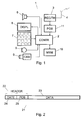
- the device 1 can be a mobile telephone for use in a GSM (Global System for Mobile Communications) system or a UMTS (Universal Mobile Telephone System) / WCDMA (Wideband Code Division Multiple Access) system.
- the device 1 is controlled by a controller circuit 2, and a receiver/transmitter circuit 3 takes care of the communication with a communications network, e.g. with a number of base stations (not shown), through an antenna 4.
- the device 1 has a microphone 5, a speaker 6, a keypad 7 and a display 8 in order to handle the normal functions of a mobile telephone.
- Today, many devices also comprise a digital camera 9, which can either be a camera for capturing single images or a video camera.
- a memory 10 allows the controller circuit 2 to store and retrieve information or data items obtained from e.g. the microphone 5, the camera 9, the keypad 7 or the receiver/transmitter circuit 3.
- Data items could be e.g. messages, images, sound recordings, or video recordings.
- an image generated by the camera 9 or received through the receiver/transmitter circuit 3 can be stored in the memory 10 and then at a later occasion retrieved and shown on the display 8, or a sound sequence from the microphone 5 can be stored and then later played via the speaker 6.
- header information can include information about the file type (message, image, etc.), the size of the data item, or the date it was stored.
- a catalogue list of the header information for each stored data item can be shown on the display 8, and, provided the user can recognize the data item searched for from the header information, the data item can be selected from the list and then retrieved.
- the header information can also include a parameter indicating the position of the device 1 when the data item was stored. This is shown in figure 2.
- the data item 21 comprises a header field 22 and a data field 23, and in the illustrated embodiment the header field 22 has, in addition to the field 24 showing the date on which the data item was stored, a field 25 showing one or more parameters indicating the position of the device 1 at the time of storing the data item.
- the information to be stored in the position field 25 can be generated automatically in the device 1 in a positioning unit 11, which may e.g. comprise a GPS (Global Positioning System) receiver.
- a positioning unit 11 which may e.g. comprise a GPS (Global Positioning System) receiver.
- the controller circuit 2 requests the current position from the positioning unit 11 and places the result in the position field 25 before the data item is stored in the memory 10.
- the position information may be in the form of coordinates, such as longitude and latitude.
- information relating to the current position may be obtained from the network or the base station through the antenna 4 and the receiver/transmitter circuit 3.
- the position information can be coordinates as above, or it could simply be an identification of the base station currently used by the device 1.
- the position information can also be entered by the user of the device 1 by means of the keypad 7.
- the user could obtain this information from an external device, in which case it could have the same form as above, or he could simply enter the name of the location.
- position field 25 may also be stored in the position field 25. This could be information relating to humidity, altitude or the name of the person who created the data item.
- the display 7 can show a list of data items arranged according to the names stored together with the items.
- Figure 3 shows an example where a number of images taken at different locations are shown on the display. It is seen that four images from Paris and two from Rome are presented on the display. Each image is further identified by date and time.
- One item is highlighted and can be selected by e.g. pressing a yes-key or similar key on the keypad 7. If these items are not the ones searched for, the user can browse through the complete list until the correct one is found.
- each item is identified by date and file type, such as image, video, sound, etc. Since the items are grouped by location, it is easy to find a specific item, because the user will normally be able to remember where a given item was stored.
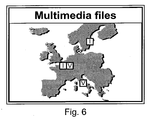
- FIG. 5 Another possibility would be to show a map on the display 7 and present the stored data items as icons on the map.
- An example of this is shown in figure 5, in which two data items have been stored in Paris, one in Rome and one in Sweden. The user can now easily see on the map where each data item was taken, recorded or received, and this makes it very easy to find and select a specific item. Zooming in on the map can give the user more precise information on where e.g. a given picture was taken. Different file types may be indicated by different icons. In figure 6 this is illustrated using the letters "I” for image and "V" for video recording, but any type of symbol could be used as well. If, for instance, the user wanted to retrieve an image taken in Sweden, he can now simply point at the icon "I" located near Sweden at the map and then select this item by pressing a key as described before.
- parameters such as humidity, altitude or the name of the creator
- these parameters may be used to further facilitate the search for a specific data item.
- the altitude parameter the user can restrict the search, and thus modify the view of the map, to e.g. only show data items having an altitude between 1 and 10 metres over the ocean. All images that do not fall within these criteria will automatically be hidden. This setting will probably show all beach-related data items, since the beach is normally quite close to the surface of the ocean.
- a data item stored in the memory 10 may also be sent to another communications device if the user e.g. wants to share an image or a video recording with a friend.
- the stored position information may be transmitted together with the data item.
- the user can choose to maintain the received position information when the item is stored, so that the item can be searched for by the location where it was originally generated, or the item can be stored with the current position of the device as described above, so that the item can be searched for by the location where it was received.
Landscapes
- Engineering & Computer Science (AREA)
- Databases & Information Systems (AREA)
- Theoretical Computer Science (AREA)
- Remote Sensing (AREA)
- Data Mining & Analysis (AREA)
- Physics & Mathematics (AREA)
- General Engineering & Computer Science (AREA)
- General Physics & Mathematics (AREA)
- Telephone Function (AREA)
Priority Applications (1)
| Application Number | Priority Date | Filing Date | Title |
|---|---|---|---|
| EP04388001A EP1553788A1 (de) | 2004-01-08 | 2004-01-08 | Speichern von Dateneinheiten mit einem Positionsparameter |
Applications Claiming Priority (1)
| Application Number | Priority Date | Filing Date | Title |
|---|---|---|---|
| EP04388001A EP1553788A1 (de) | 2004-01-08 | 2004-01-08 | Speichern von Dateneinheiten mit einem Positionsparameter |
Publications (1)
| Publication Number | Publication Date |
|---|---|
| EP1553788A1 true EP1553788A1 (de) | 2005-07-13 |
Family
ID=34586026
Family Applications (1)
| Application Number | Title | Priority Date | Filing Date |
|---|---|---|---|
| EP04388001A Withdrawn EP1553788A1 (de) | 2004-01-08 | 2004-01-08 | Speichern von Dateneinheiten mit einem Positionsparameter |
Country Status (1)
| Country | Link |
|---|---|
| EP (1) | EP1553788A1 (de) |
Cited By (1)
| Publication number | Priority date | Publication date | Assignee | Title |
|---|---|---|---|---|
| WO2010044914A3 (en) * | 2008-10-15 | 2010-07-22 | Sony Ericsson Mobile Communications Ab | Location-based tagging and sorting of content on a mobile device |
Citations (6)
| Publication number | Priority date | Publication date | Assignee | Title |
|---|---|---|---|---|
| EP0833494A2 (de) * | 1996-09-25 | 1998-04-01 | Canon Kabushiki Kaisha | Bildeingabegerät wie z.B. digitales drahtloses Telefon mit Funkübertragungsfunktion zur Kommunikation mit einer ortsfesten Station |
| EP1128284A2 (de) * | 2000-02-21 | 2001-08-29 | Hewlett-Packard Company, A Delaware Corporation | Verknüpfung von Bilddaten und Positionsdaten |
| EP1189021A1 (de) * | 2000-09-13 | 2002-03-20 | Roke Manor Research Limited | Verbesserungen in Bezug auf Kamerasystemen |
| WO2002029635A2 (en) * | 2000-09-29 | 2002-04-11 | Casio Computer Co., Ltd. | Picked-up image managing device and method of determining group name |
| WO2003004969A1 (en) * | 2001-07-02 | 2003-01-16 | Telia Ab (Publ) | System and method for position marking/stamping of digital pictures in real time |
| US20030151677A1 (en) * | 1998-10-21 | 2003-08-14 | American Calcar, Inc. | Positional camera and GPS data interchange device |
-
2004
- 2004-01-08 EP EP04388001A patent/EP1553788A1/de not_active Withdrawn
Patent Citations (6)
| Publication number | Priority date | Publication date | Assignee | Title |
|---|---|---|---|---|
| EP0833494A2 (de) * | 1996-09-25 | 1998-04-01 | Canon Kabushiki Kaisha | Bildeingabegerät wie z.B. digitales drahtloses Telefon mit Funkübertragungsfunktion zur Kommunikation mit einer ortsfesten Station |
| US20030151677A1 (en) * | 1998-10-21 | 2003-08-14 | American Calcar, Inc. | Positional camera and GPS data interchange device |
| EP1128284A2 (de) * | 2000-02-21 | 2001-08-29 | Hewlett-Packard Company, A Delaware Corporation | Verknüpfung von Bilddaten und Positionsdaten |
| EP1189021A1 (de) * | 2000-09-13 | 2002-03-20 | Roke Manor Research Limited | Verbesserungen in Bezug auf Kamerasystemen |
| WO2002029635A2 (en) * | 2000-09-29 | 2002-04-11 | Casio Computer Co., Ltd. | Picked-up image managing device and method of determining group name |
| WO2003004969A1 (en) * | 2001-07-02 | 2003-01-16 | Telia Ab (Publ) | System and method for position marking/stamping of digital pictures in real time |
Cited By (3)
| Publication number | Priority date | Publication date | Assignee | Title |
|---|---|---|---|---|
| WO2010044914A3 (en) * | 2008-10-15 | 2010-07-22 | Sony Ericsson Mobile Communications Ab | Location-based tagging and sorting of content on a mobile device |
| US7996015B2 (en) | 2008-10-15 | 2011-08-09 | Sony Ericsson Mobile Communications Ab | Location-based tagging and sorting of content on a mobile device |
| CN102171692A (zh) * | 2008-10-15 | 2011-08-31 | 索尼爱立信移动通讯有限公司 | 移动设备上内容的基于位置的加标签和分类 |
Similar Documents
| Publication | Publication Date | Title |
|---|---|---|
| US11714523B2 (en) | Digital image tagging apparatuses, systems, and methods | |
| KR101232994B1 (ko) | 이동 통신 단말기 및 통신 설정 방법 | |
| US7454090B2 (en) | Augmentation of sets of image recordings | |
| US9560498B2 (en) | Method and apparatus for managing message history data for a mobile communication device | |
| US6741864B2 (en) | Associating image and location data | |
| US20080064438A1 (en) | Place Name Picture Annotation on Camera Phones | |
| US20100216441A1 (en) | Method for photo tagging based on broadcast assisted face identification | |
| US7840586B2 (en) | Searching and naming items based on metadata | |
| US20080133526A1 (en) | Method and system for processing images using time and location filters | |
| US20090204899A1 (en) | Mobile journal for portable electronic equipment | |
| US20050225643A1 (en) | Context enhanced pictures | |
| US20050096092A1 (en) | Method of creating individual information including call log and method using the created information | |
| JP2006338553A (ja) | コンテンツ再生装置 | |
| US20040242266A1 (en) | Apparatus and method for communication of visual messages | |
| KR20070115194A (ko) | 태그기반 사진파일 관리방법 | |
| KR20050082593A (ko) | Gps를 이용한 영상데이터 파일명 설정방법 및 장치 | |
| KR101108837B1 (ko) | 휴대단말기의 메시지 저장장치 및 방법 | |
| EP1553788A1 (de) | Speichern von Dateneinheiten mit einem Positionsparameter | |
| JP4855130B2 (ja) | 情報処理装置およびデータ記録保存方法 | |
| EP2407899A1 (de) | Vorrichtung und zugehöriges Verfahren zur Markierung eines erfassten Bildes mithilfe von geografischen Angaben | |
| KR100866638B1 (ko) | 영상 데이터의 위치 정보 제공 장치 및 방법 | |
| US20070070220A1 (en) | Method and camera for image enhancement | |
| US20070284450A1 (en) | Image handling | |
| KR100393069B1 (ko) | 디지털 카메라 및 상기 디지털 카메라에서 이미지 저장방법 | |
| JP2002044713A (ja) | 携帯型装置 |
Legal Events
| Date | Code | Title | Description |
|---|---|---|---|
| PUAI | Public reference made under article 153(3) epc to a published international application that has entered the european phase |
Free format text: ORIGINAL CODE: 0009012 |
|
| AK | Designated contracting states |
Kind code of ref document: A1 Designated state(s): AT BE BG CH CY CZ DE DK EE ES FI FR GB GR HU IE IT LI LU MC NL PT RO SE SI SK TR |
|
| AX | Request for extension of the european patent |
Extension state: AL LT LV MK |
|
| AKX | Designation fees paid | ||
| REG | Reference to a national code |
Ref country code: DE Ref legal event code: 8566 |
|
| STAA | Information on the status of an ep patent application or granted ep patent |
Free format text: STATUS: THE APPLICATION IS DEEMED TO BE WITHDRAWN |
|
| 18D | Application deemed to be withdrawn |
Effective date: 20060114 |