EP1553811A2 - Schaltungsanordnung zum Betrieb von Lichtquellen mit Leistungsfaktorkorrektur - Google Patents
Schaltungsanordnung zum Betrieb von Lichtquellen mit Leistungsfaktorkorrektur Download PDFInfo
- Publication number
- EP1553811A2 EP1553811A2 EP04029902A EP04029902A EP1553811A2 EP 1553811 A2 EP1553811 A2 EP 1553811A2 EP 04029902 A EP04029902 A EP 04029902A EP 04029902 A EP04029902 A EP 04029902A EP 1553811 A2 EP1553811 A2 EP 1553811A2
- Authority
- EP
- European Patent Office
- Prior art keywords
- node
- positive
- capacitor
- dcn
- inverter
- Prior art date
- Legal status (The legal status is an assumption and is not a legal conclusion. Google has not performed a legal analysis and makes no representation as to the accuracy of the status listed.)
- Granted
Links
Images
Classifications
-
- A—HUMAN NECESSITIES
- A45—HAND OR TRAVELLING ARTICLES
- A45B—WALKING STICKS; UMBRELLAS; LADIES' OR LIKE FANS
- A45B25/00—Details of umbrellas
- A45B25/06—Umbrella runners
-
- H—ELECTRICITY
- H02—GENERATION; CONVERSION OR DISTRIBUTION OF ELECTRIC POWER
- H02M—APPARATUS FOR CONVERSION BETWEEN AC AND AC, BETWEEN AC AND DC, OR BETWEEN DC AND DC, AND FOR USE WITH MAINS OR SIMILAR POWER SUPPLY SYSTEMS; CONVERSION OF DC OR AC INPUT POWER INTO SURGE OUTPUT POWER; CONTROL OR REGULATION THEREOF
- H02M1/00—Details of apparatus for conversion
- H02M1/42—Circuits or arrangements for compensating for or adjusting power factor in converters or inverters
- H02M1/4208—Arrangements for improving power factor of AC input
- H02M1/425—Arrangements for improving power factor of AC input using a single converter stage both for correction of AC input power factor and generation of a high frequency AC output voltage
-
- H—ELECTRICITY
- H05—ELECTRIC TECHNIQUES NOT OTHERWISE PROVIDED FOR
- H05B—ELECTRIC HEATING; ELECTRIC LIGHT SOURCES NOT OTHERWISE PROVIDED FOR; CIRCUIT ARRANGEMENTS FOR ELECTRIC LIGHT SOURCES, IN GENERAL
- H05B41/00—Circuit arrangements or apparatus for igniting or operating discharge lamps
- H05B41/14—Circuit arrangements
- H05B41/26—Circuit arrangements in which the lamp is fed by power derived from DC by means of a converter, e.g. by high-voltage DC
- H05B41/28—Circuit arrangements in which the lamp is fed by power derived from DC by means of a converter, e.g. by high-voltage DC using static converters
-
- Y—GENERAL TAGGING OF NEW TECHNOLOGICAL DEVELOPMENTS; GENERAL TAGGING OF CROSS-SECTIONAL TECHNOLOGIES SPANNING OVER SEVERAL SECTIONS OF THE IPC; TECHNICAL SUBJECTS COVERED BY FORMER USPC CROSS-REFERENCE ART COLLECTIONS [XRACs] AND DIGESTS
- Y02—TECHNOLOGIES OR APPLICATIONS FOR MITIGATION OR ADAPTATION AGAINST CLIMATE CHANGE
- Y02B—CLIMATE CHANGE MITIGATION TECHNOLOGIES RELATED TO BUILDINGS, e.g. HOUSING, HOUSE APPLIANCES OR RELATED END-USER APPLICATIONS
- Y02B70/00—Technologies for an efficient end-user side electric power management and consumption
- Y02B70/10—Technologies improving the efficiency by using switched-mode power supplies [SMPS], i.e. efficient power electronics conversion e.g. power factor correction or reduction of losses in power supplies or efficient standby modes
Definitions
- the invention relates to circuit arrangements for the operation of light sources. Especially The invention relates to circuit arrangements for the power supply of light sources from a utility network, which are suitable to a network side Correct power factor.
- the following is the expression line factor correction the abbreviation PFC, which refers to the English-speaking Expression "Power Factor Correction”.
- a feeding mains voltage has a mains frequency.
- the term "high-frequency” is used in the following for frequencies that are much higher than the grid frequency.
- Charge pumps are z. B. from the document US 4,949,013 (breeding bars) known. essential Characteristic of a charge pump is the connection of a rectifier output with a pumping diode. At the resulting junction is a applied high-frequency voltage, which is taken from a load circuit. It should be on This point emphasizes that only one rectifier output with a pumping diode is why this part of the circuit arrangement in WO 02/47441 (Hu) called "single feedback".
- Valley fill circuits are z. B. from document WO 90/09087 (Skalak) known. It is a passive PFC circuit consisting of two storage capacitors and three diodes connected between two rectifier outputs. The Effect of the valley-fill circuit is due to the fact that the storage capacitors via the diodes are connected so that they are from a mains voltage be charged as a series circuit, but discharged from a load as a parallel connection become.
- a valley-fill circuit can be created by splitting one of its diodes into two diodes restricted act as a charge pump. This is to the connection point the two resulting from splitting diodes a high-frequency AC voltage to apply.
- US 6,316,883 Cho
- the operating device for discharge lamps described therein additionally has a separate charge pump. This charge pump is the valley-fill circuit downstream of the mains voltage side, whereby a further storage capacitor is needed.
- An object of the document WO 02/47441 (Hu) is a compact fluorescent lamp with integrated operating device. Such lamps are up to a recorded from the network Power of 25W commercially available. Because up to 25W the requirements of relevant Standards to the mains current harmonics are low, the in WO 02/47441 (Hu) disclosed circuitry to 25W one with the standards compliant operation of fluorescent lamps.
- WO 02/47441 Hu
- the invention is not suggested in WO 02/47441 (Hu) because it is related thereto with the charge pump expressly from a "single feedback" (page 5 / line 3), while in the present invention the charge pump is designed to be double, by providing both a positive and a negative rectifier output connected to a pump capacitor.
- the valley-fill circuit is a PFC circuit that does not require significant overhead of components causes. This additional burden concerns components such. B. throttling and electronic switches and is caused by current or voltage overshoots conditions that arise in connection with reactive power transport. Indeed can not use a valley fill circuit alone standard-compliant mains harmonics be achieved. Also a standard lamp current crest factor is not given.
- the charge pump is made double. Ie. either with the positive as well as the negative rectifier output is a charge pump connected. This will be synonymous with a recorded by the network Power over 25 W standard-compliant mains harmonics and a standard-compliant Lamp current crest factor with only minor additional load on components reached.
- a particularly advantageous embodiment of the invention is characterized in that an inverter is designed as a half-bridge inverter.
- the inverter is between a positive and a negative rail is switched and thereby with a Supplied DC voltage.
- the inverter sets a high frequency AC voltage for operation of light sources available.
- a further particularly advantageous embodiment of the invention is characterized in that that a connection of the light source via a coupling capacitor with the positive or negative rail is connected. This will be another reduction the mains current harmonics and the lamp current crest factor reached.
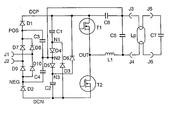
- FIG. 1 shows an embodiment of the invention for a fluorescent lamp with electrode coils.
- transistors by the letter T diodes by the letter D
- capacitors by the letter C capacitors by the letter C
- chokes by the letter L
- terminals indicated by the letter J respectively followed by a number.
- the terminals J 1 and J 2 constitute the mains voltage input.
- J 1 and J2 are a mains voltage connectable.
- J 1 and J2 are connected to the input of a rectifier connected.
- the rectifier can also have means for radio interference suppression be upstream.
- the rectifier consists of a known bridge circuit of Rectifier diodes D7, D8, D9 and D10 connected to their positive rectifier output POS and at their negative rectifier output NEG the rectified Mains voltage provides. Due to the charge pump, the Rectifier diodes can switch high frequency. It is also possible slow To use rectifier diodes. Then, however, must each have a fast diode connected between the bridge circuit and the respective rectifier output become.
- a first diode D1 which is a pumping diode, is connected to its anode with the positive rectifier output POS and with its cathode with a positive one Rail DCP connected.
- a second diode D2 which is also a pumping diode, is with its cathode with the negative rectifier output NEG and with its anode connected to a negative rail DCN.
- a third D3, a fourth D4, a fifth D5 and a sixth diode D6 switched, in each case the cathode of these diodes to the positive rail DCP out is directed and the junctions of these diodes form the following nodes: Between the third D3 and the fourth diode D4 a first node N1, between the fourth D4 and the fifth diode D5 a second node N2 and between the fifth D5 and the sixth diode D6 a third node N3.
- a first storage capacitor C1 is between the positive rail DCP and the first node N1 switched.
- a second storage capacitor C2 is between the negative rail DCN and the third node N3.
- the diodes D3, D4, D5 and D6 and the storage capacitors C1 and C2 form the valley-fill circuit. It is a modified valley fill circuit like the one in the Connection with the o. G. No. 6,316,883 (Gyu).
- the diodes D4 and D5 form the o.g. split diode pair.
- At the between the diodes D4 and D5 located node N2 is a high-frequency voltage applied, the is coupled to a load circuit. This is also used in the valley-fill circuit in limited extent the effect of a charge pump achieved. In series with the diodes can also be switched a resistor. This will be the mains current harmonics further reduced.
- T1 and T2 form one Half-bridge inverter, which has an inverter output at the connection point of T1 and T2 OUT.
- About the positive and negative rail DCP and DCN refers the half-bridge inverter energy.
- This output voltage of the inverter has an inverter oscillation frequency that is much higher than mains frequency.
- the negative rail DCN serves as the reference potential for the definition the output voltage of the inverter. Without limitation of generality, can also serve the positive rail DCP as a reference potential.
- T1 and T2 are executed in the embodiment as a MOSFET. It can, however also other electronic switches are used. At the gates of T1 and T2 is a control voltage, which is the alternating on and off caused by T1 and T2. This control voltage is provided by a control circuit, which is not shown in the figure.
- the control circuit can either contain a free oscillating oscillator, or controlled by the load circuit, whereby a self-oscillating half-bridge inverter is formed.
- the reactance network comprises a series circuit of a lamp inductor L1, a resonant capacitor C5 and a coupling capacitor C6. This is at one end with the inverter output OUT connected and connected at the other end to the positive rail DCP. Equally effective, this series circuit instead of the positive and the negative Be connected to rail DCN.
- the lamp inductor Lp is connected to the inverter output OUT and the coupling capacitor C6 is connected to the positive rail DCP.
- the resonant capacitor C5 is between the lamp inductor L1 and the coupling capacitor C6 switched.
- the resonant capacitor C5 has two terminals connected to output terminals (J3, J4) are connected, to which a light source (Lp) is connectable.
- a light source a fluorescent lamp.
- the circuit arrangement Basically, but also for the operation of other light sources such.
- Light-emitting diodes or incandescent lamps may require a transformer to provide the output voltage of the inverter to the voltage level required by the light sources adapts.
- the fluorescent lamp shown in the figure has two electrode coils. One connection each of the electrode coils is connected to the output terminals J3 and J4 connected.
- the other connection of the electrode coils is via other terminals J5 and J6 with another resonant capacitor C7 connected.
- the two resonant capacitors C5 and C7 are thus over the electrode coils connected.
- the high frequency AC voltage supplied to the node N2 is in Embodiment taken from the potential at terminal J3. This matches with the potential at a terminal of the resonance capacitor C5.
- the node N2 can also be linked to other potentials that are high-frequency Have AC voltage.
- the other terminal of the resonance capacitor is suitable for this purpose C5 or the inverter output OUT.
- the in the embodiment chosen variant has the lowest amplitude for the mains current harmonics and the lowest lamp current crest factor.
- the high-frequency AC voltage applied to node 2 is also at one Pump capacitor C3, which is connected to the positive rectifier output POS is.
- This is a second charge pump realized at the negative rectifier output NEG.
- the two have Pumping capacitors the same value.
- Charge pump it is possible to measure the amplitude of the mains harmonics and reduce the value of the lamp current crest factor, without intermediate storage large amounts of reactive power in the pump capacitors C3 and C4. In order to remains the burden of the lamp inductor L1 and the electronic switches T1 and T2 low.
Landscapes
- Engineering & Computer Science (AREA)
- Power Engineering (AREA)
- Circuit Arrangements For Discharge Lamps (AREA)
- Rectifiers (AREA)
- Led Devices (AREA)
Abstract
Description
- Niedriger netzseitiger Leitungsfaktor
- Niedriger Klirrfaktor (Total Harmonic Distortion: THD) des vom Netz aufgenommenen Stroms
- Normgerechte Netzstromoberschwingungen
- Hoher Wirkungsgrad
- Niedriger Crest-Faktor des Stroms durch die Lichtquelle
- Geringe Funkstörungen
- Geringe Kosten
- Geringe geometrische Abmessungen
Soll zusätzlich der Grenzwert für den Crest-Faktor des Lampenstroms nach IEC 60929 eingehalten werden, so werden die Bauteile noch stärker belastet.
Claims (6)
- Schaltungsanordnung zum Betrieb von Lichtquellen mit folgenden Merkmalen:dadurch gekennzeichnet, dassEin Gleichrichter (D7, D8, D9, D10) mit einem Netzspannungseingang (J1, J2), der bei Anlegen einer Netzwechselspannung mit einer Netzfrequenz an seinen Netzspannungseingang an einem positiven (POS) und einem negativen Gleichrichterausgang (NEG) eine gleichgerichtete Netzwechselspannung bereitstellt,eine erste Diode (D1), die mit ihrer Anode mit dem positiven Gleichrichterausgang (POS) und mit ihrer Kathode mit einer positiven Schiene (DCP) verbunden ist,eine zweite Diode (D2), die mit ihrer Kathode mit dem negativen Gleichrichterausgang (NEG) und mit ihrer Anode mit einer negativen Schiene (DCN) verbunden ist,eine dritte (D3), eine vierte (D4), eine fünfte (D5) und eine sechste Diode (D6), die in Serie zwischen die positive (DCP) und die negative Schiene (DCN) geschaltet sind, wobei jeweils die Kathode dieser Dioden (D3, D4, D5, D6) zur positiven Schiene (DCP) hin gerichtet ist und die Verbindungsstellen dieser Dioden (D3, D4, D5, D6) folgende Knoten ausbilden: Zwischen der dritten (D3) und der vierten Diode (D4) einen ersten Knoten (N1), zwischen der vierten (D4) und der fünften Diode (D5) einen zweiten Knoten (N2) und zwischen der fünften (D5) und der sechsten Diode (D6) einen dritten Knoten (N3),einen ersten (C1) und einen zweiten Speicherkondensator (C2), wobei der erste Speicherkondensator (C1) zwischen die positive Schiene (DCP) und den ersten Knoten (N1) und der zweite Speicherkondensator (C2) zwischen die negative Schiene (DCN) und den dritten Knoten (N3) geschaltet ist,ein Inverter (T1, T2), der zur Energieversorgung an die positive (DCP) und die negative Schiene (DCN) angeschlossen ist und an einem Inverterausgang (OUT) gegenüber der negativen Schiene (DCN) eine Inverterausgangsspannung bereitstellt, die eine Inverterschwingfrequenz aufweist, die wesentlich höher ist als Netzfrequenz,ein Reaktanznetzwerk, das an den Inverterausgang (OUT) angeschlossen ist, und Ausgangsklemmen (J3, J4) zum Anschluss von Lichtquellen bereitstellt,eine Kopplung zwischen dem Reaktanznetzwerk und dem Knoten (N2), der am Knoten (N2) gegenüber der negativen Schiene (DCN) einen Spannungsverlauf bewirkt, der die Inverterschwingfrequenz aufweist,einen ersten Pumpkondensator (C3), der mit dem Knoten (N2) und dem positiven Gleichrichterausgang (POS) verbunden ist,
die Schaltungsanordnung einen zweiten Pumpkondensator (C4) aufweist, wobei der zweite Pumpkondensator (C4) mit dem Knoten (N2) und dem negativen Gleichrichterausgang (NEG) verbunden ist. - Schaltungsanordnung zum Betrieb von Lichtquellen gemäß Anspruch 1, gekennzeichnet durch folgende Merkmale:Das Reaktanznetzwerk umfasst eine Serienschaltung aus einer Lampendrossel (L1), einem Resonanzkondensator (C5) und einem Koppelkondensator (C6),die Serienschaltung ist an einem Ende mit dem Inverterausgang (OUT) verbunden und am anderen Ende mit der positiven (DCP) oder der negativen Schiene (DCN) verbunden,der Resonanzkondensator (C5) besitzt zwei Anschlüsse, die mit Ausgangsklemmen (J3, J4) verbunden sind, an die eine Lichtquelle (Lp) anschließbar ist,ein Anschluss des Resonanzkondensators (C5) ist mit dem zweiten Knoten (N2) verbunden.
- Schaltungsanordnung zum Betrieb von Lichtquellen gemäß Anspruch 2, gekennzeichnet durch folgende Merkmale:die Lampendrossel (Lp) ist mit dem Inverterausgang verbunden,der Koppelkondensator (C6) ist mit der positiven (DCP) oder der negativen Schiene (DCN) verbunden,der Resonanzkondensator (C5) ist zwischen die Lampendrossel (L1) und den Koppelkondensator (C6) geschaltetder dem Koppelkondensator (C6) zugewandte Anschluss des Resonanzkondensators (C5) ist mit dem zweiten Knoten (N2) verbunden.
- Schaltungsanordnung zum Betrieb von Lichtquellen gemäß Anspruch 2,
dadurch gekennzeichnet, dass
die Lichtquelle (Lp) eine Gasentladungslampe mit zwei Elektrodenwendeln ist und ein zweiter Resonanzkondensator (C7) über die Elektrodenwendeln mit dem Resonanzkondensator (C5) aus Anspruch 2 verbunden ist. - Schaltungsanordnung von Betrieb von Lichtquellen gemäß Anspruch 1,
dadurch gekennzeichnet, dass
die Lichtquelle (Lp) eine Gasentladungslampe ist. - Schaltungsanordnung zum Betrieb von Lichtquellen gemäß Anspruch 1,
dadurch gekennzeichnet, dass
der Inverter ein Halbbrückeninverter ist, der eine Serienschaltung von zwei elektronischen Schaltern (T1, T2) umfasst, die zwischen die positive (DCP) und die negative Schiene (DCN) geschaltet sind und der Inverterausgang (OUT) der Verbindungspunkt der beiden elektronischen Schalter (T1, T2) ist.
Applications Claiming Priority (2)
| Application Number | Priority Date | Filing Date | Title |
|---|---|---|---|
| DE102004001617A DE102004001617A1 (de) | 2004-01-09 | 2004-01-09 | Schaltungsanordnung zum Betrieb von Lichtquellen |
| DE102004001617 | 2004-01-09 |
Publications (3)
| Publication Number | Publication Date |
|---|---|
| EP1553811A2 true EP1553811A2 (de) | 2005-07-13 |
| EP1553811A3 EP1553811A3 (de) | 2006-02-01 |
| EP1553811B1 EP1553811B1 (de) | 2006-09-27 |
Family
ID=34585391
Family Applications (1)
| Application Number | Title | Priority Date | Filing Date |
|---|---|---|---|
| EP04029902A Expired - Lifetime EP1553811B1 (de) | 2004-01-09 | 2004-12-16 | Schaltungsanordnung zum Betrieb von Lichtquellen mit Leistungsfaktorkorrektur |
Country Status (8)
| Country | Link |
|---|---|
| US (1) | US7053563B2 (de) |
| EP (1) | EP1553811B1 (de) |
| KR (1) | KR101220255B1 (de) |
| CN (1) | CN100566498C (de) |
| AT (1) | ATE341185T1 (de) |
| CA (1) | CA2491559A1 (de) |
| DE (2) | DE102004001617A1 (de) |
| TW (1) | TW200537988A (de) |
Families Citing this family (4)
| Publication number | Priority date | Publication date | Assignee | Title |
|---|---|---|---|---|
| DE102004001618A1 (de) * | 2004-01-09 | 2005-08-11 | Patent-Treuhand-Gesellschaft für elektrische Glühlampen mbH | Schaltungsanordnung zum Betrieb von Lichtquellen |
| ATE515177T1 (de) * | 2006-05-02 | 2011-07-15 | Koninkl Philips Electronics Nv | Leuchtdiodenschaltung, anordnung und vorrichtung |
| EP2030487A1 (de) * | 2006-05-31 | 2009-03-04 | Koninklijke Philips Electronics N.V. | Verfahren und system zum betrieb einer gasentladungslampe |
| US9825552B1 (en) * | 2016-09-13 | 2017-11-21 | Kabushiki Kaisha Toshiba | Power conversion apparatus |
Family Cites Families (9)
| Publication number | Priority date | Publication date | Assignee | Title |
|---|---|---|---|---|
| US6459213B1 (en) * | 1978-03-20 | 2002-10-01 | Ole K. Nilssen | Ballast for parallel-connected lamps |
| US5191262A (en) * | 1978-12-28 | 1993-03-02 | Nilssen Ole K | Extra cost-effective electronic ballast |
| US5512801A (en) * | 1980-08-14 | 1996-04-30 | Nilssen; Ole K. | Ballast for instant-start parallel-connected lamps |
| DE3805510A1 (de) * | 1988-02-22 | 1989-08-31 | Patent Treuhand Ges Fuer Elektrische Gluehlampen Mbh | Schaltungsanordnung zum betrieb einer niederdruckentladungslampe |
| EP0410966B1 (de) | 1989-01-30 | 1995-03-08 | Flotronic Technology (1989) Pte. Ltd. | Monolithischer, elektronischer ballast |
| US5939837A (en) * | 1997-07-15 | 1999-08-17 | Magnetek, Inc. | Electronic ballast circuit for independently increasing the power factor and decreasing the crest factor |
| KR100335990B1 (ko) * | 1999-08-27 | 2002-05-10 | 윤덕용 | 형광등용 전자식 안정기의 역률 개선회로 |
| CN100438714C (zh) * | 2000-12-04 | 2008-11-26 | 皇家菲利浦电子有限公司 | 镇流器电路装置 |
| US6700331B2 (en) * | 2002-06-05 | 2004-03-02 | Lusa Lighting, Inc. | Control circuit for dimming fluorescent lamps |
-
2004
- 2004-01-09 DE DE102004001617A patent/DE102004001617A1/de not_active Withdrawn
- 2004-12-16 AT AT04029902T patent/ATE341185T1/de active
- 2004-12-16 EP EP04029902A patent/EP1553811B1/de not_active Expired - Lifetime
- 2004-12-16 DE DE502004001589T patent/DE502004001589D1/de not_active Expired - Lifetime
-
2005
- 2005-01-03 US US11/025,924 patent/US7053563B2/en not_active Expired - Fee Related
- 2005-01-05 CA CA002491559A patent/CA2491559A1/en not_active Abandoned
- 2005-01-05 TW TW094100256A patent/TW200537988A/zh unknown
- 2005-01-07 KR KR1020050001521A patent/KR101220255B1/ko not_active Expired - Fee Related
- 2005-01-07 CN CNB2005100036216A patent/CN100566498C/zh not_active Expired - Fee Related
Also Published As
| Publication number | Publication date |
|---|---|
| EP1553811B1 (de) | 2006-09-27 |
| EP1553811A3 (de) | 2006-02-01 |
| CN100566498C (zh) | 2009-12-02 |
| US7053563B2 (en) | 2006-05-30 |
| CA2491559A1 (en) | 2005-07-09 |
| US20050151481A1 (en) | 2005-07-14 |
| DE502004001589D1 (de) | 2006-11-09 |
| KR20050073415A (ko) | 2005-07-13 |
| CN1638596A (zh) | 2005-07-13 |
| ATE341185T1 (de) | 2006-10-15 |
| DE102004001617A1 (de) | 2005-08-11 |
| KR101220255B1 (ko) | 2013-01-09 |
| TW200537988A (en) | 2005-11-16 |
Similar Documents
| Publication | Publication Date | Title |
|---|---|---|
| DE69117008T2 (de) | Wechselrichteranordnung | |
| EP0253224B1 (de) | Schaltungsanordnung zum Betrieb von Niederdruckentladungslampen | |
| DE112008000245T5 (de) | Elektronische Vorschaltgerät des Ladungspumpentyps zur Verwendung bei niedriger Eingangsspannung | |
| DE69108586T2 (de) | Stromversorgungsschaltung. | |
| CH656753A5 (de) | Gleichrichtervorrichtung mit gesiebter ausgangsspannung. | |
| DE69016815T2 (de) | Vorschaltgeräte für Gasentladungslampen. | |
| DE3841227A1 (de) | Schaltungsanordnung zum betrieb einer niederdruckentladungslampe | |
| EP1553810B1 (de) | Schaltungsanordnung zum Betrieb von Lichtquellen mit Leistungsfaktorkorrektur | |
| EP1638374B1 (de) | Schaltungsanordnung zum Betrieb mindestens einer Lichtquelle mit verbessertem Crest-Faktor | |
| EP1092260B1 (de) | Schaltung zur korrektur des leistungsfaktors | |
| EP0600340B1 (de) | Passive Schaltungsanordnung zur Verbesserung des Leistungsfaktor | |
| EP1553811B1 (de) | Schaltungsanordnung zum Betrieb von Lichtquellen mit Leistungsfaktorkorrektur | |
| DE60127452T2 (de) | Verbesserte steuerschaltung für leistungsfaktorverbesserte elektronische vorschaltgeräte und stromversorgungen | |
| DE69114982T2 (de) | Stromversorgungskreis. | |
| EP0669075A1 (de) | Schaltungsanordnung zum betrieb von niederdruckentladungslampen. | |
| EP1485982B1 (de) | Schaltung zur elektrischen leistungsfaktorkorrektur | |
| EP1615476B1 (de) | Schaltungsanordnung mit einer schalterentlasteten Vollbrücke zum Betrieb von Lampen | |
| DE202011110425U1 (de) | Leistungsfaktorkorrekturschaltung und Leistungsversorgungsvorrichtung mit Leistungsfaktorkorrekturschaltung | |
| EP1761112A2 (de) | Potenzialtrennung für SEPIC-Wandler | |
| EP0596397B1 (de) | Schaltungsanordnung zum hochfrequenten Betrieb eines Verbrauchers | |
| DE69313257T2 (de) | Schaltung | |
| DE3612906A1 (de) | Netzteil fuer die transformatorlose umwandlung einer netzwechselspannung in zumindest eine gleichspannung | |
| DE102004031445A1 (de) | Schaltungsanordnung und Betriebsgerät zum Betrieb von Lampen | |
| DE102023208281A1 (de) | Inverswandlerschaltung, Stromversorgungssystem und Verfahren zum Betreiben einer Inverswandlerschaltung | |
| DE202011051453U1 (de) | Wechselstrom-Gleichstrom-Wandlerschaltung ohne Transformator mit einstellbarem Leistungsfaktor |
Legal Events
| Date | Code | Title | Description |
|---|---|---|---|
| PUAI | Public reference made under article 153(3) epc to a published international application that has entered the european phase |
Free format text: ORIGINAL CODE: 0009012 |
|
| AK | Designated contracting states |
Kind code of ref document: A2 Designated state(s): AT BE BG CH CY CZ DE DK EE ES FI FR GB GR HU IE IS IT LI LT LU MC NL PL PT RO SE SI SK TR |
|
| AX | Request for extension of the european patent |
Extension state: AL BA HR LV MK YU |
|
| PUAL | Search report despatched |
Free format text: ORIGINAL CODE: 0009013 |
|
| AK | Designated contracting states |
Kind code of ref document: A3 Designated state(s): AT BE BG CH CY CZ DE DK EE ES FI FR GB GR HU IE IS IT LI LT LU MC NL PL PT RO SE SI SK TR |
|
| AX | Request for extension of the european patent |
Extension state: AL BA HR LV MK YU |
|
| GRAP | Despatch of communication of intention to grant a patent |
Free format text: ORIGINAL CODE: EPIDOSNIGR1 |
|
| 17P | Request for examination filed |
Effective date: 20060220 |
|
| GRAS | Grant fee paid |
Free format text: ORIGINAL CODE: EPIDOSNIGR3 |
|
| GRAA | (expected) grant |
Free format text: ORIGINAL CODE: 0009210 |
|
| AK | Designated contracting states |
Kind code of ref document: B1 Designated state(s): AT BE BG CH CY CZ DE DK EE ES FI FR GB GR HU IE IS IT LI LT LU MC NL PL PT RO SE SI SK TR |
|
| PG25 | Lapsed in a contracting state [announced via postgrant information from national office to epo] |
Ref country code: IE Free format text: LAPSE BECAUSE OF FAILURE TO SUBMIT A TRANSLATION OF THE DESCRIPTION OR TO PAY THE FEE WITHIN THE PRESCRIBED TIME-LIMIT Effective date: 20060927 Ref country code: FI Free format text: LAPSE BECAUSE OF FAILURE TO SUBMIT A TRANSLATION OF THE DESCRIPTION OR TO PAY THE FEE WITHIN THE PRESCRIBED TIME-LIMIT Effective date: 20060927 Ref country code: PL Free format text: LAPSE BECAUSE OF FAILURE TO SUBMIT A TRANSLATION OF THE DESCRIPTION OR TO PAY THE FEE WITHIN THE PRESCRIBED TIME-LIMIT Effective date: 20060927 Ref country code: CZ Free format text: LAPSE BECAUSE OF FAILURE TO SUBMIT A TRANSLATION OF THE DESCRIPTION OR TO PAY THE FEE WITHIN THE PRESCRIBED TIME-LIMIT Effective date: 20060927 Ref country code: RO Free format text: LAPSE BECAUSE OF FAILURE TO SUBMIT A TRANSLATION OF THE DESCRIPTION OR TO PAY THE FEE WITHIN THE PRESCRIBED TIME-LIMIT Effective date: 20060927 Ref country code: SK Free format text: LAPSE BECAUSE OF FAILURE TO SUBMIT A TRANSLATION OF THE DESCRIPTION OR TO PAY THE FEE WITHIN THE PRESCRIBED TIME-LIMIT Effective date: 20060927 Ref country code: SI Free format text: LAPSE BECAUSE OF FAILURE TO SUBMIT A TRANSLATION OF THE DESCRIPTION OR TO PAY THE FEE WITHIN THE PRESCRIBED TIME-LIMIT Effective date: 20060927 Ref country code: LT Free format text: LAPSE BECAUSE OF FAILURE TO SUBMIT A TRANSLATION OF THE DESCRIPTION OR TO PAY THE FEE WITHIN THE PRESCRIBED TIME-LIMIT Effective date: 20060927 |
|
| REG | Reference to a national code |
Ref country code: GB Ref legal event code: FG4D Free format text: NOT ENGLISH |
|
| AKX | Designation fees paid |
Designated state(s): AT BE BG CH CY CZ DE DK EE ES FI FR GB GR HU IE IS IT LI LT LU MC NL PL PT RO SE SI SK TR |
|
| REG | Reference to a national code |
Ref country code: CH Ref legal event code: EP |
|
| REG | Reference to a national code |
Ref country code: IE Ref legal event code: FG4D Free format text: LANGUAGE OF EP DOCUMENT: GERMAN |
|
| REF | Corresponds to: |
Ref document number: 502004001589 Country of ref document: DE Date of ref document: 20061109 Kind code of ref document: P |
|
| PG25 | Lapsed in a contracting state [announced via postgrant information from national office to epo] |
Ref country code: BG Free format text: LAPSE BECAUSE OF FAILURE TO SUBMIT A TRANSLATION OF THE DESCRIPTION OR TO PAY THE FEE WITHIN THE PRESCRIBED TIME-LIMIT Effective date: 20061227 Ref country code: DK Free format text: LAPSE BECAUSE OF FAILURE TO SUBMIT A TRANSLATION OF THE DESCRIPTION OR TO PAY THE FEE WITHIN THE PRESCRIBED TIME-LIMIT Effective date: 20061227 |
|
| PG25 | Lapsed in a contracting state [announced via postgrant information from national office to epo] |
Ref country code: MC Free format text: LAPSE BECAUSE OF NON-PAYMENT OF DUE FEES Effective date: 20061231 Ref country code: BE Free format text: LAPSE BECAUSE OF NON-PAYMENT OF DUE FEES Effective date: 20061231 |
|
| PG25 | Lapsed in a contracting state [announced via postgrant information from national office to epo] |
Ref country code: ES Free format text: LAPSE BECAUSE OF FAILURE TO SUBMIT A TRANSLATION OF THE DESCRIPTION OR TO PAY THE FEE WITHIN THE PRESCRIBED TIME-LIMIT Effective date: 20070107 |
|
| REG | Reference to a national code |
Ref country code: SE Ref legal event code: TRGR |
|
| PG25 | Lapsed in a contracting state [announced via postgrant information from national office to epo] |
Ref country code: IS Free format text: LAPSE BECAUSE OF FAILURE TO SUBMIT A TRANSLATION OF THE DESCRIPTION OR TO PAY THE FEE WITHIN THE PRESCRIBED TIME-LIMIT Effective date: 20070127 |
|
| GBT | Gb: translation of ep patent filed (gb section 77(6)(a)/1977) |
Effective date: 20070104 |
|
| REG | Reference to a national code |
Ref country code: HU Ref legal event code: AG4A Ref document number: E001069 Country of ref document: HU |
|
| PG25 | Lapsed in a contracting state [announced via postgrant information from national office to epo] |
Ref country code: PT Free format text: LAPSE BECAUSE OF FAILURE TO SUBMIT A TRANSLATION OF THE DESCRIPTION OR TO PAY THE FEE WITHIN THE PRESCRIBED TIME-LIMIT Effective date: 20070313 |
|
| ET | Fr: translation filed | ||
| REG | Reference to a national code |
Ref country code: IE Ref legal event code: FD4D |
|
| PLBE | No opposition filed within time limit |
Free format text: ORIGINAL CODE: 0009261 |
|
| STAA | Information on the status of an ep patent application or granted ep patent |
Free format text: STATUS: NO OPPOSITION FILED WITHIN TIME LIMIT |
|
| 26N | No opposition filed |
Effective date: 20070628 |
|
| BERE | Be: lapsed |
Owner name: PATENT-TREUHAND-GESELLSCHAFT FUR ELEKTRISCHE GLUH Effective date: 20061231 |
|
| PG25 | Lapsed in a contracting state [announced via postgrant information from national office to epo] |
Ref country code: GR Free format text: LAPSE BECAUSE OF FAILURE TO SUBMIT A TRANSLATION OF THE DESCRIPTION OR TO PAY THE FEE WITHIN THE PRESCRIBED TIME-LIMIT Effective date: 20061228 |
|
| PG25 | Lapsed in a contracting state [announced via postgrant information from national office to epo] |
Ref country code: EE Free format text: LAPSE BECAUSE OF FAILURE TO SUBMIT A TRANSLATION OF THE DESCRIPTION OR TO PAY THE FEE WITHIN THE PRESCRIBED TIME-LIMIT Effective date: 20060927 |
|
| PG25 | Lapsed in a contracting state [announced via postgrant information from national office to epo] |
Ref country code: LU Free format text: LAPSE BECAUSE OF NON-PAYMENT OF DUE FEES Effective date: 20061216 Ref country code: TR Free format text: LAPSE BECAUSE OF FAILURE TO SUBMIT A TRANSLATION OF THE DESCRIPTION OR TO PAY THE FEE WITHIN THE PRESCRIBED TIME-LIMIT Effective date: 20060927 |
|
| PG25 | Lapsed in a contracting state [announced via postgrant information from national office to epo] |
Ref country code: CY Free format text: LAPSE BECAUSE OF FAILURE TO SUBMIT A TRANSLATION OF THE DESCRIPTION OR TO PAY THE FEE WITHIN THE PRESCRIBED TIME-LIMIT Effective date: 20060927 |
|
| REG | Reference to a national code |
Ref country code: CH Ref legal event code: PL |
|
| PG25 | Lapsed in a contracting state [announced via postgrant information from national office to epo] |
Ref country code: CH Free format text: LAPSE BECAUSE OF NON-PAYMENT OF DUE FEES Effective date: 20081231 Ref country code: LI Free format text: LAPSE BECAUSE OF NON-PAYMENT OF DUE FEES Effective date: 20081231 |
|
| PGFP | Annual fee paid to national office [announced via postgrant information from national office to epo] |
Ref country code: AT Payment date: 20101110 Year of fee payment: 7 |
|
| PGFP | Annual fee paid to national office [announced via postgrant information from national office to epo] |
Ref country code: SE Payment date: 20101207 Year of fee payment: 7 Ref country code: NL Payment date: 20101203 Year of fee payment: 7 |
|
| PGFP | Annual fee paid to national office [announced via postgrant information from national office to epo] |
Ref country code: IT Payment date: 20101229 Year of fee payment: 7 |
|
| REG | Reference to a national code |
Ref country code: DE Ref legal event code: R081 Ref document number: 502004001589 Country of ref document: DE Owner name: OSRAM GMBH, DE Free format text: FORMER OWNER: OSRAM GESELLSCHAFT MIT BESCHRAENKTER HAFTUNG, 81543 MUENCHEN, DE Effective date: 20111213 |
|
| PGFP | Annual fee paid to national office [announced via postgrant information from national office to epo] |
Ref country code: HU Payment date: 20120214 Year of fee payment: 8 |
|
| REG | Reference to a national code |
Ref country code: NL Ref legal event code: V1 Effective date: 20120701 |
|
| REG | Reference to a national code |
Ref country code: SE Ref legal event code: EUG |
|
| PG25 | Lapsed in a contracting state [announced via postgrant information from national office to epo] |
Ref country code: SE Free format text: LAPSE BECAUSE OF NON-PAYMENT OF DUE FEES Effective date: 20111217 |
|
| PG25 | Lapsed in a contracting state [announced via postgrant information from national office to epo] |
Ref country code: IT Free format text: LAPSE BECAUSE OF NON-PAYMENT OF DUE FEES Effective date: 20111216 |
|
| REG | Reference to a national code |
Ref country code: AT Ref legal event code: MM01 Ref document number: 341185 Country of ref document: AT Kind code of ref document: T Effective date: 20111216 |
|
| PG25 | Lapsed in a contracting state [announced via postgrant information from national office to epo] |
Ref country code: AT Free format text: LAPSE BECAUSE OF NON-PAYMENT OF DUE FEES Effective date: 20111216 Ref country code: NL Free format text: LAPSE BECAUSE OF NON-PAYMENT OF DUE FEES Effective date: 20120701 |
|
| REG | Reference to a national code |
Ref country code: DE Ref legal event code: R081 Ref document number: 502004001589 Country of ref document: DE Owner name: OSRAM GMBH, DE Free format text: FORMER OWNER: OSRAM AG, 81543 MUENCHEN, DE Effective date: 20130205 |
|
| REG | Reference to a national code |
Ref country code: DE Ref legal event code: R081 Ref document number: 502004001589 Country of ref document: DE Owner name: OSRAM GMBH, DE Free format text: FORMER OWNER: OSRAM GMBH, 81543 MUENCHEN, DE Effective date: 20130823 |
|
| PG25 | Lapsed in a contracting state [announced via postgrant information from national office to epo] |
Ref country code: HU Free format text: LAPSE BECAUSE OF NON-PAYMENT OF DUE FEES Effective date: 20121217 |
|
| PGFP | Annual fee paid to national office [announced via postgrant information from national office to epo] |
Ref country code: GB Payment date: 20131219 Year of fee payment: 10 Ref country code: DE Payment date: 20131220 Year of fee payment: 10 |
|
| PGFP | Annual fee paid to national office [announced via postgrant information from national office to epo] |
Ref country code: FR Payment date: 20131220 Year of fee payment: 10 |
|
| REG | Reference to a national code |
Ref country code: DE Ref legal event code: R119 Ref document number: 502004001589 Country of ref document: DE |
|
| GBPC | Gb: european patent ceased through non-payment of renewal fee |
Effective date: 20141216 |
|
| REG | Reference to a national code |
Ref country code: FR Ref legal event code: ST Effective date: 20150831 |
|
| PG25 | Lapsed in a contracting state [announced via postgrant information from national office to epo] |
Ref country code: DE Free format text: LAPSE BECAUSE OF NON-PAYMENT OF DUE FEES Effective date: 20150701 Ref country code: GB Free format text: LAPSE BECAUSE OF NON-PAYMENT OF DUE FEES Effective date: 20141216 |
|
| PG25 | Lapsed in a contracting state [announced via postgrant information from national office to epo] |
Ref country code: FR Free format text: LAPSE BECAUSE OF NON-PAYMENT OF DUE FEES Effective date: 20141231 |