EP1554780B1 - Camera a longueur d'onde submillimetrique - Google Patents
Camera a longueur d'onde submillimetrique Download PDFInfo
- Publication number
- EP1554780B1 EP1554780B1 EP03778333A EP03778333A EP1554780B1 EP 1554780 B1 EP1554780 B1 EP 1554780B1 EP 03778333 A EP03778333 A EP 03778333A EP 03778333 A EP03778333 A EP 03778333A EP 1554780 B1 EP1554780 B1 EP 1554780B1
- Authority
- EP
- European Patent Office
- Prior art keywords
- mask
- antenna
- mixer
- radiation
- millimeter
- Prior art date
- Legal status (The legal status is an assumption and is not a legal conclusion. Google has not performed a legal analysis and makes no representation as to the accuracy of the status listed.)
- Expired - Lifetime
Links
- 238000003384 imaging method Methods 0.000 claims abstract description 29
- 230000005855 radiation Effects 0.000 claims abstract description 28
- 239000000758 substrate Substances 0.000 claims abstract description 25
- 238000000059 patterning Methods 0.000 claims abstract description 8
- 238000004891 communication Methods 0.000 claims abstract description 6
- 230000005670 electromagnetic radiation Effects 0.000 claims abstract description 5
- 238000000034 method Methods 0.000 claims description 13
- 230000001154 acute effect Effects 0.000 claims description 5
- VYPSYNLAJGMNEJ-UHFFFAOYSA-N Silicium dioxide Chemical compound O=[Si]=O VYPSYNLAJGMNEJ-UHFFFAOYSA-N 0.000 claims description 4
- 229910052751 metal Inorganic materials 0.000 claims description 3
- 239000002184 metal Substances 0.000 claims description 3
- 229920002120 photoresistant polymer Polymers 0.000 claims description 3
- 229910017083 AlN Inorganic materials 0.000 claims description 2
- PIGFYZPCRLYGLF-UHFFFAOYSA-N Aluminum nitride Chemical compound [Al]#N PIGFYZPCRLYGLF-UHFFFAOYSA-N 0.000 claims description 2
- 239000000377 silicon dioxide Substances 0.000 claims description 2
- 235000012239 silicon dioxide Nutrition 0.000 claims description 2
- 230000000295 complement effect Effects 0.000 claims 1
- XUIMIQQOPSSXEZ-UHFFFAOYSA-N Silicon Chemical group [Si] XUIMIQQOPSSXEZ-UHFFFAOYSA-N 0.000 description 18
- 229910052710 silicon Inorganic materials 0.000 description 16
- 239000010703 silicon Substances 0.000 description 16
- 238000005530 etching Methods 0.000 description 7
- 238000001514 detection method Methods 0.000 description 5
- 238000004519 manufacturing process Methods 0.000 description 5
- 239000000463 material Substances 0.000 description 4
- 230000003287 optical effect Effects 0.000 description 2
- 239000004065 semiconductor Substances 0.000 description 2
- 238000001228 spectrum Methods 0.000 description 2
- 239000000126 substance Substances 0.000 description 2
- 230000007704 transition Effects 0.000 description 2
- 208000000453 Skin Neoplasms Diseases 0.000 description 1
- 150000001408 amides Chemical class 0.000 description 1
- 150000001412 amines Chemical class 0.000 description 1
- 239000000470 constituent Substances 0.000 description 1
- 238000010586 diagram Methods 0.000 description 1
- 239000006185 dispersion Substances 0.000 description 1
- 230000000694 effects Effects 0.000 description 1
- 238000005516 engineering process Methods 0.000 description 1
- 238000005259 measurement Methods 0.000 description 1
- 239000000203 mixture Substances 0.000 description 1
- 230000000135 prohibitive effect Effects 0.000 description 1
- 238000002310 reflectometry Methods 0.000 description 1
- 230000003068 static effect Effects 0.000 description 1
- 238000011144 upstream manufacturing Methods 0.000 description 1
Images




Classifications
-
- H—ELECTRICITY
- H01—ELECTRIC ELEMENTS
- H01Q—ANTENNAS, i.e. RADIO AERIALS
- H01Q21/00—Antenna arrays or systems
- H01Q21/06—Arrays of individually energised antenna units similarly polarised and spaced apart
- H01Q21/061—Two dimensional planar arrays
- H01Q21/064—Two dimensional planar arrays using horn or slot aerials
-
- H—ELECTRICITY
- H01—ELECTRIC ELEMENTS
- H01Q—ANTENNAS, i.e. RADIO AERIALS
- H01Q13/00—Waveguide horns or mouths; Slot antennas; Leaky-waveguide antennas; Equivalent structures causing radiation along the transmission path of a guided wave
- H01Q13/02—Waveguide horns
-
- H—ELECTRICITY
- H01—ELECTRIC ELEMENTS
- H01Q—ANTENNAS, i.e. RADIO AERIALS
- H01Q13/00—Waveguide horns or mouths; Slot antennas; Leaky-waveguide antennas; Equivalent structures causing radiation along the transmission path of a guided wave
- H01Q13/02—Waveguide horns
- H01Q13/0208—Corrugated horns
- H01Q13/0225—Corrugated horns of non-circular cross-section
-
- H—ELECTRICITY
- H01—ELECTRIC ELEMENTS
- H01Q—ANTENNAS, i.e. RADIO AERIALS
- H01Q21/00—Antenna arrays or systems
- H01Q21/06—Arrays of individually energised antenna units similarly polarised and spaced apart
-
- H—ELECTRICITY
- H01—ELECTRIC ELEMENTS
- H01Q—ANTENNAS, i.e. RADIO AERIALS
- H01Q3/00—Arrangements for changing or varying the orientation or the shape of the directional pattern of the waves radiated from an antenna or antenna system
- H01Q3/12—Arrangements for changing or varying the orientation or the shape of the directional pattern of the waves radiated from an antenna or antenna system using mechanical relative movement between primary active elements and secondary devices of antennas or antenna systems
-
- H—ELECTRICITY
- H04—ELECTRIC COMMUNICATION TECHNIQUE
- H04N—PICTORIAL COMMUNICATION, e.g. TELEVISION
- H04N23/00—Cameras or camera modules comprising electronic image sensors; Control thereof
- H04N23/50—Constructional details
Definitions
- the present invention relates to a sub-millimeter wavelength imaging device and particularly but not exclusively to an ambient temperature camera using either single or multiple heterodyne detectors.
- the terahertz electromagnetic spectrum extends over a range of frequencies where radio waves and optical waves merge and consequently the detection of terahertz radiation utilises a mixture of optical and radio wave technology.
- the cost of terahertz imaging systems has generally been prohibitive.
- terahertz frequencies have long been recognised as potentially extremely useful frequencies for imaging purposes as many materials which are opaque in the visible region of the spectrum become transparent to terahertz waves.
- imagers at terahertz frequencies are suitable for imaging the Earth's surface as most weather conditions such as fog are transparent to terahertz waves.
- This also makes a terahertz imager a potentially useful imaging device when flying a plane or driving a land vehicle in bad weather, for example.
- the transparency of many materials to terahertz frequencies has also been identified as a useful tool for security purposes. Most notably clothing becomes transparent at these frequencies enabling hidden weapons worn under clothing to be seen clearly and for spotting people hidden in canvas sided trucks and lorries.
- terahertz radiation has also been identified as a potentially powerful diagnostic tool for example in the early detection of skin cancers.
- applications of terahertz imaging in the chemical and food industries have been identified, for example in the detection of one or more constituents each having different transmissive/reflective properties at these frequencies.
- the present invention therefore seeks to provide an imaging device capable of detecting low power passive terahertz radiation and of operating at ambient temperatures, in sub-millimeter (i.e. terahertz) and/or millimeter wavelength range.
- An imaging device as in the preamble of claim 1 is known from PCT WO 98/42486.
- US 6,229,411 discloses a mixer mounted in a mixer channel and a waveguide structure that is coupled to the mixer and having a signal input for connection to a local oscillator.
- the present invention provides a imaging device to be used with millimeter and/or sub-millimeter radiation comprising at least a pair of substrates, as defined in claim 1.
- the arrangement of the local oscillator feed at an acute angle to the mixer improves the bandwidth at the mixer transition and reduces the space occupied by each detector.
- the pair of substrates have patterning defining in combination a plurality of antennae with respective mixing channels and local oscillator waveguide structures.
- one of the pair of substrates may be patterned on opposed surfaces and the imaging device may further comprise a third substrate patterned on one of its surfaces such that the three substrates co-operably define by means of their patterning two rows of antennae and respective mixing channels and local oscillator waveguide structures.
- the imaging device has a plurality of imaging pixels for increased imaging resolution and is capable of generating multiple colour images.
- the present invention also provides a method of fabricating a three dimensional structure in a substrate comprising applying to a surface of the substrate a plurality of differently patterned masks directly on top of one another and thereafter etching through a mask and then removing the mask before repeating the process for each of the remaining masks.
- the invention relates to a process for making a substrate for an imaging device as defined above, as defined in claims 8 to 13.
- the terahertz camera 1 of Figure 1 comprises an X-Y stage 2 on which are mounted the scanning optics 3 and the terahertz detector 4 and a processor 5.
- the arrangement of the scanning optics 3 is conventional and comprises a plurality of mirrors 6, 7, e.g. planar or parabolic or hyperbolic.
- Each mirror 6, 7 is movably mounted on respective orthogonal tracks 8, 9 and arranged to direct incident radiation from a specimen on a fixed specimen support (not illustrated) to the terahertz detector 4. Relative movement of the two mirrors 6, 7 on their tracks thus enables the specimen to be scanned in orthogonal directions.
- the scanning may be effected otherwise, e.g. by means of rotating or flipping mirrors.
- the mirrors 6, 7 should exhibit a high reflectivity to the particular radiation in order to minimise losses especially where passive radiation of a specimen is being imaged as the power of such radiation can be of the order of 10 -12 W.
- each of the motors 10, 11 includes a data port 12 that is connected to the processor 5 and feeds data on the instantaneous positions of the mirrors, and also receives control signals from the computer.
- flipping mirrors or else may be use for scanning.
- the terahertz detector 4 is coupled to an intermediate frequency IF electronic circuit 28 and to a baseband electronic circuit 29 which has an output data port 13 in communication with the controller 5.
- the controller 5 which is preferably a conventional desktop or portable computer, receives and synchronises the image data from the detector 4 and the positional data from the drivers of the motors 10, 11 and builds from the data an image of the scanned specimen. Conventional data acquisition software may be used for this purpose. This image may be displayed on a screen and/or output to a printer as well as being stored as a conventional file.
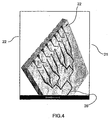
- the terahertz detector 4 is illustrated in detail. Its components are fabricated in or are mounted on a semi-conductor, e.g. silicon structure an example of which is illustrated in Figures 3 and 4.
- the components of the detector 4 comprise an antenna comprised of a horn antenna 14 and a waveguide 15, a mixer 16 and a local oscillator feed 17.
- the antenna selectively receives a predetermined frequency of electromagnetic radiation ("signal input"), the waveguide 15 being in communication with a mixer 16 which is also in communication with a local oscillator feed 17 comprised of a waveguide structure and having a signal input for connection to a local oscillator.
- the mixer 16 heterodyns the signal input and the local oscillator input so as to generate an intermediate frequency (“IF”) output.
- IF intermediate frequency
- the mixer 16 includes on a microstrip a first pass band filter 18 for isolating the local oscillator input from the waveguide 15 and a second pass band filter 19 which acts as a back stop to allow through only the pre-selected IF output.
- the mixer 16 is arranged so as to be substantially orthogonal to the waveguide 15.
- the intersection of the axis of the mixer 16 with the axis of the local oscillator feed 17 is not orthogonal and instead describes an acute angle.
- This arrangement of the local oscillator feed 17 at an acute angle to the mixer 16 reduces the back short length over a wider band width and so improves the bandwidth of the mixer transition in comparison to the more conventional 90° arrangement.
- this arrangement of the local oscillator input 17 and the mixer 16 provides an added benefit particular to imaging systems at these frequencies. It reduces the space occupied by each detector, thereby allowing them to be placed closer and a larger number of them, improving the resolution of the camera.
- the illustrated detector 4 is comprised for example of sixteen separate horn antenna providing a two-colour, eight pixel array.
- the size of the aperture of the detector 4 required to generate images at terahertz frequencies is such that the spacing between the individual horn antennae is limited to approximately 2.5 mm in the illustrated example. This spacing is not sufficient to enable the more conventional arrangement of the mixer at 90° to the local oscillator feed and so the detector aperture presents a limit to the number of antenna.
- the axis of the local oscillator input feed 17 so that it is substantially aligned with the axis of the antenna horn 14 and arranging the intersection of the axis of the mixer and the local oscillator feed 17 at 45° the number of detectors may be increased in the same area thereby improving the resolution of the detector.
- the detector 4 is fabricated from a semi conductor, e.g. silicon structure consisting of three separate etched layers: a top layer 23, a middle layer 20 and a lower layer 24 which are illustrated in Figure 1.
- Figures 3 and 4 show the middle layer 20 which is etched on both its upper surface 21 and its lower surface 22.
- the upper layer 23 and the lower layer 24 are each etched on only one side and the pattern of the etch in each case is a mirror image of the etch pattern of the respective upper surface 21 and lower surface 22 of the middle layer 20.
- the etch pattern whilst for each individual layer of silicon the etch pattern is open, when the three layers are brought together, the etch patterns of their surfaces match to define waveguide structures extending along the interface of the surfaces.
- Cooperating location holes and pins 25 are also provided in the surfaces of each of the layers to ensure accurate positioning of the layers with respect to one another.
- each horn antenna 14 is individually connected to its respective waveguide 15 and mixer 16.
- Individual local oscillator feeds 17 connect with respective mixers 16 but are themselves interconnected with one another upstream from the mixers to a single common local oscillator input 26.
- the dimensions of the etch pattern defining the waveguide structure are important to the functioning of the detector 4 and these dimensions can be determined though conventional modelling techniques.
- the detector illustrated in the figures is a two-colour detector with one of the set of eight antenna detecting a first terahertz frequency and the parallel second set of eight antenna detecting a second, different, terahertz frequency. This in turn requires the dimensions of the etch pattern for each of the two sets of eight antenna to differ slightly depending upon the frequencies of the input signal and the local oscillator signal. Moreover, to maximise structural strength, it can be seen in Figure 4 that each row of horn antennae are offset from one another. The following measurements in relation to Figure 5 are therefore provided solely to illustrate typical dimensions.
- the IF output for each antenna passes to an outer surface of the silicon layered structure along a wire extending through a respective via 27.
- a series of eight IF output vias extend through the body of the top silicon layer 23 and a corresponding series of eight IF output vias extend through the body of the bottom silicon layer 24. From there the IF outputs pass through a conventional series of 2 stage amplifiers 28 to an integrated detector 29 and from there to the data input port of the processor 5.
- a local oscillator signal of 245 GHz may be used to extracted an IF signal at 5 GHZ. It is to be understood that the frequencies quoted above are one illustration only and that conventional heterodyne theory can be employed to identify other suitable local oscillator frequencies and IF frequencies.
- the number of antennas in a row may be different from 8, and there may be more than 8 antennas in a row.
- the antennae may be fabricated in photonic bandgap material. This would prevent signal leakage between adjacent antennae and could provide an alternative structure for the mixer and for the conduction of both the signal input, the local oscillator LO signal and the intermediate frequency IF output.
- a silicon substrate 30 is illustrated on the upper surface of which is provided a series of three masks 31, 32 and 33 each laid on top of the next and in direct contact with the adjacent mask.
- the first uppermost mask 31 is a positive resist or a metal mask.
- a second negative resist mask 32 such as SU8 or other suitable amide mask material.
- Beneath the second mask is a third mask 33 preferably of silicon dioxide or aluminium nitride.
- the first mask 31 defines the deepest structures in the substrate and protects other areas from early etching.
- the second mask exposes, in addition to the deepest etch regions, intermediate depth etch regions whilst protecting those regions of the substrate that require the shallowest etch.
- the third and final mask exposes all areas previously etched as well as those areas requiring the shallowest etch. It is worth noting that the masks are not necessarily laid one on top of the next, but may be brought separately.
- the deepest etches are patterned for the horn antennas 14 and the waveguides 15, the intermediate etch depth is required for the majority of the local oscillator waveguide structure and then the shallowest etching is required for the mixer channel.
- the first etch is performed using the positive resist mask 31.
- the etch is continued to an etch depth equivalent to the difference between the desired final depth of the deepest structures and the final depth of the intermediate structures.
- the positive resist mask 31 is then removed ( Figure 6b) using a normal stripper such as an amine type stripper which does not affect the underlying negative resist mask 32.
- the next etch stage is then performed through the SU8 mask 32 to a depth equivalent to the difference between the desired final depth of the intermediate structures and the shallowest structures. As the etched pattern from the first etch stage remain exposed this pattern is again etched and the pattern driven deeper into the substrate.
- the second mask 32 is removed ( Figure 6c) which does not affect the underlying third mask 33 and then the third and final etch stage can be performed during which the shallowest features of the pattern are etched and the existing pattern again etched more deeply into the substrate 30 to its final depth.
- the third mask 33 is then removed ( Figure 6d). This procedure differs from then conventional procedure as it involves the use of a plurality of different masks each directly overlying an adjacent mask and an etching procedure in which new masks are not applied to the surface of the wafer in between etching steps.
- the silicon is metallised in the desired regions (waveguides and vias)
- the specimen may be mounted on an X-Y stage and moved so that different areas of the specimen are scanned in turn.
- phase shifter may be introduced into the individual local oscillator feeds 17.
- the phase shifter is comprised of a waveguide which has a slab of high resistivity intrinsic silicon mounted on the inside of one wall of the waveguide.
- the slab of silicon is exposed to incident light which causes the silicon to exhibit resistive and/or metallic properties.
- the power of the incident light determines the depth to which the changes in the silicon penetrate, changing the dimensions of the waveguide and thereby its dispersion characteristics.
- the imaging device described herein is suitable for the detection of passive millimeter and sub-millimeter electromagnetic radiation and in this respect is particularly convenient in view of its compact size, potential for portability and its ability to perform at room temperature.
- immediate applications for the imaging device are envisaged in both airborne and land vehicles, in security systems, in the chemical and food industries and in medical diagnostics.
- the scope of applications is not limited to those identified above and because of the low power requirements of the imaging system, it is particularly suited for example to imaging from space.
Landscapes
- Multimedia (AREA)
- Signal Processing (AREA)
- Engineering & Computer Science (AREA)
- Investigating Or Analysing Materials By Optical Means (AREA)
- Optical Filters (AREA)
- Radar Systems Or Details Thereof (AREA)
- Waveguides (AREA)
- Variable-Direction Aerials And Aerial Arrays (AREA)
- Waveguide Aerials (AREA)
- Details Of Aerials (AREA)
- Transforming Light Signals Into Electric Signals (AREA)
- Measurement Of Velocity Or Position Using Acoustic Or Ultrasonic Waves (AREA)
- Ceramic Capacitors (AREA)
Claims (13)
- Dispositif imageur à utiliser avec un rayonnement millimétrique et/ou submillimétrique comprenant au moins une paire de substrats (20, 23, 24, 30), dont au moins un est configuré sur au moins une surface ayant une configuration définissant au moins un détecteur de rayonnement (4) ; chaque détecteur de rayonnement comprenant :- une antenne (14) adaptée pour recevoir un rayonnement électromagnétique millimétrique et/ou submillimétrique,- un canal mélangeur (16) couplé à ladite antenne et en communication avec un trou d'interconnexion s'étendant à travers un substrat pour la connexion à une sortie de signal,- caractérisé par un mélangeur comprenant des filtres (18, 19) montés dans le canal mélangeur destiné à extraire un signal de fréquence intermédiaire en fonction dudit rayonnement reçu par l'antenne,- et par une structure de guide d'ondes (17) couplée audit mélangeur et ayant une entrée de signal pour la connexion à un oscillateur local, dans lequel le canal mélangeur croise le guide d'ondes de l'oscillateur local à un angle aigu.
- Dispositif imageur selon la revendication 1, dans lequel chaque substrat de ladite paire de substrats est configuré sur au moins une surface avec une configuration complémentaire définissant en combinaison ledit détecteur de rayonnement.
- Dispositif imageur selon la revendication 1 ou 2, dans lequel ladite configuration définit une pluralité de détecteurs de rayonnement (4).
- Dispositif imageur selon l'une quelconque des revendications 1 à 3, dans lequel il comprend au moins un troisième substrat, lesdits trois substrats définissant deux rangées de détecteurs de rayonnement.
- Dispositif imageur selon l'une quelconque des revendications 1 à 4, dans lequel l'antenne comprend un cornet (14) et un guide d'ondes d'antenne (15) qui est couplé audit cornet (14) et qui croise le canal mélangeur (16) de façon sensiblement orthogonale.
- Dispositif imageur selon la revendication 5, dans lequel le guide d'ondes d'antenne est décalé par rapport à l'axe du cornet selon un angle aigu.
- Dispositif imageur selon la revendication 6, dans lequel le guide d'ondes de l'oscillateur local est parallèle à l'axe du cornet.
- Procédé destiné à fabriquer un substrat configuré pour un dispositif imageur à utiliser avec un rayonnement millimétrique et/ou submillimétrique comprenant au moins une paire de substrats (20, 23, 24, 30), dont au moins un est configuré sur au moins une surface ayant une configuration définissant au moins un détecteur de rayonnement (4) ; chaque détecteur de rayonnement comprenant :- une antenne (14) adaptée pour recevoir un rayonnement électromagnétique millimétrique et/ou submillimétrique,- un canal mélangeur (16) couplé à ladite antenne et en communication avec un trou d'interconnexion s'étendant à travers un substrat pour la connexion à une sortie de signal, un mélangeur comprenant des filtres (18, 19) étant montés dans le canal mélangeur pour extraire un signal de fréquence intermédiaire en fonction dudit rayonnement reçu par l'antenne,- une structure de guide d'ondes (17) couplée audit mélangeur et ayant une entrée de signal pour la connexion à un oscillateur local, ledit procédé comprenant les étapes suivantes consistant à :- fournir sur une surface d'un substrat un premier (31), un deuxième (32) et un troisième (33) masques configurés, ledit premier masque (31) ayant un premier motif correspondant à une première région de chaque détecteur de rayonnement avec la profondeur de gravure la plus élevée, ledit deuxième masque (32) ayant un deuxième motif correspondant à ladite première région et à une deuxième région de chaque détecteur de rayonnement avec une profondeur de gravure intermédiaire, et ledit troisième masque (33) ayant un troisième motif correspondant auxdites première et deuxième régions et à une troisième région de chaque détecteur de rayonnement avec la profondeur de gravure la plus superficielle,- exécuter une première gravure via le premier motif du premier masque (31) à une première profondeur qui est sensiblement égale à la différence entre la profondeur de gravure la plus élevée et la profondeur de gravure intermédiaire,- retirer ledit premier masque (31)- exécuter une deuxième gravure via le deuxième motif du deuxième masque (32) à une deuxième profondeur qui est sensiblement égale à la différence entre la profondeur de gravure intermédiaire et la profondeur de gravure la plus superficielle,- retirer ledit deuxième masque (32)- exécuter une troisième gravure via le troisième motif du troisième masque (33) avec une profondeur de gravure qui est sensiblement égale à la profondeur de gravure la plus superficielle,- retirer le troisième masque (33).
- Procédé selon la revendication 8, dans lequel lesdits premier (31), deuxième (32) et troisième (33) masques sont chacun posés sur la partie supérieure du suivant et en contact direct avec le masque adjacent.
- Procédé selon la revendication 9, dans lequel l'un desdits masques (31, 33, 33) est un masque réserve positif ou métallique, dans lequel un autre masque est un masque réserve négatif ou un masque amide, et encore un autre masque est en oxyde de silicium ou en nitrure d'aluminium.
- Procédé selon la revendication 8 ou 9, dans lequel ladite première région correspond à ladite antenne.
- Procédé selon l'une quelconque des revendications 9 à 11, dans lequel ladite deuxième région correspond à au moins une partie de ladite structure de guide d'ondes.
- Procédé selon l'une quelconque des revendications 9 à 12, dans lequel ladite deuxième région correspond audit canal mélangeur.
Applications Claiming Priority (3)
| Application Number | Priority Date | Filing Date | Title |
|---|---|---|---|
| GB0224912 | 2002-10-25 | ||
| GBGB0224912.6A GB0224912D0 (en) | 2002-10-25 | 2002-10-25 | Sub-millimetre wavelength camera |
| PCT/EP2003/013342 WO2004038854A2 (fr) | 2002-10-25 | 2003-10-27 | Camera a longueur d'onde submillimetrique |
Publications (2)
| Publication Number | Publication Date |
|---|---|
| EP1554780A2 EP1554780A2 (fr) | 2005-07-20 |
| EP1554780B1 true EP1554780B1 (fr) | 2007-04-18 |
Family
ID=9946612
Family Applications (1)
| Application Number | Title | Priority Date | Filing Date |
|---|---|---|---|
| EP03778333A Expired - Lifetime EP1554780B1 (fr) | 2002-10-25 | 2003-10-27 | Camera a longueur d'onde submillimetrique |
Country Status (13)
| Country | Link |
|---|---|
| US (1) | US7502605B2 (fr) |
| EP (1) | EP1554780B1 (fr) |
| JP (1) | JP4516426B2 (fr) |
| KR (1) | KR100989846B1 (fr) |
| CN (1) | CN1726618B (fr) |
| AT (1) | ATE360271T1 (fr) |
| AU (1) | AU2003285345A1 (fr) |
| CA (1) | CA2503556A1 (fr) |
| DE (1) | DE60313352T2 (fr) |
| DK (1) | DK1554780T3 (fr) |
| ES (1) | ES2285216T3 (fr) |
| GB (1) | GB0224912D0 (fr) |
| WO (1) | WO2004038854A2 (fr) |
Families Citing this family (24)
| Publication number | Priority date | Publication date | Assignee | Title |
|---|---|---|---|---|
| US7521680B1 (en) * | 2003-12-05 | 2009-04-21 | Eric Dean Rosenthal | Electromagnetic spectral-based imaging devices and methods |
| US8311616B2 (en) | 2005-05-26 | 2012-11-13 | Yissum Research Development Company Of The Hebrew University Of Jerusalem | Method and system for determination of physiological conditions and emotional states of a living organism |
| GB0511209D0 (en) * | 2005-06-02 | 2005-07-06 | Thru Vision Ltd | Scanning method and apparatus |
| GB0603193D0 (en) * | 2006-02-16 | 2006-03-29 | Thruvision Ltd | Detection method and apparatus |
| ATE521106T1 (de) | 2006-04-25 | 2011-09-15 | Thruvision Systems Ltd | Feedhorn-baugruppe und herstellungsverfahren dafür |
| US7873329B2 (en) | 2006-04-25 | 2011-01-18 | ThruVision Systems Limited | Transceiver having mixer/filter within receiving/transmitting cavity |
| US7764324B2 (en) * | 2007-01-30 | 2010-07-27 | Radiabeam Technologies, Llc | Terahertz camera |
| DE102007007378B3 (de) * | 2007-02-12 | 2008-04-17 | Genesis Adaptive Systeme Deutschland Gmbh | Verfahren und Vorrichtung zur Erfassung eines Objekts mit Terahertz-Strahlung |
| DE102007011704A1 (de) | 2007-03-08 | 2008-09-11 | Genesis Adaptive Systeme Deutschland Gmbh | Messvorrichtung für die Abbildung mit Terahertz-Strahlung |
| US7888646B2 (en) * | 2007-06-04 | 2011-02-15 | Morpho Detection, Inc. | System and method for detecting contraband |
| WO2009013681A1 (fr) * | 2007-07-25 | 2009-01-29 | Koninklijke Philips Electronics N.V. | Appareil d'imagerie/spectroscopie térahertzien électronique intégré |
| US7745792B2 (en) * | 2007-08-15 | 2010-06-29 | Morpho Detection, Inc. | Terahertz detectors for use in terahertz inspection or imaging systems |
| JP5144175B2 (ja) * | 2007-08-31 | 2013-02-13 | キヤノン株式会社 | 電磁波を用いる検査装置及び検査方法 |
| US9157852B2 (en) | 2010-09-17 | 2015-10-13 | Raytheon Company | Explosive material detection |
| WO2012094051A2 (fr) | 2010-10-26 | 2012-07-12 | California Institute Of Technology | Structures d'antennes à éléments rayonnants actifs distribués à ondes progressives, génération de puissance à haute fréquence et filtrage quasi-optique |
| US9268017B2 (en) | 2011-07-29 | 2016-02-23 | International Business Machines Corporation | Near-field millimeter wave imaging |
| US8658976B2 (en) * | 2011-12-01 | 2014-02-25 | California Institute Of Technology | Integrated terahertz imaging systems |
| GB2499380A (en) * | 2012-02-06 | 2013-08-21 | Digital Barriers Services Ltd | Multiple frequency terahertz imaging system |
| US9658155B2 (en) | 2012-12-17 | 2017-05-23 | Patrick K Brady | System and method for identifying materials using a THz spectral fingerprint in a media with high water content |
| US9494464B2 (en) * | 2013-02-20 | 2016-11-15 | Battelle Energy Alliance, Llc | Terahertz imaging devices and systems, and related methods, for detection of materials |
| CN106603015A (zh) * | 2016-12-29 | 2017-04-26 | 中国科学院国家空间科学中心 | 一种实现短基线测量的太赫兹混频器和接收机前端 |
| US20200081433A1 (en) * | 2018-09-12 | 2020-03-12 | International Business Machines Corporation | Self-Driving Security Checking and Boarding Vehicle System |
| US20230144500A1 (en) * | 2019-10-17 | 2023-05-11 | Thruvision Limited | High frequency heterodyne mixer |
| JP7644108B2 (ja) * | 2019-10-17 | 2025-03-11 | スルービジョン リミテッド | 高周波検出方法および装置 |
Family Cites Families (9)
| Publication number | Priority date | Publication date | Assignee | Title |
|---|---|---|---|---|
| US4641369A (en) * | 1984-11-29 | 1987-02-03 | Trw Inc. | Local oscillator and mixer assembly |
| US4607394A (en) * | 1985-03-04 | 1986-08-19 | General Electric Company | Single balanced planar mixer |
| GB9603196D0 (en) * | 1996-02-15 | 1996-04-17 | Council Cent Lab Res Councils | Waveguide structures and a method of fabrication thereof |
| WO1998042486A1 (fr) * | 1997-03-25 | 1998-10-01 | The University Of Virginia Patent Foundation | Procede de fabrication de composant a frequence millimetrique ou decimillimetrique |
| AU6583898A (en) * | 1997-03-25 | 1998-10-20 | Council For The Central Laboratory Of The Research Councils | Integration of hollow waveguides, channels and horns by lithographic and et chingtechniques |
| AU8655898A (en) * | 1997-03-25 | 1998-11-11 | University Of Virginia Patent Foundation | A preferential crystal etching technique for the fabrication of millimeter and submillimeter wavelength horn antennas |
| JP3760051B2 (ja) * | 1998-08-04 | 2006-03-29 | シャープ株式会社 | Nrdガイドミリ波帯発振器の周波数調整装置 |
| US6522304B2 (en) * | 2001-04-11 | 2003-02-18 | International Business Machines Corporation | Dual damascene horn antenna |
| JP3954380B2 (ja) * | 2001-12-28 | 2007-08-08 | 株式会社東芝 | 撮像装置 |
-
2002
- 2002-10-25 GB GBGB0224912.6A patent/GB0224912D0/en not_active Ceased
-
2003
- 2003-10-27 JP JP2004546033A patent/JP4516426B2/ja not_active Expired - Lifetime
- 2003-10-27 EP EP03778333A patent/EP1554780B1/fr not_active Expired - Lifetime
- 2003-10-27 CA CA002503556A patent/CA2503556A1/fr not_active Abandoned
- 2003-10-27 KR KR1020057007155A patent/KR100989846B1/ko not_active Expired - Lifetime
- 2003-10-27 ES ES03778333T patent/ES2285216T3/es not_active Expired - Lifetime
- 2003-10-27 DK DK03778333T patent/DK1554780T3/da active
- 2003-10-27 DE DE60313352T patent/DE60313352T2/de not_active Expired - Lifetime
- 2003-10-27 US US10/532,736 patent/US7502605B2/en not_active Expired - Lifetime
- 2003-10-27 AT AT03778333T patent/ATE360271T1/de not_active IP Right Cessation
- 2003-10-27 WO PCT/EP2003/013342 patent/WO2004038854A2/fr not_active Ceased
- 2003-10-27 CN CN200380106120.XA patent/CN1726618B/zh not_active Expired - Lifetime
- 2003-10-27 AU AU2003285345A patent/AU2003285345A1/en not_active Abandoned
Non-Patent Citations (1)
| Title |
|---|
| None * |
Also Published As
| Publication number | Publication date |
|---|---|
| WO2004038854A2 (fr) | 2004-05-06 |
| DE60313352D1 (de) | 2007-05-31 |
| KR20050088405A (ko) | 2005-09-06 |
| WO2004038854A3 (fr) | 2004-06-17 |
| AU2003285345A8 (en) | 2004-05-13 |
| US7502605B2 (en) | 2009-03-10 |
| CA2503556A1 (fr) | 2004-05-06 |
| DK1554780T3 (da) | 2007-09-17 |
| KR100989846B1 (ko) | 2010-10-29 |
| ES2285216T3 (es) | 2007-11-16 |
| GB0224912D0 (en) | 2002-12-04 |
| HK1077127A1 (en) | 2006-02-03 |
| EP1554780A2 (fr) | 2005-07-20 |
| ATE360271T1 (de) | 2007-05-15 |
| JP2006505157A (ja) | 2006-02-09 |
| JP4516426B2 (ja) | 2010-08-04 |
| CN1726618B (zh) | 2011-07-06 |
| CN1726618A (zh) | 2006-01-25 |
| US20060111619A1 (en) | 2006-05-25 |
| AU2003285345A1 (en) | 2004-05-13 |
| DE60313352T2 (de) | 2008-01-03 |
Similar Documents
| Publication | Publication Date | Title |
|---|---|---|
| EP1554780B1 (fr) | Camera a longueur d'onde submillimetrique | |
| DE102019205150A1 (de) | Elektronische vorrichtung zum anordnen von antennen an einer dielektrischen schicht | |
| DE69833716T2 (de) | Transparente planare Antennenstruktur | |
| DE102022204159A1 (de) | Elektronische vorrichtungen mit isolierten antennenmodulen | |
| US8305259B2 (en) | Dual-band antenna array and RF front-end for mm-wave imager and radar | |
| KR100421771B1 (ko) | 전자파영상시스템 | |
| US10038252B2 (en) | Tiling system and method for an array antenna | |
| EP1723696B1 (fr) | Mecanismes accordables | |
| DE60318075T2 (de) | Echtzeitmillimeterwellenabbildungssystem mittels kreuzkorrelation | |
| DE69412264T2 (de) | Strahlungssensor | |
| DE102021203692A1 (de) | Elektronische vorrichtungen mit dielektrischen resonatorantennen mit parasitären patches | |
| DE112018002681T5 (de) | Antennen in strukturierten leitfähigen schichten | |
| CA1234911A (fr) | Radiometre a balayage de frequences | |
| US20190369200A1 (en) | Radiovision device | |
| US5237334A (en) | Focal plane antenna array for millimeter waves | |
| US8885774B2 (en) | Receiving apparatus for high frequency imaging system | |
| DE4313397A1 (de) | Planarantenne | |
| US20030137452A1 (en) | Self-orienting antenna array systems | |
| CN115313066B (zh) | 相控阵天线装置及相控阵通信系统 | |
| HK1077127B (en) | Sub-millimetre wavelength camera | |
| KR20200142019A (ko) | 테라헤르츠 근거리 이미저 | |
| DE10035623A1 (de) | Vorrichtung zum Senden und/oder Empfangen elektromagnetischer Wellen und Verfahren zum Herstellen der Vorrichtung | |
| DE102023208493A1 (de) | Elektronische vorrichtung mit leitfähigem an eine gedruckte schaltung gelöteten kontakt | |
| JPH1168455A (ja) | 準光学アンテナ・ミキサ素子および配列型準光学アンテナ・ミキサ | |
| US7148842B1 (en) | Ferroelectric delay line based on a dielectric-slab transmission line |
Legal Events
| Date | Code | Title | Description |
|---|---|---|---|
| PUAI | Public reference made under article 153(3) epc to a published international application that has entered the european phase |
Free format text: ORIGINAL CODE: 0009012 |
|
| 17P | Request for examination filed |
Effective date: 20050518 |
|
| AK | Designated contracting states |
Kind code of ref document: A2 Designated state(s): AT BE BG CH CY CZ DE DK EE ES FI FR GB GR HU IE IT LI LU MC NL PT RO SE SI SK TR |
|
| AX | Request for extension of the european patent |
Extension state: AL LT LV MK |
|
| REG | Reference to a national code |
Ref country code: HK Ref legal event code: DE Ref document number: 1077127 Country of ref document: HK |
|
| DAX | Request for extension of the european patent (deleted) | ||
| GRAP | Despatch of communication of intention to grant a patent |
Free format text: ORIGINAL CODE: EPIDOSNIGR1 |
|
| RTI1 | Title (correction) |
Free format text: SUB-MILLIMETER WAVELENGTH CAMERA |
|
| GRAS | Grant fee paid |
Free format text: ORIGINAL CODE: EPIDOSNIGR3 |
|
| 17Q | First examination report despatched |
Effective date: 20050819 |
|
| GRAJ | Information related to disapproval of communication of intention to grant by the applicant or resumption of examination proceedings by the epo deleted |
Free format text: ORIGINAL CODE: EPIDOSDIGR1 |
|
| GRAP | Despatch of communication of intention to grant a patent |
Free format text: ORIGINAL CODE: EPIDOSNIGR1 |
|
| GRAS | Grant fee paid |
Free format text: ORIGINAL CODE: EPIDOSNIGR3 |
|
| GRAA | (expected) grant |
Free format text: ORIGINAL CODE: 0009210 |
|
| AK | Designated contracting states |
Kind code of ref document: B1 Designated state(s): AT BE BG CH CY CZ DE DK EE ES FI FR GB GR HU IE IT LI LU MC NL PT RO SE SI SK TR |
|
| PG25 | Lapsed in a contracting state [announced via postgrant information from national office to epo] |
Ref country code: LI Free format text: LAPSE BECAUSE OF FAILURE TO SUBMIT A TRANSLATION OF THE DESCRIPTION OR TO PAY THE FEE WITHIN THE PRESCRIBED TIME-LIMIT Effective date: 20070418 Ref country code: SI Free format text: LAPSE BECAUSE OF FAILURE TO SUBMIT A TRANSLATION OF THE DESCRIPTION OR TO PAY THE FEE WITHIN THE PRESCRIBED TIME-LIMIT Effective date: 20070418 Ref country code: FI Free format text: LAPSE BECAUSE OF FAILURE TO SUBMIT A TRANSLATION OF THE DESCRIPTION OR TO PAY THE FEE WITHIN THE PRESCRIBED TIME-LIMIT Effective date: 20070418 Ref country code: CH Free format text: LAPSE BECAUSE OF FAILURE TO SUBMIT A TRANSLATION OF THE DESCRIPTION OR TO PAY THE FEE WITHIN THE PRESCRIBED TIME-LIMIT Effective date: 20070418 |
|
| REG | Reference to a national code |
Ref country code: CH Ref legal event code: EP |
|
| REG | Reference to a national code |
Ref country code: IE Ref legal event code: FG4D |
|
| REF | Corresponds to: |
Ref document number: 60313352 Country of ref document: DE Date of ref document: 20070531 Kind code of ref document: P |
|
| REG | Reference to a national code |
Ref country code: SE Ref legal event code: TRGR |
|
| ET | Fr: translation filed | ||
| REG | Reference to a national code |
Ref country code: DK Ref legal event code: T3 |
|
| PG25 | Lapsed in a contracting state [announced via postgrant information from national office to epo] |
Ref country code: PT Free format text: LAPSE BECAUSE OF FAILURE TO SUBMIT A TRANSLATION OF THE DESCRIPTION OR TO PAY THE FEE WITHIN THE PRESCRIBED TIME-LIMIT Effective date: 20070918 |
|
| REG | Reference to a national code |
Ref country code: CH Ref legal event code: PL |
|
| REG | Reference to a national code |
Ref country code: ES Ref legal event code: FG2A Ref document number: 2285216 Country of ref document: ES Kind code of ref document: T3 |
|
| PG25 | Lapsed in a contracting state [announced via postgrant information from national office to epo] |
Ref country code: AT Free format text: LAPSE BECAUSE OF FAILURE TO SUBMIT A TRANSLATION OF THE DESCRIPTION OR TO PAY THE FEE WITHIN THE PRESCRIBED TIME-LIMIT Effective date: 20070418 |
|
| REG | Reference to a national code |
Ref country code: HK Ref legal event code: GR Ref document number: 1077127 Country of ref document: HK |
|
| PG25 | Lapsed in a contracting state [announced via postgrant information from national office to epo] |
Ref country code: BE Free format text: LAPSE BECAUSE OF FAILURE TO SUBMIT A TRANSLATION OF THE DESCRIPTION OR TO PAY THE FEE WITHIN THE PRESCRIBED TIME-LIMIT Effective date: 20070418 |
|
| PG25 | Lapsed in a contracting state [announced via postgrant information from national office to epo] |
Ref country code: CZ Free format text: LAPSE BECAUSE OF FAILURE TO SUBMIT A TRANSLATION OF THE DESCRIPTION OR TO PAY THE FEE WITHIN THE PRESCRIBED TIME-LIMIT Effective date: 20070418 Ref country code: BG Free format text: LAPSE BECAUSE OF FAILURE TO SUBMIT A TRANSLATION OF THE DESCRIPTION OR TO PAY THE FEE WITHIN THE PRESCRIBED TIME-LIMIT Effective date: 20070718 |
|
| PLBE | No opposition filed within time limit |
Free format text: ORIGINAL CODE: 0009261 |
|
| STAA | Information on the status of an ep patent application or granted ep patent |
Free format text: STATUS: NO OPPOSITION FILED WITHIN TIME LIMIT |
|
| PG25 | Lapsed in a contracting state [announced via postgrant information from national office to epo] |
Ref country code: SK Free format text: LAPSE BECAUSE OF FAILURE TO SUBMIT A TRANSLATION OF THE DESCRIPTION OR TO PAY THE FEE WITHIN THE PRESCRIBED TIME-LIMIT Effective date: 20070418 |
|
| 26N | No opposition filed |
Effective date: 20080121 |
|
| PG25 | Lapsed in a contracting state [announced via postgrant information from national office to epo] |
Ref country code: GR Free format text: LAPSE BECAUSE OF FAILURE TO SUBMIT A TRANSLATION OF THE DESCRIPTION OR TO PAY THE FEE WITHIN THE PRESCRIBED TIME-LIMIT Effective date: 20070719 |
|
| PG25 | Lapsed in a contracting state [announced via postgrant information from national office to epo] |
Ref country code: RO Free format text: LAPSE BECAUSE OF FAILURE TO SUBMIT A TRANSLATION OF THE DESCRIPTION OR TO PAY THE FEE WITHIN THE PRESCRIBED TIME-LIMIT Effective date: 20070418 Ref country code: MC Free format text: LAPSE BECAUSE OF NON-PAYMENT OF DUE FEES Effective date: 20071031 |
|
| PG25 | Lapsed in a contracting state [announced via postgrant information from national office to epo] |
Ref country code: IE Free format text: LAPSE BECAUSE OF NON-PAYMENT OF DUE FEES Effective date: 20071030 |
|
| PG25 | Lapsed in a contracting state [announced via postgrant information from national office to epo] |
Ref country code: EE Free format text: LAPSE BECAUSE OF FAILURE TO SUBMIT A TRANSLATION OF THE DESCRIPTION OR TO PAY THE FEE WITHIN THE PRESCRIBED TIME-LIMIT Effective date: 20070418 |
|
| PG25 | Lapsed in a contracting state [announced via postgrant information from national office to epo] |
Ref country code: CY Free format text: LAPSE BECAUSE OF FAILURE TO SUBMIT A TRANSLATION OF THE DESCRIPTION OR TO PAY THE FEE WITHIN THE PRESCRIBED TIME-LIMIT Effective date: 20070418 |
|
| PG25 | Lapsed in a contracting state [announced via postgrant information from national office to epo] |
Ref country code: LU Free format text: LAPSE BECAUSE OF NON-PAYMENT OF DUE FEES Effective date: 20071027 |
|
| PG25 | Lapsed in a contracting state [announced via postgrant information from national office to epo] |
Ref country code: TR Free format text: LAPSE BECAUSE OF FAILURE TO SUBMIT A TRANSLATION OF THE DESCRIPTION OR TO PAY THE FEE WITHIN THE PRESCRIBED TIME-LIMIT Effective date: 20070418 Ref country code: HU Free format text: LAPSE BECAUSE OF FAILURE TO SUBMIT A TRANSLATION OF THE DESCRIPTION OR TO PAY THE FEE WITHIN THE PRESCRIBED TIME-LIMIT Effective date: 20071019 |
|
| PGFP | Annual fee paid to national office [announced via postgrant information from national office to epo] |
Ref country code: DK Payment date: 20101015 Year of fee payment: 8 Ref country code: NL Payment date: 20101013 Year of fee payment: 8 |
|
| PGFP | Annual fee paid to national office [announced via postgrant information from national office to epo] |
Ref country code: SE Payment date: 20101014 Year of fee payment: 8 |
|
| REG | Reference to a national code |
Ref country code: NL Ref legal event code: V1 Effective date: 20120501 |
|
| REG | Reference to a national code |
Ref country code: DK Ref legal event code: EBP |
|
| REG | Reference to a national code |
Ref country code: SE Ref legal event code: EUG |
|
| PG25 | Lapsed in a contracting state [announced via postgrant information from national office to epo] |
Ref country code: NL Free format text: LAPSE BECAUSE OF NON-PAYMENT OF DUE FEES Effective date: 20120501 |
|
| PG25 | Lapsed in a contracting state [announced via postgrant information from national office to epo] |
Ref country code: DK Free format text: LAPSE BECAUSE OF NON-PAYMENT OF DUE FEES Effective date: 20111031 Ref country code: SE Free format text: LAPSE BECAUSE OF NON-PAYMENT OF DUE FEES Effective date: 20111028 |
|
| REG | Reference to a national code |
Ref country code: FR Ref legal event code: PLFP Year of fee payment: 13 |
|
| REG | Reference to a national code |
Ref country code: FR Ref legal event code: PLFP Year of fee payment: 14 |
|
| REG | Reference to a national code |
Ref country code: FR Ref legal event code: PLFP Year of fee payment: 15 |
|
| REG | Reference to a national code |
Ref country code: FR Ref legal event code: PLFP Year of fee payment: 16 |
|
| PGFP | Annual fee paid to national office [announced via postgrant information from national office to epo] |
Ref country code: FR Payment date: 20221028 Year of fee payment: 20 |
|
| PGFP | Annual fee paid to national office [announced via postgrant information from national office to epo] |
Ref country code: IT Payment date: 20221026 Year of fee payment: 20 Ref country code: GB Payment date: 20221019 Year of fee payment: 20 Ref country code: ES Payment date: 20221222 Year of fee payment: 20 Ref country code: DE Payment date: 20220620 Year of fee payment: 20 |
|
| REG | Reference to a national code |
Ref country code: DE Ref legal event code: R071 Ref document number: 60313352 Country of ref document: DE |
|
| REG | Reference to a national code |
Ref country code: ES Ref legal event code: FD2A Effective date: 20231106 |
|
| REG | Reference to a national code |
Ref country code: GB Ref legal event code: PE20 Expiry date: 20231026 |
|
| PG25 | Lapsed in a contracting state [announced via postgrant information from national office to epo] |
Ref country code: GB Free format text: LAPSE BECAUSE OF EXPIRATION OF PROTECTION Effective date: 20231026 |
|
| PG25 | Lapsed in a contracting state [announced via postgrant information from national office to epo] |
Ref country code: ES Free format text: LAPSE BECAUSE OF EXPIRATION OF PROTECTION Effective date: 20231028 |
|
| PG25 | Lapsed in a contracting state [announced via postgrant information from national office to epo] |
Ref country code: GB Free format text: LAPSE BECAUSE OF EXPIRATION OF PROTECTION Effective date: 20231026 Ref country code: ES Free format text: LAPSE BECAUSE OF EXPIRATION OF PROTECTION Effective date: 20231028 |