EP1555839A1 - Verfahren zur Kommunikationsübertragung durch Tastendruck an einem Telefon und zugehörige Telefon - Google Patents
Verfahren zur Kommunikationsübertragung durch Tastendruck an einem Telefon und zugehörige Telefon Download PDFInfo
- Publication number
- EP1555839A1 EP1555839A1 EP05290090A EP05290090A EP1555839A1 EP 1555839 A1 EP1555839 A1 EP 1555839A1 EP 05290090 A EP05290090 A EP 05290090A EP 05290090 A EP05290090 A EP 05290090A EP 1555839 A1 EP1555839 A1 EP 1555839A1
- Authority
- EP
- European Patent Office
- Prior art keywords
- telephone
- information
- transmitting
- receiving
- transmitted
- Prior art date
- Legal status (The legal status is an assumption and is not a legal conclusion. Google has not performed a legal analysis and makes no representation as to the accuracy of the status listed.)
- Granted
Links
- 238000004891 communication Methods 0.000 title claims abstract description 57
- 238000000034 method Methods 0.000 title claims abstract description 39
- 230000008569 process Effects 0.000 claims abstract description 5
- 230000005540 biological transmission Effects 0.000 claims description 17
- 230000011664 signaling Effects 0.000 claims description 11
- 230000004913 activation Effects 0.000 claims description 3
- 230000006870 function Effects 0.000 description 4
- 230000008901 benefit Effects 0.000 description 3
- 238000001514 detection method Methods 0.000 description 3
- 238000011161 development Methods 0.000 description 3
- 230000018109 developmental process Effects 0.000 description 3
- 230000004044 response Effects 0.000 description 3
- 238000012790 confirmation Methods 0.000 description 2
- 230000003111 delayed effect Effects 0.000 description 2
- 238000012986 modification Methods 0.000 description 2
- 230000004048 modification Effects 0.000 description 2
- 230000001419 dependent effect Effects 0.000 description 1
- 230000009977 dual effect Effects 0.000 description 1
- 230000000694 effects Effects 0.000 description 1
- 238000012546 transfer Methods 0.000 description 1
- 238000013519 translation Methods 0.000 description 1
Images

Classifications
-
- H—ELECTRICITY
- H04—ELECTRIC COMMUNICATION TECHNIQUE
- H04W—WIRELESS COMMUNICATION NETWORKS
- H04W84/00—Network topologies
- H04W84/02—Hierarchically pre-organised networks, e.g. paging networks, cellular networks, WLAN [Wireless Local Area Network] or WLL [Wireless Local Loop]
- H04W84/04—Large scale networks; Deep hierarchical networks
- H04W84/08—Trunked mobile radio systems
Definitions
- the present invention relates to telephony, preferably mobile.
- a user may wish to communicate information under form of a short sentence to at least one correspondent.
- the short message serves then to indicate for example a current geographical position and / or a place and / or schedule of appointments.
- communication ordinary telephone service a communication between two telephony, on a channel in circuit mode.
- GPRS General Packet Radio Service
- VOIP voice over IP
- Signaling resources are then implemented in the network until the recipient stalls, then resources from communication. If the call does not succeed, a mail resource in the network can be implemented.
- a caller A for example must first find on his terminal the number of a correspondent B to call - he then uses possibly the "bis" function of his terminal - then call his correspondent B. If correspondent B does not pick up fast enough, caller A must leave his short message on B's message box telephony network.
- Called B may eventually leave a message on the A messenger, but this message will be irrelevant, since the called B did not listen to A.'s message.
- Caller A and called party B must therefore repeat several times the communications to agree on a meeting place by example.
- each communication occupies resources of the network and is billed, which can cause a significant cost to users.
- the called B does not call back immediately caller A and consult his messaging to listen to the message, but he can then elapse a relatively long time between the communication of A to B and the consultation of the message.
- a solution according to the state of the art is the use of a method communication transmission by pressing a pushbutton on a mobile phone combined with a presence and messaging service instantaneous - or a push-to-talk (PTT) method combined with a "Instant Message Presence Service” (IMPS) according to the English terminology generally used by those skilled in the art.
- PTT presence and messaging service instantaneous - or a push-to-talk
- IMS Intelligent Message Presence Service
- the terminal of A is configured for a call to at least the terminal of B declared, and vice versa.
- the terminals preferably comprise a pusher dedicated to this operating mode.
- the correspondent A for example press the dedicated pusher of his terminal and speak into the microphone of its terminal, the terminal of B reproduces directly what A says, and reciprocally.
- This operating mode preferably uses the protocol of transfer of voice over IP ("Internet Protocol” in English or Protocol Internet) or "voice over IP” (VOIP), itself transported by the protocol GPRS packet radio access.
- voice over IP Internet Protocol
- VOIP voice over IP
- the correspondents A and B or members of the tribe preferentially wear a hands-free earphone or pedestrians to be able to listen to messages at any time, without having to manipulate their terminal.
- the mobile phone network must be adapted to IMPS and VOIP protocols. In particular, it must include a server presence.
- the terminals must also include means to support and implement the protocols of IMPS and of VOIP.
- the invention proposes to overcome at least one of the disadvantages of the art prior.
- One of the aims of the invention is to propose a technique of transmission of communications by pressing a key - no limitatively push-button pressure - on a mobile phone - or a push-to-talk technique (PTT) according to the English terminology generally used by those skilled in the art - which does not require modification of the ordinary mobile network for its implementation artwork.
- PTT push-to-talk technique
- Another aim of the invention is to propose a PTT technique on a phone, especially mobile, which requires little or no, for its implementation, of modifications of a terminal able to carry out a ordinary telephony communication.
- Another aim of the invention is to propose a PTT technique on a phone, especially mobile that does not require that members of a tribe are simultaneously declared to a presence service and / or listen simultaneously to their terminal.
- the invention provides a method according to claim 1.
- the invention also relates to the transmitter and receiver telephones implementation of the method.
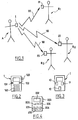
- Figure 1 shows schematically an information transmission 30 from a mobile phone 1 transmitter belonging to a caller A to three receiving mobile telephones 21, 22 and 23 respectively belonging to three correspondents B1, B2 and B3.
- the information to be transmitted is advantageously short voice messages.
- the number of correspondents is arbitrary. Caller A can by example have only one privileged correspondent, or more than three.
- the correspondents form what the skilled person calls a "tribe".
- the transmission of information is carried out by a method of transmission of communications by pressing a key on a mobile phone, also known as the push-to-talk (PTT) English.
- PTT push-to-talk
- the actuation of the key is preferentially but not limitingly a pressure of a pusher. This is the example we will take in the following description.
- the actuation can also be performed as a translation of a switch for example.
- At least the beginning of the information to be transmitted is marked by pressing a key, namely preferentially by pressing a pushbutton on the mobile phone 1 transmitter.
- the pressure of the pusher can be extended and maintained, or short and relaxed.
- the pusher may for example be the call acceptance push 101 - typically the "green key" on mobile phones - or an additional pusher 103 dedicated to PTT operating mode.
- the dedicated pusher 103 is advantageously located on one side of the phone 1.
- the pusher can be also any which key on the keyboard 100.
- Figure 5 shows schematically the main steps of a possible example of PTT process according to the invention.
- a caller A presses the pusher 101 or 103 and speaks in the conventional microphone mounted on the phone 1. He speaks and pronounce the information 30, for example in the form of a short message voice, which he wants to deliver to his correspondents B1, B2 and B3.
- the pressure of the pusher 101 or 103 generates two steps 51 and 52 concurrent.
- step 51 the transmitter telephone 1 records, from their beginning and on memory means, the information to be transmitted to each receiving telephone 21, 22 and 23.
- the telephone transmitter 1 records the information to be transmitted on memory means 10 included in the transmitter telephone 1 and visible in FIG.
- the duration of the recording 51 of the information is indicated schematically by the dots in Figure 5.
- the recording lasts, as will be seen in more detail later in this description, up to a step 510.
- step 510 it is determined whether on the one hand all the information have been recorded, which is usually materialized by the actuation of a key, preferably the release of the same pusher or a short and loose pressure or the same or other key - one stands then in case 511 - or if on the other hand the recording is interrupted by establishing direct communication between Caller A and least one of his correspondents - we are then in the case referenced by 512.
- step 52 the transmitting telephone 1 calls simultaneously to step 51 of recording the information to be transmitted, at least one receiver telephone 21, 22 and 23.
- the number of each mobile phone receiver 21, 22 and 23 to be called is stored by the transmitter telephone 1, in means 11, for example in the form of a list.
- the transmitter telephone 1 thus calls for example the first 21 receiver phone in the list of the tribe, then the others, successively.
- the call is made by a regular switched telephone call of circuit.
- the telephone 1 calls successively each correspondent by ordinary calls, the information 30 of the message having been recorded once
- the telephone 1 thus conventionally comprises means 12 capable of successively call the correspondents and establish or interrupt a ordinary communication with a correspondent, as well as information online.
- the transmitting telephone 1 calls successively each receiver 21, 22 and 23 and records the information 30 to be transmitted when pressing the key 101 or the pressure of the pusher 103 for example.
- a user A can add or delete corresponding to a navigation in a menu of options by example.
- Phone 1 can have a tribe associated with a key, for example example the key 101, and another tribe associated with another key, by example the pusher 103, etc. Caller A can therefore call tribes different by pressing different keys on your phone 1.
- the options menu allows a phone user 1 to modify at will the tribes and their associations to pushers.
- a communication is established between the transmitter telephone 1 and successively each telephone receiver 21, 22 and 23 or its messaging on the telephony network mobile.
- step 530 it is determined from step 530 whether the mobile phone of the corresponding is modified for an advantageous implementation of a according to the invention, or if it is an ordinary mobile telephone, or if it is facing the network mailbox of the correspondent because of his radio inaccessibility.
- the phone 1 determines whether the phone 21 receiver answers, or if it is on the contrary its network answer.
- the telephone transmitter 1 triggers in step 530 the means 12 which are able to transmit, as soon as the stall of the line, a silence or a choppy tone or a tone synthetic.
- the phone 1 also sets, at step 530, immediately to listening to the means 12 for detecting tones comprising filters and level detectors.
- the means 12 are able to perform the simultaneous search of DTMF1 or DTMF2 or a beep.
- the telephone 1 goes to step 54 described in more detail later in this description.
- the phone 1 then receives confirmation that the receiving telephone 21 is available and is modified.
- the phone 1 If the means 12 receive an end of announcement message beep, the phone 1 then receives confirmation that the receiving telephone 21 is not available. Phone 1 goes to step 531.
- step 531 the call is taken by the network mailbox, and the phone 1 recognizes the beep end of message announcement through one filters / detectors means 12.
- step 532 the telephone 1 reproduces online on the phone messaging 21 information.
- the correspondent B1 will consult the message during a phase subsequent 533, during a call to his mail.
- the phone 1 receives the DTMF2 signal. Phone 1 then goes to a referenced step by 54.
- step 54 the receiving telephone 21 visible in FIG. automatically a communication with the transmitter telephone 1, from the receiving a call signal from the transmitting telephone 1.
- the automatic establishment of the communication is carried out thanks to means 200 capable of recognizing, on the one hand, a call of a PTT nature, by recognizing ad hoc fields in the incoming call signaling, or on the other hand its origin, namely the identity of the calling line, also contained in the incoming call signaling.
- Incoming call signaling is built by the caller, processed by the network to route the call, and presented to the called party. It contains different fields, including the identity of the caller, but it contains others standardized, and new ones can be normalized.
- the ad hoc characteristic detected by the called party to decide to pick up can be: a specific field in signage incoming call meaning "push to talk call", a field currently standardization of incoming call signaling to which a value would be particular agreement (field under address or field "user to user signaling "according to the English terminology used by those skilled in the art), and the identity field of the caller.
- A can make ordinary calls to B1 (not requiring a automatic stall) or PTT calls (requiring a stall automatic).
- B1 takes all calls from A to PTT, but has the advantage of walking on all networks. It is recalled that the great majority of the networks transmit the identity of the caller, but it is likely that much of the current networks are not transmitting the field under address or "user to user".
- means 206 of the telephone 21 issue a code of the dual-tone multifrequency or code referenced by DTMF2 in English to the sending telephone 1 and indicating that he has taken the call in PTT mode and is ready to receive the recorded message.
- the telephone transmitter 1 detects that the communication is established in PTT mode, namely on receipt of the DTMF2 code by the telephone 1 and the means 12 including selective filters and a detector level - two simultaneous steps 541 and 542 are set up.
- step 541 the receiving telephone 21 records the information transmitted by the transmitting telephone 1. Registration is performed on memory means 201 visible in Figure 4.
- step 541 the transmitting telephone 1 transmits to the telephone receiver 21 the information recorded on its means 10.
- the transmission of information recorded by means 12 of the telephone 1 is carried out while continuing the recording 51 of any information.
- the recording 51 of the information on the means 10 takes place until the end of the information to be transmitted is marked by the actuation of a key, preferably by pressing a pusher 101 or release of the pusher 103 on the transmitting mobile telephone 1.
- the recording 51 of information begins when a dedicated pusher 103 is pressed, extends when maintaining the pusher 103 in a pressed position, and terminates when releasing the pusher 103.
- step 542 taking place simultaneously at the step recording 541, the receiver telephone 21 triggers indication of the call from the sending telephone 1, to alert the user of the telephone 21.
- the indication of the call from the telephone 1 can be made thanks to at a ringing tone emitted by means 204 of the telephone 21 forming high speaker or by a vibration for example, and / or by the display or presentation of the calling line by means 202 forming a screen display.
- the sound or vibratory indication of the call lasts a few instants, for example of the order of twenty seconds.
- the duration of the ringtone or vibrations can be parameterized by a user thanks to a menu of options.
- the correspondent B1 of the telephone can therefore answer this indication of the call by operating listening means 203 visible to the FIG. 4 and being preferably in the form of a pusher, located on the side of the phone for example.
- listening means 203 visible to the FIG. 4 and being preferably in the form of a pusher, located on the side of the phone for example.
- Another key on the keyboard phone or switch is also possible for this function.
- the phone 21 determines whether the actuation of the means 203 or 205 takes place during the phase 541 registration of information by the telephone 21.
- step 545 If the actuation of the means 203 or 205 takes place after the end of recording 541 information from the phone 1, one then proceeds to step 545, via a step 544.
- the communication was interrupted during a phase 544 as soon as the end of the registration 541.
- the telephone 21 found it by receiving conventional signaling of disconnection of the network.
- the communication between the transmitter telephone 1 and the receiving telephone 21 stops when all information 30 recorded to be transmitted have been transmitted to the receiving telephone 21 and recorded by the latter.
- step 545 it is in the case where the set of information 30 from the phone 1 is recorded on the means 201. 541 recording of information by telephone the receiver 21 was thus carried out until the end of the transmission of the information is marked by the interruption 544 of the communication between the transmitting telephone 1 and the receiving telephone 21, that is to say when all recorded information to be transmitted have been transmitted to the receiving telephone 21.
- the telephone 21 determines in step 545 whether the means 203 dedicated to PTT operation or means 205 call acceptance.
- pressing the key 205 produces the same effect as the the actuation of the means 203.
- the telephone receiver 21 reproduces all the information recorded during the step 546.
- the means 204 forming the speaker perform this function.
- step 547 the telephone 21 determines whether the correspondent B1 operates means 203 dedicated to PTT operation or means 205 call acceptance.
- the means 203 are actuated by the correspondent B1.
- step 548 during which the reproduction of the information by the means 204 is carried out simultaneously with recording 541 information.
- the correspondent B1 therefore listens the information is slightly delayed.
- the means 205 are operated.
- the telephone 21 transmits a DTMF1 code meaning a request for direct communication.
- the direct communication of A and B1 takes place after the phone 1 has issued DTMF3 signifying the acceptance of the communication direct.
- DTMF3 signifying the acceptance of the communication direct.
- the phone 21 stops its own registration and puts his own user B1 online with A.
- the telephone 21 after actuating the means 205, the telephone 21 then transmits DTMF1 (or a beep) and puts his user directly online. This one is talking.
- DTMF1 or a beep
- the direct communication of A and B1 takes place after the phone 1 has issued DTMF3 signifying the acceptance of the communication direct.
- DTMF3 On detection of DTMF3, the phone 21 stops its own recording.
- Both possibilities of implementation allow the user of the phone receiver 21 to choose, during the recording phase 541, if he wants to listen to the message received on his phone - in this case he activates the means 203 - or if he wishes to speak directly to his interlocutor - in this case he operates the means 205.
- means 205 and 203 are separated.
- the correspondent B1 chooses whether the actuation of the unique means during step 541 generates listening to the delayed message or if it generates the establishment of a direct communication with Caller A. This choice can be made in a menu of options for example. The choice can also be made by default and not modifiable.
- step 530 the phone 1 determines whether the phone receiver picks up, or if it's the opposite network that responds.
- step 530 the phone 1 is warned of the stall by a signaling the network but he does not know who has dropped out.
- Phone 1 immediately sends a silence or signal online chopped or synthetic which will be described later, and immediately listening to the means 12 for detecting tones comprising filters and level detectors described in more detail later in the description.
- step 531 If the call is taken by network messaging, go to step 531 already described above, and the phone 1 recognizes the beep end of announcement of messaging through one of the filters / detector means 12.
- step 532 the telephone 1 reproduces online on the phone messaging 21 information.
- the correspondent B1 will consult the message during a phase subsequent 533, during a call to his mail.
- the phone 21 therefore indicates in a step 554 the call from the 1.
- Call indication is classically done by means of a call ringtone emitted by means of the phone 21 forming speaker or by a vibration for example, and / or by the display or presentation of the calling line by means 202 forming a display screen.
- a step 555 it is determined whether the user B1 of the telephone 21 receiver does not pick up quickly.
- the network switches the call on the messaging.
- the phone 1 recognizes this situation, thanks to its means 12, by detecting the end of announcement beep, and then step 531 already described above.
- a step 556 the called party B1, hearing the silence, or the choppy tone or the synthetic phrase, presses the key corresponding to DTMF1.
- the phone 1 determines during a step 557, if his user A is still recording.
- the phone 1 stops recording and puts the user Has online for a direct conversation with the called B1 during a stage 512.
- the telephone 1 sends the message to the called party B1 during a step 558.
- the telephone 1 transmitter deals advantageously the 2 cases in same time, without needing to be preconfigured for one or the other.
- the transmitter telephone 1 successively calls each correspondent, and as soon as he discovers a stall by a correspondent, the transmitter telephone 1 listens for simultaneous search for DTMF1 or 2 or beep, and emits silence or choppy or synthetic tone. If he receives DTMF2 he knows that the receiver phone is changed, otherwise he knows that the phone is unmodified.
- a method according to the invention has many advantages.
- the calling party's calling phone does not have to have all the message to start calling the correspondents.
- the caller has an impression of transmitting information in real time. dialer take his phone, press the pusher, speak, release the pusher and put away his phone. The sending telephone performs the phases registration and call.
- the sender phone must be able to recognize the end beep email ad, which is not standardized.
- a broadband pure tone recognition implemented in the means 12 operates in the vast majority of cases.
- the receiver phone can be a modified phone or not.
- the only requirement is that the DTMF1 and DTMF2 and DTMF3 codes be agreed between the transmitter and receiver phones. This concordance is simple to set up.
- a method according to the invention is useful for a quick help call.
- the person with discomfort for example gives his position and explains his problem without waiting for someone to pick up their phone. Moreover, we can continue in real time the conversation when the correspondent answers.
Landscapes
- Engineering & Computer Science (AREA)
- Computer Networks & Wireless Communication (AREA)
- Signal Processing (AREA)
- Mobile Radio Communication Systems (AREA)
Applications Claiming Priority (2)
| Application Number | Priority Date | Filing Date | Title |
|---|---|---|---|
| FR0400338A FR2865338B1 (fr) | 2004-01-15 | 2004-01-15 | Procede de transmission de communications par actionnement d'une touche sur un telephone et telephone associe |
| FR0400338 | 2004-01-15 |
Publications (2)
| Publication Number | Publication Date |
|---|---|
| EP1555839A1 true EP1555839A1 (de) | 2005-07-20 |
| EP1555839B1 EP1555839B1 (de) | 2008-12-17 |
Family
ID=34610772
Family Applications (1)
| Application Number | Title | Priority Date | Filing Date |
|---|---|---|---|
| EP20050290090 Expired - Lifetime EP1555839B1 (de) | 2004-01-15 | 2005-01-14 | Verfahren zur Kommunikationsübertragung durch Tastendruck an einem Telefon und zugehörige Telefon |
Country Status (3)
| Country | Link |
|---|---|
| EP (1) | EP1555839B1 (de) |
| DE (1) | DE602005011689D1 (de) |
| FR (1) | FR2865338B1 (de) |
Citations (5)
| Publication number | Priority date | Publication date | Assignee | Title |
|---|---|---|---|---|
| EP0321672A2 (de) * | 1987-12-22 | 1989-06-28 | Motorola, Inc. | Funkrelaisstellenübertragungssystem mit Sprach-Speicher und Funkkanalfreies Wählen |
| US5003576A (en) * | 1987-07-24 | 1991-03-26 | Richard J. Helferich | Analog/digital voice storage cellular telephone |
| US5109525A (en) * | 1988-12-02 | 1992-04-28 | Delaware | Two-way radio with voice storage |
| FR2705517A1 (fr) * | 1993-05-14 | 1994-11-25 | Motorola Inc | Procédé et dispositif d'atténuation de la perte de voix dans un système de communication. |
| EP1182895A1 (de) * | 2000-08-15 | 2002-02-27 | Lucent Technologies Inc. | Verfahren und Vorrichtung zur Durchführung eines Sprach-Bündelfunkrufs in einem digitalen Kommunikationssystem |
-
2004
- 2004-01-15 FR FR0400338A patent/FR2865338B1/fr not_active Expired - Lifetime
-
2005
- 2005-01-14 DE DE200560011689 patent/DE602005011689D1/de not_active Expired - Lifetime
- 2005-01-14 EP EP20050290090 patent/EP1555839B1/de not_active Expired - Lifetime
Patent Citations (5)
| Publication number | Priority date | Publication date | Assignee | Title |
|---|---|---|---|---|
| US5003576A (en) * | 1987-07-24 | 1991-03-26 | Richard J. Helferich | Analog/digital voice storage cellular telephone |
| EP0321672A2 (de) * | 1987-12-22 | 1989-06-28 | Motorola, Inc. | Funkrelaisstellenübertragungssystem mit Sprach-Speicher und Funkkanalfreies Wählen |
| US5109525A (en) * | 1988-12-02 | 1992-04-28 | Delaware | Two-way radio with voice storage |
| FR2705517A1 (fr) * | 1993-05-14 | 1994-11-25 | Motorola Inc | Procédé et dispositif d'atténuation de la perte de voix dans un système de communication. |
| EP1182895A1 (de) * | 2000-08-15 | 2002-02-27 | Lucent Technologies Inc. | Verfahren und Vorrichtung zur Durchführung eines Sprach-Bündelfunkrufs in einem digitalen Kommunikationssystem |
Also Published As
| Publication number | Publication date |
|---|---|
| FR2865338B1 (fr) | 2006-04-14 |
| DE602005011689D1 (de) | 2009-01-29 |
| FR2865338A1 (fr) | 2005-07-22 |
| EP1555839B1 (de) | 2008-12-17 |
Similar Documents
| Publication | Publication Date | Title |
|---|---|---|
| US8355708B2 (en) | Method for announcing a calling party from a communication device | |
| CN103155606B (zh) | 用于实时处理移动电话上入站语音呼叫的动态呼叫路由 | |
| FR2753862A1 (fr) | Procede et systeme de communication interactive entre deux appareils telephoniques via le reseau internet | |
| CN1839583A (zh) | 用于将呼叫者信息从源发送到目的地的系统和方法 | |
| CN101222536A (zh) | 考虑了呼叫理由的信号通知方法 | |
| EP2064900B1 (de) | Verfahren zur übertragung eines audiostroms zwischen mehreren endgeräten | |
| EP1111889A2 (de) | Verfahren zur automatischen Rufnummernwahl mit einem Mobiltelefon sowie eine Datenzentrale und ein Funktelekommunikationsendgerät zu dessen Betrieb | |
| EP1555839B1 (de) | Verfahren zur Kommunikationsübertragung durch Tastendruck an einem Telefon und zugehörige Telefon | |
| EP2605491B1 (de) | Verfahren zur Initialisierung eines Gesprächs | |
| US20090016497A1 (en) | Network edge telephony device with audio message insertion | |
| EP2856733B1 (de) | Verfahren zur bewahrung der anonymität während einer fernsprechverbindung und telekommunikationssystem zur durchführung des verfahrens | |
| TWI434566B (zh) | A method of setting up music in a single call | |
| FR3079702A1 (fr) | Procede de routage d'un appel telephonique vers une messagerie vocale alias | |
| FR2865877A1 (fr) | Procede d'etablissement d'appels entre un terminal telephonique et un terminal ip. | |
| EP1176791B1 (de) | Übertragungsprotokoll für das Übermitteln einer dringenden Meldung an einem entfernten Benutzer | |
| EP1213932A1 (de) | Verfahren zum einstellen von Funktionen eines Mobiltelefons und Mobiltelefon einstellbar nach diesem Verfahren | |
| WO2005009016A1 (fr) | Procede et dispositif d'activation d'un transfert d'au moins un message court | |
| FR2837050A1 (fr) | Procede et dispositif de transmission d'un message entre terminaux telephoniques | |
| CA2463565A1 (en) | Remote policy assistant with pstn/internet inter-working for qos and enabled services | |
| FR2867651A1 (fr) | Procede de transmission d'informations par mms et telephones associes | |
| EP1466467A1 (de) | Verfahren, system und server, wodurch mobiltelefonbenutzer, die teilnehmer eines mobiltelefonnetzwerks sind, anonym in echtzeit kommunizieren können | |
| WO2005029827A1 (fr) | Procede, terminal et serveur de telephonie fixe permettant l'envoi et la reception de messages sms | |
| EP1267559A1 (de) | Verfahren und Vorrichtung für gleichzeitige Kommunikation einer Vielzahl von Benutzern eines Telefonnetzes | |
| WO2005117408A1 (fr) | Procede et dispositif d’etablissement düne conference telephonique |
Legal Events
| Date | Code | Title | Description |
|---|---|---|---|
| PUAI | Public reference made under article 153(3) epc to a published international application that has entered the european phase |
Free format text: ORIGINAL CODE: 0009012 |
|
| 17P | Request for examination filed |
Effective date: 20050209 |
|
| AK | Designated contracting states |
Kind code of ref document: A1 Designated state(s): AT BE BG CH CY CZ DE DK EE ES FI FR GB GR HU IE IS IT LI LT LU MC NL PL PT RO SE SI SK TR |
|
| AX | Request for extension of the european patent |
Extension state: AL BA HR LV MK YU |
|
| AKX | Designation fees paid |
Designated state(s): DE GB |
|
| 17Q | First examination report despatched |
Effective date: 20051006 |
|
| RAP1 | Party data changed (applicant data changed or rights of an application transferred) |
Owner name: SAGEM COMMUNICATION |
|
| GRAP | Despatch of communication of intention to grant a patent |
Free format text: ORIGINAL CODE: EPIDOSNIGR1 |
|
| RAP1 | Party data changed (applicant data changed or rights of an application transferred) |
Owner name: SAGEM MOBILES |
|
| GRAS | Grant fee paid |
Free format text: ORIGINAL CODE: EPIDOSNIGR3 |
|
| GRAS | Grant fee paid |
Free format text: ORIGINAL CODE: EPIDOSNIGR3 |
|
| GRAA | (expected) grant |
Free format text: ORIGINAL CODE: 0009210 |
|
| AK | Designated contracting states |
Kind code of ref document: B1 Designated state(s): DE GB |
|
| REG | Reference to a national code |
Ref country code: GB Ref legal event code: FG4D Free format text: NOT ENGLISH |
|
| RAP2 | Party data changed (patent owner data changed or rights of a patent transferred) |
Owner name: SAGEM MOBILES |
|
| REF | Corresponds to: |
Ref document number: 602005011689 Country of ref document: DE Date of ref document: 20090129 Kind code of ref document: P |
|
| PLBE | No opposition filed within time limit |
Free format text: ORIGINAL CODE: 0009261 |
|
| STAA | Information on the status of an ep patent application or granted ep patent |
Free format text: STATUS: NO OPPOSITION FILED WITHIN TIME LIMIT |
|
| 26N | No opposition filed |
Effective date: 20090918 |
|
| REG | Reference to a national code |
Ref country code: DE Ref legal event code: R082 Ref document number: 602005011689 Country of ref document: DE Representative=s name: BARDEHLE PAGENBERG PARTNERSCHAFT PATENTANWAELT, DE |
|
| REG | Reference to a national code |
Ref country code: DE Ref legal event code: R081 Ref document number: 602005011689 Country of ref document: DE Owner name: APPLE INC., US Free format text: FORMER OWNER: SAGEM MOBILES, PARIS, FR Effective date: 20121212 Ref country code: DE Ref legal event code: R082 Ref document number: 602005011689 Country of ref document: DE Representative=s name: BARDEHLE PAGENBERG PARTNERSCHAFT PATENTANWAELT, DE Effective date: 20121212 Ref country code: DE Ref legal event code: R082 Ref document number: 602005011689 Country of ref document: DE Representative=s name: BARDEHLE PAGENBERG PARTNERSCHAFT MBB PATENTANW, DE Effective date: 20121212 Ref country code: DE Ref legal event code: R081 Ref document number: 602005011689 Country of ref document: DE Owner name: APPLE INC., CUPERTINO, US Free format text: FORMER OWNER: SAGEM MOBILES, PARIS, FR Effective date: 20121212 |
|
| REG | Reference to a national code |
Ref country code: GB Ref legal event code: 732E Free format text: REGISTERED BETWEEN 20180920 AND 20180926 |
|
| PGFP | Annual fee paid to national office [announced via postgrant information from national office to epo] |
Ref country code: GB Payment date: 20231130 Year of fee payment: 20 |
|
| PGFP | Annual fee paid to national office [announced via postgrant information from national office to epo] |
Ref country code: DE Payment date: 20231205 Year of fee payment: 20 |
|
| REG | Reference to a national code |
Ref country code: DE Ref legal event code: R071 Ref document number: 602005011689 Country of ref document: DE |
|
| REG | Reference to a national code |
Ref country code: GB Ref legal event code: PE20 Expiry date: 20250113 |
|
| PG25 | Lapsed in a contracting state [announced via postgrant information from national office to epo] |
Ref country code: GB Free format text: LAPSE BECAUSE OF EXPIRATION OF PROTECTION Effective date: 20250113 |