EP1557567A2 - Cast aluminum alloy compressor wheel for a turbocharger - Google Patents
Cast aluminum alloy compressor wheel for a turbocharger Download PDFInfo
- Publication number
- EP1557567A2 EP1557567A2 EP05001357A EP05001357A EP1557567A2 EP 1557567 A2 EP1557567 A2 EP 1557567A2 EP 05001357 A EP05001357 A EP 05001357A EP 05001357 A EP05001357 A EP 05001357A EP 1557567 A2 EP1557567 A2 EP 1557567A2
- Authority
- EP
- European Patent Office
- Prior art keywords
- mass
- compressor wheel
- aluminum alloy
- cast aluminum
- alloy
- Prior art date
- Legal status (The legal status is an assumption and is not a legal conclusion. Google has not performed a legal analysis and makes no representation as to the accuracy of the status listed.)
- Granted
Links
Images
Classifications
-
- C—CHEMISTRY; METALLURGY
- C22—METALLURGY; FERROUS OR NON-FERROUS ALLOYS; TREATMENT OF ALLOYS OR NON-FERROUS METALS
- C22C—ALLOYS
- C22C21/00—Alloys based on aluminium
- C22C21/12—Alloys based on aluminium with copper as the next major constituent
- C22C21/16—Alloys based on aluminium with copper as the next major constituent with magnesium
-
- C—CHEMISTRY; METALLURGY
- C22—METALLURGY; FERROUS OR NON-FERROUS ALLOYS; TREATMENT OF ALLOYS OR NON-FERROUS METALS
- C22C—ALLOYS
- C22C21/00—Alloys based on aluminium
-
- C—CHEMISTRY; METALLURGY
- C22—METALLURGY; FERROUS OR NON-FERROUS ALLOYS; TREATMENT OF ALLOYS OR NON-FERROUS METALS
- C22C—ALLOYS
- C22C21/00—Alloys based on aluminium
- C22C21/06—Alloys based on aluminium with magnesium as the next major constituent
-
- C—CHEMISTRY; METALLURGY
- C22—METALLURGY; FERROUS OR NON-FERROUS ALLOYS; TREATMENT OF ALLOYS OR NON-FERROUS METALS
- C22C—ALLOYS
- C22C21/00—Alloys based on aluminium
- C22C21/12—Alloys based on aluminium with copper as the next major constituent
-
- C—CHEMISTRY; METALLURGY
- C22—METALLURGY; FERROUS OR NON-FERROUS ALLOYS; TREATMENT OF ALLOYS OR NON-FERROUS METALS
- C22F—CHANGING THE PHYSICAL STRUCTURE OF NON-FERROUS METALS AND NON-FERROUS ALLOYS
- C22F1/00—Changing the physical structure of non-ferrous metals or alloys by heat treatment or by hot or cold working
- C22F1/04—Changing the physical structure of non-ferrous metals or alloys by heat treatment or by hot or cold working of aluminium or alloys based thereon
- C22F1/047—Changing the physical structure of non-ferrous metals or alloys by heat treatment or by hot or cold working of aluminium or alloys based thereon of alloys with magnesium as the next major constituent
-
- C—CHEMISTRY; METALLURGY
- C22—METALLURGY; FERROUS OR NON-FERROUS ALLOYS; TREATMENT OF ALLOYS OR NON-FERROUS METALS
- C22F—CHANGING THE PHYSICAL STRUCTURE OF NON-FERROUS METALS AND NON-FERROUS ALLOYS
- C22F1/00—Changing the physical structure of non-ferrous metals or alloys by heat treatment or by hot or cold working
- C22F1/04—Changing the physical structure of non-ferrous metals or alloys by heat treatment or by hot or cold working of aluminium or alloys based thereon
- C22F1/057—Changing the physical structure of non-ferrous metals or alloys by heat treatment or by hot or cold working of aluminium or alloys based thereon of alloys with copper as the next major constituent
-
- F—MECHANICAL ENGINEERING; LIGHTING; HEATING; WEAPONS; BLASTING
- F04—POSITIVE - DISPLACEMENT MACHINES FOR LIQUIDS; PUMPS FOR LIQUIDS OR ELASTIC FLUIDS
- F04D—NON-POSITIVE-DISPLACEMENT PUMPS
- F04D29/00—Details, component parts, or accessories
- F04D29/02—Selection of particular materials
- F04D29/023—Selection of particular materials especially adapted for elastic fluid pumps
-
- F—MECHANICAL ENGINEERING; LIGHTING; HEATING; WEAPONS; BLASTING
- F04—POSITIVE - DISPLACEMENT MACHINES FOR LIQUIDS; PUMPS FOR LIQUIDS OR ELASTIC FLUIDS
- F04D—NON-POSITIVE-DISPLACEMENT PUMPS
- F04D29/00—Details, component parts, or accessories
- F04D29/26—Rotors specially for elastic fluids
- F04D29/28—Rotors specially for elastic fluids for centrifugal or helico-centrifugal pumps for radial-flow or helico-centrifugal pumps
- F04D29/284—Rotors specially for elastic fluids for centrifugal or helico-centrifugal pumps for radial-flow or helico-centrifugal pumps for compressors
-
- F—MECHANICAL ENGINEERING; LIGHTING; HEATING; WEAPONS; BLASTING
- F05—INDEXING SCHEMES RELATING TO ENGINES OR PUMPS IN VARIOUS SUBCLASSES OF CLASSES F01-F04
- F05D—INDEXING SCHEME FOR ASPECTS RELATING TO NON-POSITIVE-DISPLACEMENT MACHINES OR ENGINES, GAS-TURBINES OR JET-PROPULSION PLANTS
- F05D2230/00—Manufacture
- F05D2230/20—Manufacture essentially without removing material
- F05D2230/21—Manufacture essentially without removing material by casting
-
- F—MECHANICAL ENGINEERING; LIGHTING; HEATING; WEAPONS; BLASTING
- F05—INDEXING SCHEMES RELATING TO ENGINES OR PUMPS IN VARIOUS SUBCLASSES OF CLASSES F01-F04
- F05D—INDEXING SCHEME FOR ASPECTS RELATING TO NON-POSITIVE-DISPLACEMENT MACHINES OR ENGINES, GAS-TURBINES OR JET-PROPULSION PLANTS
- F05D2300/00—Materials; Properties thereof
- F05D2300/10—Metals, alloys or intermetallic compounds
- F05D2300/17—Alloys
- F05D2300/173—Aluminium alloys, e.g. AlCuMgPb
Definitions
- the present invention relates to a compressor wheel made of a cast aluminum alloy capable of use for a turbocharger for an internal combustion engine for use, for example, in automobiles and ships.
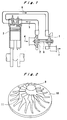
- the turbocharger for an internal combustion engine for use, for example, in automobiles and ships is constructed by providing a compressor wheel (compressor impeller) 2 whose rotating axis is identical with that of a turbine wheel (turbine impeller) 1 rotated by exhaust energy, as illustrated in Fig. 1.
- the compressor wheel 2 is provided for feeding air compressed by high-speed rotation to an internal combustion engine 3.
- reference numeral 4 denotes air
- reference numeral 5 denotes compressed air
- reference numerals 6 and 7 denote flow of an exhaust gas at respective sites.
- Reference numeral 8 denotes a shaft connecting the turbine wheel 1 to the compressor wheel 2.
- Fig. 2 shows an example of the shape of the compressor wheel.
- the compressor wheel is configured so that a plurality of thin blades 11 protrude out from a disk 10 integrated with a rotation center shaft (boss) 9.
- the compressor wheel is heated at a temperature as high as about 150°C during high-speed rotation, while the vicinity of the center of rotation, particularly the disk, suffers high stress caused by torsional stress and centrifugal force from the rotation shaft.
- the compressor wheel is constructed with various materials depending on the demand for performance of the turbocharger.
- the wheel is generally shaped by cutting an aluminum alloy hot-forged material, for use in larger-size engines, such as for ships.
- easily-castable aluminum alloys containing Si as a major additive element for example, those good in castability as defined in JIS-AC4CH (an alloy of Al-7%Si-0.3%Mg), ASTM-354.0 (an alloy of Al-9%Si-1.8%Cu-0.5%Mg) and ASTM-C355.0 (an alloy of Al-5%Si-1.3%Cu-0.5%Mg)
- JIS-AC4CH an alloy of Al-7%Si-0.3%Mg
- ASTM-354.0 an alloy of Al-9%Si-1.8%Cu-0.5%Mg
- ASTM-C355.0 an alloy of Al-5%Si-1.3%Cu-0.5%Mg
- JP-A-10-58119 proposes a method in which an easily-castable alloy, such as an Al-Si-series alloy, for example, AC4HC, is used for the blade portion that emphasizes run of the molten alloy, while a high-strength alloy, such as Al-Cu-series alloy, for example, AC1B, is used from the boss portion to the disk portion, where sufficient strength is required to join the rotation shaft; and, the molten alloys of these alloys are independently poured into the mold in two steps, followed by combining the two portions, to form the compressor wheel.
- an easily-castable alloy such as an Al-Si-series alloy, for example, AC4HC
- a high-strength alloy such as Al-Cu-series alloy, for example, AC1B
- JP-A-10-212967 proposes a method for forming the compressor wheel in which an alloy good in castability is used for the blade portion, while a composite reinforced material, prepared by strengthening a reinforce material, such as 25%B-aluminum whiskers, which is impregnated with aluminum, is used at the portion from the boss portion through the central portion of the disk that suffers from stress; and these portions are separately produced, and are joined thereafter to form the compressor wheel.
- JP-A-11-343858 proposes to join these portions by friction welding.
- the present invention resides in a compressor wheel made of a cast aluminum alloy, wherein the cast aluminum alloy comprises Cu 1.4 to 3.2% by mass, Mg 1.0 to 2.0% by mass, Ni 0.5 to 2.0% by mass, Fe 0.5 to 2.0% by mass, and at least one selected from the group consisting of Ti 0.01 to 0.35% by mass, Zr 0.01 to 0.30% by mass, Sc 0.01 to 0.8% by mass, and V 0.01 to 0.5% by mass, with the balance being aluminum and inevitable impurities, with the [(Cu content) + 0.5 ⁇ (Mg content)] being 3.8% by mass or less, and with a secondary dendrite arm spacing being 50 ⁇ m or less, wherein the cast aluminum alloy is being reinforced by a solution treatment and an aging treatment, and wherein the compressor wheel shows good heat resistant strength, and is for use in a turbocharger.
- the cast aluminum alloy comprises Cu 1.4 to 3.2% by mass, Mg 1.0 to 2.0% by mass, Ni 0.5 to 2.0% by mass, Fe 0.5 to 2.0% by mass
- the phrase "excellent in heat resistant strength" as used herein means that the cast product is not deformed or broken by fatigue even by using it at a temperature of as high as about 180°C.
- the inventors of the present invention have made various experiments and studied for solving the above problems in the conventional technique, and we found that a mechanical strength durable to uses at a temperature of as high as 180°C can be obtained, while maintaining castability, by selecting specific additive elements and combination thereof in Al-Cu-Mg-based alloys in a specific range, and by specifically controlling the secondary dendrite arm spacing.
- Cu and Mg have effects for enhancing mechanical strength through solid-solution strengthening by forming a solid solution in an Al matrix. Further, when Cu and Mg co-exist, they contribute for improving the strength through precipitation hardening by Al 2 Cu, Al 2 CuMg, and the like. However, adding excess amounts of these two elements may deteriorate castability, since they act to expand the solidification temperature range. A desired mechanical strength at a high temperature of 180°C cannot be obtained when the content of Cu is less than 1.4% by mass or the content of Mg is less than 1.0% by mass.
- the preferable ranges of addition are Cu 1.7 to 2.8% by mass, Mg 1.3 to 1.8% by mass, and (Cu + 0.5 Mg) 2.3 to 3.5% by mass, to surely prevent troubles or failures such as deformation during use and to reduce occurrence of insufficient filling during the casting process to be as small as possible in order to attain an industrially preferable yield.
- Ni and Fe have effects for improving the high temperature strength of the alloy by dispersing and forming an intermetallic compound with Al.
- the required lower limit of the contents of Ni and Fe each are 0.5% by mass or more.
- the upper limits of Ni and Fe each are 2.0% by mass or less.
- the preferable ranges of addition of these elements are Fe 0.7 to 1.5% by mass and Ni 0.5 to 1.4% by mass.
- the lower limit(s) of the preferable range(s) is a measure for realizing stable industrial mass production by taking uneven production conditions into consideration, while the upper limit(s) is the addition amount that addition of this element(s) exceeding the amount is not necessary since the effect is saturated.
- At least one of Ti, Zr, Sc and V is added, since these elements have effects for improving a supplying property of the molten alloy by fining the solidified texture during the casting process, and for improving run of the molten alloy.
- the effect above cannot be sufficiently obtained when the amount(s) of addition of these elements are less than 0.01% by mass.
- the content of Ti exceeds 0.35% by mass
- the content of Zr exceeds 0.30% by mass
- the content of Sc exceeds 0.8% by mass
- or the content of V exceeds 0.5% by mass
- coarse intermetallic compounds with a size of several tens to several hundreds micrometers are formed with Al, and these intermetallic compounds serve as starting points of fatigue cracks at the rotation, to thereby reduce reliability of the compressor wheel.
- a cast crystal grain-fining material that contains Ti may be used instead of pure Ti when Ti is added.
- the preferable ranges are Ti 0.05 to 0.20% by mass, Zr 0.05 to 0.20% by mass, Sc 0.15 to 0.65% by mass, and V 0.05 to 0.3% by mass.
- the lower limit(s) of the preferable range(s) is a measure for realizing stable industrial mass production by taking uneven production conditions into consideration, while the upper limit(s) is the addition amount that addition of these elements exceeding this limit is not necessary since the effect is saturated.
- the permissible contents of inevitable impurity elements other than the elements described above are Si up to about 0.3% by mass, and Zn, Mn, Cr, or the like up to about 0.2% by mass.
- the aluminum alloy according to the present invention in which the components are defined as described above, is cast into the compressor wheel shape, by a low-pressure casting method, a reduced-pressure casting method, or a gravity casting method, generally using a plaster mold, after treatments of the molten alloy (e.g. degassing treatment and inclusion-removing treatment), if necessary, according to conventional methods for producing cast Al-Si-series aluminum alloys.
- the solidification conditions should be controlled such that the secondary dendrite arm spacing would be 50 ⁇ m or less. This is to prevent fatigue breakage that may be caused by repeated stress generated by acceleration and deceleration of rotation of the compressor wheel.
- the secondary dendrite arm spacing is made to be preferably 40 ⁇ m or less.
- the lower limit of the secondary dendrite arm spacing is not particularly limited, and it is sufficient that the secondary dendrite arm can be recognized in the alloy, i.e. the secondary dendrite arm spacing is more than 0 ⁇ m. It is effective to increase the cooling speed for reducing the secondary dendrite arm spacing, and the above specific secondary dendrite arm spacing can be attained, for example, by adjusting the size of the plaster mold, by specifically providing a (e.g. metal) chill member to the mold, by controlling the preheat temperature of the plaster mold, and by controlling the casting temperature. These casting conditions are required to be properly determined depending on production facilities and the size of the product.
- solution treatment and aging treatment should be applied after casting. It is preferable to reinforce the alloy by applying the solution treatment in a temperature range from below a solidus temperature to a temperature lower by 5 to 25°C than the solidus temperature, followed by applying the aging treatment at 180 to 230°C for 3 to 30 hours.
- the solution treatment is more preferably applied at a temperature range of 510 to 530°C.
- the aging treatment is more preferably applied in a temperature range of 190 to 210°C for 5 to 20 hours.
- Precipitation hardening enough for effectively hardening cannot be attained when the aging treatment temperature is too low or the aging treatment time is too short.
- the aging treatment temperature is too high or the aging treatment time is too long, it becomes difficult to attain hardening ability due to coarsening of the precipitation phase formed (i.e. overaging), and solution hardening ability of Cu decreases.
- the cast aluminum alloy compressor wheel for a turbocharger excellent in heat resistance can be obtained by the process as described above.
- the composition is controlled while the solution treatment and aging treatment are applied such that proof stress at 180°C would be 250 MPa or more, to prevent high-temperature deformation during the use.
- the preferable lower limit of 250 MPa of the proof stress is a mechanical strength necessary for preventing deformation at high-speed rotation at 180°C.
- the proof stress at 180°C is more preferably 260 MPa or more.
- the upper limit of the proof stress at 180°C is not particularly limited, but it is a value lower than the tensile strength of the alloy.
- the temperature of the plaster mold is adjusted to 180 to 250°C and a metal chill member is disposed on the backing surface of the chill member in contact with the disk portion of the compressor wheel.
- a metal chill member is disposed on the backing surface of the chill member in contact with the disk portion of the compressor wheel.
- the temperature of the plaster mold is preferably in the range of 190 to 240°C, to industrially and stably prevent insufficient filling, and to stably make the secondary dendrite arm spacing fine.
- the material of the chill pate is preferably copper or a copper alloy due to its high heat conductivity, but another material, e.g. iron and stainless steel, may be used.
- the chill member may be additionally cooled with water or the like, and cooling with water is preferable for temperature control in industrial mass-production.
- the cast aluminum alloy compressor wheel of the present invention is excellent in productivity without relying on a measure such as making it complex in structure that results in increase of the production cost, and it shows good heat resistant strength durable to use at a temperature as high as about 180°C caused by high-speed rotation.
- the aluminum alloy compressor wheel durable to an elevated temperature as a result of increase of the rotation speed can be supplied with a low production cost.
- the cast aluminum alloy compressor wheel of the present invention can contribute to enhancement of output of internal combustion engines by increasing the air-feeding ability of the turbocharger utilized for the engines. Accordingly, the present invention is able to exhibit industrially remarkable effects.
- miss run of the molten alloy the case where at least one portion was recognized that the molten alloy did not run in the shaft portion and the bottom portion including the blade portions.
- the following table shows the Results of casting, by using incidence (%) of the miss run of molten alloy in 100 tests.
- the endurance test was carried out as follows.
- the thus-obtained sample compressor wheel was set to an engine equipped with a turbocharger, and the resultant wheel was tested under the conditions of given values of the rotation number (rpm), period of time (hr), and temperature (°C) at the outlet side of the wheel, as described in Table 1. Then, the tested wheel was observed with the naked eye.
- the resultant alloy was cast into a structure of a compressor wheel for a passenger car turbocharger with disk diameter 50 mm, height 40 mm, the number of blades twelve, and thickness at the tip of the blade 0.3 mm, under any of the various conditions, using a plaster mold, as shown in Table 2. Then, the cast compressor wheels were subjected to the solution treatment and/or the aging treatment, as shown in Table 2, followed by the tests and evaluation in the same manner as in Example 1.
- a negative value (-) of the applied pressure (kPa) means that the test was carried out, under an atmosphere reduced by the negative value from the atmospheric pressure, as indicated in the table;
- a positive value (+) of the applied pressure means that the test was carried out, under an atmosphere pressurized by the positive value from the atmospheric pressure, as indicated in the table; and zero (0) as the applied pressure means that the test was carried out under the atmospheric pressure.
- the cast aluminum alloy compressor wheels in the Example Nos. 25 to 30 according to the present invention each had the secondary dendrite arm spacing of as fine as 50 ⁇ m or less, and they were quite high in the high-temperature proof stress, and they involved no problems in the endurance test. While quite fine fatigue cracks were observed in the endurance test in the sample in No. 29, these cracks were within the permissible range.
Landscapes
- Chemical & Material Sciences (AREA)
- Engineering & Computer Science (AREA)
- Mechanical Engineering (AREA)
- Materials Engineering (AREA)
- Metallurgy (AREA)
- Organic Chemistry (AREA)
- Physics & Mathematics (AREA)
- Thermal Sciences (AREA)
- Crystallography & Structural Chemistry (AREA)
- General Engineering & Computer Science (AREA)
- Structures Of Non-Positive Displacement Pumps (AREA)
- Supercharger (AREA)
Abstract
Description
- The present invention relates to a compressor wheel made of a cast aluminum alloy capable of use for a turbocharger for an internal combustion engine for use, for example, in automobiles and ships.
- The turbocharger for an internal combustion engine for use, for example, in automobiles and ships, is constructed by providing a compressor wheel (compressor impeller) 2 whose rotating axis is identical with that of a turbine wheel (turbine impeller) 1 rotated by exhaust energy, as illustrated in Fig. 1. The
compressor wheel 2 is provided for feeding air compressed by high-speed rotation to aninternal combustion engine 3. In Fig. 1, reference numeral 4 denotes air,reference numeral 5 denotes compressed air, andreference numerals Reference numeral 8 denotes a shaft connecting the turbine wheel 1 to thecompressor wheel 2. Fig. 2 shows an example of the shape of the compressor wheel. The compressor wheel is configured so that a plurality ofthin blades 11 protrude out from adisk 10 integrated with a rotation center shaft (boss) 9. The compressor wheel is heated at a temperature as high as about 150°C during high-speed rotation, while the vicinity of the center of rotation, particularly the disk, suffers high stress caused by torsional stress and centrifugal force from the rotation shaft. - The compressor wheel is constructed with various materials depending on the demand for performance of the turbocharger. The wheel is generally shaped by cutting an aluminum alloy hot-forged material, for use in larger-size engines, such as for ships. However, for relatively smaller wheels for automobiles engines, such as for passenger cars and trucks, or small-size ships engines, easily-castable aluminum alloys containing Si as a major additive element, for example, those good in castability as defined in JIS-AC4CH (an alloy of Al-7%Si-0.3%Mg), ASTM-354.0 (an alloy of Al-9%Si-1.8%Cu-0.5%Mg) and ASTM-C355.0 (an alloy of Al-5%Si-1.3%Cu-0.5%Mg), are cast in a plaster mold, by a low-pressure or reduced-pressure casting method or a gravity casting method, and the cast alloy is subjected to a solution treatment and/or an aging treatment, to strengthen to be widely used, since mass productivity and production cost are emphasized. The basic production methods thereof are disclosed in detail in U.S. Patent No. 4,556,528.
- Meanwhile, a high compression ratio of air has been required in the turbocharger in recent years, to improve output power of the internal combustion engine, and high-speed rotation is naturally required for this purpose. However, heat values generated by air compression by increasing the rotation speed are increased, and the turbine wheel at the exhaust side is heated at a high temperature. Consequently, the compressor wheel is also heated at a high temperature, due to heat conduction from the turbine wheel. It has been revealed that continuous normal rotation is impossible in a compressor wheel made of the above conventional easily-castable aluminum alloy containing Si as a principal additive element, since it is apt to cause such trouble as deformation during operation and further breakage by fatigue. In particular, while the upper limit available for use in the existing conventional compressor wheel is about 150°C, development of a compressor wheel capable of use at a temperature of about 180°C has been strongly required to attain the objects described above.
- Accordingly, it may be conceived to change the composition of the aluminum alloy to another composition excellent in high-temperature mechanical strength, for example, an alloy defined in JIS-AC1B (an alloy of Al-5%Cu-0.3%Mg). However, since the compressor wheel has a complex shape with thin blade portions thereon, fluidity of a molten alloy of this alloy is so poor that the molten alloy tends to cause miss run in the thin portions (poor filling), as described in paragraph [0011],
page 2, in the specification of JP-A-10-58119 ("JP-A" means unexamined published Japanese patent application). Accordingly, JP-A-10-58119 proposes a method in which an easily-castable alloy, such as an Al-Si-series alloy, for example, AC4HC, is used for the blade portion that emphasizes run of the molten alloy, while a high-strength alloy, such as Al-Cu-series alloy, for example, AC1B, is used from the boss portion to the disk portion, where sufficient strength is required to join the rotation shaft; and, the molten alloys of these alloys are independently poured into the mold in two steps, followed by combining the two portions, to form the compressor wheel. JP-A-10-212967 proposes a method for forming the compressor wheel in which an alloy good in castability is used for the blade portion, while a composite reinforced material, prepared by strengthening a reinforce material, such as 25%B-aluminum whiskers, which is impregnated with aluminum, is used at the portion from the boss portion through the central portion of the disk that suffers from stress; and these portions are separately produced, and are joined thereafter to form the compressor wheel. JP-A-11-343858 proposes to join these portions by friction welding. - As described above, no compressor wheels made of cast aluminum alloys that are durable to an increased temperature caused by an increase of the rotation speed have been industrially manufactured using a single alloy. Further, the methods described above, in which different materials are independently used for the blade portion and boss portion, respectively, have not been industrially applied yet, since these methods are poor in productivity to result in increase of the production cost.
- The present invention resides in a compressor wheel made of a cast aluminum alloy, wherein the cast aluminum alloy comprises Cu 1.4 to 3.2% by mass, Mg 1.0 to 2.0% by mass, Ni 0.5 to 2.0% by mass, Fe 0.5 to 2.0% by mass, and at least one selected from the group consisting of Ti 0.01 to 0.35% by mass, Zr 0.01 to 0.30% by mass, Sc 0.01 to 0.8% by mass, and V 0.01 to 0.5% by mass, with the balance being aluminum and inevitable impurities, with the [(Cu content) + 0.5 × (Mg content)] being 3.8% by mass or less, and with a secondary dendrite arm spacing being 50 µm or less, wherein the cast aluminum alloy is being reinforced by a solution treatment and an aging treatment, and wherein the compressor wheel shows good heat resistant strength, and is for use in a turbocharger.
- Other and further features and advantages of the invention will appear more fully from the following description, taken in connection with the accompanying drawings.
-
- Fig. 1 is an explanatory view for illustrating a turbocharger.
- Fig. 2 is a perspective view showing an example of the structure of a compressor wheel.
-
- According to the present invention, there is provided the following means:
- (1) A compressor wheel made of a cast aluminum alloy,
wherein the cast aluminum alloy comprises Cu 1.4 to 3.2%
by mass, Mg 1.0 to 2.0% by mass, Ni 0.5 to 2.0% by mass,
Fe 0.5 to 2.0% by mass, and at least one selected from the
group consisting of Ti 0.01 to 0.35% by mass, Zr 0.01 to
0.30% by mass, Sc 0.01 to 0.8% by mass, and V 0.01 to 0.5%
by mass, with the balance being aluminum and inevitable
impurities, with the [(Cu content) + 0.5 × (Mg content)]
being 3.8% by mass or less, and with a secondary dendrite
arm spacing being 50 µm or less,
wherein the cast aluminum alloy is being reinforced by a solution treatment and an aging treatment, and
wherein the compressor wheel shows good heat resistant strength, and is for use in a turbocharger; - (2) The compressor wheel made of a cast aluminum alloy according to item (1), whose proof stress at 180°C is 250 MPa or more; and
- (3) The compressor wheel made of a cast aluminum alloy according to item (1) or (2), wherein a temperature of a plaster mold is controlled to 180 to 250°C in casting by using the plaster mold, and the compressor wheel is produced by providing a metal chill member on an opposite surface of the plaster mold in contact with a disk portion surface of the compressor wheel.
-
- Herein, the phrase "excellent in heat resistant strength" as used herein means that the cast product is not deformed or broken by fatigue even by using it at a temperature of as high as about 180°C.
- The present invention will be described in detail below.
- The inventors of the present invention have made various experiments and studied for solving the above problems in the conventional technique, and we found that a mechanical strength durable to uses at a temperature of as high as 180°C can be obtained, while maintaining castability, by selecting specific additive elements and combination thereof in Al-Cu-Mg-based alloys in a specific range, and by specifically controlling the secondary dendrite arm spacing.
- The reason why the range of the composition of the aluminum alloy in the present invention is defined will be described below.
- Cu and Mg have effects for enhancing mechanical strength through solid-solution strengthening by forming a solid solution in an Al matrix. Further, when Cu and Mg co-exist, they contribute for improving the strength through precipitation hardening by Al2Cu, Al2CuMg, and the like. However, adding excess amounts of these two elements may deteriorate castability, since they act to expand the solidification temperature range. A desired mechanical strength at a high temperature of 180°C cannot be obtained when the content of Cu is less than 1.4% by mass or the content of Mg is less than 1.0% by mass. On the other hand, when the content of Cu exceeds 3.2% by mass or the content of Mg exceeds 2.0% by mass, or when these are contained in such a manner that [(the content of Cu) + 0.5 x (the content of Mg)] (hereinafter referred to as "Cu + 0.5 Mg") exceeds 3.8% by mass, castability required for the alloy to be cast into the compressor wheel deteriorates, particularly insufficient filling is liable to occur due to miss run of the molten alloy at the tip of the blade. The preferable ranges of addition are Cu 1.7 to 2.8% by mass, Mg 1.3 to 1.8% by mass, and (Cu + 0.5 Mg) 2.3 to 3.5% by mass, to surely prevent troubles or failures such as deformation during use and to reduce occurrence of insufficient filling during the casting process to be as small as possible in order to attain an industrially preferable yield.
- Ni and Fe have effects for improving the high temperature strength of the alloy by dispersing and forming an intermetallic compound with Al. The required lower limit of the contents of Ni and Fe each are 0.5% by mass or more. However, when the contents of these elements are too large, not only the intermetallic compound is coarsened, but also the mechanical strength is rather decreased by reducing the content of Cu solid-dissolution in the Al matrix as a result of forming Cu2FeAl7 and Cu3NiAl6 at a high temperature. Therefore, the upper limits of Ni and Fe each are 2.0% by mass or less. The preferable ranges of addition of these elements are Fe 0.7 to 1.5% by mass and Ni 0.5 to 1.4% by mass. The lower limit(s) of the preferable range(s) is a measure for realizing stable industrial mass production by taking uneven production conditions into consideration, while the upper limit(s) is the addition amount that addition of this element(s) exceeding the amount is not necessary since the effect is saturated.
- At least one of Ti, Zr, Sc and V is added, since these elements have effects for improving a supplying property of the molten alloy by fining the solidified texture during the casting process, and for improving run of the molten alloy. The effect above cannot be sufficiently obtained when the amount(s) of addition of these elements are less than 0.01% by mass. However, when the content of Ti exceeds 0.35% by mass, the content of Zr exceeds 0.30% by mass, the content of Sc exceeds 0.8% by mass, or the content of V exceeds 0.5% by mass, coarse intermetallic compounds with a size of several tens to several hundreds micrometers are formed with Al, and these intermetallic compounds serve as starting points of fatigue cracks at the rotation, to thereby reduce reliability of the compressor wheel. A cast crystal grain-fining material that contains Ti, for example a commercially available Al-5%Ti-1%B alloy or Al-5%Ti-0.2%C, may be used instead of pure Ti when Ti is added. The preferable ranges are Ti 0.05 to 0.20% by mass, Zr 0.05 to 0.20% by mass, Sc 0.15 to 0.65% by mass, and V 0.05 to 0.3% by mass. The lower limit(s) of the preferable range(s) is a measure for realizing stable industrial mass production by taking uneven production conditions into consideration, while the upper limit(s) is the addition amount that addition of these elements exceeding this limit is not necessary since the effect is saturated.
- The permissible contents of inevitable impurity elements other than the elements described above are Si up to about 0.3% by mass, and Zn, Mn, Cr, or the like up to about 0.2% by mass.
- The aluminum alloy according to the present invention in which the components are defined as described above, is cast into the compressor wheel shape, by a low-pressure casting method, a reduced-pressure casting method, or a gravity casting method, generally using a plaster mold, after treatments of the molten alloy (e.g. degassing treatment and inclusion-removing treatment), if necessary, according to conventional methods for producing cast Al-Si-series aluminum alloys. At that time, the solidification conditions should be controlled such that the secondary dendrite arm spacing would be 50 µm or less. This is to prevent fatigue breakage that may be caused by repeated stress generated by acceleration and deceleration of rotation of the compressor wheel. When the secondary dendrite arm spacing exceeds 50 µm, fatigue cracks tend to be occurred and developed along the intermetallic compounds linearly distributed along the boundaries of the coarse dendrite arms. To completely prevent the fatigue cracks from occurring, the secondary dendrite arm spacing is made to be preferably 40 µm or less. The lower limit of the secondary dendrite arm spacing is not particularly limited, and it is sufficient that the secondary dendrite arm can be recognized in the alloy, i.e. the secondary dendrite arm spacing is more than 0µm. It is effective to increase the cooling speed for reducing the secondary dendrite arm spacing, and the above specific secondary dendrite arm spacing can be attained, for example, by adjusting the size of the plaster mold, by specifically providing a (e.g. metal) chill member to the mold, by controlling the preheat temperature of the plaster mold, and by controlling the casting temperature. These casting conditions are required to be properly determined depending on production facilities and the size of the product.
- For effectively utilizing solid-solution hardening by Cu, precipitation hardening by Cu and Mg, and dispersion hardening by forming intermetallic compounds between Al and Fe and between Al and Ni, solution treatment and aging treatment should be applied after casting. It is preferable to reinforce the alloy by applying the solution treatment in a temperature range from below a solidus temperature to a temperature lower by 5 to 25°C than the solidus temperature, followed by applying the aging treatment at 180 to 230°C for 3 to 30 hours. The solution treatment is more preferably applied at a temperature range of 510 to 530°C. The aging treatment is more preferably applied in a temperature range of 190 to 210°C for 5 to 20 hours. Precipitation hardening enough for effectively hardening cannot be attained when the aging treatment temperature is too low or the aging treatment time is too short. On the other hand, when the aging treatment temperature is too high or the aging treatment time is too long, it becomes difficult to attain hardening ability due to coarsening of the precipitation phase formed (i.e. overaging), and solution hardening ability of Cu decreases.
- Thus, the cast aluminum alloy compressor wheel for a turbocharger excellent in heat resistance can be obtained by the process as described above.
- Further, in the cast aluminum alloy compressor wheel for a turbocharger in the second embodiment of the present invention, the composition is controlled while the solution treatment and aging treatment are applied such that proof stress at 180°C would be 250 MPa or more, to prevent high-temperature deformation during the use. The preferable lower limit of 250 MPa of the proof stress is a mechanical strength necessary for preventing deformation at high-speed rotation at 180°C. To surely prevent the deformation, the proof stress at 180°C is more preferably 260 MPa or more. The upper limit of the proof stress at 180°C is not particularly limited, but it is a value lower than the tensile strength of the alloy.
- Further, in the cast aluminum alloy compressor wheel for a turbocharger in the third embodiment of the present invention, when casting by using a plaster mold, the temperature of the plaster mold is adjusted to 180 to 250°C and a metal chill member is disposed on the backing surface of the chill member in contact with the disk portion of the compressor wheel. When the temperature of the plaster mold is too low, solidification is completed before the molten alloy has arrived at the tip of the thin blade, thereby being apt to cause insufficient filling. The temperature of the plaster mold is preferably in the range of 190 to 240°C, to industrially and stably prevent insufficient filling, and to stably make the secondary dendrite arm spacing fine. The solidification speed becomes slow unless any chill member is provided, and the secondary dendrite arm spacing may not be stably made fine. The material of the chill pate is preferably copper or a copper alloy due to its high heat conductivity, but another material, e.g. iron and stainless steel, may be used. The chill member may be additionally cooled with water or the like, and cooling with water is preferable for temperature control in industrial mass-production.
- The cast aluminum alloy compressor wheel of the present invention is excellent in productivity without relying on a measure such as making it complex in structure that results in increase of the production cost, and it shows good heat resistant strength durable to use at a temperature as high as about 180°C caused by high-speed rotation.
- According to the present invention, the aluminum alloy compressor wheel durable to an elevated temperature as a result of increase of the rotation speed, can be supplied with a low production cost. The cast aluminum alloy compressor wheel of the present invention can contribute to enhancement of output of internal combustion engines by increasing the air-feeding ability of the turbocharger utilized for the engines. Accordingly, the present invention is able to exhibit industrially remarkable effects.
- The present invention will be explained in more detail with reference to the following examples, but the invention is not intended to be limited thereto.
- After melting and degassing any of aluminum alloys, as shown in Table 1, in a usual manner, it was cast into a structure of a compressor wheel for a truck turbocharger with disk diameter 96 mm, height 70 mm, the number of blades fourteen, and thickness at the tip of the blade 0.4 mm, by a low-pressure casting method using a plaster mold. The plaster mold was pre-heated to 200°C, and a copper chill member was placed on the backing surface of the mold in contact with the bottom face of the disk. Then, the cast compressor wheel was subjected to a solution treatment at 530°C for 8 hours, followed by an aging treatment at 200°C for 20 hours. Then, a rod as a test piece in a tension test, was sampled from the center shaft of the compressor wheel, and proof stress of the test piece was measured at room temperature, 150°C, and 180°C. The metal texture at a position apart by 10 mm from the bottom of the disk was observed on the cross-section of the center shaft, under an optical microscope at a magnification of 100 times, to determine a secondary dendrite arm spacing by a tangent method. These measuring methods are described in "Methods for Measuring Dendrite Arm Spacing of Aluminum and Cooling Speed," Report of Investigation Division, the Japan Institute of Light Metals, No. 20 (1988), pages 46 to 52.
- Upon the casting, the case where at least one portion was recognized that the molten alloy did not run in the shaft portion and the bottom portion including the blade portions, is designated to "miss run of the molten alloy". The following table shows the Results of casting, by using incidence (%) of the miss run of molten alloy in 100 tests.
- The endurance test was carried out as follows. The thus-obtained sample compressor wheel was set to an engine equipped with a turbocharger, and the resultant wheel was tested under the conditions of given values of the rotation number (rpm), period of time (hr), and temperature (°C) at the outlet side of the wheel, as described in Table 1. Then, the tested wheel was observed with the naked eye.


- The samples in Comparative Example Nos. 9 to 11 containing a too small amount of Cu and/or Mg, each were poor in high-temperature proof stress, resulting in deformation of the disk in the endurance test at 180°C. The samples in Comparative Example Nos. 12 to 14, in which the content of Cu and/or Mg was too large, or in which the contents of each of Cu and Mg were below the defined upper limit, but the (Cu + 0.5Mg) was too large exceeding 3.8% by mass, each caused conspicuous incidence of miss run of the molten alloy exceeding 30% in the casting process, although proof stress of the alloys were high. Thus, these samples for comparison were not suitable for industrial production, due to their low production yield. The samples in Comparative Example Nos. 15 to 17 containing a too small amount of Ni and/or Fe, each was poor in high-temperature proof stress, resulting in deformation of the disk portion and the like in the endurance test at 180°C. The sample in Comparative Example No. 18 containing too small amounts of Ti, Zr, Sc and V, caused conspicuous occurrence or incidence of miss run of the molten alloy exceeding 30% in the casting process, and the sample was not suitable for industrial production. On the other hand, the samples in Comparative Example Nos. 19 to 21 containing any of Ti, Zr, Sc and V exceeding the defined upper limit, formed coarse intermetallic compounds, and fatigue cracks were occurred in the disk during the endurance test. On the contrary, the samples in Example Nos. 1 to 8 according to the present invention, exhibited good castability, which is comparable to that in the samples in Conventional Example Nos. 22 to 24 (incidence of miss run of the molten alloy of 8% or less), and they had excellent high-temperature proof stress, while no problems of large deformation that may cause trouble in operation or cracks were observed in the endurance test at 180°C for 200 hours.
- After melting and degassing the No. 4 alloy in Table 1, in a usual manner, the resultant alloy was cast into a structure of a compressor wheel for a passenger car turbocharger with disk diameter 50 mm, height 40 mm, the number of blades twelve, and thickness at the tip of the blade 0.3 mm, under any of the various conditions, using a plaster mold, as shown in Table 2. Then, the cast compressor wheels were subjected to the solution treatment and/or the aging treatment, as shown in Table 2, followed by the tests and evaluation in the same manner as in Example 1.
- In the casting conditions, a negative value (-) of the applied pressure (kPa) means that the test was carried out, under an atmosphere reduced by the negative value from the atmospheric pressure, as indicated in the table; a positive value (+) of the applied pressure means that the test was carried out, under an atmosphere pressurized by the positive value from the atmospheric pressure, as indicated in the table; and zero (0) as the applied pressure means that the test was carried out under the atmospheric pressure.


- Conspicuous incidence of miss run of the molten alloy occurred in the samples in Nos. 31 and 32 produced at a low temperature of the plaster mold. In the sample in No. 33 produced at a high temperature in the preheating of the plaster mold and in the samples in Nos. 34 and 35 using no chill member, since the samples each were cooled with a very slow cooling speed upon solidification, the resultant secondary dendrites were coarsened with a too large secondary dendrite arm spacing of exceeding 50 µm. As a result, fatigue cracks were observed in the endurance test of each of these samples in Nos. 33, 34 and 35. Further, the samples in Nos. 36 to 38, in which the solution treatment and/or the aging treatment was omitted or the treatment(s) was insufficient, each were poor in the proof stress at 180°C of less than 250 MPa, resulting in occurrence of deformation in the endurance test. On the contrary, the cast aluminum alloy compressor wheels in the Example Nos. 25 to 30 according to the present invention, each had the secondary dendrite arm spacing of as fine as 50 µm or less, and they were quite high in the high-temperature proof stress, and they involved no problems in the endurance test. While quite fine fatigue cracks were observed in the endurance test in the sample in No. 29, these cracks were within the permissible range.
- Having described our invention as related to the present embodiments, it is our intention that the invention not be limited by any of the details of the description, unless otherwise specified, but rather be construed broadly within its spirit and scope as set out in the accompanying claims.
Claims (3)
- A compressor wheel made of a cast aluminum alloy,
wherein the cast aluminum alloy comprises Cu 1.4 to 3.2% by mass, Mg 1.0 to 2.0% by mass, Ni 0.5 to 2.0% by mass, Fe 0.5 to 2.0% by mass, and at least one selected from the group consisting of Ti 0.01 to 0.35% by mass, Zr 0.01 to 0.30% by mass, Sc 0.01 to 0.8% by mass, and V 0.01 to 0.5% by mass, with the balance being aluminum and inevitable impurities, with the [(Cu content) + 0.5 × (Mg content)] being 3.8% by mass or less, and with a secondary dendrite arm spacing being 50 µm or less,
wherein the cast aluminum alloy is being reinforced by a solution treatment and an aging treatment, and
wherein the compressor wheel shows good heat resistant strength, and is for use in a turbocharger. - The compressor wheel according to claim 1, whose proof stress at 180°C is 250 MPa or more.
- The compressor wheel according to claim 1 or 2,
wherein a temperature of a plaster mold is controlled to 180 to 250°C in casting by using said plaster mold, and the compressor wheel is produced by providing a metal chill member on an opposite surface of the plaster mold in contact with a disk portion surface of said compressor wheel.
Applications Claiming Priority (2)
| Application Number | Priority Date | Filing Date | Title |
|---|---|---|---|
| JP2004017590A JP4290024B2 (en) | 2004-01-26 | 2004-01-26 | Compressor impeller made of cast aluminum alloy for turbochargers with excellent heat resistance |
| JP2004017590 | 2004-01-26 |
Publications (3)
| Publication Number | Publication Date |
|---|---|
| EP1557567A2 true EP1557567A2 (en) | 2005-07-27 |
| EP1557567A3 EP1557567A3 (en) | 2010-12-29 |
| EP1557567B1 EP1557567B1 (en) | 2017-07-26 |
Family
ID=34631982
Family Applications (1)
| Application Number | Title | Priority Date | Filing Date |
|---|---|---|---|
| EP05001357.2A Expired - Lifetime EP1557567B1 (en) | 2004-01-26 | 2005-01-24 | Cast aluminum alloy compressor wheel for a turbocharger |
Country Status (3)
| Country | Link |
|---|---|
| US (1) | US7435305B2 (en) |
| EP (1) | EP1557567B1 (en) |
| JP (1) | JP4290024B2 (en) |
Cited By (8)
| Publication number | Priority date | Publication date | Assignee | Title |
|---|---|---|---|---|
| WO2008094610A1 (en) * | 2007-01-31 | 2008-08-07 | Caterpillar Inc. | Compressor wheel for a turbocharger system |
| EP2036993A4 (en) * | 2006-06-29 | 2011-01-26 | Hitachi Metals Ltd | ALLOY ALLOY FOR CASTING, MOLDED COMPRESSOR ROTOR COMPRISING ALLOY AND PROCESS FOR PRODUCING THE SAME |
| EP2095895A4 (en) * | 2006-12-20 | 2011-12-28 | Mitsubishi Heavy Ind Ltd | Aluminum die cast product and process for manufacturing the same |
| WO2015085433A1 (en) * | 2013-12-13 | 2015-06-18 | Rio Tinto Alcan International Limited | Aluminum casting alloy with improved high-temperature performance |
| EP2913122A4 (en) * | 2012-10-26 | 2016-01-13 | Uacj Corp | ALUMINUM ALLOY CASTING WHEEL FOR A COMPRESSOR AND METHOD FOR PRODUCING THE SAME |
| EP3121303A4 (en) * | 2014-03-15 | 2017-03-15 | UACJ Corporation | Compressor impeller cast from al alloy and method for producing same |
| DE112009001890B4 (en) | 2008-09-25 | 2019-05-09 | Borgwarner Inc. | Compressor wheel and method of production thereof, and this comprehensive exhaust gas turbocharger |
| CN119525452A (en) * | 2024-11-05 | 2025-02-28 | 上海交通大学 | A method and system for removing iron from recycled aluminum based on centrifugal casting |
Families Citing this family (18)
| Publication number | Priority date | Publication date | Assignee | Title |
|---|---|---|---|---|
| JP2008088460A (en) * | 2006-09-29 | 2008-04-17 | Hitachi Metal Precision:Kk | High-strength aluminum casting alloy and compressor impeller using the same |
| JP4958292B2 (en) * | 2007-07-19 | 2012-06-20 | 日立金属株式会社 | Aluminum die-cast alloy, cast compressor impeller made of this alloy, and method for manufacturing the same |
| JP2012025986A (en) * | 2010-07-21 | 2012-02-09 | Furukawa-Sky Aluminum Corp | Aluminum-alloy cast compressor impeller and its manufacturing method |
| CA2776003C (en) | 2012-04-27 | 2019-03-12 | Rio Tinto Alcan International Limited | Aluminum alloy having an excellent combination of strength, extrudability and corrosion resistance |
| DK2898107T3 (en) | 2012-09-21 | 2018-07-23 | Rio Tinto Alcan Int Ltd | ALUMINUM ALLOY COMPOSITION AND PROCEDURE |
| JP5415655B1 (en) * | 2012-10-26 | 2014-02-12 | 株式会社Uacj | Compressor impeller made of Al alloy casting and manufacturing method thereof |
| US10975718B2 (en) | 2013-02-12 | 2021-04-13 | Garrett Transportation I Inc | Stainless steel alloys, turbocharger turbine housings formed from the stainless steel alloys, and methods for manufacturing the same |
| US20140224385A1 (en) * | 2013-02-13 | 2014-08-14 | Caterpillar Incorporated | Apparatus and method for manufacturing a turbocharger component |
| JP6063318B2 (en) * | 2013-03-27 | 2017-01-18 | 株式会社Uacj | Aluminum alloy and method for producing the same |
| JP2015059531A (en) * | 2013-09-19 | 2015-03-30 | 株式会社Uacj | Compressor impeller made of Al alloy casting and manufacturing method thereof |
| DE112014005623T5 (en) | 2013-12-13 | 2016-09-22 | Showa Denko K.K. | A molded aluminum component for a turbo compressor wheel and method of making a turbo compressor wheel |
| JP6385683B2 (en) | 2014-02-07 | 2018-09-05 | 本田技研工業株式会社 | Al alloy casting and manufacturing method thereof |
| JP6905388B2 (en) * | 2016-05-31 | 2021-07-21 | 三協立山株式会社 | Aluminum alloy |
| CN106131720B (en) * | 2016-08-30 | 2019-02-05 | 宁波泊人艾电子有限公司 | A kind of multifunctional portable speaker |
| CN106131719B (en) * | 2016-08-30 | 2019-02-05 | 宁波泊人艾电子有限公司 | A kind of portable sound box |
| CN108869392B (en) * | 2018-08-06 | 2024-06-21 | 杭州老板电器股份有限公司 | Composite impeller, centrifugal fan and range hood |
| USD1048108S1 (en) * | 2022-02-14 | 2024-10-22 | Fizzle Llc | Compressor wheel |
| USD1044870S1 (en) * | 2022-02-14 | 2024-10-01 | Fizzle Llc | Compressor wheel |
Citations (3)
| Publication number | Priority date | Publication date | Assignee | Title |
|---|---|---|---|---|
| US4556528A (en) | 1983-06-16 | 1985-12-03 | The Garrett Corporation | Mold and method for casting of fragile and complex shapes |
| JPH1058119A (en) | 1996-08-26 | 1998-03-03 | Mitsubishi Heavy Ind Ltd | Method for casting aluminum alloy-made impeller |
| JPH11343858A (en) | 1998-06-02 | 1999-12-14 | Ishikawajima Harima Heavy Ind Co Ltd | Method of manufacturing turbocharger compressor impeller |
Family Cites Families (16)
| Publication number | Priority date | Publication date | Assignee | Title |
|---|---|---|---|---|
| GB572672A (en) * | 1941-08-21 | 1945-10-18 | Tennyson Fraser Bradbury | Heat treatment of multiple aluminium alloys |
| GB642390A (en) * | 1948-01-23 | 1950-08-30 | High Duty Alloys Ltd | Forging aluminium alloy |
| GB709636A (en) * | 1951-05-09 | 1954-06-02 | Rolls Royce | Improvements in or relating to compressor and turbine bladed rotors |
| US4062704A (en) * | 1976-07-09 | 1977-12-13 | Swiss Aluminium Ltd. | Aluminum alloys possessing improved resistance weldability |
| JPS5910445A (en) * | 1982-07-12 | 1984-01-19 | Honda Motor Co Ltd | Chiller for casting |
| JPS6311643A (en) * | 1986-03-11 | 1988-01-19 | Kobe Steel Ltd | High strength aluminum alloy having superior heat resistance |
| JPH07113136B2 (en) * | 1986-12-02 | 1995-12-06 | 古河電気工業株式会社 | Free-Cutting Aluminum Alloy Cast Material and Manufacturing Method Thereof |
| JPS63161137A (en) * | 1986-12-23 | 1988-07-04 | Kobe Steel Ltd | High tensile aluminum alloy having excellent heat resistance |
| JPH01152237A (en) * | 1987-12-10 | 1989-06-14 | Furukawa Alum Co Ltd | Aluminum alloy material for engine member |
| JPH01272743A (en) * | 1988-04-25 | 1989-10-31 | Kobe Steel Ltd | High tensile aluminum alloy having excellent heat resistance |
| JPH0339453A (en) * | 1989-07-06 | 1991-02-20 | Sumitomo Light Metal Ind Ltd | Production of cast aluminum alloy bar for vtr cylinder |
| JPH0681067A (en) * | 1992-08-31 | 1994-03-22 | Mitsubishi Alum Co Ltd | Heat resistant aluminum alloy with high strength |
| US5338510A (en) * | 1993-10-04 | 1994-08-16 | Zuech Romeo A | Cast aluminum alloy and tooling fixture therefrom |
| JPH07242976A (en) * | 1994-03-01 | 1995-09-19 | Nippon Steel Corp | Aluminum alloy for wrought having excellent heat resistance and method for producing the same |
| JPH08144002A (en) * | 1994-11-16 | 1996-06-04 | Mitsubishi Alum Co Ltd | High strenght aluminum alloy excellent in heat resistance |
| JPH10212967A (en) | 1997-01-29 | 1998-08-11 | Ishikawajima Harima Heavy Ind Co Ltd | Turbocharger compressor impeller and method of manufacturing the same |
-
2004
- 2004-01-26 JP JP2004017590A patent/JP4290024B2/en not_active Expired - Fee Related
-
2005
- 2005-01-21 US US11/038,768 patent/US7435305B2/en not_active Expired - Lifetime
- 2005-01-24 EP EP05001357.2A patent/EP1557567B1/en not_active Expired - Lifetime
Patent Citations (3)
| Publication number | Priority date | Publication date | Assignee | Title |
|---|---|---|---|---|
| US4556528A (en) | 1983-06-16 | 1985-12-03 | The Garrett Corporation | Mold and method for casting of fragile and complex shapes |
| JPH1058119A (en) | 1996-08-26 | 1998-03-03 | Mitsubishi Heavy Ind Ltd | Method for casting aluminum alloy-made impeller |
| JPH11343858A (en) | 1998-06-02 | 1999-12-14 | Ishikawajima Harima Heavy Ind Co Ltd | Method of manufacturing turbocharger compressor impeller |
Cited By (13)
| Publication number | Priority date | Publication date | Assignee | Title |
|---|---|---|---|---|
| EP2036993A4 (en) * | 2006-06-29 | 2011-01-26 | Hitachi Metals Ltd | ALLOY ALLOY FOR CASTING, MOLDED COMPRESSOR ROTOR COMPRISING ALLOY AND PROCESS FOR PRODUCING THE SAME |
| US8292589B2 (en) | 2006-06-29 | 2012-10-23 | Hitachi Metals Precision, Ltd. | Casting aluminum alloy, cast compressor impeller comprising the alloy, and process for producing the same |
| EP2095895A4 (en) * | 2006-12-20 | 2011-12-28 | Mitsubishi Heavy Ind Ltd | Aluminum die cast product and process for manufacturing the same |
| WO2008094610A1 (en) * | 2007-01-31 | 2008-08-07 | Caterpillar Inc. | Compressor wheel for a turbocharger system |
| US8118556B2 (en) | 2007-01-31 | 2012-02-21 | Caterpillar Inc. | Compressor wheel for a turbocharger system |
| DE112009001890B4 (en) | 2008-09-25 | 2019-05-09 | Borgwarner Inc. | Compressor wheel and method of production thereof, and this comprehensive exhaust gas turbocharger |
| EP2913122A4 (en) * | 2012-10-26 | 2016-01-13 | Uacj Corp | ALUMINUM ALLOY CASTING WHEEL FOR A COMPRESSOR AND METHOD FOR PRODUCING THE SAME |
| US10018203B2 (en) | 2012-10-26 | 2018-07-10 | Uacj Corporation | Al alloy cast impeller for compressor and process for producing same |
| CN105283568A (en) * | 2013-12-13 | 2016-01-27 | 力拓加铝国际有限公司 | Aluminum casting alloy with improved high-temperature performance |
| GB2536095A (en) * | 2013-12-13 | 2016-09-07 | Rio Tinto Alcan Int | Aluminium casting alloy with improved high-temperature performance |
| WO2015085433A1 (en) * | 2013-12-13 | 2015-06-18 | Rio Tinto Alcan International Limited | Aluminum casting alloy with improved high-temperature performance |
| EP3121303A4 (en) * | 2014-03-15 | 2017-03-15 | UACJ Corporation | Compressor impeller cast from al alloy and method for producing same |
| CN119525452A (en) * | 2024-11-05 | 2025-02-28 | 上海交通大学 | A method and system for removing iron from recycled aluminum based on centrifugal casting |
Also Published As
| Publication number | Publication date |
|---|---|
| JP4290024B2 (en) | 2009-07-01 |
| EP1557567B1 (en) | 2017-07-26 |
| US20050167009A1 (en) | 2005-08-04 |
| US7435305B2 (en) | 2008-10-14 |
| EP1557567A3 (en) | 2010-12-29 |
| JP2005206927A (en) | 2005-08-04 |
Similar Documents
| Publication | Publication Date | Title |
|---|---|---|
| US7435305B2 (en) | Cast aluminum alloy compressor wheel for a turbocharger | |
| EP2913122B1 (en) | Al alloy cast impeller for compressor and process for producing same | |
| WO2008001758A1 (en) | Casting aluminum alloy, cast compressor impeller comprising the alloy, and process for producing the same | |
| EP3121303B1 (en) | Compressor impeller cast from al alloy and method for producing same | |
| US7041179B2 (en) | High strength creep resistant magnesium alloys | |
| HUE034596T2 (en) | Ti-al-based heat-resistant member | |
| Zhu et al. | Semi-solid moulding: Competition to cast and machine from forging in making automotive complex components | |
| JP3492118B2 (en) | TiAl intermetallic compound based alloy | |
| CN100366775C (en) | High Strength Creep Resistant Magnesium-Based Alloy | |
| JP2002129271A (en) | Aluminum alloy and method for producing aluminum alloy casting | |
| HK1078632A (en) | Cast aluminum alloy compressor wheel for a turbocharger | |
| CN101087895B (en) | Aluminum-based alloy and molded body made of the alloy | |
| HK1078632B (en) | Cast aluminum alloy compressor wheel for a turbocharger | |
| CN114875283A (en) | Fourth-generation ultra-light ultra-fine grain high-strength aluminum-lithium alloy capable of being cast | |
| CN1114711C (en) | Iron-based heat-resistant alloy | |
| JP5415655B1 (en) | Compressor impeller made of Al alloy casting and manufacturing method thereof | |
| JP4026563B2 (en) | Aluminum cast alloy piston and method of manufacturing the same | |
| JPH0835030A (en) | Aluminum alloy for casting, excellent in strength | |
| CN1492067A (en) | Heat-resistant corrosion resistant iron base alloy | |
| JP2019218612A (en) | Aluminum alloy cast made compressor impeller excellent in creep resistance, and manufacturing method therefor | |
| JP3336631B2 (en) | Aluminum alloy oil pump | |
| JP2017155268A (en) | Al ALLOY CAST ARTICLE-MADE COMPRESSOR IMPELLER | |
| JP2015059531A (en) | Compressor impeller made of Al alloy casting and manufacturing method thereof | |
| JPH0762480A (en) | Low linear expansion rapidly solidified aluminum alloy and method for producing the same | |
| CN111118360A (en) | Alloy material for wheel hub and preparation method thereof |
Legal Events
| Date | Code | Title | Description |
|---|---|---|---|
| PUAI | Public reference made under article 153(3) epc to a published international application that has entered the european phase |
Free format text: ORIGINAL CODE: 0009012 |
|
| AK | Designated contracting states |
Kind code of ref document: A2 Designated state(s): AT BE BG CH CY CZ DE DK EE ES FI FR GB GR HU IE IS IT LI LT LU MC NL PL PT RO SE SI SK TR |
|
| AX | Request for extension of the european patent |
Extension state: AL BA HR LV MK YU |
|
| REG | Reference to a national code |
Ref country code: HK Ref legal event code: DE Ref document number: 1078632 Country of ref document: HK |
|
| RAP1 | Party data changed (applicant data changed or rights of an application transferred) |
Owner name: FURUKAWA-SKY ALUMINUM CORPORATION |
|
| PUAL | Search report despatched |
Free format text: ORIGINAL CODE: 0009013 |
|
| AK | Designated contracting states |
Kind code of ref document: A3 Designated state(s): AT BE BG CH CY CZ DE DK EE ES FI FR GB GR HU IE IS IT LI LT LU MC NL PL PT RO SE SI SK TR |
|
| AX | Request for extension of the european patent |
Extension state: AL BA HR LV MK YU |
|
| RIC1 | Information provided on ipc code assigned before grant |
Ipc: C22F 1/047 20060101ALI20101122BHEP Ipc: C22F 1/057 20060101ALI20101122BHEP Ipc: C22C 21/16 20060101ALI20101122BHEP Ipc: C22C 21/06 20060101ALI20101122BHEP Ipc: C22C 21/00 20060101ALI20101122BHEP Ipc: F04D 29/02 20060101AFI20050427BHEP Ipc: F04D 29/28 20060101ALI20101122BHEP Ipc: C22C 21/12 20060101ALI20101122BHEP |
|
| 17P | Request for examination filed |
Effective date: 20110616 |
|
| AKX | Designation fees paid |
Designated state(s): DE FR GB |
|
| 17Q | First examination report despatched |
Effective date: 20110921 |
|
| GRAP | Despatch of communication of intention to grant a patent |
Free format text: ORIGINAL CODE: EPIDOSNIGR1 |
|
| STAA | Information on the status of an ep patent application or granted ep patent |
Free format text: STATUS: GRANT OF PATENT IS INTENDED |
|
| INTG | Intention to grant announced |
Effective date: 20170303 |
|
| GRAS | Grant fee paid |
Free format text: ORIGINAL CODE: EPIDOSNIGR3 |
|
| GRAA | (expected) grant |
Free format text: ORIGINAL CODE: 0009210 |
|
| STAA | Information on the status of an ep patent application or granted ep patent |
Free format text: STATUS: THE PATENT HAS BEEN GRANTED |
|
| AK | Designated contracting states |
Kind code of ref document: B1 Designated state(s): DE FR GB |
|
| REG | Reference to a national code |
Ref country code: GB Ref legal event code: FG4D |
|
| REG | Reference to a national code |
Ref country code: DE Ref legal event code: R096 Ref document number: 602005052392 Country of ref document: DE |
|
| REG | Reference to a national code |
Ref country code: FR Ref legal event code: PLFP Year of fee payment: 14 |
|
| REG | Reference to a national code |
Ref country code: HK Ref legal event code: GR Ref document number: 1078632 Country of ref document: HK |
|
| REG | Reference to a national code |
Ref country code: DE Ref legal event code: R097 Ref document number: 602005052392 Country of ref document: DE |
|
| PLBE | No opposition filed within time limit |
Free format text: ORIGINAL CODE: 0009261 |
|
| STAA | Information on the status of an ep patent application or granted ep patent |
Free format text: STATUS: NO OPPOSITION FILED WITHIN TIME LIMIT |
|
| 26N | No opposition filed |
Effective date: 20180430 |
|
| PGFP | Annual fee paid to national office [announced via postgrant information from national office to epo] |
Ref country code: FR Payment date: 20181213 Year of fee payment: 15 |
|
| PGFP | Annual fee paid to national office [announced via postgrant information from national office to epo] |
Ref country code: IT Payment date: 20190225 Year of fee payment: 14 |
|
| GBPC | Gb: european patent ceased through non-payment of renewal fee |
Effective date: 20200124 |
|
| PG25 | Lapsed in a contracting state [announced via postgrant information from national office to epo] |
Ref country code: GB Free format text: LAPSE BECAUSE OF NON-PAYMENT OF DUE FEES Effective date: 20200124 Ref country code: FR Free format text: LAPSE BECAUSE OF NON-PAYMENT OF DUE FEES Effective date: 20200131 |
|
| P01 | Opt-out of the competence of the unified patent court (upc) registered |
Effective date: 20230816 |
|
| PGFP | Annual fee paid to national office [announced via postgrant information from national office to epo] |
Ref country code: DE Payment date: 20231128 Year of fee payment: 20 |
|
| REG | Reference to a national code |
Ref country code: DE Ref legal event code: R071 Ref document number: 602005052392 Country of ref document: DE |