EP1557595A1 - Produit d'etancheite - Google Patents
Produit d'etancheite Download PDFInfo
- Publication number
- EP1557595A1 EP1557595A1 EP03725721A EP03725721A EP1557595A1 EP 1557595 A1 EP1557595 A1 EP 1557595A1 EP 03725721 A EP03725721 A EP 03725721A EP 03725721 A EP03725721 A EP 03725721A EP 1557595 A1 EP1557595 A1 EP 1557595A1
- Authority
- EP
- European Patent Office
- Prior art keywords
- gasket
- joint seat
- ingredient
- gasket material
- layer
- Prior art date
- Legal status (The legal status is an assumption and is not a legal conclusion. Google has not performed a legal analysis and makes no representation as to the accuracy of the status listed.)
- Withdrawn
Links
Images




Classifications
-
- F—MECHANICAL ENGINEERING; LIGHTING; HEATING; WEAPONS; BLASTING
- F16—ENGINEERING ELEMENTS AND UNITS; GENERAL MEASURES FOR PRODUCING AND MAINTAINING EFFECTIVE FUNCTIONING OF MACHINES OR INSTALLATIONS; THERMAL INSULATION IN GENERAL
- F16J—PISTONS; CYLINDERS; SEALINGS
- F16J15/00—Sealings
- F16J15/02—Sealings between relatively-stationary surfaces
- F16J15/06—Sealings between relatively-stationary surfaces with solid packing compressed between sealing surfaces
- F16J15/10—Sealings between relatively-stationary surfaces with solid packing compressed between sealing surfaces with non-metallic packing
- F16J15/104—Sealings between relatively-stationary surfaces with solid packing compressed between sealing surfaces with non-metallic packing characterised by structure
-
- F—MECHANICAL ENGINEERING; LIGHTING; HEATING; WEAPONS; BLASTING
- F16—ENGINEERING ELEMENTS AND UNITS; GENERAL MEASURES FOR PRODUCING AND MAINTAINING EFFECTIVE FUNCTIONING OF MACHINES OR INSTALLATIONS; THERMAL INSULATION IN GENERAL
- F16J—PISTONS; CYLINDERS; SEALINGS
- F16J15/00—Sealings
- F16J15/02—Sealings between relatively-stationary surfaces
- F16J15/06—Sealings between relatively-stationary surfaces with solid packing compressed between sealing surfaces
- F16J15/10—Sealings between relatively-stationary surfaces with solid packing compressed between sealing surfaces with non-metallic packing
- F16J15/102—Sealings between relatively-stationary surfaces with solid packing compressed between sealing surfaces with non-metallic packing characterised by material
-
- Y—GENERAL TAGGING OF NEW TECHNOLOGICAL DEVELOPMENTS; GENERAL TAGGING OF CROSS-SECTIONAL TECHNOLOGIES SPANNING OVER SEVERAL SECTIONS OF THE IPC; TECHNICAL SUBJECTS COVERED BY FORMER USPC CROSS-REFERENCE ART COLLECTIONS [XRACs] AND DIGESTS
- Y10—TECHNICAL SUBJECTS COVERED BY FORMER USPC
- Y10T—TECHNICAL SUBJECTS COVERED BY FORMER US CLASSIFICATION
- Y10T428/00—Stock material or miscellaneous articles
- Y10T428/21—Circular sheet or circular blank
- Y10T428/215—Seal, gasket, or packing
-
- Y—GENERAL TAGGING OF NEW TECHNOLOGICAL DEVELOPMENTS; GENERAL TAGGING OF CROSS-SECTIONAL TECHNOLOGIES SPANNING OVER SEVERAL SECTIONS OF THE IPC; TECHNICAL SUBJECTS COVERED BY FORMER USPC CROSS-REFERENCE ART COLLECTIONS [XRACs] AND DIGESTS
- Y10—TECHNICAL SUBJECTS COVERED BY FORMER USPC
- Y10T—TECHNICAL SUBJECTS COVERED BY FORMER US CLASSIFICATION
- Y10T428/00—Stock material or miscellaneous articles
- Y10T428/24—Structurally defined web or sheet [e.g., overall dimension, etc.]
- Y10T428/24355—Continuous and nonuniform or irregular surface on layer or component [e.g., roofing, etc.]
-
- Y—GENERAL TAGGING OF NEW TECHNOLOGICAL DEVELOPMENTS; GENERAL TAGGING OF CROSS-SECTIONAL TECHNOLOGIES SPANNING OVER SEVERAL SECTIONS OF THE IPC; TECHNICAL SUBJECTS COVERED BY FORMER USPC CROSS-REFERENCE ART COLLECTIONS [XRACs] AND DIGESTS
- Y10—TECHNICAL SUBJECTS COVERED BY FORMER USPC
- Y10T—TECHNICAL SUBJECTS COVERED BY FORMER US CLASSIFICATION
- Y10T428/00—Stock material or miscellaneous articles
- Y10T428/26—Web or sheet containing structurally defined element or component, the element or component having a specified physical dimension
- Y10T428/269—Web or sheet containing structurally defined element or component, the element or component having a specified physical dimension including synthetic resin or polymer layer or component
-
- Y—GENERAL TAGGING OF NEW TECHNOLOGICAL DEVELOPMENTS; GENERAL TAGGING OF CROSS-SECTIONAL TECHNOLOGIES SPANNING OVER SEVERAL SECTIONS OF THE IPC; TECHNICAL SUBJECTS COVERED BY FORMER USPC CROSS-REFERENCE ART COLLECTIONS [XRACs] AND DIGESTS
- Y10—TECHNICAL SUBJECTS COVERED BY FORMER USPC
- Y10T—TECHNICAL SUBJECTS COVERED BY FORMER US CLASSIFICATION
- Y10T428/00—Stock material or miscellaneous articles
- Y10T428/31504—Composite [nonstructural laminate]
- Y10T428/31855—Of addition polymer from unsaturated monomers
- Y10T428/31931—Polyene monomer-containing
-
- Y—GENERAL TAGGING OF NEW TECHNOLOGICAL DEVELOPMENTS; GENERAL TAGGING OF CROSS-SECTIONAL TECHNOLOGIES SPANNING OVER SEVERAL SECTIONS OF THE IPC; TECHNICAL SUBJECTS COVERED BY FORMER USPC CROSS-REFERENCE ART COLLECTIONS [XRACs] AND DIGESTS
- Y10—TECHNICAL SUBJECTS COVERED BY FORMER USPC
- Y10T—TECHNICAL SUBJECTS COVERED BY FORMER US CLASSIFICATION
- Y10T428/00—Stock material or miscellaneous articles
- Y10T428/31504—Composite [nonstructural laminate]
- Y10T428/31942—Of aldehyde or ketone condensation product
Definitions
- the present invention is related to a gasket material which is used for an engine and a transmission for automotive and the like, especially, this gasket material is manufactured from a joint seat, which is made from an ingredient made by mixing and kneading rubber, reinforced fiber and filler, and pressurized laminating and vulcanizing the ingredient by means of calender roll.
- asbestos joint seat was used as the material of the gasket for the circumference of the engine carried on the vehicles and so on.
- This asbestos joint seat was formed from following process; preparing a ingredient M by mixing and kneading a asbestos as a reinforced fiber, nitrile rubber and phenol resin; forming the joint seat by laminating and vulcanizing the ingredient M on the hot roll HR of a calender roll which is comprising a pair of rolls, that is, a hot roll HR and a cold roll CR as shown in Fig. 9.
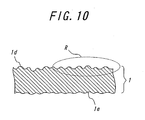
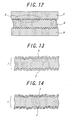
- a laminated seat S sticking on the hot roll HR always contacts to the cold roll CR with sliding, so that, as shown in Fig. 10, a contact surface 1d of the laminated seat S, as a result of a joint seat 1, opposed to the cold roll CR tends to coarse indicated as a portion R compared with a contact surface 1e of the seat 1 opposed to the hot roll HR.
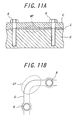
- a sealing efficiency of the gasket tends to decrease because of the reducing of the surface pressure which is generated of the portion like a corner portion CP which is offset to a straight line drawn between two bolts B as shown in Fig. 11B, or a portion MP which lies between two bolts B and has low rigidity of cover C as shown in Fig. 11A.
- the joint seat is generally manufactured from forms a laminated seat on the hot roll of the calender roll by mixing and rolling the ingredient attached on the hot roll, and breaks away the seat from the chilled the hot roll afterward. Therefore, the ingredient of the joint seat requires the characteristics that it is easy to attach the heated hot roll but difficult to the cold roll, and easy to break away from the chilled hot roll after the forming of the seat.
- the joint seat 1 generally composed as a three-layer construction which comprises a front surface layer 1a which is composed as so-called a dish component that is adhered on the hot roll, a back surface layer 1b which is composed as so-called a finished component that is difficult to adhere on the cold roll and, a middle layer 1c which is composed as so-called a middle component which is intervened between the front surface layer and the back surface layer and has a sufficient mechanical strength.
- a natural rubber as a rubber material which is used as the dish component.
- the natural rubber has a characteristic that it has a large permanent compression strain under the heat-suffering environment.
- a surface pressure acts upon the gasket is high directly below the bolt.
- the surface pressure is low at the corner portion, which is offset to a straight line drawn between two bolts, or a bolt span portion, which lies between two bolts. So it is well known the difference of the surface pressure is arise.
- Such the difference of the surface pressure recently tends to increase as the rigidity of the constructive body becomes low with the weight saving of the body.
- the low rigidity of the constructive body arises the change of the gap between the seal because of the change of the temperature and the like; such the change brings out the increase of the additional difference of the surface pressure.
- the fastening force of the bolt is determined under the condition to ensure the sealing effect at the low surface pressure potion. So a high surface pressure acts upon the gasket directly below of the bolt consequently, there exists the problem that the permanent pressure strain of the front surface 1a which the above-mentioned natural rubber used is facilitated and the stress relaxation increases, so the fastening torque of the bolt decreases and it is possible to arise the leakage of the media for sealing.
- the object of this invention is to provide the gasket material to be solved the above-mentioned problems advantageously.
- the gasket material in the first point of view of this invention that is manufactured from a joint seat which is made from an ingredient made by mixing and kneading rubber, reinforced fiber and filler, and pressurized laminating and vulcanizing the ingredient by means of calender roll, is characterized in that at least the outermost layer of the joint seat that faces the cold roll is formed to have its flexibility and smoothness.
- At least the cold roll side of the outermost layer of the joint seat to make the gasket is formed to have its flexibility and smoothness, so the burying of micro gap between the contact surface of the sealing subject and the gasket can achieved sufficiently under the low surface pressure, and can improve the seal efficiency of the gasket.
- the smoothness of the outermost layer is preferably that the surface roughness Rz (average of 10 points) is less or equal to 20 ⁇ m. If this Rz is less or equal to 20 ⁇ m, the seal efficiency will be improved to a large extent as described afterward.
- the composition of the outermost layer is preferably composed from that the rate of aramid fiber as the reinforced fiber is under 7wt%, and the rate of rubber is 15wt% - 25wt%.
- the flexibility of the outermost layer can be acquired.
- the surface roughness becomes small as much as there are many rates of the rubber again as much as there are a few rates of the aramid fiber.
- the thickness of the above outermost layer is 30 ⁇ m - 150 ⁇ m. If the layer has such thickness, it can maintain the affection of the stress relaxation caused by permanent compression strain is small with acquiring the flexibility of the layer.
- the gasket material in the second point of view of this invention that is manufactured from a joint seat which is made from an ingredient made by mixing and kneading rubber, reinforced fiber and filler, and pressurized laminating and vulcanizing the ingredient by means of calender roll, is characterized in that the joint seat has an mono-layer structure and, the fundamental composition of the ingredient materials is that the rate of aramid fiber as the reinforced fiber is over 15wt%, the rate of NBR as the rubber material is 10wt% - 30wt%, the rate of phenol resin as the filler is 2wt% - 26wt%, and the remainder is the inorganic filler.
- the joint seat that composes the gasket material has a mono-layer structure without surface layer of the dish component which uses natural rubber that is a permanent compression strain element at hot rolling process, the leakage of the media for seal such as lubricant or working oil or the like caused from the decrease of the fastening torque of the bolt due to the stress relaxation where the large difference of the surface pressure is existed in the heat-subjected environment such as the peripheral of the engine.
- the phenol resin as the filler with 2wt% - 26wt% gives the ingredients the moderate adherence for the running hot roll with high temperature and the moderate ability of detachment, so it can be favorable to form the joint seat by means of the calender roll.
- the phenol resin is preferably resol type. It is because this gives the good dispersion of the phenol resin in the ingredient material.
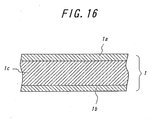
- Fig. 1 shows a cross sectional view of one embodiment of the gasket material of this invention in above-mentioned the first point of view
- the numeral 1 indicates a joint seat as the gasket material of this embodiment.
- This joint seat 1 has three-layer construction, that is, a front surface layer 1a and a back surface layer 1b that these layers forms outermost layer respectively, and a middle layer 1c that exists between the front surface and back surface layer.
- these surface layer 1a and 1b is formed to have flexibility and smoothness.
- a ingredient material M is made by mixing rubber such as NBR (Nitrile-Butadiene-Rubber), aramid fiber as a reinforced fiber and inorganic filler such as barium sulfate, then this ingredient material M feeds on a hot roll HR of a calender roll which comprises a pair of rolls, namely, hot roll HR and cold roll CR, forming a laminated ingredient on the hot roll HR by mixing and pressing with the use of these rolls, furthermore forming a joint seat S by vulcanizing and curing the ingredient with the use of the heat of the hot roll HR, hereinafter the joint seat 1 forms by detaching the seat S from the hot roll HR.
- rubber such as NBR (Nitrile-Butadiene-Rubber)
- aramid fiber as a reinforced fiber
- inorganic filler such as barium sulfate
- Fig. 5 shows an examples of the composition of aramid fiber, glass fiber and NBR of the middle layer, especially, in the percentage of composition that is indicated by point 5, aramid fiber is about 24wt%, glass fiber is about 33wt% and NBR is about 43wt%.
- the composition of the front surface 1a is configured that the percentage of aramid fiber is less and equal to 7wt% and rubber is 15wt% - 25wt%. And this front surface 1a is formed that its thickness is 30 ⁇ m - 150 ⁇ m.
- the front surface layer 1a that is outermost layer of the joint seat 1 which is the cold roll side (the side having a contact surface that attaches to cold roll CR) is formed to be flexibly and smoothly, so like a portion V that is shown in Fig. 2, burying of the micro gap that exists between the cover C as the sealing subject and the gasket G can achieve sufficiently under the low surface pressure, and consequently, the seal efficiency of the gasket can be improved.
- the back surface layer 1b which is the hot roll side (the side having a contact surface that attaches to hot roll HR) is also formed to be flexibly and smoothly, thus burying of the micro gap that exists between the housing H and the gasket G can achieve sufficiently under the low surface pressure, and consequently, the seal efficiency of the gasket can be improved.
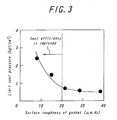
- Fig. 3 shows a experimental result of the limit seal pressure of the gasket which made from the joint seat 1 of this embodiment and of the gasket which made from the present joint seat under the condition that a number of these gasket with difference surface roughness made respectively, each gasket is held between two metal flanges, and the surface roughness of the flange: 11.7 ⁇ m (Rmax, ⁇ ), surface pressure of fastening of these flanges: 5MPa, sealing media: air, test temperature: 20°C ⁇ 5°C.
- the gasket that is made from the joint seat 1 of this embodiment makes the seal efficiency improve drastically.
- Fig. 4 shows another experimental result of the limit seal pressure of the gasket which made from the joint seat 1 of this embodiment with the surface roughness 14.5 ⁇ m (indicated by the curve G1 in the graph) and of the gasket as a comparative example which made from the present joint seat with the surface roughness 38.6 ⁇ m (indicated by the curve G2 in the graph) under the condition that each gasket is held between two metal flanges with the surface roughness of the flange: 11.7 ⁇ m (Rmax, ⁇ ), sealing media: air, test temperature: 20°C ⁇ 5°C.
- the gasket that is made from the joint seat 1 of this embodiment has less degree of decrease of seal efficiency under the low surface pressure area as the surface pressure of fastening is less and equal to 6MPa, and has the excellence of the seal efficiency at the low surface pressure area.
- Fig. 5 shows the other experimental result of the limit seal pressure of the gasket which made from the joint seat 1 of this embodiment with the surface roughness 14.5 ⁇ m (indicated by the curve G1 in the graph) and of the gasket as a comparative example which made from the present joint seat with the surface roughness 38.6 ⁇ m (indicated by the curve G2 in the graph) under the condition that each gasket is held between two metal flanges with different surface roughness each other, and surface pressure of fastening of these flanges: 6MPa, sealing media: air, test temperature: 20°C ⁇ 5°C.
- the gasket that is made from the joint seat 1 of this embodiment has the excellence of the seal efficiency on the rough surface of the sealing subject and has less degree of the seal efficiency although the surface roughness of the flange become worse.
- each joint seat is made by the combination which is selected from the groups that the each of the groups is; the composition of the aramid fiber is 3wt% or 6wt%; the composition of the NBR is 18wt% or 23wt%; the thickness of the surface layer (front surface layer 1a and back surface layer 1b) is 140 ⁇ m or 75 ⁇ m (the thickness of one layer).
- this invention is not limited by the above-mentioned embodiment, as the other embodiment, for example, the front surface layer 1a of the joint seat 1 may be only formed to be flexibly and smoothly, and this joint seat 1 may be formed to have double-layer structure.
- this gasket material of this invention can be used to the gasket except for the gasket that is inserted between the housing H and cover C of a transmission.
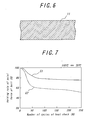
- Fig. 6 shows a cross sectional view of another embodiment of the gasket material of this invention in above-mentioned the second point of view, the numeral 11 indicates a joint seat as the gasket material of this embodiment.
- This joint seat 11 has monolayer construction compositionally.
- a ingredient material is made by mixing NBR as a rubber material, aramid fiber as a reinforced fiber and phenol resin and the like as filler, then this ingredient material feeds on a hot roll of a calender roll which comprises a pair of rolls, namely, heated hot roll and chilled cold roll, forming a laminated ingredient on the hot roll by mixing and pressing with the use of these rolls, furthermore forming a laminated seat by vulcanizing and curing the ingredient with the use of the heat of the hot roll, hereinafter the joint seat 11 formed by detaching the seat from the hot roll.
- a calender roll which comprises a pair of rolls, namely, heated hot roll and chilled cold roll, forming a laminated ingredient on the hot roll by mixing and pressing with the use of these rolls, furthermore forming a laminated seat by vulcanizing and curing the ingredient with the use of the heat of the hot roll, hereinafter the joint seat 11 formed by detaching the seat from the hot roll.
- the composition of the ingredient is configured that the percentage of aramid fiber is over 15wt% and NBR is 10wt% - 30wt%, phenol resin is more 2wt% - 26wt%, and the remains are inorganic fiber.
- the phenol resin is the resol type (for example, product name PR-217 of Sumitomo bakelite Co. Ltd., the weight of the solid content is 100wt%).
- the joint seat 11 of this embodiment has a mono-layer structure without any surface layer of the dish component which is made from natural rubber that has different composition from the middle component and is a permanent compression strain element in the hot rolling process
- the leakage of the sealing media such as a lubricant or working oil or the like caused from the decrease of the fastening torque of the bolt due to the stress relaxation where the large difference of the surface pressure is existed in the heat-subjected environment such as the peripheral of the engine.
- the phenol resin as the filler with 2wt% - 26wt% gives the ingredients the moderate adherence for the running hot roll with high temperature and the moderate ability of detachment, so it is favorable to form the joint seat by means of the calender roll.
- the phenol resin that is used as the ingredient is resol type, so it has a good dispersibility in the ingredient, thus, the above-mentioned action and effect of this invention can be brought perfectly.
- Fig. 7 shows an experimental result of the retention of the axial force of bolt of the gasket which made from the joint seat 11 of this embodiment (indicated by the curve G1 in the graph) and of the gasket as a comparative example which made from the present joint seat with three-layer structure (indicated by the curve G2 in the graph) via the experiment of degradation by thermal shock cycle under the condition that each gasket is held between two metal flanges by a bolt, the surface pressure of fastening of these flanges : 150MPa, repeat the heating and cooling between 150°C and 20°C.
- the gasket formed from the joint seat 11 of this embodiment has a high retention of the axial force of bolt and a small stress relaxation by the permanent compression strain.
- Table 9 shows the experimental result of the attach efficiency of the ingredient in the making of the joint seat to the hot roll with a high temperature
- the samples 9 - 14 are formed from the joint seat 11 of this embodiment, each samples have different composition of aramid fiber, phenol resin and NBR as the rubber material
- the comparative samples 1 - 3 are formed from the joint seat that the composition of phenol resin of the seats are 0wt%, 35wt % and 40wt%, respectively, and these comparative samples thus are out of the range of the embodiment of this invention.
- This experiment was executed under the condition that the surface pressure: 100MPa, temperature: 100°C and period of time: 60min.
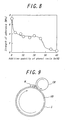
- Fig. 8 shows the relation of the strength of attachment and the composition of phenol resin of these samples.
- composition Composition Performance of joint seat Aramid fiber Phenol resin rubber Inorganic filler strength of attachment (MPa) Sample 9 20 3 20 remainder 4.2 Sample 10 20 8 25 remainder 4.0 Sample 11 20 10 24 remainder 3.5 Sample 12 20 16 23 remainder 3.2 Sample 13 15 20 27 remainder 3.7 Sample 14 20 26 23 remainder 3.0 Comparative sample 1 15 0 18 remainder 7.5 Comparative sample 2 25 35 20 remainder 0.8 Comparative sample 3 25 40 10 remainder 0.4
- the ingredient has a moderate strength of attachment when the additive quantity of phenol resin is between 2wt% - 26wt%, and has too large strength of attachment when the quantity is less than 2 wt%, thus it makes difficult to detach the laminated seat from the hot roll, and too small strength of attachment when the quantity is over 26wt%, thus it makes difficult to laminate the ingredient on the hot roll.
- the tensile test was executed under the condition which is defined in JIS K 6251, and buckling fatigue test was executed under the condition that a ring-shaped sample was set between a pair of jigs and one of the jigs was reciprocating slid at the distance of movement 300 ⁇ m and frequency 1Hz by an actuator with loading a predetermined surface pressure by the hydropress whether the fluff of the fiber generates or not at reciprocating cycle 3000cycle, and the buckling fatigue surface pressure is determined as the surface pressure when the fluff of the sample is generated, and the limit seal pressure test was executed under the condition that the nitrogen gas was supplied to inside the sample which the fluff generated via the jigs and the soap solution was applied to the periphery of the sample to check the leakage of the nitrogen gas, and the limit seal pressure is measured as the gas pressure when the leakage is generated.
- these samples of this invention has a
- this invention is not limited by the above-mentioned embodiments, for example, the phenol resin may be non-resol type.
- the gasket material of this invention of course can be used as the gasket to the periphery of engine instead of the gasket that is inserted between the housing and the cover of the transmission.
- the burying of micro gap between the contact surface of the sealing subject and the gasket can achieved sufficiently under the low surface pressure, and can improve the seal efficiency of the gasket.
- the leakage of the media for seal such as lubricant or working oil or the like caused from the decrease of the fastening torque of the bolt due to the stress relaxation where the large difference of the surface pressure is existed in the heat-subjected environment such as the peripheral of the engine, and it can be favorable to form the joint seat by means of the calender roll.
Landscapes
- Engineering & Computer Science (AREA)
- General Engineering & Computer Science (AREA)
- Mechanical Engineering (AREA)
- Sealing Material Composition (AREA)
- Gasket Seals (AREA)
Applications Claiming Priority (5)
| Application Number | Priority Date | Filing Date | Title |
|---|---|---|---|
| JP2002196824A JP2004035800A (ja) | 2002-07-05 | 2002-07-05 | ガスケット素材 |
| JP2002196713A JP4145584B2 (ja) | 2002-07-05 | 2002-07-05 | ガスケット素材 |
| JP2002196824 | 2002-07-05 | ||
| JP2002196713 | 2002-07-05 | ||
| PCT/JP2003/005548 WO2004005774A1 (fr) | 2002-07-05 | 2003-04-30 | Produit d'etancheite |
Publications (2)
| Publication Number | Publication Date |
|---|---|
| EP1557595A1 true EP1557595A1 (fr) | 2005-07-27 |
| EP1557595A4 EP1557595A4 (fr) | 2008-03-26 |
Family
ID=30117388
Family Applications (1)
| Application Number | Title | Priority Date | Filing Date |
|---|---|---|---|
| EP03725721A Withdrawn EP1557595A4 (fr) | 2002-07-05 | 2003-04-30 | Produit d'etancheite |
Country Status (5)
| Country | Link |
|---|---|
| US (1) | US20060093780A1 (fr) |
| EP (1) | EP1557595A4 (fr) |
| CN (1) | CN100422604C (fr) |
| TW (1) | TWI238232B (fr) |
| WO (1) | WO2004005774A1 (fr) |
Families Citing this family (5)
| Publication number | Priority date | Publication date | Assignee | Title |
|---|---|---|---|---|
| WO2008069706A1 (fr) | 2006-12-06 | 2008-06-12 | Volvo Construction Equipment Ab | Procédé et système pour commander un véhicule |
| JP5065154B2 (ja) * | 2008-05-23 | 2012-10-31 | 日本リークレス工業株式会社 | ガスケット素材 |
| CN102729491B (zh) * | 2011-04-06 | 2014-10-08 | 杭州藤仓橡胶有限公司 | 带夹层的橡胶膜片制造方法 |
| JP5852470B2 (ja) | 2012-02-28 | 2016-02-03 | ニチアス株式会社 | シーリング材及びその製造方法 |
| JP7564186B2 (ja) * | 2020-02-12 | 2024-10-08 | Nok株式会社 | ガスケット |
Family Cites Families (16)
| Publication number | Priority date | Publication date | Assignee | Title |
|---|---|---|---|---|
| JPS5938999B2 (ja) * | 1980-03-14 | 1984-09-20 | ニチアス株式会社 | ジヨイントシ−ト |
| US4330442A (en) * | 1980-05-07 | 1982-05-18 | Armstrong World Industries, Inc. | Asbestos free gasket forming compositions |
| GB2093474B (en) * | 1981-02-10 | 1984-10-24 | Texon Inc | High temperature resistant gasketing material incorporating organic fibers |
| US4423109A (en) * | 1981-10-02 | 1983-12-27 | Rogers Corporation | Fiber reinforced rubber gasket material |
| DE4109681C1 (fr) * | 1991-03-23 | 1992-11-05 | Goetze Ag, 5093 Burscheid, De | |
| US5240766A (en) * | 1992-04-01 | 1993-08-31 | Hollingsworth & Vose Company | Gasket material |
| CN2213890Y (zh) * | 1992-09-10 | 1995-11-29 | 孙宝伟 | 新型复合密封材料及密封垫片 |
| JP2883293B2 (ja) * | 1995-05-15 | 1999-04-19 | ニチアス株式会社 | ジョイントシート |
| JPH0913006A (ja) * | 1995-06-30 | 1997-01-14 | Sumitomo Chem Co Ltd | ジョイントシート |
| CN1051832C (zh) * | 1995-07-31 | 2000-04-26 | 舟山市海山密封材料有限公司 | 摩托车发动机专用密封垫片及其制造工艺 |
| JPH09111048A (ja) * | 1995-10-16 | 1997-04-28 | Sumitomo Chem Co Ltd | ゴム組成物およびジョイントシート |
| JPH10265765A (ja) * | 1997-03-24 | 1998-10-06 | Nichias Corp | ジョイントシートおよびその製造方法 |
| US6554936B1 (en) * | 1999-09-08 | 2003-04-29 | Alliant Techsystems Inc. | Method of constructing insulated metal dome structure for a rocket motor |
| JP2001271056A (ja) * | 2000-03-28 | 2001-10-02 | Nichias Corp | ジョイントシート |
| JP3939909B2 (ja) * | 2000-10-04 | 2007-07-04 | 本田技研工業株式会社 | 複合シートガスケット |
| JP3837354B2 (ja) * | 2002-03-29 | 2006-10-25 | ニチアス株式会社 | ガスケット用素材 |
-
2003
- 2003-04-30 US US10/520,112 patent/US20060093780A1/en not_active Abandoned
- 2003-04-30 EP EP03725721A patent/EP1557595A4/fr not_active Withdrawn
- 2003-04-30 WO PCT/JP2003/005548 patent/WO2004005774A1/fr not_active Ceased
- 2003-04-30 CN CNB038156768A patent/CN100422604C/zh not_active Expired - Lifetime
- 2003-07-03 TW TW92118173A patent/TWI238232B/zh not_active IP Right Cessation
Also Published As
| Publication number | Publication date |
|---|---|
| TWI238232B (en) | 2005-08-21 |
| WO2004005774A1 (fr) | 2004-01-15 |
| EP1557595A4 (fr) | 2008-03-26 |
| CN100422604C (zh) | 2008-10-01 |
| US20060093780A1 (en) | 2006-05-04 |
| CN1666049A (zh) | 2005-09-07 |
| TW200405928A (en) | 2004-04-16 |
Similar Documents
| Publication | Publication Date | Title |
|---|---|---|
| US6626439B1 (en) | Edge coated gaskets and method of making same | |
| EP1541907B1 (fr) | Produit d'etancheite | |
| JP2645800B2 (ja) | 膨張黒鉛製シール素材およびその製造方法ならびにガスケット用シート | |
| EP1566582A1 (fr) | Joint en composition de fluoroélastomère | |
| CZ297804B6 (cs) | Tesnení | |
| US6398224B1 (en) | Metal seal and coating material for metal seals | |
| EP1557595A1 (fr) | Produit d'etancheite | |
| US4620995A (en) | Surface coated gasket sheet | |
| JPH08258203A (ja) | 自動変速機内コントロールバルブ用セパレートプレート | |
| CN102037262B (zh) | 垫料材料 | |
| JP3939909B2 (ja) | 複合シートガスケット | |
| EP1566403A2 (fr) | Composition de silicones pour des joints | |
| CN101265975A (zh) | 垫片材料 | |
| CN101201108A (zh) | 垫片材料 | |
| JP4176401B2 (ja) | ガスケット素材 | |
| JP2004035800A (ja) | ガスケット素材 | |
| EP0516356A1 (fr) | Joint de culasse | |
| EP0705168B1 (fr) | Stratifie compressible et son utilisation | |
| JPS5877970A (ja) | メタルガスケツト | |
| JPH06173962A (ja) | 滑り軸受 | |
| JP2789423B2 (ja) | 非石綿系ジョイントシートおよびその製造方法 | |
| JP2004036808A (ja) | ガスケット素材 | |
| JP2004035804A (ja) | ガスケット素材 |
Legal Events
| Date | Code | Title | Description |
|---|---|---|---|
| PUAI | Public reference made under article 153(3) epc to a published international application that has entered the european phase |
Free format text: ORIGINAL CODE: 0009012 |
|
| 17P | Request for examination filed |
Effective date: 20050203 |
|
| AK | Designated contracting states |
Kind code of ref document: A1 Designated state(s): DE GB |
|
| RIN1 | Information on inventor provided before grant (corrected) |
Inventor name: TABATA, MASAMUNE,C/O HONDA GIJUTSU KENKYUSHO Inventor name: HAMADA, YOSHIAKI,NIPPON LEAKLESS IND. CO., LTD Inventor name: MURAKAMI, YASUNORI,C/O HONDA GIJUTSU KENKYUSHO Inventor name: AKIYOSHI, KOJI,NIPPON LEAKLESS IND. CO., LTD |
|
| A4 | Supplementary search report drawn up and despatched |
Effective date: 20080221 |
|
| 17Q | First examination report despatched |
Effective date: 20081006 |
|
| STAA | Information on the status of an ep patent application or granted ep patent |
Free format text: STATUS: THE APPLICATION IS DEEMED TO BE WITHDRAWN |
|
| 18D | Application deemed to be withdrawn |
Effective date: 20130122 |