EP1557788A2 - Reduktion von Angepasstheitsbeurteilungen unter Verwendung von Gruppierungstechniken und Neuronalnetzwerkmengen - Google Patents
Reduktion von Angepasstheitsbeurteilungen unter Verwendung von Gruppierungstechniken und Neuronalnetzwerkmengen Download PDFInfo
- Publication number
- EP1557788A2 EP1557788A2 EP04010194A EP04010194A EP1557788A2 EP 1557788 A2 EP1557788 A2 EP 1557788A2 EP 04010194 A EP04010194 A EP 04010194A EP 04010194 A EP04010194 A EP 04010194A EP 1557788 A2 EP1557788 A2 EP 1557788A2
- Authority
- EP
- European Patent Office
- Prior art keywords
- ensemble
- individuals
- fitness function
- neural network
- offspring individuals
- Prior art date
- Legal status (The legal status is an assumption and is not a legal conclusion. Google has not performed a legal analysis and makes no representation as to the accuracy of the status listed.)
- Granted
Links
Images





Classifications
-
- G—PHYSICS
- G06—COMPUTING OR CALCULATING; COUNTING
- G06N—COMPUTING ARRANGEMENTS BASED ON SPECIFIC COMPUTATIONAL MODELS
- G06N3/00—Computing arrangements based on biological models
- G06N3/12—Computing arrangements based on biological models using genetic models
- G06N3/126—Evolutionary algorithms, e.g. genetic algorithms or genetic programming
Definitions
- the underlying invention generally relates to the field of evolutionary computation, especially to the reduction of the number of fitness evaluations in evolutionary algorithms (EA).
- Generation-based or individual-based evolution control can be implemented.
- generation-based approach [14, 2, 6, 7] some generations are evaluated using the approximate model and the rest using the original fitness function.
- individual-based evolution control part of the individuals of each generation are evaluated using the approximation model and the rest using the original fitness function [6, 3, 17, 1].
- the generation-based approach is more suitable when the individuals are evaluated in parallel, where the duration of the optimization process depends to a large degree on the number of generations needed.
- the individual-based approach is better suited when the number of evaluations is limited, for example, when an experiment needs to be done for a fitness evaluation.
- the population is grouped into a number of clusters, and only the individual that is closest to the cluster center is evaluated using the original fitness function.
- the evaluated individuals can be used to create a neural network ensemble, which is then used for estimating the fitness values of the remaining individuals.
- Both the structure and the parameters of the neural networks can e.g. be optimized using an evolutionary algorithm (EA) with Lamarckian inheritance.
- the present invention thus proposes a computationally efficient model that can be constructed for fitness evaluations to assist the evolutionary algorithms.
- the invention suggests a method for reducing the required number of fitness evaluations using meta-models. It deals with three aspects in meta-model assisted evolutionary computation.
- the invention uses a clustering method using a k-means algorithm.
- a neural network ensemble has been used instead of a single neural network. Meanwhile, both the structure and parameters of the neural networks are on-line optimized using a Lamarkian evolutionary algorithm. Finally, the weights of the ensemble members are optimized using a standard Evolution Strategy (ES).
- ES Evolution Strategy
- the invention uses the output variance of the ensemble members.
- an evolutionary optimization method is proposed.
- an initial population of individuals is set up and an original fitness function is applied.
- the offspring individuals having a high evaluated quality value are selected as parents.
- the parents are reproduced to create a plurality of offspring individuals.
- the quality of the offspring individuals is evaluated by means of a fitness function, wherein selectively the original or an approximate fitness function is used.
- the method goes back to the selection step until a termination condition is met.
- the step of evaluating the quality of the offspring individuals further consists in grouping all ⁇ offspring individuals in clusters, selecting for each cluster one or a plurality of offspring individuals, resulting in altogether ⁇ selected offspring individuals, evaluating the ⁇ selected offspring individuals by means of the original fitness function and evaluating the remaining ⁇ - ⁇ offspring individuals by means of the approximate fitness function.
- the approximate fitness function can e.g. be a neural network ensemble comprising a plurality of neural network.
- the offspring individuals chosen for evaluation with the original fitness function can e.g. be the one closest to the cluster center.
- a k-means method can be used to group all offspring into clusters.
- each neural network in the ensemble can be weighted and combined to the final output of the neural network ensemble.
- a Genetic Algorithm (GA) with a local search can also be used to generate the neural network ensemble.
- An evolution strategy can be used to optimize the weights of the ensemble by minimizing an expected prediction error.
- the variance of the neural network's output in the ensemble can be derived and if the variance is larger than a given threshold, the corresponding fitness value of the individual concerned can be replaced by the value of the individual closest to the cluster center.
- Said variance can be used to control how many individuals in each cluster are evaluated using the original function.
- the number of individuals to be evaluated using the original fitness function can be increased if the variance is high and decreased if the variance is low.
- a use of the presented evolutionary optimization method is proposed for the optimization of hydrodynamic or aerodynamic designs, of turbine rotor and stator blades and outlet guide vanes, and of aerodynamic properties of vehicles.
- the k-means method is applied to group the individuals of a population into a number of clusters. For each cluster, e.g. only the individual that is closest to the cluster center is evaluated using the expensive original fitness function. The fitness of the other individuals is estimated using a neural network ensemble, which is also used to detect possible serious prediction errors. Simulation results from three test functions show that the proposed invention exhibits better performance than the strategy where only the best individuals according to the approximate model are re-evaluated.
- clustering techniques have been proposed for grouping similar patterns (data items) [4]. All of these clustering techniques can be used in conjunction with the present invention. Generally, they can be divided into:
- a hierarchical algorithm yields a tree structure representing a nested grouping of patterns, whereas a partitional clustering algorithm generates a single partition of the patterns.
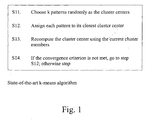
- the k-means is the simplest and the most commonly used clustering algorithm. It employs the squared error criterion and its computational complexity is O(n), where n is the number of patterns.
- Fig. 1 shows an algorithm for population clustering which is known as such.
- a typical stopping criterion is that the decrease in the squared error is minimized.
- a major problem of the k-means clustering algorithm is that it may converge to a local minimum if the initial partition is not properly chosen. Besides, the number of clusters needs to be specified beforehand, which is a general problem for partitional clustering algorithms [4].
- the silhouette method [16] can be used.
- s ij has a value between -1 and 1. If s ij equals 1, it means that s ij is in the proper cluster. If s ij is 0, it indicates that x ij may also be grouped in the nearest neighboring cluster and if x ij is -1, it suggests that x ij is very likely in the wrong cluster. Thus, a global silhouette width can be obtained by summing up the silhouette width of all patterns:
- this value can be used to determine the proper number of clusters.
- a standard neural network has been constructed using the data generated during optimization.
- the neural network model is trained off-line and further updated when new data are available.
- One problem that may occur is that as the number of samples increases, the learning efficiency may decrease.
- weighted learning [7] and off-line structure optimization of the neural networks have been shown to be promising.
- the benefit of using a neural network ensemble originates from the diversity of the behavior of the ensemble members on unseen data.
- diverse behavior on unseen data can be obtained via the following approaches:
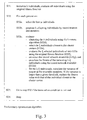
- a Genetic Algorithm can be used to generate the neural network ensemble (S22), which can provide two sources of diversity: both the architecture and the final weights of the neural networks are different. Since the goal of the neural networks is to learn the local fitness landscape, the optimization method of the invention only uses the data generated in the two most recent generations instead of using all data.
- the final output of the ensemble can be obtained by averaging the weighted outputs of the ensemble members: where y (k) and w (k) are the output and its weight of the k-th neural network in the ensemble.
- the expected error of the ensemble is given by: where C ij is the error correlation matrix between network i and network j in the ensemble (S23): where E(.) denotes the mathematical expectation.
- a canonical Evolution Strategy (ES) can be employed to find the optimal weights (S24) to minimize the expected error in Eq. 5.
- test functions are set to 30.
- a standard (5, 30) Evolution Strategy (ES) is used in all simulations.
- the first issue is the number of clusters. This number is relevant to performance of the clustering algorithm, the quality of the approximate model, and eventually the convergence property of the evolutionary algorithm.
- the clustering performance is then evaluated when the number of clusters is set to be one third of the population.
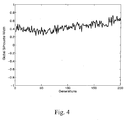
- Fig. 4 shows the global silhouette width when the cluster number is 10 and the population size is 30 on the 30-dimensional Ackley function. It can be seen that the clustering performance is acceptable.
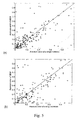
- the ensemble output versus that of a single network is plotted in Fig. 5, where in Fig. 5(a) the ensemble size is 3 and in Fig. 5(b) the ensemble size is 5. Note that the more points locate in the right lower part of the figure the more effective the ensemble. It can be seen from the figure that no significant performance improvement has been achieved when the ensemble size is changed from 3 to 5. Thus, the ensemble size is fixed to 3.
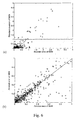
- Fig. 6(a) shows the relationship between the standard deviation of the predictions of the ensemble members and the estimation error of the ensemble.
- ES Evolution Strategy
- BEM Basic Ensemble Method
- the evolutionary optimization method of the invention is applied to the optimization of three functions: Ackley function, the Rosenbrock function and the Sphere function.
- the maximal number of fitness evaluations is set to 2000 in all simulations.
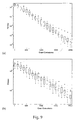
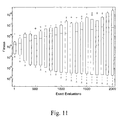
- Fig. 7, 8 and 9 show the box plots of the ten runs on the three test functions. For clarity, only 20 data points are shown in the figures, which are uniformly sampled from the original data. From these figures, it can clearly be seen that on average, the optimization results using the proposed algorithm are much better than those from the plain evolution strategy on all test functions. Meanwhile, they are also much better than the results reported in [6], where no clustering of the population has been implemented. As mentioned, without clustering, the evolutionary algorithm does not converge correctly if only one third of the population is re-evaluated using the original fitness function. Nevertheless, it can noticed that for the Ackley function, the result from one of the 10 runs using the proposed method is much worse than the average performance, even a little worse than the average result when the plain ES is used, refer to Fig. 7(a).
- a new method for reducing fitness evaluations in evolutionary computation is proposed.
- the population is clustered into a number of groups and only the individuals closest to each cluster center is evaluated.
- a neural network ensemble is constructed using the data from the evaluated individuals.
- the weights of the ensemble are optimized using a standard ES.
- the invention further exploit information contained in the ensemble by taking advantage of the standard deviation of the output of the ensemble members.
- the prediction error is very likely to be large and thus the ensemble prediction is replaced by the fitness value of the cluster center of the individual. Simulation results on the test functions suggest that the proposed algorithm is very promising.
Landscapes
- Engineering & Computer Science (AREA)
- Physics & Mathematics (AREA)
- Health & Medical Sciences (AREA)
- Life Sciences & Earth Sciences (AREA)
- Biophysics (AREA)
- Bioinformatics & Cheminformatics (AREA)
- Bioinformatics & Computational Biology (AREA)
- Evolutionary Biology (AREA)
- Theoretical Computer Science (AREA)
- Computational Linguistics (AREA)
- General Engineering & Computer Science (AREA)
- Biomedical Technology (AREA)
- Genetics & Genomics (AREA)
- Data Mining & Analysis (AREA)
- Evolutionary Computation (AREA)
- General Health & Medical Sciences (AREA)
- Molecular Biology (AREA)
- Computing Systems (AREA)
- Artificial Intelligence (AREA)
- General Physics & Mathematics (AREA)
- Mathematical Physics (AREA)
- Software Systems (AREA)
- Physiology (AREA)
- Management, Administration, Business Operations System, And Electronic Commerce (AREA)
- Financial Or Insurance-Related Operations Such As Payment And Settlement (AREA)
- General Factory Administration (AREA)
Priority Applications (3)
| Application Number | Priority Date | Filing Date | Title |
|---|---|---|---|
| EP04010194A EP1557788B1 (de) | 2004-01-26 | 2004-04-29 | Reduktion von Angepasstheitsbeurteilungen unter Verwendung von Gruppierungstechniken und Neuronalnetzwerkmengen |
| US11/042,991 US7363281B2 (en) | 2004-01-26 | 2005-01-24 | Reduction of fitness evaluations using clustering techniques and neural network ensembles |
| JP2005016654A JP2005209211A (ja) | 2004-01-26 | 2005-01-25 | 進化的最適化方法 |
Applications Claiming Priority (3)
| Application Number | Priority Date | Filing Date | Title |
|---|---|---|---|
| EP04001615 | 2004-01-26 | ||
| EP04001615 | 2004-01-26 | ||
| EP04010194A EP1557788B1 (de) | 2004-01-26 | 2004-04-29 | Reduktion von Angepasstheitsbeurteilungen unter Verwendung von Gruppierungstechniken und Neuronalnetzwerkmengen |
Publications (3)
| Publication Number | Publication Date |
|---|---|
| EP1557788A2 true EP1557788A2 (de) | 2005-07-27 |
| EP1557788A3 EP1557788A3 (de) | 2006-07-05 |
| EP1557788B1 EP1557788B1 (de) | 2008-04-16 |
Family
ID=34635348
Family Applications (1)
| Application Number | Title | Priority Date | Filing Date |
|---|---|---|---|
| EP04010194A Expired - Lifetime EP1557788B1 (de) | 2004-01-26 | 2004-04-29 | Reduktion von Angepasstheitsbeurteilungen unter Verwendung von Gruppierungstechniken und Neuronalnetzwerkmengen |
Country Status (3)
| Country | Link |
|---|---|
| US (1) | US7363281B2 (de) |
| EP (1) | EP1557788B1 (de) |
| JP (1) | JP2005209211A (de) |
Cited By (7)
| Publication number | Priority date | Publication date | Assignee | Title |
|---|---|---|---|---|
| EP2284738A1 (de) | 2009-08-13 | 2011-02-16 | Honda Research Institute Europe GmbH | Integration von funktionellen CAE-Daten im CAD-basierten Designverfahren für ein Industrie-Design, insbesondere Autos, Motorräder oder Raumfahrzeuge |
| WO2017148536A1 (en) * | 2016-03-04 | 2017-09-08 | VON MÜLLER, Albrecht | Electronic devices, artificial evolutionary neural networks, methods and computer programs for implementing evolutionary search and optimisation |
| WO2019101836A1 (en) * | 2017-11-22 | 2019-05-31 | Deepmind Technologies Limited | Population based training of neural networks |
| WO2021113427A1 (en) * | 2019-12-04 | 2021-06-10 | Marvell Asia Pte Ltd | System and method for altering memory accesses using machine learning |
| CN115620831A (zh) * | 2022-10-09 | 2023-01-17 | 深圳瑞德林生物技术有限公司 | 一种循环迭代优化生成序列突变适应度的方法及相关装置 |
| US11907821B2 (en) | 2019-09-27 | 2024-02-20 | Deepmind Technologies Limited | Population-based training of machine learning models |
| CN119129073A (zh) * | 2024-09-19 | 2024-12-13 | 陕西省建筑科学研究院有限公司 | 一种场馆网壳屋盖测点优化方法及系统 |
Families Citing this family (43)
| Publication number | Priority date | Publication date | Assignee | Title |
|---|---|---|---|---|
| EP1205863A1 (de) * | 2000-11-14 | 2002-05-15 | Honda R&D Europe (Deutschland) GmbH | Optimierung mehrerer Ziele |
| EP1235180A1 (de) * | 2001-02-26 | 2002-08-28 | Honda R&D Europe (Deutschland) GmbH | Anpassung der Parameter in einer Evolutionsstrategie |
| US20040044633A1 (en) * | 2002-08-29 | 2004-03-04 | Chen Thomas W. | System and method for solving an optimization problem using a neural-network-based genetic algorithm technique |
| US8374974B2 (en) * | 2003-01-06 | 2013-02-12 | Halliburton Energy Services, Inc. | Neural network training data selection using memory reduced cluster analysis for field model development |
| EP1598751B1 (de) * | 2004-01-12 | 2014-06-25 | Honda Research Institute Europe GmbH | Bewertung von Verteilungsalgorithmen |
| EP1557788B1 (de) * | 2004-01-26 | 2008-04-16 | Honda Research Institute Europe GmbH | Reduktion von Angepasstheitsbeurteilungen unter Verwendung von Gruppierungstechniken und Neuronalnetzwerkmengen |
| US20060212279A1 (en) * | 2005-01-31 | 2006-09-21 | The Board of Trustees of the University of Illinois and | Methods for efficient solution set optimization |
| US20070016389A1 (en) * | 2005-06-24 | 2007-01-18 | Cetin Ozgen | Method and system for accelerating and improving the history matching of a reservoir simulation model |
| EP1768053A1 (de) * | 2005-09-12 | 2007-03-28 | Honda Research Institute Europe GmbH | Evolutionäre Suche für robuste Lösungen |
| US7277823B2 (en) * | 2005-09-26 | 2007-10-02 | Lockheed Martin Corporation | Method and system of monitoring and prognostics |
| US7979365B2 (en) * | 2006-01-31 | 2011-07-12 | The Board Of Trustees Of The University Of Illinois | Methods and systems for interactive computing |
| US8131656B2 (en) * | 2006-01-31 | 2012-03-06 | The Board Of Trustees Of The University Of Illinois | Adaptive optimization methods |
| US8332188B2 (en) * | 2006-03-03 | 2012-12-11 | Solido Design Automation Inc. | Modeling of systems using canonical form functions and symbolic regression |
| US7809657B2 (en) * | 2006-07-12 | 2010-10-05 | General Electric Company | System and method for implementing a multi objective evolutionary algorithm on a programmable logic hardware device |
| US8019584B2 (en) * | 2006-07-31 | 2011-09-13 | Nec Laboratories America, Inc. | Method and system for modeling likely invariants in distributed systems |
| US7882052B2 (en) * | 2006-09-11 | 2011-02-01 | Eors Szathmary | Evolutionary neural network and method of generating an evolutionary neural network |
| US8065244B2 (en) * | 2007-03-14 | 2011-11-22 | Halliburton Energy Services, Inc. | Neural-network based surrogate model construction methods and applications thereof |
| US9514388B2 (en) * | 2008-08-12 | 2016-12-06 | Halliburton Energy Services, Inc. | Systems and methods employing cooperative optimization-based dimensionality reduction |
| US8380607B2 (en) * | 2010-12-17 | 2013-02-19 | Indiana University Research And Technology Corporation | Predicting economic trends via network communication mood tracking |
| US8838510B2 (en) | 2011-09-16 | 2014-09-16 | International Business Machines Corporation | Choosing pattern recognition algorithms and data features using a genetic algorithm |
| US9368109B2 (en) * | 2013-05-31 | 2016-06-14 | Nuance Communications, Inc. | Method and apparatus for automatic speaker-based speech clustering |
| US9690844B2 (en) | 2014-01-24 | 2017-06-27 | Samsung Electronics Co., Ltd. | Methods and systems for customizable clustering of sub-networks for bioinformatics and health care applications |
| CN103984996B (zh) * | 2014-05-26 | 2017-02-15 | 北京工商大学 | 水华机理时变模型的禁忌搜索及遗传算法优化预测方法 |
| US20180129961A1 (en) * | 2015-05-12 | 2018-05-10 | New York University | System, method and computer-accessible medium for making a prediction from market data |
| KR101680055B1 (ko) | 2015-08-27 | 2016-11-29 | 서울대학교산학협력단 | 결합적 클러스터링 기법과 앙상블 모델링 기법을 이용한 인공신경망 모델 개발 방법 |
| KR101948235B1 (ko) * | 2016-12-30 | 2019-02-14 | 중앙대학교 산학협력단 | 클러스터 앙상블을 통한 소프트웨어 아키텍처 모듈 뷰 복원 프레임워크 장치 및 방법 |
| EP4700664A3 (de) * | 2017-05-17 | 2026-04-22 | Intel Corporation | Systeme und verfahren zur implementierung einer intelligenten optimierungsplattform |
| US11074503B2 (en) | 2017-09-06 | 2021-07-27 | SparkCognition, Inc. | Execution of a genetic algorithm having variable epoch size with selective execution of a training algorithm |
| US11106978B2 (en) | 2017-09-08 | 2021-08-31 | SparkCognition, Inc. | Execution of a genetic algorithm with variable evolutionary weights of topological parameters for neural network generation and training |
| US10635978B2 (en) * | 2017-10-26 | 2020-04-28 | SparkCognition, Inc. | Ensembling of neural network models |
| US10282237B1 (en) | 2017-10-30 | 2019-05-07 | SigOpt, Inc. | Systems and methods for implementing an intelligent application program interface for an intelligent optimization platform |
| US11270217B2 (en) | 2017-11-17 | 2022-03-08 | Intel Corporation | Systems and methods implementing an intelligent machine learning tuning system providing multiple tuned hyperparameter solutions |
| DE102018210894A1 (de) * | 2018-07-03 | 2020-01-09 | Siemens Aktiengesellschaft | Entwurf und Herstellung einer Strömungsmaschinenschaufel |
| US11704567B2 (en) | 2018-07-13 | 2023-07-18 | Intel Corporation | Systems and methods for an accelerated tuning of hyperparameters of a model using a machine learning-based tuning service |
| US11544536B2 (en) * | 2018-09-27 | 2023-01-03 | Google Llc | Hybrid neural architecture search |
| CN111105029B (zh) * | 2018-10-29 | 2024-04-16 | 北京地平线机器人技术研发有限公司 | 神经网络的生成方法、生成装置和电子设备 |
| CN109299142B (zh) * | 2018-11-14 | 2020-10-27 | 中山大学 | 一种基于进化算法的卷积神经网络结构搜索方法及系统 |
| US11157812B2 (en) | 2019-04-15 | 2021-10-26 | Intel Corporation | Systems and methods for tuning hyperparameters of a model and advanced curtailment of a training of the model |
| JP7298284B2 (ja) * | 2019-05-09 | 2023-06-27 | 富士通株式会社 | 演算処理装置、演算処理プログラム、及び演算処理方法 |
| JP7272200B2 (ja) | 2019-09-17 | 2023-05-12 | 富士通株式会社 | 情報処理装置、情報処理プログラムおよび情報処理方法 |
| US20230107088A1 (en) * | 2020-03-25 | 2023-04-06 | Hiroshima University | Method and system for determining event class by ai |
| CN113221467B (zh) * | 2021-05-31 | 2022-10-25 | 西安交通大学 | 一种涡轮气热性能不确定性可视化分析方法与系统 |
| US12555153B2 (en) * | 2023-06-30 | 2026-02-17 | Maplebear Inc. | Recommendation method, product, and system using user embeddings having stable long-term component and dynamic short-term session component |
Family Cites Families (37)
| Publication number | Priority date | Publication date | Assignee | Title |
|---|---|---|---|---|
| US5148513A (en) * | 1988-05-20 | 1992-09-15 | John R. Koza | Non-linear genetic process for use with plural co-evolving populations |
| WO1991014990A1 (en) * | 1990-03-28 | 1991-10-03 | Koza John R | Non-linear genetic algorithms for solving problems by finding a fit composition of functions |
| US5074752A (en) * | 1990-08-06 | 1991-12-24 | General Electric Company | Gas turbine outlet guide vane mounting assembly |
| US5319781A (en) * | 1991-05-03 | 1994-06-07 | Bolt Beranek And Newman Inc. | Generation of schedules using a genetic procedure |
| US5265830A (en) * | 1992-01-21 | 1993-11-30 | Mcdonnell Douglas Corporation | Trailing edge splitter |
| US5355528A (en) * | 1992-10-13 | 1994-10-11 | The Regents Of The University Of California | Reprogrammable CNN and supercomputer |
| JPH06131188A (ja) * | 1992-10-22 | 1994-05-13 | Hitachi Ltd | ファジィルール獲得方法およびファジィ推論システム |
| US5461570A (en) * | 1994-06-10 | 1995-10-24 | Johnson & Johnson Vision Products, Inc. | Computer system for quality control correlations |
| US5541848A (en) * | 1994-12-15 | 1996-07-30 | Atlantic Richfield Company | Genetic method of scheduling the delivery of non-uniform inventory |
| US5819244A (en) * | 1995-10-02 | 1998-10-06 | Apple Computer, Inc. | Adaptive computing systems, computer readable memories and processes employing hyperlinear chromosomes |
| US5724258A (en) * | 1996-05-09 | 1998-03-03 | Johnson & Johnson Vision Products, Inc. | Neural network analysis for multifocal contact lens design |
| AU3286897A (en) * | 1996-05-23 | 1997-12-09 | United States Of America, Represented By The Secretary, Department Of Health And Human Services, The | System and method for combining multiple learning agents to produce a prediction method |
| US5794432A (en) * | 1996-08-27 | 1998-08-18 | Diversitech, Inc. | Variable pressure and variable air flow turbofan engines |
| US5924048A (en) * | 1997-03-14 | 1999-07-13 | Mccormack; Michael D. | Automated material balance system for hydrocarbon reservoirs using a genetic procedure |
| JP3881428B2 (ja) * | 1997-07-11 | 2007-02-14 | 本田技研工業株式会社 | 物体形状決定方法 |
| EP0962874A1 (de) * | 1998-06-04 | 1999-12-08 | Asea Brown Boveri AG | Verfahren zum Entwurf von Durchflussvorrichtungen |
| US6516309B1 (en) * | 1998-07-17 | 2003-02-04 | Advanced Research & Technology Institute | Method and apparatus for evolving a neural network |
| US6549233B1 (en) * | 1998-08-07 | 2003-04-15 | Intel Corporation | Color interpolation system |
| US6606612B1 (en) * | 1998-08-13 | 2003-08-12 | The United States Of America As Represented By The Administrator Of The National Aeronautics And Space Administration | Method for constructing composite response surfaces by combining neural networks with other interpolation or estimation techniques |
| DE69924464T2 (de) * | 1998-09-07 | 2006-03-16 | Bridgestone Corp. | Methode zur voraussage der leistungsfähigkeit eines reifens |
| WO2000036523A1 (en) * | 1998-12-15 | 2000-06-22 | Jing Xiao | Method for solving partial constraint satisfaction problems for sequencing tasks |
| US6578018B1 (en) * | 1999-07-27 | 2003-06-10 | Yamaha Hatsudoki Kabushiki Kaisha | System and method for control using quantum soft computing |
| US20040030666A1 (en) * | 1999-07-30 | 2004-02-12 | Marra John J. | Method of designing a multi-stage compressor rotor |
| JP3885183B2 (ja) * | 2000-01-17 | 2007-02-21 | 独立行政法人産業技術総合研究所 | 光学装置、光学装置の調整方法、およびその調整方法で実行する処理プログラムを記録した記録媒体 |
| US7542948B2 (en) * | 2000-06-16 | 2009-06-02 | Honda Giken Kogyo Kabushiki Kaisha | Genetic design method and apparatus |
| EP1205877A1 (de) * | 2000-11-14 | 2002-05-15 | Honda R&D Europe (Deutschland) GmbH | Approximative Angepasstheitsfunktionen |
| WO2002057946A1 (en) * | 2001-01-18 | 2002-07-25 | The Board Of Trustees Of The University Of Illinois | Method for optimizing a solution set |
| US6928434B1 (en) * | 2001-01-31 | 2005-08-09 | Rosetta Marketing Strategies Group | Method and system for clustering optimization and applications |
| EP1235180A1 (de) * | 2001-02-26 | 2002-08-28 | Honda R&D Europe (Deutschland) GmbH | Anpassung der Parameter in einer Evolutionsstrategie |
| CA2340792A1 (en) * | 2001-03-28 | 2002-09-28 | Michael C. Allan | Method and system for evolutionary phenogenetic engineering |
| US20020188424A1 (en) * | 2001-04-20 | 2002-12-12 | Grinstein Georges G. | Method and system for data analysis |
| US20030065632A1 (en) * | 2001-05-30 | 2003-04-03 | Haci-Murat Hubey | Scalable, parallelizable, fuzzy logic, boolean algebra, and multiplicative neural network based classifier, datamining, association rule finder and visualization software tool |
| US7313550B2 (en) * | 2002-03-27 | 2007-12-25 | Council Of Scientific & Industrial Research | Performance of artificial neural network models in the presence of instrumental noise and measurement errors |
| EP1367534A3 (de) * | 2002-05-30 | 2008-07-02 | L'oreal | Verfahren mit künstlicher Intelligenz |
| US6950712B2 (en) * | 2002-07-30 | 2005-09-27 | Yamaha Hatsudoki Kabushiki Kaisha | System and method for nonlinear dynamic control based on soft computing with discrete constraints |
| EP1557788B1 (de) * | 2004-01-26 | 2008-04-16 | Honda Research Institute Europe GmbH | Reduktion von Angepasstheitsbeurteilungen unter Verwendung von Gruppierungstechniken und Neuronalnetzwerkmengen |
| US7280987B2 (en) * | 2004-03-26 | 2007-10-09 | Halliburton Energy Services, Inc. | Genetic algorithm based selection of neural network ensemble for processing well logging data |
-
2004
- 2004-04-29 EP EP04010194A patent/EP1557788B1/de not_active Expired - Lifetime
-
2005
- 2005-01-24 US US11/042,991 patent/US7363281B2/en not_active Expired - Fee Related
- 2005-01-25 JP JP2005016654A patent/JP2005209211A/ja active Pending
Cited By (13)
| Publication number | Priority date | Publication date | Assignee | Title |
|---|---|---|---|---|
| EP2284738A1 (de) | 2009-08-13 | 2011-02-16 | Honda Research Institute Europe GmbH | Integration von funktionellen CAE-Daten im CAD-basierten Designverfahren für ein Industrie-Design, insbesondere Autos, Motorräder oder Raumfahrzeuge |
| WO2017148536A1 (en) * | 2016-03-04 | 2017-09-08 | VON MÜLLER, Albrecht | Electronic devices, artificial evolutionary neural networks, methods and computer programs for implementing evolutionary search and optimisation |
| WO2019101836A1 (en) * | 2017-11-22 | 2019-05-31 | Deepmind Technologies Limited | Population based training of neural networks |
| US12314856B2 (en) | 2017-11-22 | 2025-05-27 | Deepmind Technologies Limited | Population based training of neural networks |
| EP4383136A3 (de) * | 2017-11-22 | 2024-09-04 | DeepMind Technologies Limited | Populationsbasiertes training von neuronalen netzen |
| US11941527B2 (en) | 2017-11-22 | 2024-03-26 | Deepmind Technologies Limited | Population based training of neural networks |
| US11604985B2 (en) | 2017-11-22 | 2023-03-14 | Deepmind Technologies Limited | Population based training of neural networks |
| US11907821B2 (en) | 2019-09-27 | 2024-02-20 | Deepmind Technologies Limited | Population-based training of machine learning models |
| WO2021113427A1 (en) * | 2019-12-04 | 2021-06-10 | Marvell Asia Pte Ltd | System and method for altering memory accesses using machine learning |
| US20220156548A1 (en) * | 2019-12-04 | 2022-05-19 | Marvell Asia Pte Ltd | System and Method for Improving a Processing System |
| WO2021113428A1 (en) * | 2019-12-04 | 2021-06-10 | Marvell Asia Pte Ltd | System and method for improving a processing system |
| CN115620831A (zh) * | 2022-10-09 | 2023-01-17 | 深圳瑞德林生物技术有限公司 | 一种循环迭代优化生成序列突变适应度的方法及相关装置 |
| CN119129073A (zh) * | 2024-09-19 | 2024-12-13 | 陕西省建筑科学研究院有限公司 | 一种场馆网壳屋盖测点优化方法及系统 |
Also Published As
| Publication number | Publication date |
|---|---|
| EP1557788B1 (de) | 2008-04-16 |
| JP2005209211A (ja) | 2005-08-04 |
| US7363281B2 (en) | 2008-04-22 |
| US20050209982A1 (en) | 2005-09-22 |
| EP1557788A3 (de) | 2006-07-05 |
Similar Documents
| Publication | Publication Date | Title |
|---|---|---|
| EP1557788B1 (de) | Reduktion von Angepasstheitsbeurteilungen unter Verwendung von Gruppierungstechniken und Neuronalnetzwerkmengen | |
| Jin et al. | Reducing fitness evaluations using clustering techniques and neural network ensembles | |
| EP1598751B1 (de) | Bewertung von Verteilungsalgorithmen | |
| US7043462B2 (en) | Approximate fitness functions | |
| Abraham | Intelligent systems: Architectures and perspectives | |
| Fischer et al. | A genetic-algorithms based evolutionary computational neural network for modelling spatial interaction dataNeural network for modelling spatial interaction data | |
| WO1990011568A1 (en) | Genetic synthesis of neural networks | |
| CN119167985A (zh) | 基于社区结构共性的图神经网络预训练方法及系统 | |
| Giampaolo et al. | Investigating random variations of the forward-forward algorithm for training neural networks | |
| Jin et al. | Neural networks for fitness approximation in evolutionary optimization | |
| Gräning et al. | Efficient evolutionary optimization using individual-based evolution control and neural networks: A comparative study. | |
| Hussain et al. | A new selection operator for genetic algorithms that balances between premature convergence and population diversity | |
| Hassan et al. | Neural network ensemble: Evaluation of aggregation algorithms in electricity demand forecasting | |
| Balabanova et al. | Synthesizing of models for identification of teletraffic Markov chains by artificial neural networks and decision tree method | |
| Espinal et al. | Comparison of PSO and DE for training neural networks | |
| Cococcioni et al. | Towards Efficient multi-objective genetic Takagi-Sugeno fuzzy systems for high dimensional problems | |
| Zhou et al. | New travel demand models with back-propagation network | |
| Chimatapu et al. | Stacked auto encoder based hybrid genetic algorithm for workforce optimization | |
| Nogueira et al. | Using neural networks to classify internet users | |
| Davila | A new metric for evaluating genetic optimization of neural networks | |
| Shin et al. | Function optimization with latent variable models | |
| Afonin | SELECTIVE EVOLUTION CONTROL METHOD FOR EVOLUTION STRATEGIES WITH NEURAL NETWORK METAMODELS | |
| Abraham | Intelligent systems: Architectures and perspectives | |
| Durand et al. | Probabilistic analysis of a genealogical model of animal group patterns | |
| Huhse et al. | Investigation of the neighborhood attraction evolutionary algorithm based on neural gas |
Legal Events
| Date | Code | Title | Description |
|---|---|---|---|
| PUAI | Public reference made under article 153(3) epc to a published international application that has entered the european phase |
Free format text: ORIGINAL CODE: 0009012 |
|
| AK | Designated contracting states |
Kind code of ref document: A2 Designated state(s): AT BE BG CH CY CZ DE DK EE ES FI FR GB GR HU IE IT LI LU MC NL PL PT RO SE SI SK TR |
|
| AX | Request for extension of the european patent |
Extension state: AL HR LT LV MK |
|
| PUAL | Search report despatched |
Free format text: ORIGINAL CODE: 0009013 |
|
| AK | Designated contracting states |
Kind code of ref document: A3 Designated state(s): AT BE BG CH CY CZ DE DK EE ES FI FR GB GR HU IE IT LI LU MC NL PL PT RO SE SI SK TR |
|
| AX | Request for extension of the european patent |
Extension state: AL HR LT LV MK |
|
| 17P | Request for examination filed |
Effective date: 20061107 |
|
| AKX | Designation fees paid |
Designated state(s): DE GB |
|
| GRAP | Despatch of communication of intention to grant a patent |
Free format text: ORIGINAL CODE: EPIDOSNIGR1 |
|
| GRAS | Grant fee paid |
Free format text: ORIGINAL CODE: EPIDOSNIGR3 |
|
| GRAA | (expected) grant |
Free format text: ORIGINAL CODE: 0009210 |
|
| AK | Designated contracting states |
Kind code of ref document: B1 Designated state(s): DE GB |
|
| REF | Corresponds to: |
Ref document number: 602004013117 Country of ref document: DE Date of ref document: 20080529 Kind code of ref document: P |
|
| PLBE | No opposition filed within time limit |
Free format text: ORIGINAL CODE: 0009261 |
|
| STAA | Information on the status of an ep patent application or granted ep patent |
Free format text: STATUS: NO OPPOSITION FILED WITHIN TIME LIMIT |
|
| 26N | No opposition filed |
Effective date: 20090119 |
|
| PGFP | Annual fee paid to national office [announced via postgrant information from national office to epo] |
Ref country code: GB Payment date: 20110419 Year of fee payment: 8 |
|
| PGFP | Annual fee paid to national office [announced via postgrant information from national office to epo] |
Ref country code: DE Payment date: 20110629 Year of fee payment: 8 |
|
| GBPC | Gb: european patent ceased through non-payment of renewal fee |
Effective date: 20120429 |
|
| PG25 | Lapsed in a contracting state [announced via postgrant information from national office to epo] |
Ref country code: GB Free format text: LAPSE BECAUSE OF NON-PAYMENT OF DUE FEES Effective date: 20120429 |
|
| REG | Reference to a national code |
Ref country code: DE Ref legal event code: R119 Ref document number: 602004013117 Country of ref document: DE Effective date: 20121101 |
|
| PG25 | Lapsed in a contracting state [announced via postgrant information from national office to epo] |
Ref country code: DE Free format text: LAPSE BECAUSE OF NON-PAYMENT OF DUE FEES Effective date: 20121101 |