EP1558053A1 - Dynamische Anpassung der Detektion von Zugriffanforderungen auf einem Mobilfunknetz abhänging von der Funkumgebung des Anfordernden-komunikationsendgeräts - Google Patents
Dynamische Anpassung der Detektion von Zugriffanforderungen auf einem Mobilfunknetz abhänging von der Funkumgebung des Anfordernden-komunikationsendgeräts Download PDFInfo
- Publication number
- EP1558053A1 EP1558053A1 EP05290158A EP05290158A EP1558053A1 EP 1558053 A1 EP1558053 A1 EP 1558053A1 EP 05290158 A EP05290158 A EP 05290158A EP 05290158 A EP05290158 A EP 05290158A EP 1558053 A1 EP1558053 A1 EP 1558053A1
- Authority
- EP
- European Patent Office
- Prior art keywords
- detection
- parameter
- preamble
- environment
- access
- Prior art date
- Legal status (The legal status is an assumption and is not a legal conclusion. Google has not performed a legal analysis and makes no representation as to the accuracy of the status listed.)
- Granted
Links
- 238000001514 detection method Methods 0.000 title claims abstract description 115
- 230000010267 cellular communication Effects 0.000 title claims abstract description 11
- 238000004891 communication Methods 0.000 title description 14
- 230000006978 adaptation Effects 0.000 title description 3
- 238000012545 processing Methods 0.000 claims abstract description 48
- 238000004458 analytical method Methods 0.000 claims abstract description 30
- 230000000694 effects Effects 0.000 claims description 5
- 238000004364 calculation method Methods 0.000 claims description 2
- 230000007613 environmental effect Effects 0.000 claims 2
- 238000000034 method Methods 0.000 description 9
- 230000000875 corresponding effect Effects 0.000 description 7
- 230000001413 cellular effect Effects 0.000 description 6
- 230000006870 function Effects 0.000 description 6
- 230000005540 biological transmission Effects 0.000 description 4
- 230000015556 catabolic process Effects 0.000 description 4
- 238000006731 degradation reaction Methods 0.000 description 4
- 238000012423 maintenance Methods 0.000 description 4
- 230000033001 locomotion Effects 0.000 description 3
- 238000004088 simulation Methods 0.000 description 3
- 230000006866 deterioration Effects 0.000 description 2
- 238000012935 Averaging Methods 0.000 description 1
- 101150081027 RNC1 gene Proteins 0.000 description 1
- 101100426111 Saccharomyces cerevisiae (strain ATCC 204508 / S288c) TRM2 gene Proteins 0.000 description 1
- 230000006399 behavior Effects 0.000 description 1
- 230000001276 controlling effect Effects 0.000 description 1
- 230000002596 correlated effect Effects 0.000 description 1
- 238000000354 decomposition reaction Methods 0.000 description 1
- 230000001419 dependent effect Effects 0.000 description 1
- 238000001914 filtration Methods 0.000 description 1
- 238000013507 mapping Methods 0.000 description 1
- 238000005259 measurement Methods 0.000 description 1
- 230000003287 optical effect Effects 0.000 description 1
- 239000013307 optical fiber Substances 0.000 description 1
- 229920001690 polydopamine Polymers 0.000 description 1
- 239000000047 product Substances 0.000 description 1
- 238000011160 research Methods 0.000 description 1
- 101150015070 rnc2 gene Proteins 0.000 description 1
- 239000013589 supplement Substances 0.000 description 1
- 238000012731 temporal analysis Methods 0.000 description 1
Images
Classifications
-
- H—ELECTRICITY
- H04—ELECTRIC COMMUNICATION TECHNIQUE
- H04W—WIRELESS COMMUNICATION NETWORKS
- H04W74/00—Wireless channel access
- H04W74/08—Non-scheduled access, e.g. ALOHA
- H04W74/0866—Non-scheduled access, e.g. ALOHA using a dedicated channel for access
Definitions
- the invention relates to the field of cellular networks of communications, and more particularly the detection of access requests to such networks.
- the communications terminals can not transmit their messages only during time intervals allowed by the network.
- a requesting terminal when it wishes to access the network, it must transmit, for example to the base station which it depends on the within said network, signals representative of a preamble defining a request for access to transmit an associated message.
- PRACH Physical Random Access Channel
- access time slice or "access slot” of width predefined.
- PRACH Physical Random Access Channel
- access time slice or "access slot”
- the preamble extends over a period equal to 4096 chips
- the width an access slot is equal to 5120 chips (which corresponds to 1.3 ms)
- 15 access time slots periodically subdivide intervals time of 20 ms (corresponding to two 10 ms radio frames).
- the message which is associated with a transmitted preamble, can not be transmitted to the network by the calling terminal provided that the said preamble was actually acknowledged by the network, and more specifically by one of its access request management equipment, as per example a base station (or Node B).
- the requesting terminal sends the the message part associated with the preamble PRACH when the equipment of access request management detected the presence of the terminal that issued it and when the terminal has received equipment, on the AlCH channel (for "Acquisition Indicator Channel") an acknowledgment message within one predefined acknowledgment.
- the calling terminal If the calling terminal has not received an acknowledgment message within the predefined (and configurable) acknowledgment delay, it re-transmits another preamble in an access bracket, possibly different from the previous, with a power greater than that used for the preamble previous.
- the number of preambles that can be issued consecutively and the periodicity of emission preambles are predefined and configurable. They are periodically broadcast by the network to terminals in its area cover. Similarly, the mapping of access slots during which terminals are allowed to issue their preambles is configurable and periodically broadcast to terminals located in the area of network coverage.
- the time reference of each base station is also broadcast periodically by the network on a channel of synchronization dedicated to terminals located in their coverage areas (or cells) respectively.
- a base station In order for a base station to determine the presence of a requesting terminal, it performs a detection procedure for each signature authorized by the network in the cell it manages, consisting, for each time slice of access allowed by the network in said cell, correlating each signal received at a candidate time of receipt of a preamble, belonging to a time window of analysis of width W, to complex conjugate preamble codes, corresponding to the signature considered, then to treat it, in particular by squaring, in order to determine an associated correlation energy, with a view to decision.
- the width W of the time window of analysis depends in particular the distance from a base station to the furthest the cell that she controls. For example, we can choose a time window analysis of a width W equal to about 608 chips to detect a mobile terminal about 20 km from the base station on which it depends.
- the number of detection errors of preamble performed by a base station depends on certain parameters the radio channel used by a requesting terminal in its radio coverage (or cell), which depends on the environment in which which evolves said requesting terminal.
- Each base station being statically configured for its entire radio coverage area (or cell), it uses the same detection parameters for all mobile terminals that are located in his cell, while the parameters of optimal detection vary depending on the particular mobile terminal and its radio environment.
- Each detection error resulting in retransmission of a preamble (with a power superior to the previous one), the time of connection of a calling terminal may therefore vary according to its environment.
- the level of interference within a cell can be increased when it covers an area in which terminals can present significantly different behaviors.
- the invention therefore aims to overcome the aforementioned drawback.
- a signal processing device for example for a base station of a cellular communications network (random access), this device comprising processing means responsible for performing preamble detection on each transmitted signal by a requesting terminal during one of the access time slots authorized and representative of a network access request preamble associated with one of the authorized signatures, based on parameters of detection.
- This treatment device is characterized by the fact that its means are loaded, upon receipt of an access request signal to the network transmitted by a requesting terminal, to determine a value of use for one or more detection parameter (s) chosen in function of the value of at least one chosen parameter representative of the radio environment of the requesting terminal, so as to adapt the detection of the received signal dynamically according to the environment requesting terminal.
- parameter of the radio environment all parameter that may influence the radio channel used by a terminal requestor to transmit his request for access to the network at a given moment given. Therefore, it may be, for example, speed (estimated) of the requesting terminal, the average speed of the mobile terminals are placed in the cell in which the requesting terminal is located, from the Doppler effect perceived by the receiving base station (for example) and associated the signal transmitted by the requesting terminal, the amplitude and / or the phase of multiple paths induced by fixed or moving obstacles, or of the type environment (dwelling, road, motorway) in which the requesting terminal.
- the processing means may comprise detection means for estimating the value of each parameter chosen environment.
- the device may include detection means coupled to the processing means and responsible for estimating the value of each environment parameter chosen.
- detection means can be responsible for analyzing the signal received in order to estimate the value of the speed of the requesting terminal.
- the detection means can be loaded with deduce from information data and / or dedicated signals transmitted by the requesting terminal and / or terminals, present in the cell in which the calling terminal is located, the value of at least one parameter chosen environment.
- the environment parameter chosen can be, for example, the average speed of mobile terminals that are placed in the cell in which the requesting terminal is located.
- the adaptable detection parameters are preferentially chosen from the number of segments used in the calculation energy (and the associated length) and the threshold (so-called preamble) used in the comparison.
- the number of segments and / or the threshold are adaptable.
- the device may include a memory storing a correspondence table between environment parameter (s) values and detection parameter (s) values.
- the means of processing are arranged to determine each parameter value of detection to be used by comparing each parameter value determined environment and at least one set sufficiently representative, of parameter values (s) of environment stored in the correspondence table.
- the memory may for example store a lookup table between at least interval values velocity, segment number values (and associated lengths) and preamble threshold values. But, the table could only establish correspondence between values of speed intervals and values of number of segments (and the associated lengths), the threshold value being then set, or between values of speed intervals and values of preamble threshold, the value of number of segments (and the length associated) being then fixed.
- Some values of detection parameters which may possibly feed the correspondence table and associated with a value (or set of values) of at least one parameter radio environment, can be transmitted to a processing device according to the invention by the network, and in particular by the radio network controller (or RNC), to which is coupled the base station in which it is possibly implemented, or by an operations and maintenance center of the cellular network (or OMC for "Operation and Maintenance Center").
- the device may comprise configuration means responsible for providing the processing means with parameter values of detection corresponding to different values of at least one parameter environment.
- the invention also proposes, firstly, a station of basis, for a cellular communications network, equipped with a less than a treatment device of the type of that presented above, of a second part, a control equipment, for a cellular network of communications, equipped with at least part of a processing device type of the one presented above, and a third part, a center operation and maintenance (or OMC), for a cellular network of communications, comprising at least means for configuring a treatment device of the type of that presented above.
- a station of basis for a cellular communications network, equipped with a less than a treatment device of the type of that presented above, of a second part, a control equipment, for a cellular network of communications, equipped with at least part of a processing device type of the one presented above, and a third part, a center operation and maintenance (or OMC), for a cellular network of communications, comprising at least means for configuring a treatment device of the type of that presented above.
- OMC center operation and maintenance
- the invention is particularly well adapted, although in a non in the field of 3GPP radio, terrestrial communications and / or including W-CDMA, CDMA 2000, IS95, UMTS and GSM / GPRS, as well as in the field of optical communications by optical fiber.
- the object of the invention is to enable performance adaptation of the preamble detection procedure (or requests for access to a random access network), transmitted by communication terminals, in according to their respective radio environments.
- the term "communication terminal Any network equipment capable of exchanging data under the form of signals, either with other equipment, via their network (s) attachment, either with its own home network. It can therefore for example, user equipment such as computers fixed or portable, mobile phones, or personal assistants digital devices (or PDAs), or servers.
- user equipment such as computers fixed or portable, mobile phones, or personal assistants digital devices (or PDAs), or servers.
- the communications network has a type of access mechanism slotted ALOHA, presented in the introductory part.
- the invention is not limited to this type of network. It concerns all the networks of communications, to which communication terminals can access through a random access procedure based on the issuance of a preamble (or access request) during access time slots (or "access slots").
- the invention relates to networks of random access communications, possibly of the satellite type, as for example the W-CDMA, CDMA 2000, IS95, UMTS and GSM / GPRS networks.
- the terminals are user equipment (UE) of the telephone type connected to a 3G type cellular communications network, such as a UMTS network, and operating according to the so-called duplexing mode in frequency (or FDD for "Frequency Division Duplex”) or the so-called time division duplex (or TDD for "Time Division Duplex").
- UE user equipment
- 3G type cellular communications network such as a UMTS network
- a UMTS network can, in a way very schematic but nevertheless sufficient to understand the invention, be summarized at a core network (or “Core Network” (CN)) coupled to a radio access network (UTRAN).
- CN Core Network
- UTRAN radio access network
- the radio access network includes one or more base stations called Node Bs and connected to the Core Network CN by one or more RNC nodes (or "Radio Network Controller").
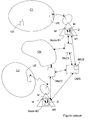
- the UMTS network comprises two stations of Node B1 and Node B2 respectively connected to the Core Network CN by RNC1 and RNC2 nodes. Moreover, in this example each station base Node B1, Node B2 is associated with a single cell C1, C2 covering a radio zone in which one or more UE user equipment.
- the number of signatures and the number of time slots AS access that can be used in each cell is set by the network. These numbers are broadcast in each cell by the network. By therefore, a terminal does not consider 16 signatures and 15 time access AS, but only those that the network has authorized to consider.
- the UE terminal then transmits the preamble, in the form of a signal radio, to the Node Bi on which it depends, using a physical access channel Random Access, called PRACH (for "Physical Random Access Channel”) and in one of the allowed ASn access time slots.
- PRACH Physical Random Access Channel
- the Node Bi When the Node Bi receives the signal representative of the demand access (or preamble), it implements an acknowledgment mechanism (or detection device) for detecting the presence of the UE requesting terminal so to send him an acknowledgment message authorizing him to transmit the message data associated with the preamble detected that he previously transmitted.
- an acknowledgment mechanism or detection device
- the acknowledgment mechanism consists of search for all signatures in all access time slots AS to deduce the signature (s) that has been used by each terminal EU applicant.
- the time scale is decomposed into 20 ms intervals that decompose themselves into 15 access slots AS0 to AS14. But, of course, other decompositions are conceivable.
- the signature used is an authorized signature
- the Node Bi is ready to receive the message associated with the detected preamble, it generates an acknowledgment information Al s of which the value is +1. If the Node Bi does not detect a signature, it generates an acknowledgment information A1 s whose value is equal to 0. Finally, if the Node Bi detects a signature but does not wish, or can not receive the associated message (for example because it does not have enough resources to process it), it generates an acknowledgment information Al s whose value is equal to -1.
- the Node Bi then transforms the acknowledgment information Al s associated with the signatures s detected in a given access slot ASn into a sequence S s of symbols occupying 4096 chips and constituting an associated acknowledgment message. said detected signatures. It is recalled that in a UMTS network each access slot lasts 1.3 ms, which corresponds to 5120 chips.
- Each UE requesting terminal listening to the AICH channel it can extract the acknowledgment message which is associated, in particular, with the signature he had used to transmit his preamble (or access request), and deduce from this message whether the acknowledgment is effective or not.
- the EU terminal can not transmit the message associated with the previously transmitted preamble condition that he has received the acknowledgment message during the delay acknowledgment for which it is configured. If the acquittal is effective, but the EU terminal has received the acknowledgment message outside the deadline of acknowledgment, he can not send the message associated with the preamble previously transmitted. In the meantime, he has passed on a new its preamble using a new signature drawn randomly, a new access slot and a power greater than that used for transmission of the previous preamble, or abandoned the procedure. Of even if the acknowledgment is not effective, the EU terminal transmits again its preamble using a new signature drawn randomly, a new access slot and a power greater than that used for the transmission of the preceding preamble.
- the preamble acknowledgment mechanism (or PRACH), presented schematically above, is defined in detail by the specifications 3GPP TS 25.211, TS 25.213 and TS 25.214.
- the acknowledgment mechanism is of great importance, especially in terms of network access time for UE requesting terminals and interference level.
- the acknowledgment mechanism also called the detection procedure
- P fa and P nd probabilities of false alarm P fa and non-detection P nd which must be as low as possible, regardless of the radio environments in which the requesting terminals operate, if PRACH preamble detection is desired. be efficient.
- the invention is therefore intended to dynamically adapt the detection parameters according to the radio environments of the EU requesting terminals, so that the performance of the detection are better than when the detection parameters are fixed.
- Radio environment means any parameter capable of disrupt (or influence) directly or indirectly the radio channel used by an EU requesting terminal to transmit its access request to the network at a given moment. It is therefore, for example, speed (estimated) of the EU requesting terminal in relation to the Node Bi on which it depends, the effect doppler associated with the signal transmitted by the UE requesting terminal when there is a relative motion between the latter and the Node Bi on which it depends or when the environment of the requesting UE terminal moves (for example in the case the passage of a vehicle), amplitude and / or phase of journeys multiple induced by fixed obstacles (such as buildings) or movement (like people or vehicles), or type environment in which the requesting EU terminal is located (city, road national or departmental, highway, etc.).
- the first P 1 concerns the probability that a signature different from the one transmitted will be detected.
- the optimal preamble threshold PT depends in particular on the number of segments M chosen (in fact it depends on P fa , M and W).
- the optimal number of segments M depends at least on the environment parameter that is the speed of the requesting terminal UE. Therefore, the optimal preamble threshold PT also depends, at least, on the environment parameter that is the speed of the requesting terminal UE.
- the detection is all the more effective as the preamble threshold PT is Student.
- the probability of detection P d is the probability that a signature transmitted with a preamble is correctly detected.
- the probability of non-detection P nd is the probability that a signature transmitted with a preamble is not detected.
- This formula uses the same variables C i (j) as those presented above, but this time the signal received by each antenna of the receiver Node B is equal to the sum of the transmitted signal and the thermal noise.
- the detection probability P d can be reformulated as follows: where Q m (a, b) is the generalized Marcum function and E C is the energy per chip of the signal received by Node B.
- the detection probability P d is in the theoretical case of a AWGN channel words, little dependent on the width W of the analysis time window, for low probability of false alarm P f. This results from the fact that if no preamble is detected at the level of the first chip, then it is not possible to improve the detection probability by increasing the width W of the time window of analysis and consequently the probability of detection. non-detection is the same regardless of W.
- the approximate formula mentioned above (valid in the case of an AWGN channel) n is more valid.
- W and P nd There is no simple relationship between W and P nd . It can nevertheless be shown by means of numerical simulations that the detection probability P d is no longer independent of the width W of the analysis time window.
- the ratio E C / ⁇ 2 represents the average energy that the Node B must receive to reach a given quality (for example a P nd equal to 1%), in the presence of an averaging of the effects of the variations. radio channel, induced by the environment parameters. It can notably be observed that the larger the ratio E C / ⁇ 2 , the smaller the variations. Consequently, in a disturbed radio environment, the detection procedure is all the more efficient when the ratio E C / ⁇ 2 is high.
- the optimum number of segments M varies at least as a function of P nd , and the environment parameter is the speed of the requesting terminal UE.
- the environment parameter is the speed of the requesting terminal UE.
- the invention proposes to equip each Node Bi base station of the network of a device D charged, in particular, with the processing signals representative of access requests (or preambles).
- a device according to the invention can be implanted, at least partially, in other network equipment than base station, and in particular in a radio network controller such as a RNC.
- Such a treatment device D is responsible for implementing the acknowledgment mechanism (or detection method) described above, but in dynamically adaptable form.
- the treatment device D comprises a processing module MT coupled to the reception module of signals of the Node Bi in which it is implanted (or to which it is coupled).
- This processing module MT is loaded when it receives a signal from request for access to the network transmitted by a requesting terminal, determining a usage value for at least one detection parameter chosen according to the value of at least one chosen parameter representative of the radio environment of the requesting terminal.
- each radio environment parameter can be determined on receipt of the access request signal, possibly in the analysand, before this reception.
- the module MT processing may include a parameter detection module (s) environment, or cooperate with an MD detection module belonging to the device D, as illustrated.
- the detection module MD may be responsible for analyzing the received signal so as to estimate the value of the relative speed of the terminal EU applicant with respect to the Node Bi on which it depends. Any technique known to those skilled in the art can be used for this purpose, including indirect techniques based on the prior determination of another environment parameter such as the Doppler effect associated with the radio channel. Of course, other environment parameters can be determined from the received signal, such as amplitude and / or multipath phase, or the type of environment in which the EU requesting terminal.
- the detection module MD can be responsible for deriving the value of at least one environment parameter selected information data, such as local measurements, and / or dedicated signals transmitted by the requesting terminal UE and / or by terminals that are present in the cell in which is located the EU requesting terminal.
- information data and signals DPCCH can be used, for example, the pilot bits of the DPCCH of a or more mobile terminals, or other bits of DPCCH or DPDCH.
- the environment setting chosen may be the average speed mobile terminals that are placed in the cell in which is located the UE requesting terminal, or the average number of multipaths in the cell, or an average variation of the radio channel, for example the variance.
- the MD detection module can be arranged to determine the values of several parameters different types of environment, before and / or after receiving a signal access request.
- the MD detection module can be used in other situations. It can thus be shared with other entities of the Node B in which it is implanted, for example to adapt the estimate of channel according to the speed.
- the processing module MT proceeds to the determination of the value that at least one of the detection parameters must take, given each environment parameter value determined. In other words, the processing module MT adapts dynamically the value of one or more selected detection parameters according to each environment parameter value determined at from the signal transmitted by the requesting terminal UE. Number of Detection parameters that can be adapted depends on the configuration of the device D, and more precisely the level of constancy of performance research.
- detection parameter is meant here any parameter involved in the estimation of the false alarm probability P fa and / or the non-detection probability P nd , such as for example the number M of segments (and the segment length Associated) or the preamble threshold PT.
- the processing module MT is arranged to adapt the number M of segments and / or preamble threshold PT.
- Two modes for determining parameter values environment to use can be considered.
- a first mode consists in directly calculating the values from formulas derived from false alarm probability formulas P fa and / or non-detection probability P nd , such as those presented above, or equivalent formulas.
- a second mode consists in determining the values in a table of correspondence stored in a memory M of the device D. More precisely, the memory M can store a correspondence table between environment parameter (s) and parameter values (s) detection.
- the table maps velocity intervals, segment numbers M (and associated correlation lengths L of each segment), and preamble thresholds PT, as in the example provided. below.
- Estimated speed (km / h) Number of Segments M Correlation length L (chips)
- Preamble threshold (dB) 0 - 109 1 4096 - 23.3 110 - 349 2 2048 - 22.3 350 - 499 4 1024 -21.1 ⁇ 500 8 512 - 19.5
- This sample table provides four sets of three parameters of detection tailored to four different radio environments because of different movement speeds of UE requesting terminals.
- the processing module MT is therefore configured from to determine the estimated value of the requesting terminal speed EU, in cooperation with the MD detection module, and then determine in the correspondence table the values of the number of segments M, of the correlation length L and the preamble threshold PT which are stored in the speed interval to which the estimated value belongs speed.
- the table could only match velocity intervals and numbers of segments M (and lengths L the value of the preamble threshold PT then being set, or between velocity intervals and preamble threshold values PT, the value the number of segments M (and the associated length L) being then fixed.
- the search in the table may relate only to a together sufficiently representative of parameter values. In that case, we extract from the table the value or values stored in it match of the "tabulated" value that is closest to the value estimated.
- certain values of detection parameters which may possibly feed the correspondence table and associated with a value (or set of values) of at least one parameter radio environment, can be transmitted to the processing device D by the cellular network, and preferably by the radio network controller RNC to which is coupled the Node B in which it is implanted.
- each RNC sets the threshold of detection that is used by each Node B it controls. This information from detection threshold is transmitted to Node B via the NBAP protocol, using a message called "common transport channel setup". Therefore, UMTS can be adapted so that an RNC can transmit to a Node B that he controls (to his D), via the NBAP protocol and possibly using the message mentioned above, several detection parameter values, for example the detection threshold or the number of segments M, corresponding to different values of at least one characteristic parameter of the radio environment.
- the processing device D may comprise a module of MCG configuration to provide an installed MT processing module in a Node B detection parameter values (s) associated with parameter values (s) of radio environment.
- This configuration module MCG can be implanted in a local terminal, type LMT, which one connects directly to the Node B concerned to supply it with values.
- the MCG configuration module can be implemented in a cellular network operation and maintenance center or OMC (for "Operation and Maintenance Center").
- OMC for "Operation and Maintenance Center”
- This WTO center is indeed charged manage the Node Bs and the RNCs of the GSM network separately. It is in particular responsible for controlling the operation and maintenance of the Node Bs either directly, in terms of operation and maintenance physically, either indirectly via their home RNCs, with respect to regards operation and logical maintenance.
- the OMC Center can therefore transmit to Node Bs chosen (and possibly at selected RNCs) values adapted to their respective needs.
- the processing module MT has the parameters of adaptable detection, necessary for the detection of the preamble, the module of MT processing only has to perform said detection.
- the processing module MT starts by correlating, for each of the N slices ASn access times allowed within the cell it manages, the signal received preamble codes that correspond to each of the signatures authorized within said cell. Then, the processing module MT calculates, at each moment of receiving a preamble, the energy (of the correlation) that is associated with each treatment segment, among segments whose number M is possibly determined from the determined environment parameters, if it is a parameter of adaptable detection. He then calculates for each candidate moment the sum energies of the M segments. Then he determines inside a window temporal analysis maximizes calculated energy sums. Then, the processing module MT compares the maximum energy determined with the preamble threshold PT, possibly determined from the determined environment parameters, if it is a parameter of adaptable detection.
- the processing module MT decides to acknowledge the preamble (that is to say, the consider as detected), with s signatures and time slice associated ASn access, if and only if the maximum energy determined, which corresponds to it, is greater than the preamble threshold PT.
- the processing module MT begins with correlate the received signal for each of the N access time slots ASn authorized codes, preamble codes that correspond to each of the U authorized signatures. Then, the processing module MT calculates, at each candidate moment of receipt of a preamble, the energy (of the correlation) which is associated with each treatment segment, among the segments whose number M is possibly determined from the parameter or parameters determined environment, if it is an adaptable detection parameter. He then calculates for each candidate moment the sum of the energies of the M segments and compares it to the preamble threshold PT, possibly determined from the determined environment parameter (s), if it is a adaptable detection parameter.
- the sum of energy associated with a time of the analysis time window is below the PT threshold, then it compare with the threshold PT the sum of energy associated with the next instant. In However, as soon as a sum of energy is greater than the threshold PT, he decides to acknowledge the preamble (ie to consider it as detected), with associated ss and time slot ASn access signatures. Therefore, as soon as a detection is positive within a time window it is no longer necessary to make comparisons of the sums of energy associated with the following instants of the time window considered.
- the treatment device D according to the invention and in particular its MT processing module, its MD detection module, its module for MCG configuration and possibly its memory M, can be realized in the form of electronic circuits, software modules (or computer), or a combination of circuits and software.
Landscapes
- Engineering & Computer Science (AREA)
- Computer Networks & Wireless Communication (AREA)
- Signal Processing (AREA)
- Mobile Radio Communication Systems (AREA)
- Radio Relay Systems (AREA)
Applications Claiming Priority (2)
| Application Number | Priority Date | Filing Date | Title |
|---|---|---|---|
| FR0400770A FR2865600B1 (fr) | 2004-01-26 | 2004-01-26 | Adaptation dynamique de la detection de demandes d'acces a un reseau cellulaire de communications, en fonction de l'environnement radio associe a l'equipement de communication demandeur |
| FR0400770 | 2004-01-26 |
Publications (2)
| Publication Number | Publication Date |
|---|---|
| EP1558053A1 true EP1558053A1 (de) | 2005-07-27 |
| EP1558053B1 EP1558053B1 (de) | 2007-08-08 |
Family
ID=34630678
Family Applications (1)
| Application Number | Title | Priority Date | Filing Date |
|---|---|---|---|
| EP05290158A Expired - Lifetime EP1558053B1 (de) | 2004-01-26 | 2005-01-24 | Dynamische Anpassung der Detektion von Zugriffanforderungen auf ein Mobilfunknetz abhänging von der Funkumgebung des anfordernden Komunikationsendgeräts |
Country Status (6)
| Country | Link |
|---|---|
| US (1) | US20050164708A1 (de) |
| EP (1) | EP1558053B1 (de) |
| CN (1) | CN1649440A (de) |
| AT (1) | ATE369711T1 (de) |
| DE (1) | DE602005001865T2 (de) |
| FR (1) | FR2865600B1 (de) |
Families Citing this family (14)
| Publication number | Priority date | Publication date | Assignee | Title |
|---|---|---|---|---|
| JP4641973B2 (ja) * | 2006-05-10 | 2011-03-02 | 富士通株式会社 | 片方向通信方法、移動局装置及び無線基地局装置 |
| KR101342373B1 (ko) | 2006-10-25 | 2013-12-16 | 엘지전자 주식회사 | 주파수 옵셋에 대비한 rach 송신 설정 방법, rach송신 방법, 및 rach 검출 방법 |
| US8295266B2 (en) * | 2006-10-25 | 2012-10-23 | Lg Electronics Inc. | Method for adjusting RACH transmission against frequency offset |
| CN101883440B (zh) | 2006-10-31 | 2014-05-28 | 夏普株式会社 | 通信处理方法、通信系统、基站以及移动站 |
| CN101193435B (zh) * | 2006-11-29 | 2010-12-08 | 中兴通讯股份有限公司 | 一种物理层随机接入信道前导检测门限获得方法 |
| TWI581595B (zh) | 2007-01-05 | 2017-05-01 | Lg電子股份有限公司 | 考量到頻率偏移下設定循環平移的方法 |
| EP1944935B1 (de) | 2007-01-05 | 2012-05-23 | LG Electronics Inc. | Verfahren für das Einstellen einer zyklischen Verschiebung unter Berücksichtigung des Frequenz-Offsets |
| US8175191B2 (en) * | 2007-02-20 | 2012-05-08 | Adaptrum, Inc. | Combined sensing methods for cognitive radio |
| KR101234418B1 (ko) * | 2007-08-10 | 2013-02-18 | 후지쯔 가부시끼가이샤 | 무선 통신 시스템에서의 랜덤 액세스 방법 및 무선 통신 시스템, 무선 단말기 및 기지국 장치 |
| TWI364955B (en) * | 2007-12-20 | 2012-05-21 | Ind Tech Res Inst | Method and apparatus for packet detection |
| CN101478827B (zh) * | 2008-01-04 | 2011-09-14 | 华为技术有限公司 | 一种再次发射前导签名的方法、系统和装置 |
| WO2009105003A1 (en) * | 2008-02-21 | 2009-08-27 | Telefonaktiebolaget Lm Ericsson (Publ) | Adjustment of radio detection level for request signals based observed false detection |
| US8228971B2 (en) | 2008-07-29 | 2012-07-24 | Agere Systems Inc. | Technique for searching for a preamble signal in a spread spectrum signal using a fast Hadamard transform |
| CN105163347B (zh) * | 2015-09-24 | 2019-02-22 | 江苏复大资讯科技有限公司 | 一种基于干扰消除的多模式无线通信方法 |
Citations (2)
| Publication number | Priority date | Publication date | Assignee | Title |
|---|---|---|---|---|
| US20010026543A1 (en) * | 2000-02-16 | 2001-10-04 | Samsung Electronics Co.,Ltd. | Apparatus and method for assigning a common packet channel in a CDMA communication system |
| US20030076852A1 (en) * | 2001-10-23 | 2003-04-24 | Kiyoshi Fukui | Communication apparatus capable of selectively using a plurality of access channels |
Family Cites Families (14)
| Publication number | Priority date | Publication date | Assignee | Title |
|---|---|---|---|---|
| US4670899A (en) * | 1985-05-31 | 1987-06-02 | Northern Telecom Limited | Load balancing for cellular radiotelephone system |
| US5901144A (en) * | 1995-04-13 | 1999-05-04 | Hitachi, Ltd. | Mobile radio communications system |
| DE69711134T2 (de) * | 1996-07-25 | 2002-09-05 | Matsushita Electric Industrial Co., Ltd. | Übertragungssystem und Übertragungsverfahren für ein Übertragungssystem |
| EP1064561A4 (de) * | 1998-01-30 | 2005-05-18 | Widata Corp | Funksystem zur positionsbestimmung mit transponderetiketten |
| JP3913879B2 (ja) * | 1998-02-03 | 2007-05-09 | 富士通株式会社 | 移動速度に基づく通信制御装置および方法 |
| US6434361B1 (en) * | 1999-09-29 | 2002-08-13 | Trw Inc. | Synchronization burst processor for a processing satellite |
| KR100317267B1 (ko) * | 1999-10-02 | 2001-12-22 | 서평원 | 공통 패킷 채널의 보호 방법 |
| US6643318B1 (en) * | 1999-10-26 | 2003-11-04 | Golden Bridge Technology Incorporated | Hybrid DSMA/CDMA (digital sense multiple access/code division multiple access) method with collision resolution for packet communications |
| EP1232575B1 (de) * | 1999-11-29 | 2009-06-03 | Samsung Electronics Co., Ltd. | verfahren zur zuweisung eines gemeinsamen paketkanals in einem cdma-kommunikationssystem |
| EP1234422A4 (de) * | 1999-11-29 | 2006-10-18 | Golden Bridge Tech Inc | Leistungsreglung in geschlossener schleife für gemeinsame abwärtstransportkanale |
| US6611755B1 (en) * | 1999-12-19 | 2003-08-26 | Trimble Navigation Ltd. | Vehicle tracking, communication and fleet management system |
| US6778835B2 (en) * | 2000-03-18 | 2004-08-17 | Lg Electronics Inc. | Method for allocating physical channel of mobile communication system and communication method using the same |
| FR2840476B1 (fr) * | 2002-05-30 | 2004-07-16 | Nortel Networks Ltd | Procede de restriction de l'usage d'un terminal radio et dispositif de restriction associe |
| WO2005036809A1 (en) * | 2003-10-09 | 2005-04-21 | Matsushita Electric Industrial Co., Ltd. | Communication terminal and method for timing the detection of communication-medium characteristics |
-
2004
- 2004-01-26 FR FR0400770A patent/FR2865600B1/fr not_active Expired - Fee Related
-
2005
- 2005-01-24 EP EP05290158A patent/EP1558053B1/de not_active Expired - Lifetime
- 2005-01-24 AT AT05290158T patent/ATE369711T1/de not_active IP Right Cessation
- 2005-01-24 DE DE602005001865T patent/DE602005001865T2/de not_active Expired - Fee Related
- 2005-01-25 US US11/041,743 patent/US20050164708A1/en not_active Abandoned
- 2005-01-26 CN CNA2005100029212A patent/CN1649440A/zh active Pending
Patent Citations (2)
| Publication number | Priority date | Publication date | Assignee | Title |
|---|---|---|---|---|
| US20010026543A1 (en) * | 2000-02-16 | 2001-10-04 | Samsung Electronics Co.,Ltd. | Apparatus and method for assigning a common packet channel in a CDMA communication system |
| US20030076852A1 (en) * | 2001-10-23 | 2003-04-24 | Kiyoshi Fukui | Communication apparatus capable of selectively using a plurality of access channels |
Non-Patent Citations (1)
| Title |
|---|
| OKADA K ET AL: "A DYNAMIC CHANNEL ASSIGNMENT STRATEGY USING INFORMATION ON SPEED AND MOVING DIRECTION FOR MICRO CELLULAR SYSTEMS", IEICE TRANSACTIONS ON COMMUNICATIONS, INSTITUTE OF ELECTRONICS INFORMATION AND COMM. ENG. TOKYO, JP, vol. E79-B, no. 3, 1 March 1996 (1996-03-01), pages 279 - 288, XP000588451, ISSN: 0916-8516 * |
Also Published As
| Publication number | Publication date |
|---|---|
| EP1558053B1 (de) | 2007-08-08 |
| CN1649440A (zh) | 2005-08-03 |
| DE602005001865T2 (de) | 2008-05-08 |
| FR2865600A1 (fr) | 2005-07-29 |
| ATE369711T1 (de) | 2007-08-15 |
| DE602005001865D1 (de) | 2007-09-20 |
| US20050164708A1 (en) | 2005-07-28 |
| FR2865600B1 (fr) | 2006-05-19 |
Similar Documents
| Publication | Publication Date | Title |
|---|---|---|
| EP1558053B1 (de) | Dynamische Anpassung der Detektion von Zugriffanforderungen auf ein Mobilfunknetz abhänging von der Funkumgebung des anfordernden Komunikationsendgeräts | |
| EP1508981B1 (de) | Verfahren und System für die Kommunkationsverwaltung in einem Random Access Netzwerk | |
| EP0931429B1 (de) | Verfahren und vorrichtung zur interferenzanalyse in einem zellularen mobilkommunikationssystem | |
| EP0735702B1 (de) | Verfahren und Vorrichtung zum Diversity-Empfang einer Basisstation in einem Mobilkommunikationssystem | |
| EP0700172A1 (de) | System zur Informationsübertragung über einen Zeitvariierden Kanal, und entsprechende Sende- und Empfangseinrichtung | |
| EP0903049B1 (de) | Verfahren zur einleitung des weiterreichens von gesprächen in einem zellularfunksystem | |
| EP1223782B1 (de) | Verfahren zum Verwalten von Verarbeitungsressourcen in einem Mobilfunksystem | |
| EP2394474B1 (de) | Übertragungsverfahren für ein drahtloses netzwerk und entsprechendes empfangsverfahren | |
| EP1260071B1 (de) | Verfahren und vorrichtung für kanalschäztung | |
| EP1536575B1 (de) | Kommunikationssteuerungsverfahren für wahlfreie Netzwerke mit langer Übertragungsverzögerungszeit | |
| EP0721291B1 (de) | Verfahren und System zur Verkürzung der Anschlusszeit einer Mobileinheit an eine Basisstation eines zellularen Funkübertragungsnetzwerkes | |
| WO2005114873A1 (fr) | Determination par un terminal de communication du temps de propagation d'un signal de reference provenant d'un equipement de gestion de communications | |
| WO2020224947A1 (fr) | Procede avec acces lbt au canal, dispositif et programme correspondants | |
| EP3977785B1 (de) | Verfahren zur auswahl einer vielzahl von möglichen übertragungsleistungswerten, die für den unkoordinierten zugriff auf ein kommunikationsmedium bestimmt sind, und zugehörige vorrichtungen | |
| EP1427157B1 (de) | Verfahren und Empfängersystem für Burst-Detektion mittels Kanalschätzung | |
| WO2002041539A1 (fr) | Procede et dispositif d'evaluation du niveau energetique d'un signal radio | |
| CA2342725C (fr) | Procede d'estimation du rapport signal a bruit dans un recepteur de telecommunications et application de ce procede au controle d'un emetteur | |
| EP1714511B1 (de) | Verfahren zur optimierung der planung in einem cdma-kommunikationssystem | |
| EP1206091A1 (de) | Verfahren und Vorrichtung zur Kanalschätzung, insbesondere für eine Mobiltelefon | |
| EP1427156B1 (de) | Verfahren und Empfänger zur Burstdetektion | |
| WO2026082561A1 (fr) | Détection de signal en présence d'effet doppler | |
| WO2026082557A1 (fr) | Communication iot via un réseau d'accès satellitaire | |
| EP1551109A1 (de) | Verfahren zur Unterdrückung von falschen Echos in einem Rake-Empfänger | |
| EP2023560A1 (de) | Vorrichtung und Verfahren zur Steuerung der Zeitvorverschiebung von Mobilfunkendgeräten in einem OFDM Funknetzwerk | |
| WO2013164553A1 (fr) | Procede de pre-codage et d'allocation de puissance conjoints pour un systeme de transmission en presence d'interferences |
Legal Events
| Date | Code | Title | Description |
|---|---|---|---|
| PUAI | Public reference made under article 153(3) epc to a published international application that has entered the european phase |
Free format text: ORIGINAL CODE: 0009012 |
|
| AK | Designated contracting states |
Kind code of ref document: A1 Designated state(s): AT BE BG CH CY CZ DE DK EE ES FI FR GB GR HU IE IS IT LI LT LU MC NL PL PT RO SE SI SK TR |
|
| AX | Request for extension of the european patent |
Extension state: AL BA HR LV MK YU |
|
| 17P | Request for examination filed |
Effective date: 20051202 |
|
| AKX | Designation fees paid |
Designated state(s): AT BE BG CH CY CZ DE DK EE ES FI FR GB GR HU IE IS IT LI LT LU MC NL PL PT RO SE SI SK TR |
|
| GRAP | Despatch of communication of intention to grant a patent |
Free format text: ORIGINAL CODE: EPIDOSNIGR1 |
|
| GRAS | Grant fee paid |
Free format text: ORIGINAL CODE: EPIDOSNIGR3 |
|
| GRAA | (expected) grant |
Free format text: ORIGINAL CODE: 0009210 |
|
| AK | Designated contracting states |
Kind code of ref document: B1 Designated state(s): AT BE BG CH CY CZ DE DK EE ES FI FR GB GR HU IE IS IT LI LT LU MC NL PL PT RO SE SI SK TR |
|
| REG | Reference to a national code |
Ref country code: GB Ref legal event code: FG4D Free format text: NOT ENGLISH |
|
| REG | Reference to a national code |
Ref country code: CH Ref legal event code: EP |
|
| REG | Reference to a national code |
Ref country code: IE Ref legal event code: FG4D Free format text: LANGUAGE OF EP DOCUMENT: FRENCH |
|
| REF | Corresponds to: |
Ref document number: 602005001865 Country of ref document: DE Date of ref document: 20070920 Kind code of ref document: P |
|
| RAP2 | Party data changed (patent owner data changed or rights of a patent transferred) |
Owner name: ALCATEL LUCENT |
|
| GBT | Gb: translation of ep patent filed (gb section 77(6)(a)/1977) |
Effective date: 20071205 |
|
| REG | Reference to a national code |
Ref country code: GB Ref legal event code: 732E |
|
| NLT2 | Nl: modifications (of names), taken from the european patent patent bulletin |
Owner name: ALCATEL LUCENT Effective date: 20071114 |
|
| PG25 | Lapsed in a contracting state [announced via postgrant information from national office to epo] |
Ref country code: LT Free format text: LAPSE BECAUSE OF FAILURE TO SUBMIT A TRANSLATION OF THE DESCRIPTION OR TO PAY THE FEE WITHIN THE PRESCRIBED TIME-LIMIT Effective date: 20070808 Ref country code: ES Free format text: LAPSE BECAUSE OF FAILURE TO SUBMIT A TRANSLATION OF THE DESCRIPTION OR TO PAY THE FEE WITHIN THE PRESCRIBED TIME-LIMIT Effective date: 20071119 Ref country code: BG Free format text: LAPSE BECAUSE OF FAILURE TO SUBMIT A TRANSLATION OF THE DESCRIPTION OR TO PAY THE FEE WITHIN THE PRESCRIBED TIME-LIMIT Effective date: 20071108 Ref country code: IS Free format text: LAPSE BECAUSE OF FAILURE TO SUBMIT A TRANSLATION OF THE DESCRIPTION OR TO PAY THE FEE WITHIN THE PRESCRIBED TIME-LIMIT Effective date: 20071208 Ref country code: FI Free format text: LAPSE BECAUSE OF FAILURE TO SUBMIT A TRANSLATION OF THE DESCRIPTION OR TO PAY THE FEE WITHIN THE PRESCRIBED TIME-LIMIT Effective date: 20070808 Ref country code: NL Free format text: LAPSE BECAUSE OF FAILURE TO SUBMIT A TRANSLATION OF THE DESCRIPTION OR TO PAY THE FEE WITHIN THE PRESCRIBED TIME-LIMIT Effective date: 20070808 |
|
| NLV1 | Nl: lapsed or annulled due to failure to fulfill the requirements of art. 29p and 29m of the patents act | ||
| PG25 | Lapsed in a contracting state [announced via postgrant information from national office to epo] |
Ref country code: AT Free format text: LAPSE BECAUSE OF FAILURE TO SUBMIT A TRANSLATION OF THE DESCRIPTION OR TO PAY THE FEE WITHIN THE PRESCRIBED TIME-LIMIT Effective date: 20070808 Ref country code: PL Free format text: LAPSE BECAUSE OF FAILURE TO SUBMIT A TRANSLATION OF THE DESCRIPTION OR TO PAY THE FEE WITHIN THE PRESCRIBED TIME-LIMIT Effective date: 20070808 |
|
| REG | Reference to a national code |
Ref country code: IE Ref legal event code: FD4D |
|
| REG | Reference to a national code |
Ref country code: FR Ref legal event code: TP |
|
| PG25 | Lapsed in a contracting state [announced via postgrant information from national office to epo] |
Ref country code: DK Free format text: LAPSE BECAUSE OF FAILURE TO SUBMIT A TRANSLATION OF THE DESCRIPTION OR TO PAY THE FEE WITHIN THE PRESCRIBED TIME-LIMIT Effective date: 20070808 Ref country code: GR Free format text: LAPSE BECAUSE OF FAILURE TO SUBMIT A TRANSLATION OF THE DESCRIPTION OR TO PAY THE FEE WITHIN THE PRESCRIBED TIME-LIMIT Effective date: 20071109 |
|
| PG25 | Lapsed in a contracting state [announced via postgrant information from national office to epo] |
Ref country code: SK Free format text: LAPSE BECAUSE OF FAILURE TO SUBMIT A TRANSLATION OF THE DESCRIPTION OR TO PAY THE FEE WITHIN THE PRESCRIBED TIME-LIMIT Effective date: 20070808 Ref country code: PT Free format text: LAPSE BECAUSE OF FAILURE TO SUBMIT A TRANSLATION OF THE DESCRIPTION OR TO PAY THE FEE WITHIN THE PRESCRIBED TIME-LIMIT Effective date: 20080108 Ref country code: CZ Free format text: LAPSE BECAUSE OF FAILURE TO SUBMIT A TRANSLATION OF THE DESCRIPTION OR TO PAY THE FEE WITHIN THE PRESCRIBED TIME-LIMIT Effective date: 20070808 Ref country code: IE Free format text: LAPSE BECAUSE OF FAILURE TO SUBMIT A TRANSLATION OF THE DESCRIPTION OR TO PAY THE FEE WITHIN THE PRESCRIBED TIME-LIMIT Effective date: 20070808 |
|
| PLBE | No opposition filed within time limit |
Free format text: ORIGINAL CODE: 0009261 |
|
| STAA | Information on the status of an ep patent application or granted ep patent |
Free format text: STATUS: NO OPPOSITION FILED WITHIN TIME LIMIT |
|
| PG25 | Lapsed in a contracting state [announced via postgrant information from national office to epo] |
Ref country code: RO Free format text: LAPSE BECAUSE OF FAILURE TO SUBMIT A TRANSLATION OF THE DESCRIPTION OR TO PAY THE FEE WITHIN THE PRESCRIBED TIME-LIMIT Effective date: 20070808 Ref country code: SE Free format text: LAPSE BECAUSE OF FAILURE TO SUBMIT A TRANSLATION OF THE DESCRIPTION OR TO PAY THE FEE WITHIN THE PRESCRIBED TIME-LIMIT Effective date: 20071108 |
|
| 26N | No opposition filed |
Effective date: 20080509 |
|
| BERE | Be: lapsed |
Owner name: EVOLIUM S.A.S. Effective date: 20080131 |
|
| PG25 | Lapsed in a contracting state [announced via postgrant information from national office to epo] |
Ref country code: MC Free format text: LAPSE BECAUSE OF NON-PAYMENT OF DUE FEES Effective date: 20080131 |
|
| PG25 | Lapsed in a contracting state [announced via postgrant information from national office to epo] |
Ref country code: DE Free format text: LAPSE BECAUSE OF NON-PAYMENT OF DUE FEES Effective date: 20080801 |
|
| REG | Reference to a national code |
Ref country code: FR Ref legal event code: ST Effective date: 20081029 |
|
| PG25 | Lapsed in a contracting state [announced via postgrant information from national office to epo] |
Ref country code: EE Free format text: LAPSE BECAUSE OF FAILURE TO SUBMIT A TRANSLATION OF THE DESCRIPTION OR TO PAY THE FEE WITHIN THE PRESCRIBED TIME-LIMIT Effective date: 20070808 |
|
| PG25 | Lapsed in a contracting state [announced via postgrant information from national office to epo] |
Ref country code: BE Free format text: LAPSE BECAUSE OF NON-PAYMENT OF DUE FEES Effective date: 20080131 |
|
| PG25 | Lapsed in a contracting state [announced via postgrant information from national office to epo] |
Ref country code: FR Free format text: LAPSE BECAUSE OF NON-PAYMENT OF DUE FEES Effective date: 20080131 |
|
| PG25 | Lapsed in a contracting state [announced via postgrant information from national office to epo] |
Ref country code: SI Free format text: LAPSE BECAUSE OF FAILURE TO SUBMIT A TRANSLATION OF THE DESCRIPTION OR TO PAY THE FEE WITHIN THE PRESCRIBED TIME-LIMIT Effective date: 20070808 |
|
| PG25 | Lapsed in a contracting state [announced via postgrant information from national office to epo] |
Ref country code: CY Free format text: LAPSE BECAUSE OF FAILURE TO SUBMIT A TRANSLATION OF THE DESCRIPTION OR TO PAY THE FEE WITHIN THE PRESCRIBED TIME-LIMIT Effective date: 20070808 |
|
| REG | Reference to a national code |
Ref country code: CH Ref legal event code: PL |
|
| GBPC | Gb: european patent ceased through non-payment of renewal fee |
Effective date: 20090124 |
|
| PG25 | Lapsed in a contracting state [announced via postgrant information from national office to epo] |
Ref country code: LI Free format text: LAPSE BECAUSE OF NON-PAYMENT OF DUE FEES Effective date: 20090131 Ref country code: CH Free format text: LAPSE BECAUSE OF NON-PAYMENT OF DUE FEES Effective date: 20090131 |
|
| PG25 | Lapsed in a contracting state [announced via postgrant information from national office to epo] |
Ref country code: GB Free format text: LAPSE BECAUSE OF NON-PAYMENT OF DUE FEES Effective date: 20090124 |
|
| PG25 | Lapsed in a contracting state [announced via postgrant information from national office to epo] |
Ref country code: HU Free format text: LAPSE BECAUSE OF FAILURE TO SUBMIT A TRANSLATION OF THE DESCRIPTION OR TO PAY THE FEE WITHIN THE PRESCRIBED TIME-LIMIT Effective date: 20080209 Ref country code: LU Free format text: LAPSE BECAUSE OF NON-PAYMENT OF DUE FEES Effective date: 20080124 |
|
| PG25 | Lapsed in a contracting state [announced via postgrant information from national office to epo] |
Ref country code: TR Free format text: LAPSE BECAUSE OF FAILURE TO SUBMIT A TRANSLATION OF THE DESCRIPTION OR TO PAY THE FEE WITHIN THE PRESCRIBED TIME-LIMIT Effective date: 20070808 |
|
| PG25 | Lapsed in a contracting state [announced via postgrant information from national office to epo] |
Ref country code: IT Free format text: LAPSE BECAUSE OF NON-PAYMENT OF DUE FEES Effective date: 20080131 |
|
| REG | Reference to a national code |
Ref country code: FR Ref legal event code: CA Effective date: 20150521 |
|
| REG | Reference to a national code |
Ref country code: FR Ref legal event code: CA Effective date: 20150521 |