EP1558078B1 - Saure chlorit-zusammensetzungen mit stickstoffhaltigen stabilisatoren, systeme und methoden zu ihrer anwendung - Google Patents
Saure chlorit-zusammensetzungen mit stickstoffhaltigen stabilisatoren, systeme und methoden zu ihrer anwendung Download PDFInfo
- Publication number
- EP1558078B1 EP1558078B1 EP03770670A EP03770670A EP1558078B1 EP 1558078 B1 EP1558078 B1 EP 1558078B1 EP 03770670 A EP03770670 A EP 03770670A EP 03770670 A EP03770670 A EP 03770670A EP 1558078 B1 EP1558078 B1 EP 1558078B1
- Authority
- EP
- European Patent Office
- Prior art keywords
- acid
- disinfecting
- present
- chlorite
- disinfecting composition
- Prior art date
- Legal status (The legal status is an assumption and is not a legal conclusion. Google has not performed a legal analysis and makes no representation as to the accuracy of the status listed.)
- Expired - Lifetime
Links
Images


Classifications
-
- C—CHEMISTRY; METALLURGY
- C11—ANIMAL OR VEGETABLE OILS, FATS, FATTY SUBSTANCES OR WAXES; FATTY ACIDS THEREFROM; DETERGENTS; CANDLES
- C11D—DETERGENT COMPOSITIONS; USE OF SINGLE SUBSTANCES AS DETERGENTS; SOAP OR SOAP-MAKING; RESIN SOAPS; RECOVERY OF GLYCEROL
- C11D3/00—Other compounding ingredients of detergent compositions covered in group C11D1/00
- C11D3/02—Inorganic compounds ; Elemental compounds
- C11D3/04—Water-soluble compounds
- C11D3/046—Salts
-
- A—HUMAN NECESSITIES
- A01—AGRICULTURE; FORESTRY; ANIMAL HUSBANDRY; HUNTING; TRAPPING; FISHING
- A01N—PRESERVATION OF BODIES OF HUMANS OR ANIMALS OR PLANTS OR PARTS THEREOF; BIOCIDES, e.g. AS DISINFECTANTS, AS PESTICIDES OR AS HERBICIDES; PEST REPELLANTS OR ATTRACTANTS; PLANT GROWTH REGULATORS
- A01N59/00—Biocides, pest repellants or attractants, or plant growth regulators containing elements or inorganic compounds
-
- A—HUMAN NECESSITIES
- A23—FOODS OR FOODSTUFFS; TREATMENT THEREOF, NOT COVERED BY OTHER CLASSES
- A23B—PRESERVATION OF FOODS, FOODSTUFFS OR NON-ALCOHOLIC BEVERAGES; CHEMICAL RIPENING OF FRUIT OR VEGETABLES
- A23B2/00—Preservation of foods or foodstuffs, in general
- A23B2/70—Preservation of foods or foodstuffs, in general by treatment with chemicals
- A23B2/725—Preservation of foods or foodstuffs, in general by treatment with chemicals in the form of liquids or solids
- A23B2/729—Organic compounds; Microorganisms; Enzymes
- A23B2/742—Organic compounds containing oxygen
- A23B2/754—Organic compounds containing oxygen containing carboxyl groups
-
- A—HUMAN NECESSITIES
- A23—FOODS OR FOODSTUFFS; TREATMENT THEREOF, NOT COVERED BY OTHER CLASSES
- A23B—PRESERVATION OF FOODS, FOODSTUFFS OR NON-ALCOHOLIC BEVERAGES; CHEMICAL RIPENING OF FRUIT OR VEGETABLES
- A23B2/00—Preservation of foods or foodstuffs, in general
- A23B2/70—Preservation of foods or foodstuffs, in general by treatment with chemicals
- A23B2/725—Preservation of foods or foodstuffs, in general by treatment with chemicals in the form of liquids or solids
- A23B2/729—Organic compounds; Microorganisms; Enzymes
- A23B2/762—Organic compounds containing nitrogen
-
- A—HUMAN NECESSITIES
- A23—FOODS OR FOODSTUFFS; TREATMENT THEREOF, NOT COVERED BY OTHER CLASSES
- A23B—PRESERVATION OF FOODS, FOODSTUFFS OR NON-ALCOHOLIC BEVERAGES; CHEMICAL RIPENING OF FRUIT OR VEGETABLES
- A23B2/00—Preservation of foods or foodstuffs, in general
- A23B2/70—Preservation of foods or foodstuffs, in general by treatment with chemicals
- A23B2/725—Preservation of foods or foodstuffs, in general by treatment with chemicals in the form of liquids or solids
- A23B2/788—Inorganic compounds
-
- A—HUMAN NECESSITIES
- A61—MEDICAL OR VETERINARY SCIENCE; HYGIENE
- A61K—PREPARATIONS FOR MEDICAL, DENTAL OR TOILETRY PURPOSES
- A61K33/00—Medicinal preparations containing inorganic active ingredients
-
- A—HUMAN NECESSITIES
- A61—MEDICAL OR VETERINARY SCIENCE; HYGIENE
- A61K—PREPARATIONS FOR MEDICAL, DENTAL OR TOILETRY PURPOSES
- A61K33/00—Medicinal preparations containing inorganic active ingredients
- A61K33/20—Elemental chlorine; Inorganic compounds releasing chlorine
-
- A—HUMAN NECESSITIES
- A61—MEDICAL OR VETERINARY SCIENCE; HYGIENE
- A61K—PREPARATIONS FOR MEDICAL, DENTAL OR TOILETRY PURPOSES
- A61K33/00—Medicinal preparations containing inorganic active ingredients
- A61K33/42—Phosphorus; Compounds thereof
-
- A—HUMAN NECESSITIES
- A61—MEDICAL OR VETERINARY SCIENCE; HYGIENE
- A61K—PREPARATIONS FOR MEDICAL, DENTAL OR TOILETRY PURPOSES
- A61K45/00—Medicinal preparations containing active ingredients not provided for in groups A61K31/00 - A61K41/00
- A61K45/06—Mixtures of active ingredients without chemical characterisation, e.g. antiphlogistics and cardiaca
-
- A—HUMAN NECESSITIES
- A61—MEDICAL OR VETERINARY SCIENCE; HYGIENE
- A61L—METHODS OR APPARATUS FOR STERILISING MATERIALS OR OBJECTS IN GENERAL; DISINFECTION, STERILISATION OR DEODORISATION OF AIR; CHEMICAL ASPECTS OF BANDAGES, DRESSINGS, ABSORBENT PADS OR SURGICAL ARTICLES; MATERIALS FOR BANDAGES, DRESSINGS, ABSORBENT PADS OR SURGICAL ARTICLES
- A61L2/00—Disinfection or sterilisation of materials or objects, in general; Accessories therefor
- A61L2/16—Disinfection or sterilisation of materials or objects, in general; Accessories therefor using chemical substances
- A61L2/18—Liquid substances
-
- C—CHEMISTRY; METALLURGY
- C02—TREATMENT OF WATER, WASTE WATER, SEWAGE, OR SLUDGE
- C02F—TREATMENT OF WATER, WASTE WATER, SEWAGE, OR SLUDGE
- C02F1/00—Treatment of water, waste water, or sewage
- C02F1/50—Treatment of water, waste water, or sewage by addition or application of a germicide or by oligodynamic treatment
-
- C—CHEMISTRY; METALLURGY
- C02—TREATMENT OF WATER, WASTE WATER, SEWAGE, OR SLUDGE
- C02F—TREATMENT OF WATER, WASTE WATER, SEWAGE, OR SLUDGE
- C02F1/00—Treatment of water, waste water, or sewage
- C02F1/72—Treatment of water, waste water, or sewage by oxidation
- C02F1/76—Treatment of water, waste water, or sewage by oxidation with halogens or compounds of halogens
-
- C—CHEMISTRY; METALLURGY
- C11—ANIMAL OR VEGETABLE OILS, FATS, FATTY SUBSTANCES OR WAXES; FATTY ACIDS THEREFROM; DETERGENTS; CANDLES
- C11D—DETERGENT COMPOSITIONS; USE OF SINGLE SUBSTANCES AS DETERGENTS; SOAP OR SOAP-MAKING; RESIN SOAPS; RECOVERY OF GLYCEROL
- C11D3/00—Other compounding ingredients of detergent compositions covered in group C11D1/00
- C11D3/02—Inorganic compounds ; Elemental compounds
- C11D3/04—Water-soluble compounds
- C11D3/042—Acids
-
- C—CHEMISTRY; METALLURGY
- C11—ANIMAL OR VEGETABLE OILS, FATS, FATTY SUBSTANCES OR WAXES; FATTY ACIDS THEREFROM; DETERGENTS; CANDLES
- C11D—DETERGENT COMPOSITIONS; USE OF SINGLE SUBSTANCES AS DETERGENTS; SOAP OR SOAP-MAKING; RESIN SOAPS; RECOVERY OF GLYCEROL
- C11D3/00—Other compounding ingredients of detergent compositions covered in group C11D1/00
- C11D3/16—Organic compounds
- C11D3/20—Organic compounds containing oxygen
- C11D3/2075—Carboxylic acids-salts thereof
-
- C—CHEMISTRY; METALLURGY
- C11—ANIMAL OR VEGETABLE OILS, FATS, FATTY SUBSTANCES OR WAXES; FATTY ACIDS THEREFROM; DETERGENTS; CANDLES
- C11D—DETERGENT COMPOSITIONS; USE OF SINGLE SUBSTANCES AS DETERGENTS; SOAP OR SOAP-MAKING; RESIN SOAPS; RECOVERY OF GLYCEROL
- C11D3/00—Other compounding ingredients of detergent compositions covered in group C11D1/00
- C11D3/16—Organic compounds
- C11D3/20—Organic compounds containing oxygen
- C11D3/2075—Carboxylic acids-salts thereof
- C11D3/2082—Polycarboxylic acids-salts thereof
-
- C—CHEMISTRY; METALLURGY
- C11—ANIMAL OR VEGETABLE OILS, FATS, FATTY SUBSTANCES OR WAXES; FATTY ACIDS THEREFROM; DETERGENTS; CANDLES
- C11D—DETERGENT COMPOSITIONS; USE OF SINGLE SUBSTANCES AS DETERGENTS; SOAP OR SOAP-MAKING; RESIN SOAPS; RECOVERY OF GLYCEROL
- C11D3/00—Other compounding ingredients of detergent compositions covered in group C11D1/00
- C11D3/16—Organic compounds
- C11D3/20—Organic compounds containing oxygen
- C11D3/2075—Carboxylic acids-salts thereof
- C11D3/2086—Hydroxy carboxylic acids-salts thereof
-
- C—CHEMISTRY; METALLURGY
- C11—ANIMAL OR VEGETABLE OILS, FATS, FATTY SUBSTANCES OR WAXES; FATTY ACIDS THEREFROM; DETERGENTS; CANDLES
- C11D—DETERGENT COMPOSITIONS; USE OF SINGLE SUBSTANCES AS DETERGENTS; SOAP OR SOAP-MAKING; RESIN SOAPS; RECOVERY OF GLYCEROL
- C11D3/00—Other compounding ingredients of detergent compositions covered in group C11D1/00
- C11D3/16—Organic compounds
- C11D3/26—Organic compounds containing nitrogen
- C11D3/30—Amines; Substituted amines ; Quaternized amines
-
- C—CHEMISTRY; METALLURGY
- C11—ANIMAL OR VEGETABLE OILS, FATS, FATTY SUBSTANCES OR WAXES; FATTY ACIDS THEREFROM; DETERGENTS; CANDLES
- C11D—DETERGENT COMPOSITIONS; USE OF SINGLE SUBSTANCES AS DETERGENTS; SOAP OR SOAP-MAKING; RESIN SOAPS; RECOVERY OF GLYCEROL
- C11D3/00—Other compounding ingredients of detergent compositions covered in group C11D1/00
- C11D3/16—Organic compounds
- C11D3/34—Organic compounds containing sulfur
- C11D3/349—Organic compounds containing sulfur additionally containing nitrogen atoms, e.g. nitro, nitroso, amino, imino, nitrilo, nitrile groups containing compounds or their derivatives or thio urea
-
- C—CHEMISTRY; METALLURGY
- C11—ANIMAL OR VEGETABLE OILS, FATS, FATTY SUBSTANCES OR WAXES; FATTY ACIDS THEREFROM; DETERGENTS; CANDLES
- C11D—DETERGENT COMPOSITIONS; USE OF SINGLE SUBSTANCES AS DETERGENTS; SOAP OR SOAP-MAKING; RESIN SOAPS; RECOVERY OF GLYCEROL
- C11D3/00—Other compounding ingredients of detergent compositions covered in group C11D1/00
- C11D3/395—Bleaching agents
- C11D3/3956—Liquid compositions
-
- C—CHEMISTRY; METALLURGY
- C11—ANIMAL OR VEGETABLE OILS, FATS, FATTY SUBSTANCES OR WAXES; FATTY ACIDS THEREFROM; DETERGENTS; CANDLES
- C11D—DETERGENT COMPOSITIONS; USE OF SINGLE SUBSTANCES AS DETERGENTS; SOAP OR SOAP-MAKING; RESIN SOAPS; RECOVERY OF GLYCEROL
- C11D3/00—Other compounding ingredients of detergent compositions covered in group C11D1/00
- C11D3/48—Medical, disinfecting agents, disinfecting, antibacterial, germicidal or antimicrobial compositions
-
- C—CHEMISTRY; METALLURGY
- C11—ANIMAL OR VEGETABLE OILS, FATS, FATTY SUBSTANCES OR WAXES; FATTY ACIDS THEREFROM; DETERGENTS; CANDLES
- C11D—DETERGENT COMPOSITIONS; USE OF SINGLE SUBSTANCES AS DETERGENTS; SOAP OR SOAP-MAKING; RESIN SOAPS; RECOVERY OF GLYCEROL
- C11D7/00—Compositions of detergents based essentially on non-surface-active compounds
- C11D7/02—Inorganic compounds
- C11D7/04—Water-soluble compounds
- C11D7/08—Acids
-
- C—CHEMISTRY; METALLURGY
- C11—ANIMAL OR VEGETABLE OILS, FATS, FATTY SUBSTANCES OR WAXES; FATTY ACIDS THEREFROM; DETERGENTS; CANDLES
- C11D—DETERGENT COMPOSITIONS; USE OF SINGLE SUBSTANCES AS DETERGENTS; SOAP OR SOAP-MAKING; RESIN SOAPS; RECOVERY OF GLYCEROL
- C11D7/00—Compositions of detergents based essentially on non-surface-active compounds
- C11D7/02—Inorganic compounds
- C11D7/04—Water-soluble compounds
- C11D7/10—Salts
-
- C—CHEMISTRY; METALLURGY
- C11—ANIMAL OR VEGETABLE OILS, FATS, FATTY SUBSTANCES OR WAXES; FATTY ACIDS THEREFROM; DETERGENTS; CANDLES
- C11D—DETERGENT COMPOSITIONS; USE OF SINGLE SUBSTANCES AS DETERGENTS; SOAP OR SOAP-MAKING; RESIN SOAPS; RECOVERY OF GLYCEROL
- C11D7/00—Compositions of detergents based essentially on non-surface-active compounds
- C11D7/22—Organic compounds
- C11D7/26—Organic compounds containing oxygen
- C11D7/265—Carboxylic acids or salts thereof
-
- C—CHEMISTRY; METALLURGY
- C11—ANIMAL OR VEGETABLE OILS, FATS, FATTY SUBSTANCES OR WAXES; FATTY ACIDS THEREFROM; DETERGENTS; CANDLES
- C11D—DETERGENT COMPOSITIONS; USE OF SINGLE SUBSTANCES AS DETERGENTS; SOAP OR SOAP-MAKING; RESIN SOAPS; RECOVERY OF GLYCEROL
- C11D7/00—Compositions of detergents based essentially on non-surface-active compounds
- C11D7/22—Organic compounds
- C11D7/32—Organic compounds containing nitrogen
-
- C—CHEMISTRY; METALLURGY
- C11—ANIMAL OR VEGETABLE OILS, FATS, FATTY SUBSTANCES OR WAXES; FATTY ACIDS THEREFROM; DETERGENTS; CANDLES
- C11D—DETERGENT COMPOSITIONS; USE OF SINGLE SUBSTANCES AS DETERGENTS; SOAP OR SOAP-MAKING; RESIN SOAPS; RECOVERY OF GLYCEROL
- C11D7/00—Compositions of detergents based essentially on non-surface-active compounds
- C11D7/22—Organic compounds
- C11D7/34—Organic compounds containing sulfur
-
- A—HUMAN NECESSITIES
- A61—MEDICAL OR VETERINARY SCIENCE; HYGIENE
- A61L—METHODS OR APPARATUS FOR STERILISING MATERIALS OR OBJECTS IN GENERAL; DISINFECTION, STERILISATION OR DEODORISATION OF AIR; CHEMICAL ASPECTS OF BANDAGES, DRESSINGS, ABSORBENT PADS OR SURGICAL ARTICLES; MATERIALS FOR BANDAGES, DRESSINGS, ABSORBENT PADS OR SURGICAL ARTICLES
- A61L2103/00—Materials or objects being the target of disinfection or sterilisation
- A61L2103/05—Living organisms or biological materials
-
- C—CHEMISTRY; METALLURGY
- C02—TREATMENT OF WATER, WASTE WATER, SEWAGE, OR SLUDGE
- C02F—TREATMENT OF WATER, WASTE WATER, SEWAGE, OR SLUDGE
- C02F2103/00—Nature of the water, waste water, sewage or sludge to be treated
- C02F2103/02—Non-contaminated water, e.g. for industrial water supply
- C02F2103/023—Water in cooling circuits
-
- C—CHEMISTRY; METALLURGY
- C11—ANIMAL OR VEGETABLE OILS, FATS, FATTY SUBSTANCES OR WAXES; FATTY ACIDS THEREFROM; DETERGENTS; CANDLES
- C11D—DETERGENT COMPOSITIONS; USE OF SINGLE SUBSTANCES AS DETERGENTS; SOAP OR SOAP-MAKING; RESIN SOAPS; RECOVERY OF GLYCEROL
- C11D7/00—Compositions of detergents based essentially on non-surface-active compounds
- C11D7/22—Organic compounds
- C11D7/32—Organic compounds containing nitrogen
- C11D7/3209—Amines or imines with one to four nitrogen atoms; Quaternized amines
-
- C—CHEMISTRY; METALLURGY
- C11—ANIMAL OR VEGETABLE OILS, FATS, FATTY SUBSTANCES OR WAXES; FATTY ACIDS THEREFROM; DETERGENTS; CANDLES
- C11D—DETERGENT COMPOSITIONS; USE OF SINGLE SUBSTANCES AS DETERGENTS; SOAP OR SOAP-MAKING; RESIN SOAPS; RECOVERY OF GLYCEROL
- C11D7/00—Compositions of detergents based essentially on non-surface-active compounds
- C11D7/22—Organic compounds
- C11D7/32—Organic compounds containing nitrogen
- C11D7/3218—Alkanolamines or alkanolimines
-
- C—CHEMISTRY; METALLURGY
- C11—ANIMAL OR VEGETABLE OILS, FATS, FATTY SUBSTANCES OR WAXES; FATTY ACIDS THEREFROM; DETERGENTS; CANDLES
- C11D—DETERGENT COMPOSITIONS; USE OF SINGLE SUBSTANCES AS DETERGENTS; SOAP OR SOAP-MAKING; RESIN SOAPS; RECOVERY OF GLYCEROL
- C11D7/00—Compositions of detergents based essentially on non-surface-active compounds
- C11D7/22—Organic compounds
- C11D7/32—Organic compounds containing nitrogen
- C11D7/3245—Aminoacids
-
- C—CHEMISTRY; METALLURGY
- C11—ANIMAL OR VEGETABLE OILS, FATS, FATTY SUBSTANCES OR WAXES; FATTY ACIDS THEREFROM; DETERGENTS; CANDLES
- C11D—DETERGENT COMPOSITIONS; USE OF SINGLE SUBSTANCES AS DETERGENTS; SOAP OR SOAP-MAKING; RESIN SOAPS; RECOVERY OF GLYCEROL
- C11D7/00—Compositions of detergents based essentially on non-surface-active compounds
- C11D7/22—Organic compounds
- C11D7/32—Organic compounds containing nitrogen
- C11D7/3263—Amides or imides
-
- Y—GENERAL TAGGING OF NEW TECHNOLOGICAL DEVELOPMENTS; GENERAL TAGGING OF CROSS-SECTIONAL TECHNOLOGIES SPANNING OVER SEVERAL SECTIONS OF THE IPC; TECHNICAL SUBJECTS COVERED BY FORMER USPC CROSS-REFERENCE ART COLLECTIONS [XRACs] AND DIGESTS
- Y02—TECHNOLOGIES OR APPLICATIONS FOR MITIGATION OR ADAPTATION AGAINST CLIMATE CHANGE
- Y02A—TECHNOLOGIES FOR ADAPTATION TO CLIMATE CHANGE
- Y02A40/00—Adaptation technologies in agriculture, forestry, livestock or agroalimentary production
- Y02A40/90—Adaptation technologies in agriculture, forestry, livestock or agroalimentary production in food processing or handling, e.g. food conservation
Definitions
- the present invention relates to acidified chlorite compositions containing a nitrogenous stabilizer, as well as to two-part systems for generation of such compositions and to methods related to their use.
- Disinfectants have found wide spread application in all these areas. Hospitals perform rigorous programs to disinfect and sterilize their environments. Consumer homes are replete with disinfectant hand cleaners, sprays, hard surface cleaners, disinfectant wipes, and fruits and vegetable washes. Disinfectants are widely used on farms where the difference between healthy and sick animals can mean the difference between profitability and loss.
- Mastitis is one of the most common and economically costly diseases confronting milk producers. Economic losses result from poorer milk quality, lower milk production, and potential culling of chronically infected animals.
- disinfectant solutions both before and after milking has found great success in preventing mastitis, particularly disinfectants based on acidified chlorite as commercially available from Alcide Corporation (Redmond, Washington).
- Acidified chlorite (AC) disinfectants are commonly two-part products having a first or “base” part containing a chlorite (such as sodium chlorite) and a second or “activator” part containing an acid activator. Such products are disclosed in WO 02/23993 A2 .
- the AC disinfectant is formed upon mixing the first and second parts, and typically only in amounts sufficient for a given milking period.
- either the first or second part, or both parts may contain one or more optional ingredients such as skin conditioners, healing agents, surfactants, thickeners, film-forming agents, and/or preservatives.
- the AC disinfecting composition may be formed by simply mixing the first and second parts, often in approximately equal volumes, or may involve some additional dilution step before or after mixing.
- Color has proved to be an important attribute for teat disinfectants, allowing farmers to visually confirm that the disinfectant has been properly applied to the teat. This is particularly advantageous for confirming application to large herds when multiple farm workers are applying the disinfectant to many different animals. Unfortunately, colorants often lead to the rapid consumption of chlorite, leading to a shorter useful lifetime than the same compositions without colorants.
- the present invention provides a two-part disinfecting system according to claim 1.
- N-methylsulfamic acid as nitrogenous stabilizer has surprisingly been found to minimize the rate of chlorite consumption, and thus reduce the rate of chlorine dioxide generation, thereby providing a disinfecting composition that is longer lasting (and with less noxious odors).
- Such compositions are useful as teat dips, as well as for other disinfecting applications where extended lifetime is desirable.
- a method for making a disinfecting composition is disclosed by combining the first part and the second part of the two-part disinfecting system. Such combination may involve mixing liquid forms of the first part and second part, or may involve diluting or dissolving the first part and/or second part prior to mixing, at the time of mixing, and/or after mixing.
- a method for disinfecting a substrate is disclosed by contacting the substrate with an effective amount of a disinfecting composition of this invention.
- substrates include any surface, material, or fluid that would benefit from being disinfected, including the skin or tissue of a warm-blooded animal, in particular the teat of a dairy cow, goat or sheep, as well as hard surfaces generally and food surfaces such as meat and meat parts (including beef, poultry, pork, other generally recognized red meats, and fish), fruits and vegetables, and process waters, such as flume waters, cooling tower waters, equipment, and facility cleaning solutions.
- Acidified chlorite compositions may be generated by combining chlorite (i.e ., ClO 2 - ), typically in the form of a metal salt such as sodium chlorite, with an acid activator.
- chlorite i.e ., ClO 2 -
- Such compositions are effective disinfectants due to the generation of antimicrobial oxidants, particularly chlorous acid (i.e. , HClO 2 ).
- Chlorous acid is formed very rapidly upon acidification of chlorite in an equilibrium process governed by the solution pH. Chlorous acid can subsequently undergo a series of chemical reactions to form chlorine dioxide through various oxychlorine intermediates.
- the nitrogenous stabilizer reduces generation of chlorine dioxide upon formation of the disinfecting composition by interacting with the oxychlorine intermediates in the conversion of chlorous acid to chlorine dioxide.
- a colorant When a colorant is present, it is degraded (e.g. , oxidized) in significant part by the chlorine dioxide generated within the disinfectant.
- the nitrogenous stabilizer by controlling chlorine dioxide generation, imparts extended color longevity to the disinfecting composition by limiting oxidation of the colorant.
- Chlorine dioxide is a particularly pungent gas that can be unpleasant and unhealthy at excessive levels in air. Unlike chlorous acid, which stays in solution at the surface being disinfected, chlorine dioxide can escape into the air around the user. Slowing the rate of chlorine dioxide formation leads to a longer lasting disinfectant composition with less noxious odors to the user.
- the first and second parts of the two-part disinfecting system may both be in the form of an aqueous solution, emulsion, microemulsion, cream or gel, or one or both may be in a concentrated, non-aqueous or solid form.
- the first and second parts may be aqueous solutions or gels to be mixed in approximately equal volumes to form the disinfecting composition, or may be concentrates or solids to be diluted by or dissolved in water, and then mixed to yield the disinfecting composition.
- the first and/or second parts may be in a non-aqueous or solid form (such as a powder or tablet) to be mixed with or dissolved in water prior to combination. To avoid excessive generation of chlorine dioxide which may occur upon combination of concentrated forms, it is preferable to mix the first and second parts after the parts are diluted with or dissolved in water.
- the chlorite of the first part is typically an alkali or alkaline earth metal chlorite, such as potassium or sodium chlorite, and more typically sodium chlorite.
- the chlorite is present in the first part in an amount such that, when combined with the second part, it is present within the disinfecting composition at a concentration ranging from about 0.005% to about 3% by weight, generally from 0.05% to 0.5% by weight, and typically from 0.1% to 0.4%.
- the acid of the second part is any compound or mixture of compounds that will acidify the chlorite of the first part.
- the acid has a pKa ranging from 2 to 5.
- the acid can be an organic acid, inorganic acid, or mixture thereof.
- Organic acids include (but are not limited to) formic acid, acetic acid, glycolic acid, lactic acid, pyruvic acid, malic acid, mandelic acid, citric acid, tartaric acid, adipic acid, succinic acid, malonic acid, propionic acid, heptanoic acid, octanoic acid, nonanoic acid, salicylic acid, benzoic acid, gluconic acid, or mixtures thereof.
- the organic acid can also be alkyl-, alkylarl-, and arylsulfonic acids such as octanesulfonic acid, toluenesulfonic acid, cumenesulfonic acid, dodecylbenzenesulfonic acid, and homo- & copolymers containing poly(styrenesulfonic acid) and poly(acrylamidopropylsulfonic acid).
- Inorganic acids include (but are not limited to) sulfuric acid, sodium bisulfate, phosphoric acid, hydrochloric acid, nitric acid, boric acid, or mixtures thereof.
- acids that may be used include (but are not limited to) hydrated metals salts of iron, aluminum, zirconium, vanadium, and gadolinium as described in U.S. Patent No. 5,820,822 .
- Acids also include (but are not limited to) solid acid exchange resins, such as Amberlite ® , Diaion ® , Dowex ® and Duolite ® , as well as aluminum silicate zeolites.
- the acid may be any organic acid precursor which forms an acid upon contact with water, such as acid anhydrides, esters, and sulfonate esters. Examples of organic acid precursors are described in U.S. Patent No. 4,585,482 .
- the acid of the second part is an organic acid such as glycolic, lactic, malic, mandelic, citric, tartaric, adipic acid, succinic acid, malonic acid, heptanoic acid, octanoic acid, nonanoic acid, benzoic acid, salicylic acid, gluconic acid, and mixtures thereof.
- the acid of the second part is an inorganic acid such as sulfuric acid, sodium bisulfate, phosphoric acid, hydrochloric acid, nitric acid, or a mixture thereof.
- the acid of the second part is a different chemical entity than the nitrogenous stabilizer in those embodiments wherein the optional colorant is not present in the first part, the second part, or both the first and second parts.
- both the acid of the second part and the nitrogenous stabilizer may be the same or different chemical entities.
- the acid is present in the second part in an amount such that, when combined with the first part, it is present within the disinfecting composition at a concentration ranging from about 0.1% to about 10% by weight, generally from 0.5% to 5.0% by weight, and typically from 1.0% to 3.0% by weight.
- the acid is present in the second part in an amount such that, when combined with the first part, the pH of the disinfecting composition is from 2.3 to 3.5.
- the optional oxidizable colorant of the second part is a colorant that undergoes color loss upon contact with the acidified chlorite disinfectants.
- Such colorants are typically soluble in vehicles which may be used as carriers for the second part, including (but not limited to) water, alcohol, glycerin and/or oil.
- a single oxidizable colorant, or a mixture of two or more oxidizable colorants may be present in the second part.
- the amount of oxidizable colorant present in the second part is an amount that, upon combination with the first part, will impart the desired color and/or color intensity to the disinfecting composition.
- colorants approved for use in foods, drugs, and cosmetics are regulated by the Food and Drug Administration (FDA) under 21 CFR parts 70 through 82.
- Colorants are generally classified as either (1) a food, drug and cosmetic (FD&C) colorant, (2) a drug and cosmetic (D&C) colorant, or (3) an externally applied drug and cosmetic (Ext. D&C) colorant, and the list of approved colorants are referenced therein.
- FD&C food, drug and cosmetic
- D&C drug and cosmetic
- Ext. D&C an externally applied drug and cosmetic
- oxidizable colorants also include naturally occurring colorants such as red cabbage extract, beet root extract, carminic acid, curcumin, beta carotene, annatto extract, grape skin extract, astaxanthin, canthaxanthin, henna, guaiazulene, and mixtures thereof.
- Oxidizable colorants of this invention also include any combination of two or more of the above FD&C, D&C, Ext. D&C, and naturally occurring colorants.
- the oxidizable colorant may, upon contact with the first part, undergo a change in color. Such color change maybe attributable, for example, to a change in pH going from the pH of the second part to the pH of the resulting composition.
- the first part may optionally contain a colorant such that, when combined with the second part, the resulting composition has a color different from either first and second parts.
- the presence of N-methylsulfamic acid as the nitrogenous stabilizer in either the first part, the second part, or both the first and second parts reduces the generation of chlorine dioxide and the consumption of chlorite in the resulting disinfecting composition.
- the nitrogenous stabilizer when an optional oxidizable colorant is present, the nitrogenous stabilizer imparts enhanced color and chlorite longevity to the disinfection composition.
- the nitrogenous stabilizer and the acid of the second part can be the same chemical entity.
- a “nitrogenous stabilizer” is a nitrogen-containing compound having at least one N-H bond. Such a bond is present in both primary and secondary amines, but not tertiary amines. Such a bond is also present in certain carbamates, oxazolidinones, succinimides, and phthalimides.
- representative nitrogenous stabilizers include (but are not limited to):
- nitrogenous stabilizers of this invention may be represented by the following structure: R 1 -NH-R 2 wherein R 1 and R 2 are the same or different and, in the case of a primary amine, one of R 1 or R 2 is hydrogen, while in the case of a secondary amine neither R 1 nor R 2 are hydrogen. More specifically, R 1 and R 2 are the same or different and individually selected from hydrogen, alkyl, aryl, arylalkyl, heterocycle and heterocyclealkyl, each optionally substituted with one to six substituents.
- Polymeric nitrogenous scavengers of this invention contain at least one monomeric repeating unit of the following structure: -[R 1 -NH-R 2 ]- wherein R 1 and R 2 are the same or different and individually selected from alkyl, aryl, arylalkyl, heterocycle and heterocyclealkyl, each optionally substituted with one to six substituents.
- Polymeric nitrogenous scavengers may be linear or branched homopolymers or copolymers, and in the case of copolymers may be graft or block.
- the optional substituent as used in the context of R 1 and R 2 above, means any of the above groups (i.e. , alkyl, aryl, arylalkyl, heterocycle and/or heterocyclealkyl) wherein at least one hydrogen atom is replaced with a substituent.
- a substituent i.e. , alkyl, aryl, arylalkyl, heterocycle and/or heterocyclealkyl
- two hydrogen atoms are replaced.
- RCDF Reduced Chlorite Demand Factor
- nitrogenous stabilizers not according to the invention include monoethanolamine, ethylenediamine, diethylenetriamine, triethylenetetraamine, polyethyleneimine, glycine, analine, serine, aspartate, glutamate, aniline, para- aminobenzoic acid, aniline sulfonic acid, methyl anthranilate, anthranilic acid, phenylenediamine, sulfamic acid, aminomethylsulfonic acid, taurine, sulfonamide, sulfanilamide, benzenesulfonamide, toluenesulfonamide, urea.
- nitrogenous stabilizers possess nitrogen groups that are substituted with two hydrogens (i.e., primary amines).
- Representative nitrogenous stabilizers include monoethanolamine, ethylenediamine, glycine, analine, serine, aspartate, glutamate, aniline, para-aminobenzoic acid, aniline sulfonic acid, methyl anthranilate, anthranilic acid, phenylenediamine, sulfamic acid, aminomethylsulfonic acid, taurine, sulfonamide, sulfanilamide, benzenesulfonamide, toluenesulfonamide, and urea.
- the nitrogenous stabilizer is present in the first part, the second part, or both the first and second parts in an amount such that, when the first part and second part are combined, it is present within the disinfecting composition at a concentration ranging from about 0.001% to about 20% by weight, generally from 0.05% to 10% by weight, and typically from 0.1 % to 5% by weight.
- Mixtures of nitrogenous stabilizers are also encompassed within this invention.
- a first nitrogenous stabilizer may be present in the first part, and a second and different type present in the second part.
- ingredients may also be present in the first part, the second part, or both first and second parts of the two-part system.
- Such ingredients include (but are not limited to) wetting agents, textural modifiers, film-forming polymers, surfactants, colorants and mixtures thereof.
- the wetting agents facilitate contact of the disinfecting composition with the skin or surface, and can be selected from those materials recognized to provide this effect, in both identity and amount.
- Textural modifiers are those materials which primarily affect the body of the mixed disinfecting composition in terms of retention, flow and lubricity.
- thickening agents such as alkyl celluloses, alkoxy celluloses, xanthan gum, guar gum, and polyacrylamide derivatives, of which the polymer of 2-acrylamido-2-methylpropane sulfonic acid is a preferred example.
- Inorganic thickening agents include hectorite, synthetic hectorite, magnesium aluminum silicate, bentonite, montmorillonite, and amorphous silicon dioxide. Thickening can also be achieved by a combination of anionic surfactants with amphoteric or zwitterionic surfactants and salt.
- Other textural modifiers include lanolin derivatives, acyl lactylates, polyethylene glycol, glyceryl esters, and mixtures thereof.
- Skin conditioning and skin healing agents include glycerin, sorbitol, pyrrolidone carboxylic acid, mineral oils, silicone oils, protein hydrolysates, petrolatum, hydrocarbon emollient alcohols and esters, allantoin, and urea.
- Film-forming polymers include the above-referenced polyacrylamides, as well as the class of poly(vinyl alcohols/vinyl acetates), polyurethanes, chitosan, polyvinyl pyrrolidone, and polyvinyl pyrrolidone copolymers.
- representative oral rinse and malodor compositions not according to this invention may contain the various ingredients as identified in Table 1.
- Table 1 Representative Oral Rinse and Malodor Compositions Option 1 (Wt%)
- Option 2 Wt%)
- Option 3 Wt%)
- Part 1 Sodium Chlorite 0.32 0.08 0.32 1-Carvone 0.10 0.10 - FD&C Green #3 0.09 0.09 - 1N NaOH 0.10 0.10 0.10 Sodium Fluoride - - 0.10 Water q.s. q.s. q.s.
- Part 1 Part 2 Sodium Chlorite 4.00% Mandelic Acid 5.00% Disodium Edetate 0.19% Methylsulfamic Acid 0.10% Isopropanol 30.0% Polyacrylamide 0.75% Polyethylene Glycol 4500 0.30% Poloxamer 188 0.60% Octylphenoxypolethoyethanol 0.45% Sodium Benzoate 0.05% Sodium Hydroxide 0.075% D&C Green #% 0.01% Water q.s. Water q.s.
- teat skin disinfectants not according to the invention are exemplified in Table 2 below: Table 2 Part 1 Wt% Wt% Wt% Wt% Sodium Chlorite 0.64 0.64 0.32 0.50 Disodium Edetate 0.20 - - - Tetrasodium EDTA - 0.20 - 0.045 Cosmedia HSP 1180 - 15.00 - - Sodium Hydroxide 0.01 0.50 0.02 0.02 Water q.s. q.s. q.s. q.s. q.s.
- a method for disinfecting a substrate comprising contacting the substrate with an effective amount of the disinfecting composition formed by combining the first part and the second part of the two-part disinfecting system of this invention.
- the substrate may be any surface or material in need of, or that would benefit from, such disinfection, including (but not limited to) skin or tissue, as well as body fluids and mucosal membranes.
- the substrate may be a wound where disinfection would aid healing.
- the substrate may include any item that is intimately placed in, on, or around the body of an animal, such as dentures, braces, and contact lenses. In a specific application, the substrate is the teat of a dairy cow, goat or sheep.
- the substrate may be any surface of a food product, such as meat, fish, fruits and vegetables.
- the substrate may also include food contact surfaces, and nonfood contact surfaces in food processing plants.
- the substrate may include any hard surface, such as (but not limited to) floors, walls, countertops, containers, instruments and/or equipment found in homes, hospitals, and manufacturing facilities.
- the hard surfaces may include housing and equipment surfaces in animal rearing and production environments. Materials that may benefit from disinfection include, for example, process waters, such as flume waters, cooling tower waters, livestock drinking waters, equipment and facility cleaning solutions.
- this invention is directed to a method for making a disinfecting composition
- a method for making a disinfecting composition comprising combining the first part and the second part of the two-part disinfecting system.
- the first and second parts are both aqueous solutions, emulsions, microemulsions, creams or gels, and may be adapted to be combined in equal or different volumes.
- at least one of the first or second parts is in a concentrated, non-aqueous or solid form, and the concentrated, non-aqueous or solid form is first diluted with or dissolved in water, and then combined with the other part.
- the dilution or dissolving step can occur prior to combination with the other part, or simultaneous with combination.
- the disinfecting compositions include a typical disinfecting system and the corresponding simplified disinfecting system, with a nitrogenous stabilizer (Formulas C & D) and without a nitrogenous stabilizer (Formulas A & B) for comparison.
- the first and second parts of the two-part system were as follows: Formulas (% w/w) Part 1 A B C D Sodium Chlorite 0.64 0.64 0.64 0.64 Sodium Hydroxide 0.022 0.022 0.022 0.022 Na 4 EDTA 0.045 0.045 0.045 0.045 Water q.s. q.s. q.s. q.s.
- Disinfecting Compositions Formulas (% w/w) A B C D Sodium Chlorite 0.32 0.32 0.32 0.32 Sodium Hydroxide 0.011 0.011 0.111 0.111 Na 4 EDTA 0.027 - 0.027 - Lactic Acid 1.32 1.32 1.32 1.32 Sulfamic Acid - - 0.25 0.25 Triton X-100 0.076 - 0.076 - FD&C Yellow #5 0.15 0.15 0.15 0.15 0.15 Glycerin 5.00 5.00 5.00 Hydroxyethylcellulose 0.25 - 0.25 - Isopropanol 1.00 - 1.00 - Sodium Benzoate 0.02 - 0.02 - Water q.s. q.s. q.s. q.s.s.
- Color intensity was also monitored using a Perkin Elmer Lambda 12 UV/Vis Spectrometer by making a 100-fold dilution by volume of the disinfecting system with deionized water and quantifying the absorbance at 425 nm with a 1 cm path length cuvette cell.
- the results of the color study are set forth in Figure 2 .
- Figures 1 and 2 show that sodium chlorite and color longevity can be substantially improved for disinfecting systems containing a nitrogenous stabilizer. Over the course of 4 hours, more than 60% of the sodium chlorite is consumed for Formulas A and B whereas less than 10% for Formulas C & D. In 4 hours, all the color intensity in Formulas A & B is lost, whereas Formulas C & D show less than 20% loss.
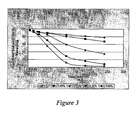
- Example 1 To determine how increasing levels of colorant causes a more rapid consumption of chlorite, the disinfecting composition A of Example 1 was prepared with either 0% (control), 0.03%, 0.15%, 0.30% or 0.60% by weight FD&C Yellow #5. The rate of sodium chlorite consumption over time was determined as in Example 1. The results of these experiments are set forth in Figure 3 .
- colorants cause an increased rate of chlorite consumption and the chlorite demand is proportional to the level.
- nitrogenous stabilizers of this invention having an N-H bond slowed the rate of sodium chlorite consumption, while a tertiary amine (i.e., triethanolamine), which does not contain an N-H bond, was found to accelerate the rate of sodium chlorite consumption.
- Example 3 The experiment of Example 3 was repeated using nitrogenous stabilizers containing N-H bonds as listed in Table 5. Weight percentages were chosen to provide a relative comparison at equal molar levels of N-H groups.
- Table 5 Nitrogenous Stabilizers Level (Wt%) Percent of Initial NaClO 2 After 2 Hours Percent of Initial NaClO 2 After 5 hours Methylsulfamic Acid 1.14 98% 94% Aminomethanesulfonic Acid 1.14 86% 57% Taurine 1.29 89% 49% Sulfonamide 0.49 94% 87% Aniline 0.96 95% 87% Sulfanilamide 0.89 94% 87% Aniline Sulfonic Acid 1.78 90% 75% Urea 0.31 94% 66% Control --- 66% 13%
- Equal volumes of one part aqueous sodium chlorite (0.64%) and a second part containing lactic acid (2.64%), FD&C Yellow #5 (0.30%), glycerin (10.0%), and the nitrogen-containing compound listed in Table 6 were combined and the color intensity was measured by UV/Visible spectrophotometry at 425nm over time to monitor color longevity.
- the pH of the second part was adjusted for all compositions to achieve a mixed product pH of 2.5 using either aqueous sodium hydroxide or sulfuric acid.
- Equal volumes of one part aqueous sodium chlorite (0.64%) and a second part containing lactic acid (2.64%), FD&C Yellow #5 (0.30%), glycerin (10.0%), and various levels of sulfamic acid ( see Table 9) were combined and the rate of sodium chlorite consumption was measured over time, as in Example 1.
- the pH of the second part was adjusted for all compositions to achieve a mixed product pH of 2.5 using either aqueous sodium hydroxide or sulfuric acid.
- Nitrogenous stabilizers at 1.33 M concentration (or less if solubility limited) and polymeric derivatives are based on the molar concentration of the nitrogen monomeric repeating unit) were combined with lactic acid (2.64 wt %), FD&C Yellow #5 (0.30 wt %), and sulfuric acid or sodium hydroxide as needed such that the final mixed product with sodium chlorite had a pH of 2.5. Fifty grams of this solution was mixed with 50 grams of a 0.64 wt % sodium chlorite solution in a capped polyethylene container. A corresponding control sample without the nitrogenous stabilizer was prepared at the same time.
- the sodium chlorite level was determined by potentiometric titration with potassium iodide and sodium thiosulfate. Approximately 10 gram samples of both the test and control solutions (W test/control ) were accurately weighed in 250 mL beakers with stir bars and the samples are vigorously stirred for 1 minute in a ventilation hood to off-gas any chlorine dioxide. Potassium iodide (2 g) was added followed by 10 mL of 0.5 N hydrochloric acid.
- nitrogenous stabilizers have an RCFF of 2 or greater.
- the RCDF is 3.0 or greater, or in an even more specific embodiment is 4.0 or greater.
Landscapes
- Chemical & Material Sciences (AREA)
- Life Sciences & Earth Sciences (AREA)
- Engineering & Computer Science (AREA)
- Health & Medical Sciences (AREA)
- Wood Science & Technology (AREA)
- Organic Chemistry (AREA)
- Chemical Kinetics & Catalysis (AREA)
- Oil, Petroleum & Natural Gas (AREA)
- Inorganic Chemistry (AREA)
- General Health & Medical Sciences (AREA)
- Public Health (AREA)
- Veterinary Medicine (AREA)
- Epidemiology (AREA)
- Animal Behavior & Ethology (AREA)
- Pharmacology & Pharmacy (AREA)
- Zoology (AREA)
- Medicinal Chemistry (AREA)
- Emergency Medicine (AREA)
- Polymers & Plastics (AREA)
- Food Science & Technology (AREA)
- Water Supply & Treatment (AREA)
- Environmental & Geological Engineering (AREA)
- Hydrology & Water Resources (AREA)
- Agronomy & Crop Science (AREA)
- Dentistry (AREA)
- Plant Pathology (AREA)
- Environmental Sciences (AREA)
- Pest Control & Pesticides (AREA)
- General Chemical & Material Sciences (AREA)
- Agricultural Chemicals And Associated Chemicals (AREA)
Claims (39)
- Ein zweiteiliges Desinfektionssystem umfassend einen ersten und einen zweiten Teil, derart aufbereitet, dass sie so vermischt werden, dass sie eine wässrige saurere Desinfektionszusammensetzung ergeben, wobei (i) der erste Teil ein Chlorit umfasst und der zweite Teil eine Säure umfasst (ii) wobei die Säure in dem zweiten Teil in einer Menge vorliegt, so dass, wenn sie mit dem ersten Teil vereinigt wird, der pH der Desinfektionszusammensetzung von 2,3 bis 3,5 reicht und (iii) der erste Teil und der zweite Teil oder beide Teile einen stickstoffhaltigen Stabilisator umfassen,
wobeia) das Desinfektionssystem des Weiteren ein farbgebendes Mittel umfasst; oderb) das Desinfektionssystem kein farbgebendes Mittel enthält und der stickstoffhaltige Stabilisator und die Säure des Desinfektionssystems unterschiedliche chemische Entitäten sind; undwobei der stickstoffhaltige Stabilisator N-Methylsulfaminsäure ist. - Das System von Anspruch 1, wobei der stickstoffhaltige Stabilisator in dem ersten Teil vorliegt, in dem zweiten Teil, oder sowohl im ersten als auch zweiten Teil, in einer Menge, so dass, wenn der erste und der zweite Teil vereinigt werden, er innerhalb der Desinfektionszusammensetzung in einer Konzentration vorliegt, die von 0,001% bis 20 Gew.-% reicht.
- Das System von Anspruch 1, wobei der stickstoffhaltige Stabilisator in dem ersten Teil vorliegt, in dem zweiten Teil, oder sowohl im ersten als auch zweiten Teil, in einer Menge, so dass, wenn der erste und der zweite Teil vereinigt werden, er innerhalb der Desinfektionszusammensetzung in einer Konzentration vorliegt, die von 0,05% bis 10 Gew.-% reicht.
- Das System von Anspruch 1, wobei der stickstoffhaltige Stabilisator in dem ersten Teil vorliegt, in dem zweiten Teil, oder sowohl im ersten als auch zweiten Teil, in einer Menge, so dass, wenn der erste und der zweite Teil vereinigt werden, er innerhalb der Desinfektionszusammensetzung in einer Konzentration vorliegt, die von 0,1% bis 5 Gew.-% reicht.
- Das System von Anspruch 1, wobei das Chlorit ein Metallchlorit ist.
- Das System von Anspruch 5, wobei das Metallchlorit ein Alkali- oder Erdalaklimetall-Chlorit ist.
- Das System von Anspruch 5, wobei das Metallchlorit Natriumchlorit oder Kaliumchlorit ist.
- Das System von Anspruch 5, wobei das Metallchlorit Natriumchlorit ist.
- Das System von Anspruch 1, wobei das Chlorit in dem ersten Teil in einer Menge vorliegt, so dass es, wenn er mit dem zweiten Teil vereinigt wird, innerhalb der Desinfektionszusammensetzung in einer Konzentration vorliegt, welche von 0,05% bis 3 Gew.-% reicht.
- Das System von Anspruch 1, wobei das Chlorit in dem ersten Teil in einer Menge vorliegt, so dass es, wenn er mit dem zweiten Teil vereinigt wird, innerhalb der Desinfektionszusammensetzung in einer Konzentration vorliegt, welche von 0,05% bis 0,5 Gew.-% reicht.
- Das System von Anspruch 1, wobei das Chlorit in dem ersten Teil in einer Menge vorliegt, so dass es, wenn er mit dem zweiten Teil vereinigt wird, innerhalb der Desinfektionszusammensetzung in einer Konzentration vorliegt, welche von 0,1% bis 0,4 Gew.-% reicht.
- Das System von Anspruch 1, wobei die Säure einen pKa-Wert hat, der von 2 bis 5 reicht.
- Das System von Anspruch 1, wobei die Säure eine organische Säure ist.
- Das System von Anspruch 13, wobei die organische Säure Glykolsäure, Milchsäure, Maleinsäure, Mandelsäure, Zitronensäure, Weinsäure, Adipinsäure, Succinsäure, Ma-Ionsäure, Heptansäure, Octansäure, Nonansäure, Benzoesäure, Salicylsäure, Gluconsäure oder eine Mischung davon ist.
- Das System von Anspruch 1, wobei die Säure eine anorganische Säure ist.
- Das System von Anspruch 15, wobei die anorganische Säure Schwefelsäure Natriumbisulfat, Phosphorsäure, Salzsäure, Salpetersäure oder eine Mischung davon ist.
- Das System von Anspruch 1, wobei die Säure eine Mischung einer organischen Säure und einer anorganischen Säure ist.
- Das System von Anspruch 1, wobei die Säure in dem zweiten Teil in einer Menge vorliegt, so dass bei Vereinigung mit dem ersten Teil sie innerhalb der Desinfektionszusammensetzung in einer Konzentration vorliegt, die von 0, 1 % bis 10 Gew.-% reicht.
- Das System von Anspruch 1, wobei die Säure in dem zweiten Teil in einer Menge vorliegt, so dass bei Vereinigung mit dem ersten Teil sie innerhalb der Desinfektionszusammensetzung in einer Konzentration vorliegt, die von 0,5 bis 5,0 Gew.-% reicht.
- Das System von Anspruch 1, wobei die Säure in dem zweiten Teil in einer Menge vorliegt, so dass bei Vereinigung mit dem ersten Teil sie innerhalb der Desinfektionszusammensetzung in einer Konzentration vorliegt, die von 1,0% bis 3,0 Gew.-% reicht.
- Das System nach Anspruch 1, wobei das optionale farbgebende Mittel nicht in dem ersten Teil vorliegt, nicht im zweiten Teil vorliegt, oder weder im ersten noch im zweiten Teil vorliegt.
- Das System von Anspruch 1, wobei das oxidierbare farbgebende Mittel im ersten Teil, im zweiten Teil, oder sowohl im ersten als auch im zweiten Teil vorliegt.
- Das System von Anspruch 22, wobei das oxidierbare farbgebende Mittel im zweiten Teil vorliegt.
- Das System von Anspruch 1, wobei der erste Teil und der zweite Teil so eingestellt sind, dass sie in gleichen Volumina vereinigt werden können.
- Das System von Anspruch 1, wobei sowohl der erste als auch der zweite Teil in einer Form einer wässrigen Lösung, Emulsion, Mikroemulsion, Creme oder Gel vorliegen.
- Das System von Anspruch 1, wobei zumindest einer, der erste Teil oder der zweite Teil, in einer konzentrierten oder festen Form vorliegt.
- Das System von Anspruch 1, wobei der erste Teil, der zweite Teil oder sowohl der erste als auch der zweite Teil des Weiteren einen Textur-Modulator, ein benetzendes Agens, ein Verdickungsmittel, ein Hautpflegemittel, ein Wundheilungsagens, ein filmbildendes Polymer, ein Tensid, ein Konservierungsmittel oder eine Mischung davon umfassen.
- Eine Desinfektionszusammensetzung, ausgebildet durch Vereinigen des ersten Teils und des zweiten Teils des zweiteiligen Desinfektionssystems von Anspruch 1.
- Ein Verfahren zum Erstellen einer Desinfektionszusammensetzung, umfassend das Vereinigen des ersten Teils und des zweiten Teils des zweiteiligen Desinfektionssystems von Anspruch 1.
- Das Verfahren von Anspruch 29, wobei sowohl der erste Teil als auch der zweite Teil in der Form einer wässrigen Lösung, Emulsion, Mikroemulsion, Creme oder Gel vorliegen.
- Das Verfahren von Anspruch 29, wobei zumindest einer, der erste Teil oder der zweite Teil, in einer konzentrierten oder festen Form vorliegt.
- Das Verfahren von Anspruch 31, wobei die konzentrierte oder feste Form zunächst verdünnt ist mit oder aufgelöst ist in Wasser, bevor sie in Kontakt mit dem anderen Teil tritt.
- Ein Verfahren zum Desinfizieren eines Substrats, umfassend das Inkontaktbringen des Substrates mit einer effektiven Menge der Desinfektionszusammensetzung, ausgebildet durch Mischen des zweiteiligen Desinfektionssystems von Anspruch 1.
- Die Desinfektionszusammensetzung gemäß Anspruch 28 zur Verwendung der Desinfektion der Haut oder des Gewebes von warmblütigen Tieren.
- Die Desinfektionszusammensetzung gemäß Anspruch 28 zur Verwendung einer Desinfektion der Zitze einer Milchkuh, einer Ziege, oder eines Schafes.
- Das Verfahren von Anspruch 33, wobei das Substrat eine harte Oberfläche darstellt.
- Das Verfahren von Anspruch 33, wobei das Substrat eine Nahrungsoberfläche ist oder eine Oberfläche in Kontakt mit Nahrung.
- Das Verfahren von Anspruch 33, wobei das Substrat aufbereitetes Wasser ist.
- Das Verfahren von Anspruch 33, wobei das Substrat Kühlturmwasser ist.
Applications Claiming Priority (3)
| Application Number | Priority Date | Filing Date | Title |
|---|---|---|---|
| US41701902P | 2002-10-07 | 2002-10-07 | |
| US417019P | 2002-10-07 | ||
| PCT/US2003/031695 WO2004032979A2 (en) | 2002-10-07 | 2003-10-07 | Acidified chlorite compositions containing nitrogenous stabilizers and systems and methods related thereto |
Publications (2)
| Publication Number | Publication Date |
|---|---|
| EP1558078A2 EP1558078A2 (de) | 2005-08-03 |
| EP1558078B1 true EP1558078B1 (de) | 2012-05-30 |
Family
ID=32093948
Family Applications (1)
| Application Number | Title | Priority Date | Filing Date |
|---|---|---|---|
| EP03770670A Expired - Lifetime EP1558078B1 (de) | 2002-10-07 | 2003-10-07 | Saure chlorit-zusammensetzungen mit stickstoffhaltigen stabilisatoren, systeme und methoden zu ihrer anwendung |
Country Status (6)
| Country | Link |
|---|---|
| US (1) | US8388990B2 (de) |
| EP (1) | EP1558078B1 (de) |
| AU (1) | AU2003279165A1 (de) |
| DK (1) | DK1558078T3 (de) |
| ES (1) | ES2387463T3 (de) |
| WO (1) | WO2004032979A2 (de) |
Families Citing this family (36)
| Publication number | Priority date | Publication date | Assignee | Title |
|---|---|---|---|---|
| US8021694B2 (en) | 2001-05-16 | 2011-09-20 | Ecolab Usa Inc. | Acidified chlorite disinfectant compositions with olefin stabilizers |
| US6919364B2 (en) | 2001-06-28 | 2005-07-19 | Solution Biosciences, Inc. | Microbiological control in animal processing |
| US6986910B2 (en) | 2001-06-28 | 2006-01-17 | Albemarle Corporation | Microbiological control in poultry processing |
| US20060073216A1 (en) * | 2002-12-26 | 2006-04-06 | Solution Biosciences, Inc. | Compositions and methods for control of bovine mastitis |
| US7901276B2 (en) | 2003-06-24 | 2011-03-08 | Albemarle Corporation | Microbiocidal control in the processing of meat-producing four-legged animals |
| AU2004326211B2 (en) * | 2004-12-23 | 2011-12-08 | Albemarle Corporation | Microbiocidal control in the processing of meat-producing four-legged animals |
| GB0501719D0 (en) * | 2005-01-28 | 2005-03-02 | Green Bruce P | Sterilant system |
| US20070042094A1 (en) * | 2005-08-22 | 2007-02-22 | Alcide Corporation | Oxidation method and compositions therefor |
| JP2009518014A (ja) | 2005-12-01 | 2009-05-07 | ソリユーシヨン・バイオサイエンシズ・インコーポレーテツド | 食肉用四足動物の処理における殺菌剤コントロール |
| GB0609485D0 (en) * | 2006-05-12 | 2006-06-21 | Glaxo Group Ltd | Chlorine dioxide tooth whitening composition |
| WO2008111358A1 (ja) | 2007-03-15 | 2008-09-18 | Taiko Pharmaceutical Co., Ltd. | 二酸化塩素用の安定化組成物 |
| US20080226748A1 (en) * | 2007-03-16 | 2008-09-18 | Stevenson Randal D | Stabilized Chlorine Dioxide and Hypochlorous Acid in a Liquid Biocide |
| WO2008137632A1 (en) * | 2007-05-04 | 2008-11-13 | The Procter & Gamble Company | Antimicrobial compositions, products, and methods of use |
| WO2009089496A2 (en) * | 2008-01-09 | 2009-07-16 | Reveal Sciences, Llc | Color-changing cleansing compositons and methods |
| EP2165981A1 (de) * | 2008-08-21 | 2010-03-24 | Lonza, Inc. | Antimikrobielle Abwasserbehandlung |
| CA2763212C (en) | 2009-06-26 | 2020-04-21 | Solenis Technologies Cayman, L.P. | Use of monochlorourea to treat industrial waters |
| CN102234597B (zh) * | 2010-04-26 | 2015-05-27 | 东友精细化工有限公司 | 清洗组合物 |
| US20120184618A1 (en) * | 2011-01-13 | 2012-07-19 | Ecolab Usa Inc. | Teat dip concentrate |
| WO2012172071A2 (en) | 2011-06-15 | 2012-12-20 | Orasolv Ab | Detection and removal of carious dentin tissue. |
| SE536581C2 (sv) | 2012-07-24 | 2014-03-11 | Rls Global Ab | Ett kit för behandling av sår eller liknande och ett preparat och metoder därav |
| CA2940776A1 (en) | 2014-02-26 | 2015-09-03 | Disinfection Research Llc | Broad spectrum disinfectant |
| US9404069B1 (en) | 2015-06-12 | 2016-08-02 | Crossford International, Llc | Systems and methods for cooling tower fill cleaning with a chemical gel |
| US10030216B2 (en) | 2015-06-12 | 2018-07-24 | Crossford International, Llc | Systems and methods for cooling tower fill cleaning with a chemical gel |
| FR3063012A1 (fr) * | 2017-02-23 | 2018-08-24 | Hydrachim | Composition desinfectante et filmogene destinee a etre appliquee apres la traite sur un trayon contenant de l'acide lactique |
| EP3366279A1 (de) * | 2017-02-23 | 2018-08-29 | Hydrachim | Desinfizierende und filmbildende zusammensetzung mit milchsäure zur aufbringung nach dem melken auf eine euterzitze |
| JP6565966B2 (ja) * | 2017-04-19 | 2019-08-28 | 栗田工業株式会社 | 水処理方法 |
| US11231360B2 (en) * | 2017-06-29 | 2022-01-25 | Hydrite Chemical Co. | Automatic titration device |
| WO2019241635A1 (en) | 2018-06-15 | 2019-12-19 | Ecolab Usa Inc. | On site generated performic acid compositions for teat treatment |
| US11421191B1 (en) | 2018-11-15 | 2022-08-23 | Ecolab Usa Inc. | Acidic cleaner |
| CN109762164B (zh) * | 2018-12-25 | 2021-04-13 | 西安近代化学研究所 | 乙烯亚胺组合物和使用该组合物制备聚乙烯亚胺的方法 |
| US20210352905A1 (en) * | 2020-05-15 | 2021-11-18 | Wiab Water Innovation Ab | Compositions and methods to disinfect, treat and prevent microbial infections |
| CN112675195B (zh) * | 2020-12-31 | 2021-09-17 | 中国农业科学院饲料研究所 | 一种二氧化氯奶牛乳头消毒剂及其制备方法与应用 |
| CN114762739B (zh) * | 2021-01-11 | 2023-05-09 | 中国科学院上海硅酸盐研究所 | 高强度的羟基磷灰石-竹基生物活性支架及其制备方法 |
| US11806420B2 (en) | 2021-03-11 | 2023-11-07 | Benova Rx LLC | Compositions and methods of use thereof for antiseptic mouth rinses |
| CN114403157B (zh) * | 2022-02-11 | 2022-11-29 | 山东大学 | 双组分凝胶缓释型二氧化氯消毒剂及其制备方法、应用 |
| EP4667425A1 (de) * | 2024-06-18 | 2025-12-24 | Aqua Tech Consulting Oy | Wasserdesinfektionszusammensetzung und -verfahren für den freizeitgebrauch |
Family Cites Families (13)
| Publication number | Priority date | Publication date | Assignee | Title |
|---|---|---|---|---|
| US4084747A (en) * | 1976-03-26 | 1978-04-18 | Howard Alliger | Germ killing composition and method |
| SE7902893L (sv) * | 1979-04-02 | 1980-10-03 | Astra Chem Prod Ab | Desinfektionsmedel |
| JPS5818617A (ja) * | 1982-05-14 | 1983-02-03 | Toray Ind Inc | ソフトコンタクトレンズ用洗浄液 |
| US4986990A (en) | 1984-03-21 | 1991-01-22 | Alcide Corporation | Disinfection method and composition therefor |
| US4585482A (en) | 1984-05-25 | 1986-04-29 | Southern Research Institute | Long-acting biocidal compositions and method therefor |
| US5407656A (en) * | 1992-03-04 | 1995-04-18 | Arco Research Co., Inc. | Method and compositions for the production of chlorine dioxide |
| US5380518A (en) * | 1992-03-04 | 1995-01-10 | Arco Research Co., Inc. | Method for the production of chlorine dioxide |
| US5914120A (en) | 1995-06-05 | 1999-06-22 | Southwest Research Institute | Amine-containing biocidal compositions containing a stabilized chlorite source |
| US6071483A (en) * | 1996-08-02 | 2000-06-06 | Pastore; Mauro | Reactor vessel and process for preparing a controlled-dosage chlorine dioxide solution |
| US5820822A (en) | 1996-10-25 | 1998-10-13 | Kross; Robert D. | Antimicrobial composition and method of use |
| US6436444B1 (en) | 1997-09-26 | 2002-08-20 | Ecolab Inc. | Acidic aqueous chlorite teat dip providing shelf life sanitizing capacity and tissue protection |
| US6663902B1 (en) * | 2000-09-19 | 2003-12-16 | Ecolab Inc. | Method and composition for the generation of chlorine dioxide using Iodo-Compounds, and methods of use |
| US6524624B1 (en) * | 2001-05-16 | 2003-02-25 | Alcide Corporation | Two-part disinfecting systems and compositions and methods related thereto |
-
2003
- 2003-10-07 EP EP03770670A patent/EP1558078B1/de not_active Expired - Lifetime
- 2003-10-07 AU AU2003279165A patent/AU2003279165A1/en not_active Abandoned
- 2003-10-07 DK DK03770670.2T patent/DK1558078T3/da active
- 2003-10-07 US US10/680,703 patent/US8388990B2/en active Active
- 2003-10-07 ES ES03770670T patent/ES2387463T3/es not_active Expired - Lifetime
- 2003-10-07 WO PCT/US2003/031695 patent/WO2004032979A2/en not_active Ceased
Also Published As
| Publication number | Publication date |
|---|---|
| ES2387463T3 (es) | 2012-09-24 |
| US8388990B2 (en) | 2013-03-05 |
| US20040166136A1 (en) | 2004-08-26 |
| WO2004032979A2 (en) | 2004-04-22 |
| AU2003279165A8 (en) | 2004-05-04 |
| WO2004032979A3 (en) | 2004-07-01 |
| AU2003279165A1 (en) | 2004-05-04 |
| DK1558078T3 (da) | 2012-09-03 |
| EP1558078A2 (de) | 2005-08-03 |
Similar Documents
| Publication | Publication Date | Title |
|---|---|---|
| US8388990B2 (en) | Acidified chlorite compositions containing nitrogenous stabilizers and systems and methods related thereto | |
| US6916493B2 (en) | Two-part disinfecting systems and compositions and methods relating thereto | |
| US20110300080A1 (en) | Acidified chlorite disinfectant compositions with olefin stabilizers | |
| AU603203B2 (en) | Disinfecting compositions and methods therefor | |
| JP3625214B2 (ja) | 防腐殺菌剤並びに該防腐殺菌剤を配合した化粧料、医薬品及び食品 | |
| US6696047B2 (en) | Stable oral care compositions comprising chlorite | |
| JP2008537954A5 (de) | ||
| EP0037224A1 (de) | Carboxylate von Seltenen Erden, ihre Verwendung als antimikrobielle Mittel und diese enthaltende medizinische, kosmetische und Reinigungsmittelzusammensetzungen | |
| CA2369067A1 (en) | Acidic solution of sparingly-soluble group iia complexes | |
| RU2358710C2 (ru) | Композиции для полоскания полости рта, содержащие соли алкиловых эфиров n-ациларгинина | |
| JP2004307484A (ja) | 防腐殺菌剤並びに該防腐殺菌剤を配合した化粧料、医薬品及び食品 | |
| WO2011094657A2 (en) | Additives for chlorine dioxide-containing compositions | |
| JP4734293B2 (ja) | 防腐殺菌剤及び人体施用組成物 | |
| JP4999321B2 (ja) | 防腐殺菌剤を配合した医薬品、及び防腐殺菌方法 | |
| CA1339066C (en) | Disinfecting compositions and methods therefor | |
| JP3643373B2 (ja) | 防腐殺菌剤並びに該防腐殺菌剤を配合した化粧料、医薬品及び食品 | |
| NO171094B (no) | Fremgangsmaate for fremstilling av et munnpleiepreparat |
Legal Events
| Date | Code | Title | Description |
|---|---|---|---|
| PUAI | Public reference made under article 153(3) epc to a published international application that has entered the european phase |
Free format text: ORIGINAL CODE: 0009012 |
|
| 17P | Request for examination filed |
Effective date: 20050405 |
|
| AK | Designated contracting states |
Kind code of ref document: A2 Designated state(s): AT BE BG CH CY CZ DE DK EE ES FI FR GB GR HU IE IT LI LU MC NL PT RO SE SI SK TR |
|
| AX | Request for extension of the european patent |
Extension state: AL LT LV MK |
|
| DAX | Request for extension of the european patent (deleted) | ||
| GRAP | Despatch of communication of intention to grant a patent |
Free format text: ORIGINAL CODE: EPIDOSNIGR1 |
|
| GRAS | Grant fee paid |
Free format text: ORIGINAL CODE: EPIDOSNIGR3 |
|
| GRAA | (expected) grant |
Free format text: ORIGINAL CODE: 0009210 |
|
| AK | Designated contracting states |
Kind code of ref document: B1 Designated state(s): AT BE BG CH CY CZ DE DK EE ES FI FR GB GR HU IE IT LI LU MC NL PT RO SE SI SK TR |
|
| REG | Reference to a national code |
Ref country code: GB Ref legal event code: FG4D |
|
| REG | Reference to a national code |
Ref country code: CH Ref legal event code: EP |
|
| REG | Reference to a national code |
Ref country code: AT Ref legal event code: REF Ref document number: 559618 Country of ref document: AT Kind code of ref document: T Effective date: 20120615 |
|
| REG | Reference to a national code |
Ref country code: IE Ref legal event code: FG4D |
|
| REG | Reference to a national code |
Ref country code: DE Ref legal event code: R096 Ref document number: 60341100 Country of ref document: DE Effective date: 20120726 |
|
| REG | Reference to a national code |
Ref country code: NL Ref legal event code: T3 |
|
| REG | Reference to a national code |
Ref country code: DK Ref legal event code: T3 |
|
| REG | Reference to a national code |
Ref country code: ES Ref legal event code: FG2A Ref document number: 2387463 Country of ref document: ES Kind code of ref document: T3 Effective date: 20120924 |
|
| PG25 | Lapsed in a contracting state [announced via postgrant information from national office to epo] |
Ref country code: CY Free format text: LAPSE BECAUSE OF FAILURE TO SUBMIT A TRANSLATION OF THE DESCRIPTION OR TO PAY THE FEE WITHIN THE PRESCRIBED TIME-LIMIT Effective date: 20120530 Ref country code: SE Free format text: LAPSE BECAUSE OF FAILURE TO SUBMIT A TRANSLATION OF THE DESCRIPTION OR TO PAY THE FEE WITHIN THE PRESCRIBED TIME-LIMIT Effective date: 20120530 Ref country code: FI Free format text: LAPSE BECAUSE OF FAILURE TO SUBMIT A TRANSLATION OF THE DESCRIPTION OR TO PAY THE FEE WITHIN THE PRESCRIBED TIME-LIMIT Effective date: 20120530 |
|
| REG | Reference to a national code |
Ref country code: AT Ref legal event code: MK05 Ref document number: 559618 Country of ref document: AT Kind code of ref document: T Effective date: 20120530 |
|
| PG25 | Lapsed in a contracting state [announced via postgrant information from national office to epo] |
Ref country code: GR Free format text: LAPSE BECAUSE OF FAILURE TO SUBMIT A TRANSLATION OF THE DESCRIPTION OR TO PAY THE FEE WITHIN THE PRESCRIBED TIME-LIMIT Effective date: 20120831 Ref country code: SI Free format text: LAPSE BECAUSE OF FAILURE TO SUBMIT A TRANSLATION OF THE DESCRIPTION OR TO PAY THE FEE WITHIN THE PRESCRIBED TIME-LIMIT Effective date: 20120530 |
|
| PG25 | Lapsed in a contracting state [announced via postgrant information from national office to epo] |
Ref country code: BE Free format text: LAPSE BECAUSE OF FAILURE TO SUBMIT A TRANSLATION OF THE DESCRIPTION OR TO PAY THE FEE WITHIN THE PRESCRIBED TIME-LIMIT Effective date: 20120530 |
|
| PG25 | Lapsed in a contracting state [announced via postgrant information from national office to epo] |
Ref country code: EE Free format text: LAPSE BECAUSE OF FAILURE TO SUBMIT A TRANSLATION OF THE DESCRIPTION OR TO PAY THE FEE WITHIN THE PRESCRIBED TIME-LIMIT Effective date: 20120530 Ref country code: RO Free format text: LAPSE BECAUSE OF FAILURE TO SUBMIT A TRANSLATION OF THE DESCRIPTION OR TO PAY THE FEE WITHIN THE PRESCRIBED TIME-LIMIT Effective date: 20120530 Ref country code: CZ Free format text: LAPSE BECAUSE OF FAILURE TO SUBMIT A TRANSLATION OF THE DESCRIPTION OR TO PAY THE FEE WITHIN THE PRESCRIBED TIME-LIMIT Effective date: 20120530 Ref country code: SK Free format text: LAPSE BECAUSE OF FAILURE TO SUBMIT A TRANSLATION OF THE DESCRIPTION OR TO PAY THE FEE WITHIN THE PRESCRIBED TIME-LIMIT Effective date: 20120530 Ref country code: AT Free format text: LAPSE BECAUSE OF FAILURE TO SUBMIT A TRANSLATION OF THE DESCRIPTION OR TO PAY THE FEE WITHIN THE PRESCRIBED TIME-LIMIT Effective date: 20120530 |
|
| PG25 | Lapsed in a contracting state [announced via postgrant information from national office to epo] |
Ref country code: PT Free format text: LAPSE BECAUSE OF FAILURE TO SUBMIT A TRANSLATION OF THE DESCRIPTION OR TO PAY THE FEE WITHIN THE PRESCRIBED TIME-LIMIT Effective date: 20121001 |
|
| PLBE | No opposition filed within time limit |
Free format text: ORIGINAL CODE: 0009261 |
|
| STAA | Information on the status of an ep patent application or granted ep patent |
Free format text: STATUS: NO OPPOSITION FILED WITHIN TIME LIMIT |
|
| 26N | No opposition filed |
Effective date: 20130301 |
|
| PG25 | Lapsed in a contracting state [announced via postgrant information from national office to epo] |
Ref country code: MC Free format text: LAPSE BECAUSE OF NON-PAYMENT OF DUE FEES Effective date: 20121031 |
|
| REG | Reference to a national code |
Ref country code: CH Ref legal event code: PL |
|
| REG | Reference to a national code |
Ref country code: DE Ref legal event code: R097 Ref document number: 60341100 Country of ref document: DE Effective date: 20130301 |
|
| REG | Reference to a national code |
Ref country code: IE Ref legal event code: MM4A |
|
| PG25 | Lapsed in a contracting state [announced via postgrant information from national office to epo] |
Ref country code: BG Free format text: LAPSE BECAUSE OF FAILURE TO SUBMIT A TRANSLATION OF THE DESCRIPTION OR TO PAY THE FEE WITHIN THE PRESCRIBED TIME-LIMIT Effective date: 20120830 Ref country code: IE Free format text: LAPSE BECAUSE OF NON-PAYMENT OF DUE FEES Effective date: 20121007 Ref country code: LI Free format text: LAPSE BECAUSE OF NON-PAYMENT OF DUE FEES Effective date: 20121031 Ref country code: CH Free format text: LAPSE BECAUSE OF NON-PAYMENT OF DUE FEES Effective date: 20121031 |
|
| PG25 | Lapsed in a contracting state [announced via postgrant information from national office to epo] |
Ref country code: TR Free format text: LAPSE BECAUSE OF FAILURE TO SUBMIT A TRANSLATION OF THE DESCRIPTION OR TO PAY THE FEE WITHIN THE PRESCRIBED TIME-LIMIT Effective date: 20120530 |
|
| PG25 | Lapsed in a contracting state [announced via postgrant information from national office to epo] |
Ref country code: LU Free format text: LAPSE BECAUSE OF NON-PAYMENT OF DUE FEES Effective date: 20121007 |
|
| PG25 | Lapsed in a contracting state [announced via postgrant information from national office to epo] |
Ref country code: HU Free format text: LAPSE BECAUSE OF FAILURE TO SUBMIT A TRANSLATION OF THE DESCRIPTION OR TO PAY THE FEE WITHIN THE PRESCRIBED TIME-LIMIT Effective date: 20031007 |
|
| REG | Reference to a national code |
Ref country code: FR Ref legal event code: PLFP Year of fee payment: 14 |
|
| REG | Reference to a national code |
Ref country code: FR Ref legal event code: PLFP Year of fee payment: 15 |
|
| REG | Reference to a national code |
Ref country code: FR Ref legal event code: PLFP Year of fee payment: 16 |
|
| PGFP | Annual fee paid to national office [announced via postgrant information from national office to epo] |
Ref country code: NL Payment date: 20220819 Year of fee payment: 20 |
|
| PGFP | Annual fee paid to national office [announced via postgrant information from national office to epo] |
Ref country code: GB Payment date: 20220818 Year of fee payment: 20 |
|
| PGFP | Annual fee paid to national office [announced via postgrant information from national office to epo] |
Ref country code: FR Payment date: 20220808 Year of fee payment: 20 |
|
| PGFP | Annual fee paid to national office [announced via postgrant information from national office to epo] |
Ref country code: IT Payment date: 20220913 Year of fee payment: 20 Ref country code: ES Payment date: 20221104 Year of fee payment: 20 Ref country code: DK Payment date: 20221011 Year of fee payment: 20 Ref country code: DE Payment date: 20220816 Year of fee payment: 20 |
|
| REG | Reference to a national code |
Ref country code: DE Ref legal event code: R071 Ref document number: 60341100 Country of ref document: DE |
|
| REG | Reference to a national code |
Ref country code: DK Ref legal event code: EUP Expiry date: 20231007 |
|
| REG | Reference to a national code |
Ref country code: NL Ref legal event code: MK Effective date: 20231006 |
|
| REG | Reference to a national code |
Ref country code: ES Ref legal event code: FD2A Effective date: 20231026 |
|
| REG | Reference to a national code |
Ref country code: GB Ref legal event code: PE20 Expiry date: 20231006 |
|
| PG25 | Lapsed in a contracting state [announced via postgrant information from national office to epo] |
Ref country code: GB Free format text: LAPSE BECAUSE OF EXPIRATION OF PROTECTION Effective date: 20231006 |
|
| PG25 | Lapsed in a contracting state [announced via postgrant information from national office to epo] |
Ref country code: ES Free format text: LAPSE BECAUSE OF EXPIRATION OF PROTECTION Effective date: 20231008 |
|
| PG25 | Lapsed in a contracting state [announced via postgrant information from national office to epo] |
Ref country code: GB Free format text: LAPSE BECAUSE OF EXPIRATION OF PROTECTION Effective date: 20231006 Ref country code: ES Free format text: LAPSE BECAUSE OF EXPIRATION OF PROTECTION Effective date: 20231008 |