EP1559444A1 - Schallerzeugungsmethode, computerlesbares speichermedium, freistehende schallerzeugungs/reproduktionsvorrichtung, und schallerzeugungs/reproduktionssystem vom netzverteilungstyp - Google Patents
Schallerzeugungsmethode, computerlesbares speichermedium, freistehende schallerzeugungs/reproduktionsvorrichtung, und schallerzeugungs/reproduktionssystem vom netzverteilungstyp Download PDFInfo
- Publication number
- EP1559444A1 EP1559444A1 EP03780745A EP03780745A EP1559444A1 EP 1559444 A1 EP1559444 A1 EP 1559444A1 EP 03780745 A EP03780745 A EP 03780745A EP 03780745 A EP03780745 A EP 03780745A EP 1559444 A1 EP1559444 A1 EP 1559444A1
- Authority
- EP
- European Patent Office
- Prior art keywords
- sound
- sound generation
- physiological signal
- fractal
- generation method
- Prior art date
- Legal status (The legal status is an assumption and is not a legal conclusion. Google has not performed a legal analysis and makes no representation as to the accuracy of the status listed.)
- Withdrawn
Links
Images









Classifications
-
- A—HUMAN NECESSITIES
- A61—MEDICAL OR VETERINARY SCIENCE; HYGIENE
- A61M—DEVICES FOR INTRODUCING MEDIA INTO, OR ONTO, THE BODY; DEVICES FOR TRANSDUCING BODY MEDIA OR FOR TAKING MEDIA FROM THE BODY; DEVICES FOR PRODUCING OR ENDING SLEEP OR STUPOR
- A61M16/00—Devices for influencing the respiratory system of patients by gas treatment, e.g. ventilators; Tracheal tubes
- A61M16/20—Valves specially adapted to medical respiratory devices
- A61M16/208—Non-controlled one-way valves, e.g. exhalation, check, pop-off non-rebreathing valves
-
- A—HUMAN NECESSITIES
- A61—MEDICAL OR VETERINARY SCIENCE; HYGIENE
- A61M—DEVICES FOR INTRODUCING MEDIA INTO, OR ONTO, THE BODY; DEVICES FOR TRANSDUCING BODY MEDIA OR FOR TAKING MEDIA FROM THE BODY; DEVICES FOR PRODUCING OR ENDING SLEEP OR STUPOR
- A61M21/00—Other devices or methods to cause a change in the state of consciousness; Devices for producing or ending sleep by mechanical, optical, or acoustical means, e.g. for hypnosis
-
- A—HUMAN NECESSITIES
- A61—MEDICAL OR VETERINARY SCIENCE; HYGIENE
- A61M—DEVICES FOR INTRODUCING MEDIA INTO, OR ONTO, THE BODY; DEVICES FOR TRANSDUCING BODY MEDIA OR FOR TAKING MEDIA FROM THE BODY; DEVICES FOR PRODUCING OR ENDING SLEEP OR STUPOR
- A61M21/00—Other devices or methods to cause a change in the state of consciousness; Devices for producing or ending sleep by mechanical, optical, or acoustical means, e.g. for hypnosis
- A61M2021/0005—Other devices or methods to cause a change in the state of consciousness; Devices for producing or ending sleep by mechanical, optical, or acoustical means, e.g. for hypnosis by the use of a particular sense, or stimulus
- A61M2021/0027—Other devices or methods to cause a change in the state of consciousness; Devices for producing or ending sleep by mechanical, optical, or acoustical means, e.g. for hypnosis by the use of a particular sense, or stimulus by the hearing sense
-
- A—HUMAN NECESSITIES
- A61—MEDICAL OR VETERINARY SCIENCE; HYGIENE
- A61M—DEVICES FOR INTRODUCING MEDIA INTO, OR ONTO, THE BODY; DEVICES FOR TRANSDUCING BODY MEDIA OR FOR TAKING MEDIA FROM THE BODY; DEVICES FOR PRODUCING OR ENDING SLEEP OR STUPOR
- A61M2230/00—Measuring parameters of the user
- A61M2230/04—Heartbeat characteristics, e.g. ECG, blood pressure modulation
-
- A—HUMAN NECESSITIES
- A61—MEDICAL OR VETERINARY SCIENCE; HYGIENE
- A61M—DEVICES FOR INTRODUCING MEDIA INTO, OR ONTO, THE BODY; DEVICES FOR TRANSDUCING BODY MEDIA OR FOR TAKING MEDIA FROM THE BODY; DEVICES FOR PRODUCING OR ENDING SLEEP OR STUPOR
- A61M2230/00—Measuring parameters of the user
- A61M2230/08—Other bio-electrical signals
- A61M2230/10—Electroencephalographic signals
-
- A—HUMAN NECESSITIES
- A61—MEDICAL OR VETERINARY SCIENCE; HYGIENE
- A61M—DEVICES FOR INTRODUCING MEDIA INTO, OR ONTO, THE BODY; DEVICES FOR TRANSDUCING BODY MEDIA OR FOR TAKING MEDIA FROM THE BODY; DEVICES FOR PRODUCING OR ENDING SLEEP OR STUPOR
- A61M2230/00—Measuring parameters of the user
- A61M2230/40—Respiratory characteristics
-
- A—HUMAN NECESSITIES
- A61—MEDICAL OR VETERINARY SCIENCE; HYGIENE
- A61M—DEVICES FOR INTRODUCING MEDIA INTO, OR ONTO, THE BODY; DEVICES FOR TRANSDUCING BODY MEDIA OR FOR TAKING MEDIA FROM THE BODY; DEVICES FOR PRODUCING OR ENDING SLEEP OR STUPOR
- A61M2230/00—Measuring parameters of the user
- A61M2230/60—Muscle strain, i.e. measured on the user
Definitions
- the present invention relates to a sound generation method that uses basic information having characteristics of chaos and/or fractal and that thereby generates a sound having those characteristics. Sounds generated in this way are beneficial to us, human body for maintaining good health condition.
- the present invention relates to a computer-readable storage medium on which a sound generation program based on the above sound generation method is stored, and it also relates to a stand-alone sound generation and playback apparatus and a network-communicative sound generation and playback system, each of which generates a sound that agrees to the above-mentioned purpose.
- basic information is converted into computable data, and then, the characteristics of chaos and/or fractal are quantified, and a sound generation rule is applied on the quantified characteristics to generate a sound.
- the present invention is described as follows.
- a sound is generated on the basis of basic information having chaos and/or fractal by converting the basic information into data that are numerically operable, by calculating a chaos and/or fractal characteristic of the basic information, and by applying a generation rule to the chaos and/or fractal data, which has been gained by the calculation.
- a sound is generated to induce tranquility more effectively to the informant by changing the plane that cuts through the chaos attractor and by modifying the scaling width for extracting a fractal feature while the pulse wave and brain wave of the informant is being measured.
- the sound generation rule is modified interactively to the informant, then the sound generated can provide more relaxing effect to the informant.
- physiological information is used as basic information for the generation of a sound file
- a sound adapted to the individual who is providing the physiological information can be generated.
- physiological information is taken when the individual feels well and at ease, and a sound can be generated on the basis of this physiological information to effect an improvement in his or her health condition or mood especially when his or her health deteriorates or he or she is in a gloomy mood.
- the baby is let to hear the sound used to hear in mother's womb before the birth, an individual is healed or encouraged by listening to a sound that is specific to the individual.
- This method is essentially different in sound quality from just letting an individual hear a sound from nature, which is generally referred to as a healing sound.
- the condition of the mind and body is evaluated by the data of physiological signals that are classified into frequency bands. By repeating the modification and evaluation of the section and the scaling width, respectively, resultant evaluation values are led to converge, so that a more preferable or optimal condition be achieved.
- the above-mentioned sound generation method can be executed to generate a sound.
- the above-mentioned sound generation method can be embodied in a single unit to generate a sound.
- the above-mentioned sound generation method is executed on a server computer to generate a sound on the basis of a physiological signal that is measured by a remote computer.
- the above-mentioned "basic information" having chaotic and fractal characteristics are signals that originate, for example, from organisms, weather condition, and so on.
- examples are information that arises in the nature such as sound data like the murmur of a river, measurement data of the strength and/or direction of winds, and vibration data measured with a seismograph.
- physiological signal can be any signal that is measured from a living body and can be chosen freely. Examples are brain waves, pulse waves measured from the pulsation, electrocardiogram, which shows chronological changes in electrical potential caused by the heart beat, electromyogram, which shows chronological changes in electrical potential caused by contractions of muscles, and expiration, which causes changes in the pressure or flow rate of the breathing through the mouth.
- the above-mentioned "sound file” can be any data reproducible as a sound and can be in any type of file format. It can be, for example, in a PCM (Pulse Code Modulation) format that is used for sampling audio signals, or in a format that lists the frequencies and time intervals of a sound in a predetermined form. Furthermore, for example, a sound sampled specifically in standard MIDI format file (such a sound file is also referred to as a MIDI file or a SMF file) and PCM format can be compiled as a file (WAVE file).
- PCM Pulse Code Modulation
- a generation method comprises a basic information converting part 1, where basic information A having a chaos and fractal is measured and converted into numerical data for computation, a chaotic space generating process 2, where a chaotic space is generated by calculating a chaos attractor, and a sound generating process 3, where a sound file C having a chaotic behavior is generated by applying a sound generation rule B.
- the basic information converting part 1 includes a basic information conversion process that converts basic information A having a chaos and/or fractal into numerical data by an information measurement device 101 and then measures the basic information A, which has a chaos and fractal in time series, by a measurement computer 102.
- the sound generation method in this embodiment also includes a basic information converting part 1, where basic information A having a chaos and fractal is measured and converted into numerical data for computation, a fractal space generating process 6 which is generated by extracting a fractal feature, and a sound generating process 3, where a sound file C having a fractal behavior is generated by applying a sound generation rule B.
- a computer-readable storage medium on which a program of sound generation method using a physiological signal according to the present invention is stored includes a program that makes a computer generate a sound by using a physiological signal, a physiological signal used in the sound generation, and a sound file that is produced by the sound generation.
- a sound generation and playback apparatus comprises a measurement of a physiological signal and a playback of a sound file in a unified model or in a network-communicative model.
- the unified model of sound generation and playback apparatus comprises a listener-condition measuring part, a physiological signal measuring part, a sound generating part and a sound playback part.
- the network model of sound generation and playback apparatus comprises a server computer that includes a sound generating part, and a client terminal, which is a computer located remotely and connected to the server computer through a network.
- the client terminal comprises a listener-condition measuring part, a physiological signal measuring part and a sound playback part.
- the network is used for the transmission of the listener-condition and the physiological signal, which are measured by the listener-condition measuring part and the physiological signal measuring part, to the sound generating part of the server computer or for the transmission of a sound file from the sound generating part of the server computer to the sound playback part of the client terminal.
- the above-mentioned “listener-condition measuring part” measures the condition of the listener, which is used in section learning.
- This listener condition can be detected by any measuring method, for example, by taking electroencephalogram. Therefore, the listener-condition measuring part of this embodiment measures brain waves to detect the listener condition.
- the above-mentioned “physiological signal measuring part” measures a physiological signal. Furthermore, it uses pulse waves as a physiological signal.
- the above-mentioned "sound generating part” comprises a computer that can execute the sound generation method so that a sound is generated on the basis of the listener condition, which is detected by the listener-condition measuring part, and the physiological signal, which is measured by the physiological signal measuring part.
- the above-mentioned "sound playback part” comprises a speaker and an amplifier, which plays the sound generated by the sound generating part.
- network can be of any kind and any form.
- the computer-readable storage medium which stores the sound generation method program, and the sound generation and playback apparatus may use either the sound generation method that uses chaos or the method that uses fractal. Also, they may comprise both the sound generation methods, and either method may be selected for use as desired. Furthermore, sound files generated by these sound generation methods can be mixed into one file.
- the above-mentioned chaotic space generating process 2 considers the measured basic information A having a chaos in time series as one-dimensional time series data and defines it as x(t).
- t represents elapse of time.
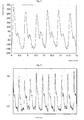
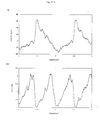
- FIG. 5 and FIG. 6 show graphs of pulse waves, respectively.
- a chaos attractor calculating part 201 calculates a chaos attractor by using two given parameters of time delay ⁇ (second) and embedded dimension m (dimension), so the chaos attractor becomes multivariate data of m dimension.
- the following equation 1 defines chaos attractors.
- For the measured pulse waves a time delay of 0.1 second and an embedded dimension of 3 are applied.
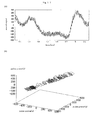
- FIG. 7 and FIG. 8 show two examples of three-dimensional graph of chaos attractors calculated by the equation 1.
- a section-constructing part 202 calculates minute deviations in the period of the chaos. This calculation cuts the orbit of solutions of the chaos attractor along a predetermined plane and finds point sequences p(i) in (m - 1) dimensions which are plotted in the section (Poincare section).
- p(i) is the chronological number that is assigned to each of the set of points of intersection.
- a reference-point setting part 203 sets up a reference point P b at a predetermined position in the section.
- This reference point P b can be set at any given position and is used to determine a vector to a point where a chaos attractor intersects the section.
- the rule-applying part 301 of the sound generating process 3 calculates the difference P(i) between the position vector p b of the reference point p b and the position vector p(i) of a point sequence p(i), which is a point of intersection of a chaos attractor in the section.
- the differences are calculated, for example as shown in FIG. 9, as vectors P(i) between the reference point p b and each of the points of intersection p(1) to p(5) in the section.
- a sound is generated by combining the vectors P(i) to a sound generation rule B.
- a minimum unit (phoneme) is determined with height n, length l and strength v, and the sound generated from the chaos attractors of m dimensions can be composed in a series of chords of at least m phonemes.
- the i in the S k (i) is the ordinal number of a phoneme in channel k
- the m (a, b) represents musical scale elements, the a being octave height, and the b being scale number.
- the r represents the number of phonemes in the chosen musical scale.
- the P k (i) represents the value of the element at number k in the vector P(i), and the mod represents the calculation of the remainder.
- the angle of deviation calculated from the two vectors P(i -1) and P(i) can be used as a sound generation rule, with the two vectors being determined from the points of intersection collected last time and those collected before the last.
- Any such element as length and angle that can be determined from the reference point and the points of intersection in the Poincare section can be used for this purpose.
- effects of performance such as type of musical instrument (tone), code progression, vibrato, portamento and echo can be determined so that the generated sound will achieve a higher mental effect.
- the fractal space generating process 6 considers the measured basic information A having a chronological fractal as a one-dimensional chronological data and defines it as x(t).
- the t represents elapse of time.
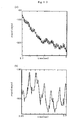
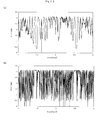
- Two examples of the x(t) are shown in FIGS. 10 to 13 and FIG. 14(a), FIG. 14(b), FIG. 15(a) and FIG. 15(b).
- FIGS. 11 to 13 show part of the content in FIG. 10 in enlargement, respectively
- FIG. 14(b), FIG. 15(a) and FIG. 15(b) show part of the content in FIG. 14(a).
- These x(t) are determined by executing scaling conversions on the graphs of pulse waves, which are examples of measured basic information A having a fractal in time series, and by extracting a fractal feature, which shows self-similarity.
- FIGS. 13 show each of the results of 5-fold scale expansion operated twice in the chronological direction on one fifth (0.8 second) of the chronological data of the plethysmogram measured with a pulse-wave sensor for 4 seconds.
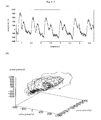
- FIGS. 16 to 19 show three-dimensional graphs of (b) attractors calculated by the equation 1 from pulse waves (a) in time series, respectively. The three attractor spaces, which have been achieved in this way, are then mixed with sound series on which the above-mentioned sound conversion rule has been applied to generate a sound that is based on the basic information having a fractal.
- complex forms brought about by changes in the chronological data can be considered as changes in the angle of deviation, so that the changes in the angle of deviation can be observed at a plurality of appropriate scales to extract a fractal feature directly from the measured basic information.
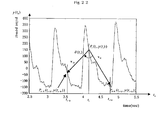
- the change ⁇ (t) of the angle of deviation is measured on the plethysmogram shown in FIG. 20(a) by applying a deviation angle calculation method described in FIG. 22 while the range of
- one point P i (t i , y(t i )) in the basic information is determined as a reference for a certain period of time, and the angle ⁇ (t i ) is defined by the two points that are determined at the previous period P i-k (t i-k , y(t i-k )) and at the next period P i+k (t i+k , y(t i+k )).
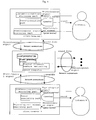
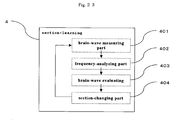
- the section learning 4 comprises a brain-wave measuring part 401, which measures the informant's brain waves, a frequency-analyzing part 402, which processes the brain waves into numerical data classified in frequency bands, a brain-wave evaluating part 403, which compares the numerical data of each frequency band with the others to evaluate the condition of the mind and body, and a section-changing part 404, which changes the plane that cuts through the chaos attractor in correspondence with the evaluation.
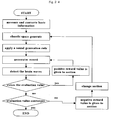
- the section learning 4 plays the sound generated on the basis of basic information, for example, brain waves as described in the flow chart of FIG. 24, which details the section learning process. It detects the brain waves of the listener who is listening to the sound and evaluates his or her condition and then feeds this evaluation back, so that the section can be changed in correspondence with the evaluation. In this way, a more suitable sound can be generated.
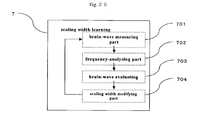
- a scaling width learning 7 in this embodiment comprises a brain-wave measuring part 701, which measures the informant's brain waves, a frequency-analyzing part 702, which processes the brain waves into numerical data classified in frequency bands, a brain-wave evaluating part 703, which compares the numerical data of each frequency band with the others to evaluate the condition of the mind and body, and a scaling width modifying part 704, which modifies the scaling width used for extracting a fractal feature in correspondence with the evaluation.
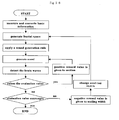
- the scaling width learning 7 plays the sound generated on the basis of basic information, for example, brain waves as described in the flow chart of FIG. 26, which details a scaling width learning process. Then, it detects the brain waves of the listener who is listening to the sound and evaluates his or her condition and feeds this evaluation back, so that the scaling width can be modified in correspondence with the evaluation. In this way, a more suitable sound can be generated.
- the above-mentioned brain-wave measuring parts 401 and 701 measure brain waves with electrodes attached at a plurality of positions on the head of the informant and convert this information into data that are numerically operable.
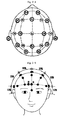
- the brain wave measurement method in this embodiment is in compliance with the international 10/20 standard for EEG placement, and twelve positions (Fp1, Fp2, F7, F8, Fz, C3, C4, Pz, T5, T6, O1 and O2) are adopted for the electrodes in the electroencephalography. In addition, plethysmogram, ophthalmogram and electrocardiogram are taken.
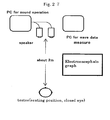
- FIG. 27 is a schematic diagram describing an environment where electroencephalography is performed, while brain waves are being measured, for example, a speaker set is installed for sound playback at a predetermined distance in front of the testee, who wears the electrodes used for brain wave measurement.
- a computer that executes the sound generation method is activated to generate a sound file and play it back through this speaker set.
- the electrodes are positioned in reference to the diagram of electrode placement of the international 10/20 standard for EEG placement.
- the above-mentioned frequency-analyzing parts 402 and 702 classify the brain-wave data, which are measured, into frequency bands of ⁇ waves (0.5 to 3 Hz), ⁇ waves (3 to 7 Hz), ⁇ -waves (7 to 13 Hz), ⁇ waves (13 to 30 Hz) and ⁇ waves (30 to 40 Hz) and convert the information into numerical data by calculating a power spectrum for these waves. These numerical data are used in the analysis of the brain waves to understand the condition of the brain.
- the above-mentioned brain-wave evaluating part 403 determines interrelations among the numerical data of the frequency bands, which have been classified by the above-mentioned analysis, for evaluating whether or not the informant feels at ease, and the results of the evaluation are accumulated as reward values.
- the ratio of the waves in each frequency band to the total waves and the spectral value of each frequency band, which indicates the strength of the waves in each frequency band are used to understand general tendency for the evaluation of the condition of the brain. Then, a positive reward value is given to a section that raises the evaluation value while a negative reward value is given to a section that lowers the evaluation value.
- the above-mentioned brain-wave evaluating part 703 determines interrelations among the numerical data of the frequency bands, which have been classified by the above-mentioned analysis, for evaluating whether or not the informant feels at ease.
- the ratio of the waves in each frequency band to the total waves and the spectral value of each frequency band, which indicates the strength of the waves in each frequency band are used to understand general tendency for the evaluation of the condition of the brain. Then, a positive reward value is given to a scaling width that raises the evaluation value while a negative reward value is given to a scaling width that lowers the evaluation value.
- the above-mentioned section-changing part 404 takes the reward values having accumulated until now into consideration for changing the section and continues the brain-wave measurement. If the evaluation value converges, then the learning is considered to have come to completion. Therefore, the section at present is set as an optimal section for the brain-wave measurement, and the brain-wave measurement is terminated.
- the above-mentioned scaling width modifying part 704 takes the reward values having accumulated until now into consideration for changing the scaling width and continues the brain-wave measurement. If the evaluation value converges, then the learning is considered to have come to completion. Therefore, the scaling width at present is set as an optimal scaling width for the brain-wave measurement, and the brain-wave measurement is terminated.
- the generation-rule learning 5 in this embodiment comprises a user-input part 501, which has an interface that enables the system to talk with the informant, a generation-rule changing part 502, which changes the sound generation rule B in accordance with the input content, and a sound-modifying part 503, which generates a sound in correspondence with the change.
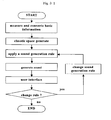
- FIG. 31 and FIG. 32 are flow charts, each describing a generation-rule learning process. As shown in FIGS. 31 and 32, by the generation-rule learning 5, the tone, volume and the like of a sound to be generated are modified.
- FIG. 33(a) is a graph showing fluctuations in the heartbeat, which are measured from a person who is listening to a sound.
- FIG. 33(b) is a graph showing the result of an analysis of the nerve-descriptive characteristic, which is extracted from a physiological signal, in this case, fluctuations in the heartbeat shown in FIG. 33(a).
- the value of the high frequency over low frequency is used to replace the evaluation value for the tranquility of the listener.
- the above-mentioned user-input part 501 has an interface by which the informant listening to the sound can change the performing musical instrument and modify the ranges of the pitch, intensity and length of the sound, so that the informant's taste can be reflected.
- the above-mentioned generation-rule changing part 502 applies to the generation rule the changes and modifications the informant has made by using the interface.
- the above-mentioned section-changing part 503 generates a sound in compliance with the changed generation rule.
- a sound generation method using such a chaos attractor measures basic information A from an informant and converts it into data that are numerically operable, by a basic information converting part 1, and then, a chaos attractor is calculated from the data by a chaotic space generating process 2. Thereafter, the method hands the chaos attractor to a sound generating process 3, where a sound file C having a chaotic behavior is generated by applying a sound generation rule B.
- a sound generation method using a fractal feature measures basic information A from an informant and converts it into data that are numerically operable, by a basic information converting part 1, and then, a fractal feature is calculated from the data by a fractal space generating process 6. Thereafter, the method hands the fractal feature to a sound generating process 3, where a sound file C is generated by applying a sound generation rule B.
Landscapes
- Health & Medical Sciences (AREA)
- Hematology (AREA)
- General Health & Medical Sciences (AREA)
- Pulmonology (AREA)
- Engineering & Computer Science (AREA)
- Anesthesiology (AREA)
- Biomedical Technology (AREA)
- Heart & Thoracic Surgery (AREA)
- Veterinary Medicine (AREA)
- Public Health (AREA)
- Life Sciences & Earth Sciences (AREA)
- Animal Behavior & Ethology (AREA)
- Acoustics & Sound (AREA)
- Physics & Mathematics (AREA)
- Psychology (AREA)
- Emergency Medicine (AREA)
- Measurement And Recording Of Electrical Phenomena And Electrical Characteristics Of The Living Body (AREA)
- Measuring Pulse, Heart Rate, Blood Pressure Or Blood Flow (AREA)
- Measurement Of The Respiration, Hearing Ability, Form, And Blood Characteristics Of Living Organisms (AREA)
Applications Claiming Priority (5)
| Application Number | Priority Date | Filing Date | Title |
|---|---|---|---|
| JP2002383239 | 2002-12-12 | ||
| JP2002383239 | 2002-12-12 | ||
| JP2003205828 | 2003-08-04 | ||
| JP2003205828 | 2003-08-04 | ||
| PCT/JP2003/016001 WO2004054649A1 (ja) | 2002-12-12 | 2003-12-12 | サウンド生成方法、コンピュータ読み取り可能な記憶媒体、スタンドアロン型サウンド生成再生装置及びネットワーク配信型サウンド生成再生システム |
Publications (2)
| Publication Number | Publication Date |
|---|---|
| EP1559444A1 true EP1559444A1 (de) | 2005-08-03 |
| EP1559444A4 EP1559444A4 (de) | 2006-06-14 |
Family
ID=32599306
Family Applications (1)
| Application Number | Title | Priority Date | Filing Date |
|---|---|---|---|
| EP03780745A Withdrawn EP1559444A4 (de) | 2002-12-12 | 2003-12-12 | Schallerzeugungsmethode, computerlesbares speichermedium, freistehende schallerzeugungs/reproduktionsvorrichtung, und schallerzeugungs/reproduktionssystem vom netzverteilungstyp |
Country Status (7)
| Country | Link |
|---|---|
| US (1) | US20060020160A1 (de) |
| EP (1) | EP1559444A4 (de) |
| JP (1) | JP3863553B2 (de) |
| KR (1) | KR100971858B1 (de) |
| AU (1) | AU2003289333A1 (de) |
| TW (1) | TWI230922B (de) |
| WO (1) | WO2004054649A1 (de) |
Families Citing this family (5)
| Publication number | Priority date | Publication date | Assignee | Title |
|---|---|---|---|---|
| JP4580812B2 (ja) * | 2005-04-21 | 2010-11-17 | 英則 伊藤 | 映像生成方法、スタンドアロン型映像再生装置及びネットワーク配信型映像再生システム |
| JP4656443B2 (ja) * | 2007-04-27 | 2011-03-23 | カシオ計算機株式会社 | 波形発生装置および波形発生処理プログラム |
| JP5347405B2 (ja) * | 2008-09-25 | 2013-11-20 | カシオ計算機株式会社 | 波形発生装置および波形発生処理プログラム |
| US12420045B2 (en) | 2022-03-15 | 2025-09-23 | GE Precision Healthcare LLC | System and method for patient-ventilator synchronization/onset detection utilizing time-frequency analysis of EMG signals |
| CN116805256B (zh) * | 2023-07-04 | 2024-06-21 | 深圳市斗鲸科技有限公司 | 基于情感分析的广告推送系统及方法 |
Family Cites Families (17)
| Publication number | Priority date | Publication date | Assignee | Title |
|---|---|---|---|---|
| US5443076A (en) * | 1992-05-22 | 1995-08-22 | Bau; Marcel | Means for enhancing the productivity of video telecommunication systems |
| JPH06296596A (ja) * | 1992-08-19 | 1994-10-25 | D F C:Kk | 集中度測定方法及びその装置 |
| US6000696A (en) * | 1992-10-22 | 1999-12-14 | Semiconductor Energy Laboratory Co., Ltd. | Game machine and game parlor |
| JP3074078B2 (ja) * | 1992-10-22 | 2000-08-07 | 株式会社半導体エネルギー研究所 | 遊技機 |
| KR950002714A (ko) * | 1993-07-22 | 1995-02-16 | 모리시타 요이찌 | 카오스응용기기 |
| JP3053318B2 (ja) * | 1993-08-12 | 2000-06-19 | パイオニア株式会社 | 身体刺激装置 |
| JPH09322943A (ja) * | 1996-06-06 | 1997-12-16 | Matsushita Electric Ind Co Ltd | 生体刺激装置 |
| KR100208309B1 (ko) * | 1996-12-30 | 1999-07-15 | 추호석 | 잡음 혹은 혼돈신호를 변수에 되먹임시키는 것에 의한 혼돈 시스템 동기화장치 및 이를 이용한 비밀 통신시스템 |
| US6135944A (en) * | 1997-11-14 | 2000-10-24 | Zebedee Research, Inc. | Method of inducing harmonious states of being |
| CN1217943A (zh) * | 1997-11-21 | 1999-06-02 | 雷沙尔·H·李 | 混沌治疗仪 |
| IL128000A0 (en) * | 1999-01-11 | 1999-11-30 | Univ Ben Gurion | A method for the diagnosis of thought states by analysis of interword silences |
| US6422998B1 (en) * | 1999-09-20 | 2002-07-23 | Ut-Battelle, Llc | Fractal analysis of time varying data |
| JP2001283134A (ja) * | 2000-03-28 | 2001-10-12 | Sharp Corp | 状態の判定・予測方法 |
| WO2002000095A2 (en) * | 2000-06-26 | 2002-01-03 | Avs Group, Inc. | Treatment using electroencephalographic and cerebral blood flow feedback |
| JP2002162968A (ja) * | 2000-11-28 | 2002-06-07 | M Zone:Kk | 音楽自動生成方法、音楽自動生成プログラム、および音楽自動生成プログラムを記録した記録媒体 |
| US20020156392A1 (en) * | 2001-03-06 | 2002-10-24 | Mitsubishi Chemical Corporation | Method and apparatus for inspecting biological rhythms |
| JP2002306492A (ja) * | 2001-04-16 | 2002-10-22 | Electronic Navigation Research Institute | カオス論的ヒューマンファクタ評価装置 |
-
2003
- 2003-12-12 AU AU2003289333A patent/AU2003289333A1/en not_active Abandoned
- 2003-12-12 KR KR1020057001795A patent/KR100971858B1/ko not_active Expired - Fee Related
- 2003-12-12 JP JP2005502491A patent/JP3863553B2/ja not_active Expired - Fee Related
- 2003-12-12 US US10/529,288 patent/US20060020160A1/en not_active Abandoned
- 2003-12-12 WO PCT/JP2003/016001 patent/WO2004054649A1/ja not_active Ceased
- 2003-12-12 TW TW092135248A patent/TWI230922B/zh not_active IP Right Cessation
- 2003-12-12 EP EP03780745A patent/EP1559444A4/de not_active Withdrawn
Also Published As
| Publication number | Publication date |
|---|---|
| KR100971858B1 (ko) | 2010-07-22 |
| AU2003289333A1 (en) | 2004-07-09 |
| TW200419530A (en) | 2004-10-01 |
| KR20050083604A (ko) | 2005-08-26 |
| EP1559444A4 (de) | 2006-06-14 |
| JP3863553B2 (ja) | 2006-12-27 |
| JPWO2004054649A1 (ja) | 2006-04-20 |
| TWI230922B (en) | 2005-04-11 |
| WO2004054649A1 (ja) | 2004-07-01 |
| US20060020160A1 (en) | 2006-01-26 |
Similar Documents
| Publication | Publication Date | Title |
|---|---|---|
| Chuen et al. | Psychophysiological responses to auditory change | |
| US10636400B2 (en) | Method for producing and streaming music generated from biofeedback | |
| US20150356876A1 (en) | Emotion regulation system and regulation method thereof | |
| KR20050084291A (ko) | 바이오리듬 활동의 유익한 수정을 위한 장치 및 방법 | |
| CN105451801A (zh) | 声音诱导的睡眠方法和用于该方法的系统 | |
| Miranda et al. | On harnessing the electroencephalogram for the musical braincap | |
| CN115399771B (zh) | 一种新型的基于脑电信号的人员专注程度检测方法及系统 | |
| WO2001008125A1 (en) | Brain development apparatus and method using brain wave biofeedback | |
| CN114099894A (zh) | 脑波音频助眠方法、装置、设备及存储介质 | |
| Yu et al. | Designing Auditory Display of Heart Rate Variability in Biofeedback Context. | |
| CN107174238B (zh) | 生理数据的处理方法及装置 | |
| WO2006021820A1 (en) | System and methods to treat headache and migraine | |
| CN115317001A (zh) | 脑电信号转换音频的方法、装置、电子设备及存储介质 | |
| US20230372662A1 (en) | Stress treatment by non-invasive, patient-specific, audio-based biofeedback procedures | |
| EP2113194A1 (de) | Vorrichtung und Verfahren zur akustischen und visuellen Darstellung von aufbereiteten physiologische Daten und Verwendung der aufbereiteten Daten | |
| EP1559444A1 (de) | Schallerzeugungsmethode, computerlesbares speichermedium, freistehende schallerzeugungs/reproduktionsvorrichtung, und schallerzeugungs/reproduktionssystem vom netzverteilungstyp | |
| Janata et al. | Spectral analysis of the EEG as a tool for evaluating expectancy violations of musical contexts | |
| CN115998259A (zh) | 基于hrv的生物反馈训练系统 | |
| CN119548103A (zh) | 一种基于多模态动态响应指数mdri的麻醉深度监测方法 | |
| CN110478595B (zh) | 一种生物反馈式的深度放松导航方法及系统 | |
| RU2124371C1 (ru) | Способ трансформации вербальной аудиоинформации на уровень подпорогового восприятия при психофизиологическом воздействии | |
| EP0432152B1 (de) | Gerät zum umsetzen des eeg's in musik | |
| JP2006346471A (ja) | サウンド生成方法、コンピュータ読み取り可能な記憶媒体、スタンドアロン型サウンド生成再生装置及びネットワーク配信型サウンド生成再生システム | |
| CN1703255A (zh) | 声音生成方法,计算机可读存储介质,独立声音生成和回放装置,以及保持网络通信联络的声音生成和回放系统 | |
| US20250025659A1 (en) | Audio signal |
Legal Events
| Date | Code | Title | Description |
|---|---|---|---|
| PUAI | Public reference made under article 153(3) epc to a published international application that has entered the european phase |
Free format text: ORIGINAL CODE: 0009012 |
|
| 17P | Request for examination filed |
Effective date: 20050329 |
|
| AK | Designated contracting states |
Kind code of ref document: A1 Designated state(s): AT BE BG CH CY CZ DE DK EE ES FI FR GB GR HU IE IT LI LU MC NL PT RO SE SI SK TR |
|
| AX | Request for extension of the european patent |
Extension state: AL LT LV MK |
|
| DAX | Request for extension of the european patent (deleted) | ||
| A4 | Supplementary search report drawn up and despatched |
Effective date: 20060515 |
|
| R17C | First examination report despatched (corrected) |
Effective date: 20070105 |
|
| STAA | Information on the status of an ep patent application or granted ep patent |
Free format text: STATUS: THE APPLICATION IS DEEMED TO BE WITHDRAWN |
|
| 18D | Application deemed to be withdrawn |
Effective date: 20081202 |