EP1559775A2 - Procédé de fermentation regulée d'un liquide - Google Patents
Procédé de fermentation regulée d'un liquide Download PDFInfo
- Publication number
- EP1559775A2 EP1559775A2 EP05001526A EP05001526A EP1559775A2 EP 1559775 A2 EP1559775 A2 EP 1559775A2 EP 05001526 A EP05001526 A EP 05001526A EP 05001526 A EP05001526 A EP 05001526A EP 1559775 A2 EP1559775 A2 EP 1559775A2
- Authority
- EP
- European Patent Office
- Prior art keywords
- liquid
- temperature
- density
- fermentation
- during
- Prior art date
- Legal status (The legal status is an assumption and is not a legal conclusion. Google has not performed a legal analysis and makes no representation as to the accuracy of the status listed.)
- Withdrawn
Links
Images

Classifications
-
- C—CHEMISTRY; METALLURGY
- C12—BIOCHEMISTRY; BEER; SPIRITS; WINE; VINEGAR; MICROBIOLOGY; ENZYMOLOGY; MUTATION OR GENETIC ENGINEERING
- C12M—APPARATUS FOR ENZYMOLOGY OR MICROBIOLOGY; APPARATUS FOR CULTURING MICROORGANISMS FOR PRODUCING BIOMASS, FOR GROWING CELLS OR FOR OBTAINING FERMENTATION OR METABOLIC PRODUCTS, i.e. BIOREACTORS OR FERMENTERS
- C12M41/00—Means for regulation, monitoring, measurement or control, e.g. flow regulation
- C12M41/30—Means for regulation, monitoring, measurement or control, e.g. flow regulation of concentration
- C12M41/32—Means for regulation, monitoring, measurement or control, e.g. flow regulation of concentration of substances in solution
-
- C—CHEMISTRY; METALLURGY
- C12—BIOCHEMISTRY; BEER; SPIRITS; WINE; VINEGAR; MICROBIOLOGY; ENZYMOLOGY; MUTATION OR GENETIC ENGINEERING
- C12G—WINE; PREPARATION THEREOF; ALCOHOLIC BEVERAGES; PREPARATION OF ALCOHOLIC BEVERAGES NOT PROVIDED FOR IN SUBCLASSES C12C OR C12H
- C12G1/00—Preparation of wine or sparkling wine
- C12G1/02—Preparation of must from grapes; Must treatment and fermentation
- C12G1/0213—Preparation of must from grapes; Must treatment and fermentation with thermal treatment of the vintage
-
- C—CHEMISTRY; METALLURGY
- C12—BIOCHEMISTRY; BEER; SPIRITS; WINE; VINEGAR; MICROBIOLOGY; ENZYMOLOGY; MUTATION OR GENETIC ENGINEERING
- C12M—APPARATUS FOR ENZYMOLOGY OR MICROBIOLOGY; APPARATUS FOR CULTURING MICROORGANISMS FOR PRODUCING BIOMASS, FOR GROWING CELLS OR FOR OBTAINING FERMENTATION OR METABOLIC PRODUCTS, i.e. BIOREACTORS OR FERMENTERS
- C12M41/00—Means for regulation, monitoring, measurement or control, e.g. flow regulation
- C12M41/48—Automatic or computerized control
Definitions
- the present invention relates to a method for controlled fermentation of a liquid.
- a density measuring probe is known, for example, from DE 199 63 935 A1.
- the density measuring probe is used to measure the concentration of an acid in Baumé grades or the must weight of a must or wine in Oechsle grades. The must weight is largely dependent on the sugar content of the must or wine, so that the must weight can be used for the rough calculation of the sugar content.
- the characterizing the fermentation state of the liquid Size is preferably the density of the liquid used.
- the alcohol and / or sugar content and in particular alternatively or additionally, the carbon dioxide emission from the liquid as a the fermentation state of To use fluid characterizing size Based on the Alcohol or sugar content and / or carbon dioxide emissions from the liquid or on the basis of temporal change of these sizes can be known per se Correlations with a good approximation to the density or density of the liquid and thus on the condition of the fermentation be closed.
- So is a targeted influence on the gaa activity of Liquid by a temperature control in dependence at least one, the fermentation state of the liquid characterizing size proposed.
- the density or density depletion and therefrom again close to the fermentation state of the liquid can based on the carbon dioxide emissions from the liquid as well be closed directly to the fermentation state of the liquid.
- the density of the liquid can be determined by a variety of Sizes are derived. Corresponding sizes are For example, the sugar content (or the Sugar decrease) the alcohol / ethanol content (or the Alcohol gain), the glucose / fructose ratio, the Carbon dioxide emissions (or the carbon dioxide electricity), the energy expenditure or the weight of the liquid.
- the CO 2 emission corresponds to the slope of the sugar degradation curve.
- sugar consumption due to the development of biomass (yeasts) and alcohol discharge are not taken into account.
- For sugar determination can be one of the following per se known methods or any other method to be used: procedure according to Luff-Schoorl and Dr. med. Rebelein, enzymatic sugar determination or Infrared spectroscopy (FTIR method).
- FTIR method Infrared spectroscopy
- the FTIR method it is an indirect measuring method in which a wave pattern (interferogram) representing all the information of the infrared spectrum, with previously calibrated Reference values from representative patterns is compared. This method thus includes a computational processing specific molecular vibration spectra.
- For the determination of alcohol may be one of the following per se known methods or any other method to be used: distillation method, method according to Dr. med. Rebelein, enzymatic determination of alcohol, gas chromatography or infrared spectroscopy (FTIR method).
- distillation method method according to Dr. med. Rebelein
- enzymatic determination of alcohol gas chromatography or infrared spectroscopy (FTIR method).
- FTIR method infrared spectroscopy
- CO 2 measurement according to Saller thermal conductivity measurement
- microthermal flow measurement gas quantity measurement by means of a mechanical device
- eddy current measuring device For example, by means of an eddy current measuring device, speed measurement of the passing gas quantities by means of an impeller sensor (so-called anemometer), pitot tube measurement or optical measurement.
- the tank temperature and the inlet and outlet temperature of the coolant is detected taking into account the amount, the flow rate and the type of coolant, and the heat loss by radiation to the room and the loss by CO 2 degassing.
- either one Sample with a defined volume or the complete tank or container containing the liquid to be fermented be weighed.
- a Removal device When weighing a sample is by a Removal device the tank a defined Fluid volume removed.
- the weight determination can done by a common scale with high resolution.
- the complete Liquid container placed on one or more scales, which continuously determine the total weight of the container.
- the volume of the Liquid metrologically be detected. This is done in the Usually by a level measurement (for example, with Radar sensors) with known tank geometry. At known Empty weight of the container and known liquid volume The density can be derived from the weight of the liquid become.
- a density or carbon dioxide-dependent temperature control and thus a targeted influencing of yeast activity in the fermenting Liquid proposed.
- the predetermined temporal Density gradient or carbon dioxide emissions can either by calculation or empirically determined become.
- the density gradient or carbon dioxide emissions can in the form of a characteristic curve or a characteristic field or in Form a mathematical function.
- the course of the Fermentation process can be user-friendly by means of a suitable Computer program with a graphical user interface (GUI) preset, observed and influenced.
- GUI graphical user interface
- the inventive method can during the Fermentation process a defined reduction of the density per unit time (so-called density depletion) or carbon dioxide flow be achieved per unit of time. This allows the Total fermentation time predicted and a given fermentation course be respected. With the method according to the invention can produces purer wines with an improved primary flavor become. In addition, a defined Endvergärungsgrad or if desired, a complete fermentation of the Liquid can be achieved. Finally, one can Time savings are achieved in the fermentation.
- the error rate is reduced and Saved working capacity.
- a targeted Influence on the density consumption or the Carbon dioxide flow the quality (composition, appearance, Taste, etc.) of the fermenting liquid. This can be a process optimization of the fermentation process, a Increasing process reliability and increasing quality the fermented or fermented liquid can be achieved.
- the temperature of the liquid within a predeterminable temperature range between a minimum Temperature and a maximum temperature is regulated.
- the Temperature as manipulated variable may only be within the move specified temperature range.
- the minimum and maximum temperature does not have to be over the duration of the entire Fermentation process can be constant value, but can become for example, time-dependent or in the presence of certain Change conditions or events.
- the values for the minimum and maximum temperature arise, for example from the boundary conditions for the maintenance of the Fermentation process or for the achievement of a certain quality the fermented liquid. This way you can unwanted termination of the fermentation process (so-called fermentation stagnation) or an impairment of the quality of the fermented or fermented liquid safely and reliably avoided become.
- the fermentation process is preferably in different phases divided. It is conceivable, for example, a subdivision into An Angärphase, a Hauptgärphase and a final fermentation phase. Once certain boundary conditions are met, will automatically from one phase to the next phase changed. According to a preferred embodiment of Invention is proposed that during the Angärphase too Beginning of the fermentation process, the temperature of the liquid a predetermined constant value is regulated until in the liquid a predetermined density reduction or Set carbon dioxide flow per unit time until a specifiable absolute density reduction respectively Carbon dioxide flow has taken place or until a predeterminable Time is exceeded.
- Angärphase that attacks System starting from a predefinable, preferably constant fermentation start temperature at a certain time, in which preferably a predefinable optimal density consumption (Fermentation intensity) or an optimal carbon dioxide stream is present for the initiation of the main phase into the Fermentation process.
- a predefinable optimal density consumption (Fermentation intensity) or an optimal carbon dioxide stream is present for the initiation of the main phase into the Fermentation process.
- the liquid is regulated so that in the Liquid a predeterminable density reduction respectively Setting carbon dioxide flow per unit time.
- the Main fermentation phase thus enable automatic Temperature changes of the liquid a gentle, predetermined density or a gentle, given carbon dioxide stream.
- the main fermentation phase automatically becomes one Endgärphase passed as soon as a predetermined threshold for the density or for the whole of the Liquid emitted amount of carbon dioxide or a predetermined Time is exceeded. These are the switching conditions for the transition from the main fermentation phase to the final fermentation phase.
- the Specification of different thresholds for the density or carbon dioxide amount of the liquid can the Significantly affect the quality of a wine.
- the temperature of the liquid so is regulated, that in the liquid a density reduction or a carbon dioxide stream per unit time of sets about zero and a definable final value for the density or for the total amount of carbon dioxide released the liquid is reached.
- an automatic stopping of the fermentation process on one absolute, definable density or carbon dioxide final value, for example, for producing fructose Wines can be achieved by appropriate temperature control.
- the Temperature control takes place within one Temperature corridor, which is of the allowable temperature range during the Angärphase and the Hauptgärphase may differ. In this case, the scheme is based on density or Carbon dioxide flow stopped.
- the temperature of the liquid during this embodiment of the final fermentation phase within a predeterminable end temperature range between a minimum End temperature and a maximum end temperature regulated.
- the minimum end temperature is lower as the minimum temperature and is the maximum end temperature lower than the maximum temperature.
- the temperature of the liquid is regulated so that a complete fermentation of the liquid.
- it is with the Density or carbon dioxide flow from the Main fermentation phase continued, that is the regulation after Density is continued.
- the regulation according to density consumption or carbon dioxide flow new during the final fermentation phase opposite the Parameter values changed during the main fermentation phase Parameter values are specified.
- the temperature of the liquid during the alternative embodiment of the final fermentation phase within a definable end temperature range between a minimum end temperature and a maximum end temperature regulated.
- the minimum end temperature is present higher than the minimum temperature and is the maximum end temperature lower than the maximum temperature.
- the thresholds relate, for example, a minimum and maximum allowable Density consumption, a minimum and maximum allowable Carbon dioxide electricity, a minimum and maximum allowable Temperature of the liquid and / or a minimum and maximum permissible final fermentation density.
- the information of the user takes place for example, via the output of appropriate messages or Waveforms on a screen of a controller or like. It is also about an information of the user about the process state using simple light signals (warning or State lights) or acoustic signals thought.
- the computer program is on one Computing device, in particular on a microprocessor, executable and for the execution of the invention Programmed procedure.
- the computer program is preferably stored on a memory element.
- Memory element may in particular an electrical, optical or magnetic storage medium are used, for example, a random access memory, a read-only memory, a flash memory, a floppy disk, a CD-ROM or a DVD.
- a control device for a Temperature control of a liquid proposed, the one Computing device, in particular a microprocessor, and a Memory element comprises.
- the control unit can Part of a programmable logic controller (PLC) or a conventional computer (PC).
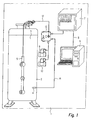
- FIG. 1 shows a device for carrying out a inventive method according to a preferred Embodiment in its entirety by the reference numeral 1 designated.
- the device 1 comprises a Liquid container 2, the part to be fermented with the Liquid 3 is filled.
- the liquid 3 is For example, grape juice or wine.
- Temperature sensor 4 for measuring the temperature of the liquid 3 dipped.
- a density measuring probe 5 for Detecting the density of the liquid 3 immersed in this. Details of the structure and operation of the Density measuring probe 5 can be found in DE 199 63 935 A1 become.
- the density measuring probe 5 is shown in the Embodiment for measuring the must weight of Liquid 3 used in Oechsle grades.
- the density of the liquid 3 on other than with a density probe is determined by other sizes of Liquid 3, most preferably based on the Fermentation state of the liquid 3 characterizing quantities, determined or modeled. Such sizes are for example the alcohol or sugar content of the liquid 3 or the Carbon dioxide emission from the liquid 3. These sizes can in any known manner be determined, measured or modeled. From these sizes can by any known method, the density Derived from the liquid 3 and the current state of the Fermentation can be determined.
- the device 1 also comprises a control unit, which in the present embodiment of a personal computer (PC) 6 and a programmable logic controller (PLC) 7 comprises.
- the PC 6 includes user interfaces in the form of a Screen and a keyboard.
- the PC 6 includes a Computing device, in particular as a microprocessor (not shown) is formed.
- the PC includes 6 also an electric storage medium (not shown), the for example, as a random access memory, as a read-only memory or formed as a flash memory.
- the storage medium is a computer program for executing the stored method according to the invention. For processing of the computer program it becomes either sectionwise or as a whole transferred to the microprocessor and there processed.
- the PC 6 and the microprocessor control or the PLC 7 are connected to each other via a data connection 8 Connection.
- Figure 1 includes the executable on the PC 6 computer program the functions Parameterization of the temperature controller, graphic Data recording and output of messages, waveforms, etc.
- the computer program is either as such over the Internet or stored on a disk.
- the PLC 7 is a Sequence control, a temperature control, a Measurement data acquisition and process monitoring integrated.
- Temperature control is in the PLC 7 a temperature controller integrated, by the temperature of the liquid. 3 can be regulated. These are heating medium and coolant (both not shown) provided, the temperature increasing or temperature-reducing effect on the liquid 3.
- the heating and cooling agents work electrically or hydraulically via a heating or cooling liquid.
- the illustrated Embodiment embodiments include the coolant Heating circuit and a cooling circuit, which is independent from each other via suitable electromagnetically actuated Valves 9, 10 can be activated and deactivated.
- the PLC 7 can by controlling the valves 9, 10, the heating means or activate the coolant and in this way the temperature Set the liquid 3 to a predetermined value. By Raising or lowering the temperature of the fermenting liquid 3 the fermenting activity can be stimulated or inhibited.
- a first measurement data line 11 is the temperature sensor 4 with the PLC 7 in connection.
- the measured temperature of the Fluid 3 is fed to the PLC 7 and for the Temperature control used.
- a second Measurement data line 12 is the density measuring probe 5 with the PLC. 7 in connection.
- the measured density and thus the one Fermentation characterizing size is about the Messismetechnisch 12 led to the PLC 7 and also for the Temperature control used.
- the two measurement data lines 11, 12 are via a Verklemmdose 13 to the PLC. 7 connected. Of course, you can also contact directly the PLC 7 must be connected.
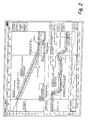
- FIG. 2 shows the courses of different signals during the execution of the method according to the invention applied.
- An essential aspect of the present Invention is to be seen in that the temperature of the Liquid 3 at least during a part of the fermentation process is regulated so that a predetermined temporal Density gradient of the liquid 3 as accurately as possible becomes.
- the default Target density profile is in the upper part of Figure 2 with a shown dashed line.
- the nominal density profile is in advance of the fermentation process mathematically or empirically determined. By a variation of the desired density profile, the is traveled according to the invention during the fermentation process, can the quality (composition, appearance, taste, etc.) of the Liquid 3 are affected.
- the nominal density profile is specified by a user via the PC 6 and on the Data line 8 transmitted to the PLC 7.
- the specification of the nominal density profile is explained in more detail with reference to FIG 3.
- the SPS 7 regulates the temperature of the liquid then so that the predetermined density gradient is traversed.
- the one of the Density probe 5 measured value for the actual density is with a solid line. It is clearly too recognize that the actual density curve substantially the desired density profile equivalent.
- Figure 2 can be seen that the fermentation process in is divided into three consecutive sections, one Angärphase, a Hauptgärphase and a final fermentation phase. Of course, during the fermentation process more Be traversed phases.
- the three phases according to the described embodiment will be with reference to the figures 4 to 7 explained in more detail.
- Density thresholds are specified, the exceeding of which (upward down) or undershooting (downwards) triggers an alarm. On the one hand, these are closer to the nominal density gradient running pre-alarm density (dotted line) and an in a greater distance to the desired density gradient running Main alarm density (dotted line).
- FIG Temperature curves of the liquid applied The Liquid 3 is regulated to the values shown there, Thus, the actual density profile shown in Figure 2 above the Liquid 3 is reached.
- the desired temperature profile is represented by a dashed line.
- the actual temperature profile is with a solid line shown.
- a pre-alarm temperature history is with a dotted line and a main alarm temperature curve is with a dotted line shown.
- the maximum and the minimum permissible temperature of the liquid 3 located located. These maximum and minimum allowable Temperatures can be different for the different phases Fermentation process take different values.
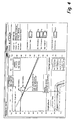
- Figure 3 is a graphical user interface shown as shown on the screen of the PC 6 becomes.
- a user can select the desired Values entered for the specified parameters.
- About the entered parameter is the desired density curve exactly Are defined.
- the parameters entered initially include General information on the fermenting liquid, such as Example Batch Number, Batch Designation, Date of Fermentation process.
- the parameters include the Fermentation start temperature (with or without rise limit), the minimum and maximum density reduction and the maximum Period until fermentation begins.
- the main fermentation phase include the entered Parameter, for example, the desired density, the maximum and minimum temperature of the liquid 3 and the maximum temperature change rate.
- For the Final fermentation phase include the parameters selecting one of several possible types of final fermentation (stopping or Fermentation), as well as the maximum and the minimum end temperature.
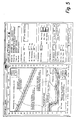
- the waveform of Figure 2 is enlarged in Section for the main fermentation phase shown.
- the main fermentation phase allow automatic Temperature changes of the liquid 3 a gentle, specified density consumption.
- a planned fermentation time From the main fermentation phase becomes automatically passed into a final fermentation phase as soon as a predefinable threshold value for the density of the liquid 3 (final density plus start before end density) or alternatively one predetermined time is exceeded.
- the waveform of Figure 2 is enlarged in Section for a first embodiment of the final fermentation phase shown.
- the temperature of the liquid 3 is so regulated that in the liquid 3, a density reduction per Set time unit (density consumption) of about zero and a definable final value (final density) for the density of the Liquid 3 is reached.
- a automatic stopping of the fermentation process to an absolute, predefinable final density value (end density), for example for Production of fructose-stressed wines, by suitable Temperature control can be achieved.
- the temperature control takes place within a temperature corridor of the permissible temperature range during the Angärphase and the Main fermentation phase may differ. In the process, the regulation will be Density finished.
- the temperature of the liquid 3 is during this Embodiment of the final fermentation phase within a predefinable End temperature range between a minimum end temperature and a maximum end temperature regulated.
- the minimum end temperature is lower than that minimum temperature during the main fermentation phase and is the maximum end temperature lower than the maximum temperature during the main fermentation phase.
- the temperature of the liquid 3 is during the alternative Embodiment of Endgärphase also within the predeterminable end temperature range between the minimum end temperature and the maximum end temperature regulated.
- the minimum end temperature is higher than the minimum temperature during the main fermentation phase, whereas the maximum end temperature lower than the maximum Temperature during the main fermentation phase is.
- inventive method of the example here may vary course, for example, to to achieve different wine qualities.
- Use of the method of the invention not on the Production of wine or fruit wine limited, but can for any fermentation processes, for example from the field of Food or drug production can be used.
Landscapes
- Chemical & Material Sciences (AREA)
- Organic Chemistry (AREA)
- Engineering & Computer Science (AREA)
- Zoology (AREA)
- Health & Medical Sciences (AREA)
- Life Sciences & Earth Sciences (AREA)
- Wood Science & Technology (AREA)
- Bioinformatics & Cheminformatics (AREA)
- Genetics & Genomics (AREA)
- Analytical Chemistry (AREA)
- General Health & Medical Sciences (AREA)
- General Engineering & Computer Science (AREA)
- Biochemistry (AREA)
- Microbiology (AREA)
- Biomedical Technology (AREA)
- Biotechnology (AREA)
- Sustainable Development (AREA)
- Thermal Sciences (AREA)
- Computer Hardware Design (AREA)
- Physics & Mathematics (AREA)
- Apparatus Associated With Microorganisms And Enzymes (AREA)
- Micro-Organisms Or Cultivation Processes Thereof (AREA)
Applications Claiming Priority (2)
| Application Number | Priority Date | Filing Date | Title |
|---|---|---|---|
| DE102004005495 | 2004-01-31 | ||
| DE200410005495 DE102004005495A1 (de) | 2004-01-31 | 2004-01-31 | Verfahren zum kontrollierten Vergären einer Flüssigkeit |
Publications (2)
| Publication Number | Publication Date |
|---|---|
| EP1559775A2 true EP1559775A2 (fr) | 2005-08-03 |
| EP1559775A3 EP1559775A3 (fr) | 2006-06-14 |
Family
ID=34638839
Family Applications (1)
| Application Number | Title | Priority Date | Filing Date |
|---|---|---|---|
| EP05001526A Withdrawn EP1559775A3 (fr) | 2004-01-31 | 2005-01-26 | Procédé de fermentation regulée d'un liquide |
Country Status (2)
| Country | Link |
|---|---|
| EP (1) | EP1559775A3 (fr) |
| DE (1) | DE102004005495A1 (fr) |
Cited By (6)
| Publication number | Priority date | Publication date | Assignee | Title |
|---|---|---|---|---|
| WO2011058585A1 (fr) * | 2009-11-10 | 2011-05-19 | Carlo Farotto | Système automatisé de vinification et procédé de vinification associé |
| CN103131574A (zh) * | 2013-02-28 | 2013-06-05 | 河南科技大学 | 一种家用葡萄酒酿酒器及其盖体 |
| ITTV20120149A1 (it) * | 2012-07-30 | 2014-01-31 | L A S I S R L | Fermentatore migliorato |
| EP2948768B1 (fr) * | 2013-01-22 | 2019-05-15 | Bernd Alber | Procédé de contrôle d'une fermentation |
| WO2022013226A1 (fr) * | 2020-07-13 | 2022-01-20 | Vogelsang Gmbh & Co. Kg | Procédé de création d'un programme de maintenance |
| US12577519B2 (en) | 2020-07-13 | 2026-03-17 | Vogelsang Gmbh & Co. Kg | Bioreactor cleaning system with an acid tank and a device for neutralizing the acid |
Families Citing this family (2)
| Publication number | Priority date | Publication date | Assignee | Title |
|---|---|---|---|---|
| DE102011114580B4 (de) | 2011-09-30 | 2016-04-21 | Leo Kübler GmbH Thermometer-, Aräometerfabrik | Verfahren und Vorrichtung zur automatischenGärkontrolle und/oder Gärführung |
| TW201629200A (zh) * | 2015-02-04 | 2016-08-16 | Ching-Yen Chang | 智慧釀造瓶蓋及其方法 |
Family Cites Families (5)
| Publication number | Priority date | Publication date | Assignee | Title |
|---|---|---|---|---|
| FR2600339B1 (fr) * | 1986-06-19 | 1988-12-09 | Laude Bousquet Adrien | Procede de controle thermique du processus de vinification et dispositif de mise en oeuvre de ce procede |
| DE4429809A1 (de) * | 1994-08-23 | 1996-02-29 | Ziemann Gmbh A | Verfahren zur vollautomatischen Gärprozeßregelung bei der Herstellung alkoholischer Getränke nach dem "Umpumpverfahren" |
| AT4855U3 (de) * | 2001-09-28 | 2002-10-25 | Stingel Itt Oeg | Verfahren und vorrichtung zum behandeln von maische |
| ITTO20010965A1 (it) * | 2001-10-11 | 2003-04-11 | Gimar Tecno S R L | Apparecchiatura di fermentazione a funzionamento automatico. |
| DE50312021D1 (de) * | 2002-03-22 | 2009-11-26 | Matthias Griebl | Verfahren zur gesteuerten garfuhrung von getranken mit hilfe von sensoren bzw. automatisierter analysemethoden |
-
2004
- 2004-01-31 DE DE200410005495 patent/DE102004005495A1/de not_active Ceased
-
2005
- 2005-01-26 EP EP05001526A patent/EP1559775A3/fr not_active Withdrawn
Cited By (9)
| Publication number | Priority date | Publication date | Assignee | Title |
|---|---|---|---|---|
| WO2011058585A1 (fr) * | 2009-11-10 | 2011-05-19 | Carlo Farotto | Système automatisé de vinification et procédé de vinification associé |
| ITTV20120149A1 (it) * | 2012-07-30 | 2014-01-31 | L A S I S R L | Fermentatore migliorato |
| EP2692846A3 (fr) * | 2012-07-30 | 2014-02-19 | Noform S.r.l. | Fermenteur amélioré |
| EP2948768B1 (fr) * | 2013-01-22 | 2019-05-15 | Bernd Alber | Procédé de contrôle d'une fermentation |
| CN103131574A (zh) * | 2013-02-28 | 2013-06-05 | 河南科技大学 | 一种家用葡萄酒酿酒器及其盖体 |
| CN103131574B (zh) * | 2013-02-28 | 2015-07-15 | 河南科技大学 | 一种家用葡萄酒酿酒器及其盖体 |
| WO2022013226A1 (fr) * | 2020-07-13 | 2022-01-20 | Vogelsang Gmbh & Co. Kg | Procédé de création d'un programme de maintenance |
| US12306606B2 (en) | 2020-07-13 | 2025-05-20 | Vogelsang Gmbh & Co Kg | Bioreactor cleaning installation for bioreactors in rail vehicles |
| US12577519B2 (en) | 2020-07-13 | 2026-03-17 | Vogelsang Gmbh & Co. Kg | Bioreactor cleaning system with an acid tank and a device for neutralizing the acid |
Also Published As
| Publication number | Publication date |
|---|---|
| EP1559775A3 (fr) | 2006-06-14 |
| DE102004005495A1 (de) | 2005-08-18 |
Similar Documents
| Publication | Publication Date | Title |
|---|---|---|
| Delsart et al. | Effects of pulsed electric fields on Cabernet Sauvignon grape berries and on the characteristics of wines | |
| EP1703809B1 (fr) | Procede pour cuire des charges de produits a cuire, contenant des produits a cuire de calibre different, et appareil de cuisson pour la mise en oeuvre dudit procede | |
| EP1559775A2 (fr) | Procédé de fermentation regulée d'un liquide | |
| DE69200150T2 (de) | Verfahren für die Regelung einer Vorrichtung zur Abwasserreinigung. | |
| EP4248813A1 (fr) | Robot de cuisine avec dispositif de surveillance | |
| EP0485901B1 (fr) | Procédé de pressurage et dispositif pour sa mise en oeuvre | |
| EP1298197A1 (fr) | Procédé et appareil de traitement de moût | |
| DE3514634C2 (fr) | ||
| DE10360066A1 (de) | Verfahren zur fotometrischen Bestimmung eines Parameters | |
| AT518624A1 (de) | Verfahren zur Herstellung eines Trockenverfestigers, insbesondere von glyoxyliertem Polyacrylamid | |
| WO1989012091A1 (fr) | Procede et agencement pour reguler un processus de croissance biologique | |
| DE4331409C1 (de) | Verfahren und Anlage zur Vermehrung von Bierhefe | |
| Setford et al. | A new approach to predicting the extraction of malvidin-3-glucoside during red wine fermentation at industrial-scale | |
| AT507918B1 (de) | Verfahren und vorrichtung zur hefevitalisierung im zuge eines brauprozesses | |
| EP1487959B1 (fr) | Procede de fermentation regulee de boissons a l'aide de capteurs et methodes d'analyse automatisees | |
| EP0492364B1 (fr) | Système de commande pour diriger la production de pâte à papier dans un digesteur en discontinu | |
| DE4429809A1 (de) | Verfahren zur vollautomatischen Gärprozeßregelung bei der Herstellung alkoholischer Getränke nach dem "Umpumpverfahren" | |
| DE10106312B4 (de) | Regelungsverfahren für die Methangaserzeugung | |
| EP4652256A1 (fr) | Procédé et appareil de récupération d'énergie et/ou d'économie d'énergie dans l'infusion et/ou la distillation d'un liquide d'infusion | |
| EP0098826B1 (fr) | Procédé de fabrication de vinaigre par charges successives | |
| DE19547473C2 (de) | Verfahren zur Echtzeit-Ermittlung der Konzentration eines Sekundär-Stoffwechselprodukts in einem chargenbetriebenen Fermentationsprozeß | |
| EP4370912A1 (fr) | Procédé et système pour la surveillance de la qualité d'un processus de fermentation pour de la bière | |
| DE19609071C2 (de) | Verfahren zur Fehlervermeidung bei der Messung oder Bestimmung des Gasverbrauchs von Materie | |
| DE2825381C2 (fr) | ||
| DE2652048A1 (de) | Verfahren zur gaerungssteuerung bei der herstellung von wein |
Legal Events
| Date | Code | Title | Description |
|---|---|---|---|
| PUAI | Public reference made under article 153(3) epc to a published international application that has entered the european phase |
Free format text: ORIGINAL CODE: 0009012 |
|
| AK | Designated contracting states |
Kind code of ref document: A2 Designated state(s): AT BE BG CH CY CZ DE DK EE ES FI FR GB GR HU IE IS IT LI LT LU MC NL PL PT RO SE SI SK TR |
|
| AX | Request for extension of the european patent |
Extension state: AL BA HR LV MK YU |
|
| PUAL | Search report despatched |
Free format text: ORIGINAL CODE: 0009013 |
|
| AK | Designated contracting states |
Kind code of ref document: A3 Designated state(s): AT BE BG CH CY CZ DE DK EE ES FI FR GB GR HU IE IS IT LI LT LU MC NL PL PT RO SE SI SK TR |
|
| AX | Request for extension of the european patent |
Extension state: AL BA HR LV MK YU |
|
| AKX | Designation fees paid | ||
| STAA | Information on the status of an ep patent application or granted ep patent |
Free format text: STATUS: THE APPLICATION IS DEEMED TO BE WITHDRAWN |
|
| 18D | Application deemed to be withdrawn |
Effective date: 20061215 |
|
| REG | Reference to a national code |
Ref country code: DE Ref legal event code: 8566 |