EP1560362A1 - Authentisierungsverfahren und -system - Google Patents
Authentisierungsverfahren und -system Download PDFInfo
- Publication number
- EP1560362A1 EP1560362A1 EP04462003A EP04462003A EP1560362A1 EP 1560362 A1 EP1560362 A1 EP 1560362A1 EP 04462003 A EP04462003 A EP 04462003A EP 04462003 A EP04462003 A EP 04462003A EP 1560362 A1 EP1560362 A1 EP 1560362A1
- Authority
- EP
- European Patent Office
- Prior art keywords
- data
- vector
- random
- reference data
- vectors
- Prior art date
- Legal status (The legal status is an assumption and is not a legal conclusion. Google has not performed a legal analysis and makes no representation as to the accuracy of the status listed.)
- Granted
Links
Images





Classifications
-
- H—ELECTRICITY
- H04—ELECTRIC COMMUNICATION TECHNIQUE
- H04L—TRANSMISSION OF DIGITAL INFORMATION, e.g. TELEGRAPHIC COMMUNICATION
- H04L9/00—Cryptographic mechanisms or cryptographic arrangements for secret or secure communications; Network security protocols
- H04L9/08—Key distribution or management, e.g. generation, sharing or updating, of cryptographic keys or passwords
- H04L9/0861—Generation of secret information including derivation or calculation of cryptographic keys or passwords
- H04L9/0866—Generation of secret information including derivation or calculation of cryptographic keys or passwords involving user or device identifiers, e.g. serial number, physical or biometrical information, DNA, hand-signature or measurable physical characteristics
-
- G—PHYSICS
- G06—COMPUTING OR CALCULATING; COUNTING
- G06F—ELECTRIC DIGITAL DATA PROCESSING
- G06F21/00—Security arrangements for protecting computers, components thereof, programs or data against unauthorised activity
- G06F21/60—Protecting data
- G06F21/602—Providing cryptographic facilities or services
-
- H—ELECTRICITY
- H04—ELECTRIC COMMUNICATION TECHNIQUE
- H04L—TRANSMISSION OF DIGITAL INFORMATION, e.g. TELEGRAPHIC COMMUNICATION
- H04L9/00—Cryptographic mechanisms or cryptographic arrangements for secret or secure communications; Network security protocols
- H04L9/06—Cryptographic mechanisms or cryptographic arrangements for secret or secure communications; Network security protocols the encryption apparatus using shift registers or memories for block-wise or stream coding, e.g. DES systems or RC4; Hash functions; Pseudorandom sequence generators
- H04L9/065—Encryption by serially and continuously modifying data stream elements, e.g. stream cipher systems, RC4, SEAL or A5/3
- H04L9/0656—Pseudorandom key sequence combined element-for-element with data sequence, e.g. one-time-pad [OTP] or Vernam's cipher
- H04L9/0662—Pseudorandom key sequence combined element-for-element with data sequence, e.g. one-time-pad [OTP] or Vernam's cipher with particular pseudorandom sequence generator
-
- H—ELECTRICITY
- H04—ELECTRIC COMMUNICATION TECHNIQUE
- H04L—TRANSMISSION OF DIGITAL INFORMATION, e.g. TELEGRAPHIC COMMUNICATION
- H04L2209/00—Additional information or applications relating to cryptographic mechanisms or cryptographic arrangements for secret or secure communication H04L9/00
- H04L2209/12—Details relating to cryptographic hardware or logic circuitry
Definitions
- the present invention relates to the field of cryptography.
- the sender and receiver of a message know and use the same secret key: the sender uses the secret key to encrypt the message, and the receiver uses the same secret key to decrypt the message.
- This method is known as secret-key or symmetric cryptography.
- the main challenge is getting the sender and receiver to agree on the secret key without anyone else finding out. If they are in separate physical locations, they must trust a courier, a phone system, or some other transmission medium to prevent the disclosure of the secret key.
- Anonymous cryptosystems must deal with key management issues. Because all keys in a secret-key cryptosystem must remain secret, secret-key cryptography often has difficulty providing secure key management, especially in open systems with a large number of users.
- DES Data Encryption Standard
- DES applies a 56-bit key to each 64-bit block of data.
- the process can run in several modes and involves 16 rounds or operations. Although this is considered “strong” encryption, many companies use “triple DES", which applies three keys in succession.
- DES is specified in the ANSI X3.92 and X3.106 standards and in the Federal FIPS 46 and 81 standards.
- a public-key cryptosystem In a public-key cryptosystem, the private key is always linked mathematically to the public key. Therefore, it is always possible to attack a public-key system by deriving the private key from the public key. Typically, the defence against this is to make the problem of deriving the private key from the public key as difficult as possible. For instance, some public-key cryptosystem are designed such that deriving the private key from the public key requires the attacker to factor a large number, it this case it is computationally infeasible to perform the derivation. This is the idea behind the RSA public-key cryptosystem.
- the invention facilitates provision of an improved solution for the key management problem.
- the invention provides a method of encrypting binary data.
- a reference data vector is acquired using a reference object.
- For encoding of each bit of the binary data a random vector is determined on the basis of the reference data vector.
- This encryption method is particularly advantageous as the key management problem is avoided.
- encryption is not performed on the basis of an exact key but on the basis of a reference object from which a reference data vector is acquired.
- the reference object is a physical object.
- some kind of measurement is performed on the physical object in order to acquire the reference data vector that is the basis for determining the random vectors for encoding of the data.
- a biometric object is used as a reference object, such as a user's fingerprint, iris, voice, or face. Biometric features are extracted from the biometric reference object in order to acquire the reference data vector.
- an image is used as a reference object.
- a photograph of a passport or chip card can be used as such an image.
- the image is scanned and filtered in order to obtain the reference data vector.
- the filtering involves some kind of averaging in order to increase the robustness of the method.
- a data object is used as a reference object.
- the data object is rendered by means of a rendering program, such as a text processing program where the data object is a text document, and the data acquisition is performed on the rendered data object.
- the random vector for encoding one of the bits is determined by generating a candidate random vector and by calculating the scalar product of the candidate random vector and the reference data vector.
- the candidate random vector is accepted for encoding of the bit and stored.
- the candidate random vector does not fulfil these two requirements (i) and (ii) another candidate random vector is generated and the conditions are tested again. This procedure continues until a candidate random vector is identified that fulfils both conditions.
- a running index of the accepted candidate random vector is stored rather than the complete candidate random vector.
- the combination of the running index and the seed value of the pseudo random number generator that is used for generating of the random vectors unequivocally identifies the complete random vector. This way the size of the result of the encryption can be reduced drastically.
- a data file is encrypted.
- a user can encrypt a data file on his or her computer on the basis of one of his or her biometric features in order to protect the data file against unauthorised access.
- a user's personal data such as the user's name as printed on his or her passport or chip card, is encrypted. This is useful for checking the authenticity of the passport or chip card.
- a symmetric key is encrypted on the basis of the reference object.
- the symmetric key is used for encryption of a large data file.
- the symmetric key itself is encrypted in accordance with a method of the present invention on the basis of a reference object. This way the symmetric key is protected in a secure way while avoiding the disadvantages of prior art key management approaches.
- the present invention provides a method of decrypting binary data.
- the binary data comprises a random vector for each encoded bit.
- the decoding is performed by acquiring a reference data vector from a reference object.
- the decryption of one of the bits is performed on the basis of one of the random vectors and the reference data vector.
- the decryption of one of the bits is performed by determining the sign of the scalar product of the reference data vector and the one of the random vectors.
- Decryption of the encrypted binary data is only possible if the reference object is authentic.
- decrypting requires the encryptor's biometric data, the image that was used as a reference object for the encryption, e.g. the user's passport, or rending of a data object that was used for acquisition of the reference data for the encryption.
- the reference data vector that was used for the encryption does not need to be reproduced in an exact way for the decryption; some degree of error in the acquisition of the reference data vector is allowed without negatively affecting the decryption.
- the present invention is particularly advantageous in that it facilitates solution of the prior art key management problem in a user friendly, convenient and yet secure way.
- the present invention can be used in various fields for the purposes of protecting the confidentiality of data and for the purpose of authentication of documents or files.
- Figure 1 shows a flow chart for encryption of I bits of binary data B 1 B 2 , B 3 , ... B j , .... B l .
- a reference object is used as a basis of the encryption.
- any physical or data object that has a certain uniqueness can be used as such a reference object.
- an image such as a photo printed or attached to a document, can be used as a reference object.
- a rendered data file is used as a reference object, such as a text file that is rendered by a text processing program.
- a portion of a person's body is used as a reference object for extraction of biometric features, or a user's utterance, such as the user's voice.
- a data acquisition step is performed (step 100). This way the reference data vector ⁇ is obtained (step 102) that has a number k of values obtained from the reference data object.
- the raw data is filtered by a low pass filter for increased robustness of the encoding and decoding method.
- step 104 the I bits to be encrypted are entered.
- step 106 the index j is initialised.
- step 108 a first candidate random vector R is generated by means of a random number generator.
- the random vector R has the same size k as the reference data vector ⁇ .
- step 110 the scalar product of the reference data vector and the candidate random vector is calculated. If the absolute value of this scalar product is above a predefined threshold level ⁇ a first condition is fulfilled. If the sign of the scalar product matches the bit B j to be encoded this means that the candidate random vector can be accepted for encoding of bit B j .
- the candidate random vector R is accepted for encrypting bit B j if both of the following conditions are met:
- step 108 If one of the conditions (i) and (ii) is not fulfilled the control goes back to step 108 for generation of a new candidate random vector which is then tested against the two conditions (i) and (ii) in step 110. Steps 108 and 110 are carried out repeatedly until a candidate random vector has been found that fulfils both of the conditions of step 110.
- the accepted candidate random vector constitutes row j of matrix M (step 112).
- step 114 index j is implemented and the control goes back to step 108 for encoding of the next bit B j of the I bits to be encrypted.
- step 116 After encryption of all I bits the control goes to step 116 where the matrix M is outputted as a result of the encryption.
- threshold ⁇ is a trade off between security and processing time.
- the security of the encoding is proportional to the value of the threshold ⁇ .
- increasing ⁇ also increases the average number of attempts for finding an acceptable candidate random vector.
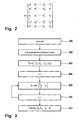
- Figure 2 shows the resulting matrix M that has a number I of rows and k of columns.
- Each row j of matrix M is assigned to one of the bits B j and contains the random vector that encodes the respective bit B j .
- Decryption of matrix M in order to recover the encrypted bits is only possible if the decryptor is in the possession of the reference object that was used for the encryption (cf. step 100 of fig. 1) as the reference data vector ⁇ is not stored in the matrix M or elsewhere.
- Figure 3 illustrates a corresponding decryption method.
- step 300 the matrix M is entered.
- step 302 data is acquired from the reference object.
- the reference data vector ⁇ ' is obtained (step 304). It is to be noted that the data acquisition step 100 of figure 1 and data acquisition step 302 of figure 3 are substantially identical. However, in case the reference object is a physical object the data acquisition will involve some kind of measurement error.
- step 306 the index j is initialised.
- step 308 the scalar product of the reference data vector ⁇ ' and the random vector in row j of matrix M that is assigned to bit B j is calculated.
- the sign of the scalar provides the decoded bit value B j whereby the same convention as for the encoding is used. In other words, when the sign is negative, the bit value is '0'; if the sign is positive the bit value B j is '1'.
- step 310 the index j is implemented and the control goes back to step 308 for decoding of the next bit position. Steps 308 and 310 are carried out repeatedly until all I bit positions have been decoded. The decoded I bits are outputted in step 312.
- the encryption and decryption methods of figures 1 and 3 are particularly advantageous as they are error tolerant in view of unavoidable measurement errors in the data acquisition from the reference object.
- the reference data vectors used for the encryption and for the decryption will not be exactly the same but still a correct decryption result is obtained with a high degree of reliability and security.
- Figure 4 shows a block diagram of a corresponding computer system.
- the computer system has computer 400 that is used for encryption and computer 402 that is used for decryption.
- Computer 400 has processor 404 for running program 406.
- Program 406 has program modules 408, 410, 412 and 414.
- Program module 408 implements a random number generator.
- Program module 410 serves for encryption of a file by means of a symmetric key, such as by DES encryption.
- Program module 412 serves for encryption of the symmetric key in accordance with the method of figure 1.
- Program module 414 serves for image processing of image data provided by scanner 416 that is coupled to computer 400.
- Computer 400 has storage 418 for storage of file 420, encrypted file 422, symmetric key 424 and matrix 426 that results from the encoding of symmetric key 424.
- Computer 402 has processor 428 for running of program 430.
- Program 430 has program modules 432, 434, 414.
- Computer 402 has storage 438.
- Storage 438 serves for storage of the encrypted file 422 received via network 440 from computer 400. Further, storage 438 serves for storage of the decrypted file 420, matrix 426 received via network 440 from computer 400 and the decrypted symmetric key 424.
- computer 400 is used for encryption of file 420.
- File 420 is encrypted by means of program module 410 using symmetric key 424.
- the resulting encrypted file 422 is stored in storage 418.
- symmetric key 424 the user scans a reference object, such as his or hers passport, by means of scanner 416.
- the resulting raw image data is processed by program module 414.
- program module 414 performs some kind of low pass filtering and normalization of the raw image data obtained from scanner 416.
- the filtered image data is provided to program module 412 that performs the encryption of symmetric key 424 in accordance with the method of figure 1 using program module 408 as a source for the candidate random vectors.
- the resulting matrix M 426 is stored in storage 418.
- computer 402 receives data object 446 containing encrypted file 422 and matrix 426.
- the user has to scan in the reference object, e.g. his or hers passport. This will result in similar raw image data as obtained in the original scan for the encryption.
- the raw image data are processed in the same way as for the encryption by program module 414 of program 430.
- the filtered image data is provided to program module 434 that performs the decryption of matrix M 426 in accordance with the method of figure 3.
- the result of the decryption performed by program module 434 is symmetric key 424 that is stored in storage 438.
- program module 432 decrypts encrypted file 422 which provides the original file 420.
- the computer system of figure 4 does not require a key management system for the symmetric key 424. Rather a convenient reference object, such as the user's passport or other unique document, is used as a basis for the protection of the symmetric key 424.
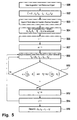
- Figure 5 shows a preferred embodiment of the encryption method of figure 1 that enables to compress the result of the encryption operation.
- Steps 500 and 502 are identical to steps 100 and 102 of figure 1.
- a seed value for the pseudo random number generator is entered.
- step 504 a symmetric key having a length I is entered. This corresponds to step 104 of figure 1.
- index m is initialised in step 507.
- Index m is the running index of the random number generator.
- This candidate random vector is evaluated in step 510 in the same way as in step 110 of figure 1.
- Step 514 corresponds to step 114.
- step 516 the sequence S containing a number of I running indices is outputted rather than a matrix M having a number of l x k random numbers. Hence, by storing the running indices and the seed value rather than the random vectors themselves a drastic compression of the result of the encoding operation is obtained.
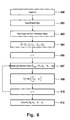
- Figure 6 shows the corresponding decoding method that is similar to the decoding method of figure 3.
- step 600 the sequence S is inputted.
- the seed value that was used for the encoding (cf. step 503 of figure 5) is inputted in step 601.
- Steps 602, 604, 606 are substantially identical to the corresponding steps 302, 304 and 306 of figure 3.
- step 608 is identical to step 308 of figure 3.
- step 610 the index j is incremented. From there the control returns to step 607 for recovery of the consecutive random vector having the running index s j .
- step 612 the result of the decoding is outputted.
- Figure 7 shows a computer system that implements the methods of figures 5 and 6. Elements of figure 7, that correspond to elements of figure 4 are designated by like reference numerals.
- Program module 708 of program 706 implements a pseudo random number generator that produces a sequence of pseudo random numbers depending on an initial seed value.
- the seed value 719 is stored in storage 718.
- Computer 702 has user interface 748 for entering of seed value 719.
- Program module 712 of program 706 implements the method of figure 5 whereas program module 734 of program 730 implements the decryption method of figure 6.
- Operation of computer 700 for encryption of file 720 and symmetric key 724 is similar to operation of computer 400 of figure 4 except that seed value 719 is used as a basis for generation of pseudo random numbers by program module 708.
- the running indices of the accepted candidate random vectors are stored rather than the complete random vectors themselves which provides sequence S 726.
- the encrypted file 722 and the sequence S 726 are transmitted as data object 746 from computer 700 to computer 702.
- the seed value can be memorised by the user and entered via user interface 748 into computer 702. Alternatively the seed value is transmitted from computer 700 to computer 702 as part of data object 746 for increased user convenience.
- Operation of computer 702 is similar to operation of computer 402 of figure 4.
- Program 730 has program module 708 for generation of the pseudo random vectors as identified by sequence S 726 on the basis of see value 719.
- Program module 734 uses the recovered random vectors for performing the decryption of symmetric key 724.
- Figures 8 and 9 are illustrative of an example for data acquisition and a low pass filtering operation for the purpose of generating a reference data vector (cf. steps 100 and 110 of figure 1, steps 303 and 304 of figure 3, steps 500 and 502 of figure 5, and steps 602 and 604 of figure 6).
- Figure 8 shows grid 800 that has grid elements 802. Grid 800 is used for filtering of an image. For each of the grid elements 802 a normalised average grey value is calculated. The normalised and averaged grey values provide the reference data vectors ⁇ for encryption) and ⁇ ' for decryption.
- Figure 9 shows original image 900 that is used as a reference object.
- image 900 image data is obtained and low pass filtered by means of grid 800.
- the result of the filter operation is illustrated as image 902.
- FIG 10 illustrates an application example of the method of figure 5 for the purpose of producing a secure passport.
- the passport photography is scanned in step 1000.
- the reference data vector is obtained in step 1002 (cf. corresponding steps 500 and 502 of figure 5).
- the passport number is entered as a seed value for the pseudo random number generator.
- step 1004 the name of the person for which the passport is produced is entered.
- the ASCI coded name is the information to be encrypted (cf. corresponding steps 503 and 504 of figure 5).
- the following steps 1006 to 1014 are substantially identical to the corresponding steps 506 to 514 of figure 5.
- the resulting sequence S is digitally signed in step 1016 by the private key of the organisation that issues the passport.
- the digitally signed sequence S is printed on the passport in step 1018. This can be done by means of a bar code or otherwise.
- a digital circuit can be printed on the passport by means of a conductive polymer in order to store the digitally signed sequence S on the passport.
- Figure 11 shows a method for authenticating the passport that has been produced in accordance with the method of figure 10. This authentication method is an application of the decryption method of figure 6.
- step 1100 the digitally signed sequence S is read from the passport.
- the digital signature is checked.
- step 1001 the passport number is entered as a seed value for the pseudo random number generator.
- step 1002 the passport photography is scanned in order to obtain the reference data vector ⁇ ' (step 1104).
- the following steps 1106 to 1112 are identical to corresponding steps 606 to 612 of figure 6 whereby the ASCI and coded name is outputted in step 1112 as a result of the decoding operation.
- step 1114 the name that is outputted in step 1112 is compared with the name that is printed on the passport. If the names match the passport is authentic (step 1116), otherwise the passport is not accepted and access may be refused (Step 1118).
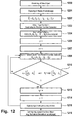
- Figure 12 illustrates another application example of the encoding method of figure 5.
- the method of figure 12 addresses a security problem of electronic commerce.
- the user When a legal document is digitally signed by an authorised user the user relies on the correctness of the rendered display of the legal document. However the display may be filtered or manipulated otherwise such that it does not correspond to a normal rendering of the legal document.
- the fonts of the computer have been manipulated to show digit '1' instead of digit '6'.
- the user risks to digitally sign e.g. a payment order in the amount of 6,000,000 when his intention is only to authorise payment of 1,000,000.
- the rendered data object e.g. a text file (step 1200)
- step 1200 is captured in step 1201.
- step 1204 the user's name is entered.
- the ASCI coded user name is the information to be encrypted.
- step 1216 the resulting sequence S is digitally signed with the private key of the user.
- the digitally signed sequence S is added to the data object.
- the data object is a text file, such as a Word document, this can be done by adding the digitally signed sequence S to the footer or header of the file. Each page of the data object can be processed this way.
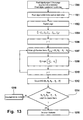
- Figure 13 shows the corresponding authentication method that is an application of the method of figure 6.
- step 1300 the digitally signed sequence S is read from the rendered data object.
- the digital signature is checked by means of the public key of the authorised user.
- step 1301 the page number of the actual page is read and used as a seed value for the pseudo random number generator.
- step 1302 the actual page is captured by means of a screen print-type operation in order to provide image data.
- the reference data vector is obtained (step 1304).
- steps 1306 to 1318 are analogous to steps 1106 to 1118 of figure 11. If the user name that is obtained as a result of the decryption is correct the digital document is considered authentic (step 1116).
- Figure 14 shows a corresponding computer system that implements the methods of figures 12 and 13.
- Program 1406 has program module 1410 for digitally signing file 1420 by means of private key 1421 of an authorised user.
- Program module 1412 implements the method of figure 12 for encrypting the user's name 1424.
- file 1420 is rendered by text processing program module 1415, such as Microsoft Word.
- the actual page that is rendered by program module 1415 is captured by program module 1414 for image processing.
- the result of the image processing is a reference data vector that is provided to program module 1412 for encryption of user name 1424 in accordance with the method of figure 12.
- the result of the encryption i.e. the sequence S, is digitally signed by means of program module 1410 using the user's private key 1421.
- the digitally signed sequence S is added to the file 1420.
- page number of the page that is rendered by text processing program module 1415 is identified by image processing program module 1414 and stored as page number 1419 in storage 1418. This page number is used as a seed value for the pseudo random number generator implemented by program module 1408.
- the authorised user can perform the corresponding user interactions.
- the user may send file 1420 with the digitally signed sequence S to computer 1402 via network 1440.
- File 1420 is rendered by program module 1415.
- the digitally signed sequence S and the page number 1419 are extracted from file 1420.
- Image processing program module 1414 uses the rendered file 1420 in order to provide the reference data vector ⁇ '.
- sequence S is checked by means of program module 1432. If it is correct the sequence S is decrypted by means of program module 1434 on the basis of the reference data vector using page number 1419 as a seed value for the pseudo random number generator implemented by program module 1408. As a result the name of the user is displayed on user interface 1448. If the displayed user name corresponds to the user of public key 1452 the rendered document is authentic.
Landscapes
- Engineering & Computer Science (AREA)
- Computer Security & Cryptography (AREA)
- Computer Networks & Wireless Communication (AREA)
- Signal Processing (AREA)
- Theoretical Computer Science (AREA)
- General Health & Medical Sciences (AREA)
- Bioethics (AREA)
- Computer Hardware Design (AREA)
- Software Systems (AREA)
- Physics & Mathematics (AREA)
- General Engineering & Computer Science (AREA)
- General Physics & Mathematics (AREA)
- Health & Medical Sciences (AREA)
- Storage Device Security (AREA)
- Collating Specific Patterns (AREA)
Priority Applications (3)
| Application Number | Priority Date | Filing Date | Title |
|---|---|---|---|
| EP04462003A EP1560362B1 (de) | 2004-01-30 | 2004-01-30 | Auf der Nutzung eines Referenzdatenvektors basierendes Verschlüsselungsverfahren und -system |
| DE602004002451T DE602004002451D1 (de) | 2004-01-30 | 2004-01-30 | Auf der Nutzung eines Referenzdatenvektors basierendes Verschlüsselungsverfahren und -system |
| AT04462003T ATE340452T1 (de) | 2004-01-30 | 2004-01-30 | Auf der nutzung eines referenzdatenvektors basierendes verschlüsselungsverfahren und -system |
Applications Claiming Priority (1)
| Application Number | Priority Date | Filing Date | Title |
|---|---|---|---|
| EP04462003A EP1560362B1 (de) | 2004-01-30 | 2004-01-30 | Auf der Nutzung eines Referenzdatenvektors basierendes Verschlüsselungsverfahren und -system |
Publications (2)
| Publication Number | Publication Date |
|---|---|
| EP1560362A1 true EP1560362A1 (de) | 2005-08-03 |
| EP1560362B1 EP1560362B1 (de) | 2006-09-20 |
Family
ID=34639525
Family Applications (1)
| Application Number | Title | Priority Date | Filing Date |
|---|---|---|---|
| EP04462003A Expired - Lifetime EP1560362B1 (de) | 2004-01-30 | 2004-01-30 | Auf der Nutzung eines Referenzdatenvektors basierendes Verschlüsselungsverfahren und -system |
Country Status (3)
| Country | Link |
|---|---|
| EP (1) | EP1560362B1 (de) |
| AT (1) | ATE340452T1 (de) |
| DE (1) | DE602004002451D1 (de) |
Cited By (1)
| Publication number | Priority date | Publication date | Assignee | Title |
|---|---|---|---|---|
| CN101350724B (zh) * | 2008-08-15 | 2011-02-09 | 西安电子科技大学 | 一种基于生物特征信息的加密方法 |
Families Citing this family (1)
| Publication number | Priority date | Publication date | Assignee | Title |
|---|---|---|---|---|
| US9729318B2 (en) | 2015-10-05 | 2017-08-08 | International Business Machines Corporation | Using everyday objects as cryptographic keys |
Citations (4)
| Publication number | Priority date | Publication date | Assignee | Title |
|---|---|---|---|---|
| WO1998048538A2 (en) * | 1997-04-21 | 1998-10-29 | Mytec Technologies Inc. | Method for secure key management using a biometric |
| EP1043862A2 (de) * | 1999-04-08 | 2000-10-11 | Lucent Technologies Inc. | Erzeugung eines wiederholbaren kryptographischen Schlüssels basierend auf variablen Parametern |
| US20020070844A1 (en) * | 1999-12-14 | 2002-06-13 | Davida George I. | Perfectly secure authorization and passive identification with an error tolerant biometric system |
| WO2002078249A1 (en) * | 2001-03-23 | 2002-10-03 | Kent Ridge Digital Labs | Method of using biometric information for secret generation |
-
2004
- 2004-01-30 AT AT04462003T patent/ATE340452T1/de not_active IP Right Cessation
- 2004-01-30 EP EP04462003A patent/EP1560362B1/de not_active Expired - Lifetime
- 2004-01-30 DE DE602004002451T patent/DE602004002451D1/de not_active Expired - Lifetime
Patent Citations (4)
| Publication number | Priority date | Publication date | Assignee | Title |
|---|---|---|---|---|
| WO1998048538A2 (en) * | 1997-04-21 | 1998-10-29 | Mytec Technologies Inc. | Method for secure key management using a biometric |
| EP1043862A2 (de) * | 1999-04-08 | 2000-10-11 | Lucent Technologies Inc. | Erzeugung eines wiederholbaren kryptographischen Schlüssels basierend auf variablen Parametern |
| US20020070844A1 (en) * | 1999-12-14 | 2002-06-13 | Davida George I. | Perfectly secure authorization and passive identification with an error tolerant biometric system |
| WO2002078249A1 (en) * | 2001-03-23 | 2002-10-03 | Kent Ridge Digital Labs | Method of using biometric information for secret generation |
Cited By (1)
| Publication number | Priority date | Publication date | Assignee | Title |
|---|---|---|---|---|
| CN101350724B (zh) * | 2008-08-15 | 2011-02-09 | 西安电子科技大学 | 一种基于生物特征信息的加密方法 |
Also Published As
| Publication number | Publication date |
|---|---|
| DE602004002451D1 (de) | 2006-11-02 |
| EP1560362B1 (de) | 2006-09-20 |
| ATE340452T1 (de) | 2006-10-15 |
Similar Documents
| Publication | Publication Date | Title |
|---|---|---|
| US20060227974A1 (en) | Encryption and decryption method | |
| Friedman | The trustworthy digital camera: Restoring credibility to the photographic image | |
| Barman et al. | Fingerprint-based crypto-biometric system for network security | |
| CN114782238B (zh) | 一种基于哈希函数和信息隐藏的图像自认证方法 | |
| CN1778065A (zh) | 基于生物特性身份的加密方法和设备 | |
| CN116484341A (zh) | 一种基于哈希加密算法的数字化信息处理方法及系统 | |
| Wang et al. | Securing image-based document transmission in logistics and supply chain management through cheating-resistant visual cryptographic protocols. | |
| Upreti et al. | A comparative analysis of LSB & DCT based steganographic techniques: confidentiality, contemporary state, and future challenges | |
| Adabala et al. | Enhancing Digital Image Security using Visual Cryptography Integrated with AES and RSA Encryption Techniques | |
| Wazery et al. | A hybrid technique based on RSA and data hiding for securing handwritten signature | |
| WO2004095770A1 (en) | Biometric based identity based encryption method and apparatus | |
| EP1560362B1 (de) | Auf der Nutzung eines Referenzdatenvektors basierendes Verschlüsselungsverfahren und -system | |
| Zhao | Dual domain semi-fragile watermarking for image authentication | |
| Arumugam et al. | Quantum-Integrated Steganography for Secure Communication using QKD and LSB Techniques | |
| Bhawna et al. | A novel citadel security framework for cyber data using CryptSteg techniques | |
| Hambali et al. | Enhance Facial Biometric Template Security using Advance Encryption Standard with Least Significant Bit | |
| Goon | Major developments in visual cryptography | |
| JP2574755B2 (ja) | 個人認証システム | |
| Mitu et al. | An Encryption Approach with Steganography for Enhanced Data Security | |
| Divya et al. | Privacy preservation mechanism for the data used in image authentication | |
| Chang et al. | A novel authentication scheme based on torus automorphism for smart card | |
| El-Taj et al. | CryptoQR System based on RSA | |
| Saadatmand-Tarzjan | A Novel Patch-Based Digital Signature | |
| JP2002330129A (ja) | 暗号化装置、復号化装置および通信システム | |
| Amenu et al. | WinRan: Securing Image in a Dual-Layered Image Steganography |
Legal Events
| Date | Code | Title | Description |
|---|---|---|---|
| PUAI | Public reference made under article 153(3) epc to a published international application that has entered the european phase |
Free format text: ORIGINAL CODE: 0009012 |
|
| 17P | Request for examination filed |
Effective date: 20050418 |
|
| AK | Designated contracting states |
Kind code of ref document: A1 Designated state(s): AT BE BG CH CY CZ DE DK EE ES FI FR GB GR HU IE IT LI LU MC NL PT RO SE SI SK TR |
|
| AX | Request for extension of the european patent |
Extension state: AL LT LV MK |
|
| GRAP | Despatch of communication of intention to grant a patent |
Free format text: ORIGINAL CODE: EPIDOSNIGR1 |
|
| AKX | Designation fees paid |
Designated state(s): AT BE BG CH CY CZ DE DK EE ES FI FR GB GR HU IE IT LI LU MC NL PT RO SE SI SK TR |
|
| RTI1 | Title (correction) |
Free format text: ENCRYPTION METHOD AND ENCRYPTION SYSTEM BASED ON THE USE OF A REFERENCE DATA VECTOR |
|
| RAP1 | Party data changed (applicant data changed or rights of an application transferred) |
Owner name: HEWLETT-PACKARD DEVELOPMENT COMPANY, L.P. |
|
| GRAS | Grant fee paid |
Free format text: ORIGINAL CODE: EPIDOSNIGR3 |
|
| GRAA | (expected) grant |
Free format text: ORIGINAL CODE: 0009210 |
|
| AK | Designated contracting states |
Kind code of ref document: B1 Designated state(s): AT BE BG CH CY CZ DE DK EE ES FI FR GB GR HU IE IT LI LU MC NL PT RO SE SI SK TR |
|
| PG25 | Lapsed in a contracting state [announced via postgrant information from national office to epo] |
Ref country code: IT Free format text: LAPSE BECAUSE OF FAILURE TO SUBMIT A TRANSLATION OF THE DESCRIPTION OR TO PAY THE FEE WITHIN THE PRESCRIBED TIME-LIMIT;WARNING: LAPSES OF ITALIAN PATENTS WITH EFFECTIVE DATE BEFORE 2007 MAY HAVE OCCURRED AT ANY TIME BEFORE 2007. THE CORRECT EFFECTIVE DATE MAY BE DIFFERENT FROM THE ONE RECORDED. Effective date: 20060920 Ref country code: SI Free format text: LAPSE BECAUSE OF FAILURE TO SUBMIT A TRANSLATION OF THE DESCRIPTION OR TO PAY THE FEE WITHIN THE PRESCRIBED TIME-LIMIT Effective date: 20060920 Ref country code: RO Free format text: LAPSE BECAUSE OF FAILURE TO SUBMIT A TRANSLATION OF THE DESCRIPTION OR TO PAY THE FEE WITHIN THE PRESCRIBED TIME-LIMIT Effective date: 20060920 Ref country code: LI Free format text: LAPSE BECAUSE OF FAILURE TO SUBMIT A TRANSLATION OF THE DESCRIPTION OR TO PAY THE FEE WITHIN THE PRESCRIBED TIME-LIMIT Effective date: 20060920 Ref country code: FI Free format text: LAPSE BECAUSE OF FAILURE TO SUBMIT A TRANSLATION OF THE DESCRIPTION OR TO PAY THE FEE WITHIN THE PRESCRIBED TIME-LIMIT Effective date: 20060920 Ref country code: SK Free format text: LAPSE BECAUSE OF FAILURE TO SUBMIT A TRANSLATION OF THE DESCRIPTION OR TO PAY THE FEE WITHIN THE PRESCRIBED TIME-LIMIT Effective date: 20060920 Ref country code: CH Free format text: LAPSE BECAUSE OF FAILURE TO SUBMIT A TRANSLATION OF THE DESCRIPTION OR TO PAY THE FEE WITHIN THE PRESCRIBED TIME-LIMIT Effective date: 20060920 Ref country code: NL Free format text: LAPSE BECAUSE OF FAILURE TO SUBMIT A TRANSLATION OF THE DESCRIPTION OR TO PAY THE FEE WITHIN THE PRESCRIBED TIME-LIMIT Effective date: 20060920 Ref country code: CZ Free format text: LAPSE BECAUSE OF FAILURE TO SUBMIT A TRANSLATION OF THE DESCRIPTION OR TO PAY THE FEE WITHIN THE PRESCRIBED TIME-LIMIT Effective date: 20060920 Ref country code: AT Free format text: LAPSE BECAUSE OF FAILURE TO SUBMIT A TRANSLATION OF THE DESCRIPTION OR TO PAY THE FEE WITHIN THE PRESCRIBED TIME-LIMIT Effective date: 20060920 Ref country code: BE Free format text: LAPSE BECAUSE OF FAILURE TO SUBMIT A TRANSLATION OF THE DESCRIPTION OR TO PAY THE FEE WITHIN THE PRESCRIBED TIME-LIMIT Effective date: 20060920 |
|
| REG | Reference to a national code |
Ref country code: GB Ref legal event code: FG4D |
|
| REG | Reference to a national code |
Ref country code: CH Ref legal event code: EP |
|
| REG | Reference to a national code |
Ref country code: IE Ref legal event code: FG4D |
|
| REF | Corresponds to: |
Ref document number: 602004002451 Country of ref document: DE Date of ref document: 20061102 Kind code of ref document: P |
|
| PG25 | Lapsed in a contracting state [announced via postgrant information from national office to epo] |
Ref country code: DK Free format text: LAPSE BECAUSE OF FAILURE TO SUBMIT A TRANSLATION OF THE DESCRIPTION OR TO PAY THE FEE WITHIN THE PRESCRIBED TIME-LIMIT Effective date: 20061220 Ref country code: BG Free format text: LAPSE BECAUSE OF FAILURE TO SUBMIT A TRANSLATION OF THE DESCRIPTION OR TO PAY THE FEE WITHIN THE PRESCRIBED TIME-LIMIT Effective date: 20061220 Ref country code: SE Free format text: LAPSE BECAUSE OF FAILURE TO SUBMIT A TRANSLATION OF THE DESCRIPTION OR TO PAY THE FEE WITHIN THE PRESCRIBED TIME-LIMIT Effective date: 20061220 |
|
| PG25 | Lapsed in a contracting state [announced via postgrant information from national office to epo] |
Ref country code: DE Free format text: LAPSE BECAUSE OF FAILURE TO SUBMIT A TRANSLATION OF THE DESCRIPTION OR TO PAY THE FEE WITHIN THE PRESCRIBED TIME-LIMIT Effective date: 20061221 |
|
| PG25 | Lapsed in a contracting state [announced via postgrant information from national office to epo] |
Ref country code: ES Free format text: LAPSE BECAUSE OF FAILURE TO SUBMIT A TRANSLATION OF THE DESCRIPTION OR TO PAY THE FEE WITHIN THE PRESCRIBED TIME-LIMIT Effective date: 20061231 |
|
| PG25 | Lapsed in a contracting state [announced via postgrant information from national office to epo] |
Ref country code: MC Free format text: LAPSE BECAUSE OF NON-PAYMENT OF DUE FEES Effective date: 20070131 |
|
| REG | Reference to a national code |
Ref country code: HU Ref legal event code: AG4A Ref document number: E001032 Country of ref document: HU |
|
| NLV1 | Nl: lapsed or annulled due to failure to fulfill the requirements of art. 29p and 29m of the patents act | ||
| PG25 | Lapsed in a contracting state [announced via postgrant information from national office to epo] |
Ref country code: PT Free format text: LAPSE BECAUSE OF FAILURE TO SUBMIT A TRANSLATION OF THE DESCRIPTION OR TO PAY THE FEE WITHIN THE PRESCRIBED TIME-LIMIT Effective date: 20070312 |
|
| ET | Fr: translation filed | ||
| REG | Reference to a national code |
Ref country code: CH Ref legal event code: PL |
|
| PLBE | No opposition filed within time limit |
Free format text: ORIGINAL CODE: 0009261 |
|
| STAA | Information on the status of an ep patent application or granted ep patent |
Free format text: STATUS: NO OPPOSITION FILED WITHIN TIME LIMIT |
|
| 26N | No opposition filed |
Effective date: 20070621 |
|
| PG25 | Lapsed in a contracting state [announced via postgrant information from national office to epo] |
Ref country code: IE Free format text: LAPSE BECAUSE OF NON-PAYMENT OF DUE FEES Effective date: 20070130 |
|
| PG25 | Lapsed in a contracting state [announced via postgrant information from national office to epo] |
Ref country code: GR Free format text: LAPSE BECAUSE OF FAILURE TO SUBMIT A TRANSLATION OF THE DESCRIPTION OR TO PAY THE FEE WITHIN THE PRESCRIBED TIME-LIMIT Effective date: 20061221 |
|
| PG25 | Lapsed in a contracting state [announced via postgrant information from national office to epo] |
Ref country code: EE Free format text: LAPSE BECAUSE OF FAILURE TO SUBMIT A TRANSLATION OF THE DESCRIPTION OR TO PAY THE FEE WITHIN THE PRESCRIBED TIME-LIMIT Effective date: 20060920 |
|
| PG25 | Lapsed in a contracting state [announced via postgrant information from national office to epo] |
Ref country code: LU Free format text: LAPSE BECAUSE OF NON-PAYMENT OF DUE FEES Effective date: 20070130 Ref country code: CY Free format text: LAPSE BECAUSE OF FAILURE TO SUBMIT A TRANSLATION OF THE DESCRIPTION OR TO PAY THE FEE WITHIN THE PRESCRIBED TIME-LIMIT Effective date: 20060920 |
|
| PG25 | Lapsed in a contracting state [announced via postgrant information from national office to epo] |
Ref country code: TR Free format text: LAPSE BECAUSE OF FAILURE TO SUBMIT A TRANSLATION OF THE DESCRIPTION OR TO PAY THE FEE WITHIN THE PRESCRIBED TIME-LIMIT Effective date: 20060920 |
|
| PGFP | Annual fee paid to national office [announced via postgrant information from national office to epo] |
Ref country code: GB Payment date: 20121224 Year of fee payment: 10 |
|
| PGFP | Annual fee paid to national office [announced via postgrant information from national office to epo] |
Ref country code: HU Payment date: 20130208 Year of fee payment: 10 Ref country code: FR Payment date: 20130305 Year of fee payment: 10 |
|
| GBPC | Gb: european patent ceased through non-payment of renewal fee |
Effective date: 20140130 |
|
| REG | Reference to a national code |
Ref country code: FR Ref legal event code: ST Effective date: 20140930 |
|
| PG25 | Lapsed in a contracting state [announced via postgrant information from national office to epo] |
Ref country code: FR Free format text: LAPSE BECAUSE OF NON-PAYMENT OF DUE FEES Effective date: 20140131 Ref country code: GB Free format text: LAPSE BECAUSE OF NON-PAYMENT OF DUE FEES Effective date: 20140130 |
|
| PG25 | Lapsed in a contracting state [announced via postgrant information from national office to epo] |
Ref country code: HU Free format text: LAPSE BECAUSE OF NON-PAYMENT OF DUE FEES Effective date: 20140131 |