EP1560785B1 - Mikrobehälter für mikrokugeln und verfahren zu seiner herstellung - Google Patents
Mikrobehälter für mikrokugeln und verfahren zu seiner herstellung Download PDFInfo
- Publication number
- EP1560785B1 EP1560785B1 EP03786053A EP03786053A EP1560785B1 EP 1560785 B1 EP1560785 B1 EP 1560785B1 EP 03786053 A EP03786053 A EP 03786053A EP 03786053 A EP03786053 A EP 03786053A EP 1560785 B1 EP1560785 B1 EP 1560785B1
- Authority
- EP
- European Patent Office
- Prior art keywords
- micro
- beads
- blocking elements
- reaction
- reactor
- Prior art date
- Legal status (The legal status is an assumption and is not a legal conclusion. Google has not performed a legal analysis and makes no representation as to the accuracy of the status listed.)
- Expired - Lifetime
Links
- 239000011325 microbead Substances 0.000 title description 20
- 238000004519 manufacturing process Methods 0.000 title description 7
- 238000000034 method Methods 0.000 claims abstract description 47
- 239000012530 fluid Substances 0.000 claims abstract description 25
- 239000011324 bead Substances 0.000 claims description 69
- 230000000903 blocking effect Effects 0.000 claims description 48
- 238000006243 chemical reaction Methods 0.000 claims description 32
- 230000008569 process Effects 0.000 claims description 31
- 238000011049 filling Methods 0.000 claims description 29
- 239000000758 substrate Substances 0.000 claims description 18
- 238000005459 micromachining Methods 0.000 claims description 13
- 238000004062 sedimentation Methods 0.000 claims description 11
- 102000004190 Enzymes Human genes 0.000 claims description 9
- 108090000790 Enzymes Proteins 0.000 claims description 9
- 239000007788 liquid Substances 0.000 claims description 8
- 239000000463 material Substances 0.000 claims description 8
- 239000000126 substance Substances 0.000 claims description 8
- 238000005842 biochemical reaction Methods 0.000 claims description 7
- 239000000470 constituent Substances 0.000 claims description 7
- 238000007789 sealing Methods 0.000 claims description 7
- 239000000725 suspension Substances 0.000 claims description 6
- 238000001312 dry etching Methods 0.000 claims description 5
- 108091005804 Peptidases Proteins 0.000 claims description 4
- 239000004365 Protease Substances 0.000 claims description 4
- 108090000765 processed proteins & peptides Proteins 0.000 claims description 4
- 102000004142 Trypsin Human genes 0.000 claims description 3
- 108090000631 Trypsin Proteins 0.000 claims description 3
- 230000006862 enzymatic digestion Effects 0.000 claims description 3
- 238000000465 moulding Methods 0.000 claims description 3
- 238000000206 photolithography Methods 0.000 claims description 3
- 102000004169 proteins and genes Human genes 0.000 claims description 3
- 108090000623 proteins and genes Proteins 0.000 claims description 3
- 239000012588 trypsin Substances 0.000 claims description 3
- 238000001039 wet etching Methods 0.000 claims description 3
- 102000035195 Peptidases Human genes 0.000 claims description 2
- 102100037486 Reverse transcriptase/ribonuclease H Human genes 0.000 claims description 2
- 230000003247 decreasing effect Effects 0.000 claims description 2
- 102000004196 processed proteins & peptides Human genes 0.000 claims description 2
- 230000008676 import Effects 0.000 claims 1
- 230000004888 barrier function Effects 0.000 abstract description 6
- 239000002245 particle Substances 0.000 abstract 2
- 239000011805 ball Substances 0.000 description 77
- 239000000243 solution Substances 0.000 description 9
- 239000004005 microsphere Substances 0.000 description 8
- XUIMIQQOPSSXEZ-UHFFFAOYSA-N Silicon Chemical compound [Si] XUIMIQQOPSSXEZ-UHFFFAOYSA-N 0.000 description 7
- 239000011806 microball Substances 0.000 description 7
- 239000000047 product Substances 0.000 description 7
- 229920005989 resin Polymers 0.000 description 7
- 239000011347 resin Substances 0.000 description 7
- 229910052710 silicon Inorganic materials 0.000 description 7
- 239000010703 silicon Substances 0.000 description 7
- VYPSYNLAJGMNEJ-UHFFFAOYSA-N Silicium dioxide Chemical compound O=[Si]=O VYPSYNLAJGMNEJ-UHFFFAOYSA-N 0.000 description 6
- 239000004205 dimethyl polysiloxane Substances 0.000 description 6
- 229920000435 poly(dimethylsiloxane) Polymers 0.000 description 6
- 239000003292 glue Substances 0.000 description 5
- 238000001042 affinity chromatography Methods 0.000 description 4
- 238000004458 analytical method Methods 0.000 description 4
- 230000015572 biosynthetic process Effects 0.000 description 4
- 239000011521 glass Substances 0.000 description 4
- XLYOFNOQVPJJNP-UHFFFAOYSA-N water Substances O XLYOFNOQVPJJNP-UHFFFAOYSA-N 0.000 description 4
- 238000005370 electroosmosis Methods 0.000 description 3
- 238000005530 etching Methods 0.000 description 3
- 238000007306 functionalization reaction Methods 0.000 description 3
- 238000002513 implantation Methods 0.000 description 3
- 239000010410 layer Substances 0.000 description 3
- 239000012071 phase Substances 0.000 description 3
- 239000000377 silicon dioxide Substances 0.000 description 3
- QVGXLLKOCUKJST-UHFFFAOYSA-N atomic oxygen Chemical compound [O] QVGXLLKOCUKJST-UHFFFAOYSA-N 0.000 description 2
- 239000003054 catalyst Substances 0.000 description 2
- 230000003197 catalytic effect Effects 0.000 description 2
- 239000003153 chemical reaction reagent Substances 0.000 description 2
- 238000000151 deposition Methods 0.000 description 2
- 239000012636 effector Substances 0.000 description 2
- 235000021183 entrée Nutrition 0.000 description 2
- 238000010438 heat treatment Methods 0.000 description 2
- 230000010354 integration Effects 0.000 description 2
- 239000011159 matrix material Substances 0.000 description 2
- 229910052751 metal Inorganic materials 0.000 description 2
- 239000002184 metal Substances 0.000 description 2
- 150000002739 metals Chemical class 0.000 description 2
- 230000003647 oxidation Effects 0.000 description 2
- 238000007254 oxidation reaction Methods 0.000 description 2
- 229910052760 oxygen Inorganic materials 0.000 description 2
- 239000001301 oxygen Substances 0.000 description 2
- 230000036961 partial effect Effects 0.000 description 2
- 238000002161 passivation Methods 0.000 description 2
- HXITXNWTGFUOAU-UHFFFAOYSA-N phenylboronic acid Chemical compound OB(O)C1=CC=CC=C1 HXITXNWTGFUOAU-UHFFFAOYSA-N 0.000 description 2
- 229920000642 polymer Polymers 0.000 description 2
- 238000006116 polymerization reaction Methods 0.000 description 2
- 230000002441 reversible effect Effects 0.000 description 2
- 238000007650 screen-printing Methods 0.000 description 2
- 238000002604 ultrasonography Methods 0.000 description 2
- KRQUFUKTQHISJB-YYADALCUSA-N 2-[(E)-N-[2-(4-chlorophenoxy)propoxy]-C-propylcarbonimidoyl]-3-hydroxy-5-(thian-3-yl)cyclohex-2-en-1-one Chemical compound CCC\C(=N/OCC(C)OC1=CC=C(Cl)C=C1)C1=C(O)CC(CC1=O)C1CCCSC1 KRQUFUKTQHISJB-YYADALCUSA-N 0.000 description 1
- HQSCPPCMBMFJJN-UHFFFAOYSA-N 4-bromobenzonitrile Chemical compound BrC1=CC=C(C#N)C=C1 HQSCPPCMBMFJJN-UHFFFAOYSA-N 0.000 description 1
- GRYLNZFGIOXLOG-UHFFFAOYSA-N Nitric acid Chemical compound O[N+]([O-])=O GRYLNZFGIOXLOG-UHFFFAOYSA-N 0.000 description 1
- 102000015731 Peptide Hormones Human genes 0.000 description 1
- 108010038988 Peptide Hormones Proteins 0.000 description 1
- 239000004793 Polystyrene Substances 0.000 description 1
- 229920000297 Rayon Polymers 0.000 description 1
- 229910004298 SiO 2 Inorganic materials 0.000 description 1
- 229910020175 SiOH Inorganic materials 0.000 description 1
- 238000006069 Suzuki reaction reaction Methods 0.000 description 1
- 230000001133 acceleration Effects 0.000 description 1
- 238000004026 adhesive bonding Methods 0.000 description 1
- 238000004220 aggregation Methods 0.000 description 1
- 230000002776 aggregation Effects 0.000 description 1
- 238000013019 agitation Methods 0.000 description 1
- 239000012637 allosteric effector Substances 0.000 description 1
- 238000000137 annealing Methods 0.000 description 1
- 239000000427 antigen Substances 0.000 description 1
- 102000036639 antigens Human genes 0.000 description 1
- 108091007433 antigens Proteins 0.000 description 1
- 238000006555 catalytic reaction Methods 0.000 description 1
- 230000008859 change Effects 0.000 description 1
- 239000007795 chemical reaction product Substances 0.000 description 1
- 238000013375 chromatographic separation Methods 0.000 description 1
- 238000004587 chromatography analysis Methods 0.000 description 1
- 238000004140 cleaning Methods 0.000 description 1
- 238000010549 co-Evaporation Methods 0.000 description 1
- 239000005515 coenzyme Substances 0.000 description 1
- 150000001875 compounds Chemical class 0.000 description 1
- 230000008878 coupling Effects 0.000 description 1
- 238000010168 coupling process Methods 0.000 description 1
- 238000005859 coupling reaction Methods 0.000 description 1
- 238000000708 deep reactive-ion etching Methods 0.000 description 1
- 230000008021 deposition Effects 0.000 description 1
- 238000009826 distribution Methods 0.000 description 1
- 230000000694 effects Effects 0.000 description 1
- 230000005518 electrochemistry Effects 0.000 description 1
- 238000006911 enzymatic reaction Methods 0.000 description 1
- 230000007717 exclusion Effects 0.000 description 1
- 238000002270 exclusion chromatography Methods 0.000 description 1
- 238000000605 extraction Methods 0.000 description 1
- FFUAGWLWBBFQJT-UHFFFAOYSA-N hexamethyldisilazane Chemical compound C[Si](C)(C)N[Si](C)(C)C FFUAGWLWBBFQJT-UHFFFAOYSA-N 0.000 description 1
- 230000002209 hydrophobic effect Effects 0.000 description 1
- 230000005661 hydrophobic surface Effects 0.000 description 1
- 239000003112 inhibitor Substances 0.000 description 1
- 229910052500 inorganic mineral Inorganic materials 0.000 description 1
- 238000005342 ion exchange Methods 0.000 description 1
- 230000001678 irradiating effect Effects 0.000 description 1
- 230000000670 limiting effect Effects 0.000 description 1
- 239000007791 liquid phase Substances 0.000 description 1
- 238000001459 lithography Methods 0.000 description 1
- 230000000873 masking effect Effects 0.000 description 1
- 239000012528 membrane Substances 0.000 description 1
- 238000000813 microcontact printing Methods 0.000 description 1
- 239000011707 mineral Substances 0.000 description 1
- 239000000203 mixture Substances 0.000 description 1
- 229910017604 nitric acid Inorganic materials 0.000 description 1
- 102000039446 nucleic acids Human genes 0.000 description 1
- 108020004707 nucleic acids Proteins 0.000 description 1
- 150000007523 nucleic acids Chemical class 0.000 description 1
- YTJSFYQNRXLOIC-UHFFFAOYSA-N octadecylsilane Chemical compound CCCCCCCCCCCCCCCCCC[SiH3] YTJSFYQNRXLOIC-UHFFFAOYSA-N 0.000 description 1
- 150000002894 organic compounds Chemical class 0.000 description 1
- 229910052763 palladium Inorganic materials 0.000 description 1
- 238000004810 partition chromatography Methods 0.000 description 1
- 238000001020 plasma etching Methods 0.000 description 1
- 229910052697 platinum Inorganic materials 0.000 description 1
- -1 polydimethylsiloxane Polymers 0.000 description 1
- 229920002223 polystyrene Polymers 0.000 description 1
- 239000011148 porous material Substances 0.000 description 1
- 238000004094 preconcentration Methods 0.000 description 1
- 238000002360 preparation method Methods 0.000 description 1
- 238000005086 pumping Methods 0.000 description 1
- 239000002964 rayon Substances 0.000 description 1
- 229910052703 rhodium Inorganic materials 0.000 description 1
- 239000012487 rinsing solution Substances 0.000 description 1
- 239000013049 sediment Substances 0.000 description 1
- 238000000926 separation method Methods 0.000 description 1
- SCPYDCQAZCOKTP-UHFFFAOYSA-N silanol Chemical compound [SiH3]O SCPYDCQAZCOKTP-UHFFFAOYSA-N 0.000 description 1
- 239000002356 single layer Substances 0.000 description 1
- 239000007787 solid Substances 0.000 description 1
- 238000004528 spin coating Methods 0.000 description 1
- 238000009987 spinning Methods 0.000 description 1
- 230000002269 spontaneous effect Effects 0.000 description 1
- 238000004544 sputter deposition Methods 0.000 description 1
- 238000004381 surface treatment Methods 0.000 description 1
- 239000004094 surface-active agent Substances 0.000 description 1
- 238000003786 synthesis reaction Methods 0.000 description 1
Images


Classifications
-
- G—PHYSICS
- G01—MEASURING; TESTING
- G01N—INVESTIGATING OR ANALYSING MATERIALS BY DETERMINING THEIR CHEMICAL OR PHYSICAL PROPERTIES
- G01N30/00—Investigating or analysing materials by separation into components using adsorption, absorption or similar phenomena or using ion-exchange, e.g. chromatography or field flow fractionation
- G01N30/02—Column chromatography
- G01N30/60—Construction of the column
- G01N30/6095—Micromachined or nanomachined, e.g. micro- or nanosize
-
- B—PERFORMING OPERATIONS; TRANSPORTING
- B01—PHYSICAL OR CHEMICAL PROCESSES OR APPARATUS IN GENERAL
- B01D—SEPARATION
- B01D15/00—Separating processes involving the treatment of liquids with solid sorbents; Apparatus therefor
- B01D15/08—Selective adsorption, e.g. chromatography
- B01D15/10—Selective adsorption, e.g. chromatography characterised by constructional or operational features
- B01D15/22—Selective adsorption, e.g. chromatography characterised by constructional or operational features relating to the construction of the column
-
- B—PERFORMING OPERATIONS; TRANSPORTING
- B01—PHYSICAL OR CHEMICAL PROCESSES OR APPARATUS IN GENERAL
- B01J—CHEMICAL OR PHYSICAL PROCESSES, e.g. CATALYSIS OR COLLOID CHEMISTRY; THEIR RELEVANT APPARATUS
- B01J2219/00—Chemical, physical or physico-chemical processes in general; Their relevant apparatus
- B01J2219/00274—Sequential or parallel reactions; Apparatus and devices for combinatorial chemistry or for making arrays; Chemical library technology
- B01J2219/00277—Apparatus
- B01J2219/00279—Features relating to reactor vessels
- B01J2219/00306—Reactor vessels in a multiple arrangement
- B01J2219/00313—Reactor vessels in a multiple arrangement the reactor vessels being formed by arrays of wells in blocks
- B01J2219/00315—Microtiter plates
- B01J2219/00317—Microwell devices, i.e. having large numbers of wells
-
- B—PERFORMING OPERATIONS; TRANSPORTING
- B01—PHYSICAL OR CHEMICAL PROCESSES OR APPARATUS IN GENERAL
- B01J—CHEMICAL OR PHYSICAL PROCESSES, e.g. CATALYSIS OR COLLOID CHEMISTRY; THEIR RELEVANT APPARATUS
- B01J2219/00—Chemical, physical or physico-chemical processes in general; Their relevant apparatus
- B01J2219/00274—Sequential or parallel reactions; Apparatus and devices for combinatorial chemistry or for making arrays; Chemical library technology
- B01J2219/00277—Apparatus
- B01J2219/00457—Dispensing or evacuation of the solid phase support
- B01J2219/00459—Beads
- B01J2219/00466—Beads in a slurry
-
- B—PERFORMING OPERATIONS; TRANSPORTING
- B01—PHYSICAL OR CHEMICAL PROCESSES OR APPARATUS IN GENERAL
- B01J—CHEMICAL OR PHYSICAL PROCESSES, e.g. CATALYSIS OR COLLOID CHEMISTRY; THEIR RELEVANT APPARATUS
- B01J2219/00—Chemical, physical or physico-chemical processes in general; Their relevant apparatus
- B01J2219/00274—Sequential or parallel reactions; Apparatus and devices for combinatorial chemistry or for making arrays; Chemical library technology
- B01J2219/00277—Apparatus
- B01J2219/00457—Dispensing or evacuation of the solid phase support
- B01J2219/00459—Beads
- B01J2219/00468—Beads by manipulation of individual beads
-
- B—PERFORMING OPERATIONS; TRANSPORTING
- B01—PHYSICAL OR CHEMICAL PROCESSES OR APPARATUS IN GENERAL
- B01J—CHEMICAL OR PHYSICAL PROCESSES, e.g. CATALYSIS OR COLLOID CHEMISTRY; THEIR RELEVANT APPARATUS
- B01J2219/00—Chemical, physical or physico-chemical processes in general; Their relevant apparatus
- B01J2219/00274—Sequential or parallel reactions; Apparatus and devices for combinatorial chemistry or for making arrays; Chemical library technology
- B01J2219/00583—Features relative to the processes being carried out
- B01J2219/00603—Making arrays on substantially continuous surfaces
- B01J2219/00646—Making arrays on substantially continuous surfaces the compounds being bound to beads immobilised on the solid supports
- B01J2219/00648—Making arrays on substantially continuous surfaces the compounds being bound to beads immobilised on the solid supports by the use of solid beads
-
- B—PERFORMING OPERATIONS; TRANSPORTING
- B01—PHYSICAL OR CHEMICAL PROCESSES OR APPARATUS IN GENERAL
- B01J—CHEMICAL OR PHYSICAL PROCESSES, e.g. CATALYSIS OR COLLOID CHEMISTRY; THEIR RELEVANT APPARATUS
- B01J2219/00—Chemical, physical or physico-chemical processes in general; Their relevant apparatus
- B01J2219/00274—Sequential or parallel reactions; Apparatus and devices for combinatorial chemistry or for making arrays; Chemical library technology
- B01J2219/00718—Type of compounds synthesised
- B01J2219/0072—Organic compounds
-
- B—PERFORMING OPERATIONS; TRANSPORTING
- B01—PHYSICAL OR CHEMICAL PROCESSES OR APPARATUS IN GENERAL
- B01J—CHEMICAL OR PHYSICAL PROCESSES, e.g. CATALYSIS OR COLLOID CHEMISTRY; THEIR RELEVANT APPARATUS
- B01J2219/00—Chemical, physical or physico-chemical processes in general; Their relevant apparatus
- B01J2219/00274—Sequential or parallel reactions; Apparatus and devices for combinatorial chemistry or for making arrays; Chemical library technology
- B01J2219/00718—Type of compounds synthesised
- B01J2219/0072—Organic compounds
- B01J2219/00722—Nucleotides
-
- B—PERFORMING OPERATIONS; TRANSPORTING
- B01—PHYSICAL OR CHEMICAL PROCESSES OR APPARATUS IN GENERAL
- B01J—CHEMICAL OR PHYSICAL PROCESSES, e.g. CATALYSIS OR COLLOID CHEMISTRY; THEIR RELEVANT APPARATUS
- B01J2219/00—Chemical, physical or physico-chemical processes in general; Their relevant apparatus
- B01J2219/00274—Sequential or parallel reactions; Apparatus and devices for combinatorial chemistry or for making arrays; Chemical library technology
- B01J2219/00718—Type of compounds synthesised
- B01J2219/0072—Organic compounds
- B01J2219/00725—Peptides
-
- B—PERFORMING OPERATIONS; TRANSPORTING
- B01—PHYSICAL OR CHEMICAL PROCESSES OR APPARATUS IN GENERAL
- B01J—CHEMICAL OR PHYSICAL PROCESSES, e.g. CATALYSIS OR COLLOID CHEMISTRY; THEIR RELEVANT APPARATUS
- B01J2219/00—Chemical, physical or physico-chemical processes in general; Their relevant apparatus
- B01J2219/00274—Sequential or parallel reactions; Apparatus and devices for combinatorial chemistry or for making arrays; Chemical library technology
- B01J2219/00718—Type of compounds synthesised
- B01J2219/00745—Inorganic compounds
-
- B—PERFORMING OPERATIONS; TRANSPORTING
- B01—PHYSICAL OR CHEMICAL PROCESSES OR APPARATUS IN GENERAL
- B01J—CHEMICAL OR PHYSICAL PROCESSES, e.g. CATALYSIS OR COLLOID CHEMISTRY; THEIR RELEVANT APPARATUS
- B01J2219/00—Chemical, physical or physico-chemical processes in general; Their relevant apparatus
- B01J2219/00274—Sequential or parallel reactions; Apparatus and devices for combinatorial chemistry or for making arrays; Chemical library technology
- B01J2219/00718—Type of compounds synthesised
- B01J2219/00745—Inorganic compounds
- B01J2219/00747—Catalysts
-
- B—PERFORMING OPERATIONS; TRANSPORTING
- B01—PHYSICAL OR CHEMICAL PROCESSES OR APPARATUS IN GENERAL
- B01L—CHEMICAL OR PHYSICAL LABORATORY APPARATUS FOR GENERAL USE
- B01L3/00—Containers or dishes for laboratory use, e.g. laboratory glassware; Droppers
- B01L3/50—Containers for the purpose of retaining a material to be analysed, e.g. test tubes
- B01L3/502—Containers for the purpose of retaining a material to be analysed, e.g. test tubes with fluid transport, e.g. in multi-compartment structures
- B01L3/5027—Containers for the purpose of retaining a material to be analysed, e.g. test tubes with fluid transport, e.g. in multi-compartment structures by integrated microfluidic structures, i.e. dimensions of channels and chambers are such that surface tension forces are important, e.g. lab-on-a-chip
-
- B—PERFORMING OPERATIONS; TRANSPORTING
- B81—MICROSTRUCTURAL TECHNOLOGY
- B81B—MICROSTRUCTURAL DEVICES OR SYSTEMS, e.g. MICROMECHANICAL DEVICES
- B81B2201/00—Specific applications of microelectromechanical systems
- B81B2201/05—Microfluidics
- B81B2201/051—Micromixers, microreactors
-
- C—CHEMISTRY; METALLURGY
- C40—COMBINATORIAL TECHNOLOGY
- C40B—COMBINATORIAL CHEMISTRY; LIBRARIES, e.g. CHEMICAL LIBRARIES
- C40B30/00—Methods of screening libraries
- C40B30/08—Methods of screening libraries by measuring catalytic activity
-
- C—CHEMISTRY; METALLURGY
- C40—COMBINATORIAL TECHNOLOGY
- C40B—COMBINATORIAL CHEMISTRY; LIBRARIES, e.g. CHEMICAL LIBRARIES
- C40B40/00—Libraries per se, e.g. arrays, mixtures
- C40B40/04—Libraries containing only organic compounds
- C40B40/06—Libraries containing nucleotides or polynucleotides, or derivatives thereof
-
- C—CHEMISTRY; METALLURGY
- C40—COMBINATORIAL TECHNOLOGY
- C40B—COMBINATORIAL CHEMISTRY; LIBRARIES, e.g. CHEMICAL LIBRARIES
- C40B40/00—Libraries per se, e.g. arrays, mixtures
- C40B40/04—Libraries containing only organic compounds
- C40B40/10—Libraries containing peptides or polypeptides, or derivatives thereof
-
- C—CHEMISTRY; METALLURGY
- C40—COMBINATORIAL TECHNOLOGY
- C40B—COMBINATORIAL CHEMISTRY; LIBRARIES, e.g. CHEMICAL LIBRARIES
- C40B40/00—Libraries per se, e.g. arrays, mixtures
- C40B40/18—Libraries containing only inorganic compounds or inorganic materials
-
- C—CHEMISTRY; METALLURGY
- C40—COMBINATORIAL TECHNOLOGY
- C40B—COMBINATORIAL CHEMISTRY; LIBRARIES, e.g. CHEMICAL LIBRARIES
- C40B60/00—Apparatus specially adapted for use in combinatorial chemistry or with libraries
- C40B60/14—Apparatus specially adapted for use in combinatorial chemistry or with libraries for creating libraries
Definitions
- the present invention relates to a micro-system for receiving balls of defined diameter.
- the invention also relates to a manufacturing method and a method of filling such a micro-system to obtain a micro-reactor.
- the invention finally relates to a method for carrying out a biochemical or biological reaction that uses said micro-system filled with beads.
- the field of the invention can be defined as that of miniaturized systems or micro-systems which are used essentially for chemical analysis and synthesis.
- beads into micro-systems is widely used in the context of analysis or biochemical reactions: the use of these pre-functionalized beads, whose diameter ranges from ten nanometers to 100 micrometers, allows to have chemical functions without going through steps of functionalization of the various components of a micro-system.
- beads are also used in chromatographic separation systems for which they are stacked in capillaries of different diameters.
- a difference in size between the depth of the cavity and the height of the barriers induces a locking of the balls whose diameter is greater than this value.
- this device once the balls are introduced into the cavity, it is theoretically possible to remove them using a reverse flow to that used during the introduction, either by electro-osmosis or by a conventional pump. However, after use, it turns out that the extraction of beads from the cavity is complicated. Moreover, although the filling is homogeneous, the different images of the cavity being filled reveal areas with heterogeneities.
- a reaction chamber consists of bars made during the manufacture of the device and whose spacing is less than the diameter of the balls to be blocked. Once again, the introduction of the balls is done once the closed system.
- the solution provided by this set of barriers does not allow, as in previous devices, to ensure a filling free of any heterogeneities.
- the arrangement of the chamber trapping the balls makes it possible to extract them better by means of a flow of liquid contrary to that used for filling.
- it is feared with this system that global clusters of balls come to plug the channels and prevent either filling or emptying the chamber. In addition, nothing is provided to ensure a constant spacing between the balls all along the micro-system.
- WO-A-9909042 discloses a device and a method for separating elements, such as nucleic acids, from other elements contained in a fluid.
- the balls used in the device (FIG. 14) are loosely packed in a space (chamber 26) comprising a barrier 52 disposed adjacent to the outlet orifice 30 to prevent the balls from leaving chamber 26.
- the balls are not ordered and arranged so as to form stacks in which each ball is located one above the other and where the balls of a stack are not in contact with the balls of another stack.
- US-A-5942443 relates to devices and methods for separating and sorting a large number of different compounds present in a sample fluid.
- the device described in this document does not include a cavity provided with blocking elements in the form of columns.
- the balls are not stacked: only a ball can go to lodge in the interstices as can be seen in Figure 4A.
- the beads accumulate in bulk above a membrane.
- the balls are not stacked one above the other in an orderly manner so that each ball is in contact with two balls at most.
- micro-beads both in terms of ease of use and the wide range of biochemical functions they can provide.
- these devices still have disadvantages, including the operation of filling microsystems with functionalized beads which remains a delicate operation.
- the integration of micro-balls in the aforementioned devices is done after closing the tanks with a hood. This implies in particular the realization of a system blocking the balls at a specific location, but also a management, on the one hand, the carrier fluid of the balls and on the other hand, the associated pumping device. These steps could be greatly simplified if it were possible to introduce the balls into the tanks before closing of these.
- the filling of the tanks by the micro-beads would be much easier since accessibility would be greatly increased.
- the closure with a hood would ensure its tightness.
- the object of the present invention is to provide a micro-system which meets, among others, these needs.
- a micro-system for receiving balls and for obtaining a precise location of said balls at specific locations in the micro-system, characterized in that it comprises a reservoir having a cavity, said cavity provided with blocking elements making it possible to order and stack the balls in the interstices between the blocking elements, the interstices constituting said places determined, a hood sealingly closing the cavity and input means and output means for the circulation of a fluid in the cavity.
- the blocking elements of said micro-system may consist of columns integral with the bottom of the cavity or the cover.
- the material of the beads may be selected, depending on the application, from mineral materials, metals or organic compounds depending on the function they must carry.
- the blocking elements may be regularly arranged in a two-dimensional array.
- the choice of the network for the disposition of the blocking elements in the cavity is made as a function of the volume ratio of balls on available surface that is to be obtained in the micro-system, as well as the diameter of the balls to be inserted therein. .
- the balls placed in the same gap have the same diameter.
- the two-dimensional network may be a hexagonal mesh.
- the two-dimensional network may be a square mesh.
- the blocking elements will be distributed so as to obtain a location of the balls according to their diameters.
- the blocking elements will be distributed so as to constitute wells intended to receive balls of a first determined diameter and spaces between wells intended to receive balls of a determined second diameter.
- the blocking elements of the micro-system according to the invention will have a cross section of any shape. However, advantageously, their sections will have a shape chosen from disks, ellipses and polygons.
- the blocking elements will have a cross section of the shape of a hexagon.
- the blocking elements will have a height allowing the stacking of at least two balls.
- Another subject of the invention consists of a micro-reactor.
- said micro-reactor may comprise a micro-system filled with balls of the same diameter and functionally identical, embedded between the blocking elements.
- said micro-reactor comprises a micro-system filled with balls of the same diameter but functionalized differently, said balls being embedded between the blocking elements, the ratio between the quantities of balls carrying different functions being chosen according to of the desired effect.
- said micro-reactor will comprise a micro-system filled with balls of different diameters, each diameter corresponding to a different functionalization, said balls being embedded between the elements. blockers; in the latter mode, the balls of the same diameter constitute localized functionalized zones.
- “Functionalized beads” means “balls carrying a function or several different functions”.
- said micromachining will be performed by dry or wet etching process of a material.
- said micromachining will be carried out by molding a process.
- said micromachining will be carried out by photolithography process.
- a functionalized bead filling micro-system designed in accordance with the invention has a number of advantages.
- the device makes it possible to develop a very large reaction surface with in addition a three-dimensional geometry.
- micro-system according to the invention and its filling method since it makes it possible to precisely stack and locate the balls inside the micro-system, also makes it possible to obtain multi-functionalization in volume. by deposits of micro-beads having different functions. Indeed, as we have seen previously, we can integrate micro-beads of different natures on the same device.
- This device also allows an easy filling step.
- the expulsion of micro-beads is facilitated. Indeed, if the sealing of the reactor is not definitive, the hood can be removed. In this case, the passage of the micro-reactor in a rinsing solution coupled to ultrasonic agitation makes it possible to expel the microbeads from their housing. Then simply repeat the filling operation to be able to have a new device. This process then makes it possible either to reactivate the function provided by the beads that can degrade over time, or to change the function performed by the micro-reactor while keeping its geometry.
- the invention also relates to a method for carrying out a chemical, electrochemical, biochemical or biological reaction in which a fluid stream is circulated in a micro-reactor according to the invention, so that at least one constituent of said stream of fluid reacts with the prefunctionalized beads capable of producing a chemical reaction, electrochemical, biological or biochemical, and is collected at the (the) outlet (s) of the micro-reactor a fluid stream comprising the (the) product (s) of said reaction.
- said reaction is a substrate enzyme-type reaction and said prefunctionalized beads capable of producing a biological or biochemical reaction are enzymes, said constituent of the fluid stream is a substrate of the enzyme, and the products of the reaction are the products resulting from the reaction of said enzyme with said substrate.
- said reaction is an enzymatic digestion reaction with a protease
- said prefunctionalized beads capable of producing a biological or biochemical reaction are proteases and said constituents of the fluid stream are peptides or proteins and the reaction products are peptide segments.
- said enzyme is trypsin.
- the blocking elements are regularly arranged according to a particular two-dimensional network.
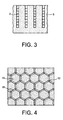
- a stack of micro-balls 2 in the interstices 6 between the columns 5 such as that represented in FIG. 2. It can be seen in this figure that the balls 2 are located in the parts of the interstices 6 delimited by the edges of three adjacent columns.
- FIG. 3 The sectional view of FIG. 2 along the axis III / III (FIG. 3) makes it possible to clearly visualize the stack of micro-balls 2 between the columns 5.
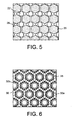
- the columns 15 are also arranged in a hexagonal mesh but the spacing between them has been deliberately chosen smaller: only balls 12 of smaller diameters than the balls of FIG. 2 or 3 can be inserted into the interstices 16.
- the blocking elements 35 are distributed so as to constitute wells intended to receive the large-diameter balls 32a and the small-diameter balls 32b will be housed in the spaces 36 between the wells.
- the wells may also be constituted by hollow columns whose envelope replaces the blocking elements 35.
- the first step that is to say the micromachining step of the micro-system, can be obtained in several distinct ways: either by dry or wet etching of a material, or by molding an impression, or by photolithography.
- micromachining method it is chosen to make explicit the manufacture of a silicon micro-reactor by dry etching, with reference to FIGS. 7A to 7F attached.
- materials are usable: for example, glass, silica, resins, polymers or even metals. The material will be chosen according to the application.
- the resin is spread at a speed of 4000 rpm for 30 seconds and for an acceleration of 1500 rpm.
- the resin-coated substrate was then dried for 60 seconds at 115 ° C.
- a lithography is then carried out using a UV irradiating beam 42 which passes through a mask 43 provided with n patterns defining the geometry of the reservoir of the micro-system (see FIG. 7B).
- the areas unprotected by the resin are etched with a deep engraving device of the DRIE ICP type.
- the blocking elements 45 are thus obtained.
- SF 6 and the following parameters are used: 129 cm 3 normal / minute (129 sccm), 5133 Pa (38.5 mT) and 600 W.
- passivation C 4 F 8 and the following parameters are used: 85 cm 3 normal / minutes (85 sccm), 3.733 Pa (28 mT) and 600 W. It is specified that the ratio of the etching times compared to the times of Passivation is adjusted to obtain straight flanks.
- the next step is to strip the resin mask using nitric acid HNO 3 fuming under ultrasound for 5 minutes.
- flanks of the etching are then cleaned by oxidation in an oxygen tube furnace for 50 minutes at 1000 ° C. and then by chemical deoxidation using HF for a few seconds (FIG. 7E).
- Thick oxidation of the units was then carried out at a thickness of 3 ⁇ m in a steam tube oven at 1000 ° C. for 18 hours and 50 minutes (FIG. 7F).
- the input and output means may be in the hood, or indifferently in the hood and in the tank.
- micro-balls The easiest access way for filling with micro-balls is over the blocking elements. This can easily be done in placing the micro-system to fill at the bottom of a container. A certain quantity of micro-beads of a determined diameter is suspended in a liquid whose viscosity and density are known. The homogeneity of the solution can be increased if ultrasound is used to avoid any micro-bead aggregate or if surfactant is added to the solution. This suspension is then poured into the container containing the device to be filled. The micro-balls in suspension sediment and fill the free spaces or interstices between the blocking elements.
- the sedimentation time of a polystyrene ball of 5 micrometers in diameter and for a height of 1 cm is of the order of 4 hours.
- the cover 7 is hermetically fixed on the reservoir 3 (see FIG. 1).
- the reservoir of the micro-reactor can be covered by a PDMS (polydimethylsiloxane) plate, with or without inlet and / or outlet means, after treatment of said cap and the reservoir by an oxygen plasma, such as as described in the literature.
- PDMS polydimethylsiloxane
- the PDMS plate is simply pressed on the tank, this is sufficient to obtain a good seal while preserving the possibility of reopening of the micro-reactor later after use by a simple withdrawal of the PDMS plate.
- PDMS is cited as an example but other polymeric materials are possible.
- the reservoir of the micro-reactor may also be, for example, covered by molecular sealing of a silica plate or a glass plate, with or without inlet and / or outlet means, after cleaning and chemical preparation.
- a silica plate or a glass plate with or without inlet and / or outlet means, after cleaning and chemical preparation.
- two hydroxylated substrates SiO 2 substrate on silicon / glass cover or silica.
- SiOH silanol sites
- the reservoir of the micro-reactor may, for example, be covered by anodic sealing of a glass plate, comprising or not input and / or output means.
- the reservoir of the micro-reactor can be, for example, flipped over by gluing a polymer plate chosen by the user, comprising or not input and / or output means, using, for example, a process Glue deposit by screen printing.
- This type of bonding consists of three main stages: screen printing, which consists in applying glue only to certain areas of the substrate, bonding which consists in bringing the locally coated substrate of glue into contact with the cover and, finally, the heating which induces the polymerization of the glue.
- the polymerization can be carried out photochemically if the glue is polymerizable under UV.
- the reservoir of the micro-reactor can be, for example, covered by silicon / silicon direct sealing (SDB: Silicon Direct Bonding, in English) to a silicon wafer, comprising or not input and / or output means .
- SDB Silicon Direct Bonding, in English
- microbeads it is also possible to produce a multi-functional micro-reactor in volume by depositing, in the reservoir of the micro-system, microbeads having different functions. Indeed, on the same device, one can integrate micro-beads of different natures according to several methods.
- the first method requires the use of functionalized beads of the same diameter but having different functions and involves a masking of the area to be filled by sedimentation.
- the second way of obtaining micro-beads having different functions in the same micro-system can be done by arranging the blocking elements in the reservoir with different spacings.
- the selectivity of the zones of the cavity having different functions is then related to the diameter of the different microspheres comprising these functions.
- the sedimentation filling must always start with the largest micro-spheres.
- FIG. 6 An example of the result obtained is visible in FIG. 6, where two diameters of balls 32a and 32b and blocking elements 35 distributed so as to form wells have been used.
- micro-reactor according to the invention can be used in several different applications in the field of chemical, electrochemical, biochemical or biological reactions.
- the micro-reactor according to the invention can thus be used in the field of biochemistry, in particular, for example, in an enzymatic digestion reaction.
- one can use micro-beads, porous or not, functionalized with trypsin, and then introduced into the micro-system according to the invention.
- a fluid stream will then be circulated in said micro-reactor so that at least one constituent of said fluid stream will react with the prefunctionalized beads may produce a biological or biochemical reaction, and is collected at the (the) outlet (s) 9 of the micro-reactor a fluid stream comprising the (the) product (s) of said reaction.
- micro-reactor according to the invention can also be used in analysis.
- the micro-system filled with beads according to the invention can be used for partition chromatography.
- micro-beads, porous or non-porous, supporting polar grafted phases (-CN, -NH2) are used which are introduced into the micro-system.
- micro-beads porous or non-porous, supporting apolar grafted phases that are introduced into the micro-system in order to carry out an ion exchange type chromatography.
- micro-system filled with beads according to the invention can also be used to perform exclusion chromatography.
- porous beads will be used whose pore diameters will be adapted to the desired degree of exclusion.
- micro-system filled with beads according to the invention can also be used to perform affinity chromatographies.
- Porous or non-porous microbeads bearing an effector having a biological affinity (enzyme-substrate, ligand-receptor, antigen-antibody) for a solute of a sample to be analyzed will then be used.
- substrates or the like may be used as effectors.
- reversible inhibitors, allosteric effectors or coenzymes may be used as effectors.
- haptens for example, haptens, antigens, or antibodies will be used.
- antigen-antibody affinity chromatography for example, hormones, peptides or peptide analogues will be used.
- micro-reactor according to the invention can also be used in chemical reactions.
- the micro-reactor makes it possible to create a system generating a perfect catalytic support by allowing the scheduling of porous micro-beads impregnated with catalyst.
- This geometrical ordering of the micro-balls makes it possible, on the one hand, to very substantially increase the surface-to-volume ratio and, on the other hand, to obtain a homogeneous distribution of the flow inside the reactor.
- porous beads used can be a mixture of beads bearing different types of catalysts (for example: Pd, Pt, Rh ).
- the inner surface of the micro-reactor may itself be covered with a catalytic layer, in particular by chemical surface treatment, by sputtering or by co-evaporation.
- a large number of catalytic reactions in the liquid phase can be transposed in a micro-reactor, such as, for example, the Suzuki coupling reaction:
Landscapes
- Chemical & Material Sciences (AREA)
- Engineering & Computer Science (AREA)
- Nanotechnology (AREA)
- Physics & Mathematics (AREA)
- Health & Medical Sciences (AREA)
- Life Sciences & Earth Sciences (AREA)
- Analytical Chemistry (AREA)
- Biochemistry (AREA)
- General Health & Medical Sciences (AREA)
- General Physics & Mathematics (AREA)
- Immunology (AREA)
- Pathology (AREA)
- Physical Or Chemical Processes And Apparatus (AREA)
- Immobilizing And Processing Of Enzymes And Microorganisms (AREA)
- Automatic Analysis And Handling Materials Therefor (AREA)
- Medicinal Preparation (AREA)
- Manufacturing Of Micro-Capsules (AREA)
Claims (25)
- Mikrosystem für die Aufnahme von Kugeln und für die Erzielung einer genauen Lokalisierung der genannten Kugeln an vorgegebenen Stellen in dem Mikrosystem, dadurch gekennzeichnet, dass es umfasst:- einen Behälter (Reservoir) (3), der eine Vertiefung (Hohlraum) (4) aufweist, in der (dem) blockierende Elemente (5, 15, 25, 35) angeordnet sind, wobei die genannten blockierenden Elemente die Blockierung der Kugeln (2, 12, 22, 32a, 32b) in den Zwischenräumen (6, 16, 26, 36) zwischen den blockierenden Elementen (5, 15, 25, 35) in geordneter Weise und in Form von Stapeln erlauben, wobei die Zwischenräume (6, 16, 26, 36) die genannten vorgegebenen Stellen darstellen,- eine Abdeckung (7), die an dem Behälter (Reservoir) (3) hermetisch fixiert ist, und- Einführungseinrichtungen (8) und Auslasseinrichtungen (9), welche die Zirkulation einer Flüssigkeit (eines Fluids) in dem Hohlraum (4) erlauben,dadurch gekennzeichnet, dass dia genannten blockierenden Elemente (5, 15, 25, 35) die Form einer Kolonne haben und dass jede vorgegebene Stelle einen einzigen Stapel von Kugeln umfasst, wobei die Kugeln in jedem Stapel aufeinanderliegend so angeordnet sind, dass jede Kugel im Kontakt mit höchstens zwei Kugeln steht und die Stapel so angeordnet sind, dass dia Kugeln eines Stapels nicht mit den Kugeln eines anderen Stapels in Kontakt stehen.
- Mikrosystem nach Anspruch 1, dadurch gekennzeichnet, dass die blockierenden Elemente (5, 15, 25, 35) mit dem Boden des Hohlraums oder mit der Abdeckung eine Einheit bilden (fest verbunden sind).
- Mikrosystem nach Anspruch 1 oder 2, dadurch gekennzeichnet, dass die Kugeln (2, 12, 22) alle den gleichen Durchmesser haben und die blockierenden Elemente (5, 15, 25) in Form eines Raster- bzw. Flächengitters regelmäßig angeordnet sind.
- Mikrosystem nach Anspruch 1 oder 2, dadurch gekennzeichnet, dass das Mikrosystem (1) vor der Aufnahme der Kugeln (32a, 32b) mit unterschiedlichen Durchmessern die blockierenden Elemente (35) so verteilt sind, dass eine Lokalisierung der Kugeln (32a, 32b) als Funktion ihrer Durchmesser erzielt wird.
- Mikrosystem nach Anspruch 4, dadurch gekennzeichnet, dass die blockierenden Elemente (35) so verteilt sind, dass sie einen Schacht für die Aufnahme von Kugeln (32a) mit einem ersten gegebenen Durchmesser und Zwischenräume zwischen den Schächten für die Aufnahme von Kugeln (32b) mit einem zweiten festgelegten Durchmesser bilden.
- Mikrosystem nach Anspruch 3, dadurch gekennzeichnet, dass das Raster- bzw. Flächengitter ein hexagonales Gitter ist.
- Mikrosystem nach Anspruch 3, dadurch gekennzeichnet, dass das Raster- bzw. Flächengitter ein quadratisches Gitter ist.
- Mikrosystem nach einem der vorhergehenden Ansprüche, dadurch gekennzeichnet, dass dia blockierenden Elemente (5, 15, 25, 35) einen Querschnitt mit einer Form haben, die ausgewählt ist aus der Gruppe der Scheiben, Ellipsen und Polygone.
- Mikrosystem nach Anspruch 8, dadurch gekennzeichnet, dass die blockierenden Elemente (5, 15, 25, 35) einen Querschnitt in Form eines Hexagons haben.
- Mikrosystem nach einem der vorhergehenden Ansprüche, dadurch gekennzeichnet, die blockierenden Elemente (5, 15, 25, 35) eine Höhe haben, welche die Aufeinanderstapelung von mindestens zwei Kugeln erlaubt.
- Mikroreaktor, der ein Mikrosystem nach einem der Ansprüche 1, 2, 3, 6 bis 10 und Kugeln (2, 12, 22) mit gleichem Durchmesser und gleicher Funktion umfasst, die zwischen die blockierenden Elemente (5, 15, 25) passen.
- Mikroreaktor, der ein Mikrosystem nach einem der Ansprüche 1, 2, 3, 6 bis 10 und Kugeln (2, 12, 22) mit gleichem Durchmesser, jedoch mit unterschiedlichen Funktionen umfasst, die zwischen die blockierenden Elemente (5, 15, 25) passen.
- Mikroreaktor, der ein Mikrosystem nach einem der Ansprüche 1, 2, 4, 5, 8 bis 10 und Kugeln (32a, 32b) mit gleicher Funktion, jedoch mit unterschiedlichen Durchmessern umfasst, die zwischen die blockierenden Elemente (5, 15, 25, 35) passen.
- Mikroreaktor, der ein Mikrosystem nach einem der Ansprüche 1, 2, 4, 5, 8 bis 10 und Kugeln (32a, 32b) mit unterschiedlichen Durchmessern und unterschiedlichen Funktionen umfasst, die zwischen die blockierenden Elemente (5, 15, 25, 35) passen.
- Verfahren zur Herstellung eines Mikrosystems nach einem der Ansprüche 1 bis 10, wobei das Verfahren die folgenden Stufen umfasst:- Bildung (Formung) des Behälters (Reservoirs), der den Hohlraum mit den darin befindlichen blockierenden Elementen (45) darstellt, durch Mikrobearbeitung eines Substrats (41),- Anbringen einer Abdeckung (7), die bestimmt ist für den hermetischen Verschluss des Hohlraums (4) des Behälters (3) und- Bildung (Formung) von Eintrittseinrichtungen (8) und Austrittseinrichtungen (9) für eine Flüssigkeit (ein Fluid) durch Mikrobearbeitung des Behälters (3) und/oder der Abdeckung (7).
- Verfahren nach Anspruch 15, bei dem die Mikrobearbeitung durchgeführt wird durch Anwendung eines Verfahrens zum trockenen oder nassen Gravieren (Ätzen) eines Materials.
- Verfahren nach Anspruch 15, bei dem die Mikrobearbeitung durchgeführt wird durch Anwendung eines Prägeform-Verfahrens.
- Verfahren nach Anspruch 15, bei dem die Mikrobearbeitung durchgeführt wird durch Anwendung eines photolithographischen Verfahrens.
- Verfahren zur Herstellung des Mikroreaktors nach Anspruch 11, das umfasst das Einfüllen von funktionalisierten Kugeln, die in einer Flüssigkeit suspendiert sind, durch Sedimentation.
- Verfahren zur Herstellung eines multifunktionellen Mikroreaktors durch Füllen des Mikrosystems nach Anspruch 3 mit funktionalisierten Kugeln mit dem gleichen Durchmesser, jedoch unterschiedlichen Funktionen, dadurch gekennzeichnet, dass das genannte Verfahren umfasst:- für die funktionalisierten Kugeln gemäß einer ersten Funktion die folgenden Stufen:a) das Anbringen einer Abdeckung auf dem Behälter (3) des Mikrosystems, die den Abschnitt zugänglich lässt, in dem man die Kugeln einer ersten Funktion anordnen will,b) das Füllen durch Sedimentation undc) die Entfernung der Abdeckung (7), und- für funktionalisierte Kugeln gemäß einer anderen Funktion die Wiederholung der Stufen (a) bis (c) mit Kugeln mit der genannten anderen Funktion so oft es noch verbleibende Funktionen gibt, und- das Verschließen des Behälters (3) mit der Abdeckung (7).
- Verfahren zur Herstellung eines multifunktionellen Mikroreaktors durch Füllen des Mikrosystems nach einem der Ansprüche 4 oder 5 mit Kugeln, deren Funktion mit dem Durchmesser der genannten Kugeln in Verbindung steht, dadurch gekennzeichnet, dass das genannte Verfahren mindestens zwei Füllungsstufen umfasst, wobei die Reihenfolge der Füllungsstufen der Reihenfolge der Abnahme des Durchmessers der Kugeln entspricht.
- Verfahren zur Durchführung einer biochemischen oder biologischen Reaktion, bei dem man einen Flüssigkeits- bzw. Fluidstrom in einem Mikroreaktor nach einem der Ansprüche 11 bis 13 zirkulieren lässt, sodass mindestens ein Bestandteil des genannten Flüssigkeits- bzw. Fluidstroms mit den vortunktionalisierten Kugeln (2, 12, 22, 32a, 32b) reagiert, die eine chemische, elektrochemische, biologische oder biochemische Reaktion eingehen können, und dass man an dem (den) Ausgang (Ausgängen) (9) des Mikroreaktors einen Flüssigkeits- bzw. Fluidstrom abtrennt, der das (die) Produkt(e) der genannten Reaktion umfasst.
- Verfahren nach Anspruch 22, bei dem die genannte Reaktion eine Reaktion vom Enzym-Substrat-Typ ist, wobei die genannten vorfunktionalisierten Kugeln (2, 12, 22, 32a, 32b), die eine biologische oder biochemische Reaktion eingehen können, Enzyme darstellen, der genannte Bestandteil des Flüssigkeits- bzw. Fluidstroms ein Enzymsubstrat ist und die Reaktionsprodukte die Produkte sind, die bei der Reaktion des genannten Enzyms mit dem genannten Substrat entstehen.
- Verfahren nach Anspruch 22, bei dem die genannte Reaktion eine enzymatische Digerierungsreaktion durch eine Protease ist, wobei die genannten vorfunktionalisierten Kugeln (2, 12, 22, 32a, 32b), die eine biologische oder biochemische Reaktion eingehen können, Proteasen sind und die genannten Bestandteile des Flüssigkeits- bzw. Fluidstroms Peptide oder Proteine sind und die Reaktionsprodukte Peptidsegmente sind.
- Verfahren nach Anspruch 24, bei dem das Enzym das Trypsin ist.
Applications Claiming Priority (3)
| Application Number | Priority Date | Filing Date | Title |
|---|---|---|---|
| FR0214177A FR2846957B1 (fr) | 2002-11-13 | 2002-11-13 | Micro-systeme a remplissage de micro-billes et procede d'obtention |
| FR0214177 | 2002-11-13 | ||
| PCT/FR2003/050117 WO2004046020A2 (fr) | 2002-11-13 | 2003-11-12 | Micro-systeme a remplissage de micro-billes et procede d'obtention |
Publications (2)
| Publication Number | Publication Date |
|---|---|
| EP1560785A2 EP1560785A2 (de) | 2005-08-10 |
| EP1560785B1 true EP1560785B1 (de) | 2007-04-04 |
Family
ID=32116580
Family Applications (1)
| Application Number | Title | Priority Date | Filing Date |
|---|---|---|---|
| EP03786053A Expired - Lifetime EP1560785B1 (de) | 2002-11-13 | 2003-11-12 | Mikrobehälter für mikrokugeln und verfahren zu seiner herstellung |
Country Status (6)
| Country | Link |
|---|---|
| US (1) | US20060068450A1 (de) |
| EP (1) | EP1560785B1 (de) |
| AT (1) | ATE358651T1 (de) |
| DE (1) | DE60313017T2 (de) |
| FR (1) | FR2846957B1 (de) |
| WO (1) | WO2004046020A2 (de) |
Families Citing this family (33)
| Publication number | Priority date | Publication date | Assignee | Title |
|---|---|---|---|---|
| US7329545B2 (en) * | 2002-09-24 | 2008-02-12 | Duke University | Methods for sampling a liquid flow |
| US6911132B2 (en) * | 2002-09-24 | 2005-06-28 | Duke University | Apparatus for manipulating droplets by electrowetting-based techniques |
| DK1859330T3 (da) | 2005-01-28 | 2012-10-15 | Univ Duke | Apparater og fremgangsmåder til håndtering af små dråber på et trykt kredsløbskort |
| FR2881339B1 (fr) * | 2005-02-02 | 2009-07-10 | Commissariat Energie Atomique | Dispositif de prelevement moleculaire par contact |
| US20090053470A1 (en) * | 2005-03-17 | 2009-02-26 | Gert Desmet | Method for Preparing Monolithic Separation and Reaction Media in a Separation or Reaction Channel |
| WO2006097302A1 (en) * | 2005-03-17 | 2006-09-21 | Vrije Universiteit Brussel | Method for manufacturing packed bed column and packed bed column obtained therewith |
| US9476856B2 (en) | 2006-04-13 | 2016-10-25 | Advanced Liquid Logic, Inc. | Droplet-based affinity assays |
| US20140193807A1 (en) | 2006-04-18 | 2014-07-10 | Advanced Liquid Logic, Inc. | Bead manipulation techniques |
| US8637317B2 (en) * | 2006-04-18 | 2014-01-28 | Advanced Liquid Logic, Inc. | Method of washing beads |
| US8613889B2 (en) * | 2006-04-13 | 2013-12-24 | Advanced Liquid Logic, Inc. | Droplet-based washing |
| US8492168B2 (en) | 2006-04-18 | 2013-07-23 | Advanced Liquid Logic Inc. | Droplet-based affinity assays |
| US7439014B2 (en) * | 2006-04-18 | 2008-10-21 | Advanced Liquid Logic, Inc. | Droplet-based surface modification and washing |
| US8389297B2 (en) * | 2006-04-18 | 2013-03-05 | Duke University | Droplet-based affinity assay device and system |
| US7901947B2 (en) | 2006-04-18 | 2011-03-08 | Advanced Liquid Logic, Inc. | Droplet-based particle sorting |
| US8980198B2 (en) * | 2006-04-18 | 2015-03-17 | Advanced Liquid Logic, Inc. | Filler fluids for droplet operations |
| US7816121B2 (en) | 2006-04-18 | 2010-10-19 | Advanced Liquid Logic, Inc. | Droplet actuation system and method |
| ATE542921T1 (de) * | 2006-04-18 | 2012-02-15 | Advanced Liquid Logic Inc | Pyrosequenzierung auf tröpfchenbasis |
| US7763471B2 (en) | 2006-04-18 | 2010-07-27 | Advanced Liquid Logic, Inc. | Method of electrowetting droplet operations for protein crystallization |
| US10078078B2 (en) | 2006-04-18 | 2018-09-18 | Advanced Liquid Logic, Inc. | Bead incubation and washing on a droplet actuator |
| US8809068B2 (en) | 2006-04-18 | 2014-08-19 | Advanced Liquid Logic, Inc. | Manipulation of beads in droplets and methods for manipulating droplets |
| US8658111B2 (en) | 2006-04-18 | 2014-02-25 | Advanced Liquid Logic, Inc. | Droplet actuators, modified fluids and methods |
| WO2007123908A2 (en) | 2006-04-18 | 2007-11-01 | Advanced Liquid Logic, Inc. | Droplet-based multiwell operations |
| US7815871B2 (en) | 2006-04-18 | 2010-10-19 | Advanced Liquid Logic, Inc. | Droplet microactuator system |
| US8716015B2 (en) | 2006-04-18 | 2014-05-06 | Advanced Liquid Logic, Inc. | Manipulation of cells on a droplet actuator |
| US8470606B2 (en) * | 2006-04-18 | 2013-06-25 | Duke University | Manipulation of beads in droplets and methods for splitting droplets |
| US8637324B2 (en) | 2006-04-18 | 2014-01-28 | Advanced Liquid Logic, Inc. | Bead incubation and washing on a droplet actuator |
| US7822510B2 (en) | 2006-05-09 | 2010-10-26 | Advanced Liquid Logic, Inc. | Systems, methods, and products for graphically illustrating and controlling a droplet actuator |
| US8041463B2 (en) * | 2006-05-09 | 2011-10-18 | Advanced Liquid Logic, Inc. | Modular droplet actuator drive |
| US7939021B2 (en) | 2007-05-09 | 2011-05-10 | Advanced Liquid Logic, Inc. | Droplet actuator analyzer with cartridge |
| FR2903590B1 (fr) * | 2006-07-13 | 2013-05-10 | Commissariat Energie Atomique | Dispositif de prelevement cellulaire par contact |
| US8268246B2 (en) | 2007-08-09 | 2012-09-18 | Advanced Liquid Logic Inc | PCB droplet actuator fabrication |
| US9513253B2 (en) | 2011-07-11 | 2016-12-06 | Advanced Liquid Logic, Inc. | Droplet actuators and techniques for droplet-based enzymatic assays |
| EP4273541A1 (de) | 2022-05-01 | 2023-11-08 | Vrije Universiteit Brussel | Mikrofluidische vorrichtung |
Family Cites Families (6)
| Publication number | Priority date | Publication date | Assignee | Title |
|---|---|---|---|---|
| US5942443A (en) * | 1996-06-28 | 1999-08-24 | Caliper Technologies Corporation | High throughput screening assay systems in microscale fluidic devices |
| EP1003759A2 (de) * | 1997-08-13 | 2000-05-31 | Cepheid | Mikrostrukturen für die manipulation von flüssigen proben |
| EP1179585B1 (de) * | 1997-12-24 | 2008-07-09 | Cepheid | Vorrichtung und Verfahren zur Lyse |
| CA2330569C (en) * | 1999-03-03 | 2006-11-07 | Symyx Technologies, Inc. | Chemical processing microsystems, diffusion-mixed microreactors and methods for preparing and using same |
| AU1325201A (en) * | 1999-07-16 | 2001-02-05 | Board Of Regents, The University Of Texas System | Detection system based on an analyte reactive particle |
| US20030091475A1 (en) * | 2001-09-26 | 2003-05-15 | Micralyne Inc. | Bead trapping device |
-
2002
- 2002-11-13 FR FR0214177A patent/FR2846957B1/fr not_active Expired - Fee Related
-
2003
- 2003-11-12 AT AT03786053T patent/ATE358651T1/de not_active IP Right Cessation
- 2003-11-12 US US10/533,947 patent/US20060068450A1/en not_active Abandoned
- 2003-11-12 EP EP03786053A patent/EP1560785B1/de not_active Expired - Lifetime
- 2003-11-12 DE DE60313017T patent/DE60313017T2/de not_active Expired - Lifetime
- 2003-11-12 WO PCT/FR2003/050117 patent/WO2004046020A2/fr not_active Ceased
Also Published As
| Publication number | Publication date |
|---|---|
| FR2846957A1 (fr) | 2004-05-14 |
| FR2846957B1 (fr) | 2005-09-30 |
| US20060068450A1 (en) | 2006-03-30 |
| WO2004046020A2 (fr) | 2004-06-03 |
| WO2004046020A3 (fr) | 2005-02-10 |
| DE60313017D1 (de) | 2007-05-16 |
| DE60313017T2 (de) | 2007-12-13 |
| EP1560785A2 (de) | 2005-08-10 |
| ATE358651T1 (de) | 2007-04-15 |
Similar Documents
| Publication | Publication Date | Title |
|---|---|---|
| EP1560785B1 (de) | Mikrobehälter für mikrokugeln und verfahren zu seiner herstellung | |
| EP2609993B1 (de) | Nano- und mikro-fluidische Vorrichtung für die Trennung und Konzentration von in einem Fluid vorhandenen Partikeln | |
| JP7170673B2 (ja) | 比色センサーおよびその製造方法 | |
| Ressine et al. | Macro-/nanoporous silicon as a support for high-performance protein microarrays | |
| US20150321191A1 (en) | Integration of ex situ fabricated porous polymer monoliths into fluidic chips | |
| FR2909293A1 (fr) | Micro-dispositif de traitement d'echantillons liquides | |
| JP2009142976A (ja) | ナノ構造体が埋設されている少なくとも1つのマイクロチャンネルを備えるマイクロ流体コンポーネントの製造方法 | |
| US8293193B2 (en) | Microfluidic component with a channel filled with nanotubes and method for its production | |
| FR2903679A1 (fr) | Fabrication de dispositifs microfluidiques polymeriques par impression photo-assistee. | |
| FR2820058A1 (fr) | Procede et systeme permettant de realiser en flux continu un protocole biologique, chimique ou biochimique | |
| US7994592B2 (en) | Method for integrating micro and nanoparticles into MEMS and apparatus including the same | |
| EP2038061B1 (de) | Mikrofluidvorrichtung mit variablem volumenmaterial | |
| WO2005042163A1 (fr) | Dispositif de travail comprenant une zone localisee de capture d'une goutte d'un liquide d'interet. | |
| EP1682273B1 (de) | Begrenzte bearbeitungszonen umfassende bearbeitungsvorrichtung, on-chip-labor und mikrosystem | |
| EP1515794A1 (de) | Hydraulische vorrichtung zum thermopneumatischen isolieren und optionalen schütteln des inhalts eines betriebshohlraums | |
| US9482651B2 (en) | Chip produced at wafer level for liquid chromatography and method for the production thereof | |
| EP1677914B1 (de) | Verfahren zur verteilung von tropfen einer betreffenden flüssigkeit auf einer fläche | |
| FR2839660A1 (fr) | Microreacteur,son procede de preparation,et procede pour realiser une reaction biochimique ou biologique | |
| FR2865806A1 (fr) | Laboratoire sur puce comprenant un reseau micro-fluidique et un nez d'electronebulisation coplanaires | |
| FR2803225A1 (fr) | Appareil d'analyse a compartiment reactionnel a geometrie variable, procede de mixage et de guidage de liquides | |
| FR2831081A1 (fr) | Dispositif d'injection parallelisee et synchronisee pour injections sequentielles de reactifs differents | |
| US7850861B1 (en) | Microfluidic device, and related methods | |
| FR2890975A1 (fr) | Plaque de tests a puits. | |
| EP3649188B1 (de) | Verfahren zur herstellung einer monolithischen stationären phase, zugehöriges verfahren zur herstellung einer chromatographiesäule und zugehöriges trennverfahren | |
| JP2007521496A (ja) | マイクロ流体デバイスの大規模表面改良 |
Legal Events
| Date | Code | Title | Description |
|---|---|---|---|
| PUAI | Public reference made under article 153(3) epc to a published international application that has entered the european phase |
Free format text: ORIGINAL CODE: 0009012 |
|
| 17P | Request for examination filed |
Effective date: 20050415 |
|
| AK | Designated contracting states |
Kind code of ref document: A2 Designated state(s): AT BE BG CH CY CZ DE DK EE ES FI FR GB GR HU IE IT LI LU MC NL PT RO SE SI SK TR |
|
| AX | Request for extension of the european patent |
Extension state: AL LT LV MK |
|
| DAX | Request for extension of the european patent (deleted) | ||
| RAP1 | Party data changed (applicant data changed or rights of an application transferred) |
Owner name: COMMISSARIAT A L'ENERGIE ATOMIQUE |
|
| GRAP | Despatch of communication of intention to grant a patent |
Free format text: ORIGINAL CODE: EPIDOSNIGR1 |
|
| RIN1 | Information on inventor provided before grant (corrected) |
Inventor name: COMBETTE, PHILIPPE Inventor name: MITTLER, FREDERIQUE Inventor name: CAILLAT, PATRICE |
|
| RIN1 | Information on inventor provided before grant (corrected) |
Inventor name: COMBETTE, PHILIPPE Inventor name: MITTLER, FREDERIQUE Inventor name: CAILLAT, PATRICE |
|
| GRAS | Grant fee paid |
Free format text: ORIGINAL CODE: EPIDOSNIGR3 |
|
| GRAA | (expected) grant |
Free format text: ORIGINAL CODE: 0009210 |
|
| AK | Designated contracting states |
Kind code of ref document: B1 Designated state(s): AT BE BG CH CY CZ DE DK EE ES FI FR GB GR HU IE IT LI LU MC NL PT RO SE SI SK TR |
|
| PG25 | Lapsed in a contracting state [announced via postgrant information from national office to epo] |
Ref country code: FI Free format text: LAPSE BECAUSE OF FAILURE TO SUBMIT A TRANSLATION OF THE DESCRIPTION OR TO PAY THE FEE WITHIN THE PRESCRIBED TIME-LIMIT Effective date: 20070404 Ref country code: SI Free format text: LAPSE BECAUSE OF FAILURE TO SUBMIT A TRANSLATION OF THE DESCRIPTION OR TO PAY THE FEE WITHIN THE PRESCRIBED TIME-LIMIT Effective date: 20070404 |
|
| REG | Reference to a national code |
Ref country code: GB Ref legal event code: FG4D Free format text: NOT ENGLISH |
|
| REG | Reference to a national code |
Ref country code: CH Ref legal event code: EP |
|
| REF | Corresponds to: |
Ref document number: 60313017 Country of ref document: DE Date of ref document: 20070516 Kind code of ref document: P |
|
| REG | Reference to a national code |
Ref country code: IE Ref legal event code: FG4D Free format text: LANGUAGE OF EP DOCUMENT: FRENCH |
|
| PG25 | Lapsed in a contracting state [announced via postgrant information from national office to epo] |
Ref country code: SE Free format text: LAPSE BECAUSE OF FAILURE TO SUBMIT A TRANSLATION OF THE DESCRIPTION OR TO PAY THE FEE WITHIN THE PRESCRIBED TIME-LIMIT Effective date: 20070704 |
|
| GBT | Gb: translation of ep patent filed (gb section 77(6)(a)/1977) |
Effective date: 20070620 |
|
| PG25 | Lapsed in a contracting state [announced via postgrant information from national office to epo] |
Ref country code: ES Free format text: LAPSE BECAUSE OF FAILURE TO SUBMIT A TRANSLATION OF THE DESCRIPTION OR TO PAY THE FEE WITHIN THE PRESCRIBED TIME-LIMIT Effective date: 20070715 |
|
| PG25 | Lapsed in a contracting state [announced via postgrant information from national office to epo] |
Ref country code: PT Free format text: LAPSE BECAUSE OF FAILURE TO SUBMIT A TRANSLATION OF THE DESCRIPTION OR TO PAY THE FEE WITHIN THE PRESCRIBED TIME-LIMIT Effective date: 20070904 |
|
| NLV1 | Nl: lapsed or annulled due to failure to fulfill the requirements of art. 29p and 29m of the patents act | ||
| PG25 | Lapsed in a contracting state [announced via postgrant information from national office to epo] |
Ref country code: AT Free format text: LAPSE BECAUSE OF FAILURE TO SUBMIT A TRANSLATION OF THE DESCRIPTION OR TO PAY THE FEE WITHIN THE PRESCRIBED TIME-LIMIT Effective date: 20070404 |
|
| REG | Reference to a national code |
Ref country code: IE Ref legal event code: FD4D |
|
| PG25 | Lapsed in a contracting state [announced via postgrant information from national office to epo] |
Ref country code: IE Free format text: LAPSE BECAUSE OF FAILURE TO SUBMIT A TRANSLATION OF THE DESCRIPTION OR TO PAY THE FEE WITHIN THE PRESCRIBED TIME-LIMIT Effective date: 20070404 Ref country code: CZ Free format text: LAPSE BECAUSE OF FAILURE TO SUBMIT A TRANSLATION OF THE DESCRIPTION OR TO PAY THE FEE WITHIN THE PRESCRIBED TIME-LIMIT Effective date: 20070404 Ref country code: DK Free format text: LAPSE BECAUSE OF FAILURE TO SUBMIT A TRANSLATION OF THE DESCRIPTION OR TO PAY THE FEE WITHIN THE PRESCRIBED TIME-LIMIT Effective date: 20070404 Ref country code: BG Free format text: LAPSE BECAUSE OF FAILURE TO SUBMIT A TRANSLATION OF THE DESCRIPTION OR TO PAY THE FEE WITHIN THE PRESCRIBED TIME-LIMIT Effective date: 20070704 Ref country code: NL Free format text: LAPSE BECAUSE OF FAILURE TO SUBMIT A TRANSLATION OF THE DESCRIPTION OR TO PAY THE FEE WITHIN THE PRESCRIBED TIME-LIMIT Effective date: 20070404 |
|
| PLBE | No opposition filed within time limit |
Free format text: ORIGINAL CODE: 0009261 |
|
| STAA | Information on the status of an ep patent application or granted ep patent |
Free format text: STATUS: NO OPPOSITION FILED WITHIN TIME LIMIT |
|
| PG25 | Lapsed in a contracting state [announced via postgrant information from national office to epo] |
Ref country code: SK Free format text: LAPSE BECAUSE OF FAILURE TO SUBMIT A TRANSLATION OF THE DESCRIPTION OR TO PAY THE FEE WITHIN THE PRESCRIBED TIME-LIMIT Effective date: 20070404 |
|
| 26N | No opposition filed |
Effective date: 20080107 |
|
| PG25 | Lapsed in a contracting state [announced via postgrant information from national office to epo] |
Ref country code: GR Free format text: LAPSE BECAUSE OF FAILURE TO SUBMIT A TRANSLATION OF THE DESCRIPTION OR TO PAY THE FEE WITHIN THE PRESCRIBED TIME-LIMIT Effective date: 20070705 |
|
| PG25 | Lapsed in a contracting state [announced via postgrant information from national office to epo] |
Ref country code: RO Free format text: LAPSE BECAUSE OF FAILURE TO SUBMIT A TRANSLATION OF THE DESCRIPTION OR TO PAY THE FEE WITHIN THE PRESCRIBED TIME-LIMIT Effective date: 20070404 |
|
| BERE | Be: lapsed |
Owner name: COMMISSARIAT A L'ENERGIE ATOMIQUE Effective date: 20071130 |
|
| PG25 | Lapsed in a contracting state [announced via postgrant information from national office to epo] |
Ref country code: MC Free format text: LAPSE BECAUSE OF NON-PAYMENT OF DUE FEES Effective date: 20071130 |
|
| PG25 | Lapsed in a contracting state [announced via postgrant information from national office to epo] |
Ref country code: BE Free format text: LAPSE BECAUSE OF NON-PAYMENT OF DUE FEES Effective date: 20071130 |
|
| PG25 | Lapsed in a contracting state [announced via postgrant information from national office to epo] |
Ref country code: EE Free format text: LAPSE BECAUSE OF FAILURE TO SUBMIT A TRANSLATION OF THE DESCRIPTION OR TO PAY THE FEE WITHIN THE PRESCRIBED TIME-LIMIT Effective date: 20070404 |
|
| PG25 | Lapsed in a contracting state [announced via postgrant information from national office to epo] |
Ref country code: CY Free format text: LAPSE BECAUSE OF FAILURE TO SUBMIT A TRANSLATION OF THE DESCRIPTION OR TO PAY THE FEE WITHIN THE PRESCRIBED TIME-LIMIT Effective date: 20070404 |
|
| PG25 | Lapsed in a contracting state [announced via postgrant information from national office to epo] |
Ref country code: LU Free format text: LAPSE BECAUSE OF NON-PAYMENT OF DUE FEES Effective date: 20071112 |
|
| PG25 | Lapsed in a contracting state [announced via postgrant information from national office to epo] |
Ref country code: HU Free format text: LAPSE BECAUSE OF FAILURE TO SUBMIT A TRANSLATION OF THE DESCRIPTION OR TO PAY THE FEE WITHIN THE PRESCRIBED TIME-LIMIT Effective date: 20071005 Ref country code: TR Free format text: LAPSE BECAUSE OF FAILURE TO SUBMIT A TRANSLATION OF THE DESCRIPTION OR TO PAY THE FEE WITHIN THE PRESCRIBED TIME-LIMIT Effective date: 20070404 |
|
| PGFP | Annual fee paid to national office [announced via postgrant information from national office to epo] |
Ref country code: CH Payment date: 20131127 Year of fee payment: 11 |
|
| PGFP | Annual fee paid to national office [announced via postgrant information from national office to epo] |
Ref country code: IT Payment date: 20131118 Year of fee payment: 11 |
|
| REG | Reference to a national code |
Ref country code: CH Ref legal event code: PL |
|
| PG25 | Lapsed in a contracting state [announced via postgrant information from national office to epo] |
Ref country code: LI Free format text: LAPSE BECAUSE OF NON-PAYMENT OF DUE FEES Effective date: 20141130 Ref country code: CH Free format text: LAPSE BECAUSE OF NON-PAYMENT OF DUE FEES Effective date: 20141130 |
|
| REG | Reference to a national code |
Ref country code: FR Ref legal event code: PLFP Year of fee payment: 13 |
|
| PG25 | Lapsed in a contracting state [announced via postgrant information from national office to epo] |
Ref country code: IT Free format text: LAPSE BECAUSE OF NON-PAYMENT OF DUE FEES Effective date: 20141112 |
|
| REG | Reference to a national code |
Ref country code: FR Ref legal event code: PLFP Year of fee payment: 14 |
|
| PGFP | Annual fee paid to national office [announced via postgrant information from national office to epo] |
Ref country code: DE Payment date: 20161115 Year of fee payment: 14 Ref country code: FR Payment date: 20161130 Year of fee payment: 14 Ref country code: GB Payment date: 20161121 Year of fee payment: 14 |
|
| REG | Reference to a national code |
Ref country code: DE Ref legal event code: R119 Ref document number: 60313017 Country of ref document: DE |
|
| GBPC | Gb: european patent ceased through non-payment of renewal fee |
Effective date: 20171112 |
|
| REG | Reference to a national code |
Ref country code: FR Ref legal event code: ST Effective date: 20180731 |
|
| PG25 | Lapsed in a contracting state [announced via postgrant information from national office to epo] |
Ref country code: DE Free format text: LAPSE BECAUSE OF NON-PAYMENT OF DUE FEES Effective date: 20180602 Ref country code: FR Free format text: LAPSE BECAUSE OF NON-PAYMENT OF DUE FEES Effective date: 20171130 |
|
| PG25 | Lapsed in a contracting state [announced via postgrant information from national office to epo] |
Ref country code: GB Free format text: LAPSE BECAUSE OF NON-PAYMENT OF DUE FEES Effective date: 20171112 |